Cache Concurrency considerations for a high performance Cassandra





- Slides: 49
Cache & Concurrency considerations for a high performance Cassandra Sri. Satish Ambati Performance, Riptano, Cassandra Azul Systems & Open. JDK Twitter: @srisatish. ambati@gmail. com
Trail ahead Elements of Cache Performance Metrics, Monitors JVM goes to Big. Data Land! Examples Lucandra, Twissandra Cassandra Performance with JVM Commentary Runtime Views Non Blocking Hash. Map Locking: concurrency Garbage Collection
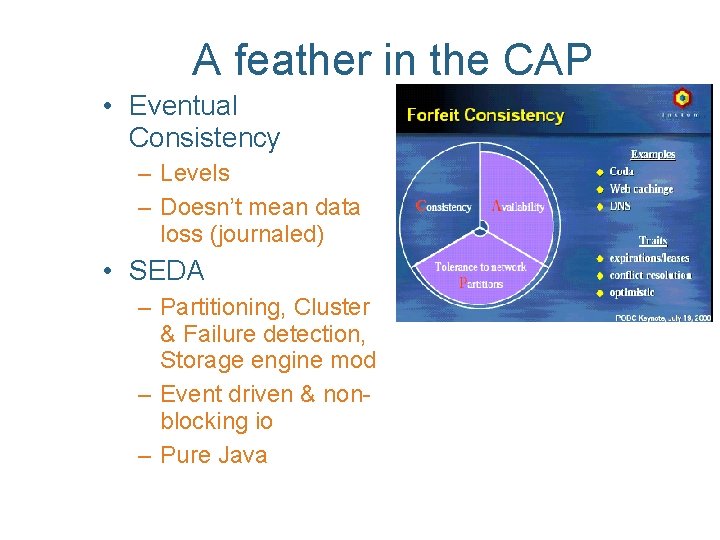
A feather in the CAP • Eventual Consistency – Levels – Doesn’t mean data loss (journaled) • SEDA – Partitioning, Cluster & Failure detection, Storage engine mod – Event driven & nonblocking io – Pure Java
Count what is countable, measure what is measurable, and what is not measurable, make measurable -Galileo
Elements of Cache Performance Metrics • Operations: – Ops/s: Puts/sec, Gets/sec, updates/sec – Latencies, percentiles – Indexing • # of nodes – scale, elasticity • Replication – Synchronous, Asynchronous (fast writes) • • Tuneable Consistency Durability/Persistence Size & Number of Objects, Size of Cache # of user clients
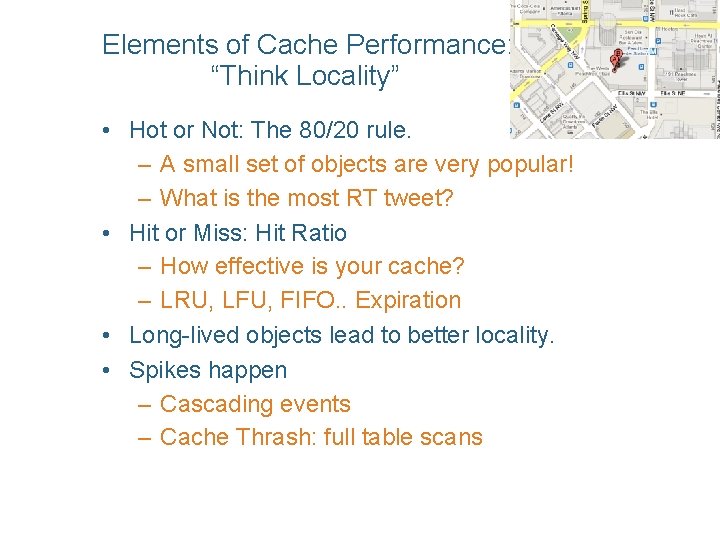
Elements of Cache Performance: “Think Locality” • Hot or Not: The 80/20 rule. – A small set of objects are very popular! – What is the most RT tweet? • Hit or Miss: Hit Ratio – How effective is your cache? – LRU, LFU, FIFO. . Expiration • Long-lived objects lead to better locality. • Spikes happen – Cascading events – Cache Thrash: full table scans
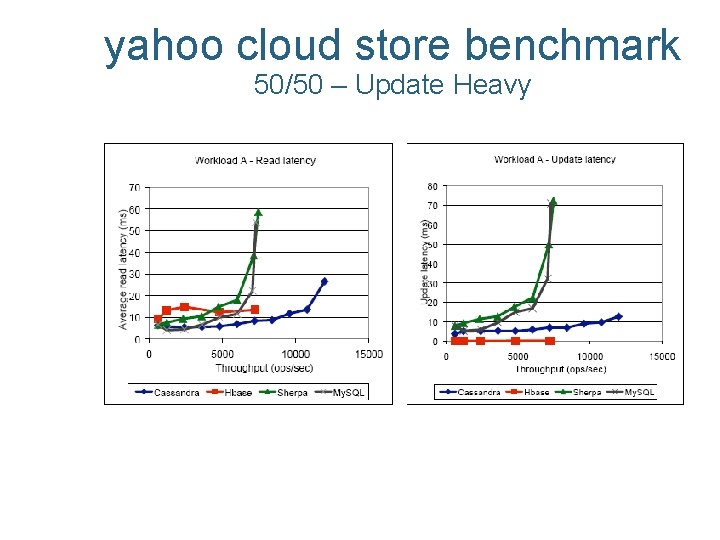
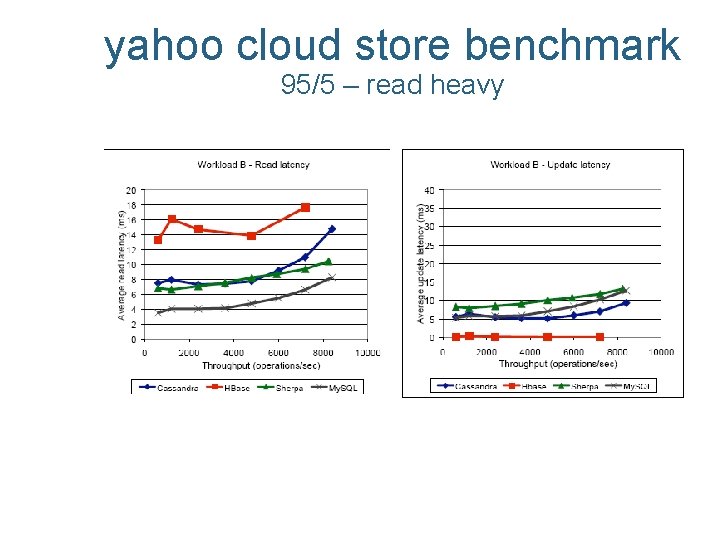
Real World Performance • Facebook Inbox – Writes: 0. 12 ms, Reads: 15 ms @ 50 GB data • Twitter performance – Twissandra (simulation) • Cassandra for Search & Portals – Lucandra, solandra (simulation) • ycbs/PNUTS benchmarks – 5 ms read/writes @ 5 k ops/s (50/50 Update heavy) – 8 ms reads/5 ms writes @ 5 k ops/s (95/5 read heavy) • Lab environment – ~5 k writes per sec per node, <5 ms latencies – ~10 k reads per sec per node, <5 ms latencies • Performance has improved in newer versions
yahoo cloud store benchmark 50/50 – Update Heavy
yahoo cloud store benchmark 95/5 – read heavy
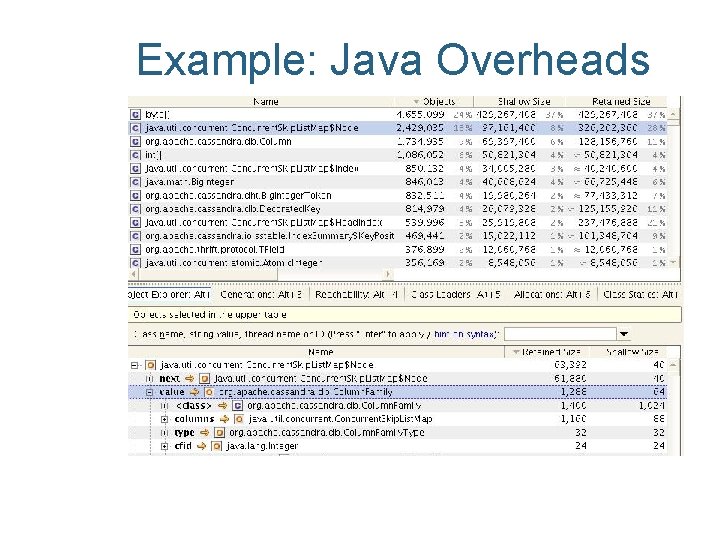
JVM in Big. Data Land! Limits for scale • Locks : synchronized – Can’t use all my multi-cores! – java. util. collections also hold locks – Use non-blocking collections! • (de)Serialization is expensive – Hampers object portability – Use avro, thrift! • Object overhead – average enterprise collection has 3 elements! – Use byte[ ], primitives where possible! • Garbage Collection – Can’t throw memory at the problem! – Mitigate, Monitor, Measure foot print
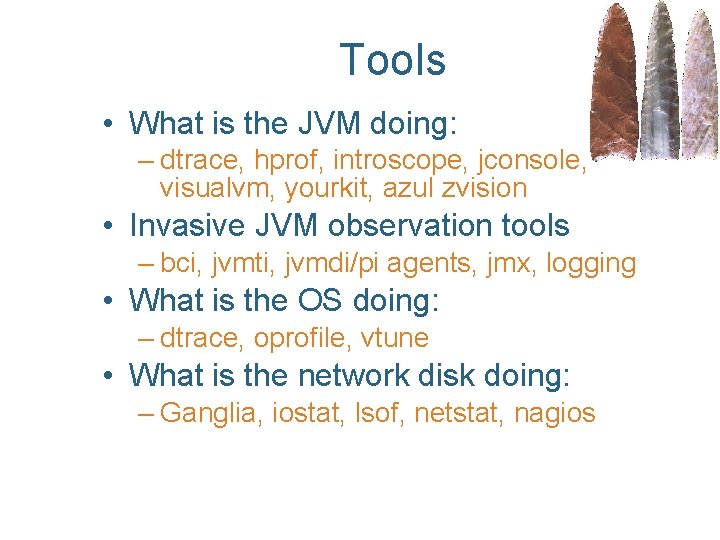
Tools • What is the JVM doing: – dtrace, hprof, introscope, jconsole, visualvm, yourkit, azul zvision • Invasive JVM observation tools – bci, jvmti, jvmdi/pi agents, jmx, logging • What is the OS doing: – dtrace, oprofile, vtune • What is the network disk doing: – Ganglia, iostat, lsof, netstat, nagios
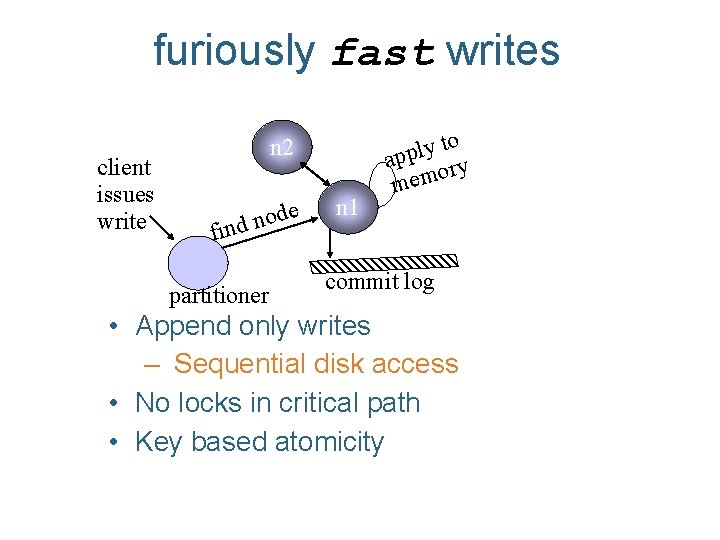
furiously fast writes client issues write n 2 e d o n nd fi partitioner n 1 to y l p ap y r o m me commit log • Append only writes – Sequential disk access • No locks in critical path • Key based atomicity
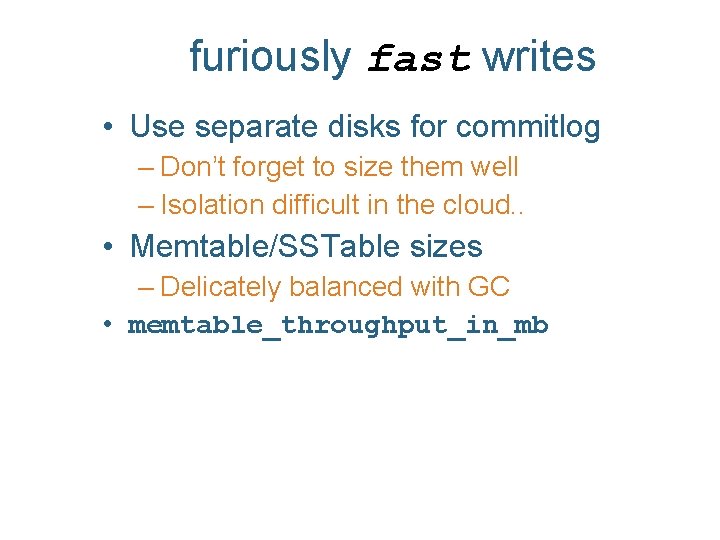
furiously fast writes • Use separate disks for commitlog – Don’t forget to size them well – Isolation difficult in the cloud. . • Memtable/SSTable sizes – Delicately balanced with GC • memtable_throughput_in_mb
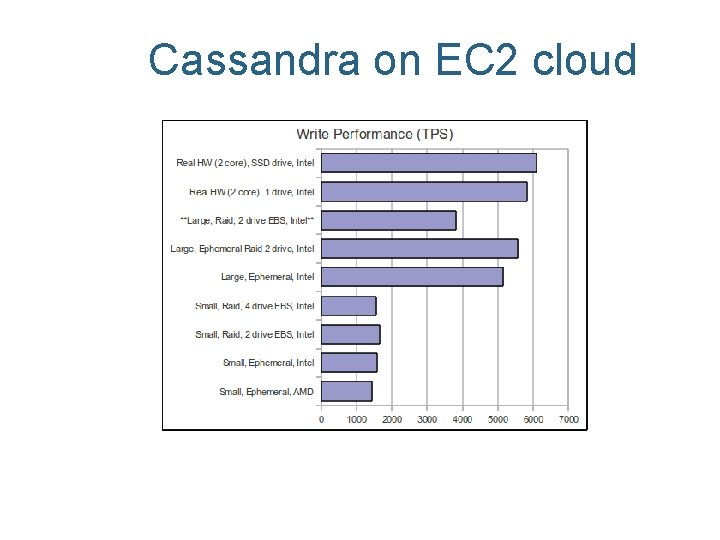
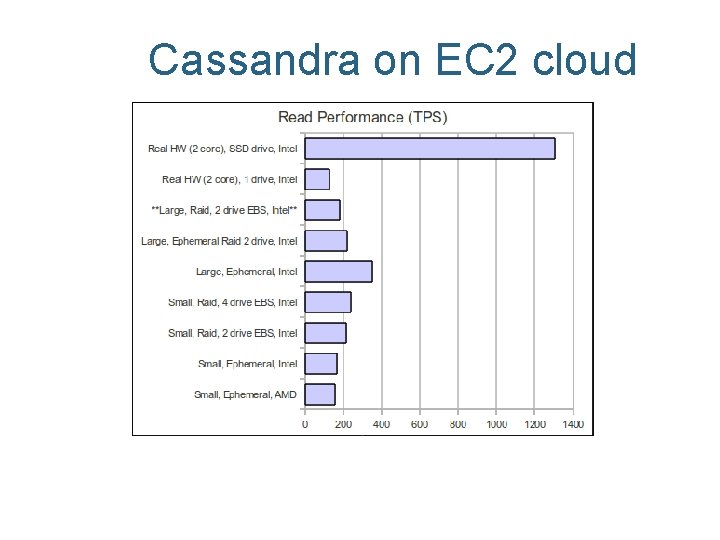
Cassandra on EC 2 cloud *Corey Hulen, EC 2
Cassandra on EC 2 cloud
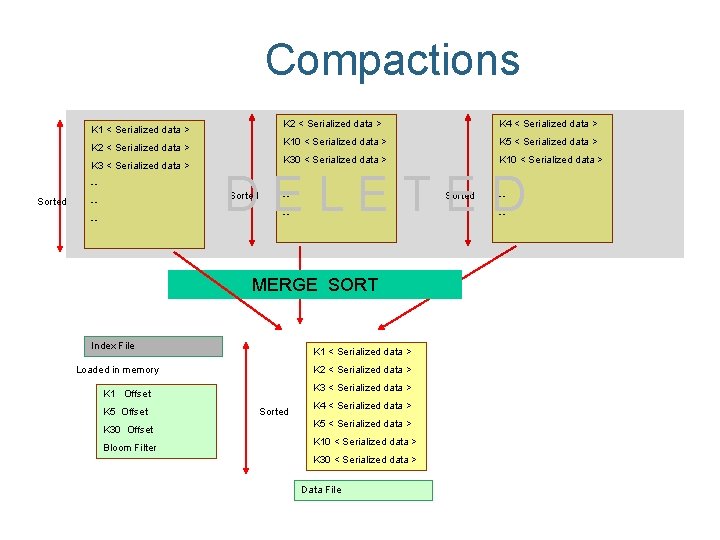
Compactions K 1 < Serialized data > K 2 < Serialized data > K 3 < Serialized data > K 4 < Serialized data > K 10 < Serialized data > K 5 < Serialized data > K 30 < Serialized data > K 10 < Serialized data > DELETED -- -Sorted K 2 < Serialized data > Sorted -- -- -- MERGE SORT Index File K 1 < Serialized data > Loaded in memory K 2 < Serialized data > K 3 < Serialized data > K 1 Offset K 5 Offset K 30 Offset Bloom Filter Sorted -- K 4 < Serialized data > K 5 < Serialized data > K 10 < Serialized data > K 30 < Serialized data > Data File
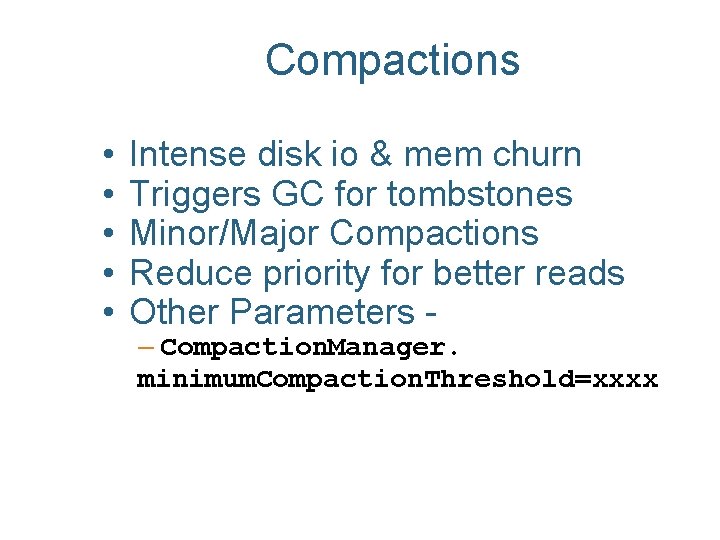
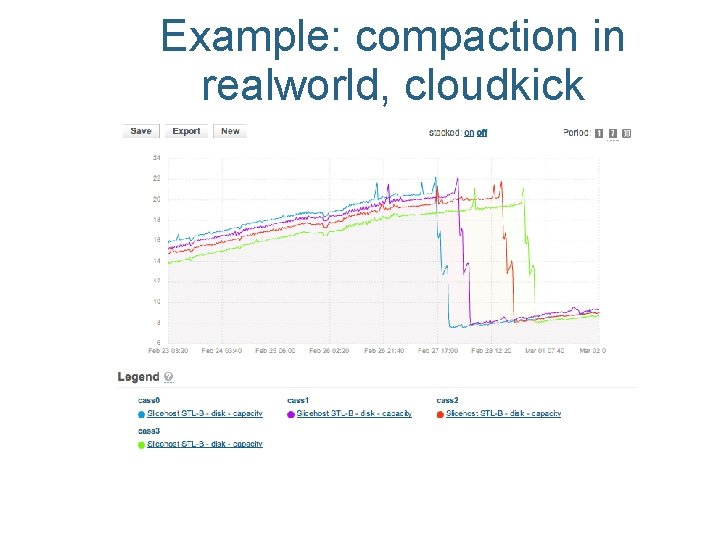
Compactions • • • Intense disk io & mem churn Triggers GC for tombstones Minor/Major Compactions Reduce priority for better reads Other Parameters - – Compaction. Manager. minimum. Compaction. Threshold=xxxx
Example: compaction in realworld, cloudkick
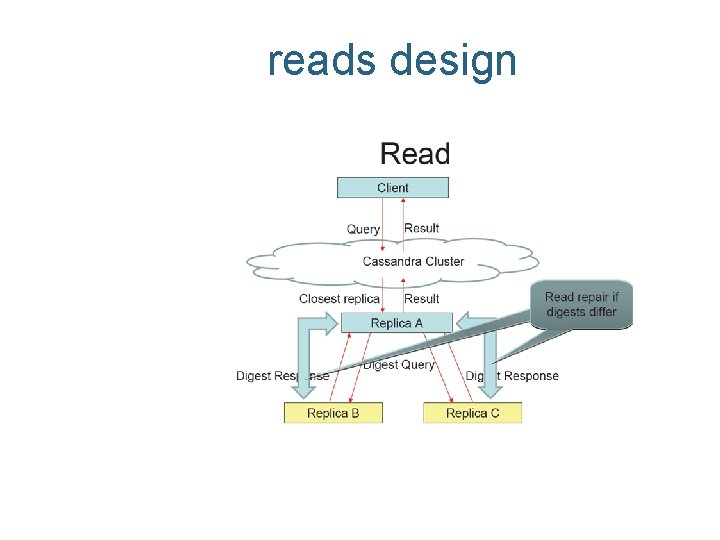
reads design
reads performance • Bloom. Filter used to identify the right file • Maintain column indices to look up columns – Which can span different SSTables • Less io than typical b-tree • Cold read: Two seeks – One for Key lookup, another row lookup • Key Cache – Optimized in latest cassandra • Row Cache – Improves read performance – GC sensitive for large rows. • Most (google) applications require single row transactions* *Sanjay G, Big. Table Design, Google.
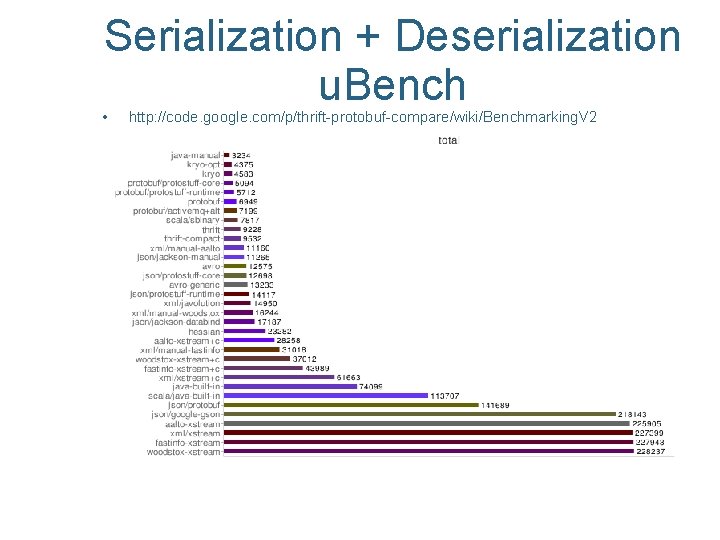
Client Performance Marshal Arts: Ser/Deserialization • Clients dominated by Thrift, Avro – Hector, Pelops • • • Thrift: upgrade to latest: 0. 5, 0. 4 No news: java. io. Serializable is S. L. . O. …W Use “transient” avro, thrift, proto-buf Common Patterns of Doom: – Death by a million gets
Serialization + Deserialization u. Bench • http: //code. google. com/p/thrift-protobuf-compare/wiki/Benchmarking. V 2
Adding Nodes • New nodes – Add themselves to busiest node – And then Split its Range • Busy Node starts transmit to new node • Bootstrap logic initiated from any node, cli, web • Each node capable of ~40 MB/s – Multiple replicas to parallelize bootstrap • UDP for control messages • TCP for request routing
inter-node comm • Gossip Protocol – It’s exponential – (epidemic algorithm) • Failure Detector – Accrual rate phi • Anti-Entropy – Bringing replicas to uptodate
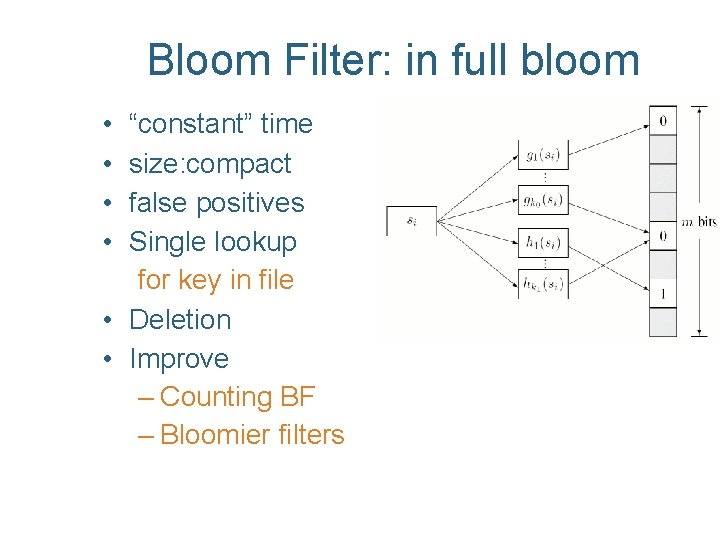
Bloom Filter: in full bloom • • “constant” time size: compact false positives Single lookup for key in file • Deletion • Improve – Counting BF – Bloomier filters
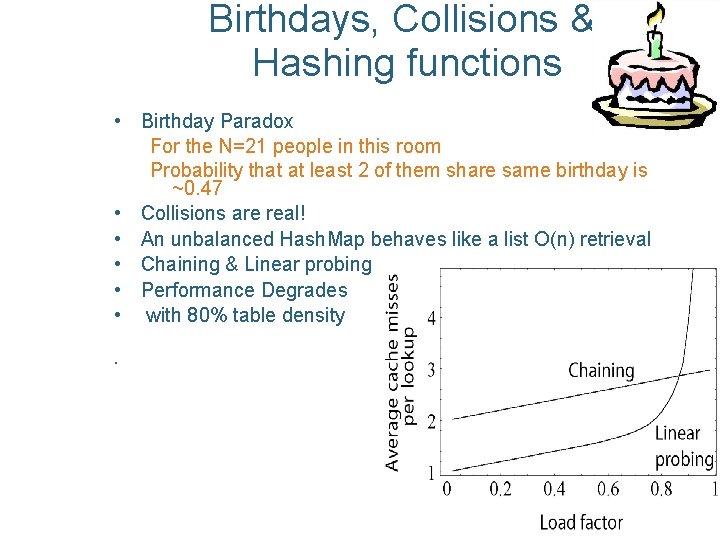
Birthdays, Collisions & Hashing functions • Birthday Paradox For the N=21 people in this room Probability that at least 2 of them share same birthday is ~0. 47 • Collisions are real! • An unbalanced Hash. Map behaves like a list O(n) retrieval • Chaining & Linear probing • Performance Degrades • with 80% table density •
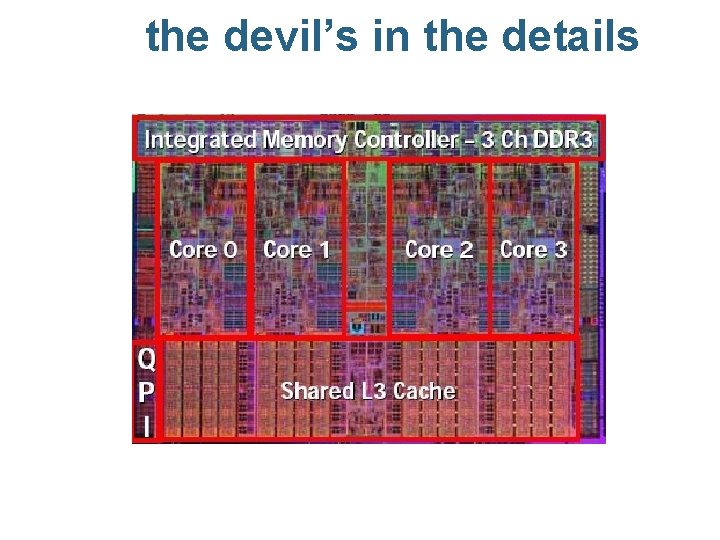
the devil’s in the details
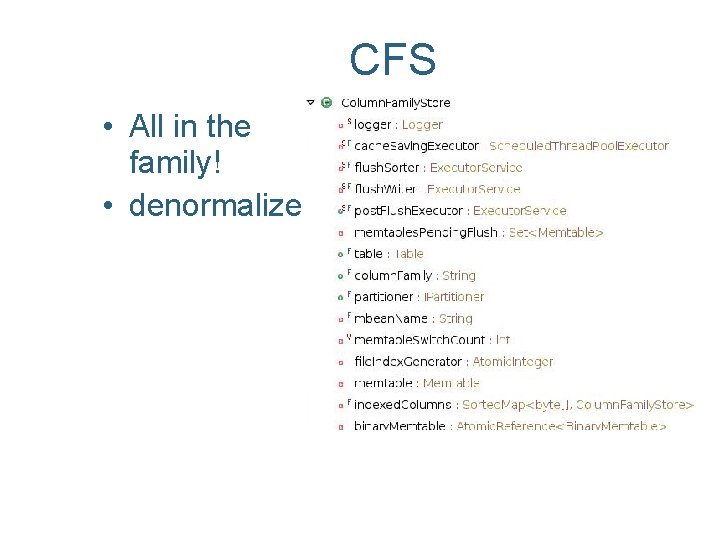
CFS • All in the family! • denormalize
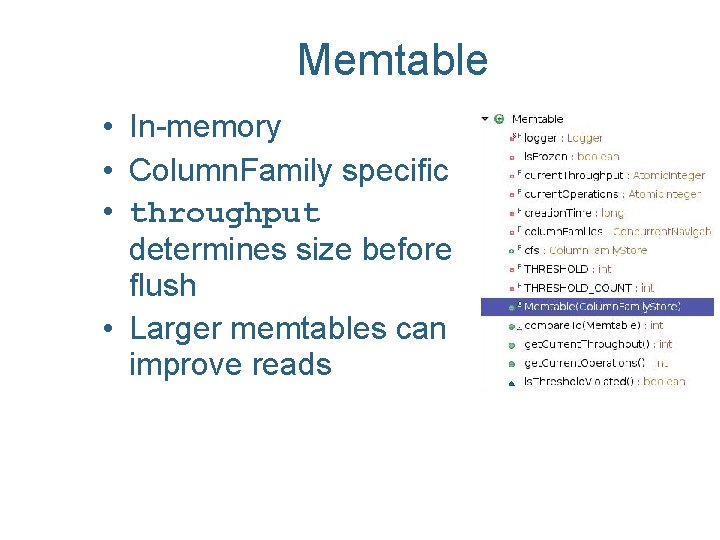
Memtable • In-memory • Column. Family specific • throughput determines size before flush • Larger memtables can improve reads
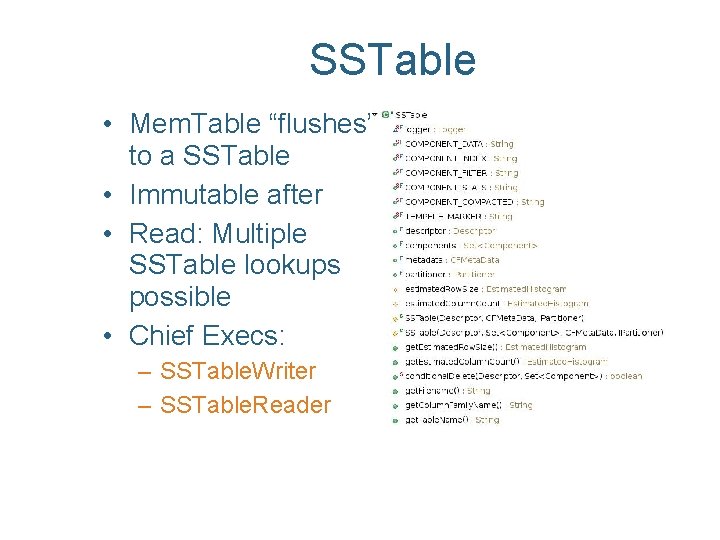
SSTable • Mem. Table “flushes” to a SSTable • Immutable after • Read: Multiple SSTable lookups possible • Chief Execs: – SSTable. Writer – SSTable. Reader
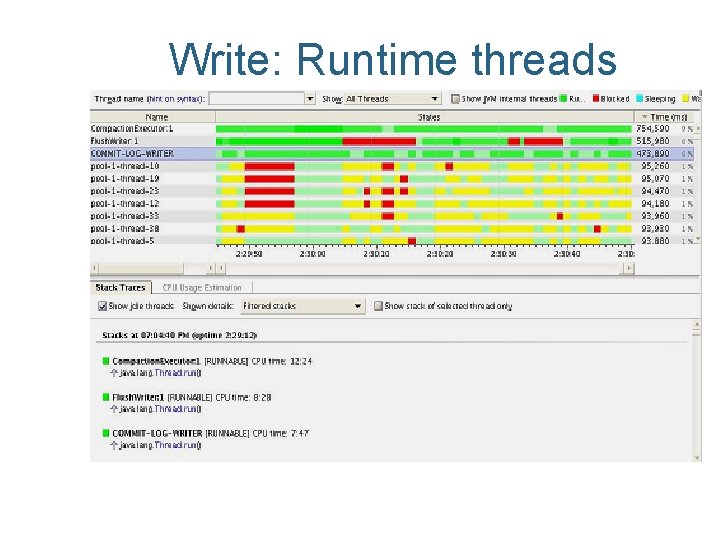
Write: Runtime threads
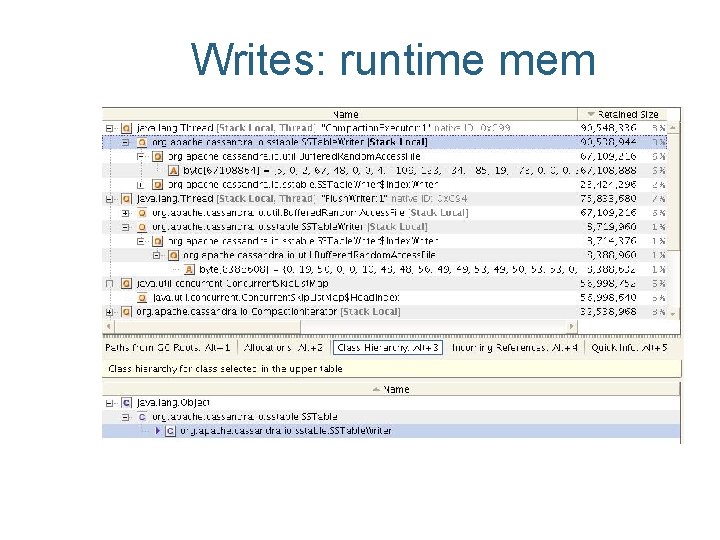
Writes: runtime mem
Example: Java Overheads
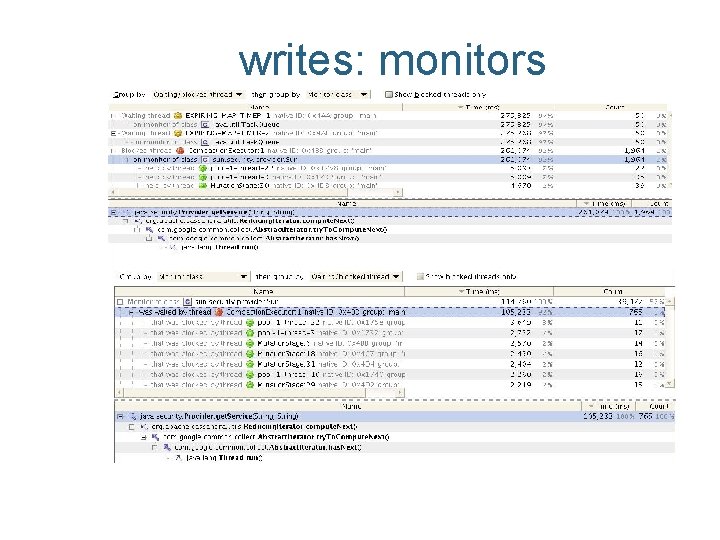
writes: monitors
UUID • java. util. UUID is slow – static use leads to contention Secure. Random • Uses /dev/urandom for seed initialization -Djava. security. egd=file: /dev/urandom • PRNG without file is atleast 20%-40% better. • Use Time. UUIDs where possible – much faster • JUG – java. uuid. generator • • • http: //github. com/cowtowncoder/java-uuid-generator http: //jug. safehaus. org/ http: //johannburkard. de/blog/programming/java/Java-UUID-generators-compared. html
synchronized • • Coarse grained locks io under lock Stop signal on a highway java. util. concurrent does not mean no locks • Non Blocking, Lock free, Wait free collections
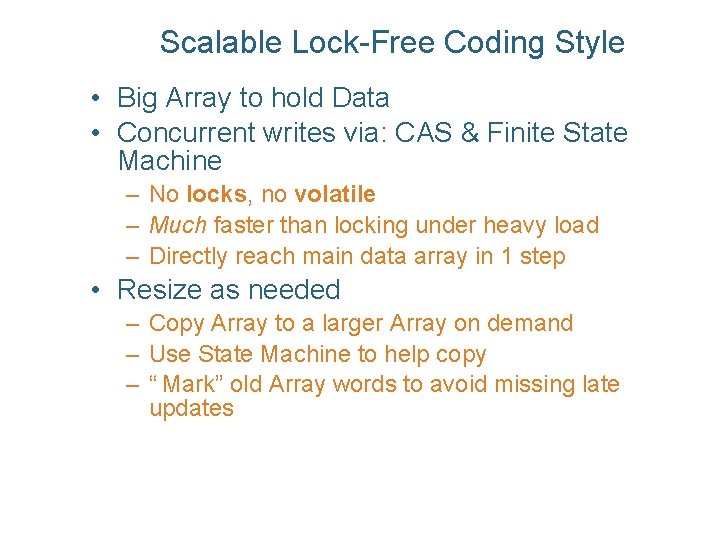
Scalable Lock-Free Coding Style • Big Array to hold Data • Concurrent writes via: CAS & Finite State Machine – No locks, no volatile – Much faster than locking under heavy load – Directly reach main data array in 1 step • Resize as needed – Copy Array to a larger Array on demand – Use State Machine to help copy – “ Mark” old Array words to avoid missing late updates
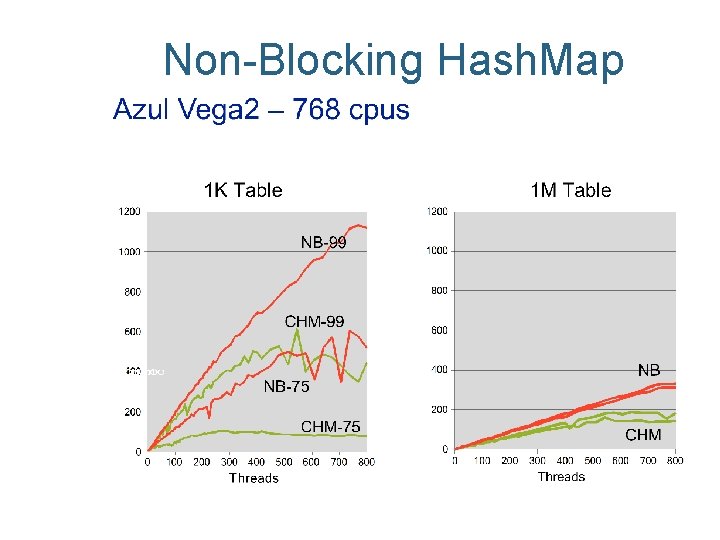
Non-Blocking Hash. Map
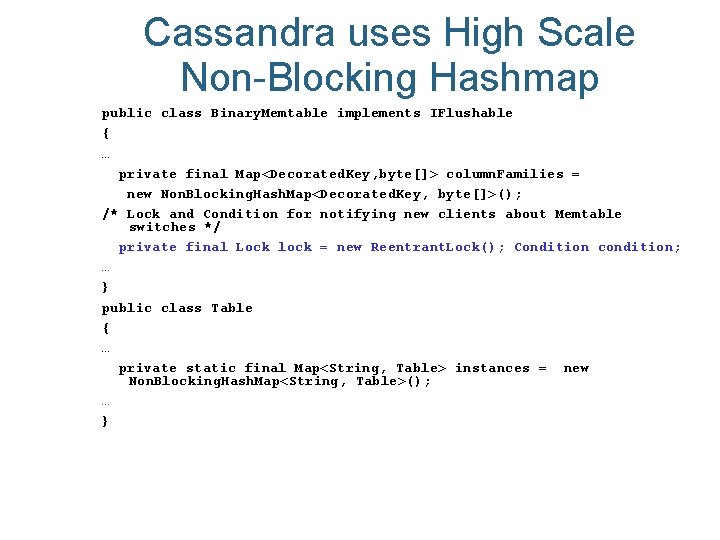
Cassandra uses High Scale Non-Blocking Hashmap public class Binary. Memtable implements IFlushable { … private final Map<Decorated. Key, byte[]> column. Families = new Non. Blocking. Hash. Map<Decorated. Key, byte[]>(); /* Lock and Condition for notifying new clients about Memtable switches */ private final Lock lock = new Reentrant. Lock(); Condition condition; … } public class Table { … private static final Map<String, Table> instances = new Non. Blocking. Hash. Map<String, Table>(); … }
GC-sensitive elements within Cassandra • Compaction triggers System. gc() – Tombstones from files • • “GCInspector” Memtable Threshold, sizes SSTable sizes Low overhead collection choices
Garbage Collection • Pause Times if stop_the_word_Full. GC > ttl_of_node => failed requests; failure accrual & node repair. • Allocation Rate – New object creation, insertion rate • Live Objects (residency) – if residency in heap > 50% – GC overheads dominate. • Overhead – space, cpu cycles spent GC • 64 -bit not addressing pause times – Bigger is not better!
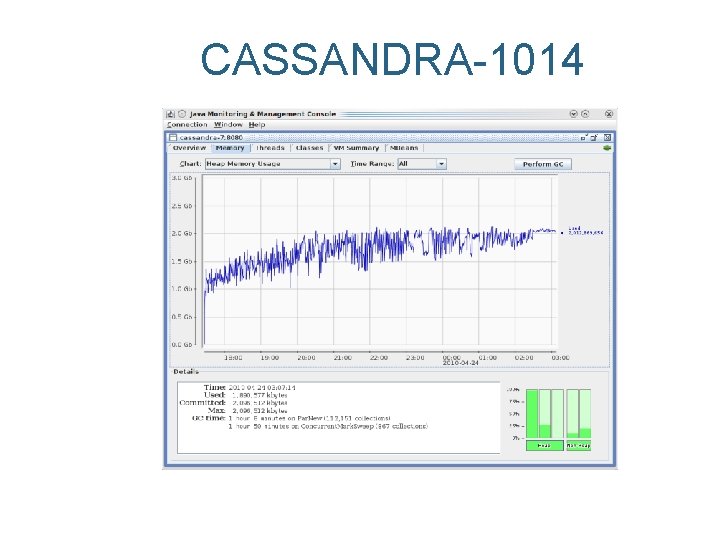
Memory Fragmentation • Fragmentation – Performance degrades over time – Inducing “Full GC” makes problem go away – Free memory that cannot be used • Reduce occurrence – Use a compacting collector – Promote less often – Use uniform sized objects • Solution – unsolved – Use latest CMS with CR: 6631166 – Azul’s Zing JVM & Pauseless GC
CASSANDRA-1014
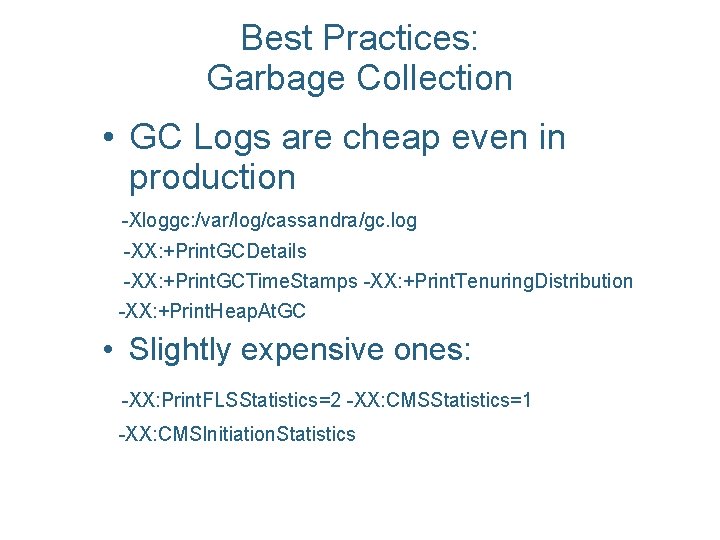
Best Practices: Garbage Collection • GC Logs are cheap even in production -Xloggc: /var/log/cassandra/gc. log -XX: +Print. GCDetails -XX: +Print. GCTime. Stamps -XX: +Print. Tenuring. Distribution -XX: +Print. Heap. At. GC • Slightly expensive ones: -XX: Print. FLSStatistics=2 -XX: CMSStatistics=1 -XX: CMSInitiation. Statistics
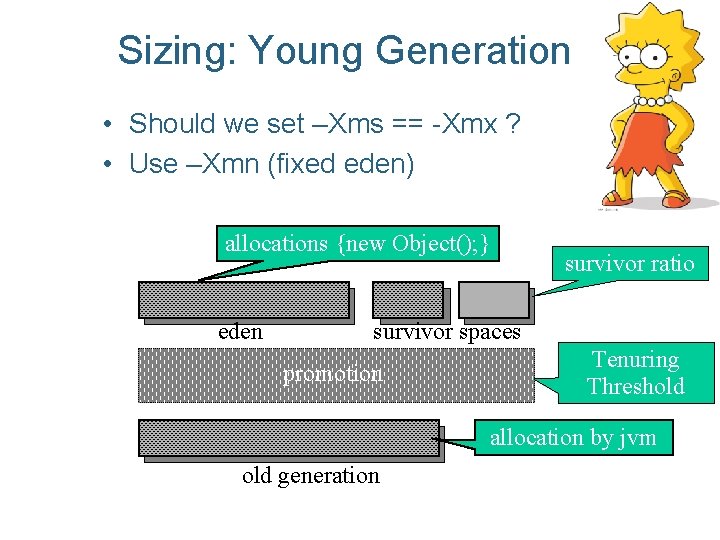
Sizing: Young Generation • Should we set –Xms == -Xmx ? • Use –Xmn (fixed eden) allocations {new Object(); } eden survivor ratio survivor spaces promotion Tenuring Threshold allocation by jvm old generation
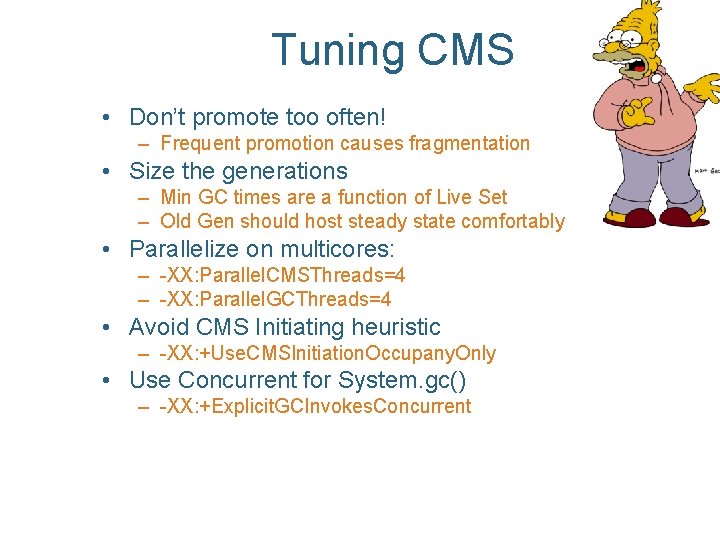
Tuning CMS • Don’t promote too often! – Frequent promotion causes fragmentation • Size the generations – Min GC times are a function of Live Set – Old Gen should host steady state comfortably • Parallelize on multicores: – -XX: Parallel. CMSThreads=4 – -XX: Parallel. GCThreads=4 • Avoid CMS Initiating heuristic – -XX: +Use. CMSInitiation. Occupany. Only • Use Concurrent for System. gc() – -XX: +Explicit. GCInvokes. Concurrent
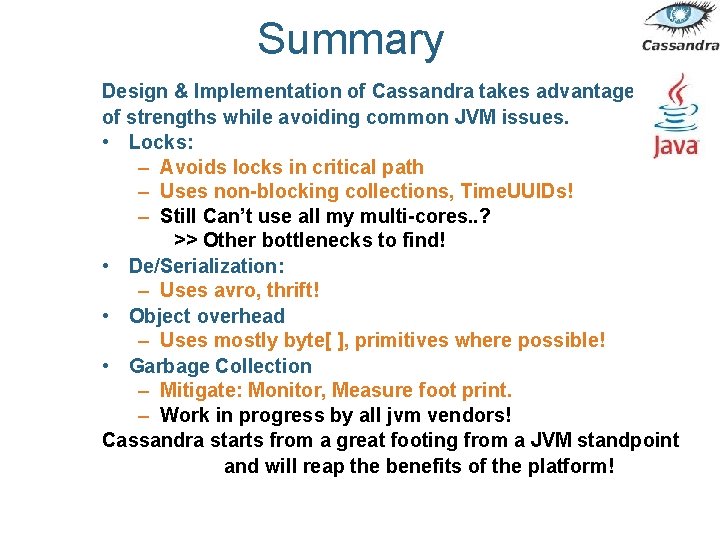
Summary Design & Implementation of Cassandra takes advantages of strengths while avoiding common JVM issues. • Locks: – Avoids locks in critical path – Uses non-blocking collections, Time. UUIDs! – Still Can’t use all my multi-cores. . ? >> Other bottlenecks to find! • De/Serialization: – Uses avro, thrift! • Object overhead – Uses mostly byte[ ], primitives where possible! • Garbage Collection – Mitigate: Monitor, Measure foot print. – Work in progress by all jvm vendors! Cassandra starts from a great footing from a JVM standpoint and will reap the benefits of the platform!
Q&A References • Verner Wogels, Eventually Consistent http: //www. allthingsdistributed. com/2008/12/eventually_consisten t. html • Bloom, Burton H. (1970), "Space/time trade-offs in hash coding with allowable errors" • Avinash Lakshman, http: //static. last. fm/johan/nosql 20090611/cassandra_nosql. pdf • Eric Brewer, CAP http: //www. cs. berkeley. edu/~brewer/cs 262 b 2004/PODC-keynote. pdf • Tony Printzeis, Charlie Hunt, Javaone Talk http: //www. scribd. com/doc/36090475/GC-Tuning-in-the-Java • http: //github. com/digitalreasoning/Py. Stratus/wiki/Documentation • http: //www. cs. cornell. edu/home/rvr/papers/flowgossip. pdf • Cassandra on Cloud, http: //www. coreyhulen. org/? p=326 • Cliff Click’s, Non-blocking Hash. Map http: //sourceforge. net/projects/high-scale-lib/ • Brian F. Cooper. , Yahoo Cloud Storage Benchmark, http: //www. brianfrankcooper. net/pubs/ycsb-v 4. pdf