
Why NOSQL Three interrelated megatrends Big Data Big
Why NO-SQL ? Ø Three interrelated megatrends Ø Big Data Ø Big Users Ø Cloud Computing are driving the adoption of No. SQL technology.
Why NO-SQL ? • Google, Amazon, Facebook, and Linked. In were among the first companies to discover the serious limitations of relational database technology for supporting these new application requirements. • Commercial alternatives didn’t exist, so they invented new data management approaches themselves. Their pioneering work generated tremendous interest because a growing number of companies faced similar problems. • Open source No. SQL database projects formed to leverage the work of the pioneers, and commercial companies associated with these projects soon followed.
Why NO-SQL ? • 1, 000 daily users of an application was a lot and 10, 000 was an extreme case. • Today, most new applications are hosted in the cloud and available over the Internet, where they must support global users 24 hours a day, 365 days a year. • More than 2 billion people are connected to the Internet worldwide – and the amount time they spend online each day is steadily growing – creating an explosion in the number of concurrent users. • Today, it’s not uncommon for apps to have millions of different users a day.
Introduction • New Generation Databases mostly addressing some of the points – – – being non-relational distributed Opensource and horizontal scalable. Multi-dimensional rather than 2 -D (relational) Ø The movement began early 2009 and is growing rapidly. § characteristics : § schema-free § Decentralized Storage System § easy replication support §simple API, etc.
Introduction • Application needs have been changing dramatically, due in large part to three trends: growing numbers of users that applications must support growth in the volume and variety of data that developers must work with; and the rise of cloud computing. • No. SQL technology is rising rapidly among Internet companies and the enterprise because it offers data management capabilities that meet the needs of modern application: • Greater ability to scale dynamically to support more users and data • Improved performance to satisfy expectations of users wanting highly responsive applications and to allow more complex processing of data. • No. SQL is increasingly considered aviable alternative to relational databases, and should be considered particularly for interactive web and mobile applications.

No-SQL (Examples) • • Cassandra Mongo. DB Ealsticsearch Hbase Couch. DB Stupid. DB Etc.

No-SQL
Cassandra • Cassandra is a distributed storage system for managing very large amounts of data spread out across many commodity servers. • while providing highly available service with no single point of failure. • Cassandra aims to run on top of an infrastructure of hundreds of nodes At this scale, small and large components fail continuously. • The way Cassandra manages the persistent state in the face of these failures drives the reliability and scalability of the software systems relying on this service. • Cassandra system was designed to run on cheap commodity hardware and handle high write throughput while not sacrificing read efficiency.
Cassandra • Facebook runs the largest social networking platform that serves hundreds of millions users at peak times using tens of thousands of servers located in many data centers around the world. • There are strict operational requirements on Facebook's platform in terms of performance, reliability and efficiency, and to support continuous growth the platform needs to be highly scalable. • Dealing with failures in an infrastructure comprised of thousands of components is standard mode of operation • There always a small but significant number of server and network components that are failing at any given time. As such, the software systems need to be constructed in a manner that treats failures as the norm rather than the exception.

Cassandra • Cassandra is now deployed as the backend storage system for multiple services within Facebook. • To meet the reliability and scalability needs described above Facebook has developed Cassandra. • Cassandra was designed to full the storage needs of the Search problem.

Data Model (Cassandra) • Cassandra is a distributed key-value store. • A table in Cassandra is a distributed multi dimensional map indexed by a key. The value is an object which is highly structured. • The row key in a table is a string with no size restrictions, although typically 16 to 36 bytes long. • Every operation under a single row key is atomic per replica no matter how many columns are being read or written into. • • Columns are grouped together into sets called column families. Cassandra exposes two kinds of columns families, Simple and Super column families. • Super column families can be visualized as a column family within a column family.
Architecture (Cassandra) • Cassandra is designed to handle big data workloads across multiple nodes with no single point of failure. • Its architecture is based in the understanding that system and hardware failure can and do occur. • Cassandra addresses the problem of failures by employing a peer-to-peer distributed system where all nodes are the same and data is distributed among all nodes in the cluster. • Each node exchanges information across the cluster every second. • A commit log on each node captures write activity to ensure data durability.

Architecture (Cassandra) • Data is also written to an in-memory structure, called a memtable, and then written to a data file called an SStable on disk once the memory structure is full. • All writes are automatically partitioned and replicated throughout the cluster. • Client read or write requests can go to any node in the cluster. • When a client connects to a node with a request, that node serves as the coordinator for that particular client operation. • The coordinator acts as a proxy between the client application and the nodes that own the data being requested. • The coordinator determines which nodes in the ring should get the request based on how the cluster is configured.
Cassandra (Properties) • • Written in: Java Main point: Best of Big. Table and Dynamo License: Apache Querying by column Big. Table-like features: columns, column families Writes are much faster than reads Map/reduce possible with Apache Hadoop.
Mango. DB • What is? • Mongo. DB is an open source, document-oriented database designed with both scalability and developer agility in mind. • Instead of storing data in tables and rows like as relational database, in Mongo. DB store JSON-like documents with dynamic schemas(schema-free, schemaless).

Mango. DB (Introduction) • • • Written in: C++ Main point: Retains some friendly properties of SQL License: AGPL (Drivers: Apache) Master/slave replication (auto failover with replica sets) Sharding built-in Queries are javascript expressions Run arbitrary javascript functions server-side Better update-in-place than Couch. DB Uses memory mapped files for data storage An empty database takes up 192 Mb Grid. FS to store big data + metadata (not actually an FS)
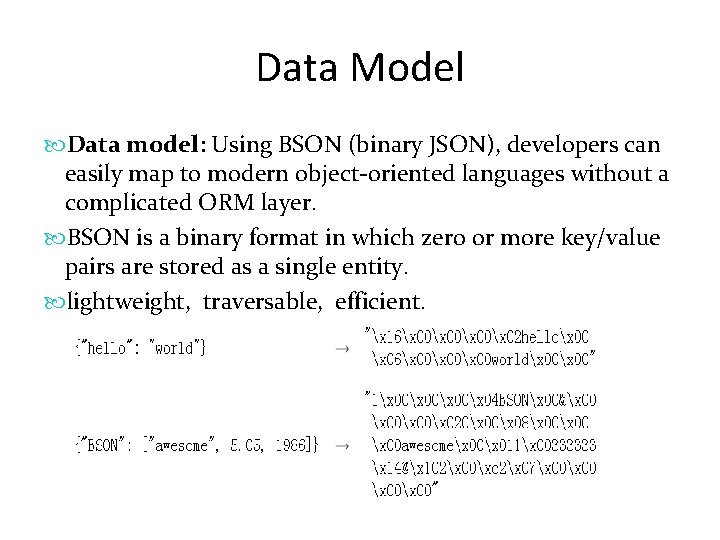
Data Model Data model: Using BSON (binary JSON), developers can easily map to modern object-oriented languages without a complicated ORM layer. BSON is a binary format in which zero or more key/value pairs are stored as a single entity. lightweight, traversable, efficient.
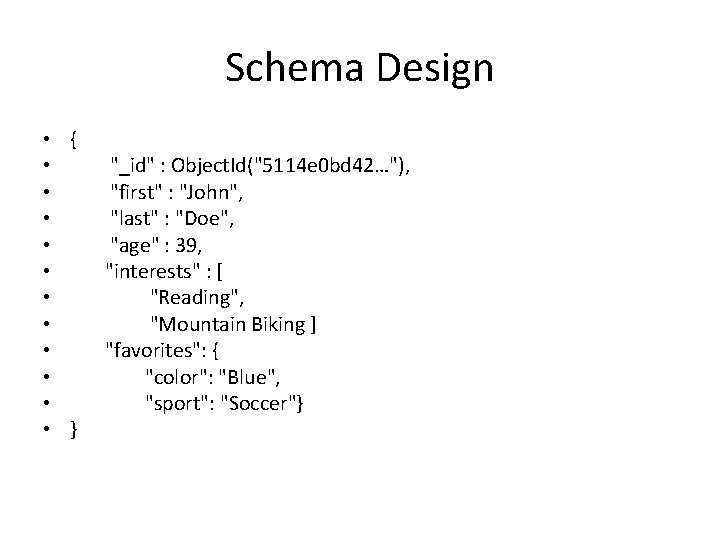
Schema Design • { • • • } "_id" : Object. Id("5114 e 0 bd 42…"), "first" : "John", "last" : "Doe", "age" : 39, "interests" : [ "Reading", "Mountain Biking ] "favorites": { "color": "Blue", "sport": "Soccer"}
Supported Languages
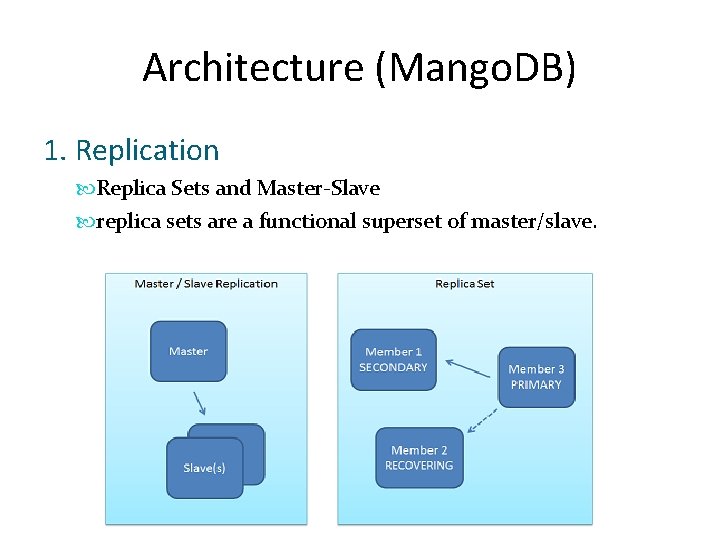
Architecture (Mango. DB) 1. Replication Replica Sets and Master-Slave replica sets are a functional superset of master/slave.
Architecture (Write process) • All write operation go through primary, which applies the write operation. • write operation than records the operations on primary’s operation log “oplog” • Secondary are continuously replicating the oplog and applying the operations to themselves in a asyn 0 chronous process.
Why replica sets Data Redundancy Automated Failover Read Scaling Maintenance Disaster Recovery(delayed secondary)
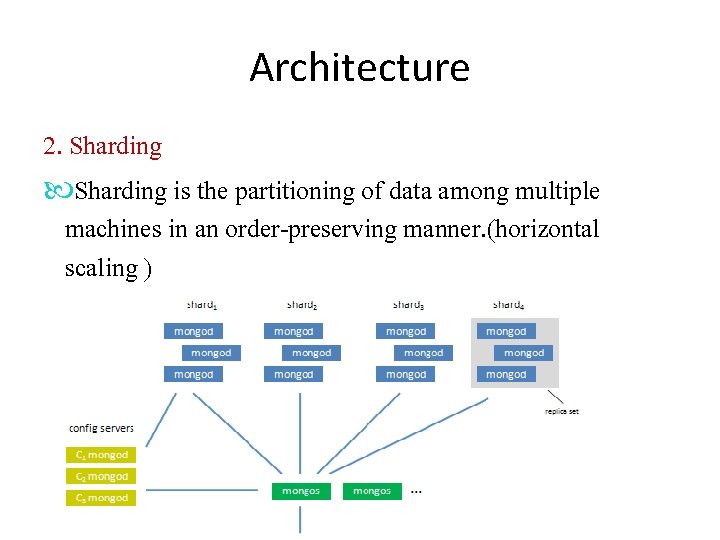
Architecture 2. Sharding is the partitioning of data among multiple machines in an order-preserving manner. (horizontal scaling )
Features • • Document-Oriented storege Full Index Support Replication & High Availability Auto-Sharding Querying Fast In-Place Updates Map/Reduce
HBase • HBase was created in 2007 at Powerset and was initially part of the contributions in Hadoop. • Since then, it has become its own top-level project under the Apache Software Foundation umbrella. • It is available under the Apache Software License, version 2. 0.
Hbase Features – non-relational – distributed – Opensource – and horizontal scalable. – Multi-dimensional rather than 2 -D (relational) § schema-free § Decentralized Storage System § easy replication support §simple API, etc.
Basic Architecture Tables, Rows, Columns, and Cells – the most basic unit is a column. – One or more columns form a row that is addressed uniquely by a row key. – A number of rows, in turn, form a table, and there can be many of them. – Each column may have distinct value contained in a separate cell.
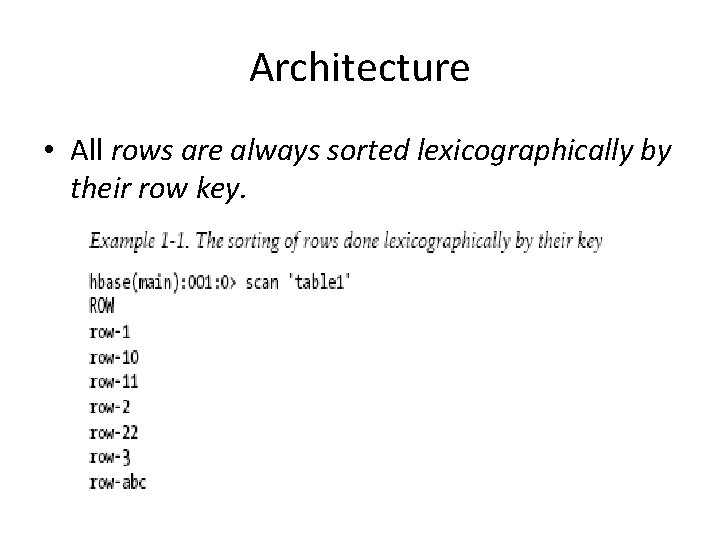
Architecture • All rows are always sorted lexicographically by their row key.
Architecture • Rows are composed of columns, and those, in turn, are grouped into column families. • All columns in a column family are stored together in the same low level storage file, called an HFile. • millions of columns in a particular column family. • There is also no type nor length boundary on the column values.

Rows and Columns in HBase

Rows and Columns in HBase
Assignment • 1. Storage structure of Google’s Big. Table. • 2. How NO-SQL deals with Structured and unstructured data
- Slides: 32