
DEVELOPING A ROADMAP TO 30 CASSANDRA BULL CORNELL

DEVELOPING A ROADMAP TO 30% CASSANDRA BULL CORNELL COOPERATIVE EXTENSION OF ALLEGANY COUNTY CB 775@CORNELL. EDU A STEP BY STEP GUIDE
STEP ONE ASSESSING YOUR LOCAL FOOD PROCUREMENT
1. 1 FIND YOUR MAGIC NUMBER v Use the spreadsheet provided by State Ed. v Enter in numbers from your last complete school year for a good estimate v For CEP schools – enter zero in “sales” v Find your school lunch budget, as projected by the state, and the 30% number – your MAGIC NUMBER

Insert image here
1. 2 FIND YOUR MILK/DAIRY PURCHASES This should be for an entire school year. You can ask your dairy company for velocity reports. Subtract any non-NY items they have like juices. Use past milk counts for an estimate of the LUNCH only counts. Are there products used during only lunch vs breakfast? If you can’t get an estimate and need to do this quickly, approximately 20% of your lunch budget will be dairy of some kind.
1. 3 FIND YOUR LUNCH APPLE PURCHASES Ask yourself: Are the apples you currently procure from NY? Can they easily be? If you are on pilot, do all of your pilot dollars go to purchasing apples? Could you rearrange any apples to purchase apples solely for breakfast or other non-NY ingredients for lunch? If you are willing to spend budget dollars on apples, and they are from NY, calculate how many apples you use each year by multiplying cases/week by 36 weeks, by cost per case ($26). This is your apple number.
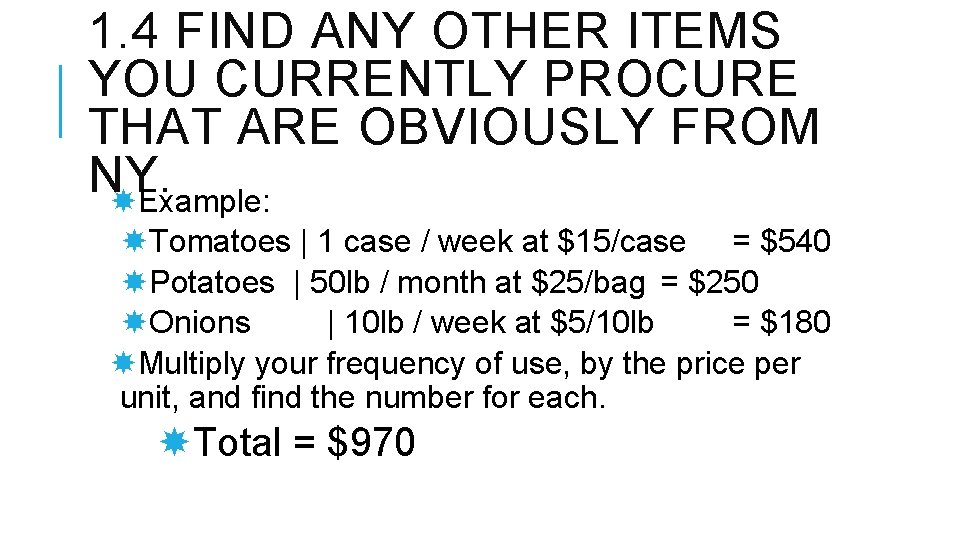
1. 4 FIND ANY OTHER ITEMS YOU CURRENTLY PROCURE THAT ARE OBVIOUSLY FROM NY. Example: Tomatoes | 1 case / week at $15/case = $540 Potatoes | 50 lb / month at $25/bag = $250 Onions | 10 lb / week at $5/10 lb = $180 Multiply your frequency of use, by the price per unit, and find the number for each. Total = $970
![1. 5 FIND YOUR ADDITIONAL TARGET PROCUREMENT GOAL Subtract: [Your Magic Number] 14, 072](http://slidetodoc.com/presentation_image/81d933c51c0fcfd5e670e7e9463d916e/image-8.jpg "1. 5 FIND YOUR ADDITIONAL TARGET PROCUREMENT GOAL Subtract: [Your Magic Number] 14, 072")
1. 5 FIND YOUR ADDITIONAL TARGET PROCUREMENT GOAL Subtract: [Your Magic Number] 14, 072 MINUS - 11, 168 - 1, 340 [milk/dairy] MINUS[apples] MINUS[other NY items] - 80_____ = $1, 520 =Your target goal to increase local food procurement past 30%.
STEP 2: LIST ALL NY SCHOOL FOOD ITEMS
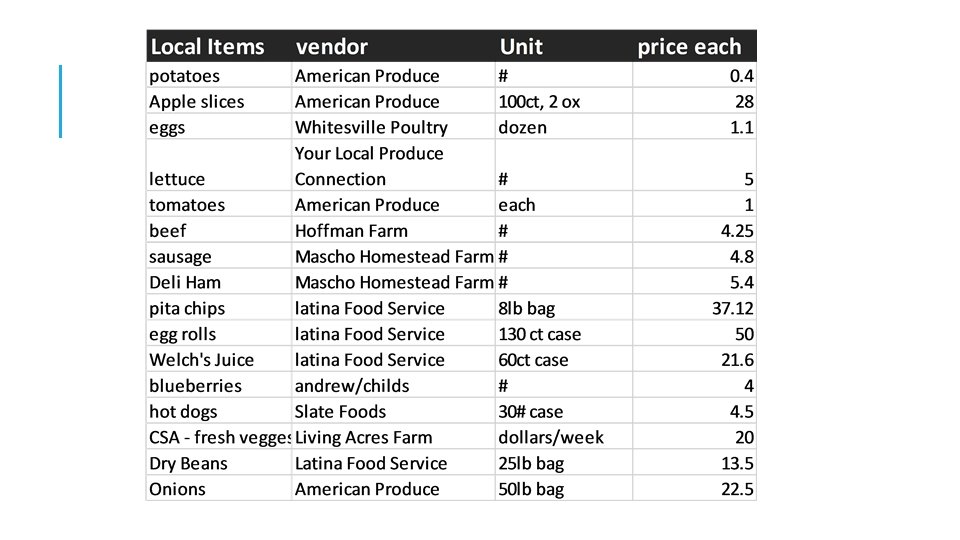
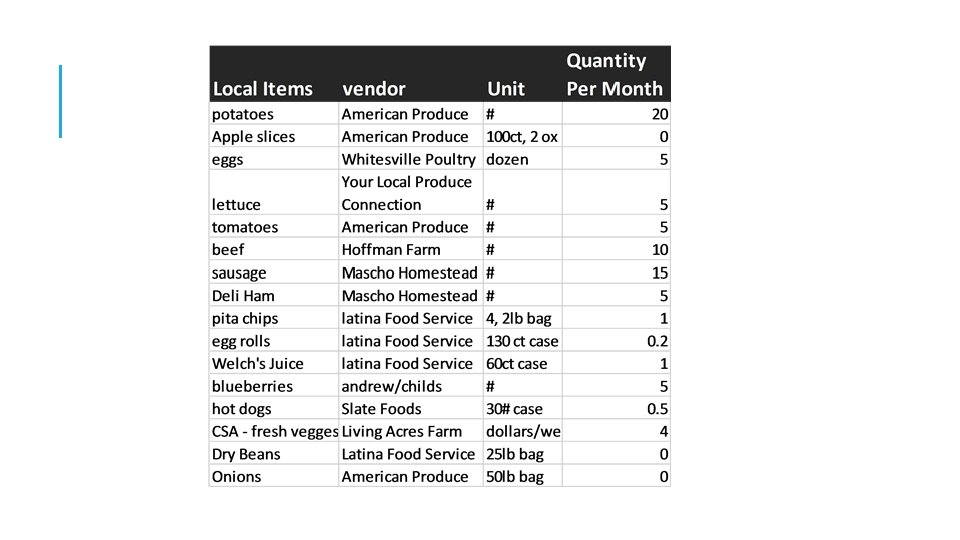
2. 1 CREATE A SPREADSHEET Create a spreadsheet with all possible NY food items, the distributor, the unit, and the price per unit. ** Use your Cornell Cooperative Extension offices or other closeby successful Farm to School Programs for references and ideas. *** Call your distributors and ask them if they stock any NY products. *** Think to yourself, is there a local farm that I know of that I
STEP THREE: MAKE A YOUR OWN SCHOOL SPECIFIC ROADMAP
3. 1 DECIDE WHETHER ALL OF THE ITEMS CAN BE EASILY BROUGHT TO YOU. Can the farmer/manufacturer sell to an existing distributor you use? If you have to add them as a new vendor, will they deliver? What is their minimum?
3. 2 ENTER YOUR NEEDED QUANTITIES Go through the spreadsheet, and type in what you think you will use each month based on your previous knowledge of the product, your comfort level of using new ingredients, and on price.

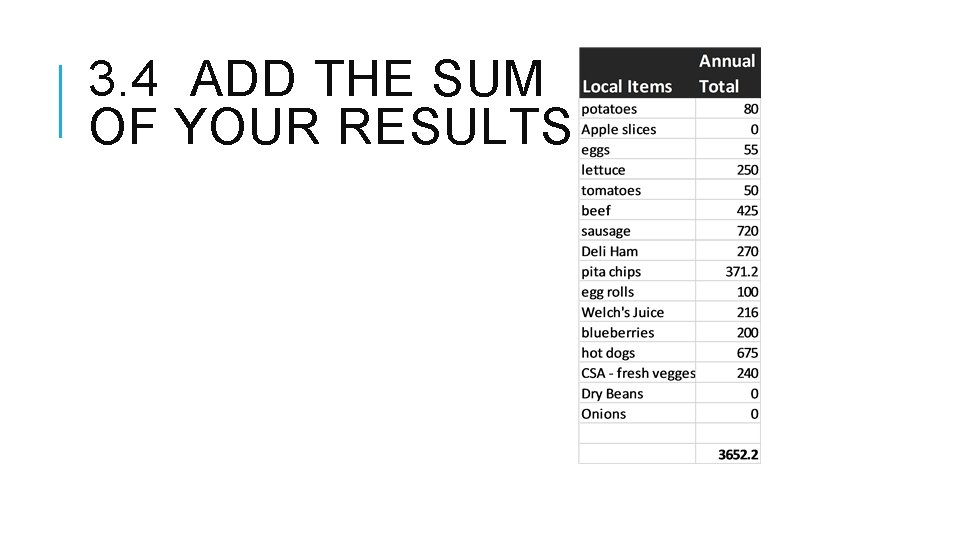
3. 4 ADD THE SUM OF YOUR RESULTS
3. 5 COMPARE THE RESULTS Compare with your “magic number” produced from State Ed’s spreadsheet. Needed: $1, 520 additional NY dollars Estimated plan: $3, 652 additional NY dollars
3. 6 ADJUST ACCORDINGLY IF TOO LOW: You may need to increase your pounds of beef, your fresh produce amount, etc. to hit your target goal Plan to be at 32% NY to be safe IF TOO HIGH: Some schools are overzealous and end up saying they’ll spend too much on local food, such that they would be cost prohibitive to have such copious, expensive local food procurement.
3. 7 COMPLETE YOUR ROADMAP You have now created your own outline to 30% local procurement. This is your “roadmap”.
STEP 4 MAKE YOUR PROCUREMENT REFLECT YOUR PURCHASING GOALS
4. 1 START A DIALOGUE Contact your distributors to have an open dialogue about what you forecast your orders to be. Contact farmers and manufacturers on your roadmap to discuss what you’re looking for in item, quantity, and velocity.
4. 2 MAINTAIN PROPER PROCUREMENT Ask yourself: Does this fall under the micro purchase? Do I need a special bid for this item? Do I need to change the bid language to reflect these numbers accordingly?
STEP 5 IMPLEMENT YOUR FARM TO SCHOOL GOALS
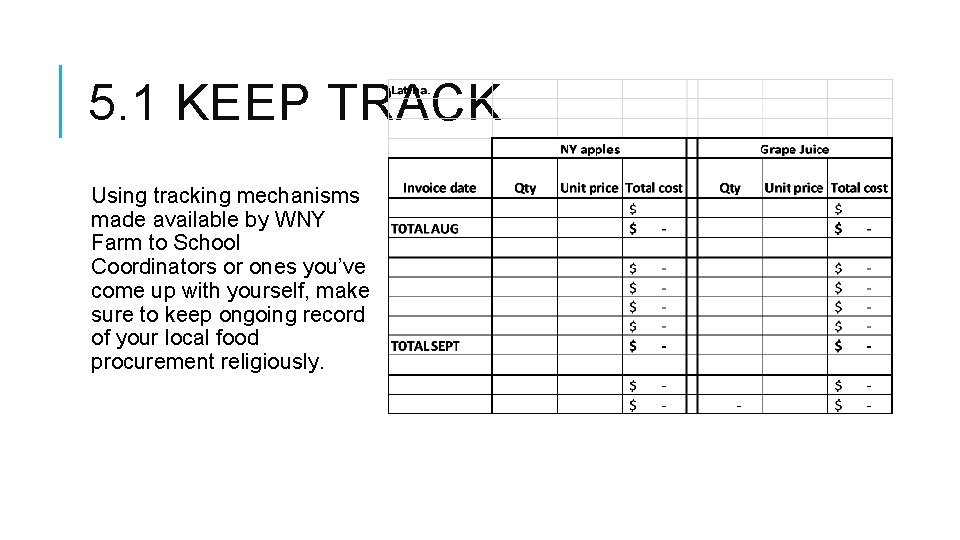
5. 1 KEEP TRACK Using tracking mechanisms made available by WNY Farm to School Coordinators or ones you’ve come up with yourself, make sure to keep ongoing record of your local food procurement religiously.
5. 2 CHECK-IN OFTEN v. Check in every month and compare your local food procurement with your roadmap. v. Fill out State Ed’s 30% calculation tool each month with your actual data for that school year, (ex. September –November, September- December, etc. ) to reflect your real data.
5. 3 ADJUST ACCORDINGLY New NY products are being produced all the time, and may not be in your original roadmap. The roadmap should be treated as a baseline guide for getting your district to 30%, it is not a hard-lined approach. Try new products, and be open to new farms. On the flip side, you may realize that you’re not hitting your 30% mark and will need to increase your local food procurement accordingly. If you have $30, 000 as your local food goal, and are spending $2, 000 every month, this is a “tell” that by the end of the year you would spend $20, 000, not $30, 000. It’s better to realize this earlier than later.
5. 4 RE-ADJUST NEXT YEAR’S GOALS At the end of the school year, readjust your goals for the next school year. If there was a new product you liked, or one you tried and would rather not serve, this is the time to lay out your decisions on paper and see if it still gets your district past 30% the following year.
STEP 6 APPLY FOR REIMBURSEMENT & REAP THE BENEFITS
GENERAL RULES OF THUMB v 20% of lunch budget goes to milk and dairy v 2 -4% of a lunch budget goes to apples (if non-pilot) = Starting place at around 23% NY products
GENERAL RULES OF THUMB v. Purchasing local meat ONCE A MONTH at $4. 00 -$4. 50/lb can increase your school lunch budget by 2%. v. Twice a month, by 4% v. Every week, by 8% v. This rule of thumb can be mirrored with products that are approximately $. 50 per serving.
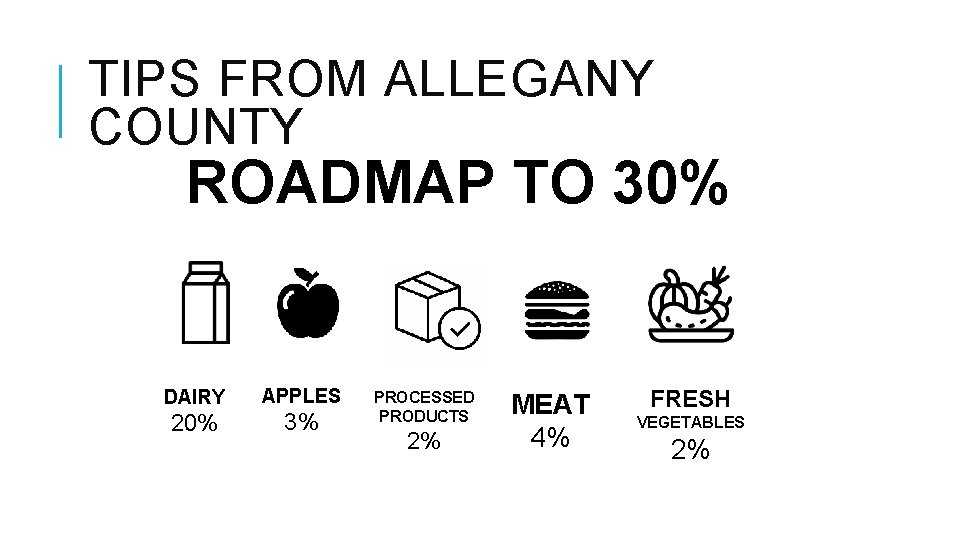
TIPS FROM ALLEGANY COUNTY ROADMAP TO 30% DAIRY APPLES 20% 3% PROCESSED PRODUCTS 2% MEAT 4% FRESH VEGETABLES 2%
TIPS FROM ALLEGANY COUNTY v. Use commodity foods to offset the cost of the expensive local ingredients v. NY Egg rolls, use rice and govt. broccoli, govt. chicken v. NY Taco Tuesday, use government beans & cheese, & pilot tomatoes v. Realize that when you’re spending local food, you aren’t just spending extra dollars. v. If a serving of local chips is $. 33 each, but you are used to serving $. 20 chips, the extra $0. 13 is an extra cost that will be offset by the additional reimbursement – and that’s what the reimbursement is for.
TIPS FROM ALLEGANY COUNTY v. Join a CSA (Community Supported Agriculture) for the salad bar v. It doesn’t have to be enough, but it’s good education for the students, marketing for you, and exposure for the farm v. Make sure your roadmap has a healthy mix of processed, fresh, and frozen products. v. Adapt your menus to reflect Farm to School with common sense v. Egg salad sandwiches, Blueberry parfaits, Taco Tuesdays, roasted B potatoes v. Don’t jump far out of your comfort zone too soon v. Replace ingredients you currently use with local ingredients
TIPS FROM ALLEGANY COUNTY v. Utilize your school’s garden produce in the cafeteria! v. Free produce? Pay a club to support their equipment costs? v. Utilize the micro-purchase threshold to highlight your community’s strengths! v. Think about what good PR and good advertising look like for your district v. EX: Cuba Cheese, Childs blueberries, Canticle Farm CSA,

QUESTIONS?
- Slides: 36