
Abusing Resources to Process 7 TB of PCAP
Abusing Resources to Process 7 TB of PCAP Data … Or how not to fork-bomb yourself Roy Hooper Demand Media OARC Fall 2013 Workshop
Introduction • Interisle’s report raised lots of new questions about DNS collisions • Triggered further analysis by NTAG and others • ICANN’s 3 week window for comments didn’t leave much time for analysis • Interisle’s work took a week for each pass, with only 8 cores… • DNS-OARC’s policies require analysis work be done at DNS-OARC • This could be challenging…
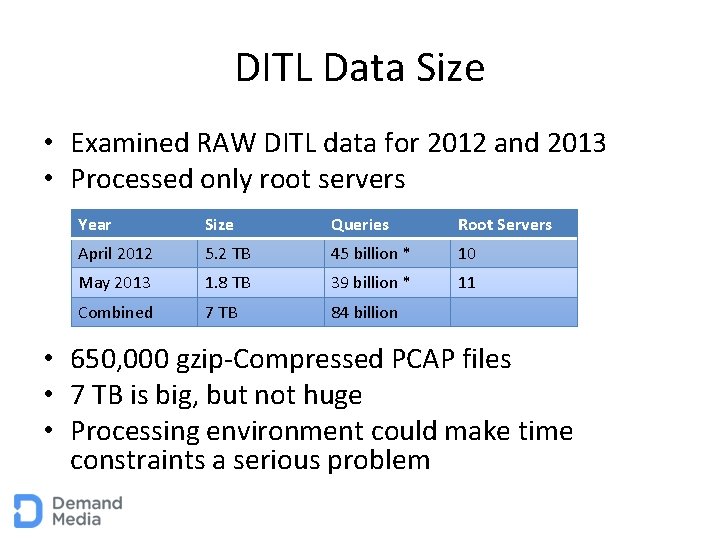
DITL Data Size • Examined RAW DITL data for 2012 and 2013 • Processed only root servers Year Size Queries Root Servers April 2012 5. 2 TB 45 billion * 10 May 2013 1. 8 TB 39 billion * 11 Combined 7 TB 84 billion • 650, 000 gzip-Compressed PCAP files • 7 TB is big, but not huge • Processing environment could make time constraints a serious problem
PCAP Conversion Tools • • Packet. Q Tcpdump Tshark And others… like pypcap for Python and Net: : Pcap for Perl • Which one’s right for the job? • Benchmarked a small sample of PCAP files
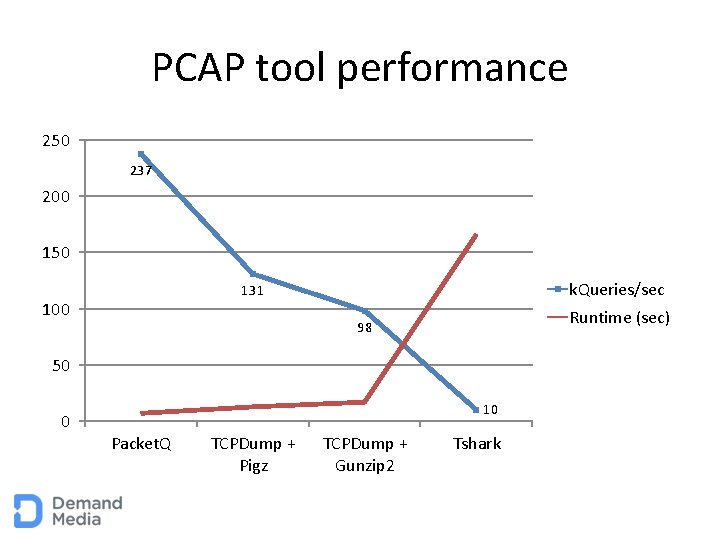
PCAP tool performance 250 237 200 150 k. Queries/sec 131 100 Runtime (sec) 98 50 0 10 Packet. Q TCPDump + Pigz TCPDump + Gunzip 2 Tshark
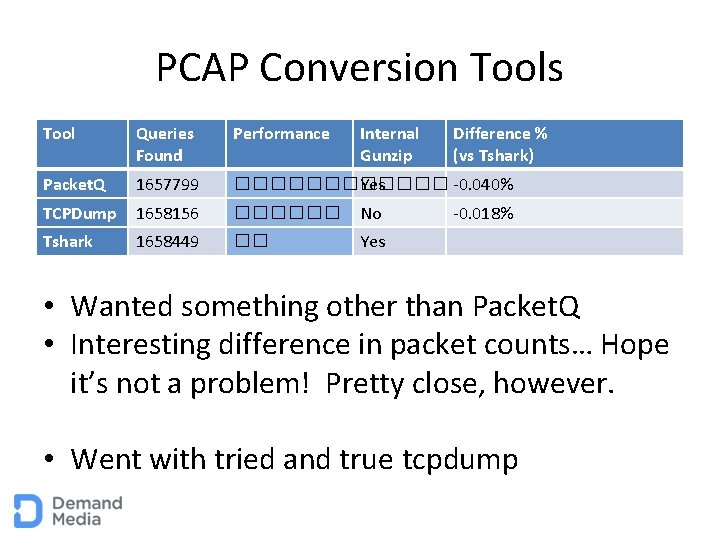
PCAP Conversion Tools Tool Queries Found Performance Internal Gunzip Difference % (vs Tshark) Packet. Q 1657799 ������ Yes -0. 040% TCPDump 1658156 ������ No Tshark 1658449 �� Yes -0. 018% • Wanted something other than Packet. Q • Interesting difference in packet counts… Hope it’s not a problem! Pretty close, however. • Went with tried and true tcpdump
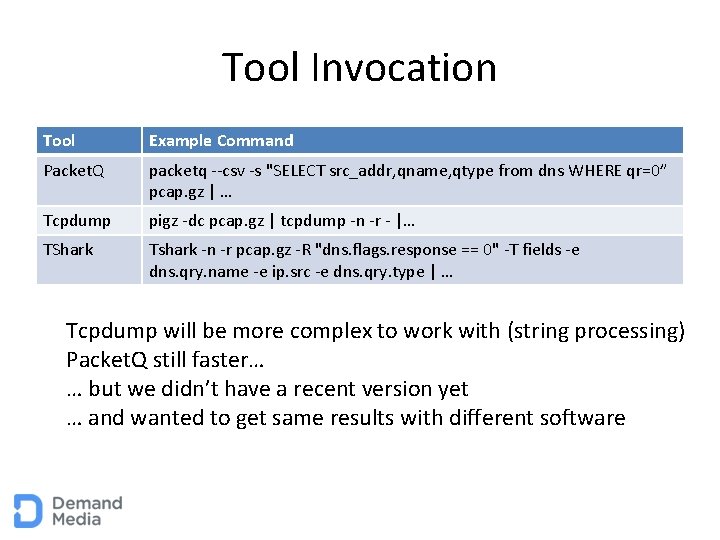
Tool Invocation Tool Example Command Packet. Q packetq --csv -s "SELECT src_addr, qname, qtype from dns WHERE qr=0” pcap. gz | … Tcpdump pigz -dc pcap. gz | tcpdump -n -r - |… TShark Tshark -n -r pcap. gz -R "dns. flags. response == 0" -T fields -e dns. qry. name -e ip. src -e dns. qry. type | … Tcpdump will be more complex to work with (string processing) Packet. Q still faster… … but we didn’t have a recent version yet … and wanted to get same results with different software
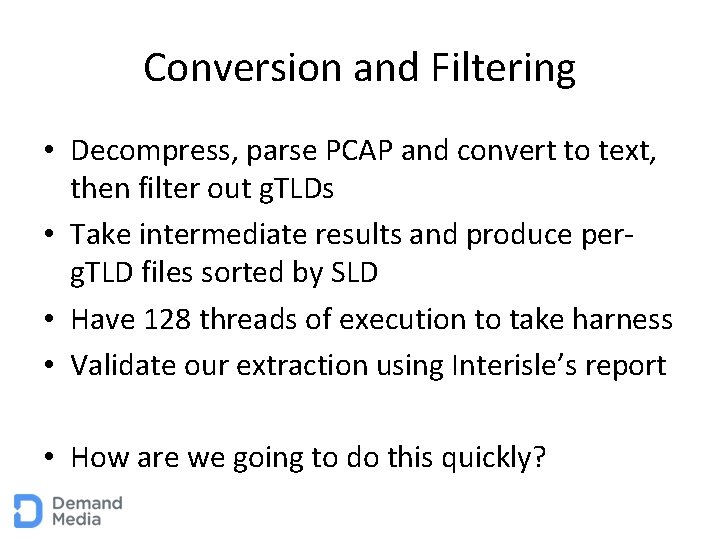
Conversion and Filtering • Decompress, parse PCAP and convert to text, then filter out g. TLDs • Take intermediate results and produce perg. TLD files sorted by SLD • Have 128 threads of execution to take harness • Validate our extraction using Interisle’s report • How are we going to do this quickly?
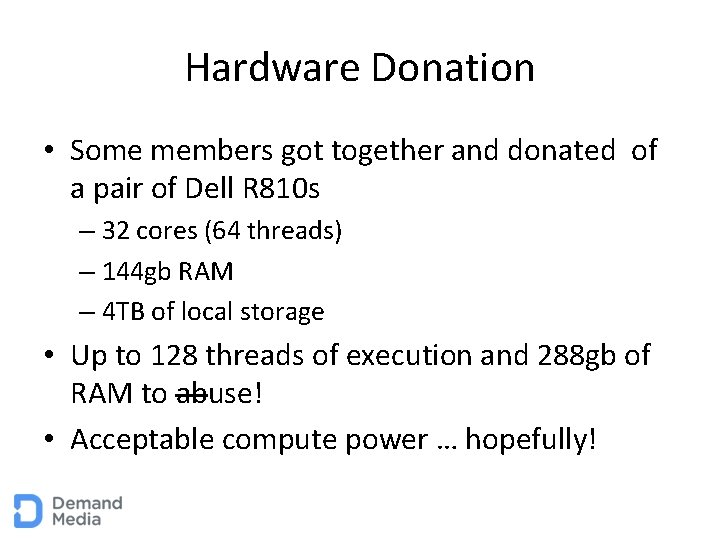
Hardware Donation • Some members got together and donated of a pair of Dell R 810 s – 32 cores (64 threads) – 144 gb RAM – 4 TB of local storage • Up to 128 threads of execution and 288 gb of RAM to abuse! • Acceptable compute power … hopefully!

Extraction Goals • Include only queries for the new g. TLDs • Produce a compact data set suitable for further analysis • Do it quickly! Less than 3 weeks. • Match the Interisle results
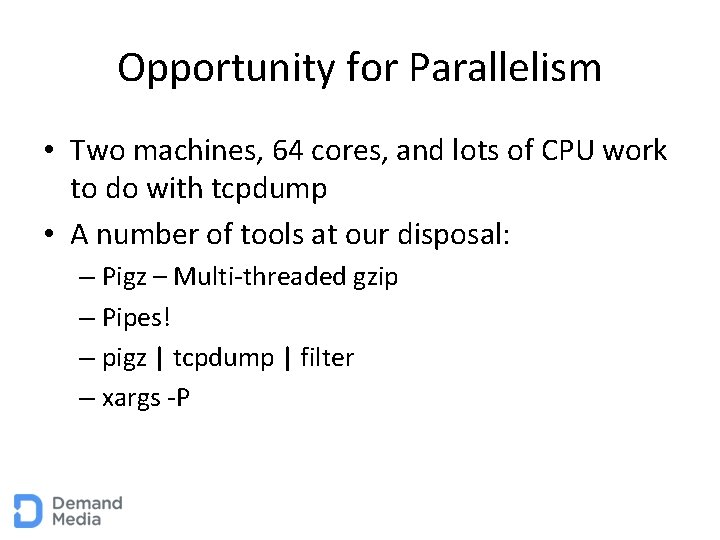
Opportunity for Parallelism • Two machines, 64 cores, and lots of CPU work to do with tcpdump • A number of tools at our disposal: – Pigz – Multi-threaded gzip – Pipes! – pigz | tcpdump | filter – xargs -P

Challenges Keeping the CPUs busy Avoiding swap NFS can be slow Be wary of local disk bottlenecks Dataset doesn’t fit on local disk (rsync server not a good option) • Babysitting multi-day jobs • Finding problems after 2 days of processing and starting over • • •

Processing Challenges • Used Perl because of it’s string processing performance • Perl Regexes too slow for the patterns needed for tcpdump output (Despite being fast) • Devel: : NYProf to the rescue • Had to use things like rindex() and substr() • Ugh, manual string processing! Reminds me of C…

Extraction Process • Produced an intermediate set of files – One file per PCAP file – Text files: srcaddr qtype qname – Converted qname to lowercase – Gzipped • Pipelined • pigz | tcpdump | parse+filter. pl | pigz • That’s only 4 processes…
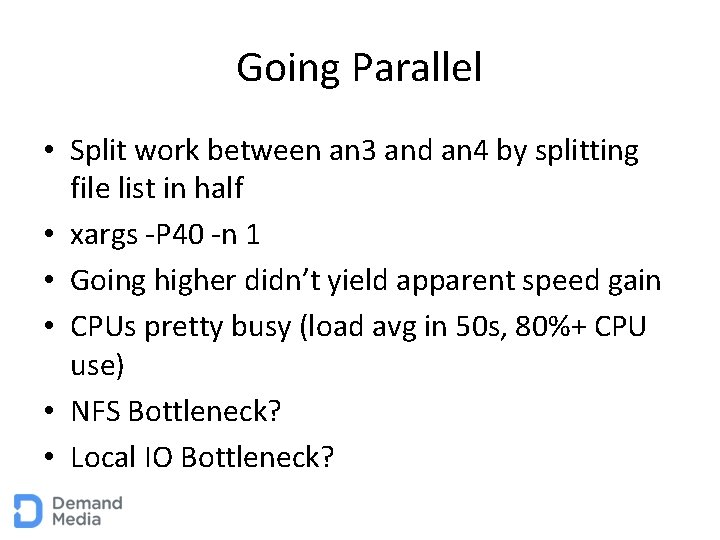
Going Parallel • Split work between an 3 and an 4 by splitting file list in half • xargs -P 40 -n 1 • Going higher didn’t yield apparent speed gain • CPUs pretty busy (load avg in 50 s, 80%+ CPU use) • NFS Bottleneck? • Local IO Bottleneck?

xargs –P: Easy Parallelism • xargs parallel mode • Automatically spawns new processes as work is finished • Needs a small script to manage the remainder of the pipeline • Wrote a shell script wrapper: – create output dirs – run filter – pipe to pigz • Could have had the filter do that… And did in later variants of the scripts
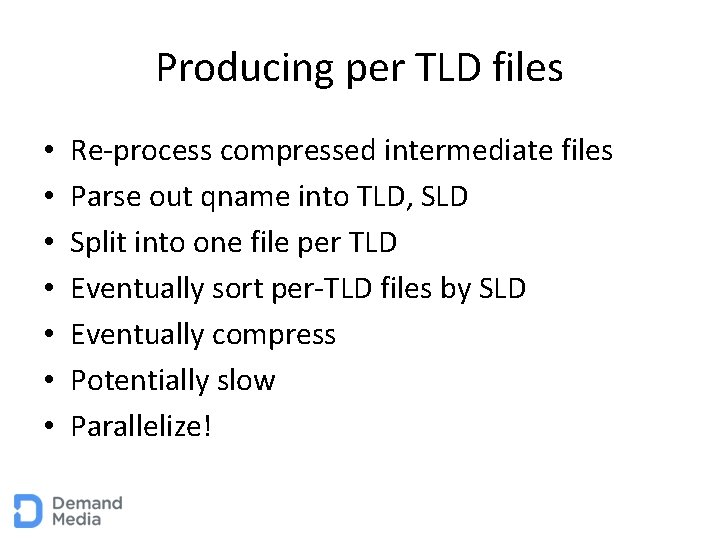
Producing per TLD files • • Re-process compressed intermediate files Parse out qname into TLD, SLD Split into one file per TLD Eventually sort per-TLD files by SLD Eventually compress Potentially slow Parallelize!
Going Parallel Relatively CPU hungry Use xargs -P 32 again, but with -n 100 Take advantage of O_APPEND flag to open(2) Multiple writers safe with use of write(2) Each splitter process opens per-TLD files as needed • Exhausted all File Handles on first try! • • •
Hitting Limits • Had to increase kern. maxfiles, kern. maxfilesperproc • Up to 45000 open files with xargs -P 32 • IO bound by local disk, not CPU – Would be better if we could compress first! • Reduced parallelism to around -P 20

What about that forkbomb? • At one point, I decided to fork one gzip per TLD per process • I didn’t do the math first… 1400*32… 44, 800 • Noticed what was happening and shut it down quickly • Need to be careful when forking!
Final sorting and compression • The unix sort(1) utility allows in-memory sorting via -S • Avoids temporary files • Selected a size suitable to the bulk of the intermediate files with 20 processes running • Sorted by SLD • Files ready for use!
Shrinking Data • Input: 7 TB, 84 billion queries • Intermediate: 30 GB (excluding. com) • Final data: 2012: 1. 3% of input (0. 6 billion queries) 2013: 2. 4% of input (1. 4 billion queries) • Much easier to process per-g. TLD files
Differences in Results • As expected, tcpdump and Packet. Q have slightly different output • Total query counts for new g. TLDs are close: – 2012: 2. 0% fewer queries than Interisle (862 M vs 881 M) – 2013: 1. 4% more queries than Interisle (1334 M vs 1316 M) • Size on disk of input data matches Interisle report (page 21)
. com Zonefile intersection • Repeated initial extraction of intermediate data, but included only. com • Processed a zone file that overlapped with the 2012 and 2013 DITL runs to produce an SLD string list for each • Wrote a simple filter daemon – Load entire string list into memory in a hash table – Pre-fork some children – Read lines of input from network connections – Respond with entries for SLDs not in zone file
. com Zonefile Intersection • Used xargs to feed intermediate file contents in parallel to the filter • Pipeline involved pigz | nc | pigz • Produced a series of compressed output files, one per intermediate file • Generated query counts and unique string list from those
Possible Improvements • Local disk is slow! Avoid storing uncompressed data? • Perhaps run one listener per TLD that receives network streams from multiple clients and writes them compressed to disk • Just expand everything after DITL runs and keep intermediate data around? • All this seems familiar • Big Data problems? Well, not that big, but big enough.

What’s Next? • Pre-process all DITL runs into a Hadoop cluster (or similar)? – Hive, Hbase, Cassandra? • Cluster would be nice – Avoid re-inventing the wheel every time someone wants to analyze DITL data – Would lets scientists dive right in and analyze – Needs hardware and someone to import data – Bonus: Distributed archive of DITL data to protect it
What’s Next? • Why the differences between tcpdump, Packet. Q and TShark? – Handling of corrupt packets and queries? – Other? • What kinds of raw UTF-8 TLDs are making it to the root (rather than punycode)? • Help improve Packet. Q – it’s damn good!
- Slides: 28