Autism Spectrum Disorders Carrie Cadwell Psy D HSPP
- Slides: 45
Autism Spectrum Disorders ©Carrie Cadwell, Psy. D. HSPP
“Social and behavioral competence in young children predict their academic performance in the 1 st grade over and above their cognitive skills and family backgrounds” (Raver & Knitzer 2002)
APA Monitor (De. Angelis, April 2010) “SOCIAL AWARENESS + EMOTIONAL SKILLS = SUCCESSFUL KIDS”
Autism First described by Leo Kanner in 1943 Asperger’s First described by Hans Asperger in 1944 Comparison yields: the two groups were similar in terms of social-communication deficits and restricted/repetitive patterns of interest BUT differed in speech, motor deficits, age of onset
DSM-IV-TR Autism Asperger’s Pervasive Disorder Developmental Disorder NOS
Similarities Social-Relation/Interaction Restrictive/Repetitive BIA Communication: verbal or non-verbal Sensory-Motor
Differences Issue of delayed verbal/speech Issue of cognitive abilities What about HFA vs Asperger’s Issue
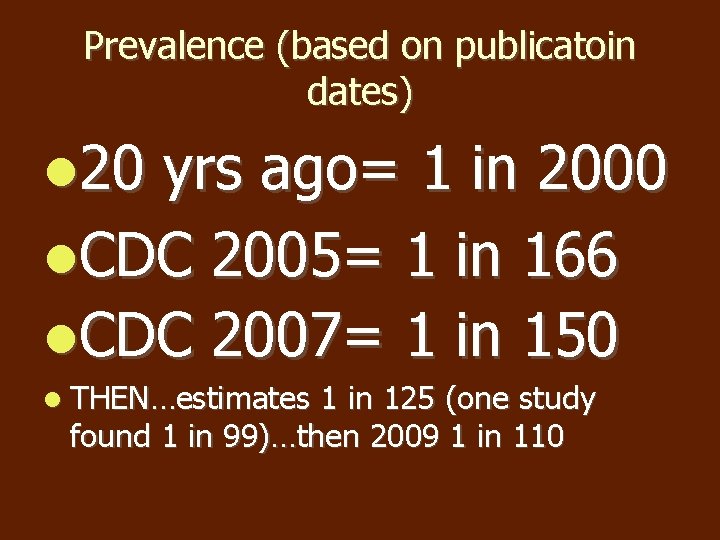
Prevalence (based on publicatoin dates) 20 yrs ago= 1 in 2000 CDC 2005= 1 in 166 CDC 2007= 1 in 150 THEN…estimates 1 in 125 (one study found 1 in 99)…then 2009 1 in 110
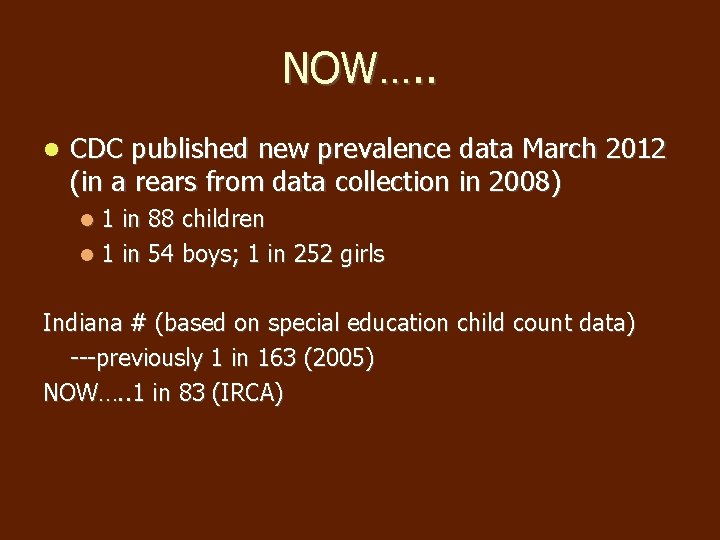
NOW…. . CDC published new prevalence data March 2012 (in a rears from data collection in 2008) 1 in 88 children 1 in 54 boys; 1 in 252 girls Indiana # (based on special education child count data) ---previously 1 in 163 (2005) NOW…. . 1 in 83 (IRCA)
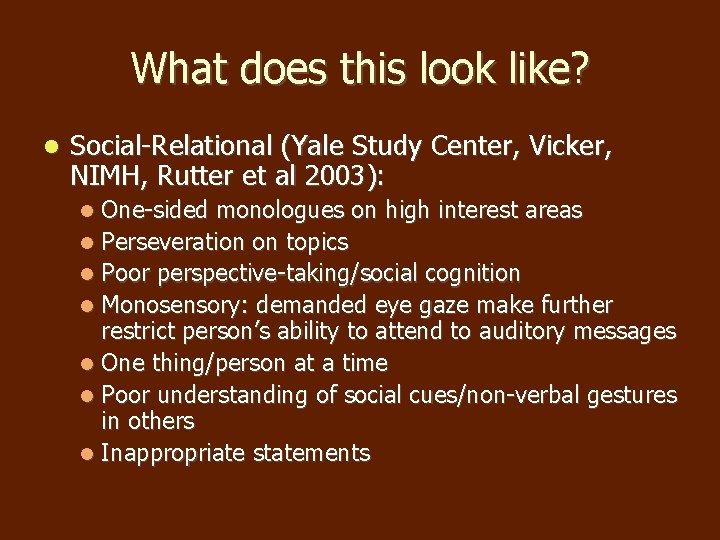
What does this look like? Social-Relational (Yale Study Center, Vicker, NIMH, Rutter et al 2003): One-sided monologues on high interest areas Perseveration on topics Poor perspective-taking/social cognition Monosensory: demanded eye gaze make further restrict person’s ability to attend to auditory messages One thing/person at a time Poor understanding of social cues/non-verbal gestures in others Inappropriate statements
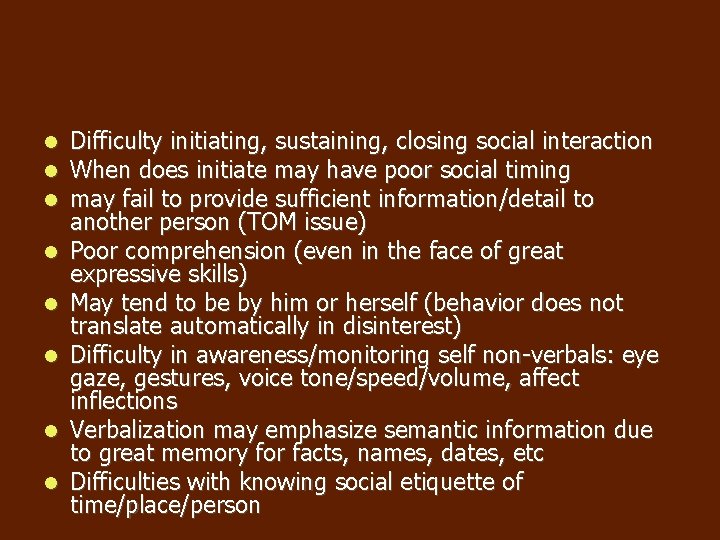
Difficulty initiating, sustaining, closing social interaction When does initiate may have poor social timing may fail to provide sufficient information/detail to another person (TOM issue) Poor comprehension (even in the face of great expressive skills) May tend to be by him or herself (behavior does not translate automatically in disinterest) Difficulty in awareness/monitoring self non-verbals: eye gaze, gestures, voice tone/speed/volume, affect inflections Verbalization may emphasize semantic information due to great memory for facts, names, dates, etc Difficulties with knowing social etiquette of time/place/person
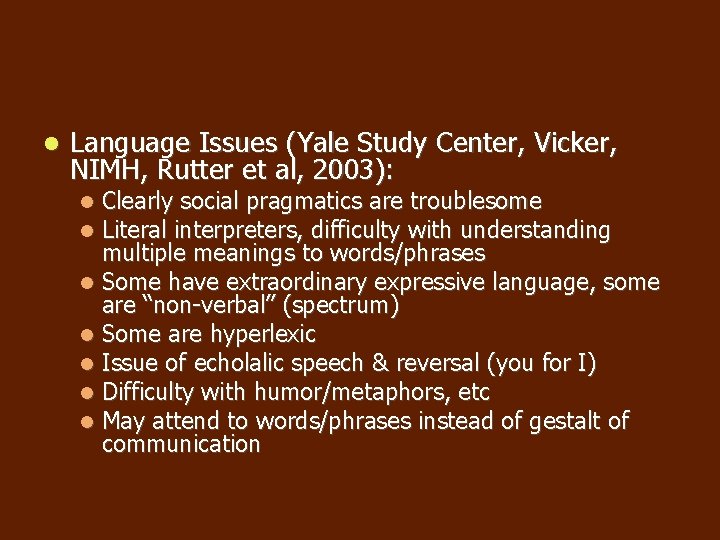
Language Issues (Yale Study Center, Vicker, NIMH, Rutter et al, 2003): Clearly social pragmatics are troublesome Literal interpreters, difficulty with understanding multiple meanings to words/phrases Some have extraordinary expressive language, some are “non-verbal” (spectrum) Some are hyperlexic Issue of echolalic speech & reversal (you for I) Difficulty with humor/metaphors, etc May attend to words/phrases instead of gestalt of communication
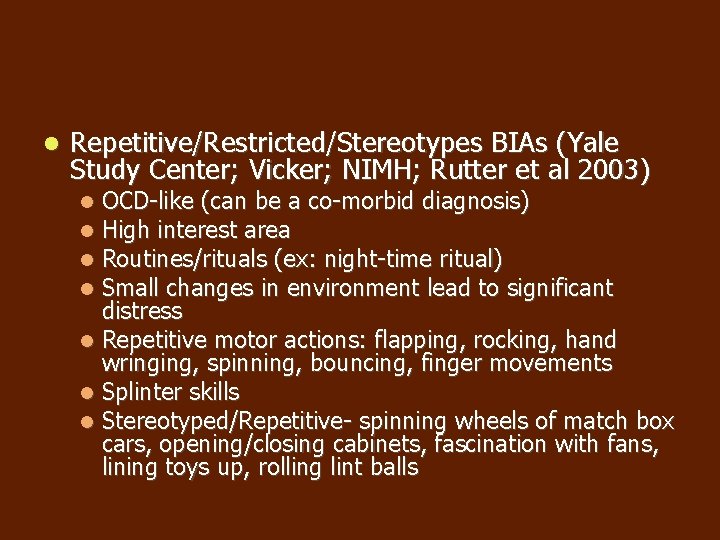
Repetitive/Restricted/Stereotypes BIAs (Yale Study Center; Vicker; NIMH; Rutter et al 2003) OCD-like (can be a co-morbid diagnosis) High interest area Routines/rituals (ex: night-time ritual) Small changes in environment lead to significant distress Repetitive motor actions: flapping, rocking, hand wringing, spinning, bouncing, finger movements Splinter skills Stereotyped/Repetitive- spinning wheels of match box cars, opening/closing cabinets, fascination with fans, lining toys up, rolling lint balls
Additional thoughts on RSBs (Hendren & Horst 2007): Not specific to ASDs…. . present in OCD, Tourettes, schizophrenia, mental retardation Also present in normal development Normative to 12 months and decline At 24 mos children with autism can begin to be distinguished from typical child based upon RSB By 36 -48 months difference substantial
Additional thoughts on RSBs (Hendren & Horst, 2007): Higher v Lower level RSBs Lower level: motor stereotypies Higher level: insistence on sameness, preoccupations, restricted patterns of interest Higher level more specific to autism whereas lower level more specific to developmental delay/intellectual disability OCD v RSBs Neuro-biological similarities Qualitatively different
Underlying/Associated Joint Attention Symbolic/Imaginative Theory of Mind Executive Functions Sensory-Motor Issues ANXIETY Other mental health issues
Joint attention Shared attention/shared mental/emotional state between an child and other person often focused on another object Initiation may come from either party and may be led by verbalization and/or pointing Some differ between shared attention and joint attention Shared attention— 3 -6 mos (may be like socialemotinal reciprocity) Joint attention---12 -18 mos
Imaginative play Often children on the spectrum will not engage in “imaginative”play…. have to differ between rote re-enactment and a more creative, symbolic/pretend, spontaneous imaginative play Example: using the remote control as a telephone Most 2 year-olds are observed as evidencing the above type of play Kids on the spectrum more fascinated by parts, properties of objects, using toys in a very restricted manner
Are we losing imaginative play in today’s world? What does that mean for social skills/social problem solving
Theory of Mind Perspective-taking Recognition that another person has “mind of their own” (ie thoughts, feelings, and resultant behaviors) Social- referencing/reciprocity, joint attention, and imaginative play often thought as precursors Sally-Anne task—by age 4 most children can answer correctly, majority of individuals with ASD cannot Without TOM we are “mind-blind” and it greatly impairs social-relations/communcations Think impaired empathy, think not understanding why you cant come to the same conclusion as them, think not filling in the blanks of communication
Executive Functions Problem-solving (Stokes 2004) Planning Organizing (multi-sensory and motor input to plan for apropo output Enacting Monitoring Shifting Working memory Response Inhibition
Do you know this youth? Brian is 10 years old, parents and teachers are concerned by his emotional outbursts, his mother got a call from the school that she had to come pick him up as he was “out of control” and he was not calming down, Brian had a substitute that day. Parent indicate that Brian does not do well with change and gets stuck, if they tell him too far in advance he obsesses and asks questions as anxiety builds, if he is taken by surprise he becomes emotionally unraveled and becomes so locked in that nothing seems to sooth him
Sensory-Motor Issues Sensory (Kranowitz) Hypersensitive/hyposensitive Overaroused/underaroused Modulation Near Senses: Vestibular, Tactile, Propioceptive Far Senses: Visual, Touch, Auditory, Olfactory, Gustatory ASD often present with additional sensory issues—loud noises, certain textures, lighting, rocking, aversion/craving certain tastes/smells
ANXIETY Anxiety is very prevalent in this population Social anxiety, worried thoughts, panic What appears to be aggressive behavior, tanrums, “noncompliance”, or self-stimulation behaviors may be anxiety-based As we know high anxiety can impede attention/awareness/learning/executive functions---so think about the role for ASD in terms of social learning, interaction/performance Habituation is not the answer! Consider overlap of sensory sensitivities and anxiety
AD cont. OCD versus Aspergers (Neziroglu & Henriksen) Look at the social-relational piece: kids with OCD may experience peer problems but do not have the social-pragmatic challenges like ASD Several similarities: shifting, emotions, incompleteness, obsessions, compulsions
AD cont. OCD vs Aspergers (Neziroglu & Henriksen) Shifting: need for sameness is a similarity OCD- difficulty with transition may be related to balancing/symmetry obsession (everything must be completed in total) ASD: even smallest changes can evoke extremely strong reponse; check sensory issues; also check if you are interfering with a high interest area
AD cont. OCD vs Aspergers (Neziroglu & Henriksen Obsessions/compulsions: OCD: intrusive, recurrent thoughts elicit distress ASD: high interest areas do not -----distress only elicited when interrupted Compulsions attached to obsessions----high interest areas not attached to true compulsive behavior Common compulsion such as checking, handwashing, touching rare in ASD
Other associated/co-occurring: Depression/Bipolar Disorder (2 -6% increased prevalence of BPD) ADHD (40 -95% overlap—Kolevzon, 2007)) OCD Tourettes Mental retardation Non-verbal Learning Disability (neuropsychological designation) Specific Learning Disabilities—WRITING!!! Auditory Processing Disorder Sleep concerns Gastrointestinal Issues PICA Ear Infections/Allergies Seizures
Early Identification Early identification + early intervention = better outcomes Asperger’s/HFA may not be easily identified in the below age frames---development on track, may be verbally precocious, may not be the most flexible Research supports: A portion of children can be accurately diagnosed by 18 mos…some research pointing to be ale to identify social-emotional delays even in the first year Most exhibit some symptoms between 18 and 36 mos. Joint attention, gaze and pointing issues, imaginative play Parental concerns @ communication, peer socialization, sensory sensitivities, challenging behaviors
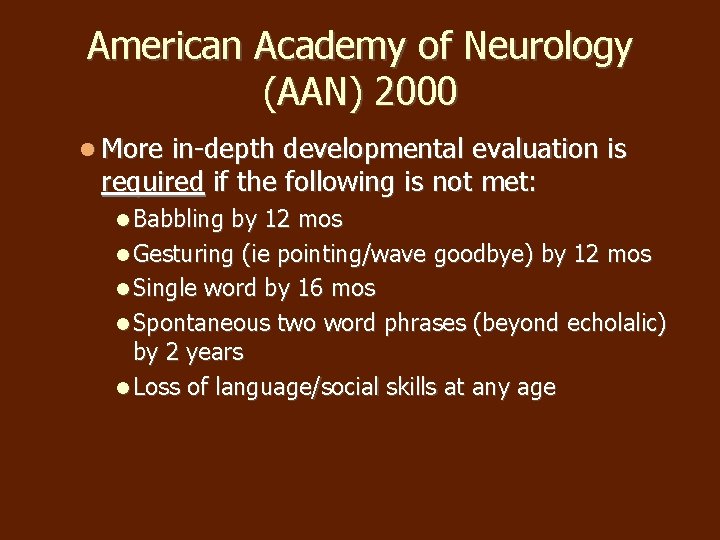
American Academy of Neurology (AAN) 2000 More in-depth developmental evaluation is required if the following is not met: Babbling by 12 mos Gesturing (ie pointing/wave goodbye) by 12 mos Single word by 16 mos Spontaneous two word phrases (beyond echolalic) by 2 years Loss of language/social skills at any age
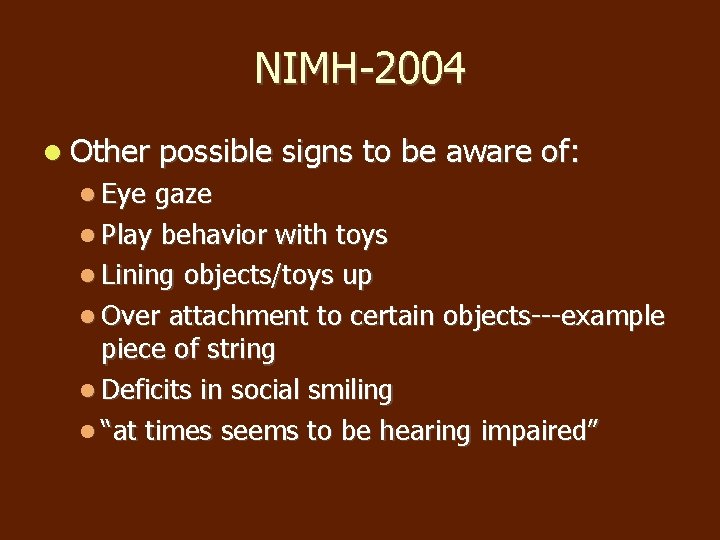
NIMH-2004 Other Eye possible signs to be aware of: gaze Play behavior with toys Lining objects/toys up Over attachment to certain objects---example piece of string Deficits in social smiling “at times seems to be hearing impaired”
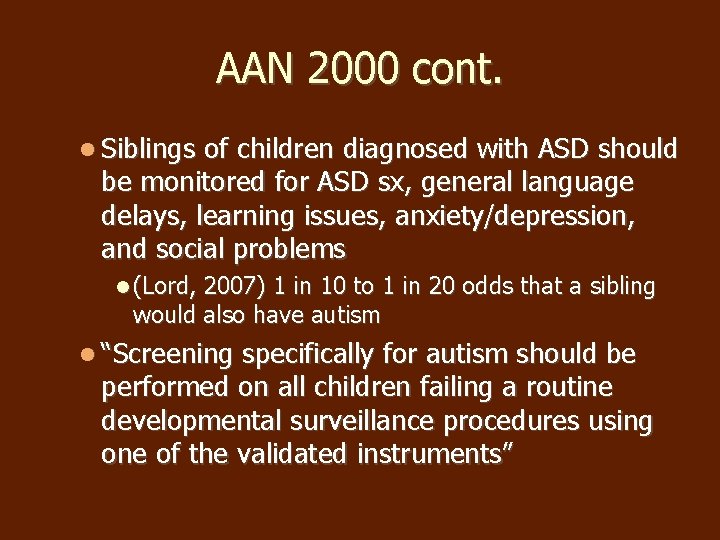
AAN 2000 cont. Siblings of children diagnosed with ASD should be monitored for ASD sx, general language delays, learning issues, anxiety/depression, and social problems (Lord, 2007) 1 in 10 to 1 in 20 odds that a sibling would also have autism “Screening specifically for autism should be performed on all children failing a routine developmental surveillance procedures using one of the validated instruments”
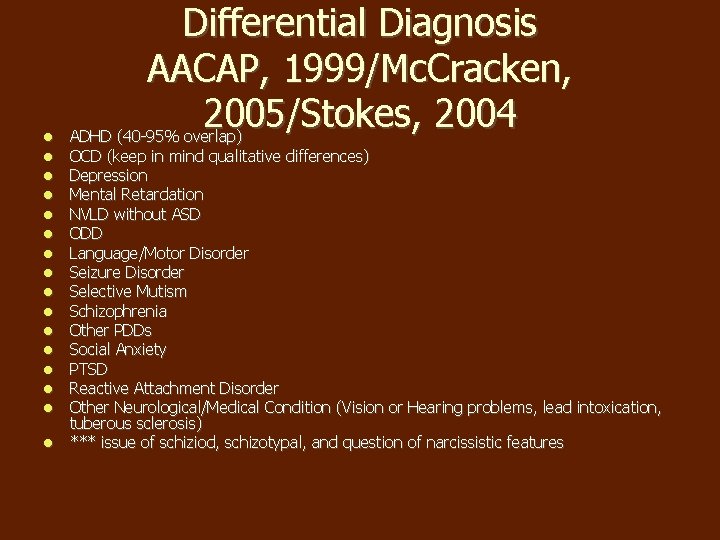
Differential Diagnosis AACAP, 1999/Mc. Cracken, 2005/Stokes, 2004 ADHD (40 -95% overlap) OCD (keep in mind qualitative differences) Depression Mental Retardation NVLD without ASD ODD Language/Motor Disorder Seizure Disorder Selective Mutism Schizophrenia Other PDDs Social Anxiety PTSD Reactive Attachment Disorder Other Neurological/Medical Condition (Vision or Hearing problems, lead intoxication, tuberous sclerosis) *** issue of schiziod, schizotypal, and question of narcissistic features
Skills Training Anxiety management/Emotional Regulation Positive Behavior Support Cognitive-Behavioral Interventions Social Skills…. . Social Connections…. Social Opportunities Give parents the coaching they need, the tools they need to build the skills in the community/at home
Skills Training cont. Applied Behavior Analysis (ABA) DIR model (Floortime) Many other models (ie CERTS, Ziggurat, etc)
My favorite things… Visual Schedules Make the link as often as possible between visual-verbal Social Stories Social recreational groups 5 point scale First---then boards Visual Countdowns Using the high interest area!!! OCALI internet modules (autisminternetmodules. org) HANDS in autism (www. handsinautism. org)
Social-Emotional learning SEL, Emotional IQ, Social IQ Components: Goleman/CASEL (www. casel. org) Self-awareness Self-management Knowing your feelings and how they influence choices/behavior Regulating, controlling, motivating to achieve personal and social goal Social awareness Perspective-taking, empathy, similarities/differences
SEL cont… Relationship Skills/management Reflective listening, clear communication, conflict management, positive relationships, resisting negative pressure Responsible Making decision-making sound responsible, ethical decisions based on good problem-solving skills and being accountable for those decisions/outcomes
Schools and SEL 2004 - Illinois adopted SEL standards for education and performance indicators SEL becomes a part of the educational curriculum With associated benchmarks for elementary, middle, jr high, and highschool See handouts
Schools and SEL Many places to locate information about solid SEL programs CASEL; Dept of Education; SAMHSA; OJJDP Programs should be “SAFE” Sequenced—building skills step by step—lessons introduced incrementally over time/grades Active- active/experiential learning experience-role plays, behavioral rehearsal Focused-is sufficient time devoted to SEL development Explicit- target specific SEL skills
Examples of Lessons (JCCP, 2010) Feeling words Feeling faces/developing mood meters External cues on others Internal Cues for self Differentiating feelings and behaviors Making and sustaining friendships Good manners Taking turns Sharing Making up after conflict Reflective listening Communicating your viewpoint
Examples of Lessons (JCCP, 2010) Problem-solving skills PATHS Control Signal Poster Red- STOP Calm Down Yellow- GO SLOW Think Green- GO Try my plan Class/milieu mailbox for concerns/problems for “problem-solving meetings” Homework for SEL concepts---get parents involved
WHY talk about SEL globally? Consistent with PBS model Youth diagnosed on the spectrum need this input however…. . So do a lot of children of elementary age and it positively impacts achievement scores and proactively/preventatively addresses bullying issues, emotiona/behavioral problems, social issues, etc Recent meta-analysis of 213 SEL programs found 11 percentage pt gains on achievement tests (in press, Durlack, Weissberg)
Final thoughts Lord, 2007: Early intervention has been associated with 10 -20 point gains on IQ testing Nonverbal IQ more relevant to comparison and outcome: Using nonverbal problem-solving performance as base to compare social and communicative impairments Individuals with a nonverbal IQ less than 70= decreased likelihood of independent living Individuals with borderline to average IQ scores greater likelihood of achieving independence
Final Thoughts Lord, 2007: Practitioners who had seen more than 25 youth with ASD more reliable diagnosticians Two heads are better than one applies to improving reliability and validity of diagnosis