Author John Waters Natural Law Socratic Ideas Limited

- Slides: 67
Author: John Waters Natural Law Socratic Ideas Limited © All Rights Reserved
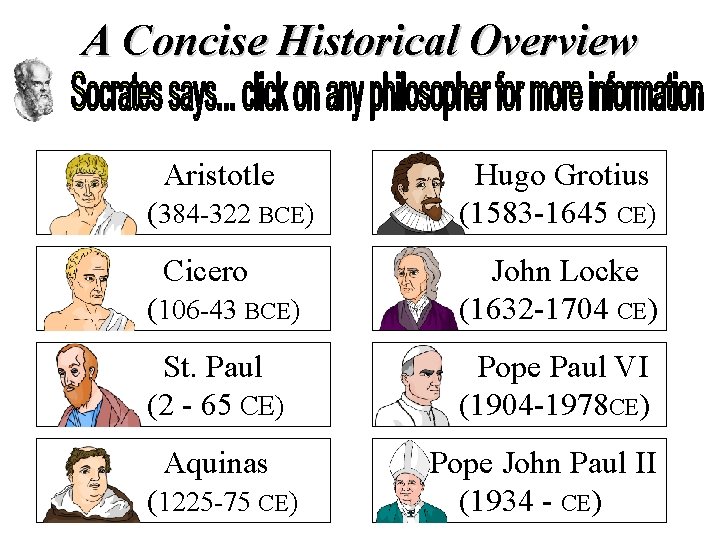
A Concise Historical Overview Aristotle (384 -322 BCE) Hugo Grotius (1583 -1645 CE) Cicero (106 -43 BCE) John Locke (1632 -1704 CE) St. Paul (2 - 65 CE) Pope Paul VI (1904 -1978 CE) Aquinas (1225 -75 CE) Pope John Paul II (1934 - CE)
Clarifying the difference between Laws of Nature and Natural Law LAWS OF NATURE Universal laws of science understood by analysing the physical world. e. g. Copernicus’s heliocentric universe or Einstein’s Theory of Relativity. Descriptive Laws Simply stating what IS scientifically, factually the case NATURAL LAW Concerned with the moral law of how human beings should behave. It is understood by reflecting on human nature and rationally working out what leads to happiness. Prescriptive Laws Recommending a particular way of behaving; what one OUGHT to do.
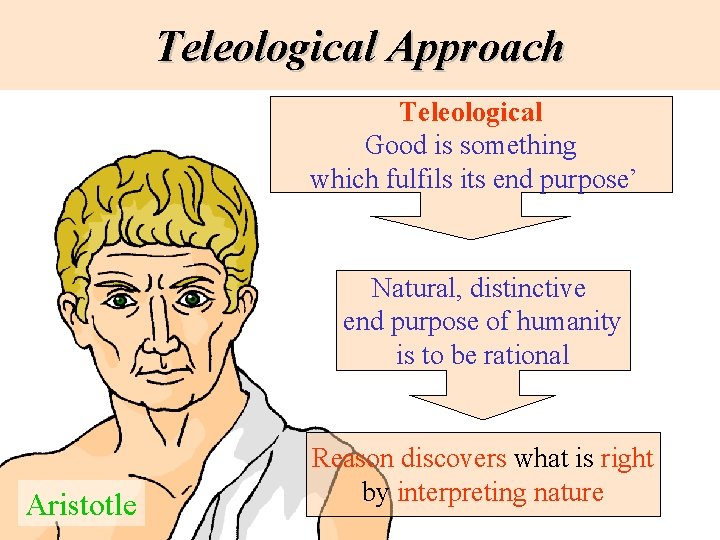
Teleological Approach Teleological Good is something which fulfils its end purpose’ Natural, distinctive end purpose of humanity is to be rational Aristotle Reason discovers what is right by interpreting nature
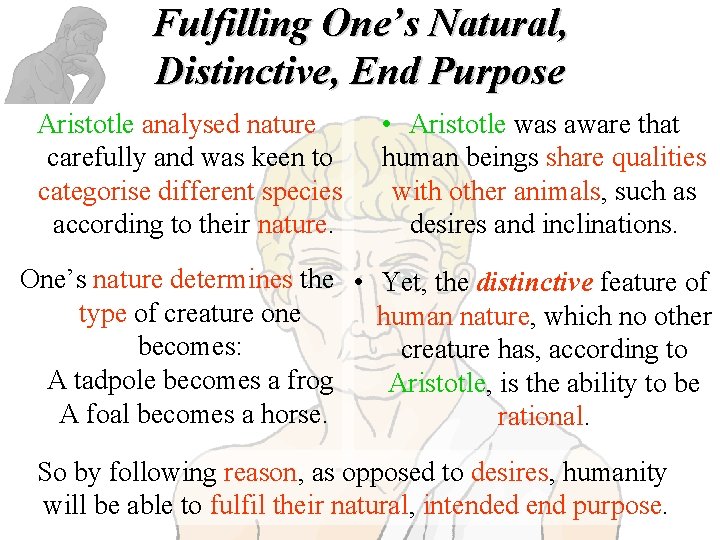
Fulfilling One’s Natural, Distinctive, End Purpose Aristotle analysed nature carefully and was keen to categorise different species according to their nature. • Aristotle was aware that human beings share qualities with other animals, such as desires and inclinations. One’s nature determines the • Yet, the distinctive feature of type of creature one human nature, which no other becomes: creature has, according to A tadpole becomes a frog Aristotle, is the ability to be A foal becomes a horse. rational. So by following reason, as opposed to desires, humanity will be able to fulfil their natural, intended end purpose.
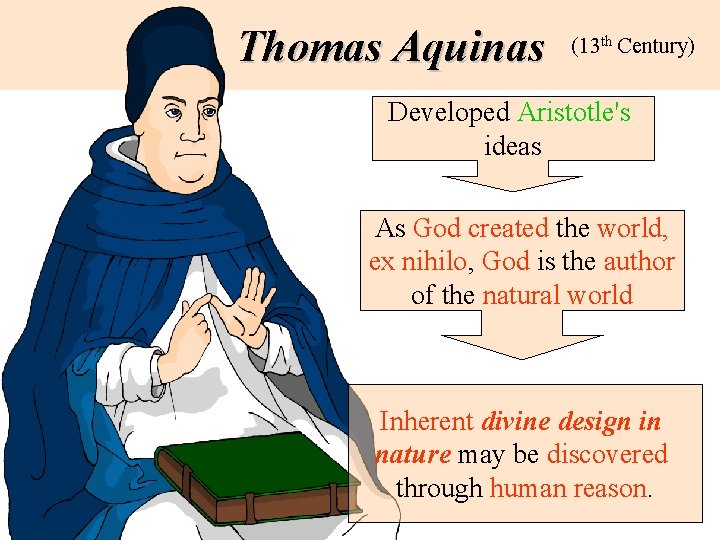
Thomas Aquinas (13 th Century) Developed Aristotle's ideas As God created the world, ex nihilo, God is the author of the natural world Inherent divine design in nature may be discovered through human reason.
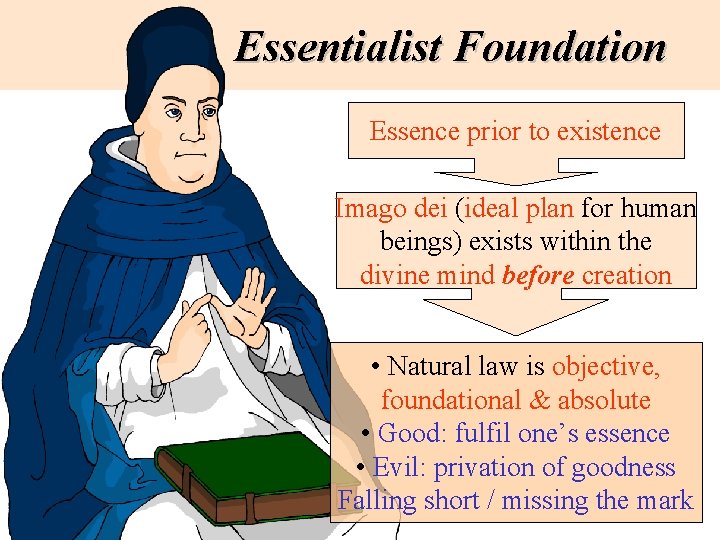
Essentialist Foundation Essence prior to existence Imago dei (ideal plan for human beings) exists within the divine mind before creation • Natural law is objective, foundational & absolute • Good: fulfil one’s essence • Evil: privation of goodness Falling short / missing the mark
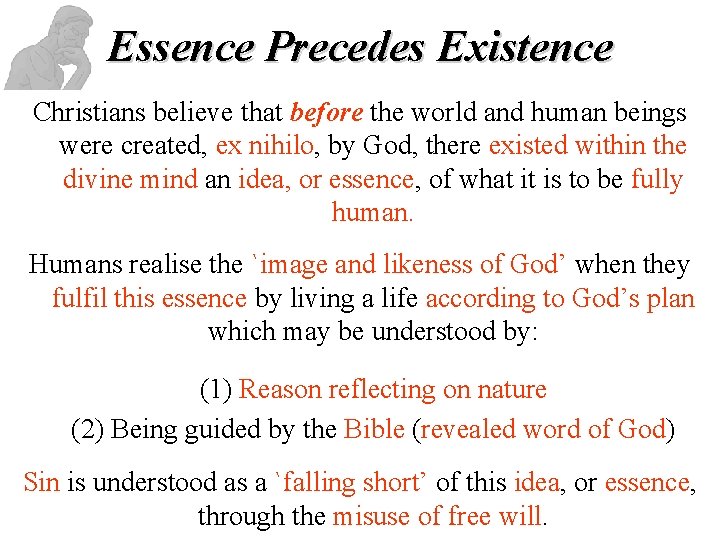
Essence Precedes Existence Christians believe that before the world and human beings were created, ex nihilo, by God, there existed within the divine mind an idea, or essence, of what it is to be fully human. Humans realise the `image and likeness of God’ when they fulfil this essence by living a life according to God’s plan which may be understood by: (1) Reason reflecting on nature (2) Being guided by the Bible (revealed word of God) Sin is understood as a `falling short’ of this idea, or essence, through the misuse of free will.
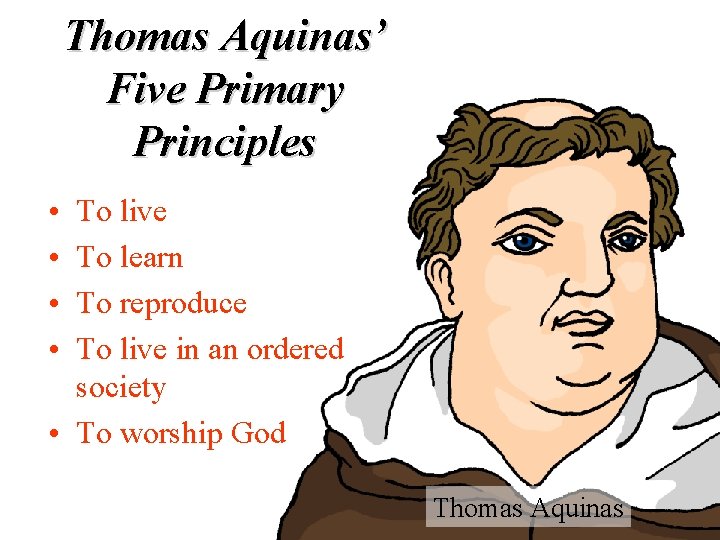
Thomas Aquinas’ Five Primary Principles • • To live To learn To reproduce To live in an ordered society • To worship God Thomas Aquinas
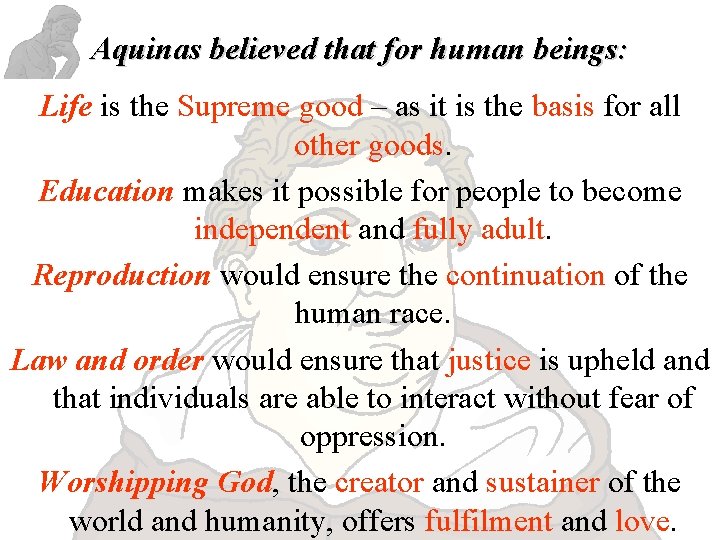
Aquinas believed that for human beings: Life is the Supreme good – as it is the basis for all other goods. Education makes it possible for people to become independent and fully adult. Reproduction would ensure the continuation of the human race. Law and order would ensure that justice is upheld and that individuals are able to interact without fear of oppression. Worshipping God, the creator and sustainer of the world and humanity, offers fulfilment and love.
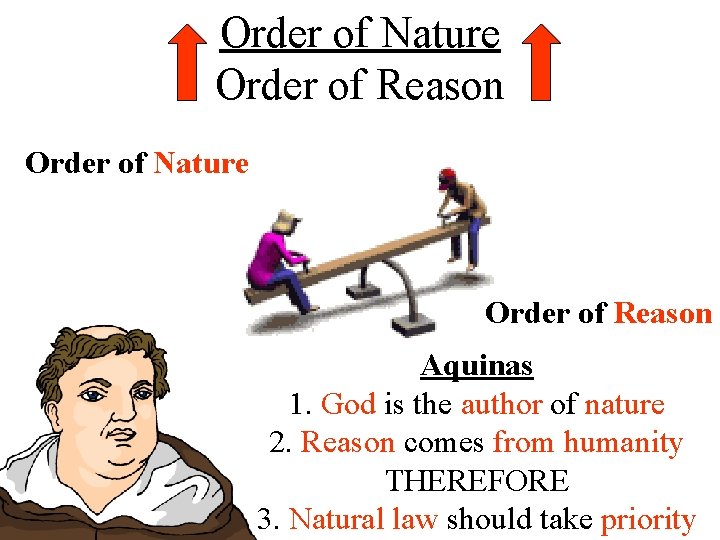
Order of Nature Order of Reason Aquinas 1. God is the author of nature 2. Reason comes from humanity THEREFORE 3. Natural law should take priority
Nature Is Superior To Reason Aquinas maintained that as nature is created by God, ex nihilo, it has an inherent design which reflects the will, purpose and goodness of the divine creator. Therefore in the medieval period the natural order of the world had greater status than human reason – as God’s design is superior to human reason. Furthermore, it was thought that a consequence of the Fall was the corruption of human reason.
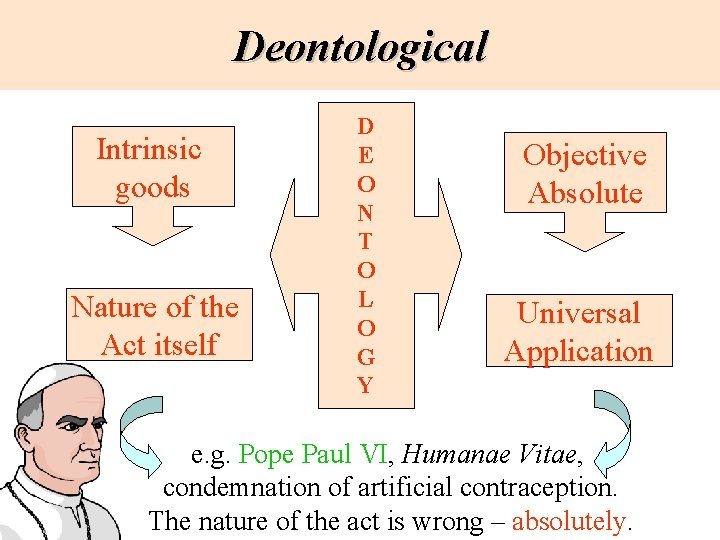
Deontological Intrinsic goods Nature of the Act itself D E O N T O L O G Y Objective Absolute Universal Application e. g. Pope Paul VI, Humanae Vitae, condemnation of artificial contraception. The nature of the act is wrong – absolutely.
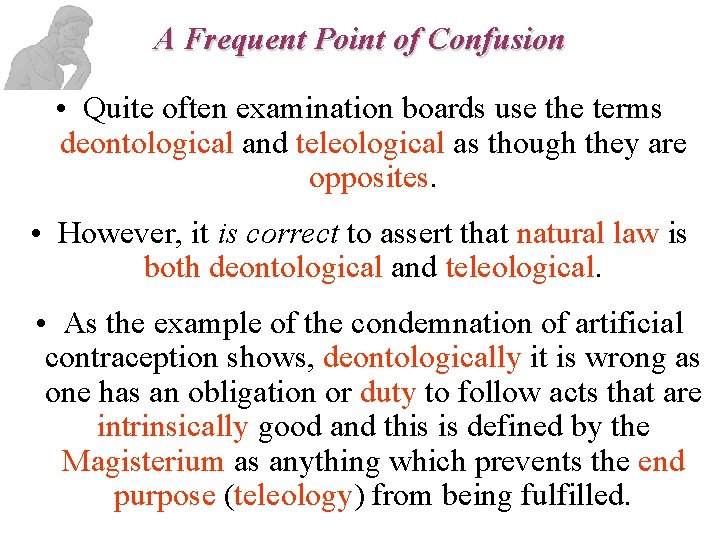
A Frequent Point of Confusion • Quite often examination boards use the terms deontological and teleological as though they are opposites. • However, it is correct to assert that natural law is both deontological and teleological. • As the example of the condemnation of artificial contraception shows, deontologically it is wrong as one has an obligation or duty to follow acts that are intrinsically good and this is defined by the Magisterium as anything which prevents the end purpose (teleology) from being fulfilled.
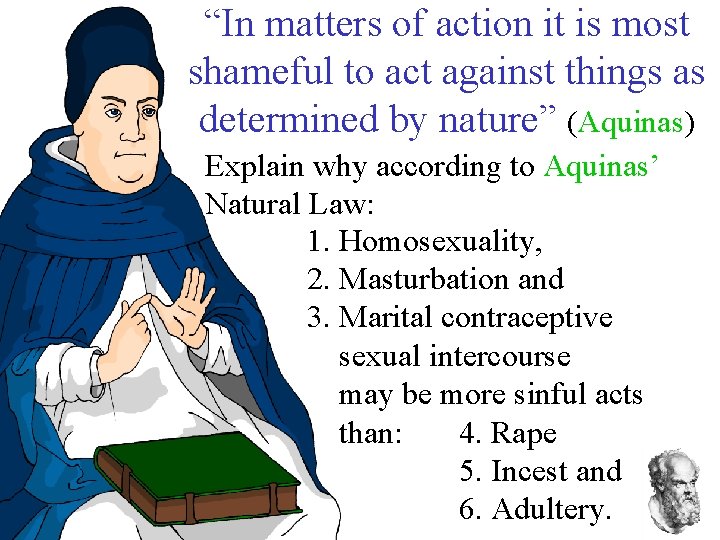
“In matters of action it is most shameful to act against things as determined by nature” (Aquinas) Explain why according to Aquinas’ Natural Law: 1. Homosexuality, 2. Masturbation and 3. Marital contraceptive sexual intercourse may be more sinful acts than: 4. Rape 5. Incest and 6. Adultery.
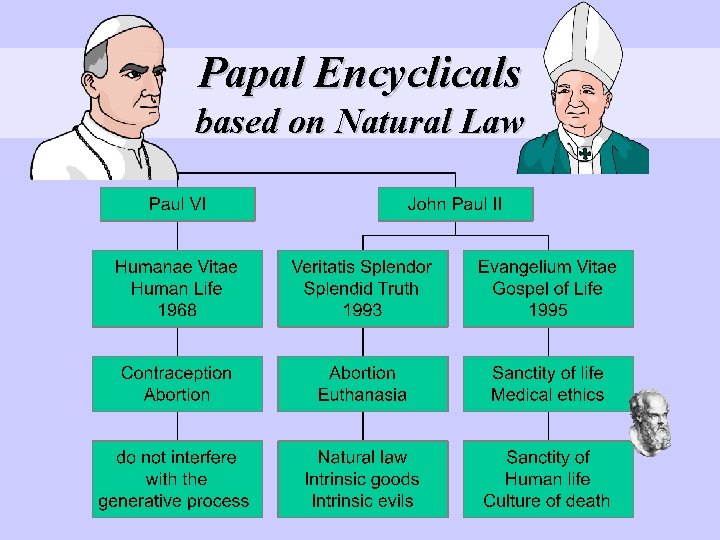
Papal Encyclicals based on Natural Law
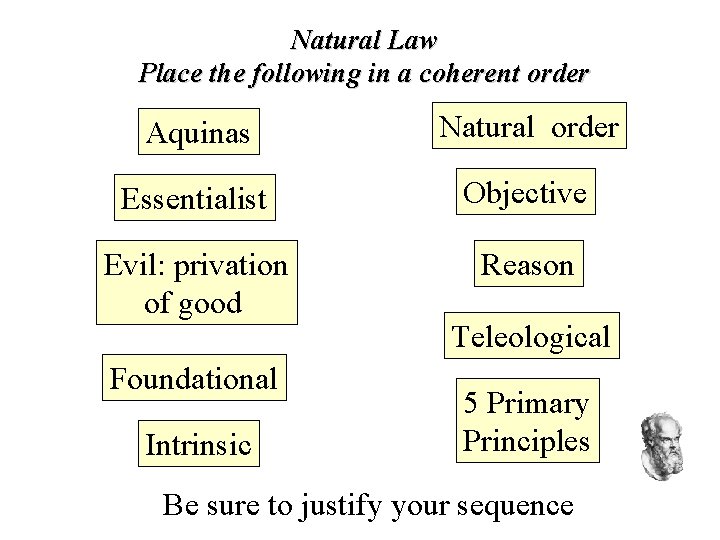
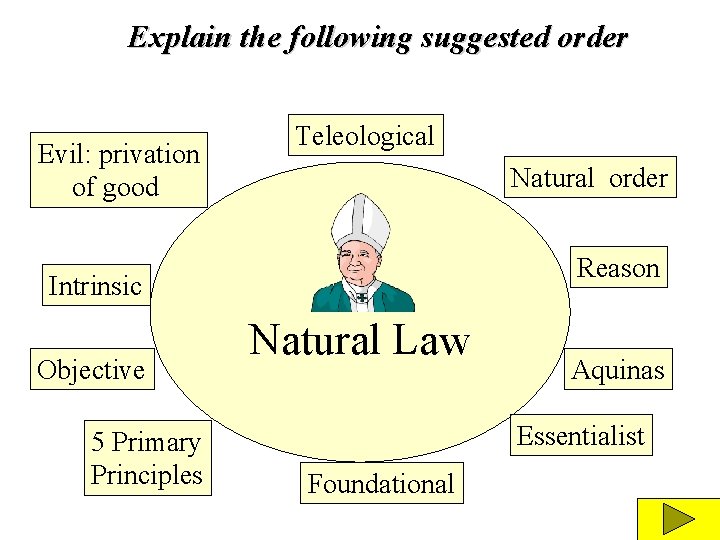
Natural Law Place the following in a coherent order Aquinas Natural order Essentialist Objective Evil: privation of good Reason Foundational Intrinsic Teleological 5 Primary Principles Be sure to justify your sequence
Benefits of Natural Law
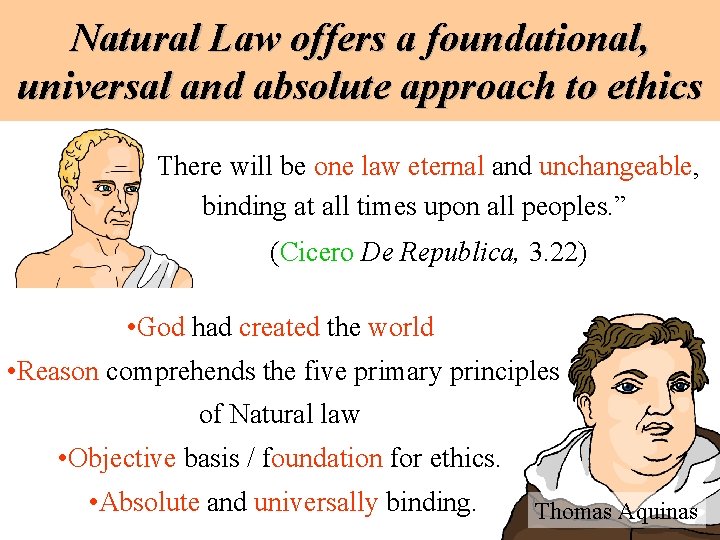
Natural Law offers a foundational, universal and absolute approach to ethics There will be one law eternal and unchangeable, binding at all times upon all peoples. ” (Cicero De Republica, 3. 22) • God had created the world • Reason comprehends the five primary principles of Natural law • Objective basis / foundation for ethics. • Absolute and universally binding. Thomas Aquinas
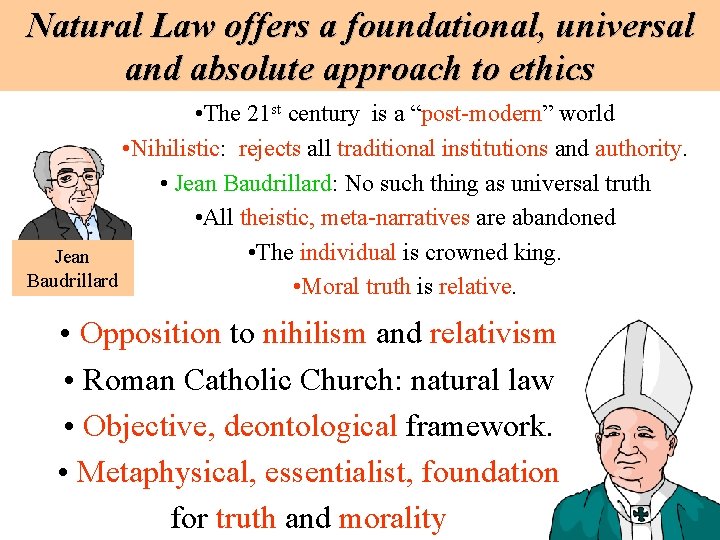
Natural Law offers a foundational, universal and absolute approach to ethics • The 21 st century is a “post-modern” world • Nihilistic: rejects all traditional institutions and authority. • Jean Baudrillard: No such thing as universal truth • All theistic, meta-narratives are abandoned • The individual is crowned king. Jean Baudrillard • Moral truth is relative. • Opposition to nihilism and relativism • Roman Catholic Church: natural law • Objective, deontological framework. • Metaphysical, essentialist, foundation for truth and morality
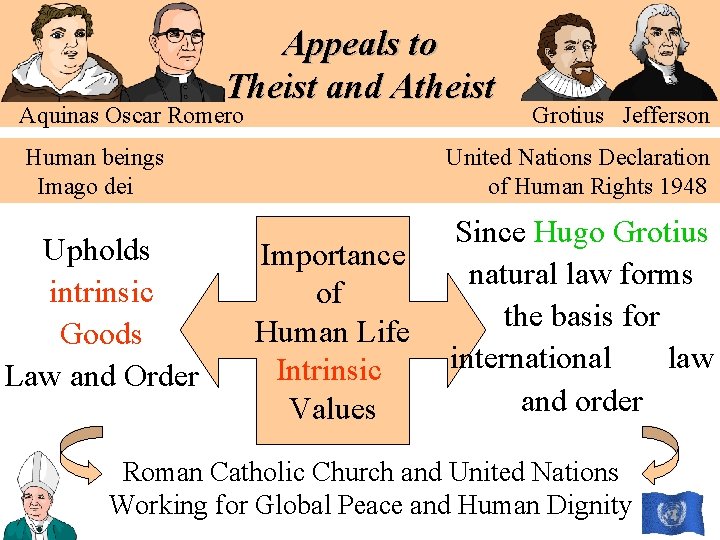
Appeals to Theist and Atheist Aquinas Oscar Romero Grotius Jefferson Human beings United Nations Declaration Imago dei of Human Rights 1948 Upholds intrinsic Goods Law and Order Importance of Human Life Intrinsic Values Since Hugo Grotius natural law forms the basis for international law and order Roman Catholic Church and United Nations Working for Global Peace and Human Dignity
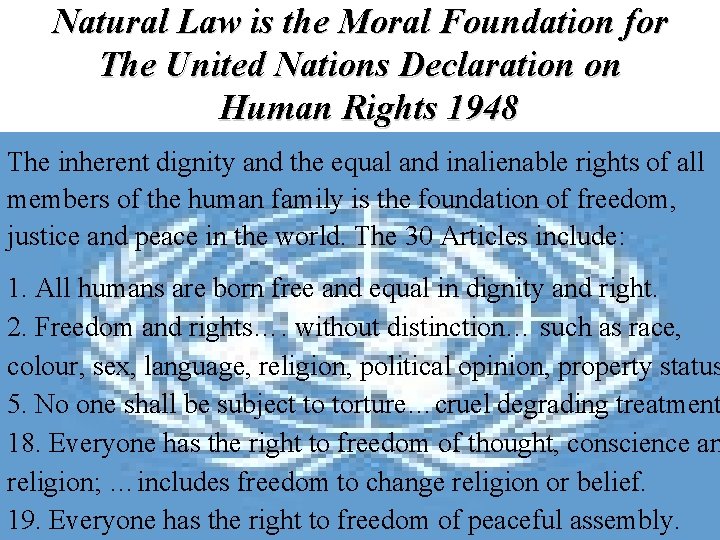
Natural Law is the Moral Foundation for The United Nations Declaration on Human Rights 1948 The inherent dignity and the equal and inalienable rights of all members of the human family is the foundation of freedom, justice and peace in the world. The 30 Articles include: 1. All humans are born free and equal in dignity and right. 2. Freedom and rights…. without distinction… such as race, colour, sex, language, religion, political opinion, property status 5. No one shall be subject to torture…cruel degrading treatment 18. Everyone has the right to freedom of thought, conscience an religion; …includes freedom to change religion or belief. 19. Everyone has the right to freedom of peaceful assembly.
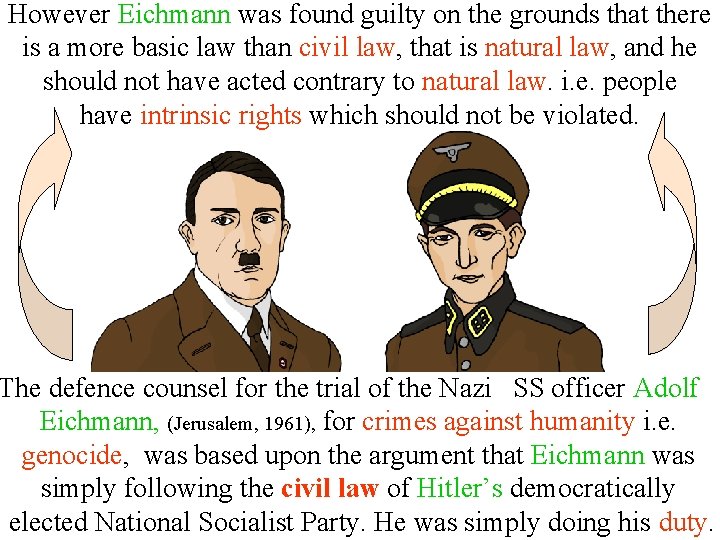
However Eichmann was found guilty on the grounds that there is a more basic law than civil law, that is natural law, and he should not have acted contrary to natural law. i. e. people have intrinsic rights which should not be violated. The defence counsel for the trial of the Nazi SS officer Adolf Eichmann, (Jerusalem, 1961), for crimes against humanity i. e. genocide, was based upon the argument that Eichmann was simply following the civil law of Hitler’s democratically elected National Socialist Party. He was simply doing his duty.
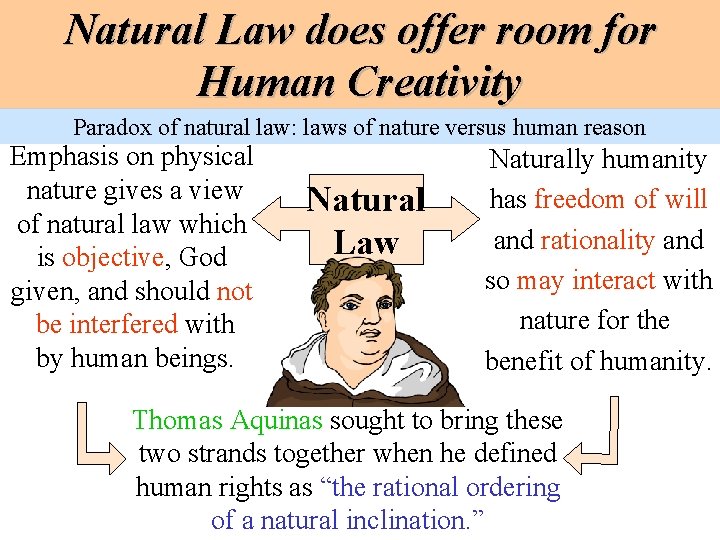
Natural Law does offer room for Human Creativity Paradox of natural law: laws of nature versus human reason Emphasis on physical nature gives a view of natural law which is objective, God given, and should not be interfered with by human beings. Natural Law Naturally humanity has freedom of will and rationality and so may interact with nature for the benefit of humanity. Thomas Aquinas sought to bring these two strands together when he defined human rights as “the rational ordering of a natural inclination. ”
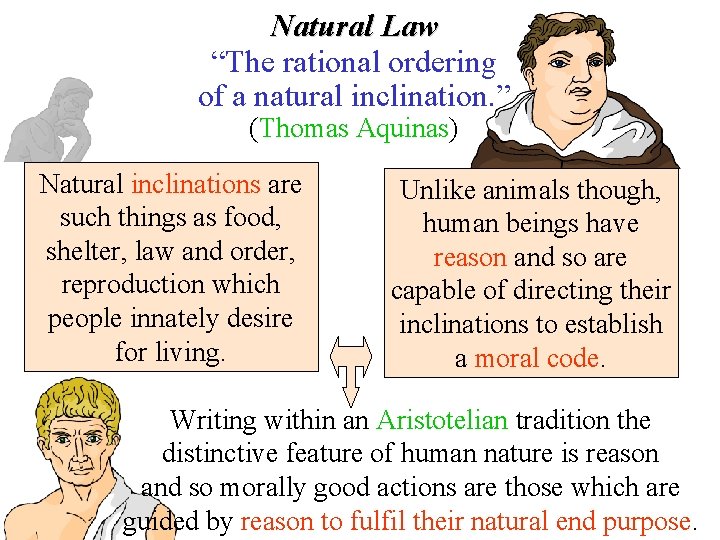
Natural Law “The rational ordering of a natural inclination. ” (Thomas Aquinas) Natural inclinations are such things as food, shelter, law and order, reproduction which people innately desire for living. Unlike animals though, human beings have reason and so are capable of directing their inclinations to establish a moral code. Writing within an Aristotelian tradition the distinctive feature of human nature is reason and so morally good actions are those which are guided by reason to fulfil their natural end purpose.
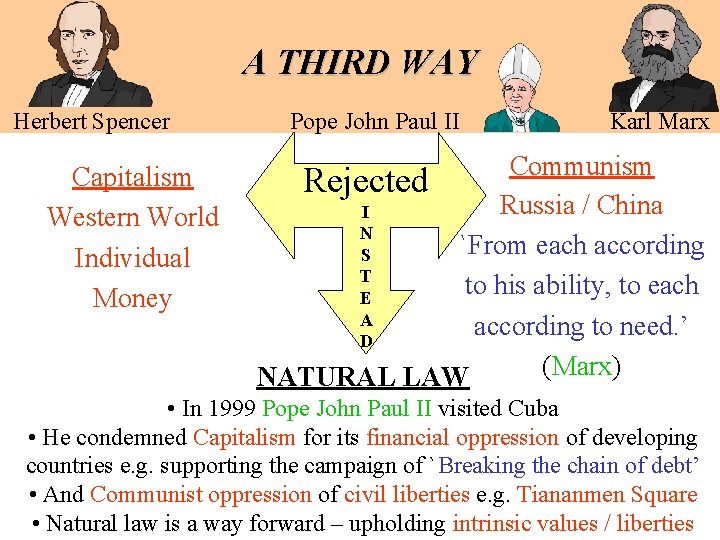
A THIRD WAY Herbert Spencer Pope John Paul II Karl Marx Capitalism Western World Individual Money Communism Rejected Russia / China I N `From each according S T to his ability, to each E A according to need. ’ D (Marx) NATURAL LAW • In 1999 Pope John Paul II visited Cuba • He condemned Capitalism for its financial oppression of developing countries e. g. supporting the campaign of `Breaking the chain of debt’ • And Communist oppression of civil liberties e. g. Tiananmen Square • Natural law is a way forward – upholding intrinsic values / liberties
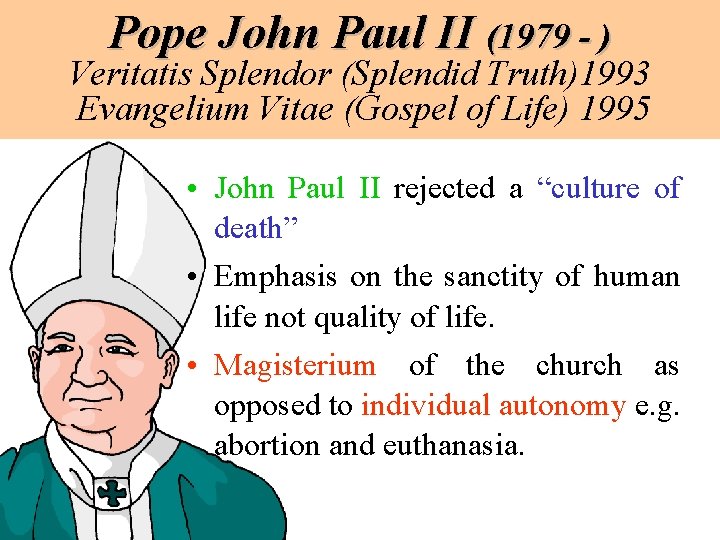
Pope John Paul II (1979 - ) Veritatis Splendor (Splendid Truth)1993 Evangelium Vitae (Gospel of Life) 1995 • John Paul II rejected a “culture of death” • Emphasis on the sanctity of human life not quality of life. • Magisterium of the church as opposed to individual autonomy e. g. abortion and euthanasia.
Problems of Natural Law
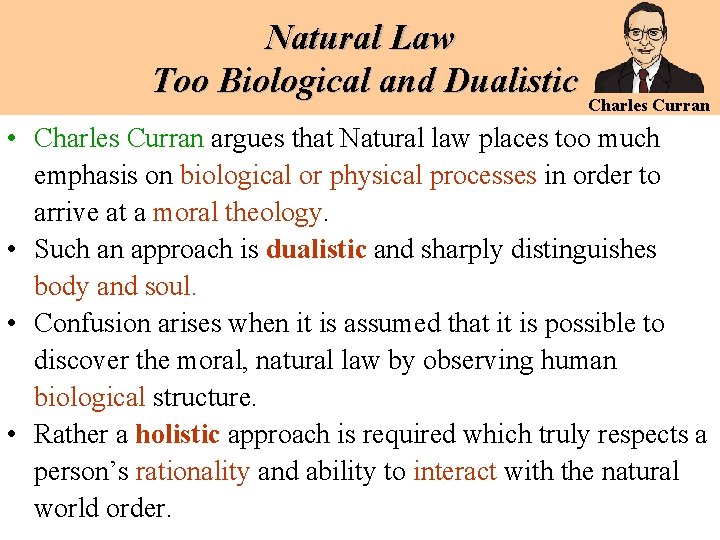
Natural Law Too Biological and Dualistic Charles Curran • Charles Curran argues that Natural law places too much emphasis on biological or physical processes in order to arrive at a moral theology. • Such an approach is dualistic and sharply distinguishes body and soul. • Confusion arises when it is assumed that it is possible to discover the moral, natural law by observing human biological structure. • Rather a holistic approach is required which truly respects a person’s rationality and ability to interact with the natural world order.
Natural Law Too Biological and Dualistic Charles Curran considers that there has been a vast change in outlook between the medieval period and the present day. He argues that “before modern times people knew they could not control nature, and therefore they thought principally of conforming to it. Reason then became identified with the order of nature. By contrast we live in a scientific and technological society. We know of the endless process of change in the natural world. And we know that human beings can in many ways intervene in natural processes and shape the world for greater human happiness. ”
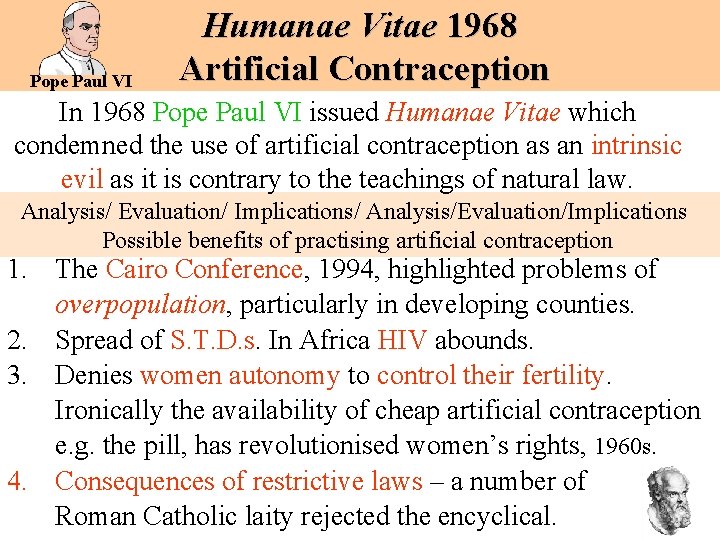
Pope Paul VI Humanae Vitae 1968 Artificial Contraception In 1968 Pope Paul VI issued Humanae Vitae which condemned the use of artificial contraception as an intrinsic evil as it is contrary to the teachings of natural law. Analysis/ Evaluation/ Implications/ Analysis/Evaluation/Implications Possible benefits of practising artificial contraception 1. The Cairo Conference, 1994, highlighted problems of overpopulation, particularly in developing counties. 2. Spread of S. T. D. s. In Africa HIV abounds. 3. Denies women autonomy to control their fertility. Ironically the availability of cheap artificial contraception e. g. the pill, has revolutionised women’s rights, 1960 s. 4. Consequences of restrictive laws – a number of Roman Catholic laity rejected the encyclical.
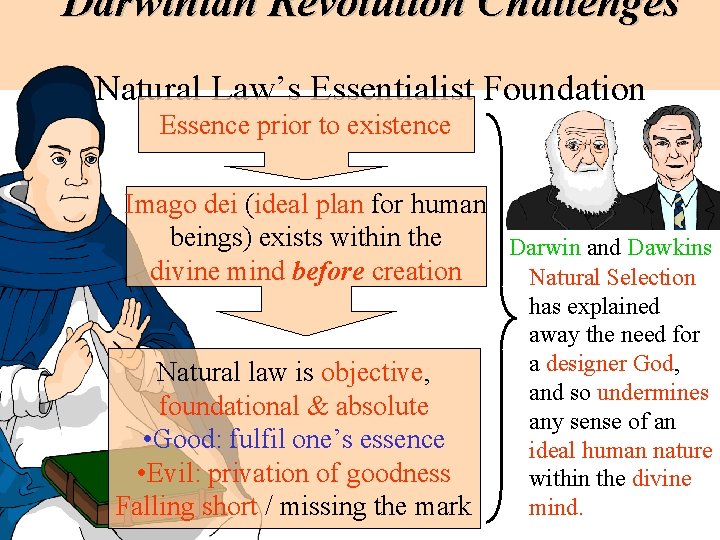
Darwinian Revolution Challenges Natural Law’s Essentialist Foundation Essence prior to existence Imago dei (ideal plan for human beings) exists within the Darwin and Dawkins divine mind before creation Natural Selection Natural law is objective, foundational & absolute • Good: fulfil one’s essence • Evil: privation of goodness Falling short / missing the mark has explained away the need for a designer God, and so undermines any sense of an ideal human nature within the divine mind.
The very premise of Roman Catholic teaching about natural law – i. e. one ideal view of human nature existing before creation within the divine mind is challenged by …. . Charles Darwin and Richard Dawkins. Darwinian Natural Selection offers a comprehensive account as to why there is design in the world: “design occurs through a process of step by step evolution guided by non random survival. ” (Dawkins) Design does not lie in the past, but is continually evolving; so if anything design is seen to lie in the future. Talk of artificial contraception as being unnatural, a falling short of God’s intended purpose, makes no sense at all – there is nothing to fall short of.
Only ONE human nature? e. g. sexuality • Hetero? • Homo? • Auto? • Bi? • Bestial? • In vitro? • AIH • AID • Surgical Sperm Recovery? A serious criticism of Natural Law is that it is questionable as to whethere is just one universally accepted view of human nature. e. g. within the arena of sexual ethics it is argued that 5 -10% of people are naturally gay or lesbian. This criticism undermines the absolute understanding of natural law – as a person who is naturally (genetically) gay is being good when having homosexual intercourse as this fulfils their natural end purpose, as designed by God.
Natural Law: Only One End Purpose? According to Roman Catholic teaching the natural end purpose of sexual intercourse is reproduction. “A man should never make love to his wife for pleasure. When it was necessary to make love to produce children the man should descend with a certain sense of sadness to his regrettable task. ” (St. Augustine, Confessions) However the Church of England considers sexual intercourse may be unitive or procreative. Sex being a beautiful gift from God to be shared in marriage. Rowan Williams Indeed, the Vatican II Council agreed that sexual intercourse could be procreative and unitive, though note, the key word here, due to natural law, is AND. Paul VI
Only ONE sexual position? (St Albert the Great – Aquinas’ esteemed teacher) Analysis/ Evaluation/ Implications/ Analysis/Evaluation/Implications Nature teaches that the proper position for intercourse is that the woman should be on her back and that the man lie on her belly…and women conceive more easily in this position than in others…Intercourse sideways is a minor deviation from this, sitting is greater, standing is greater still, and greatest of all is from behind, like beasts of burden. Some people have said that this last is a mortal sin, but I disagree with this. ( Sentences 4. 31. 24).
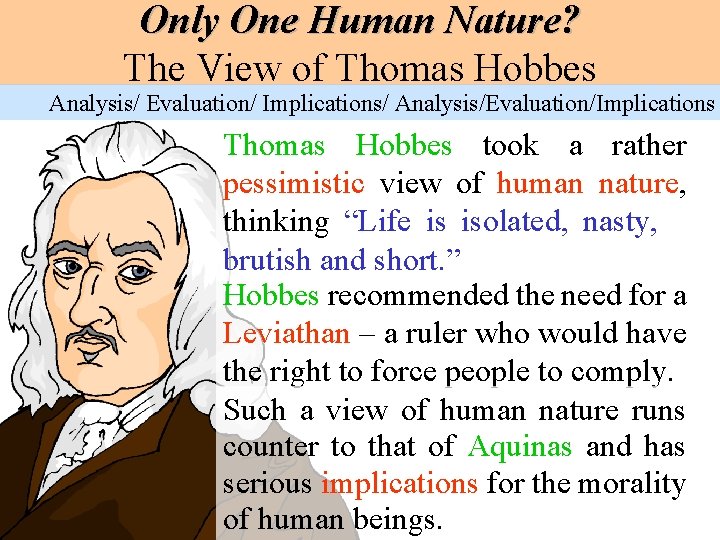
Only One Human Nature? The View of Thomas Hobbes Analysis/ Evaluation/ Implications/ Analysis/Evaluation/Implications Thomas Hobbes took a rather pessimistic view of human nature, thinking “Life is isolated, nasty, brutish and short. ” Hobbes recommended the need for a Leviathan – a ruler who would have the right to force people to comply. Such a view of human nature runs counter to that of Aquinas and has serious implications for the morality of human beings.
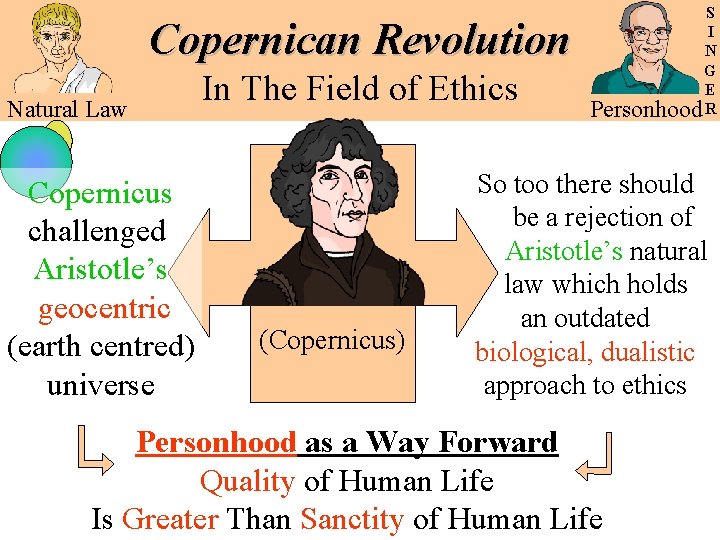
S I N G E Natural Law Personhood R Copernican Revolution In The Field of Ethics Copernicus challenged Aristotle’s geocentric (earth centred) universe (Copernicus) So too there should be a rejection of Aristotle’s natural law which holds an outdated biological, dualistic approach to ethics Personhood as a Way Forward Quality of Human Life Is Greater Than Sanctity of Human Life
• The Sanctity of Human Life, from the moment of conception, has been challenged by: • Charles Darwin, Origin of the Species, challenged the Biblical view that human beings were created in the imago dei with his theory of natural selection. Human beings are part of the evolutionary ladder. • Advances in medical technology means that it is able to prolong human life. e. g. life support machines, even though the quality of life may be minimal. • An increasingly secular society: rationalism, empiricism and biological reductionism have challenged metaphysical ideas of the human soul.
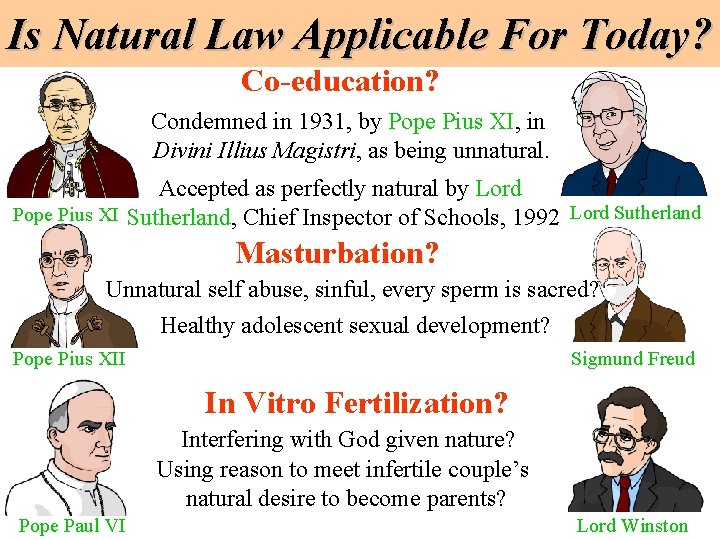
Is Natural Law Applicable For Today? Co-education? Condemned in 1931, by Pope Pius XI, in Divini Illius Magistri, as being unnatural. Accepted as perfectly natural by Lord Pope Pius XI Sutherland, Chief Inspector of Schools, 1992 Lord Sutherland Masturbation? Unnatural self abuse, sinful, every sperm is sacred? Healthy adolescent sexual development? Pope Pius XII Sigmund Freud In Vitro Fertilization? Interfering with God given nature? Using reason to meet infertile couple’s natural desire to become parents? Pope Paul VI Lord Winston
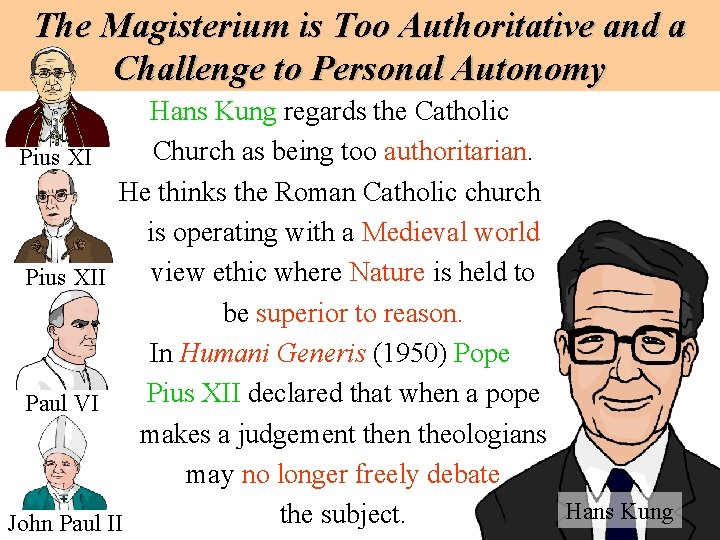
The Magisterium is Too Authoritative and a Challenge to Personal Autonomy Hans Kung regards the Catholic Church as being too authoritarian. Pius XI He thinks the Roman Catholic church is operating with a Medieval world view ethic where Nature is held to Pius XII be superior to reason. In Humani Generis (1950) Pope Pius XII declared that when a pope Paul VI makes a judgement then theologians may no longer freely debate Hans Kung the subject. John Paul II
Case Studies Application of Natural Law To Moral Issues
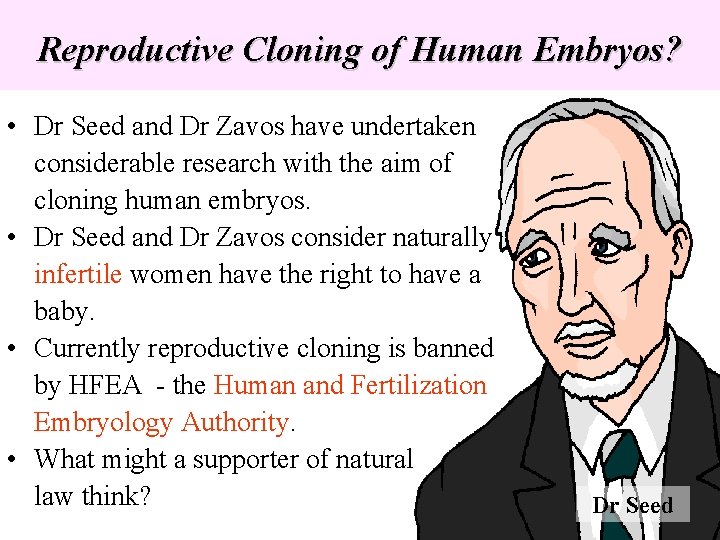
Reproductive Cloning of Human Embryos? • Dr Seed and Dr Zavos have undertaken considerable research with the aim of cloning human embryos. • Dr Seed and Dr Zavos consider naturally infertile women have the right to have a baby. • Currently reproductive cloning is banned by HFEA - the Human and Fertilization Embryology Authority. • What might a supporter of natural law think? Dr Seed
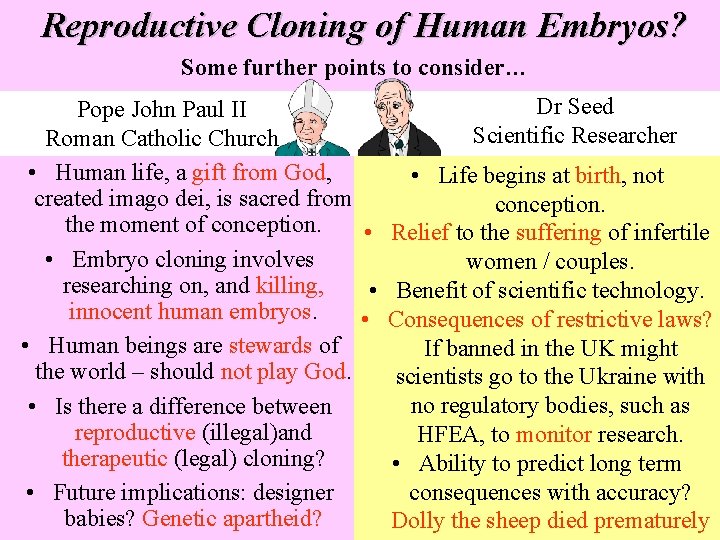
Reproductive Cloning of Human Embryos? Some further points to consider… Pope John Paul II Roman Catholic Church • Human life, a gift from God, created imago dei, is sacred from the moment of conception. • • Embryo cloning involves researching on, and killing, • innocent human embryos. • • Human beings are stewards of the world – should not play God. • Is there a difference between reproductive (illegal)and therapeutic (legal) cloning? • Future implications: designer babies? Genetic apartheid? Dr Seed Scientific Researcher • Life begins at birth, not conception. Relief to the suffering of infertile women / couples. Benefit of scientific technology. Consequences of restrictive laws? If banned in the UK might scientists go to the Ukraine with no regulatory bodies, such as HFEA, to monitor research. • Ability to predict long term consequences with accuracy? Dolly the sheep died prematurely
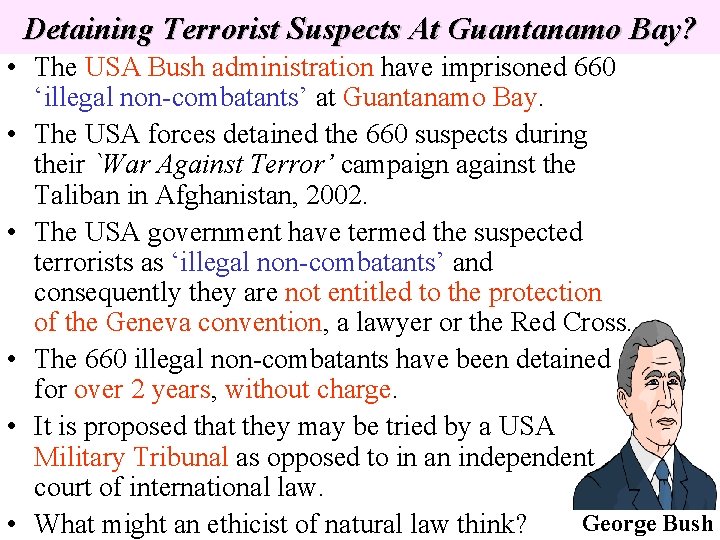
Detaining Terrorist Suspects At Guantanamo Bay? • The USA Bush administration have imprisoned 660 ‘illegal non-combatants’ at Guantanamo Bay. • The USA forces detained the 660 suspects during their `War Against Terror’ campaign against the Taliban in Afghanistan, 2002. • The USA government have termed the suspected terrorists as ‘illegal non-combatants’ and consequently they are not entitled to the protection of the Geneva convention, a lawyer or the Red Cross. • The 660 illegal non-combatants have been detained for over 2 years, without charge. • It is proposed that they may be tried by a USA Military Tribunal as opposed to in an independent court of international law. George Bush • What might an ethicist of natural law think?
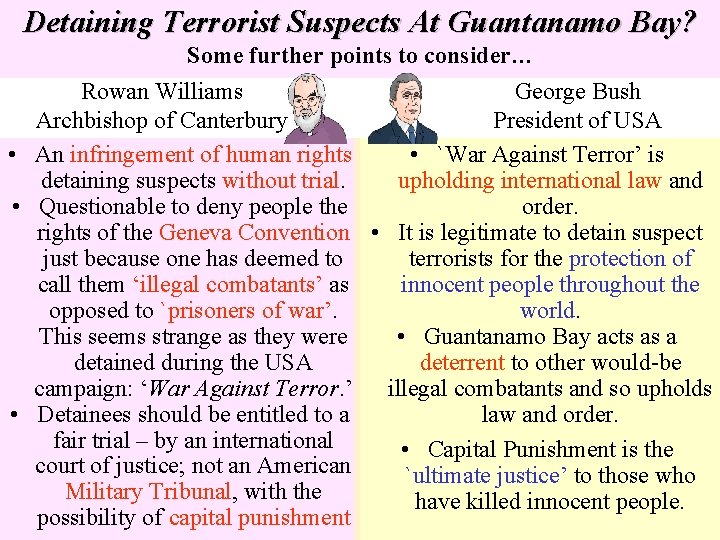
Detaining Terrorist Suspects At Guantanamo Bay? Some further points to consider… Rowan Williams George Bush Archbishop of Canterbury President of USA • An infringement of human rights • `War Against Terror’ is detaining suspects without trial. upholding international law and • Questionable to deny people the order. rights of the Geneva Convention • It is legitimate to detain suspect just because one has deemed to terrorists for the protection of call them ‘illegal combatants’ as innocent people throughout the opposed to `prisoners of war’. world. This seems strange as they were • Guantanamo Bay acts as a detained during the USA deterrent to other would-be campaign: ‘War Against Terror. ’ illegal combatants and so upholds • Detainees should be entitled to a law and order. fair trial – by an international • Capital Punishment is the court of justice; not an American `ultimate justice’ to those who Military Tribunal, with the have killed innocent people. possibility of capital punishment
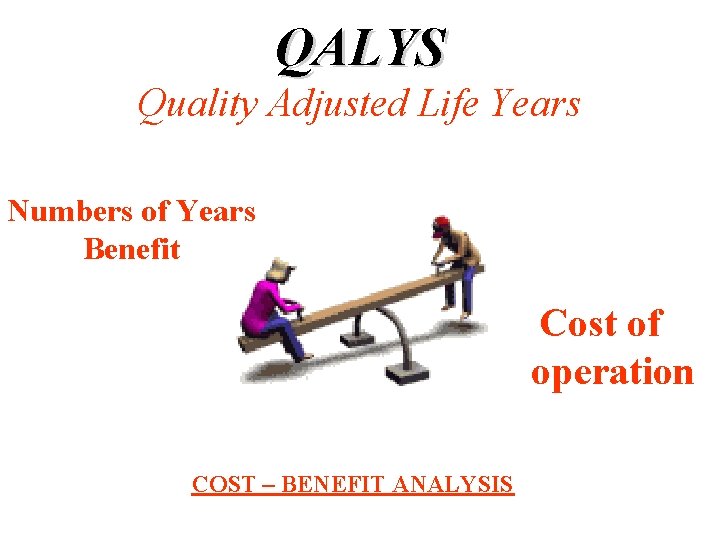
QALYS Quality Adjusted Life Years Numbers of Years Benefit Cost of operation COST – BENEFIT ANALYSIS
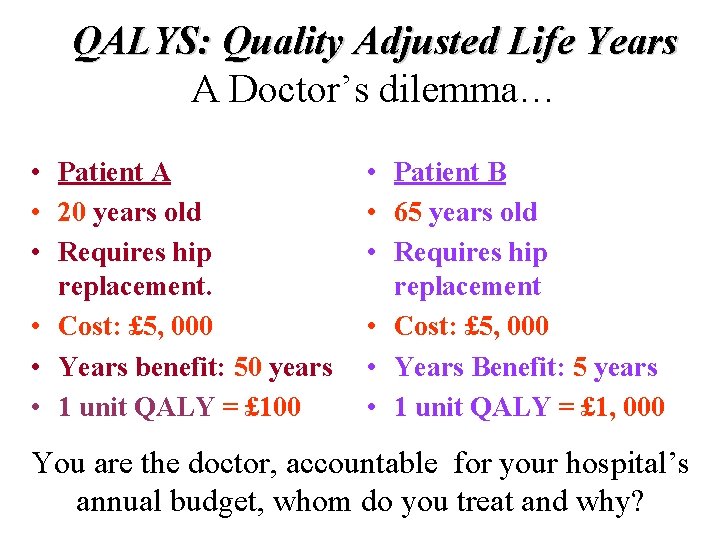
QALYS: Quality Adjusted Life Years A Doctor’s dilemma… • Patient A • 20 years old • Requires hip replacement. • Cost: £ 5, 000 • Years benefit: 50 years • 1 unit QALY = £ 100 • Patient B • 65 years old • Requires hip replacement • Cost: £ 5, 000 • Years Benefit: 5 years • 1 unit QALY = £ 1, 000 You are the doctor, accountable for your hospital’s annual budget, whom do you treat and why?
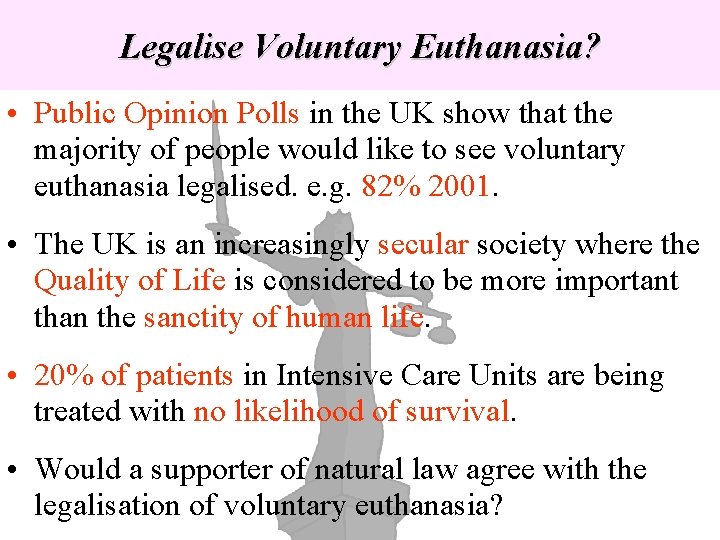
Legalise Voluntary Euthanasia? • Public Opinion Polls in the UK show that the majority of people would like to see voluntary euthanasia legalised. e. g. 82% 2001. • The UK is an increasingly secular society where the Quality of Life is considered to be more important than the sanctity of human life. • 20% of patients in Intensive Care Units are being treated with no likelihood of survival. • Would a supporter of natural law agree with the legalisation of voluntary euthanasia?
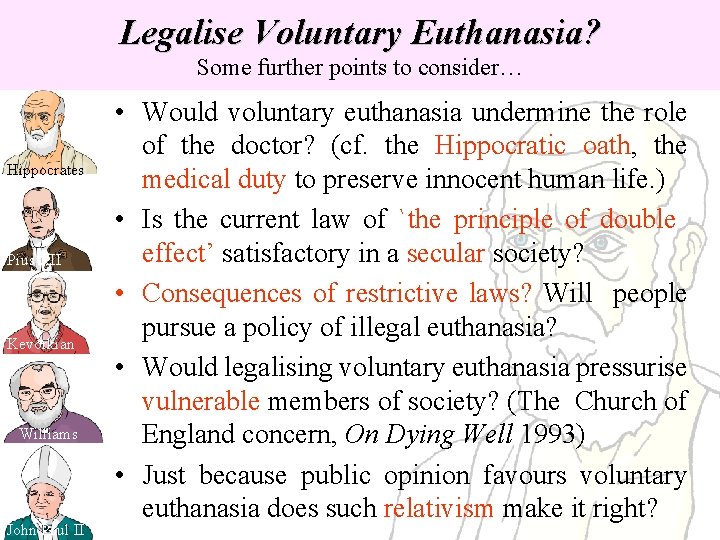
Legalise Voluntary Euthanasia? Some further points to consider… Hippocrates Pius XII Kevorkian Williams John Paul II • Would voluntary euthanasia undermine the role of the doctor? (cf. the Hippocratic oath, the medical duty to preserve innocent human life. ) • Is the current law of `the principle of double effect’ satisfactory in a secular society? • Consequences of restrictive laws? Will people pursue a policy of illegal euthanasia? • Would legalising voluntary euthanasia pressurise vulnerable members of society? (The Church of England concern, On Dying Well 1993) • Just because public opinion favours voluntary euthanasia does such relativism make it right?
Socrates Says Links
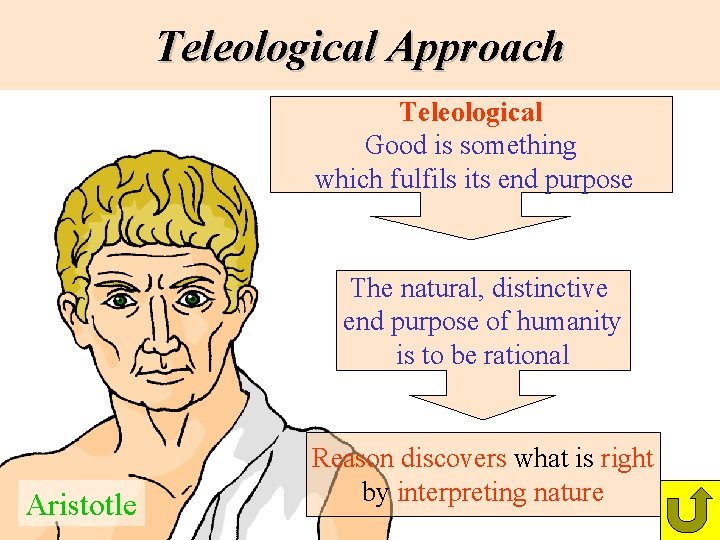
Teleological Approach Teleological Good is something which fulfils its end purpose The natural, distinctive end purpose of humanity is to be rational Aristotle Reason discovers what is right by interpreting nature
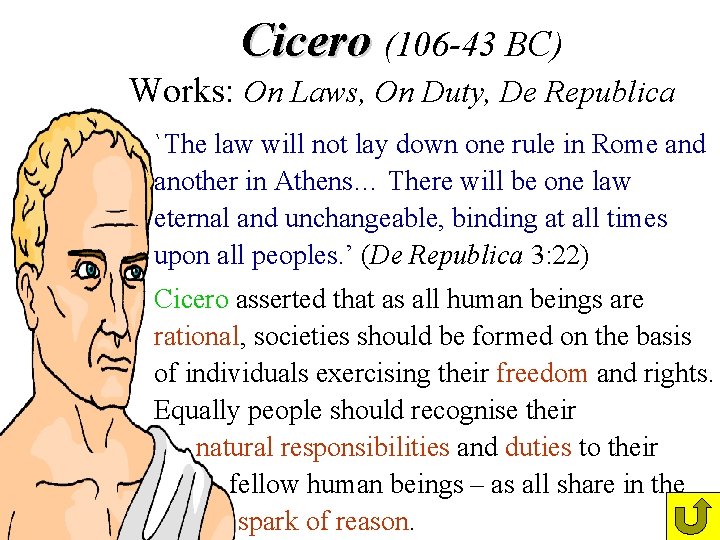
Cicero (106 -43 BC) Works: On Laws, On Duty, De Republica • `The law will not lay down one rule in Rome and another in Athens… There will be one law eternal and unchangeable, binding at all times upon all peoples. ’ (De Republica 3: 22) • Cicero asserted that as all human beings are rational, societies should be formed on the basis of individuals exercising their freedom and rights. Equally people should recognise their b…natural responsibilities and duties to their B……fellow human beings – as all share in the ……. spark of reason.
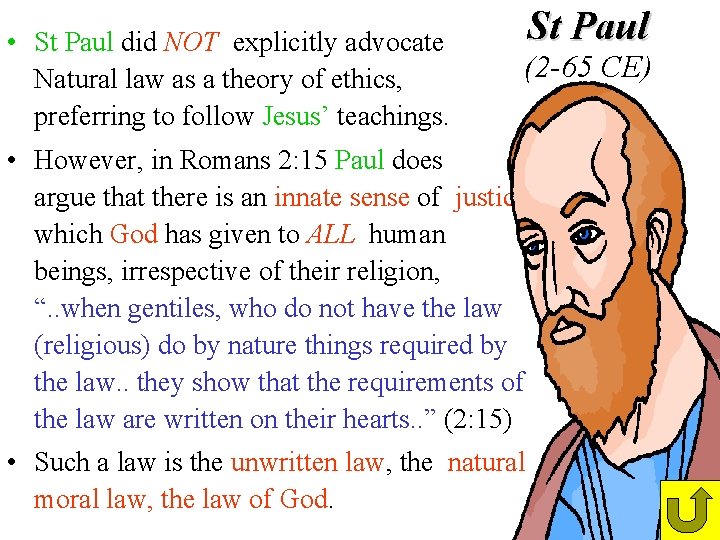
• St Paul did NOT explicitly advocate Natural law as a theory of ethics, preferring to follow Jesus’ teachings. St Paul (2 -65 CE) • However, in Romans 2: 15 Paul does argue that there is an innate sense of justice which God has given to ALL human beings, irrespective of their religion, “. . when gentiles, who do not have the law (religious) do by nature things required by the law. . they show that the requirements of the law are written on their hearts. . ” (2: 15) • Such a law is the unwritten law, the natural moral law, the law of God.
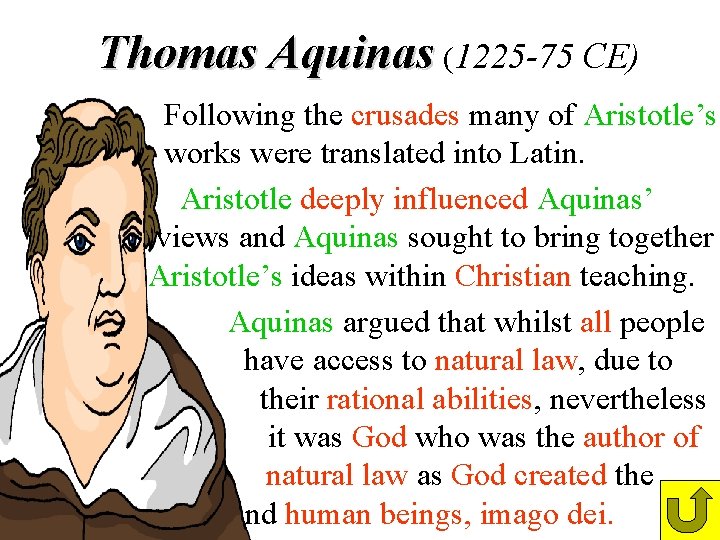
Thomas Aquinas (1225 -75 CE) • Following the crusades many of Aristotle’s . works were translated into Latin. • Aristotle deeply influenced Aquinas’ . views and Aquinas sought to bring together Aristotle’s ideas within Christian teaching. • Aquinas argued that whilst all people …. . have access to natural law, due to …… their rational abilities, nevertheless …. it was God who was the author of B…… natural law as God created the …. … world and human beings, imago dei.
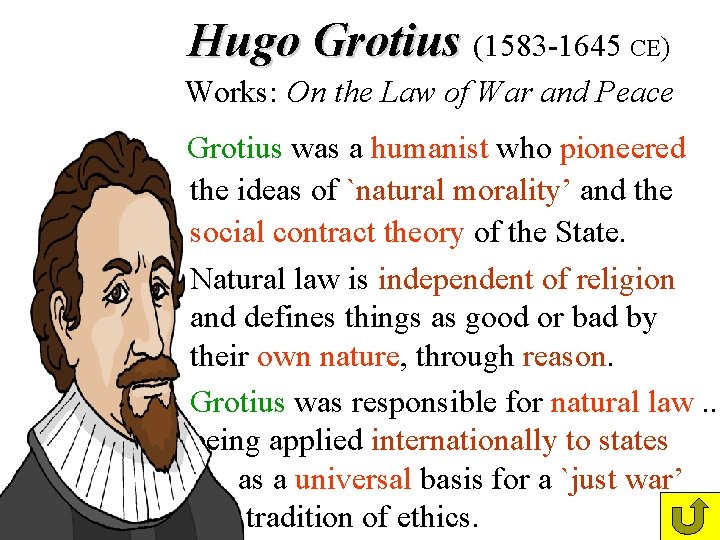
Hugo Grotius (1583 -1645 CE) Works: On the Law of War and Peace Grotius was a humanist who pioneered the ideas of `natural morality’ and the social contract theory of the State. • Natural law is independent of religion and defines things as good or bad by their own nature, through reason. • Grotius was responsible for natural law. . being applied internationally to states … as a universal basis for a `just war’ b…. tradition of ethics.
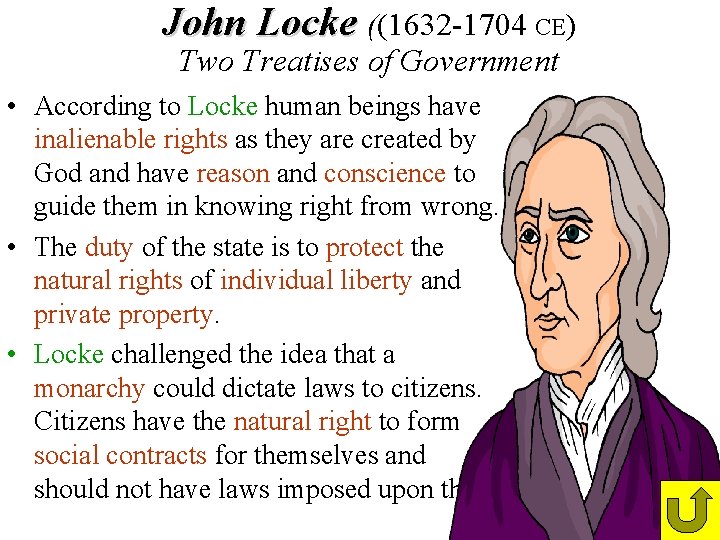
John Locke ((1632 -1704 CE) Two Treatises of Government • According to Locke human beings have inalienable rights as they are created by God and have reason and conscience to guide them in knowing right from wrong. • The duty of the state is to protect the natural rights of individual liberty and private property. • Locke challenged the idea that a monarchy could dictate laws to citizens. Citizens have the natural right to form social contracts for themselves and should not have laws imposed upon them.
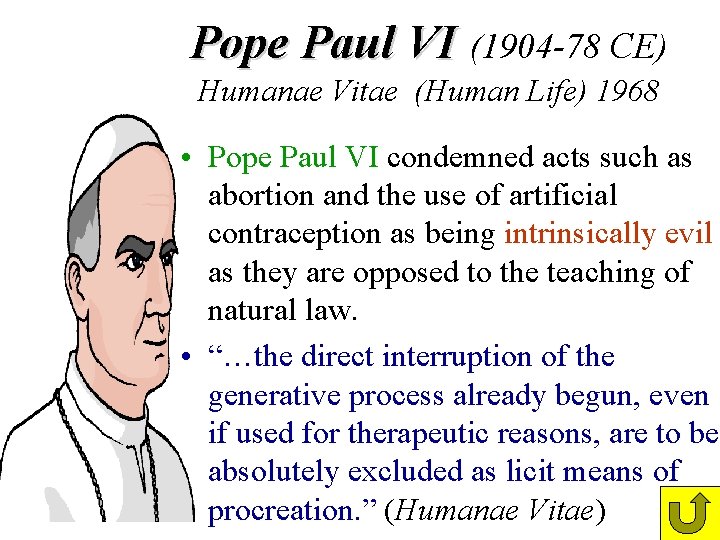
Pope Paul VI VI (1904 -78 CE) Humanae Vitae (Human Life) 1968 • Pope Paul VI condemned acts such as abortion and the use of artificial contraception as being intrinsically evil as they are opposed to the teaching of natural law. • “…the direct interruption of the generative process already begun, even if used for therapeutic reasons, are to be absolutely excluded as licit means of procreation. ” (Humanae Vitae)
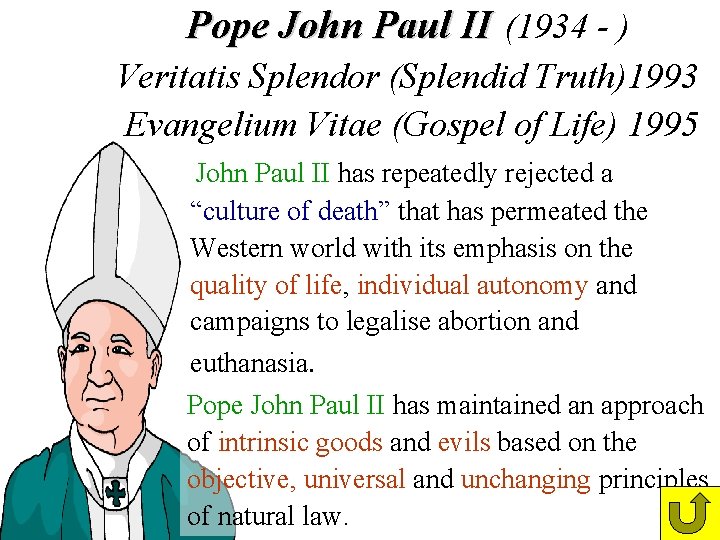
Pope John Paul II (1934 - ) Veritatis Splendor (Splendid Truth)1993 Evangelium Vitae (Gospel of Life) 1995 John Paul II has repeatedly rejected a “culture of death” that has permeated the Western world with its emphasis on the quality of life, individual autonomy and campaigns to legalise abortion and euthanasia. Pope John Paul II has maintained an approach of intrinsic goods and evils based on the objective, universal and unchanging principles of natural law.
• Homosexuality, masturbation and marital contraceptive sexual intercourse do not allow for the possibility of natural procreation and so according to Aquinas’ understanding of natural law such acts may be considered to be more sinful than rape, incest and adultery. • Equally, one may argue that the acts of rape, incest and adultery are more sinful as they undermine an ordered society and do not respect the intrinsic rights of innocent people unlike consenting acts of homosexuality, masturbation and marital contraceptive sexual intercourse.
• In an examination it is useful to be able to make reference to Papal Encyclicals (documents) as they offer a source of external authority to help justify assertions. • Papal Encyclicals form part of the Magisterium of the Roman Catholic church and therefore show an appreciation of tradition within Catholic theology. • The Encyclicals, best referred to by their Latin name, show natural law is applied to particular moral issues. • Identifying the correct Pope with the relevant Encyclical, with a short quotation, is often helpful.
Explain the following suggested order Evil: privation of good Teleological Natural order Reason Intrinsic Objective 5 Primary Principles Natural Law Aquinas Essentialist Foundational
Explain Natural Law Natural law adopts a deontological approach to morality as it is concerned with intrinsic goods, the nature of the act itself. Natural law became prominent through the writing of Aristotle who argued that because reason is the distinctive feature of humanity people are able to use their reason to discover the teleological goal of human nature. For Aristotle something is good if it fulfils its natural end purpose. Thomas Aquinas, 13 th century, developed Aristotle’s teaching on natural law, incorporating it into Christian theology, arguing that as God created the world ex nihilo there is an inherent design in the world of nature which humanity, using reason, can discover and so follow the divine end purpose of the creation.
Due to the essentialist theological foundation, (e. g the idea of human beings created in the image of God, existing within the divine mind prior to creation), natural law considers evil to be a privation of goodness, a falling short of our intended purpose Aquinas argued that there are five primary principles, which when followed will lead to human happiness. These principles, which human reason discerns are: to live, to learn, to reproduce, to live in an ordered society and to worship God. As natural law has an essentialist foundation it is applicable to all people (as there is one human nature) and so it is universal and absolute in its approach; concerned with intrinsic goods. The Magisterium of the Roman Catholic church upholds natural law e. g. In 1968 Pope Paul VI condemned artificial contraception in the papal encyclical Humanae Vitae (Human Life) as the Aristotelian efficient cause of sexual intercourse is prevented from fulfilling its final cause, human life.
Natural Law is too rigid to be of any use as an ethical theory in today’s society. Today’s secular society encourages individual autonomy, where people’s freedom is respected, and they are free to make decisions that will make them happy. Natural law, as presented by Magisterium of the Catholic church, can be oppressive, allowing no exceptions (as natural law is deontological) particularly in the area of sexual ethics. For example, Paul VI, Humanae Vitae, denies couples the right to use artificial contraception. This can lead to overpopulation and unsustainable growth, a concern raised during the Cairo Conference in 1994, as well as the spread of STDs and possible abortions of unwanted pregnancies.
Natural Law is too rigid to be of any use as an ethical theory in today’s society. It is significant that both Aristotle and Aquinas considered that the final telos of natural law is human happiness, which Aquinas’s 5 primary principles promote. For example, New Labour adopts NL in its social policy for law and order, offering an ordered society e. g. trying to reduce crimes which are committed to feed hedonistic drug habits. But within the arena of medical ethics a Copernican revolution has happened. The sanctity of human life has been challenged by quality of life (e. g. Bob Crowe and voluntary euthanasia / Advanced Directives) and the criteria of personhood, by Peter Singer. I think a person’s autonomy, rationality and sentience are more important than following natural law, a Medieval ethic for a world prior to the Enlightenment / Age of Reason
• Pope Paul VI’s Humanae Vitae is a helpful encyclical to quote in the examination room as it raises so many issues which may be analysed and evaluated. • However, it is worth remembering that the church’s condemnation of the use of artificial contraception does not represent the full picture of Roman Catholic teaching on natural law. • Sometimes students are derogatory about natural law when applied to artificial contraception and miss the benefits of natural law when applied to social ethics e. g. upholding intrinsic human rights.