
The Enlightenment From 1650 to 1800 European philosophers

- Slides: 27
The Enlightenment
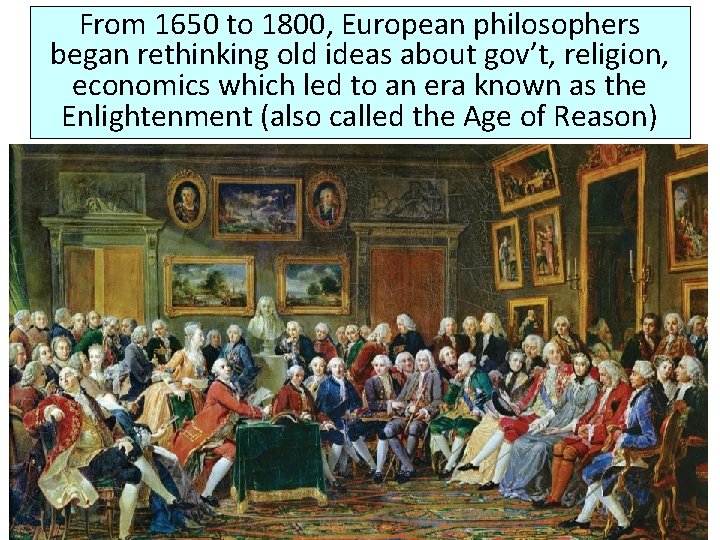
From 1650 to 1800, European philosophers began rethinking old ideas about gov’t, religion, economics which led to an era known as the Enlightenment (also called the Age of Reason)
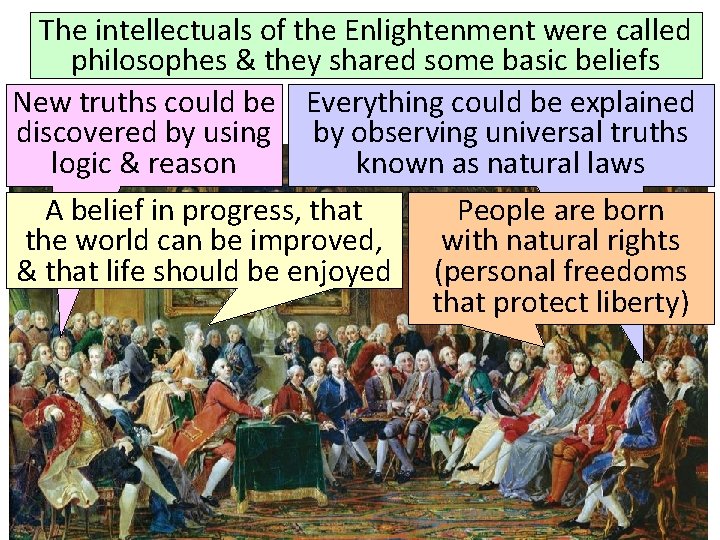
The intellectuals of the Enlightenment were called The Enlightenment philosophes & they shared some basic beliefs New truths could be Everything could be explained discovered by using by observing universal truths logic & reason known as natural laws A belief in progress, that People are born the world can be improved, with natural rights & that life should be enjoyed (personal freedoms that protect liberty)
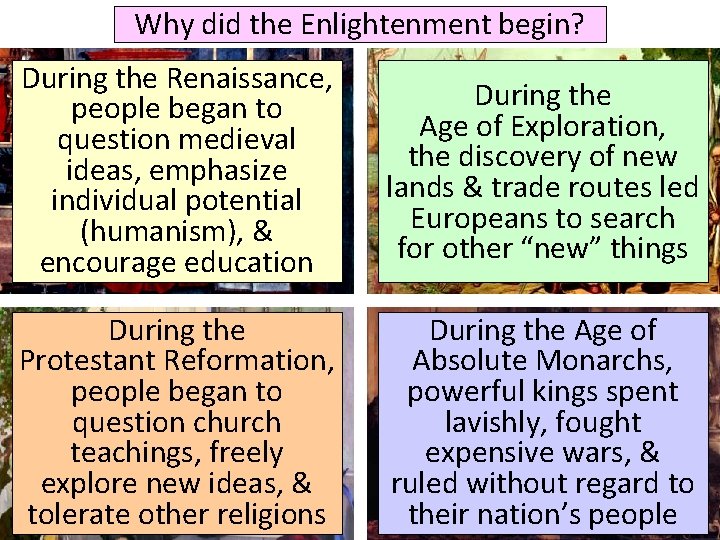
Why did the Enlightenment begin? During the Renaissance, people began to question medieval ideas, emphasize individual potential (humanism), & encourage education During the Age of Exploration, the discovery of new lands & trade routes led Europeans to search for other “new” things During the Protestant Reformation, people began to question church teachings, freely explore new ideas, & tolerate other religions During the Age of Absolute Monarchs, powerful kings spent lavishly, fought expensive wars, & ruled without regard to their nation’s people
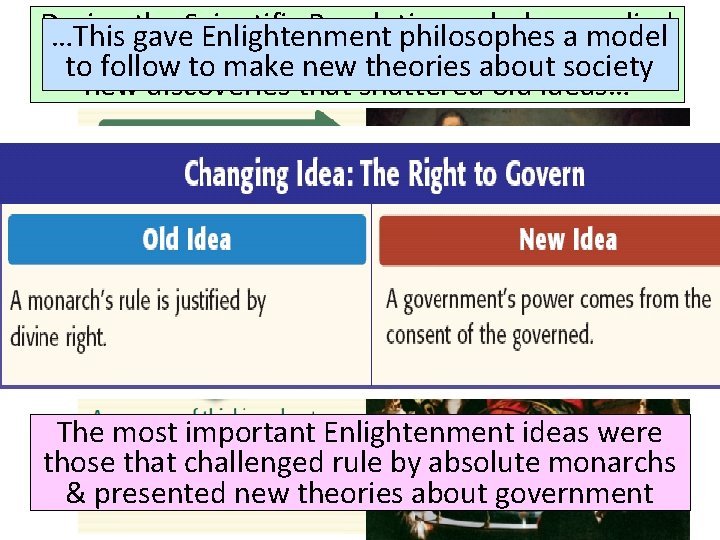
During the Scientific Revolution, scholarsaapplied …This gave Enlightenment philosophes model logic, perfected thenew scientific method, made to follow to make theories about&society new discoveries that shattered old ideas… The most important Enlightenment ideas were those that challenged rule by absolute monarchs & presented new theories about government
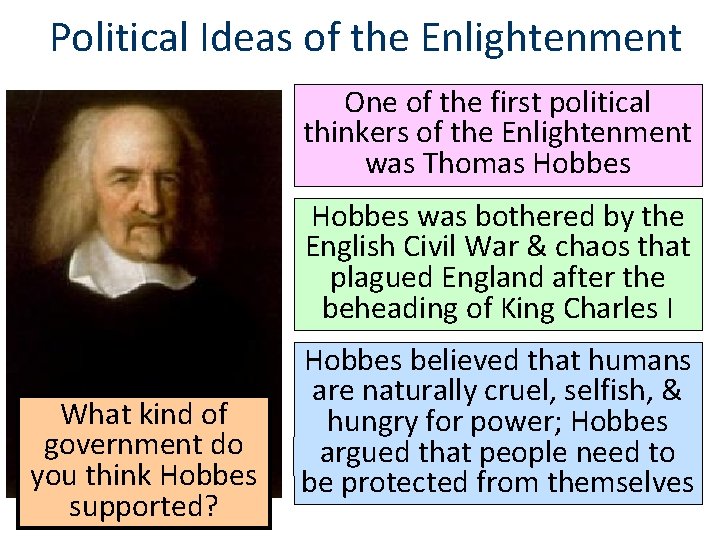
Political Ideas of the Enlightenment One of the first political thinkers of the Enlightenment was Thomas Hobbes was bothered by the English Civil War & chaos that plagued England after the beheading of King Charles I What kind of government do you think Hobbes supported? Hobbes believed that humans are naturally cruel, selfish, & hungry for power; Hobbes argued that people need to be protected from themselves
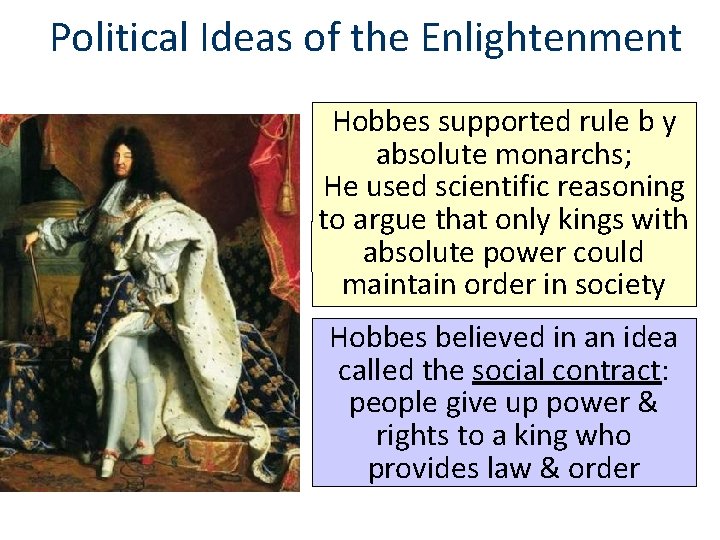
Political Ideas of the Enlightenment Hobbes supported rule b y absolute monarchs; He used scientific reasoning to argue that only kings with absolute power could maintain order in society Hobbes believed in an idea called the social contract: people give up power & rights to a king who provides law & order
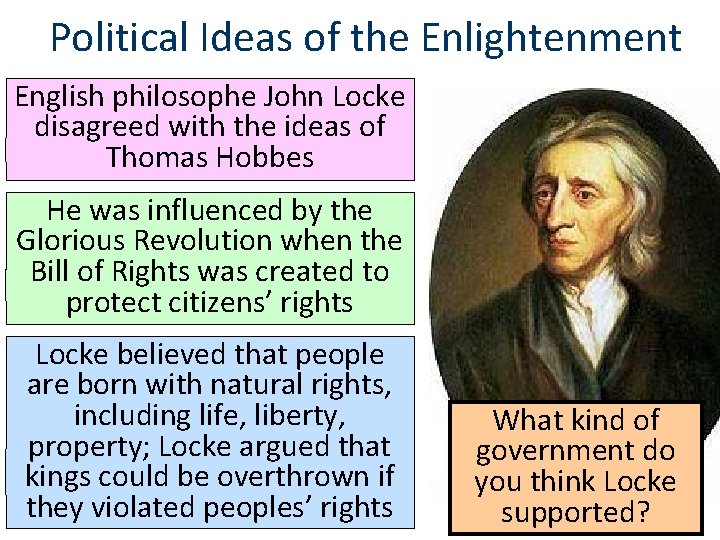
Political Ideas of the Enlightenment English philosophe John Locke disagreed with the ideas of Thomas Hobbes He was influenced by the Glorious Revolution when the Bill of Rights was created to protect citizens’ rights Locke believed that people are born with natural rights, including life, liberty, property; Locke argued that kings could be overthrown if they violated peoples’ rights What kind of government do you think Locke supported?
Political Ideas of the Enlightenment Locke supported limited or constitutional monarchies Locke believed that gov’t power came from the consent of the governed (approval of the people) & that kings should protect the rights of the people The English Bill of Rights (1689) • The king cannot tax or overturn Parliament’s laws • Protected freedom of speech • The army cannot be used as a police force • No excessive bail
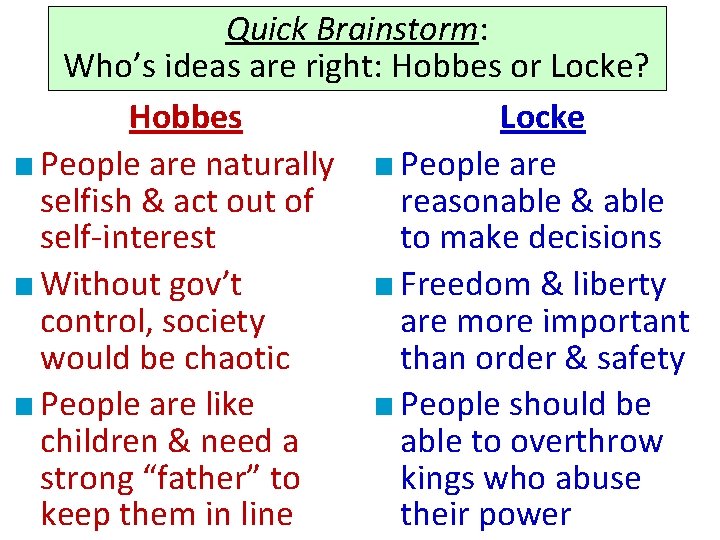
Quick Brainstorm: Who’s ideas are right: Hobbes or Locke? Hobbes Locke ■ People are naturally ■ People are selfish & act out of reasonable & able self-interest to make decisions ■ Without gov’t ■ Freedom & liberty control, society are more important would be chaotic than order & safety ■ People are like ■ People should be children & need a able to overthrow strong “father” to kings who abuse keep them in line their power
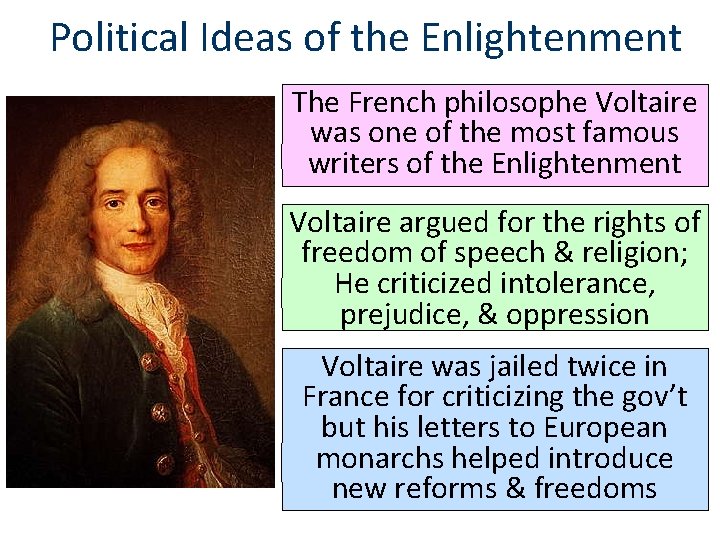
Political Ideas of the Enlightenment The French philosophe Voltaire was one of the most famous writers of the Enlightenment Voltaire argued for the rights of freedom of speech & religion; He criticized intolerance, prejudice, & oppression Voltaire was jailed twice in France for criticizing the gov’t but his letters to European monarchs helped introduce new reforms & freedoms
Quick Brainstorm: Do you agree with Voltaire? Voltaire once said: “I may disapprove of what you say, but I will defend to the death your right to say it. ” When, if ever, should freedom of speech be restricted? Consider schools, TV, radio, wartime, etc.
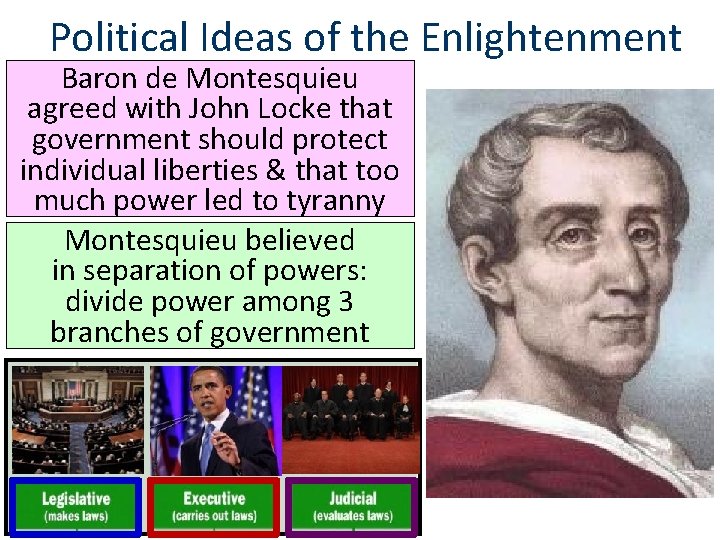
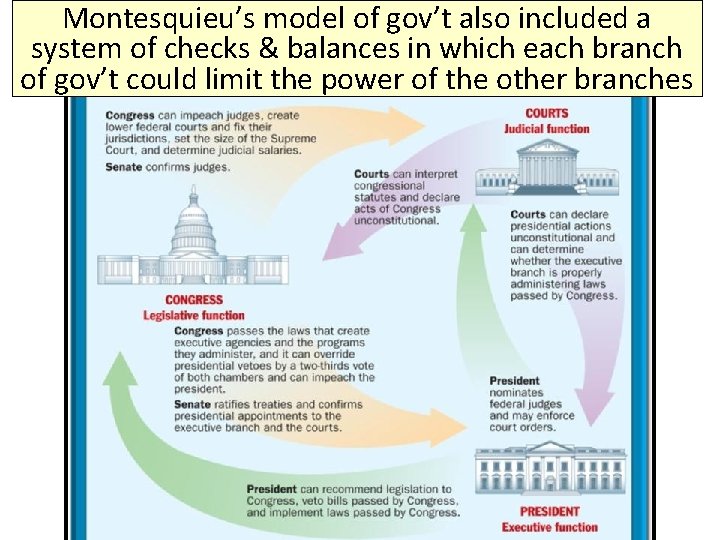
Political Ideas of the Enlightenment Baron de Montesquieu agreed with John Locke that government should protect individual liberties & that too much power led to tyranny Montesquieu believed in separation of powers: divide power among 3 branches of government
Montesquieu’s model of gov’t also included a system of checks & balances in which each branch of gov’t could limit the power of the other branches
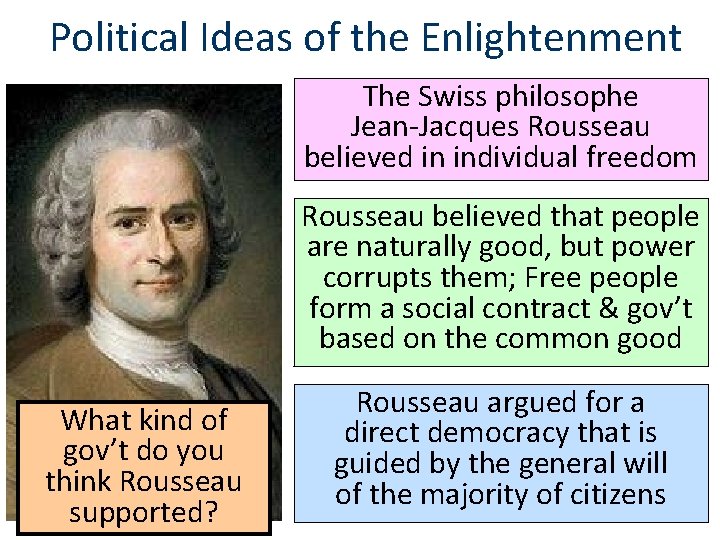
Political Ideas of the Enlightenment The Swiss philosophe Jean-Jacques Rousseau believed in individual freedom Rousseau believed that people are naturally good, but power corrupts them; Free people form a social contract & gov’t based on the common good What kind of gov’t do you think Rousseau supported? Rousseau argued for a direct democracy that is guided by the general will of the majority of citizens
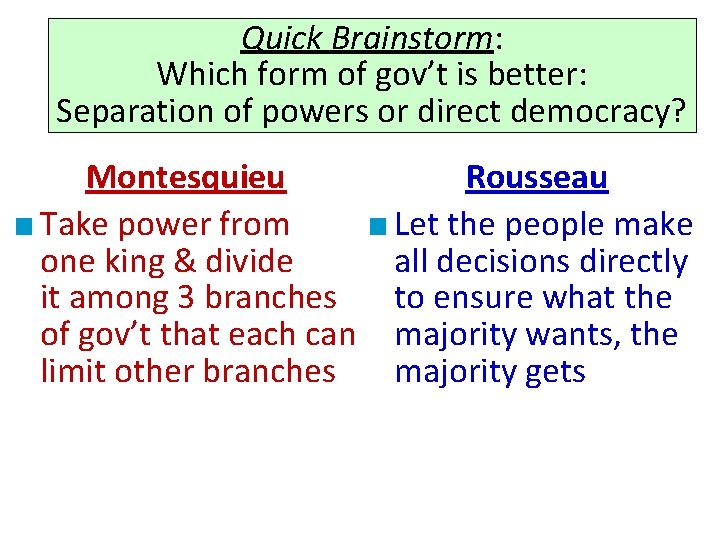
Quick Brainstorm: Which form of gov’t is better: Separation of powers or direct democracy? Montesquieu Rousseau ■ Take power from ■ Let the people make one king & divide all decisions directly it among 3 branches to ensure what the of gov’t that each can majority wants, the limit other branches majority gets
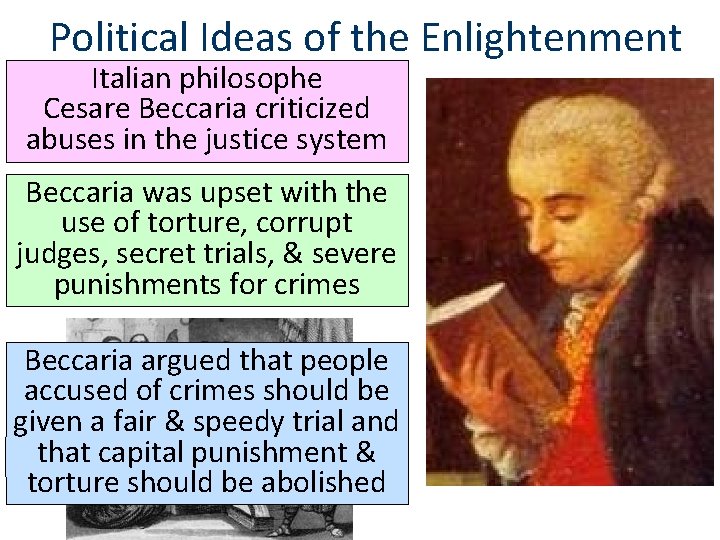
Political Ideas of the Enlightenment Italian philosophe Cesare Beccaria criticized abuses in the justice system Beccaria was upset with the use of torture, corrupt judges, secret trials, & severe punishments for crimes Beccaria argued that people accused of crimes should be given a fair & speedy trial and that capital punishment & torture should be abolished
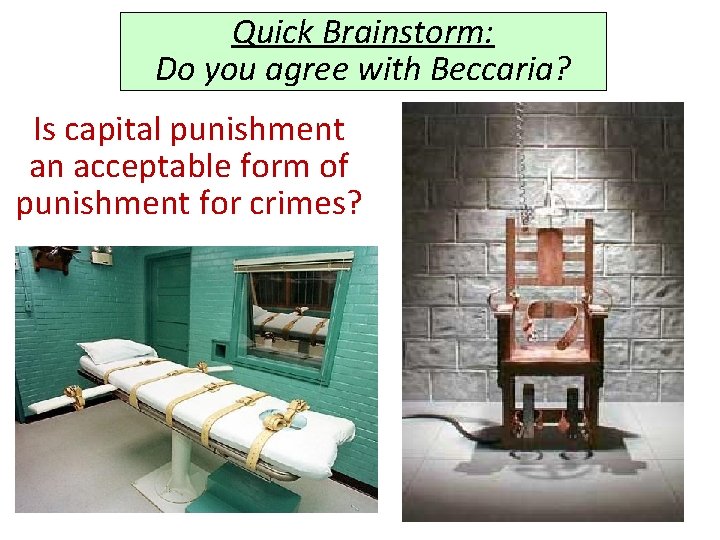
Quick Brainstorm: Do you agree with Beccaria? Is capital punishment an acceptable form of punishment for crimes?
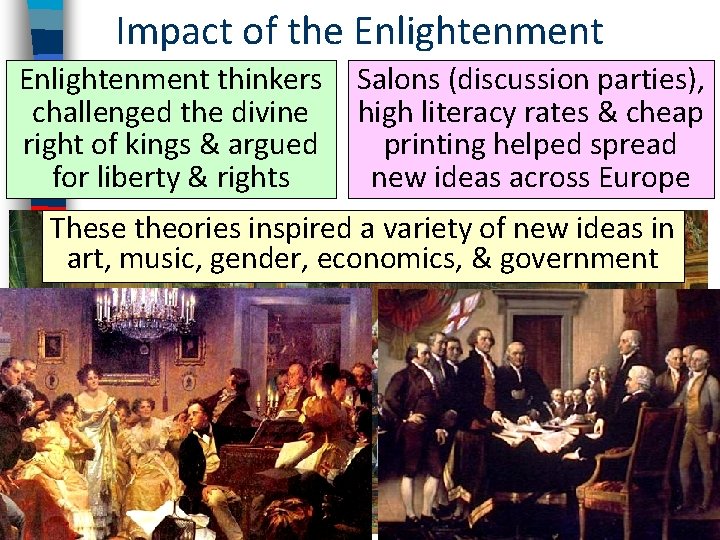
Impact of the Enlightenment thinkers challenged the divine right of kings & argued for liberty & rights Salons (discussion parties), high literacy rates & cheap printing helped spread new ideas across Europe These theories inspired a variety of new ideas in art, music, gender, economics, & government
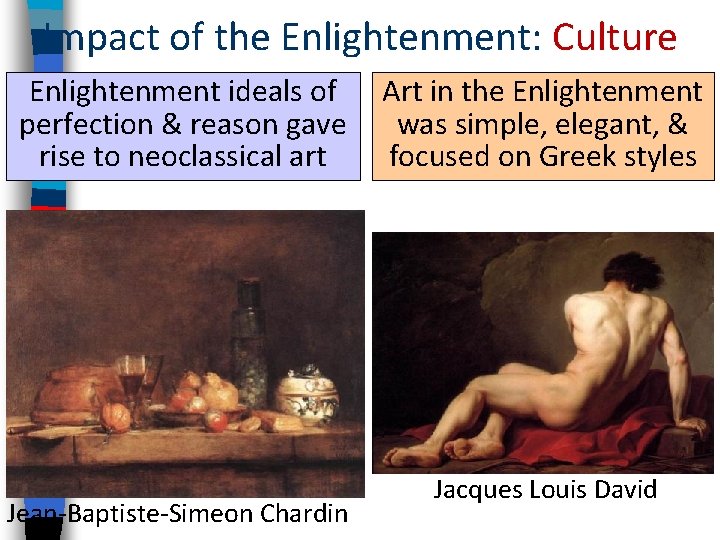
Impact of the Enlightenment: Culture Enlightenment ideals of perfection & reason gave rise to neoclassical art Jean-Baptiste-Simeon Chardin Art in the Enlightenment was simple, elegant, & focused on Greek styles Jacques Louis David
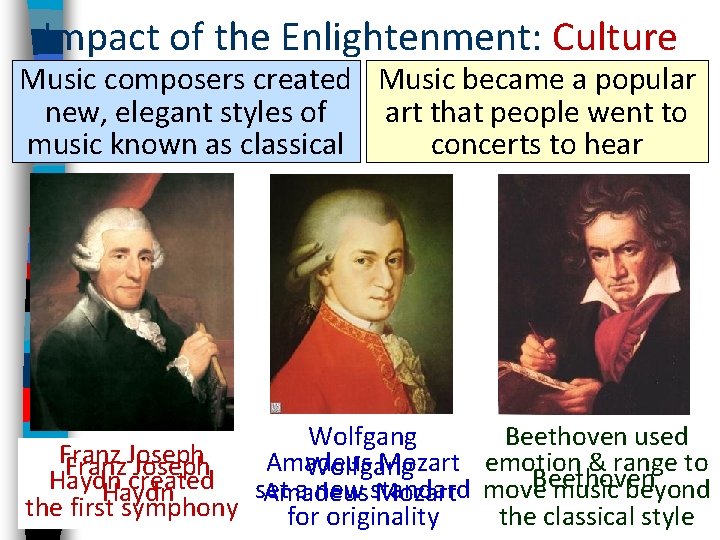
Impact of the Enlightenment: Culture Music composers created Music became a popular new, elegant styles of art that people went to music known as classical concerts to hear Wolfgang Beethoven used Franz Amadeus Mozart emotion & range to Franz. Joseph Wolfgang Beethoven Haydn created set a new standard move music beyond Haydn Amadeus Mozart the first symphony for originality the classical style
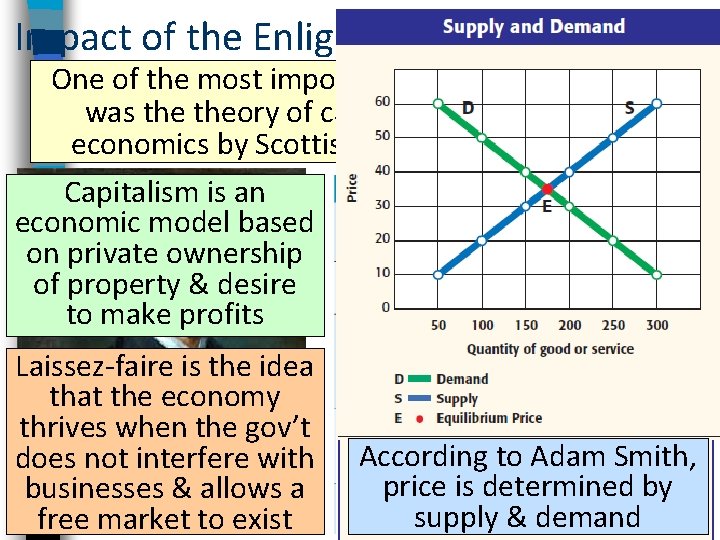
Impact of the Enlightenment: Economics One of the most important Enlightenment ideas was theory of capitalism & laissez-faire economics by Scottish professor Adam Smith Capitalism is an economic model based on private ownership of property & desire to make profits Laissez-faire is the idea that the economy thrives when the gov’t does not interfere with businesses & allows a free market to exist According to Adam Smith, price is determined by supply & demand
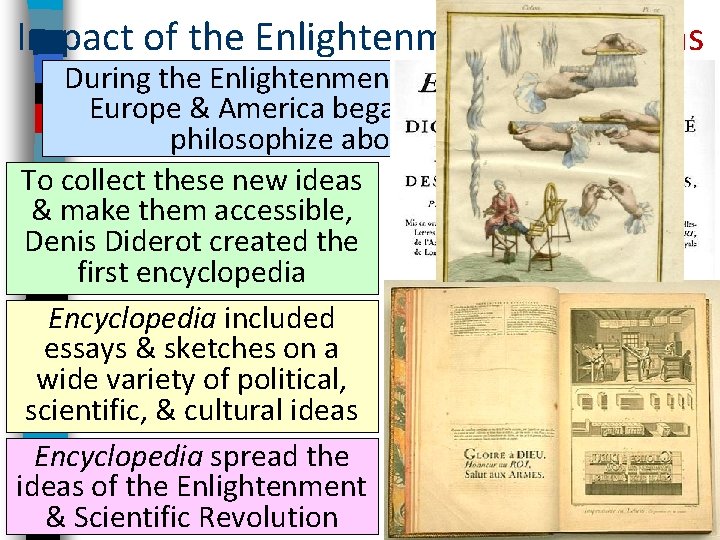
Impact of the Enlightenment: New Ideas During the Enlightenment, people throughout Europe & America began to study, read, & philosophize about new ideas To collect these new ideas & make them accessible, Denis Diderot created the first encyclopedia Encyclopedia included essays & sketches on a wide variety of political, scientific, & cultural ideas Encyclopedia spread the ideas of the Enlightenment & Scientific Revolution
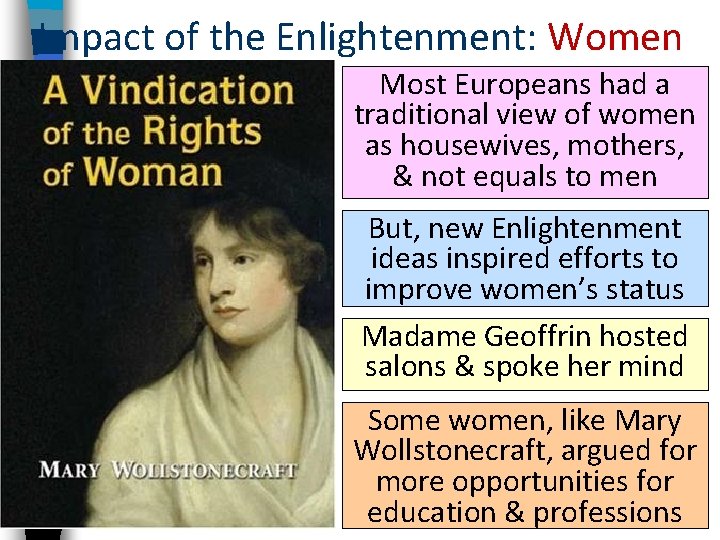
Impact of the Enlightenment: Women Most Europeans had a traditional view of women as housewives, mothers, & not equals to men But, new Enlightenment ideas inspired efforts to improve women’s status Madame Geoffrin hosted salons & spoke her mind Some women, like Mary Wollstonecraft, argued for more opportunities for education & professions
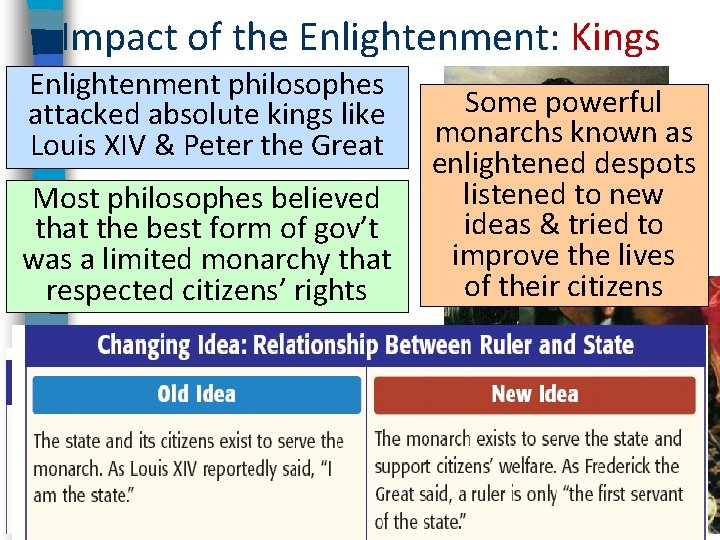
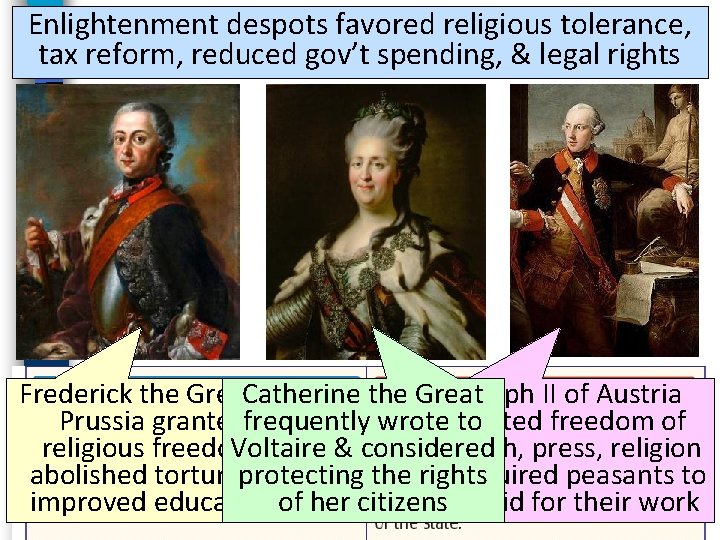
Impact of the Enlightenment: Kings Enlightenment philosophes attacked absolute kings like Louis XIV & Peter the Great Most philosophes believed that the best form of gov’t was a limited monarchy that respected citizens’ rights Some powerful monarchs known as enlightened despots listened to new ideas & tried to improve the lives of their citizens
Enlightenment despots favored religious tolerance, tax reform, reduced gov’t spending, & legal rights Frederick the Great. Catherine of the Great Joseph II of Austria Prussia grantedfrequently wrotegranted to freedom of religious freedom, Voltaire & considered speech, press, religion abolished torture, protecting & the rights & required peasants to improved education of her citizensbe paid for their work
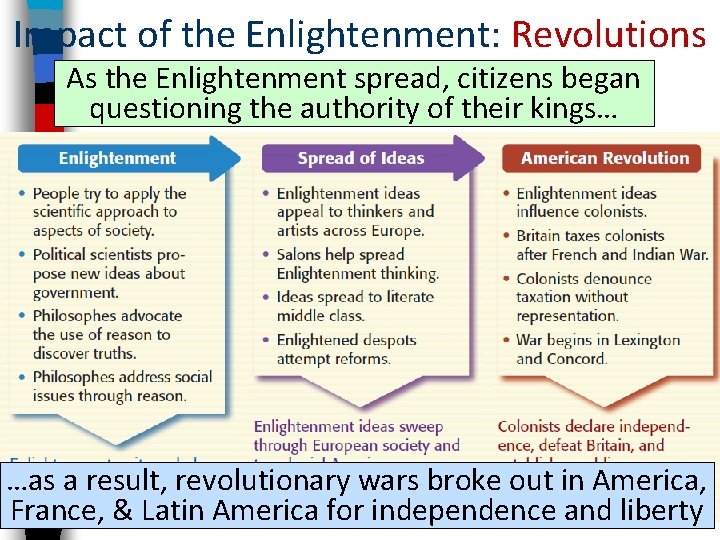
Impact of the Enlightenment: Revolutions As the Enlightenment spread, citizens began questioning the authority of their kings… …as a result, revolutionary wars broke out in America, France, & Latin America for independence and liberty