Are all languages equally complex sten Dahl oestenling
- Slides: 41
Are all languages equally complex? Östen Dahl oesten@ling. su. se 1
Comparative complexity of languages • Does it make sense to compare languages as to complexity? • And if the answer is yes, can languages differ in complexity? • Currently, there are two competing answers to the last question. 2
The balancing hypothesis • Most linguists who have had anything to say on this question favour the balancing hypothesis, which claims… • … claims that lack of complexity in one component of the system will be compensated by greater complexity in another (and vice versa) • …which means that in principle all languages are equally complex 3
The competing view • Recently, various linguists (e. g. John Mc. Whorter) have challenged this view, claiming… • that languages indeed vary in complexity • …and that this variation is related to the ”ecology” of the language, that is, to the conditions under which the language is spoken and transmitted to new generations 4
Cross-linguistic comparison of complexity • However, few attempts have been made to make systematic global comparisons of complexity cross-linguistically • This presentation is an attempt to compare two closely related languages… • …which guarantees relatively extensive commensurability • But first I need to discuss the notion of linguistic complexity 5
Two different notions of linguistic complexity • In speaking of linguistic complexity, people tend to have two rather different notions in mind: – “objective” complexity – “agent-related” complexity 6
Objective complexity • Objective complexity is the notion employed in information theory and theory of complex systems • It involves the idea that complexity is an objective property of an object or a system • It is notoriously difficult to give a rigid definition of complexity in this sense 7
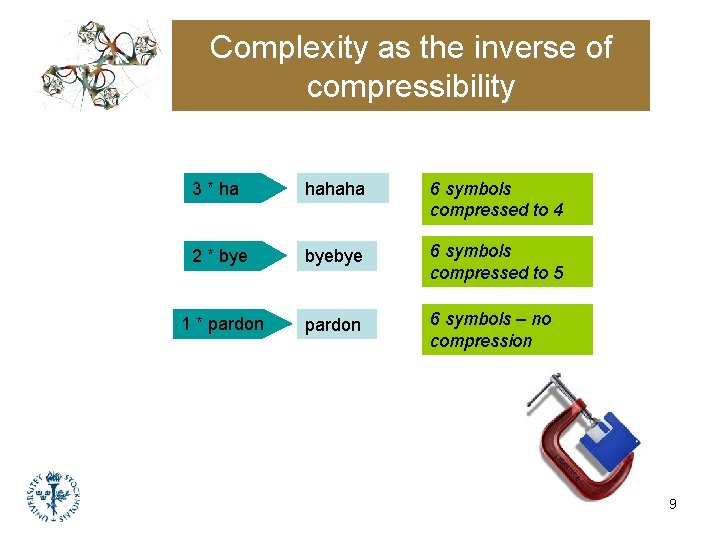
Objective complexity • Intuitively the complexity of an object is to be measured in terms of – the amount of information needed to re-create it or alternatively, – the length of the shortest possible complete description of it. 8
Complexity as the inverse of compressibility 3 * ha hahaha 6 symbols compressed to 4 2 * byebye 6 symbols compressed to 5 1 * pardon 6 symbols – no compression 9
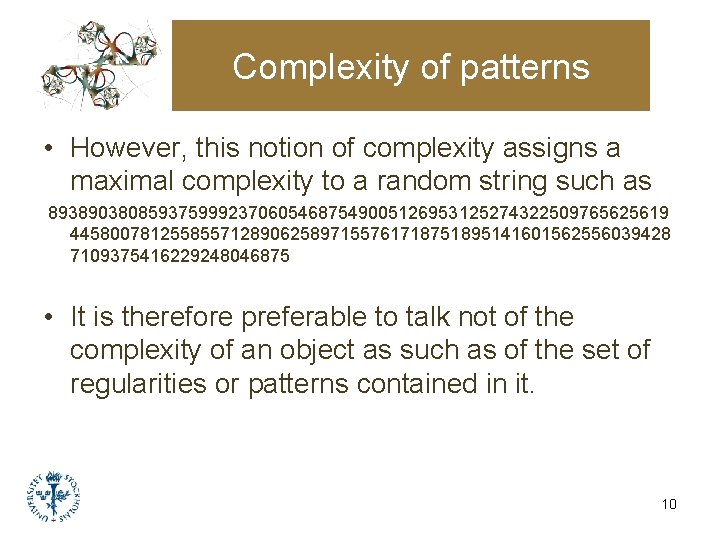
Complexity of patterns • However, this notion of complexity assigns a maximal complexity to a random string such as 89389038085937599923706054687549005126953125274322509765625619 445800781255855712890625897155761718751895141601562556039428 7109375416229248046875 • It is therefore preferable to talk not of the complexity of an object as such as of the set of regularities or patterns contained in it. 10
System complexity vs. structural complexity • In linguistics, such a complexity measure could apply to different things. Most importantly, it could apply on the one hand to – a language seen as a system (system complexity) – to the structure of utterances and expressions (structural complexity) 11
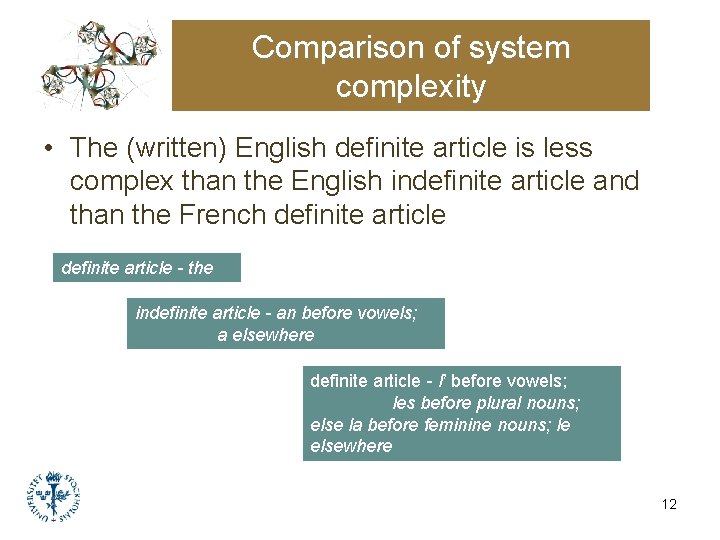
Comparison of system complexity • The (written) English definite article is less complex than the English indefinite article and than the French definite article - the indefinite article - an before vowels; a elsewhere definite article - l’ before vowels; les before plural nouns; else la before feminine nouns; le elsewhere 12
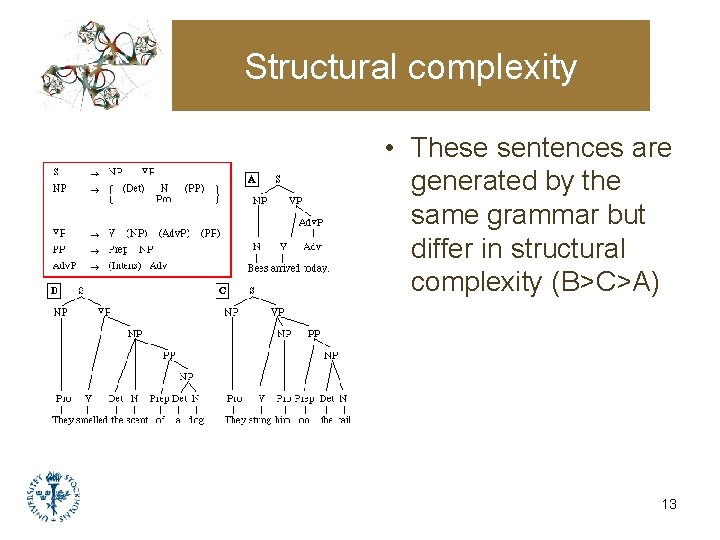
Structural complexity • These sentences are generated by the same grammar but differ in structural complexity (B>C>A) 13
System complexity • System complexity could be seen as a measure of the content that language learners have to master in order to be proficient in a language. • It does not as such tell us anything about the difficulty they have in learning, producing and understanding the language - • -- that would take us to the other notion of complexity, viz. agent-related complexity. 14
Agent-related complexity? • Although agent-related complexity is perhaps the most popular way of understanding complexity in linguistics, I would in fact prefer to reserve the term “complexity” for objective complexity and use other terms such as “cost”, “difficulty”, and “demandingness” to denote ‘complexity for a user’. 15
My general notion of complexity • I am mainly concerned with objective system complexity understood as – the length of the simplest complete description of the language as a system 16
Kinds of complexity • Phenogrammatical complexity • Lexical metacomplexity • Tightness 17
Phenogrammatical complexity • pertains to the relationship between a given content and its expression • operationalized as – given a configuration of lexical items, how complex are the rules that allow you to build a unitary expression out of those items? 18
Lexical metacomplexity • What is the complexity of the information associated with a lexical item? • …including: – segmental phonology – suprasegmental phonology – morphosyntactic features 19
Tightness • What is the maximal structural complexity allowed at each level of grammatical structure? 20
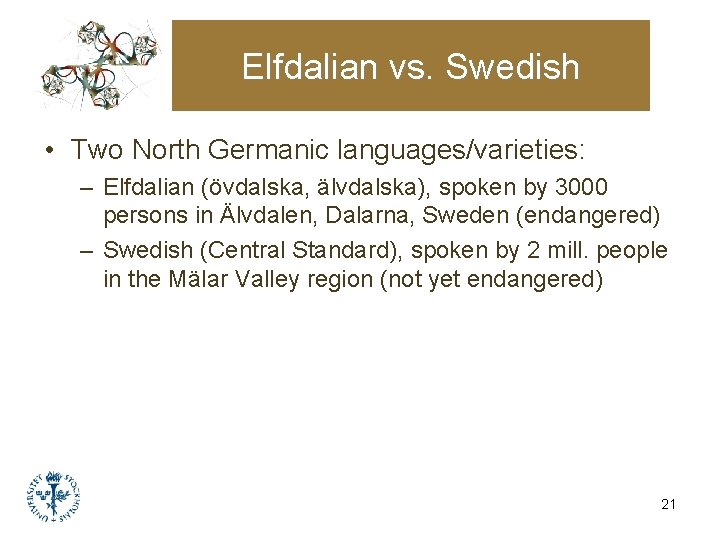
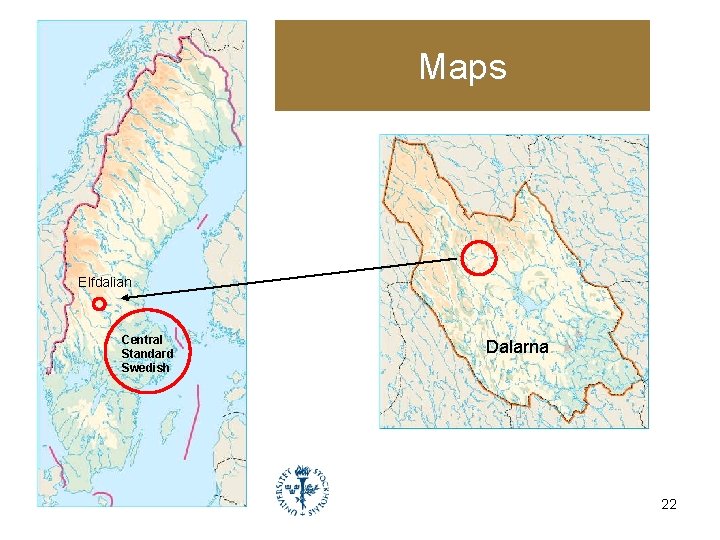
Elfdalian vs. Swedish • Two North Germanic languages/varieties: – Elfdalian (övdalska, älvdalska), spoken by 3000 persons in Älvdalen, Dalarna, Sweden (endangered) – Swedish (Central Standard), spoken by 2 mill. people in the Mälar Valley region (not yet endangered) 21
Maps Elfdalian Central Standard Swedish Dalarna 22
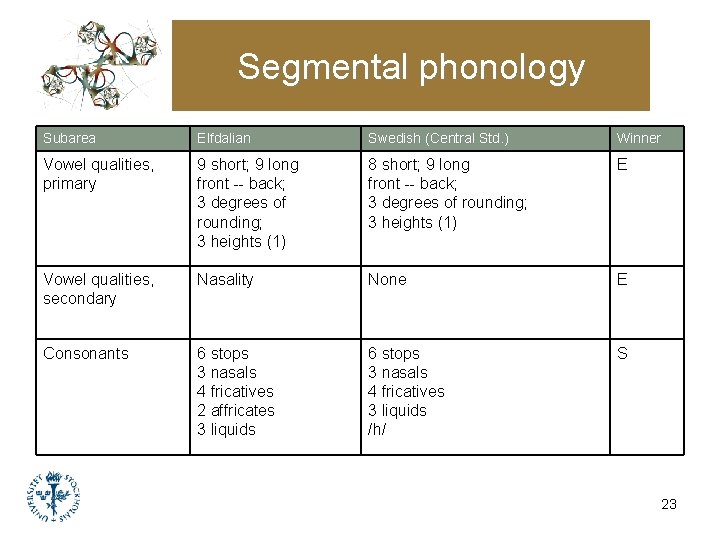
Segmental phonology Subarea Elfdalian Swedish (Central Std. ) Winner Vowel qualities, primary 9 short; 9 long front -- back; 3 degrees of rounding; 3 heights (1) 8 short; 9 long front -- back; 3 degrees of rounding; 3 heights (1) E Vowel qualities, secondary Nasality None E Consonants 6 stops 3 nasals 4 fricatives 2 affricates 3 liquids 6 stops 3 nasals 4 fricatives 3 liquids /h/ S 23
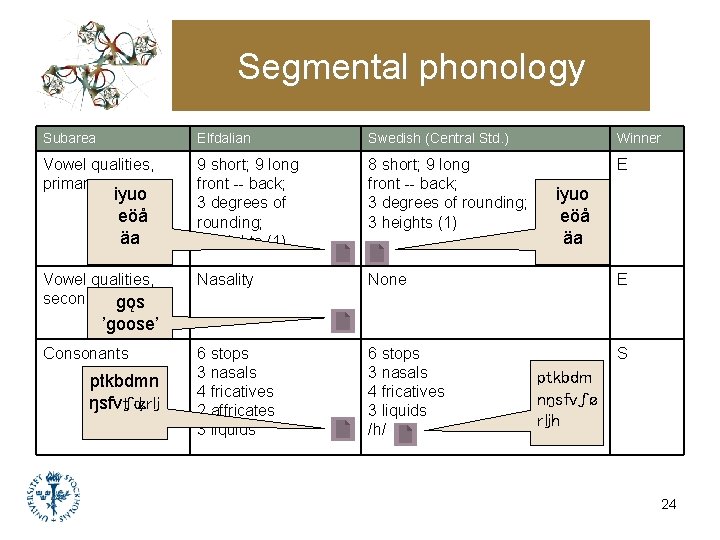
Segmental phonology Subarea Elfdalian Swedish (Central Std. ) Winner Vowel qualities, primary 9 short; 9 long front -- back; 3 degrees of rounding; 3 heights (1) 8 short; 9 long front -- back; 3 degrees of rounding; 3 heights (1) E Vowel qualities, secondarygǫs Nasality None E 6 stops 3 nasals 4 fricatives 2 affricates 3 liquids 6 stops 3 nasals 4 fricatives 3 liquids /h/ S iyuo eöå äa ’goose’ Consonants ptkbdmn ŋsfvʧʥrlj ptkbdm nŋsfvʃɕ rljh 24
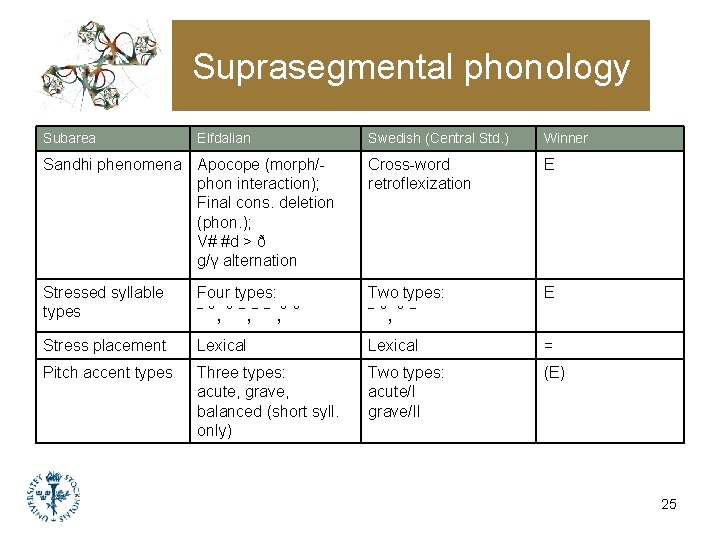
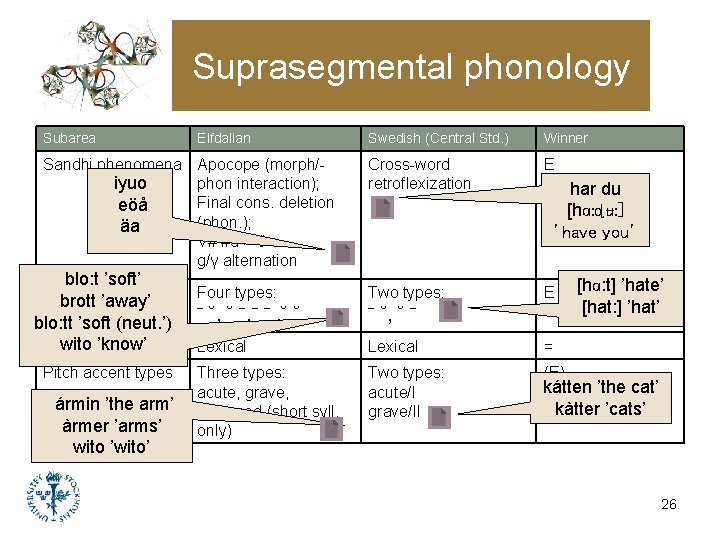
Suprasegmental phonology Subarea Elfdalian Swedish (Central Std. ) Winner Sandhi phenomena Apocope (morph/phon interaction); Final cons. deletion (phon. ); V# #d > ð g/γ alternation Cross-word retroflexization E Stressed syllable types Four types: Two types: E ˉ ˘, ˘ ˉ, ˉ ˉ , ˘ ˘ ˉ ˘, ˘ ˉ Stress placement Lexical = Pitch accent types Three types: acute, grave, balanced (short syll. only) Two types: acute/I grave/II (E) 25
Suprasegmental phonology Subarea Swedish (Central Std. ) Winner Sandhi phenomena Apocope (morph/iyuo phon interaction); Final cons. deletion eöå (phon. ); äa V# #d > ð g/γ alternation Cross-word retroflexization E Stressed syllable brott ’away’ types Four types: Two types: E ˉ ˘, ˘ ˉ, ˉ ˉ , ˘ ˘ ˉ ˘, ˘ ˉ Lexical = Three types: acute, grave, balanced (short syll. only) Two types: acute/I grave/II (E) blo: t ’soft’ blo: tt ’soft (neut. ’) wito placement ’know’ Stress Pitch accent types ármin ’the arm’ àrmer ’arms’ wito ’wito’ Elfdalian har du [hɑ: ɖʉ: ] ’have you’ [hɑ: t] ’hate’ [hat: ] ’hat’ kátten ’the cat’ kàtter ’cats’ 26
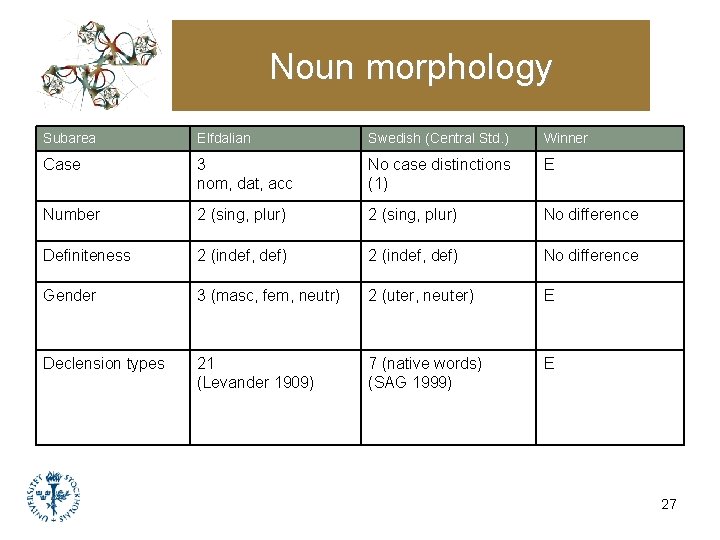
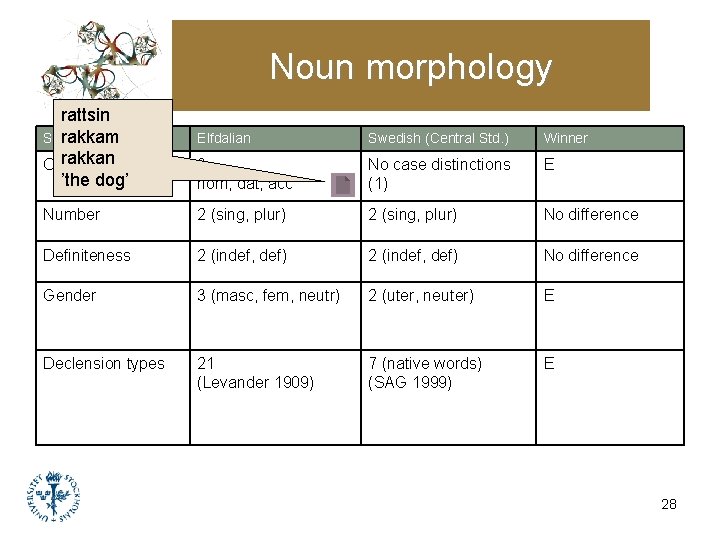
Noun morphology Subarea Elfdalian Swedish (Central Std. ) Winner Case 3 nom, dat, acc No case distinctions (1) E Number 2 (sing, plur) No difference Definiteness 2 (indef, def) No difference Gender 3 (masc, fem, neutr) 2 (uter, neuter) E Declension types 21 (Levander 1909) 7 (native words) (SAG 1999) E 27
Noun morphology rattsin rakkam Subarea rakkan Case ’the dog’ Elfdalian Swedish (Central Std. ) Winner 3 nom, dat, acc No case distinctions (1) E Number 2 (sing, plur) No difference Definiteness 2 (indef, def) No difference Gender 3 (masc, fem, neutr) 2 (uter, neuter) E Declension types 21 (Levander 1909) 7 (native words) (SAG 1999) E 28
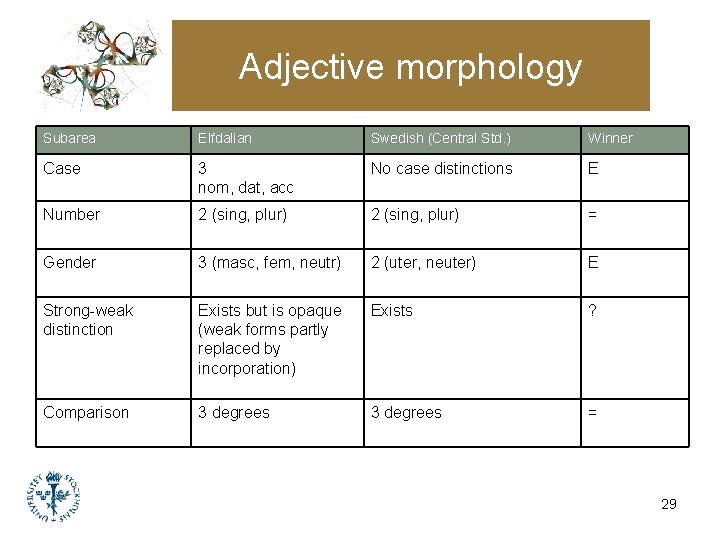
Adjective morphology Subarea Elfdalian Swedish (Central Std. ) Winner Case 3 nom, dat, acc No case distinctions E Number 2 (sing, plur) = Gender 3 (masc, fem, neutr) 2 (uter, neuter) E Strong-weak distinction Exists but is opaque (weak forms partly replaced by incorporation) Exists ? Comparison 3 degrees = 29
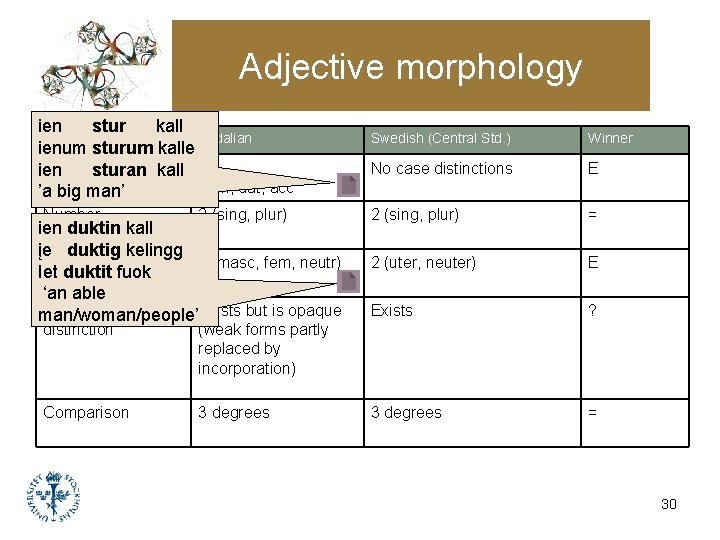
Adjective morphology ien stur kall Subarea Elfdalian ienum sturum kalle Case sturan kall 3 ien nom, dat, acc ’a big man’ Number 2 (sing, plur) ien duktin kall įe duktig kelingg Gender 3 (masc, fem, neutr) Iet duktit fuok ‘an able Strong-weak Exists but is opaque man/woman/people’ distinction (weak forms partly replaced by incorporation) Comparison 3 degrees Swedish (Central Std. ) Winner No case distinctions E 2 (sing, plur) = 2 (uter, neuter) E Exists ? 3 degrees = 30
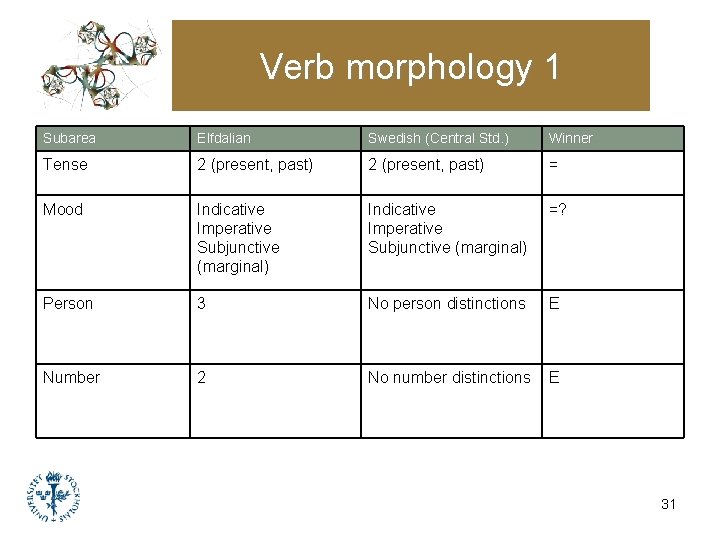
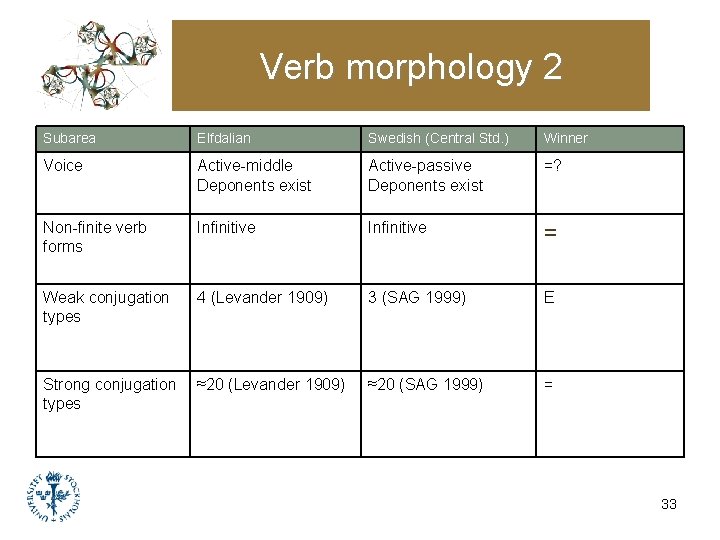
Verb morphology 1 Subarea Elfdalian Swedish (Central Std. ) Winner Tense 2 (present, past) = Mood Indicative Imperative Subjunctive (marginal) =? Person 3 No person distinctions E Number 2 No number distinctions E 31
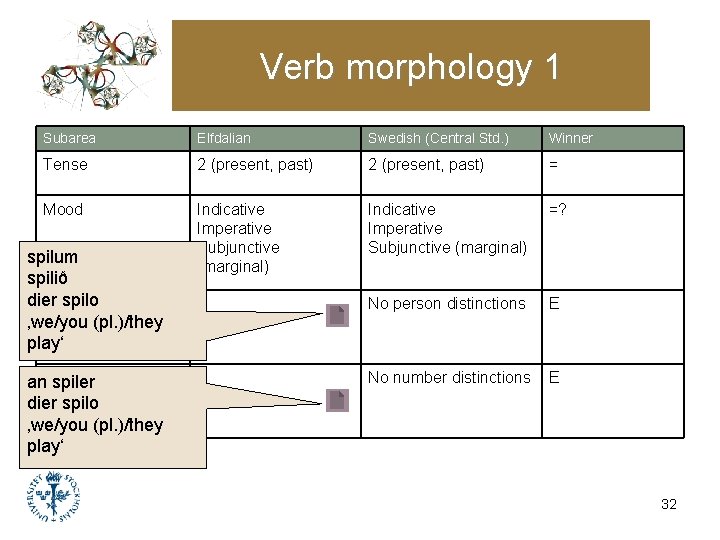
Verb morphology 1 Subarea Elfdalian Swedish (Central Std. ) Winner Tense 2 (present, past) = Mood Indicative Imperative Subjunctive (marginal) =? 3 No person distinctions E 2 No number distinctions E spilum spilið dier spilo Person ‚we/you (pl. )/they play‘ an. Number spiler dier spilo ‚we/you (pl. )/they play‘ 32
Verb morphology 2 Subarea Elfdalian Swedish (Central Std. ) Winner Voice Active-middle Deponents exist Active-passive Deponents exist =? Non-finite verb forms Infinitive = Weak conjugation types 4 (Levander 1909) 3 (SAG 1999) E Strong conjugation types ≈20 (Levander 1909) ≈20 (SAG 1999) = 33
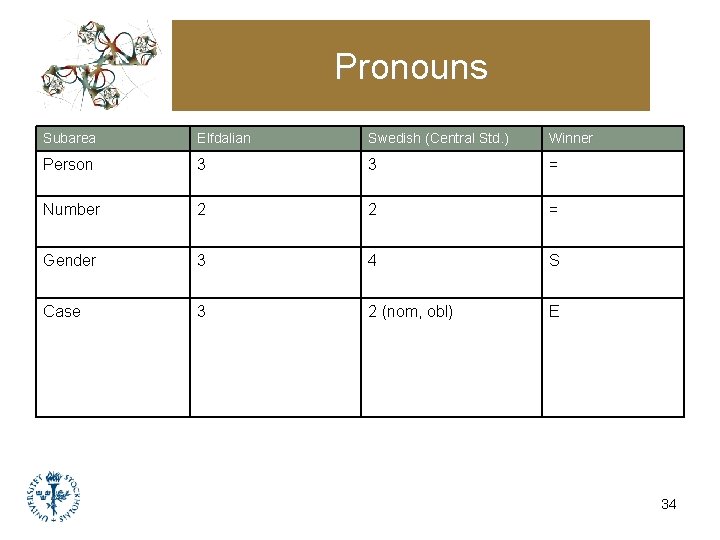
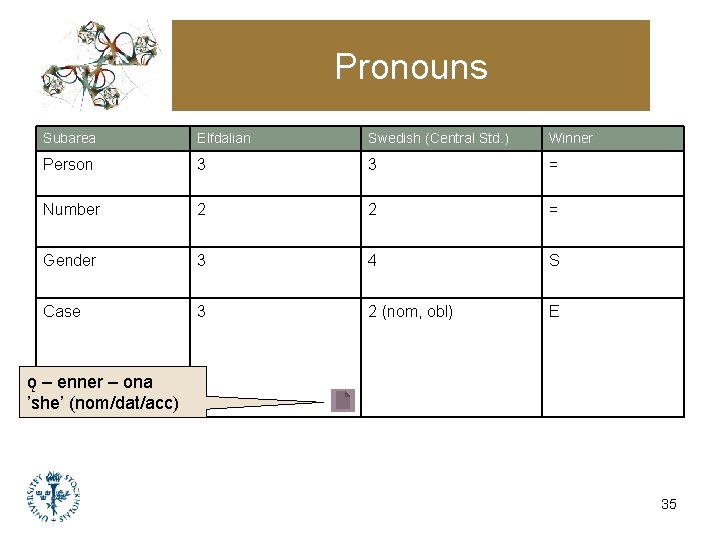
Pronouns Subarea Elfdalian Swedish (Central Std. ) Winner Person 3 3 = Number 2 2 = Gender 3 4 S Case 3 2 (nom, obl) E 34
Pronouns Subarea Elfdalian Swedish (Central Std. ) Winner Person 3 3 = Number 2 2 = Gender 3 4 S Case 3 2 (nom, obl) E ǫ – enner – ona ’she’ (nom/dat/acc) 35
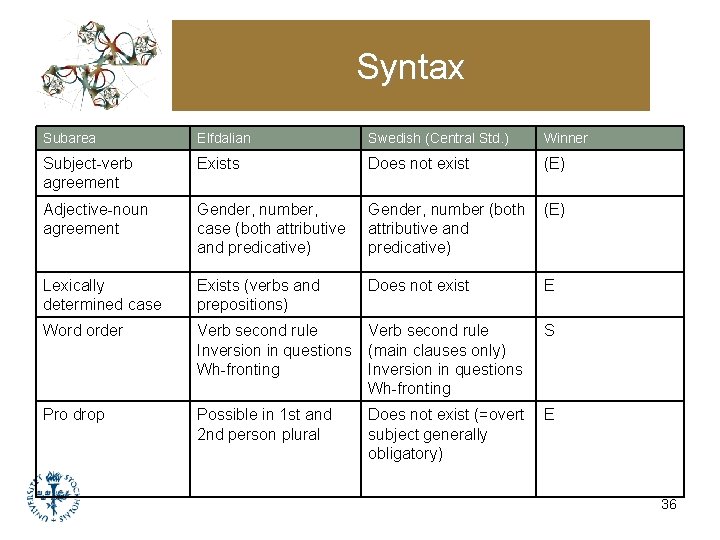
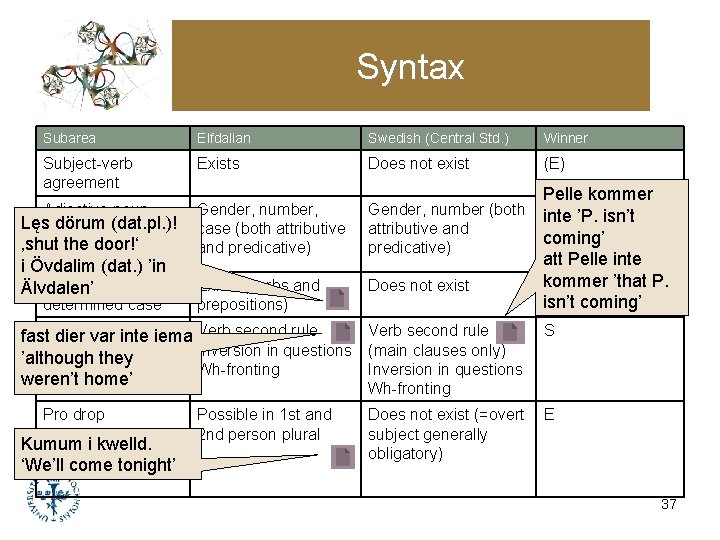
Syntax Subarea Elfdalian Swedish (Central Std. ) Winner Subject-verb agreement Exists Does not exist (E) Adjective-noun agreement Gender, number, case (both attributive and predicative) Gender, number (both attributive and predicative) (E) Lexically determined case Exists (verbs and prepositions) Does not exist E Word order Verb second rule Inversion in questions Wh-fronting Verb second rule (main clauses only) Inversion in questions Wh-fronting S Pro drop Possible in 1 st and 2 nd person plural Does not exist (=overt subject generally obligatory) E 36
Syntax Subarea Elfdalian Swedish (Central Std. ) Winner Subject-verb agreement Exists Does not exist (E) Gender, number, case (both attributive and predicative) Gender, number (both attributive and predicative) Exists (verbs and prepositions) Does not exist Adjective-noun Lęsagreement dörum (dat. pl. )! ‚shut the door!‘ i Övdalim (dat. ) ’in Lexically Älvdalen’ determined case fast. Word dier order var inte iema Verb second rule Inversion in questions ’although they Wh-fronting weren’t home’ Pro drop Kumum i kwelld. ‘We’ll come tonight’ Possible in 1 st and 2 nd person plural Pelle kommer (E) ’P. isn’t inte coming’ att Pelle inte kommer ’that P. E isn’t coming’ Verb second rule (main clauses only) Inversion in questions Wh-fronting S Does not exist (=overt subject generally obligatory) E 37
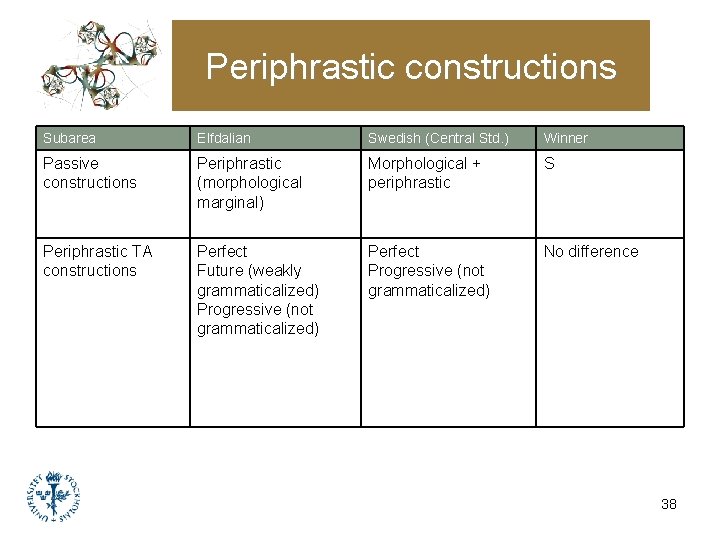
Periphrastic constructions Subarea Elfdalian Swedish (Central Std. ) Winner Passive constructions Periphrastic (morphological marginal) Morphological + periphrastic S Periphrastic TA constructions Perfect Future (weakly grammaticalized) Progressive (not grammaticalized) Perfect Progressive (not grammaticalized) No difference 38
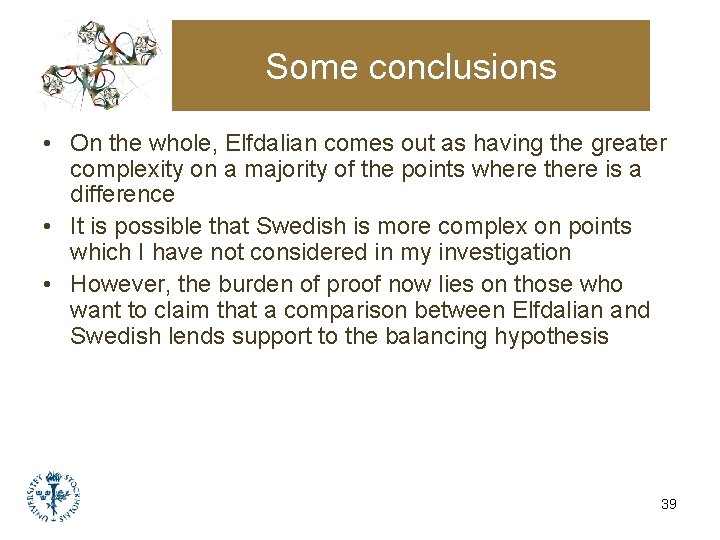
Some conclusions • On the whole, Elfdalian comes out as having the greater complexity on a majority of the points where there is a difference • It is possible that Swedish is more complex on points which I have not considered in my investigation • However, the burden of proof now lies on those who want to claim that a comparison between Elfdalian and Swedish lends support to the balancing hypothesis 39
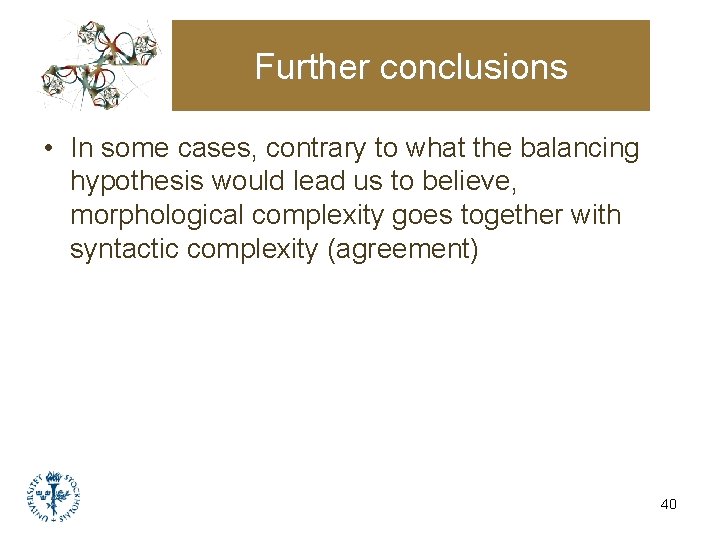
Further conclusions • In some cases, contrary to what the balancing hypothesis would lead us to believe, morphological complexity goes together with syntactic complexity (agreement) 40
Language contact • With its history and geographical position, Elfdalian can be expected to be a ”low-contact language” relative to Swedish • This then is compatible with the hypothesis that high-contact languages tend to be less complex… • …but it is hardly advisable to draw conclusions from a single example 41