
An opportunistic mental health intervention Equally Well Symposium
- Slides: 18
An opportunistic mental health intervention Equally Well Symposium 28 -29 March 19 Fiona Glover – LICBT Program Coordinator, Flinders University Nicci Tepper – Remedy Healthcare, Mind. Step Services Manager
Agenda § Remedy Healthcare – a brief overview § Integration of services § Why mental health coaching and why an IAPT model § Demographics § Outcomes § Mind. Step program § Questions § Chronic disease management health coaching programs 2
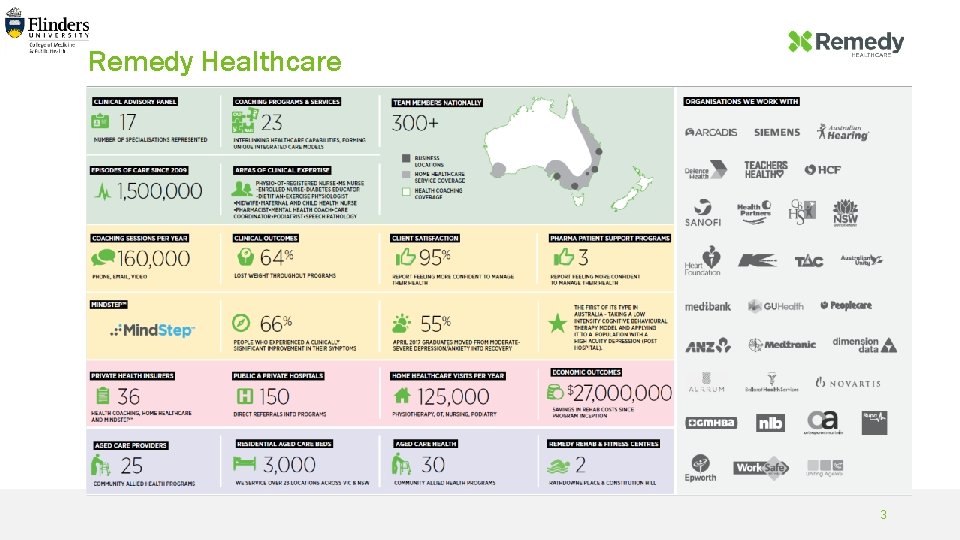
Remedy Healthcare 3
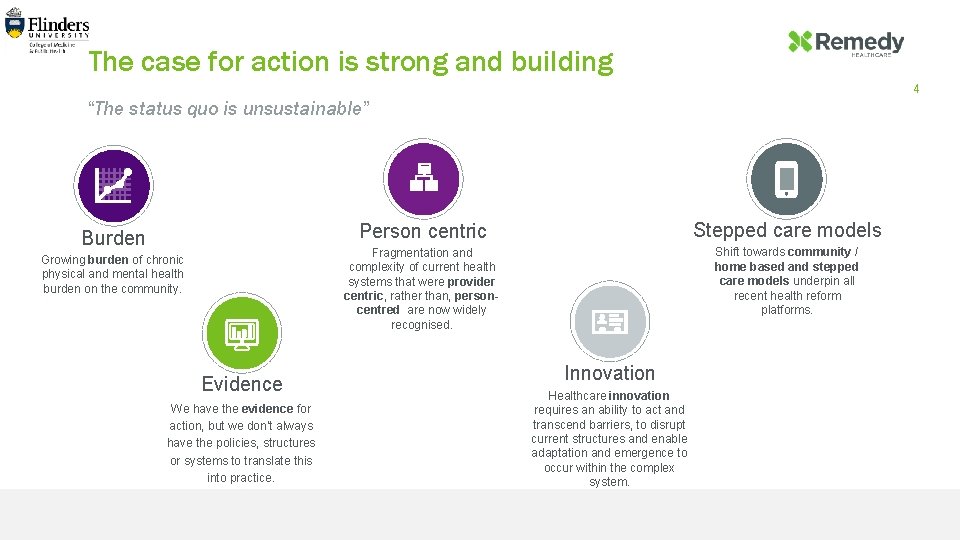
The case for action is strong and building 4 “The status quo is unsustainable” Burden Growing burden of chronic physical and mental health burden on the community. Evidence We have the evidence for action, but we don’t always have the policies, structures or systems to translate this into practice. Person centric Stepped care models Fragmentation and complexity of current health systems that were provider centric, rather than, personcentred are now widely recognised. Shift towards community / home based and stepped care models underpin all recent health reform platforms. Innovation Healthcare innovation requires an ability to act and transcend barriers, to disrupt current structures and enable adaptation and emergence to occur within the complex system.
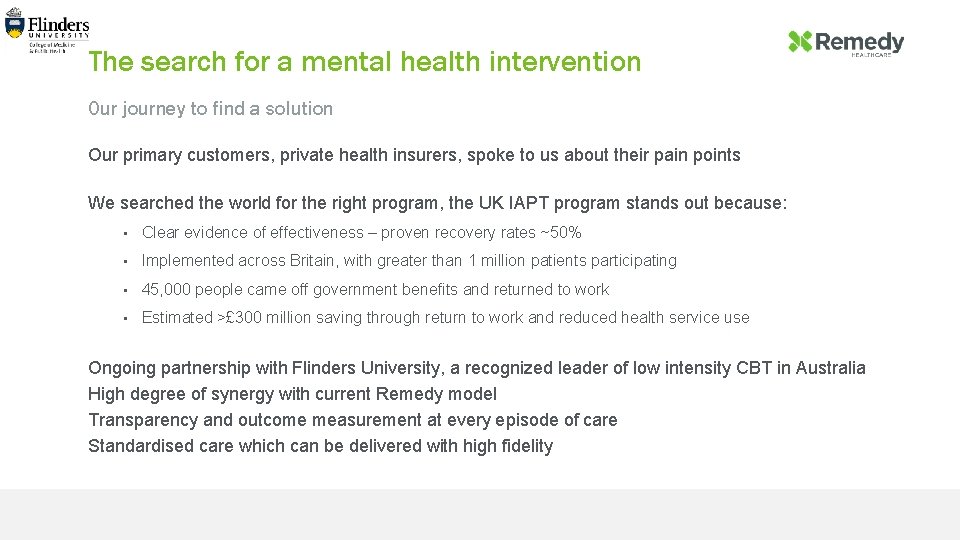
The search for a mental health intervention Our journey to find a solution Our primary customers, private health insurers, spoke to us about their pain points We searched the world for the right program, the UK IAPT program stands out because: • Clear evidence of effectiveness – proven recovery rates ~50% • Implemented across Britain, with greater than 1 million patients participating • 45, 000 people came off government benefits and returned to work • Estimated >£ 300 million saving through return to work and reduced health service use Ongoing partnership with Flinders University, a recognized leader of low intensity CBT in Australia High degree of synergy with current Remedy model Transparency and outcome measurement at every episode of care Standardised care which can be delivered with high fidelity
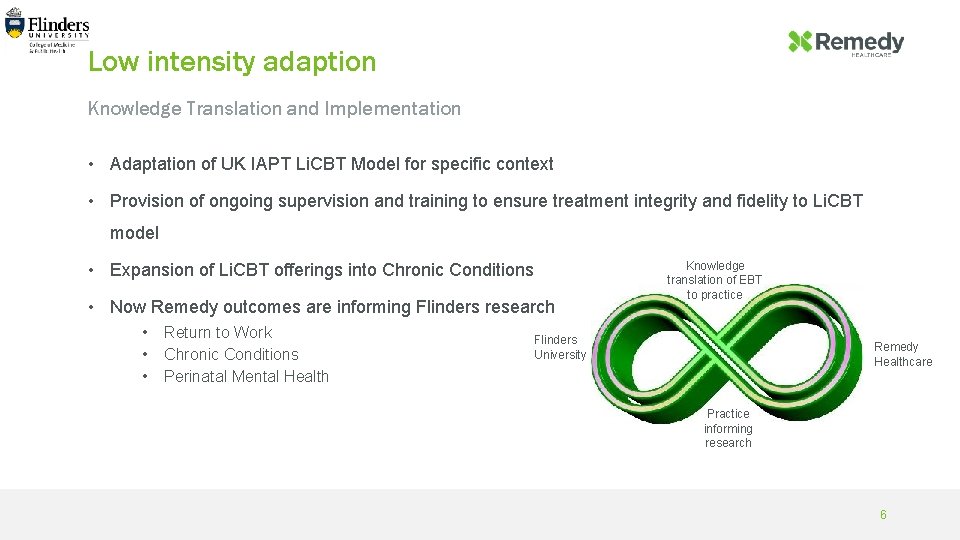
Low intensity adaption Knowledge Translation and Implementation • Adaptation of UK IAPT Li. CBT Model for specific context • Provision of ongoing supervision and training to ensure treatment integrity and fidelity to Li. CBT model • Expansion of Li. CBT offerings into Chronic Conditions • Now Remedy outcomes are informing Flinders research • • • Return to Work Chronic Conditions Perinatal Mental Health Knowledge translation of EBT to practice Flinders University Remedy Healthcare Practice informing research 6
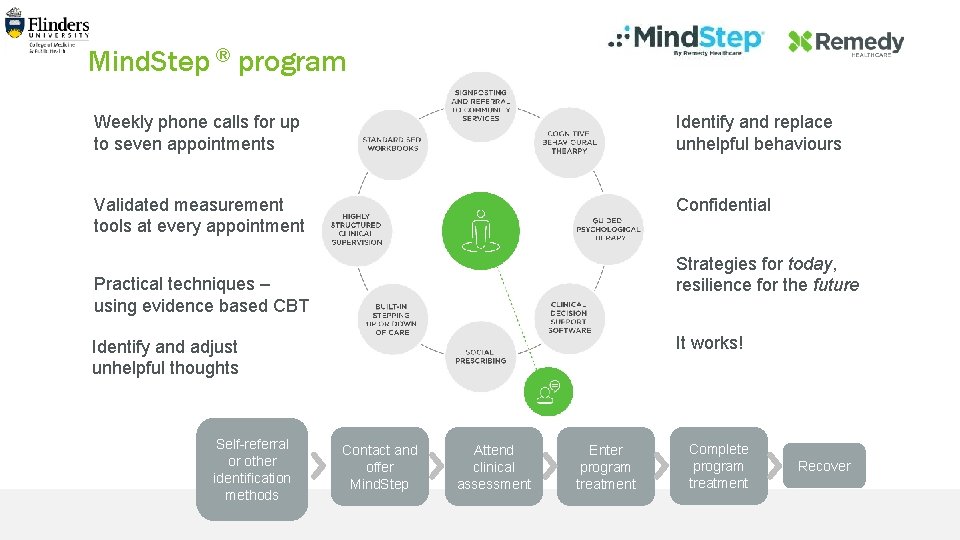
Mind. Step ® program Weekly phone calls for up to seven appointments Identify and replace unhelpful behaviours Validated measurement tools at every appointment Confidential Strategies for today, resilience for the future Practical techniques – using evidence based CBT It works! Identify and adjust unhelpful thoughts Self-referral or other identification methods Contact and offer Mind. Step Attend clinical assessment Enter program treatment Complete program treatment Recover
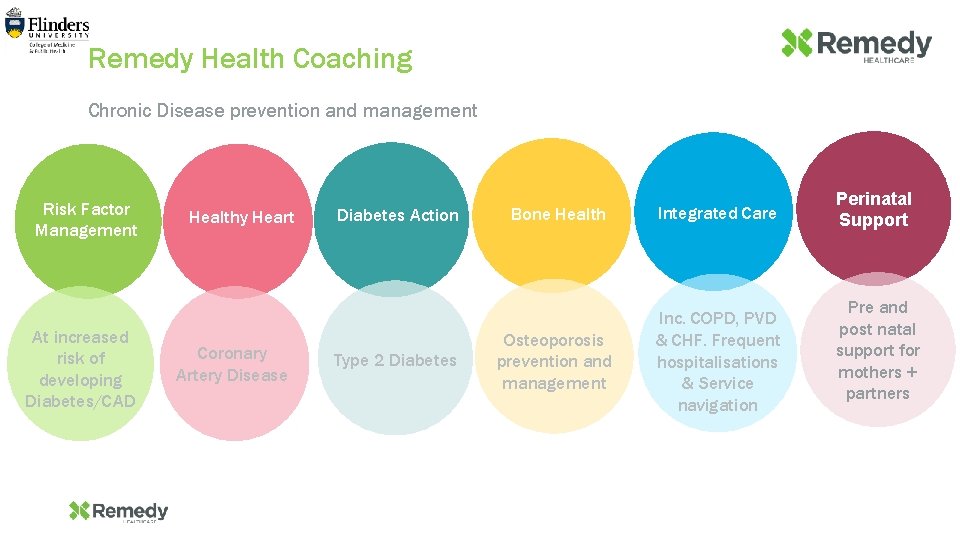
Remedy Health Coaching 8 Chronic Disease prevention and management Risk Factor Management At increased risk of developing Diabetes/CAD Healthy Heart Coronary Artery Disease Diabetes Action Type 2 Diabetes Bone Health Integrated Care Osteoporosis prevention and management Inc. COPD, PVD & CHF. Frequent hospitalisations & Service navigation Perinatal Support Pre and post natal support for mothers + partners
Health Coaching Programs Features Chronic Disease Management and Prevention Programs § ~6 months in duration § Via your choice of Phone, Email, Skype, and/or SMS messaging § Individualised contact frequency and duration (e. g. 5 min calls each week, or 25 min calls each month) Maternity Support programs § ~4 -6 Outbound consultations § Unlimited inbound email § Unlimited inbound Calls § Linkage to support services and ongoing support
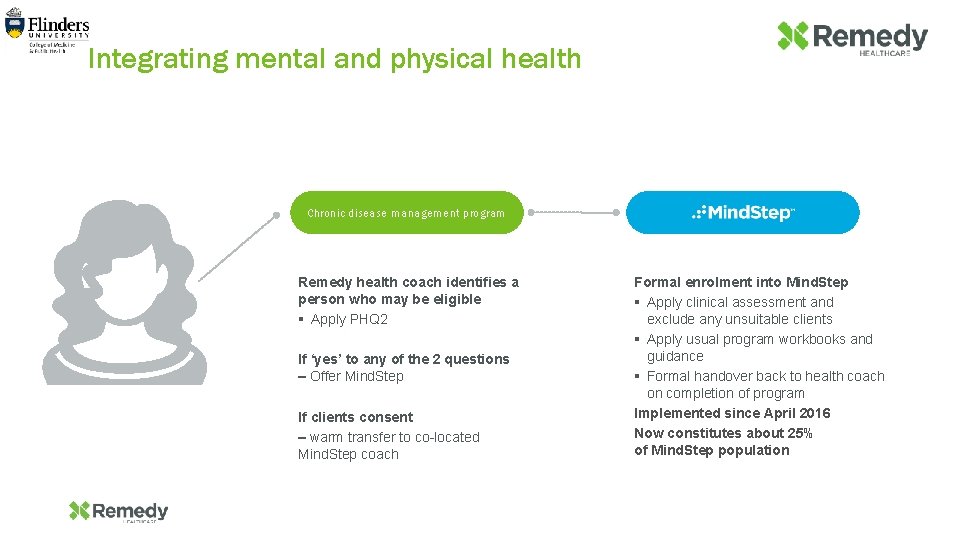
Integrating mental and physical health 10 Chronic disease management program Remedy health coach identifies a person who may be eligible § Apply PHQ 2 If ‘yes’ to any of the 2 questions – Offer Mind. Step If clients consent – warm transfer to co-located Mind. Step coach Formal enrolment into Mind. Step § Apply clinical assessment and exclude any unsuitable clients § Apply usual program workbooks and guidance § Formal handover back to health coach on completion of program Implemented since April 2016 Now constitutes about 25% of Mind. Step population
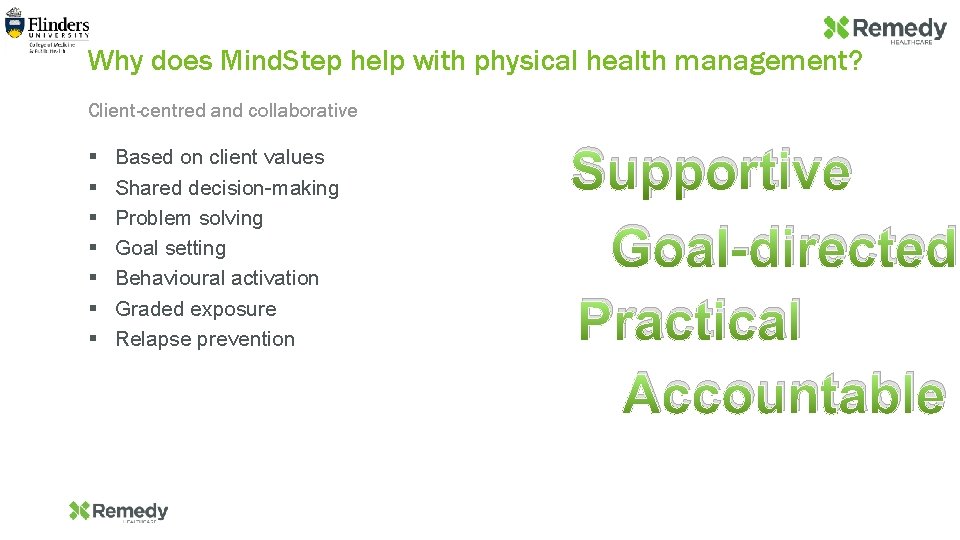
Why does Mind. Step help with physical health management? Client-centred and collaborative § § § § Based on client values Shared decision-making Problem solving Goal setting Behavioural activation Graded exposure Relapse prevention Supportive Goal-directed Practical Accountable
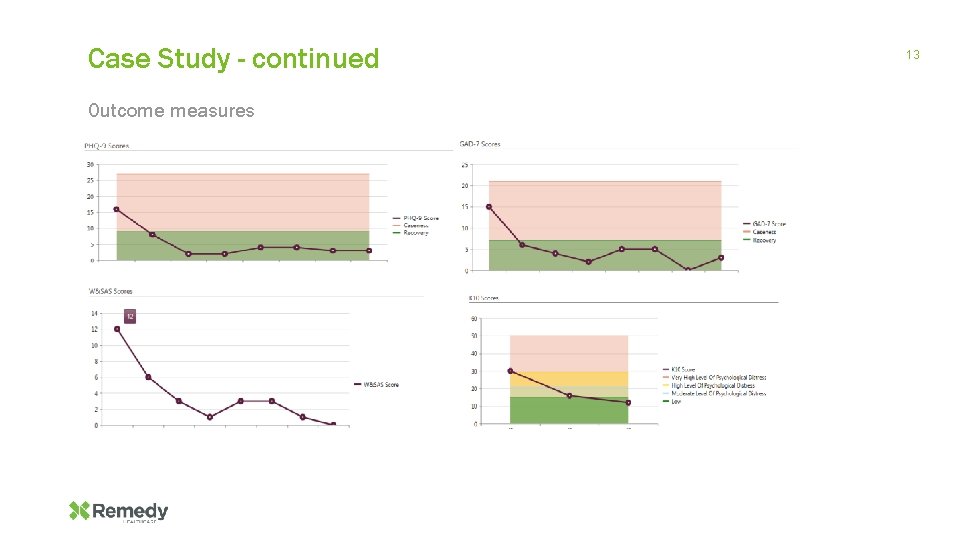
Case Study ‘Mary’ a 49 y/o female cross-referred from Remedy Healthy Heart Program (CAD) § § § Presented with overwhelm, guilt and anger relating to her work, family situation and health management Highly irritable, snappy, often teary, “not taking care of herself” Engaged in a course of behavioural activation focussing on realistic goal setting and practical problem solving Achieved end of coaching goals of exercising most days and socialising weekly Additional achievements – Improved sleep – Reported improved optimistic outlook – By two month follow-up has lost 8 kg – Reported is now enjoying getting up early once a week with hubby to watch the sunrise ♥ 12
Case Study - continued Outcome measures 13
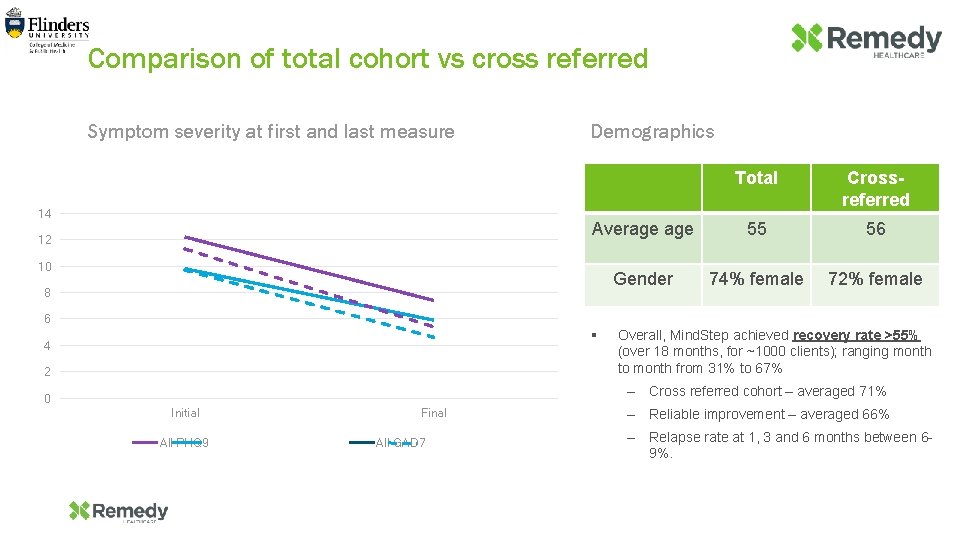
Comparison of total cohort vs cross referred Symptom severity at first and last measure 14 12 14 Demographics Total Crossreferred Average 55 56 Gender 74% female 72% female 10 8 6 § 4 2 Overall, Mind. Step achieved recovery rate >55% (over 18 months, for ~1000 clients); ranging month to month from 31% to 67% – Cross referred cohort – averaged 71% 0 Initial All PHQ 9 Final All GAD 7 – Reliable improvement – averaged 66% – Relapse rate at 1, 3 and 6 months between 69%.
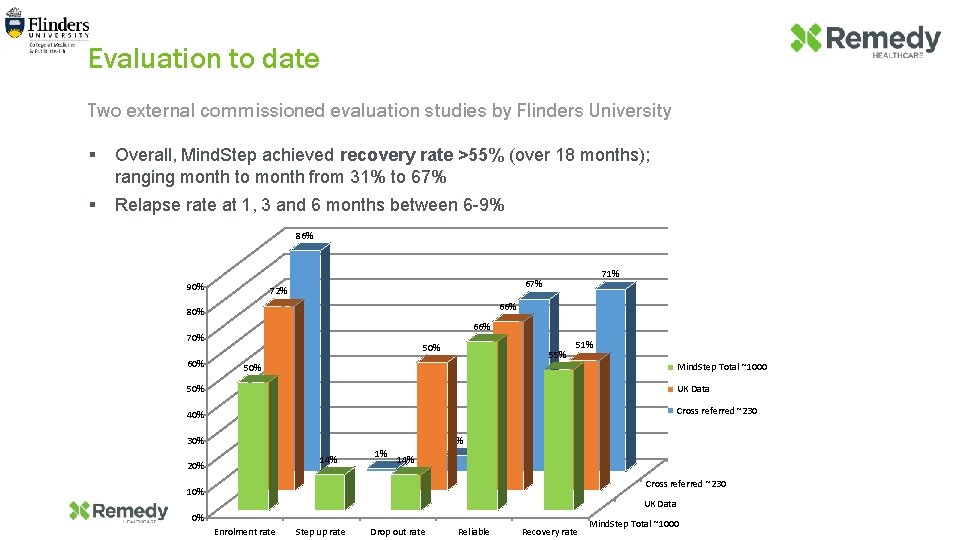
Evaluation to date 15 Two external commissioned evaluation studies by Flinders University § Overall, Mind. Step achieved recovery rate >55% (over 18 months); ranging month to month from 31% to 67% § Relapse rate at 1, 3 and 6 months between 6 -9% 86% 90% 72% 66% 80% 66% 70% 60% 71% 67% 50% 55% 51% Mind. Step Total ~1000 50% UK Data 40% Cross referred ~230 30% 6% 14% 20% 1% 14% Cross referred ~230 10% UK Data 0% Enrolment rate Step up rate Drop out rate Reliable Recovery rate Mind. Step Total ~1000
Next Steps § Ongoing research partnership – Balanced, prospective comparative study to evaluate physical health, self-management and health literacy outcomes of traditional Health coaching cohort vs Health coaching + Mind. Step cohort § Cross referring clients from Mind. Step to coaching § Chronic pain intervention using physical and CBT strategies including psychoeducation, pain catastrophizing, cognitive restructuring, pacing § Return to work intervention including problem solving, worry management and goal setting principles 16
Questions? § § We invite any questions for the group this afternoon Alternatively, feel free to be in touch: – fiona. glover@flinders. edu. au | https: //www. linkedin. com/in/fiona-glover-6 a 8530 aa/ – ntepper@remedyhealthcare. com. au | https: //www. linkedin. com/in/nicci-tepper/ 17