
Probing cosmology using dark matter microhalos M Sten
Probing cosmology using dark matter microhalos M. Sten Delos University of North Carolina at Chapel Hill Talk prepared for the Max Planck Institute for Astrophysics January 20, 2020
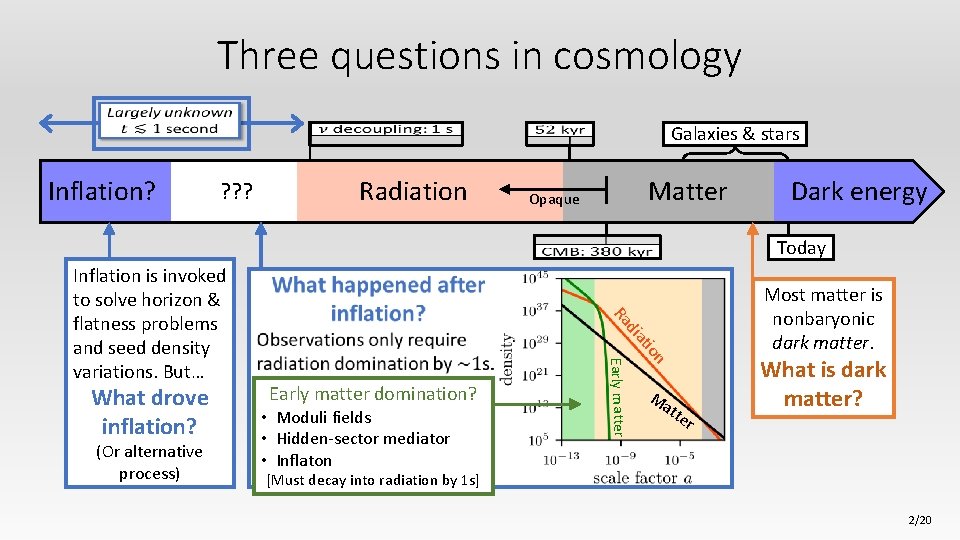
Three questions in cosmology Galaxies & stars Inflation? ? ? ? Radiation Matter Opaque Dark energy Today • Moduli fields • Hidden-sector mediator • Inflaton n io at di (Or alternative process) Early matter domination? Early matter What drove inflation? Most matter is nonbaryonic dark matter. Ra Inflation is invoked to solve horizon & flatness problems and seed density variations. But… Ma tte r What is dark matter? [Must decay into radiation by 1 s] 2/20
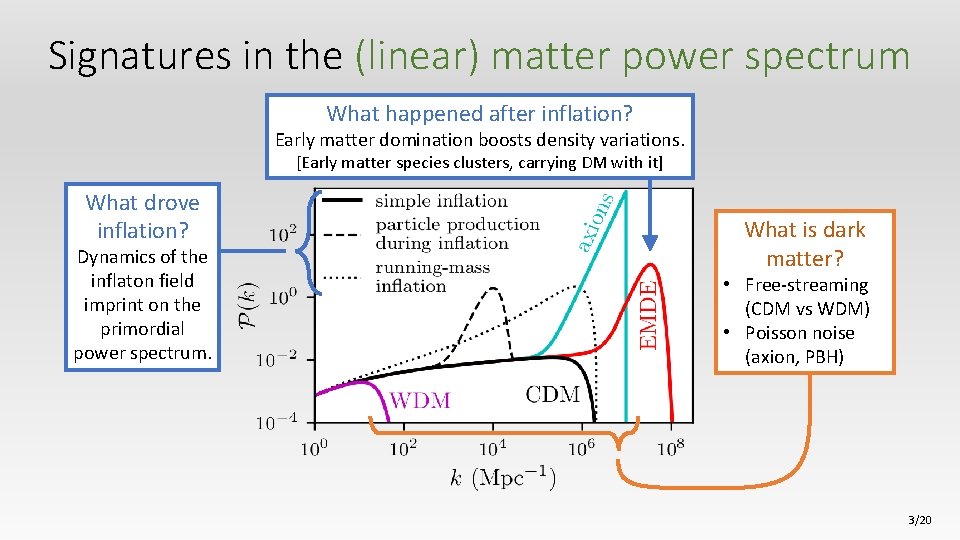
Signatures in the (linear) matter power spectrum What happened after inflation? Early matter domination boosts density variations. [Early matter species clusters, carrying DM with it] What drove inflation? Dynamics of the inflaton field imprint on the primordial power spectrum. What is dark matter? • Free-streaming (CDM vs WDM) • Poisson noise (axion, PBH) 3/20
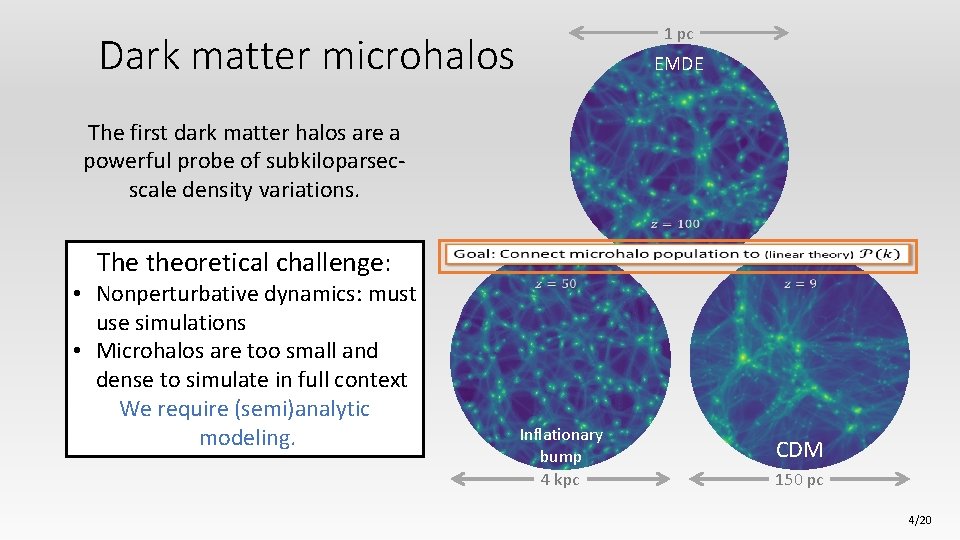
1 pc Dark matter microhalos EMDE The first dark matter halos are a powerful probe of subkiloparsecscale density variations. The theoretical challenge: • Nonperturbative dynamics: must use simulations • Microhalos are too small and dense to simulate in full context We require (semi)analytic modeling. Inflationary bump 4 kpc CDM 150 pc 4/20
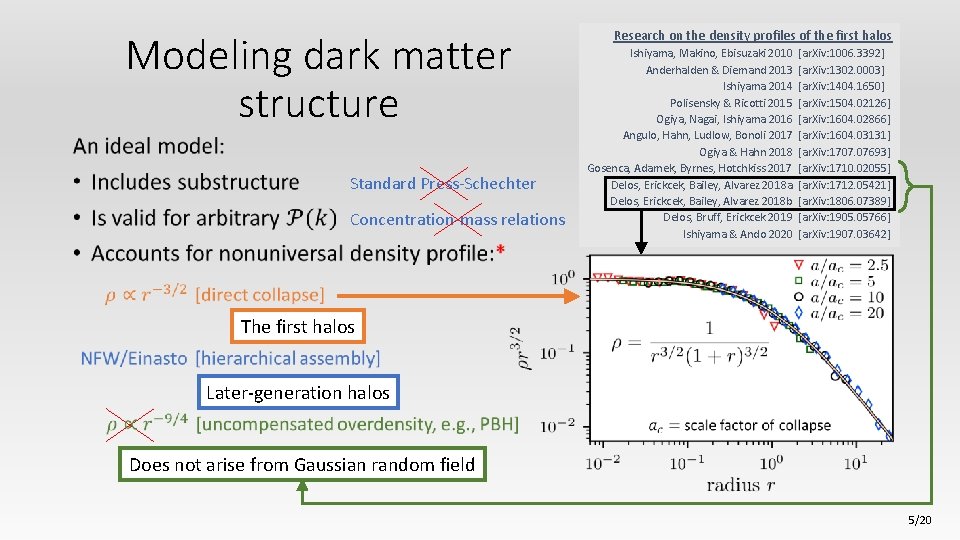
Modeling dark matter structure • Standard Press-Schechter Concentration-mass relations Research on the density profiles of the first halos Ishiyama, Makino, Ebisuzaki 2010 Anderhalden & Diemand 2013 Ishiyama 2014 Polisensky & Ricotti 2015 Ogiya, Nagai, Ishiyama 2016 Angulo, Hahn, Ludlow, Bonoli 2017 Ogiya & Hahn 2018 Gosenca, Adamek, Byrnes, Hotchkiss 2017 Delos, Erickcek, Bailey, Alvarez 2018 a Delos, Erickcek, Bailey, Alvarez 2018 b Delos, Bruff, Erickcek 2019 Ishiyama & Ando 2020 [ar. Xiv: 1006. 3392] [ar. Xiv: 1302. 0003] [ar. Xiv: 1404. 1650] [ar. Xiv: 1504. 02126] [ar. Xiv: 1604. 02866] [ar. Xiv: 1604. 03131] [ar. Xiv: 1707. 07693] [ar. Xiv: 1710. 02055] [ar. Xiv: 1712. 05421] [ar. Xiv: 1806. 07389] [ar. Xiv: 1905. 05766] [ar. Xiv: 1907. 03642] The first halos Later-generation halos Does not arise from Gaussian random field 5/20
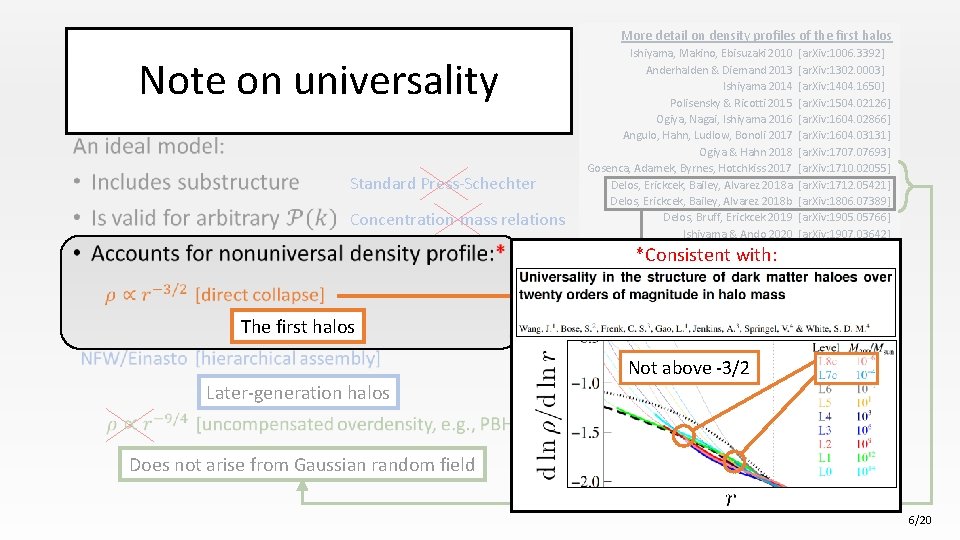
More detail on density profiles of the first halos Note on universality • Standard Press-Schechter Concentration-mass relations Ishiyama, Makino, Ebisuzaki 2010 Anderhalden & Diemand 2013 Ishiyama 2014 Polisensky & Ricotti 2015 Ogiya, Nagai, Ishiyama 2016 Angulo, Hahn, Ludlow, Bonoli 2017 Ogiya & Hahn 2018 Gosenca, Adamek, Byrnes, Hotchkiss 2017 Delos, Erickcek, Bailey, Alvarez 2018 a Delos, Erickcek, Bailey, Alvarez 2018 b Delos, Bruff, Erickcek 2019 Ishiyama & Ando 2020 [ar. Xiv: 1006. 3392] [ar. Xiv: 1302. 0003] [ar. Xiv: 1404. 1650] [ar. Xiv: 1504. 02126] [ar. Xiv: 1604. 02866] [ar. Xiv: 1604. 03131] [ar. Xiv: 1707. 07693] [ar. Xiv: 1710. 02055] [ar. Xiv: 1712. 05421] [ar. Xiv: 1806. 07389] [ar. Xiv: 1905. 05766] [ar. Xiv: 1907. 03642] *Consistent with: The first halos Not above -3/2 Later-generation halos Does not arise from Gaussian random field 6/20
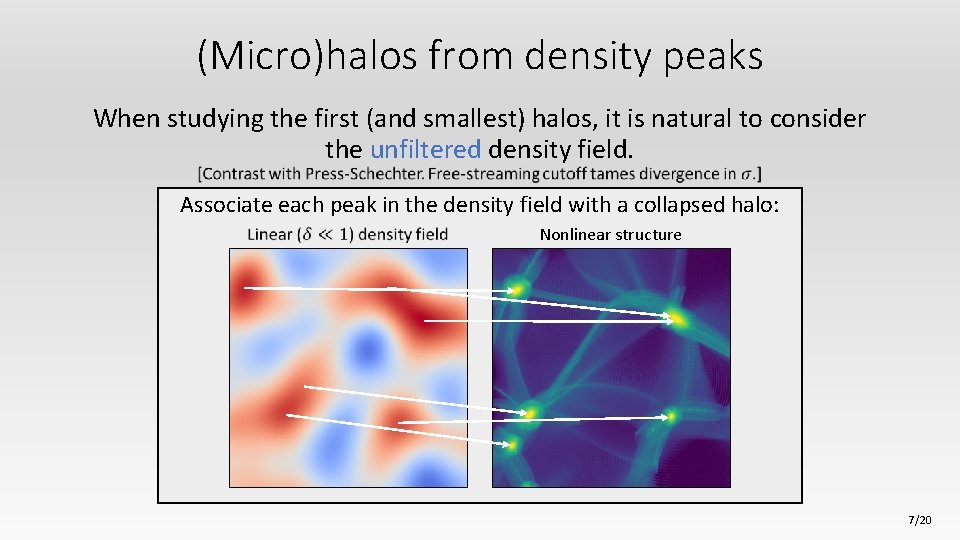
(Micro)halos from density peaks When studying the first (and smallest) halos, it is natural to consider the unfiltered density field. Associate each peak in the density field with a collapsed halo: Nonlinear structure 7/20
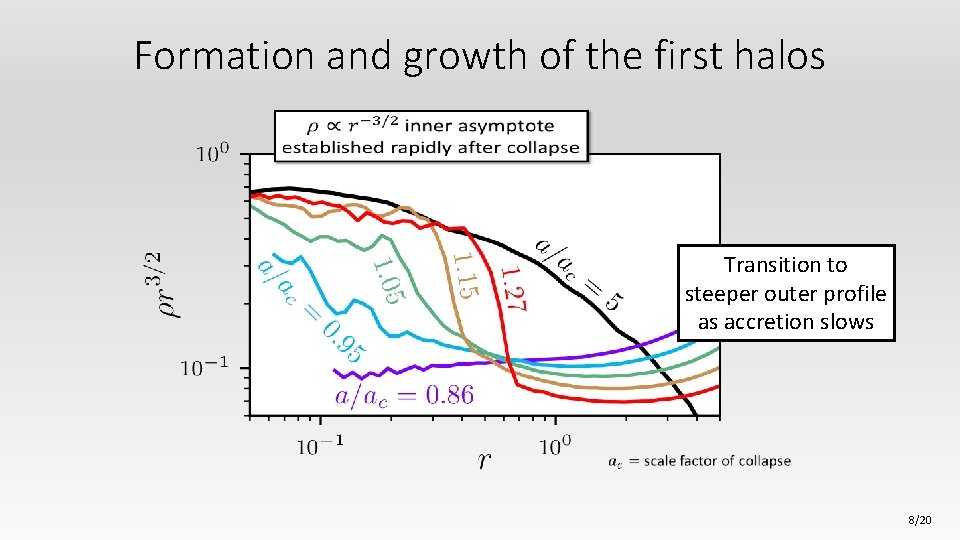
Formation and growth of the first halos Transition to steeper outer profile as accretion slows 8/20
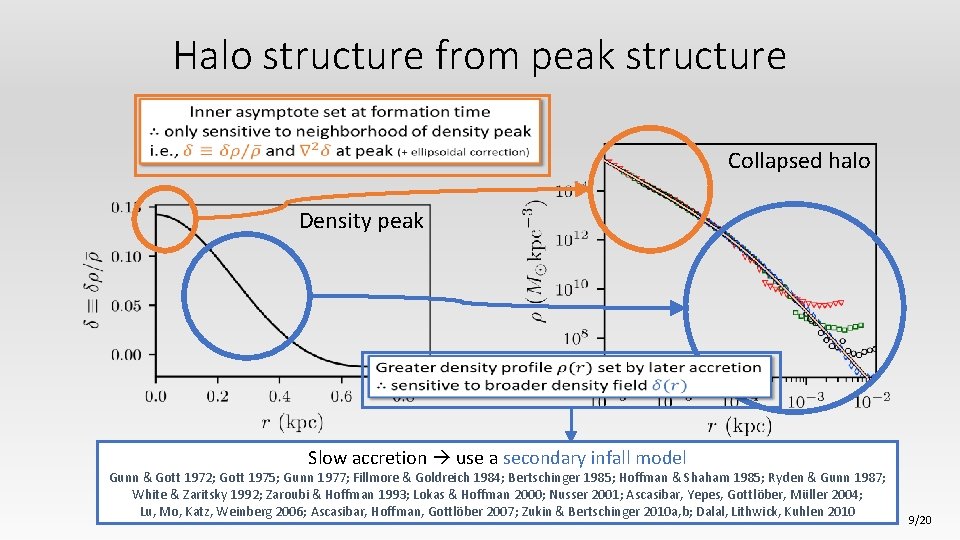
Halo structure from peak structure Collapsed halo Density peak Slow accretion use a secondary infall model Gunn & Gott 1972; Gott 1975; Gunn 1977; Fillmore & Goldreich 1984; Bertschinger 1985; Hoffman & Shaham 1985; Ryden & Gunn 1987; White & Zaritsky 1992; Zaroubi & Hoffman 1993; Lokas & Hoffman 2000; Nusser 2001; Ascasibar, Yepes, Gottlöber, Müller 2004; Lu, Mo, Katz, Weinberg 2006; Ascasibar, Hoffman, Gottlöber 2007; Zukin & Bertschinger 2010 a, b; Dalal, Lithwick, Kuhlen 2010 9/20
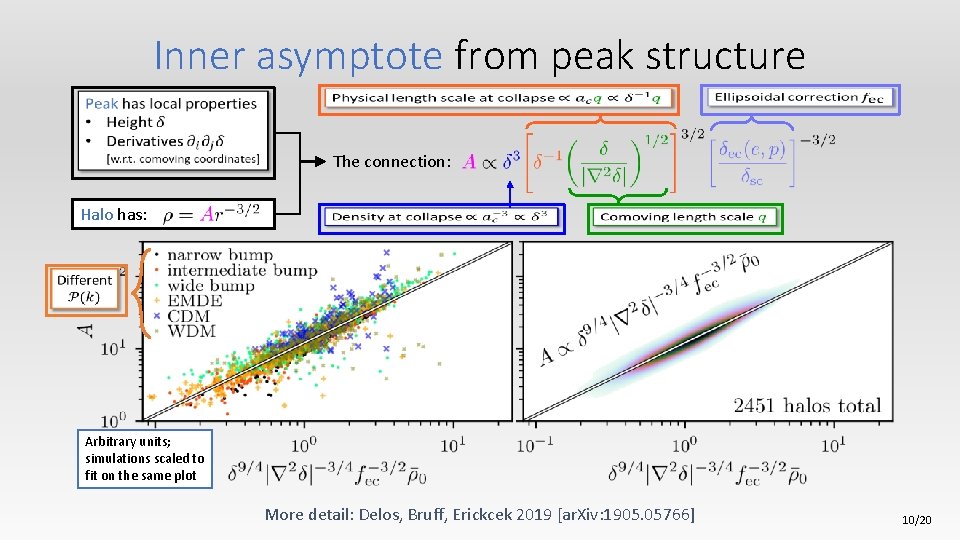
Inner asymptote from peak structure The connection: Halo has: Arbitrary units; simulations scaled to fit on the same plot More detail: Delos, Bruff, Erickcek 2019 [ar. Xiv: 1905. 05766] 10/20
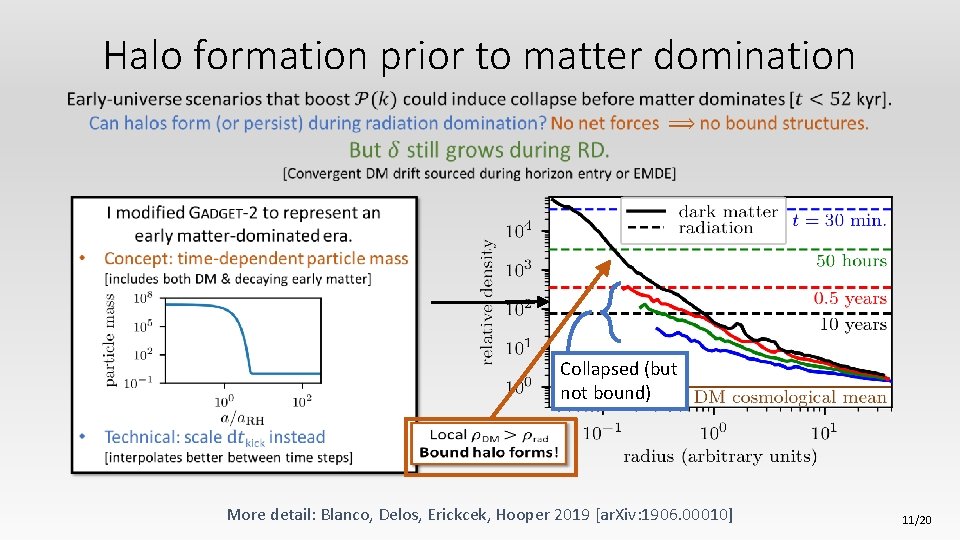
Halo formation prior to matter domination Collapsed (but not bound) More detail: Blanco, Delos, Erickcek, Hooper 2019 [ar. Xiv: 1906. 00010] 11/20
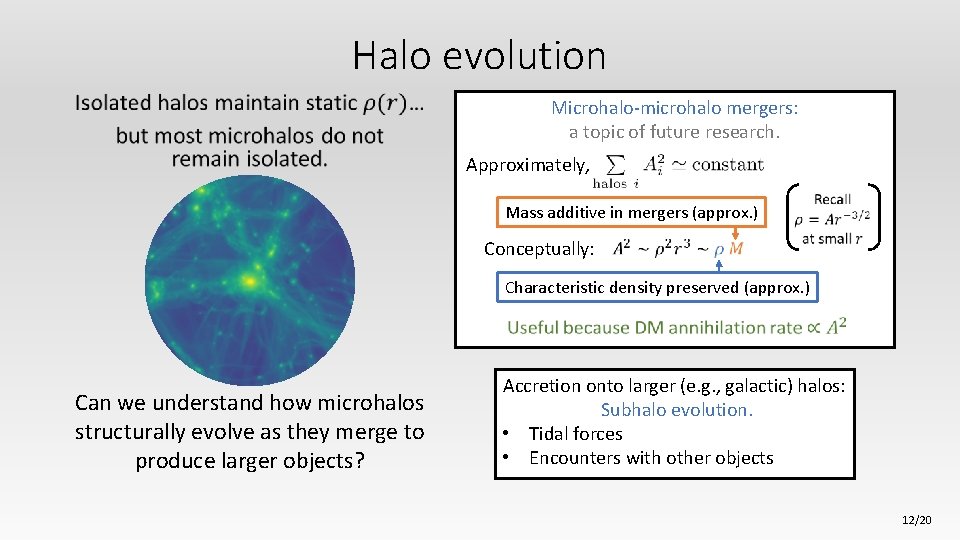
Halo evolution • Microhalo-microhalo mergers: a topic of future research. Approximately, Mass additive in mergers (approx. ) Conceptually: Characteristic density preserved (approx. ) Can we understand how microhalos structurally evolve as they merge to produce larger objects? Accretion onto larger (e. g. , galactic) halos: Subhalo evolution. • Tidal forces • Encounters with other objects 12/20
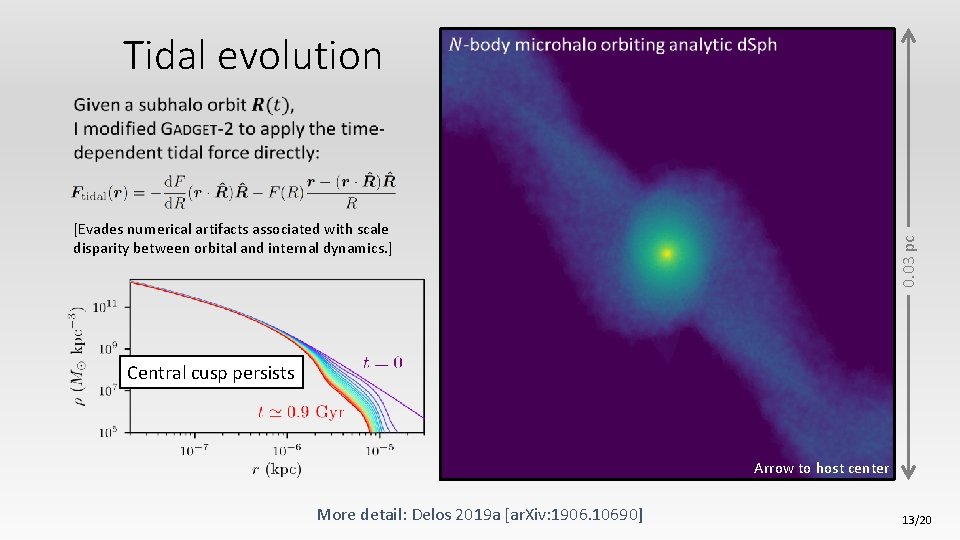
Tidal evolution 0. 03 pc [Evades numerical artifacts associated with scale disparity between orbital and internal dynamics. ] Central cusp persists Arrow to host center More detail: Delos 2019 a [ar. Xiv: 1906. 10690] 13/20
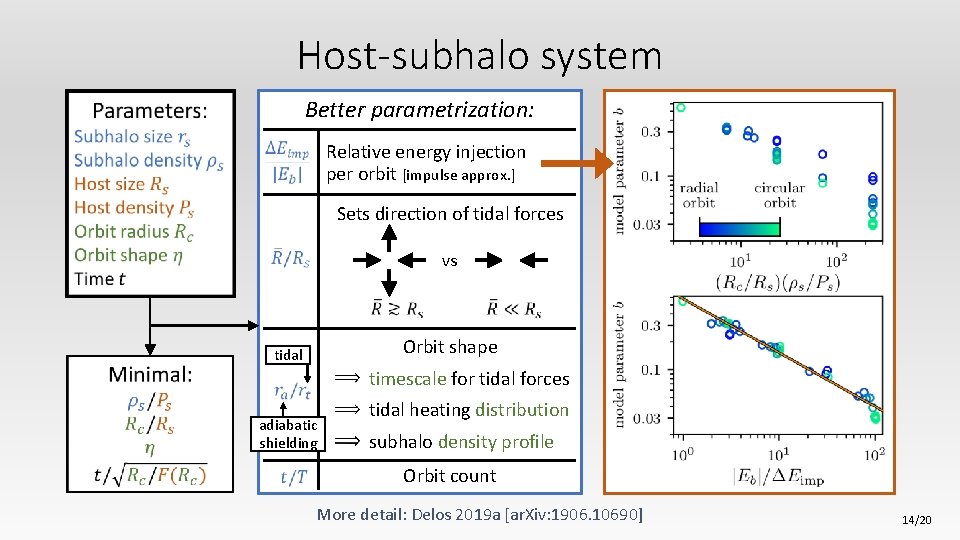
Host-subhalo system • Better parametrization: Relative energy injection per orbit [impulse approx. ] Sets direction of tidal forces vs Orbit shape tidal timescale for tidal forces adiabatic shielding tidal heating distribution subhalo density profile Orbit count More detail: Delos 2019 a [ar. Xiv: 1906. 10690] 14/20
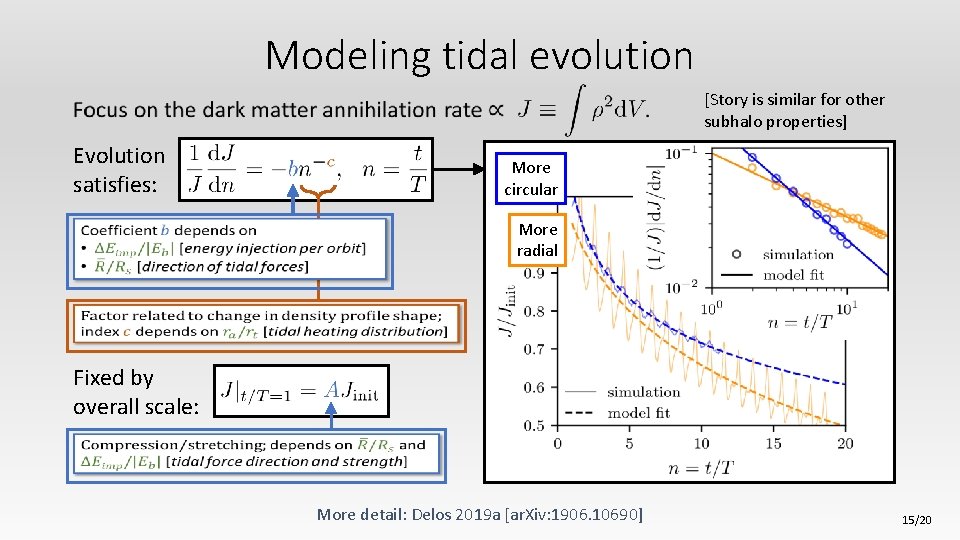
Modeling tidal evolution [Story is similar for other subhalo properties] • Evolution satisfies: More circular More radial Fixed by overall scale: More detail: Delos 2019 a [ar. Xiv: 1906. 10690] 15/20
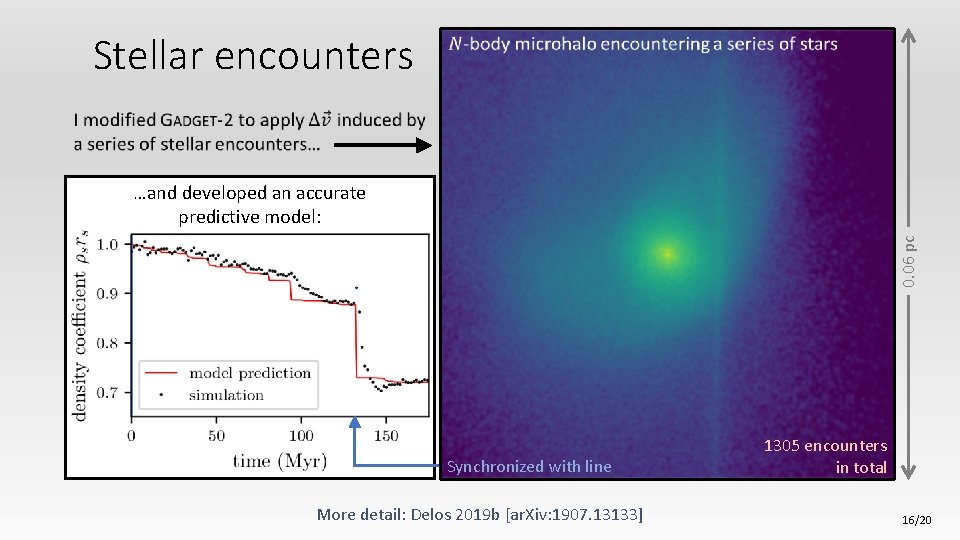
Stellar encounters 0. 06 pc …and developed an accurate predictive model: Synchronized with line More detail: Delos 2019 b [ar. Xiv: 1907. 13133] 1305 encounters in total 16/20
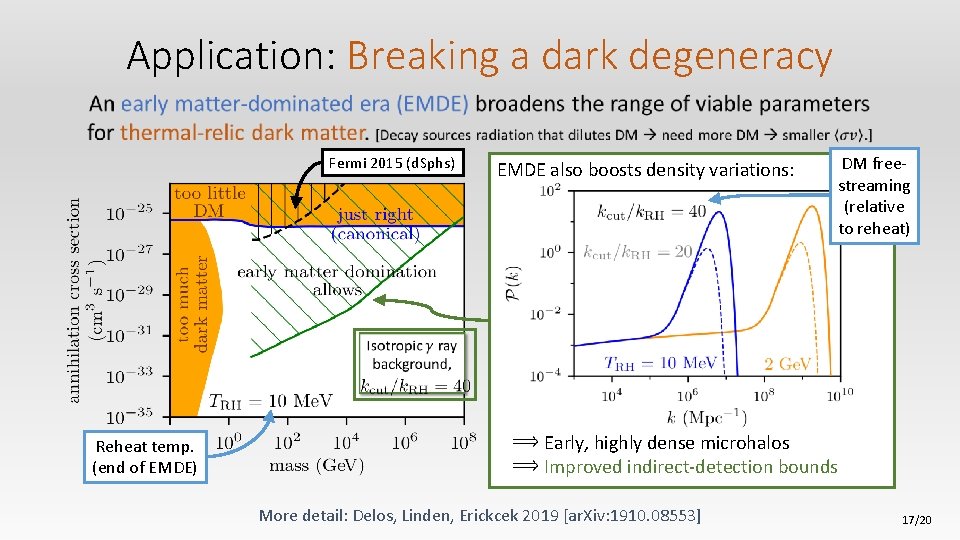
Application: Breaking a dark degeneracy Fermi 2015 (d. Sphs) Reheat temp. (end of EMDE) EMDE also boosts density variations: DM freestreaming (relative to reheat) Early, highly dense microhalos Improved indirect-detection bounds More detail: Delos, Linden, Erickcek 2019 [ar. Xiv: 1910. 08553] 17/20
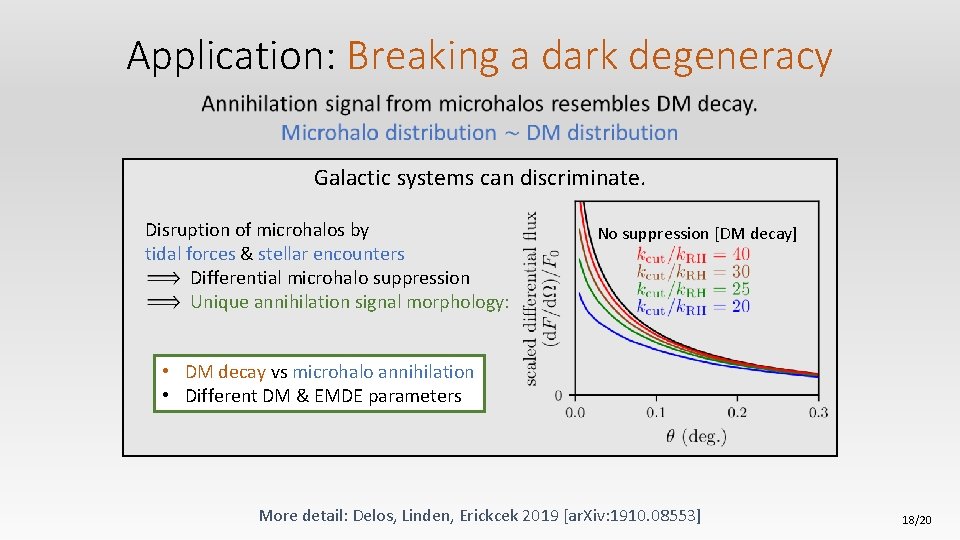
Application: Breaking a dark degeneracy Galactic systems can discriminate. Disruption of microhalos by tidal forces & stellar encounters Differential microhalo suppression Unique annihilation signal morphology: No suppression [DM decay] • DM decay vs microhalo annihilation • Different DM & EMDE parameters More detail: Delos, Linden, Erickcek 2019 [ar. Xiv: 1910. 08553] 18/20
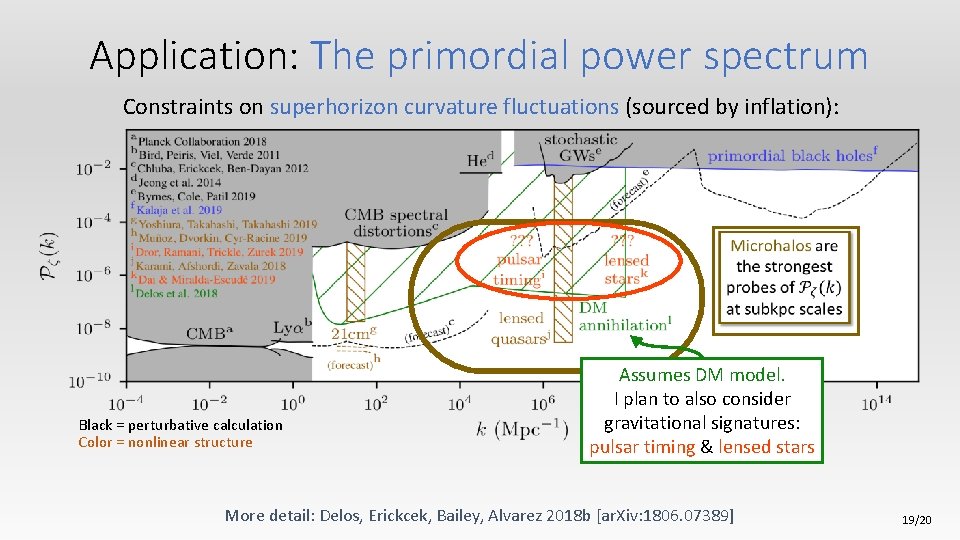
Application: The primordial power spectrum Constraints on superhorizon curvature fluctuations (sourced by inflation): Black = perturbative calculation Color = nonlinear structure Assumes DM model. I plan to also consider gravitational signatures: pulsar timing & lensed stars More detail: Delos, Erickcek, Bailey, Alvarez 2018 b [ar. Xiv: 1806. 07389] 19/20
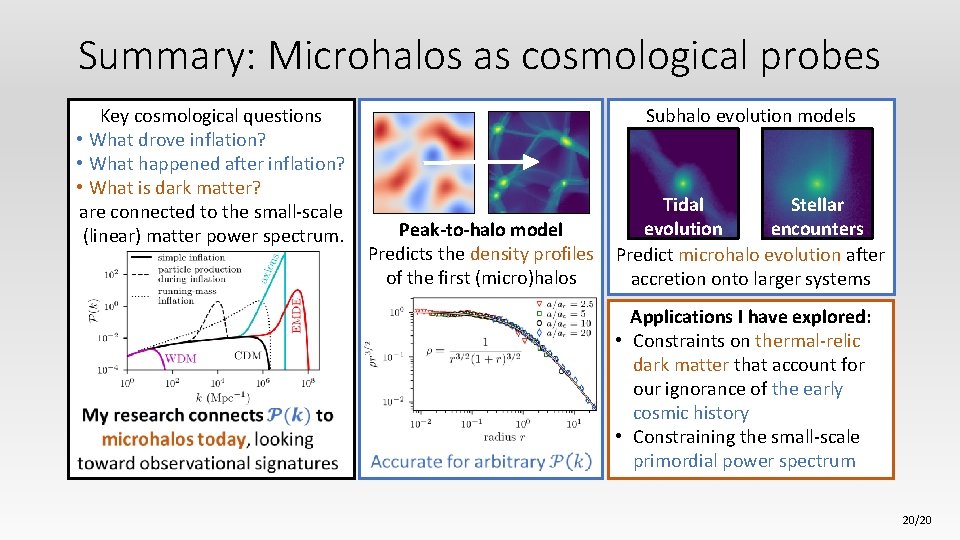
Summary: Microhalos as cosmological probes Key cosmological questions • What drove inflation? • What happened after inflation? • What is dark matter? are connected to the small-scale (linear) matter power spectrum. Subhalo evolution models Peak-to-halo model Predicts the density profiles of the first (micro)halos Tidal Stellar evolution encounters Predict microhalo evolution after accretion onto larger systems Applications I have explored: • Constraints on thermal-relic dark matter that account for our ignorance of the early cosmic history • Constraining the small-scale primordial power spectrum 20/20
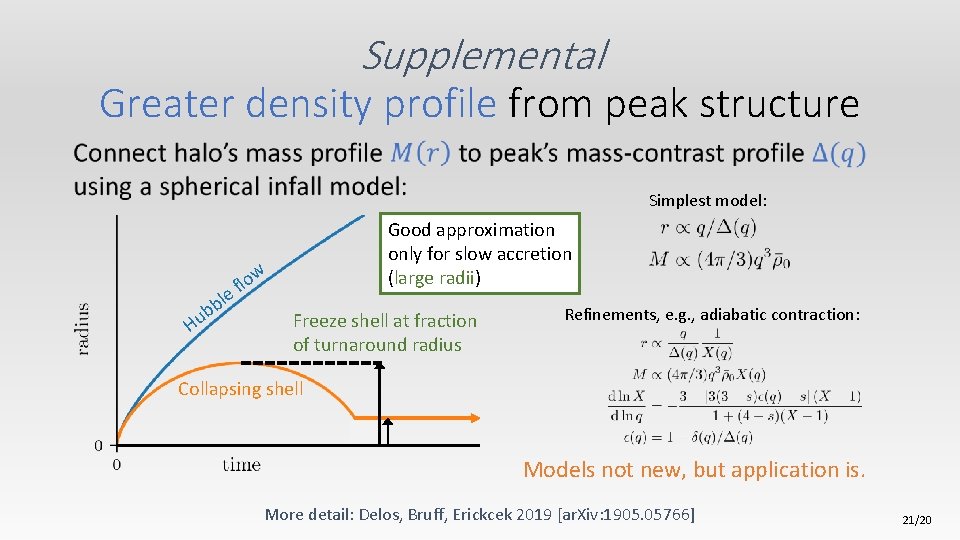
Supplemental Greater density profile from peak structure Simplest model: low f le b ub H Good approximation only for slow accretion (large radii) Freeze shell at fraction of turnaround radius Refinements, e. g. , adiabatic contraction: Collapsing shell Models not new, but application is. More detail: Delos, Bruff, Erickcek 2019 [ar. Xiv: 1905. 05766] 21/20
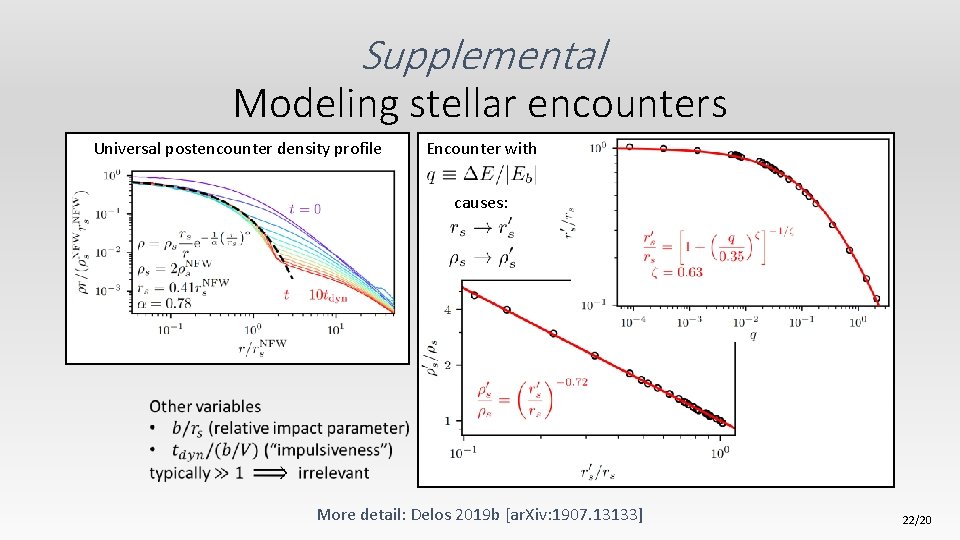
Supplemental Modeling stellar encounters Universal postencounter density profile Encounter with causes: More detail: Delos 2019 b [ar. Xiv: 1907. 13133] 22/20
- Slides: 22