Applied Psychology in Human Resource Management seventh edition


- Slides: 69
Applied Psychology in Human Resource Management seventh edition Cascio & Aguinis Power. Point Slides developed by Ms. Elizabeth Freeman University of South Carolina Upstate Copyright © 2011 Pearson Education, Inc. publishing as Prentice Hall 17 -1
Chapter 17 International Dimensions of Applied Psychology Copyright © 2011 Pearson Education, Inc. publishing as Prentice Hall 17 -2
What are some of the implications of globalization for Applied Psychology? Copyright © 2011 Pearson Education, Inc. publishing as Prentice Hall 17 -3
1. Identifying Potential International Management 2. International Assignment Selection 3. Cross-cultural Training 4. Performance Management 5. Repatriation Copyright © 2011 Pearson Education, Inc. publishing as Prentice Hall 17 -4
Just what is globalization? Copyright © 2011 Pearson Education, Inc. publishing as Prentice Hall 17 -5
Just what is globalization? Satellite transmissions, Internet businesses, fiber optics, computers, work locations, free trade, ATMs, 24/7 atmosphere, ownership of companies, legal framework, multinational enterprises Copyright © 2011 Pearson Education, Inc. publishing as Prentice Hall 17 -6
What about globalization and cultures? How are people digitizing? What are fungible resources? Copyright © 2011 Pearson Education, Inc. publishing as Prentice Hall 17 -7
Cultures are being globalized through data. Digital data can move from one nation to another nation faster than we can reason it. Copyright © 2011 Pearson Education, Inc. publishing as Prentice Hall 17 -8
Fungible resources are replaceable resources. Copyright © 2011 Pearson Education, Inc. publishing as Prentice Hall 17 -9
Digital data includes: money (capital), technology, information Digital data is fungible. Copyright © 2011 Pearson Education, Inc. publishing as Prentice Hall 17 -10
Only unique aspects to work are humans & their skills Copyright © 2011 Pearson Education, Inc. publishing as Prentice Hall 17 -11
Just what is culture? Copyright © 2011 Pearson Education, Inc. publishing as Prentice Hall 17 -12
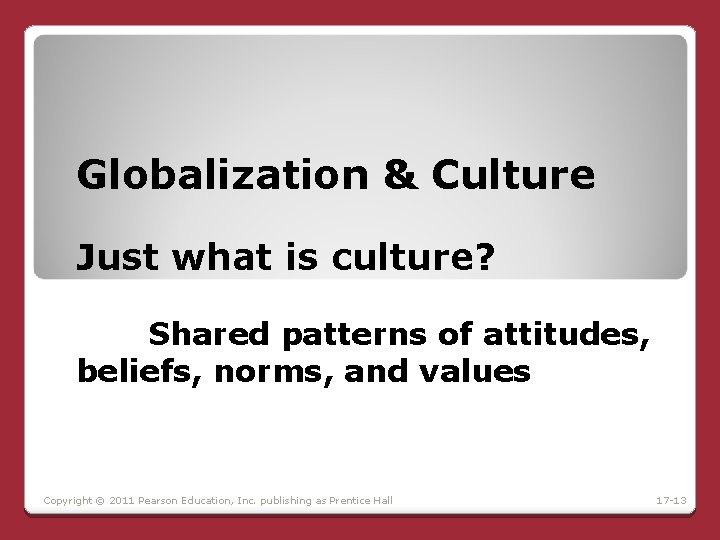
Globalization & Culture Just what is culture? Shared patterns of attitudes, beliefs, norms, and values Copyright © 2011 Pearson Education, Inc. publishing as Prentice Hall 17 -13
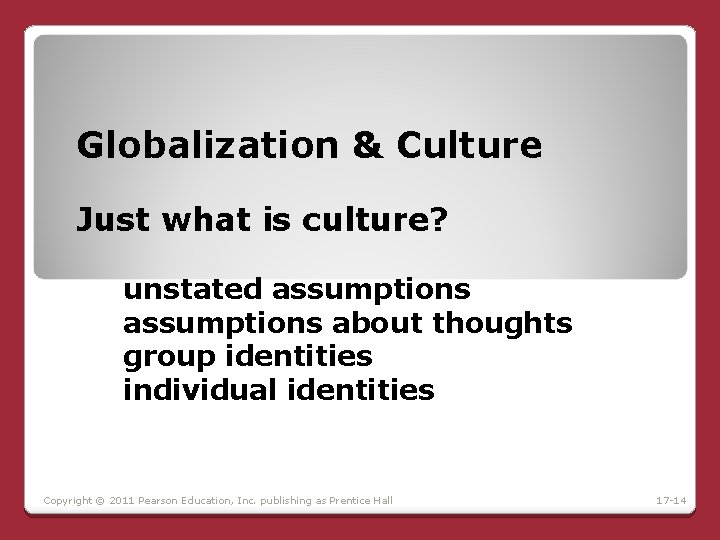
Globalization & Culture Just what is culture? unstated assumptions about thoughts group identities individual identities Copyright © 2011 Pearson Education, Inc. publishing as Prentice Hall 17 -14
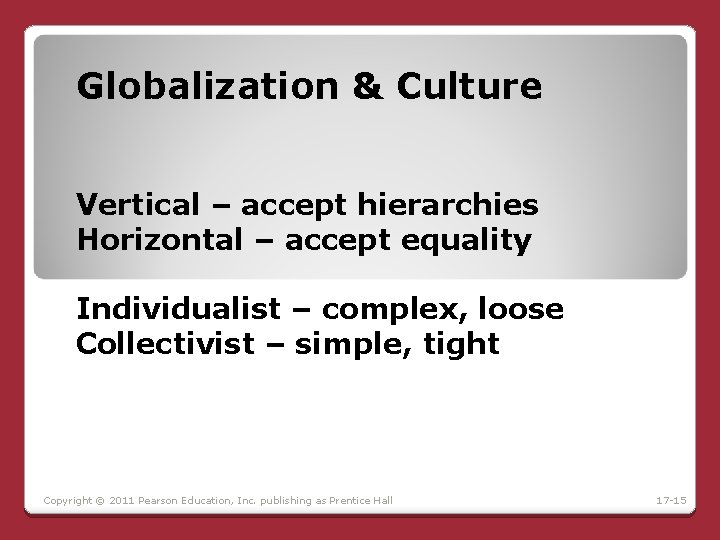
Globalization & Culture Vertical – accept hierarchies Horizontal – accept equality Individualist – complex, loose Collectivist – simple, tight Copyright © 2011 Pearson Education, Inc. publishing as Prentice Hall 17 -15
Globalization & Culture Universal dimensions of culture Definition of self Structure of goals Norms versus attitudes Relatedness versus rationality Copyright © 2011 Pearson Education, Inc. publishing as Prentice Hall 17 -16
Globalization & Culture HRM Impacts Goal-setting Reward systems Communications Performance feedback Assessment practices Training & Development Copyright © 2011 Pearson Education, Inc. publishing as Prentice Hall 17 -17
Country-Level Cultural Differences Power distance Uncertainty avoidance Individualism Masculinity Long-term versus short-term orientation Copyright © 2011 Pearson Education, Inc. publishing as Prentice Hall 17 -18
Country-Level Cultural Differences Power distance: accepting inequality, distance from those in higher positions Copyright © 2011 Pearson Education, Inc. publishing as Prentice Hall 17 -19
Country-Level Cultural Differences Uncertainty avoidance: cultural acceptance to ambiguous situations Copyright © 2011 Pearson Education, Inc. publishing as Prentice Hall 17 -20
Country-Level Cultural Differences Individualism: extent to which person goals as opposed to group goals are encouraged Copyright © 2011 Pearson Education, Inc. publishing as Prentice Hall 17 -21
Country-Level Cultural Differences Long-term vs. short-term orientation: acceptance of delayed gratification Copyright © 2011 Pearson Education, Inc. publishing as Prentice Hall 17 -22
Country-Level Cultural Differences Looking at countries by dimension Power distance: accepting inequality, distance from those in higher positions top = Malaysia, Guatemala, Philippines bottom = Austria, Israel, Denmark Copyright © 2011 Pearson Education, Inc. publishing as Prentice Hall 17 -23
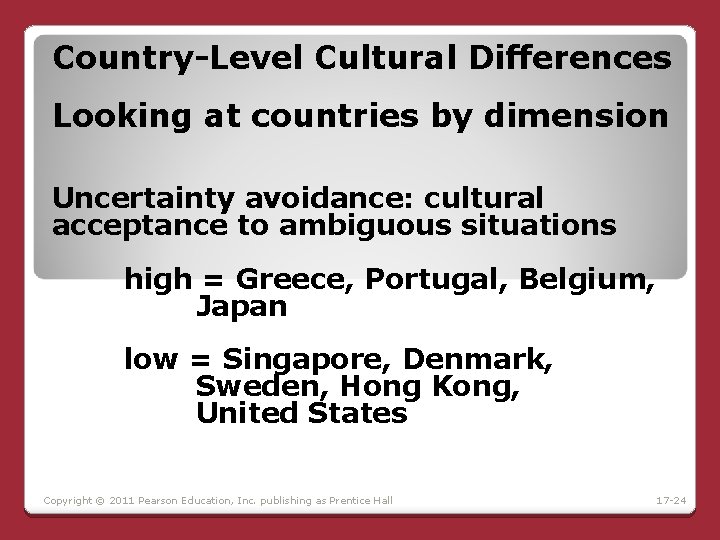
Country-Level Cultural Differences Looking at countries by dimension Uncertainty avoidance: cultural acceptance to ambiguous situations high = Greece, Portugal, Belgium, Japan low = Singapore, Denmark, Sweden, Hong Kong, United States Copyright © 2011 Pearson Education, Inc. publishing as Prentice Hall 17 -24
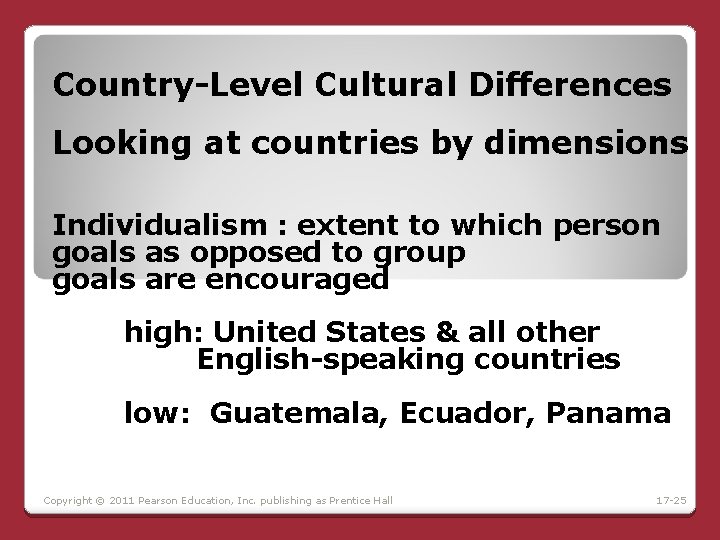
Country-Level Cultural Differences Looking at countries by dimensions Individualism : extent to which person goals as opposed to group goals are encouraged high: United States & all other English-speaking countries low: Guatemala, Ecuador, Panama Copyright © 2011 Pearson Education, Inc. publishing as Prentice Hall 17 -25
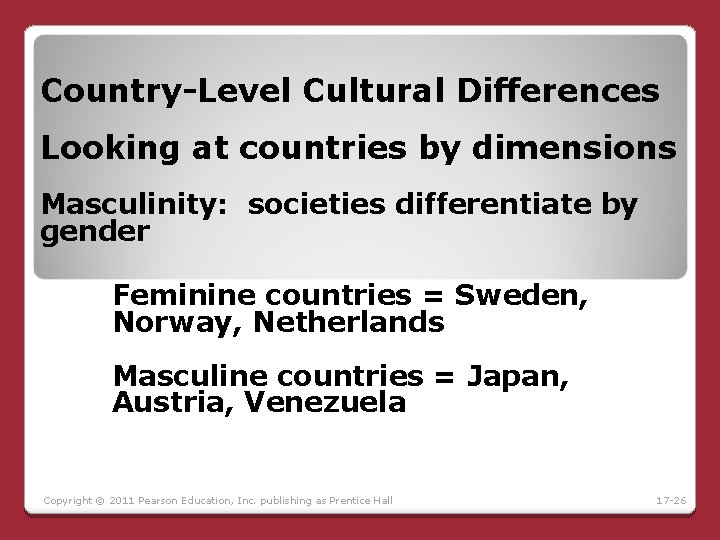
Country-Level Cultural Differences Looking at countries by dimensions Masculinity: societies differentiate by gender Feminine countries = Sweden, Norway, Netherlands Masculine countries = Japan, Austria, Venezuela Copyright © 2011 Pearson Education, Inc. publishing as Prentice Hall 17 -26
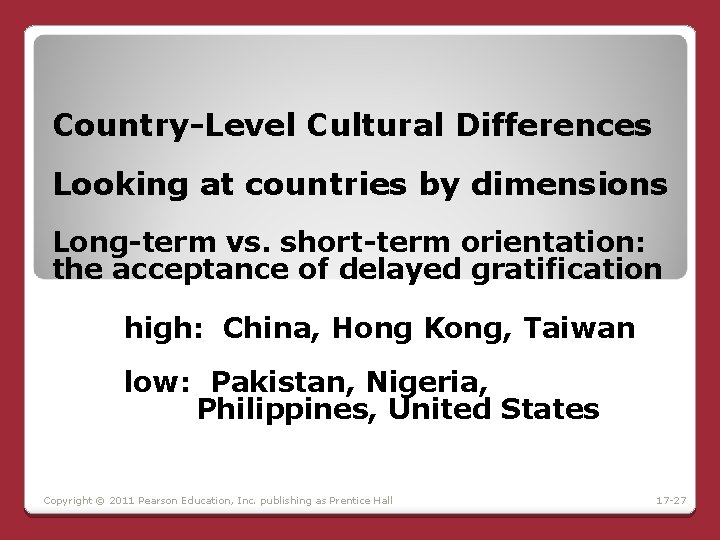
Country-Level Cultural Differences Looking at countries by dimensions Long-term vs. short-term orientation: the acceptance of delayed gratification high: China, Hong Kong, Taiwan low: Pakistan, Nigeria, Philippines, United States Copyright © 2011 Pearson Education, Inc. publishing as Prentice Hall 17 -27
Globalization & Psychological Measurement Issues Cross-cultural reliability Computerized testing Multi-trait theories Copyright © 2011 Pearson Education, Inc. publishing as Prentice Hall 17 -28
Globalization & Psychological Measurement International Guidelines for Adapting Educational & Psychological Tests Must establish that translation is accurate, blind retranslate, compare Must have cultural concept equivalence Statistical associations must be consistent across cultures Copyright © 2011 Pearson Education, Inc. publishing as Prentice Hall 17 -29
Globalization Terms Expatriate – any person working outside their home country with a planned return to their home or another country Repatriate – any employee who returns to their home country after having worked in another country Copyright © 2011 Pearson Education, Inc. publishing as Prentice Hall 17 -30
Globalization Terms Home country – country of legal residence Host country – country in which expatriate is working Copyright © 2011 Pearson Education, Inc. publishing as Prentice Hall 17 -31
Globalization Terms Third-country national – expatriate who is transferred to another country while working abroad Culture shock – period of time to adjust to new culture lasting an average of 6 months Copyright © 2011 Pearson Education, Inc. publishing as Prentice Hall 17 -32
With globalization as a new norm, how do you identify who will do well? Copyright © 2011 Pearson Education, Inc. publishing as Prentice Hall 17 -33
First, understand executive characteristics Copyright © 2011 Pearson Education, Inc. publishing as Prentice Hall 17 -34
Executive competencies: cognitive & analytical ability business knowledge interpersonal skills commitment courage to take action employment experience Learning from experience: proactive learning mistakes as opportunities flexible, adaptable seek & use feedback Copyright © 2011 Pearson Education, Inc. publishing as Prentice Hall 17 -35
Next, learn to use specific assessment tools such as The Prospector Copyright © 2011 Pearson Education, Inc. publishing as Prentice Hall 17 -36
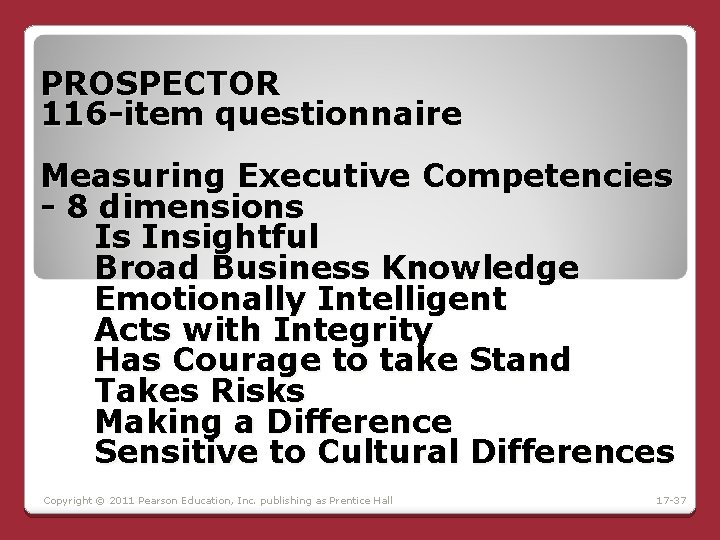
PROSPECTOR 116 -item questionnaire Measuring Executive Competencies - 8 dimensions Is Insightful Broad Business Knowledge Emotionally Intelligent Acts with Integrity Has Courage to take Stand Takes Risks Making a Difference Sensitive to Cultural Differences Copyright © 2011 Pearson Education, Inc. publishing as Prentice Hall 17 -37
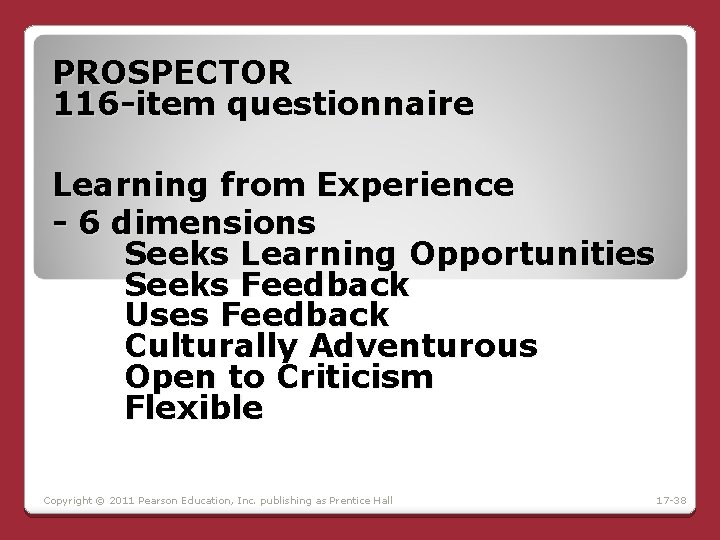
PROSPECTOR 116 -item questionnaire Learning from Experience - 6 dimensions Seeks Learning Opportunities Seeks Feedback Uses Feedback Culturally Adventurous Open to Criticism Flexible Copyright © 2011 Pearson Education, Inc. publishing as Prentice Hall 17 -38
Once selected, how do you recognize developing talent? Copyright © 2011 Pearson Education, Inc. publishing as Prentice Hall 17 -39
Gets Organizational Attention & Investment Takes or Makes more Opportunities to Learn Is Receptive to Learning Opportunities Changes as a Result of Experience Copyright © 2011 Pearson Education, Inc. publishing as Prentice Hall 17 -40
Now that talent is identified and is developing, how do you select? Copyright © 2011 Pearson Education, Inc. publishing as Prentice Hall 17 -41
Is it enough to be highly technical? What about adapting to a new environment and understanding foreign coworkers? Copyright © 2011 Pearson Education, Inc. publishing as Prentice Hall 17 -42
General Mental Ability is extremely important Measured by omnibus tests or battery of tests Verbal Numerical Spatial Cultural International predictive validity coefficients range from. 38 to. 57 Copyright © 2011 Pearson Education, Inc. publishing as Prentice Hall 17 -43
Omnibus tests include: Wonderlic Personnel Test – matches skill sets to jobs based on bureau of labor statistics & general intelligence score, in use since 1937 Ravens Progressive Matrices – measures spatial reasoning & reasoning by analogy, compares to Stanford-Binet & Weschler Copyright © 2011 Pearson Education, Inc. publishing as Prentice Hall 17 -44
Battery of tests may include: General Aptitude Test Battery – general intelligence score, requires certification to administer & interpret Differential Aptitude Test – 8 tests measuring verbal, math, abstract reasoning, perceptual speed, mechanical reasoning, spelling, language usage, space relations Copyright © 2011 Pearson Education, Inc. publishing as Prentice Hall 17 -45
Other global success predictors Personality - Big 5 Factors for all occupations, all criteria United States, Canada, & 36 European countries – conscientiousness best Emotional Stability next best for all occupations, all criteria Extroversion, Agreeableness, Openness - predict some performance aspects of some occupations Copyright © 2011 Pearson Education, Inc. publishing as Prentice Hall 17 -46
Specific assessment tool GLOBAL PERSONALITY INVENTORY standardized with 10 teams, 12 countries developed using 2 approaches emit – culture from within & etic – culture from without Copyright © 2011 Pearson Education, Inc. publishing as Prentice Hall 17 -47
Summarizing Personality & International Success Conscientiousness predicts work ethic & is necessary for overall success. Extroversion, agreeableness, & emotional stability predict completion of international assignment. If these 4 factors are high, offer cross-cultural training. Copyright © 2011 Pearson Education, Inc. publishing as Prentice Hall 17 -48
Assessment Center Considerations Tenacity - resilience Communications Adaptability Organizational & commercial awareness Teamwork Self-discipline Cross-cultural awareness Copyright © 2011 Pearson Education, Inc. publishing as Prentice Hall 17 -49
What is cross-cultural training (CCT)? Copyright © 2011 Pearson Education, Inc. publishing as Prentice Hall 17 -50
Cross-cultural training Formal programs designed to teach people from one culture how to adjust & how to work effectively in another culture 64% of multicultural U. S. organizations offer 76% of these make it optional Copyright © 2011 Pearson Education, Inc. publishing as Prentice Hall 17 -51
Cross-cultural training Includes at a minimum: Language Culture Day-to-day practicalities currency, signs, manners Particularly important to females regarding norms, values, traditions Copyright © 2011 Pearson Education, Inc. publishing as Prentice Hall 17 -52
Cross-cultural training If massive adaptations required, simulation training particularly useful 1 st must understand own culture 2 nd must practice new culture’s behaviors Best training occurs before arriving & immediately after arriving Formal mentoring assists adjustments & well received by host country Copyright © 2011 Pearson Education, Inc. publishing as Prentice Hall 17 -53
Cross-cultural training Significant time commitment required for any level of quality, proficiency Example: 150 hours of Spanish to be able to greet, get directions, shop, order restaurant food, ask for specific items versus 350 hours of Chinese Copyright © 2011 Pearson Education, Inc. publishing as Prentice Hall 17 -54
What happens with cross-cultural training and performance management? Copyright © 2011 Pearson Education, Inc. publishing as Prentice Hall 17 -55
Cross-cultural training & Performance Management (PM) BEST CASE - 4 input sources Person being evaluated Cultural management Organizational management Former expatriate Copyright © 2011 Pearson Education, Inc. publishing as Prentice Hall 17 -56
Cross-cultural training & Performance Management (PM) MOST COMMON Organization manager writes up performance after receiving host country management input Copyright © 2011 Pearson Education, Inc. publishing as Prentice Hall 17 -57
Cross-cultural training & Performance Management (PM) Predictors Differences in accounting, labor laws International culture may not be as stable Time & distance can hinder the PM Foreign market is slower, employees may need longer goal times Copyright © 2011 Pearson Education, Inc. publishing as Prentice Hall 17 -58
Cross-cultural training & Other PM Predictors Technical knowledge Personal & family adjustment Political environment Work force stability Currency fluctuations Differences from one’s own culture Support from home offices Host-county characteristics Type of business Copyright © 2011 Pearson Education, Inc. publishing as Prentice Hall 17 -59
Cross-cultural training & PM Criteria 3 broad categories Objective – gross revenues, market share, return on investment Subjective – judgments by host country management Contextual – situational influences: political climate, host culture skills, organizational citizenship Copyright © 2011 Pearson Education, Inc. publishing as Prentice Hall 17 -60
Cross-cultural training & PM Criteria Establish, maintain business contacts Technical performance Productivity Ability to work with others Communication & persuasion Independent effort & initiative Personal discipline Interpersonal relations Management & supervision Overall job performance Copyright © 2011 Pearson Education, Inc. publishing as Prentice Hall 17 -61
Cross-cultural training & the feedback aspect of PM Individualistic Culture Person being evaluated wants to receive feedback face-to-face Example: USA, Great Britain, Australia Collectivist Culture Face-to-face reviews can indicate loss of face or lack of respect Example: China, Japan, Korea, Taiwan Copyright © 2011 Pearson Education, Inc. publishing as Prentice Hall 17 -62
What happens when the expatriate comes home to work? Copyright © 2011 Pearson Education, Inc. publishing as Prentice Hall 17 -63
Repatriation Copyright © 2011 Pearson Education, Inc. publishing as Prentice Hall 17 -64
Repatriation 3 consistent areas of adjustment Personal finances Reacclimation to home country lifestyle – reverse culture shock Readjustment to home corporation structure Copyright © 2011 Pearson Education, Inc. publishing as Prentice Hall 17 -65
How do you maximize the cross-cultural experience? Copyright © 2011 Pearson Education, Inc. publishing as Prentice Hall 17 -66
To maximize the corporate & personal cross-cultural experience Plan all phases: expatriation, performance, & repatriation Copyright © 2011 Pearson Education, Inc. publishing as Prentice Hall 17 -67
To maximize the corporate & personal cross-cultural experience Have specific purpose: executive development, coordination & control of locations, transfer of technology, & transfer of information Costs can run up to $1 million per executive Copyright © 2011 Pearson Education, Inc. publishing as Prentice Hall 17 -68
All rights reserved. No part of this publication may be reproduced, stored in a retrieval system, or transmitted, in any form or by any means, electronic, mechanical, photocopying, recording, or otherwise, without the prior written permission of the publisher. Printed in the United States of America. Copyright © 2011 Pearson Education, Inc. publishing as Prentice Hall 17 -69