
Unit 3 Human Resource Development EXAM BREADOWN PHR

Unit 3: Human Resource Development
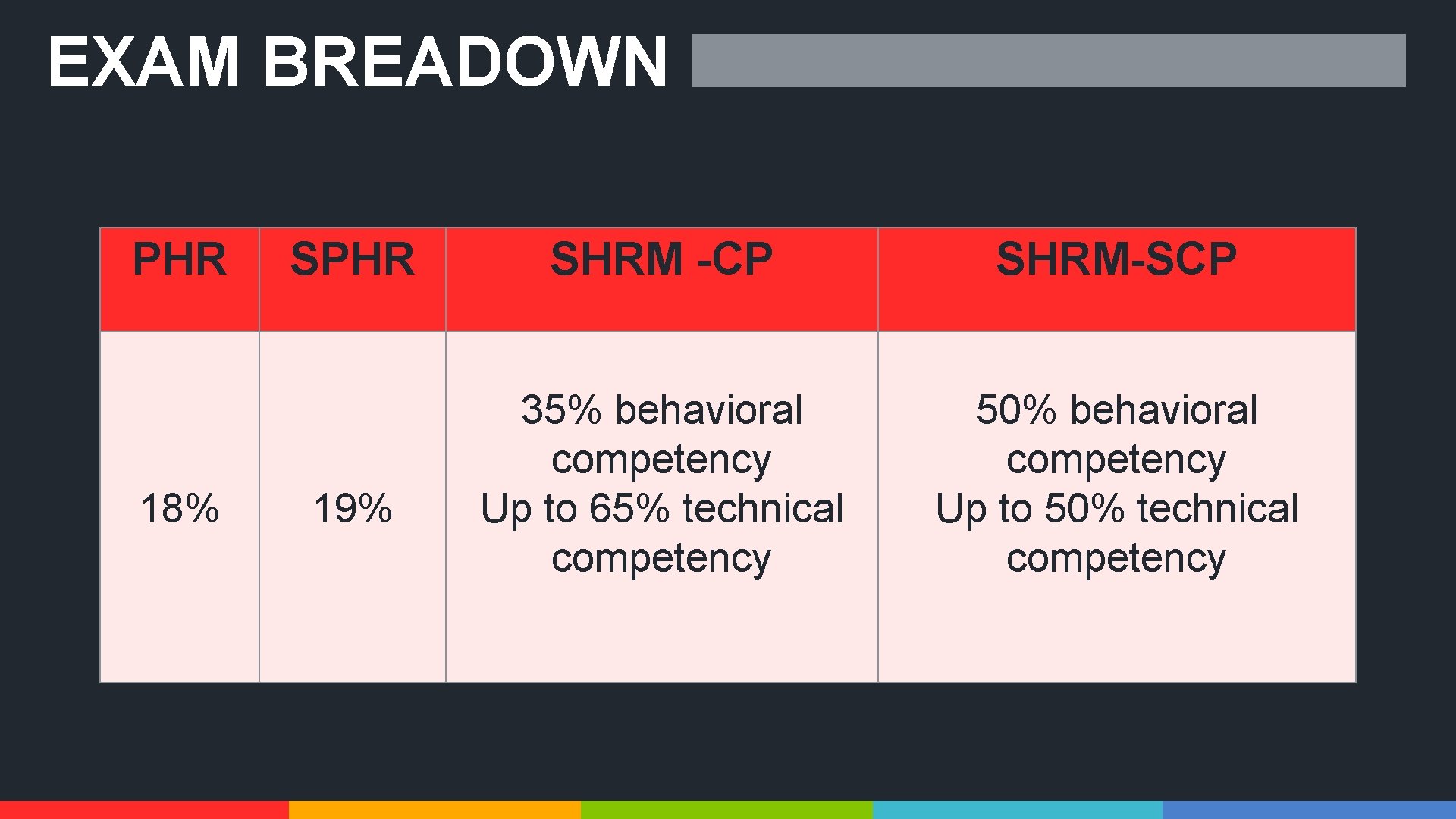
EXAM BREADOWN PHR 18% SPHR 19% SHRM -CP SHRM-SCP 35% behavioral competency Up to 65% technical competency 50% behavioral competency Up to 50% technical competency
SECTION 01 Training & Development in the Organization
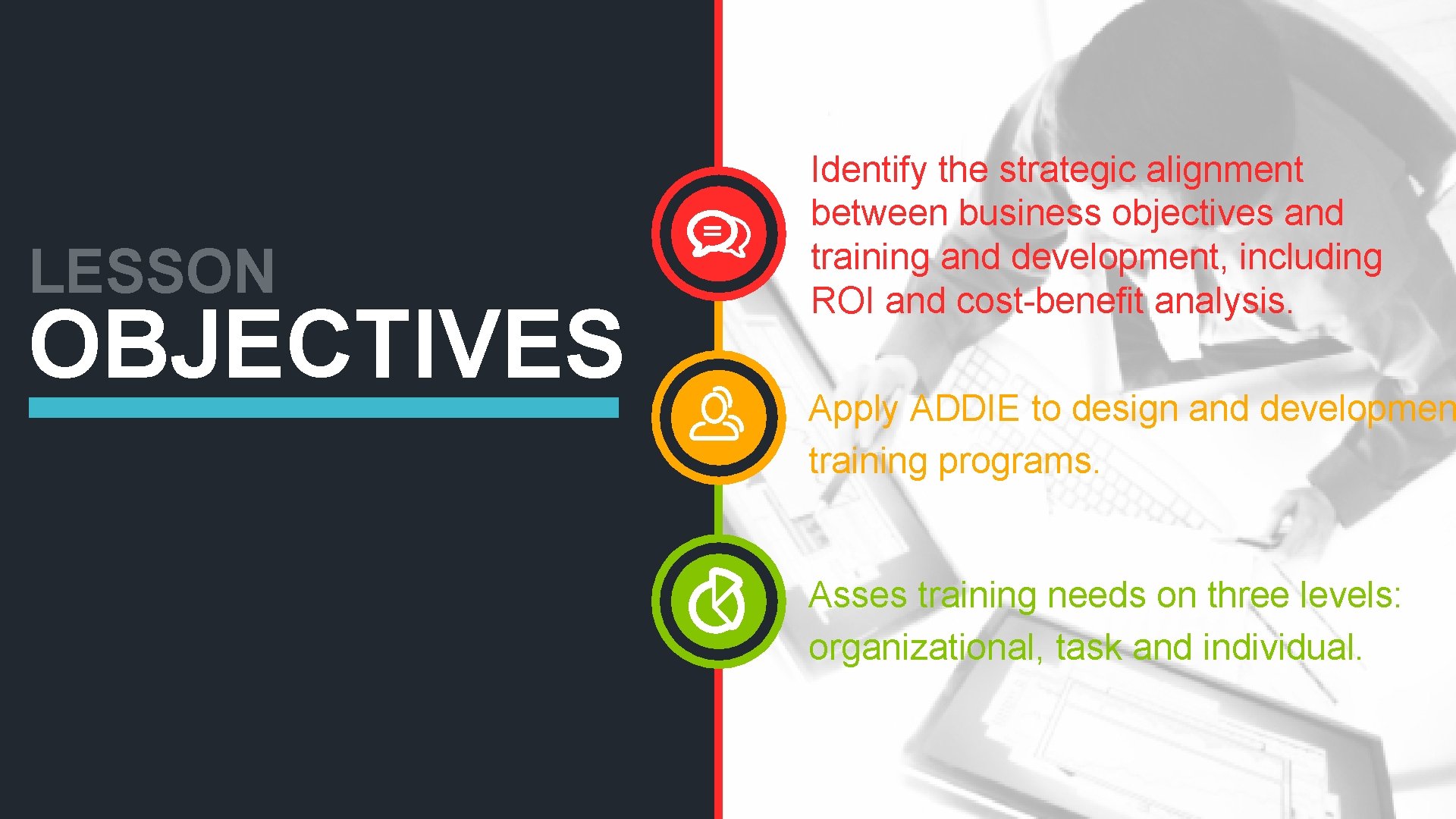
LESSON OBJECTIVES Identify the strategic alignment between business objectives and training and development, including ROI and cost-benefit analysis. Apply ADDIE to design and developmen training programs. Asses training needs on three levels: organizational, task and individual.
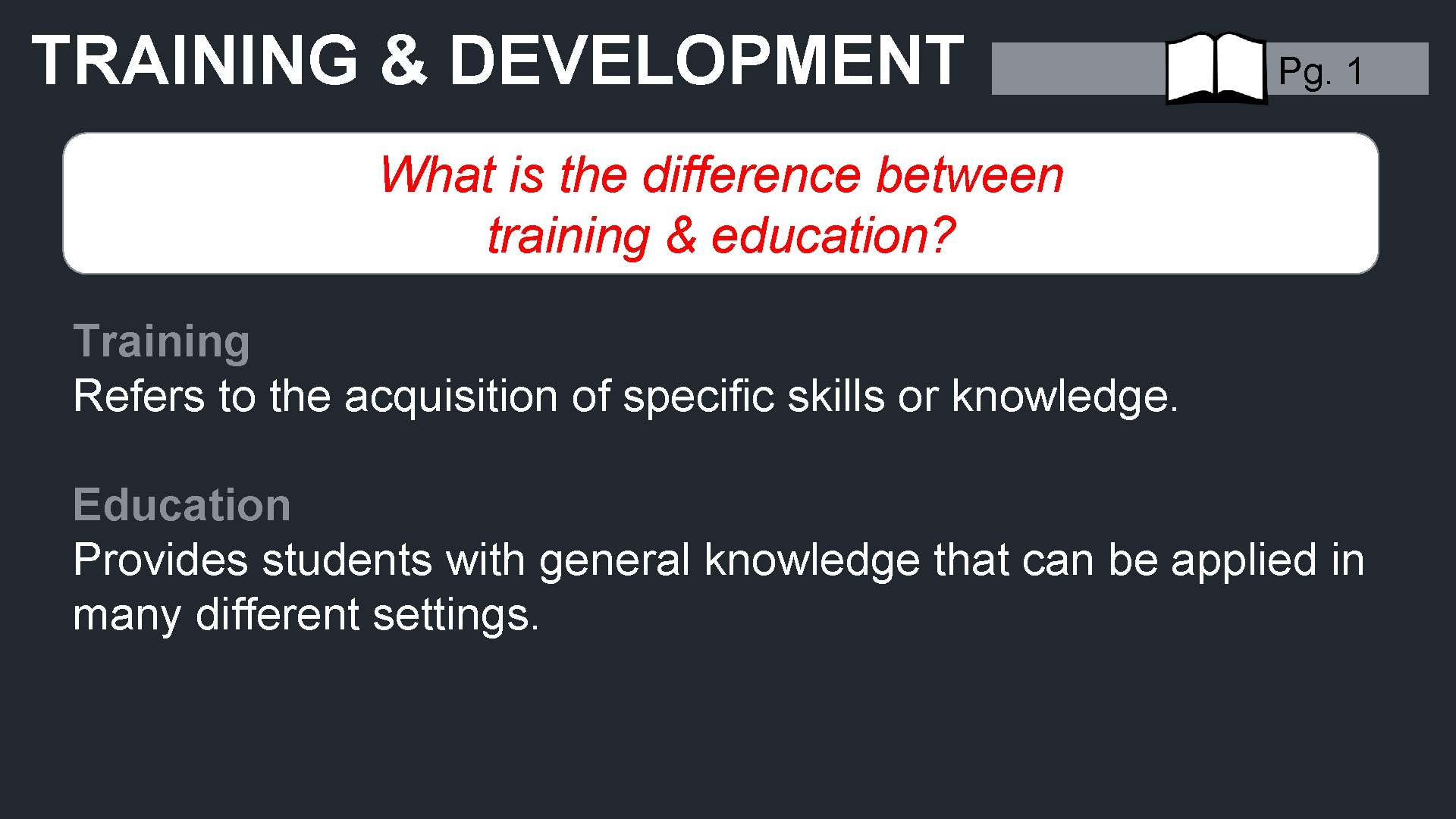
TRAINING & DEVELOPMENT Pg. 1 What is the difference between training & education? Training Refers to the acquisition of specific skills or knowledge. Education Provides students with general knowledge that can be applied in many different settings.
EXPLICIT & TACIT KNOWLEDGE Pg. 1 Explicit Knowledge Refers to knowledge that can be formalized, codified, and communicated. This kind of knowledge is found in manuals, formulas, and task specifications. Tacit Knowledge Refers to personal knowledge based on individual experience and is much more difficult to explain to others.
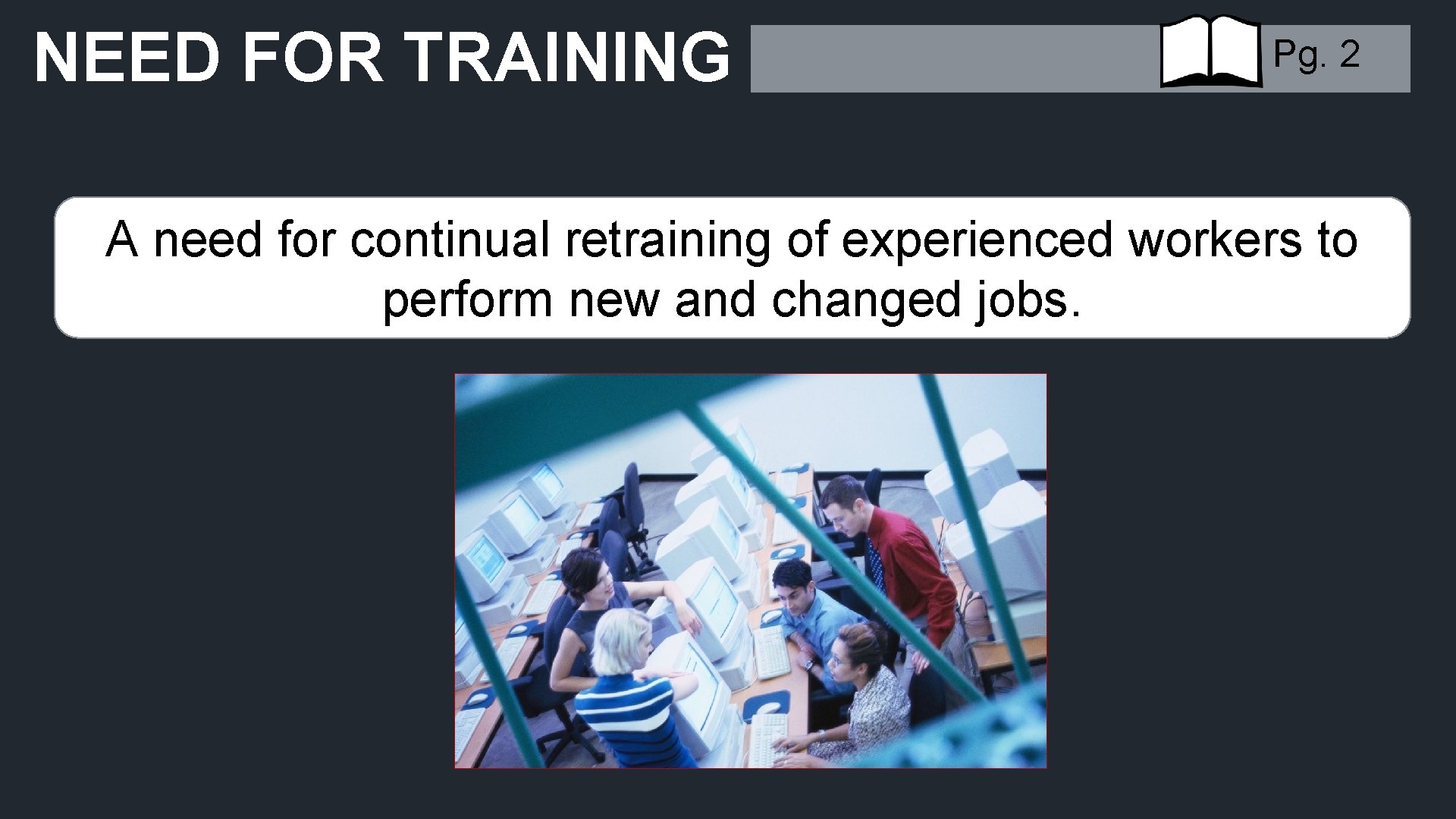
NEED FOR TRAINING Pg. 2 A need for continual retraining of experienced workers to perform new and changed jobs.
KNOWLEDGE CHECK The MAJOR difference between training and education is that A) Education refers more to acquiring specific skills B) Education is more closely related to learning a particular job C) Training provides more general knowledge D) Training narrows the range of responses while education broadens the range
STRATEGIC ALIGNMENT OF TRAINING & DEVELOPMENT Pg. 3 Training is a strategic human resource activity because it plays a large part in determining the effectiveness and efficiency of an organization. • Improve the quality & quantity of productivity. • Reduce the learning time required for employees to reach acceptable standards of performance. • Create more favorable attitudes, loyalty, & cooperation. • Satisfy human resource planning requirements. • Reduce the number & cost of accidents. • Help employees in their personal development & advancement. • Help organizations respond to dynamic market conditions & changing consumer demands.
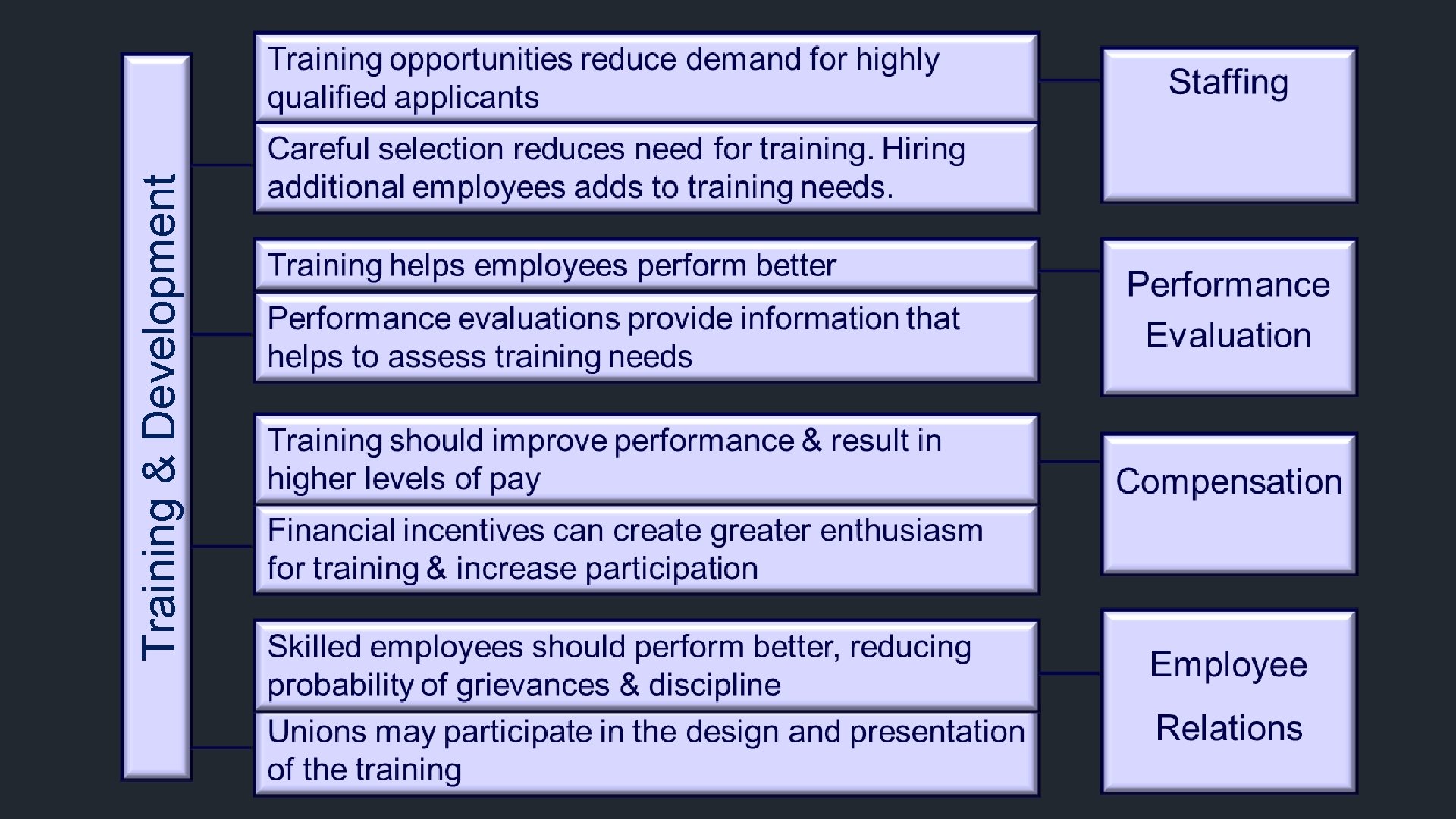
Training & Development
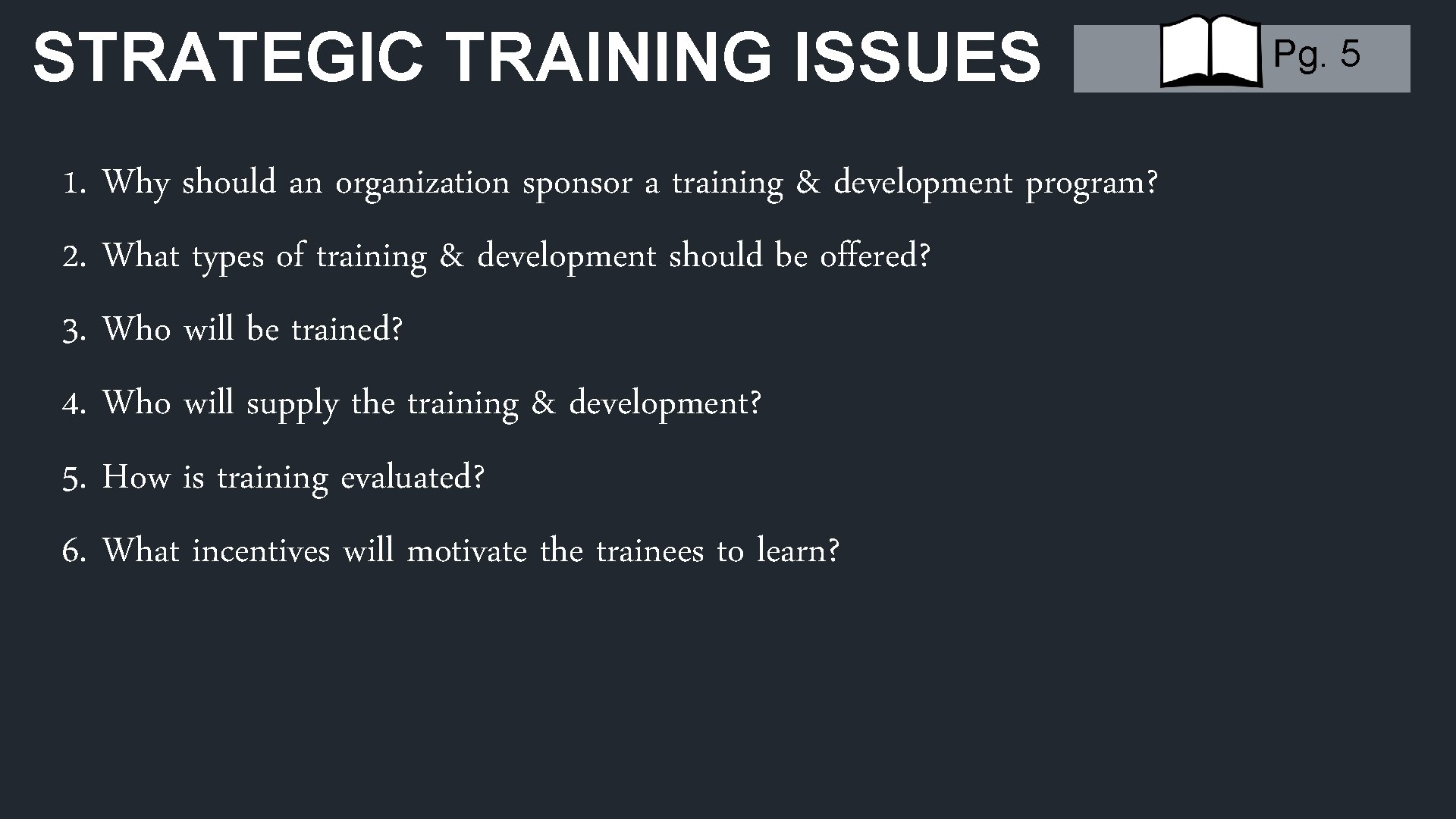
STRATEGIC TRAINING ISSUES 1. Why should an organization sponsor a training & development program? 2. What types of training & development should be offered? 3. Who will be trained? 4. Who will supply the training & development? 5. How is training evaluated? 6. What incentives will motivate the trainees to learn? Pg. 5
FUNDING THE TRAINING FUNCTION Pg. 6 1. Fixed amount are allocated the training department each year 2. Training costs come from operating budget 3. Operating departments contract with the training department to provide training.
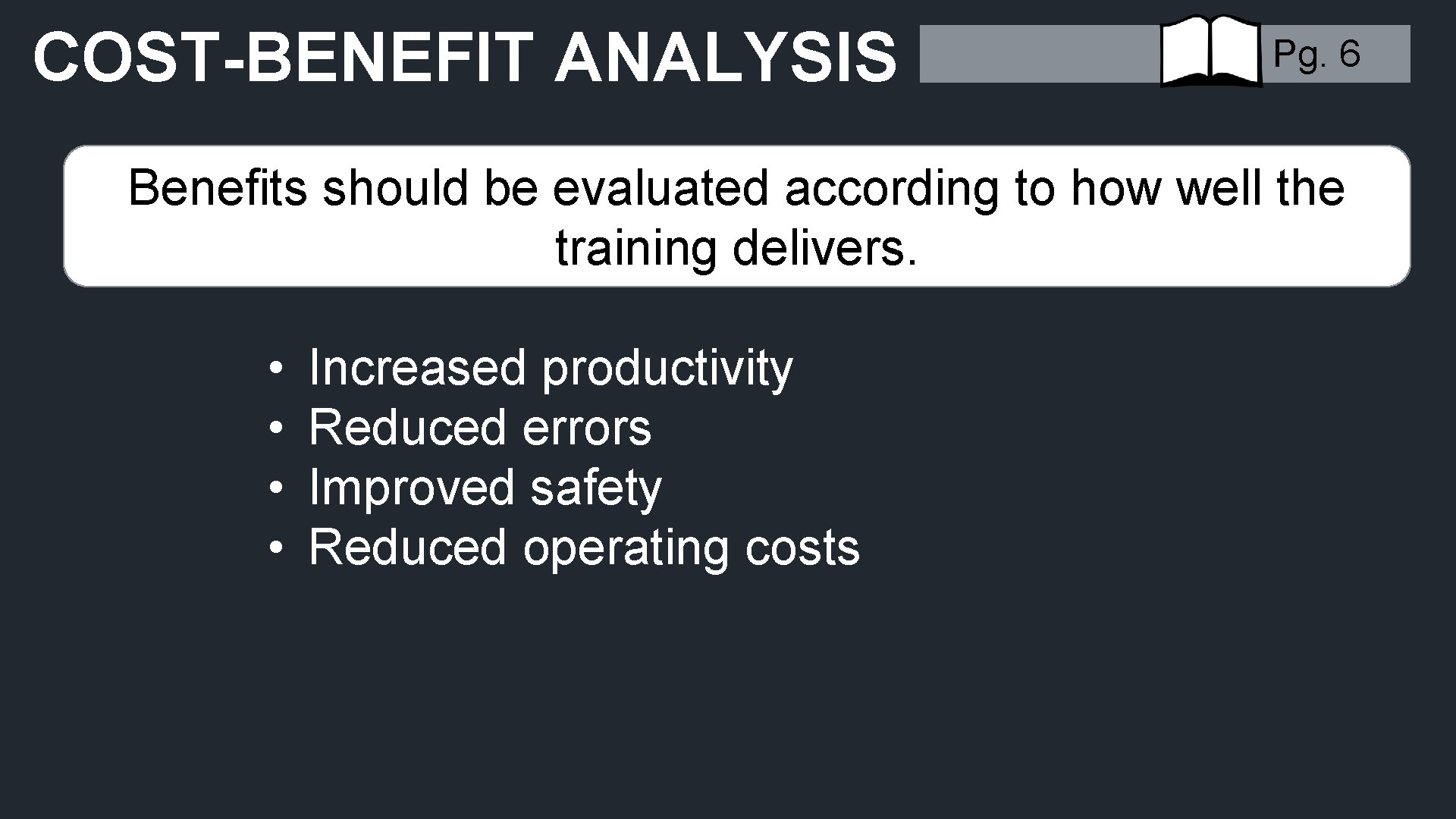
COST-BENEFIT ANALYSIS Pg. 6 Benefits should be evaluated according to how well the training delivers. • • Increased productivity Reduced errors Improved safety Reduced operating costs
KNOWLEDGE CHECK Which of the following would be considered an indirect cost when analyzing the cost-benefit of a training program? A) Lost production time B) The cost of the facility C) The training materials D) The included meals
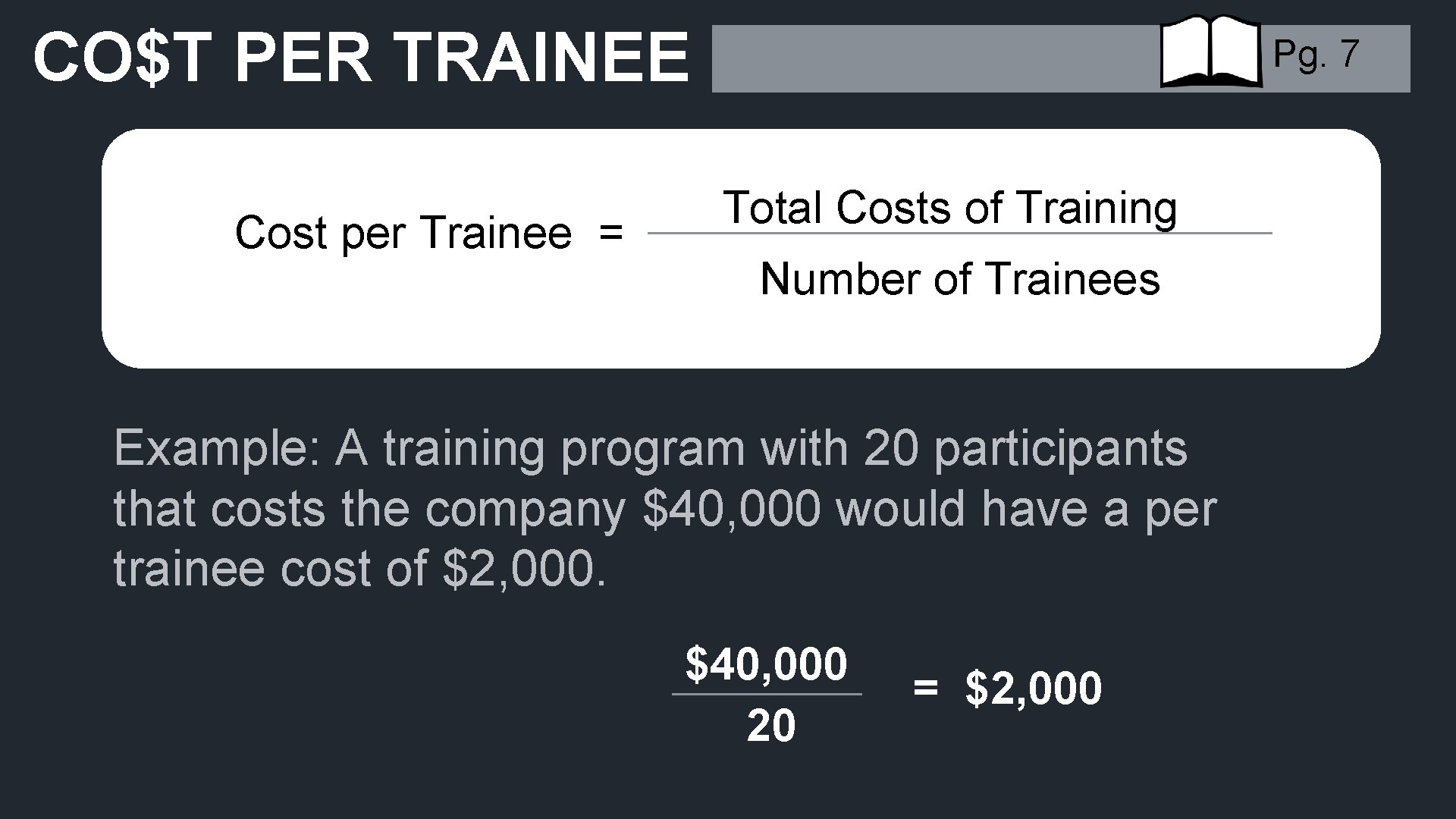
CO$T PER TRAINEE Cost per Trainee = Pg. 7 Total Costs of Training Number of Trainees Example: A training program with 20 participants that costs the company $40, 000 would have a per trainee cost of $2, 000. $40, 000 20 = $2, 000
TRAINING ROI Pg. 8 Business managers expect to know the return they are getting for their investments. HR professionals can demonstrate the impact of training on the goals and objectives of an organization by conducting return on investment (ROI) analysis and annually reporting the results to management. Serving purposes: • Justifies the training function by showing the value of training to the bottom line. • Helps training department assess itself internally and make adjustments.
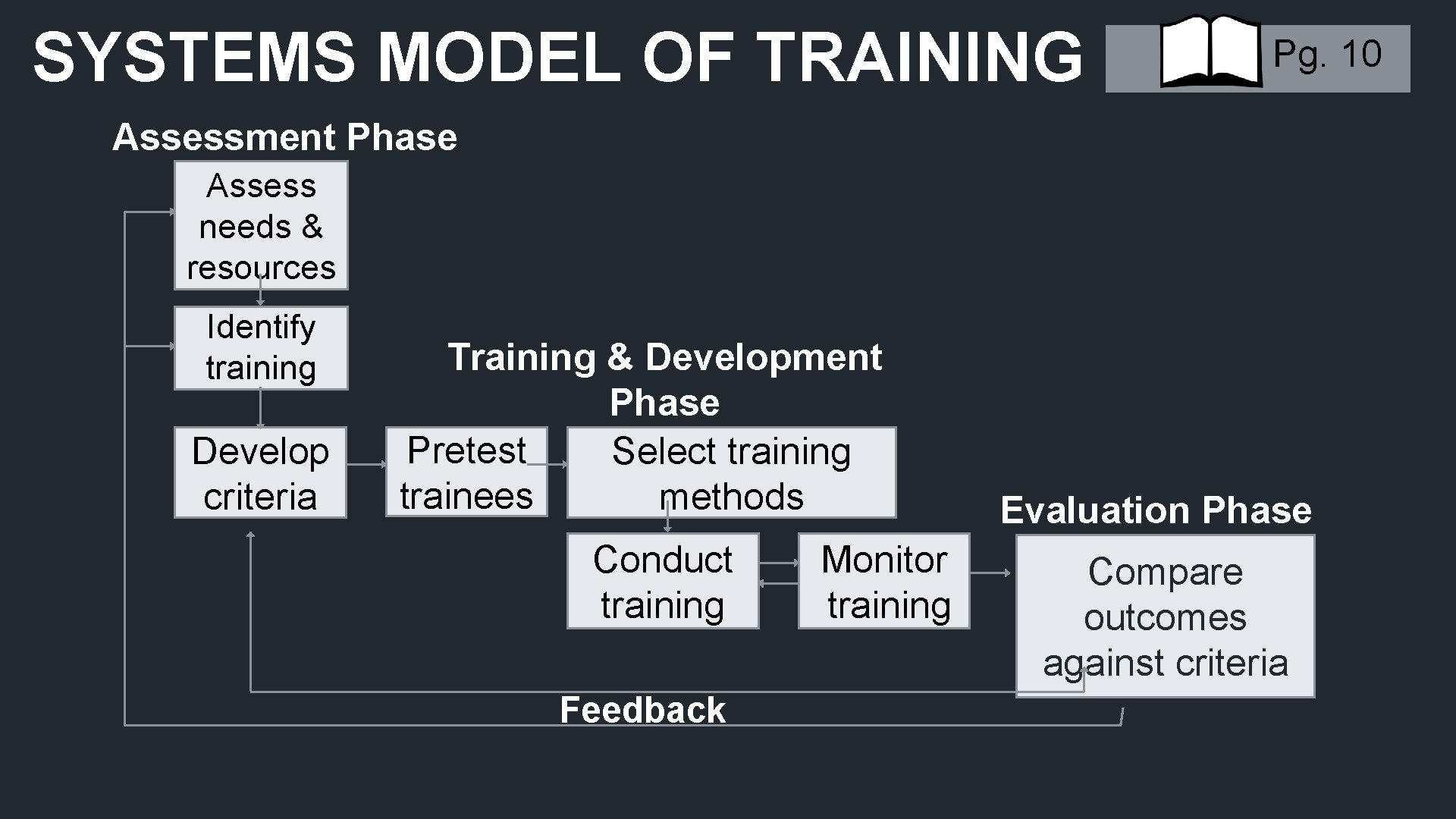
SYSTEMS MODEL OF TRAINING Pg. 10 Assessment Phase Assess needs & resources Identify training Develop criteria Training & Development Phase Pretest Select training trainees methods Conduct training Feedback Monitor training Evaluation Phase Compare outcomes against criteria
ADDIE MODEL OF TRAINING A Assessment D Design D Development I Implementation E Evaluation Pg. 11
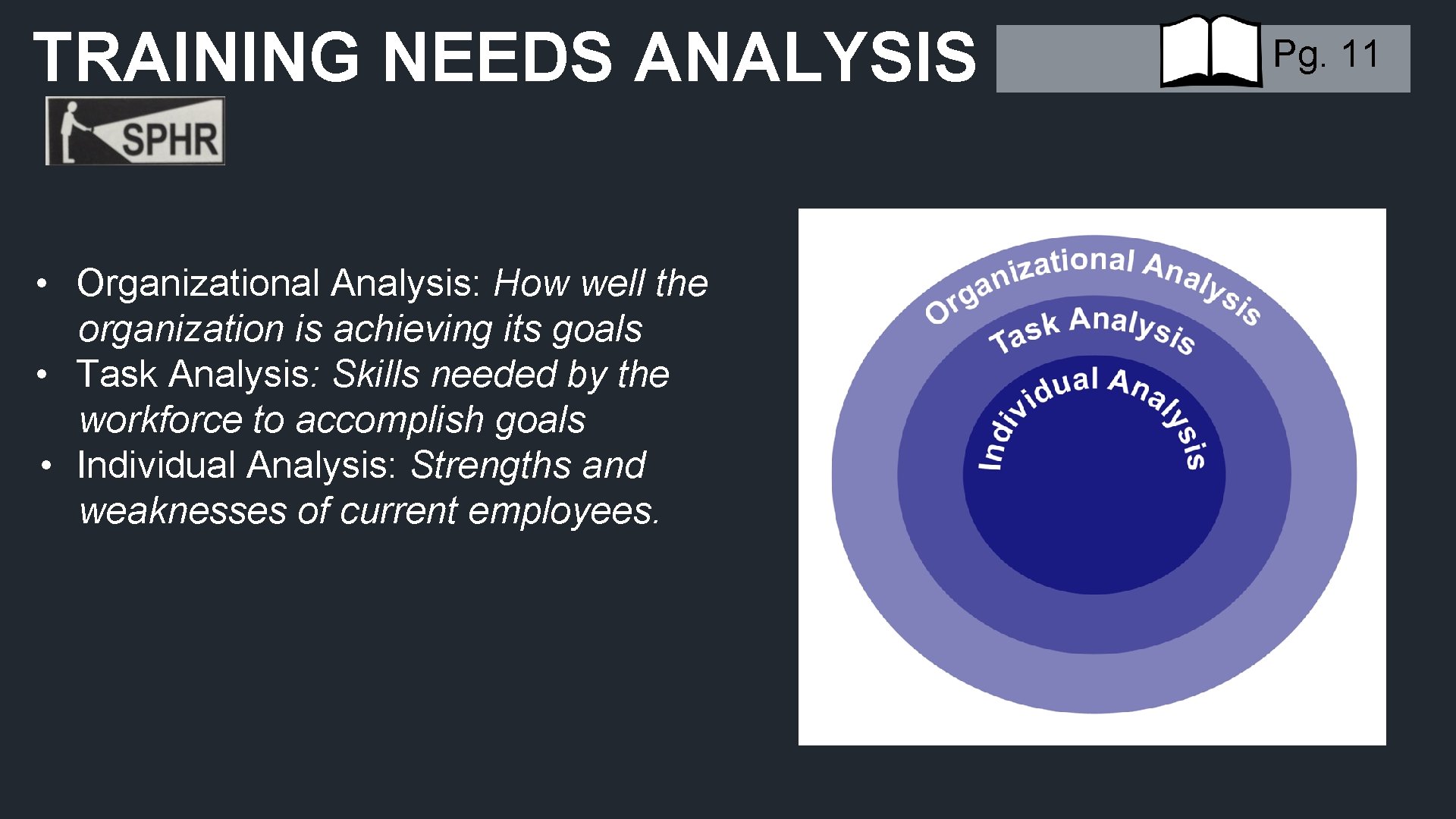
TRAINING NEEDS ANALYSIS • Organizational Analysis: How well the organization is achieving its goals • Task Analysis: Skills needed by the workforce to accomplish goals • Individual Analysis: Strengths and weaknesses of current employees. Pg. 11
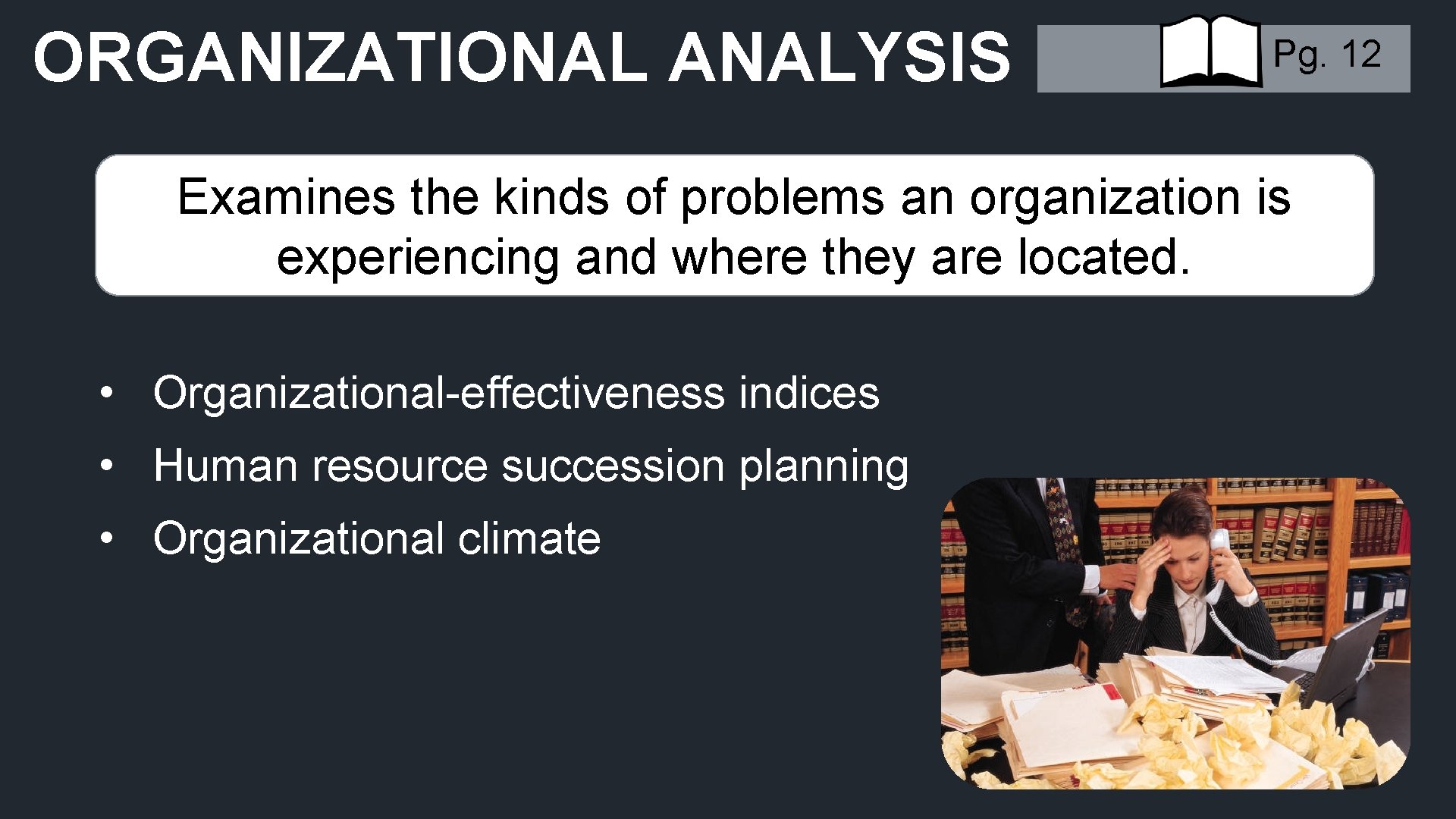
ORGANIZATIONAL ANALYSIS Pg. 12 Examines the kinds of problems an organization is experiencing and where they are located. • Organizational-effectiveness indices • Human resource succession planning • Organizational climate
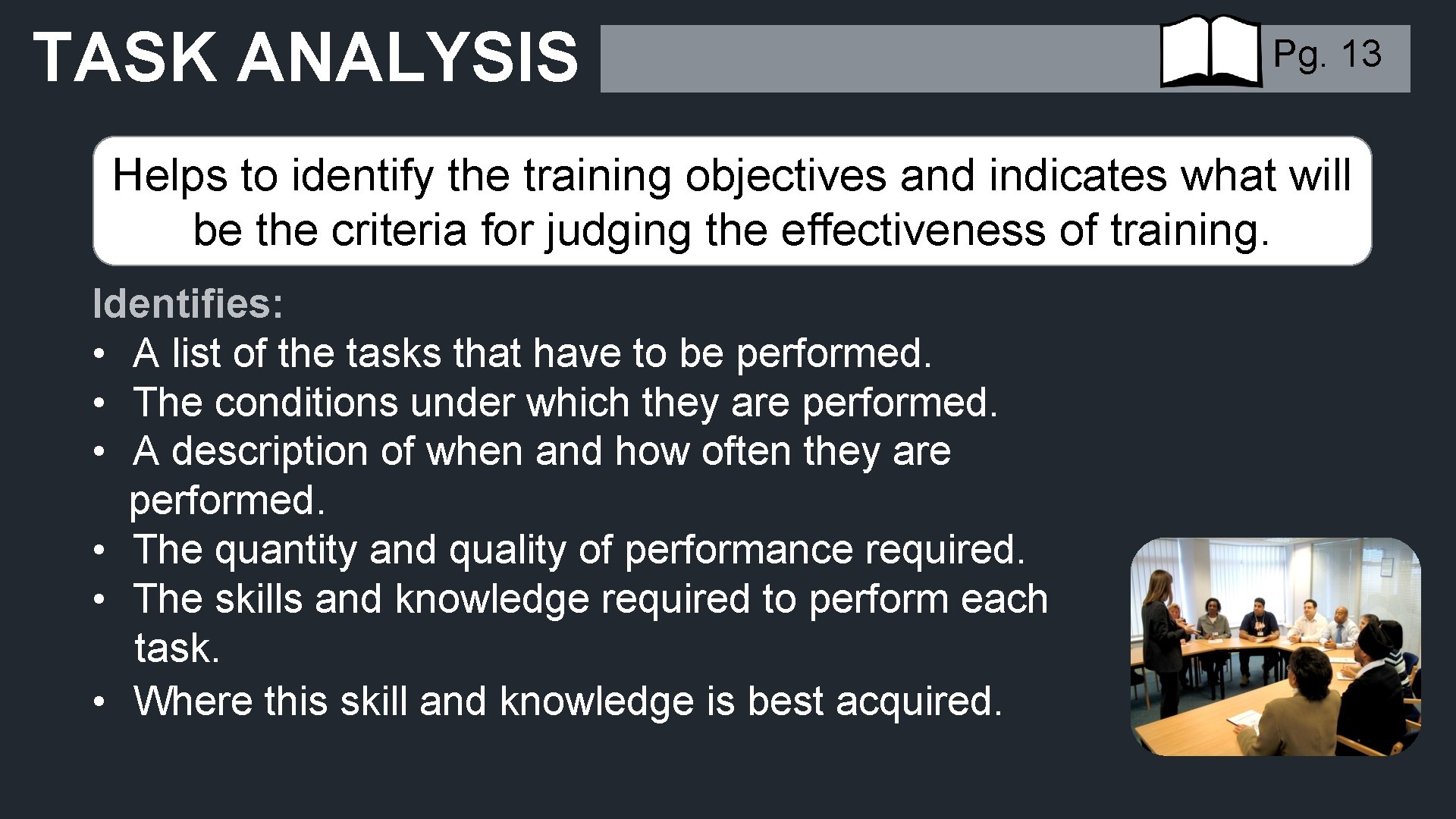
TASK ANALYSIS Pg. 13 Helps to identify the training objectives and indicates what will be the criteria for judging the effectiveness of training. Identifies: • A list of the tasks that have to be performed. • The conditions under which they are performed. • A description of when and how often they are performed. • The quantity and quality of performance required. • The skills and knowledge required to perform each task. • Where this skill and knowledge is best acquired.
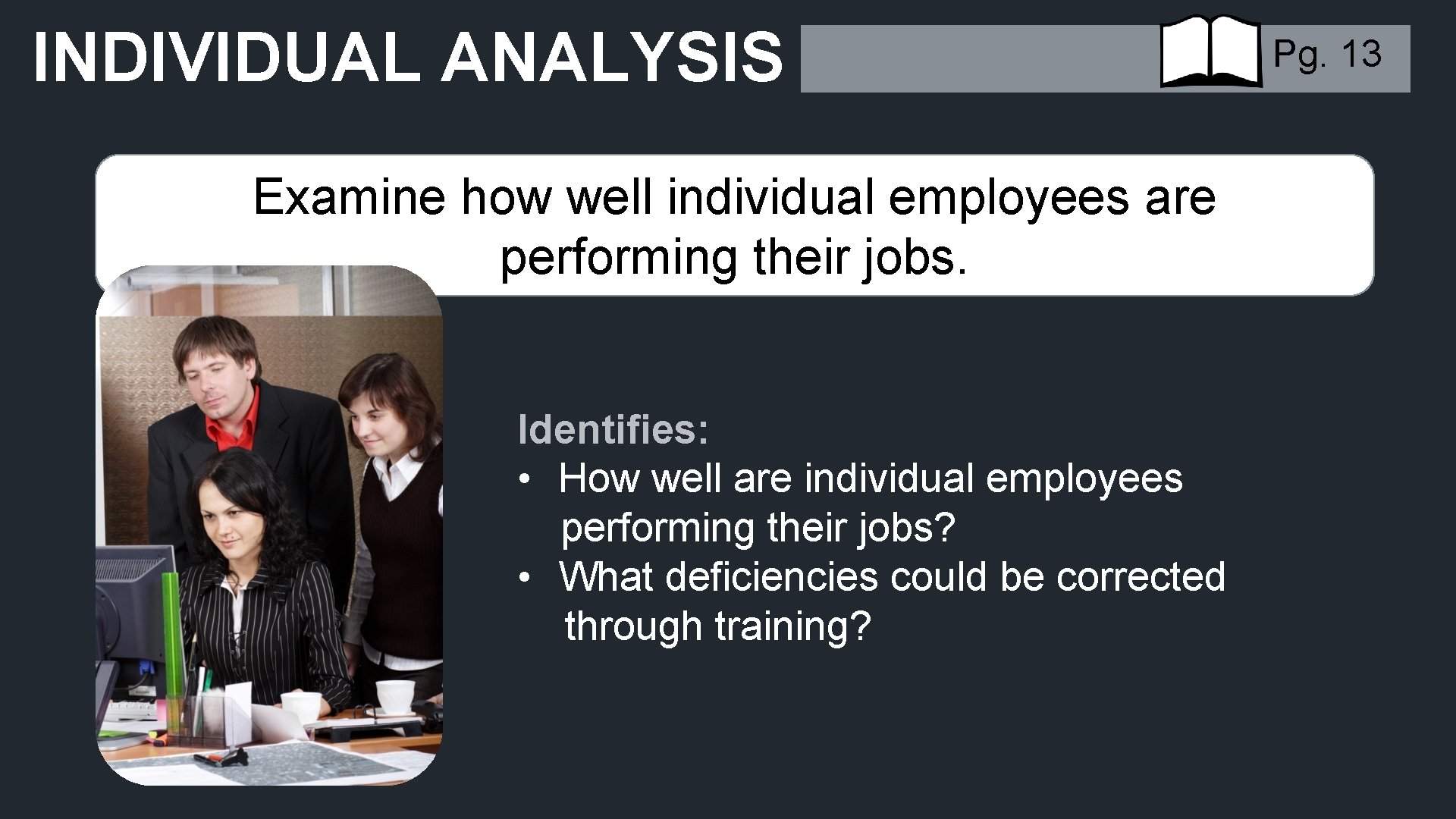
INDIVIDUAL ANALYSIS Examine how well individual employees are performing their jobs. Identifies: • How well are individual employees performing their jobs? • What deficiencies could be corrected through training? Pg. 13
ASSESSING TRAINING NEEDS • Surveys/Questionnaires • Interviews • Performance Data (Results and Appraisals) • Observations/Audits • Tests • Assessment Centers • Focus Groups/Group Discussions • Document Reviews • Advisory Committees Pg. 14
KNOWLEDGE CHECK In assessing training needs, an examination of production efficiency, labor costs, turnover, and accidents would be part of which training needs analysis? A) Personnel B) Task C) Operations D) Organizational

Congratulations, you have completed this section
SECTION 02 Principles of Training & Development
LESSON OBJECTIVES Explain and apply three learning theories. Comprehend the four learning curves and the situations in which they likely occur. Understand apply the diverse levels, styles and strategies of learning.
LEARNING THEORIES • Classical Conditioning • Operant Conditioning • Social Cognitive Theory Pg. 17

CLASSICAL CONDITIONING Pg. 18
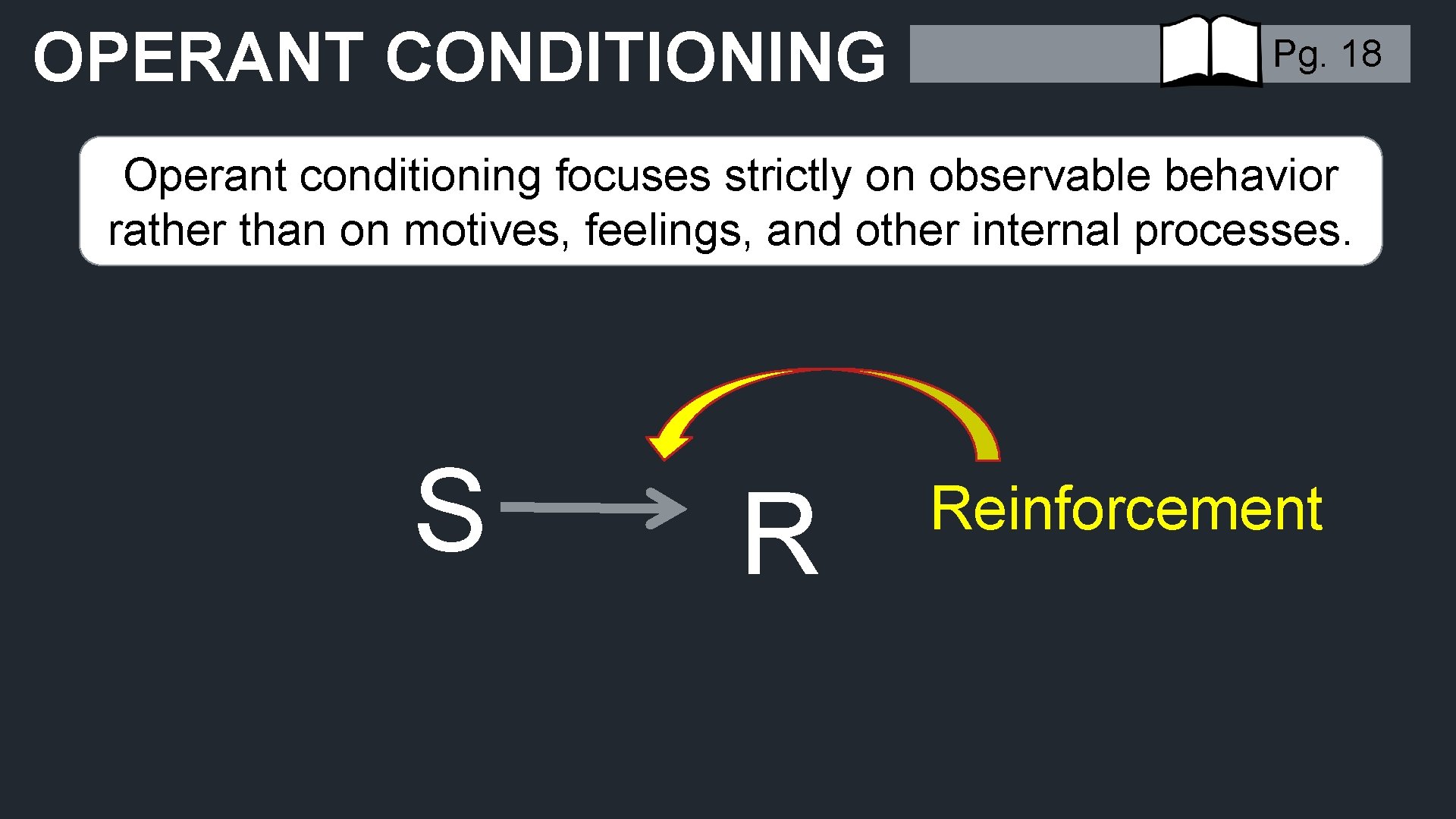
OPERANT CONDITIONING Pg. 18 Operant conditioning focuses strictly on observable behavior rather than on motives, feelings, and other internal processes. S R Reinforcement
REWARD SCHEDULES The timing of the reinforcement: how often the correct response is reinforced. • Continuous • Intermittent • Interval Pg. 20
KNOWLEDGE CHECK For most people, supervisor compliments are according to what type of reward schedule? A) Continuous B) Fixed Ratio C) Variable Ratio D) Fixed Interval
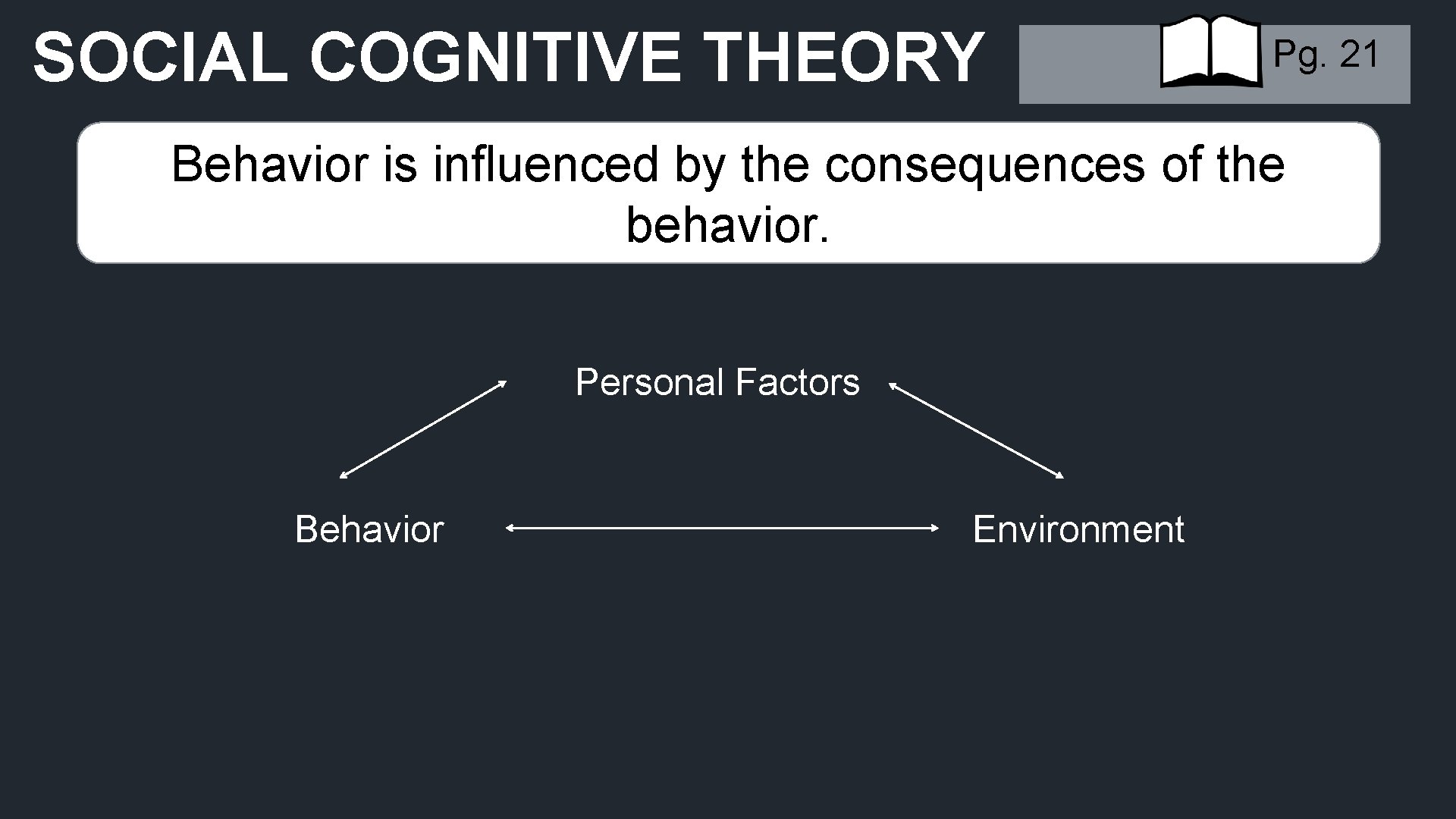
SOCIAL COGNITIVE THEORY Pg. 21 Behavior is influenced by the consequences of the behavior. Personal Factors Behavior Environment
ANDRAGOGY Principles • Learning is experienced-based. • Learning is problem-centered. • Learning is enhanced by active participation. • Learning is collaborative. • Learning requires involvement. Pg. 24
PRINCIPLES OF LEARNING Pg. 27 The design and presentation of training programs should be based on the principles of learning proposed by both operant conditioning and social cognitive theory. • Stimulus • Response • Motivation • Feedback
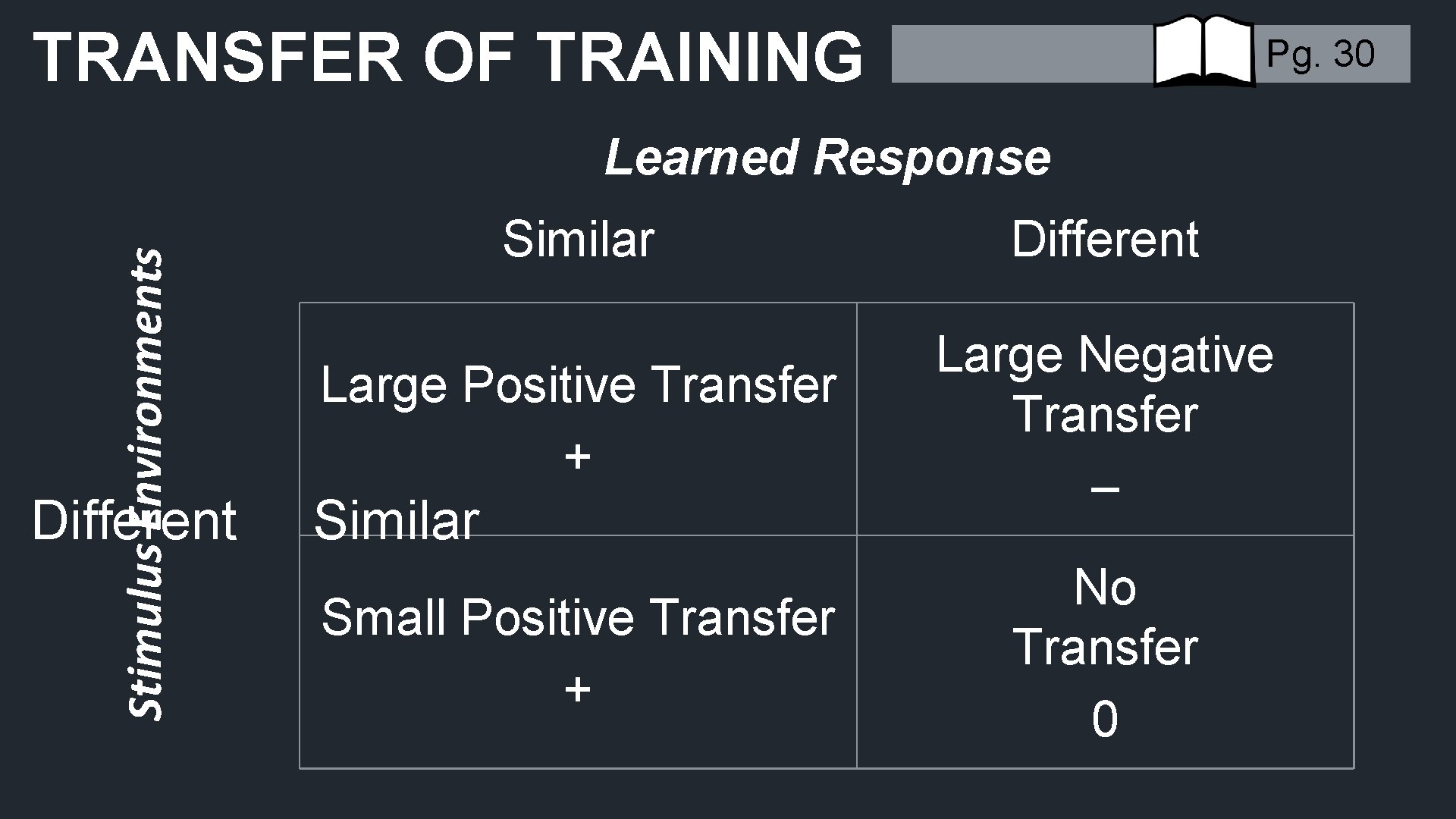
TRANSFER OF TRAINING Pg. 30 Stimulus Environments Learned Response Different Similar Different Large Positive Transfer + Large Negative Transfer – Similar Small Positive Transfer + No Transfer 0
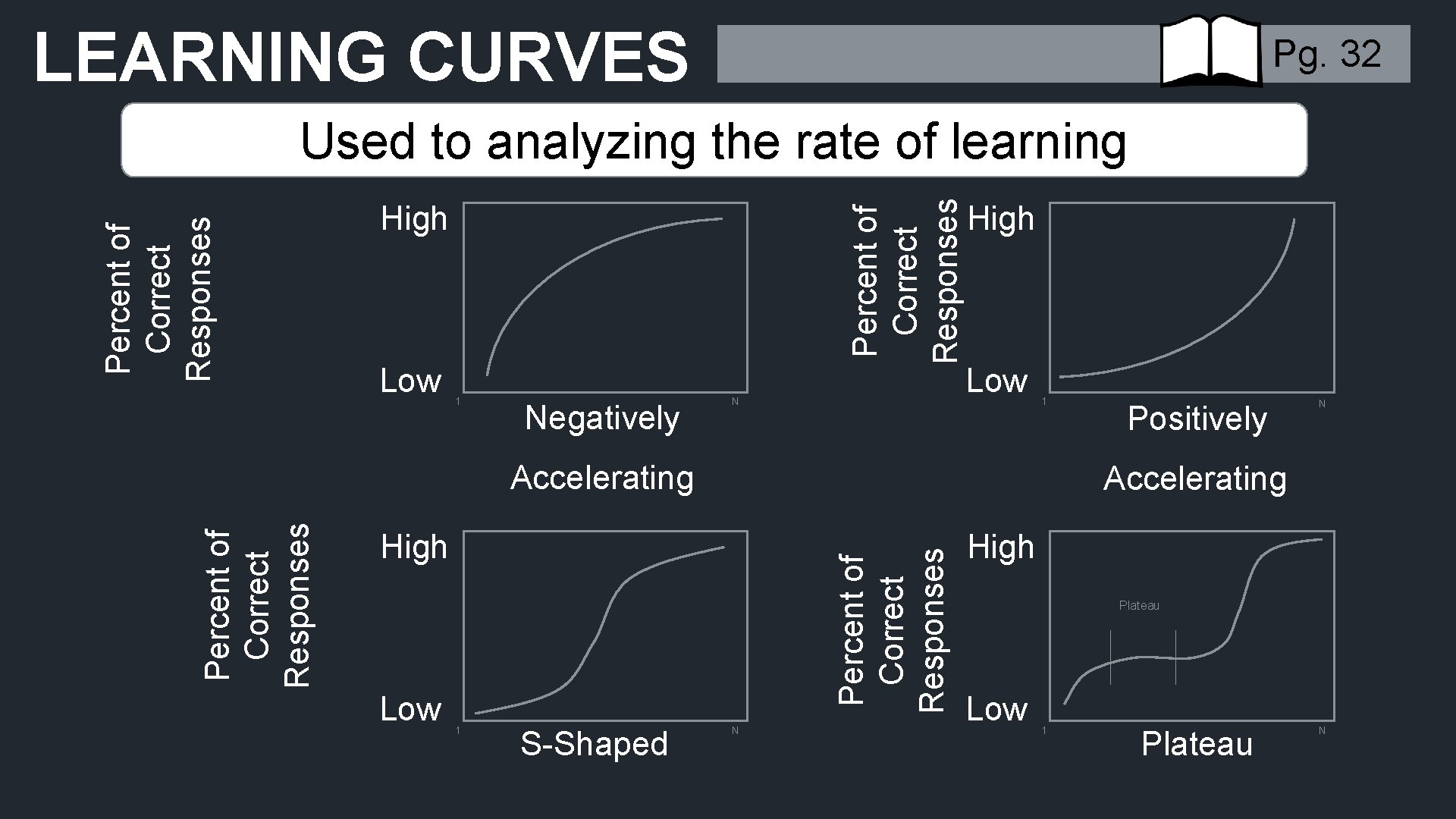
LEARNING CURVES Pg. 32 Percent of Correct Responses Used to analyzing the rate of learning High Low 1 Negatively N High Low 1 Accelerating High Low Percent of Correct Responses Accelerating 1 S-Shaped Positively N N High Plateau Low 1 Plateau N
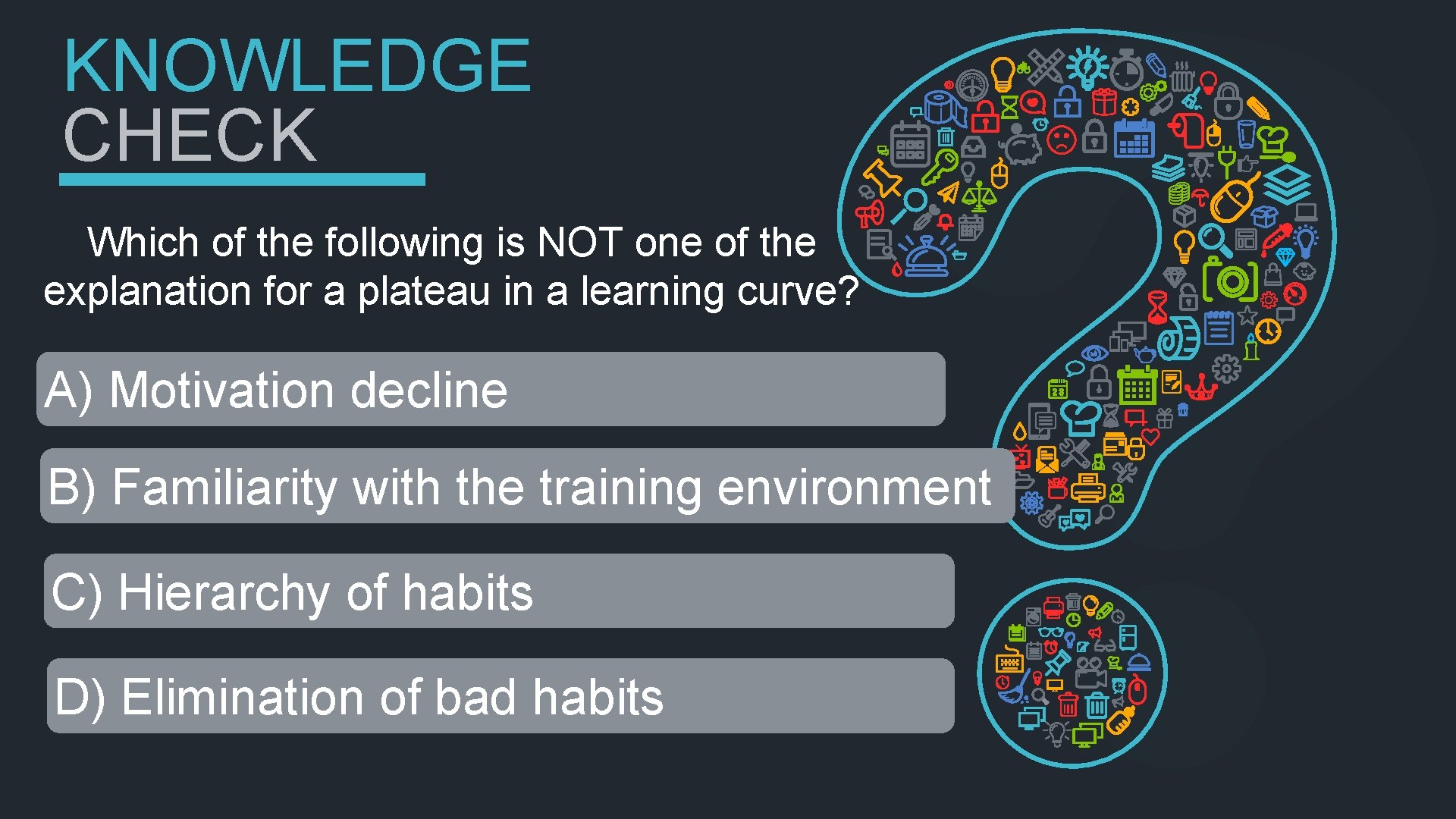
KNOWLEDGE CHECK Which of the following is NOT one of the explanation for a plateau in a learning curve? A) Motivation decline B) Familiarity with the training environment C) Hierarchy of habits D) Elimination of bad habits
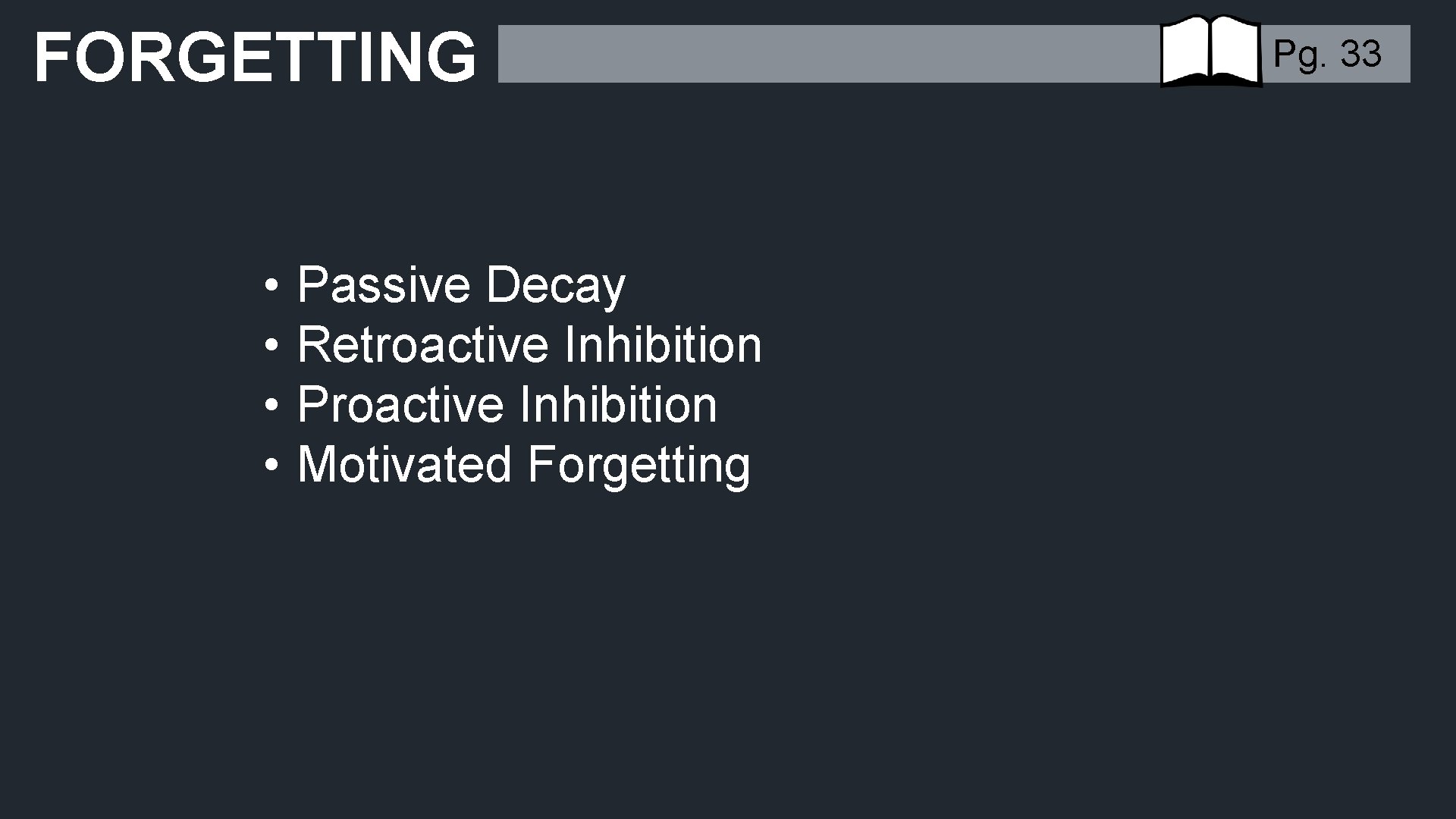
FORGETTING • • Passive Decay Retroactive Inhibition Proactive Inhibition Motivated Forgetting Pg. 33

LEARNING STYLES Pg. 34
LEVEL OF LEARNING Pg. 35 Learning can occur at different levels. There are six levels of learning proposed by Bloom in a taxonomy of cognitive learning. • • • Knowledge Comprehension Application Analysis Synthesis Evaluation
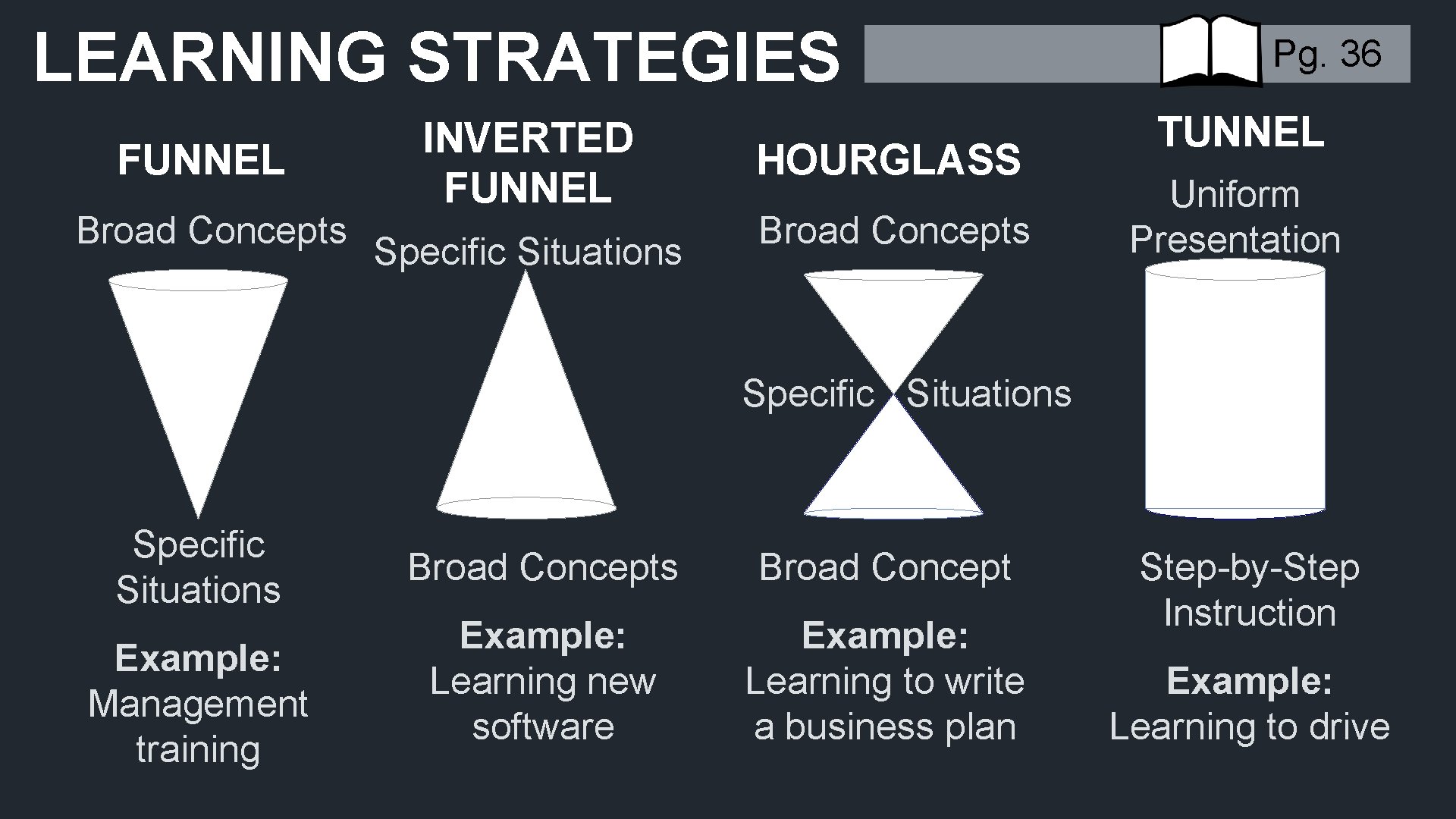
LEARNING STRATEGIES FUNNEL Broad Concepts INVERTED FUNNEL Specific Situations HOURGLASS Broad Concepts Pg. 36 TUNNEL Uniform Presentation Specific Situations Example: Management training Broad Concepts Broad Concept Example: Learning new software Example: Learning to write a business plan Step-by-Step Instruction Example: Learning to drive
KINDS OF LEARNING • Motor Response • Rote Learning • Learning Ideas • Value Internalization Pg. 36
KNOWLEDGE CHECK Memorizing a sales presentation involves what kind of learning? A) Motor response learning B) Idea learning C) Value learning D) Rote learning

Congratulations, you have completed this section
SECTION 03 Training & Development Techniques
LESSON Describe and craft SMART goals. OBJECTIVES Differentiate between on the job and off the job training and list their advantages and disadvantages.
BEHAVIORAL OBJECTIVES Pg. 39 Attributes of good behavioral objective: 1. The objective is described in specific behavioral terms, using an active verbs 2. Specifies the standard of performance, which should be expressed in terms of number, degree, and accuracy. 3. Specifies the relevant constraints and time limitations for performing the behavior.
KNOWLEDGE CHECK Which of the following is the BEST example of a good behavioral training objective? A) After completing the training program, the trainee will know how to operate a roller press. B) After completing this training program, the trainee will be able to list four potential safety hazards of operating a roller press. C) After completing this training program, the trainee will understand how to feed materials safely through a roller press. D) After completing this training program, the trainee will feel more confident in operating a roller press.
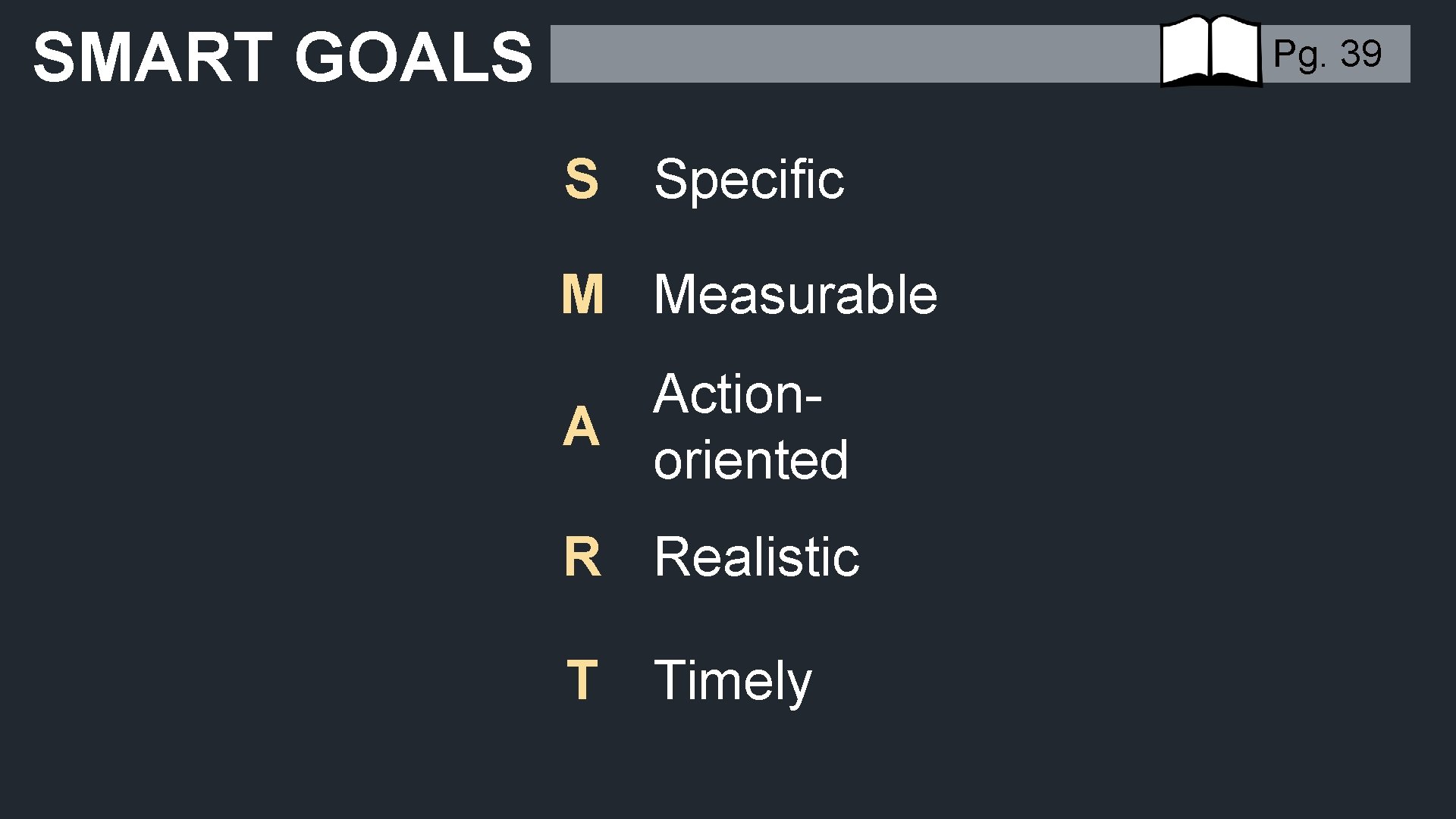
SMART GOALS Pg. 39 S Specific M Measurable Action. A oriented R Realistic T Timely
TRAINING METHODS AND PROCESSES The appropriate training method depends on what is being taught. Methods: • Motor responses • Rote learning • Idea learning • Value internalization Pg. 40
VALUE INTERNALIZAITON Pg. 42 The most important techniques for developing value internalization are induction and modeling. Induction All forms of verbal explanation, such as reasoning, preaching, and teaching. Modeling The example that individuals observe in others’ behavior.
ON THE JOB TRAINING Pg. 243 On-the-job techniques are used more frequently than offthe-job techniques, probably because they focus on increasing immediate productivity. • • • job-instruction training apprenticeships internships & assistantships job rotation & cross training action learning coaching and counseling
OFF THE JOB TRAINING Pg. 47 Off-the-job techniques tend to focus more on long-term development and education rather than on short-term training for production. q independent study q simulations q corporate universities q programmed group exercises q vestibule training q television & films q lecture q asynchronous learning networks q case studies q computer-based training q conferences & discussions q teletraining or e-learning q role playing q mobile learning & social media
KNOWLEDGE CHECK Which of the following is an ADVANTAGE of off-the-job training techniques? A) Allows employees to practice exactly what they will do later on the job. B) Provides immediate transfer of training. C) Allows employees to learn at their own rate without any pressure to produce. D) Allows employees to produce while they are learning.

Congratulations, you have completed this section
SECTION 04 Presenting the Training: Delivery
LESSON OBJECTIVES Acquainted with facility and material planning to facilitate instructional design.
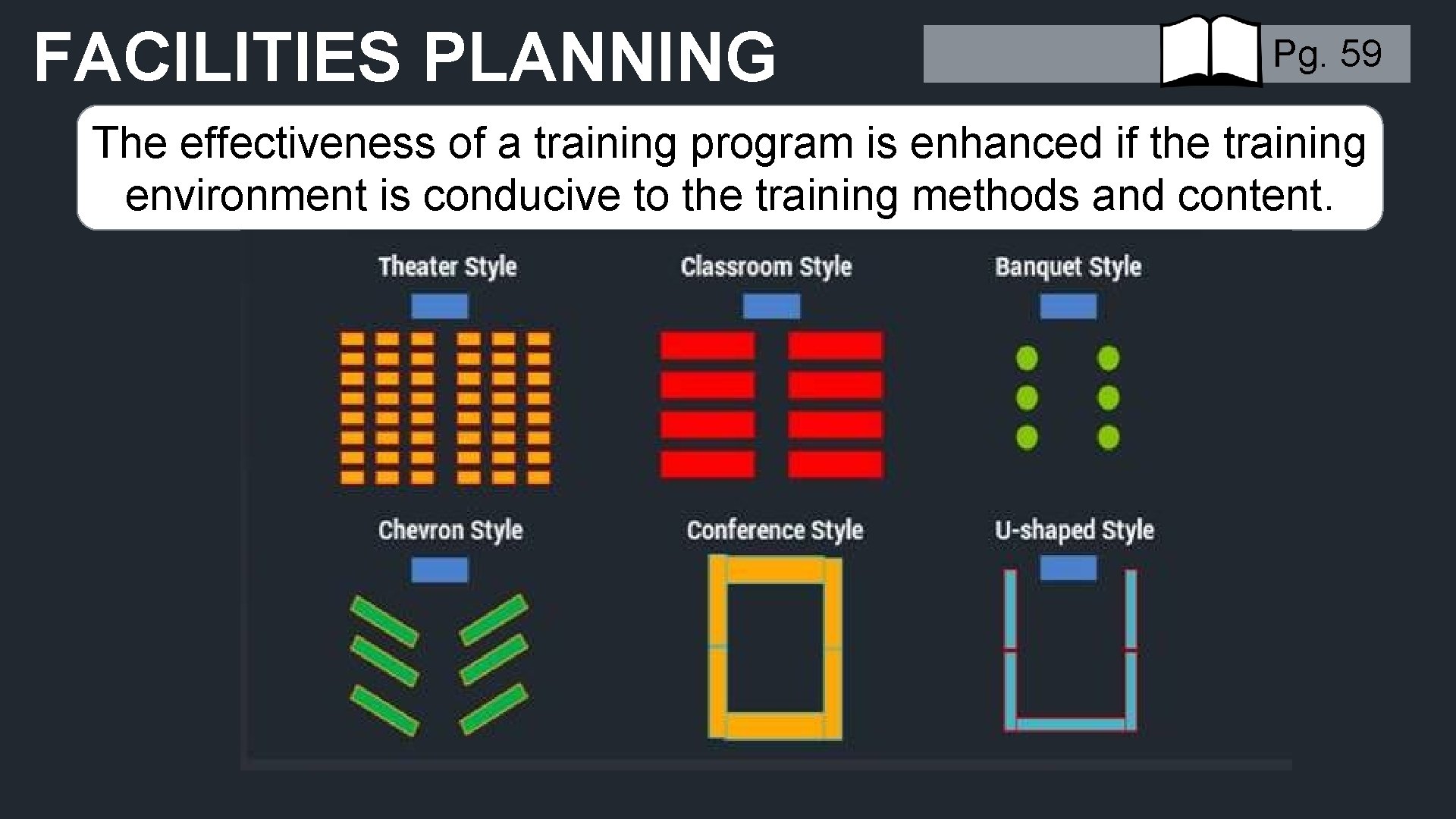
FACILITIES PLANNING Pg. 59 The effectiveness of a training program is enhanced if the training environment is conducive to the training methods and content.
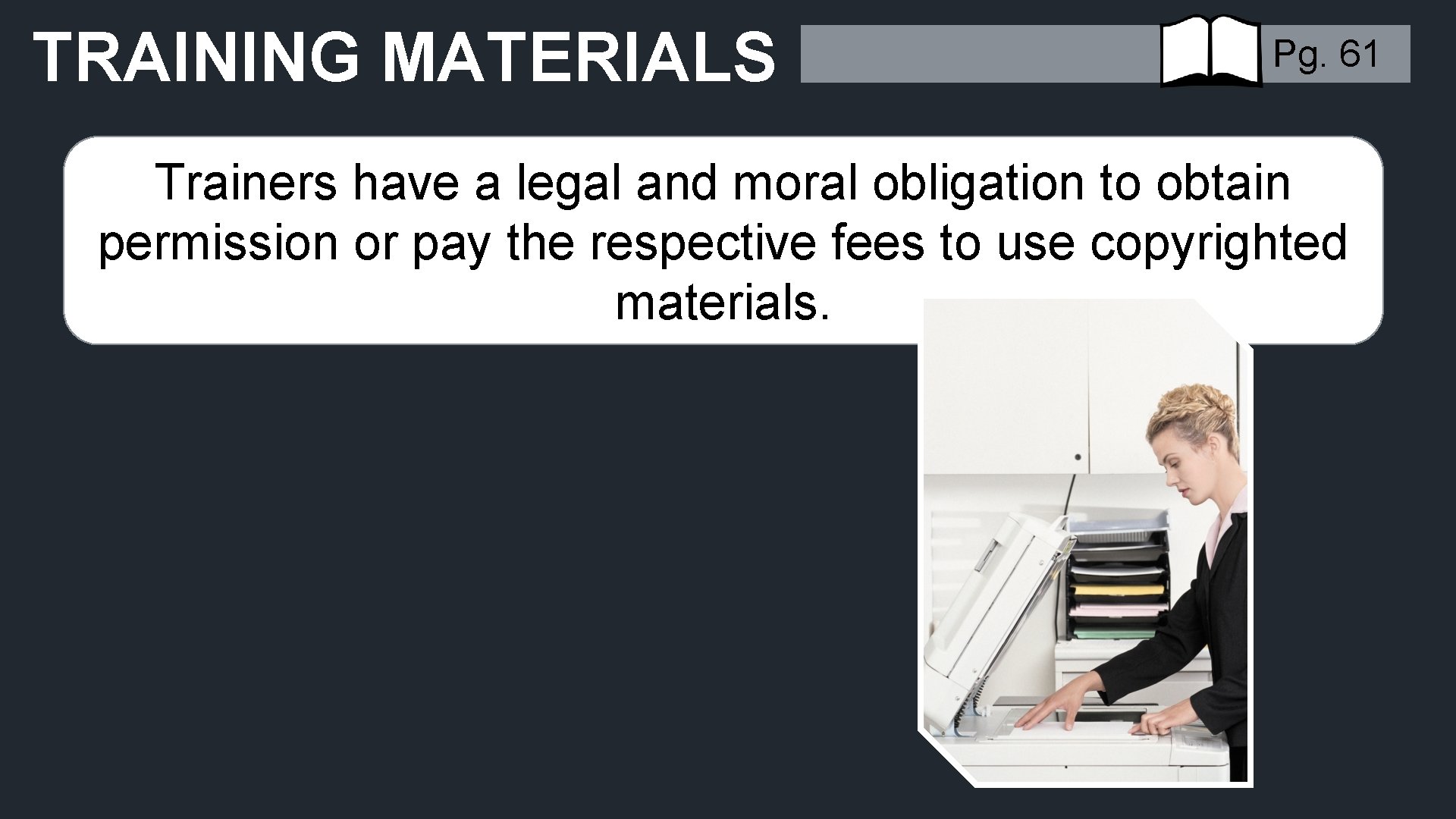
TRAINING MATERIALS Pg. 61 Trainers have a legal and moral obligation to obtain permission or pay the respective fees to use copyrighted materials.
KNOWLEDGE CHECK What are the legal restrictions on using copyrighted audio-visual materials in a training program? A)There are no restrictions within the United States provided that an admissions fee is not charged for seeing them. B) Copyrighted materials fall under the fair use clause for educational purposes. C) The trainer can view them but they cannot be shown to trainees unless the trainer has a licensed agreement. D) An admissions fee for all trainees must be paid either by the trainees or the company sponsoring the training.

Congratulations, you have completed this section
SECTION 05 Evaluation of Training Effectiveness
LESSON OBJECTIVES Be aware of the four criteria used to evaluate training. Apply research design models to examine and dissect training success and failures.
CRITERIA FOR EVALUATING TRAINING Pg. 65 The criteria for evaluating a training program should be determined by the training objectives. Criteria: • Reactions • Learning • Behavior • Results
SOURCES OF DATA Archive data Questionnaires and surveys Performance tests Interviews Simulations Ratings/ checklists Critical incidents Observations Performance appraisals Pg. 68
RESEARCH DESIGN Pg. 69 1. Post-test–only design (case study) 2. Pretest–post-test comparison 3. Pretest–post-test control group design 4. Post-test–only control group design 5. Solomon four-group design 6. Time-series design 7. Separate sample pretest–post-test control group design
KNOWLEDGE CHECK Which of the following statements is TRUE of the Solomon Four Group Design? A) All four groups receive the training. B) Participants are randomly assigned to groups. C) Just two groups are given the post-test. D) All four groups are given the pre-test.

Congratulations, you have completed this section
SECTION 06 Talent Management Programs
LESSON OBJECTIVES Understand socialization and the impacts of the right of passage. Recognize the large scale impact onboarding and orientation can have on turnover and career pathing within an organization.
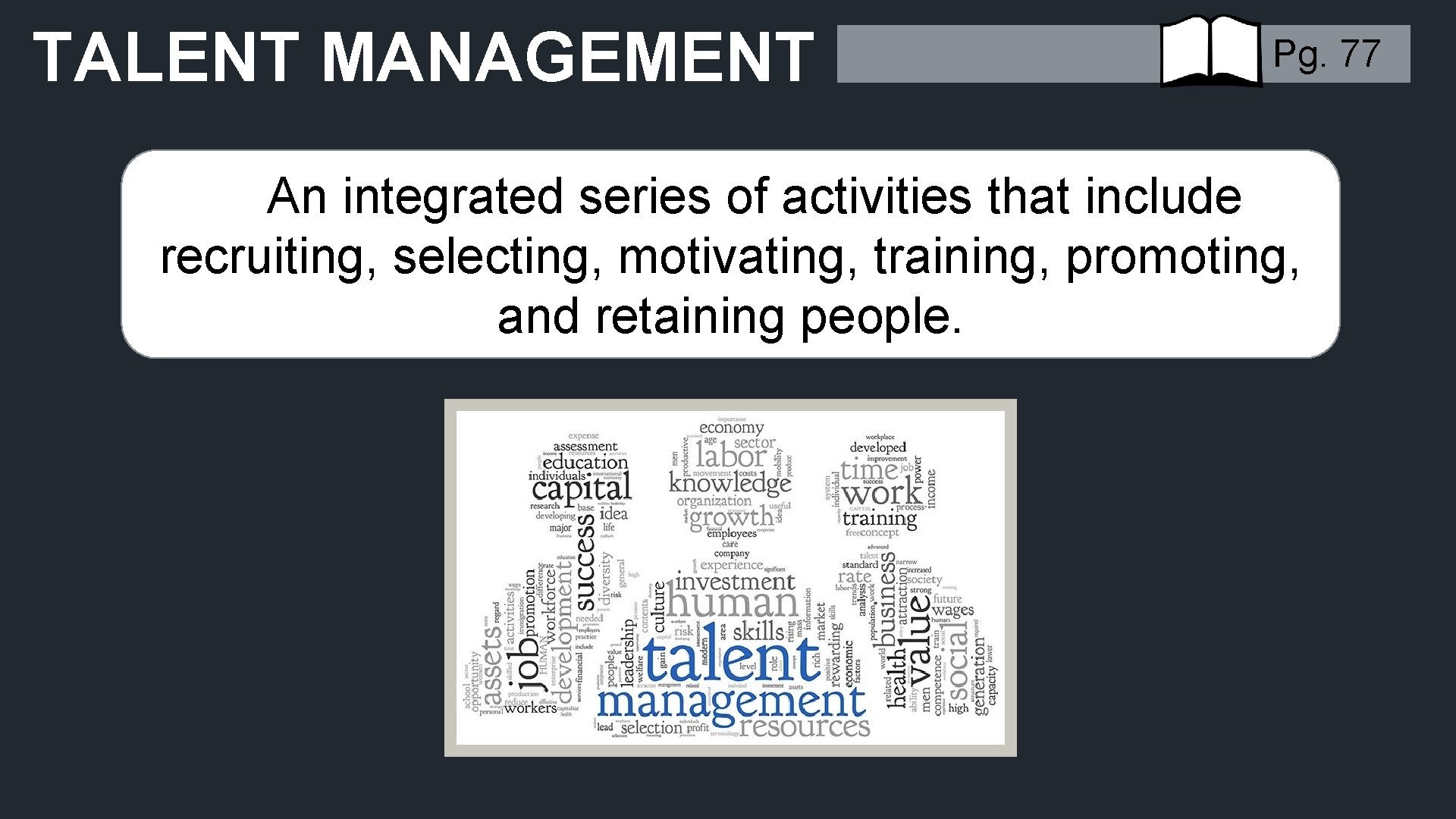
TALENT MANAGEMENT Pg. 77 An integrated series of activities that include recruiting, selecting, motivating, training, promoting, and retaining people.
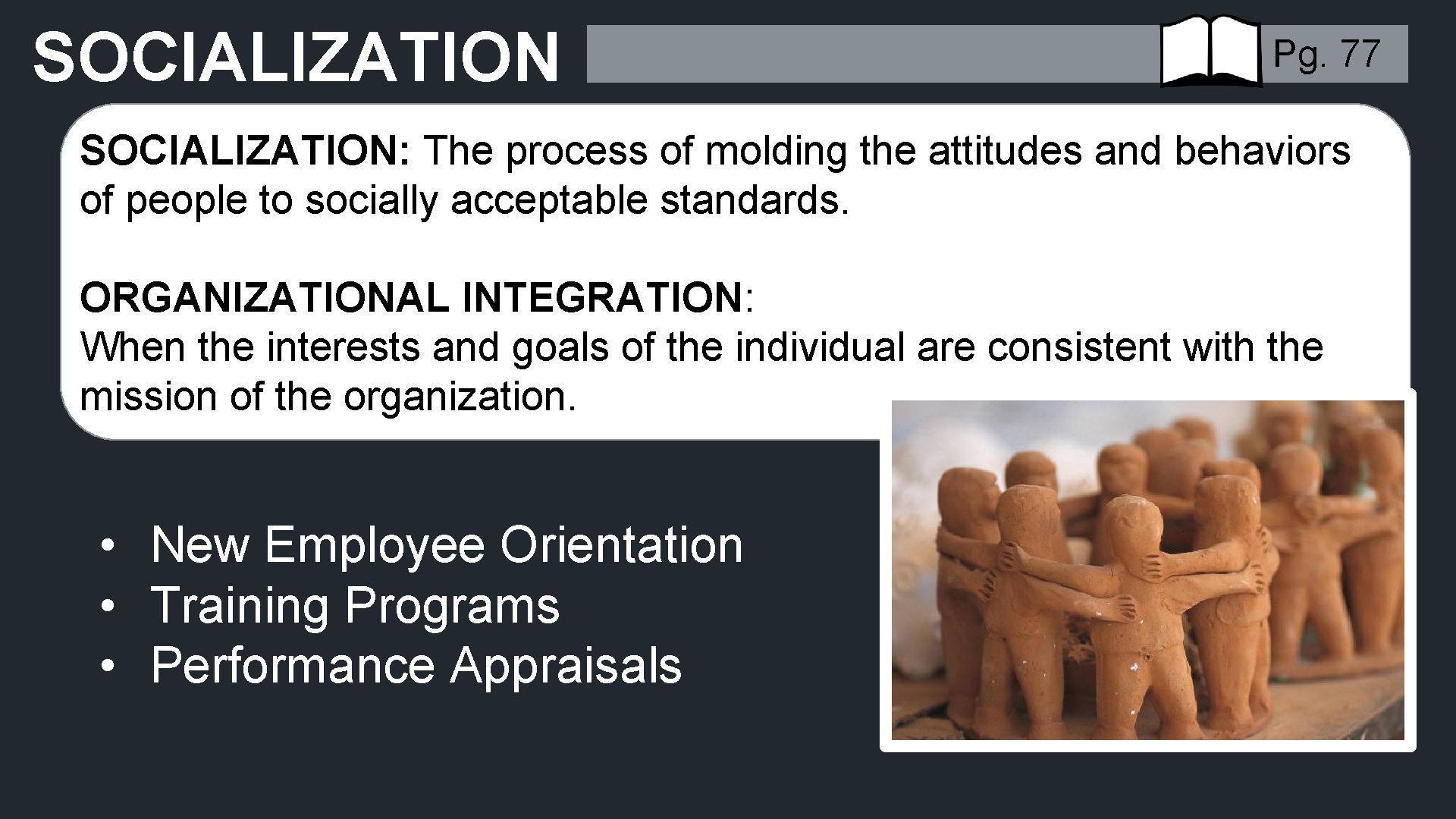
SOCIALIZATION Pg. 77 SOCIALIZATION: The process of molding the attitudes and behaviors of people to socially acceptable standards. ORGANIZATIONAL INTEGRATION: When the interests and goals of the individual are consistent with the mission of the organization. • New Employee Orientation • Training Programs • Performance Appraisals
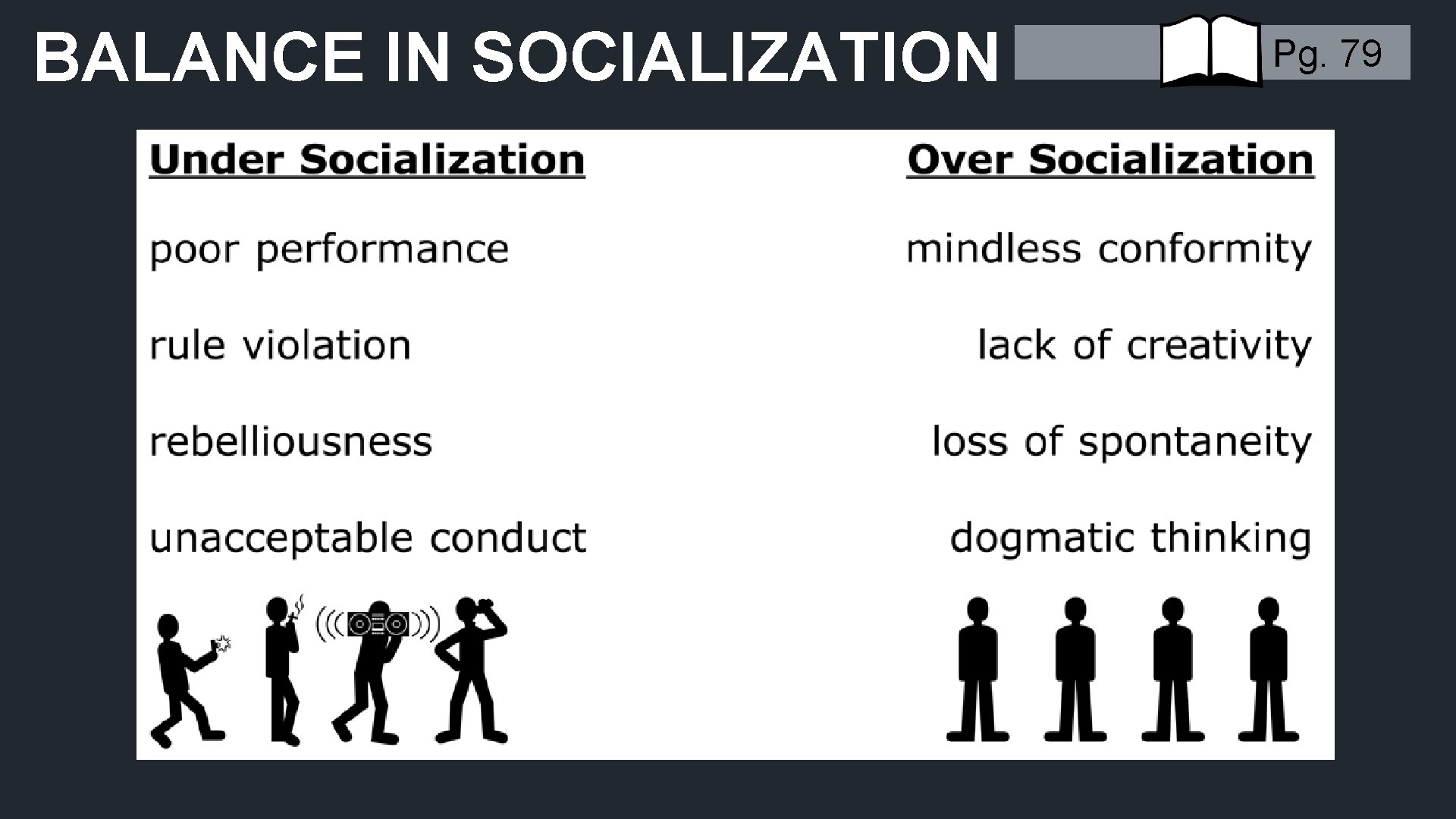
BALANCE IN SOCIALIZATION Pg. 79
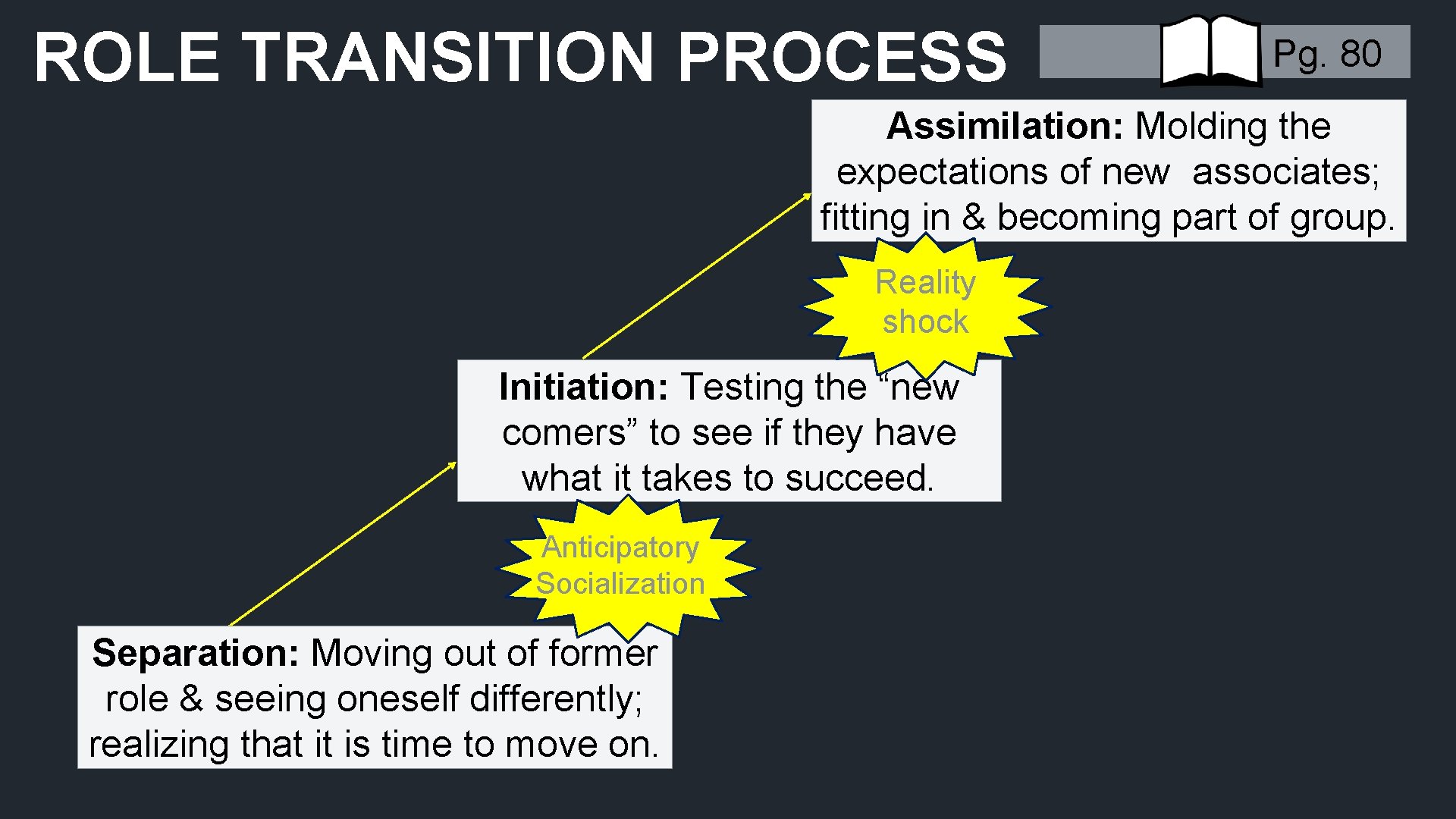
ROLE TRANSITION PROCESS Pg. 80 Assimilation: Molding the expectations of new associates; fitting in & becoming part of group. Reality shock Initiation: Testing the “new comers” to see if they have what it takes to succeed. Anticipatory Socialization Separation: Moving out of former role & seeing oneself differently; realizing that it is time to move on.
ORIENTATION TRAINING Pg. 80 In designing an orientation program, trainers should decide what information is needed right now by new employees. Make it Effective! • Begin with most relevant information. • Sponsors/mentors to help new employees learn the ropes. • Gradually introduce employees to members of work group. • Space orientation over a period of time rather than one long session. • Provide both oral and written information.
ORIENTATION vs. ONBOARDING Orientation • • • Is typically a 1 day event Focuses on organization’s structure, mission and policies Includes a review of the employee handbook Completion of payroll and benefits paperwork Other administrative issues Pg. 83 Onboarding • • Extends well beyond the 1 st few days Is a systematic process Can last from 3 to 18 months depending on the position Cultivates long term relationship building and access to information Promotes better understanding of the culture, mission, and goals Fosters a feeling of belonging & affirmation of making a right choice Reduces the time it takes to “hit the ground running”
KNOWLEDGE CHECK An effective new employee orientation program begins A) On the first day of the job B) Sometime during the first week C) Anytime within the first month D) Before new employees are even hired
EMPLOYEE DEVELOPMENT Pg. 83 Often during the hiring and on-boarding process opportunities for employee development will be uncovered. • • literacy training mentoring attitude change personality adjustments
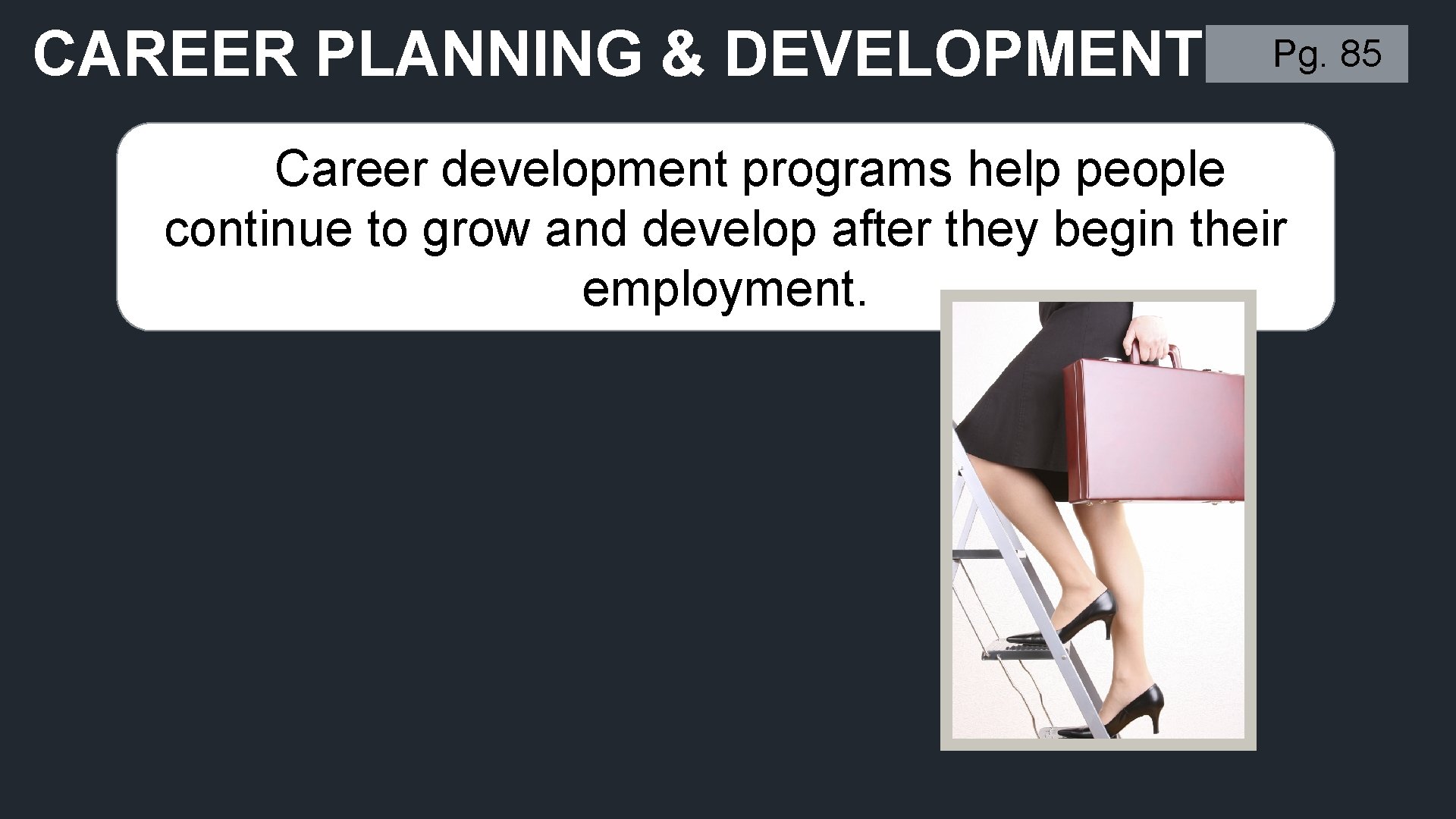
CAREER PLANNING & DEVELOPMENT Pg. 85 Career development programs help people continue to grow and develop after they begin their employment.
KNOWLEDGE CHECK A dual career ladder refers to which of the following? A) An employee pursues both a managerial career track and a technical career track B) An employee hold two full time jobs C) An employee changes specialties mid-career D) An employee leaves retirement to pursue a new career
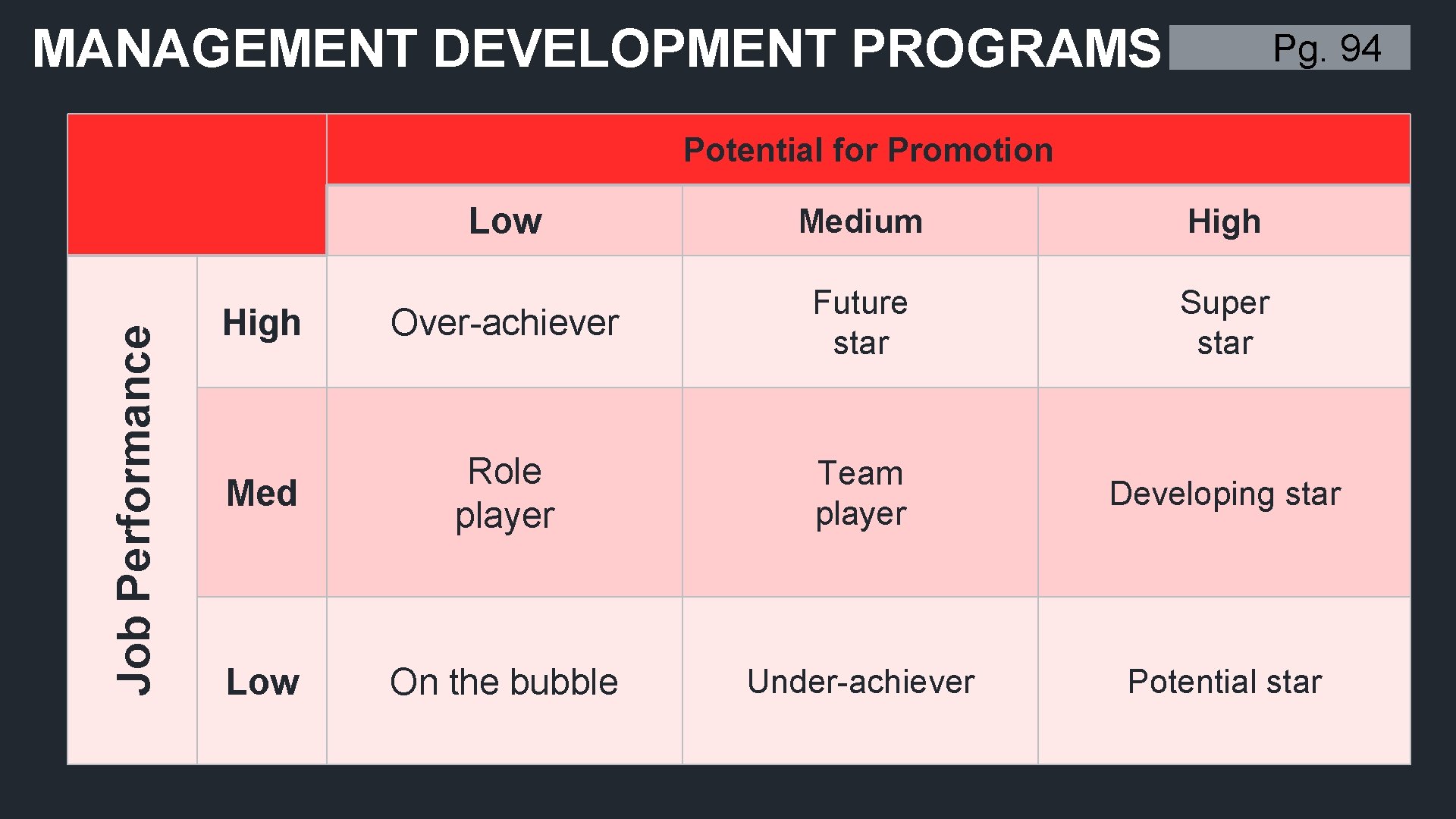
MANAGEMENT DEVELOPMENT PROGRAMS Pg. 94 Job Performance Potential for Promotion Low Medium High Over-achiever Future star Super star Med Role player Team player Developing star Low On the bubble Under-achiever Potential star
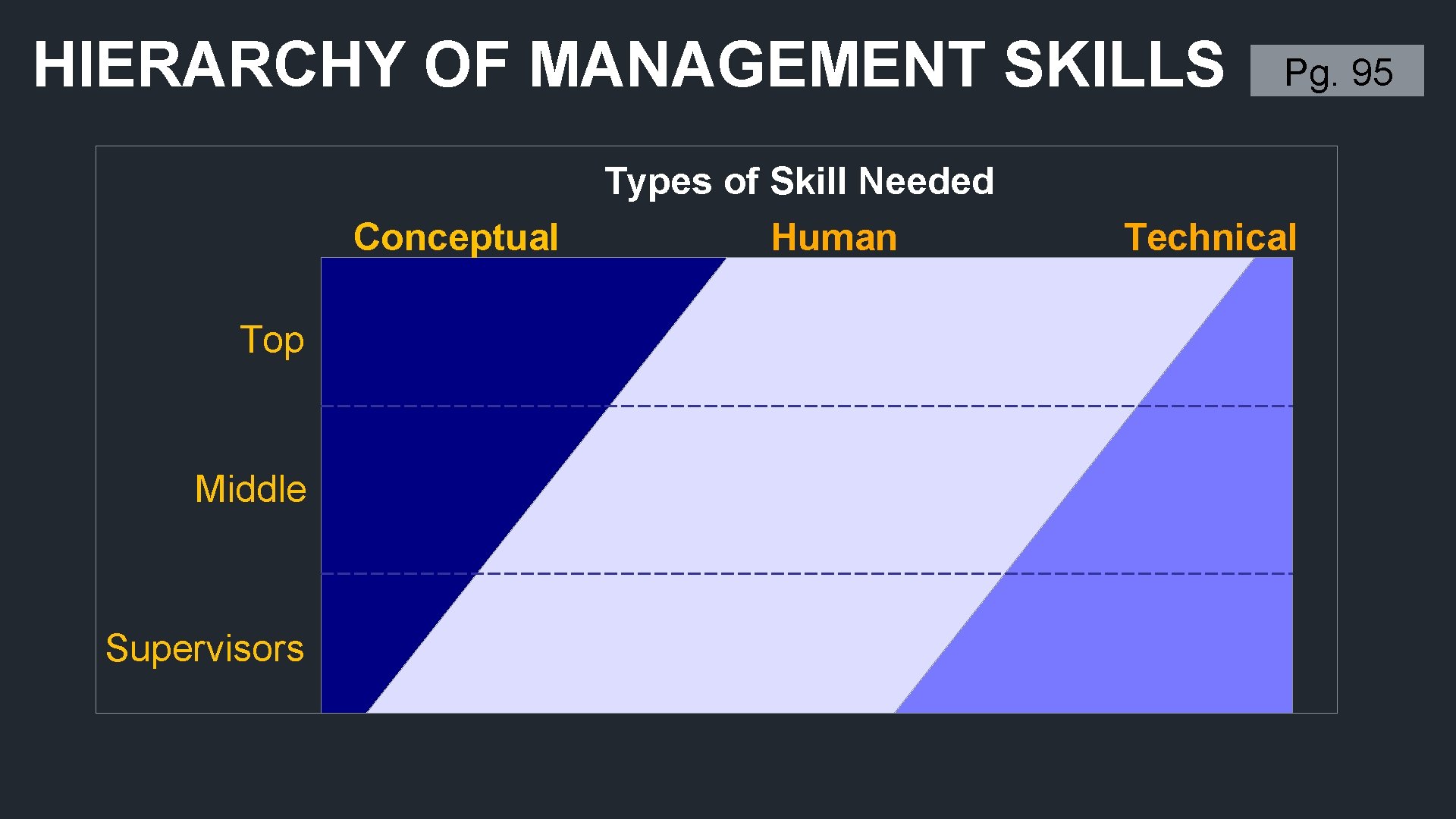
HIERARCHY OF MANAGEMENT SKILLS Conceptual Top Middle Supervisors Types of Skill Needed Human Pg. 95 Technical
EXPATRIATE TRAINING Expatriate managers face special challenges. • Problems of adjustment • Cross-cultural training • Culture shock Pg. 96
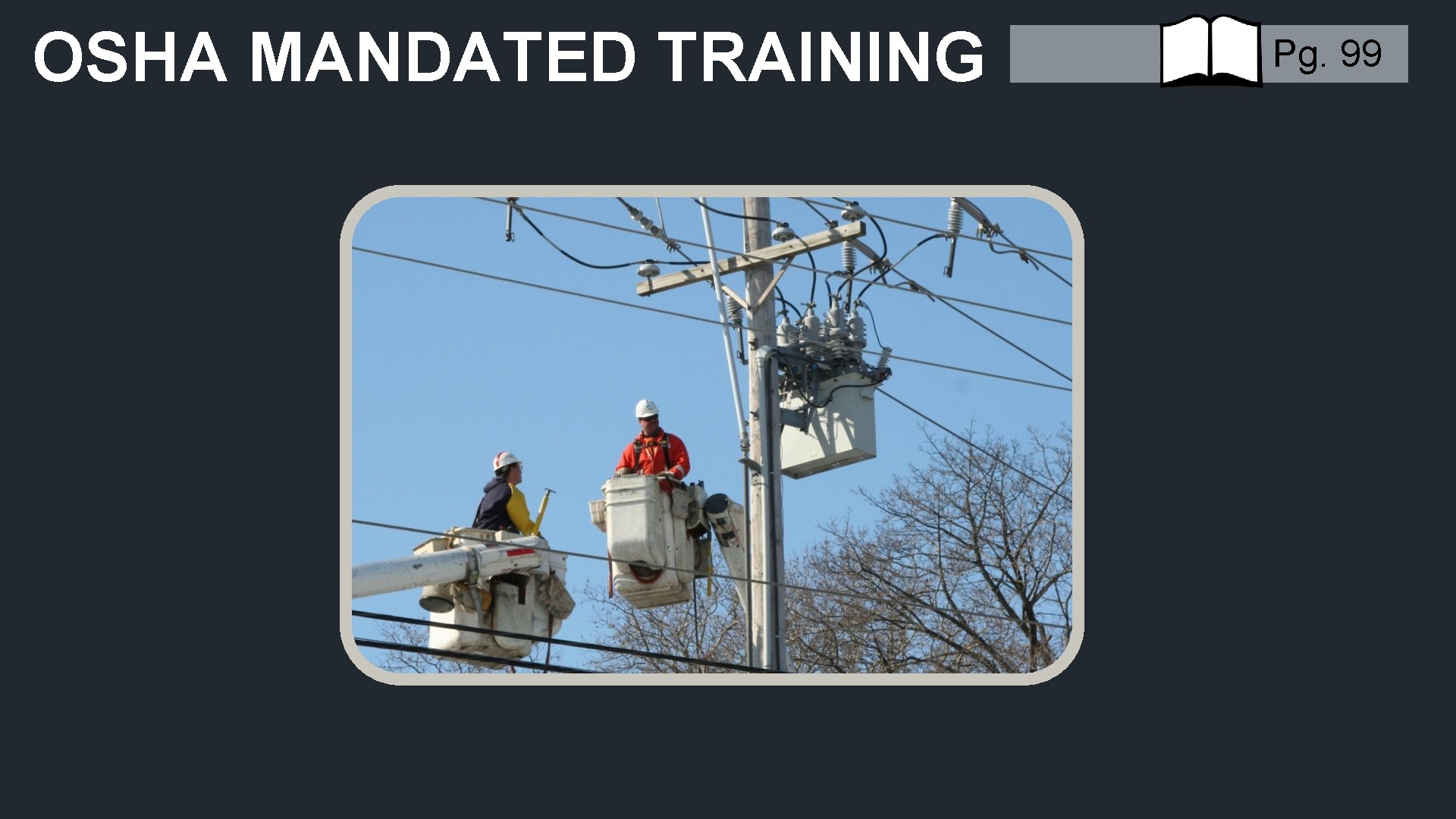
OSHA MANDATED TRAINING Pg. 99
SEXUAL HARASSMENT & DISCRIMINATION TRAINING Training designed to prevent harassment is part of an employer’s affirmative defense when cases go to trial. Pg. 99
KNOWLEDGE CHECK During the establishment career stage, employees strive to A) Protect themselves and secure their position within the organization. B) Solidify their career choices and secure the ideal job. C) Match their interests and abilities with the demands of a job. D) Create a permanent position within their chosen occupation.

Congratulations, you have completed this section
SECTION 07 Performance Management
LESSON OBJECTIVES Differentiate and apply the different types of performance appraisals.
PERFORMANCE EVALUATION Pg. 101 Performance management involves all of the human resource functions associated with evaluating and rewarding employee performance. Organizational Functions: • Guide human resource decisions • Reward and motivate employees • Promote personal development • Identify training needs • Integrate human resource functions
ANSI GUIDELINES Pg. 101 The American National Standards Institute (ANSI) publishes a set of guidelines explaining how performance management should be implemented. Guidelines 1. Goal setting 2. Performance review 3. Performance improvement plan
PERFORMANCE CRITERIA Three basic types of behavior that should be included in performance appraisal: 1. Attracting and Holding People in the Organization 2. Dependable Task Accomplishment 3. Organizational Citizenship Behaviors Pg. 103
WHAT SHOULD BE EVALUATED? Pg. 106 In deciding what to evaluate, an important issue is whether to focus on outcomes (results) or behaviors (activities).
KNOWLEDGE CHECK Which of the following BEST describes the proper role of performance evaluation in the employment exchange? A) Employers should trust employees to perform well and not have to check up on them. B) Only those employees who fail to demonstrate that they can be trusted should be evaluated. C) Performance evaluations should be conducted only on managers and used for promotion decisions. D) All employees should expect to have their performance evaluated and this information should be used for pay increases and promotion decisions.

RATING ERRORS Pg. 109
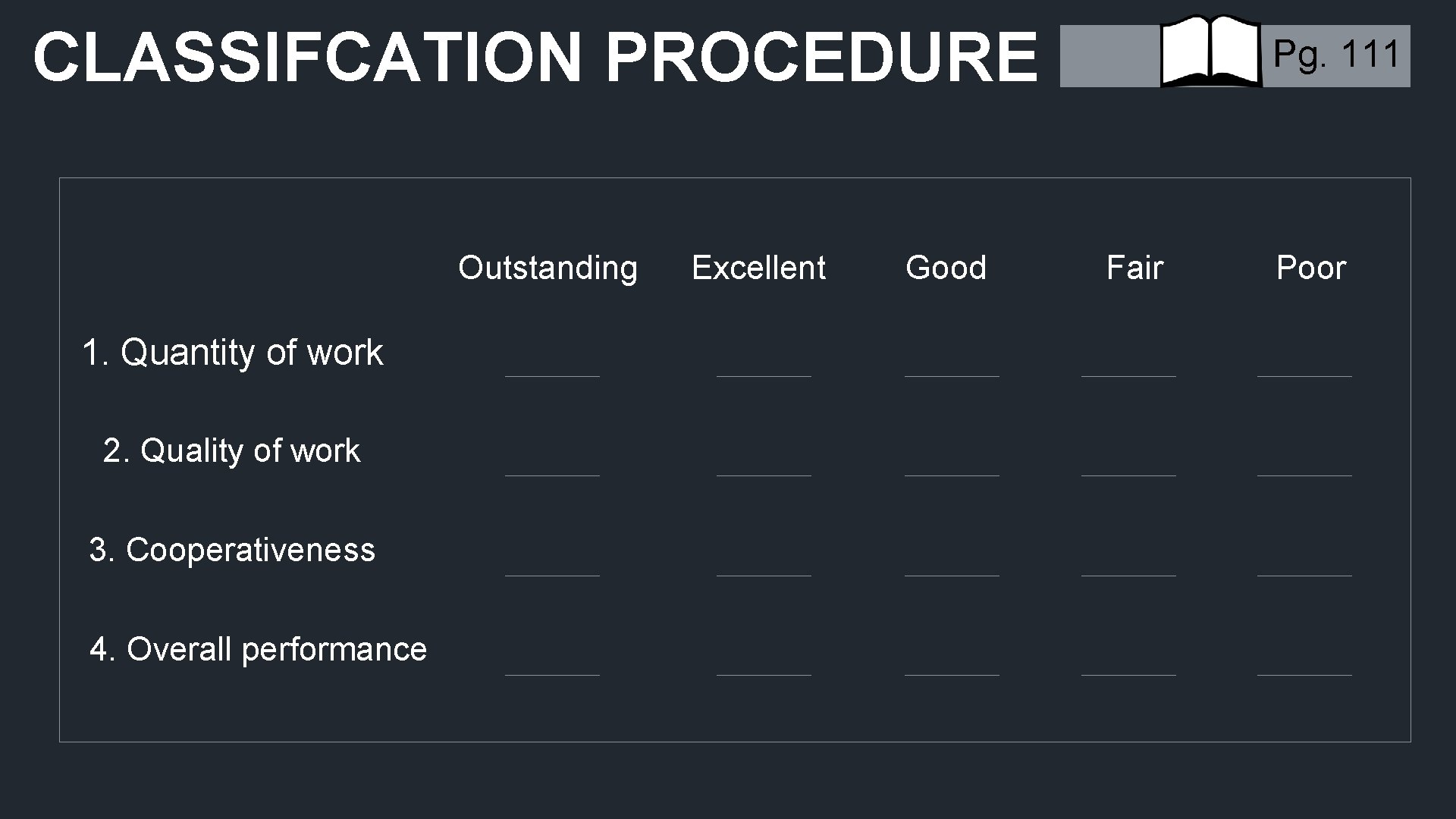
CLASSIFCATION PROCEDURE Outstanding 1. Quantity of work 2. Quality of work 3. Cooperativeness 4. Overall performance Excellent Good Pg. 111 Fair Poor
RANKING Pg. 112 To order a group of employees from highest to lowest along some dimension, usually overall performance. • straight ranking • alternate ranking • paired comparisons
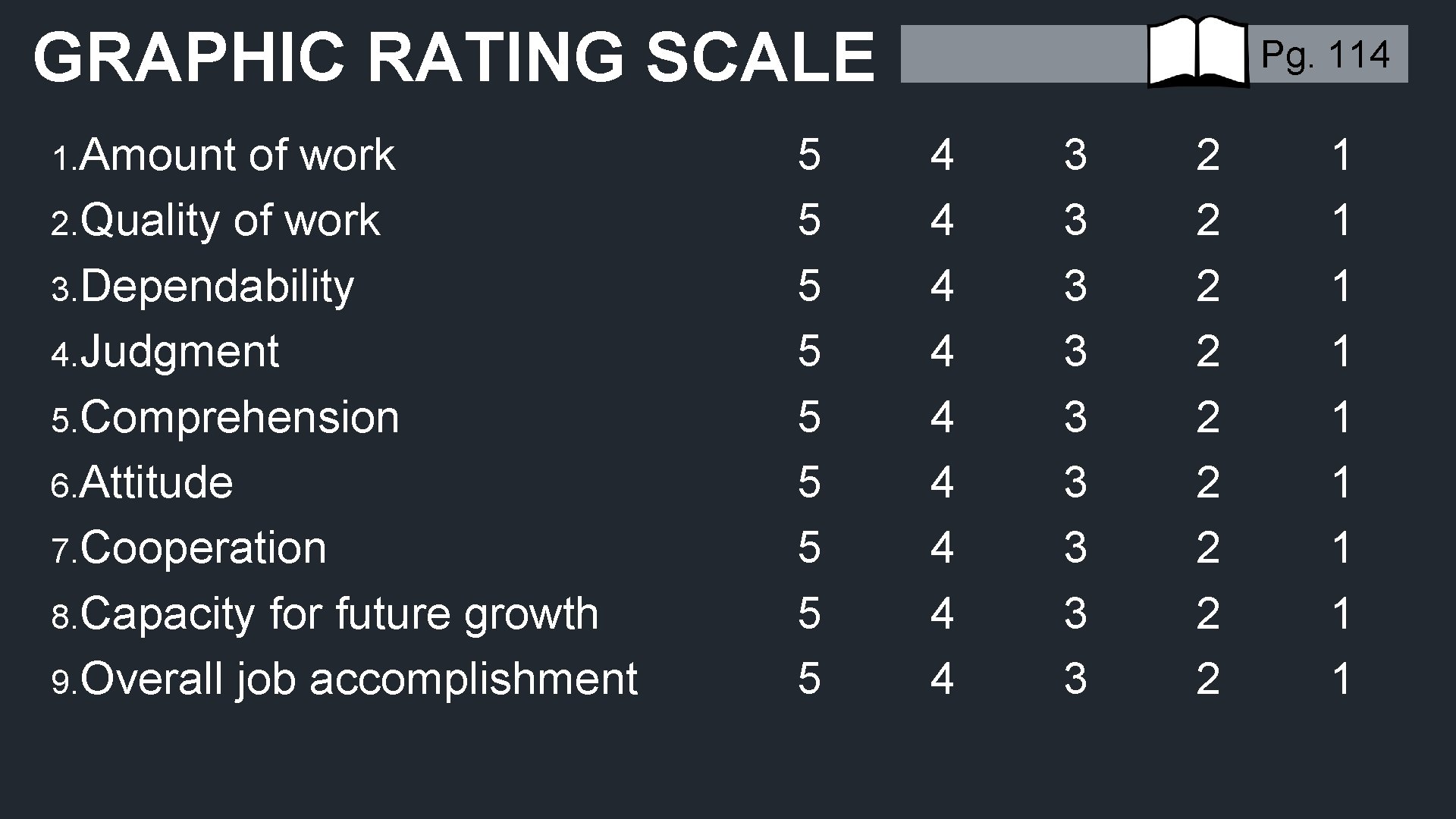
GRAPHIC RATING SCALE 1. Amount of work 2. Quality of work 3. Dependability 4. Judgment 5. Comprehension 6. Attitude 7. Cooperation 8. Capacity for future growth 9. Overall job accomplishment 5 5 5 5 5 Pg. 114 4 4 4 4 3 3 3 3 3 2 2 2 2 2 1 1 1 1 1
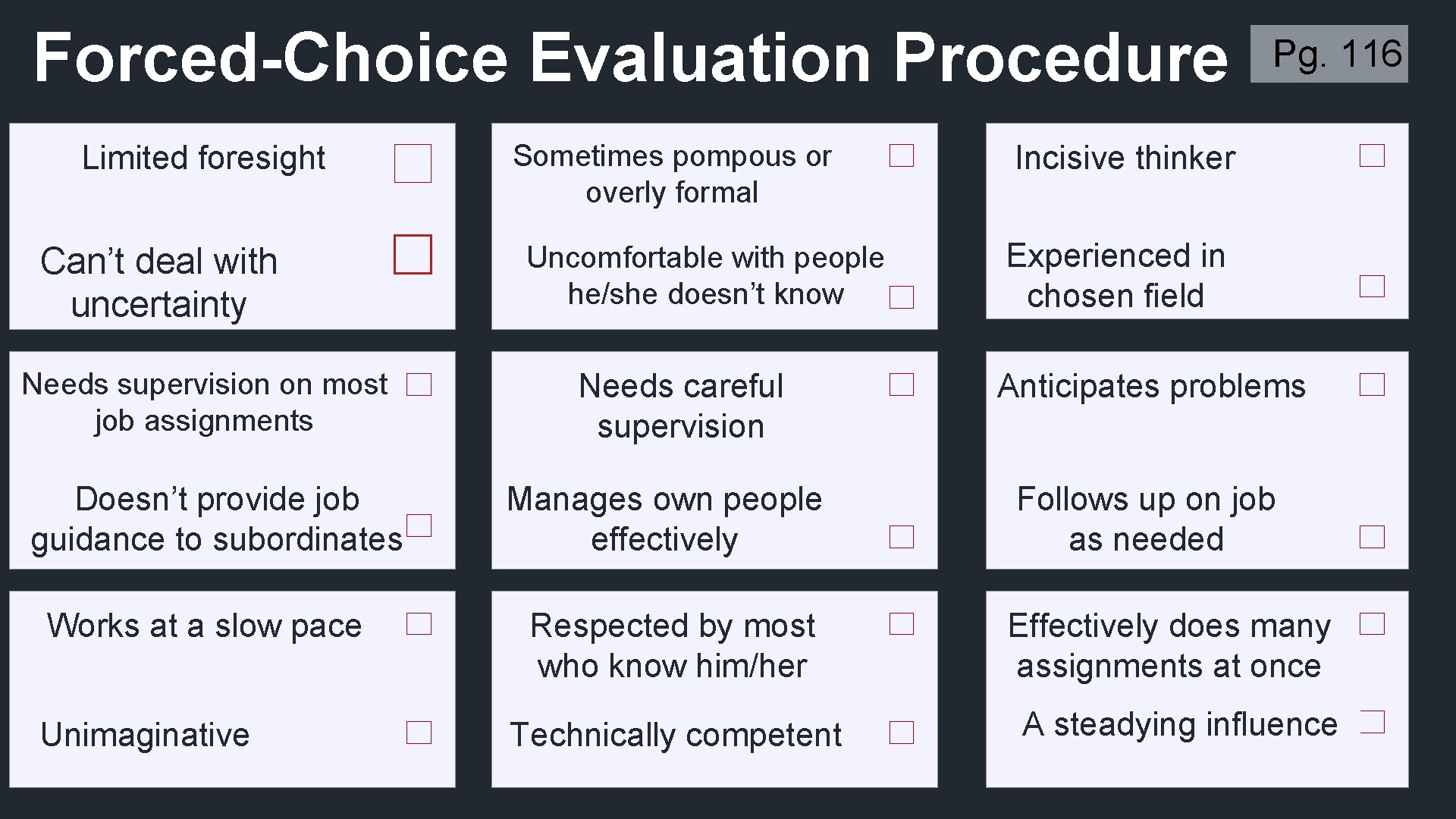
Forced-Choice Evaluation Procedure Limited foresight Can’t deal with uncertainty Needs supervision on most job assignments Doesn’t provide job guidance to subordinates Works at a slow pace Unimaginative Sometimes pompous or overly formal Uncomfortable with people he/she doesn’t know Needs careful supervision Manages own people effectively Respected by most who know him/her Technically competent Pg. 116 Incisive thinker Experienced in chosen field Anticipates problems Follows up on job as needed Effectively does many assignments at once A steadying influence
CHECKLISTS A weighted checklist consists of a list of behaviors that evaluators use to describe the performance of employees. Pg. 117

NARRATIVE APPRIASALS/ ESSAYS Pg. 117 Used to describe an employee’s performance
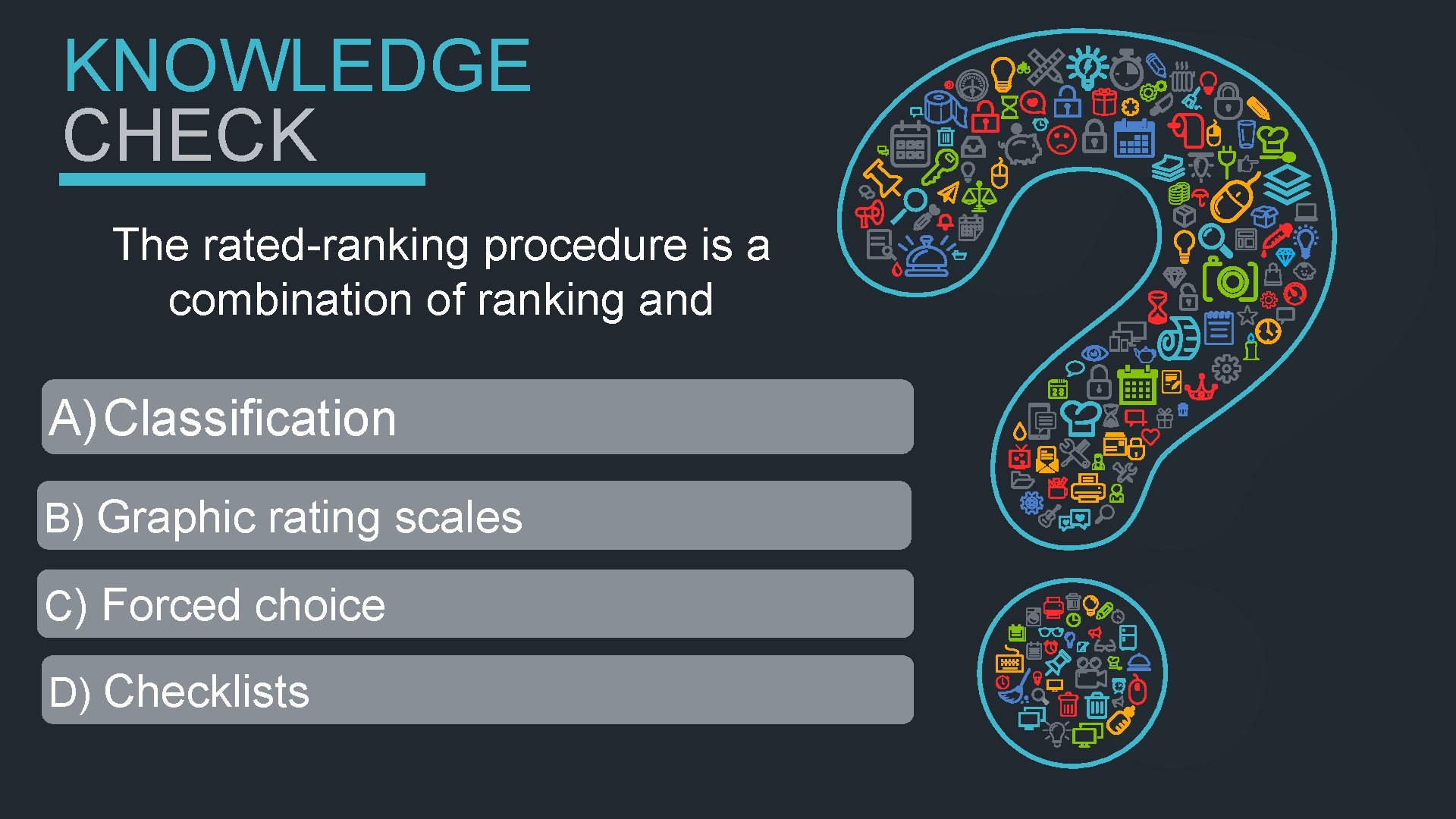
KNOWLEDGE CHECK The rated-ranking procedure is a combination of ranking and A) Classification B) Graphic rating scales C) Forced choice D) Checklists
CRITICAL INCIDENTS Pg. 117 Critical incidents is known as one of the best methods to identify the dimensions of a job. • Descriptions by qualified observers of behaviors that are especially effective or ineffective. • One of the best techniques for identifying the most important dimensions of a job.
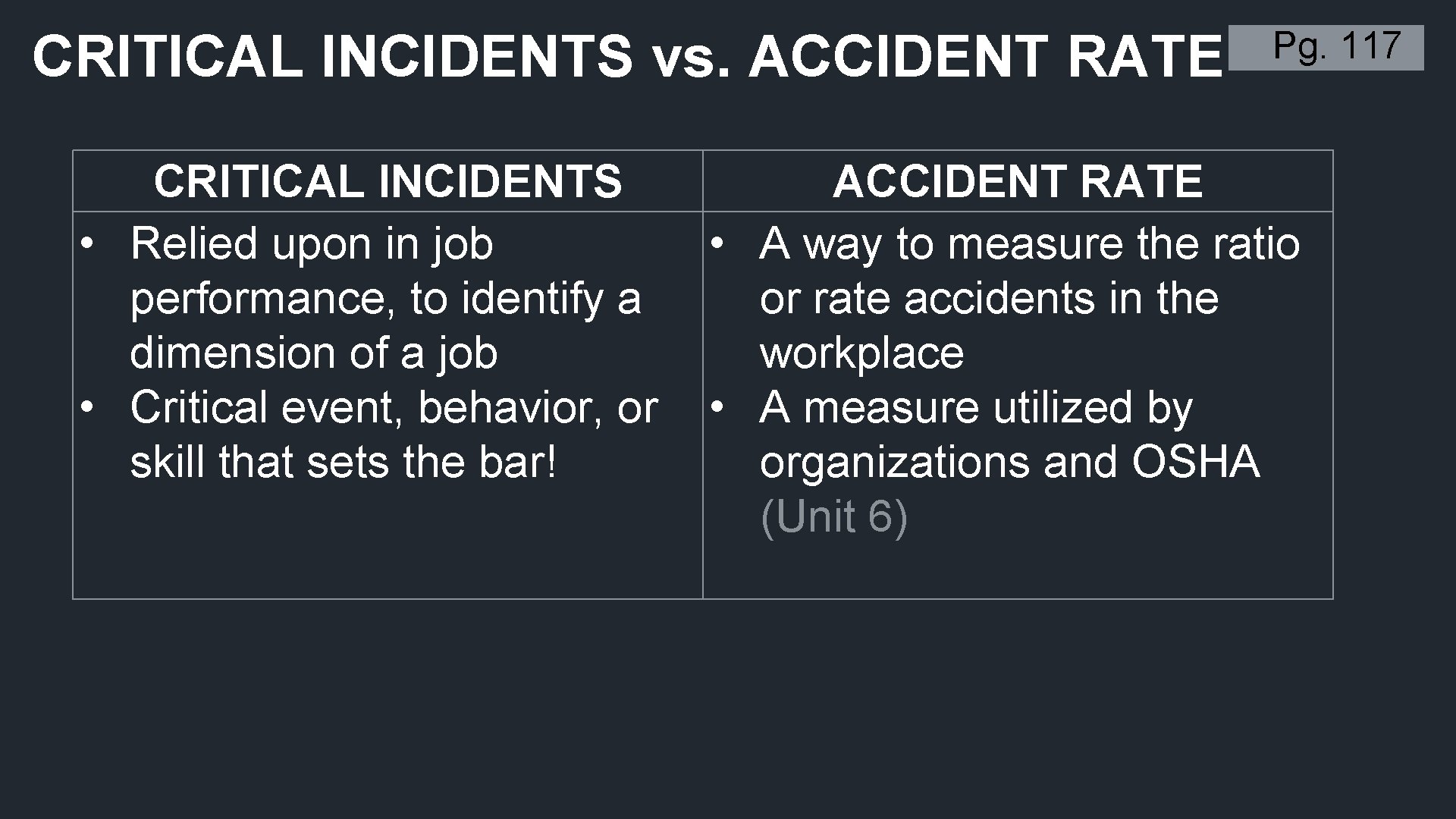
CRITICAL INCIDENTS vs. ACCIDENT RATE CRITICAL INCIDENTS • Relied upon in job performance, to identify a dimension of a job • Critical event, behavior, or skill that sets the bar! Pg. 117 ACCIDENT RATE • A way to measure the ratio or rate accidents in the workplace • A measure utilized by organizations and OSHA (Unit 6)
MANAGEMENT BY OBJECTIVES (MBO) Pg. 119 Adopts a positive, proactive way of managing rather than a reactive way. FOCUSES • predicting and shaping the future of the organization by developing long-range organizational objectives and strategic plans. • accomplishing results rather than performing activities. • improving both individual competence and organizational effectiveness. • Increasing the participation and involvement of employees in the affairs of the organization.
TYPES OF APPRAISALS • Supervisor Appraisals • Peer Appraisals • Client Appraisals • Self Appraisals • Team Appraisals • Subordinate Appraisals • 360 -Degree Appraisals Pg. 124
LINKING APPRAISALS TO EMPLOYMENT DECISIONS Pg. 130 The purpose of an evaluation should be to provide information for making important decisions. • • Pay increases and incentive compensation Personal development and training Disciplinary actions and performance improvement Promotions
DEFENSIBLE EVALUATIONS • • • Identify objective, job-related criteria Document performance events Communicate performance standards Use reasonable care train evaluators Pg. 132
KNOWLEDGE CHECK Self appraisals usually result in A) Less defensiveness regarding the evaluation process B) Less satisfying evaluation interviews C) Excellent data for making pay and promotion decisions D) A high correlation with supervisory evaluations

Congratulations, you have completed this section

SECTION 08 Change Management
LESSON OBJECTIVES Realize the significant role as a catalyst and change agent as implementing and sustaining change in an organization. Distinguish between three types of change Identify two predominant (and several other) change theories. Define ‘Learning Organization’.
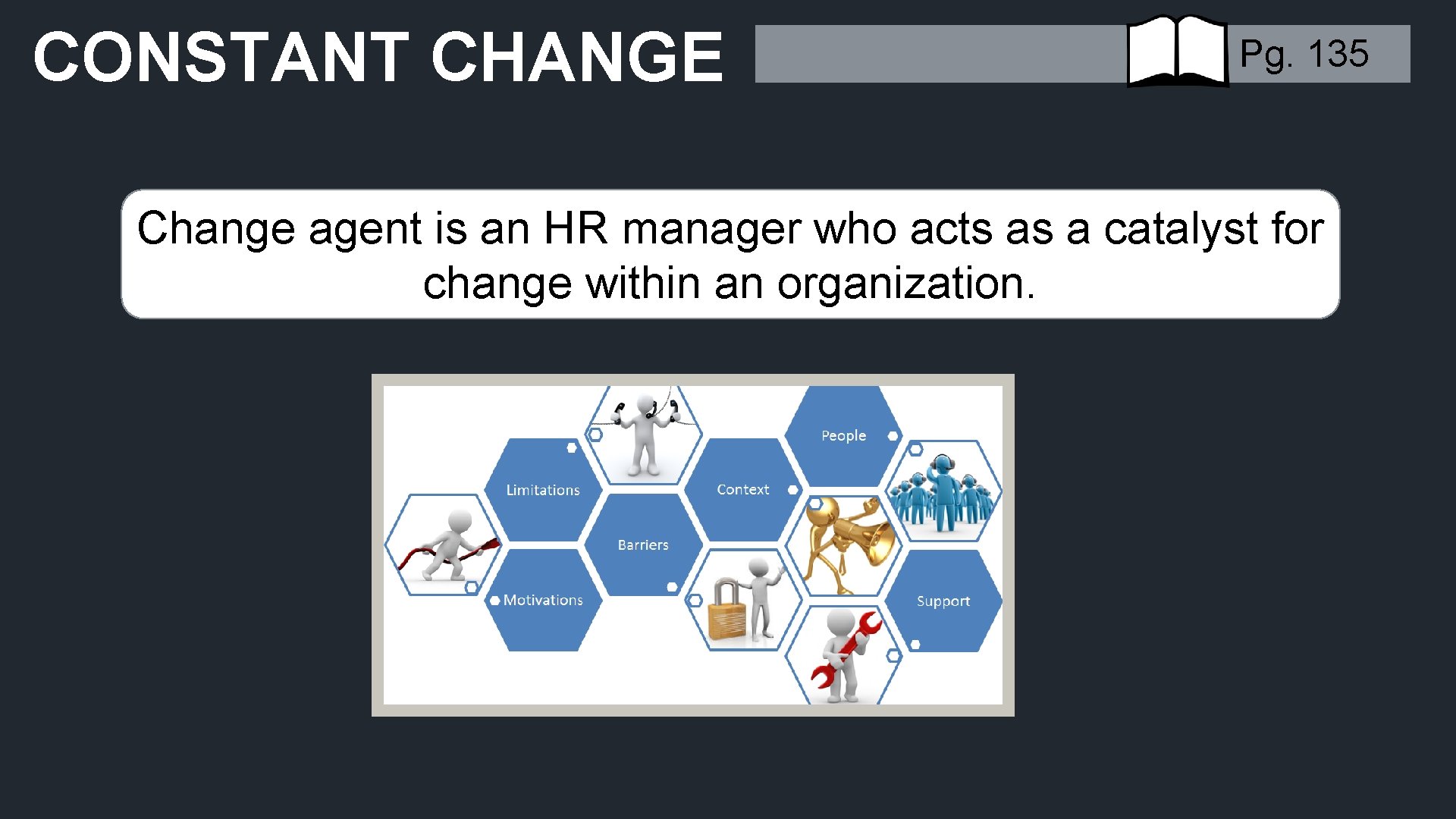
CONSTANT CHANGE Pg. 135 Change agent is an HR manager who acts as a catalyst for change within an organization.
LASTING CHANGE • • Pg. 135 The change was not tied to the organization’s strategy. The change was seen as a fad or quick fix. The change involved grandiose expectations that were inconsistent with the economic and political realities. Those leading the change had a short-term perspective and provided inadequate leadership. There was a lack of measurable goals and timetables. Those affected by the change were afraid of the unknown. Those involved in the change lacked the necessary commitment to sustain the change
CRUCIAL FACTORS TO SUCCESSFUL CHANGE EFFORT 1. 2. 3. 4. 5. 6. 7. Having a change sponsor Creating a shared need Creating a shared vision Mobilizing commitment Changing systems and structures Monitoring progress Making change last Pg. 135
Driving Forces for Change Internal Forces 1. New technology 2. Changing work values 3. Creation of new knowledge 4. Product obsolescence 5. Desire for leisure & alternative work schedules Environmental Forces 1. Competition 2. Changes in consumer demands 3. Resource availability 4. Social and political changes 5. International changes Forces Resisting Change 1. 2. 3. 4. Individual Resistance Fear of the unknown New learning Disruption of stable friendships Distrust of management 1. 2. 3. 4. Organizational Resistance Threat to the power structure Inertia of organizational structure System relationships Sunk costs & vested interests
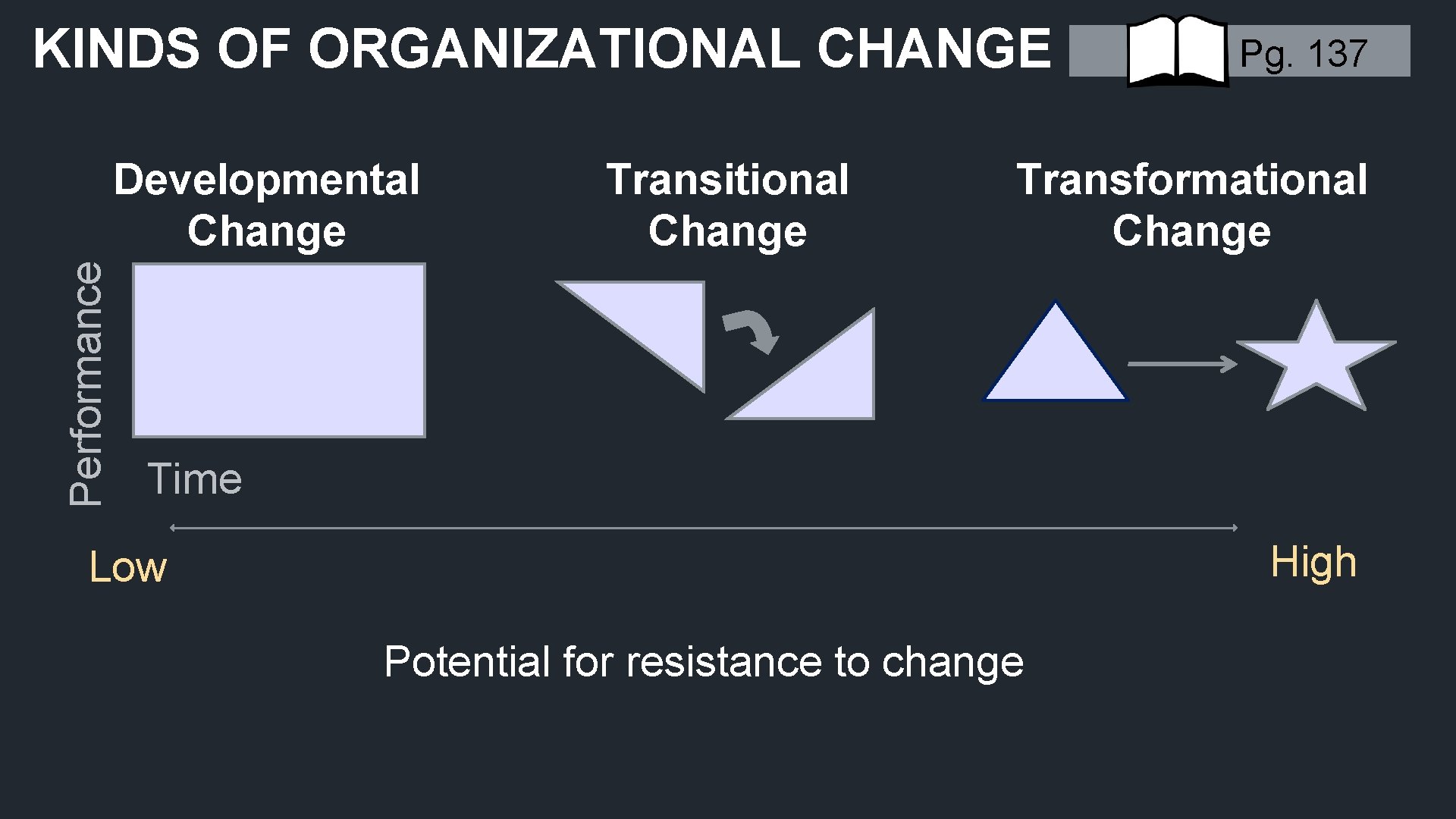
KINDS OF ORGANIZATIONAL CHANGE Performance Developmental Change Transitional Change Pg. 137 Transformational Change Time High Low Potential for resistance to change
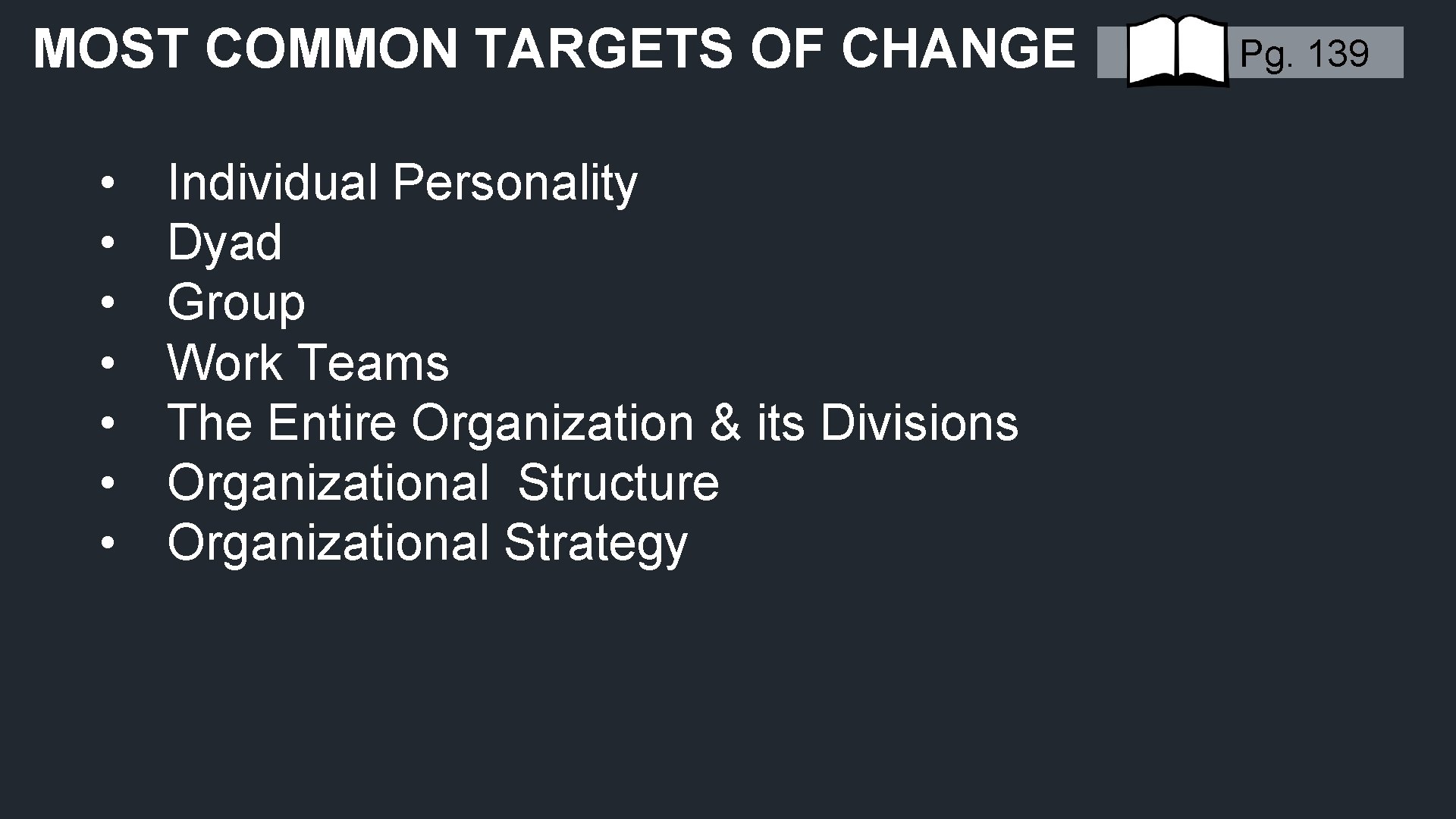
MOST COMMON TARGETS OF CHANGE • • Individual Personality Dyad Group Work Teams The Entire Organization & its Divisions Organizational Structure Organizational Strategy Pg. 139
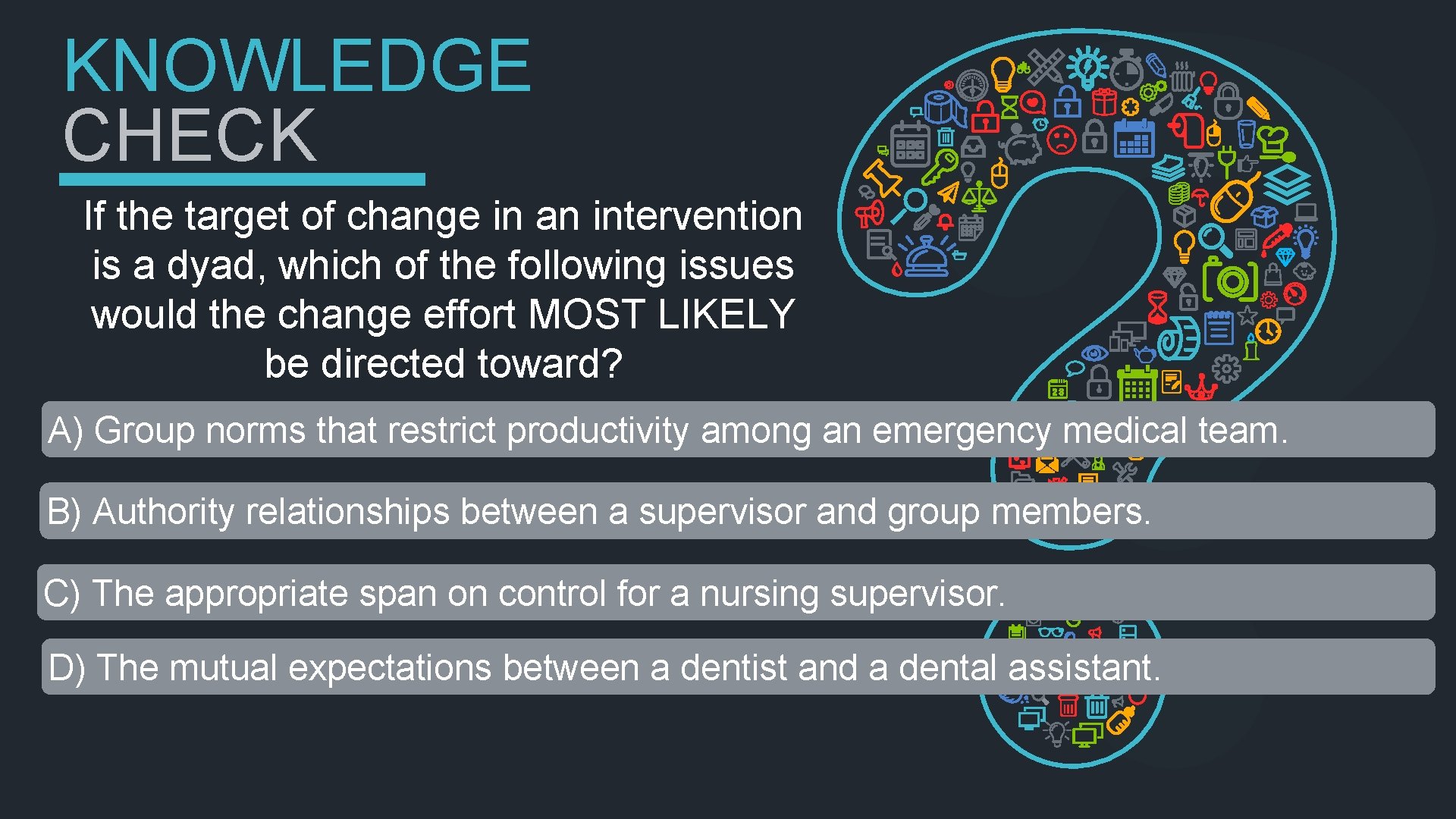
KNOWLEDGE CHECK If the target of change in an intervention is a dyad, which of the following issues would the change effort MOST LIKELY be directed toward? A) Group norms that restrict productivity among an emergency medical team. B) Authority relationships between a supervisor and group members. C) The appropriate span on control for a nursing supervisor. D) The mutual expectations between a dentist and a dental assistant.
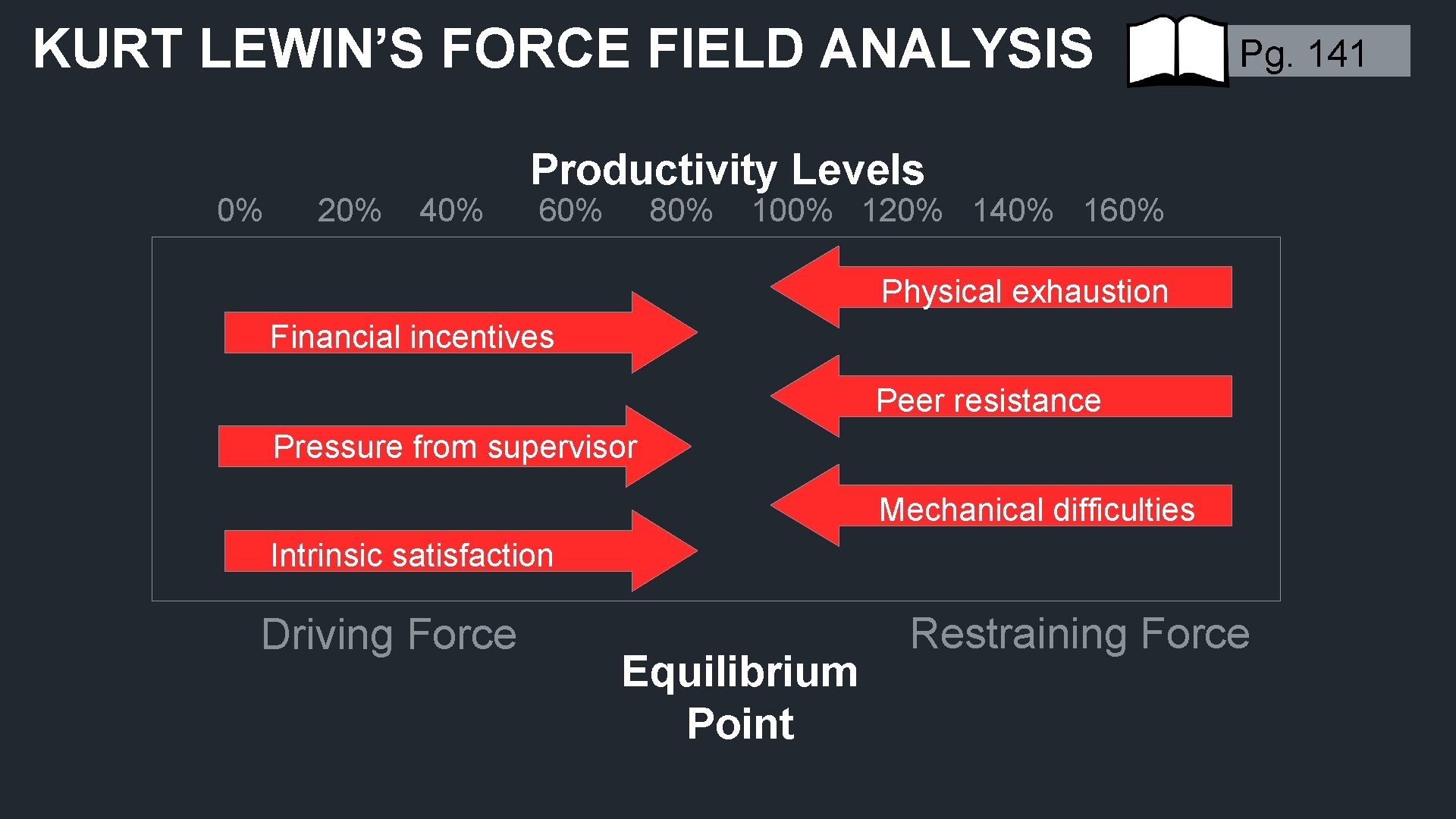
KURT LEWIN’S FORCE FIELD ANALYSIS 0% 20% 40% Pg. 141 Productivity Levels 60% 80% 100% 120% 140% 160% Physical exhaustion Financial incentives Peer resistance Pressure from supervisor Mechanical difficulties Intrinsic satisfaction Driving Force Equilibrium Point Restraining Force
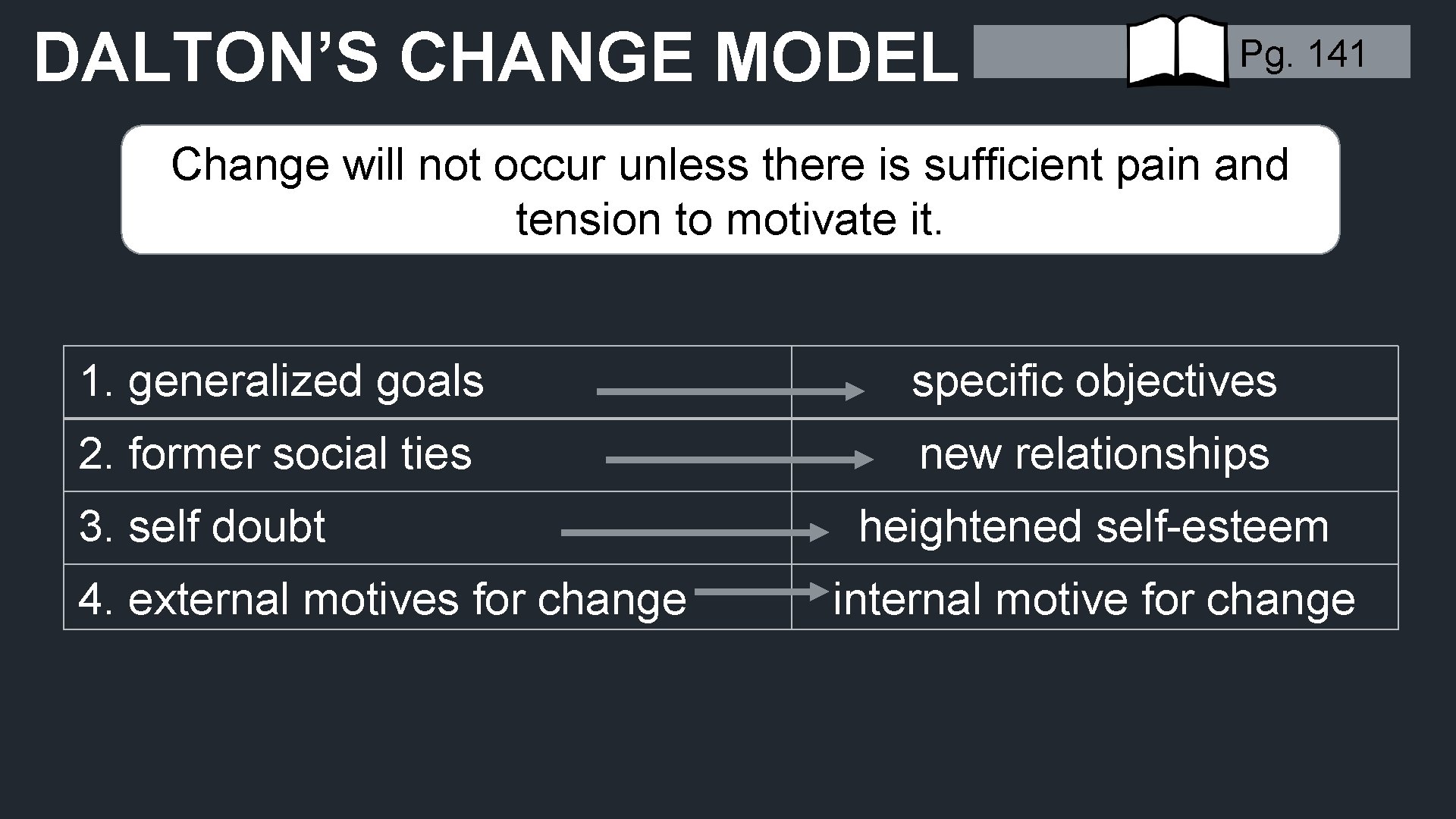
DALTON’S CHANGE MODEL Pg. 141 Change will not occur unless there is sufficient pain and tension to motivate it. 1. generalized goals specific objectives 2. former social ties new relationships 3. self doubt 4. external motives for change heightened self-esteem internal motive for change
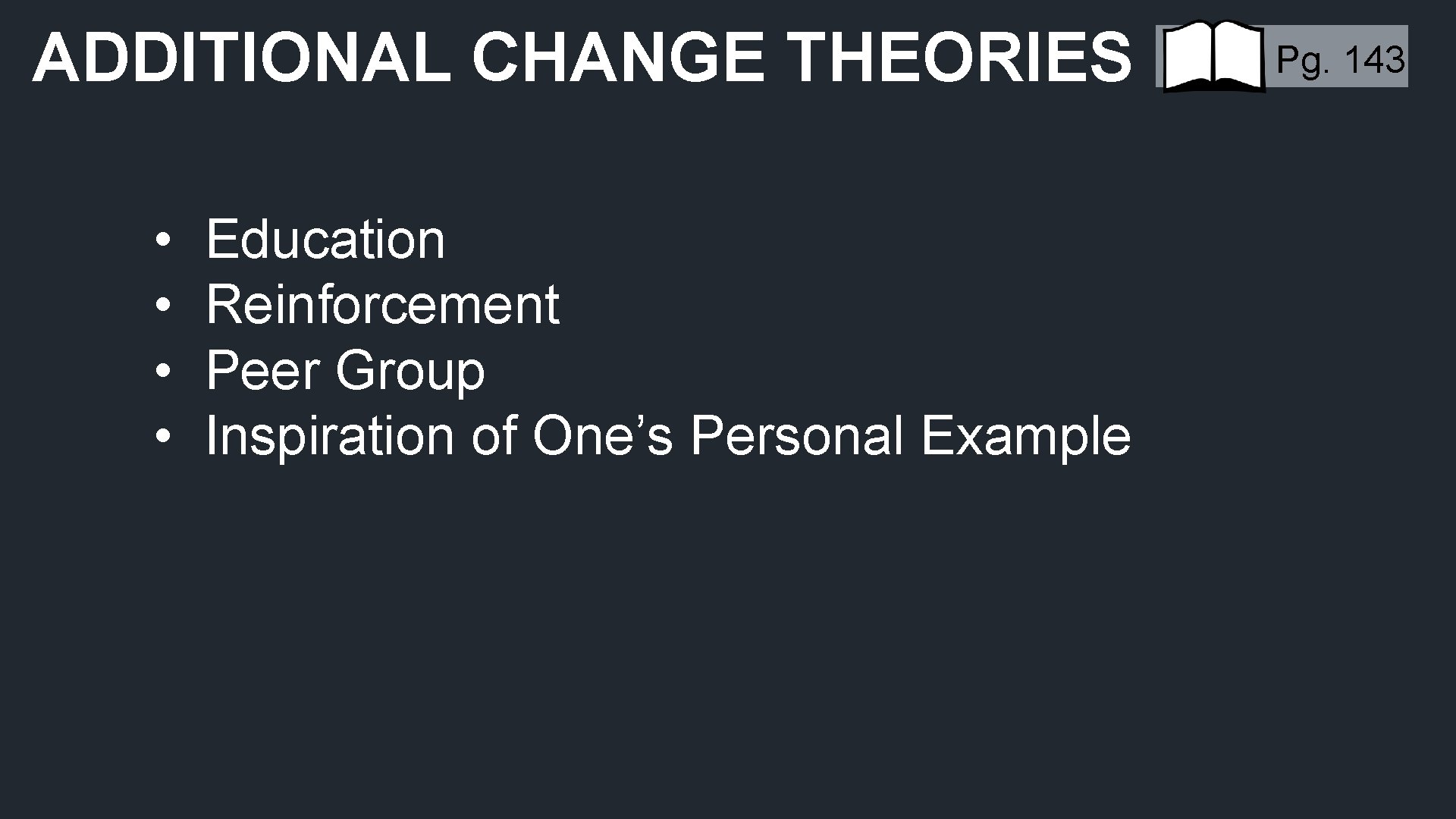
ADDITIONAL CHANGE THEORIES • • Education Reinforcement Peer Group Inspiration of One’s Personal Example Pg. 143
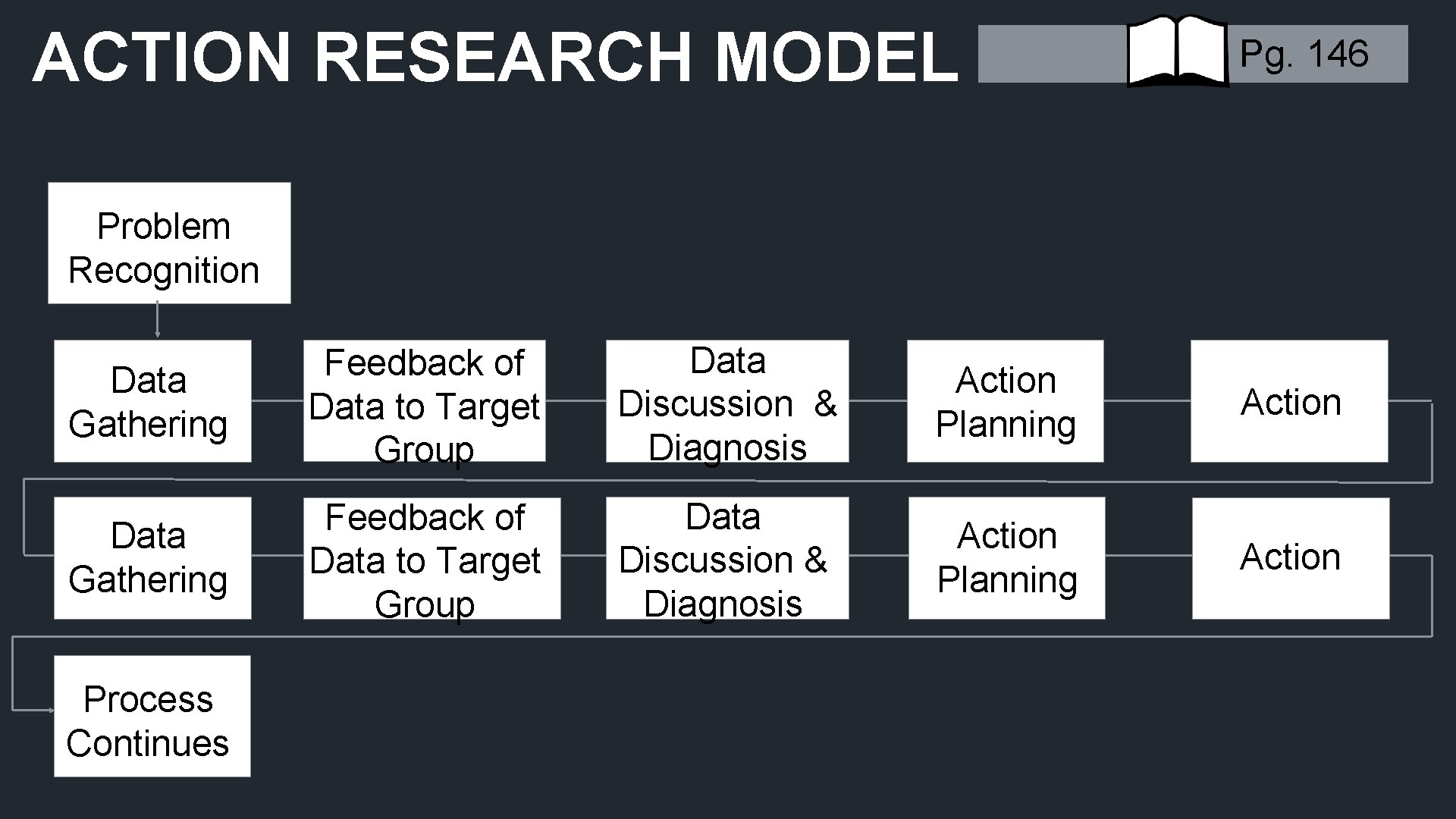
ACTION RESEARCH MODEL Pg. 146 Problem Recognition Data Gathering Feedback of Data to Target Group Data Discussion & Diagnosis Action Planning Action Process Continues
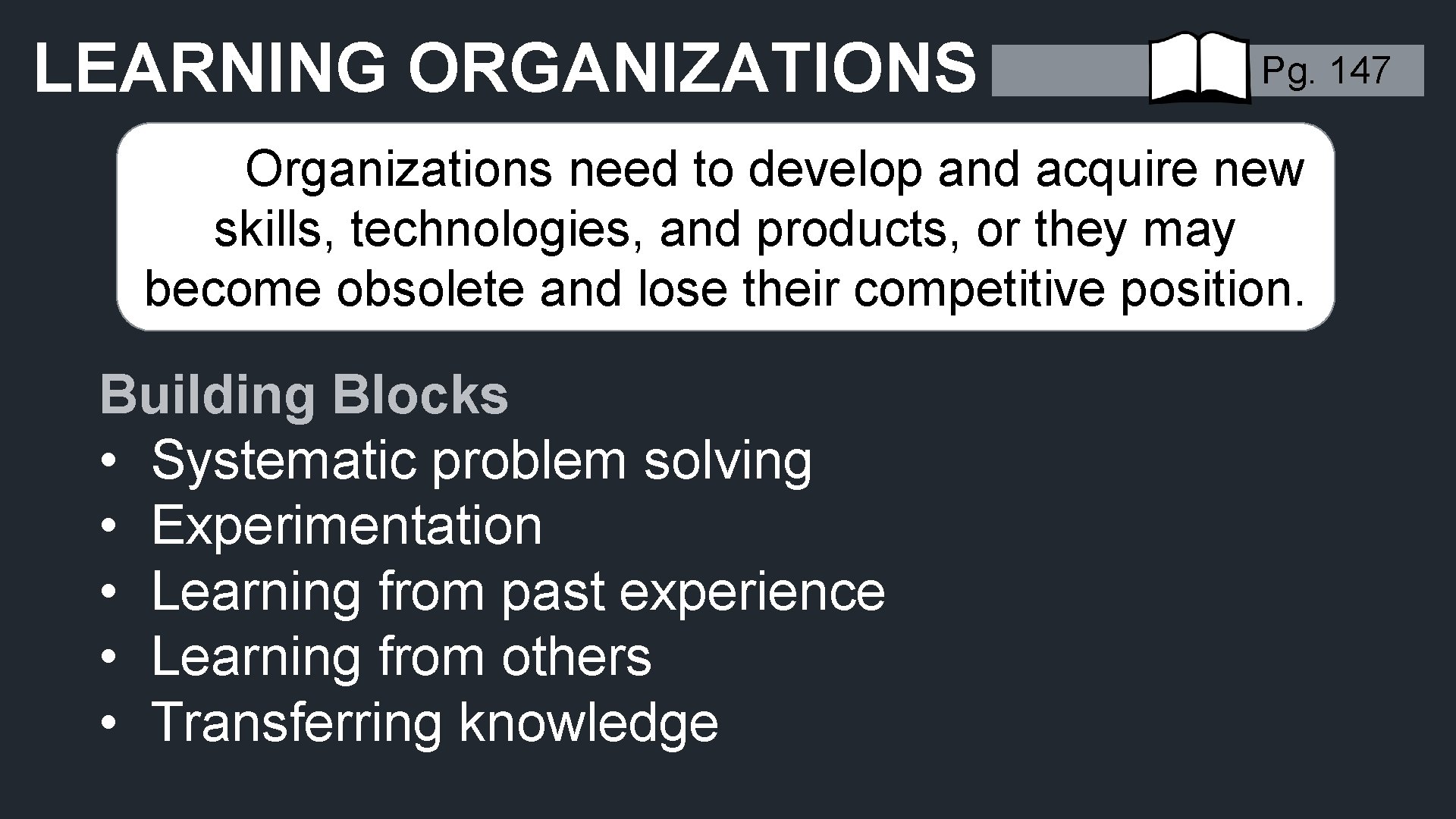
LEARNING ORGANIZATIONS Pg. 147 Organizations need to develop and acquire new skills, technologies, and products, or they may become obsolete and lose their competitive position. Building Blocks • Systematic problem solving • Experimentation • Learning from past experience • Learning from others • Transferring knowledge
KNOWLEDGE CHECK The unique characteristic of a learning organization is that A) The members learn about each other B) It has the capacity to gather new information and use it for improvements C) It focuses on selecting new employees who love learning and are highly skilled D) Employees are rewarded for submitting creative suggestions and participating their implementation

Congratulations, you have completed this section
SECTION 09 Organizational Development Interventions
LESSON OBJECTIVES Classify the four levels of organizational development interventions. Explain through illustration TQM.
OD INTERVENTIONS Pg. 153 An OD intervention is a set of structured activities designed to improve some aspect of organizational functioning.
TARGETS OF INTERVENTIONS Interpersonal Interventions • • • coaching and counseling sensitivity training process consultation Pg. 157
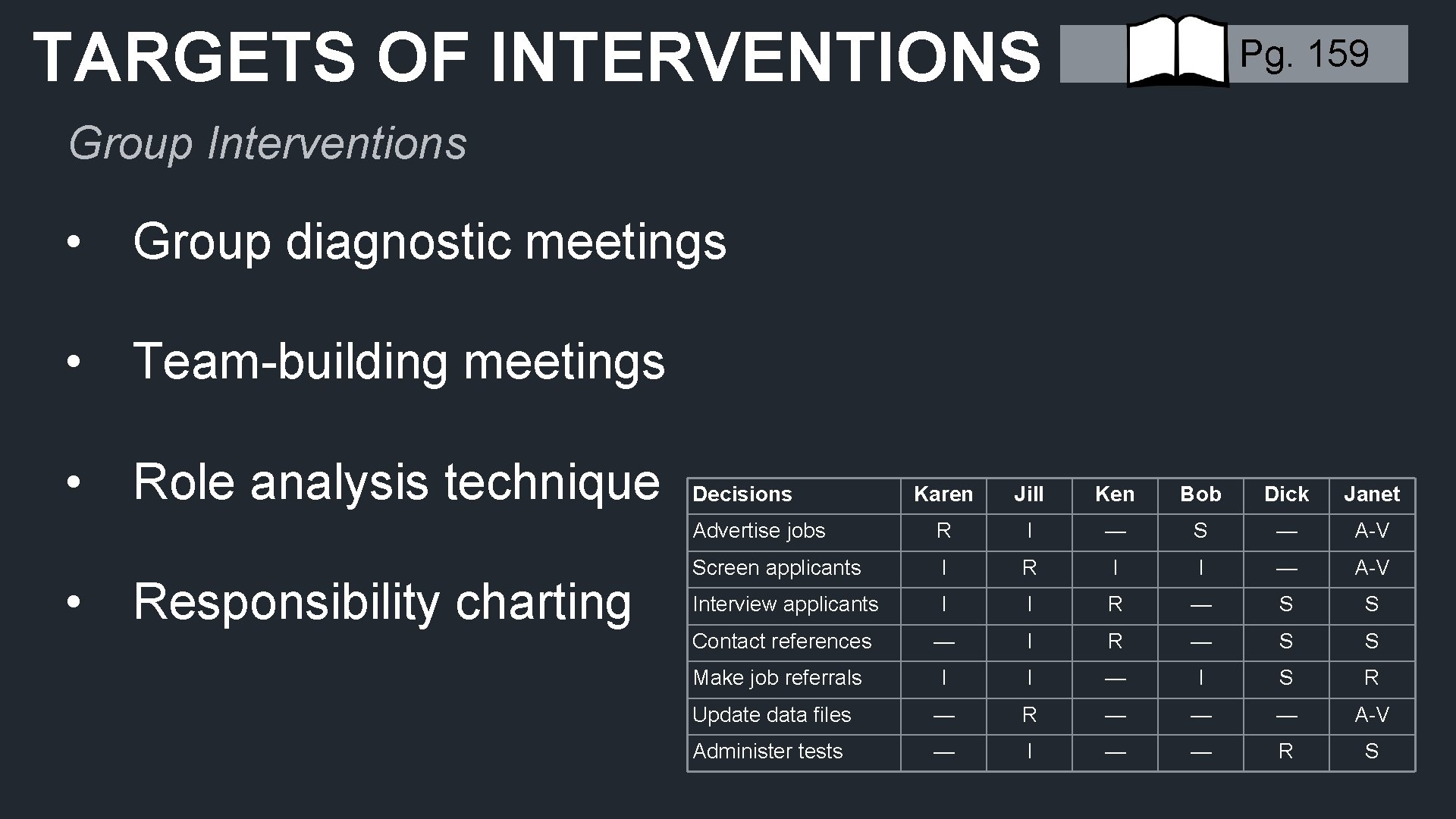
TARGETS OF INTERVENTIONS Pg. 159 Group Interventions • Group diagnostic meetings • Team-building meetings • Role analysis technique • Responsibility charting Decisions Karen Jill Ken Bob Dick Janet Advertise jobs R I — S — A-V Screen applicants I R I I — A-V Interview applicants I I R — S S Contact references — I R — S S Make job referrals I I — I S R Update data files — R — — — A-V Administer tests — I — — R S
TARGETS OF INTERVENTIONS Intergroup Interventions • • Finding a common enemy Joint activities Rotating membership Conflict resolution meetings Pg. 159
TARGETS OF INTERVENTIONS Organizational Interventions • Survey feedback • Knowledge management programs • Structural change • Quality and performance management-TQM Pg. 160
KNOWLEDGE CHECK Which of the following would probably increase rather than decrease the level of conflict between two groups? A) Find a common enemy B) Have them participate in joint social activities C) Exchange members between groups D) Engage in competitive events together
QUALITY & PERFORMANCE MANAGEMENT Pg. 162 The purpose of TQM is to reduce errors to zero and to improve the quality of service. • • • Performance Planning Setting & Communicating Performance Standards Measuring Results & Providing Feedback Implementing Performance Improvement Strategies Evaluating Results
KNOWLEDGE CHECK Which of the following would NOT be one of the steps in a TQM intervention? A) Defining the major functions and services that must be performed. B) Identifying the customer’s requirements and developing quantitative measures to assess them. C) Flow-charting the process that occur within each department. D) Performing a culture audit using an ethnographic study.

Congratulations, you have completed this section
- Slides: 138