Chapter 6 Human Resource Practices 1 Toyota Georgetown

- Slides: 39
Chapter 6 Human Resource Practices 1
Toyota Georgetown • “We’ve got nothing, technology-wise, that anyone else can’t have. There’s no secret Toyota Quality Machine out there. The quality machine is the workforce -- the team members on the paint line, the suppliers, the engineers -- everybody who has a hand in production here takes the attitude that we’re making world-class vehicles. ” 2
Key Idea Businesses are learning that to satisfy customers, they must first satisfy employees. 3
Objectives of HRM • To build a high-performance workplace and maintain an environment for quality excellence to enable employees and the organization to achieve strategic objectives and adapt to change. 4
Key Activities in HRM • Determine organization’s HR needs to build a high-performance workplace • Assist in design of work systems • Recruit, select, train & develop, counsel, motivate, and reward employees • Act as liaison with unions & government • Handle other matters of employee well-being 5
Leading Practices (1 of 2) • Design, organize, and manage work and jobs to promote cooperation, initiative, empowerment, innovation, and organizational culture • Promote teamwork and skill sharing across work units and locations • Empower individuals and teams to make decisions that affect quality and customer satisfaction • Develop effective performance management systems, compensation, and reward and recognition approaches 6
Leading Practices (2 of 2) • Effective processes for hiring and career progression • Make extensive investments in training and education • Motivate employees to develop and use their full potential • Maintain a work environment conducive to the well-being and growth of all employees • Monitor extent and effectiveness of HR practices and measure employee satisfaction 7
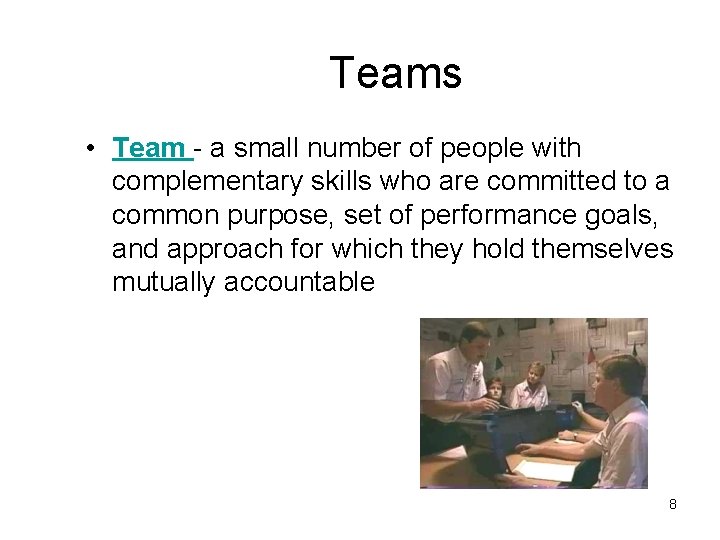
Teams • Team - a small number of people with complementary skills who are committed to a common purpose, set of performance goals, and approach for which they hold themselves mutually accountable 8
Types of Teams • • Management teams Natural work teams Self managed teams Virtual teams Quality circles Problem solving teams Project teams 9
Key Idea The three basic functions of quality circles and problem-solving teams are to identify, analyze, and solve quality and productivity problems. 10
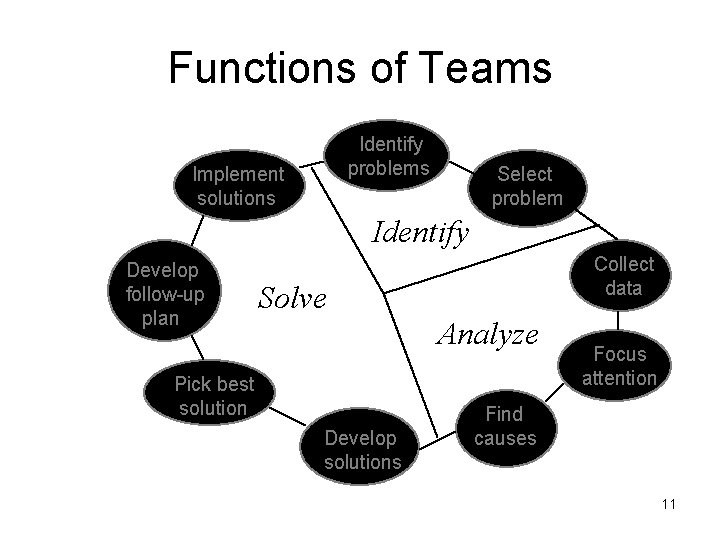
Functions of Teams Identify problems Implement solutions Select problem Identify Develop follow-up plan Collect data Solve Analyze Pick best solution Develop solutions Focus attention Find causes 11
Key Idea The key stages of a team’s life cycle are called forming, storming, norming, performing, and adjourning. 12
Ingredients for Successful Teams (1 of 2 ) • • • Clarity in team goals Improvement plan Clearly defined roles Clear communication Beneficial team behaviors 13
Ingredients for Successful Teams (2 of 2) • • • Well-defined decision procedures Balanced participation Established ground rules Awareness of group process Use of scientific approach 14
Six Sigma Project Teams • Champions – senior managers who promote Six Sigma • Master Black Belts – highly trained experts responsible for strategy, training, mentoring, deployment, and results. • Black Belts – Experts who perform technical analyses • Green Belts – functional employees trained in introductory Six Sigma tools • Team Members – Employees who support specific projects 15
Key Idea High-performance work refers to work approaches used to systematically pursue ever-higher levels of overall organizational and human performance. 16
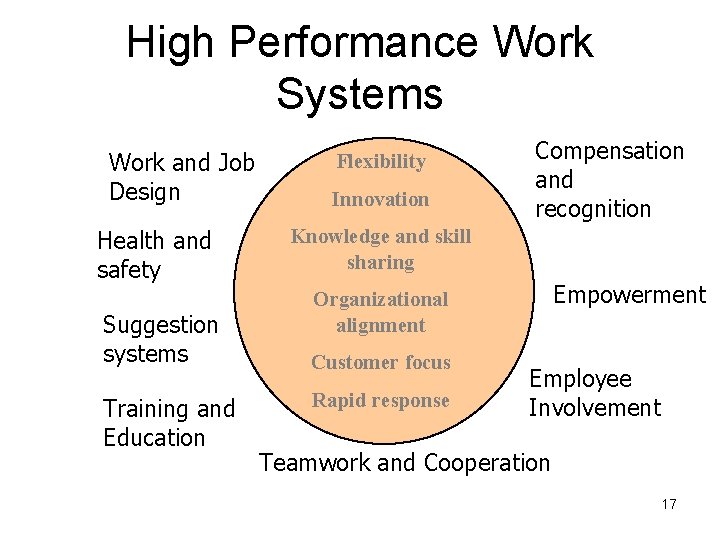
High Performance Work Systems Work and Job Design Health and safety Suggestion systems Training and Education Flexibility Innovation Compensation and recognition Knowledge and skill sharing Empowerment Organizational alignment Customer focus Rapid response Employee Involvement Teamwork and Cooperation 17
Designing High Performance Work Systems • Work design - how employees are organized in formal and informal units (departments, teams, etc. ) • Job design - responsibilities and tasks assigned to individuals 18
Key Idea The design of work should provide individuals with both the intrinsic and extrinsic motivation to achieve quality and operational performance objectives. 19
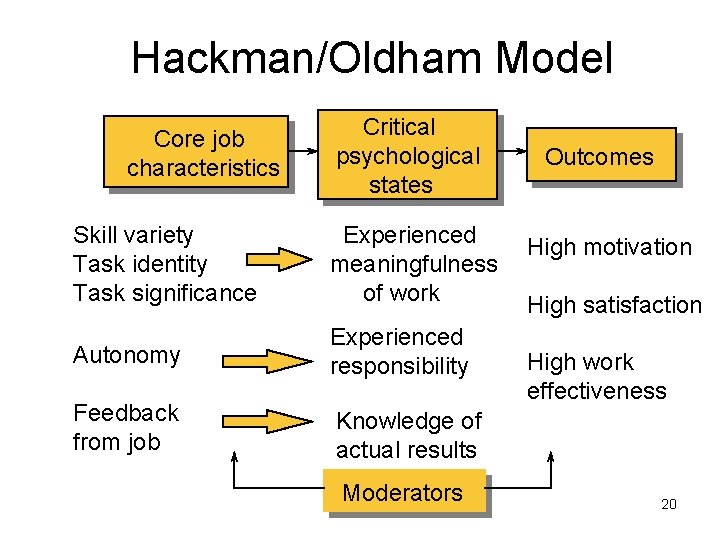
Hackman/Oldham Model Core job characteristics Critical psychological states Skill variety Task identity Task significance Experienced meaningfulness of work Autonomy Experienced responsibility Feedback from job Knowledge of actual results Moderators Outcomes High motivation High satisfaction High work effectiveness 20
Enhancing Work Design • Job enlargement – expanding workers’ jobs • Job rotation – having workers learn several tasks and rotate among them • Job enrichment – granting more authority, responsibility, and autonomy 21
Employee Involvement • Employee Involvement - any activity by which employees participate in work-related decisions and improvement activities, with the objectives of tapping the creative energies of all employees and improving their motivation 22
Key Idea EI approaches can range from simple sharing of information or providing input on work-related issues and making suggestions to self-directed responsibilities such as setting goals, making business decisions, and solving problems, often in cross-functional teams. 23
Advantages of EI • Replaces adversarial mentality with trust and cooperation • Develops skills and leadership abilities • Increases morale and commitment • Fosters creativity and innovation • Helps people understand quality principles and instilling them into the organization’s culture • Allows employees to solve problems at the source • Improves quality and productivity 24
Empowerment • Giving people authority to make decisions based on what they feel is right, to have control over their work, to take risks and learn from mistakes, and to promote change. “A sincere belief and trust in people. ” 25
Successful Empowerment • Provide education, resources, and encouragement • Remove restrictive policies/procedures • Foster an atmosphere of trust • Share information freely • Make work valuable • Train managers in “hands-off” leadership • Train employees in allowed latitude 26
Key Idea Meeting and exceeding customer expectations begins with hiring the right people whose skills and attitudes will support and enhance the organization’s objectives. 27
Training and Education • • Quality awareness Leadership Project management Communications Teamwork Problem solving Interpreting and using data • Meeting customer requirements • Process analysis • Process simplification • Waste reduction • Cycle time reduction • Error proofing 28
Key Idea Customer needs and strategic directions should drive training strategies. 29
Compensation and Recognition • Compensation – Merit versus capability/performance based plans – Gainsharing • Recognition – Monetary or non-monetary – Formal or informal – Individual or group 30
Key Idea Recognition provides a visible means of promoting quality efforts and telling employees that the organization values their efforts, which stimulates their motivation to improve. 31
Effective Recognition and Reward Strategies • • Give both individual and team awards Involve everyone Tie rewards to quality Allow peers and customers to nominate and recognize superior performance • Publicize extensively • Make recognition fun 32
Motivation • Motivation - an individual’s response to a felt need • Theories – Content Theories (Maslow; Mac. Gregor; Herzberg) – Process Theories (Vroom; Porter & Lawler) – Environmentally-based Theories (Skinner; Adams; Bandura, Snyder, & Williams) 33
Key Idea There is no such thing as an unmotivated employee, but the system within which people work can either seriously impede motivation or enhance it. 34
Performance Appraisal • How you are measured is how you perform! • Conventional appraisal systems – Focus on short-term results and individual behavior; fail to deal with uncontrollable factors • New approaches – Focus on company goals such as quality and behaviors like teamwork – 360 -degree feedback; mastery descriptions 35
Key Idea Performance appraisals are most effective when they are based on the objectives that support the strategic directions of the organization, best practices, and continuous improvement. 36
Measuring Employee Satisfaction and Effectiveness • Satisfaction – Quality of worklife, teamwork, communications, training, leadership, compensation, benefits, internal suppliers and customers • Effectiveness – Team and individual behaviors; cost, quality, and productivity improvements; employee turnover; suggestions; training effectiveness 37
Key Idea HR measures allow companies to predict customer satisfaction, identify those issues that have the greatest impact on business performance, and allocate appropriate resources. 38
Human Resources in the Baldrige Award Criteria The Human Resource Focus Category examines how an organization’s work systems and employee learning and motivation enable employees to develop and utilize their full potential in alignment with the organization ’s overall objectives and action plans, and how the organization builds and maintains a work environment and an employee support climate conducive to performance excellence and to personal and organizational growth. 5. 1 Work Systems a. Organization and Management of Work b. Employee Performance Management System c. Hiring and Career Progression 5. 2 Employee Learning and Motivation a. Employee Education, Training, and Development b. Motivation and Career Development 5. 3 Employee Well-Being and Satisfaction a. Work Environment 39 b. Employee Support and Satisfaction