Uses of Microarrays in Research Anne Rosenwald Georgetown


- Slides: 26
Uses of Microarrays in Research Anne Rosenwald Georgetown University
Microarrays in Research: A Survey of Pub. Med Schena, Shalon, Davis, and Brown (1995) Science 270, 467 Differential expression of 45 Arabidopsis genes!
Recent Microarray Papers: I. New Techniques/Applications ¡ Transcriptional regulatory networks in Saccharomyces cerevisiae l l Lee et al. (2002) Science 298 799 -804 “Ch. IP-on-chip”
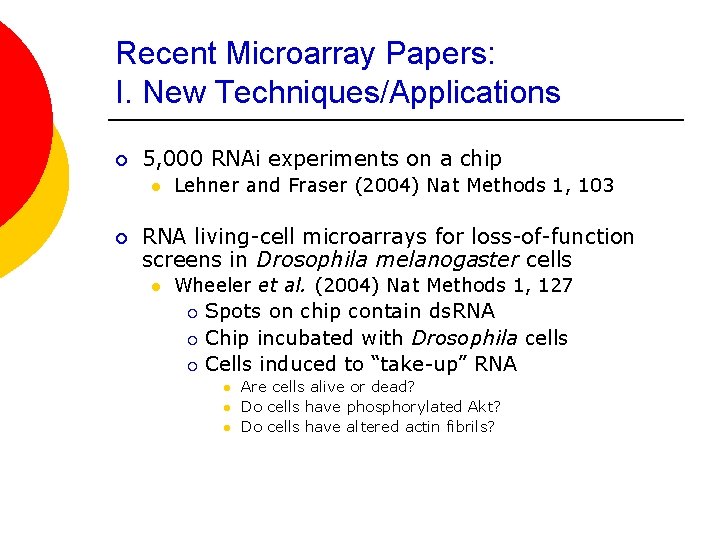
Recent Microarray Papers: I. New Techniques/Applications ¡ 5, 000 RNAi experiments on a chip l ¡ Lehner and Fraser (2004) Nat Methods 1, 103 RNA living-cell microarrays for loss-of-function screens in Drosophila melanogaster cells l Wheeler et al. (2004) Nat Methods 1, 127 Spots on chip contain ds. RNA ¡ Chip incubated with Drosophila cells ¡ Cells induced to “take-up” RNA ¡ l l l Are cells alive or dead? Do cells have phosphorylated Akt? Do cells have altered actin fibrils?
Recent Microarray Papers: II. Improved Methods for Analysis/Access ¡ Reproducibility and statistical rigor l l ¡ outbred organisms (i. e. humans) do different platforms give the same answers? Tools for analysis l l MAGIC Tool! (many others…. )
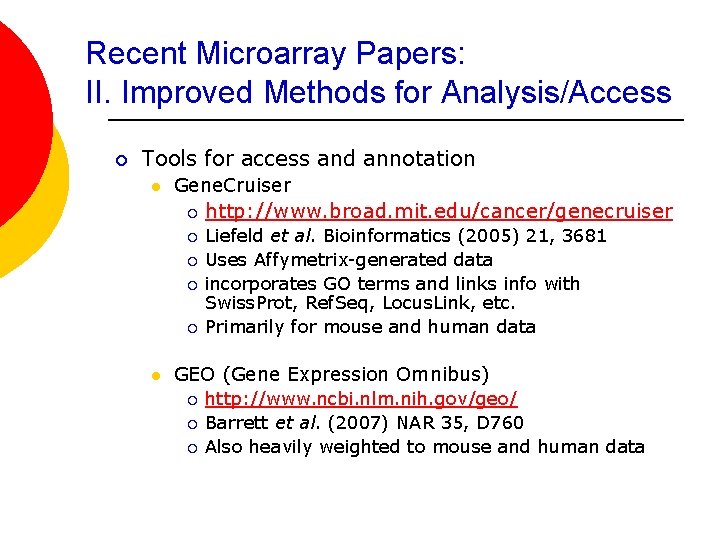
Recent Microarray Papers: II. Improved Methods for Analysis/Access ¡ Tools for access and annotation l Gene. Cruiser ¡ ¡ ¡ l http: //www. broad. mit. edu/cancer/genecruiser Liefeld et al. Bioinformatics (2005) 21, 3681 Uses Affymetrix-generated data incorporates GO terms and links info with Swiss. Prot, Ref. Seq, Locus. Link, etc. Primarily for mouse and human data GEO (Gene Expression Omnibus) ¡ ¡ ¡ http: //www. ncbi. nlm. nih. gov/geo/ Barrett et al. (2007) NAR 35, D 760 Also heavily weighted to mouse and human data
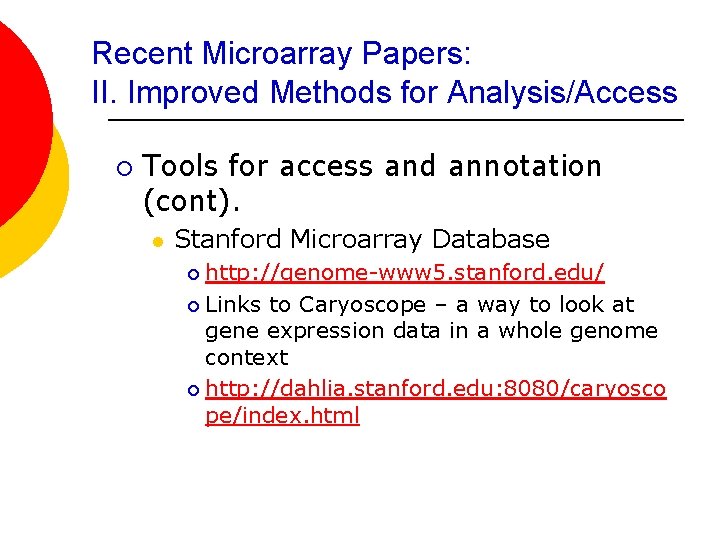
Recent Microarray Papers: II. Improved Methods for Analysis/Access ¡ Tools for access and annotation (cont). l Stanford Microarray Database http: //genome-www 5. stanford. edu/ ¡ Links to Caryoscope – a way to look at gene expression data in a whole genome context ¡ http: //dahlia. stanford. edu: 8080/caryosco pe/index. html ¡
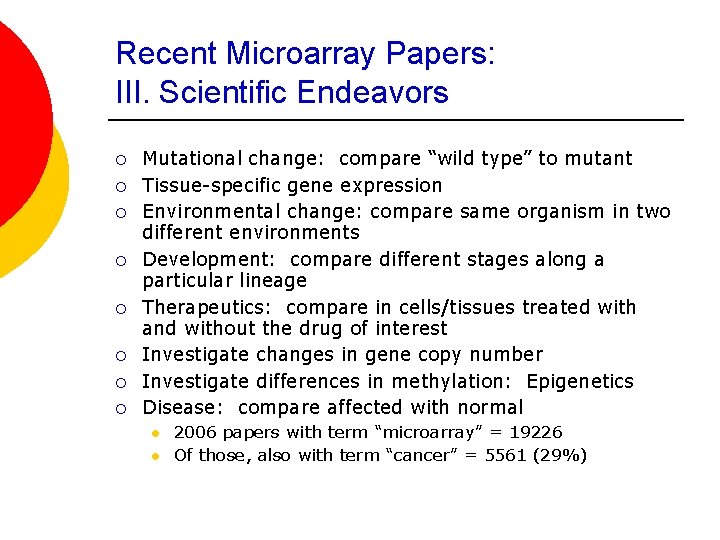
Recent Microarray Papers: III. Scientific Endeavors ¡ ¡ ¡ ¡ Mutational change: compare “wild type” to mutant Tissue-specific gene expression Environmental change: compare same organism in two different environments Development: compare different stages along a particular lineage Therapeutics: compare in cells/tissues treated with and without the drug of interest Investigate changes in gene copy number Investigate differences in methylation: Epigenetics Disease: compare affected with normal l l 2006 papers with term “microarray” = 19226 Of those, also with term “cancer” = 5561 (29%)
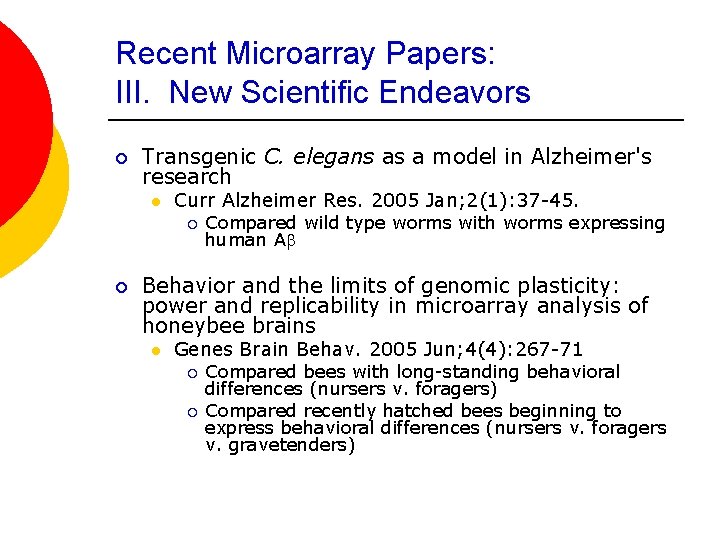
Recent Microarray Papers: III. New Scientific Endeavors ¡ Transgenic C. elegans as a model in Alzheimer's research l Curr Alzheimer Res. 2005 Jan; 2(1): 37 -45. ¡ ¡ Compared wild type worms with worms expressing human Ab Behavior and the limits of genomic plasticity: power and replicability in microarray analysis of honeybee brains l Genes Brain Behav. 2005 Jun; 4(4): 267 -71 ¡ ¡ Compared bees with long-standing behavioral differences (nursers v. foragers) Compared recently hatched bees beginning to express behavioral differences (nursers v. foragers v. gravetenders)
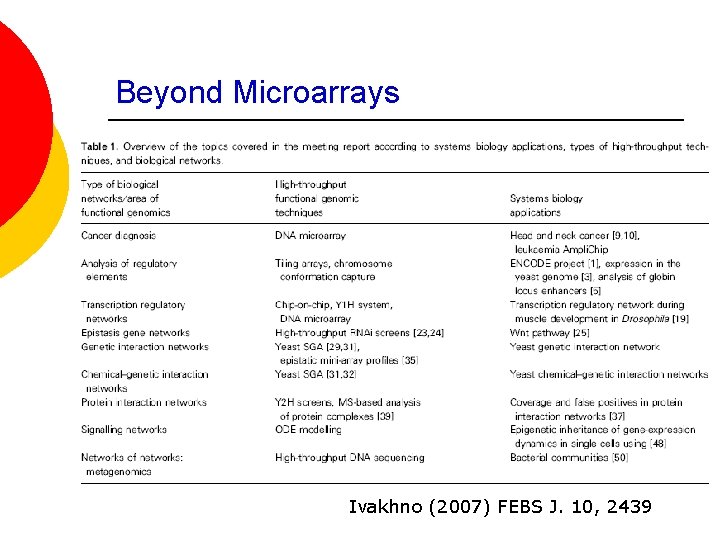
Beyond Microarrays Ivakhno (2007) FEBS J. 10, 2439
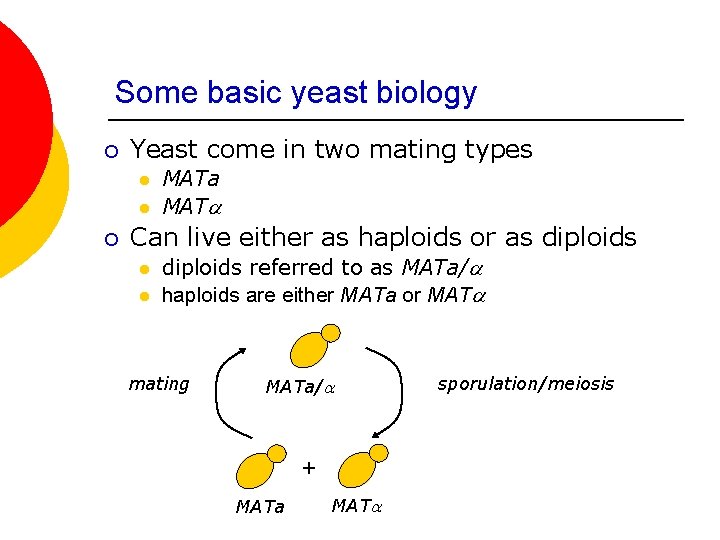
Some basic yeast biology ¡ Yeast come in two mating types l l ¡ MATa Can live either as haploids or as diploids l l diploids referred to as MATa/a haploids are either MATa or MATa mating MATa/a + MATa sporulation/meiosis
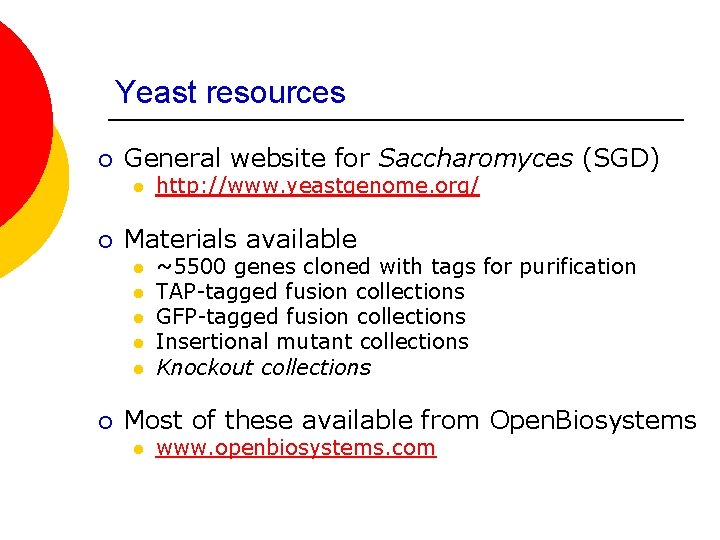
Yeast resources ¡ General website for Saccharomyces (SGD) l ¡ Materials available l l l ¡ http: //www. yeastgenome. org/ ~5500 genes cloned with tags for purification TAP-tagged fusion collections GFP-tagged fusion collections Insertional mutant collections Knockout collections Most of these available from Open. Biosystems l www. openbiosystems. com
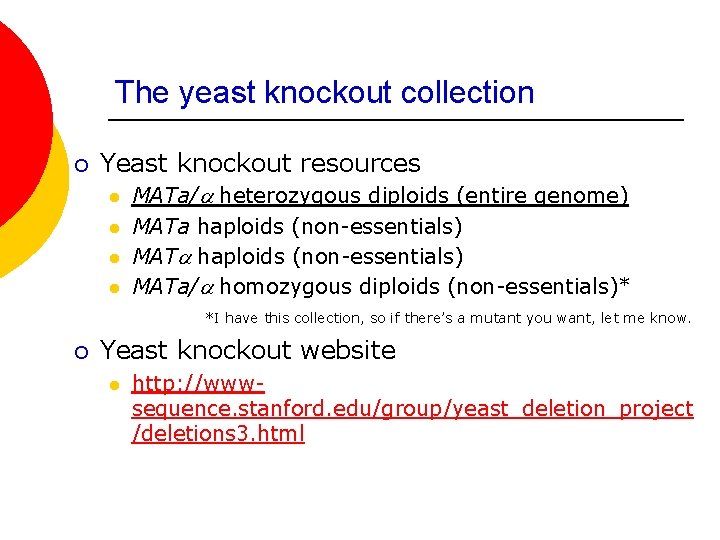
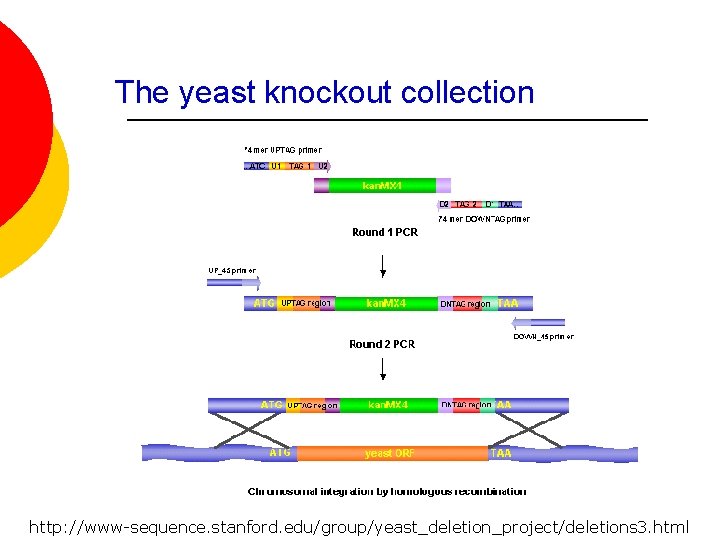
The yeast knockout collection ¡ Yeast knockout resources l l MATa/a heterozygous diploids (entire genome) MATa haploids (non-essentials) MATa/a homozygous diploids (non-essentials)* *I have this collection, so if there’s a mutant you want, let me know. ¡ Yeast knockout website l http: //wwwsequence. stanford. edu/group/yeast_deletion_project /deletions 3. html
The yeast knockout collection http: //www-sequence. stanford. edu/group/yeast_deletion_project/deletions 3. html
Using the knockouts for microarrays ¡ A Robust Toolkit for Functional Profiling of the Yeast Genome l ¡ Takes advantage of the MATa/a heterozygous diploid collection l ¡ Pan et al. (2004) Mol Cell 16, 487 identifies synthetic lethal interactions via diploid-based synthetic lethality analysis by microarrays (“d. SLAM”) Uses d. SLAM to identify those strains that upon knockout of a query gene, show growth defects l l synthetic lethal (the new double mutant = dead) synthetic fitness (the new double mutant = slow growth)
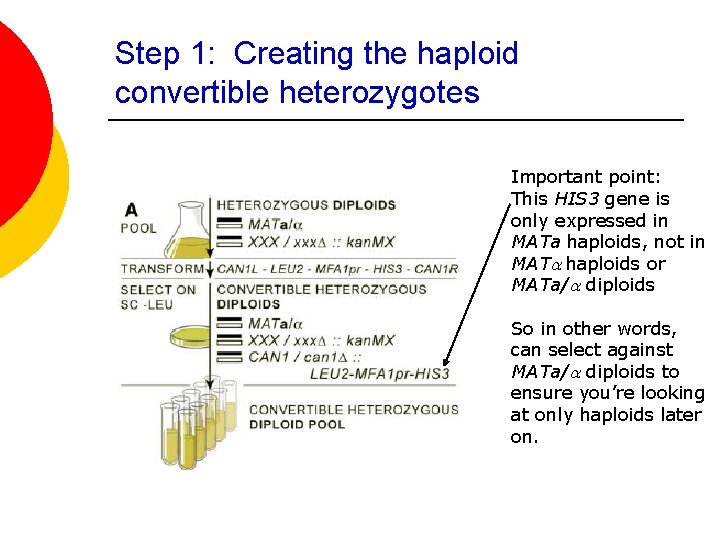
Step 1: Creating the haploid convertible heterozygotes Important point: This HIS 3 gene is only expressed in MATa haploids, not in MATa haploids or MATa/a diploids So in other words, can select against MATa/a diploids to ensure you’re looking at only haploids later on.
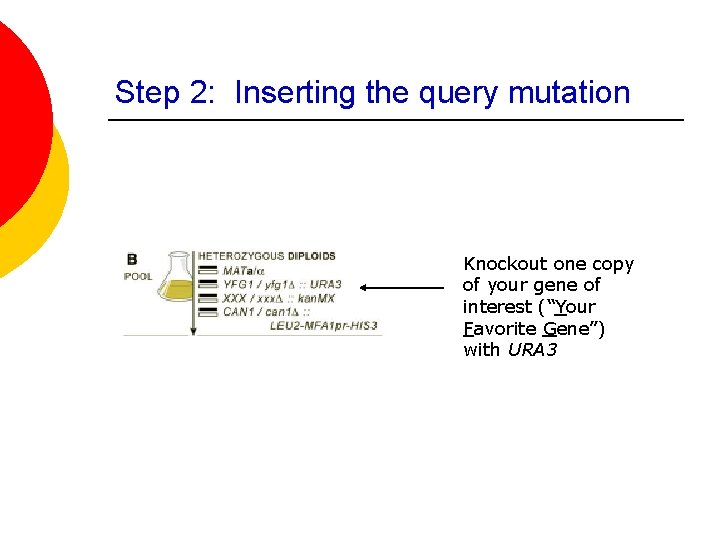
Step 2: Inserting the query mutation Knockout one copy of your gene of interest (“Your Favorite Gene”) with URA 3
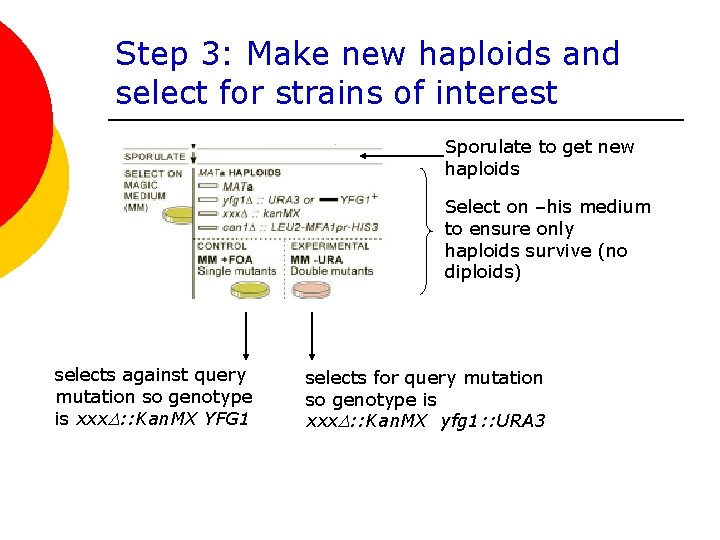
Step 3: Make new haploids and select for strains of interest Sporulate to get new haploids Select on –his medium to ensure only haploids survive (no diploids) selects against query mutation so genotype is xxx. D: : Kan. MX YFG 1 selects for query mutation so genotype is xxx. D: : Kan. MX yfg 1: : URA 3
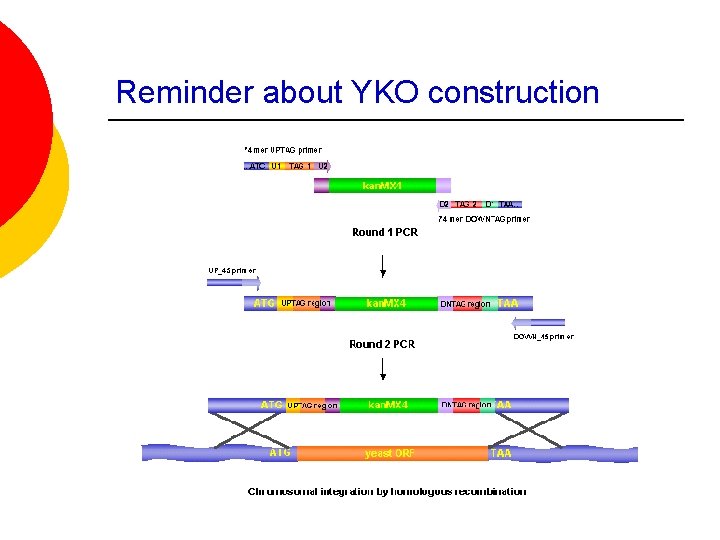
Reminder about YKO construction
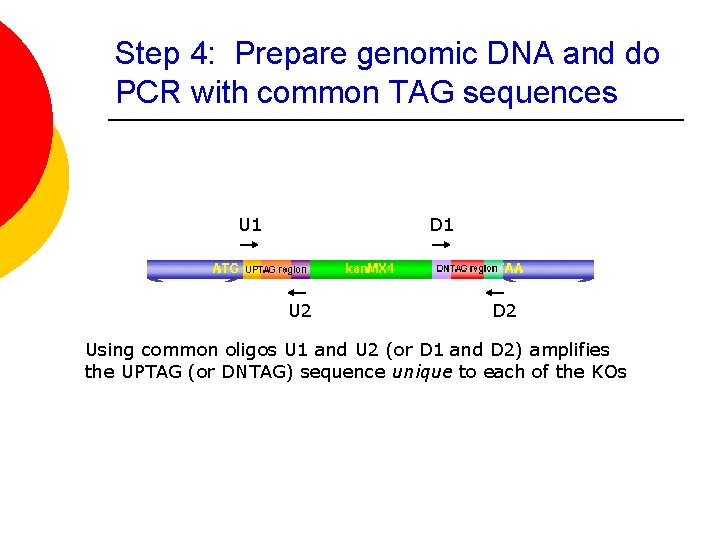
Step 4: Prepare genomic DNA and do PCR with common TAG sequences U 1 D 1 U 2 D 2 Using common oligos U 1 and U 2 (or D 1 and D 2) amplifies the UPTAG (or DNTAG) sequence unique to each of the KOs
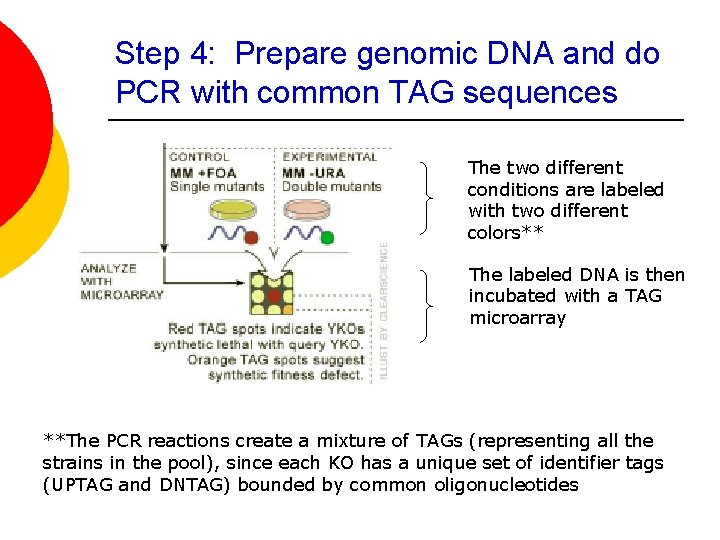
Step 4: Prepare genomic DNA and do PCR with common TAG sequences The two different conditions are labeled with two different colors** The labeled DNA is then incubated with a TAG microarray **The PCR reactions create a mixture of TAGs (representing all the strains in the pool), since each KO has a unique set of identifier tags (UPTAG and DNTAG) bounded by common oligonucleotides
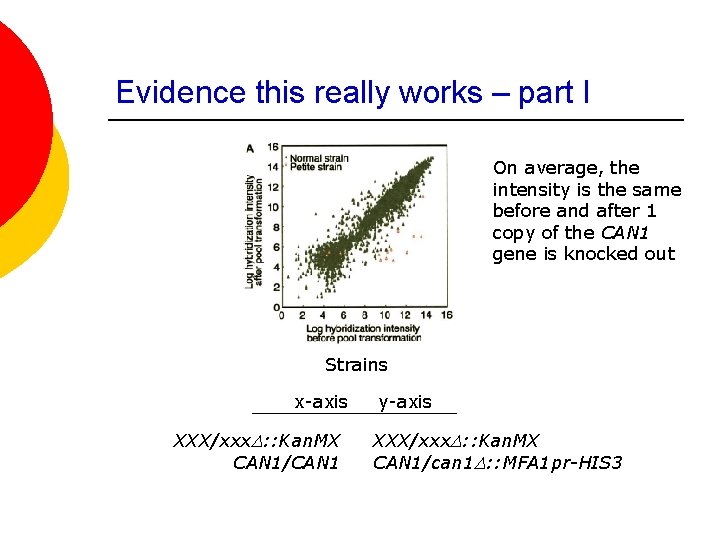
Evidence this really works – part I On average, the intensity is the same before and after 1 copy of the CAN 1 gene is knocked out Strains x-axis XXX/xxx. D: : Kan. MX CAN 1/CAN 1 y-axis XXX/xxx. D: : Kan. MX CAN 1/can 1 D: : MFA 1 pr-HIS 3
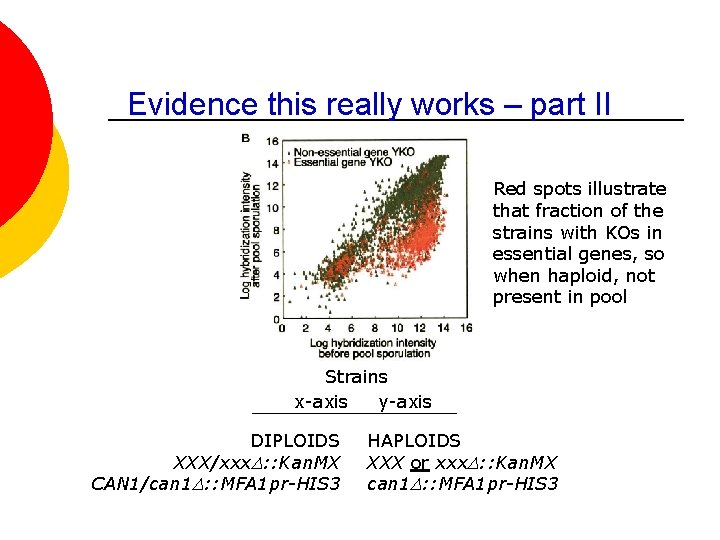
Evidence this really works – part II Red spots illustrate that fraction of the strains with KOs in essential genes, so when haploid, not present in pool Strains x-axis y-axis DIPLOIDS XXX/xxx. D: : Kan. MX CAN 1/can 1 D: : MFA 1 pr-HIS 3 HAPLOIDS XXX or xxx. D: : Kan. MX can 1 D: : MFA 1 pr-HIS 3
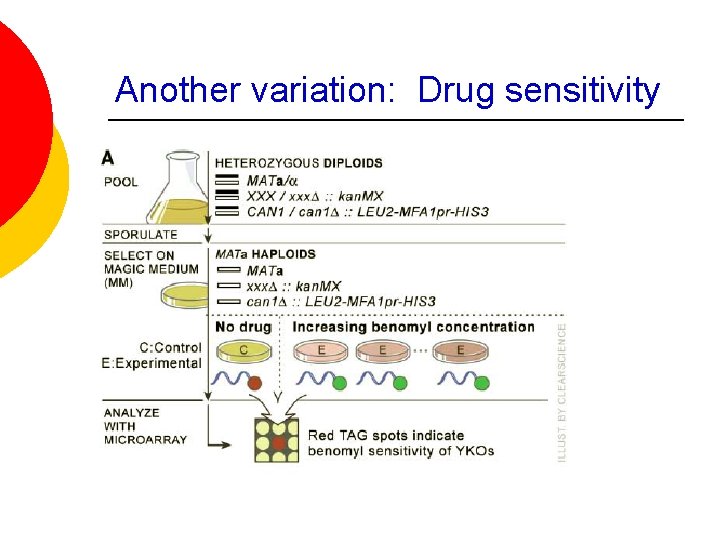
Another variation: Drug sensitivity
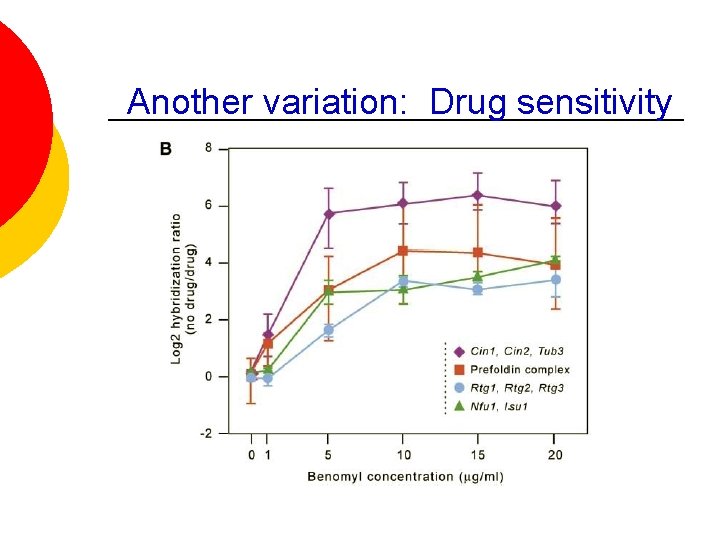
Another variation: Drug sensitivity
Summary ¡ If you can compare two different conditions and you have a way to stick things to slides, some sort of microarray is possible!