Apple Computers Avimanyu Datta Doctoral candidate College of

- Slides: 42
Apple Computers Avimanyu Datta, Doctoral candidate, College of Business, Washington State University
Timeline of the Apple Computers (History, Present, & Future) � History of the Apple Computer. � From the beginning which was in 1976 through the present 2007. � Prediction of the near future and new Apple Computer products to be released.
The Beginning “ 1976” � Steven Paul Jobs, Stephen Gary Wozniak and Ronald Gerald Wayne founded Apple Computer. � In 1976, Ronald Wayne resigned from Apple Computer with only a one time payment of $80. � Hewlett Packard grants Gary Wozniak the permission to create the Apple I.
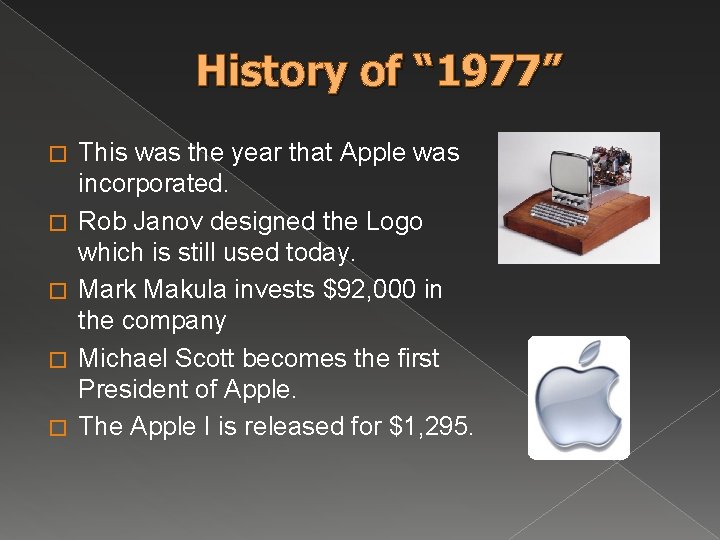
History of “ 1977” � � � This was the year that Apple was incorporated. Rob Janov designed the Logo which is still used today. Mark Makula invests $92, 000 in the company Michael Scott becomes the first President of Apple. The Apple I is released for $1, 295.
History of “ 1978” � Apple and Xerox sign an invest agreement. � Xerox invest one million dollars in Apple stocks. � Apple engineers were allowed to study Xerox’s PARC’s graphical user interface. � The PARC operating system was the 1 st OS for the public market with GUI. � It was commercially unsuccessful.
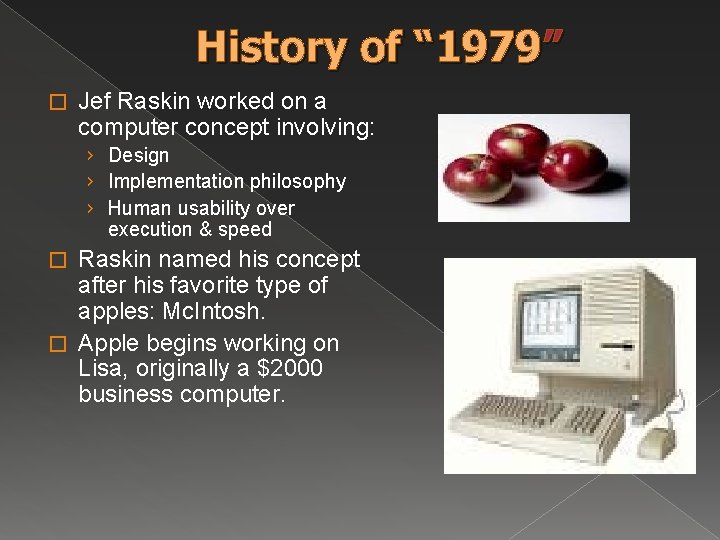
History of “ 1979” � Jef Raskin worked on a computer concept involving: › Design › Implementation philosophy › Human usability over execution & speed Raskin named his concept after his favorite type of apples: Mc. Intosh. � Apple begins working on Lisa, originally a $2000 business computer. �
History of “ 1980” � Apple goes public. � Stocks’ value increases by 1700%. � The new Apple is released. � Apple sold it for $4340 to $7800 depending on the configuration.
History of “ 1981 -1982” Steve Wozniak is injured in a plane & takes time off from Apple and does not return to the Macintosh project. � Michael Scott resigns as president of Apple. � Mike Markkula succeeds Scott. � The Lisa’s development is officially finished. � Apple Computer, Inc. & Apple Corps (recording company of the Beatles) enter a secret agreement. �
History of “ 1983 – 1984” � The Lisa is released. � Apple becomes the fastest growing company in history. � John Sculley, former president of Pepsi Co. , becomes president & CEO of Apple Computer, Inc. � The Macintosh is released-retailing for $2495.
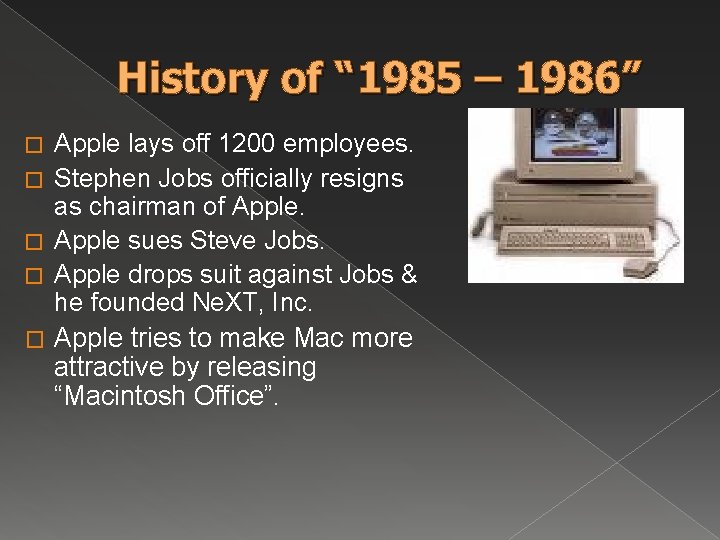
History of “ 1985 – 1986” � � � Apple lays off 1200 employees. Stephen Jobs officially resigns as chairman of Apple sues Steve Jobs. Apple drops suit against Jobs & he founded Ne. XT, Inc. Apple tries to make Mac more attractive by releasing “Macintosh Office”.
History of “ 1987 – 1988” � Apple’s 10 th Anniversary. � The Mac SE & the Mac II are introduced. � Apple sues Microsoft & Hewlett Packard accusing them of violating copyrights of Apple.
History of “ 1989 – 1990” � Apple Corps sues Apple Computer accusing it of violating the terms of the agreement in 1981 by producing synthesized music.
History of “ 1991 – 1992” � IBM, Motorola & Apple form an alliance. › Motorala makes Processors for Apple � Apple Computer, Inc. pays Apple Corps $26. 5 million. � The lawsuit between the two is settled.
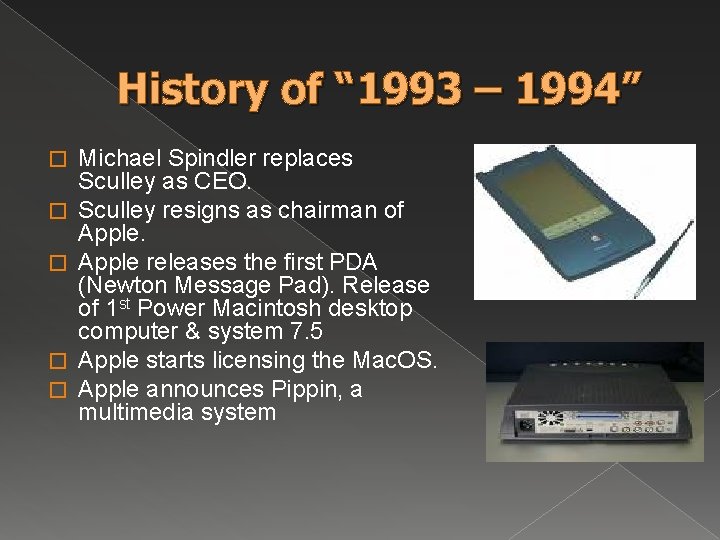
History of “ 1993 – 1994” � � � Michael Spindler replaces Sculley as CEO. Sculley resigns as chairman of Apple releases the first PDA (Newton Message Pad). Release of 1 st Power Macintosh desktop computer & system 7. 5 Apple starts licensing the Mac. OS. Apple announces Pippin, a multimedia system
History of “ 1995 – 1996” Apples’ 20 th Anniversary. � The Power. PC 603 e is announced � � Apple Computer, Inc. takes over Ne. XT Computer, Inc. for $430 million.
History of “ 1997 – 1998” � Jobs returns to Apple due to the Ne. XT Computer, Inc. � Apple starts buying back all licenses from Mac-clone manufacturers. � The Power Macintosh G 3 & The Apple Store are introduced at “Apple Event”. � The i. Mac becomes the fastest selling PC in history, being reordered over 150, 000 times.
History of “ 1999 – 2000” � Jobs becomes permanent CEO. � Chief sales executive Mitch Mandich steps down.
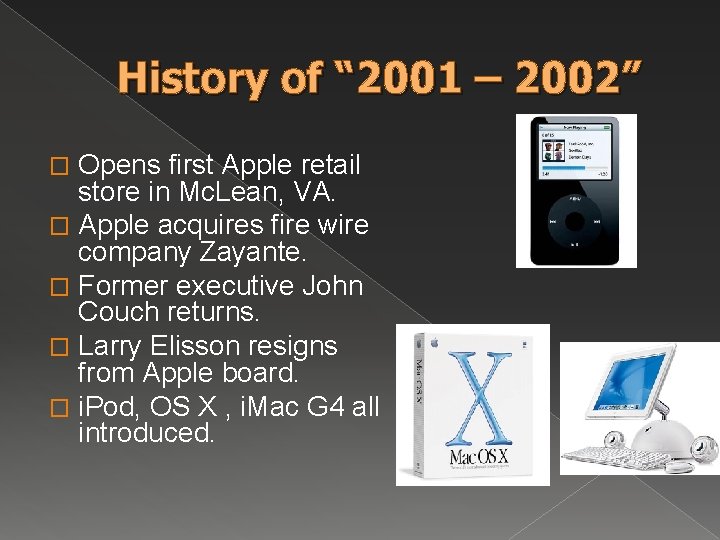
History of “ 2001 – 2002” Opens first Apple retail store in Mc. Lean, VA. � Apple acquires fire wire company Zayante. � Former executive John Couch returns. � Larry Elisson resigns from Apple board. � i. Pod, OS X , i. Mac G 4 all introduced. �
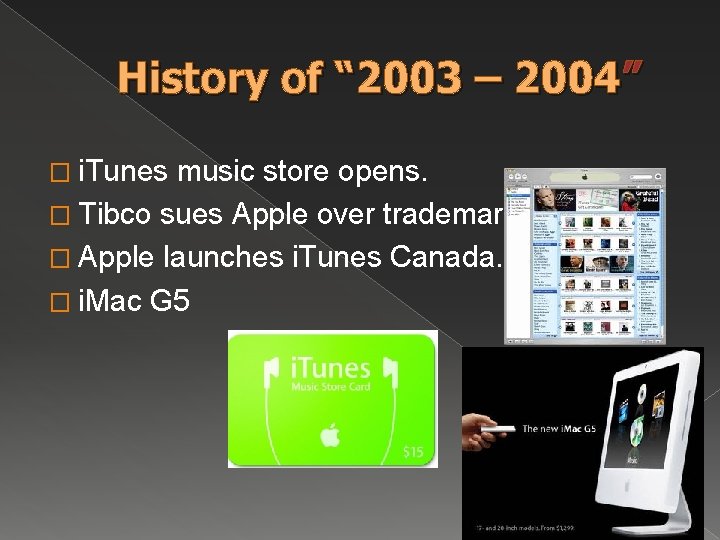
History of “ 2003 – 2004” � i. Tunes music store opens. � Tibco sues Apple over trademark. � Apple launches i. Tunes Canada. � i. Mac G 5
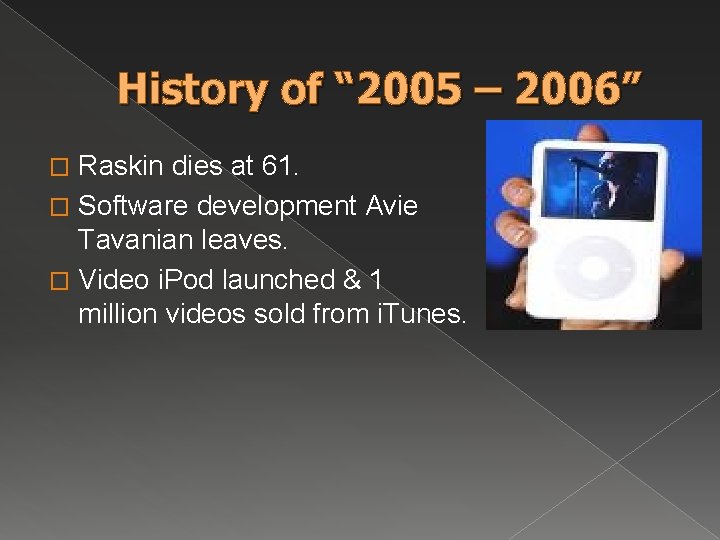
History of “ 2005 – 2006” Raskin dies at 61. � Software development Avie Tavanian leaves. � Video i. Pod launched & 1 million videos sold from i. Tunes. �
“ 2007” � January of 2007 Apple dropped “Computer from its corporate name. � Apple employs over 20, 000 permanent & temporary employees currently. � Worldwide annual sales in its fiscal year 2007 (ending September 29, 2007) are US $24. 01 billion.
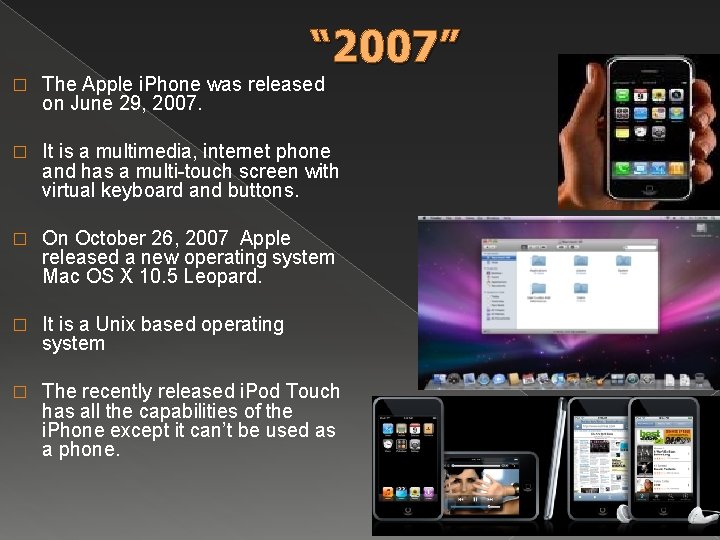
“ 2007” � The Apple i. Phone was released on June 29, 2007. � It is a multimedia, internet phone and has a multi-touch screen with virtual keyboard and buttons. � On October 26, 2007 Apple released a new operating system Mac OS X 10. 5 Leopard. � It is a Unix based operating system � The recently released i. Pod Touch has all the capabilities of the i. Phone except it can’t be used as a phone.
“ 2007” � Google released beta version of Google gadgets for Mac. � Google Gadgets are mini applications similar to Apple's own Dashboard Widgets � Google's Gadgets for Mac are now integrated and installable into Apple's Dashboard in Mac OS X. � This makes them functionally indistinguishable from Dashboard Widgets. � Google Gadgets comes integrated with Google Desktop, a desktop search application also available from Google.
Future Products of Apple Inc. � Rumors are floating around that a new Mac book will be released in early 2008. � The new ultra portable Mac Books are to be aluminum clad, 50% lighter and "strikingly slimmer" to the existing 15" Mac Book. They are also expected to incorporate NAND Flash memory to improve battery life and boot times.
Future Products of Apple Inc. � AT&T Inc. Chief Executive Officer Randall Stephenson confirmed that the 3 G version of the i. Phone would be made available in 2008. � Steve Jobs stated that a 3 G i. Phone is coming, but that the delay is due to excessive battery life consumption with existing 3 G chipsets. � The i. Phone presently uses the EDGE network for its data connectivity.
4 major issues � Historically what are Apple’s Competitive Advantages? � Structure of PC industry � Apple’s Strategy since 1990 � Has Jobs finally solved Apple’s longstanding problems? Is i-pod any different?
Apples Competitive Advantages � � � Ease of Use Traditional strength in Desktop publishing, GUI Buyer Loyalty Proprietary Systems (Supports higher margins, creates barriers to entry and limits direct imitation) Brand Plug and Play (related to ease of use- components and peripherals can be added to a Mackintosh fairly easily as compared to a PC)
PC industry � Sophisticated powerful buyers › › � Buy products in truckloads, Know what they want Wont pay a lot for it Will find some other company to sell at lower price Vicious Rivalry › Open Standards: PCs are commodities , Manufactures compete on price, pushing down margins › Fragmented: No market leader to provide price stability › Rapid technology Obsolesce › Strong buyers with great sophistication › Summary: very tough industry and not attractive
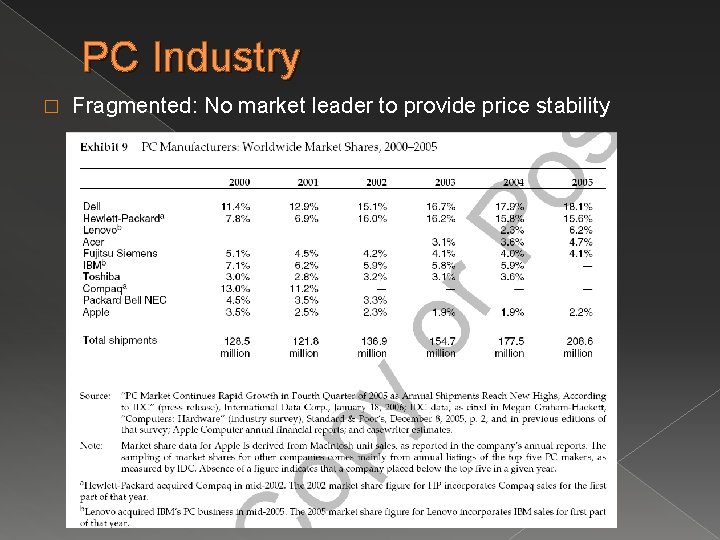
PC Industry � Fragmented: No market leader to provide price stability
PC industry � Low barriers to entry › Technology: One can assemble a PC with a screw driver › Standardized components are available › Plant/ garage: Can be done in a garage › Distribution: Cheap. Over the Web on a classified AD. › Customers: Price sensitive SOHO. Summary: Barriers to Entry are low-Harder to think of another Industry where it is lower.
PC industry � Lots › › of Potential Substitutes PDAs, Smart Phones TV Set-top boxes Video game Consoles. Summary: Existence of Substitutes Push PC prices further down. Average price of the substitutes are $300. � Complements have been fueling demands (only the bright spot)
PC industry � Complements have been fueling demands (only the bright spot) › Customer still pay for PC because of software functionalities that runs on PCS › Software, printers, scanners propel the demand. › Summary Complements are only the bright spot in the industry.
PC industry � Suppliers are appropriating most of Industries residual profits › Suppliers of components such as Disk drives have no power over PC manufacturers. › Intel/ Microsoft: Together Intel and Microsoft earned more than 20 billion in 2005. Net profit from PC industry remained at $6 billion with 3% of sales. › How can two suppliers earn more that the whole customer base? �DOMINANT WIN-TEL ARCHITECTURE �BRAND (Intel Inside. Windows)
PC industry: SUMMARY � Sophisticated powerful buyers � Vicious Rivalry � Lowe barriers to entry � Lots of Potential Substitutes � Complements have been fueling demands (only the bright spot) � Suppliers are appropriating most of Industries residual profits
Apple’ Strategy since 1990: Key Problems PCs and Macs were substitutes. So decline in price of PCs put pressure on Apple’s Prices and Margins. � Macs and PCs have different software complements. Industry was moving toward PC (Wintel). � Software developers were not interested in writing codes for a small Mac market. � Who is the largest software vendor for Mac other than Apple? � › MICROSOFT Win-Win Strategy for them. Even when Mac Sells, Microsoft becomes wealthier.
Apple’ Strategy since 1990: Key Problems � Takes 1$billion to make an OS. � AUP for XP was $45 -$60. Sold 17 million in 8 weeks , thus breakeven in 8 weeks. � Apple cannot have that speed in sales, and they are priced higher. � With these economies it was impossible for Apple to survive. They needed to change.
Apple’ Strategy since 1990: The Sculley Approach � Strategy › High Volume Low price › JV with IBM to develop a new OS. � Logic › Create big installed base › Increase Differentiation › Create a new standard to compete with Wintel and share development cost of new OS � Assessment › IBM could not deliver the higher end performance chips to compete with Wintel. › Customers wanted Intel, so Apple had to re-write its OS top work with Intel. › First two logic were conflicting › Apple and IBM could not leapfrog Microsoft and Intel.
Apple’ Strategy since 1990: The Jobs Approach � Strategy › › � Focus on traditional customer base Design and marketing to get a price premium. Shift to owned retails: Apple Stores. Shift to Intel CPUs. Logic › Re-affirm your commitment to loyal customers and get big premiums for your product. � Assessment › › As of 2006 Jobs did not raise Apple Market Share is declining Key to driving traffic for i-Pod and possible spillovers to Mac Opens Apple for potential windows Users.
The i. Pod Business � Imitation › Apple’s barrier to imitation has been a steady stream of innovations: Video ipod, ipod nano, mini ipod. › Successfully fulfilled all major price points. � Switching Costs › Locks current users with sales from i-tunes. � Cost Leadership › Has long term contracts with leading suppliers of flash memory, which reported to give 40% discount to Apple off list prices.
The i. Pod Business � Hold up › Apple sells i-pods at premium and gives away songs at less than a dollar. › Music companies have pressurized apple to raise prices. › But market share of Apple was able to retaliate. � Substitution (2006 Questions) › Will Mp 3 remain an independent category? › Will PDAs and Cell phones incorporate mp 3 capabilities? › Should Apple enter phone business against NOKIA, Motorola and Samsung?
Broader lessons � Huge difference between product advantage and competitive advantage. � Companies must look broadly at economies and driving forces of their industries. Apple was too insular. � Multiple standard co-exist when there is a huge gap between them. Difference between Mac and Windows diminished and it became hard to justify two standards, when one is clearly cheaper. � Timing and Windows of opportunities.
Questions? Comments