
hoto World Bank Namita Datta Program Manager S
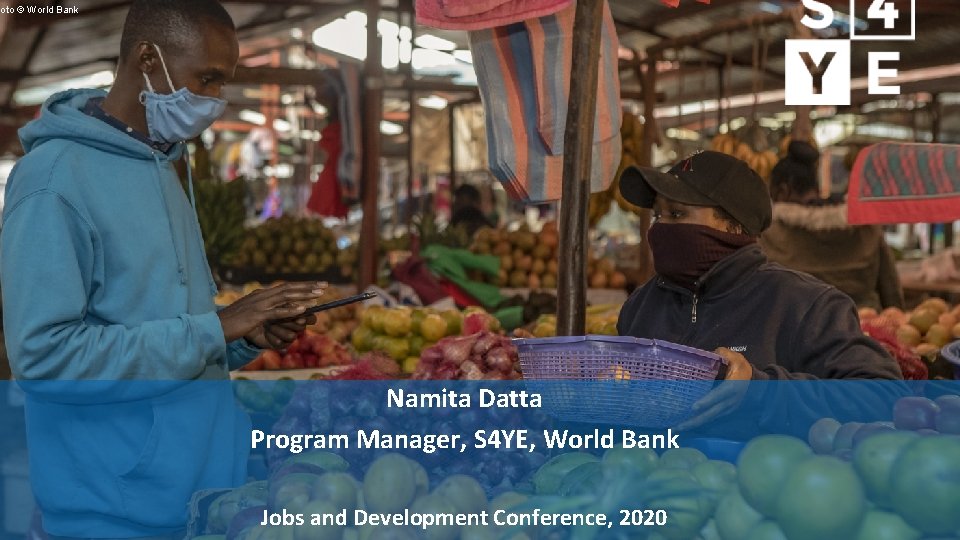
hoto © World Bank Namita Datta Program Manager, S 4 YE, World Bank Jobs and Development Conference, 2020
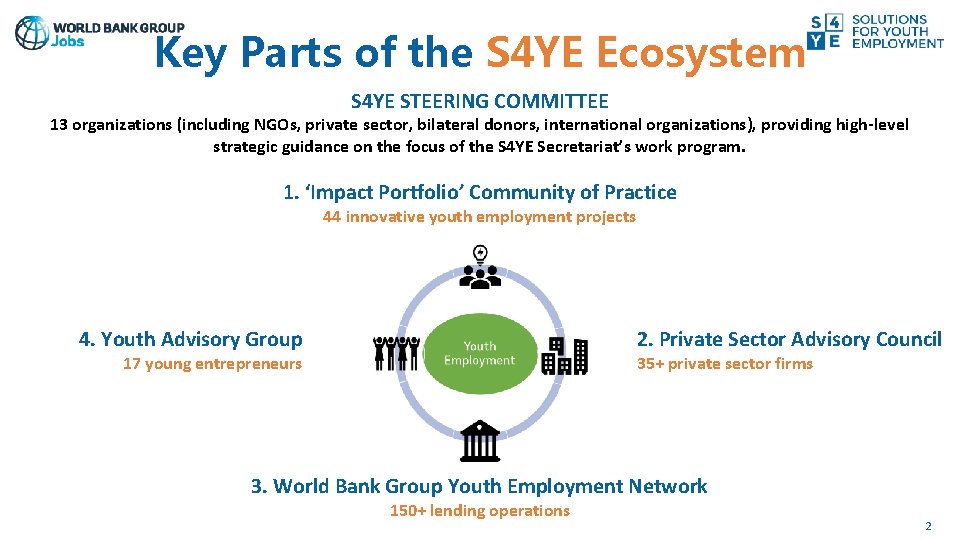
Key Parts of the S 4 YE Ecosystem S 4 YE STEERING COMMITTEE 13 organizations (including NGOs, private sector, bilateral donors, international organizations), providing high-level strategic guidance on the focus of the S 4 YE Secretariat’s work program. 1. ‘Impact Portfolio’ Community of Practice 44 innovative youth employment projects 4. Youth Advisory Group 2. Private Sector Advisory Council 17 young entrepreneurs 35+ private sector firms 3. World Bank Group Youth Employment Network 150+ lending operations 2
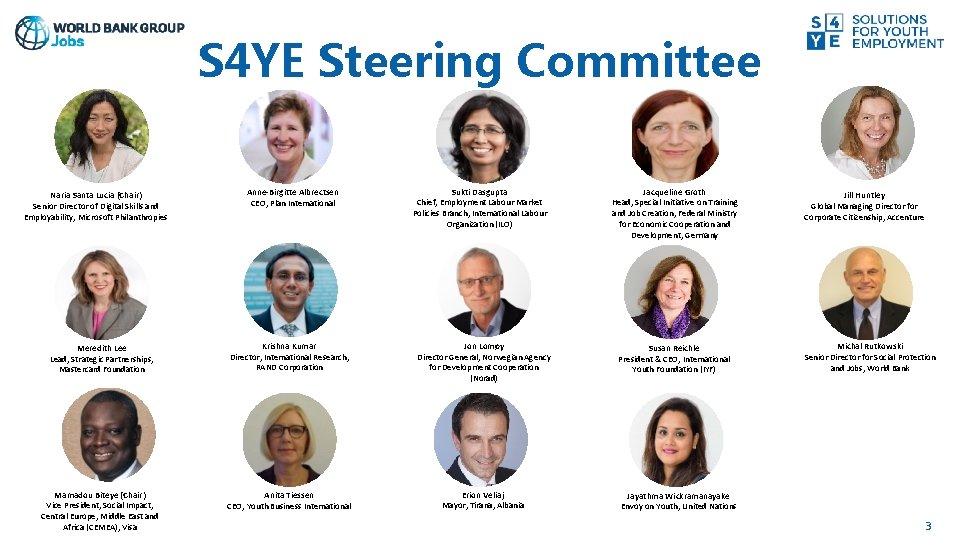
S 4 YE Steering Committee Naria Santa Lucia (Chair) Senior Director of Digital Skills and Employability, Microsoft Philanthropies Anne-Birgitte Albrectsen CEO, Plan International Sukti Dasgupta Chief, Employment Labour Market Policies Branch, International Labour Organization (ILO) Meredith Lee Lead, Strategic Partnerships, Mastercard Foundation Krishna Kumar Director, International Research, RAND Corporation Jon Lomøy Director General, Norwegian Agency for Development Cooperation (Norad) Mamadou Biteye (Chair) Vice President, Social Impact, Central Europe, Middle East and Africa (CEMEA), Visa Anita Tiessen CEO, Youth Business International Erion Veliaj Mayor, Tirana, Albania Jacqueline Groth Head, Special Initiative on Training and Job Creation, Federal Ministry for Economic Cooperation and Development, Germany Susan Reichle President & CEO, International Youth Foundation (IYF) Jill Huntley Global Managing Director for Corporate Citizenship, Accenture Michal Rutkowski Senior Director for Social Protection and Jobs, World Bank Jayathma Wickramanayake Envoy on Youth, United Nations 3
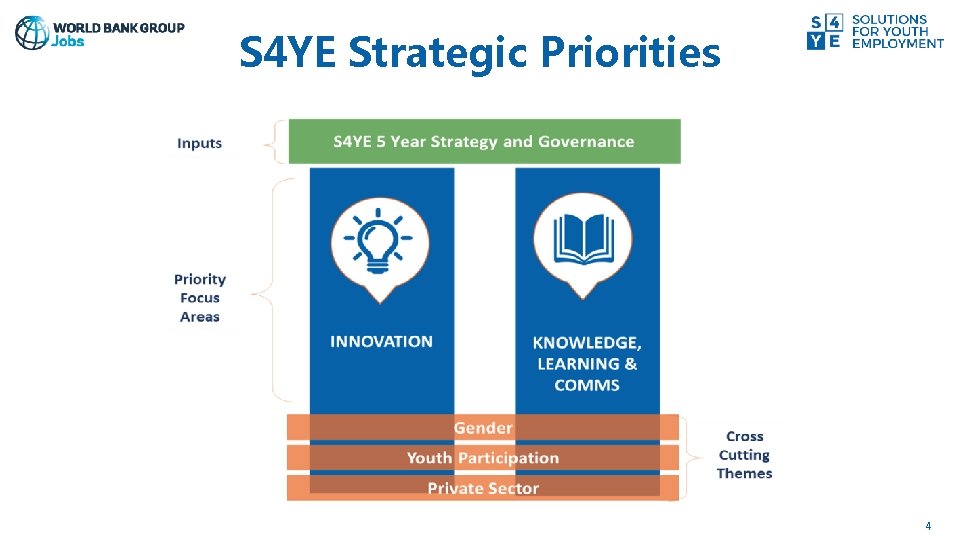
S 4 YE Strategic Priorities 4
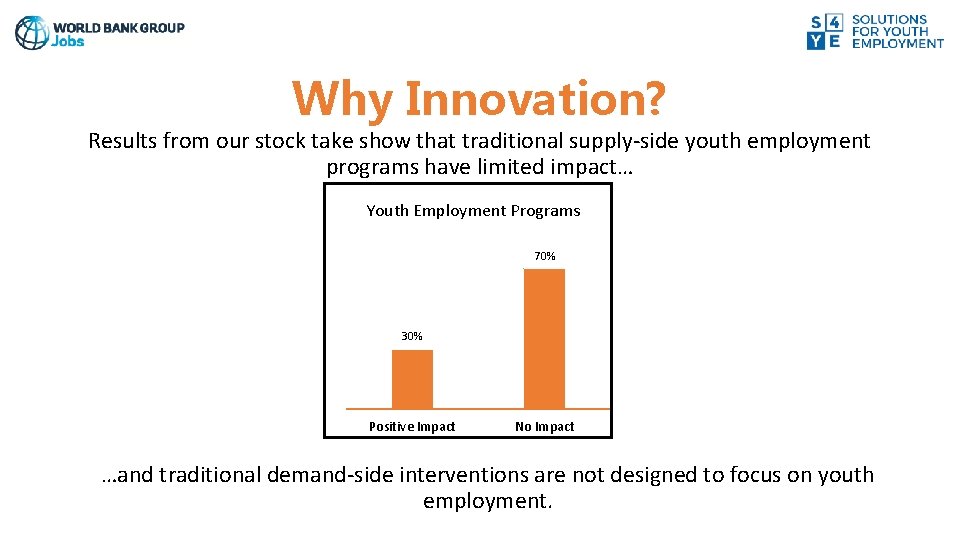
Why Innovation? Results from our stock take show that traditional supply-side youth employment programs have limited impact… Youth Employment Programs 70% 30% Positive Impact No Impact …and traditional demand-side interventions are not designed to focus on youth employment.
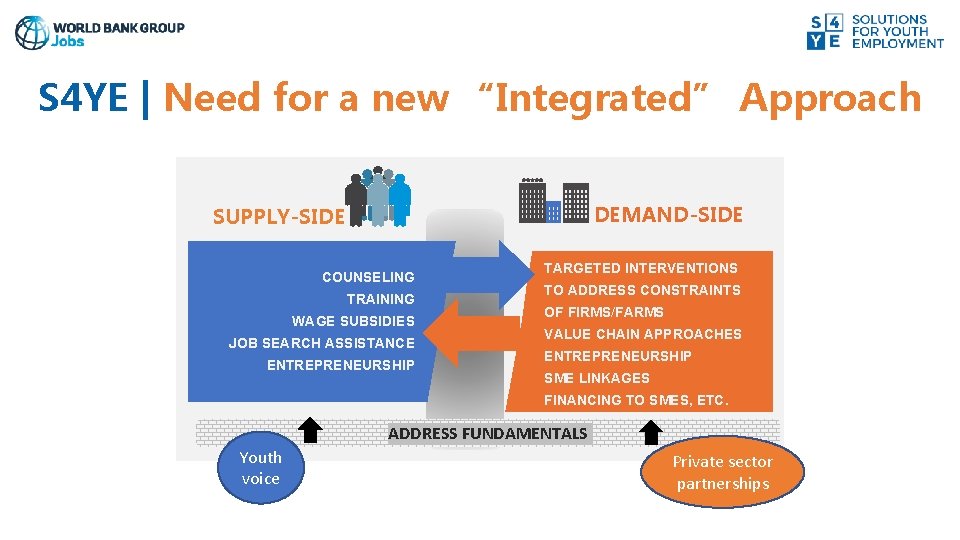
S 4 YE | Need for a new “Integrated” Approach DEMAND-SIDE SUPPLY-SIDE COUNSELING TRAINING WAGE SUBSIDIES JOB SEARCH ASSISTANCE ENTREPRENEURSHIP TARGETED INTERVENTIONS TO ADDRESS CONSTRAINTS OF FIRMS/FARMS VALUE CHAIN APPROACHES ENTREPRENEURSHIP SME LINKAGES FINANCING TO SMES, ETC. ADDRESS FUNDAMENTALS Youth voice Private sector partnerships
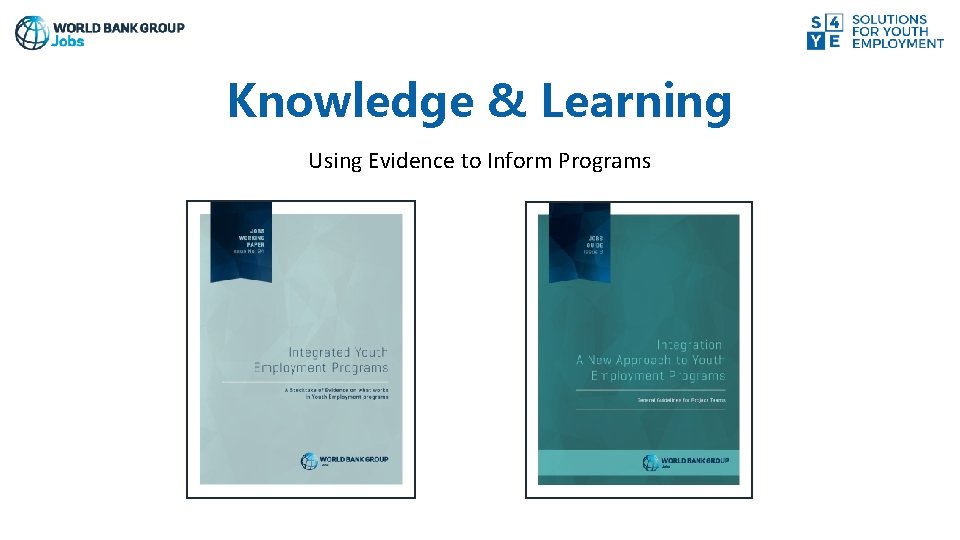
KNOWLEDGE AND LEARNING Knowledge & Learning Using Evidence to Inform Programs
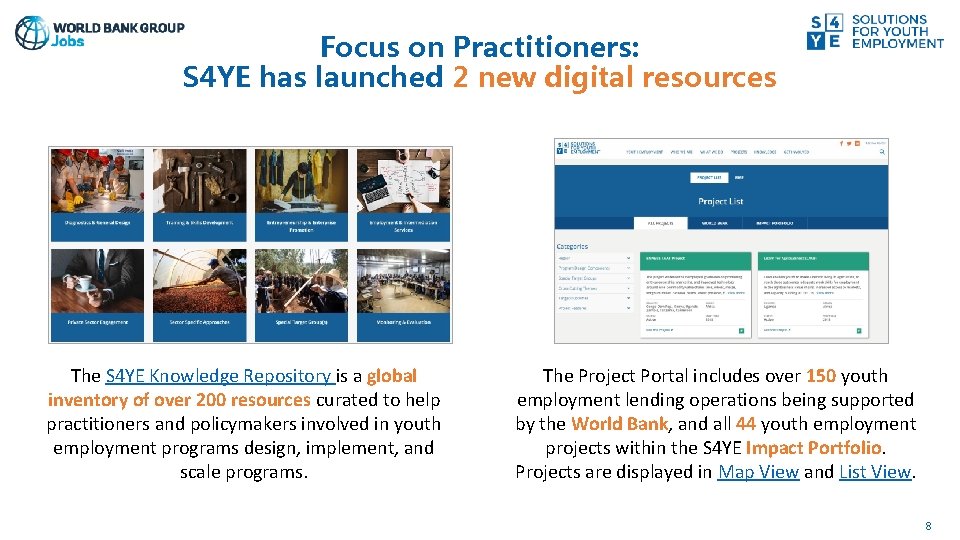
Focus on Practitioners: S 4 YE has launched 2 new digital resources The S 4 YE Knowledge Repository is a global inventory of over 200 resources curated to help practitioners and policymakers involved in youth employment programs design, implement, and scale programs. The Project Portal includes over 150 youth employment lending operations being supported by the World Bank, and all 44 youth employment projects within the S 4 YE Impact Portfolio. Projects are displayed in Map View and List View. 8
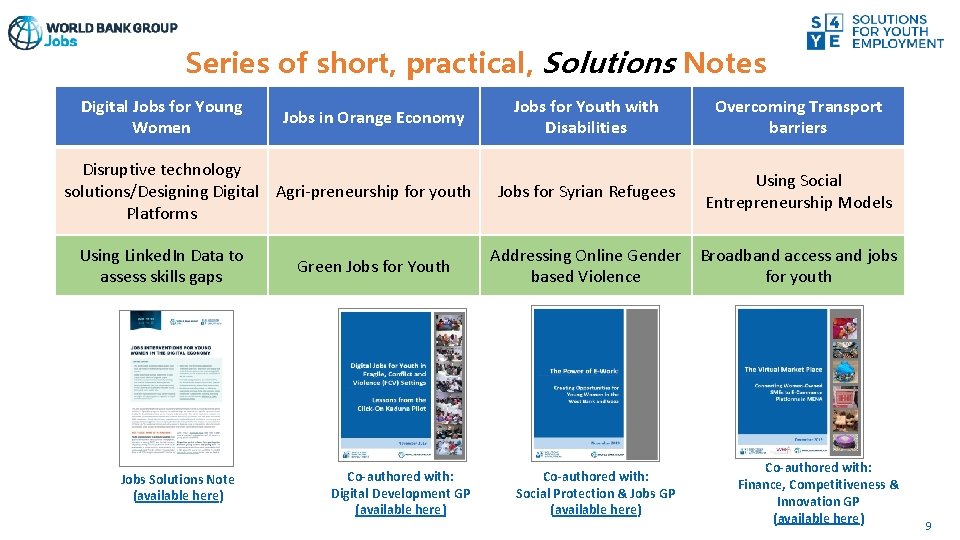
Series of short, practical, Solutions Notes Digital Jobs for Young Women Jobs in Orange Economy Disruptive technology solutions/Designing Digital Agri-preneurship for youth Platforms Using Linked. In Data to assess skills gaps Jobs Solutions Note (available here) Green Jobs for Youth Co-authored with: Digital Development GP (available here) Jobs for Youth with Disabilities Overcoming Transport barriers Jobs for Syrian Refugees Using Social Entrepreneurship Models Addressing Online Gender Broadband access and jobs based Violence for youth Co-authored with: Social Protection & Jobs GP (available here) Co-authored with: Finance, Competitiveness & Innovation GP (available here) 9
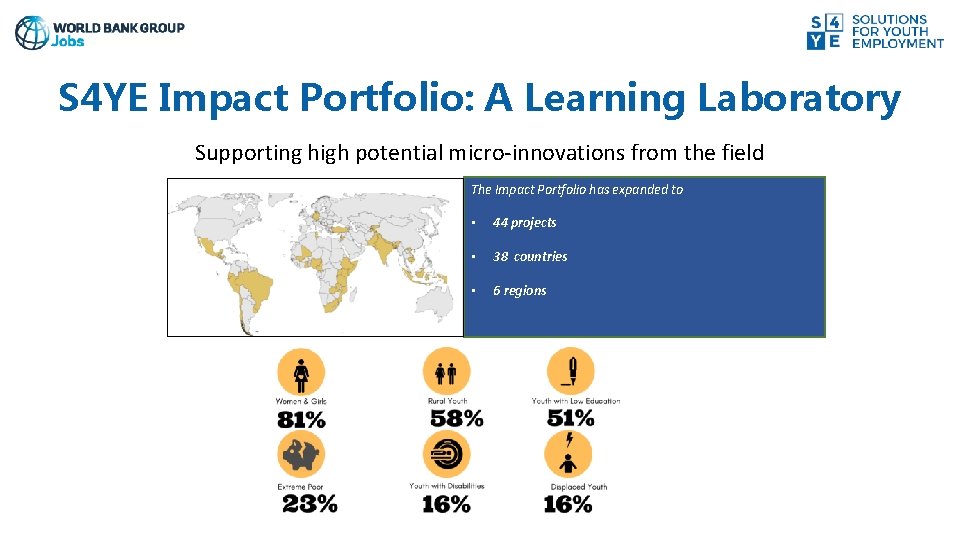
S 4 YE Impact Portfolio: A Learning Laboratory Supporting high potential micro-innovations from the field The Impact Portfolio has expanded to • 44 projects • 38 countries • 6 regions
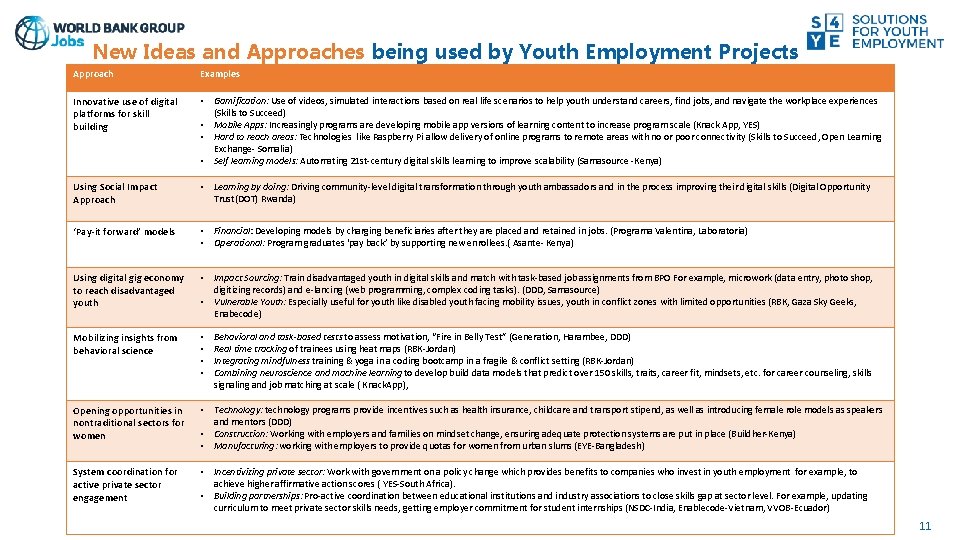
New Ideas and Approaches being used by Youth Employment Projects Approach Examples Innovative use of digital platforms for skill building • Gamification: Use of videos, simulated interactions based on real life scenarios to help youth understand careers, find jobs, and navigate the workplace experiences (Skills to Succeed) • Mobile Apps: Increasingly programs are developing mobile app versions of learning content to increase program scale (Knack App, YES) • Hard to reach areas: Technologies like Raspberry Pi allow delivery of online programs to remote areas with no or poor connectivity (Skills to Succeed, Open Learning Exchange- Somalia) • Self learning models: Automating 21 st-century digital skills learning to improve scalability (Samasource -Kenya) Using Social Impact Approach • Learning by doing: Driving community-level digital transformation through youth ambassadors and in the process improving their digital skills (Digital Opportunity Trust(DOT) Rwanda) ‘Pay-it forward’ models • Financial: Developing models by charging beneficiaries after they are placed and retained in jobs. (Programa Valentina, Laboratoria) • Operational: Program graduates ‘pay back’ by supporting new enrollees. ( Asante- Kenya) Using digital gig economy to reach disadvantaged youth • Impact Sourcing: Train disadvantaged youth in digital skills and match with task-based job assignments from BPO For example, microwork (data entry, photo shop, digitizing records) and e-lancing (web programming, complex coding tasks). (DDD, Samasource) • Vulnerable Youth: Especially useful for youth like disabled youth facing mobility issues, youth in conflict zones with limited opportunities (RBK, Gaza Sky Geeks, Enabecode) Mobilizing insights from behavioral science • • Opening opportunities in nontraditional sectors for women • Technology: technology programs provide incentives such as health insurance, childcare and transport stipend, as well as introducing female role models as speakers and mentors (DDD) • Construction: Working with employers and families on mindset change, ensuring adequate protection systems are put in place (Buildher-Kenya) • Manufacturing: working with employers to provide quotas for women from urban slums (EYE-Bangladesh) System coordination for active private sector engagement • Incentivizing private sector: Work with government on a policy change which provides benefits to companies who invest in youth employment for example, to achieve higher affirmative action scores ( YES-South Africa). • Building partnerships: Pro-active coordination between educational institutions and industry associations to close skills gap at sector level. For example, updating curriculum to meet private sector skills needs, getting employer commitment for student internships (NSDC-India, Enablecode-Vietnam, VVOB-Ecuador) Behavioral and task-based tests to assess motivation, “Fire in Belly Test” (Generation, Harambee, DDD) Real time tracking of trainees using heat maps (RBK-Jordan) Integrating mindfulness training & yoga in a coding bootcamp in a fragile & conflict setting (RBK-Jordan) Combining neuroscience and machine learning to develop build data models that predict over 150 skills, traits, career fit, mindsets, etc. for career counseling, skills signaling and job matching at scale ( Knack. App), 11
The COVID-19 pandemic threatens the livelihoods and well-being of millions of youth worldwide. Globally, youth already face high levels of unemployment and are particularly vulnerable to labor market shocks. As schools, technical and vocational education and training (TVET) institutions, and small businesses close, the number of youth not in employment, education or training (NEET) is expected to rise. Young women in low- and middle-income countries will likely be disproportionately affected, as they often have fewer social protections and bear a greater burden of household and care responsibilities. 12
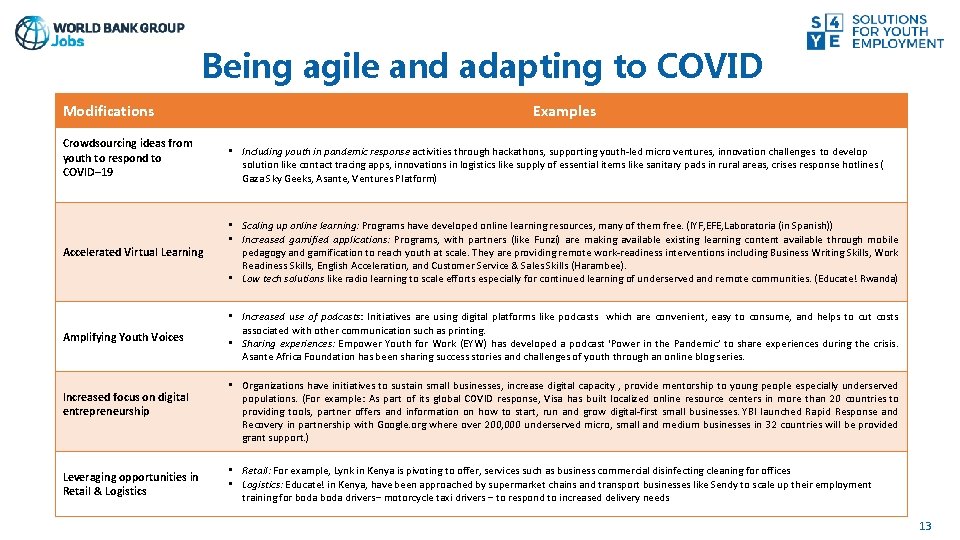
Being agile and adapting to COVID Modifications Crowdsourcing ideas from youth to respond to COVID‒ 19 Examples • Including youth in pandemic response activities through hackathons, supporting youth-led micro ventures, innovation challenges to develop solution like contact tracing apps, innovations in logistics like supply of essential items like sanitary pads in rural areas, crises response hotlines ( Gaza Sky Geeks, Asante, Ventures Platform) Accelerated Virtual Learning • Scaling up online learning: Programs have developed online learning resources, many of them free. (IYF, EFE, Laboratoria (in Spanish)) • Increased gamified applications: Programs, with partners (like Funzi) are making available existing learning content available through mobile pedagogy and gamification to reach youth at scale. They are providing remote work-readiness interventions including Business Writing Skills, Work Readiness Skills, English Acceleration, and Customer Service & Sales Skills (Harambee). • Low tech solutions like radio learning to scale efforts especially for continued learning of underserved and remote communities. (Educate! Rwanda) Amplifying Youth Voices • Increased use of podcasts: Initiatives are using digital platforms like podcasts which are convenient, easy to consume, and helps to cut costs associated with other communication such as printing. • Sharing experiences: Empower Youth for Work (EYW) has developed a podcast ‘Power in the Pandemic’ to share experiences during the crisis. Asante Africa Foundation has been sharing success stories and challenges of youth through an online blog series. Increased focus on digital entrepreneurship Leveraging opportunities in Retail & Logistics • Organizations have initiatives to sustain small businesses, increase digital capacity , provide mentorship to young people especially underserved populations. (For example: As part of its global COVID response, Visa has built localized online resource centers in more than 20 countries to providing tools, partner offers and information on how to start, run and grow digital-first small businesses. YBI launched Rapid Response and Recovery in partnership with Google. org where over 200, 000 underserved micro, small and medium businesses in 32 countries will be provided grant support. ) • Retail: For example, Lynk in Kenya is pivoting to offer, services such as business commercial disinfecting cleaning for offices • Logistics: Educate! in Kenya, have been approached by supermarket chains and transport businesses like Sendy to scale up their employment training for boda drivers‒ motorcycle taxi drivers ‒ to respond to increased delivery needs 13
Photo © Dominic Chavez/World Bank Thank You!
- Slides: 14