Korean War 1950 1953 What War The forgotten

- Slides: 13
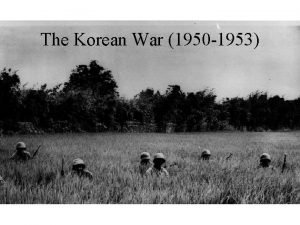
Korean War (1950 – 1953 -)
What War? • The forgotten war • The unknown war • 625 • Fatherland Liberation War • War to Resist U. S. Aggression and Aid Korea
Korea before the war • • • An independent country for more than 1000 years Geopolitical reality of Korea: bridge to Asia Part of Japanese Empire (1910) Koreans in Japan-ruled Korea Two visions of Korean independence • Nationalist • Syngman Rhee – one of major nationalist leaders • Communist • Kim Ir Sung – a minor Communist insurgant • Korea in WW II • Nationalists involved in some fighting in China and Asia • Communist guerillas in Manchuria and Korea
Division of Korea • USSR and Korea • War against Japan (9 August 1945) • Occupation of northern parts of Korea begins 10 Agust 1945 • 38 th parallel as a temporary division line • USA and Korea • USA accepts Japanese surrender south of the 38 th parallel (8 September 1945) • Moscow Conference – Korea governed for five yeras by a U. S. -Soviet Union Joint Commission – then independence • Nationalists (S. Rhee) react violently to this • Unrests, strikes and violent protests follow • In panic US administration of south Korea decides to hold UN sanctioned elections in the south. Elections boycotted by the Communists. • Jeju Uprising (at least 14. 000 dead) • Nationalists don’t support the idea of the elections, but they win and create a government with Syngman Rhee as president. • The Republic of Korea (South Korea) established on 15 August 1948. • The South Korean government begins a violent crack down on Korean communits, forcing them to flee to the North. More than 30000 inprisoned. • In the north the Soviet Union reacts by organizing their own elections and creating north Korean government with Kim Il Sung at its head.
Outbreak of the War • 1945 -1949 – Chinese Civil War • 1949 – The Soviets supply military aid to North Korea and quickly transform the North Korean army into a significant force • Soviet Advisory Group – makes plans for the invasion of the South • In South Korea violence against the communists reduces them to less than 1500 fighters • Border tension • The North Korea calls for unification and national elections while preaparing for war • Syngman Rhee repeatedly announces plans for the invasion of the North • 25 June 1950 – North Korean forces cross the 38 th parallel and quickly take Seoul and move south. • United Nations Security Council Resolution 82 • Syngman Rhee orders the Bodo League Massacre on 27 June 1950
Bodo League Massacre • Bodo League established as a ’reeducation movement’ for suspected communists and communist-sympethizers, officially to protect them from persecutions and executions • On 27 June 1950 Syngman Rhee orders the executions of all Bodo League and South Korean Workers Party members • Altogether between 100. 000 to 200. 000 people murdered, although some (less reliable) sources claim the number of victims reached over 1. 500. 000 • After the war the communists are blamed for the massacre • Only in 1990 the South Korean government began to accept the blame for the massacre • Role of American advisers unknonwn to this day, though some photographs were taken by American witnesses
American intervention • Reasons for the intervention • United Nations Security Council Resolution 82 • Truman administration uncertain of the importance of Korea and uncertain of Soviet intentions • Finally, when it’s decided US will intervene a shock comes about the US army and navy – not prepared for an operation of the desired scale
Course of the war • In its early stages dynamic changes in the frontlines. Seuol changes hands four times. • Fast advances of the North Korean Army • Pusan Perimeter – Pusan Perimeter Battle (August-September 1950) • Landing at Inchon, Battle of Inchon (September 1950) • UN Offensive 1950, past the partition line (38 th parallel) • Chinese internvention (1950) – People’s Volunteer Army (PVA) • Major UN losses in the north • Chinese counteroffensive (1951) • Fighting around the 38 th paralel (stalemate – 1951 -53) • In later stages – war of attrition • Armistice (July 1953 – November 1954) • Division of Korea ensues
Korean War characteristics • Massive land operations • Massive amphibian operations (Inchon) • Harsh conditions in the North – cold and hunger • Experience of retreat (two times, at least) • Massive military losses • US rule the air until the SU aids North Korea • Soviet pilots fly covert missions as North Korean fighters (first ever air-to-air dogfights between jet planes, possibly involving Soviet pilots), also the SU equips the PKA with air power • Strategic bombings • Effectively – US fights a war with China • The threat of nuclear warfare • Why? How? The US got closest ever to use nuclear weapons in conflict since WW II • In other words, the Korean War resembles the WW II in tactics and strategy, yet lacked the ’stability’ of WW II • War crimes • • • On both sides Bodo League Massacre Seoul National University Hospital massacre Hill 303 Massacre Bloody Gulch massacre Chaplain–Medic massacre Namyangju massacre Mungyeong Massacre Geochang massacre
Casualties and Losses • The United States suffered 33, 686 battle deaths, along with 2, 830 non-battle deaths • South Korea reported some 373, 599 civilian and 137, 899 military deaths. • PVA suffered about 400, 000 killed and 486, 000 wounded • the KPA suffered 215, 000 killed and 303, 000 wounded. • Recent scholarship has put the full battle death toll on all sides at just over 1. 2 million • Total civilians killed/wounded: 2. 5 million (est. ): • South Korea: 990, 968 / 373, 599 killed – 229, 625 wounded 387, 744 abducted/missing • North Korea: 1, 550, 000 (est. )
General Douglas Mac. Arthur • War World II • Pressed for landing in Inchon while many other commanders warned against it • Believed ’honorable victory’ in Korea is possible • Crossed the 38 th parallel believeing China would not intervene • Considered the use of nuclear weapons against North Korean and Chinese forces • Considered the use of nuclear weapons against China • Questioned the President’s sole authority to order the use of nuclear weapons • Considered a full-fledged war against China • Relieved from duty by Truman in April 1951
The Aftermath • Korea remains devided and at the state of war • Two different Koreas • South Korea struggles to face the reality of the war • Violent military rule for many years • North Korea a stronghold of utopian / dystopian communism • Bloody dictatorship • About 100, 000 North Koreans executed in post-war purges. • Forced labor and concentration camps responsible for over one million deaths in North Korea from 1945 to 1987, est. 400, 000 deaths in concentration camps alone • Estimates based on the most recent North Korean census suggest that 240, 000 to 420, 000 people died as a result of the 1990 s North Korean famine and that there were 600, 000 to 850, 000 unnatural deaths in North Korea from 1993 to 2008 • The North Korean government has been accused of "crimes against humanity" for its alleged culpability in creating and prolonging the 1990 s famine. • Seeks nuclear potential. Rougue state / axis of evil. • Cold War fears are given a real face • Hence – perhaps – a ’forgotten war’
Korean War in American Culture • The Manchurian Candidate (1959) – novel by Richard Condon • The Manchurian Candidate (1962) – movie by John Frankenheimer • The Manchurian Candidate (2004) – movie by Jonathan Demme • MASH (1970) – movie by Robert Altman • M*A*S*H (1972 – 1983) – TV Series • Goodbye, Farewell and Amen • Seinfeld • Wonder Years • Mad Men