ALTE DEFINE DIAGNOSE DISPO Riham Alwan MD MPH



- Slides: 47
ALTE DEFINE, DIAGNOSE, DISPO Riham Alwan, MD, MPH Henry Ford Hospital Department of Emergency Medicine
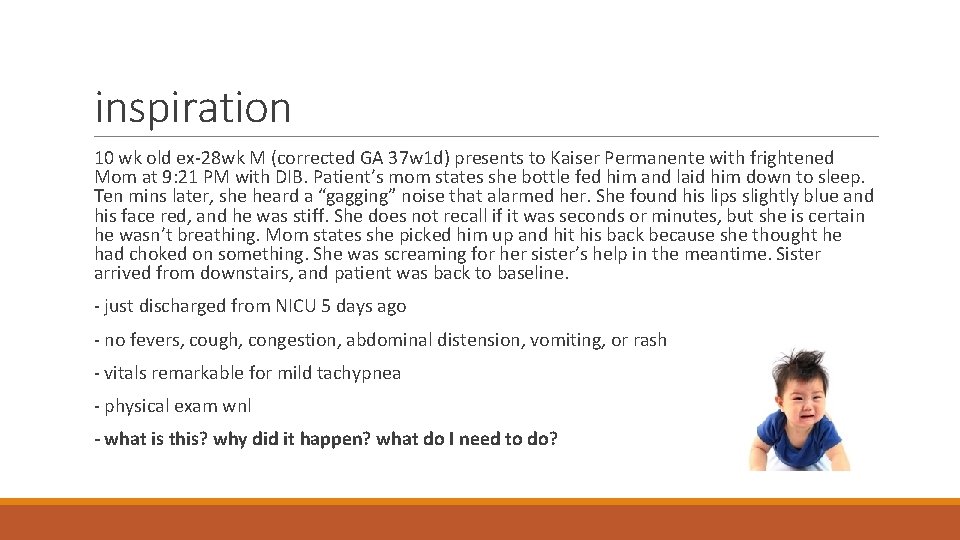
inspiration 10 wk old ex-28 wk M (corrected GA 37 w 1 d) presents to Kaiser Permanente with frightened Mom at 9: 21 PM with DIB. Patient’s mom states she bottle fed him and laid him down to sleep. Ten mins later, she heard a “gagging” noise that alarmed her. She found his lips slightly blue and his face red, and he was stiff. She does not recall if it was seconds or minutes, but she is certain he wasn’t breathing. Mom states she picked him up and hit his back because she thought he had choked on something. She was screaming for her sister’s help in the meantime. Sister arrived from downstairs, and patient was back to baseline. - just discharged from NICU 5 days ago - no fevers, cough, congestion, abdominal distension, vomiting, or rash - vitals remarkable for mild tachypnea - physical exam wnl - what is this? why did it happen? what do I need to do?
goals and objectives o Recognize ALTE in a child presenting to the ED o Learn the key historical elements of ALTE o Know the differential diagnosis of ALTE o Recognize the limitation and utility of work up o Learn criteria for admission o Understand the risks of discharge
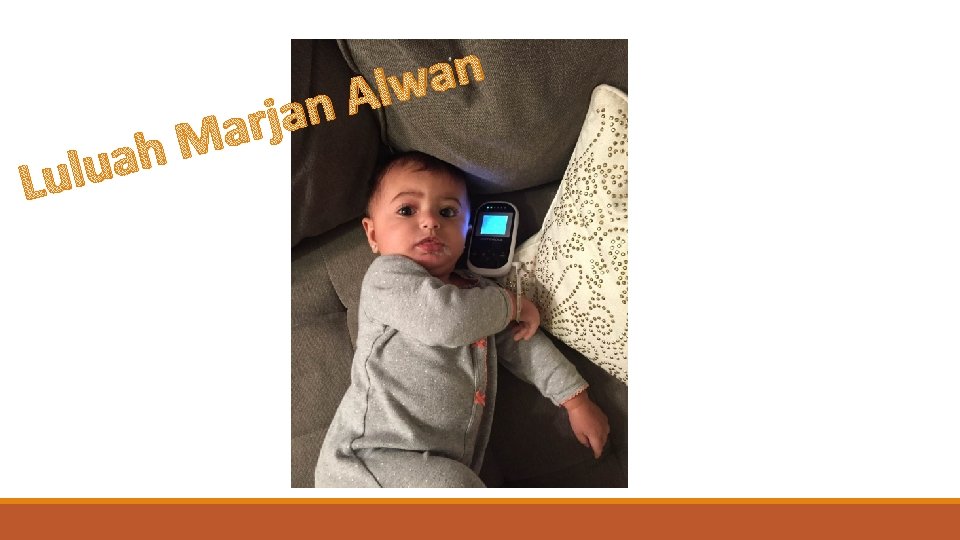
h a u l u L n a j r a M n a Alw
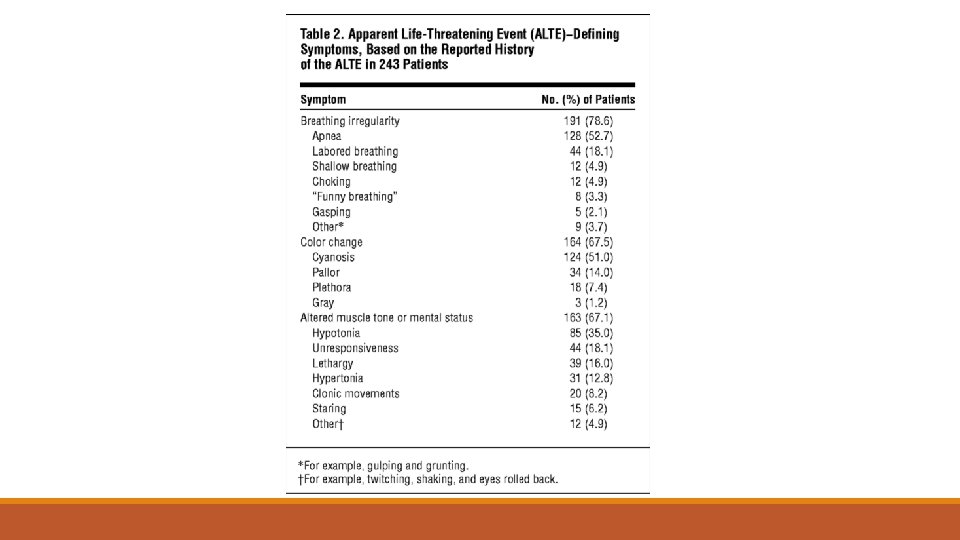
define o In 1986, an expert panel sponsored by the National Institutes of Health developed the now widely accepted definition of ALTE Apparent Life Threatening Event: an episode that is frightening to the observer and that is characterized by some combination of: o Apnea o Change in color: red, white, or blue o Change in muscle tone: hyper or hypotonicity o Choking or gagging
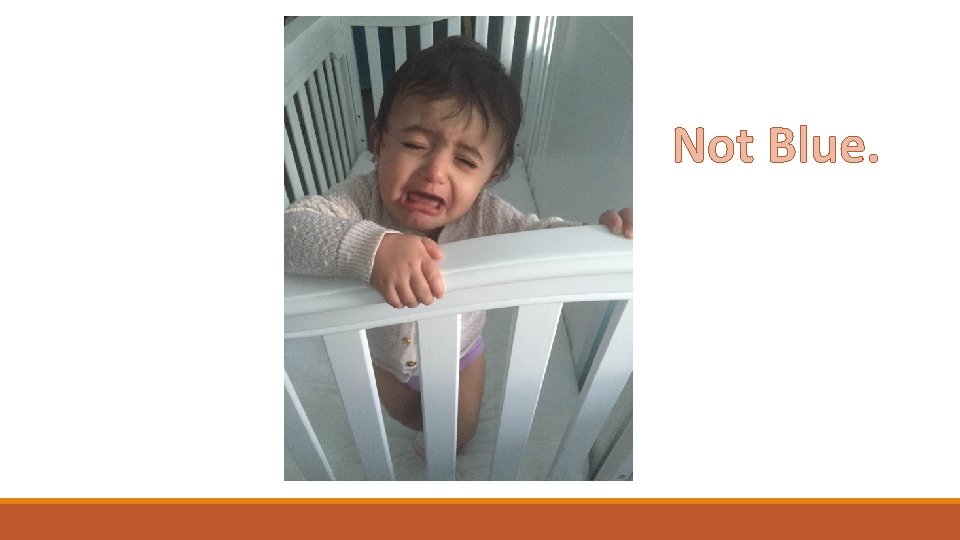
Not Blue.
epidemiology o 0. 6 to 10 per 1, 000 live births o 0. 6% to 1 % of all emergency visits for children younger than age 1 yo o 2% of pediatric hospitalizations o median age of ALTE 1 -3 mo o 29% of premies experience ALTE vs 13% of term infants
etiology No consensus currently exists about the most likely culprit of an ALTE o Is it GERD? o Is it URIs? o Is it seizures? o Is it abusive head trauma? o Is it congenital cardiac lesion? o Is it central sleep apnea?
whatchu talkin bout…
etiology The history and physical exam ◦ ◦ 21 -49% of cases reveal etiology based on hx and PE Note the feeding history Delve into the pregnancy, delivery, or previous hospitalizations Preform a thorough physical exam including ◦ Plotting the height, weight, and head circumference of infants ◦ Neuro exam appropriate for age ◦ Careful cardiac exam to detect murmurs
etiology Apparent life threatening events in infants presenting to an emergency department F Davies and R Gupta, Royal London Hospital, Emerg Med J 2002; 19, 11 -16 Study Design: 12 mo prospective study of pts <1 yo who presented to hospital ED with ALTE Methods: all patients admitted and followed up 6 mo post-ALTE Results: o 65 patients, median age 7 wks, NO deaths ◦ GERD 26% ◦ Pertussis 9% ◦ Seizures 9% ◦ UTI 5% ◦ Factitious illness 2% ◦ No diagnosis 23% o 57 or 88% of pts had only one admission for ALTE Conclusion o More serious diagnoses associated with age > 2 mo, abnormal clinical exam, and recurrent ALTE
diagnosis – GERD? Testing the association between GERD and apnea in infants Mousa, et al, Columbus Children’s Hospital, in J Pediatr Gastroenterol Nutr 2005; 41: 169 -177 Study Design: prospective study of pts <2 yo who presented with ALTE and referred to GI Methods: ◦ All acid suppressing meds stopped 5 -7 d before ◦ Monitored by combined MII/p. H and pneumography for 24 hours ◦ After 3 hr fast, impendence catheter passed transnasally and placed above the esophageal sphincter using fluoroscopy, confirmed by rads ◦ Catheter had 7 impedance sensors and 6 channels with a p. H electrode positioned between the two distal sensors ◦ Apnea was detected by pneumography recording: ◦ ◦ ◦ Nasal air flow Oxygen saturation Heart rate EKG Chest movements Definitions ◦ Apnea: decrease in air flow to 10% baseline x 10 s ◦ Reflux: impedance measured; > 50% of basal tone lost progressively retrograde over 2 or more channels ◦ Acid reflux: when p. H of the esophagus decreased <4 x 5 s ◦ Temporal linking: if apneic event and GER occurred within 5 mins
diagnosis – GERD? Results: o 25 patients (11 premies), median age 4 mo o 527 episodes of apnea ◦ 15% linked to GER ◦ 7% linked to acid reflux ◦ 8. 2% linked with non-acid reflux o Scatterplot reveals NO significance correlation between apnea and frequency or duration of episodes o Chi squared analyses within subjects found limited association between reflux and apnea o Regression analyses showed a significant association between apnea and reflux in 4/25 subjects Conclusion: Little evidence of an association between apnea and total reflux, acid reflux, or non-acid reflux in infants with apnea episodes. No difference between apnea-acid GER and non-acid GER
…my tummy be growlin’ too
diagnosis – seizure? Prevalence of epilepsy and seizure disorders as urine cx, CXR and EKG causes of ALTE in children admitted to a tertiary o Referral to GI, pulm, or cards per primary team hospital o 24 EEG recordings in case of recurrent ALTE Marques dos Anjos and Nunes, Sao Lucas Hospital, Brazil, in Arq Neuropsiquiatr 2009; 616 - Definitions 620 Minor ALTE – returned to baseline spontaneously Study Design: cross sectional study with or with mild stimulation prospective data collection of patients <2 yo admitted to hospital with ALTE over 2 yr period Major ALTE – reversed event after vigorous stimulation or CPR Methods: o All patients admitted and followed up 6 mo post. ALTE by either peds or peds neuro o“Routine tests” included CBC, lytes, BS, blood cx,
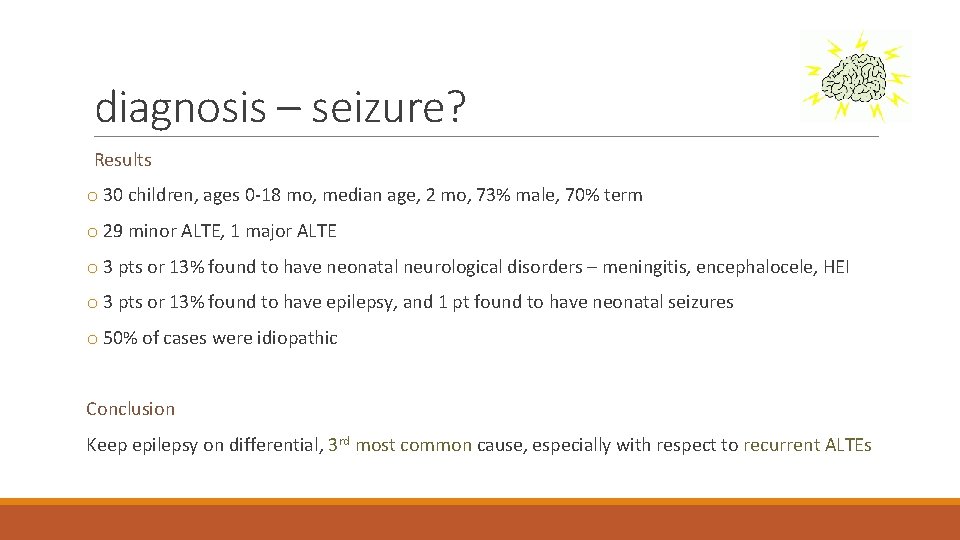
diagnosis – seizure? Results o 30 children, ages 0 -18 mo, median age, 2 mo, 73% male, 70% term o 29 minor ALTE, 1 major ALTE o 3 pts or 13% found to have neonatal neurological disorders – meningitis, encephalocele, HEI o 3 pts or 13% found to have epilepsy, and 1 pt found to have neonatal seizures o 50% of cases were idiopathic Conclusion Keep epilepsy on differential, 3 rd most common cause, especially with respect to recurrent ALTEs
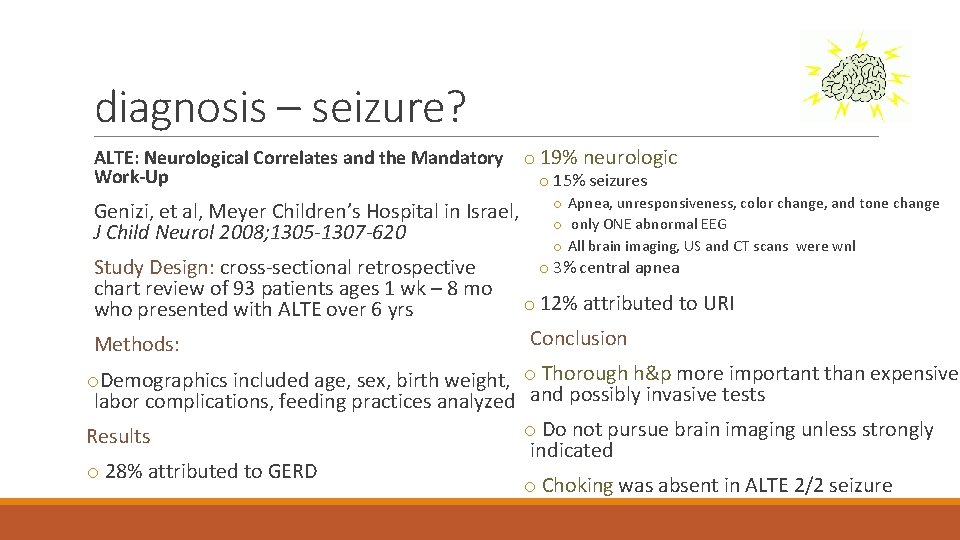
diagnosis – seizure? ALTE: Neurological Correlates and the Mandatory o 19% neurologic Work-Up o 15% seizures Genizi, et al, Meyer Children’s Hospital in Israel, J Child Neurol 2008; 1305 -1307 -620 Study Design: cross-sectional retrospective chart review of 93 patients ages 1 wk – 8 mo who presented with ALTE over 6 yrs Methods: o Apnea, unresponsiveness, color change, and tone change o only ONE abnormal EEG o All brain imaging, US and CT scans were wnl o 3% central apnea o 12% attributed to URI Conclusion o. Demographics included age, sex, birth weight, o Thorough h&p more important than expensive labor complications, feeding practices analyzed and possibly invasive tests o Do not pursue brain imaging unless strongly Results indicated o 28% attributed to GERD o Choking was absent in ALTE 2/2 seizure
seizures ain’t cute but I am
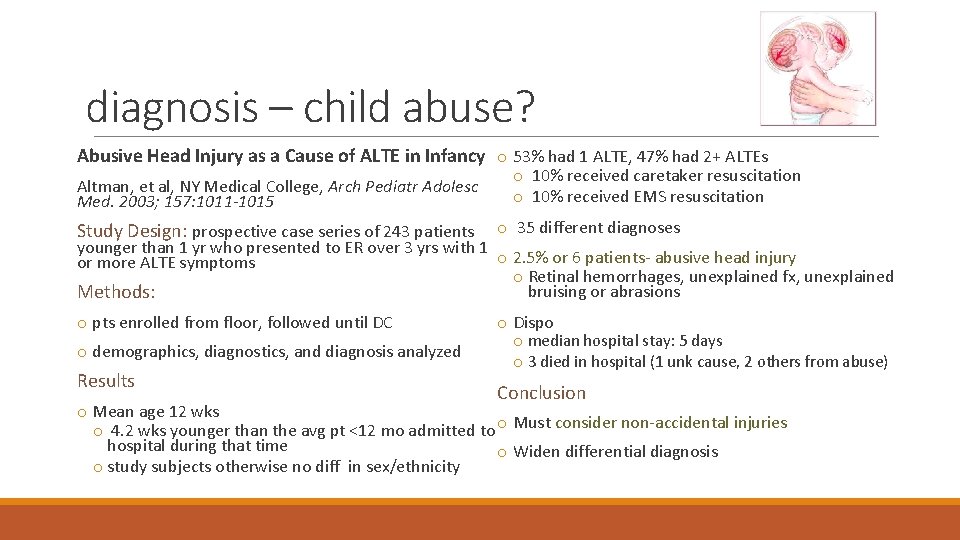
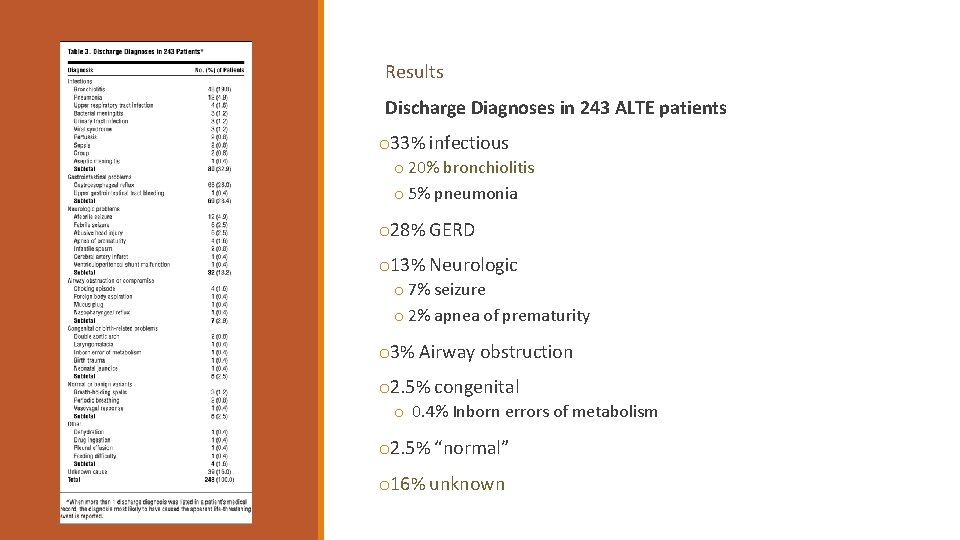
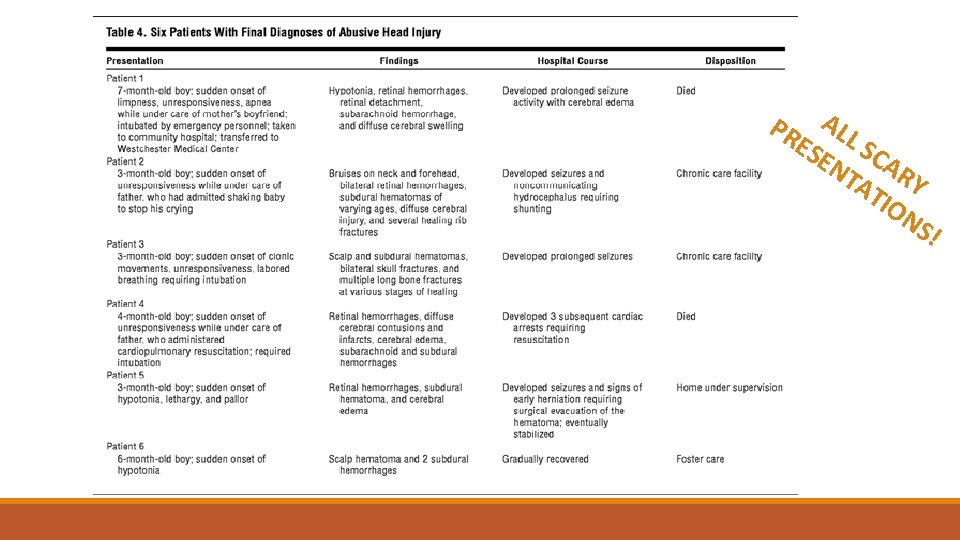
diagnosis – child abuse? Abusive Head Injury as a Cause of ALTE in Infancy o 53% had 1 ALTE, 47% had 2+ ALTEs Altman, et al, NY Medical College, Arch Pediatr Adolesc Med. 2003; 157: 1011 -1015 o 10% received caretaker resuscitation o 10% received EMS resuscitation Study Design: prospective case series of 243 patients o 35 different diagnoses o pts enrolled from floor, followed until DC o Dispo younger than 1 yr who presented to ER over 3 yrs with 1 o 2. 5% or 6 patients- abusive head injury or more ALTE symptoms o Retinal hemorrhages, unexplained fx, unexplained bruising or abrasions Methods: o demographics, diagnostics, and diagnosis analyzed Results o median hospital stay: 5 days o 3 died in hospital (1 unk cause, 2 others from abuse) Conclusion o Mean age 12 wks o 4. 2 wks younger than the avg pt <12 mo admitted to o Must consider non-accidental injuries hospital during that time o Widen differential diagnosis o study subjects otherwise no diff in sex/ethnicity
Results Discharge Diagnoses in 243 ALTE patients o 33% infectious o 20% bronchiolitis o 5% pneumonia o 28% GERD o 13% Neurologic o 7% seizure o 2% apnea of prematurity o 3% Airway obstruction o 2. 5% congenital o 0. 4% Inborn errors of metabolism o 2. 5% “normal” o 16% unknown
PR ALL ES EN SCA TA RY TIO NS !
Don’t hate. Appreciate.
diagnosis – child abuse? Mortality and Child Abuse in Children Presenting with ALTE o ALL pts: CBC, comprehensive metabolic panel, vbg, carbon monoxide level, Utox, CXR, and EKG Parker and Pitetti, CHOP, Pediatr Emerg Care 2011; 27: 591 -595 o patients followed for 12 mo post-enrollment o If ALTE and concern for abuse, CT head and SS Study Design: prospective case series including all pts < 24 mo with ALTEs presenting to the ED over 9 yrs o Diagnosis of abuse if confession, pattern of injury consistent with abuse, or child placed in foster care Methods: Results o Single investigator screened pts in the ED o 563 enrolled o Pts with obvious diagnoses were excluded o 5% or 27 pts were evaluated for child abuse o Thorough hx included descriptions of the event, physical exam findings, medical hx, family hx o 2% or 11 pts diagnosed with child abuse as ALTE cause o Abused children significantly more likely to have focal exam findings and lower mean hgb (see table)
diagnosis – child abuse? o 3 pts died o Child 1 – 2 prev ALTEs, multiple ER visits, mom confessed to smothering consistent with autopsy o Child 2 – ALTE @ age 4 mo, ex-34 wk, died at age 9 mo with multiple abrasions, autopsy “SIDS” and neg SS and retinal exam o Child 3 – ALTE @ age 2 mo, after feeding, diagnosed with GERD, died @ age 3 mo “SIDS” o Of the 11 patients diagnosed with child abuse, 1 died – 9% mortality rate o Of the 552 remaining patients, 2 died – 0. 4% mortality rate o 2 child abuse victims were initially admitted, discharged then returned in 1 -2 wks with obvious NAT Conclusion o Child abuse is a potential cause of ALTE with higher mortality rate o Stringent criteria to meet child abuse diagnosis missed cases o Recommend CXR for routine ALTE evaluation – for heart, lungs, and rib pathology o Lab values were NOT helpful
diagnose and dispo o There is no standard of care for ALTE o AAP, Peds In Review, Fu and Moon, 2012, Summary of Recommendations o “Minimum” diagnostic panel: CBC, CRP, glucose, mag, ammonia, lactate, pyruvate, ABG, UA, utox, ekg, pertussis swab, and RSV swabs o Recommend 23 hr observation o Other testing based on clinician’s degree of suspicion o More than 80% of patients with ALTE appear in no acute distress in ED o No specific diagnosis is found in up to 30% of patients o What work up is indicated? o Admit or discharge?
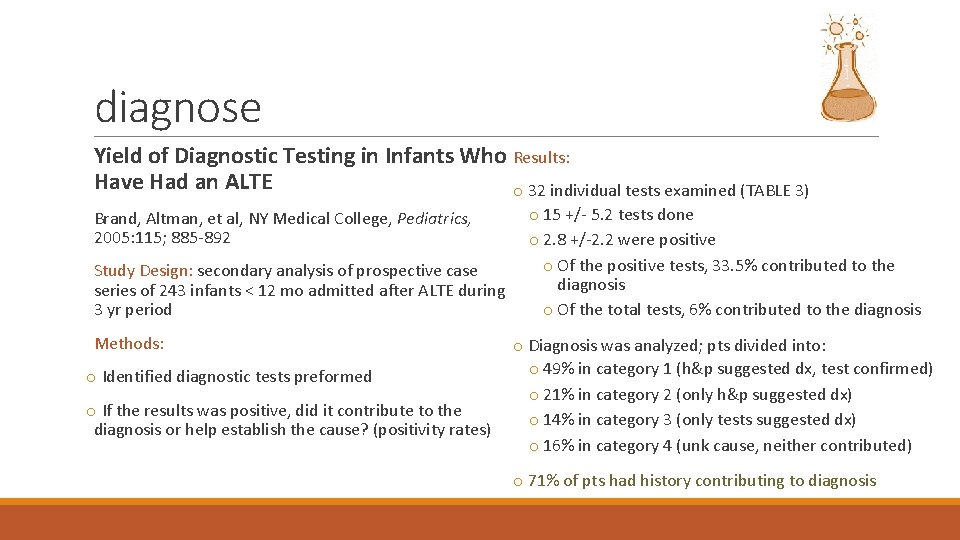
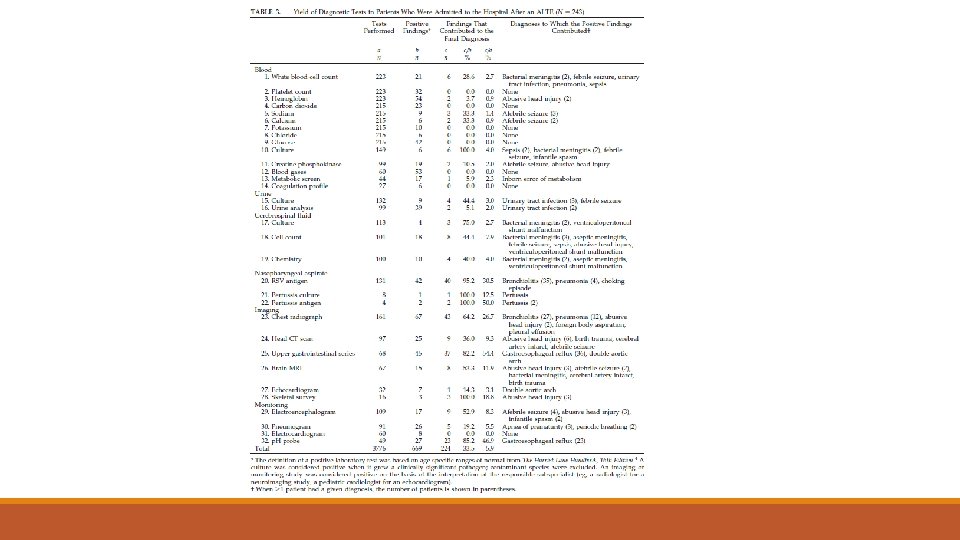
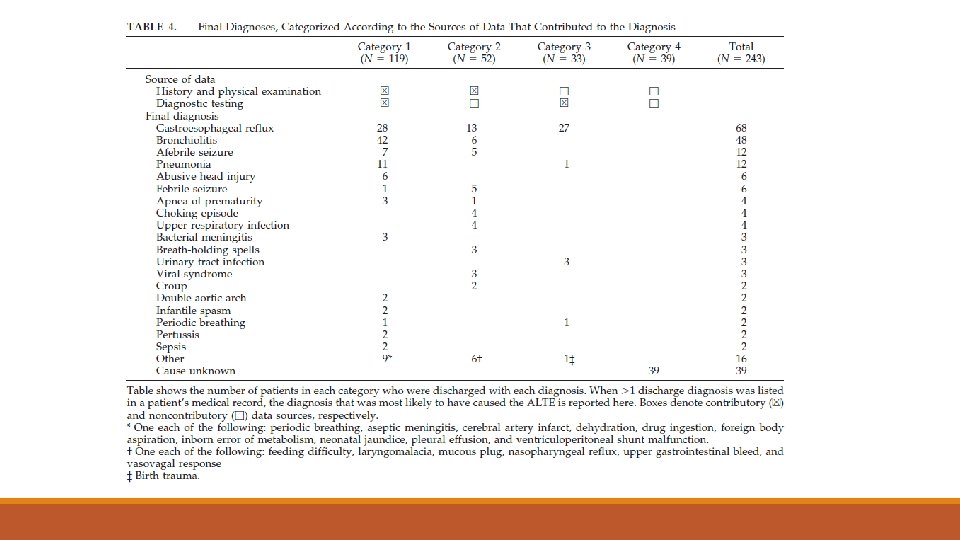
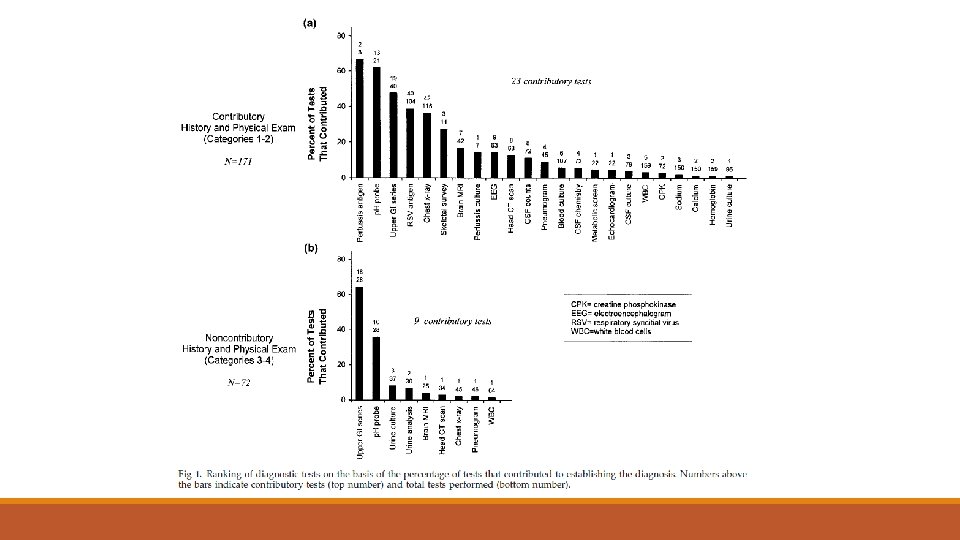
diagnose Yield of Diagnostic Testing in Infants Who Results: Have Had an ALTE o 32 individual tests examined (TABLE 3) Brand, Altman, et al, NY Medical College, Pediatrics, 2005: 115; 885 -892 Study Design: secondary analysis of prospective case series of 243 infants < 12 mo admitted after ALTE during 3 yr period Methods: o Identified diagnostic tests preformed o If the results was positive, did it contribute to the diagnosis or help establish the cause? (positivity rates) o 15 +/- 5. 2 tests done o 2. 8 +/-2. 2 were positive o Of the positive tests, 33. 5% contributed to the diagnosis o Of the total tests, 6% contributed to the diagnosis o Diagnosis was analyzed; pts divided into: o 49% in category 1 (h&p suggested dx, test confirmed) o 21% in category 2 (only h&p suggested dx) o 14% in category 3 (only tests suggested dx) o 16% in category 4 (unk cause, neither contributed) o 71% of pts had history contributing to diagnosis
diagnose Results o Occult causes of ALTE discovered by: o GERD screening o UA/Cx o Brain imaging o CBC o Pneumogram Conclusion: o For many diagnostic tests, the likelihood of a positive results is low, and the likelihood of it leading to ALTE cause is even lower o Contributory rates are more relative than posititivity rates o. If hx is nonsuggestive o Broad tests are LOW yield o Consider brain imaging, UA, CXR
going nowhere fast
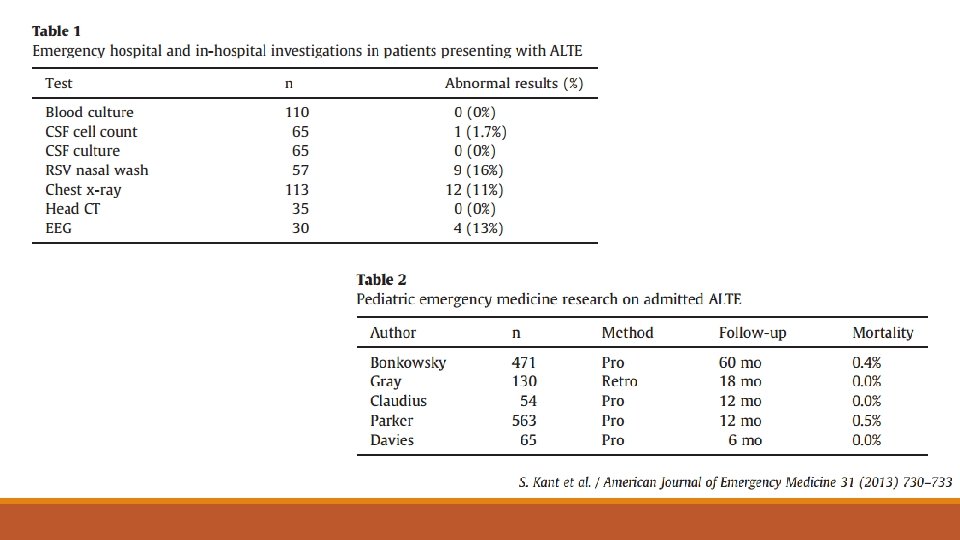
diagnostics and dispo Mortality after Discharge in Clinically Stable Infants and county coroner’s registry 6 mo after study end Admitted with a First-time ALTE Results Kant, Fisher, et al, Children’s Hospital of Nevada, in ◦ 174 included, median age of presentation = 2 mo Am J Emerg Med 2013; 31: 730 -733 ◦ 2 died from pneumonia, within 15 days of DC, 1 premie Study Design: retrospective chart review of all 366 infants 0 -6 mo old with ALTE admitted over 5 yrs Methods: o Did not include > 6 mo because “it is the group’s practice to assign alternate admission diagnosis” o Charts reviewed by 2 of 3 authors using a standardized form o Demographics, diagnosis, GA, VS, and diagnostics o Excluded if respiratory failure, need for intubation, PICU admit, presumed seizure, or hx of seizure do o Deaths identified by reviewing in hospital mortality ◦ Diagnostic eval in ED had low yield ◦ 37% got LP – ZERO pathogens ◦ 63% got Bcx – ZERO pathogens ◦ 65% got CXR – 12 pts or 7% had infiltrates ◦ 20% got CT head – NO findings ◦ 17% got EEG – 4 pts or 2% were positive ◦ 32% got RSV – 9 pts or 5% were positive ◦ 17 pts had repeat ALTE inpatient, 1 required intubation for recurrent apnea ◦ Conclusion ◦ Be cautious, either admit or arrange close follow up for clinically well ALTE patients
Almost snack time!
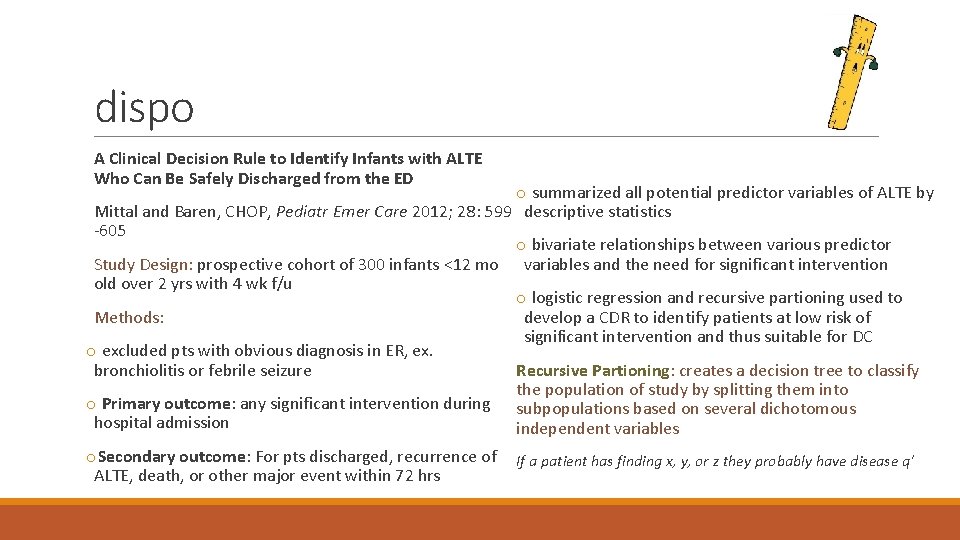
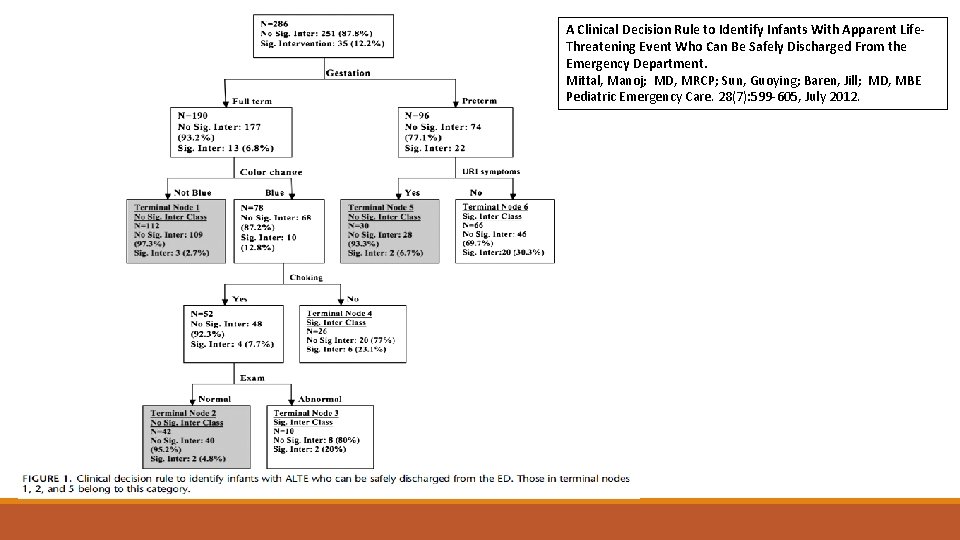
dispo A Clinical Decision Rule to Identify Infants with ALTE Who Can Be Safely Discharged from the ED o summarized all potential predictor variables of ALTE by Mittal and Baren, CHOP, Pediatr Emer Care 2012; 28: 599 descriptive statistics -605 o bivariate relationships between various predictor Study Design: prospective cohort of 300 infants <12 mo variables and the need for significant intervention old over 2 yrs with 4 wk f/u o logistic regression and recursive partioning used to Methods: develop a CDR to identify patients at low risk of significant intervention and thus suitable for DC o excluded pts with obvious diagnosis in ER, ex. bronchiolitis or febrile seizure Recursive Partioning: creates a decision tree to classify the population of study by splitting them into o Primary outcome: any significant intervention during subpopulations based on several dichotomous hospital admission independent variables o. Secondary outcome: For pts discharged, recurrence of ALTE, death, or other major event within 72 hrs If a patient has finding x, y, or z they probably have disease q'
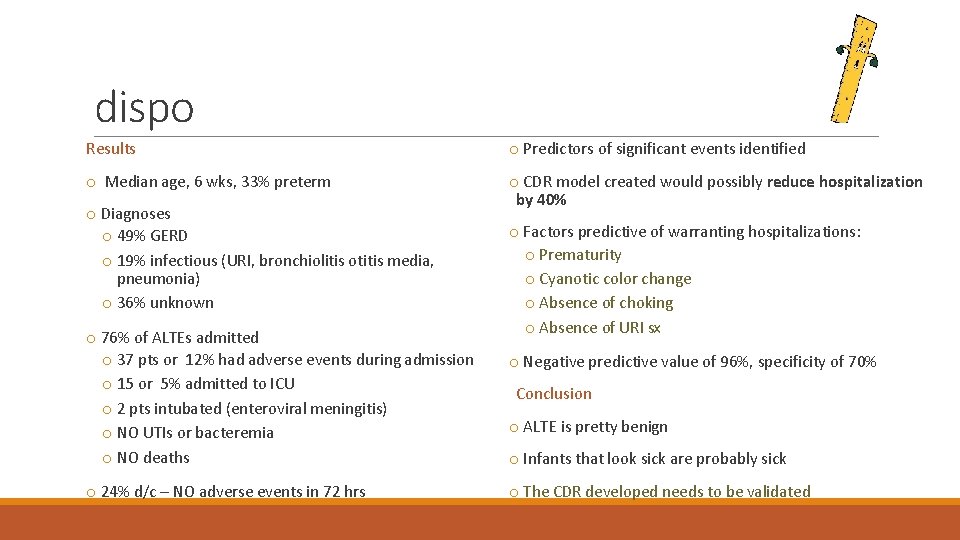
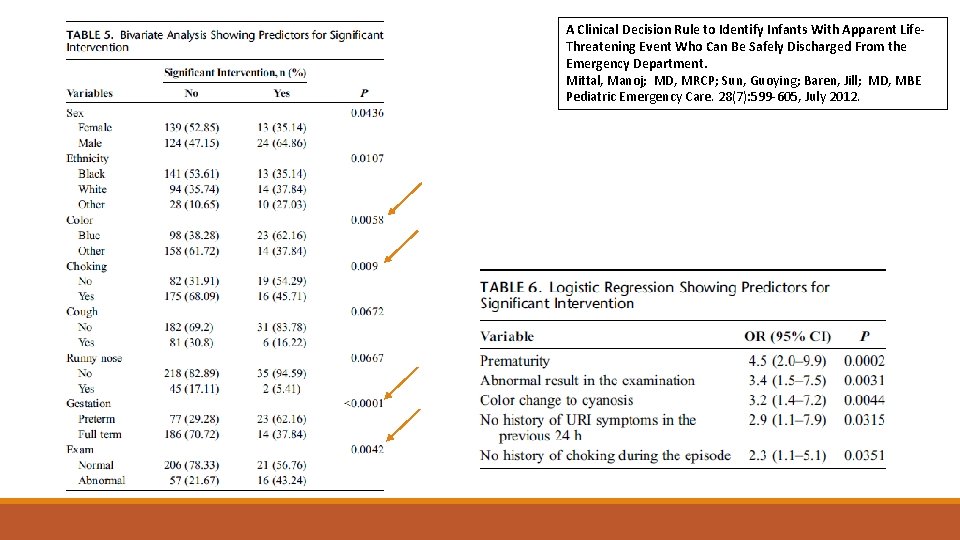
dispo Results o Predictors of significant events identified o Median age, 6 wks, 33% preterm o CDR model created would possibly reduce hospitalization by 40% o Diagnoses o 49% GERD o 19% infectious (URI, bronchiolitis otitis media, pneumonia) o 36% unknown o 76% of ALTEs admitted o 37 pts or 12% had adverse events during admission o 15 or 5% admitted to ICU o 2 pts intubated (enteroviral meningitis) o NO UTIs or bacteremia o NO deaths o 24% d/c – NO adverse events in 72 hrs o Factors predictive of warranting hospitalizations: o Prematurity o Cyanotic color change o Absence of choking o Absence of URI sx o Negative predictive value of 96%, specificity of 70% Conclusion o ALTE is pretty benign o Infants that look sick are probably sick o The CDR developed needs to be validated
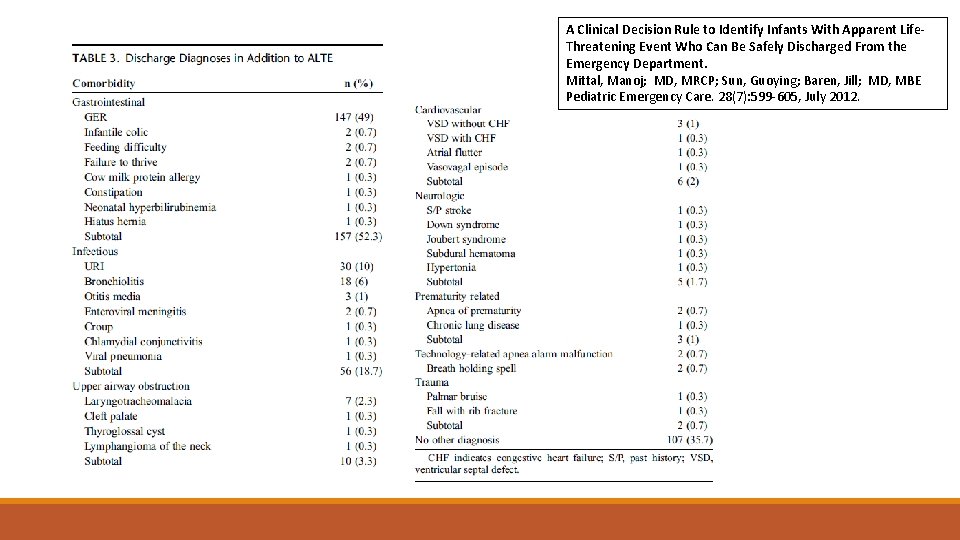
A Clinical Decision Rule to Identify Infants With Apparent Life. Threatening Event Who Can Be Safely Discharged From the Emergency Department. Mittal, Manoj; MD, MRCP; Sun, Guoying; Baren, Jill; MD, MBE Pediatric Emergency Care. 28(7): 599 -605, July 2012.
A Clinical Decision Rule to Identify Infants With Apparent Life. Threatening Event Who Can Be Safely Discharged From the Emergency Department. Mittal, Manoj; MD, MRCP; Sun, Guoying; Baren, Jill; MD, MBE Pediatric Emergency Care. 28(7): 599 -605, July 2012.
A Clinical Decision Rule to Identify Infants With Apparent Life. Threatening Event Who Can Be Safely Discharged From the Emergency Department. Mittal, Manoj; MD, MRCP; Sun, Guoying; Baren, Jill; MD, MBE Pediatric Emergency Care. 28(7): 599 -605, July 2012.
Hey, let’s try that again…
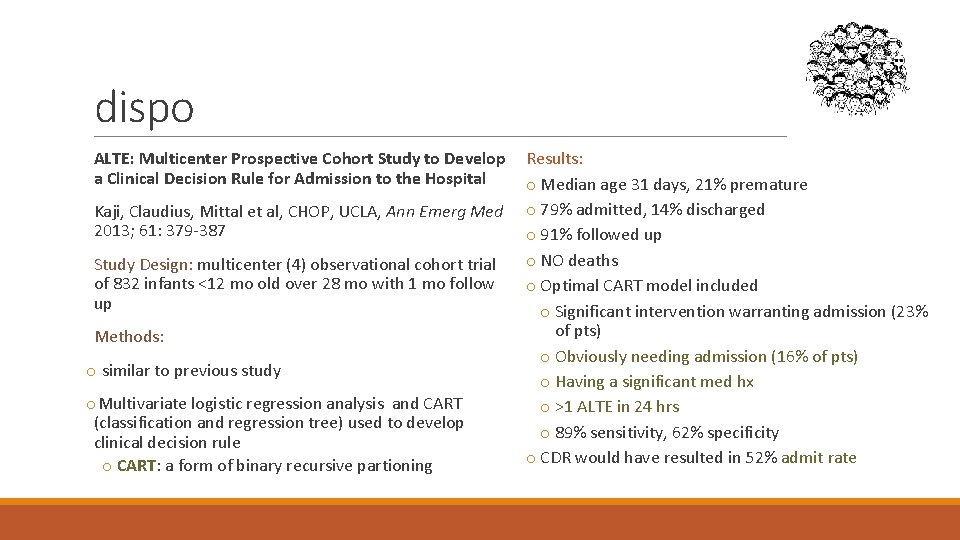
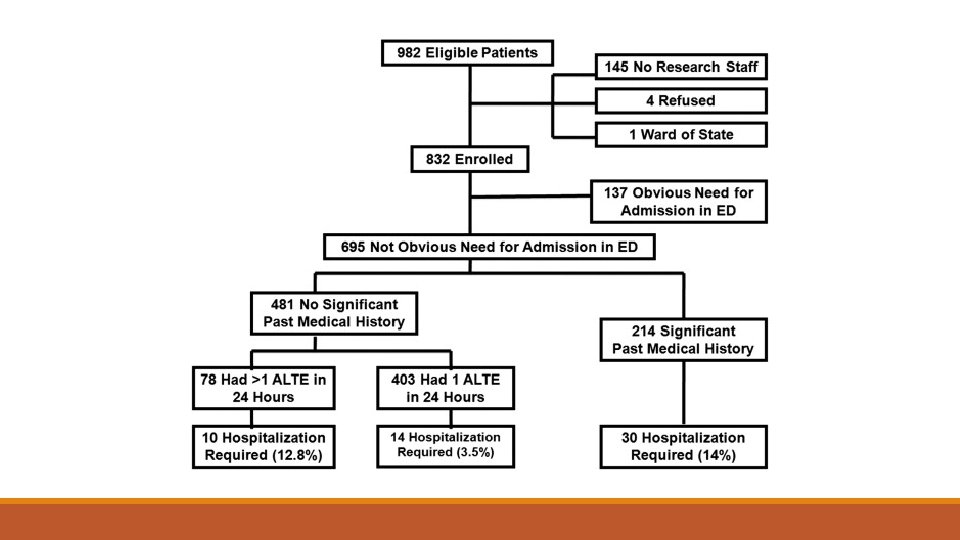
dispo ALTE: Multicenter Prospective Cohort Study to Develop a Clinical Decision Rule for Admission to the Hospital Kaji, Claudius, Mittal et al, CHOP, UCLA, Ann Emerg Med 2013; 61: 379 -387 Study Design: multicenter (4) observational cohort trial of 832 infants <12 mo old over 28 mo with 1 mo follow up Methods: o similar to previous study o. Multivariate logistic regression analysis and CART (classification and regression tree) used to develop clinical decision rule o CART: a form of binary recursive partioning Results: o Median age 31 days, 21% premature o 79% admitted, 14% discharged o 91% followed up o NO deaths o Optimal CART model included o Significant intervention warranting admission (23% of pts) o Obviously needing admission (16% of pts) o Having a significant med hx o >1 ALTE in 24 hrs o 89% sensitivity, 62% specificity o CDR would have resulted in 52% admit rate
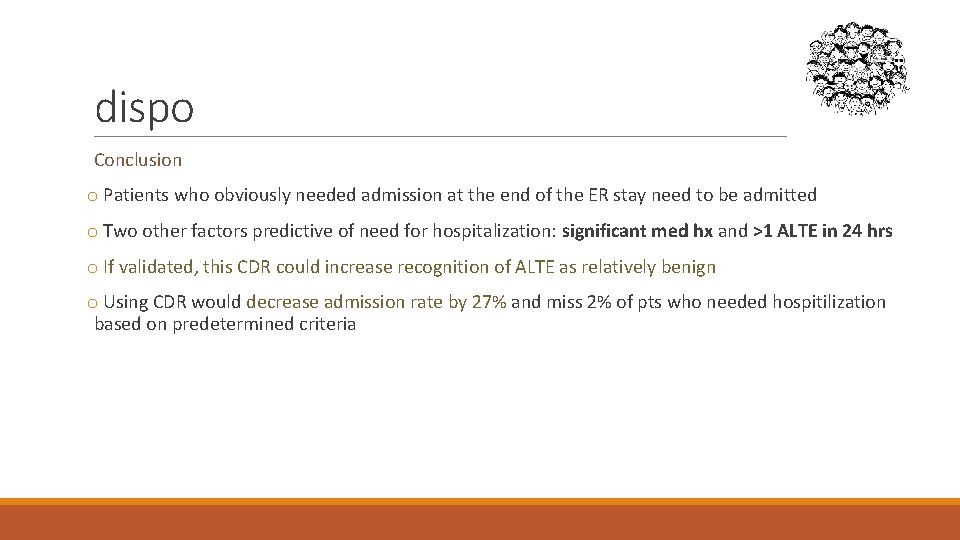
dispo Conclusion o Patients who obviously needed admission at the end of the ER stay need to be admitted o Two other factors predictive of need for hospitalization: significant med hx and >1 ALTE in 24 hrs o If validated, this CDR could increase recognition of ALTE as relatively benign o Using CDR would decrease admission rate by 27% and miss 2% of pts who needed hospitilization based on predetermined criteria
conclusion o Be familiar with common etiologies of ALTE o Take a thorough, careful history o Perform a careful physical exam specifically looking for signs of trauma or failure to thrive o Use the history to help guide the work up o If an infant appears sick, admit o If an infant appears well, stay tuned for validated clinical decision rules to help guide your mangement! o Highly consider CXR, RSV/pertussis swabs, and head imaging if indicated o Ensure follow up if you elect to discharge