
Planning for Medication Management Technologies Majd Alwan Senior




- Slides: 54
Planning for Medication Management Technologies Majd Alwan, Senior Vice President, Technology/Executive Director, CAST, Leading. Age, Washington, DC
Session Objectives • Gain an understanding of medication management and the different types of commercially available technologies relevant to long-term care settings. • Consider the most important functions and features to look for in medication management technologies. • Discuss the lessons learned from providers who have implemented technology solutions in their organization.
Speakers • Scott Code, Aging Services Technology Manager, Leading. Age CAST, Washington, DC • Zell Gaston, CFO, Elim Park, Cheshire, CT • Anabelle Locsin, Chief Nursing Officer, Menorah Manor, St. Petersburg, FL
Planning for Medication Management Technologies Scott Code, Aging Services Technology Manager, Leading. Age CAST
Medication Management Whitepaper http: //www. leadingage. org/Technology_Selection_Tools. aspx
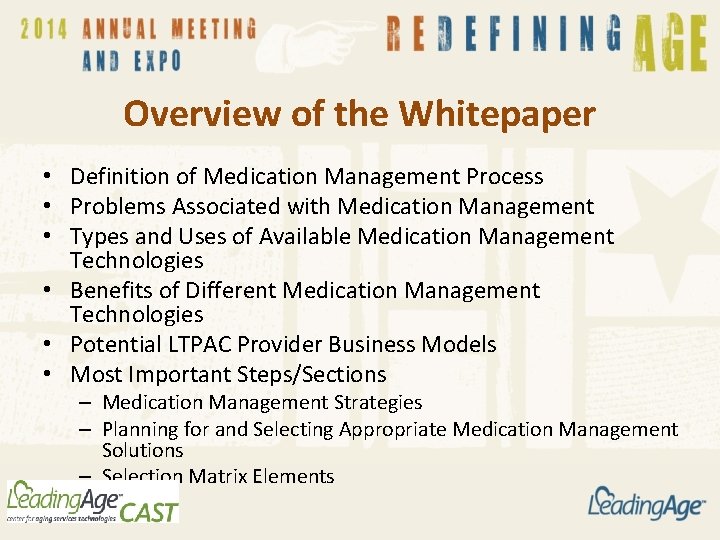
Overview of the Whitepaper • Definition of Medication Management Process • Problems Associated with Medication Management • Types and Uses of Available Medication Management Technologies • Benefits of Different Medication Management Technologies • Potential LTPAC Provider Business Models • Most Important Steps/Sections – Medication Management Strategies – Planning for and Selecting Appropriate Medication Management Solutions – Selection Matrix Elements
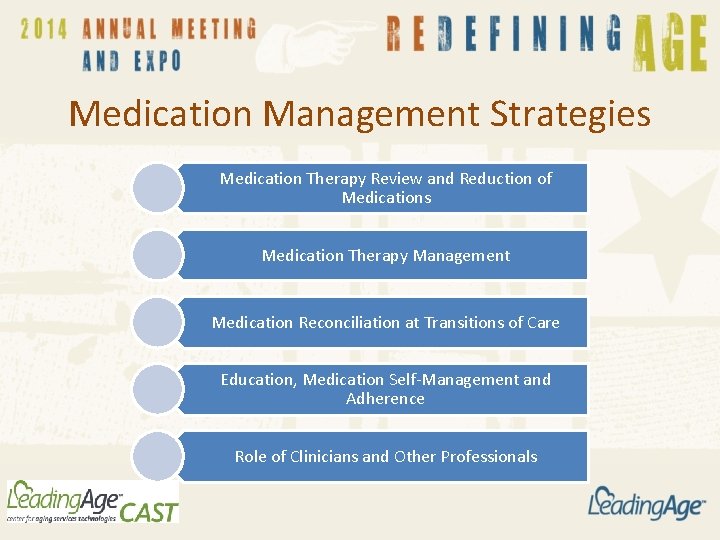
Medication Management Strategies Medication Therapy Review and Reduction of Medications Medication Therapy Management Medication Reconciliation at Transitions of Care Education, Medication Self-Management and Adherence Role of Clinicians and Other Professionals
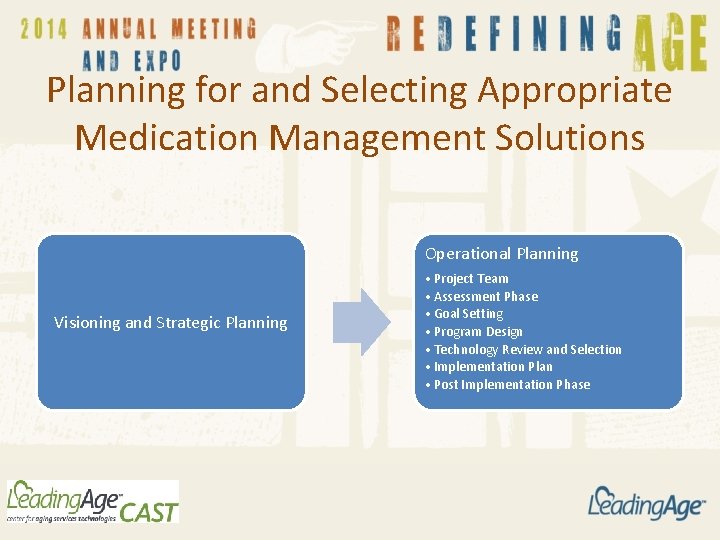
Planning for and Selecting Appropriate Medication Management Solutions Operational Planning Visioning and Strategic Planning • Project Team • Assessment Phase • Goal Setting • Program Design • Technology Review and Selection • Implementation Plan • Post Implementation Phase
Participating Vendors
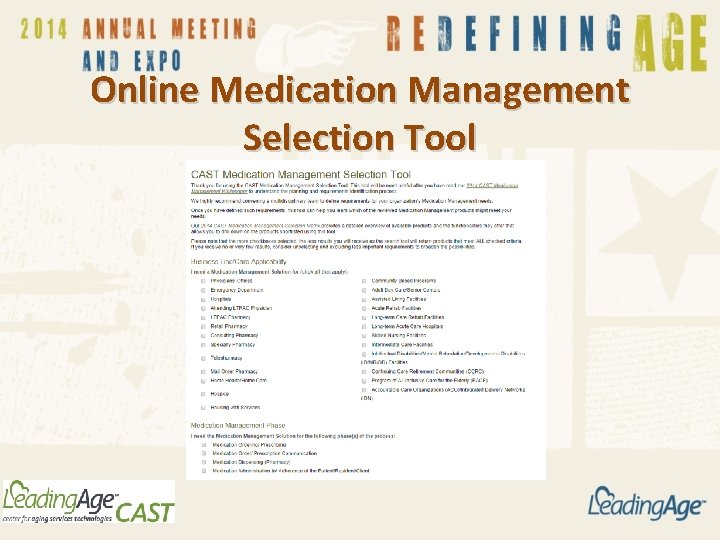
Online Medication Management Selection Tool
CAST Medication Management Selection Tool Demo http: //www. leadingage. org/Medication. Management /search. aspx
Feedback and Input on Future Initiatives Please complete the following survey: http: //tinyurl. com/o 8 f 8 kc 3
Planning for EHR to Improve Medication Management Zell Gaston, CFO, Elim Park
Elim Park Baptist Home, Cheshire, CT § 108 year Christian heritage, single site § NFP, nationally accredited by CARF-CCAC § 258 IL (AL is provided in the IL), 42 RCH & 90 SNF (30 used for Post Acute) § Vision Leadership Team: § Linda Langlais, CNO, § Chris De. Bisschop, RN Nurse Educator, § Lynn Mac. Lean, RN Quality Nurse Manager, § Anthony Musacchio, IT Assoc. Director § Zell Gaston, CFO
How We Chose & Included CFO & CNO tag-teamed together Chose 5 -6 EHR vendors at LA, CA Invited full range of staff to vendor presentations All had input, helped create buy-in, became stakeholders in success off project § Quickly went to two vendors § After 3 -4 months due diligence, chose Vision by Health. MEDX § §
Implementation Approach § § Creating an Environment for Success § Developed foundational skill before moving on to more complex solutions § Census, Admissions & MDS § Nurses Notes, CNA documentation, Dietary, Social service, Recreation and Pastors § EMAR/ETAR/CPOE/Therapy Orders § i. Care Engaging the team across all disciplines § Leadership gained input § Staff felt ownership & vested interest in success
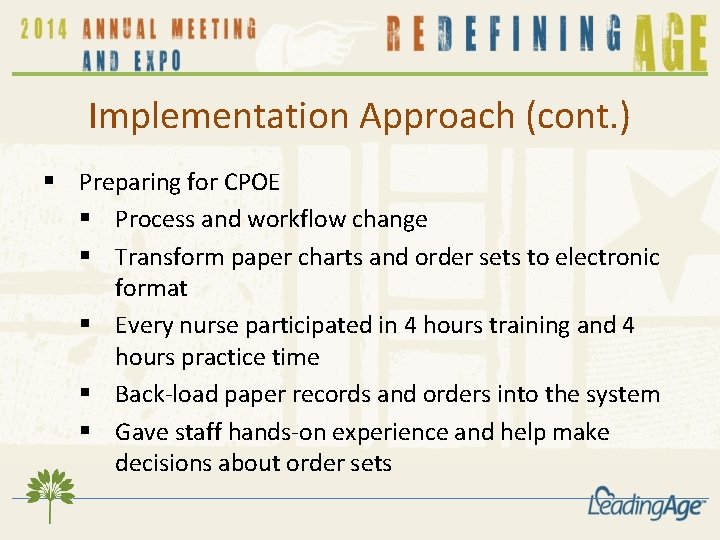
Implementation Approach (cont. ) § Preparing for CPOE § Process and workflow change § Transform paper charts and order sets to electronic format § Every nurse participated in 4 hours training and 4 hours practice time § Back-load paper records and orders into the system § Gave staff hands-on experience and help make decisions about order sets
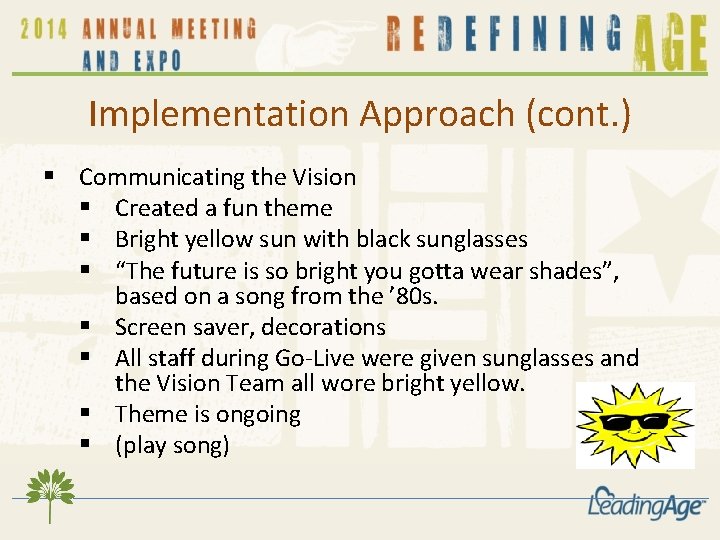
Implementation Approach (cont. ) § Communicating the Vision § Created a fun theme § Bright yellow sun with black sunglasses § “The future is so bright you gotta wear shades”, based on a song from the ’ 80 s. § Screen saver, decorations § All staff during Go-Live were given sunglasses and the Vision Team all wore bright yellow. § Theme is ongoing § (play song)
Implementation Approach (cont. ) § Introducing i. Care for Physicians § Gives Physician 24/7 access on i. Pad/i. Phone § Can communicate with care team members § Updates at several quarterly meetings preceding launch § They were looking forward to Go-Live § One-on-one training the first time the system was available to them § Nurses were trained to provide ongoing support and encourage physician use
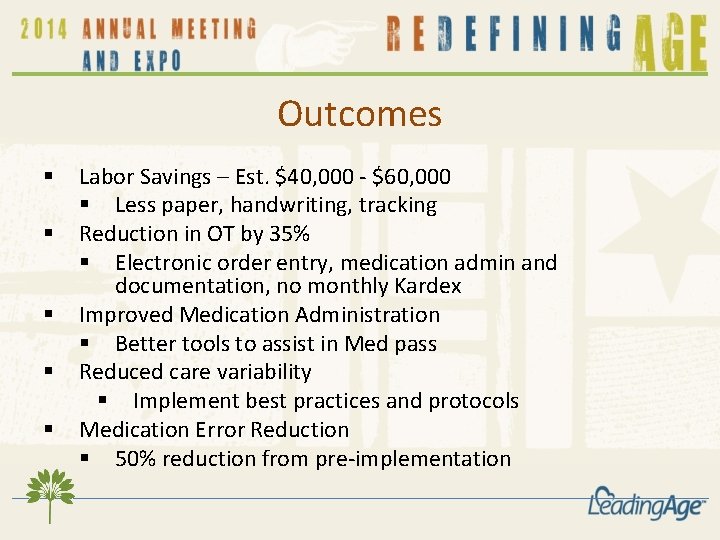
Outcomes § § § Labor Savings – Est. $40, 000 - $60, 000 § Less paper, handwriting, tracking Reduction in OT by 35% § Electronic order entry, medication admin and documentation, no monthly Kardex Improved Medication Administration § Better tools to assist in Med pass Reduced care variability § Implement best practices and protocols Medication Error Reduction § 50% reduction from pre-implementation
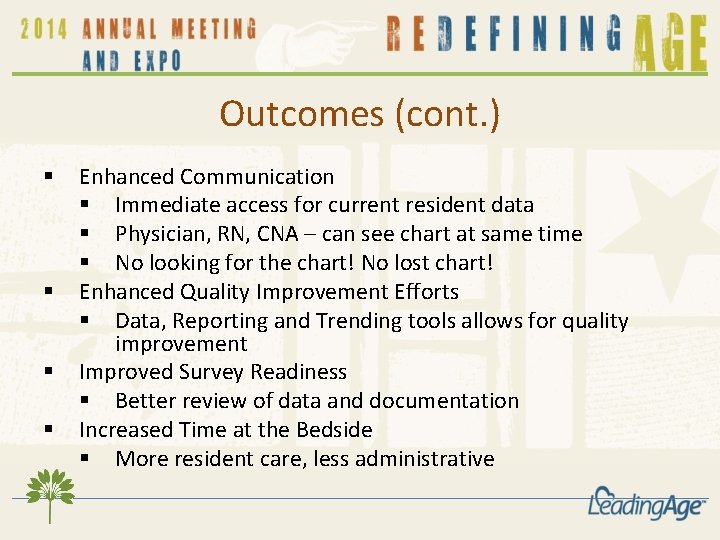
Outcomes (cont. ) § § Enhanced Communication § Immediate access for current resident data § Physician, RN, CNA – can see chart at same time § No looking for the chart! No lost chart! Enhanced Quality Improvement Efforts § Data, Reporting and Trending tools allows for quality improvement Improved Survey Readiness § Better review of data and documentation Increased Time at the Bedside § More resident care, less administrative
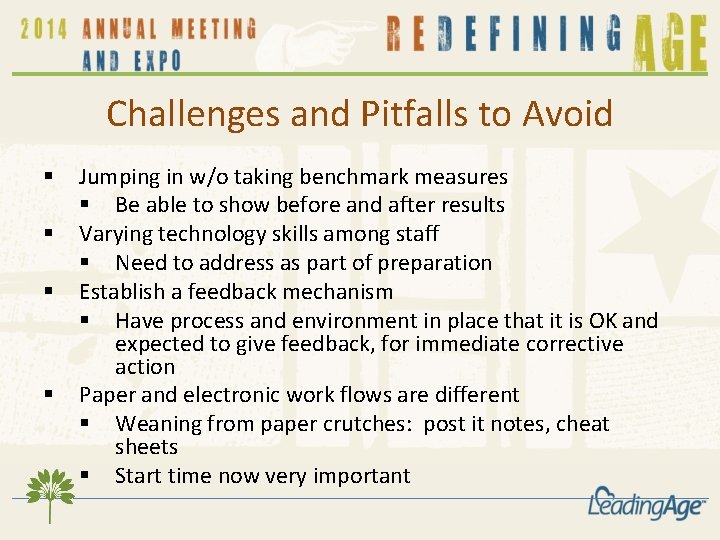
Challenges and Pitfalls to Avoid § § Jumping in w/o taking benchmark measures § Be able to show before and after results Varying technology skills among staff § Need to address as part of preparation Establish a feedback mechanism § Have process and environment in place that it is OK and expected to give feedback, for immediate corrective action Paper and electronic work flows are different § Weaning from paper crutches: post it notes, cheat sheets § Start time now very important
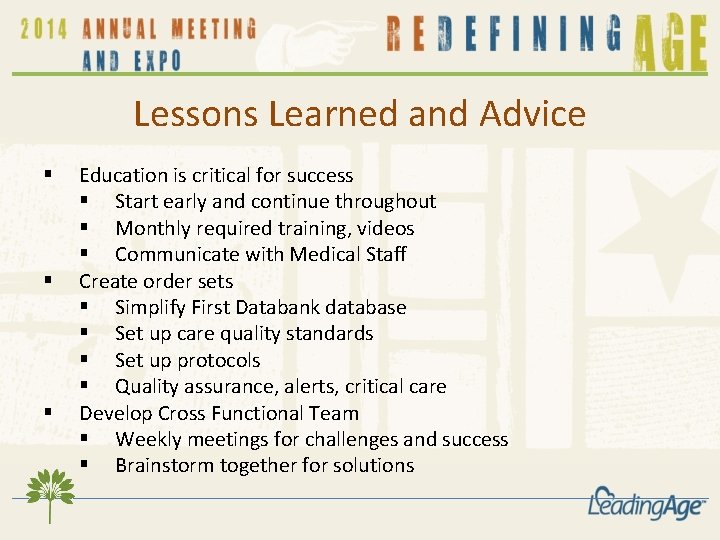
Lessons Learned and Advice § § § Education is critical for success § Start early and continue throughout § Monthly required training, videos § Communicate with Medical Staff Create order sets § Simplify First Databank database § Set up care quality standards § Set up protocols § Quality assurance, alerts, critical care Develop Cross Functional Team § Weekly meetings for challenges and success § Brainstorm together for solutions
Contact Information § Zell Gaston § Elim Park Baptist Home § Cheshire, CT § zgaston@elimpark. org § The future is BRIGHT!
Planning for Medication Management Technologies – A Facility’s Experience Anabelle Locsin, Chief Nursing Officer, Menorah Manor
Upon completion of this presentation the participants will be able to: 1. State some basic principles to consider in preparation for the utilization of medication management technologies. 2. Enumerate most important functions and features to look for in medication management technologies. 3. Gain insight into a facility’s experience and utilize some recommendations for implementation of technology solutions in their respective organizations.
Brief Background – Why use medication technology in LTC settings 1. 6 million US NH residents are at high risk for adverse effects of medication errors, use of technology when combined with quality improvement efforts can reduce this risk. Medication errors are estimated to harm at least 1. 5 million patients per year with about 400, 000 preventable adverse events (Abha Agrawal, March 2009) IT systems have also been reported to have the potential to save up to $88 billion over 10 years in costs in the USA with increasing adoption. Due to staffing shortages and expectations placed on staff today, human errors are becoming more prevalent in the administration of medications. Statistics (Karen M. Hunter, June 2011) 44, 000 to 98, 000 Americans die annually due to medical mistakes Cohen, 1999; Cousins, 1998) 7, 000 die each year due to medication errors (Hughes, 2005) Medication errors result in at least one death/day & 1. 3 million injuries/year in the US (Patel, 2009)
Anticipated End Results • Increase resident safety = better resident/family outcomes • Improve workflow conditions and accuracy of workflow • Better financial outcomes • Better health care communications
Facility Profile Menorah Manor, St. Petersburg, Florida Bernard L. Samson Nursing Center 180 beds SNF (Alzheimer Dementia Care, Palliative Care, Long Term Care and Short Term Rehab Care Two Assisted Living Communities Adult Day Care Started electronic documentation mid 2008 – echarting, POs, e. MARs, e. TARs, MDS and Care Planning, Interfacing
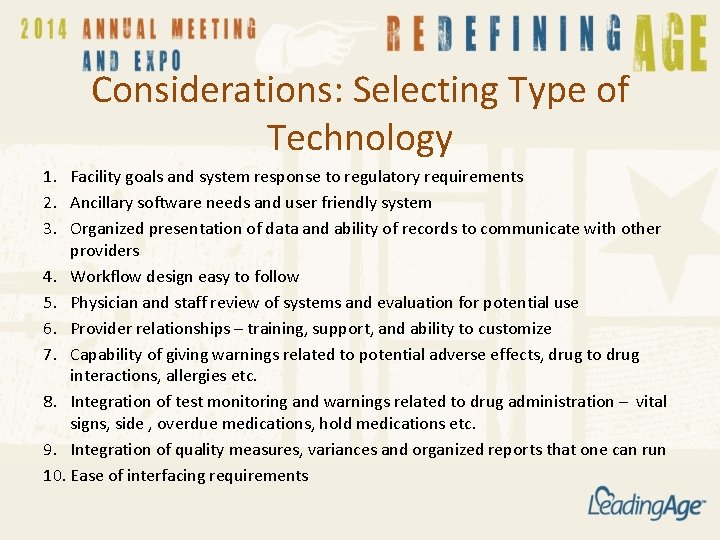
Considerations: Selecting Type of Technology 1. Facility goals and system response to regulatory requirements 2. Ancillary software needs and user friendly system 3. Organized presentation of data and ability of records to communicate with other providers 4. Workflow design easy to follow 5. Physician and staff review of systems and evaluation for potential use 6. Provider relationships – training, support, and ability to customize 7. Capability of giving warnings related to potential adverse effects, drug to drug interactions, allergies etc. 8. Integration of test monitoring and warnings related to drug administration – vital signs, side , overdue medications, hold medications etc. 9. Integration of quality measures, variances and organized reports that one can run 10. Ease of interfacing requirements
Steps in Integration and Implementation of Electronic Medical Management – Per Experience 1. At the Onset and Preplanning 2. Implementation Phase 3. Ongoing Evaluation and Management – working with the provider 4. Education, Revisit-education, Ongoing Competencies
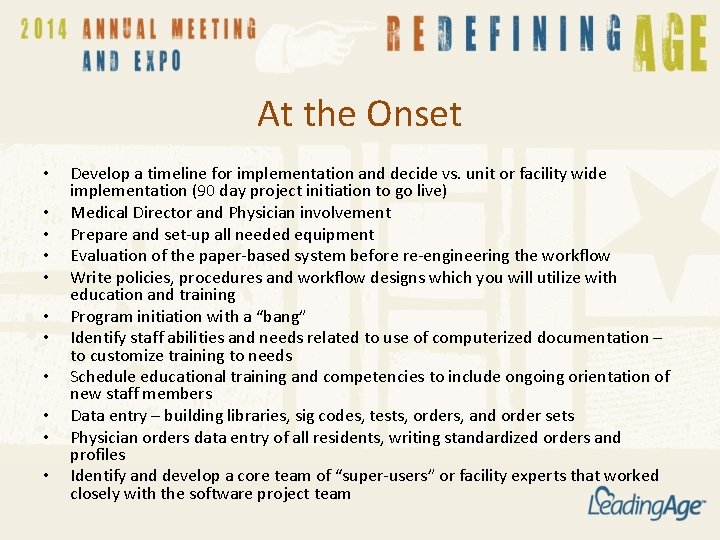
At the Onset • • • Develop a timeline for implementation and decide vs. unit or facility wide implementation (90 day project initiation to go live) Medical Director and Physician involvement Prepare and set-up all needed equipment Evaluation of the paper-based system before re-engineering the workflow Write policies, procedures and workflow designs which you will utilize with education and training Program initiation with a “bang” Identify staff abilities and needs related to use of computerized documentation – to customize training to needs Schedule educational training and competencies to include ongoing orientation of new staff members Data entry – building libraries, sig codes, tests, orders, and order sets Physician orders data entry of all residents, writing standardized orders and profiles Identify and develop a core team of “super-users” or facility experts that worked closely with the software project team
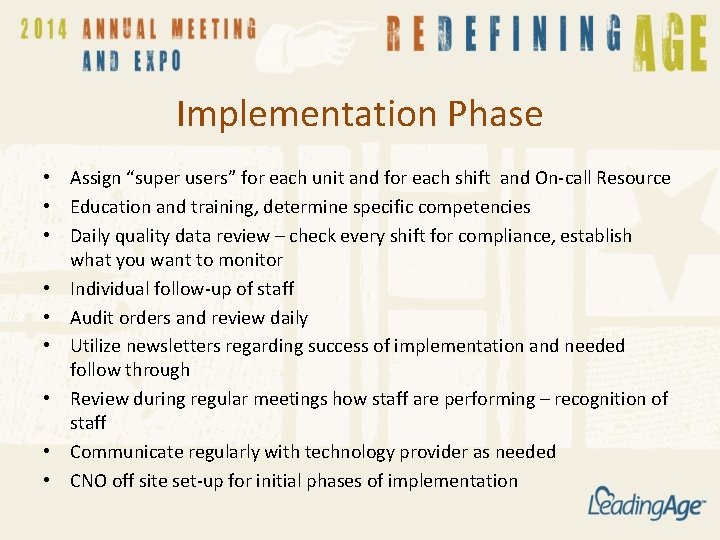
Implementation Phase • Assign “super users” for each unit and for each shift and On-call Resource • Education and training, determine specific competencies • Daily quality data review – check every shift for compliance, establish what you want to monitor • Individual follow-up of staff • Audit orders and review daily • Utilize newsletters regarding success of implementation and needed follow through • Review during regular meetings how staff are performing – recognition of staff • Communicate regularly with technology provider as needed • CNO off site set-up for initial phases of implementation
Ongoing Evaluation and Management Phase • • • Never “lax off”, continue to monitor daily compliance – managing right at your fingertips Assign the night shift and nurse managers to audit 24 hours Physician Orders for accuracy and completeness Review quality indicator reports, criteria and monitoring Supervisory daily audits – medications/treatments missed, overdue medications/treatments, compliance with pain medication documentation (including pre and post assessment of pain), tube feeding documentation, medication pass times etc. ) Continue to give feedback by individuals and group staff meetings – make this a part of the agenda Disciplinary process to be followed for continuous non-compliance Review with your mentors/preceptors things needed to be followed up on Monthly orders and turnover reviews Surveyor guidance – brief orientation and “cheat sheet” for guidance, assign contact person for each unit for any assistance needed
Education, Revisit-education, Competencies • Annually schedule educational programs to review processes – order entry, e. MAR, e. TAR documentation – at least 3 to 4 times per year • Orientation of new employees and agency staff to include competency with preceptors • Schedule orientees to work on the busiest unit for more experience • Monthly licensed staff and new orientee competency audits with medication passes. Currently doing 6 -10/month. • Identify specific preceptors and let them share their experiences during reeducation sessions • Continue to review quality indicator reports during staff meetings • “Love notes” to staff as needed and follow up individually • Managers to audit daily compliance and follow through with re-educating staff
Interfacing with Pharmacy Compatibility with interface Services offered Timelines Systems in place Super-users and Pharmacy support Meetings and Ongoing meetings to go over aspects that need to improve • Constant feedback regarding concerns and follow through • • •
Facility Review of Successes • • 50% reduction in time spent on medication administration with the electronic process New admission and readmission order audits with improved accuracy and compliance, current data 2014 1 st Quarter = 91. 4%, 2 nd Quarter = 93% and June 99. 4% In-house resident orders compliance rate at 99% Facility medication order error rate decreased from 6/1000 days to 1. 6/1000 days Drug omissions have decreased markedly and have almost become a thing of the past Processing discharges and completion time more efficient Financial savings related to high cost medication – therapeutic interchanges
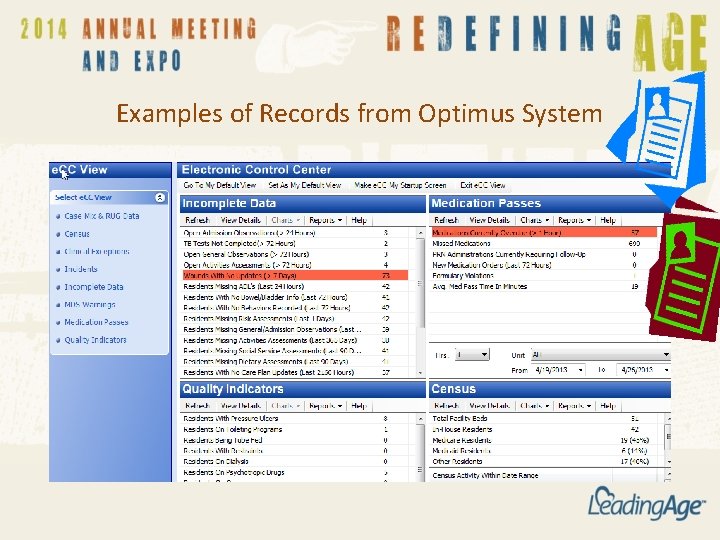
Examples of Records from Optimus System
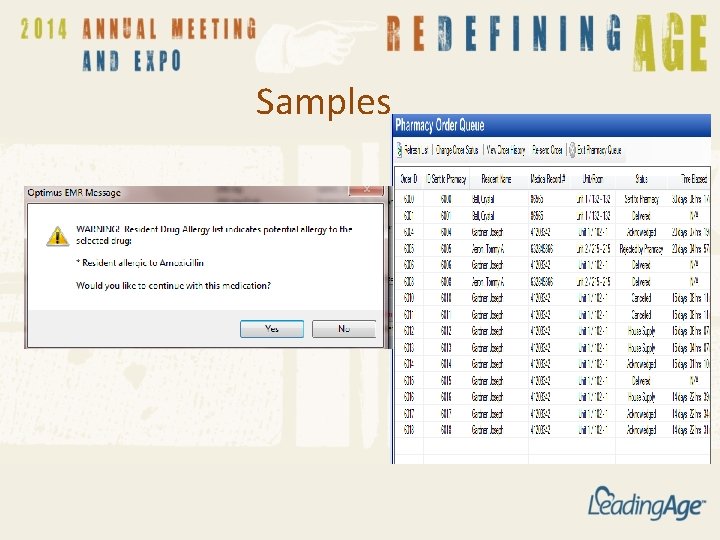
Samples
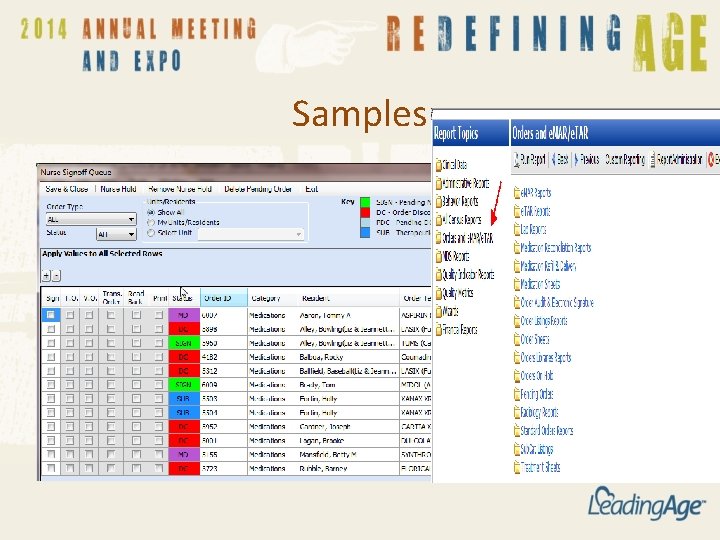
Samples
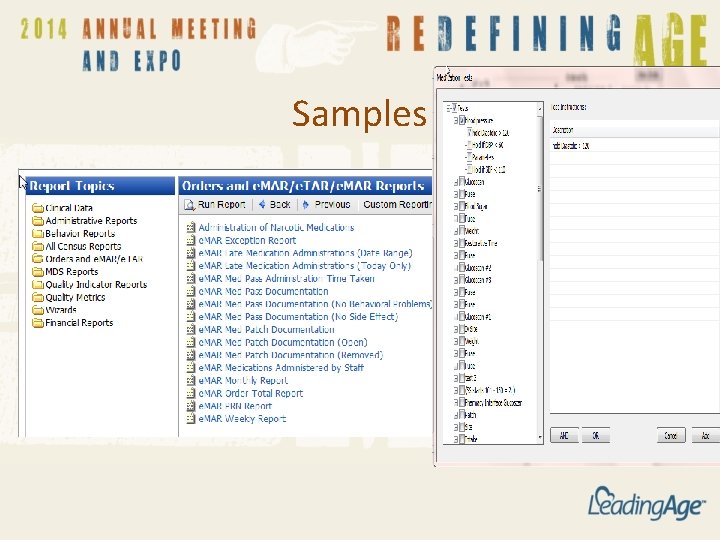
Samples
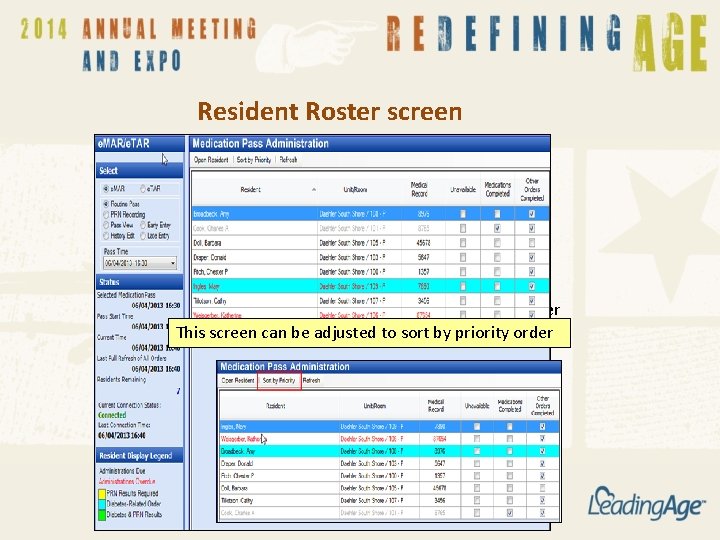
Resident Roster screen This screen can be adjusted to view in priority order This screen can be adjusted to sort by priority order
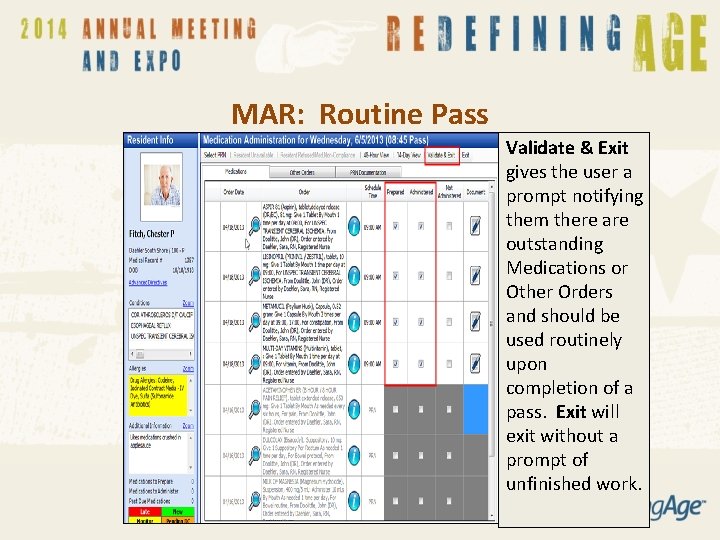
MAR: Routine Pass Validate & Exit gives the user a prompt notifying them there are outstanding Medications or Other Orders and should be used routinely upon completion of a pass. Exit will exit without a prompt of unfinished work.
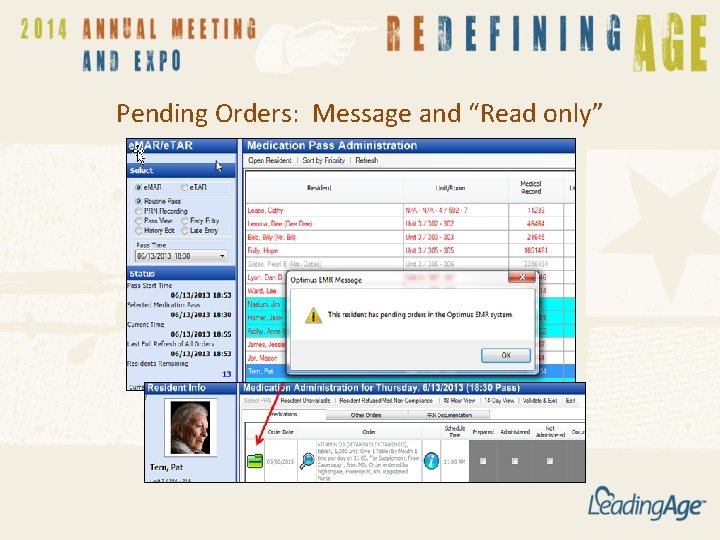
Pending Orders: Message and “Read only”
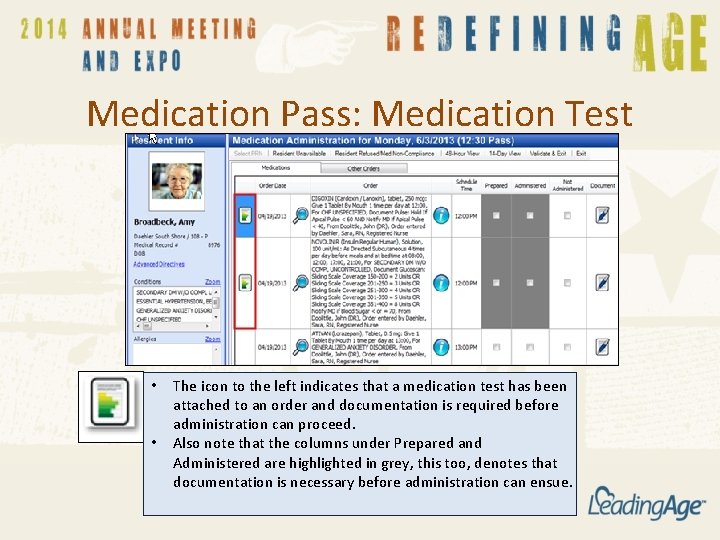
Medication Pass: Medication Test • • The icon to the left indicates that a medication test has been attached to an order and documentation is required before administration can proceed. Also note that the columns under Prepared and Administered are highlighted in grey, this too, denotes that documentation is necessary before administration can ensue.
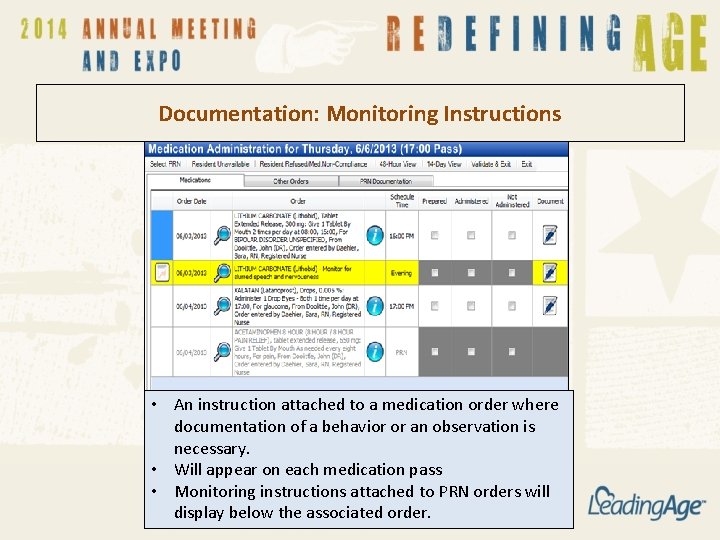
Documentation: Monitoring Instructions • An instruction attached to a medication order where documentation of a behavior or an observation is necessary. • Will appear on each medication pass • Monitoring instructions attached to PRN orders will display below the associated order.
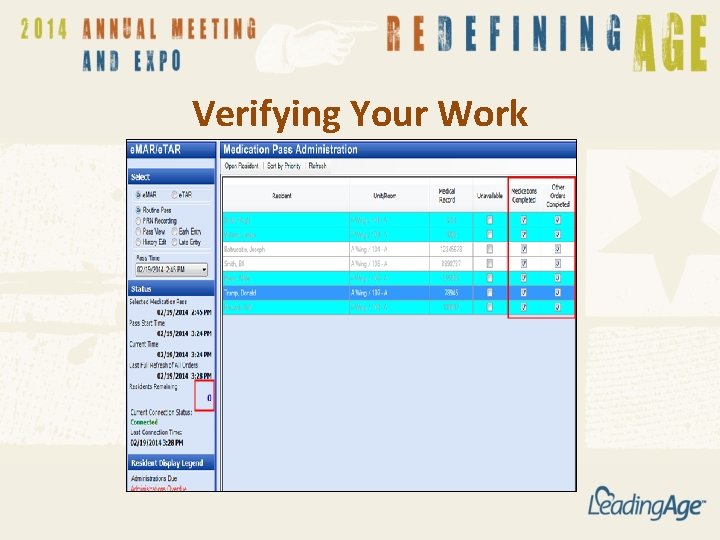
Verifying Your Work
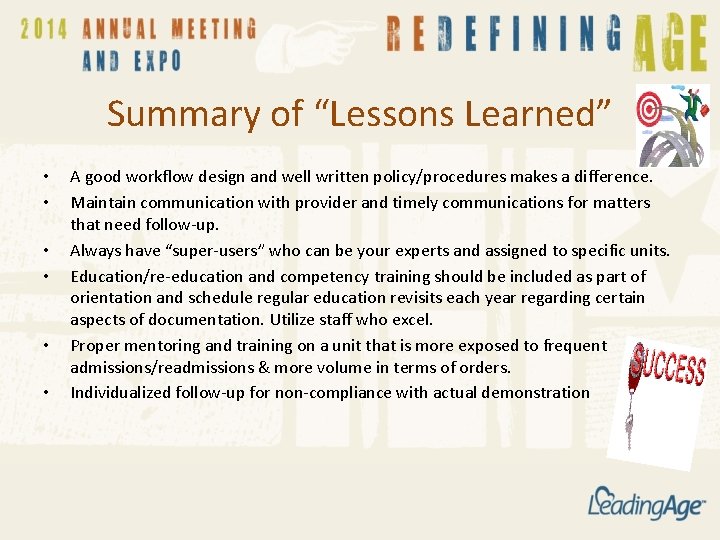
Summary of “Lessons Learned” • • • A good workflow design and well written policy/procedures makes a difference. Maintain communication with provider and timely communications for matters that need follow-up. Always have “super-users” who can be your experts and assigned to specific units. Education/re-education and competency training should be included as part of orientation and schedule regular education revisits each year regarding certain aspects of documentation. Utilize staff who excel. Proper mentoring and training on a unit that is more exposed to frequent admissions/readmissions & more volume in terms of orders. Individualized follow-up for non-compliance with actual demonstration
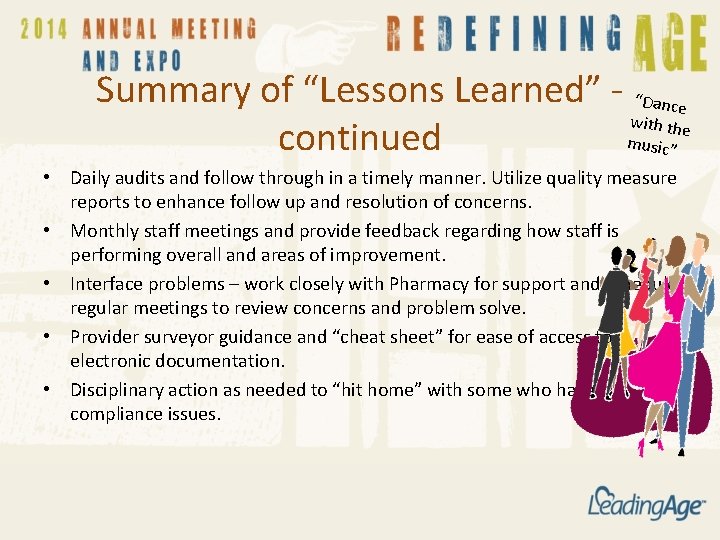
Summary of “Lessons Learned” - “Dance with the music” continued • Daily audits and follow through in a timely manner. Utilize quality measure reports to enhance follow up and resolution of concerns. • Monthly staff meetings and provide feedback regarding how staff is performing overall and areas of improvement. • Interface problems – work closely with Pharmacy for support and schedule regular meetings to review concerns and problem solve. • Provider surveyor guidance and “cheat sheet” for ease of access to electronic documentation. • Disciplinary action as needed to “hit home” with some who have compliance issues.
Summary of Outcomes 1. Significant improvement in quality indicator data which translates to increase in quality resident/family care 2. Facilitates readmission process through medication reconciliation 3. Documentation requirements better met as evidenced by great survey results and success with RAC audits 4. Discharge documentation and paperwork meets resident/family requirements and easy to follow 5. Improved communication with other providers – discharge assessments, notes, orders, e. MAR, e. TAR etc. which has facilitated the discharge process to a more time efficient one – hospital, doctors’ offices, and home health care 6. Cost effectiveness with therapeutic interchanges 7. More efficient medication management and better organization of the licensed staff nurses
SUCCESS and MY PHILOSOPHY • Remember that the success of implementation lies in the touch of a human being and that touch can change or break the chain. With careful education, training, and monitoring you can always achieve higher levels of success. ---Anabelle Locsin
References (Statistics) • Agrawal, Abha. Medication Errors: Prevention Using Information Technology Systems. http: //www. ncbi. nlm. nih. gov/pmc/articles/PMC 2723209/ 9/8/2014. • Electronic medication administration records improve communication and decision making in nursing homes. Research Activities, AHRQ, July 2009, No. 347. https: //archive. ahrq. gov/newsletters/researchactivities/jul 09/0709 RA 29. html 9/8/2014. • Hunter, Karen RN, BSN. Implementation of an Electronic Medication Administration Record and Bedside Verification System. http: //ojni. org/issues/? p=672 9/8/2014.
Questions?