Access to Core Instruction for All Erin Lavery




- Slides: 31
Access to Core Instruction for All Erin Lavery I Division of Special Populations I Fall 2019
Session Objectives • Recognize the reasons a student may not appear motivated in the classroom. • Explain how the educational climate and the environment are key levers in student achievement. • Describe what it looks like to “design for the edges. ” • Identify and use resources that support universal design for learning (UDL) and differentiation in the classroom.
Opening Reflection • Think of one student that you: – could not reach, or – failed to provide access for, or – wish you could go back and teach differently. • Think of a challenging student that: – you made a breakthrough with, or – you grew to love and understand, or – taught you something about yourself.
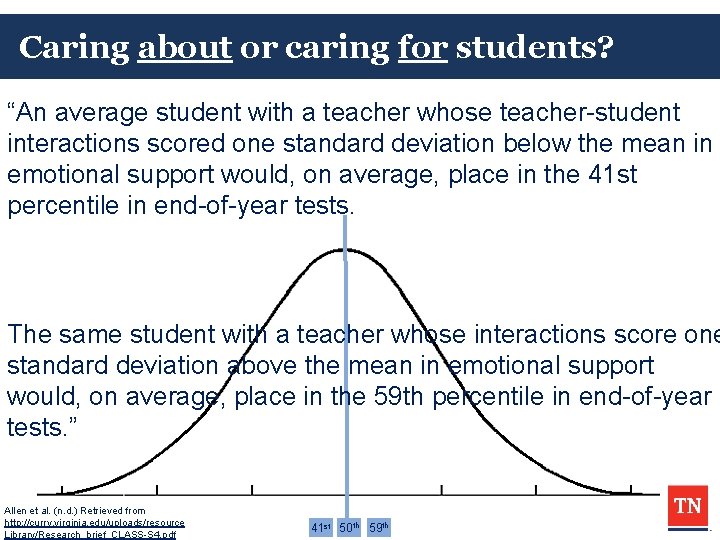
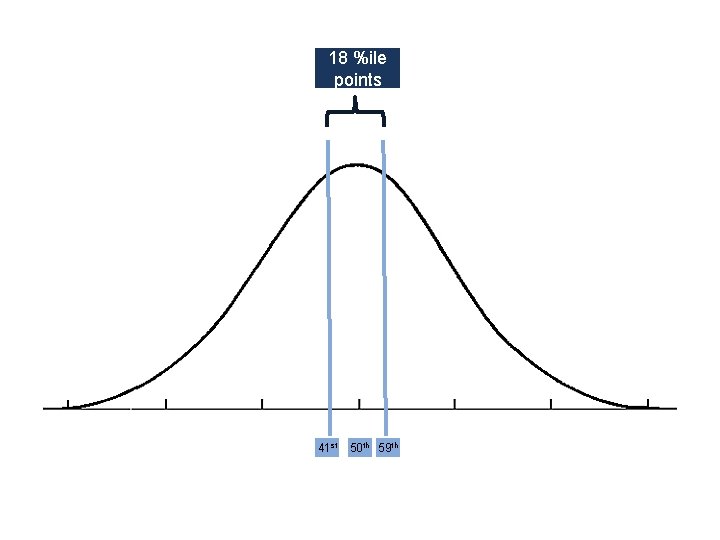
Caring about or caring for students? “An average student with a teacher whose teacher-student interactions scored one standard deviation below the mean in emotional support would, on average, place in the 41 st percentile in end-of-year tests. The same student with a teacher whose interactions score one standard deviation above the mean in emotional support would, on average, place in the 59 th percentile in end-of-year tests. ” Allen et al. (n. d. ) Retrieved from http: //curry. virginia. edu/uploads/resource Library/Research_brief_CLASS-S 4. pdf 41 st 50 th 59 th
18 %ile points 41 st 50 th 59 th
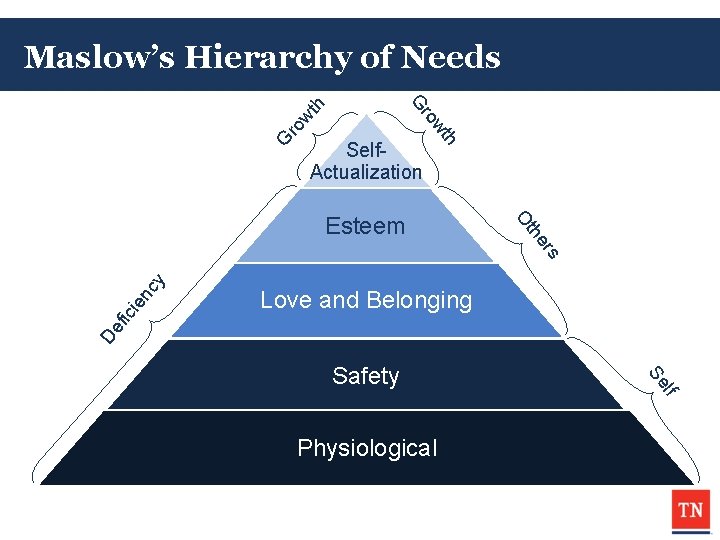
Maslow’s Hierarchy of Needs G ro h wt ro wt h G Self. Actualization er th O Esteem De fic ie nc y s Love and Belonging Physiological lf Se Safety
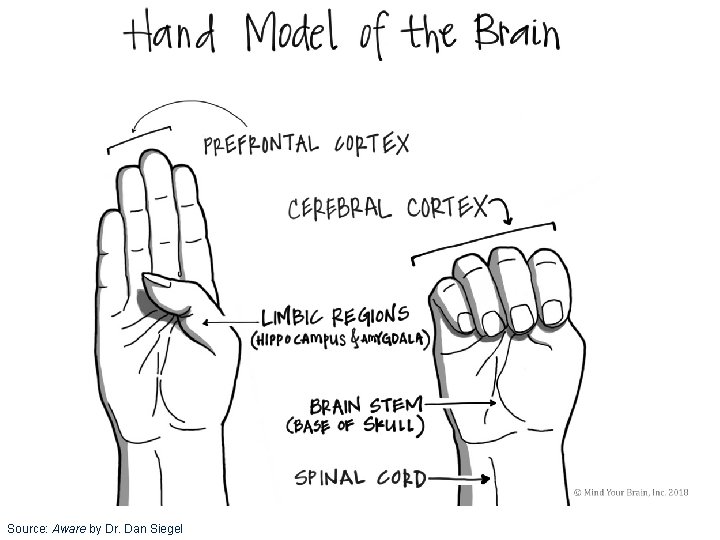
Switches us from info receivers to information “DJs” —essential for collaboration Source: Aware by Dr. Dan Siegel
How does this manifest? Flight • • • Avoids tasks Withdraws Avoids others Is disengaged Misses/avoids class Fight • Acts angry • Makes passiveaggressive comments • Makes light of situations • Is argumentative • Is fidgety Freeze • Refuses to give input • Refuses to participate • Seems unable to move forward • Refuses help
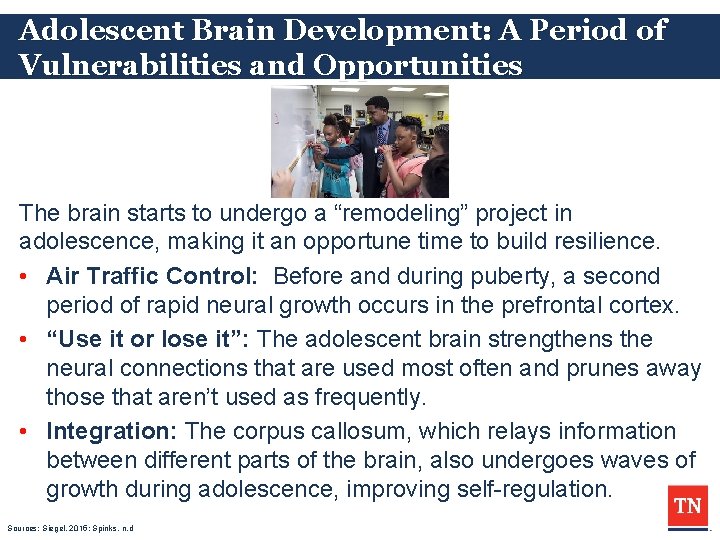
Adolescent Brain Development: A Period of Vulnerabilities and Opportunities The brain starts to undergo a “remodeling” project in adolescence, making it an opportune time to build resilience. • Air Traffic Control: Before and during puberty, a second period of rapid neural growth occurs in the prefrontal cortex. • “Use it or lose it”: The adolescent brain strengthens the neural connections that are used most often and prunes away those that aren’t used as frequently. • Integration: The corpus callosum, which relays information between different parts of the brain, also undergoes waves of growth during adolescence, improving self-regulation. Sources: Siegel, 2015; Spinks, n. d
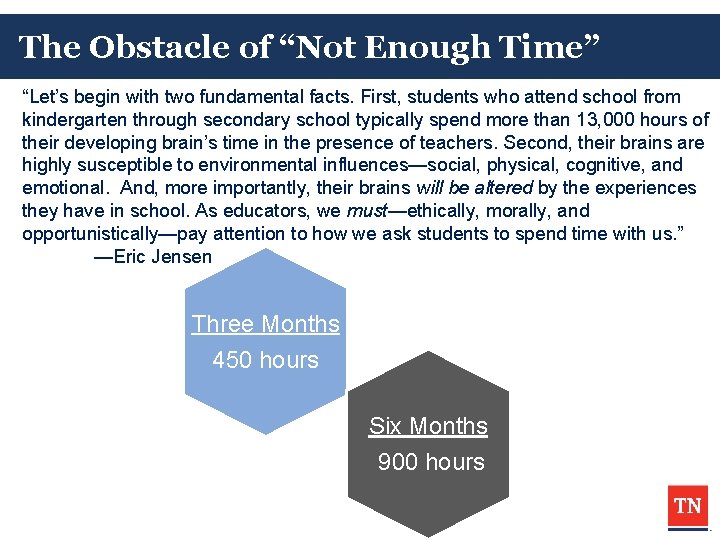
The Obstacle of “Not Enough Time” “Let’s begin with two fundamental facts. First, students who attend school from kindergarten through secondary school typically spend more than 13, 000 hours of their developing brain’s time in the presence of teachers. Second, their brains are highly susceptible to environmental influences—social, physical, cognitive, and emotional. And, more importantly, their brains will be altered by the experiences they have in school. As educators, we must—ethically, morally, and opportunistically—pay attention to how we ask students to spend time with us. ” —Eric Jensen Three Months 450 hours Six Months 900 hours
Motivation and Language When you call a child “unmotivated” or “lazy, ” you steal his dignity, diminish your power and abdicate your responsibility.
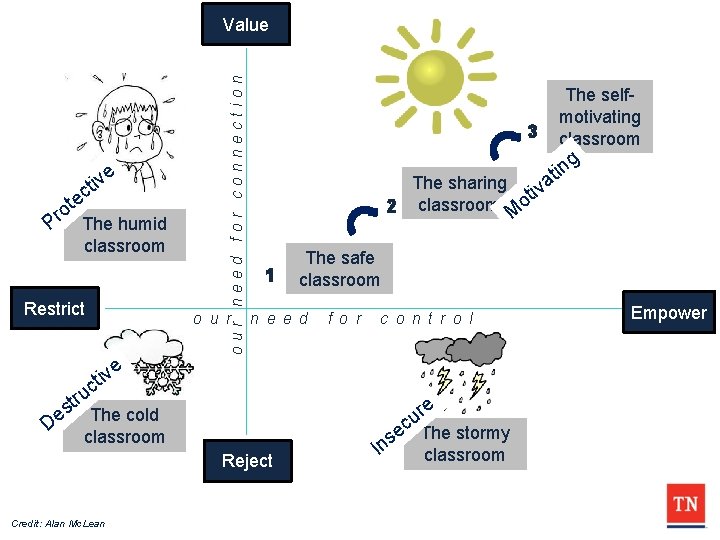
ive t ec ot r P The humid classroom Restrict our need for connection Value 3 g tin The sharing iva t 2 classroom Mo 1 The safe classroom o u r n e e d f o r c o n t r o l e iv ct tru s The cold De re u c classroom Reject Credit: Alan Mc. Lean The selfmotivating classroom I e The stormy s n classroom Empower
Environment: Teachers and Students • Classrooms with respectful environments exhibit more student engagement and fewer negative behaviors. • Students feel welcomed and valued regardless of their level of readiness. • The teacher is confident in the capacity of all students to learn and his/her ability to teach them. • Growth is reciprocal between the teacher and student. • Success and failures are inevitable and valuable in the learning process; the classroom is a safe place for both. • Hard work results in observable growth. • Hard work and growth are celebrated by the teacher and student. Source: Differentiation and the Brain, Tomlinson & Murphy (2015)
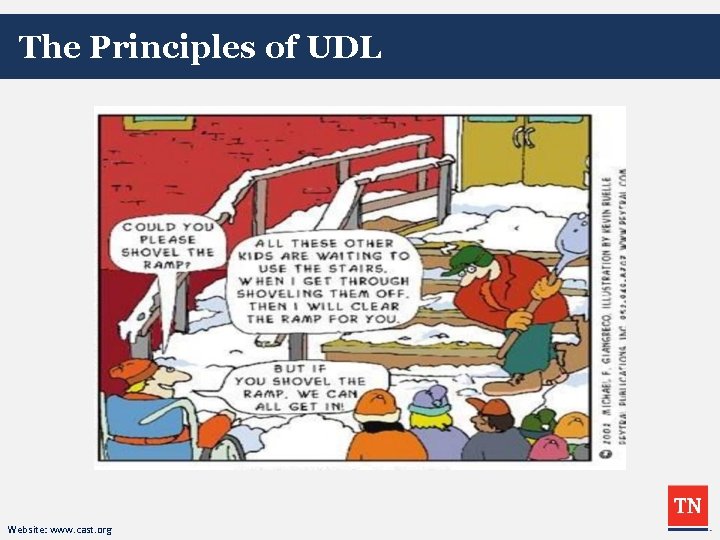
The Principles of UDL Website: www. cast. org
Universal Design for Learning (UDL)
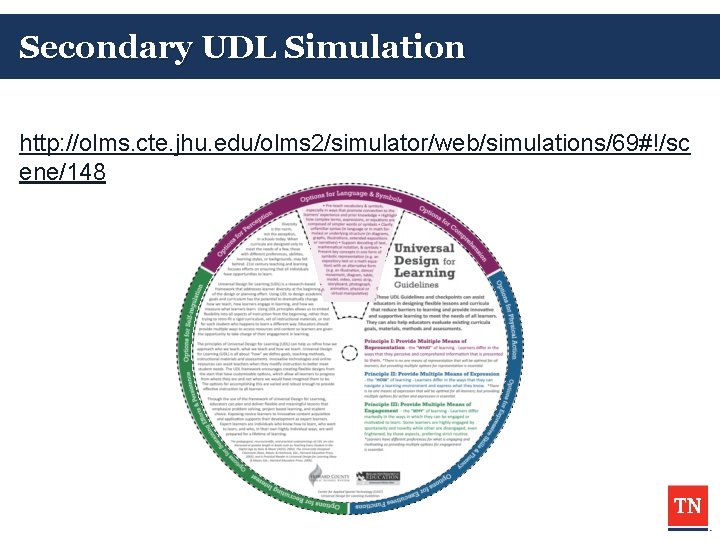
Secondary UDL Simulation http: //olms. cte. jhu. edu/olms 2/simulator/web/simulations/69#!/sc ene/148
Accommodations and Modifications • Accommodations – Change how the student is taught or expected to learn • Modifications – Change what the student is expected to learn
Sort the accommodations/ modifications into three categories (use “best fit”): Universal Design Accommodation Audio Books Audio Books Modification This greater access to flexibility in curriculum, instruction, and assessment are delivery, and multiple options in the way students can respond to instruction for demonstrating their knowledge should reduce the need for singling out individual students to provide accommodations.
The Essence of Differentiation is having a diverse repertoire of responses, so that I can respond to the needs of my students. So, many people call differentiation “ responsive teaching” or “ respectful teaching. ” ~Rick Wormeli
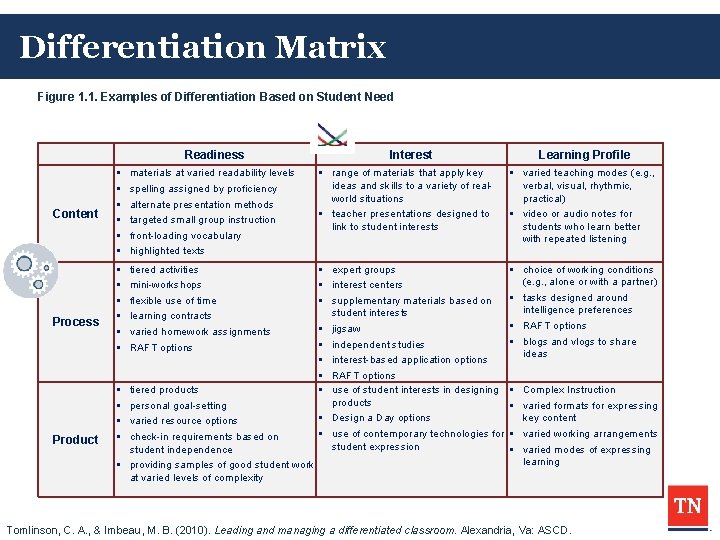
Differentiation Matrix Figure 1. 1. Examples of Differentiation Based on Student Need Readiness Content Process Product Interest Learning Profile § § § materials at varied readability levels spelling assigned by proficiency alternate presentation methods targeted small group instruction front-loading vocabulary highlighted texts § range of materials that apply key ideas and skills to a variety of realworld situations § teacher presentations designed to link to student interests § § § tiered activities mini-workshops flexible use of time learning contracts varied homework assignments RAFT options § expert groups § § interest centers § supplementary materials based on § student interests § § jigsaw § § independent studies § interest-based application options § RAFT options § use of student interests in designing § products § § Design a Day options § use of contemporary technologies for § student expression § § § tiered products personal goal-setting varied resource options check-in requirements based on student independence § providing samples of good student work at varied levels of complexity § varied teaching modes (e. g. , verbal, visual, rhythmic, practical) § video or audio notes for students who learn better with repeated listening choice of working conditions (e. g. , alone or with a partner) tasks designed around intelligence preferences RAFT options blogs and vlogs to share ideas Complex Instruction varied formats for expressing key content varied working arrangements varied modes of expressing learning Tomlinson, C. A. , & Imbeau, M. B. (2010). Leading and managing a differentiated classroom. Alexandria, Va: ASCD.
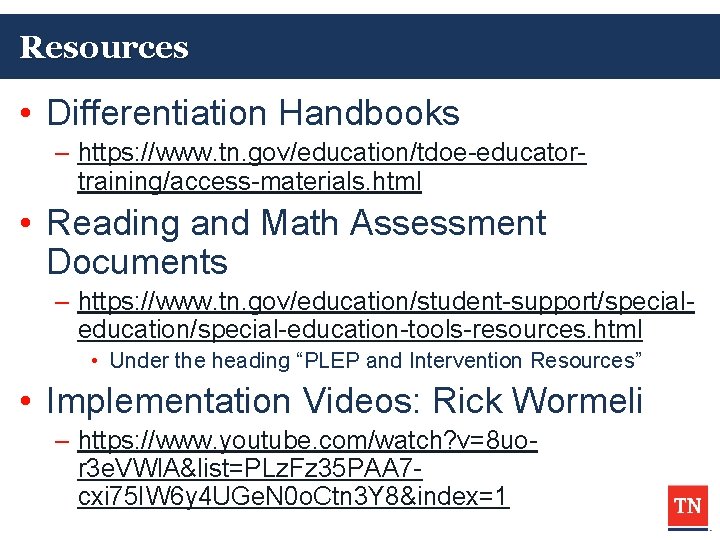
Resources • Differentiation Handbooks – https: //www. tn. gov/education/tdoe-educatortraining/access-materials. html • Reading and Math Assessment Documents – https: //www. tn. gov/education/student-support/specialeducation/special-education-tools-resources. html • Under the heading “PLEP and Intervention Resources” • Implementation Videos: Rick Wormeli – https: //www. youtube. com/watch? v=8 uor 3 e. VWl. A&list=PLz. Fz 35 PAA 7 cxi 75 IW 6 y 4 UGe. N 0 o. Ctn 3 Y 8&index=1
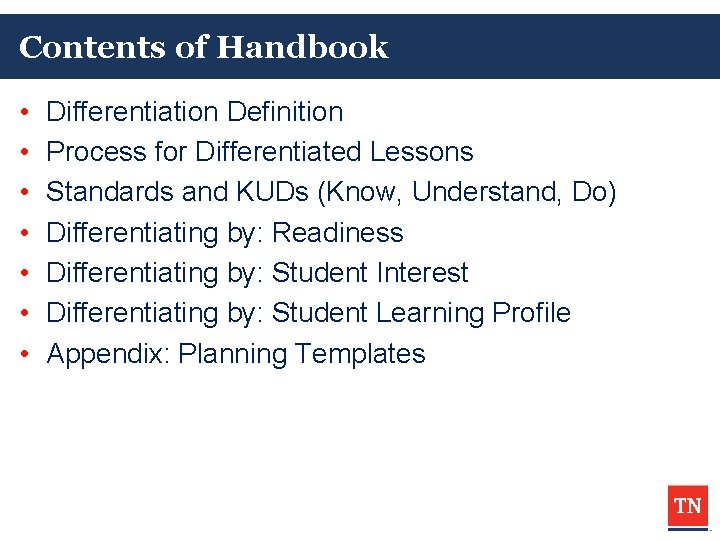
Contents of Handbook • • Differentiation Definition Process for Differentiated Lessons Standards and KUDs (Know, Understand, Do) Differentiating by: Readiness Differentiating by: Student Interest Differentiating by: Student Learning Profile Appendix: Planning Templates
Bridge to Practice The handbooks are a great resource, but… • What else is required in order to make change? • In your classroom/school/district, what areas need immediate attention?
Moving Forward: Next Steps • Be realistic and start differentiating a little at a time. Mastery requires a focus on the journey not a destination. • Collaboration between teachers is key. • Change will occur only when mindset and resources are both in line with the reality you are trying to create. Students deserve a system-wide effort to ensure that all educators believe in their ability to teach all students.
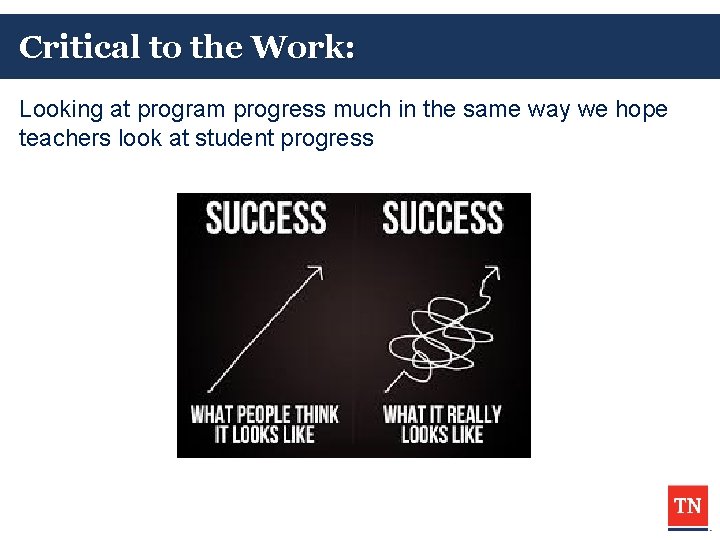
Critical to the Work: Looking at program progress much in the same way we hope teachers look at student progress
“I have spread my dreams under your feet; Tread softly because you tread on my dreams. ” And every day, everywhere, Our children spread their dreams beneath our feet; And we should tread softly.
Contact Erin Lavery Intervention Specialist Division of Special Populations Erin. Lavery@tn. gov