A childyoung person with ED on the ward
- Slides: 29
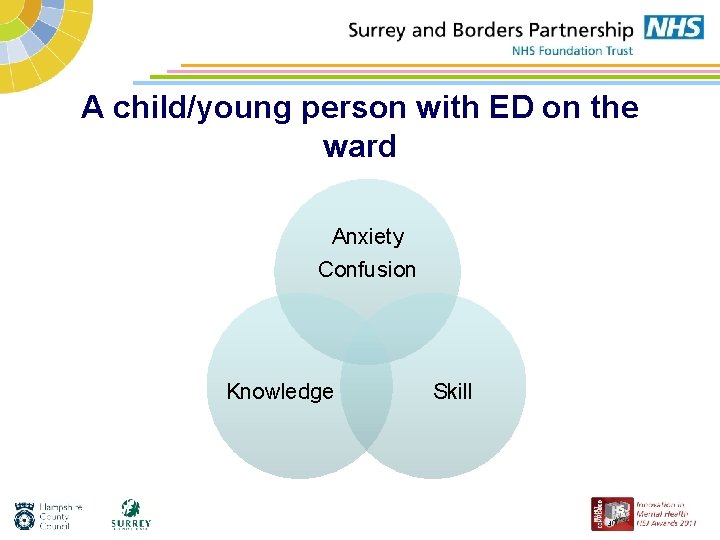
A child/young person with ED on the ward Anxiety Confusion Knowledge Skill
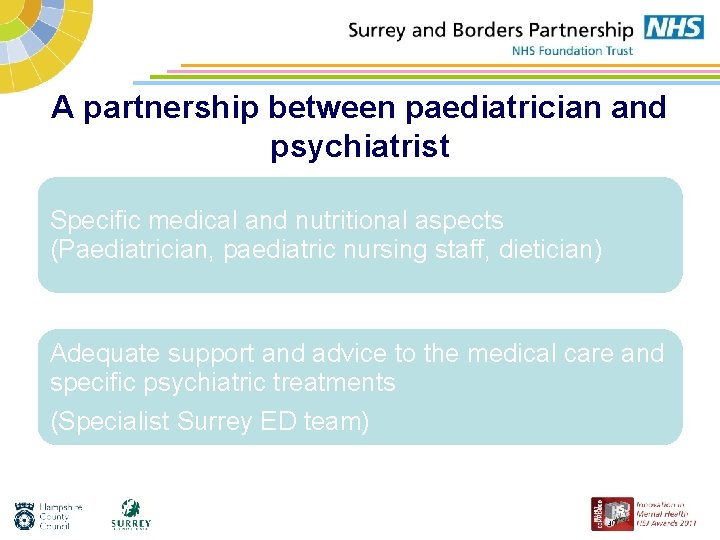
A partnership between paediatrician and psychiatrist Specific medical and nutritional aspects (Paediatrician, paediatric nursing staff, dietician) Adequate support and advice to the medical care and specific psychiatric treatments (Specialist Surrey ED team)
Eating Disorders in Children and Adolescents Management of the Really Sick Patient with Anorexia nervosa (MARSIPAN)
Guidance from the Junior MARSIPAN • • • Risk assessment, physical examination and associated action Location of care and transition between services Compulsory treatment Paediatric admission and local protocols Management of re-feeding Management of compensatory behaviours associated with an ED in a paediatric setting • Management in primary care and paediatric out –patient settings • Discharge from paediatric settings • Management in specialist CAMHS in-patient settings
Recommended Practice • Guidelines on medical management aimed primarily at junior staff • A guide for nursing and medical staff on supporting parents and families • Regular staff meetings to ensure a consistent approach and minimise the risk of splitting • Regular multidisciplinary team meeting weekly or more – Review progress, review future plans and record and discharge planning • Formulate a nursing plan
Overview • • • Medical Reasons for a paediatric admission Presentations Behavioural Manifestations Families Risk Assessment Key assessment parameters and action points Compulsory Treatment Some practical considerations and dietetic input Re-feeding Syndrome Discussion of a case
Medical reasons for in-patient paediatric admission • The need for IV fluids to correct electrolyte abnormality • Re-feeding for severe malnutrition • Management of physical complications of severe malnutrition and/or associated behaviours (eg Purging) • Management of acute medical illness unrelated to anorexia nervosa if present
Presentations – Anorexia nervosa • Refusal to maintain body weight or failure to gain weight during a period of growth • Intense fear of gaining weight • Disturbed body perception • Undue influence of body weight or shape on self-esteem • Denial of seriousness of current low body weight • Secondary amenorrhoea in girls post-menarche.
Behavioural Manifestations • • • Excessive exercise/Activity Purging Bingeing Self-harm Co-morbid psychiatric conditions – OCD, Anxiety, Depression • Violent and disturbed behaviours
Families • • • Families do not cause eating disorders Parents are the best considered partners in recovery Families are organised by the eating disorder Parental anxiety can be high Separation anxiety is common NICE guidelines
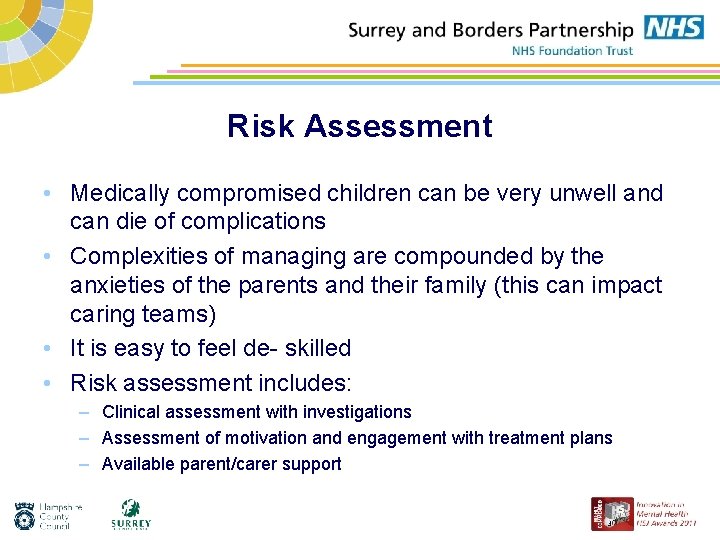
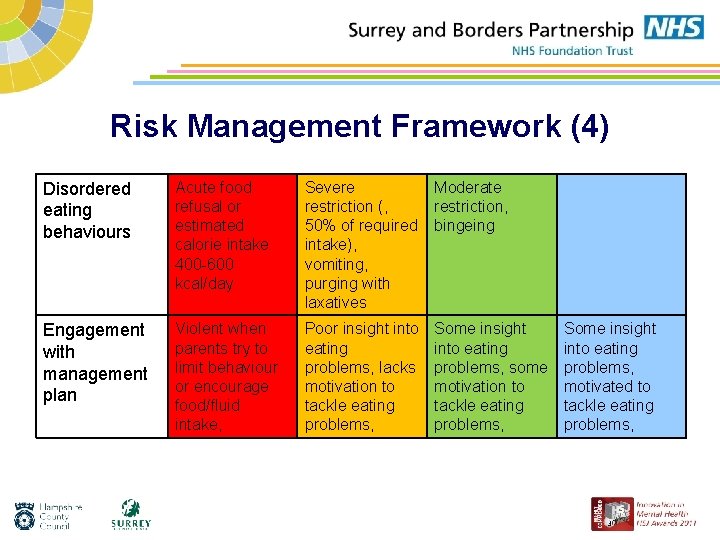
Risk Assessment • Medically compromised children can be very unwell and can die of complications • Complexities of managing are compounded by the anxieties of the parents and their family (this can impact caring teams) • It is easy to feel de- skilled • Risk assessment includes: – Clinical assessment with investigations – Assessment of motivation and engagement with treatment plans – Available parent/carer support
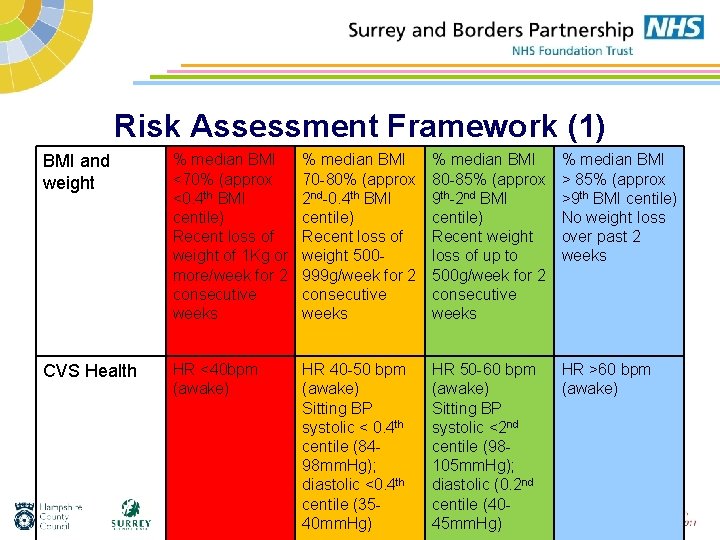
Risk Assessment Framework (1) BMI and weight % median BMI <70% (approx <0. 4 th BMI centile) Recent loss of weight of 1 Kg or more/week for 2 consecutive weeks % median BMI 70 -80% (approx 2 nd-0. 4 th BMI centile) Recent loss of weight 500999 g/week for 2 consecutive weeks % median BMI 80 -85% (approx 9 th-2 nd BMI centile) Recent weight loss of up to 500 g/week for 2 consecutive weeks % median BMI > 85% (approx >9 th BMI centile) No weight loss over past 2 weeks CVS Health HR <40 bpm (awake) HR 40 -50 bpm (awake) Sitting BP systolic < 0. 4 th centile (8498 mm. Hg); diastolic <0. 4 th centile (3540 mm. Hg) HR 50 -60 bpm (awake) Sitting BP systolic <2 nd centile (98105 mm. Hg); diastolic (0. 2 nd centile (4045 mm. Hg) HR >60 bpm (awake)
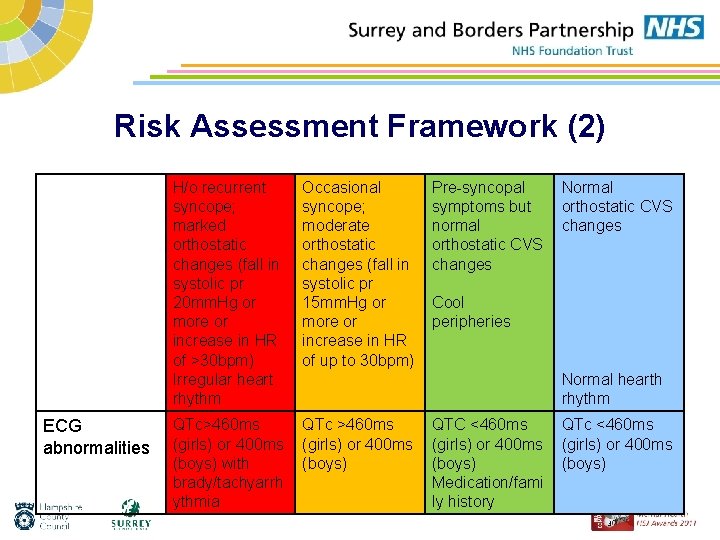
Risk Assessment Framework (2) ECG abnormalities H/o recurrent syncope; marked orthostatic changes (fall in systolic pr 20 mm. Hg or more or increase in HR of >30 bpm) Irregular heart rhythm Occasional syncope; moderate orthostatic changes (fall in systolic pr 15 mm. Hg or more or increase in HR of up to 30 bpm) QTc>460 ms (girls) or 400 ms (boys) with brady/tachyarrh ythmia QTc >460 ms (girls) or 400 ms (boys) Pre-syncopal symptoms but normal orthostatic CVS changes Normal orthostatic CVS changes Cool peripheries Normal hearth rhythm QTC <460 ms (girls) or 400 ms (boys) Medication/fami ly history QTc <460 ms (girls) or 400 ms (boys)
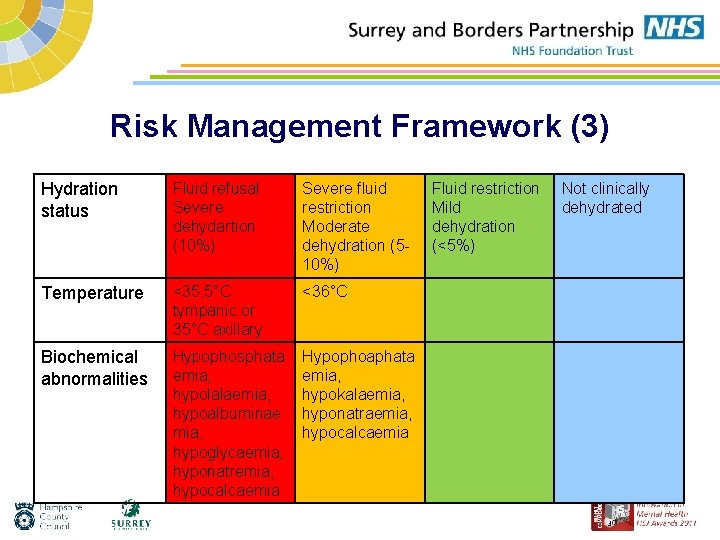
Risk Management Framework (3) Hydration status Fluid refusal Severe dehydartion (10%) Severe fluid restriction Moderate dehydration (510%) Temperature <35. 5°C tympanic or 35°C axillary <36°C Biochemical abnormalities Hypophosphata emia, hypolalaemia, hypoalbuminae mia, hypoglycaemia, hyponatremia, hypocalcaemia Hypophoaphata emia, hypokalaemia, hyponatraemia, hypocalcaemia Fluid restriction Mild dehydration (<5%) Not clinically dehydrated
Risk Management Framework (4) Disordered eating behaviours Acute food refusal or estimated calorie intake 400 -600 kcal/day Severe restriction (, 50% of required intake), vomiting, purging with laxatives Moderate restriction, bingeing Engagement with management plan Violent when parents try to limit behaviour or encourage food/fluid intake, Poor insight into eating problems, lacks motivation to tackle eating problems, Some insight into eating problems, some motivation to tackle eating problems, Some insight into eating problems, motivated to tackle eating problems,
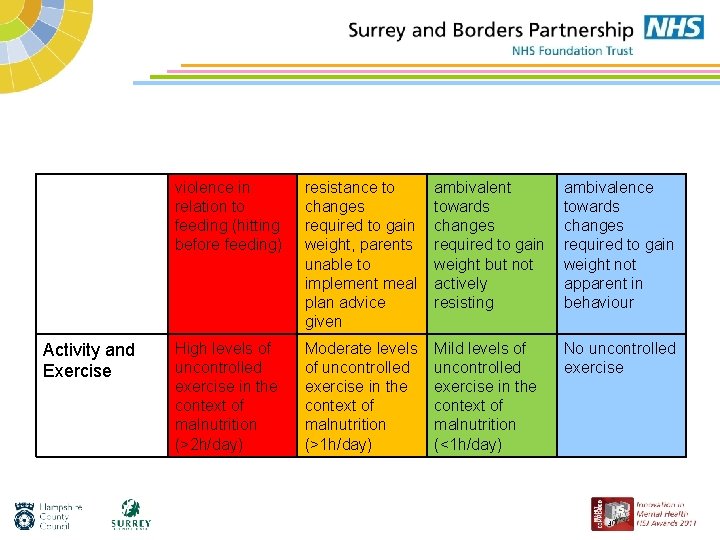
Activity and Exercise violence in relation to feeding (hitting before feeding) resistance to changes required to gain weight, parents unable to implement meal plan advice given ambivalent towards changes required to gain weight but not actively resisting ambivalence towards changes required to gain weight not apparent in behaviour High levels of uncontrolled exercise in the context of malnutrition (>2 h/day) Moderate levels of uncontrolled exercise in the context of malnutrition (>1 h/day) Mild levels of uncontrolled exercise in the context of malnutrition (<1 h/day) No uncontrolled exercise
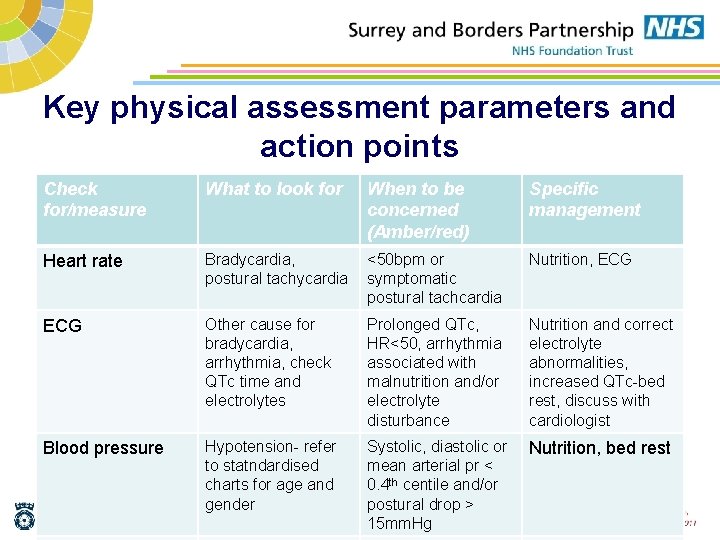
Key physical assessment parameters and action points Check for/measure What to look for When to be concerned (Amber/red) Specific management Heart rate Bradycardia, postural tachycardia <50 bpm or symptomatic postural tachcardia Nutrition, ECG Other cause for bradycardia, arrhythmia, check QTc time and electrolytes Prolonged QTc, HR<50, arrhythmia associated with malnutrition and/or electrolyte disturbance Nutrition and correct electrolyte abnormalities, increased QTc-bed rest, discuss with cardiologist Blood pressure Hypotension- refer to statndardised charts for age and gender Systolic, diastolic or mean arterial pr < 0. 4 th centile and/or postural drop > 15 mm. Hg Nutrition, bed rest
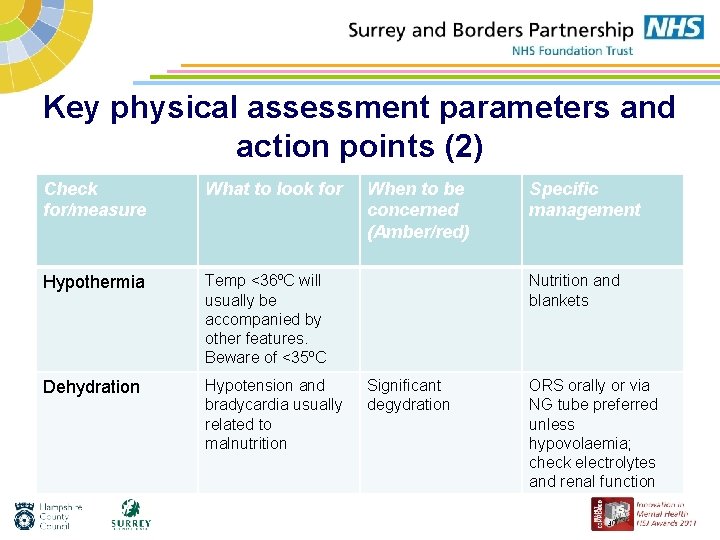
Key physical assessment parameters and action points (2) Check for/measure What to look for Hypothermia Temp <36ºC will usually be accompanied by other features. Beware of <35ºC Dehydration Hypotension and bradycardia usually related to malnutrition When to be concerned (Amber/red) Specific management Nutrition and blankets Significant degydration ORS orally or via NG tube preferred unless hypovolaemia; check electrolytes and renal function
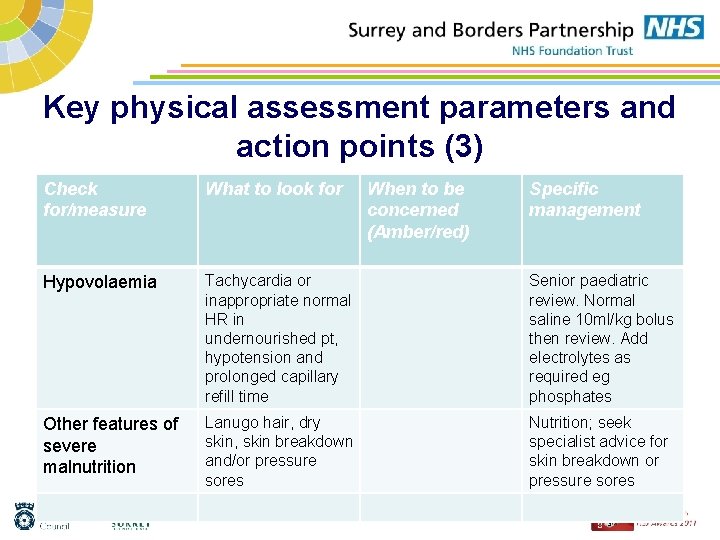
Key physical assessment parameters and action points (3) Check for/measure What to look for When to be concerned (Amber/red) Specific management Hypovolaemia Tachycardia or inappropriate normal HR in undernourished pt, hypotension and prolonged capillary refill time Senior paediatric review. Normal saline 10 ml/kg bolus then review. Add electrolytes as required eg phosphates Other features of severe malnutrition Lanugo hair, dry skin, skin breakdown and/or pressure sores Nutrition; seek specialist advice for skin breakdown or pressure sores
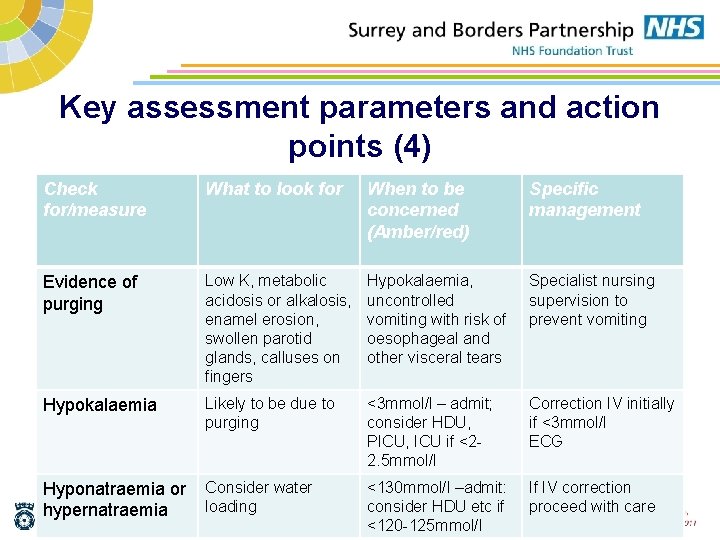
Key assessment parameters and action points (4) Check for/measure What to look for When to be concerned (Amber/red) Specific management Evidence of purging Low K, metabolic acidosis or alkalosis, enamel erosion, swollen parotid glands, calluses on fingers Hypokalaemia, uncontrolled vomiting with risk of oesophageal and other visceral tears Specialist nursing supervision to prevent vomiting Hypokalaemia Likely to be due to purging <3 mmol/l – admit; consider HDU, PICU, ICU if <22. 5 mmol/l Correction IV initially if <3 mmol/l ECG Hyponatraemia or hypernatraemia Consider water loading <130 mmol/l –admit: consider HDU etc if <120 -125 mmol/l If IV correction proceed with care
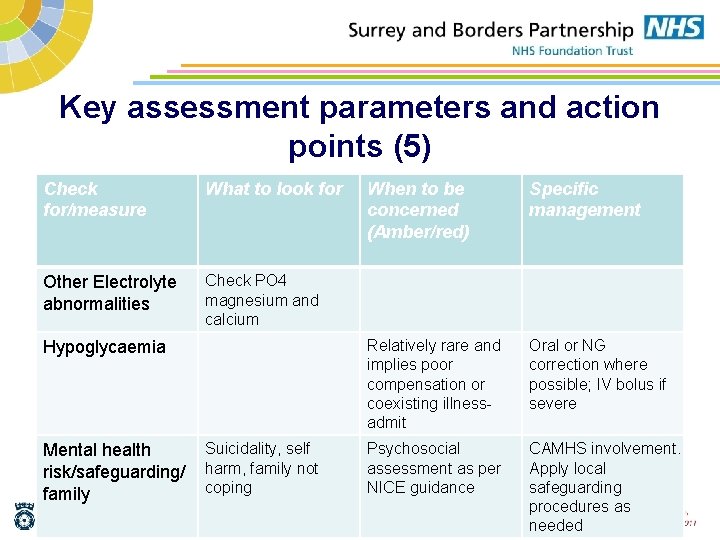
Key assessment parameters and action points (5) Check for/measure What to look for Other Electrolyte abnormalities Check PO 4 magnesium and calcium Hypoglycaemia Mental health risk/safeguarding/ family Suicidality, self harm, family not coping When to be concerned (Amber/red) Specific management Relatively rare and implies poor compensation or coexisting illnessadmit Oral or NG correction where possible; IV bolus if severe Psychosocial assessment as per NICE guidance CAMHS involvement. Apply local safeguarding procedures as needed
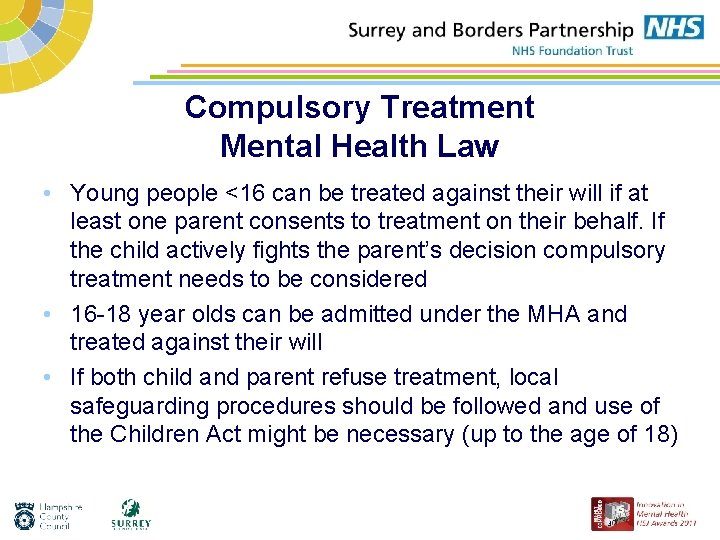
Compulsory Treatment Mental Health Law • Young people <16 can be treated against their will if at least one parent consents to treatment on their behalf. If the child actively fights the parent’s decision compulsory treatment needs to be considered • 16 -18 year olds can be admitted under the MHA and treated against their will • If both child and parent refuse treatment, local safeguarding procedures should be followed and use of the Children Act might be necessary (up to the age of 18)
Other compulsory treatments for <18 • Children Act 1989 – Specific issue Order (section 8) can be used to pass a NG tube – Care Order (section 37) can be applied if a child is thought to be at risk of significant harm because of care given or not given – Inherent Jurisdiction of the Court (section 100) can be used to treat against a child’s will when there are wider-ranging and longer-term issues • UN Convention on the Rights of Children 1991 – Children’s right to form and express their views (Article 12) – Best interests of the child (Article 3) – Responsibilities, rights and duties of parents (Article 5)
Some practical considerations • Place of nursing – general not separate cubicle • Nursing care – Identify core group of nurses to provide continuity and consistency – Special nursing- appropriate training – Parent’s role • Education – Teaching staff need to be aware • Social interaction • Time off ward – May require restriction
Dietetic Input • Paediatric dieticians are essential • Devise a safe meal plan and agree with team and family (consult parents) • Meal plan should ideally comprise solid food. Make up with Fortisip if meal is not completed • If unable to meet the presribed calorie intake within 24 hours consider insertion of NG tube (balance the risk and wishes of child/parents) • In early stages of re-feeding meal plans should not exceed the recommended guidelines of 50% TEI
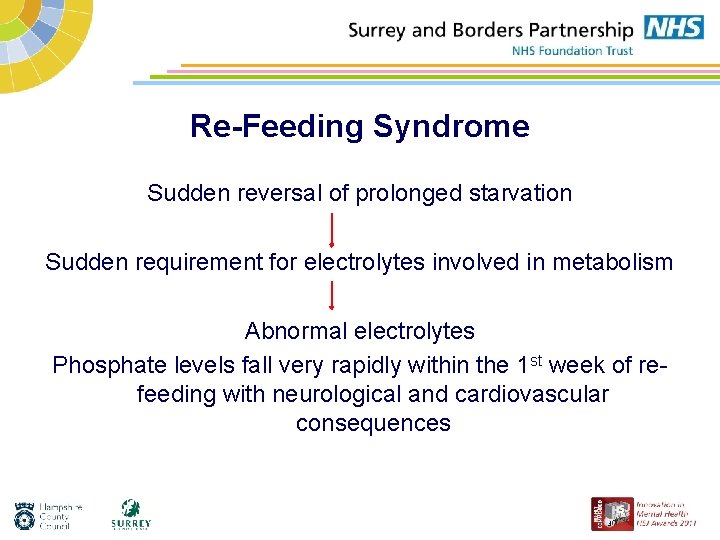
Re-Feeding Syndrome Sudden reversal of prolonged starvation Sudden requirement for electrolytes involved in metabolism Abnormal electrolytes Phosphate levels fall very rapidly within the 1 st week of refeeding with neurological and cardiovascular consequences
Re-feeding syndrome • No evidence based guidelines for re-feeding • A common recommendation is to increase daily from a baseline intake by 200 kcal/day • If phosphate drops, intake should be static until it stabilises • Blood tests done daily in the first 2 -5 days and repeat after 7 -10 dyas • Syndrome can develop later and blood tests should continue for 2 weeks or until stable
Case Discussion • 15 year old girl- “Amy”. Parents, 13 year old sister • Monday: Private GP: wt: 32 kg, Ht: 161 cm Marginally low PO 4; murmur. ? wt 36 kg x 2 years • Wednesday: Sent to local DGH for inv of murmur-Found to have MR. Possibly congenital? Or effect of ED? • Thursday: CYPS EDS: wt: 29 kg W 4 H: 54% Now eating more
Case Discussion • Friday: Back to DGH. Private assessment cancelled • W/E: Back to DGH • Monday: Assessment ED inpatient unit • Tuesday: ? ? ?