2018 OSEP Project Directors Conference DISCLAIMER The contents











- Slides: 42
2018 OSEP Project Directors’ Conference DISCLAIMER: The contents of this presentation were developed by the presenters for the 2018 Project Directors’ Conference. However, these contents do not necessarily represent the policy of the Department of Education, and you should not assume endorsement by the Federal Government. (Authority: 20 U. S. C. 1221 e-3 and 3474)
OSEP Project Directors Conference: National Collaborative on Inclusive Principal Leadership July 24, 2018
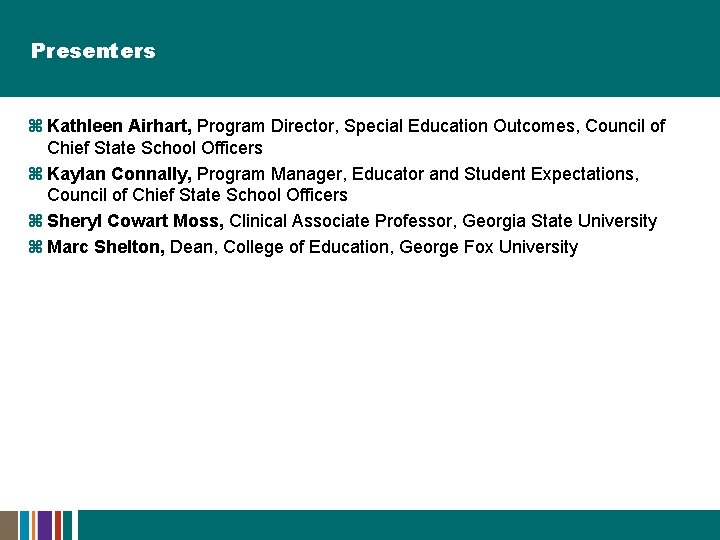
Presenters z Kathleen Airhart, Program Director, Special Education Outcomes, Council of Chief State School Officers z Kaylan Connally, Program Manager, Educator and Student Expectations, Council of Chief State School Officers z Sheryl Cowart Moss, Clinical Associate Professor, Georgia State University z Marc Shelton, Dean, College of Education, George Fox University
Overview z Overview of CCSSO’s Strategic Support to States and the National Collaborative on Inclusive Principal Leadership State-Level Guidance z The Georgia Context z The Oregon Context z Leader Preparation Exemplars
Overview of CCSSO’s 2017 -2020 Strategic Plan 2017 -2020 CCSSO Strategic Plan
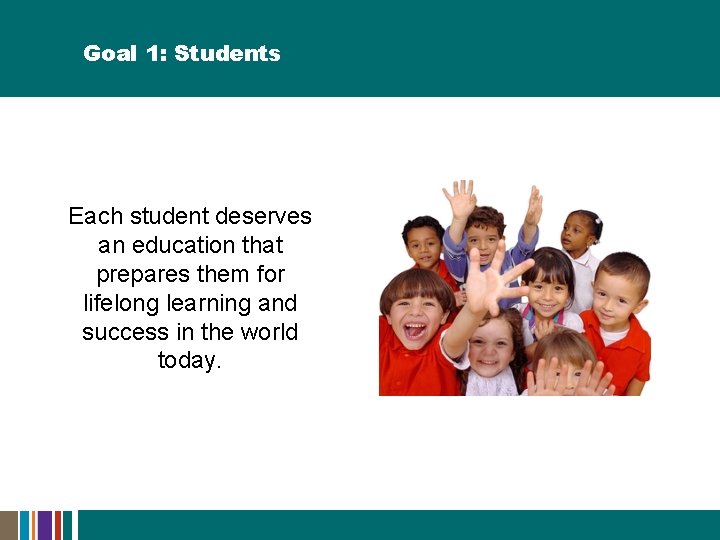
Goal 1: Students Each student deserves an education that prepares them for lifelong learning and success in the world today.
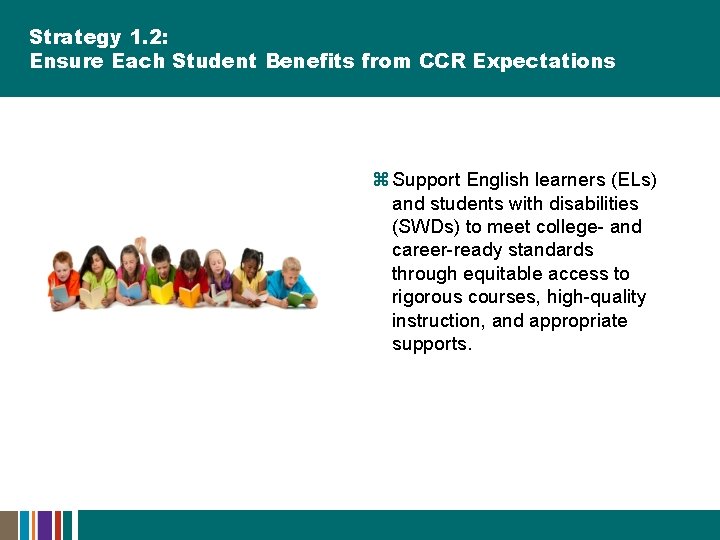
Strategy 1. 2: Ensure Each Student Benefits from CCR Expectations z Support English learners (ELs) and students with disabilities (SWDs) to meet college- and career-ready standards through equitable access to rigorous courses, high-quality instruction, and appropriate supports.
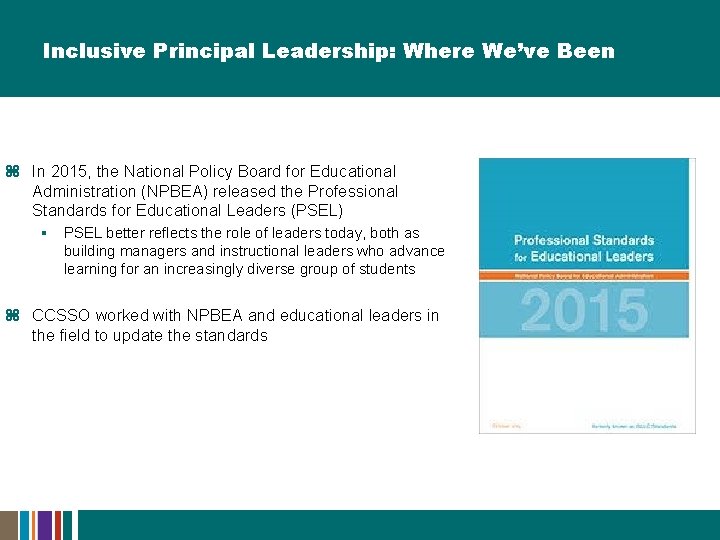
Inclusive Principal Leadership: Where We’ve Been z In 2015, the National Policy Board for Educational Administration (NPBEA) released the Professional Standards for Educational Leaders (PSEL) § PSEL better reflects the role of leaders today, both as building managers and instructional leaders who advance learning for an increasingly diverse group of students z CCSSO worked with NPBEA and educational leaders in the field to update the standards
Inclusive Principal Leadership: Where We’ve Been z In January 2017, CCSSO and the Collaboration for Effective Educator Development, Accountability, and Reform (CEEDAR) Center released a supplementary guidance document for students with learning differences § Developed by an Advisory Group of principals, leaders from state and local education agencies, the higher education community, and professional associations z Outlines key steps every state can take to ensure all school principals are prepared and supported to lead learning environments that meet the needs of students with disabilities and others who struggle to learn in school
National Collaborative on Inclusive Principal Leadership (NCIPL)
NCIPL: Where We Are We released Supporting Inclusive Schools for the Success of Each Child! (https: //ccssoinclusiveprincipalsguide. org)
NCIPL: Where We Are
NCIPL: Where We Are z Supporting Inclusive Principal Leadership for the Success of Each Child contains 8 key strategies to support states in integrating inclusive principal leadership in policy and practice: § § § § Strategy 1: Set a Vision and Plan for Inclusive Principal Leadership Strategy 2: Cultivate Coherence and Collaboration Strategy 3: Transform Principal Preparation and Licensure Strategy 4: Promote Principal Development on Inclusive Practices Strategy 5: Provide Targeted Supports to Districts and Schools Strategy 6: Connect School Improvement and Principal Development Initiatives Strategy 7: Meaningfully Engage Stakeholders as Partners in the Work Strategy 8: Adopt Processes and Supports for Continuous Improvement
Strategy 3: Transform Principal Preparation and Licensure z Analyze assessments used for licensure and program approval to ensure they address the knowledge, skills, and dispositions inclusive school leaders need, and ensure district capacity for data collection around principal preparation efficacy in inclusive schools z Create or adapt leadership performance assessments to ensure they address the degree to which leaders foster productive collaboration among special education teachers, general education teachers, and related service providers z Establish and/or implement principal preparation program approval processes and standards/criteria that include the content, coursework, and the length and quality of field experiences necessary for effective inclusive principal leadership z Use the standards for school leader preparation programs such as the National Educational Leadership Preparation (NELP) Standards, which are aligned to the PSEL 2015 standards, to update program approval processes z Review CAEP requirements to determine if requiring that the leadership programs approved to operate in your state earn national accreditation will advance inclusive leadership practices
Related Resources Strategy 3: Transform Principal Preparation and Licensure z Course Enhancement Module: School Leadership for Students with Disabilities can inform the integration of inclusive principal leadership practices into principal preparation program review and approval as well as principal licensure and certification. z Innovation Configuration: Principal Leadership – Moving toward Inclusive and High-Achieving Schools for Students with Disabilities can guide states’ efforts to reform principal preparation programs to focus on preparing principals to lead inclusive and high-achieving schools for the success of students with disabilities. z Promises to Keep: Transforming Educator Preparation to Better Serve a Diverse Range of Learners can be used by state leaders to ensure that their principal preparation programs prepare leaders to work effectively with all learners through reforms to program review and approval, licensure and certification, and data collection, analysis, and reporting. z SEP 3 Toolkit – State Evaluation of Principal Preparation Programs can help states assess the extent to which state leaders have prioritized school leadership—especially school leader preparation—and the extent to which the state education agency is positioned as a resource to local education agencies.
NCIPL: Where We’re Going z CCSSO is committed to providing short- and longer-term support to states, in partnership with the CEEDAR Center, focused on developing school principals who are well-prepared and supported to lead inclusive environments that meet the needs of students with disabilities § To support states in building upon, deepening, and refining current work on school leadership to have a greater focus on inclusive leadership practices
Georgia’s Vision ✧Teacher/Leader Preparation ✧Certification/Licensure ✧Program Evaluation
Georgia’s Context ² Six Universities (all public: Cohort I in 2014, Cohort II in ² ² ² ² 2017) Georgia Professional Standards Commission Georgia Department of Education University System Board of Regents University System Dean’s Conference Georgia Induction Summit Professional Organizations (GAEL, GELFA) P-20 Collaboratives
Georgia’s Conceptual Framework Evidence based practices/High leverage practices CEEDAR resources Review/revision of our programs Talk to our stakeholders Review our data Review our syllabi Talk to our own experts Revise our ! Scale up for Collaboration Share the work Mentor others Continue the work programs CEEDAR support for review, revisions, and results 20
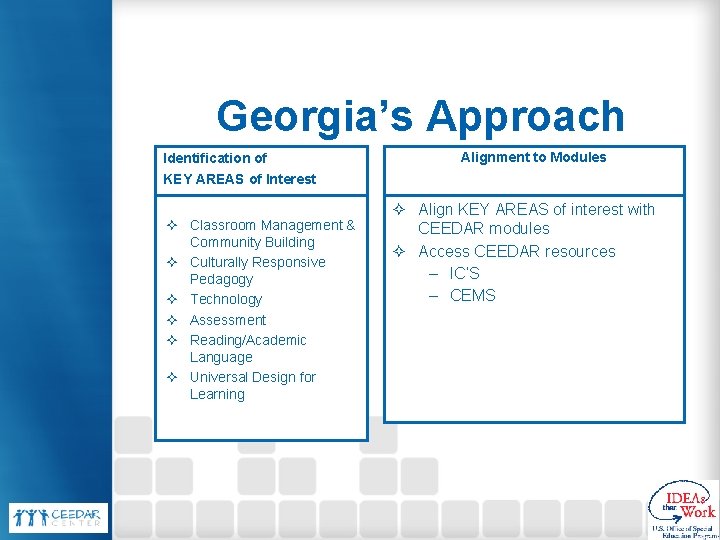
Georgia’s Approach Identification of KEY AREAS of Interest Subtitle ✧ Classroom Management & Community Building ✧ Culturally Responsive Pedagogy ✧ Technology ✧ Assessment ✧ Reading/Academic Language ✧ Universal Design for Learning Alignment to Modules ✧ Align KEY AREAS of interest with CEEDAR modules ✧ Access CEEDAR resources – IC’S – CEMS
CEEDAR Resources Supported: Development of “job-ready” capstone/induction plan Restructuring of signature courses
“Job-ready” Capstone History Ø Professional Standards Commission requirement resulted in restructuring of our initial certification pathways Ø MAT programs were launched in 2016 Ø Capstone change from MED to MAT
“Job-ready Capstone” Ø Professional Learning Plan/Induction (PLP) Ø Aligned with induction level requirements Ø Frames feedback and coaching throughout program
Restructuring Signature Courses CEEDAR Tools *Content enhancement modules *NIC syllabus reviews
Restructuring Signature Courses Emerging Themes Alignment Needs 1. Relevance of content 1. High Leverage 2. 3. and need for an inclusive focus Move beyond legalities Need to equip leaders to support induction level teachers and inclusive assessment 2. 3. Practices Changes in certification across college Eliminate “the course” and embed content in all courses
Georgia’s Accomplishments ² ² ² Induction/ PLP Plan (Capstone) Syllabi Review by Educator Preparation Programs (EPP) EPP Program and Course Revisions Alignment and Communication of the Work Technical Assistance Modules to Support Ga. PSC and EPPs in Data Usage ² Mentoring for inclusive leadership development through the state Ed Leadership Faculty Association (GELFA)
Georgia’s Cohort II ²Dedicated mentors ²Monthly webinars ²Intensive support
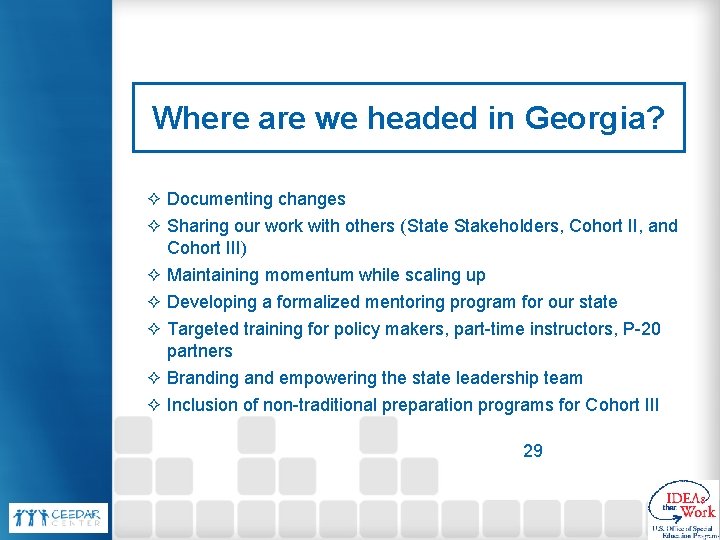
Where are we headed in Georgia? ✧ Documenting changes ✧ Sharing our work with others (State Stakeholders, Cohort II, and Cohort III) ✧ Maintaining momentum while scaling up ✧ Developing a formalized mentoring program for our state ✧ Targeted training for policy makers, part-time instructors, P-20 partners ✧ Branding and empowering the state leadership team ✧ Inclusion of non-traditional preparation programs for Cohort III 29
The Oregon Context ² Collaboration among Programs ² 7 universities (2 public / 5 private) ² Includes OR Principal’s Association ² ORPEA’s seat at OR Policy Table ² Principal Preparation Refresh ² Goal for new rules in 2017 -18 ² Integrate PELS and NELP standards
The Oregon Timeline ² OR joins CEEDAR’s 2015 Cohort ² Intensive Technical Assistance ² Administrator License Redesign ² Sep/Oct 2015 ² Focused Leadership/Clinical Practice ² New courses for Preliminary Admin ² Dec 2015/Jan 2016 (ESSA signed) ² Shift to embedded modules - hybrid
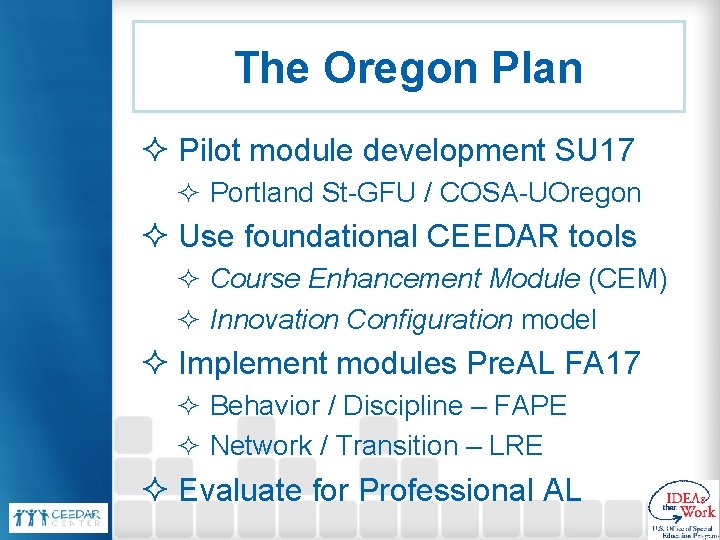
The Oregon Plan ² Pilot module development SU 17 ² Portland St-GFU / COSA-UOregon ² Use foundational CEEDAR tools ² Course Enhancement Module (CEM) ² Innovation Configuration model ² Implement modules Pre. AL FA 17 ² Behavior / Discipline – FAPE ² Network / Transition – LRE ² Evaluate for Professional AL
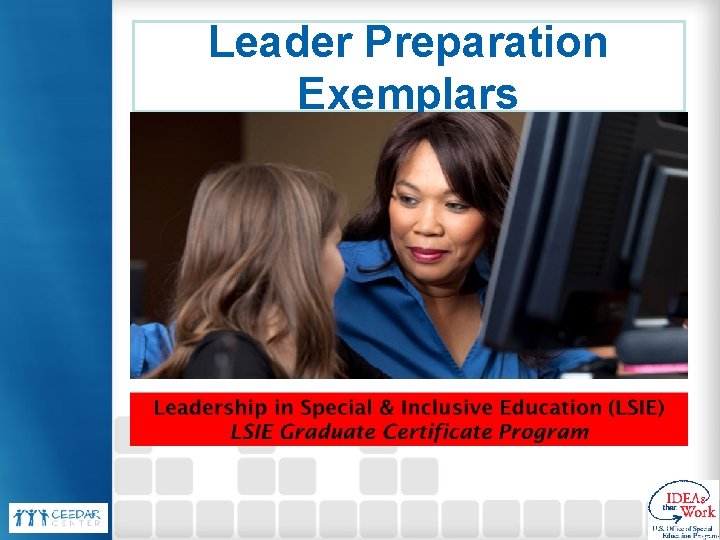
Leader Preparation Exemplars
• Four courses • 8 weeks per course • 12 credits earned • Certificate earned in 6 -8 months • Entirely online
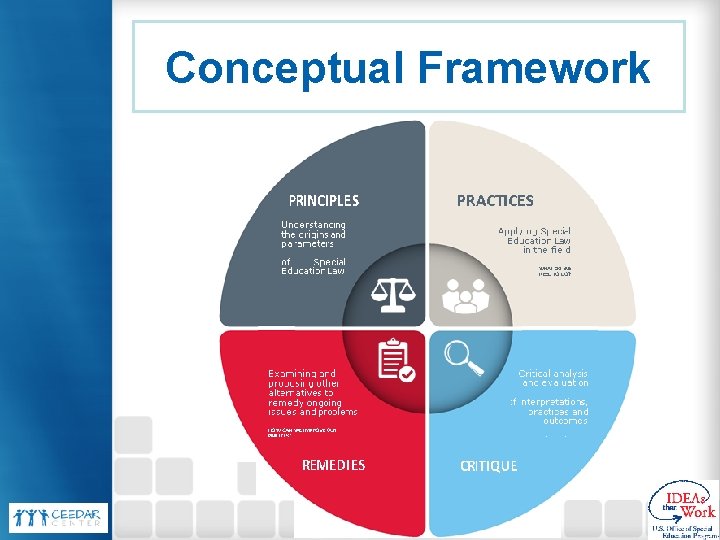
Conceptual Framework
• One-on-one coaching and mentoring • Cutting-edge research • Project-based team work • Gaming in simulated "virtual" districts • Acquiring and applying "equity tools" • Cultivating new digital literacies • Create professional webbased portfolios
References ² ² ² Billingsley, B. S. , Mc. Leskey, J. , & Crockett, J. B. (2014, August). Principal leadership: Moving toward inclusive and high-achieving schools for students with disabilities (CEEDAR Document No. IC-8). Retrieved from University of Florida, Collaboration for Effective Educator Development, Accountability, and Reform Center website: http: //ceedar. education. ufl. edu/tools/innovation-configurations/ Leadership for Students with Disabilities (2016). CEEDAR Course Enhancement Module. Retrieved from University of Florida, Collaboration for Effective Educator Development, Accountability, and Reform Center website: http: //ceedar. education. ufl. edu/cems/ Kozleski, E. B. & Huber, J. J. (2012). System-wide leadership for culturally responsive education. In J. Crockett, B. Billingsley, & M. L. Boscardin (Eds). Handbook of leadership and administration for special education (pp. 155 -169). London: Routledge. National Policy Board for Educational Administration. (2016). Draft National Educational Leadership Preparation Standards. Alexandria, VA: Author. Retrieved from the NPBEA website: http: //www. npbea. org National Policy Board for Educational Administration. (2015). Professional Standards for Educational Leaders. Alexandria, VA: Author. Retrieved from the CCSSO website: http: //www. ccsso. org/Documents/2015/Professional. Standardsfor. Educational. Leaders 20 15 for. NPBEAFINAL. pdf
Questions/Discussion Ø What questions do you have for us? Ø How can Supporting Inclusive Schools for the Success of Each Child: A Guide for States on Principal Leadership and the Georgia and Oregon examples shared today support you and your work? Ø Are there other examples of inclusive principal leadership, whether at the state, district, or higher education levels, that you are aware of and would like to share?
Disclaimer Ø This presentation was produced under U. S. Department of Education, Office of Special Education Programs, Award No. H 325 A 120003. Bonnie Jones and David Guardino serve as the project officers. The views expressed herein do not necessarily represent the positions or polices of the U. S. Department of Education. No official endorsement by the U. S. Department of Education of any product, commodity, service, or enterprise mentioned in this presentation is intended or should be inferred.
Contacts z Kathleen Airhart, CCSSO, Kathleen. Airhart@ccsso. org z Kaylan Connally, CCSSO, Kaylan. Connally@ccsso. org z Marc Shelton, George Fox U. mshelton@georgefox. edu z Sheryl Cowart Moss, Georgia State U. smoss 13@gsu. edu
THANK YOU
2018 OSEP Project Directors’ Conference DISCLAIMER: The contents of this presentation were developed by the presenters for the 2018 Project Directors’ Conference. However, these contents do not necessarily represent the policy of the Department of Education, and you should not assume endorsement by the Federal Government. (Authority: 20 U. S. C. 1221 e-3 and 3474)