
Board Advisory Services Introducing The KPMG Directors Toolkit

Board Advisory Services Introducing The KPMG Directors’ Toolkit and how it will benefit the NFP director 2 August 2014
Challenges for the Australian Not-for-Profit Sector
Key challenges for the Australian Not-for-Profit Sector Fundraising for the Future Attracting the right people Regulation and Compliance Relevance and Recognition Obtaining assistance and the right tools © 2014 KPMG, an Australian partnership and a member firm of the KPMG network of independent member firms affiliated with KPMG International Cooperative (“KPMG International”), a Swiss entity. All rights reserved. The KPMG name, logo and "cutting through complexity" are registered trademarks or trademarks of KPMG International. Liability limited by a scheme approved under Professional Standards Legislation. 2
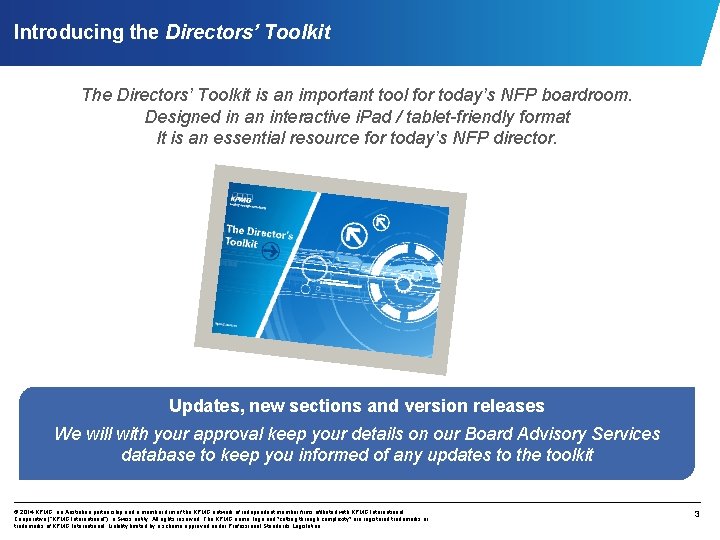
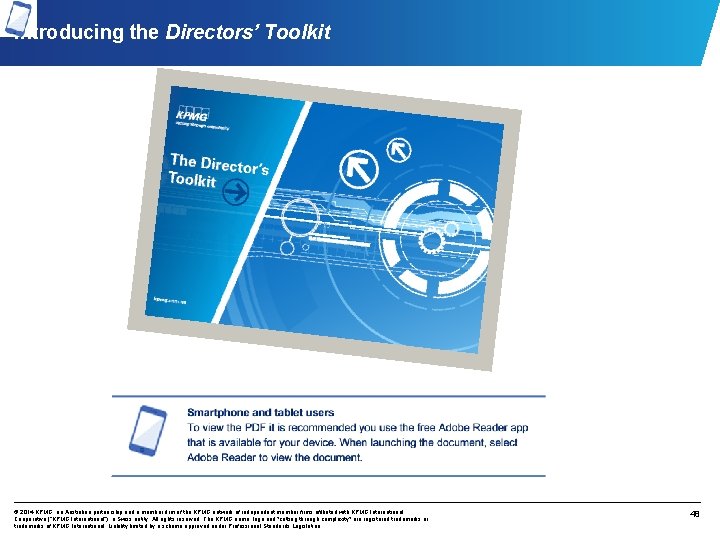
Introducing the Directors’ Toolkit The Directors’ Toolkit is an important tool for today’s NFP boardroom. Designed in an interactive i. Pad / tablet-friendly format It is an essential resource for today’s NFP director. Updates, new sections and version releases We will with your approval keep your details on our Board Advisory Services database to keep you informed of any updates to the toolkit © 2014 KPMG, an Australian partnership and a member firm of the KPMG network of independent member firms affiliated with KPMG International Cooperative (“KPMG International”), a Swiss entity. All rights reserved. The KPMG name, logo and "cutting through complexity" are registered trademarks or trademarks of KPMG International. Liability limited by a scheme approved under Professional Standards Legislation. 3
Better practice in the NFP Board Room
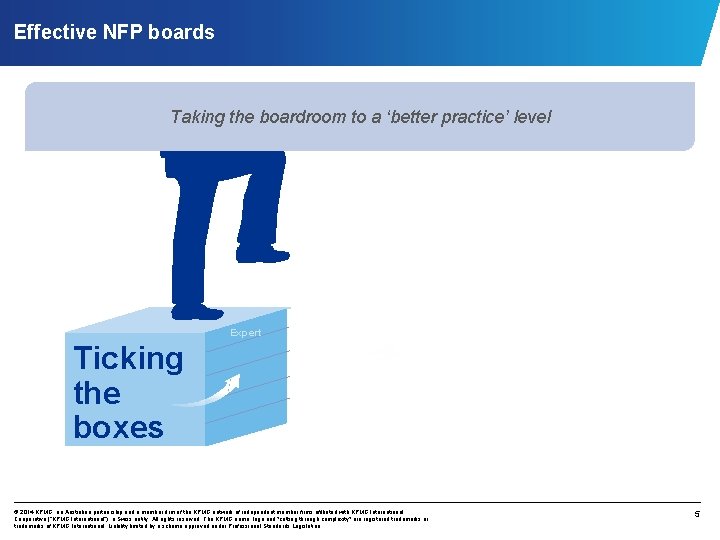
Effective NFP boards Taking the boardroom to a ‘better practice’ level Expert Ticking the boxes © 2014 KPMG, an Australian partnership and a member firm of the KPMG network of independent member firms affiliated with KPMG International Cooperative (“KPMG International”), a Swiss entity. All rights reserved. The KPMG name, logo and "cutting through complexity" are registered trademarks or trademarks of KPMG International. Liability limited by a scheme approved under Professional Standards Legislation. 5
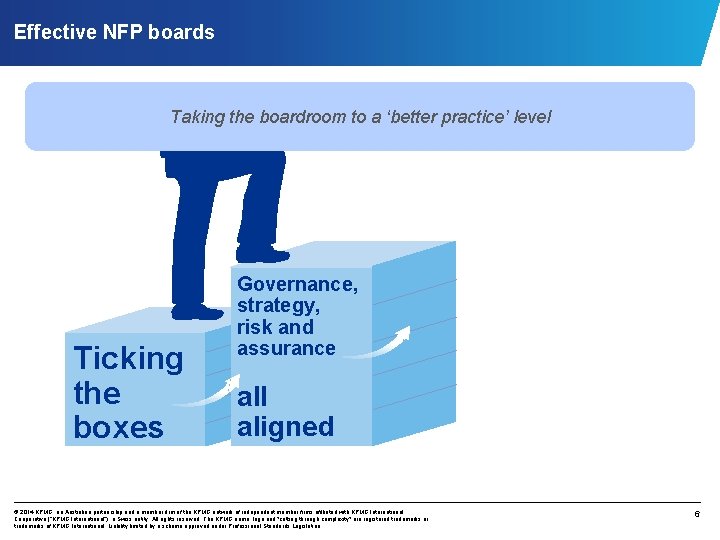
Effective NFP boards Taking the boardroom to a ‘better practice’ level Ticking the boxes Governance, strategy, Expert risk and assurance all aligned © 2014 KPMG, an Australian partnership and a member firm of the KPMG network of independent member firms affiliated with KPMG International Cooperative (“KPMG International”), a Swiss entity. All rights reserved. The KPMG name, logo and "cutting through complexity" are registered trademarks or trademarks of KPMG International. Liability limited by a scheme approved under Professional Standards Legislation. 6
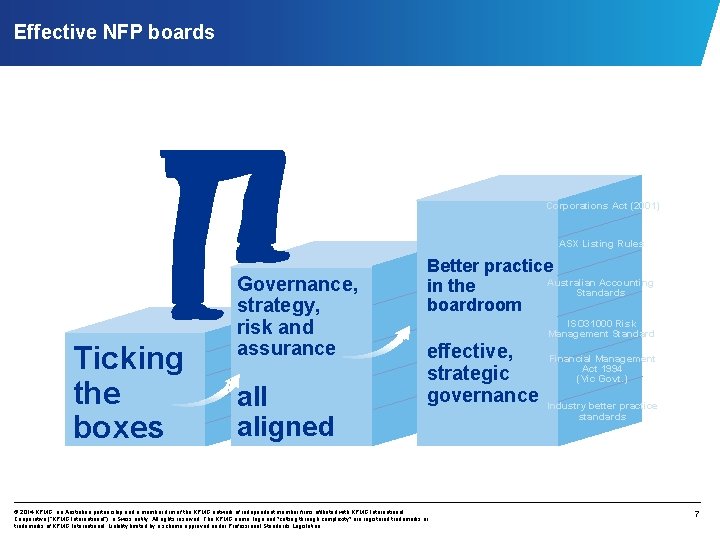
Effective NFP boards Corporations Act (2001) ASX Listing Rules Ticking the boxes Governance, strategy, Expert risk and assurance all aligned Better practice Australian Accounting in the Standards boardroom ISO 31000 Risk Management Standard effective, strategic governance © 2014 KPMG, an Australian partnership and a member firm of the KPMG network of independent member firms affiliated with KPMG International Cooperative (“KPMG International”), a Swiss entity. All rights reserved. The KPMG name, logo and "cutting through complexity" are registered trademarks or trademarks of KPMG International. Liability limited by a scheme approved under Professional Standards Legislation. Financial Management Act 1994 (Vic Govt. ) Industry better practice standards 7
Structuring an effective board and subcommittees Directors’ Toolkit Chapter 5 & 7
Structuring an effective board Red Flags • Board appointments are decided by the chairman with little input from other directors. • Directors do not receive a letter setting out the terms and conditions of their appointment. • No formal (or insufficient) board induction is provided to new board members. • Unreasonable demands are placed on the directors’ time. • The board is too large compared to similar organisations. • There is a lack of ongoing board succession planning. © 2014 KPMG, an Australian partnership and a member firm of the KPMG network of independent member firms affiliated with KPMG International Cooperative (“KPMG International”), a Swiss entity. All rights reserved. The KPMG name, logo and "cutting through complexity" are registered trademarks or trademarks of KPMG International. Liability limited by a scheme approved under Professional Standards Legislation. 9
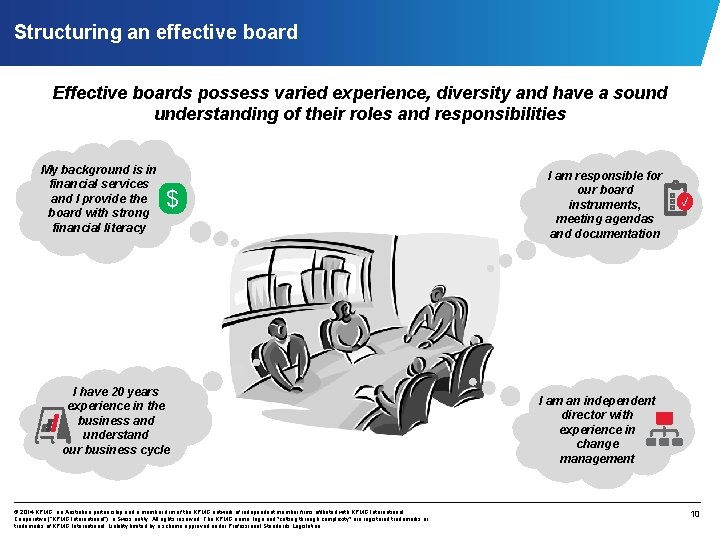
Structuring an effective board Effective boards possess varied experience, diversity and have a sound understanding of their roles and responsibilities My background is in financial services and I provide the board with strong financial literacy $ I have 20 years experience in the business and understand our business cycle © 2014 KPMG, an Australian partnership and a member firm of the KPMG network of independent member firms affiliated with KPMG International Cooperative (“KPMG International”), a Swiss entity. All rights reserved. The KPMG name, logo and "cutting through complexity" are registered trademarks or trademarks of KPMG International. Liability limited by a scheme approved under Professional Standards Legislation. I am responsible for our board instruments, meeting agendas and documentation I am an independent director with experience in change management 10
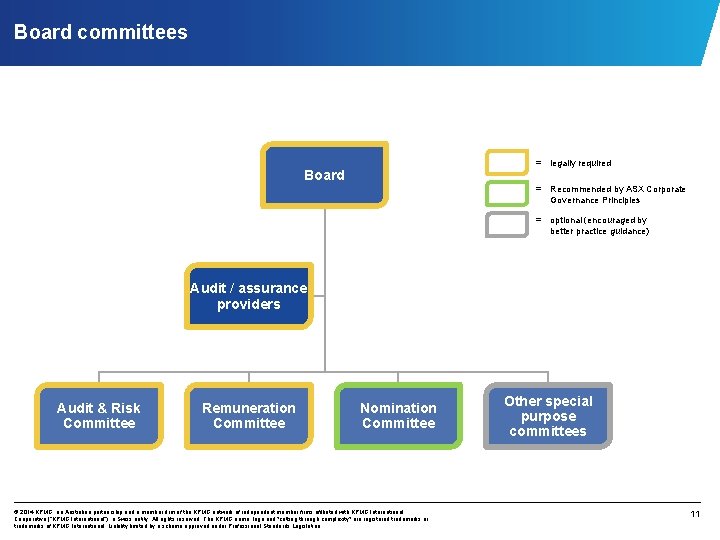
Board committees Board = legally required = Recommended by ASX Corporate Governance Principles = optional (encouraged by better practice guidance) Audit / assurance providers Audit & Risk Committee Remuneration Committee Nomination Committee © 2014 KPMG, an Australian partnership and a member firm of the KPMG network of independent member firms affiliated with KPMG International Cooperative (“KPMG International”), a Swiss entity. All rights reserved. The KPMG name, logo and "cutting through complexity" are registered trademarks or trademarks of KPMG International. Liability limited by a scheme approved under Professional Standards Legislation. Other special purpose committees 11
Supporting key executive and director appointments Directors’ Toolkit Chapter 6
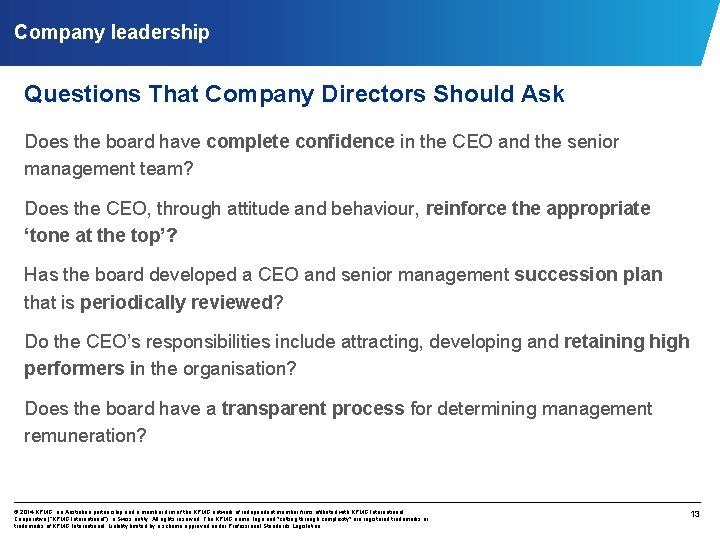
Company leadership Questions That Company Directors Should Ask Does the board have complete confidence in the CEO and the senior management team? Does the CEO, through attitude and behaviour, reinforce the appropriate ‘tone at the top’? Has the board developed a CEO and senior management succession plan that is periodically reviewed? Do the CEO’s responsibilities include attracting, developing and retaining high performers in the organisation? Does the board have a transparent process for determining management remuneration? © 2014 KPMG, an Australian partnership and a member firm of the KPMG network of independent member firms affiliated with KPMG International Cooperative (“KPMG International”), a Swiss entity. All rights reserved. The KPMG name, logo and "cutting through complexity" are registered trademarks or trademarks of KPMG International. Liability limited by a scheme approved under Professional Standards Legislation. 13
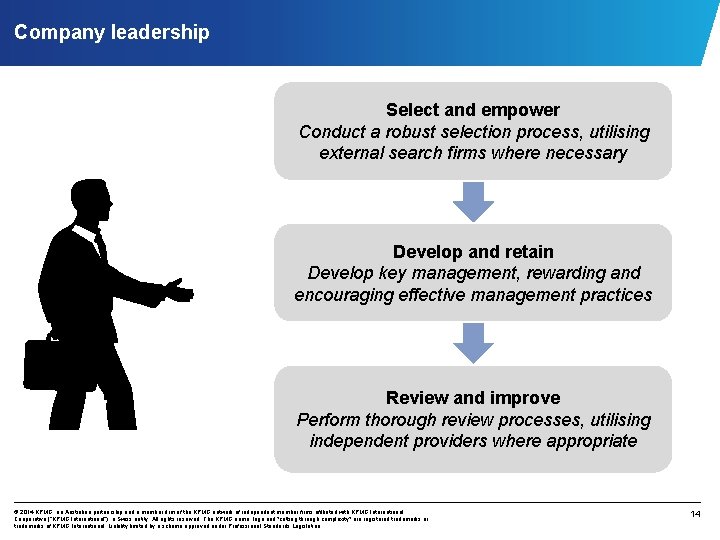
Company leadership Select and empower Conduct a robust selection process, utilising external search firms where necessary Develop and retain Develop key management, rewarding and encouraging effective management practices Review and improve Perform thorough review processes, utilising independent providers where appropriate © 2014 KPMG, an Australian partnership and a member firm of the KPMG network of independent member firms affiliated with KPMG International Cooperative (“KPMG International”), a Swiss entity. All rights reserved. The KPMG name, logo and "cutting through complexity" are registered trademarks or trademarks of KPMG International. Liability limited by a scheme approved under Professional Standards Legislation. 14
Duties and responsibilities of a NFP director Directors’ Toolkit Chapter 1
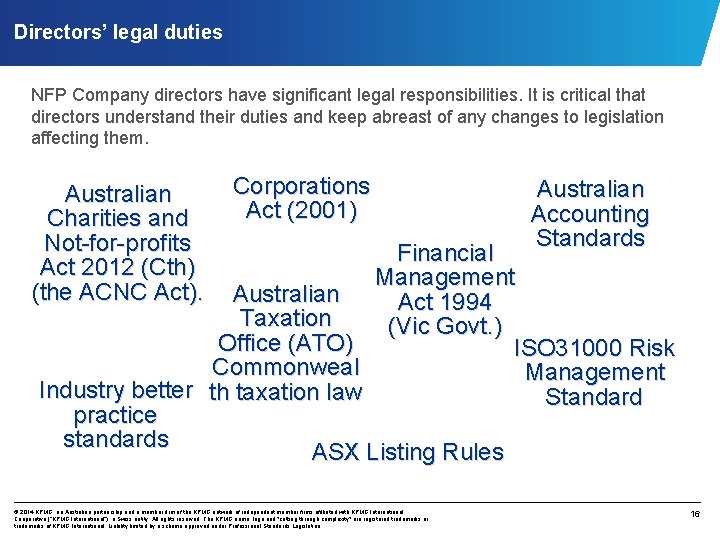
Directors’ legal duties NFP Company directors have significant legal responsibilities. It is critical that directors understand their duties and keep abreast of any changes to legislation affecting them. Australian Charities and Not-for-profits Act 2012 (Cth) (the ACNC Act). Corporations Act (2001) Australian Accounting Standards Financial Management Act 1994 (Vic Govt. ) ISO 31000 Risk Management Standard Australian Taxation Office (ATO) Commonweal Industry better th taxation law practice standards ASX Listing Rules © 2014 KPMG, an Australian partnership and a member firm of the KPMG network of independent member firms affiliated with KPMG International Cooperative (“KPMG International”), a Swiss entity. All rights reserved. The KPMG name, logo and "cutting through complexity" are registered trademarks or trademarks of KPMG International. Liability limited by a scheme approved under Professional Standards Legislation. 16
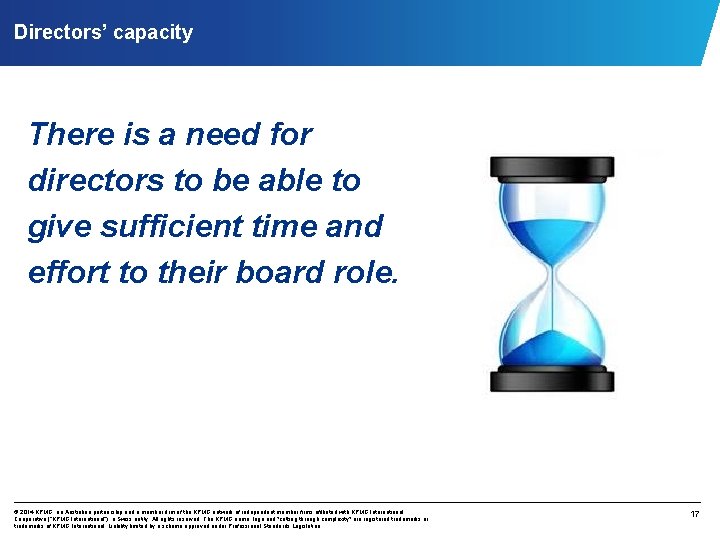
Directors’ capacity There is a need for directors to be able to give sufficient time and effort to their board role. © 2014 KPMG, an Australian partnership and a member firm of the KPMG network of independent member firms affiliated with KPMG International Cooperative (“KPMG International”), a Swiss entity. All rights reserved. The KPMG name, logo and "cutting through complexity" are registered trademarks or trademarks of KPMG International. Liability limited by a scheme approved under Professional Standards Legislation. 17
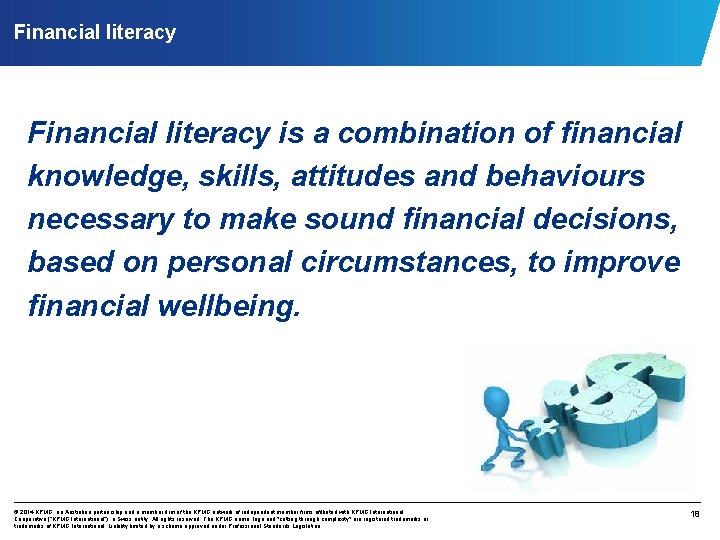
Financial literacy is a combination of financial knowledge, skills, attitudes and behaviours necessary to make sound financial decisions, based on personal circumstances, to improve financial wellbeing. © 2014 KPMG, an Australian partnership and a member firm of the KPMG network of independent member firms affiliated with KPMG International Cooperative (“KPMG International”), a Swiss entity. All rights reserved. The KPMG name, logo and "cutting through complexity" are registered trademarks or trademarks of KPMG International. Liability limited by a scheme approved under Professional Standards Legislation. 18
Oversight of strategy and governance Directors’ Toolkit Chapter 2, 10 & 13
Governance roles Questions That Company Directors Should Ask Is the composition of the board appropriately diverse for it to perform effectively? Is there an annual agenda, approved by the board, that is linked to the board’s key responsibilities as detailed in the board charter? Is the board clearly setting out the roles and authority of the CEO and directors in writing? Are delegations to management, including the delegations policy, set out in a single document? Is the board monitoring that directors allocate sufficient time to discharge their responsibilities? © 2014 KPMG, an Australian partnership and a member firm of the KPMG network of independent member firms affiliated with KPMG International Cooperative (“KPMG International”), a Swiss entity. All rights reserved. The KPMG name, logo and "cutting through complexity" are registered trademarks or trademarks of KPMG International. Liability limited by a scheme approved under Professional Standards Legislation. 20
Insightful strategy Red Flags • The board accepts management’s strategy without -depth probing or questioning. in • The board does not fully understand the nature and implications of the proposed strategy. • The external environment is not fully considered in strategy development. • Not all directors attend the meeting where strategy is discussed and approved. • Risks inherent in the strategy are not identified or managed. • Board meetings are not strategically focused. © 2014 KPMG, an Australian partnership and a member firm of the KPMG network of independent member firms affiliated with KPMG International Cooperative (“KPMG International”), a Swiss entity. All rights reserved. The KPMG name, logo and "cutting through complexity" are registered trademarks or trademarks of KPMG International. Liability limited by a scheme approved under Professional Standards Legislation. 21
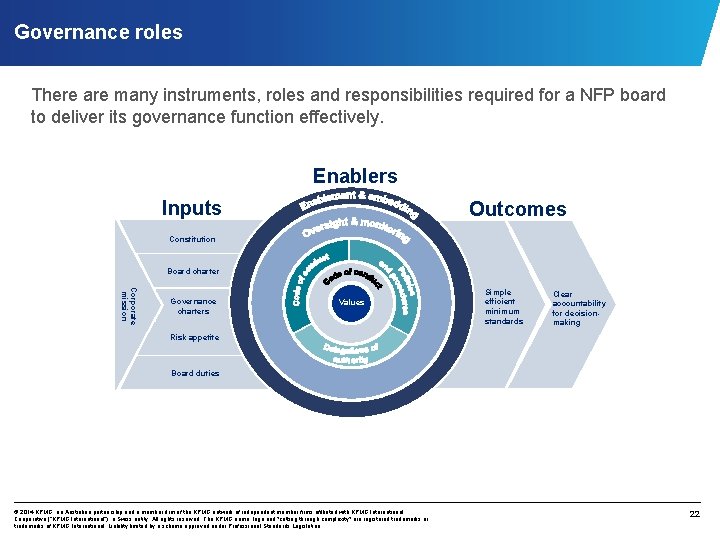
Governance roles There are many instruments, roles and responsibilities required for a NFP board to deliver its governance function effectively. Enablers Inputs Outcomes Constitution Board charter Corporate mission Governance charters Values Simple efficient minimum standards Clear accountability for decisionmaking Risk appetite Board duties © 2014 KPMG, an Australian partnership and a member firm of the KPMG network of independent member firms affiliated with KPMG International Cooperative (“KPMG International”), a Swiss entity. All rights reserved. The KPMG name, logo and "cutting through complexity" are registered trademarks or trademarks of KPMG International. Liability limited by a scheme approved under Professional Standards Legislation. 22
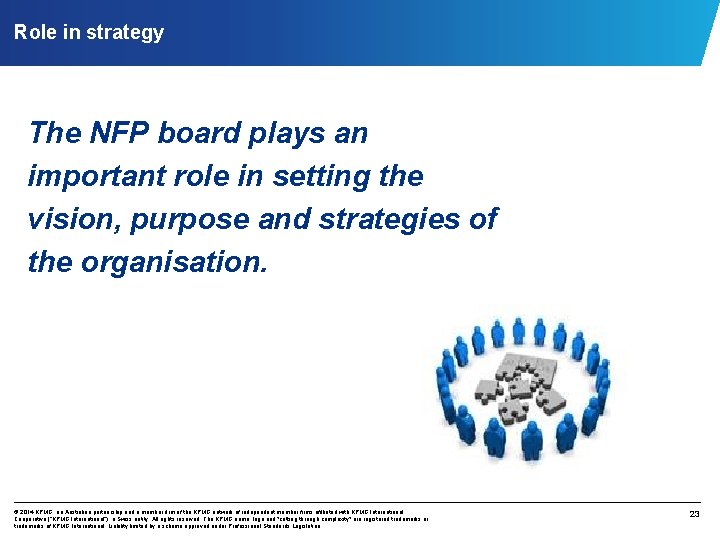
Role in strategy The NFP board plays an important role in setting the vision, purpose and strategies of the organisation. © 2014 KPMG, an Australian partnership and a member firm of the KPMG network of independent member firms affiliated with KPMG International Cooperative (“KPMG International”), a Swiss entity. All rights reserved. The KPMG name, logo and "cutting through complexity" are registered trademarks or trademarks of KPMG International. Liability limited by a scheme approved under Professional Standards Legislation. 23
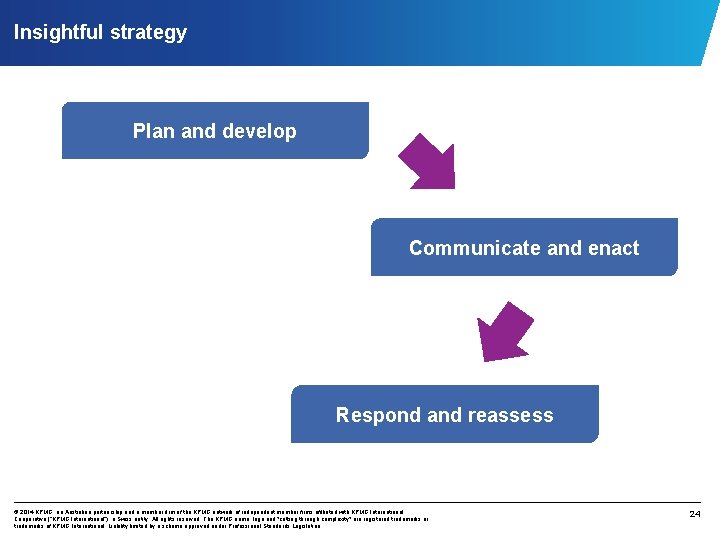
Insightful strategy Plan and develop Communicate and enact Respond and reassess © 2014 KPMG, an Australian partnership and a member firm of the KPMG network of independent member firms affiliated with KPMG International Cooperative (“KPMG International”), a Swiss entity. All rights reserved. The KPMG name, logo and "cutting through complexity" are registered trademarks or trademarks of KPMG International. Liability limited by a scheme approved under Professional Standards Legislation. 24
Board Roles and Responsibilities Board vs Management © 2014 KPMG, an Australian partnership and a member firm of the KPMG network of independent member firms affiliated with KPMG International Cooperative (“KPMG International”), a Swiss entity. All rights reserved. The KPMG name, logo and "cutting through complexity" are registered trademarks or trademarks of KPMG International. Liability limited by a scheme approved under Professional Standards Legislation. 25
Engaging effectively with stakeholders Directors’ Toolkit Chapter 4
Stakeholder engagement Red Flags • The NFP maintains no stakeholder mapping, tiering or profiling information. • The risk of not engaging stakeholders is not discussed or is often dismissed quickly by some board members. • Online coverage of the NFP is mostly negative. • Unclear executive and board accountabilities for stakeholder engagement. • The NFP is unaware or unprepared for the impact of social media activism. © 2014 KPMG, an Australian partnership and a member firm of the KPMG network of independent member firms affiliated with KPMG International Cooperative (“KPMG International”), a Swiss entity. All rights reserved. The KPMG name, logo and "cutting through complexity" are registered trademarks or trademarks of KPMG International. Liability limited by a scheme approved under Professional Standards Legislation. 27
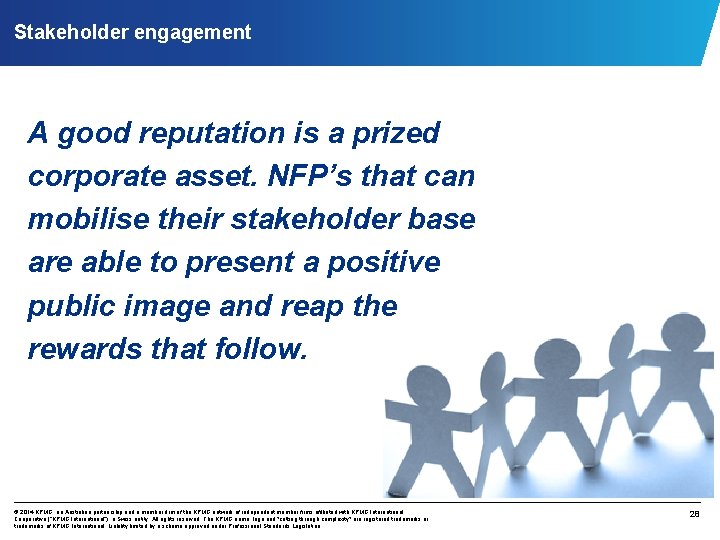
Stakeholder engagement A good reputation is a prized corporate asset. NFP’s that can mobilise their stakeholder base are able to present a positive public image and reap the rewards that follow. © 2014 KPMG, an Australian partnership and a member firm of the KPMG network of independent member firms affiliated with KPMG International Cooperative (“KPMG International”), a Swiss entity. All rights reserved. The KPMG name, logo and "cutting through complexity" are registered trademarks or trademarks of KPMG International. Liability limited by a scheme approved under Professional Standards Legislation. 28
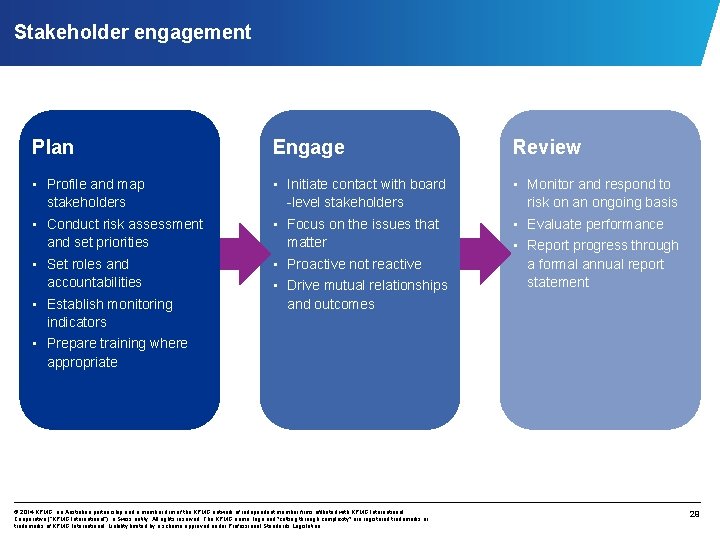
Stakeholder engagement Plan Engage Review • Profile and map stakeholders • Conduct risk assessment and set priorities • Set roles and accountabilities • Establish monitoring indicators • Prepare training where appropriate • Initiate contact with board -level stakeholders • Focus on the issues that matter • Proactive not reactive • Drive mutual relationships and outcomes • Monitor and respond to risk on an ongoing basis • Evaluate performance • Report progress through a formal annual report statement © 2014 KPMG, an Australian partnership and a member firm of the KPMG network of independent member firms affiliated with KPMG International Cooperative (“KPMG International”), a Swiss entity. All rights reserved. The KPMG name, logo and "cutting through complexity" are registered trademarks or trademarks of KPMG International. Liability limited by a scheme approved under Professional Standards Legislation. 29
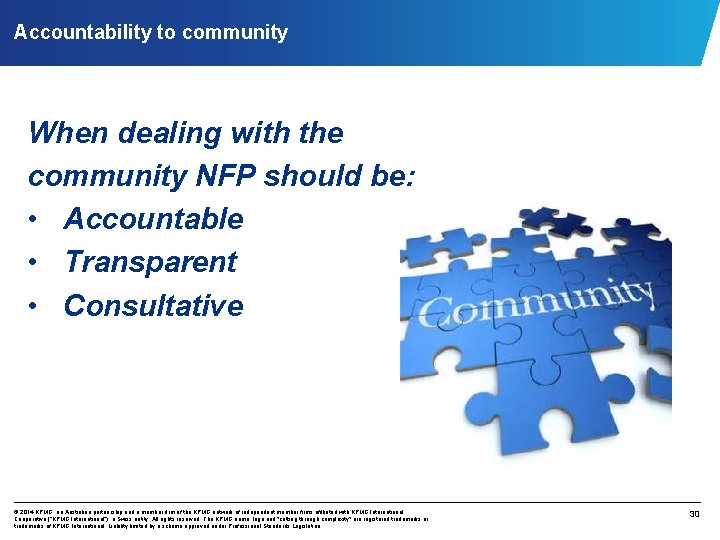
Accountability to community When dealing with the community NFP should be: • Accountable • Transparent • Consultative © 2014 KPMG, an Australian partnership and a member firm of the KPMG network of independent member firms affiliated with KPMG International Cooperative (“KPMG International”), a Swiss entity. All rights reserved. The KPMG name, logo and "cutting through complexity" are registered trademarks or trademarks of KPMG International. Liability limited by a scheme approved under Professional Standards Legislation. 30
Managing productive meetings Directors’ Toolkit Chapter 8
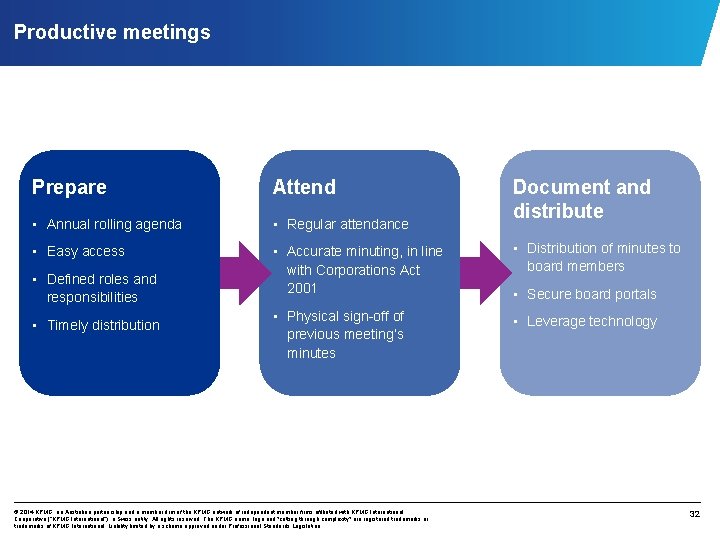
Productive meetings Prepare Attend • Annual rolling agenda • Regular attendance • Easy access • Accurate minuting, in line with Corporations Act 2001 • Distribution of minutes to board members • Physical sign-off of previous meeting’s minutes • Leverage technology • Defined roles and responsibilities • Timely distribution © 2014 KPMG, an Australian partnership and a member firm of the KPMG network of independent member firms affiliated with KPMG International Cooperative (“KPMG International”), a Swiss entity. All rights reserved. The KPMG name, logo and "cutting through complexity" are registered trademarks or trademarks of KPMG International. Liability limited by a scheme approved under Professional Standards Legislation. Document and distribute • Secure board portals 32
Risk Management Directors’ Toolkit Chapter 11
Risk management Red Flags • Risk management is not connected to corporate strategy. • Leadership from the top is lacking. • Risk management is positioned as a compliance and backroom exercise. • Risk reporting and risk management plans are not challenged at board level. • A healthy risk culture is not embedded throughout the organisation. © 2014 KPMG, an Australian partnership and a member firm of the KPMG network of independent member firms affiliated with KPMG International Cooperative (“KPMG International”), a Swiss entity. All rights reserved. The KPMG name, logo and "cutting through complexity" are registered trademarks or trademarks of KPMG International. Liability limited by a scheme approved under Professional Standards Legislation. 34
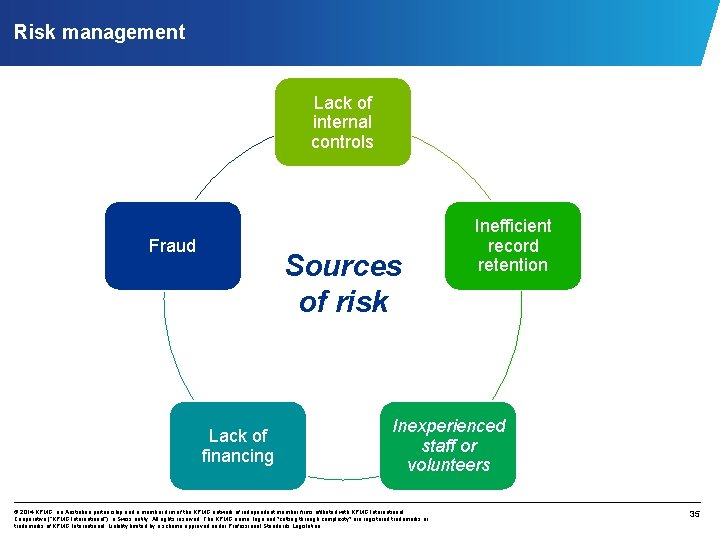
Risk management Lack of internal controls Fraud Sources of risk Lack of financing Inefficient record retention Inexperienced staff or volunteers © 2014 KPMG, an Australian partnership and a member firm of the KPMG network of independent member firms affiliated with KPMG International Cooperative (“KPMG International”), a Swiss entity. All rights reserved. The KPMG name, logo and "cutting through complexity" are registered trademarks or trademarks of KPMG International. Liability limited by a scheme approved under Professional Standards Legislation. 35
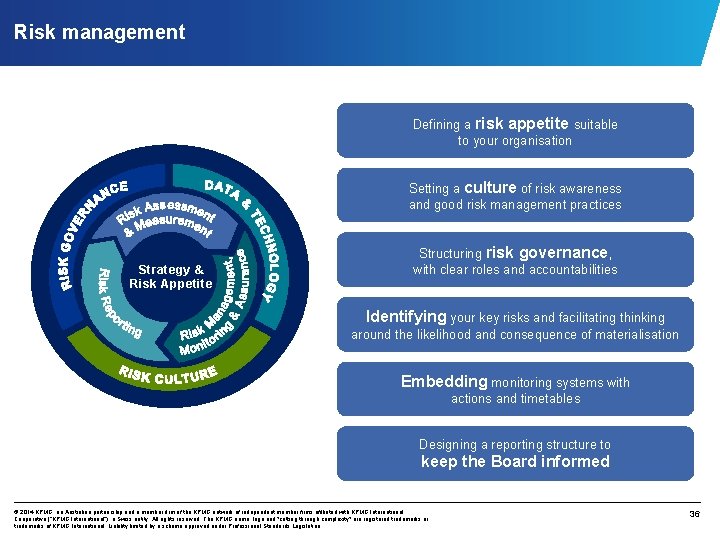
Risk management Defining a risk appetite suitable to your organisation Setting a culture of risk awareness and good risk management practices Strategy & Risk Appetite Structuring risk governance, with clear roles and accountabilities Identifying your key risks and facilitating thinking around the likelihood and consequence of materialisation Embedding monitoring systems with actions and timetables Designing a reporting structure to keep the Board informed © 2014 KPMG, an Australian partnership and a member firm of the KPMG network of independent member firms affiliated with KPMG International Cooperative (“KPMG International”), a Swiss entity. All rights reserved. The KPMG name, logo and "cutting through complexity" are registered trademarks or trademarks of KPMG International. Liability limited by a scheme approved under Professional Standards Legislation. 36
Better practice terms of reference, charters and agendas Directors’ Toolkit Chapter 9, 12 & 15 -17
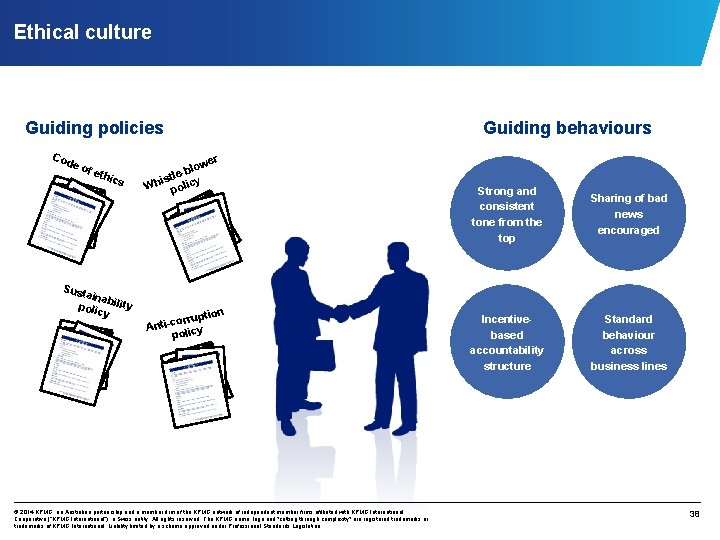
Ethical culture Guiding policies Cod eo f et hic s Guiding behaviours wer o l b eistl y Wh polic Strong and consistent tone from the top Sharing of bad news encouraged Incentivebased accountability structure Standard behaviour across business lines Sust aina b polic ility y orrup Anti-c licy po tion © 2014 KPMG, an Australian partnership and a member firm of the KPMG network of independent member firms affiliated with KPMG International Cooperative (“KPMG International”), a Swiss entity. All rights reserved. The KPMG name, logo and "cutting through complexity" are registered trademarks or trademarks of KPMG International. Liability limited by a scheme approved under Professional Standards Legislation. 38
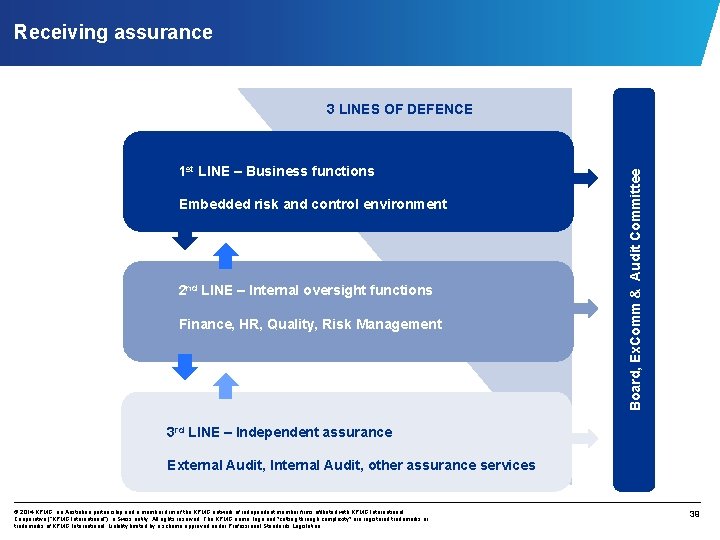
Receiving assurance 3 LINES OF DEFENCE Embedded risk and control environment 2 nd LINE – Internal oversight functions Finance, HR, Quality, Risk Management Board, Ex. Comm & Audit Committee 3 LINES OF DEFENCE 1 st LINE – Business functions 3 rd LINE – Independent assurance External Audit, Internal Audit, other assurance services © 2014 KPMG, an Australian partnership and a member firm of the KPMG network of independent member firms affiliated with KPMG International Cooperative (“KPMG International”), a Swiss entity. All rights reserved. The KPMG name, logo and "cutting through complexity" are registered trademarks or trademarks of KPMG International. Liability limited by a scheme approved under Professional Standards Legislation. 39
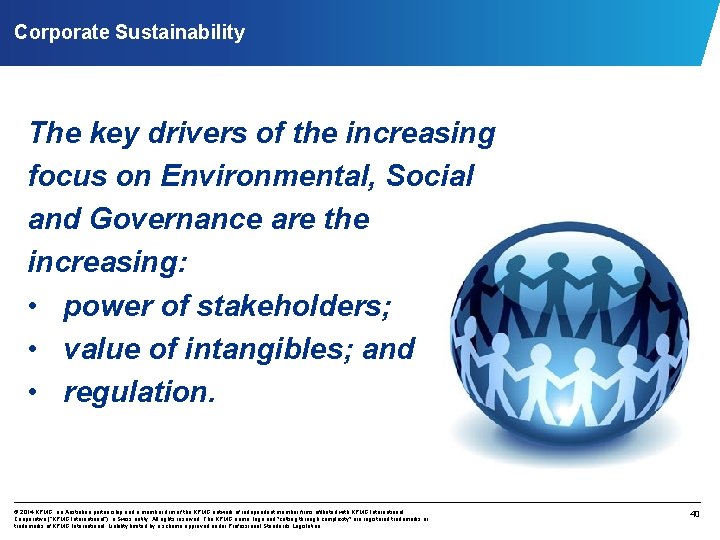
Corporate Sustainability The key drivers of the increasing focus on Environmental, Social and Governance are the increasing: • power of stakeholders; • value of intangibles; and • regulation. © 2014 KPMG, an Australian partnership and a member firm of the KPMG network of independent member firms affiliated with KPMG International Cooperative (“KPMG International”), a Swiss entity. All rights reserved. The KPMG name, logo and "cutting through complexity" are registered trademarks or trademarks of KPMG International. Liability limited by a scheme approved under Professional Standards Legislation. 40
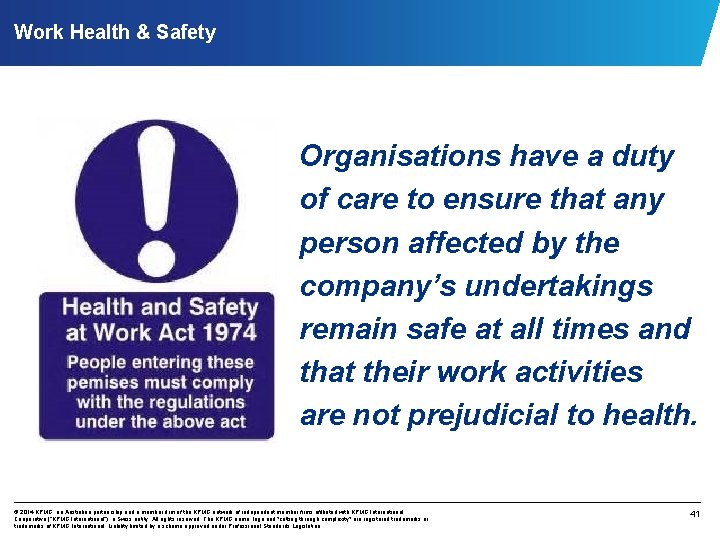
Work Health & Safety Organisations have a duty of care to ensure that any person affected by the company’s undertakings remain safe at all times and that their work activities are not prejudicial to health. © 2014 KPMG, an Australian partnership and a member firm of the KPMG network of independent member firms affiliated with KPMG International Cooperative (“KPMG International”), a Swiss entity. All rights reserved. The KPMG name, logo and "cutting through complexity" are registered trademarks or trademarks of KPMG International. Liability limited by a scheme approved under Professional Standards Legislation. 41
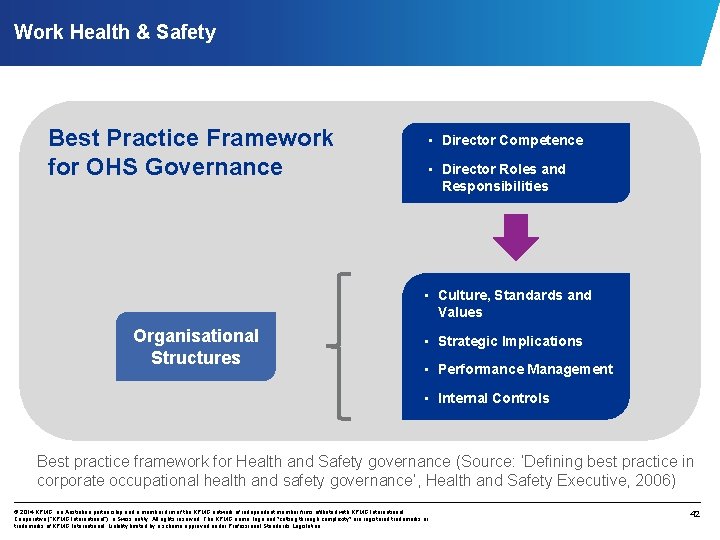
Work Health & Safety Best Practice Framework for OHS Governance • Director Competence • Director Roles and Responsibilities • Culture, Standards and Values Organisational Structures • Strategic Implications • Performance Management • Internal Controls Best practice framework for Health and Safety governance (Source: ‘Defining best practice in corporate occupational health and safety governance’, Health and Safety Executive, 2006) © 2014 KPMG, an Australian partnership and a member firm of the KPMG network of independent member firms affiliated with KPMG International Cooperative (“KPMG International”), a Swiss entity. All rights reserved. The KPMG name, logo and "cutting through complexity" are registered trademarks or trademarks of KPMG International. Liability limited by a scheme approved under Professional Standards Legislation. 42
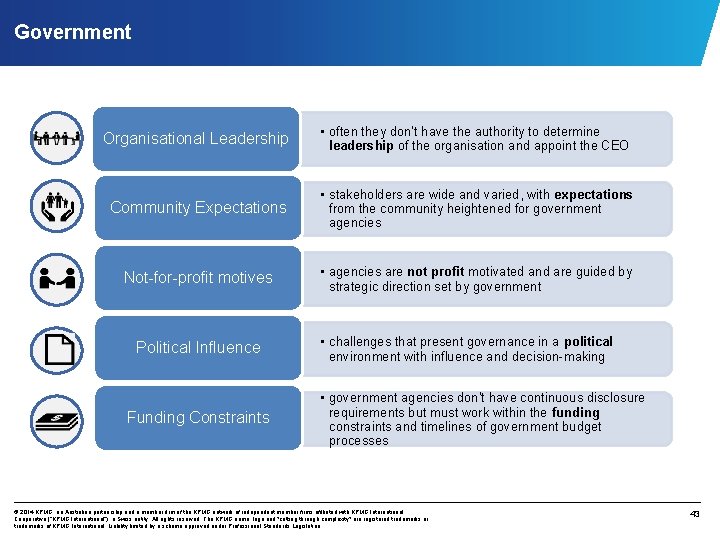
Government Organisational Leadership • often they don’t have the authority to determine leadership of the organisation and appoint the CEO Community Expectations • stakeholders are wide and varied, with expectations from the community heightened for government agencies Not-for-profit motives • agencies are not profit motivated and are guided by strategic direction set by government Political Influence Funding Constraints • challenges that present governance in a political environment with influence and decision-making • government agencies don’t have continuous disclosure requirements but must work within the funding constraints and timelines of government budget processes © 2014 KPMG, an Australian partnership and a member firm of the KPMG network of independent member firms affiliated with KPMG International Cooperative (“KPMG International”), a Swiss entity. All rights reserved. The KPMG name, logo and "cutting through complexity" are registered trademarks or trademarks of KPMG International. Liability limited by a scheme approved under Professional Standards Legislation. 43
Establishing new boards Directors’ Toolkit Chapter 18
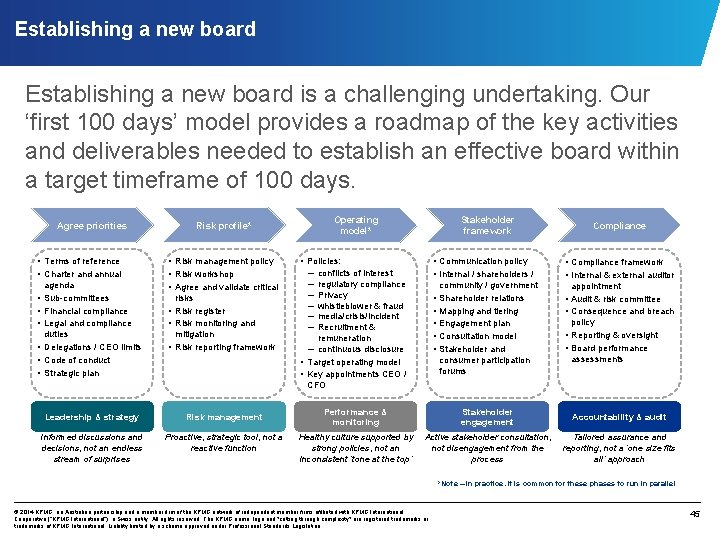
Establishing a new board is a challenging undertaking. Our ‘first 100 days’ model provides a roadmap of the key activities and deliverables needed to establish an effective board within a target timeframe of 100 days. Agree priorities • Terms of reference • Charter and annual • • • agenda Sub-committees Financial compliance Legal and compliance duties Delegations / CEO limits Code of conduct Strategic plan Operating model* Risk profile* • Risk management policy • Risk workshop • Agree and validate critical risks • Risk register • Risk monitoring and mitigation • Risk reporting framework Stakeholder framework • Policies: ‒ conflicts of interest ‒ regulatory compliance ‒ Privacy ‒ whistleblower & fraud ‒ media/crisis/incident ‒ Recruitment & • Communication policy • Internal / shareholders / • • • remuneration ‒ continuous disclosure • Target operating model • Key appointments CEO / community / government Shareholder relations Mapping and tiering Engagement plan Consultation model Stakeholder and consumer participation forums Compliance • Compliance framework • Internal & external auditor appointment • Audit & risk committee • Consequence and breach policy • Reporting & oversight • Board performance assessments CFO Leadership & strategy Risk management Informed discussions and decisions, not an endless stream of surprises Proactive, strategic tool, not a reactive function Performance & monitoring Stakeholder engagement Accountability & audit Healthy culture supported by strong policies, not an inconsistent ‘tone at the top’ Active stakeholder consultation, not disengagement from the process Tailored assurance and reporting, not a ‘one size fits all’ approach *Note – in practice, it is common for these phases to run in parallel © 2014 KPMG, an Australian partnership and a member firm of the KPMG network of independent member firms affiliated with KPMG International Cooperative (“KPMG International”), a Swiss entity. All rights reserved. The KPMG name, logo and "cutting through complexity" are registered trademarks or trademarks of KPMG International. Liability limited by a scheme approved under Professional Standards Legislation. 45
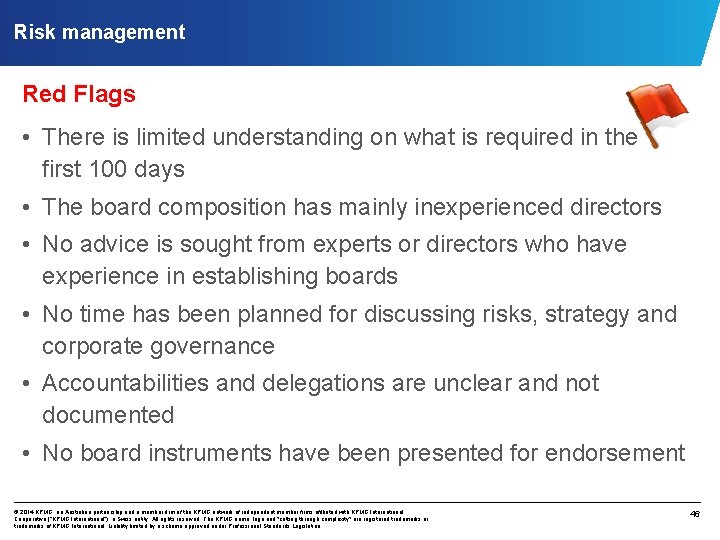
Risk management Red Flags • There is limited understanding on what is required in the first 100 days • The board composition has mainly inexperienced directors • No advice is sought from experts or directors who have experience in establishing boards • No time has been planned for discussing risks, strategy and corporate governance • Accountabilities and delegations are unclear and not documented • No board instruments have been presented for endorsement © 2014 KPMG, an Australian partnership and a member firm of the KPMG network of independent member firms affiliated with KPMG International Cooperative (“KPMG International”), a Swiss entity. All rights reserved. The KPMG name, logo and "cutting through complexity" are registered trademarks or trademarks of KPMG International. Liability limited by a scheme approved under Professional Standards Legislation. 46
Directors’ Toolkit walkthrough
Introducing the Directors’ Toolkit © 2014 KPMG, an Australian partnership and a member firm of the KPMG network of independent member firms affiliated with KPMG International Cooperative (“KPMG International”), a Swiss entity. All rights reserved. The KPMG name, logo and "cutting through complexity" are registered trademarks or trademarks of KPMG International. Liability limited by a scheme approved under Professional Standards Legislation. 48
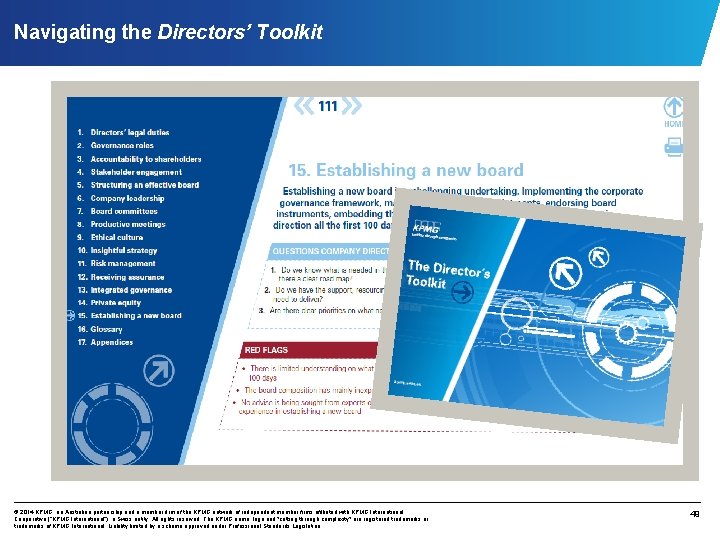
Navigating the Directors’ Toolkit © 2014 KPMG, an Australian partnership and a member firm of the KPMG network of independent member firms affiliated with KPMG International Cooperative (“KPMG International”), a Swiss entity. All rights reserved. The KPMG name, logo and "cutting through complexity" are registered trademarks or trademarks of KPMG International. Liability limited by a scheme approved under Professional Standards Legislation. 49
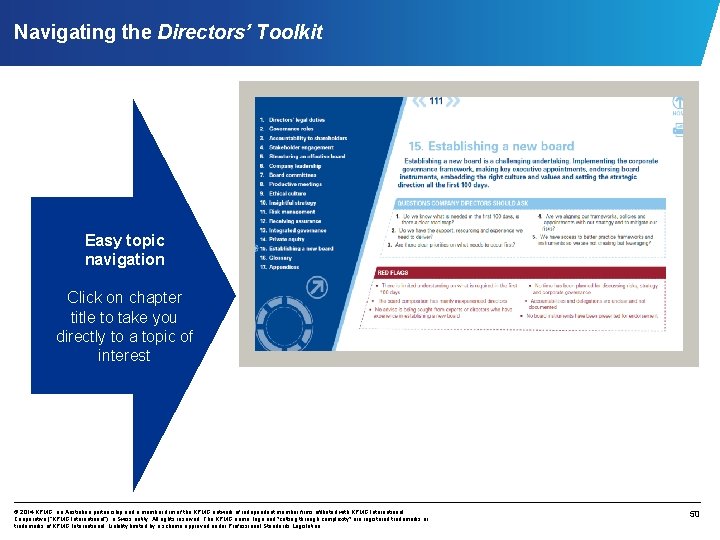
Navigating the Directors’ Toolkit Easy topic navigation Click on chapter title to take you directly to a topic of interest © 2014 KPMG, an Australian partnership and a member firm of the KPMG network of independent member firms affiliated with KPMG International Cooperative (“KPMG International”), a Swiss entity. All rights reserved. The KPMG name, logo and "cutting through complexity" are registered trademarks or trademarks of KPMG International. Liability limited by a scheme approved under Professional Standards Legislation. 50
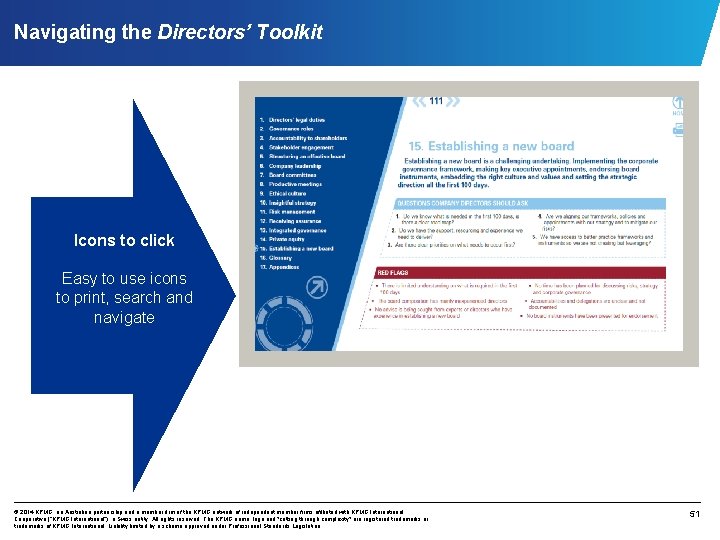
Navigating the Directors’ Toolkit Icons to click Easy to use icons to print, search and navigate © 2014 KPMG, an Australian partnership and a member firm of the KPMG network of independent member firms affiliated with KPMG International Cooperative (“KPMG International”), a Swiss entity. All rights reserved. The KPMG name, logo and "cutting through complexity" are registered trademarks or trademarks of KPMG International. Liability limited by a scheme approved under Professional Standards Legislation. 51
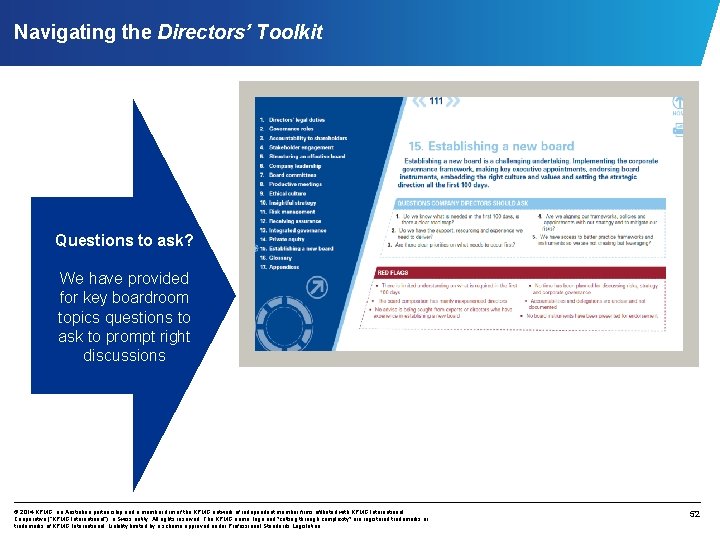
Navigating the Directors’ Toolkit Questions to ask? We have provided for key boardroom topics questions to ask to prompt right discussions © 2014 KPMG, an Australian partnership and a member firm of the KPMG network of independent member firms affiliated with KPMG International Cooperative (“KPMG International”), a Swiss entity. All rights reserved. The KPMG name, logo and "cutting through complexity" are registered trademarks or trademarks of KPMG International. Liability limited by a scheme approved under Professional Standards Legislation. 52
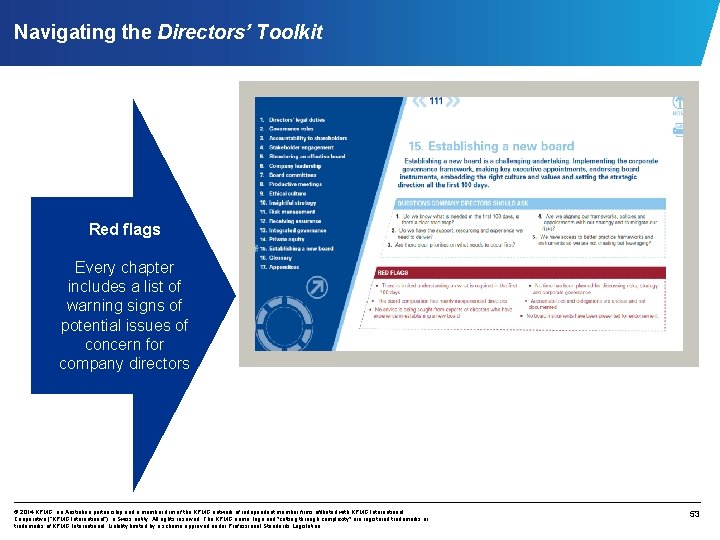
Navigating the Directors’ Toolkit Red flags Every chapter includes a list of warning signs of potential issues of concern for company directors © 2014 KPMG, an Australian partnership and a member firm of the KPMG network of independent member firms affiliated with KPMG International Cooperative (“KPMG International”), a Swiss entity. All rights reserved. The KPMG name, logo and "cutting through complexity" are registered trademarks or trademarks of KPMG International. Liability limited by a scheme approved under Professional Standards Legislation. 53
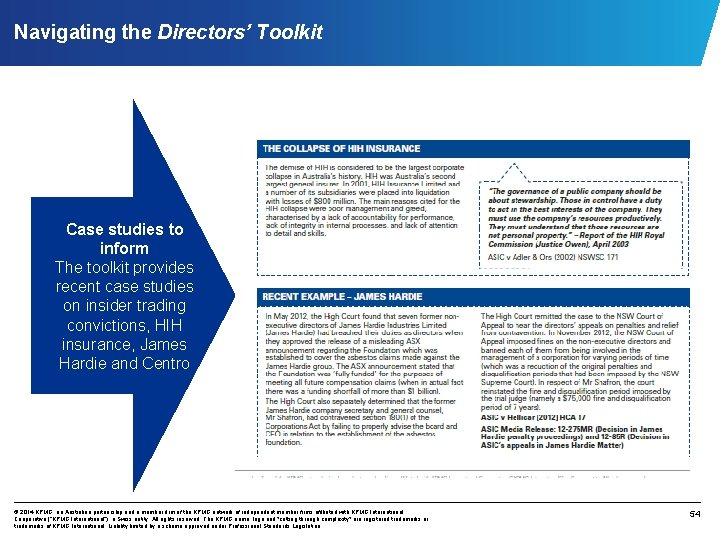
Navigating the Directors’ Toolkit Case studies to inform The toolkit provides recent case studies on insider trading convictions, HIH insurance, James Hardie and Centro © 2014 KPMG, an Australian partnership and a member firm of the KPMG network of independent member firms affiliated with KPMG International Cooperative (“KPMG International”), a Swiss entity. All rights reserved. The KPMG name, logo and "cutting through complexity" are registered trademarks or trademarks of KPMG International. Liability limited by a scheme approved under Professional Standards Legislation. 54
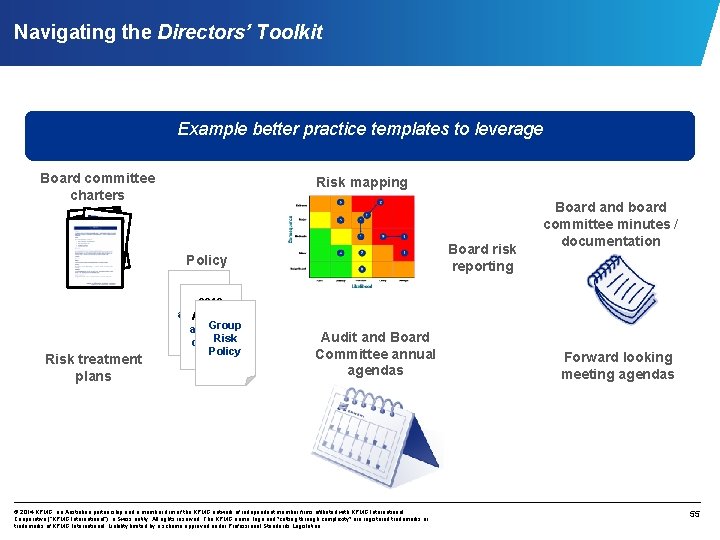
Navigating the Directors’ Toolkit Example better practice templates to leverage Board committee charters Risk mapping Templates We have include Board risk reporting Policy Risk treatment plans 2012 Annual 2012 assuran Annual Group ceassuran plan Risk ce plan Policy Audit and Board Committee annual agendas © 2014 KPMG, an Australian partnership and a member firm of the KPMG network of independent member firms affiliated with KPMG International Cooperative (“KPMG International”), a Swiss entity. All rights reserved. The KPMG name, logo and "cutting through complexity" are registered trademarks or trademarks of KPMG International. Liability limited by a scheme approved under Professional Standards Legislation. Board and board committee minutes / documentation Forward looking meeting agendas 55
Toolkit content © 2014 KPMG, an Australian partnership and a member firm of the KPMG network of independent member firms affiliated with KPMG International Cooperative (“KPMG International”), a Swiss entity. All rights reserved. The KPMG name, logo and "cutting through complexity" are registered trademarks or trademarks of KPMG International. Liability limited by a scheme approved under Professional Standards Legislation. 56
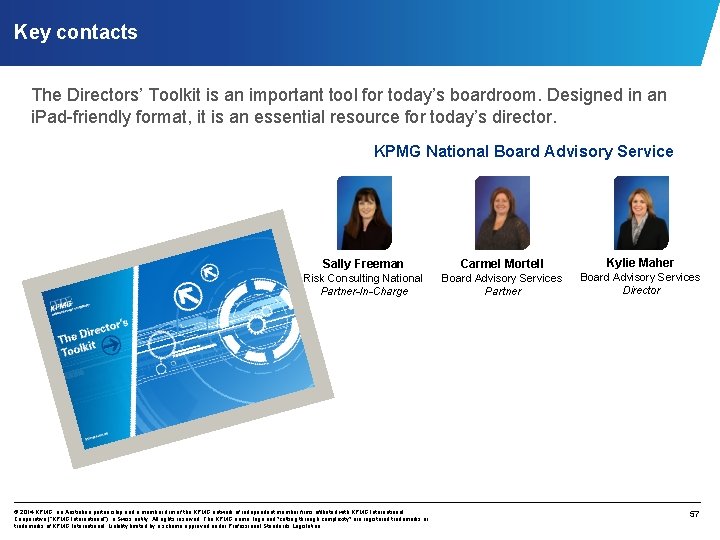
Key contacts The Directors’ Toolkit is an important tool for today’s boardroom. Designed in an i. Pad-friendly format, it is an essential resource for today’s director. KPMG National Board Advisory Service Sally Freeman Carmel Mortell Kylie Maher Risk Consulting National Partner-In-Charge Board Advisory Services Partner Board Advisory Services Director © 2014 KPMG, an Australian partnership and a member firm of the KPMG network of independent member firms affiliated with KPMG International Cooperative (“KPMG International”), a Swiss entity. All rights reserved. The KPMG name, logo and "cutting through complexity" are registered trademarks or trademarks of KPMG International. Liability limited by a scheme approved under Professional Standards Legislation. 57
- Slides: 58