
17 th European AIDS Conference EACS November 6

17 th European AIDS Conference (EACS) November 6 -9, 2019 in Basel, Switzerland Faculty Jose Ignacio Bernardino, Madrid, Spain Pedro Cahn, Buenos-Aires, Argentina François Raffi, Nantes, France Our institutional partners
Next ARV-Trials. com webinars CROI, Boston AIDS, San Francisco 8 th-11 th March 2020 6 th-10 th July 2020
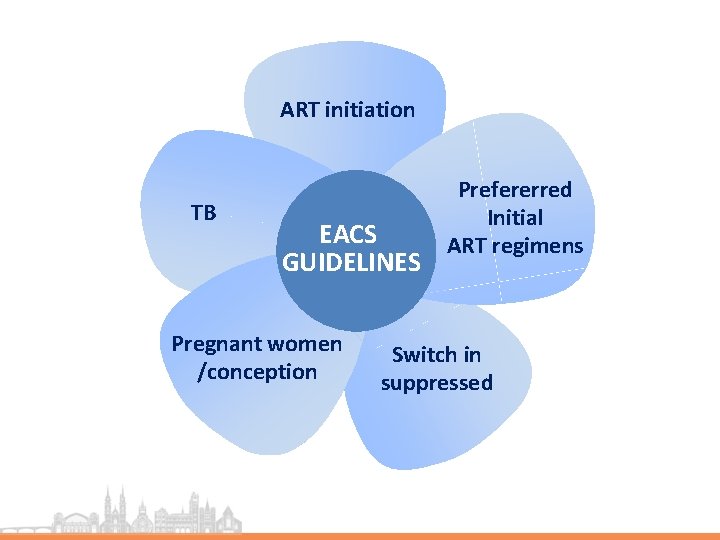
ART initiation TB EACS GUIDELINES Pregnant women /conception Prefererred Initial ART regimens Switch in suppressed
ART is recommended in all adults with HIV infection, irrespective of CD 4 counts • ART is recommended irrespective of the CD 4 count. In certain situations (i. e. lower CD 4 count or pregnancy) there is a greater urgency to start ART immediately Whether rapid, possibly same-day ART start is proposed to newly diagnosed persons or awaited until complementary assessments depends on the setting and medical circumstances, medical indications to start ART more urgently and risk of loss from care. To reduce loss to follow-up between diagnosis and ART initiation, structural barriers delaying the process should be addressed
Initial combination regimen for ART-naïve Adult HIV-positive Persons Before selecting an ART regimen, it is critical to review: If a woman wishes to conceive (see Table) If a woman is pregnant (see Table) If the person has an OI (see Table) If the person has TB (see Table) If the person has potential treatment limiting comorbidities: see Comorbidity section, dose adjustment for renal and liver impairment • If the person is treated with other medications: d-d-i • If the person has swallowing difficulties • • •
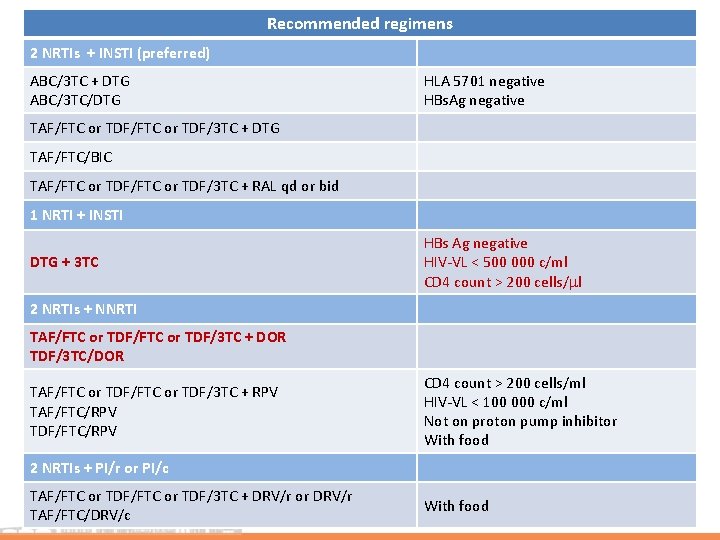
Recommended regimens 2 NRTIs + INSTI (preferred) ABC/3 TC + DTG ABC/3 TC/DTG HLA 5701 negative HBs. Ag negative TAF/FTC or TDF/3 TC + DTG TAF/FTC/BIC TAF/FTC or TDF/3 TC + RAL qd or bid 1 NRTI + INSTI DTG + 3 TC HBs Ag negative HIV-VL < 500 000 c/ml CD 4 count > 200 cells/ml 2 NRTIs + NNRTI TAF/FTC or TDF/3 TC + DOR TDF/3 TC/DOR TAF/FTC or TDF/3 TC + RPV TAF/FTC/RPV TDF/FTC/RPV CD 4 count > 200 cells/ml HIV-VL < 100 000 c/ml Not on proton pump inhibitor With food 2 NRTIs + PI/r or PI/c TAF/FTC or TDF/3 TC + DRV/r or DRV/r TAF/FTC/DRV/c With food
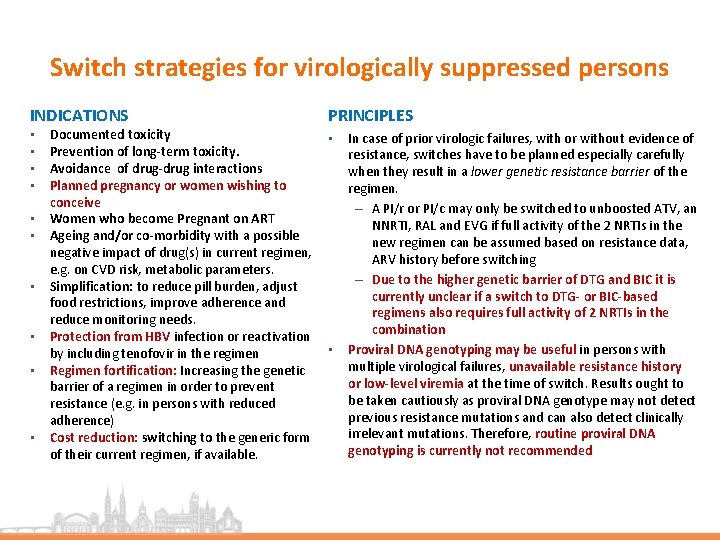
Switch strategies for virologically suppressed persons INDICATIONS • • • PRINCIPLES Documented toxicity • Prevention of long-term toxicity. Avoidance of drug-drug interactions Planned pregnancy or women wishing to conceive Women who become Pregnant on ART Ageing and/or co-morbidity with a possible negative impact of drug(s) in current regimen, e. g. on CVD risk, metabolic parameters. Simplification: to reduce pill burden, adjust food restrictions, improve adherence and reduce monitoring needs. Protection from HBV infection or reactivation • by including tenofovir in the regimen Regimen fortification: Increasing the genetic barrier of a regimen in order to prevent resistance (e. g. in persons with reduced adherence) Cost reduction: switching to the generic form of their current regimen, if available. In case of prior virologic failures, with or without evidence of resistance, switches have to be planned especially carefully when they result in a lower genetic resistance barrier of the regimen. – A PI/r or PI/c may only be switched to unboosted ATV, an NNRTI, RAL and EVG if full activity of the 2 NRTIs in the new regimen can be assumed based on resistance data, ARV history before switching – Due to the higher genetic barrier of DTG and BIC it is currently unclear if a switch to DTG- or BIC-based regimens also requires full activity of 2 NRTIs in the combination Proviral DNA genotyping may be useful in persons with multiple virological failures, unavailable resistance history or low-level viremia at the time of switch. Results ought to be taken cautiously as proviral DNA genotype may not detect previous resistance mutations and can also detect clinically irrelevant mutations. Therefore, routine proviral DNA genotyping is currently not recommended
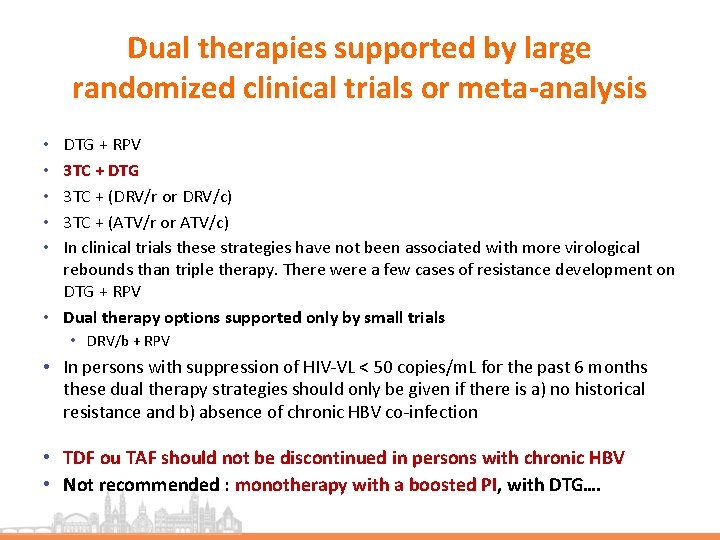
Dual therapies supported by large randomized clinical trials or meta-analysis DTG + RPV 3 TC + DTG 3 TC + (DRV/r or DRV/c) 3 TC + (ATV/r or ATV/c) In clinical trials these strategies have not been associated with more virological rebounds than triple therapy. There were a few cases of resistance development on DTG + RPV • Dual therapy options supported only by small trials • • • DRV/b + RPV • In persons with suppression of HIV-VL < 50 copies/m. L for the past 6 months these dual therapy strategies should only be given if there is a) no historical resistance and b) absence of chronic HBV co-infection • TDF ou TAF should not be discontinued in persons with chronic HBV • Not recommended : monotherapy with a boosted PI, with DTG….
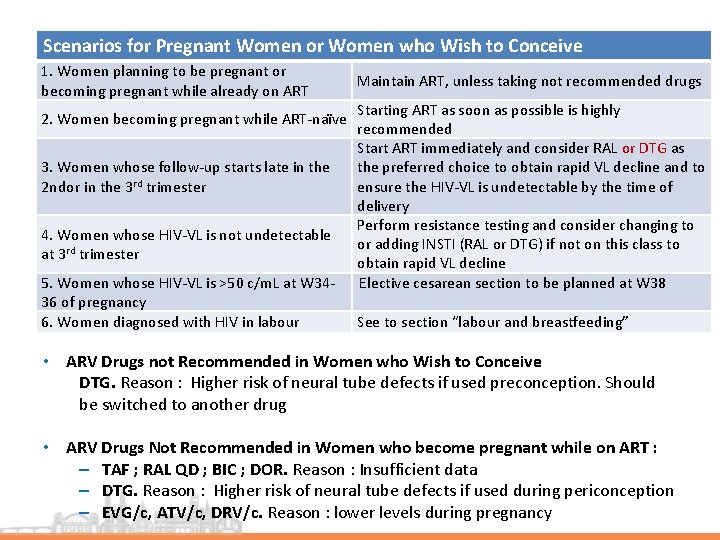
Scenarios for Pregnant Women or Women who Wish to Conceive 1. Women planning to be pregnant or becoming pregnant while already on ART 2. Women becoming pregnant while ART-naïve 3. Women whose follow-up starts late in the 2 ndor in the 3 rd trimester 4. Women whose HIV-VL is not undetectable at 3 rd trimester 5. Women whose HIV-VL is >50 c/m. L at W 3436 of pregnancy 6. Women diagnosed with HIV in labour Maintain ART, unless taking not recommended drugs Starting ART as soon as possible is highly recommended Start ART immediately and consider RAL or DTG as the preferred choice to obtain rapid VL decline and to ensure the HIV-VL is undetectable by the time of delivery Perform resistance testing and consider changing to or adding INSTI (RAL or DTG) if not on this class to obtain rapid VL decline Elective cesarean section to be planned at W 38 See to section “labour and breastfeeding” • ARV Drugs not Recommended in Women who Wish to Conceive DTG. Reason : Higher risk of neural tube defects if used preconception. Should be switched to another drug • ARV Drugs Not Recommended in Women who become pregnant while on ART : ‒ TAF ; RAL QD ; BIC ; DOR. Reason : Insufficient data ‒ DTG. Reason : Higher risk of neural tube defects if used during periconception ‒ EVG/c, ATV/c, DRV/c. Reason : lower levels during pregnancy
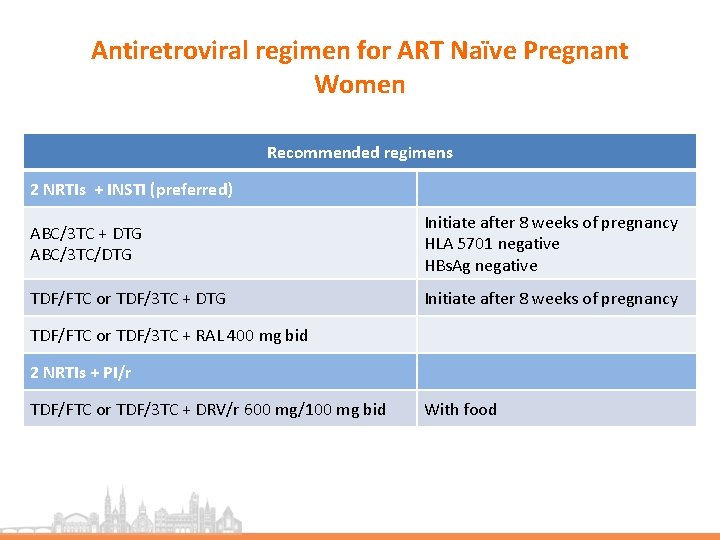
Antiretroviral regimen for ART Naïve Pregnant Women Recommended regimens 2 NRTIs + INSTI (preferred) ABC/3 TC + DTG ABC/3 TC/DTG Initiate after 8 weeks of pregnancy HLA 5701 negative HBs. Ag negative TDF/FTC or TDF/3 TC + DTG Initiate after 8 weeks of pregnancy TDF/FTC or TDF/3 TC + RAL 400 mg bid 2 NRTIs + PI/r TDF/FTC or TDF/3 TC + DRV/r 600 mg/100 mg bid With food
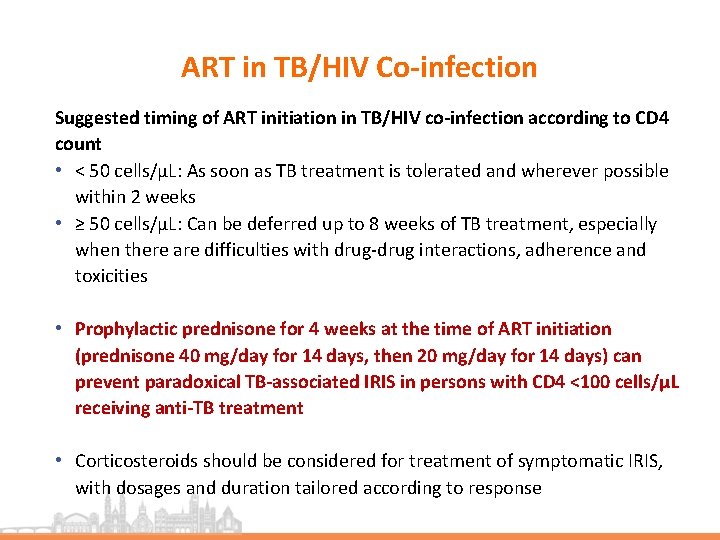
ART in TB/HIV Co-infection Suggested timing of ART initiation in TB/HIV co-infection according to CD 4 count • < 50 cells/µL: As soon as TB treatment is tolerated and wherever possible within 2 weeks • ≥ 50 cells/µL: Can be deferred up to 8 weeks of TB treatment, especially when there are difficulties with drug-drug interactions, adherence and toxicities • Prophylactic prednisone for 4 weeks at the time of ART initiation (prednisone 40 mg/day for 14 days, then 20 mg/day for 14 days) can prevent paradoxical TB-associated IRIS in persons with CD 4 <100 cells/µL receiving anti-TB treatment • Corticosteroids should be considered for treatment of symptomatic IRIS, with dosages and duration tailored according to response
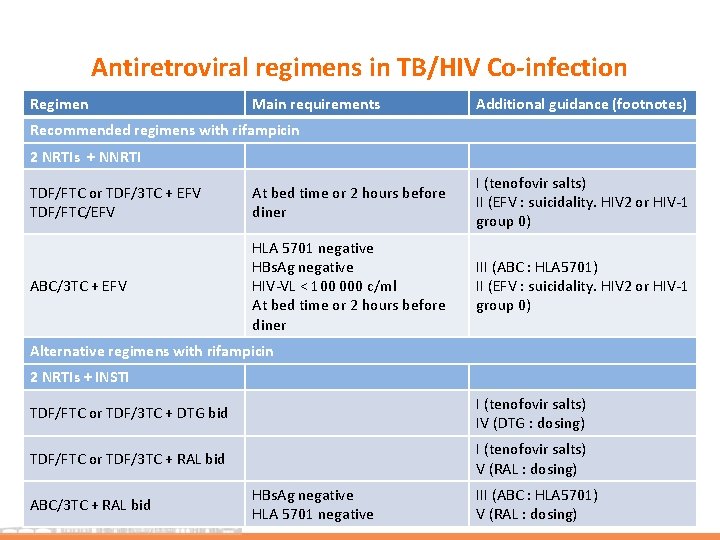
Antiretroviral regimens in TB/HIV Co-infection Regimen Main requirements Additional guidance (footnotes) Recommended regimens with rifampicin 2 NRTIs + NNRTI TDF/FTC or TDF/3 TC + EFV TDF/FTC/EFV At bed time or 2 hours before diner I (tenofovir salts) II (EFV : suicidality. HIV 2 or HIV-1 group 0) ABC/3 TC + EFV HLA 5701 negative HBs. Ag negative HIV-VL < 100 000 c/ml At bed time or 2 hours before diner III (ABC : HLA 5701) II (EFV : suicidality. HIV 2 or HIV-1 group 0) Alternative regimens with rifampicin 2 NRTIs + INSTI TDF/FTC or TDF/3 TC + DTG bid I (tenofovir salts) IV (DTG : dosing) TDF/FTC or TDF/3 TC + RAL bid I (tenofovir salts) V (RAL : dosing) ABC/3 TC + RAL bid HBs. Ag negative HLA 5701 negative III (ABC : HLA 5701) V (RAL : dosing)
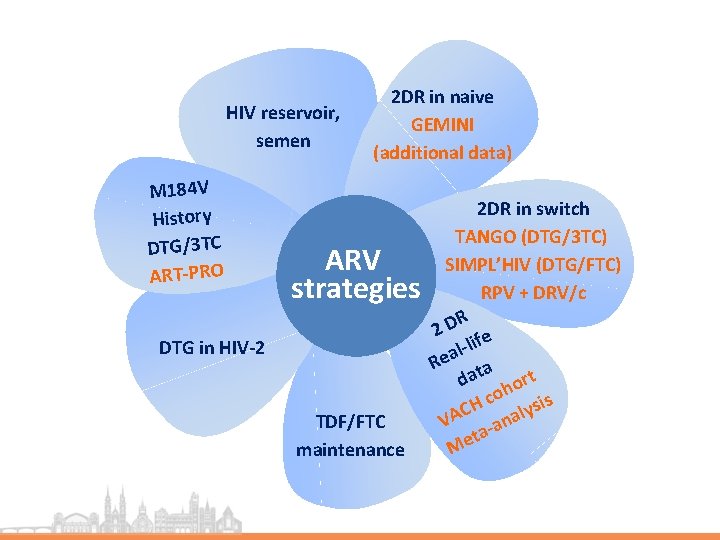
HIV reservoir, semen M 184 V History DTG/3 TC ART-PRO 2 DR in naive GEMINI (additional data) ARV strategies DTG in HIV-2 TDF/FTC maintenance 2 DR in switch TANGO (DTG/3 TC) SIMPL’HIV (DTG/FTC) RPV + DRV/c R 2 D fe -li l a Re ta da hort co is H s y C l VA -ana ta e M
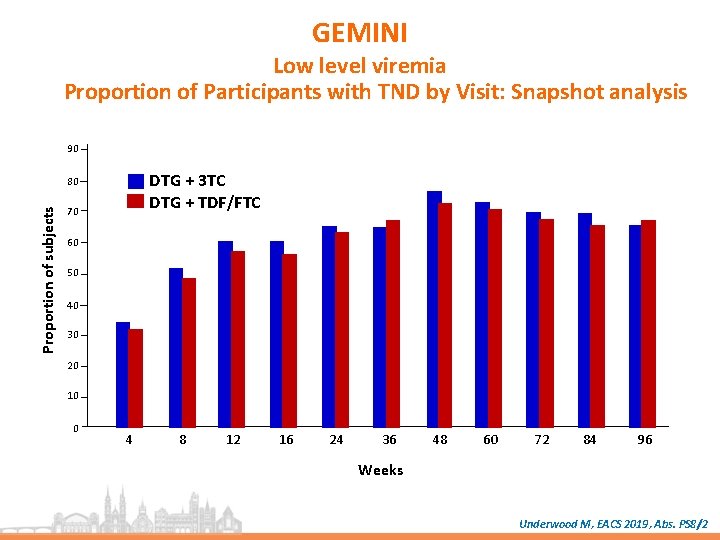
GEMINI Low level viremia Proportion of Participants with TND by Visit: Snapshot analysis 90 DTG + 3 TC DTG + TDF/FTC Proportion of subjects 80 70 60 50 40 30 20 10 0 4 8 12 16 24 36 48 60 72 84 96 Weeks Underwood M, EACS 2019, Abs. PS 8/2
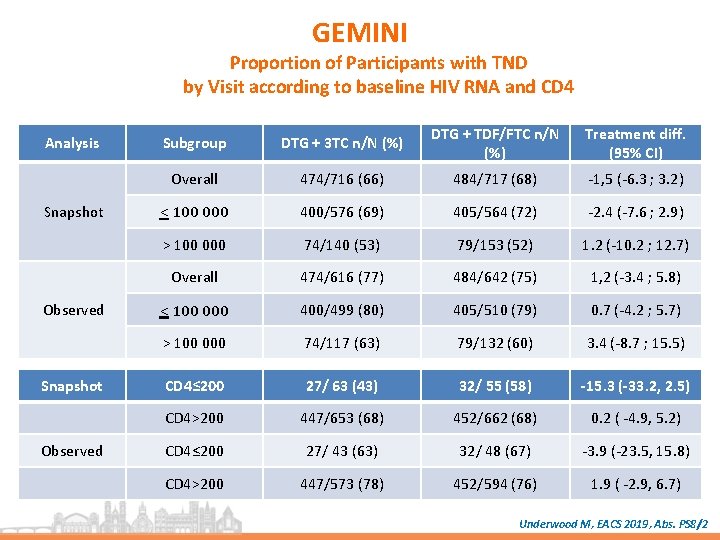
GEMINI Proportion of Participants with TND by Visit according to baseline HIV RNA and CD 4 Subgroup DTG + 3 TC n/N (%) DTG + TDF/FTC n/N (%) Treatment diff. (95% CI) Overall 474/716 (66) 484/717 (68) -1, 5 (-6. 3 ; 3. 2) < 100 000 400/576 (69) 405/564 (72) -2. 4 (-7. 6 ; 2. 9) > 100 000 74/140 (53) 79/153 (52) 1. 2 (-10. 2 ; 12. 7) Overall 474/616 (77) 484/642 (75) 1, 2 (-3. 4 ; 5. 8) < 100 000 400/499 (80) 405/510 (79) 0. 7 (-4. 2 ; 5. 7) > 100 000 74/117 (63) 79/132 (60) 3. 4 (-8. 7 ; 15. 5) Snapshot CD 4≤ 200 27/ 63 (43) 32/ 55 (58) -15. 3 (-33. 2, 2. 5) CD 4>200 447/653 (68) 452/662 (68) 0. 2 ( -4. 9, 5. 2) Observed CD 4≤ 200 27/ 43 (63) 32/ 48 (67) -3. 9 (-23. 5, 15. 8) CD 4>200 447/573 (78) 452/594 (76) 1. 9 ( -2. 9, 6. 7) Analysis Snapshot Observed Underwood M, EACS 2019, Abs. PS 8/2
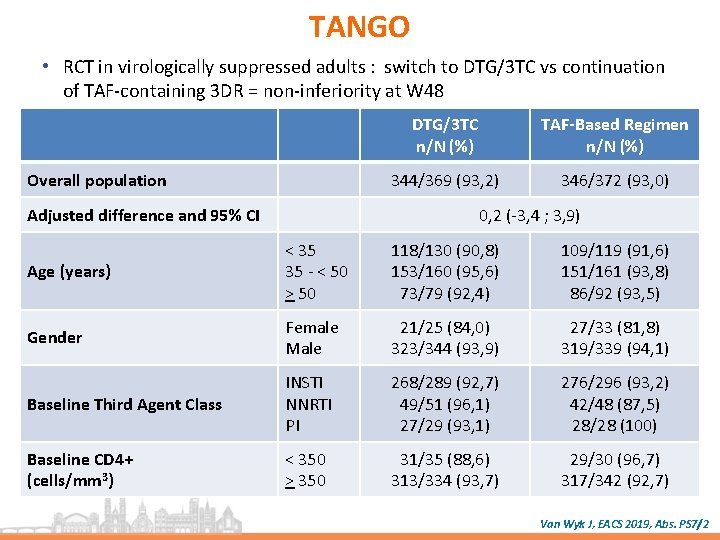
TANGO • RCT in virologically suppressed adults : switch to DTG/3 TC vs continuation of TAF-containing 3 DR = non-inferiority at W 48 Overall population Adjusted difference and 95% CI DTG/3 TC n/N (%) TAF-Based Regimen n/N (%) 344/369 (93, 2) 346/372 (93, 0) 0, 2 (-3, 4 ; 3, 9) Age (years) < 35 35 - < 50 > 50 118/130 (90, 8) 153/160 (95, 6) 73/79 (92, 4) 109/119 (91, 6) 151/161 (93, 8) 86/92 (93, 5) Gender Female Male 21/25 (84, 0) 323/344 (93, 9) 27/33 (81, 8) 319/339 (94, 1) Baseline Third Agent Class INSTI NNRTI PI 268/289 (92, 7) 49/51 (96, 1) 27/29 (93, 1) 276/296 (93, 2) 42/48 (87, 5) 28/28 (100) Baseline CD 4+ (cells/mm 3) < 350 > 350 31/35 (88, 6) 313/334 (93, 7) 29/30 (96, 7) 317/342 (92, 7) Van Wyk J, EACS 2019, Abs. PS 7/2
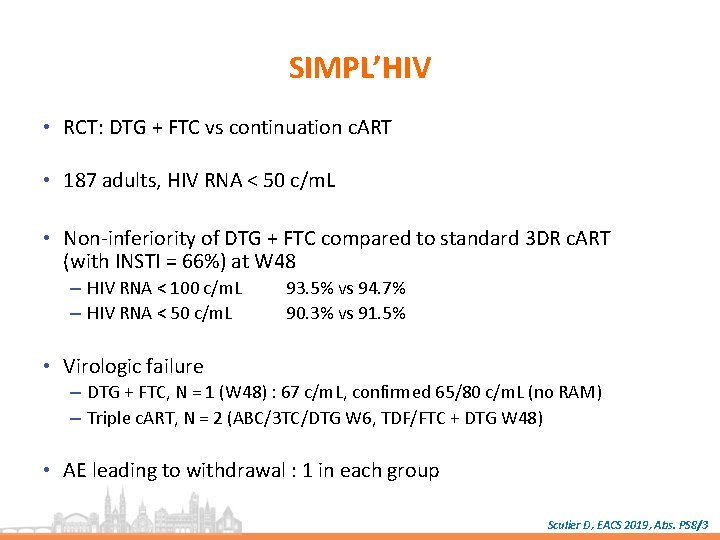
SIMPL’HIV • RCT: DTG + FTC vs continuation c. ART • 187 adults, HIV RNA < 50 c/m. L • Non-inferiority of DTG + FTC compared to standard 3 DR c. ART (with INSTI = 66%) at W 48 – HIV RNA < 100 c/m. L – HIV RNA < 50 c/m. L 93. 5% vs 94. 7% 90. 3% vs 91. 5% • Virologic failure – DTG + FTC, N = 1 (W 48) : 67 c/m. L, confirmed 65/80 c/m. L (no RAM) – Triple c. ART, N = 2 (ABC/3 TC/DTG W 6, TDF/FTC + DTG W 48) • AE leading to withdrawal : 1 in each group Sculier D, EACS 2019, Abs. PS 8/3
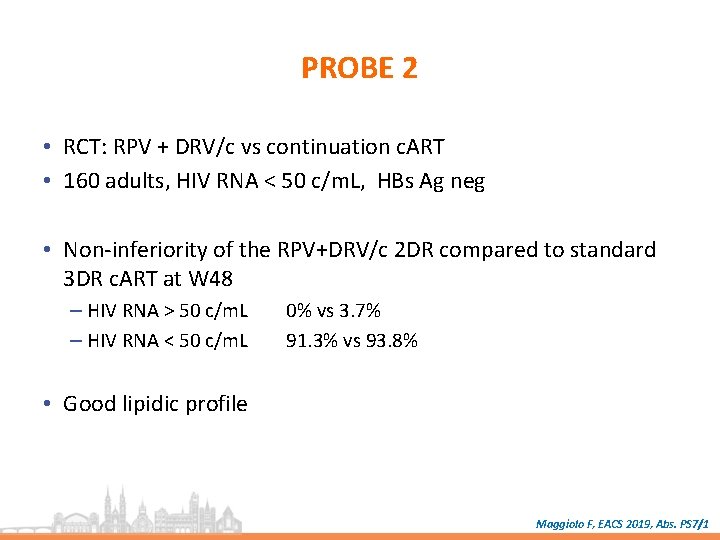
PROBE 2 • RCT: RPV + DRV/c vs continuation c. ART • 160 adults, HIV RNA < 50 c/m. L, HBs Ag neg • Non-inferiority of the RPV+DRV/c 2 DR compared to standard 3 DR c. ART at W 48 – HIV RNA > 50 c/m. L – HIV RNA < 50 c/m. L 0% vs 3. 7% 91. 3% vs 93. 8% • Good lipidic profile Maggiolo F, EACS 2019, Abs. PS 7/1
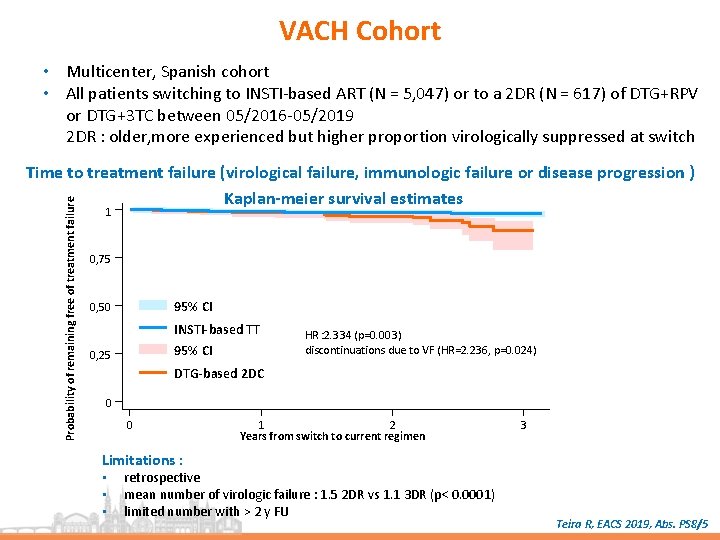
VACH Cohort • Multicenter, Spanish cohort • All patients switching to INSTI-based ART (N = 5, 047) or to a 2 DR (N = 617) of DTG+RPV or DTG+3 TC between 05/2016 -05/2019 2 DR : older, more experienced but higher proportion virologically suppressed at switch Probability of remaining free of treatment failure Time to treatment failure (virological failure, immunologic failure or disease progression ) Kaplan-meier survival estimates 1 0, 75 95% CI 0, 50 INSTI-based TT 95% CI 0, 25 HR : 2. 334 (p=0. 003) discontinuations due to VF (HR=2. 236, p=0. 024) DTG-based 2 DC 0 0 1 2 Years from switch to current regimen 3 Limitations : • • • retrospective mean number of virologic failure : 1. 5 2 DR vs 1. 1 3 DR (p< 0. 0001) limited number with > 2 y FU Teira R, EACS 2019, Abs. PS 8/5
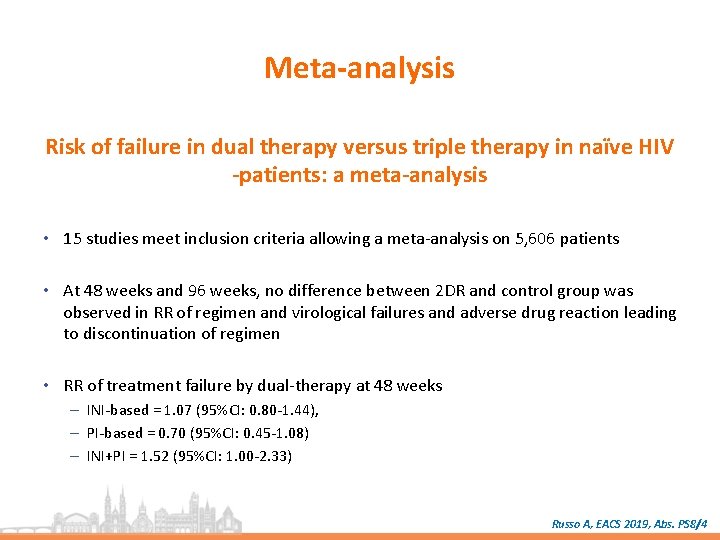
Meta-analysis Risk of failure in dual therapy versus triple therapy in naïve HIV -patients: a meta-analysis • 15 studies meet inclusion criteria allowing a meta-analysis on 5, 606 patients • At 48 weeks and 96 weeks, no difference between 2 DR and control group was observed in RR of regimen and virological failures and adverse drug reaction leading to discontinuation of regimen • RR of treatment failure by dual-therapy at 48 weeks – INI-based = 1. 07 (95%CI: 0. 80 -1. 44), – PI-based = 0. 70 (95%CI: 0. 45 -1. 08) – INI+PI = 1. 52 (95%CI: 1. 00 -2. 33) Russo A, EACS 2019, Abs. PS 8/4

TRULIGHT • RCT, open-label • 223 adults, stable triple TDF/FTC containing ART, HIV RNA < 50 c/m. L, cellular HIV DNA < 2. 7 log c/106 PBMC, CD 4 nadir > 150/mm 3 • Randomisation 1: 1, TDF/FTC vs continuation c. ART • Non-inferiority of TDF/FTC 2 DR compared to c. ART at W 48 – HIV RNA < 50 c/m. L 90. 5% vs 88. 5% – HIV RNA > 50 c/m. L 2% vs 5% • 2 virologic failure on triple c. ART • 6 virologic failure on TDF/FTC (emergence M 184 V, N = 1, emergence K 65 R, N = 1) Prazuck T, EACS 2019, Abs. BPD 1/5
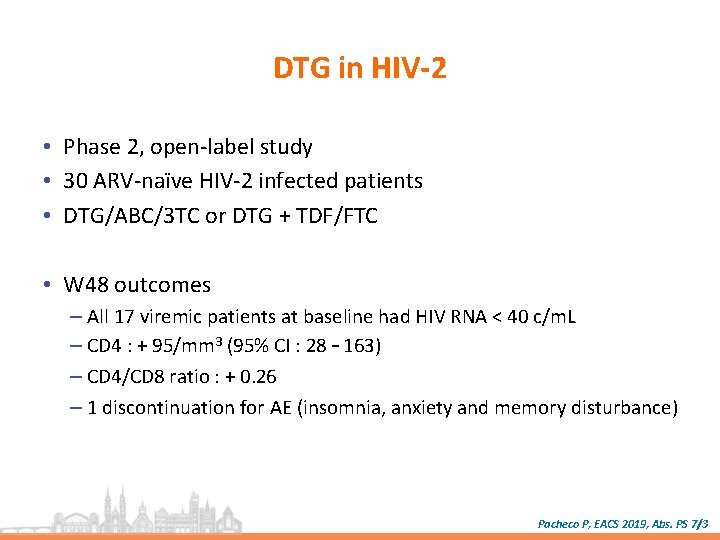
DTG in HIV-2 • Phase 2, open-label study • 30 ARV-naïve HIV-2 infected patients • DTG/ABC/3 TC or DTG + TDF/FTC • W 48 outcomes – All 17 viremic patients at baseline had HIV RNA < 40 c/m. L – CD 4 : + 95/mm 3 (95% CI : 28 – 163) – CD 4/CD 8 ratio : + 0. 26 – 1 discontinuation for AE (insomnia, anxiety and memory disturbance) Pacheco P, EACS 2019, Abs. PS 7/3
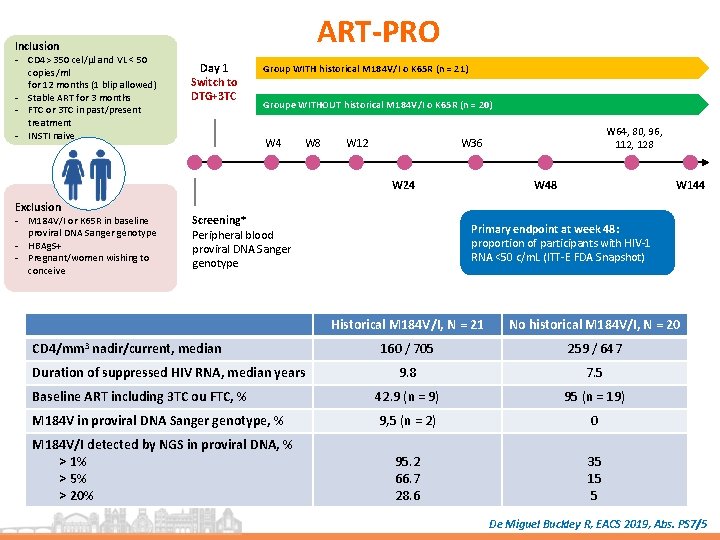
ART-PRO Inclusion - CD 4> 350 cel/µl and VL < 50 copies/ml for 12 months (1 blip allowed) - Stable ART for 3 months - FTC or 3 TC in past/present treatment - INSTI naive Day 1 Switch to DTG+3 TC Group WITH historical M 184 V/I o K 65 R (n = 21) Groupe WITHOUT historical M 184 V/I o K 65 R (n = 20) W 4 W 8 W 12 W 24 Exclusion - M 184 V/I or K 65 R in baseline proviral DNA Sanger genotype - HBAg. S+ - Pregnant/women wishing to conceive W 64, 80, 96, 112, 128 W 36 Screening* Peripheral blood proviral DNA Sanger genotype W 48 W 144 Primary endpoint at week 48: proportion of participants with HIV-1 RNA <50 c/m. L (ITT-E FDA Snapshot) Historical M 184 V/I, N = 21 No historical M 184 V/I, N = 20 160 / 705 259 / 647 9. 8 7. 5 Baseline ART including 3 TC ou FTC, % 42. 9 (n = 9) 95 (n = 19) M 184 V in proviral DNA Sanger genotype, % 9, 5 (n = 2) 0 95. 2 66. 7 28. 6 35 15 5 CD 4/mm 3 nadir/current, median Duration of suppressed HIV RNA, median years M 184 V/I detected by NGS in proviral DNA, % > 1% > 5% > 20% De Miguel Buckley R, EACS 2019, Abs. PS 7/5
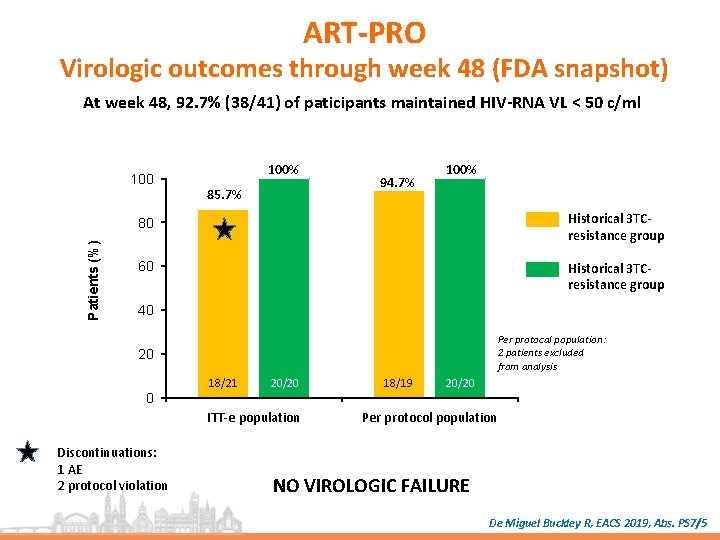
ART-PRO Virologic outcomes through week 48 (FDA snapshot) At week 48, 92. 7% (38/41) of paticipants maintained HIV-RNA VL < 50 c/ml Patients (%) 100% 85. 7% 94. 7% 100% 80 Historical 3 TCresistance group 60 Historical 3 TCresistance group 40 Per protocal population: 2 patients excluded from analysis 20 0 18/21 20/20 ITT-e population Discontinuations: 1 AE 2 protocol violation 18/19 20/20 Per protocol population NO VIROLOGIC FAILURE De Miguel Buckley R, EACS 2019, Abs. PS 7/5
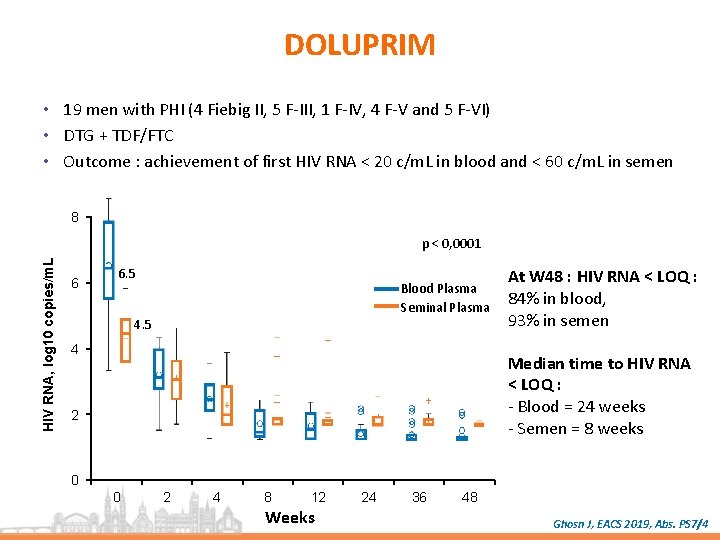
DOLUPRIM • 19 men with PHI (4 Fiebig II, 5 F-III, 1 F-IV, 4 F-V and 5 F-VI) • DTG + TDF/FTC • Outcome : achievement of first HIV RNA < 20 c/m. L in blood and < 60 c/m. L in semen 8 HIV RNA, log 10 copies/m. L p < 0, 0001 6 6. 5 Blood Plasma Seminal Plasma 4. 5 4 At W 48 : HIV RNA < LOQ : 84% in blood, 93% in semen Median time to HIV RNA < LOQ : - Blood = 24 weeks - Semen = 8 weeks 2 0 0 2 4 8 12 Weeks 24 36 48 Ghosn J, EACS 2019, Abs. PS 7/4
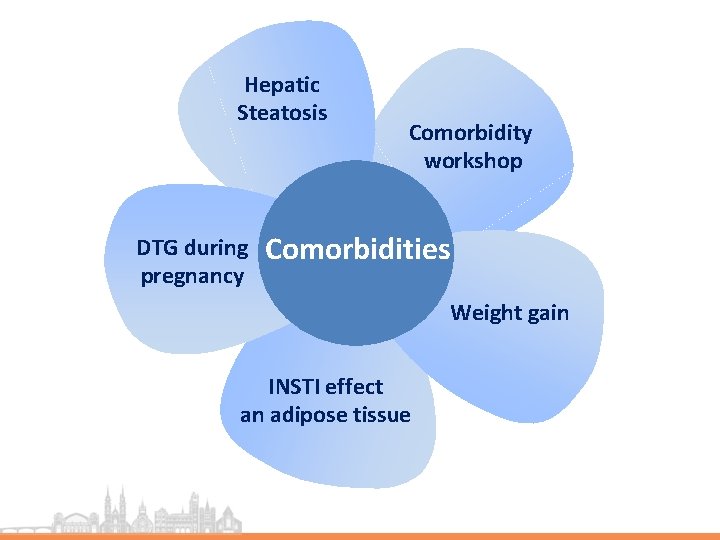
Hepatic Steatosis DTG during pregnancy Comorbidity workshop Comorbidities Weight gain INSTI effect an adipose tissue
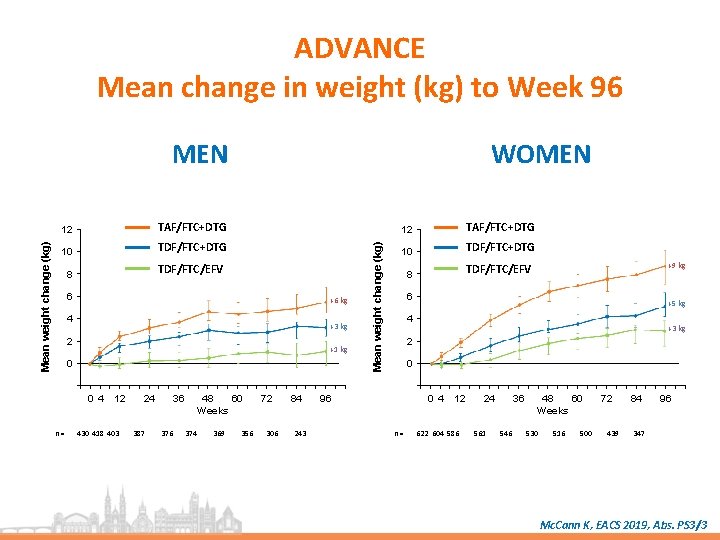
ADVANCE Mean change in weight (kg) to Week 96 12 TAF/FTC+DTG 10 TDF/FTC+DTG 8 TDF/FTC/EFV WOMEN 6 +6 kg 4 +3 kg 2 +1 kg 0 -2 12 TAF/FTC+DTG 10 TDF/FTC+DTG 8 TDF/FTC/EFV +9 kg 6 +5 kg 4 +3 kg 2 0 -2 0 4 n = Mean weight change (kg) MEN 12 430 418 403 24 387 36 376 48 60 Weeks 374 369 356 72 306 84 243 96 0 4 n = 12 622 604 586 24 561 36 546 48 60 Weeks 530 516 500 72 439 84 96 347 Mc. Cann K, EACS 2019, Abs. PS 3/3
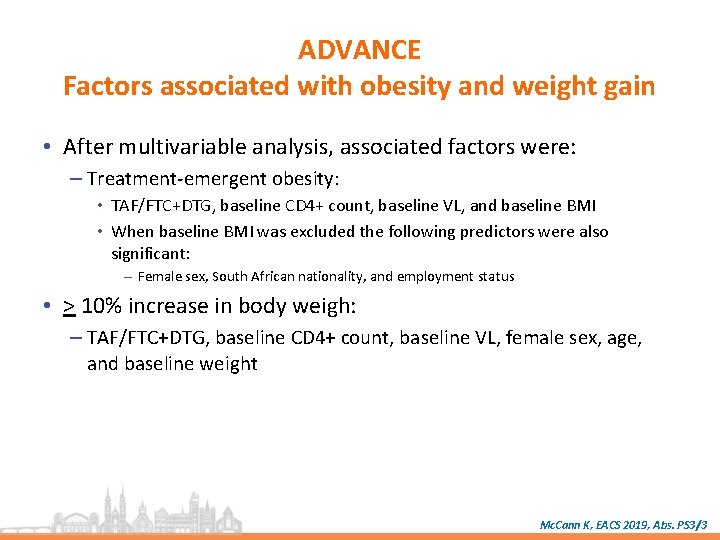
ADVANCE Factors associated with obesity and weight gain • After multivariable analysis, associated factors were: – Treatment-emergent obesity: • TAF/FTC+DTG, baseline CD 4+ count, baseline VL, and baseline BMI • When baseline BMI was excluded the following predictors were also significant: – Female sex, South African nationality, and employment status • > 10% increase in body weigh: – TAF/FTC+DTG, baseline CD 4+ count, baseline VL, female sex, age, and baseline weight Mc. Cann K, EACS 2019, Abs. PS 3/3
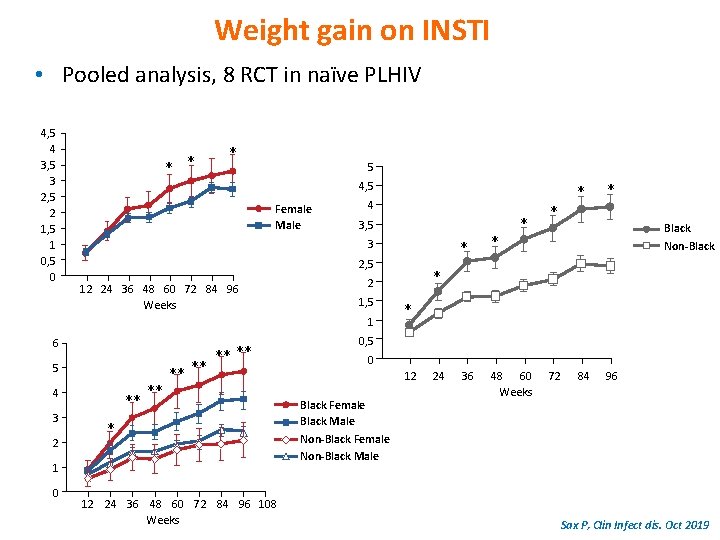
Weight gain on INSTI • Pooled analysis, 8 RCT in naïve PLHIV 4, 5 4 3, 5 3 2, 5 2 1, 5 1 0, 5 0 * * * 5 4, 5 Female Male 4 3, 5 3 2, 5 12 24 36 48 60 72 84 96 Weeks 1, 5 6 5 4 2 ** ** ** * 1 0 12 24 36 48 60 72 84 96 108 Weeks * * * 36 48 60 Weeks * * Black Non-Black * 2 1 3 * * 0, 5 0 12 Black Female Black Male 24 72 84 96 Non-Black Female Non-Black Male Sax P, Clin Infect dis. Oct 2019
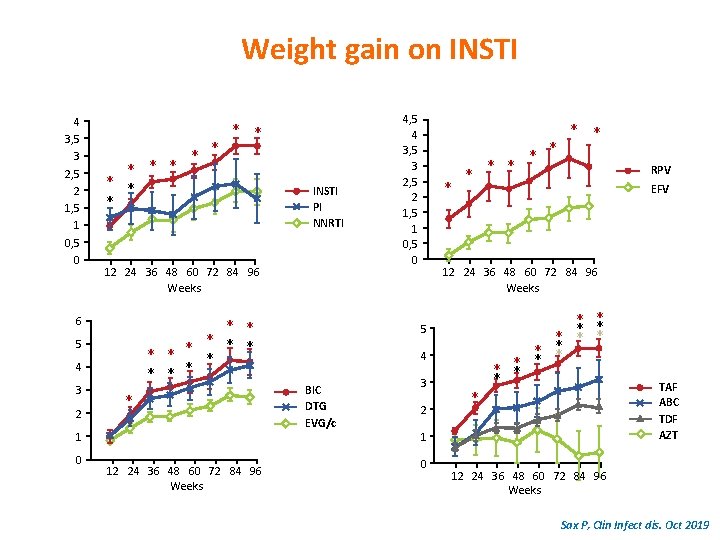
Weight gain on INSTI 4 3, 5 3 2, 5 2 1, 5 1 0, 5 0 * * * * * 5 4 2 * * 1 0 INSTI PI NNRTI 12 24 36 48 60 72 84 96 Weeks 6 3 * * * 12 24 36 48 60 72 84 96 Weeks 4, 5 4 3, 5 3 2, 5 2 1, 5 1 0, 5 0 * * * RPV EFV 12 24 36 48 60 72 84 96 Weeks 5 4 BIC DTG EVG/c * * * 3 2 * * ** * 1 0 TAF ABC TDF AZT 12 24 36 48 60 72 84 96 Weeks Sax P, Clin Infect dis. Oct 2019
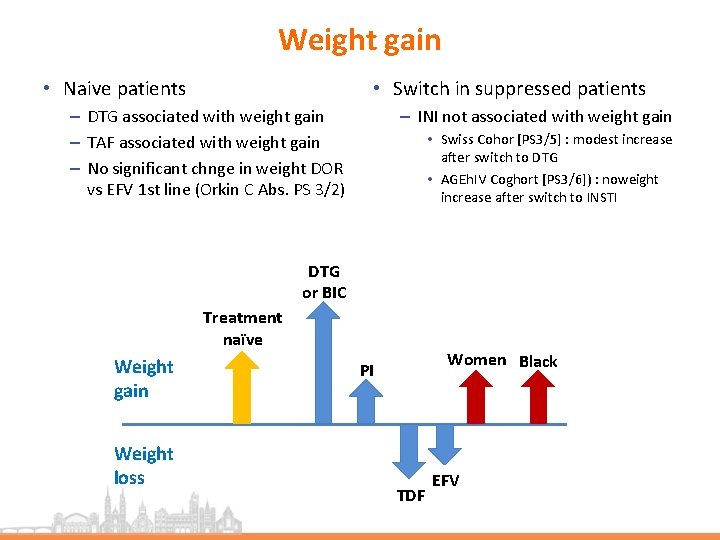
Weight gain • Naive patients • Switch in suppressed patients – DTG associated with weight gain – TAF associated with weight gain – No significant chnge in weight DOR vs EFV 1 st line (Orkin C Abs. PS 3/2) – INI not associated with weight gain • Swiss Cohor [PS 3/5] : modest increase after switch to DTG • AGEh. IV Coghort [PS 3/6]) : noweight increase after switch to INSTI DTG or BIC Treatment naïve Weight gain Weight loss Women Black PI TDF EFV
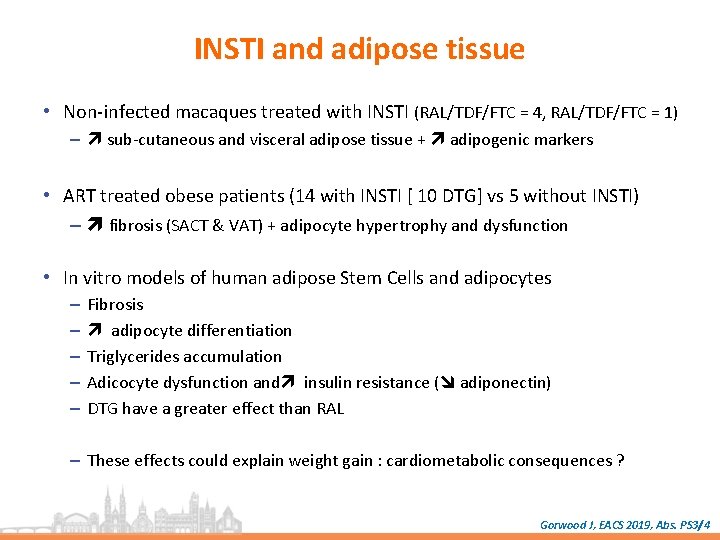
INSTI and adipose tissue • Non-infected macaques treated with INSTI (RAL/TDF/FTC = 4, RAL/TDF/FTC = 1) – sub-cutaneous and visceral adipose tissue + adipogenic markers • ART treated obese patients (14 with INSTI [ 10 DTG] vs 5 without INSTI) – fibrosis (SACT & VAT) + adipocyte hypertrophy and dysfunction • In vitro models of human adipose Stem Cells and adipocytes – – – Fibrosis adipocyte differentiation Triglycerides accumulation Adicocyte dysfunction and insulin resistance ( adiponectin) DTG have a greater effect than RAL – These effects could explain weight gain : cardiometabolic consequences ? Gorwood J, EACS 2019, Abs. PS 3/4
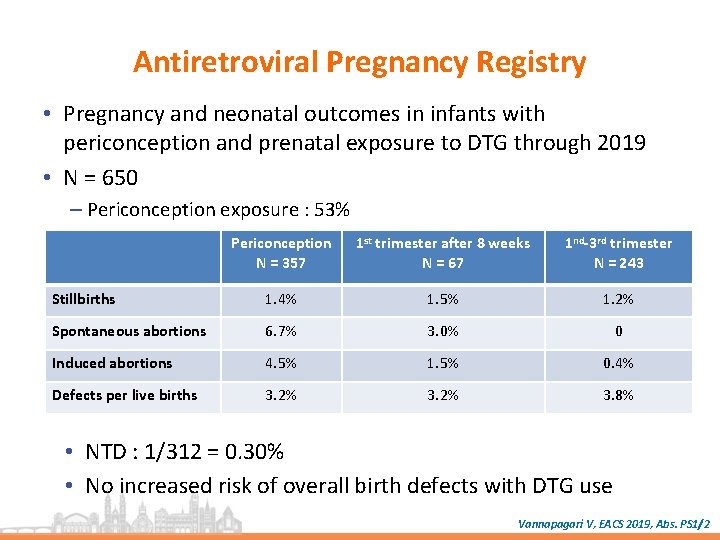
Antiretroviral Pregnancy Registry • Pregnancy and neonatal outcomes in infants with periconception and prenatal exposure to DTG through 2019 • N = 650 – Periconception exposure : 53% Periconception N = 357 1 st trimester after 8 weeks N = 67 1 nd-3 rd trimester N = 243 Stillbirths 1. 4% 1. 5% 1. 2% Spontaneous abortions 6. 7% 3. 0% 0 Induced abortions 4. 5% 1. 5% 0. 4% Defects per live births 3. 2% 3. 8% • NTD : 1/312 = 0. 30% • No increased risk of overall birth defects with DTG use Vannapagari V, EACS 2019, Abs. PS 1/2
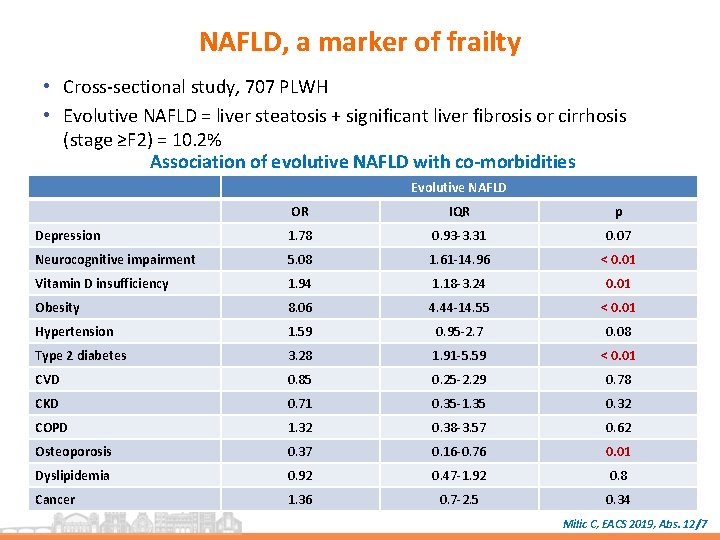
NAFLD, a marker of frailty • Cross-sectional study, 707 PLWH • Evolutive NAFLD = liver steatosis + significant liver fibrosis or cirrhosis (stage ≥F 2) = 10. 2% Association of evolutive NAFLD with co-morbidities Evolutive NAFLD OR IQR p Depression 1. 78 0. 93 -3. 31 0. 07 Neurocognitive impairment 5. 08 1. 61 -14. 96 < 0. 01 Vitamin D insufficiency 1. 94 1. 18 -3. 24 0. 01 Obesity 8. 06 4. 44 -14. 55 < 0. 01 Hypertension 1. 59 0. 95 -2. 7 0. 08 Type 2 diabetes 3. 28 1. 91 -5. 59 < 0. 01 CVD 0. 85 0. 25 -2. 29 0. 78 CKD 0. 71 0. 35 -1. 35 0. 32 COPD 1. 32 0. 38 -3. 57 0. 62 Osteoporosis 0. 37 0. 16 -0. 76 0. 01 Dyslipidemia 0. 92 0. 47 -1. 92 0. 8 Cancer 1. 36 0. 7 -2. 5 0. 34 Milic C, EACS 2019, Abs. 12/7
TASP HSIL Prevention Chem. Sex Pr. EP
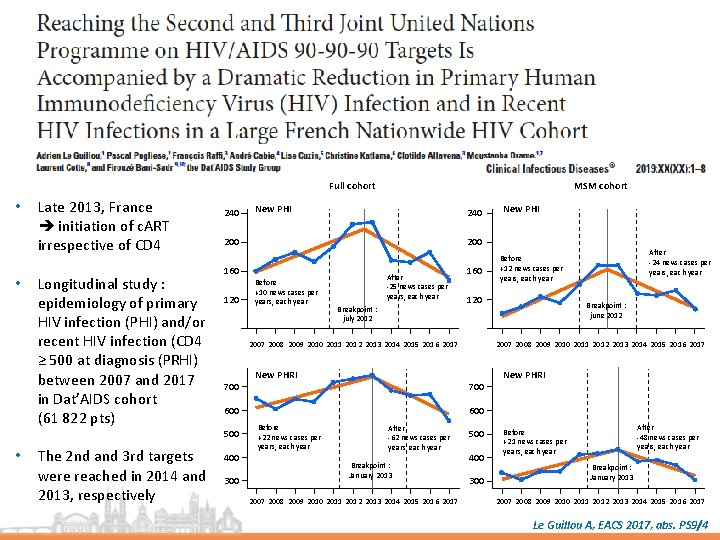
Full cohort • • Late 2013, France initiation of c. ART irrespective of CD 4 Longitudinal study : epidemiology of primary HIV infection (PHI) and/or recent HIV infection (CD 4 ≥ 500 at diagnosis (PRHI) between 2007 and 2017 in Dat’AIDS cohort (61 822 pts) 240 The 2 nd and 3 rd targets were reached in 2014 and 2013, respectively New PHI 240 200 120 Before +10 news cases per years, each year After -25 news cases per years, each year Breakpoint : july 2012 160 New PHRI 400 300 Breakpoint : june 2012 2007 2008 2009 2010 2011 2012 2013 2014 2015 2016 2017 700 600 After -24 news cases per years, each year Before +12 news cases per years, each year 120 2007 2008 2009 2010 2011 2012 2013 2014 2015 2016 2017 700 New PHI 200 160 500 • MSM cohort New PHRI 600 Before +22 news cases per years, each year After -62 news cases per years, each year Breakpoint : January 2013 2007 2008 2009 2010 2011 2012 2013 2014 2015 2016 2017 500 400 300 After -48 news cases per years, each year Before +21 news cases per years, each year Breakpoint : January 2013 2007 2008 2009 2010 2011 2012 2013 2014 2015 2016 2017 Le Guillou A, EACS 2017, abs. PS 9/4
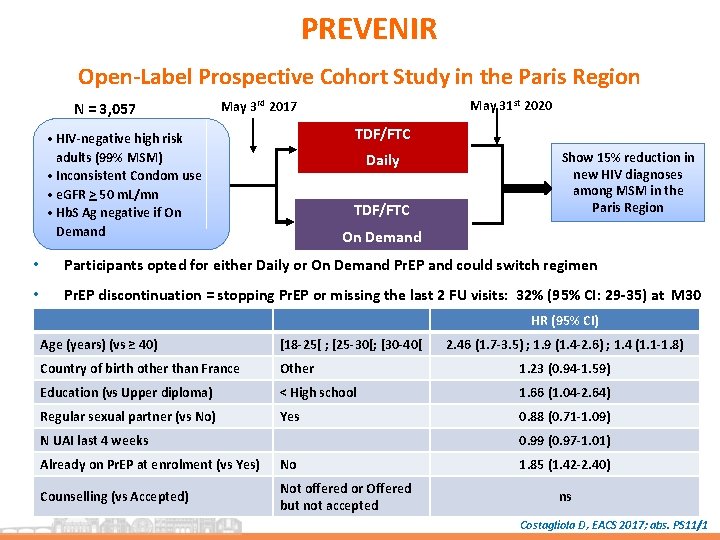
PREVENIR Open-Label Prospective Cohort Study in the Paris Region N = 3, 057 May 31 st 2020 May 3 rd 2017 TDF/FTC • HIV-negative high risk adults (99% MSM) • Inconsistent Condom use • e. GFR > 50 m. L/mn • Hb. S Ag negative if On Demand Daily TDF/FTC Show 15% reduction in new HIV diagnoses among MSM in the Paris Region On Demand • Participants opted for either Daily or On Demand Pr. EP and could switch regimen • Pr. EP discontinuation = stopping Pr. EP or missing the last 2 FU visits: 32% (95% CI: 29 -35) at M 30 HR (95% CI) Age (years) (vs ≥ 40) [18 -25[ ; [25 -30[; [30 -40[ Country of birth other than France Other 1. 23 (0. 94 -1. 59) Education (vs Upper diploma) < High school 1. 66 (1. 04 -2. 64) Regular sexual partner (vs No) Yes 0. 88 (0. 71 -1. 09) N UAI last 4 weeks 2. 46 (1. 7 -3. 5) ; 1. 9 (1. 4 -2. 6) ; 1. 4 (1. 1 -1. 8) 0. 99 (0. 97 -1. 01) Already on Pr. EP at enrolment (vs Yes) No Counselling (vs Accepted) Not offered or Offered but not accepted 1. 85 (1. 42 -2. 40) ns Costagliola D, EACS 2017; abs. PS 11/1
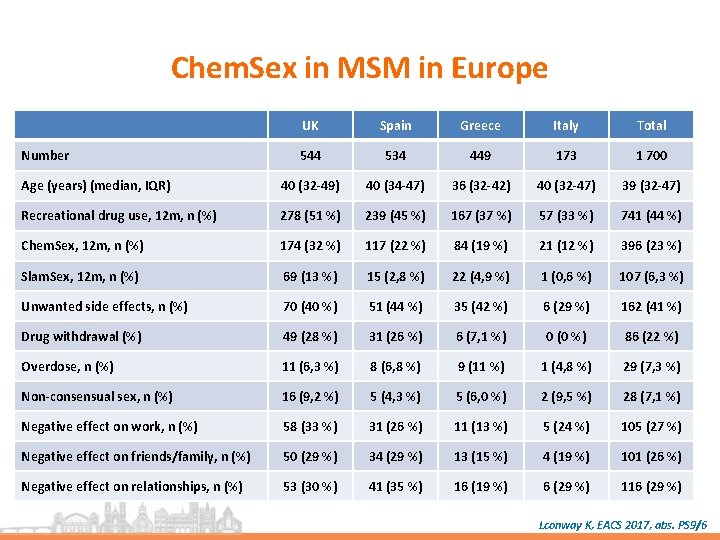
Chem. Sex in MSM in Europe UK Spain Greece Italy Total 544 534 449 173 1 700 Age (years) (median, IQR) 40 (32 -49) 40 (34 -47) 36 (32 -42) 40 (32 -47) 39 (32 -47) Recreational drug use, 12 m, n (%) 278 (51 %) 239 (45 %) 167 (37 %) 57 (33 %) 741 (44 %) Chem. Sex, 12 m, n (%) 174 (32 %) 117 (22 %) 84 (19 %) 21 (12 %) 396 (23 %) Slam. Sex, 12 m, n (%) 69 (13 %) 15 (2, 8 %) 22 (4, 9 %) 1 (0, 6 %) 107 (6, 3 %) Unwanted side effects, n (%) 70 (40 %) 51 (44 %) 35 (42 %) 6 (29 %) 162 (41 %) Drug withdrawal (%) 49 (28 %) 31 (26 %) 6 (7, 1 %) 0 (0 %) 86 (22 %) Overdose, n (%) 11 (6, 3 %) 8 (6, 8 %) 9 (11 %) 1 (4, 8 %) 29 (7, 3 %) Non-consensual sex, n (%) 16 (9, 2 %) 5 (4, 3 %) 5 (6, 0 %) 2 (9, 5 %) 28 (7, 1 %) Negative effect on work, n (%) 58 (33 %) 31 (26 %) 11 (13 %) 5 (24 %) 105 (27 %) Negative effect on friends/family, n (%) 50 (29 %) 34 (29 %) 13 (15 %) 4 (19 %) 101 (26 %) Negative effect on relationships, n (%) 53 (30 %) 41 (35 %) 16 (19 %) 6 (29 %) 116 (29 %) Number Lconway K, EACS 2017, abs. PS 9/6
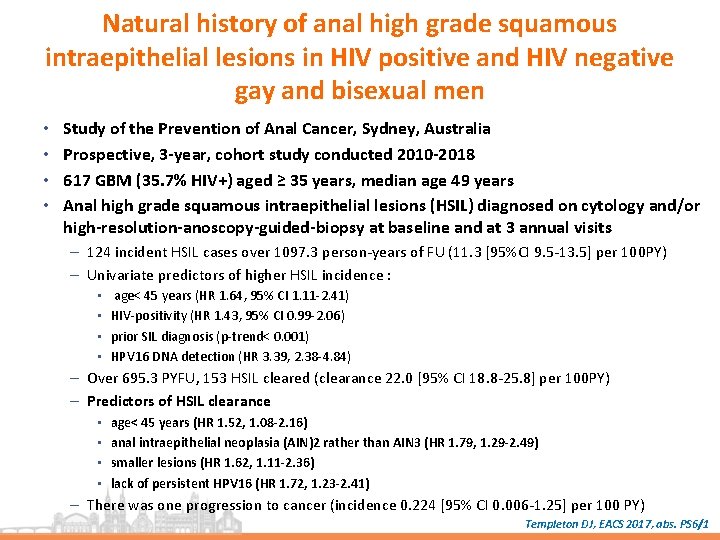
Natural history of anal high grade squamous intraepithelial lesions in HIV positive and HIV negative gay and bisexual men • • Study of the Prevention of Anal Cancer, Sydney, Australia Prospective, 3 -year, cohort study conducted 2010 -2018 617 GBM (35. 7% HIV+) aged ≥ 35 years, median age 49 years Anal high grade squamous intraepithelial lesions (HSIL) diagnosed on cytology and/or high-resolution-anoscopy-guided-biopsy at baseline and at 3 annual visits – 124 incident HSIL cases over 1097. 3 person-years of FU (11. 3 [95%CI 9. 5 -13. 5] per 100 PY) – Univariate predictors of higher HSIL incidence : • • age< 45 years (HR 1. 64, 95% CI 1. 11 -2. 41) HIV-positivity (HR 1. 43, 95% CI 0. 99 -2. 06) prior SIL diagnosis (p-trend< 0. 001) HPV 16 DNA detection (HR 3. 39, 2. 38 -4. 84) – Over 695. 3 PYFU, 153 HSIL cleared (clearance 22. 0 [95% CI 18. 8 -25. 8] per 100 PY) – Predictors of HSIL clearance • • age< 45 years (HR 1. 52, 1. 08 -2. 16) anal intraepithelial neoplasia (AIN)2 rather than AIN 3 (HR 1. 79, 1. 29 -2. 49) smaller lesions (HR 1. 62, 1. 11 -2. 36) lack of persistent HPV 16 (HR 1. 72, 1. 23 -2. 41) – There was one progression to cancer (incidence 0. 224 [95% CI 0. 006 -1. 25] per 100 PY) Templeton DJ, EACS 2017, abs. PS 6/1
- Slides: 39