
Boston Library Consortium Resource Sharing COI Meeting March
Boston Library Consortium – Resource Sharing COI Meeting March 1, 2018 The Value of Resource Sharing: Creating a toolkit to spark both Talk & Walk Dennis Massie OCLC Research
OCLC Research work on resource sharing
OCLC Research work on resource sharing ILL C ost C Confidential – internal use only alcu lator
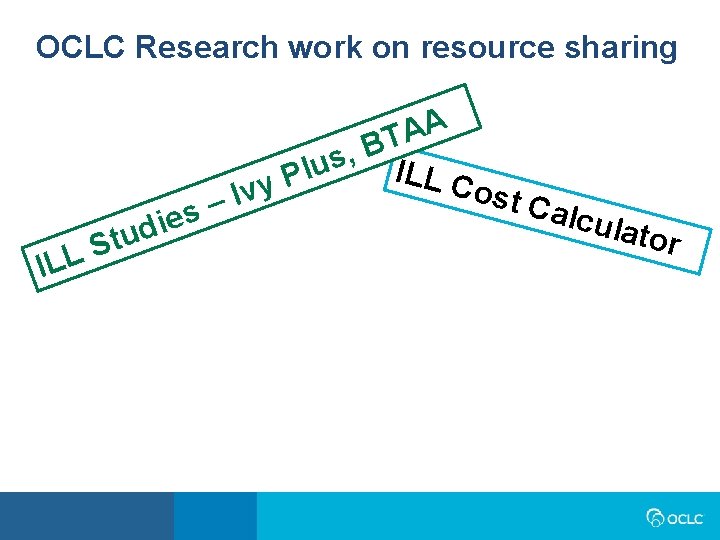
OCLC Research work on resource sharing A A T B , s u l I L P L Co vy IL t S L I – s e i ud st Ca lcula tor
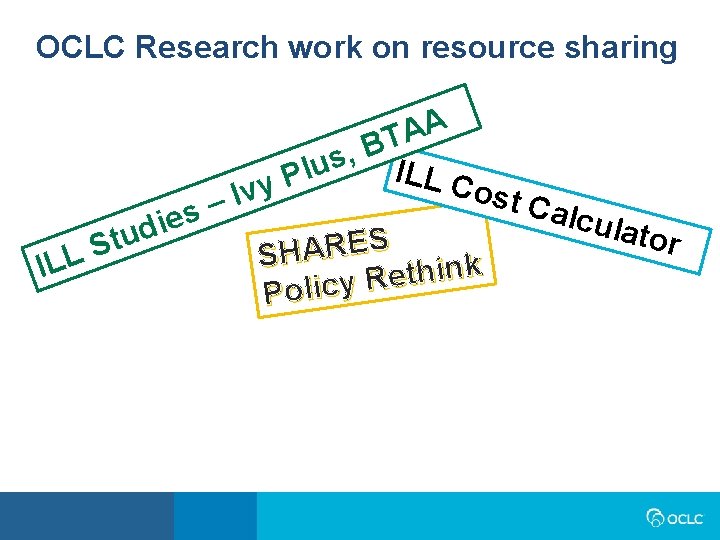
OCLC Research work on resource sharing A A T B , s u l I L P L Co vy IL t S L I – s e i ud S E R A SH k n i h t e R Policy st Ca lcula tor
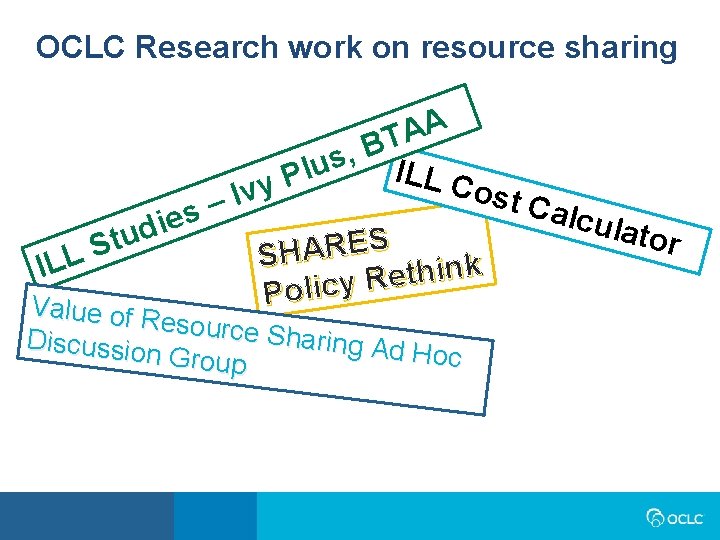
OCLC Research work on resource sharing A A T B , s u l I L P L Co vy t S L I – s e i ud IL S E R A SH k n i h t e R Policy Value of R esource S haring Ad Discussio Hoc n Group st Ca lcula tor
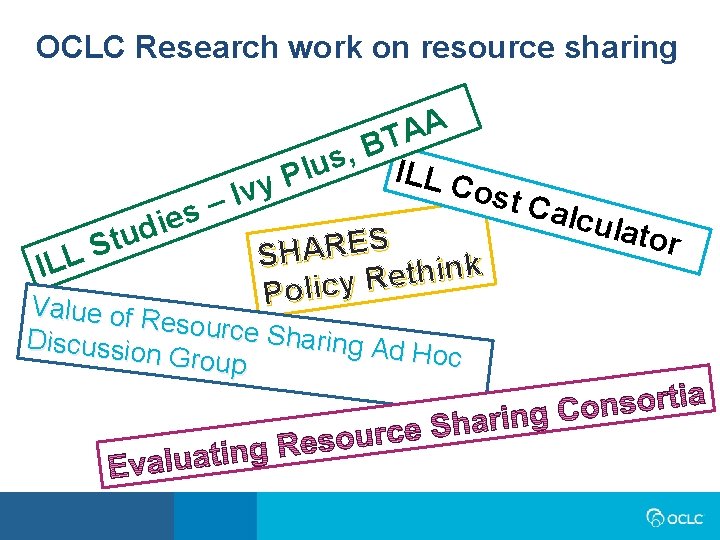
OCLC Research work on resource sharing A A T B , s u l I L P L Co vy t S L I – s e i ud IL S E R A SH k n i h t e R Policy Value of R esource S haring Ad Discussio Hoc n Group st Ca lcula tor
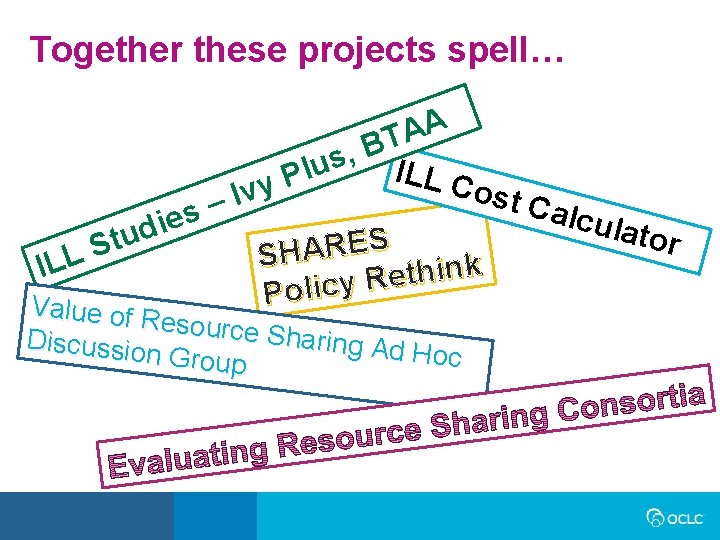
Together these projects spell… A A T B , s u l I L P L Co vy t S L I – s e i ud IL S E R A SH k n i h t e R Policy Value of R esource S haring Ad Discussio Hoc n Group st Ca lcula tor
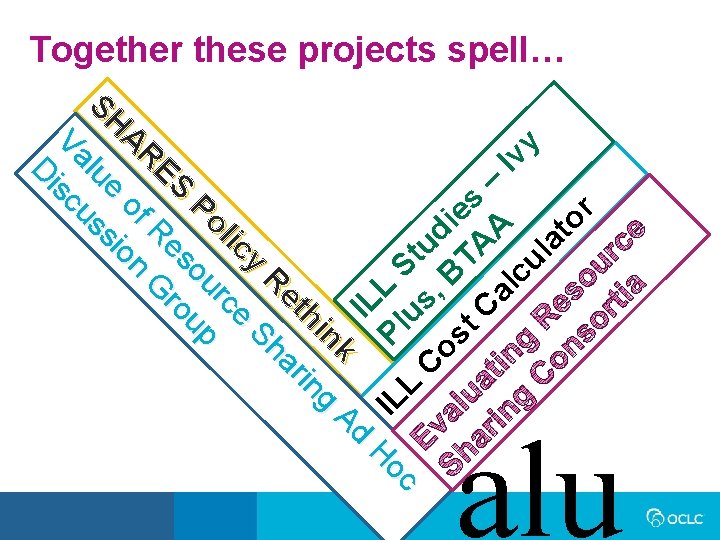
Together these projects spell… IL L C os t. C al cu la to r SH Va AR y v D lu I is e ES – cu o Po s f e ss R i A l d i io es cy u TA t n o S B G ur Re , L ro ce t s up S hin IL lu ha k P rin g Ad H oc alu
Together these projects spell… IL L C os t. C al cu la to r SH Va AR y v D lu I is e ES – cu o Po s f e ss R i A l d i io es cy u TA t n o S B G ur Re , L ro ce t s up S hin IL lu ha k P rin g Ad H oc alu
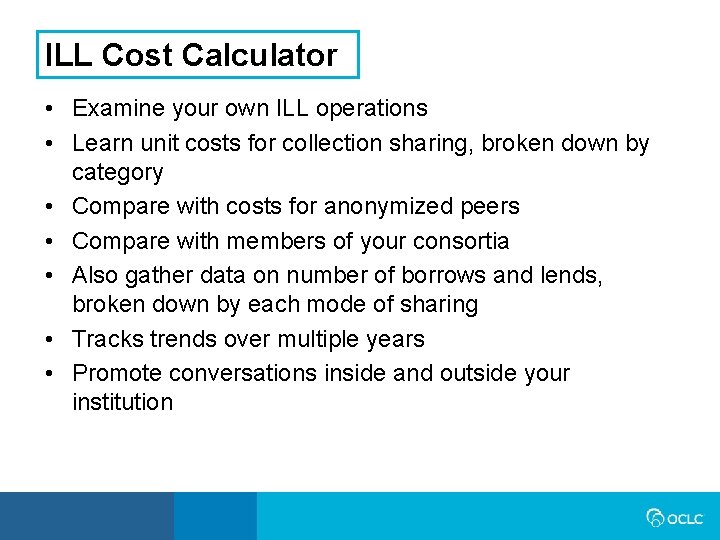
ILL Cost Calculator • Examine your own ILL operations • Learn unit costs for collection sharing, broken down by category • Compare with costs for anonymized peers • Compare with members of your consortia • Also gather data on number of borrows and lends, broken down by each mode of sharing • Tracks trends over multiple years • Promote conversations inside and outside your institution
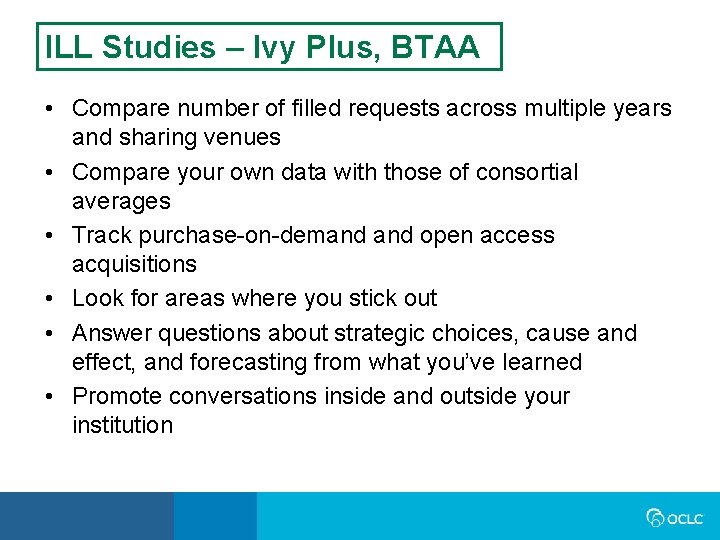
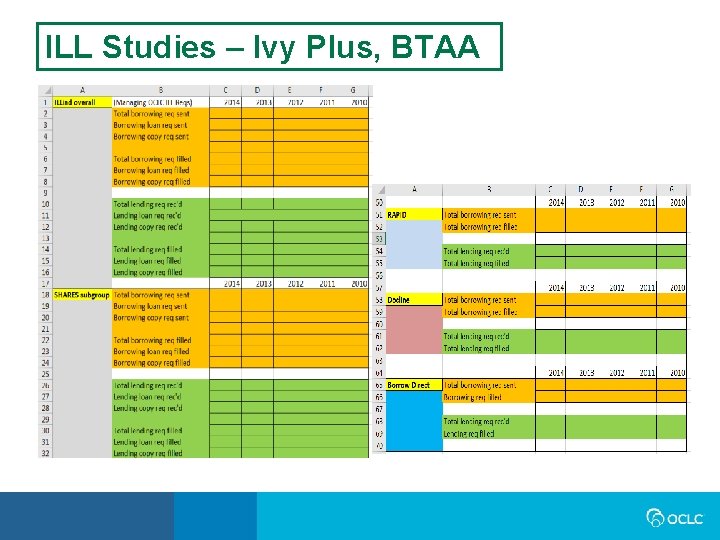
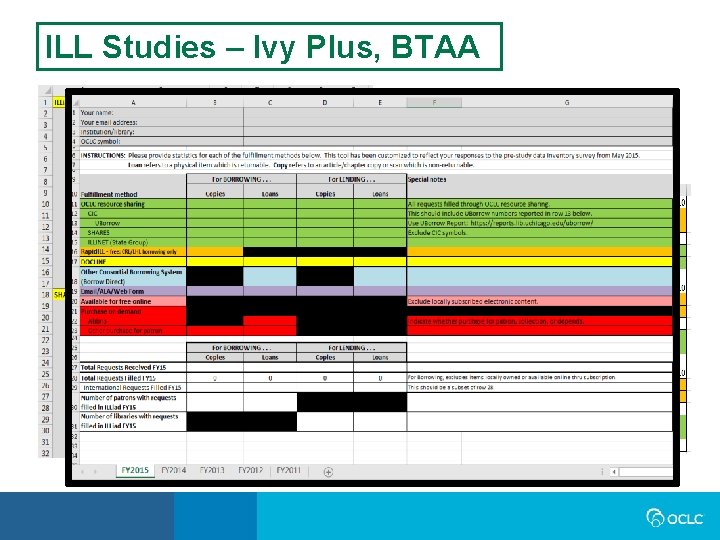
ILL Studies – Ivy Plus, BTAA • Compare number of filled requests across multiple years and sharing venues • Compare your own data with those of consortial averages • Track purchase-on-demand open access acquisitions • Look for areas where you stick out • Answer questions about strategic choices, cause and effect, and forecasting from what you’ve learned • Promote conversations inside and outside your institution
SHARES Policy Rethink • • • Question current assumptions Encourage evidence-based policies Embrace processes that add value for patrons and staff Phase out processes that add work but not value Focus on making the patron experience more like Amazon and Google • Promote conversations inside and outside your institution
Value of Resource Sharing Ad Hoc Discussion Group • Use data to measure and demonstrate the value of resource sharing to various stakeholders • Question current assumptions and received wisdom • Learn what patrons value • Consider resource sharing not in isolation but in the context of the whole information ecosystem • Push for smart systems that interoperate • Figure out how to link consortia (policy and technology) • Promote conversations inside and outside your institution
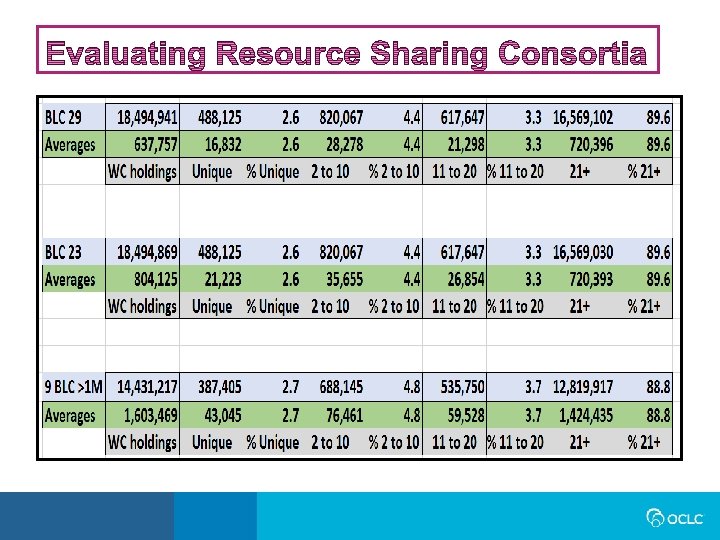
• New idea for possible joint research project with Ivy Plus • Create a matrix of the essential criteria for evaluating whether a consortium is worth joining • Note which data elements you would want and need • List the ideal along with the real; mind the gaps • Promote conversations inside and outside your institution
Promote conversations inside and outside your institution.
Proposal: Create a Value of Resource Sharing Toolkit that gives library staff templates for conducting their own investigations, and having their own conversations.
Rather than publishing more reports… • Use what we’ve learned from our Resource Sharing projects as a jumping-off point • Create various workshop templates with specific actions and discussion questions: – On resource sharing costs – On using data to rethink strategic choices in technology, processes, and affiliations – On conducting an ILL user study – On embracing policies and processes that add value – On sharing special collections
Promote conversations inside and outside your institution.
Promote conversations inside and outside The Boston Library Consortium?
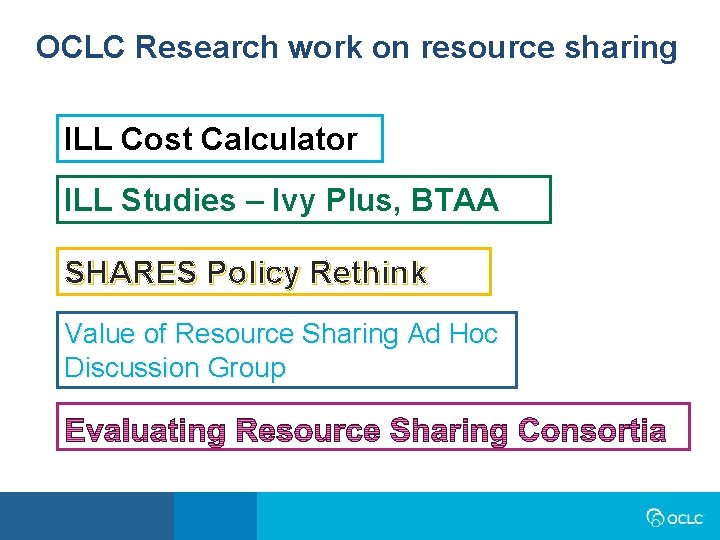
OCLC Research work on resource sharing ILL Cost Calculator ILL Studies – Ivy Plus, BTAA SHARES Policy Rethink Value of Resource Sharing Ad Hoc Discussion Group
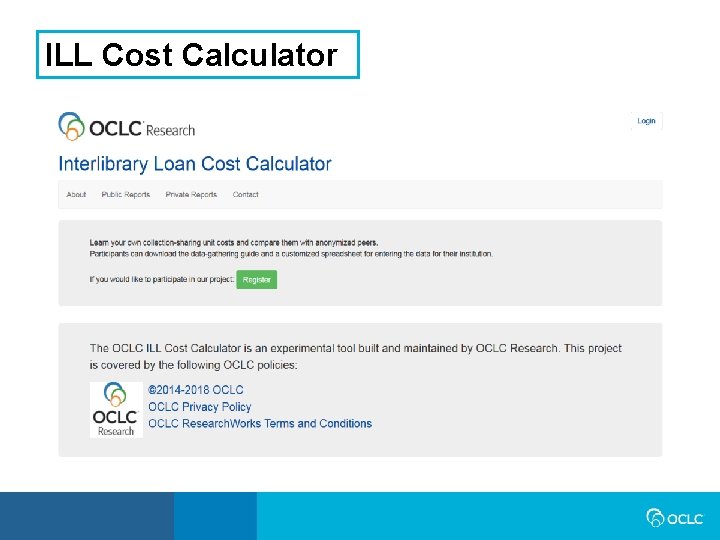
ILL Cost Calculator
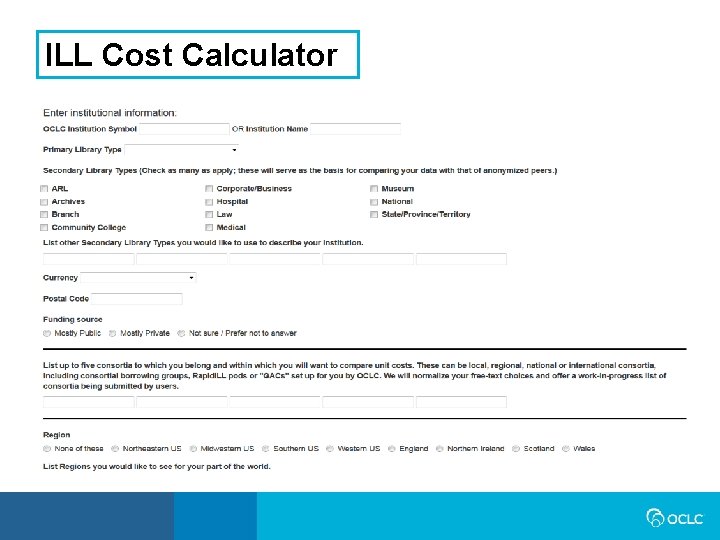
ILL Cost Calculator
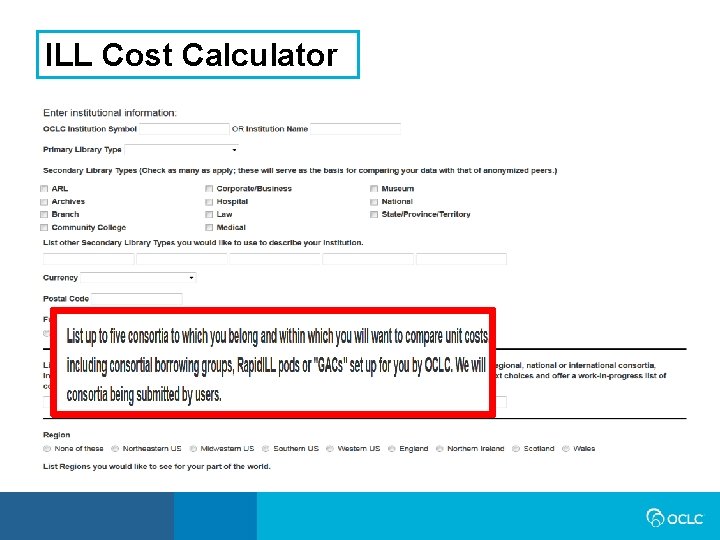
ILL Cost Calculator
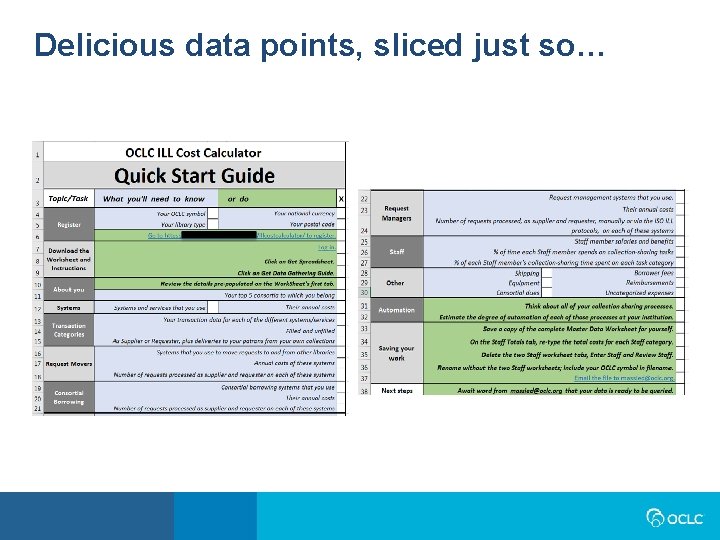
Delicious data points, sliced just so…
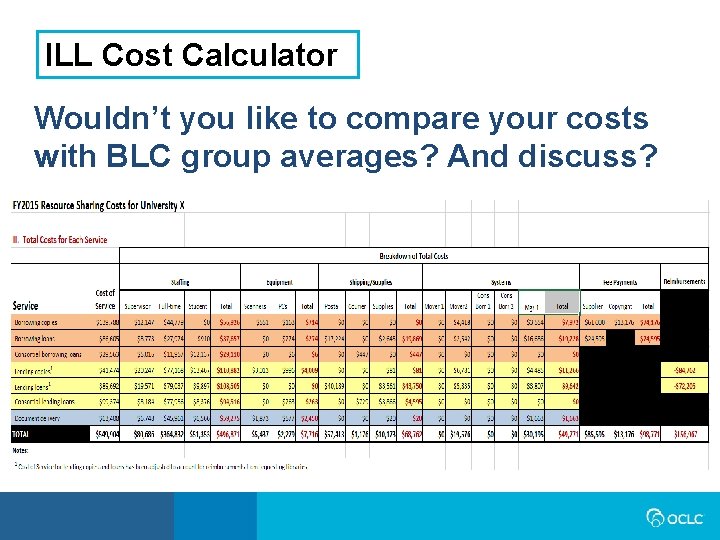
ILL Cost Calculator Wouldn’t you like to compare your costs with BLC group averages? And discuss?
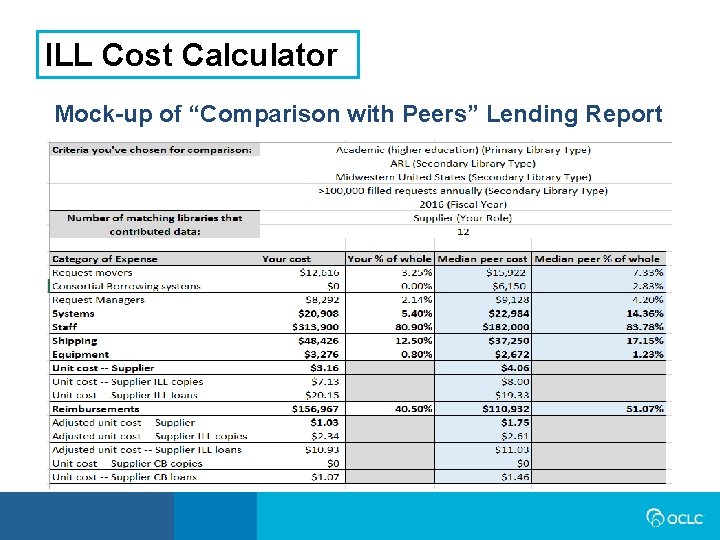
ILL Cost Calculator Mock-up of “Comparison with Peers” Lending Report
Would you like to be an ILL Cost Calculator early adopter? • In March we will be inviting early adopters to try out – – – The Quick Start guide The registration process The data gathering tool The data submission process The data gathering guide • We want to work with you! • Contact massied@oclc. org
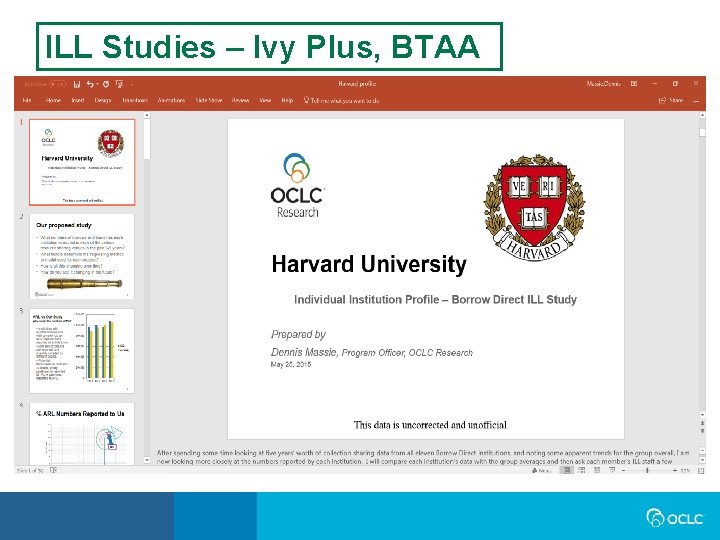
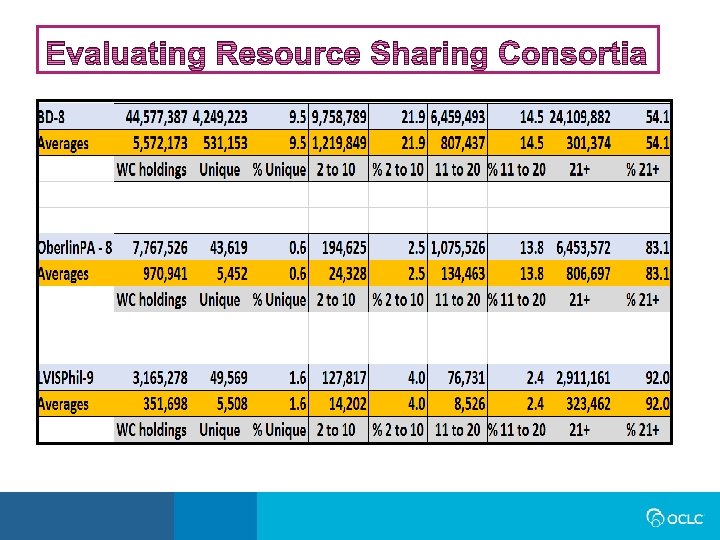
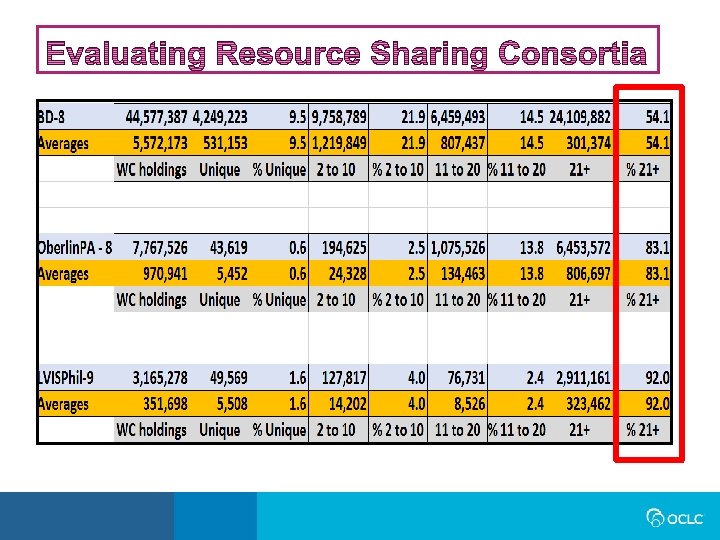
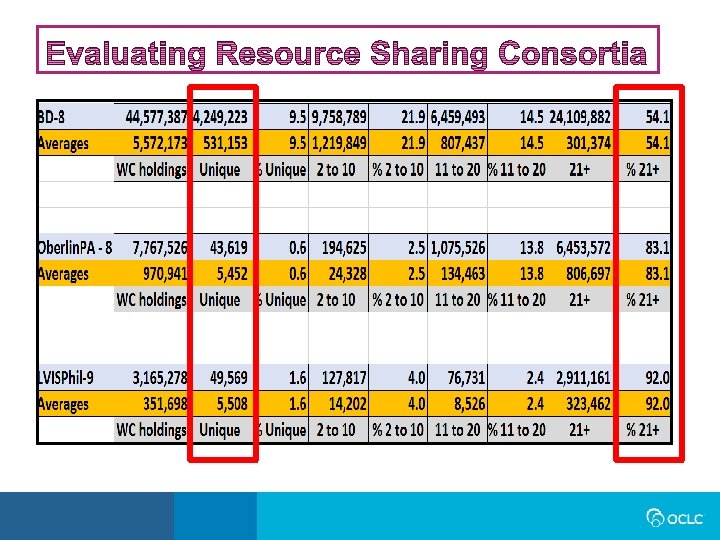
ILL Studies – Ivy Plus, BTAA • Separate studies, starting a year apart, 25 institutions • 5 years worth of data – Self-reported – Across every resource sharing model and venue – Compared with data submitted to ARL • Prepared individual profiles for each institution – Compared numbers with group averages – Asked questions about things that stuck out – Conducted hour-long interviews with each ILL unit, asking about strategic thinking behind choices • Am overlaying data about demographics, expenditures, and collections, then will compare and contrast
ILL Studies – Ivy Plus, BTAA
ILL Studies – Ivy Plus, BTAA
ILL Studies – Ivy Plus, BTAA
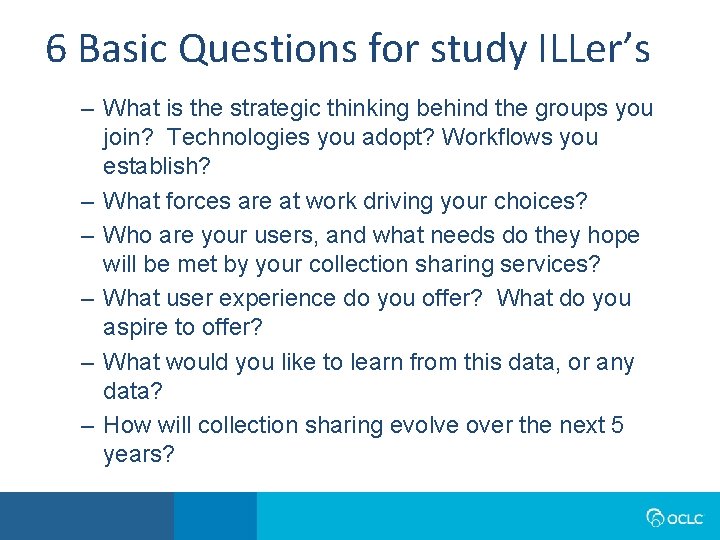
6 Basic Questions for study ILLer’s – What is the strategic thinking behind the groups you join? Technologies you adopt? Workflows you establish? – What forces are at work driving your choices? – Who are your users, and what needs do they hope will be met by your collection sharing services? – What user experience do you offer? What do you aspire to offer? – What would you like to learn from this data, or any data? – How will collection sharing evolve over the next 5 years?
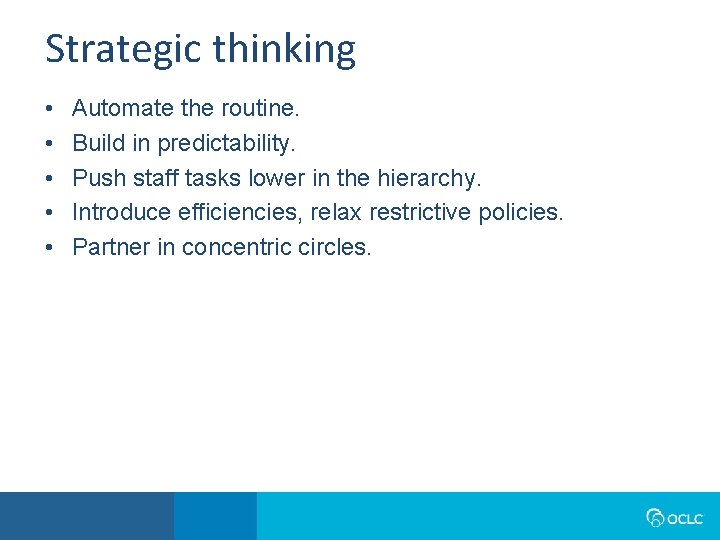
Strategic thinking • • • Automate the routine. Build in predictability. Push staff tasks lower in the hierarchy. Introduce efficiencies, relax restrictive policies. Partner in concentric circles.
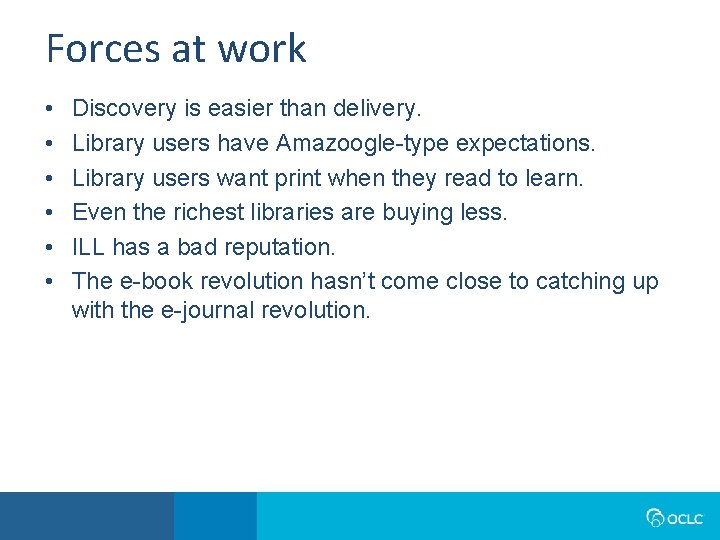
Forces at work • • • Discovery is easier than delivery. Library users have Amazoogle-type expectations. Library users want print when they read to learn. Even the richest libraries are buying less. ILL has a bad reputation. The e-book revolution hasn’t come close to catching up with the e-journal revolution.
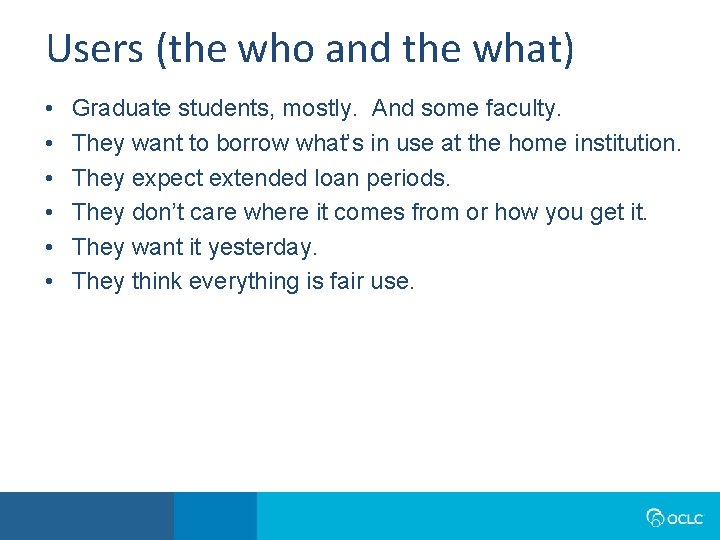
Users (the who and the what) • • • Graduate students, mostly. And some faculty. They want to borrow what’s in use at the home institution. They expect extended loan periods. They don’t care where it comes from or how you get it. They want it yesterday. They think everything is fair use.
User experience • Currently being offered: – A few fancy hidden algorithms – Some linking of systems with standards or Web services – Buttons on a Web page, describe each service, ask patron to choose • Unanimous aspiration: – Single entry point for all interactions with library services
They wish they knew… • What’s borrowed, specifically, within vs outside the group. • Effects of consortial borrowing on OCLC ILL traffic with those same partners. • Per capita consumption of library services. • Others’ budgets and workflows for purchase-on-demand. • Correlation between expenditures and collection-sharing activity. • Why some constituents don’t use library services for their research needs.
In 5 years… • Patrons will enjoy a more unified user experience. • Libraries will do more within consortia. • Circulation will stop declining and possibly even show an uptick. • The library will figure in a smaller proportion of a typical researcher’s material-gathering transactions. • Print will maintain its popularity. • Special trusted partnerships will be needed for sharing scarce and valuable materials.
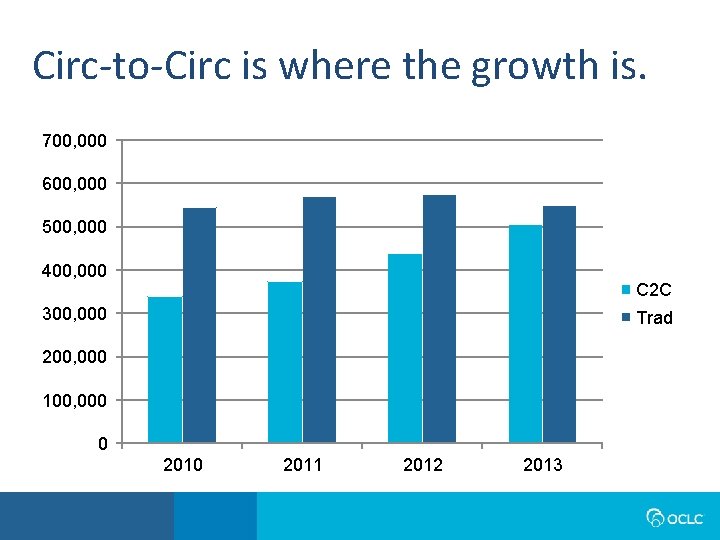
Circ-to-Circ is where the growth is. 700, 000 600, 000 500, 000 400, 000 C 2 C 300, 000 Trad 200, 000 100, 000 0 2011 2012 2013
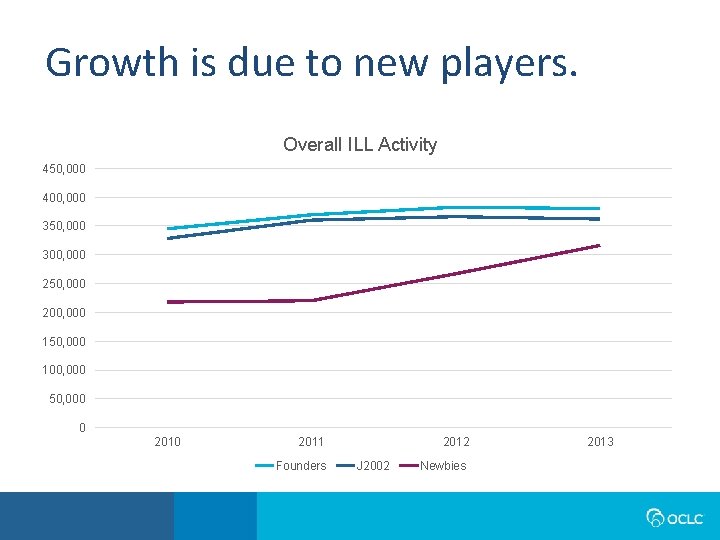
Growth is due to new players. Overall ILL Activity 450, 000 400, 000 350, 000 300, 000 250, 000 200, 000 150, 000 100, 000 50, 000 0 2011 Founders 2012 J 2002 Newbies 2013
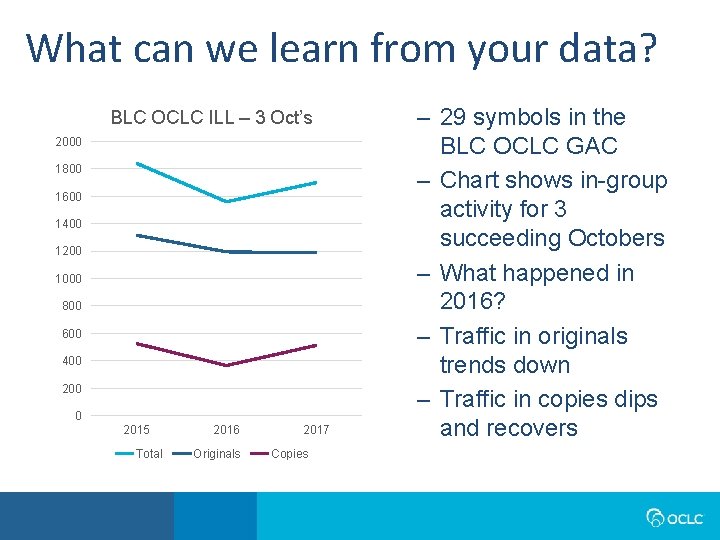
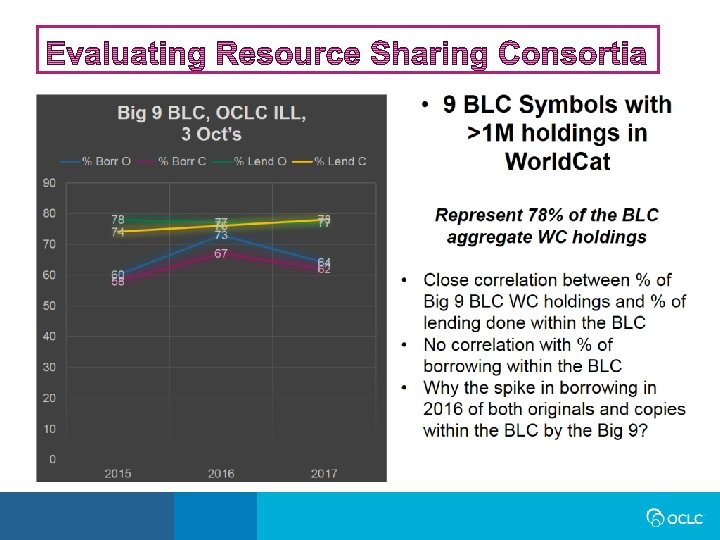
What can we learn from your data? BLC OCLC ILL – 3 Oct’s 2000 1800 1600 1400 1200 1000 800 600 400 200 0 2015 Total 2016 Originals 2017 Copies – 29 symbols in the BLC OCLC GAC – Chart shows in-group activity for 3 succeeding Octobers – What happened in 2016? – Traffic in originals trends down – Traffic in copies dips and recovers
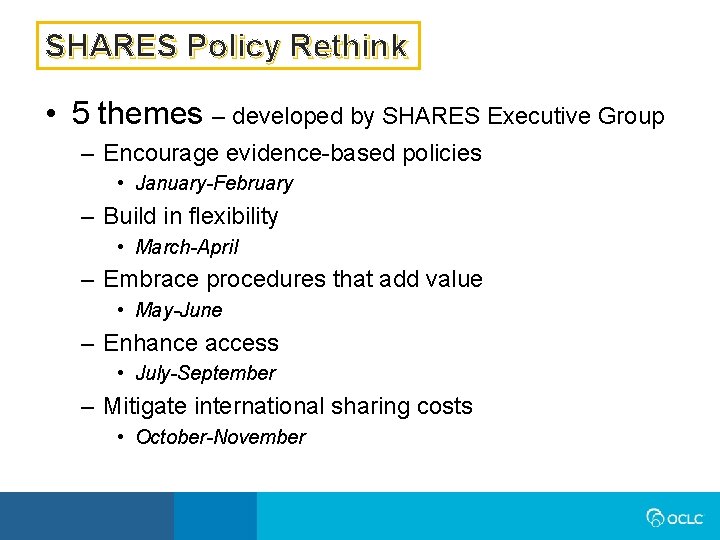
SHARES Policy Rethink • 5 themes – developed by SHARES Executive Group – Encourage evidence-based policies • January-February – Build in flexibility • March-April – Embrace procedures that add value • May-June – Enhance access • July-September – Mitigate international sharing costs • October-November
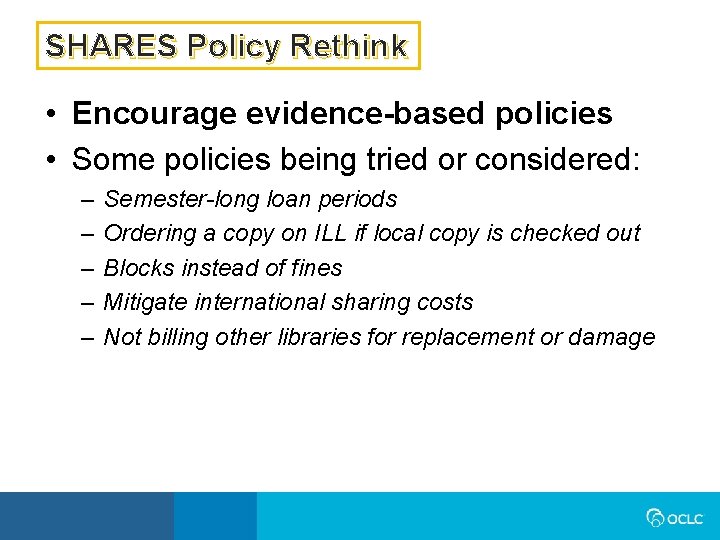
SHARES Policy Rethink • Encourage evidence-based policies • Some policies being tried or considered: – – – Semester-long loan periods Ordering a copy on ILL if local copy is checked out Blocks instead of fines Mitigate international sharing costs Not billing other libraries for replacement or damage
SHARES Policy Rethink • Encourage evidence-based policies • Some policies being tried or considered: – – – Semester-long loan periods Ordering a copy on ILL if local copy is checked out Blocks instead of fines Mitigate international sharing costs Not billing other libraries for replacement or damage • What’s your position on these options?
SHARES Policy Rethink • Encourage evidence-based policies • Some policies being tried or considered: – – – Semester-long loan periods Ordering a copy on ILL if local copy is checked out Blocks instead of fines Mitigate international sharing costs Not billing other libraries for replacement or damage • What’s your position on these options? • How do your BLC mates feel about them?
Value of Resource Sharing Ad Hoc Discussion Group • Started as a private email discussion about using data to answer questions about library services • Grew into an ad hoc group of library professionals who meet over lunch at ALA Annual and Midwinter • Started with four questions: 1) What is the value of resource sharing? 2) To whom? 3) Can it be measured? 4) How do we expect it will change?
Value of Resource Sharing Ad Hoc Discussion Group • Answering those questions led to seven areas of inquiry: – Seeking to understand the current collection-sharing environment. – Seeking to improve the current collection-sharing environment. – Calling some previously-shared values and assumptions into question. – Seeking to understand the effect of the changing environment on collection sharing. – Seeking to understand the effect of the changing environment on the library overall (and, in some cases, the parent organization). – Seeking to understand the effect of the changing environment on patron behaviors. – Seeking to understand the effect of the changing environment on content and service providers.
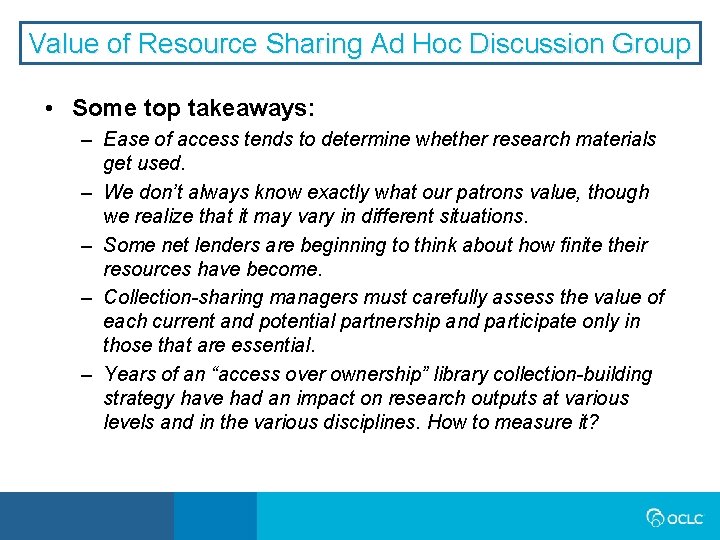
Value of Resource Sharing Ad Hoc Discussion Group • Some top takeaways: – Ease of access tends to determine whether research materials get used. – We don’t always know exactly what our patrons value, though we realize that it may vary in different situations. – Some net lenders are beginning to think about how finite their resources have become. – Collection-sharing managers must carefully assess the value of each current and potential partnership and participate only in those that are essential. – Years of an “access over ownership” library collection-building strategy have had an impact on research outputs at various levels and in the various disciplines. How to measure it?
Value of Resource Sharing Ad Hoc Discussion Group • Tippity-top takeaway: –Value to the patron ultimately determines the value to the institution.
Value of Resource Sharing Ad Hoc Discussion Group • Getting to know your ILL users (non-users will be a tougher nut to crack)
Value of Resource Sharing Ad Hoc Discussion Group • Getting to know your ILL users (non-users will be a tougher nut to crack) – Kurt Munson of Northwestern University advocates using ILLiad data to identify ILL patrons of specific types and asking them a set of multiple-choice questions.
Value of Resource Sharing Ad Hoc Discussion Group • Getting to know your ILL users (non-users will be a tougher nut to crack) – Kurt Munson of Northwestern University advocates using ILLiad data to identify ILL patrons of specific types and asking them a set of multiple-choice questions. • To find out what they value about a specific item they received via ILL. • To learn what the consequences to their research would have been if they had not been able to gain access that item.
Value of Resource Sharing Ad Hoc Discussion Group • Getting to know your ILL users (non-users will be a tougher nut to crack) – Kurt Munson of Northwestern University advocates using ILLiad data to identify ILL patrons of specific types and asking them a set of multiple-choice questions. • To find out what they value about a specific item they received via ILL. • To learn what the consequences to their research would have been if they had not been able to gain access that item. – Lars Leon of the University of Kansas and Micquel Little of the Claremont Colleges prefer a more open-ended approach where ILL users are simply asked to describe what they value about the service.
Value of Resource Sharing Ad Hoc Discussion Group • Getting to know your ILL users (non-users will be a tougher nut to crack) – Kurt Munson of Northwestern University advocates using ILLiad data to identify ILL patrons of specific types and asking them a set of multiple-choice questions. • To find out what they value about a specific item they received via ILL. • To learn what the consequences to their research would have been if they had not been able to gain access that item. – Lars Leon of the University of Kansas and Micquel Little of the Claremont Colleges prefer a more open-ended approach where ILL users are simply asked to describe what they value about the service. – Others want to track clicks, study citations, track broader user info-gathering behavior, known item vs unknown item, impacts of different discovery layers, etc.
• New idea for possible joint research project with Ivy Plus • Create a matrix of the essential criteria for evaluating whether a consortium is worth joining • Note which data elements you would want and need • List the ideal along with the real; mind the gaps • Promote conversations inside and outside your institution
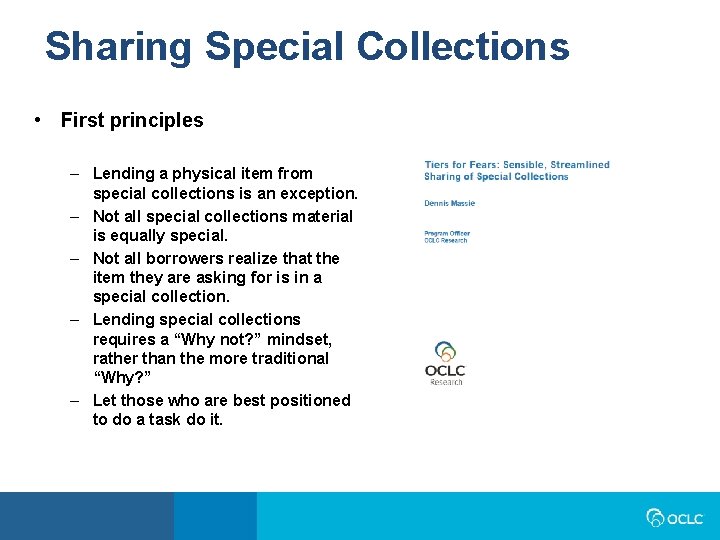
Sharing Special Collections • First principles – Lending a physical item from special collections is an exception. – Not all special collections material is equally special. – Not all borrowers realize that the item they are asking for is in a special collection. – Lending special collections requires a “Why not? ” mindset, rather than the more traditional “Why? ” – Let those who are best positioned to do a task do it.
Lending Special Collections Utility Belt
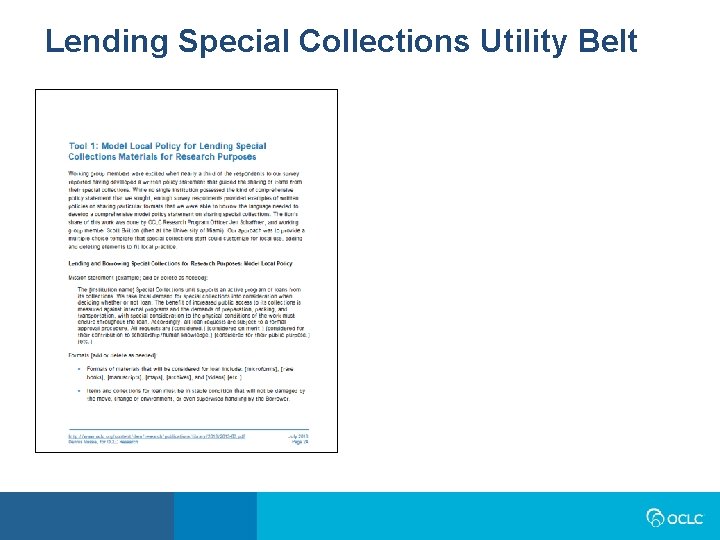
Lending Special Collections Utility Belt
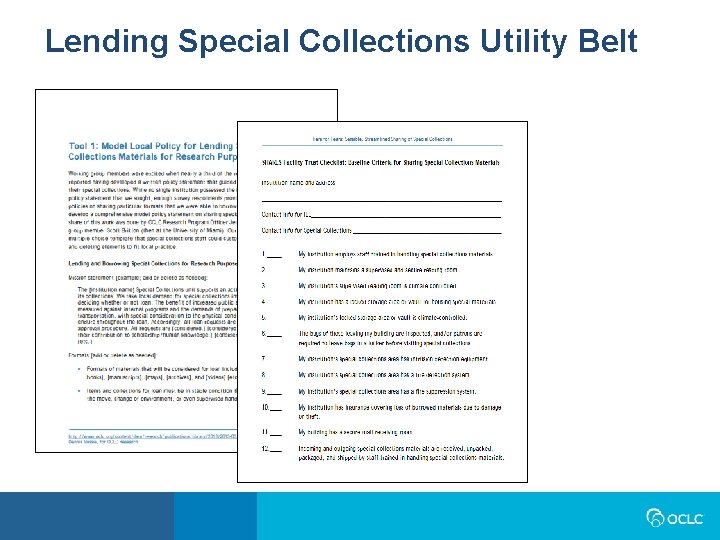
Lending Special Collections Utility Belt
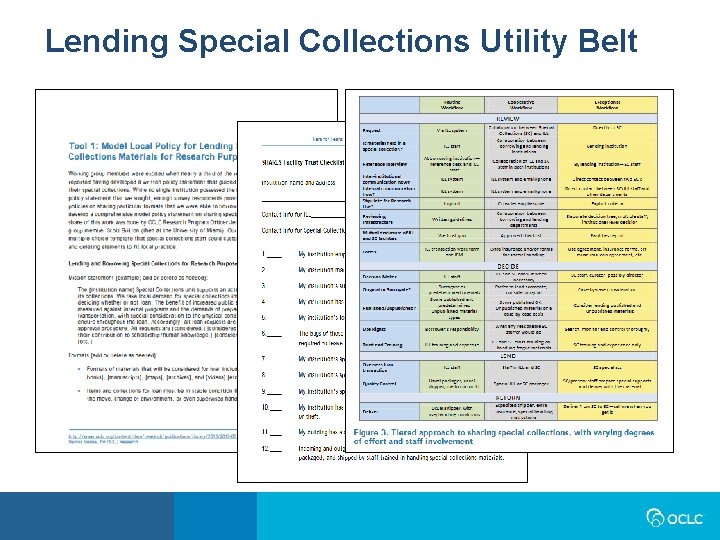
Lending Special Collections Utility Belt
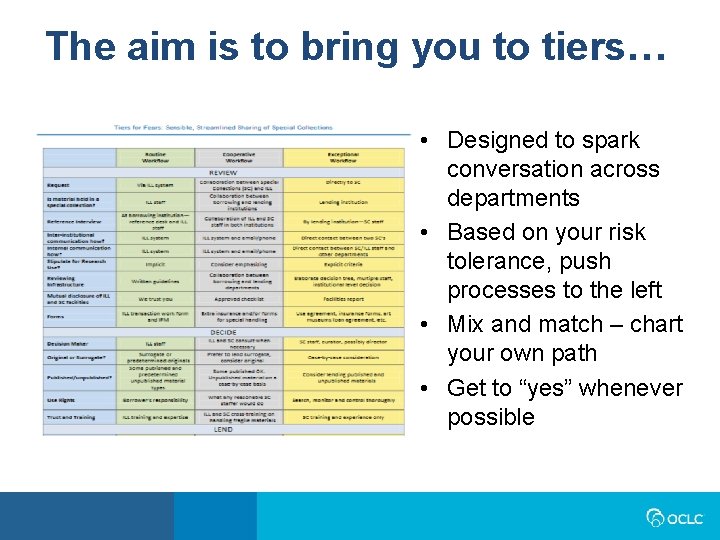
The aim is to bring you to tiers… • Designed to spark conversation across departments • Based on your risk tolerance, push processes to the left • Mix and match – chart your own path • Get to “yes” whenever possible
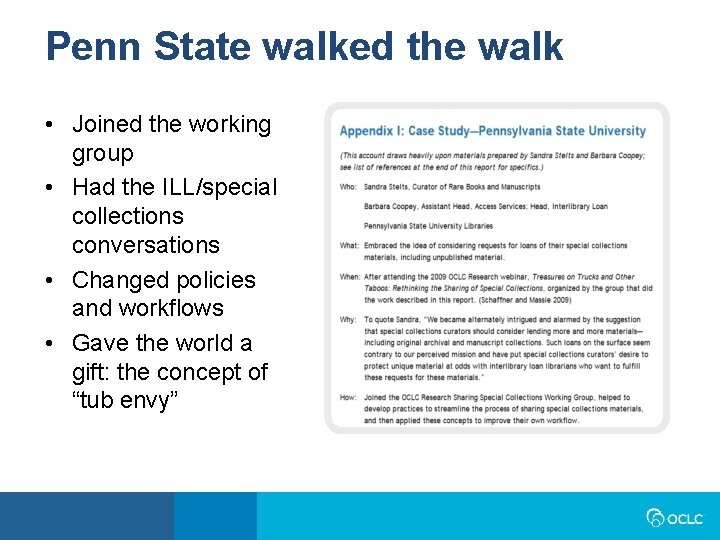
Penn State walked the walk • Joined the working group • Had the ILL/special collections conversations • Changed policies and workflows • Gave the world a gift: the concept of “tub envy”
Elements of a toolkit you could actually use? • Use what we’ve learned from our Resource Sharing projects as a jumping-off point • Create various workshop templates with specific actions and discussion questions: – On resource sharing costs – On using data to rethink strategic choices in technology, processes, and affiliations – On conducting an ILL user study – On embracing policies and processes that add value – On sharing special collections
Boston Library Consortium – Resource Sharing COI Meeting March 1, 2018 Questions? Comments? Dennis Massie massied@oclc. org SM Together we make breakthroughs possible.
- Slides: 71