2018 OSEP Project Directors Conference DISCLAIMER The contents







- Slides: 40
2018 OSEP Project Directors’ Conference DISCLAIMER: The contents of this presentation were developed by the presenters for the 2018 Project Directors’ Conference. However, these contents do not necessarily represent the policy of the Department of Education, and you should not assume endorsement by the Federal Government. (Authority: 20 U. S. C. 1221 e-3 and 3474)
MULTI-TIERED SYSTEM OF SUPPORTS (MTSS) FRAMEWORK: ENSURING THE “EACH” IN “ALL” K-12 Large Group Panel Session Project Director’s Conference July 24, 2018
Dr. Saskia Brown, Moderator Contact Information New Jersey Tiered System of Supports-Early Reading Project Manager, New Jersey Department of Education Division of Learning Supports and Specialized Services saskia. brown@doe. nj. gov
Introduction § Session Learning Outcomes § Develop a shared understanding of the needs for “all” § Address challenges with implementation § Highlight roles and responsibilities for all actors to ensure “each” child’s needs are met § Session Format § Power. Point presentation § Audience engagement § Introduction of Panelists § § Dr. George Sugai Dr. Peggy Mc. Donald Dr. Paul Barbato Monique Dujue’ Wilson
Dr. George Sugai, Panelist Contact Information Professor, Special Education University of Connecticut Carole J. Neag Endowed Chair Research Scientist, Center for Behavioral Education & Research Co-Director, Center of Positive Behavioral Interventions & Supports george. sugai@uconn. edu
THE NATIONAL INTEREST IN IMPLEMENTING MTSS A highlight of the national concerns, challenges and best practices
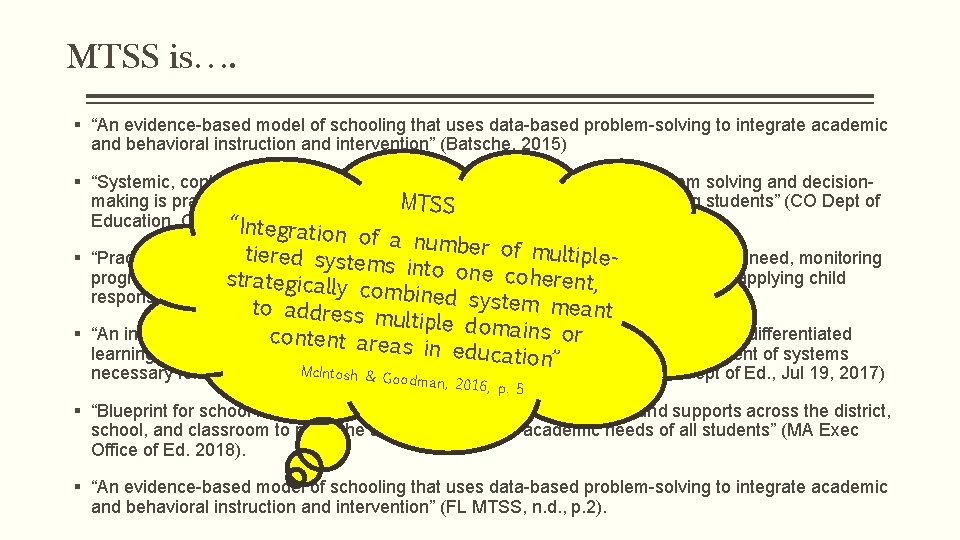
MTSS is…. § “An evidence-based model of schooling that uses data-based problem-solving to integrate academic and behavioral instruction and intervention” (Batsche, 2015) § “Systemic, continuous-improvement framework in which data-based problem solving and decisionmaking is practiced across all levels of M the system for supporting students” (CO Dept of TSeducational S Education, Oct 2016). “Int egration of a number of m ultipmatched t ie r e § “Practice of providing high-quality interventions to student need, monitoring led systeinstruction ms into and o ne coinhinstruction progress frequently about changes or goals, and applying child strto e r atmake e n egicadecisions t , ll y combdecisions" ined sys(Batsche response data to important educational et al. , 2005) tem me to address m ant ultiple doma s CCSS, § “An integrated, comprehensive that focusesinon core instruction, differentiated or contentframework a r e a s in educstudent learning, student-centered learning, individualized ation”needs, and the alignment of systems c. Intosh & Gbehavioral, necessary for all students’ Macademic, and social success” (CA Dept of Ed. , Jul 19, 2017) oodman, 2016, p. 5 § “Blueprint for school improvement that focuses on system structures and supports across the district, school, and classroom to meet the academic and non-academic needs of all students” (MA Exec Office of Ed. 2018). § “An evidence-based model of schooling that uses data-based problem-solving to integrate academic and behavioral instruction and intervention” (FL MTSS, n. d. , p. 2).
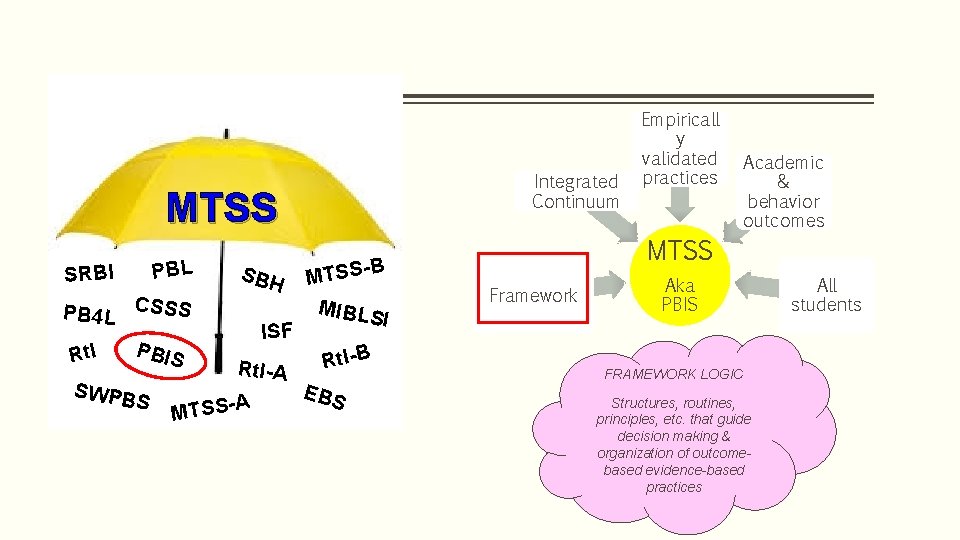
Integrated Continuum MTSS PBL SRBI PB 4 L CSSS Rt. I PBIS SWPB S SBH ISF Rt. I-A A MTSS- B MTSSMIBLS I Rt. I-B EBS Empiricall y validated practices Academic & behavior outcomes MTSS Framework Aka PBIS FRAMEWORK LOGIC Structures, routines, principles, etc. that guide decision making & organization of outcomebased evidence-based practices All students
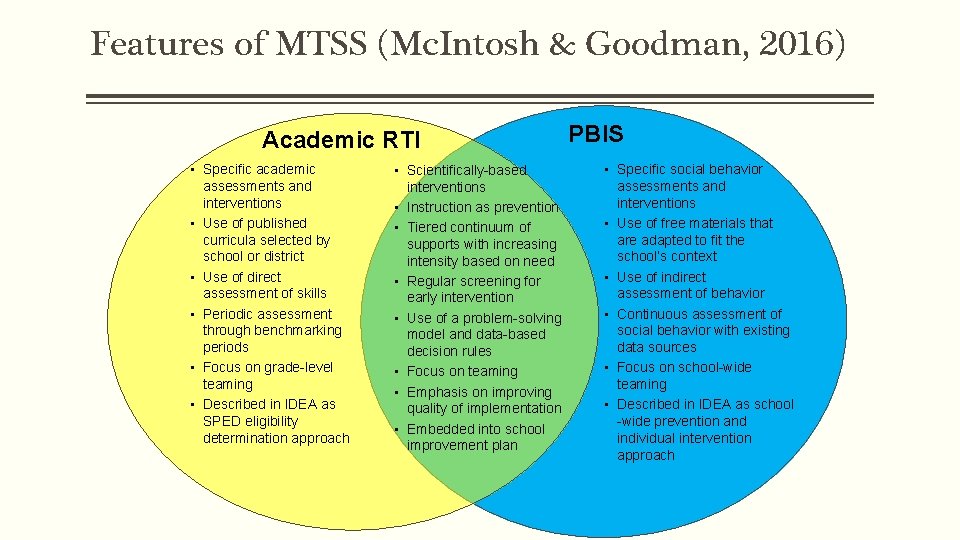
Features of MTSS (Mc. Intosh & Goodman, 2016) Academic RTI • Specific academic assessments and interventions • Use of published curricula selected by school or district • Use of direct assessment of skills • Periodic assessment through benchmarking periods • Focus on grade-level teaming • Described in IDEA as SPED eligibility determination approach • Scientifically-based interventions • Instruction as prevention • Tiered continuum of supports with increasing intensity based on need • Regular screening for early intervention • Use of a problem-solving model and data-based decision rules • Focus on teaming • Emphasis on improving quality of implementation • Embedded into school improvement plan PBIS • Specific social behavior assessments and interventions • Use of free materials that are adapted to fit the school’s context • Use of indirect assessment of behavior • Continuous assessment of social behavior with existing data sources • Focus on school-wide teaming • Described in IDEA as school -wide prevention and individual intervention approach
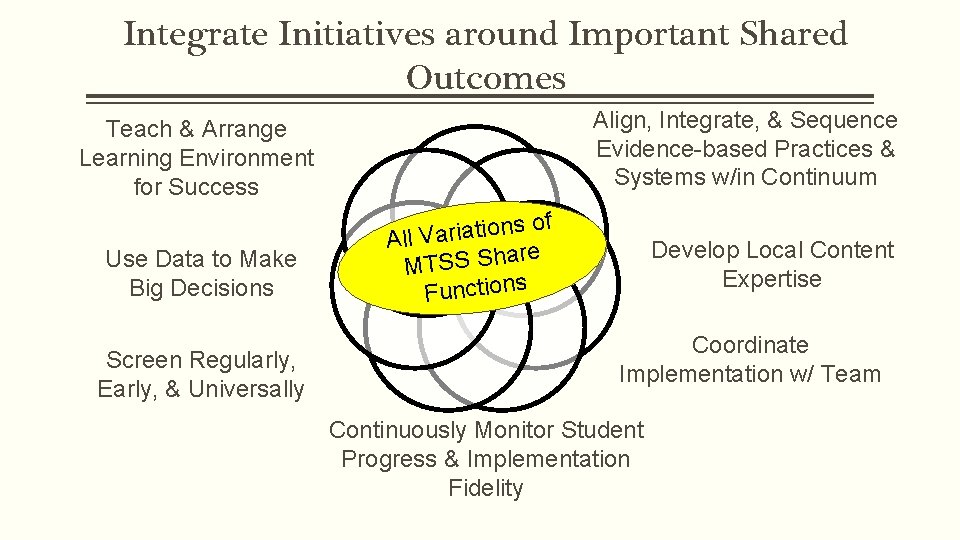
Integrate Initiatives around Important Shared Outcomes Align, Integrate, & Sequence Evidence-based Practices & Systems w/in Continuum Teach & Arrange Learning Environment for Success Use Data to Make Big Decisions Screen Regularly, Early, & Universally of s n o i t a i r a All V are MTSS Sh Functions Develop Local Content Expertise Coordinate Implementation w/ Team Continuously Monitor Student Progress & Implementation Fidelity
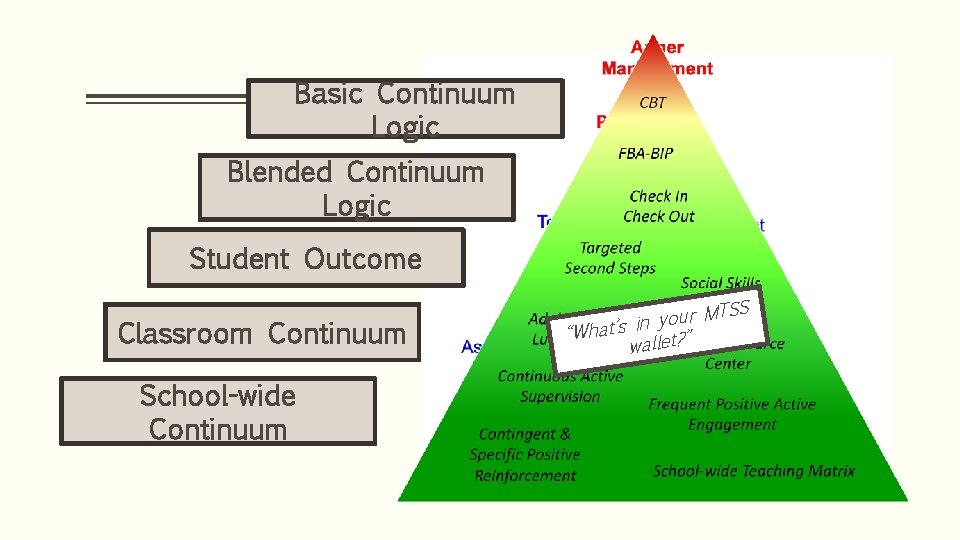
Basic Continuum Logic Blended Continuum Logic Student Outcome Classroom Continuum School-wide Continuum MTSS r u o y in “What’s llet? ” wa
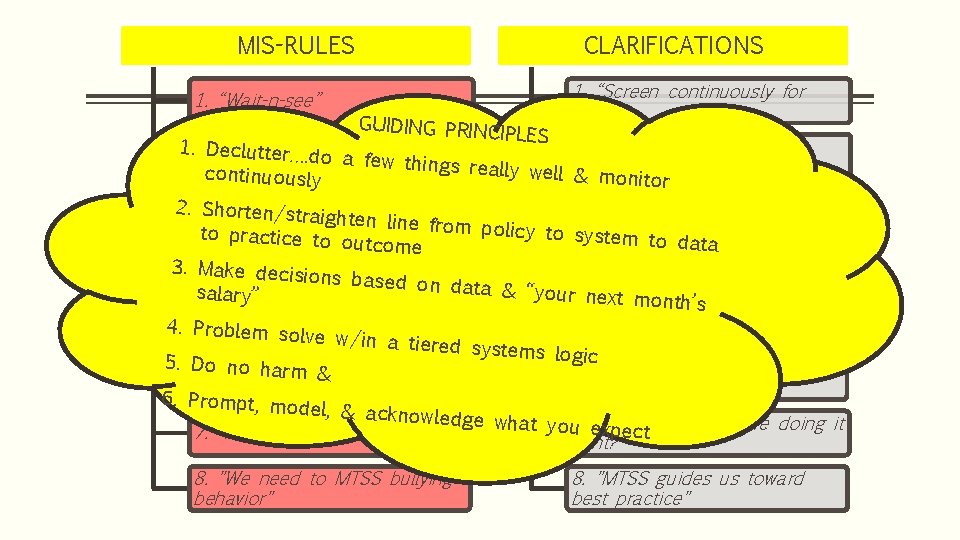
MIS-RULES CLARIFICATIONS 1. “Wait-n-see” 1. “Screen continuously for risk” 8. "We need to MTSS bullying behavior" 8. "MTSS guides us toward best practice" GUIDING PRINC IPLES 1. 2. D“Implement eclutter…. d. T 1 2. “No wait-list for T 2/3” o afirst” few things reall y well & monito continuously r T 1, now let’s do 3. “Never done; always adjust 2. 3. Sh“Done orten/w/ s tr a ig hten line from T 2/3” on data” policy to based to practice to o system to data utcome 4. “Align practice w/ need & do it” 3. 4. Ma“Ifkeit’sdeevidence-based, cisions based o outcome” n d a ta & “your next m salary” onth’s experience T 1, 5. “All students 5. “If student getting T 2/3, no some/few students receive bit 4. need Probletom experience solve w/in. T 1”a tie red systems lomore gic 5. D no haw/ 6. o“Start academics then 6. "Integrate academic & rm & shift to behavior” behavior" 6. Prompt, mod el, & acknowled ge what you 7. e"Is itcright & are we doing it xpe t 7. "If it's not working, change" right? "
Dr. Peggy Mc. Donald, Panelist Contact Information Deputy Chief, New Jersey Department of Education Division of Learning Supports and Specialized Services peggy. mcdonald@doe. nj. gov
CORE COMPONENTS OF THE MTSS FRAMEWORK Roles and responsibilities of professional at the state-level, and best practices to support implementation, capacity building, and sustainability
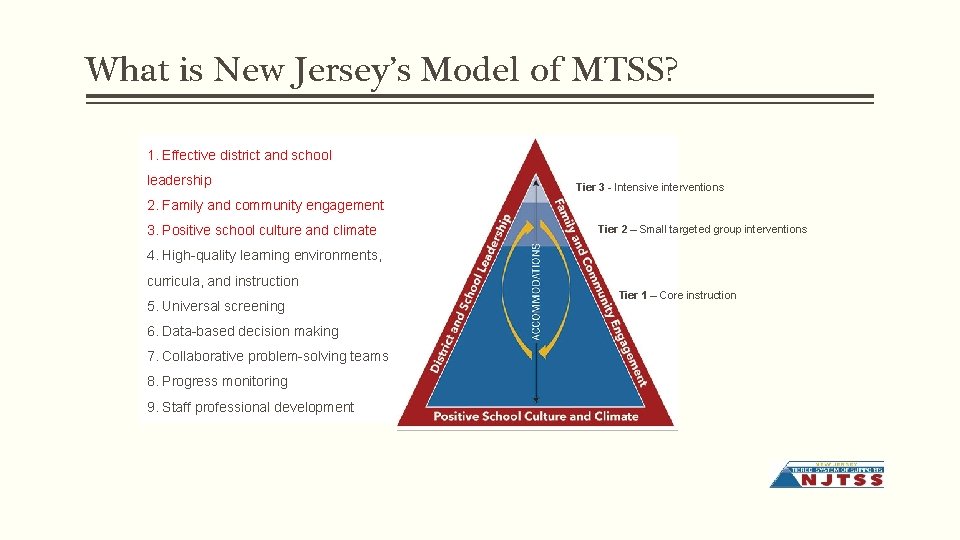
What is New Jersey’s Model of MTSS? 1. Effective district and school leadership Tier 3 - Intensive interventions 2. Family and community engagement 3. Positive school culture and climate Tier 2 – Small targeted group interventions 4. High-quality learning environments, curricula, and instruction 5. Universal screening 6. Data-based decision making 7. Collaborative problem-solving teams 8. Progress monitoring 9. Staff professional development Tier 1 – Core instruction
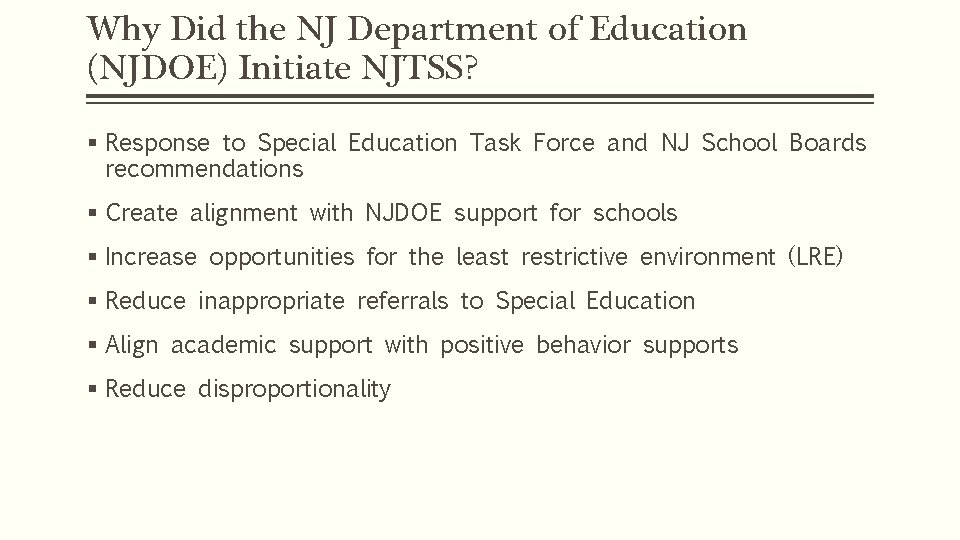
Why Did the NJ Department of Education (NJDOE) Initiate NJTSS? § Response to Special Education Task Force and NJ School Boards recommendations § Create alignment with NJDOE support for schools § Increase opportunities for the least restrictive environment (LRE) § Reduce inappropriate referrals to Special Education § Align academic support with positive behavior supports § Reduce disproportionality
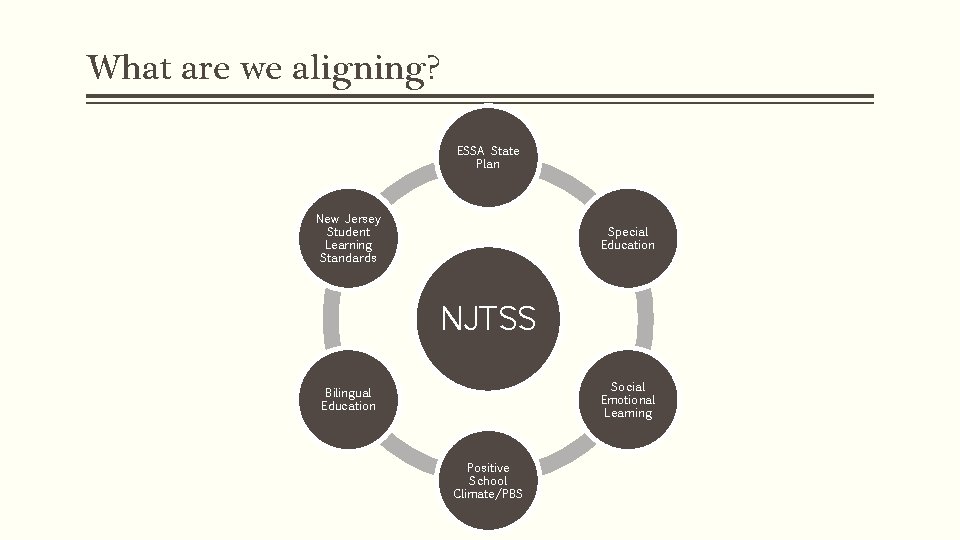
What are we aligning? ESSA State Plan New Jersey Student Learning Standards Special Education NJTSS Social Emotional Learning Bilingual Education Positive School Climate/PBS
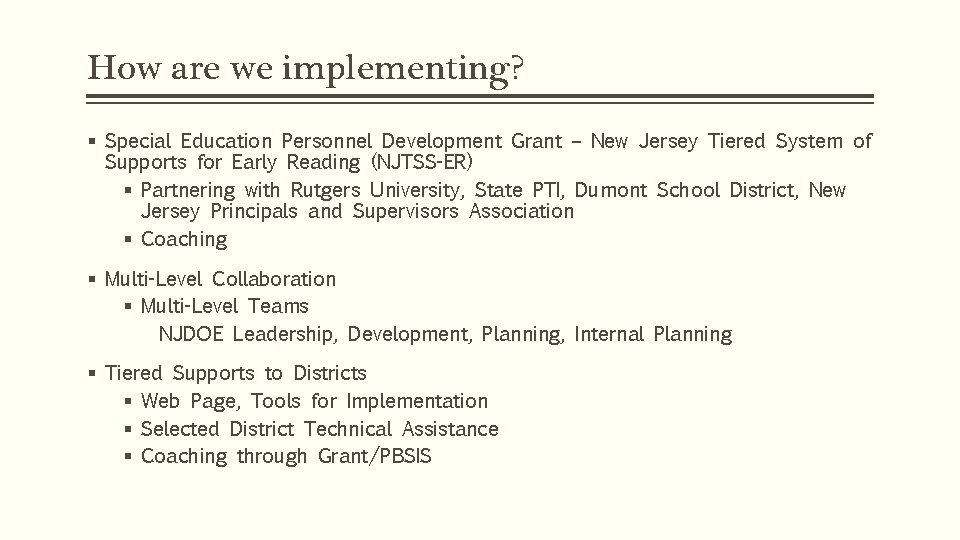
How are we implementing? § Special Education Personnel Development Grant – New Jersey Tiered System of Supports for Early Reading (NJTSS-ER) § Partnering with Rutgers University, State PTI, Dumont School District, New Jersey Principals and Supervisors Association § Coaching § Multi-Level Collaboration § Multi-Level Teams NJDOE Leadership, Development, Planning, Internal Planning § Tiered Supports to Districts § Web Page, Tools for Implementation § Selected District Technical Assistance § Coaching through Grant/PBSIS
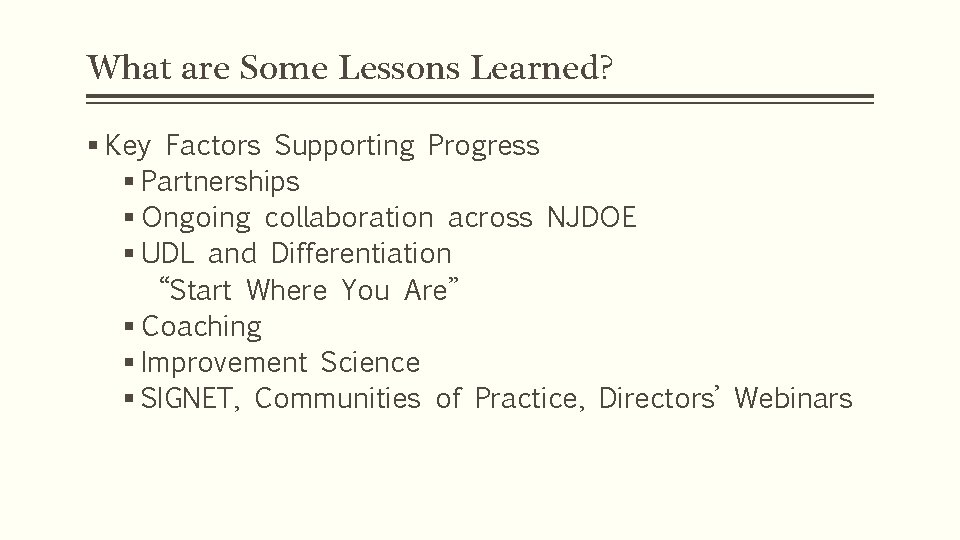
What are Some Lessons Learned? § Key Factors Supporting Progress § Partnerships § Ongoing collaboration across NJDOE § UDL and Differentiation “Start Where You Are” § Coaching § Improvement Science § SIGNET, Communities of Practice, Directors’ Webinars
Dr. Paul Barbato, Panelist Contact Information Director of Special Services, Dumont Public School in New Jersey ebarbato@dumontnj. org
IMPLEMENTING THE MTSS FRAMEWORK Implementation for the MTSS framework at the district level, roles and responsibilities of professional, and strategies for overcoming implementation challenges
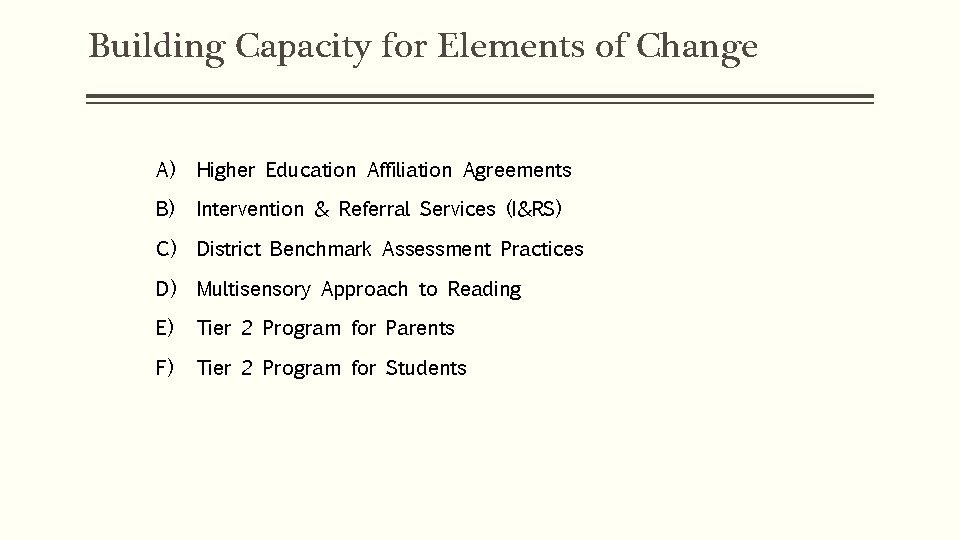
Building Capacity for Elements of Change A) Higher Education Affiliation Agreements B) Intervention & Referral Services (I&RS) C) District Benchmark Assessment Practices D) Multisensory Approach to Reading E) Tier 2 Program for Parents F) Tier 2 Program for Students
Higher Education Affiliation Agreements 1) Linkages with : School Psychology Graduate Programs School Social Work Graduate Programs School of Education Graduate Programs
Intervention & Referral Services 1) Observation of I&RS building level meetings and subsequent consultation 2) Adoption of consistent procedures for process 3) Utilization of variety of personnel as Interventionists
Benchmark Assessment Practices 1) Streamlined data collection process 2) Needs assessment teacher survey 3) Targeted professional development 4) Professional learning communities
Multisensory Approach to Reading 1) Training to: - Building Principals - District Administrators - Basic Skills (Intervention) Teachers - Special Education Teachers - General Education Teachers - Instructional Assistants 2) Adoption of evidence based programs
Tier 2 Intervention for Parents 1) Parent workshop series designed to provide strategies to: - increase children’s reading motivation - build vocabulary - strengthen phonemic awareness and letter/word recognition 2) Higher education institution collected data
Tier 2 Intervention for Students 1) After school program designed to provide: - mentoring, supplemental instruction, and online educational component - mindset activities with Language Arts 2) Higher education institution collected data
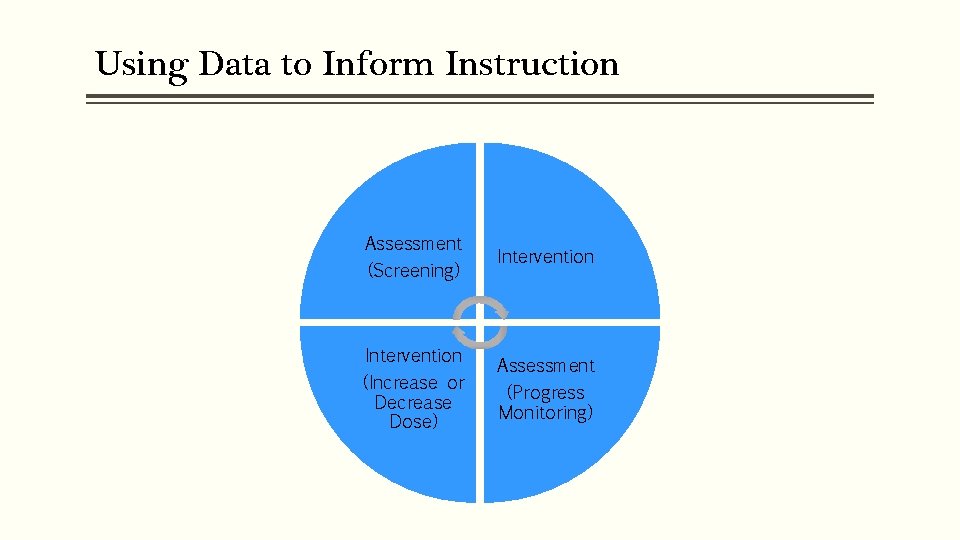
Using Data to Inform Instruction Assessment (Screening) Intervention (Increase or Decrease Dose) Intervention Assessment (Progress Monitoring)
Monique Du. Jue’ Wilson, Panelist Contact Information START Project Parent Leadership Initiative Regional Coordinator – Statewide Parent Advocacy Network Northern New Jersey START Parent Group Specialist PTI Parent/Professional Trainer mdujue@spanadvocacy. org
ENGAGING FAMILIES IN THE MTSS FRAMEWORK Discussing the role of families in supporting implementation
Effective Family Engagement is any way that a child’s adult caretaker effectively supports learning and healthy development. § Engagement among families, schools, community = shared responsibility § Reflects: § different ways families, community organizations, schools engage with/support one another § ensure that every child is academically successful § Continuous throughout a child’s life § Happens everywhere: home, school, community § Supports creation of pathways honoring dynamic, multiple, complementary ways that children learn and grow § Recognizes and encourages the roles of family and community play in advocating for educational quality and opportunity for all children. ” Adapted from the description of effective family and community engagement created by the National Family, School, and Community Engagement Working Group. (2009)
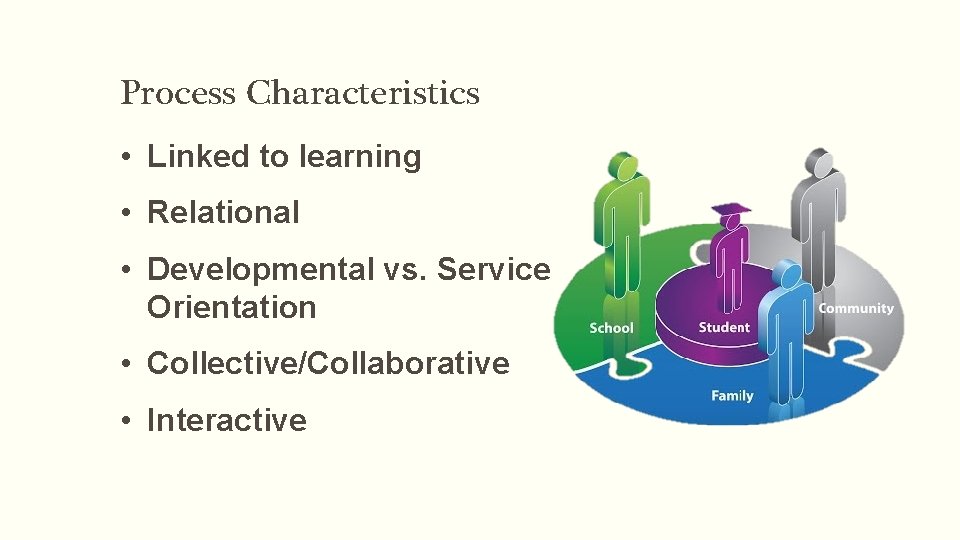
The Dual Capacity Building Framework for Family-School Partnerships The Dual Capacity-Building framework provides one model that states, districts and schools can use to guide their efforts for incorporating the rich resources that engaged families and communities bring to influence the culture of a school and enhance student outcomes.
Process Characteristics • Linked to learning • Relational • Developmental vs. Service Orientation • Collective/Collaborative • Interactive
Effective Staff & Family Engagement • Honor and recognize families’ existing knowledge, skill and forms of engagement • Create and sustain school and district cultures that welcome, invite and promote family engagement and development • Develop and connect all family engagement initiatives to student learning
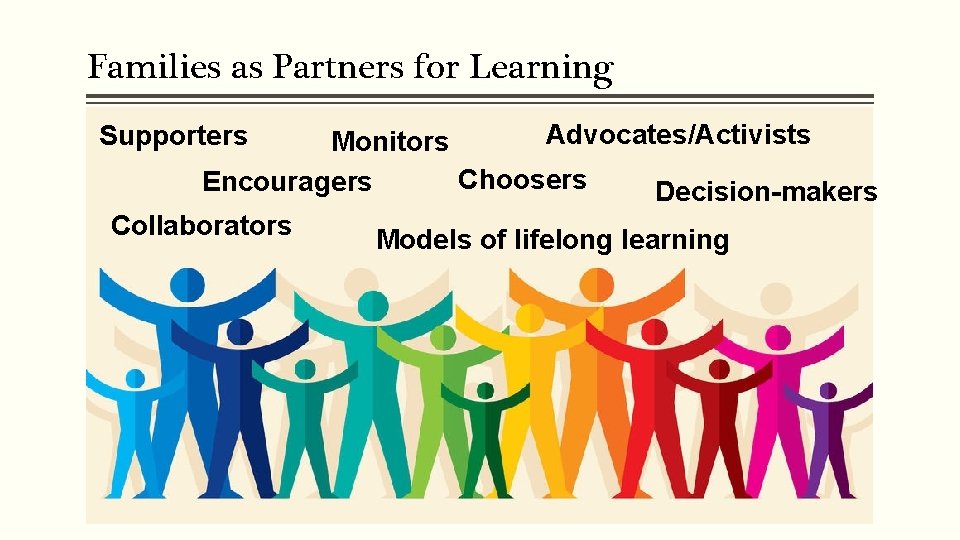
Families as Partners for Learning Advocates/Activists Monitors Choosers Encouragers Decision-makers Collaborators Models of lifelong learning Supporters
Effective Family Engagement Could Look Like This https: //www. youtube. com/watch? v=Sgo. RN 4 n 0 GGs “Effective Family Engagement”
Audience Forum § Questions and Answers for Panel Members
Closing Remarks § Thank You
2018 OSEP Project Directors’ Conference DISCLAIMER: The contents of this presentation were developed by the presenters for the 2018 Project Directors’ Conference. However, these contents do not necessarily represent the policy of the Department of Education, and you should not assume endorsement by the Federal Government. (Authority: 20 U. S. C. 1221 e-3 and 3474)