1112020 Anthony Mezzacappa ORNL Mitchell Symposium College Station

- Slides: 35
11/1/2020 Anthony Mezzacappa (ORNL) Mitchell Symposium, College Station 1
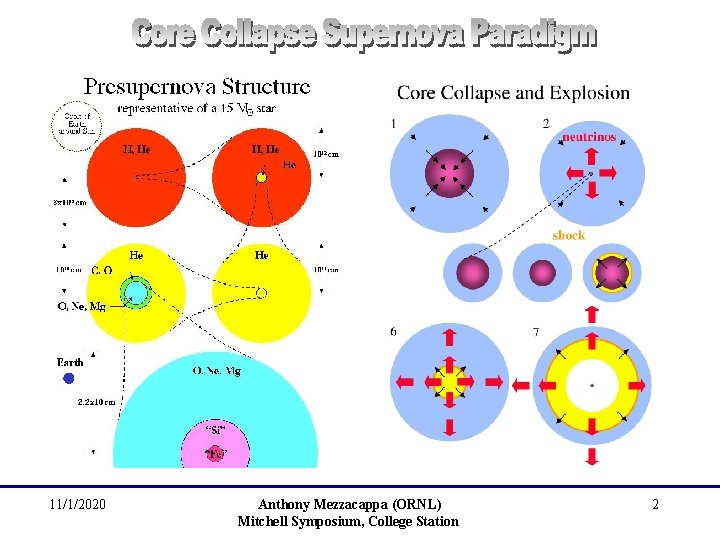
11/1/2020 Anthony Mezzacappa (ORNL) Mitchell Symposium, College Station 2
11/1/2020 Anthony Mezzacappa (ORNL) Mitchell Symposium, College Station 3
11/1/2020 Anthony Mezzacappa (ORNL) Mitchell Symposium, College Station 4
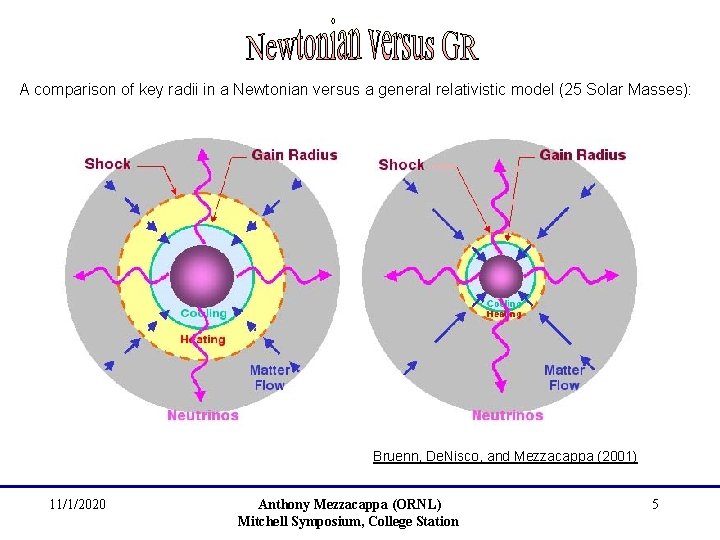
A comparison of key radii in a Newtonian versus a general relativistic model (25 Solar Masses): Bruenn, De. Nisco, and Mezzacappa (2001) 11/1/2020 Anthony Mezzacappa (ORNL) Mitchell Symposium, College Station 5
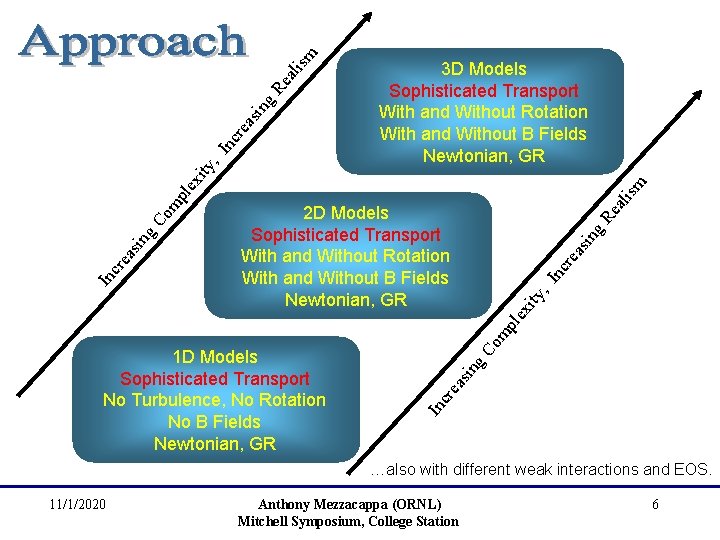
lis m Re a sin g cr ea In , sm ali pl ex ity , In cr ea sin g Re 2 D Models Sophisticated Transport With and Without Rotation With and Without B Fields Newtonian, GR g sin ea cr In 1 D Models Sophisticated Transport No Turbulence, No Rotation No B Fields Newtonian, GR Co m In cr ea sin g Co m pl ex ity 3 D Models Sophisticated Transport With and Without Rotation With and Without B Fields Newtonian, GR …also with different weak interactions and EOS. 11/1/2020 Anthony Mezzacappa (ORNL) Mitchell Symposium, College Station 6
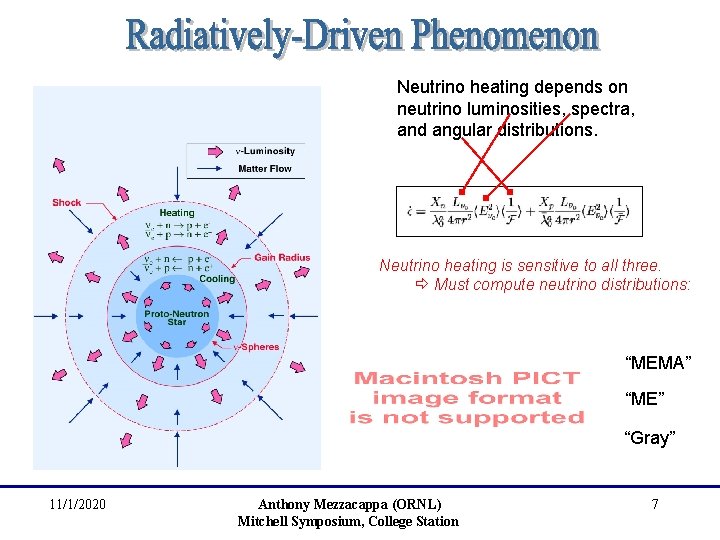
Neutrino heating depends on neutrino luminosities, spectra, and angular distributions. Neutrino heating is sensitive to all three. ð Must compute neutrino distributions: “MEMA” “ME” “Gray” 11/1/2020 Anthony Mezzacappa (ORNL) Mitchell Symposium, College Station 7
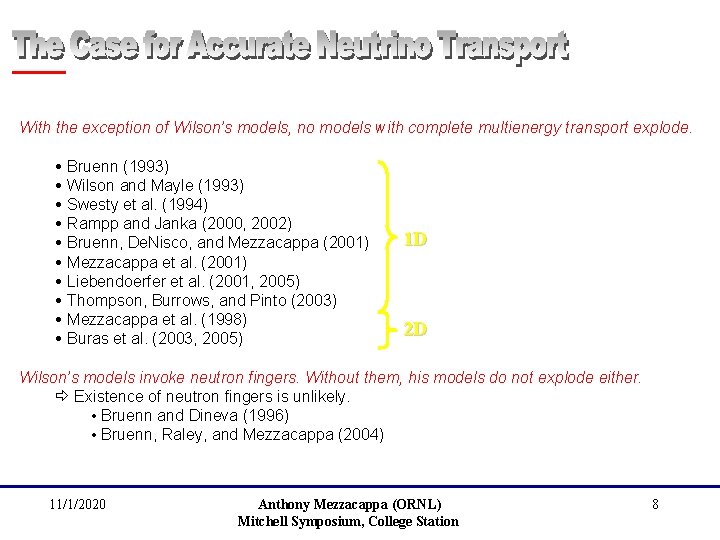
With the exception of Wilson’s models, no models with complete multienergy transport explode. Bruenn (1993) Wilson and Mayle (1993) Swesty et al. (1994) Rampp and Janka (2000, 2002) Bruenn, De. Nisco, and Mezzacappa (2001) Mezzacappa et al. (2001) Liebendoerfer et al. (2001, 2005) Thompson, Burrows, and Pinto (2003) Mezzacappa et al. (1998) Buras et al. (2003, 2005) 1 D 2 D Wilson’s models invoke neutron fingers. Without them, his models do not explode either. ð Existence of neutron fingers is unlikely. • Bruenn and Dineva (1996) • Bruenn, Raley, and Mezzacappa (2004) 11/1/2020 Anthony Mezzacappa (ORNL) Mitchell Symposium, College Station 8
11/1/2020 Anthony Mezzacappa (ORNL) Mitchell Symposium, College Station 9
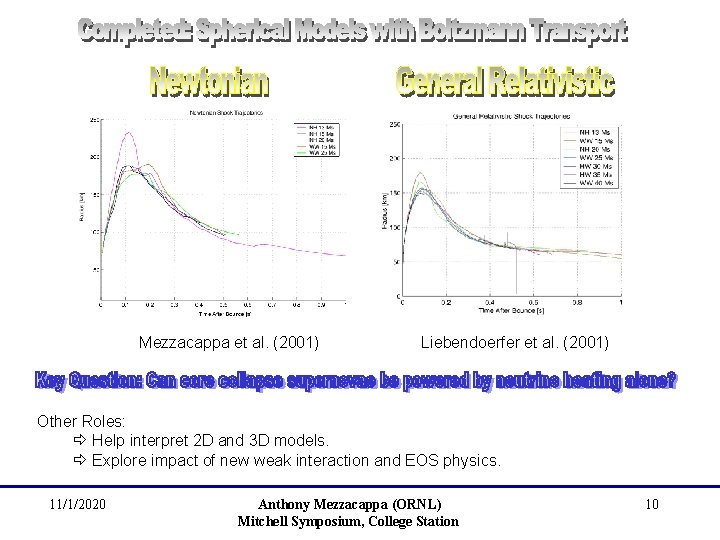
Mezzacappa et al. (2001) Liebendoerfer et al. (2001) Other Roles: ð Help interpret 2 D and 3 D models. ð Explore impact of new weak interaction and EOS physics. 11/1/2020 Anthony Mezzacappa (ORNL) Mitchell Symposium, College Station 10
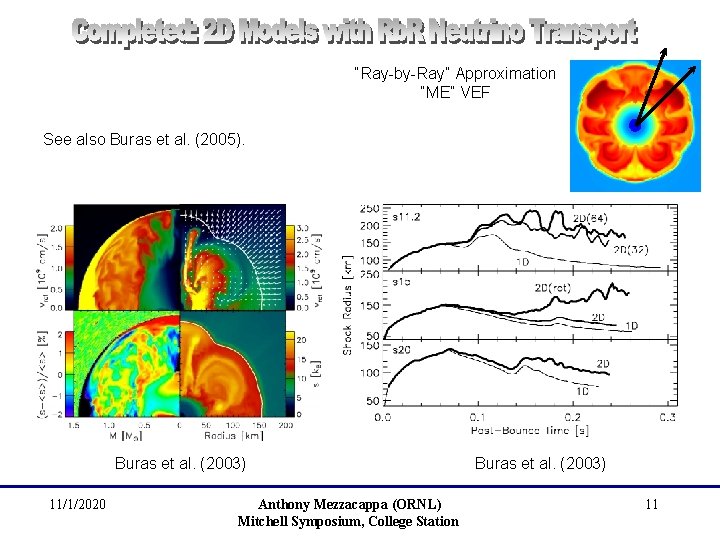
“Ray-by-Ray” Approximation “ME” VEF See also Buras et al. (2005). Buras et al. (2003) 11/1/2020 Anthony Mezzacappa (ORNL) Mitchell Symposium, College Station Buras et al. (2003) 11
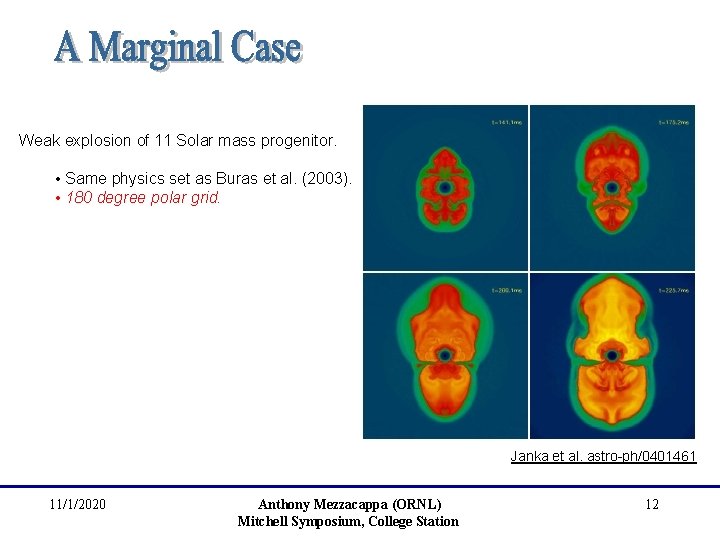
Weak explosion of 11 Solar mass progenitor. • Same physics set as Buras et al. (2003). • 180 degree polar grid. Janka et al. astro-ph/0401461 11/1/2020 Anthony Mezzacappa (ORNL) Mitchell Symposium, College Station 12
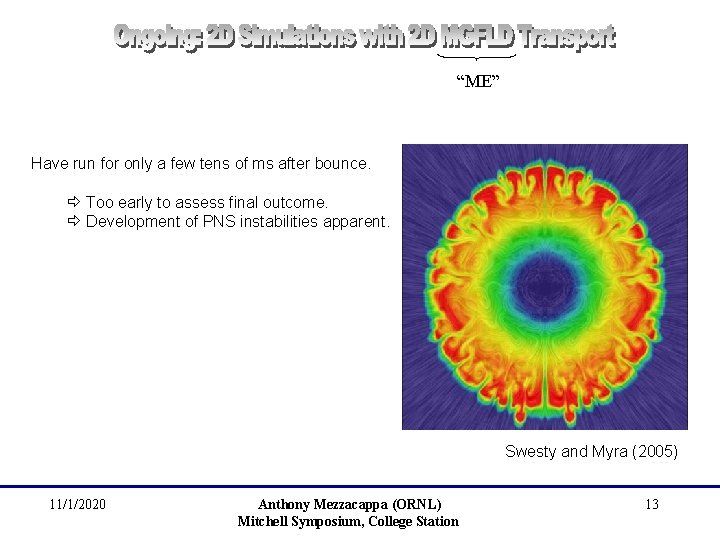
“ME” Have run for only a few tens of ms after bounce. ð Too early to assess final outcome. ð Development of PNS instabilities apparent. Swesty and Myra (2005) 11/1/2020 Anthony Mezzacappa (ORNL) Mitchell Symposium, College Station 13
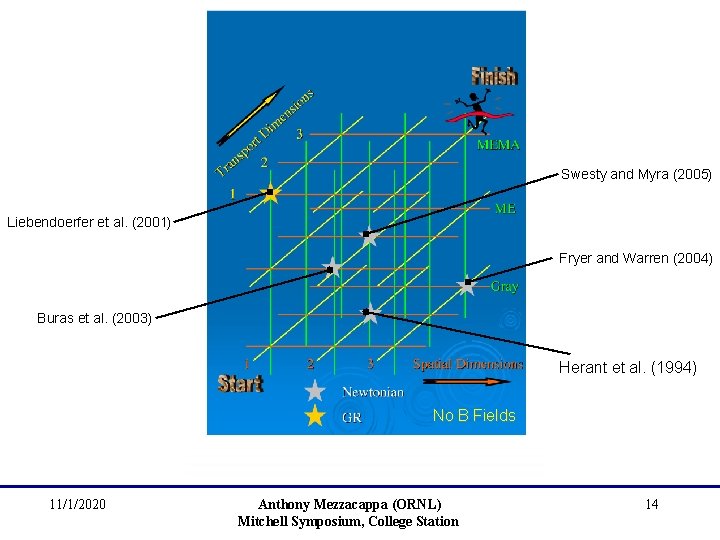
Swesty and Myra (2005) Liebendoerfer et al. (2001) Fryer and Warren (2004) Buras et al. (2003) Herant et al. (1994) No B Fields 11/1/2020 Anthony Mezzacappa (ORNL) Mitchell Symposium, College Station 14
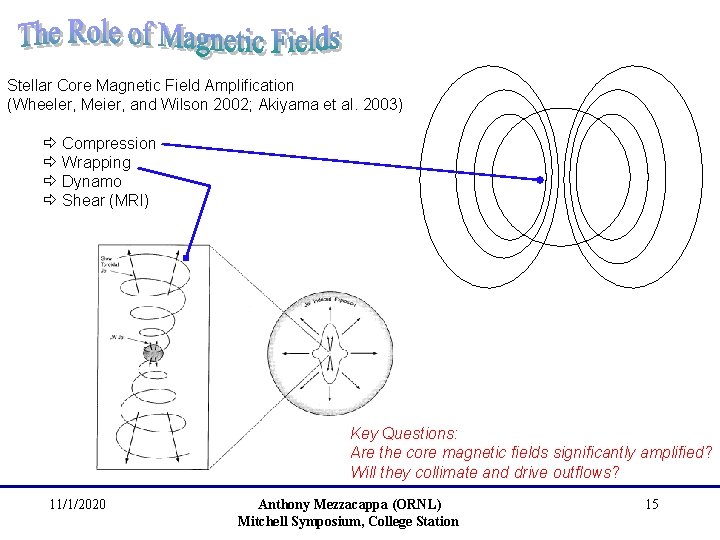
Stellar Core Magnetic Field Amplification (Wheeler, Meier, and Wilson 2002; Akiyama et al. 2003) ð Compression ð Wrapping ð Dynamo ð Shear (MRI) Key Questions: Are the core magnetic fields significantly amplified? Will they collimate and drive outflows? 11/1/2020 Anthony Mezzacappa (ORNL) Mitchell Symposium, College Station 15
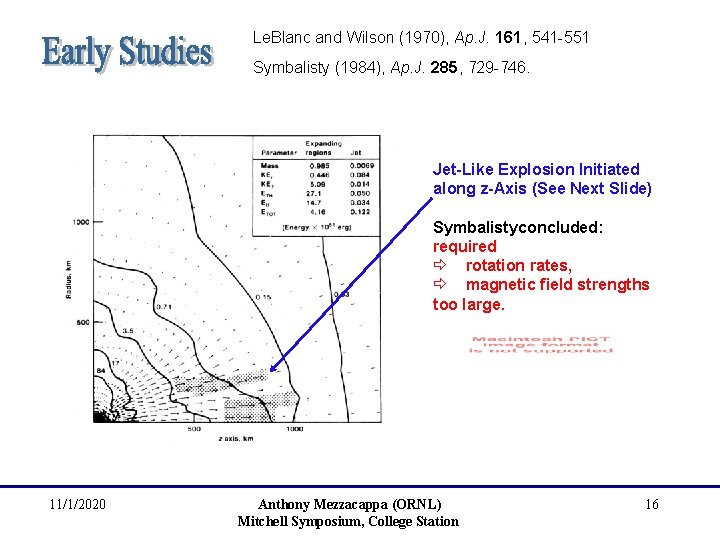
Le. Blanc and Wilson (1970), Ap. J. 161, 541 -551 Symbalisty (1984), Ap. J. 285, 729 -746. Jet-Like Explosion Initiated along z-Axis (See Next Slide) Symbalisty concluded: required ð rotation rates, ð magnetic field strengths too large. 11/1/2020 Anthony Mezzacappa (ORNL) Mitchell Symposium, College Station 16
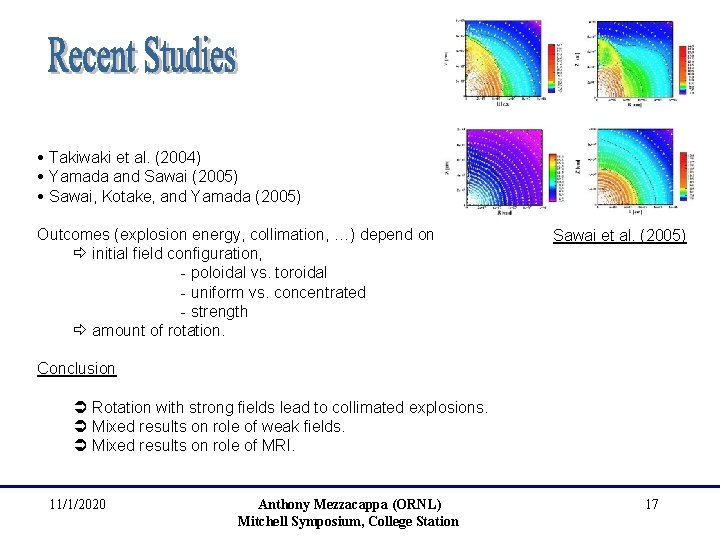
Takiwaki et al. (2004) Yamada and Sawai (2005) Sawai, Kotake, and Yamada (2005) Outcomes (explosion energy, collimation, …) depend on ð initial field configuration, - poloidal vs. toroidal - uniform vs. concentrated - strength ð amount of rotation. Sawai et al. (2005) Conclusion Ü Rotation with strong fields lead to collimated explosions. Ü Mixed results on role of weak fields. Ü Mixed results on role of MRI. 11/1/2020 Anthony Mezzacappa (ORNL) Mitchell Symposium, College Station 17
11/1/2020 Anthony Mezzacappa (ORNL) Mitchell Symposium, College Station 18
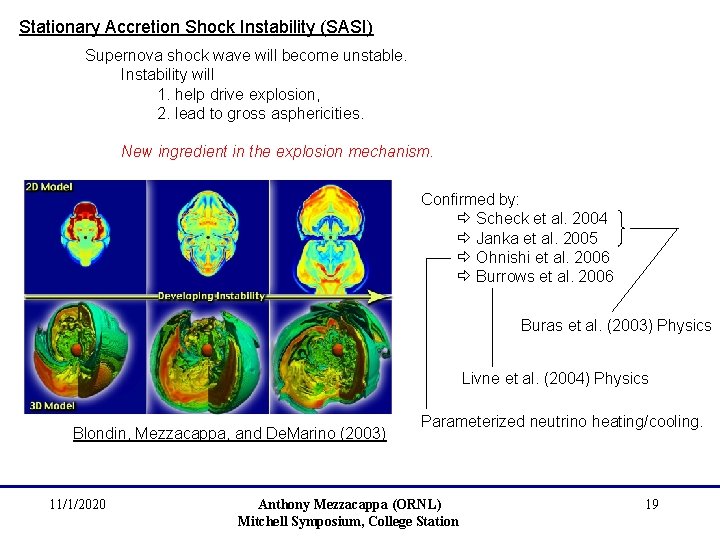
Stationary Accretion Shock Instability (SASI) Supernova shock wave will become unstable. Instability will 1. help drive explosion, 2. lead to gross asphericities. New ingredient in the explosion mechanism. Confirmed by: ð Scheck et al. 2004 ð Janka et al. 2005 ð Ohnishi et al. 2006 ð Burrows et al. 2006 Buras et al. (2003) Physics Livne et al. (2004) Physics Blondin, Mezzacappa, and De. Marino (2003) 11/1/2020 Parameterized neutrino heating/cooling. Anthony Mezzacappa (ORNL) Mitchell Symposium, College Station 19
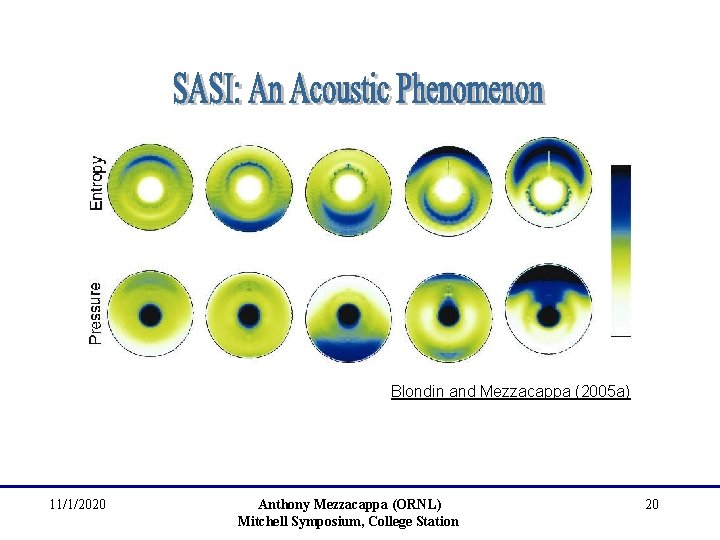
Blondin and Mezzacappa (2005 a) 11/1/2020 Anthony Mezzacappa (ORNL) Mitchell Symposium, College Station 20
11/1/2020 Anthony Mezzacappa (ORNL) Mitchell Symposium, College Station 21
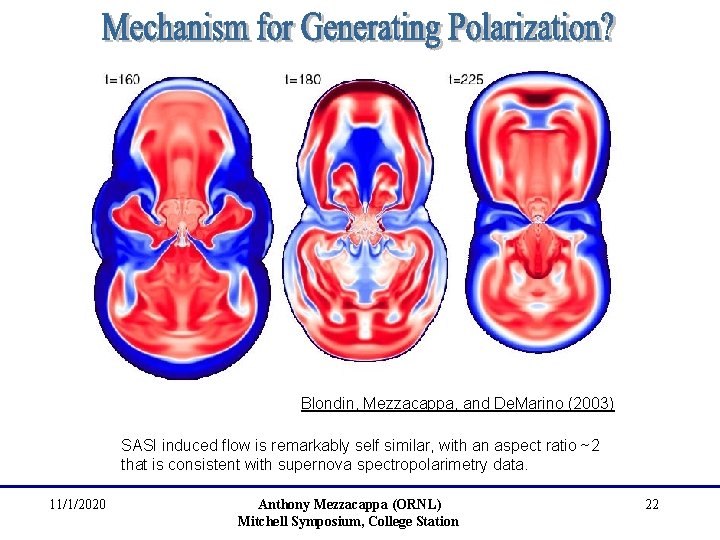
Blondin, Mezzacappa, and De. Marino (2003) SASI induced flow is remarkably self similar, with an aspect ratio ~2 that is consistent with supernova spectropolarimetry data. 11/1/2020 Anthony Mezzacappa (ORNL) Mitchell Symposium, College Station 22
11/1/2020 Anthony Mezzacappa (ORNL) Mitchell Symposium, College Station 23
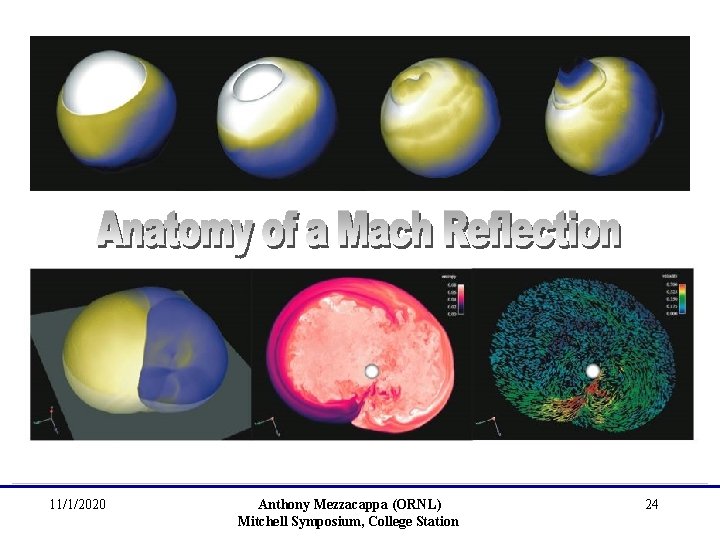
11/1/2020 Anthony Mezzacappa (ORNL) Mitchell Symposium, College Station 24
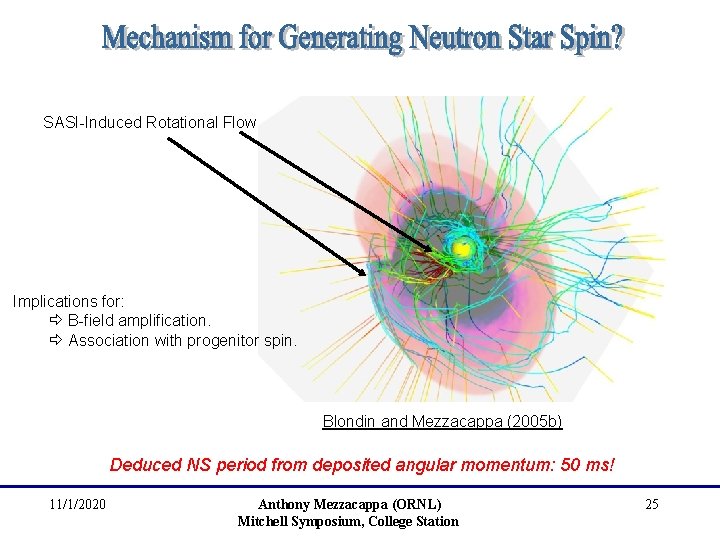
SASI-Induced Rotational Flow Implications for: ð B-field amplification. ð Association with progenitor spin. Blondin and Mezzacappa (2005 b) Deduced NS period from deposited angular momentum: 50 ms! 11/1/2020 Anthony Mezzacappa (ORNL) Mitchell Symposium, College Station 25
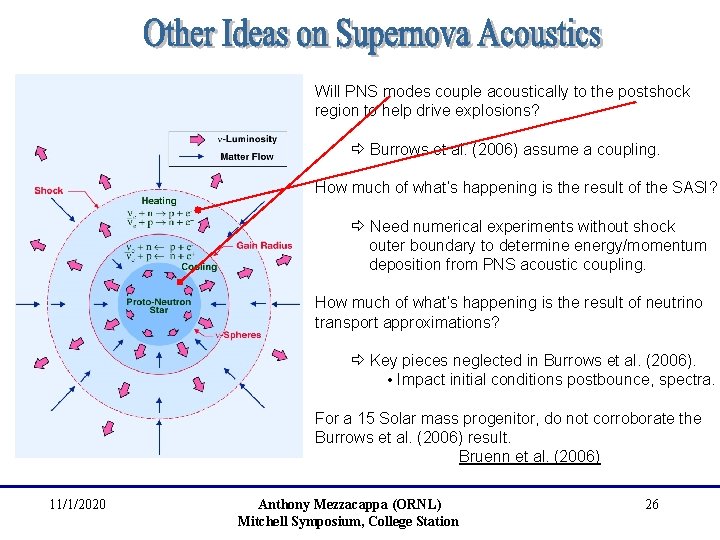
Will PNS modes couple acoustically to the postshock region to help drive explosions? ð Burrows et al. (2006) assume a coupling. How much of what’s happening is the result of the SASI? ð Need numerical experiments without shock outer boundary to determine energy/momentum deposition from PNS acoustic coupling. How much of what’s happening is the result of neutrino transport approximations? ð Key pieces neglected in Burrows et al. (2006). • Impact initial conditions postbounce, spectra. For a 15 Solar mass progenitor, do not corroborate the Burrows et al. (2006) result. Bruenn et al. (2006) 11/1/2020 Anthony Mezzacappa (ORNL) Mitchell Symposium, College Station 26
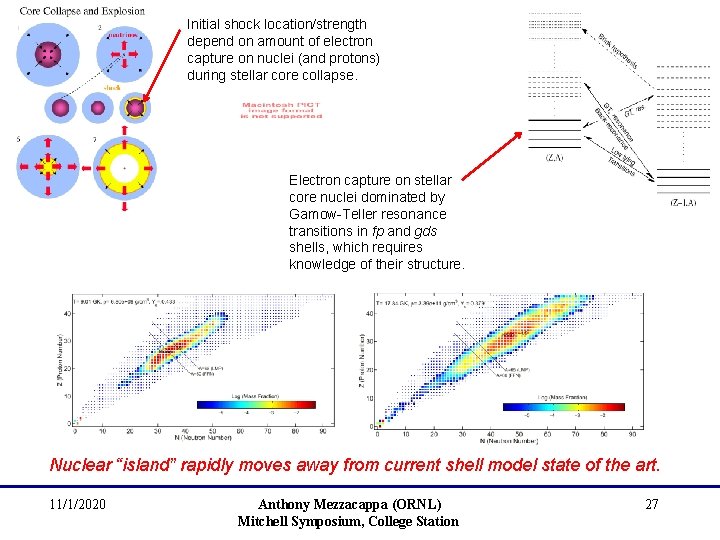
Initial shock location/strength depend on amount of electron capture on nuclei (and protons) during stellar core collapse. Electron capture on stellar core nuclei dominated by Gamow-Teller resonance transitions in fp and gds shells, which requires knowledge of their structure. Nuclear “island” rapidly moves away from current shell model state of the art. 11/1/2020 Anthony Mezzacappa (ORNL) Mitchell Symposium, College Station 27
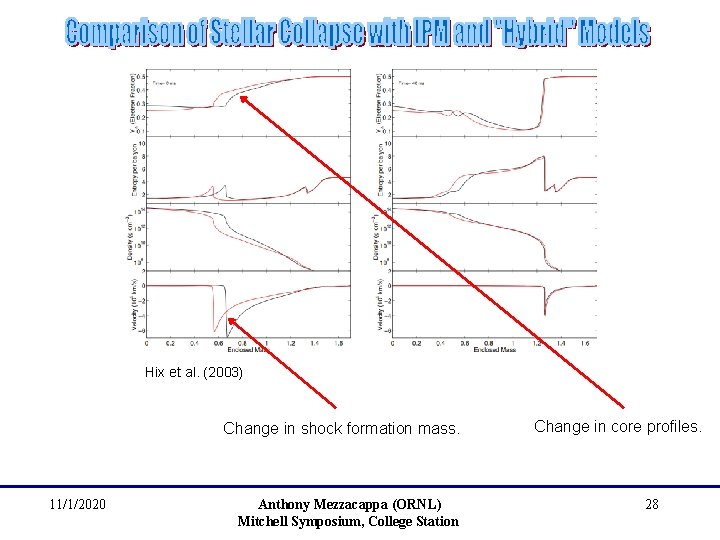
Hix et al. (2003) Change in shock formation mass. 11/1/2020 Anthony Mezzacappa (ORNL) Mitchell Symposium, College Station Change in core profiles. 28
Issues: ð Energy/Particle ð Inhomogeneous Matter Nuclei and Nuclear Matter 1 D vs. 3 D Nuclei Precise form of nucleon interaction is unknown. 11/1/2020 Anthony Mezzacappa (ORNL) Mitchell Symposium, College Station 29
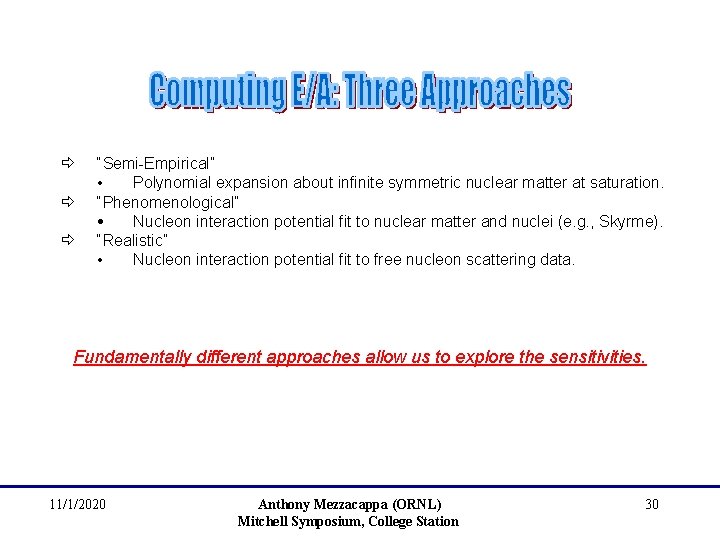
ð ð ð “Semi-Empirical” • Polynomial expansion about infinite symmetric nuclear matter at saturation. “Phenomenological” Nucleon interaction potential fit to nuclear matter and nuclei (e. g. , Skyrme). “Realistic” • Nucleon interaction potential fit to free nucleon scattering data. Fundamentally different approaches allow us to explore the sensitivities. 11/1/2020 Anthony Mezzacappa (ORNL) Mitchell Symposium, College Station 30
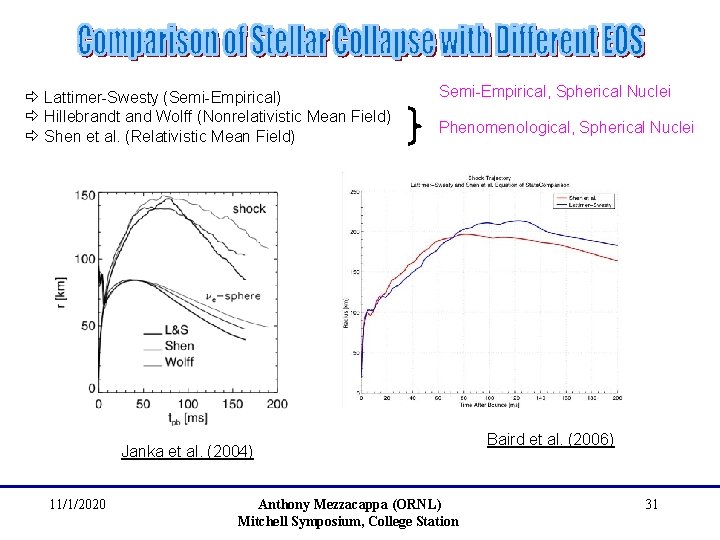
ð Lattimer-Swesty (Semi-Empirical) ð Hillebrandt and Wolff (Nonrelativistic Mean Field) ð Shen et al. (Relativistic Mean Field) Semi-Empirical, Spherical Nuclei Phenomenological, Spherical Nuclei Janka et al. (2004) 11/1/2020 Anthony Mezzacappa (ORNL) Mitchell Symposium, College Station Baird et al. (2006) 31
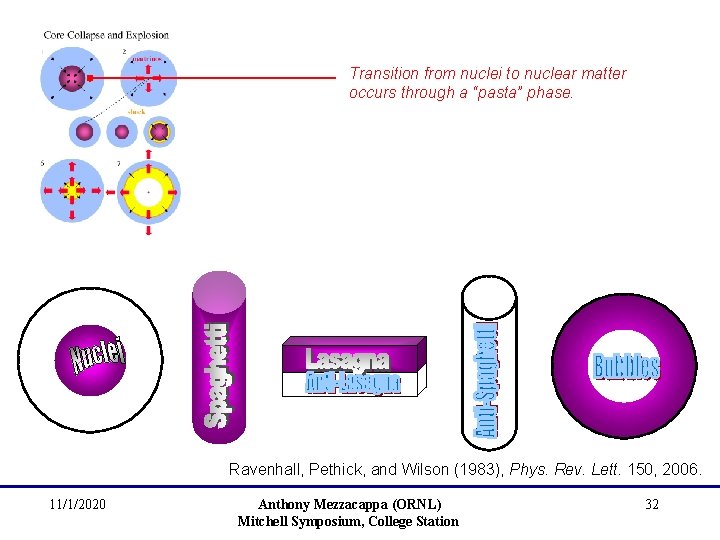
Transition from nuclei to nuclear matter occurs through a “pasta” phase. Ravenhall, Pethick, and Wilson (1983), Phys. Rev. Lett. 150, 2006. 11/1/2020 Anthony Mezzacappa (ORNL) Mitchell Symposium, College Station 32
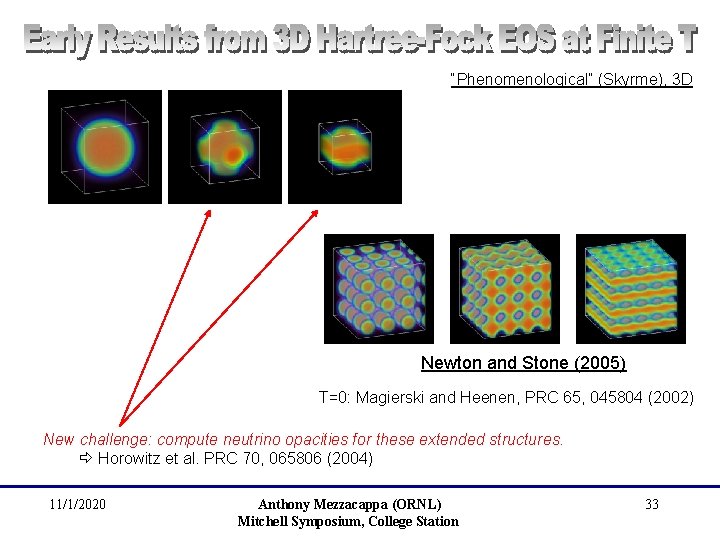
“Phenomenological” (Skyrme), 3 D Newton and Stone (2005) T=0: Magierski and Heenen, PRC 65, 045804 (2002) New challenge: compute neutrino opacities for these extended structures. ð Horowitz et al. PRC 70, 065806 (2004) 11/1/2020 Anthony Mezzacappa (ORNL) Mitchell Symposium, College Station 33
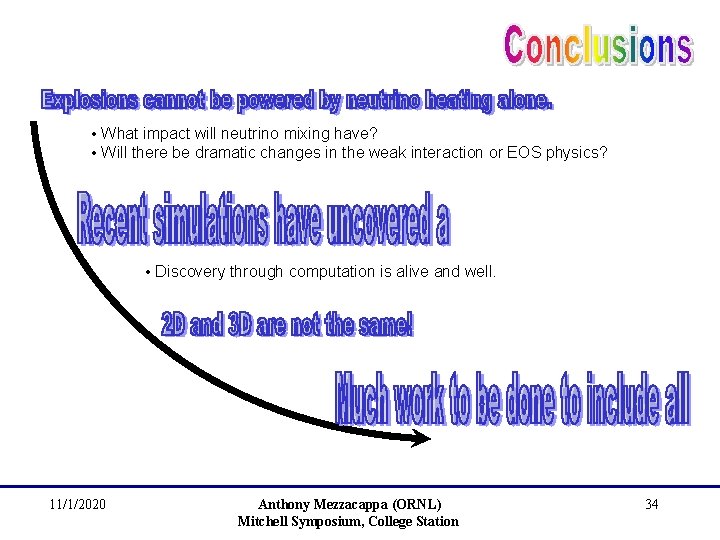
• What impact will neutrino mixing have? • Will there be dramatic changes in the weak interaction or EOS physics? • Discovery through computation is alive and well. 11/1/2020 Anthony Mezzacappa (ORNL) Mitchell Symposium, College Station 34
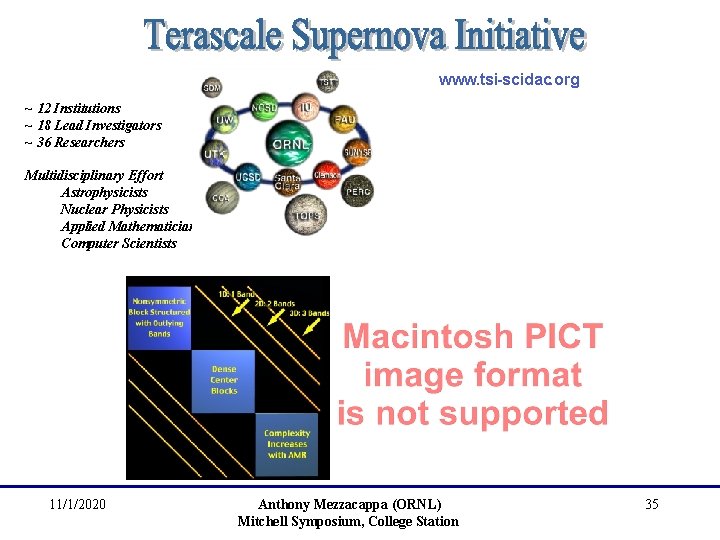
www. tsi-scidac. org ~ 12 Institutions ~ 18 Lead Investigators ~ 36 Researchers Multidisciplinary Effort Astrophysicists Nuclear Physicists Applied Mathematicians Computer Scientists 11/1/2020 Anthony Mezzacappa (ORNL) Mitchell Symposium, College Station 35