
BNLPHENIX Group M J Tannenbaum Brookhaven National Laboratory
BNL/PHENIX Group M. J. Tannenbaum Brookhaven National Laboratory Upton, NY 11973 USA RHIC Science & Technology Review July 7, 2005 BNL PHENIX Group RHIC Review 1

Manpower & Current Support BNL PHENIX Group RHIC Review 2
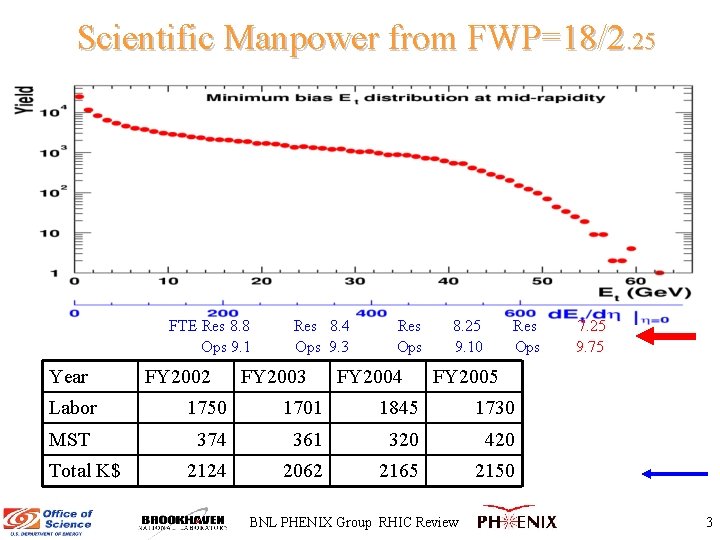
Scientific Manpower from FWP=18/2. 25 FTE Res 8. 8 Ops 9. 1 Year FY 2002 Res 8. 4 Ops 9. 3 FY 2003 Res Ops FY 2004 8. 25 9. 10 Res Ops FY 2005 Labor 1750 1701 1845 1730 MST 374 361 320 420 2124 2062 2165 2150 Total K$ 7. 25 9. 75 BNL PHENIX Group RHIC Review 3
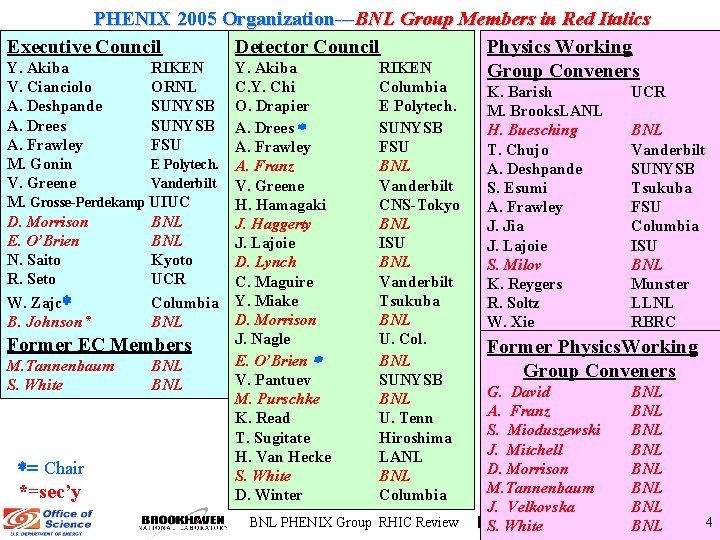
PHENIX 2005 Organization---BNL Group Members in Red Italics Executive Council Detector Council Physics Working Y. Akiba RIKEN Group Conveners V. Cianciolo ORNL A. Deshpande SUNYSB A. Drees SUNYSB A. Frawley FSU M. Gonin E Polytech. V. Greene Vanderbilt M. Grosse-Perdekamp UIUC D. Morrison BNL E. O’Brien BNL N. Saito Kyoto R. Seto UCR W. Zajc* Columbia B. Johnson* BNL Former EC Members M. Tannenbaum S. White *= Chair *=sec’y BNL C. Y. Chi O. Drapier A. Drees * A. Frawley A. Franz V. Greene H. Hamagaki J. Haggerty J. Lajoie D. Lynch C. Maguire Y. Miake D. Morrison J. Nagle E. O’Brien * V. Pantuev M. Purschke K. Read T. Sugitate H. Van Hecke S. White D. Winter Columbia E Polytech. SUNYSB FSU BNL Vanderbilt CNS-Tokyo BNL ISU BNL Vanderbilt Tsukuba BNL U. Col. BNL SUNYSB BNL U. Tenn Hiroshima LANL BNL Columbia BNL PHENIX Group RHIC Review K. Barish M. Brooks. LANL H. Buesching T. Chujo A. Deshpande S. Esumi A. Frawley J. Jia J. Lajoie S. Milov K. Reygers R. Soltz W. Xie UCR BNL Vanderbilt SUNYSB Tsukuba FSU Columbia ISU BNL Munster LLNL RBRC Former Physics. Working Group Conveners G. David A. Franz S. Mioduszewski J. Mitchell D. Morrison M. Tannenbaum J. Velkovska S. White BNL BNL 4

BNL/PHENIX Group: Science & Priorities BNL PHENIX Group RHIC Review 5
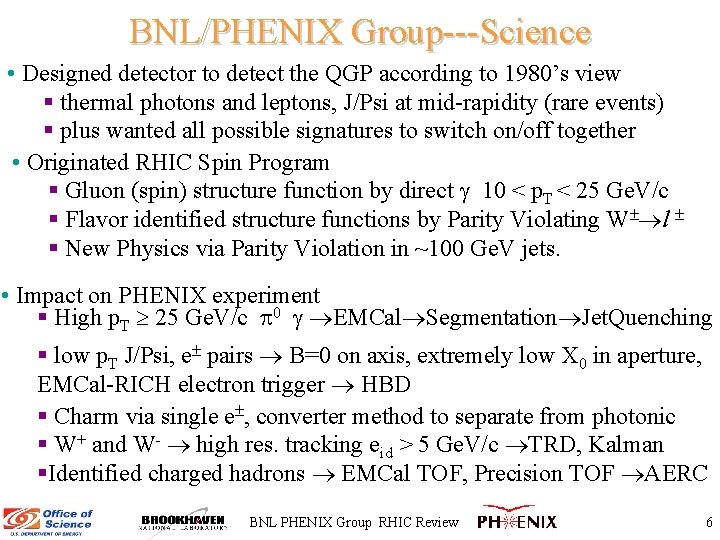
BNL/PHENIX Group---Science • Designed detector to detect the QGP according to 1980’s view § thermal photons and leptons, J/Psi at mid-rapidity (rare events) § plus wanted all possible signatures to switch on/off together • Originated RHIC Spin Program § Gluon (spin) structure function by direct 10 < p. T < 25 Ge. V/c § Flavor identified structure functions by Parity Violating W l § New Physics via Parity Violation in ~100 Ge. V jets. • Impact on PHENIX experiment § High p. T 25 Ge. V/c 0 EMCal Segmentation Jet. Quenching § low p. T J/Psi, e pairs B=0 on axis, extremely low X 0 in aperture, EMCal-RICH electron trigger HBD § Charm via single e , converter method to separate from photonic § W+ and W- high res. tracking eid > 5 Ge. V/c TRD, Kalman §Identified charged hadrons EMCal TOF, Precision TOF AERC BNL PHENIX Group RHIC Review 6
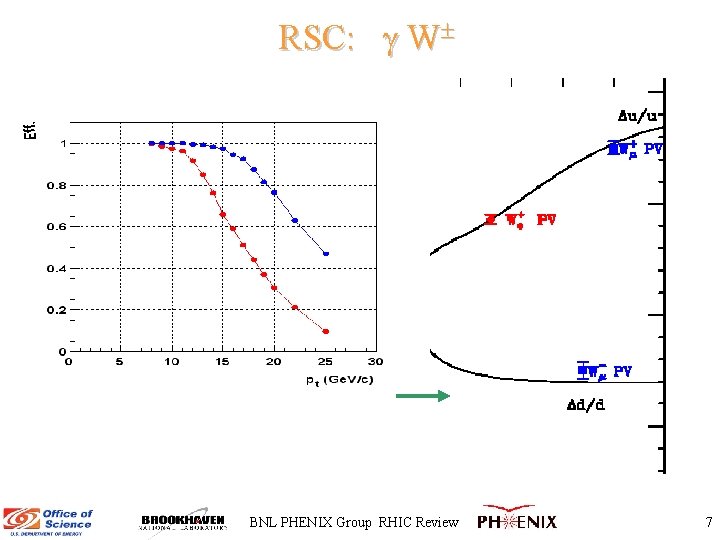
RSC: W BNL PHENIX Group RHIC Review 7
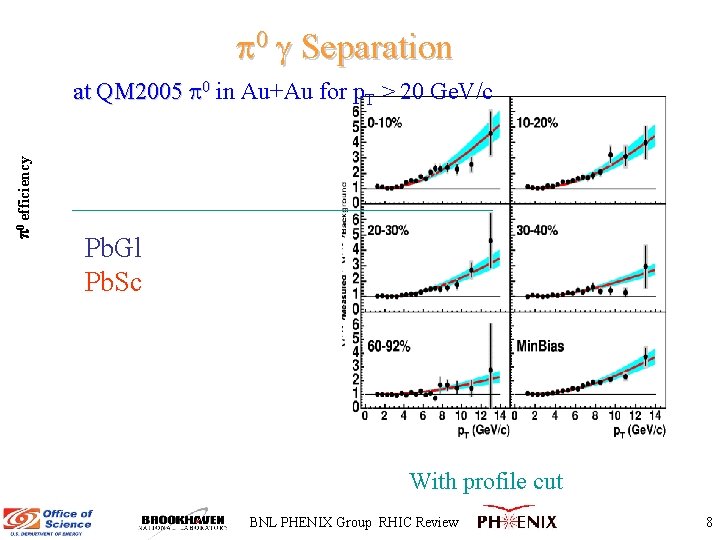
0 Separation 0 efficiency at QM 2005 0 in Au+Au for p. T > 20 Ge. V/c Pb. Gl Pb. Sc With profile cut BNL PHENIX Group RHIC Review 8
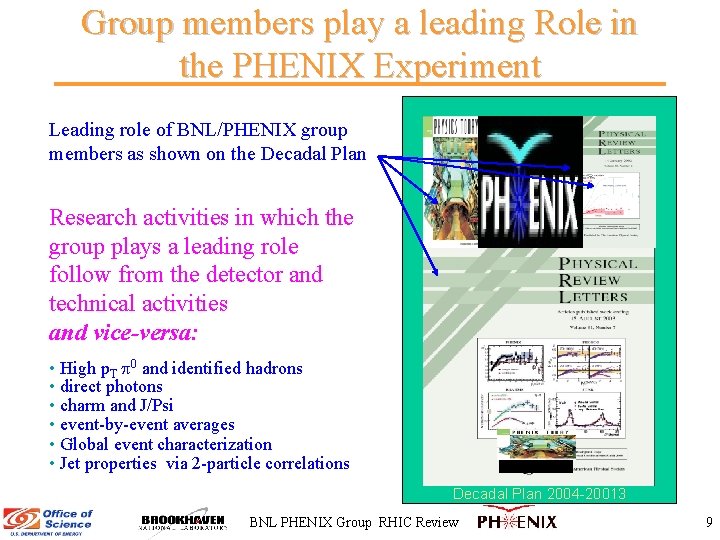
Group members play a leading Role in the PHENIX Experiment Leading role of BNL/PHENIX group members as shown on the Decadal Plan Research activities in which the group plays a leading role follow from the detector and technical activities and vice-versa: • High p. T 0 and identified hadrons • direct photons • charm and J/Psi • event-by-event averages • Global event characterization • Jet properties via 2 -particle correlations Decadal Plan 2004 -20013 BNL PHENIX Group RHIC Review 9
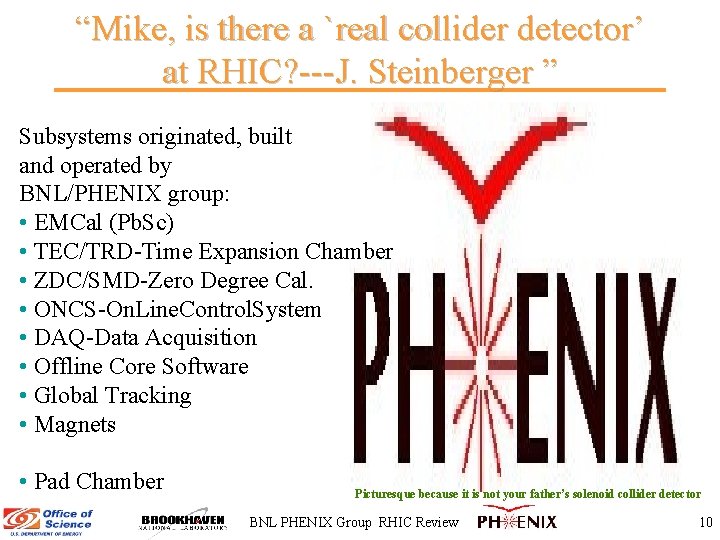
“Mike, is there a `real collider detector’ at RHIC? ---J. Steinberger ” Subsystems originated, built and operated by BNL/PHENIX group: • EMCal (Pb. Sc) • TEC/TRD-Time Expansion Chamber • ZDC/SMD-Zero Degree Cal. • ONCS-On. Line. Control. System • DAQ-Data Acquisition • Offline Core Software • Global Tracking • Magnets • Pad Chamber Picturesque because it is not your father’s solenoid collider detector BNL PHENIX Group RHIC Review 10
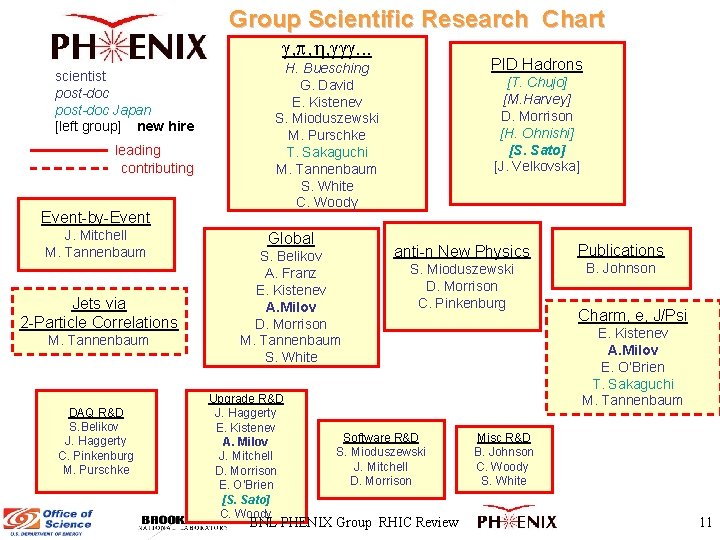
Group Scientific Research Chart , , , . . . scientist post-doc Japan [left group] new hire leading contributing Event-by-Event J. Mitchell M. Tannenbaum Jets via 2 -Particle Correlations M. Tannenbaum DAQ R&D S. Belikov J. Haggerty C. Pinkenburg M. Purschke PID Hadrons H. Buesching G. David E. Kistenev S. Mioduszewski M. Purschke T. Sakaguchi M. Tannenbaum S. White C. Woody Global S. Belikov A. Franz E. Kistenev A. Milov D. Morrison M. Tannenbaum S. White Upgrade R&D J. Haggerty E. Kistenev A. Milov J. Mitchell D. Morrison E. O’Brien [S. Sato] C. Woody [T. Chujo] [M. Harvey] D. Morrison [H. Ohnishi] [S. Sato] [J. Velkovska] anti-n New Physics Publications S. Mioduszewski D. Morrison C. Pinkenburg B. Johnson Software R&D S. Mioduszewski J. Mitchell D. Morrison BNL PHENIX Group RHIC Review Charm, e, J/Psi E. Kistenev A. Milov E. O’Brien T. Sakaguchi M. Tannenbaum Misc R&D B. Johnson C. Woody S. White 11
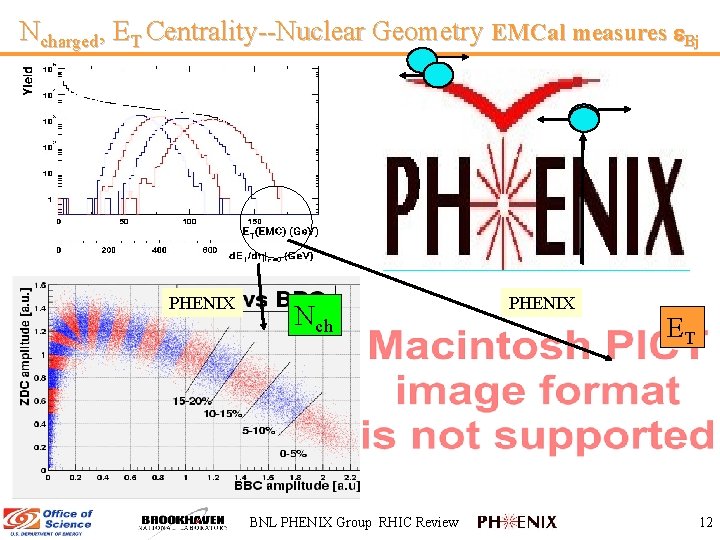
Ncharged, ET Centrality--Nuclear Geometry EMCal measures Bj PHENIX Nch BNL PHENIX Group RHIC Review PHENIX ET 12
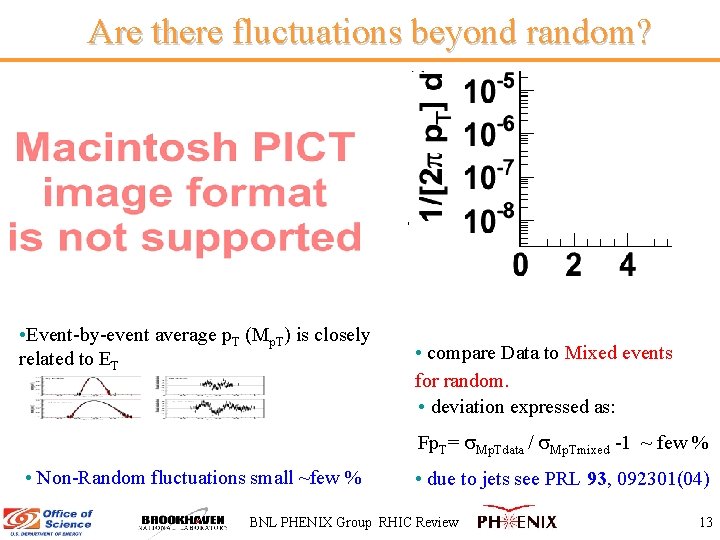
Are there fluctuations beyond random? • Event-by-event average p. T (Mp. T) is closely related to ET • compare Data to Mixed events for random. • deviation expressed as: Fp. T= Mp. Tdata / Mp. Tmixed -1 ~ few % • Non-Random fluctuations small ~few % • due to jets see PRL 93, 092301(04) BNL PHENIX Group RHIC Review 13
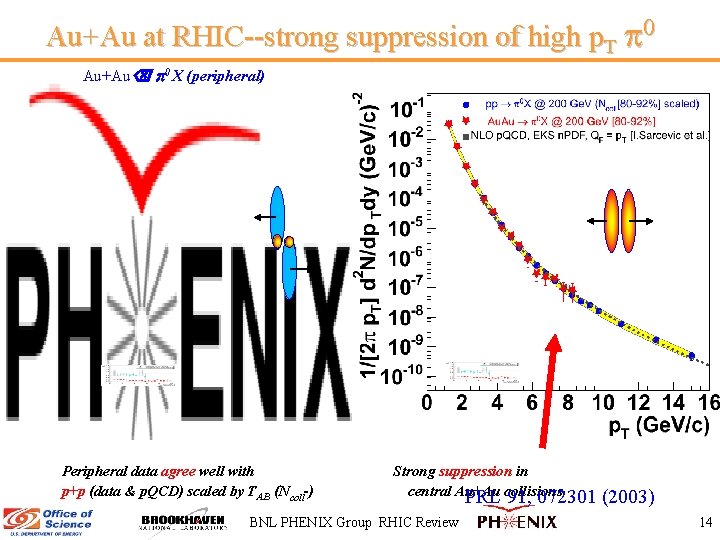
Au+Au at RHIC--strong suppression of high p. T 0 Au+Au p 0 X (peripheral) Au+Au p 0 X (central) Peripheral data agree well with p+p (data & p. QCD) scaled by TAB (Ncoll-) Strong suppression in central Au+Au PRL collisions 91, 072301 BNL PHENIX Group RHIC Review (2003) 14
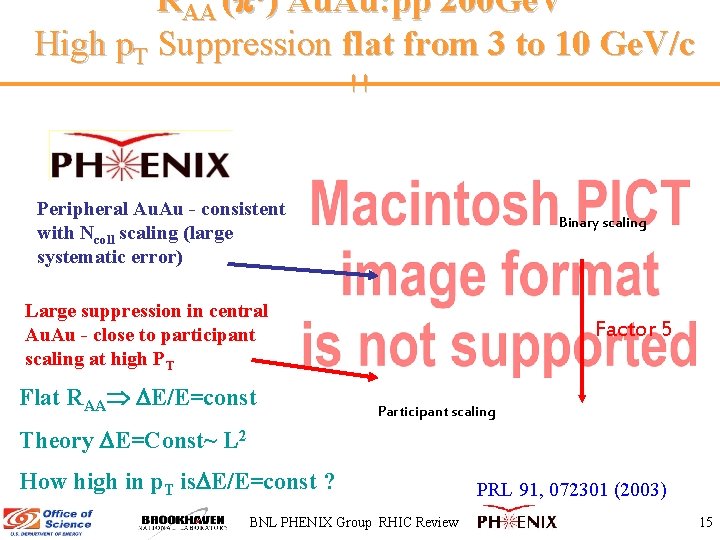
RAA ( 0) Au. Au: pp 200 Ge. V High p. T Suppression flat from 3 to 10 Ge. V/c !! Peripheral Au. Au - consistent with Ncoll scaling (large systematic error) Binary scaling Large suppression in central Au. Au - close to participant scaling at high PT Flat RAA E/E=const Factor 5 Participant scaling Theory E=Const~ L 2 How high in p. T is E/E=const ? BNL PHENIX Group RHIC Review PRL 91, 072301 (2003) 15
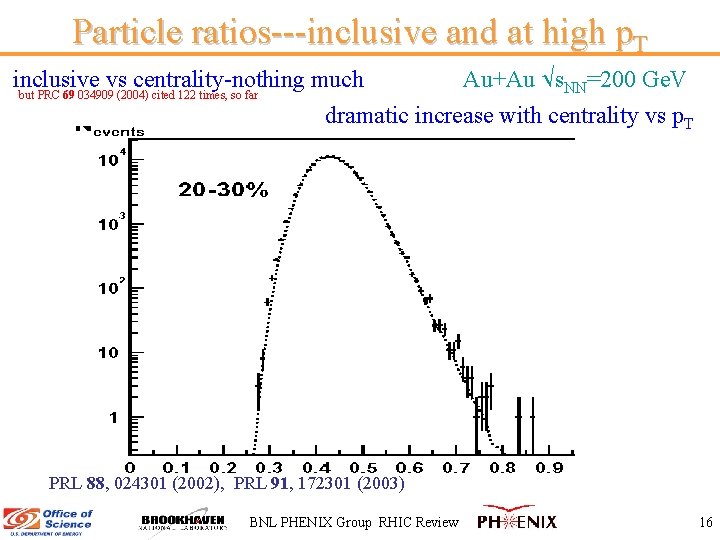
Particle ratios---inclusive and at high p. T inclusive vs centrality-nothing much Au+Au s. NN=200 Ge. V but PRC 69 034909 (2004) cited 122 times, so far dramatic increase with centrality vs p. T PRL 88, 024301 (2002), PRL 91, 172301 (2003) BNL PHENIX Group RHIC Review 16
protons: Ncoll scaling with centrality, radial flow PRL 91, 172301 (2003) protons scale with Ncoll, suppressed: why do we say p are anomalous ? BNL PHENIX Group RHIC Review 17
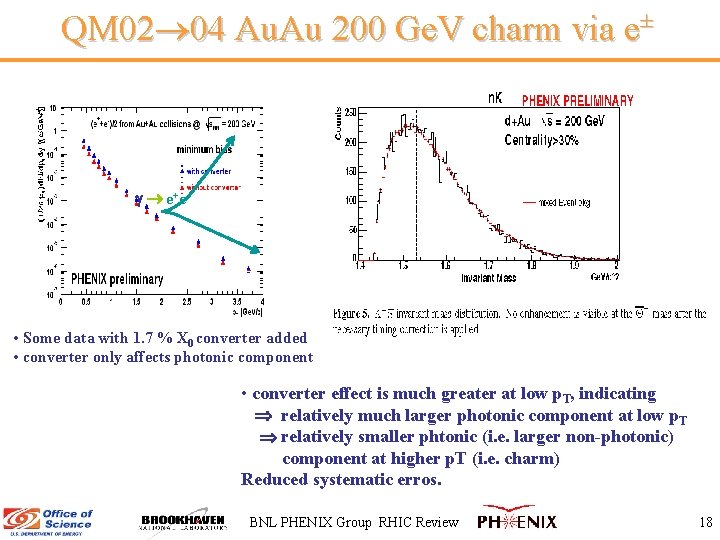
QM 02 04 Au. Au 200 Ge. V charm via e± e+e- • Some data with 1. 7 % X 0 converter added • converter only affects photonic component • converter effect is much greater at low p. T, indicating relatively much larger photonic component at low p. T relatively smaller phtonic (i. e. larger non-photonic) component at higher p. T (i. e. charm) Reduced systematic erros. BNL PHENIX Group RHIC Review 18
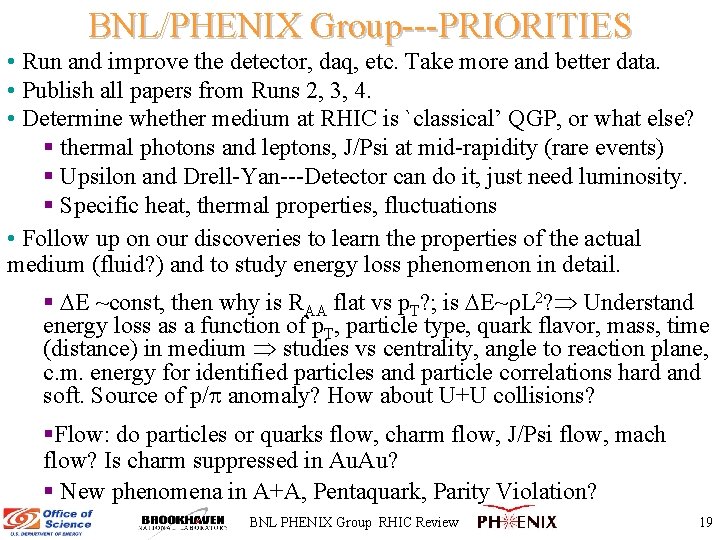
BNL/PHENIX Group---PRIORITIES • Run and improve the detector, daq, etc. Take more and better data. • Publish all papers from Runs 2, 3, 4. • Determine whether medium at RHIC is `classical’ QGP, or what else? § thermal photons and leptons, J/Psi at mid-rapidity (rare events) § Upsilon and Drell-Yan---Detector can do it, just need luminosity. § Specific heat, thermal properties, fluctuations • Follow up on our discoveries to learn the properties of the actual medium (fluid? ) and to study energy loss phenomenon in detail. § E ~const, then why is RAA flat vs p. T? ; is E~ L 2? Understand energy loss as a function of p. T, particle type, quark flavor, mass, time (distance) in medium studies vs centrality, angle to reaction plane, c. m. energy for identified particles and particle correlations hard and soft. Source of p/ anomaly? How about U+U collisions? §Flow: do particles or quarks flow, charm flow, J/Psi flow, mach flow? Is charm suppressed in Au. Au? § New phenomena in A+A, Pentaquark, Parity Violation? BNL PHENIX Group RHIC Review 19
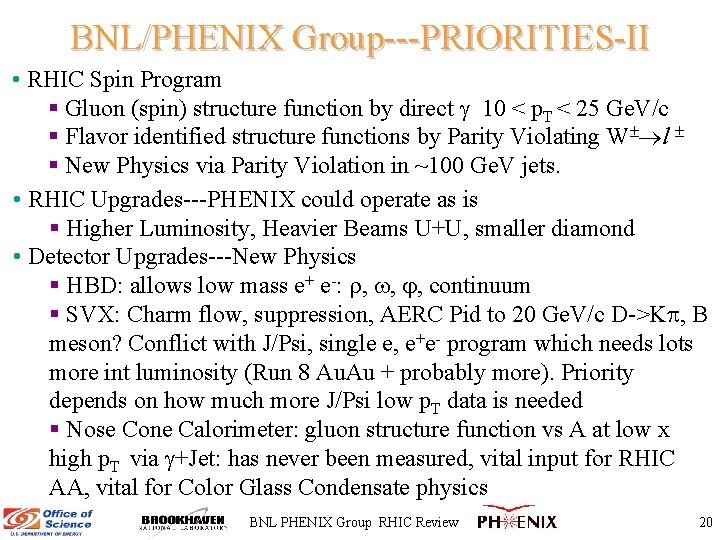
BNL/PHENIX Group---PRIORITIES-II • RHIC Spin Program § Gluon (spin) structure function by direct 10 < p. T < 25 Ge. V/c § Flavor identified structure functions by Parity Violating W l § New Physics via Parity Violation in ~100 Ge. V jets. • RHIC Upgrades---PHENIX could operate as is § Higher Luminosity, Heavier Beams U+U, smaller diamond • Detector Upgrades---New Physics § HBD: allows low mass e+ e-: , , , continuum § SVX: Charm flow, suppression, AERC Pid to 20 Ge. V/c D->K , B meson? Conflict with J/Psi, single e, e+e- program which needs lots more int luminosity (Run 8 Au. Au + probably more). Priority depends on how much more J/Psi low p. T data is needed § Nose Cone Calorimeter: gluon structure function vs A at low x high p. T via +Jet: has never been measured, vital input for RHIC AA, vital for Color Glass Condensate physics BNL PHENIX Group RHIC Review 20

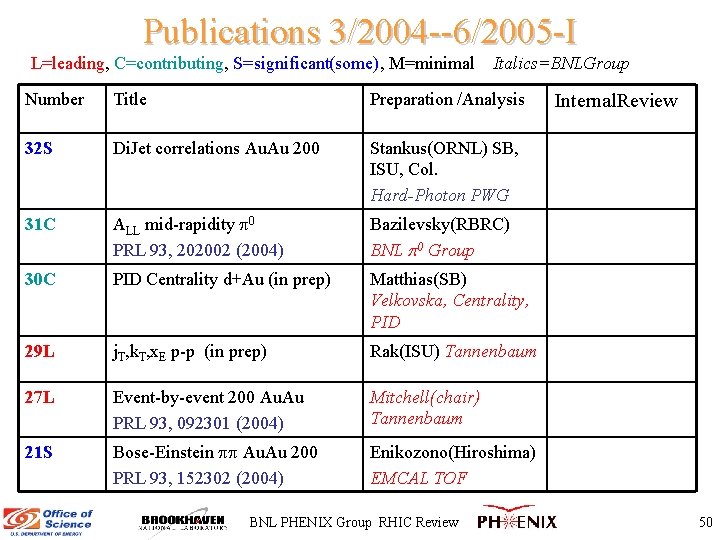
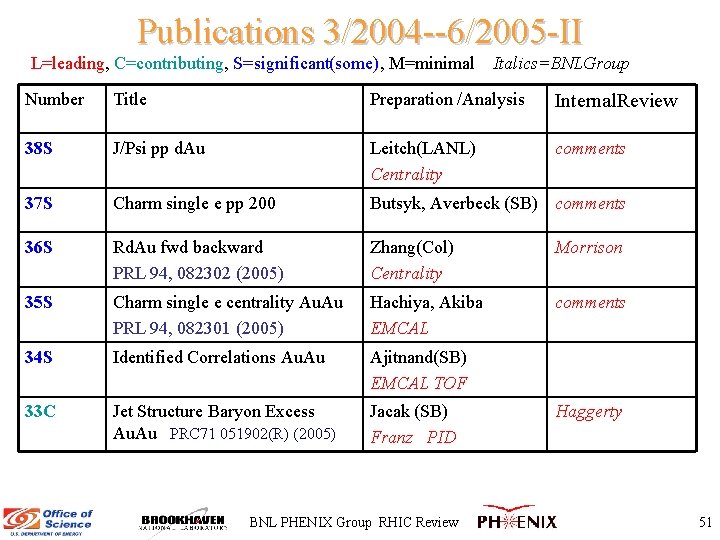
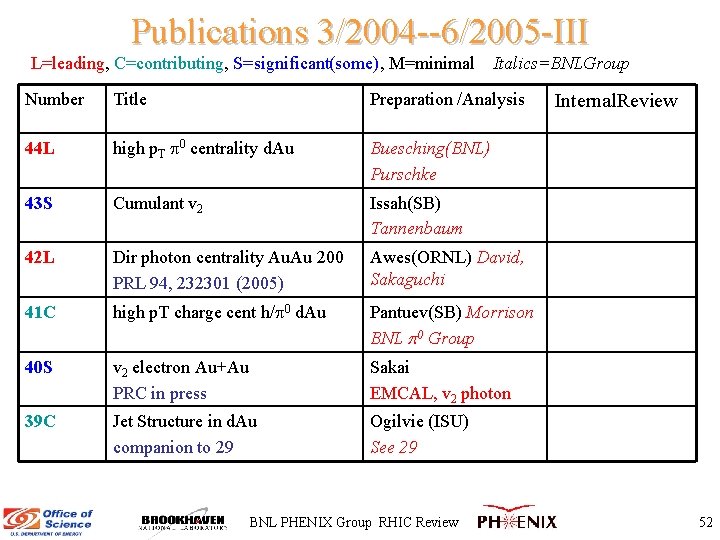
BNL/PHENIX Group Accomplishments & Plans See slides 50 -54 (extra) for group contributions to individual pubs. BNL PHENIX Group RHIC Review 21
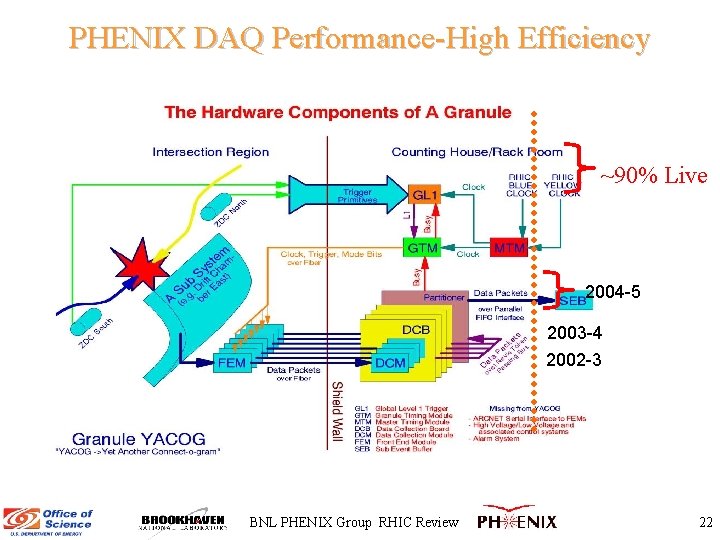
PHENIX DAQ Performance-High Efficiency ~90% Live 2004 -5 2003 -4 2002 -3 BNL PHENIX Group RHIC Review 22
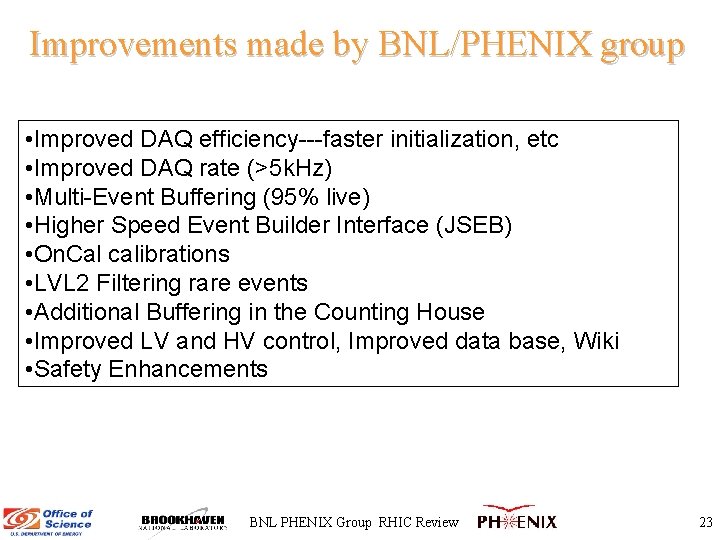
Improvements made by BNL/PHENIX group • Improved DAQ efficiency---faster initialization, etc • Improved DAQ rate (>5 k. Hz) • Multi-Event Buffering (95% live) • Higher Speed Event Builder Interface (JSEB) • On. Cal calibrations • LVL 2 Filtering rare events • Additional Buffering in the Counting House • Improved LV and HV control, Improved data base, Wiki • Safety Enhancements BNL PHENIX Group RHIC Review 23
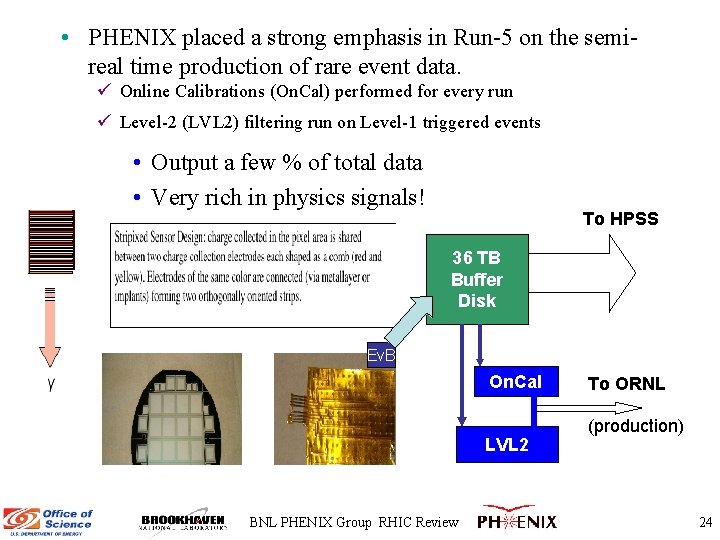
• PHENIX placed a strong emphasis in Run-5 on the semireal time production of rare event data. On. Cal and LVL 2 ü Online Calibrations (On. Cal) performed for every run ü Level-2 (LVL 2) filtering run on Level-1 triggered events • Output a few % of total data • Very rich in physics signals! To HPSS 36 TB Buffer Disk Ev. B On. Cal LVL 2 BNL PHENIX Group RHIC Review To ORNL (production) 24
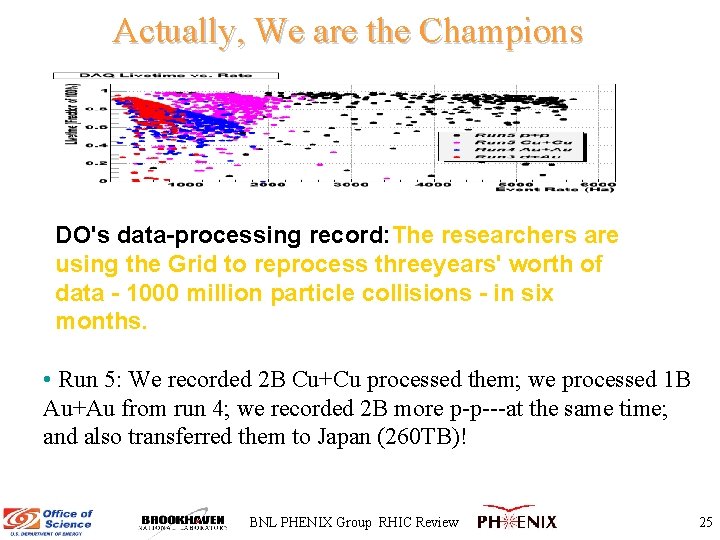
Actually, We are the Champions DO's data-processing record: The researchers are using the Grid to reprocess threeyears' worth of data - 1000 million particle collisions - in six months. • Run 5: We recorded 2 B Cu+Cu processed them; we processed 1 B Au+Au from run 4; we recorded 2 B more p-p---at the same time; and also transferred them to Japan (260 TB)! BNL PHENIX Group RHIC Review 25
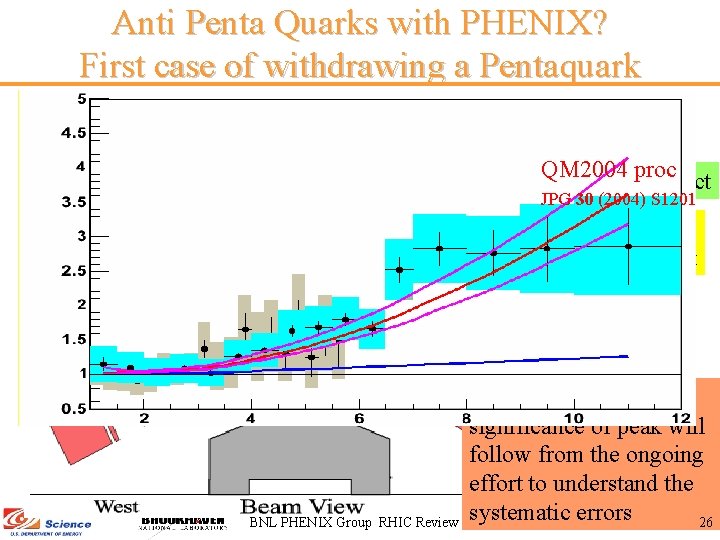
Anti Penta Quarks with PHENIX? First case of withdrawing a Pentaquark - Q n + K - QM 2004 proc Statistically it’s a 4 effect JPG 30 (2004) S 1201 No estimate of systematic Error yet 1. 54 Ge. V =6 2 Me. V BNL PHENIX Group RHIC Review No estimate of Efficiency yet Determining statistical significance of peak will follow from the ongoing effort to understand the systematic errors 26
Centrality & Total Cross Section Belikov, Milov, Morrison, White • Need Cu+Cu 22, 62. 4, 200 Ge. V, Au+Au 62. 4 Ge. V • Precision takes longer • Disagreement between BBC calibration p-p Run 2, 3 • d+Au centrality bias--correlation central arm---BBC • New d+Au cross section measurement from photodisintegration of deuteron • p-p identified charged hadron p. T distributions disagree run 2 and run 3. All resolved but delayed d. Au and p-p publications---coming soon. BNL PHENIX Group RHIC Review 27
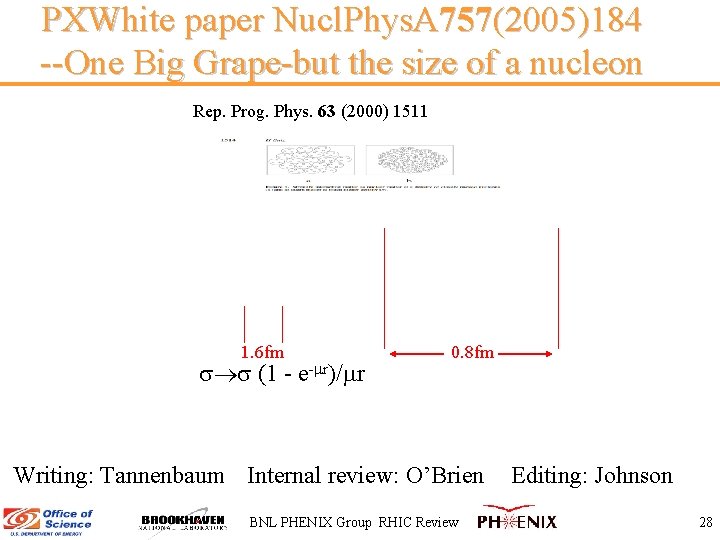
PXWhite paper Nucl. Phys. A 757(2005)184 --One Big Grape-but the size of a nucleon Rep. Prog. Phys. 63 (2000) 1511 1. 6 fm (1 - e- r)/ r 0. 8 fm Writing: Tannenbaum Internal review: O’Brien BNL PHENIX Group RHIC Review Editing: Johnson 28
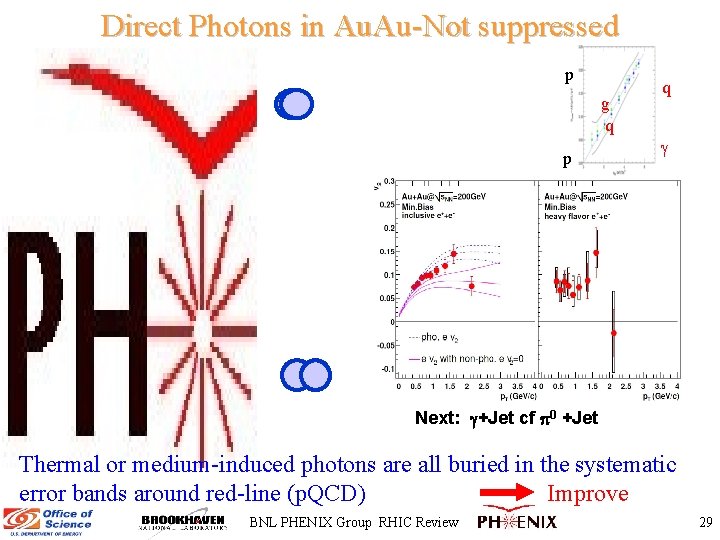
Direct Photons in Au. Au-Not suppressed p g q p q Next: +Jet cf 0 +Jet Thermal or medium-induced photons are all buried in the systematic Improve error bands around red-line (p. QCD) BNL PHENIX Group RHIC Review 29
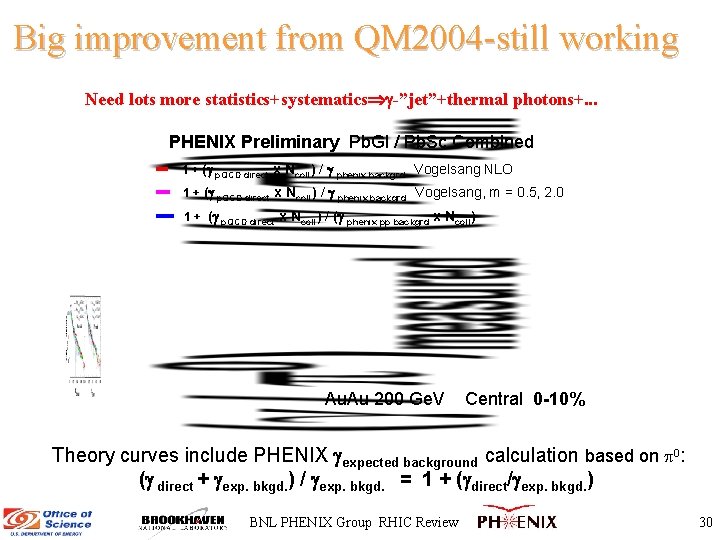
Big improvement from QM 2004 -still working Need lots more statistics+systematics -”jet”+thermal photons+. . . PHENIX Preliminary Pb. Gl / Pb. Sc Combined 1 + ( p. QCD direct x Ncoll) / phenix backgrd Vogelsang NLO 1 + ( p. QCD direct x Ncoll) / phenix backgrd Vogelsang, m = 0. 5, 2. 0 1 + ( p. QCD direct x Ncoll) / ( phenix pp backgrd x Ncoll) Au. Au 200 Ge. V Central 0 -10% Theory curves include PHENIX expected background calculation based on 0: ( direct + exp. bkgd. ) / exp. bkgd. = 1 + ( direct/ exp. bkgd. ) BNL PHENIX Group RHIC Review 30
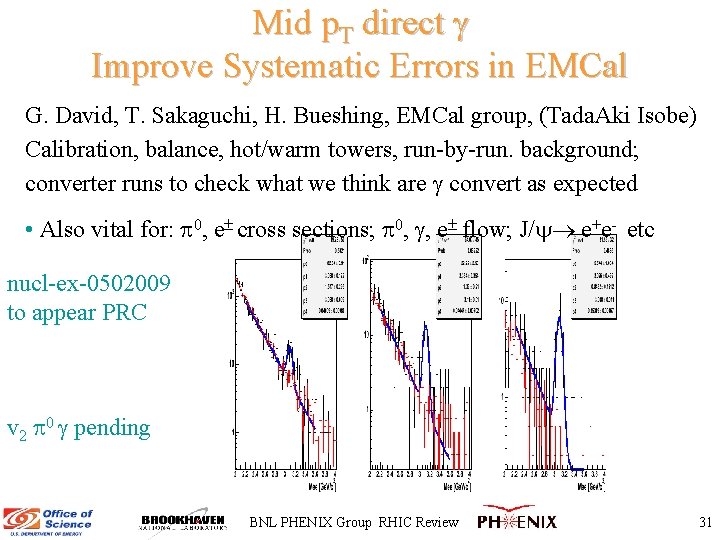
Mid p. T direct Improve Systematic Errors in EMCal G. David, T. Sakaguchi, H. Bueshing, EMCal group, (Tada. Aki Isobe) Calibration, balance, hot/warm towers, run-by-run. background; converter runs to check what we think are convert as expected • Also vital for: 0, e cross sections; 0, , e flow; J/ e+e- etc nucl-ex-0502009 to appear PRC v 2 0 pending BNL PHENIX Group RHIC Review 31
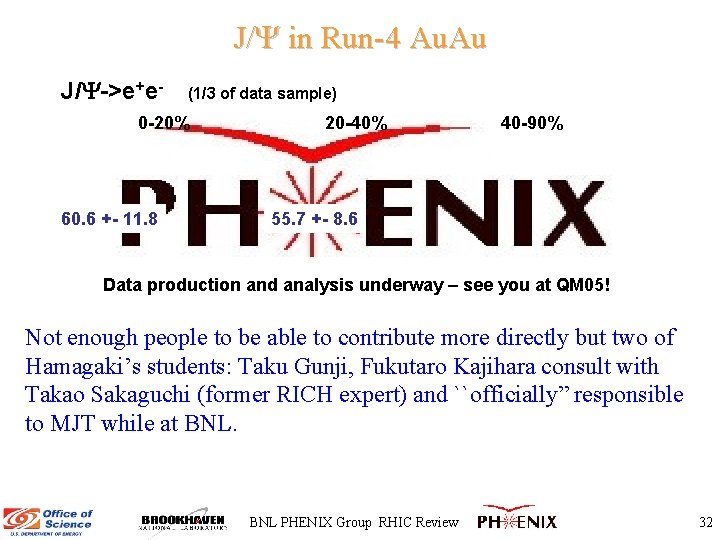
J/Y in Run-4 Au. Au J/Y->e+e- (1/3 of data sample) 0 -20% 60. 6 +- 11. 8 20 -40% 40 -90% 55. 7 +- 8. 6 Data production and analysis underway – see you at QM 05! Not enough people to be able to contribute more directly but two of Hamagaki’s students: Taku Gunji, Fukutaro Kajihara consult with Takao Sakaguchi (former RICH expert) and ``officially” responsible to MJT while at BNL PHENIX Group RHIC Review 32
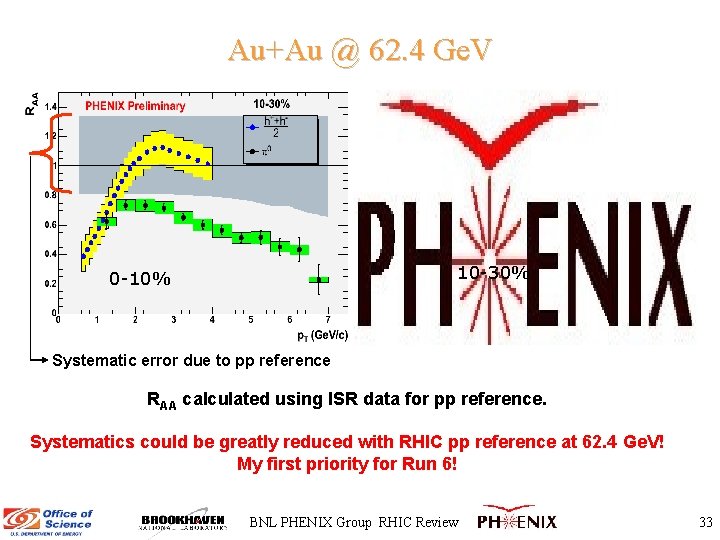
Au+Au @ 62. 4 Ge. V 10 -30% 0 -10% Systematic error due to pp reference RAA calculated using ISR data for pp reference. Systematics could be greatly reduced with RHIC pp reference at 62. 4 Ge. V! My first priority for Run 6! BNL PHENIX Group RHIC Review 33
Plot E(p. T)/p. T=Sloss vs centrality Bj(Npart) PHENIX preliminary ! BNL PHENIX Group RHIC Review 34
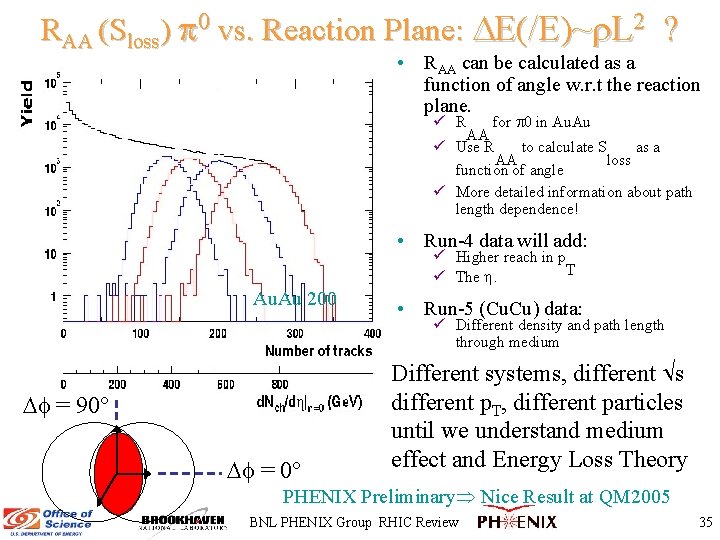
RAA (Sloss) 0 vs. Reaction Plane: E(/E)~ L 2 ? • RAA can be calculated as a function of angle w. r. t the reaction plane. for 0 in Au. Au AA ü Use R to calculate S as a AA loss function of angle ü More detailed information about path length dependence! ü R • Run-4 data will add: ü Higher reach in p T ü The . Au. Au 200 • Run-5 (Cu. Cu) data: ü Different density and path length through medium f = 90° f = 0° Different systems, different s different p. T, different particles until we understand medium effect and Energy Loss Theory PHENIX Preliminary Nice Result at QM 2005 BNL PHENIX Group RHIC Review 35
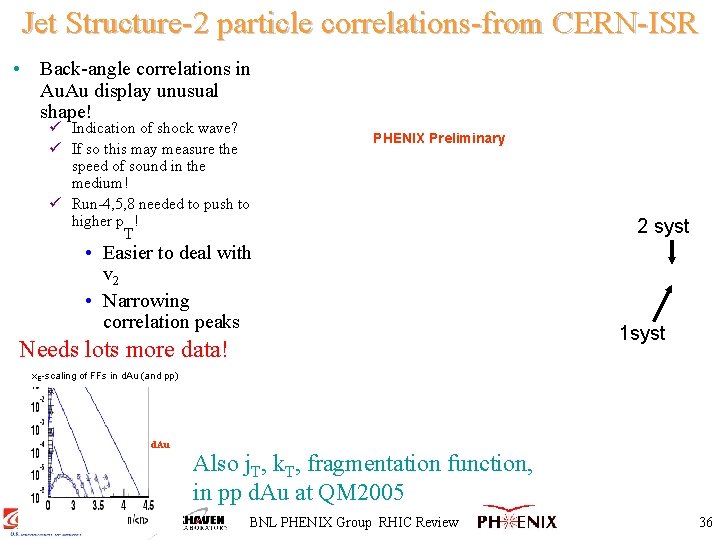
Jet Structure-2 particle correlations-from CERN-ISR • Back-angle correlations in Au. Au display unusual shape! ü Indication of shock wave? ü If so this may measure the speed of sound in the medium! ü Run-4, 5, 8 needed to push to higher p ! T PHENIX Preliminary • Easier to deal with v 2 • Narrowing correlation peaks Needs lots more data! 2 syst 1 syst x. E-scaling of FFs in d. Au (and pp) d. Au Also j. T, k. T, fragmentation function, in pp d. Au at QM 2005 BNL PHENIX Group RHIC Review 36
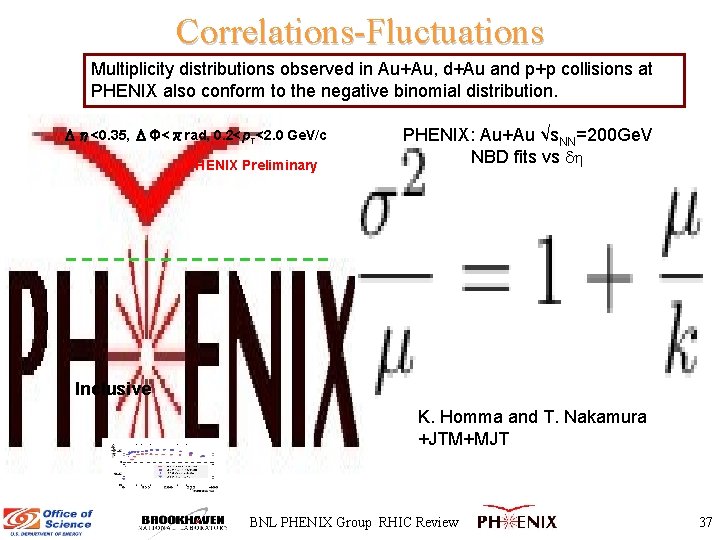
Correlations-Fluctuations Multiplicity distributions observed in Au+Au, d+Au and p+p collisions at PHENIX also conform to the negative binomial distribution. Δη<0. 35, ΔФ<πrad, 0. 2<p. T<2. 0 Ge. V/c PHENIX Preliminary PHENIX: Au+Au √s. NN=200 Ge. V NBD fits vs Inclusive K. Homma and T. Nakamura +JTM+MJT BNL PHENIX Group RHIC Review 37
LHC-Atlas [BNL-HEP is US center] • My main job is to keep everybody not thinking about LHC so as to discover everything there is to discover at RHIC • Our group’s contribution is 25% of Sebastian White § ZDC § Ultra-Peripheral (Coulomb)-``UPC” physics § Special travel budget from Physics Dept funds • Expect J/Psi measurement in UPC from PHENIX at QM 2005 or soon afterwards. BNL PHENIX Group RHIC Review 38
Future Plans-Same for Group and Collaboration BNL PHENIX Group RHIC Review 39
ISSUE(S) $ BNL PHENIX Group RHIC Review 40
Issue-Manpower and current support • Constant $$$ Flat-Flat budgets from FY 02 -FY 05 can not continue without seriously impacting Group Research (and Operations) • Increased level of effort would have the benefit of allowing the hiring of 1 or 2 more scientists or post docs which will allow the group to better keep up with the constant stream of data from RHIC while being able to devote some time to maintain their skills, attend seminars and keep up with other developments in the field • Moving support from Research to Operations can only be a one time correction. As new components are added to PHENIX money for support must increase. Support received by BNL/PHENIX group must be at least at constant effort (rather than constant dollars---flat). BNL PHENIX Group RHIC Review 41
CONCLUSION • The BNL PHENIX Group has demonstrated creativity as well as the ability to make high quality measurements of systems ranging from p-p to Au+Au central collisions in the PHENIX detector. • We wish to continue these successes in order to characterize the hot medium produced at RHIC and to measure its properties using the probes we have successfully demonstrated and mastered (and probably new ones. . . ) • We look forward to many more years of great results and discoveries which we will be able to publish as well as to present at national and international meetings. • Our staff is highly recruited for faculty positions. We would like to be able to maintain or increase (+2 FTE) the present group size. BNL PHENIX Group RHIC Review 42
Extra BNL PHENIX Group RHIC Review 43
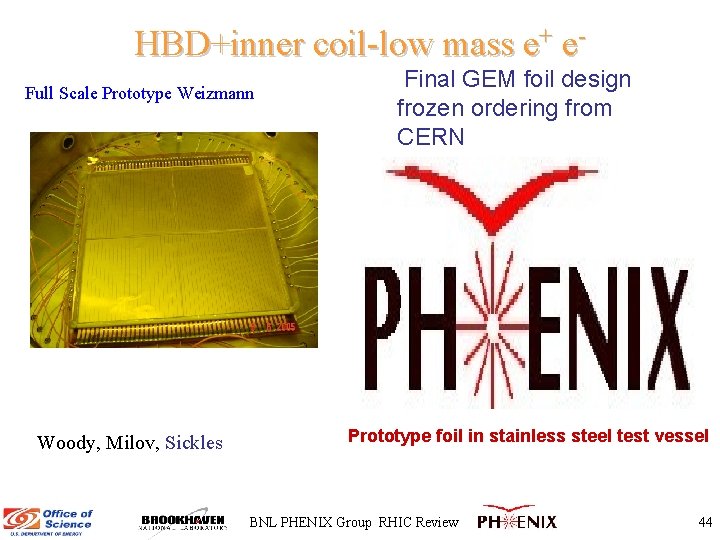
HBD+inner coil-low mass e+ e. Full Scale Prototype Weizmann Woody, Milov, Sickles Final GEM foil design frozen ordering from CERN Prototype foil in stainless steel test vessel BNL PHENIX Group RHIC Review 44
NCC-Prototype Kistenev has assembled a group of new collaborators from Czech republic and Russia---experts in Silicon BNL PHENIX Group RHIC Review 45
Leadership Positions-Goal ~25% Rhic-II Science Co-Convenors: S. Mioduszewski High p. T, David Electromagnetic Probes. G. PHENIX Collaboration Detector Council: O’Brien (head), Haggerty, Morrison, Franz (2), Purschke, White PHENIX Collaboration Executive Council: O’Brien, Morrison, former, Tannenbaum, White PHENIX Collaboration Management Group: O’Brien (OPS mgr) Coordinators: Haggerty (DAQ), Morrison (Computing), Johnson (Office, Pubs, IB-EC(secy)), Pinkenburg (Analysis software Mgr), PHENIX Collaboration Physics Working Group Convenors : Buesching, Milov. Former: David, Franz, Mioduszewski, Mitchell, Morrison, Tannenbaum, Velkovska, White QM 2005 PHENIX Plenary talk (1/2) Henner Buesching BNL PHENIX Group RHIC Review 46
Students Raul Armendariz (New Mexico State Univ): Mitchell, Tannenbaum Cesar da Silva (Sao Paulo): Franz (TEC/TRD) Robert Vertesi, Jozsef Imrek, Peter Tarjan (Debrecen): David Tada. Aki Isobe (CNS): David, Sakaguchi Taku Gunji, Fukutaro Kajihara (CNS): Tannenbaum, Sakaguchi PHENIX Focus--weekly lectures to students on PHENIX experiment and physics: Buesching. u. BNL-David-reviews PHENIX physics papers with on-site students. ASAP--Mitchell advisory board BNL PHENIX Group RHIC Review 47
Publications, Talks, Service FY 2004 BNL PHENIX Group RHIC Review 48

Publications, Talks, Service FY 2004 -II BNL PHENIX Group RHIC Review 49
Publications 3/2004 --6/2005 -I L=leading, C=contributing, S=significant(some), M=minimal Italics=BNLGroup Number Title Preparation /Analysis 32 S Di. Jet correlations Au. Au 200 Stankus(ORNL) SB, ISU, Col. Hard-Photon PWG 31 C ALL mid-rapidity 0 PRL 93, 202002 (2004) Bazilevsky(RBRC) BNL 0 Group 30 C PID Centrality d+Au (in prep) Matthias(SB) Velkovska, Centrality, PID 29 L j. T, k. T, x. E p-p (in prep) Rak(ISU) Tannenbaum 27 L Event-by-event 200 Au. Au PRL 93, 092301 (2004) Mitchell(chair) Tannenbaum 21 S Bose-Einstein Au. Au 200 PRL 93, 152302 (2004) Enikozono(Hiroshima) EMCAL TOF BNL PHENIX Group RHIC Review Internal. Review 50
Publications 3/2004 --6/2005 -II L=leading, C=contributing, S=significant(some), M=minimal Italics=BNLGroup Number Title Preparation /Analysis Internal. Review 38 S J/Psi pp d. Au Leitch(LANL) Centrality comments 37 S Charm single e pp 200 Butsyk, Averbeck (SB) comments 36 S Rd. Au fwd backward PRL 94, 082302 (2005) Zhang(Col) Centrality Morrison 35 S Charm single e centrality Au. Au PRL 94, 082301 (2005) Hachiya, Akiba EMCAL comments 34 S Identified Correlations Au. Au Ajitnand(SB) EMCAL TOF 33 C Jet Structure Baryon Excess Au. Au PRC 71 051902(R) (2005) Jacak (SB) Franz PID BNL PHENIX Group RHIC Review Haggerty 51
Publications 3/2004 --6/2005 -III L=leading, C=contributing, S=significant(some), M=minimal Italics=BNLGroup Number Title Preparation /Analysis 44 L high p. T 0 centrality d. Au Buesching(BNL) Purschke 43 S Cumulant v 2 Issah(SB) Tannenbaum 42 L Dir photon centrality Au. Au 200 PRL 94, 232301 (2005) Awes(ORNL) David, Sakaguchi 41 C high p. T charge cent h/ 0 d. Au Pantuev(SB) Morrison BNL 0 Group 40 S v 2 electron Au+Au PRC in press Sakai EMCAL, v 2 photon 39 C Jet Structure in d. Au companion to 29 Ogilvie (ISU) See 29 BNL PHENIX Group RHIC Review Internal. Review 52
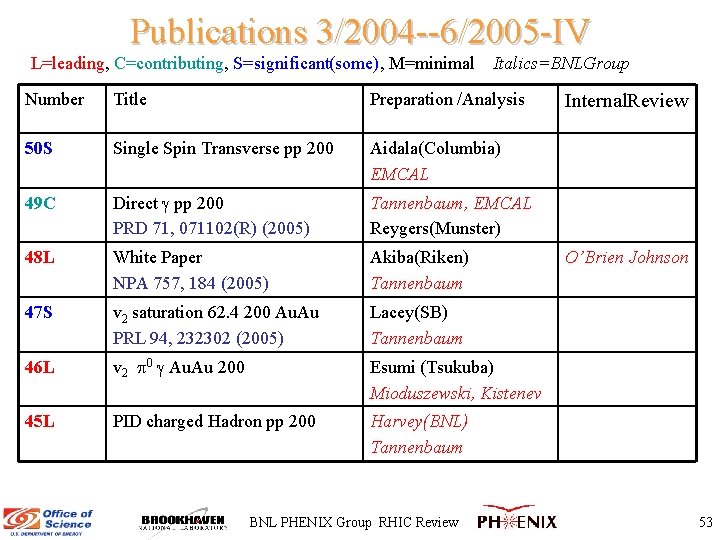
Publications 3/2004 --6/2005 -IV L=leading, C=contributing, S=significant(some), M=minimal Italics=BNLGroup Number Title Preparation /Analysis 50 S Single Spin Transverse pp 200 Aidala(Columbia) EMCAL 49 C Direct pp 200 PRD 71, 071102(R) (2005) Tannenbaum, EMCAL Reygers(Munster) 48 L White Paper NPA 757, 184 (2005) Akiba(Riken) Tannenbaum 47 S v 2 saturation 62. 4 200 Au. Au PRL 94, 232302 (2005) Lacey(SB) Tannenbaum 46 L v 2 0 Au. Au 200 Esumi (Tsukuba) Mioduszewski, Kistenev 45 L PID charged Hadron pp 200 Harvey(BNL) Tannenbaum BNL PHENIX Group RHIC Review Internal. Review O’Brien Johnson 53
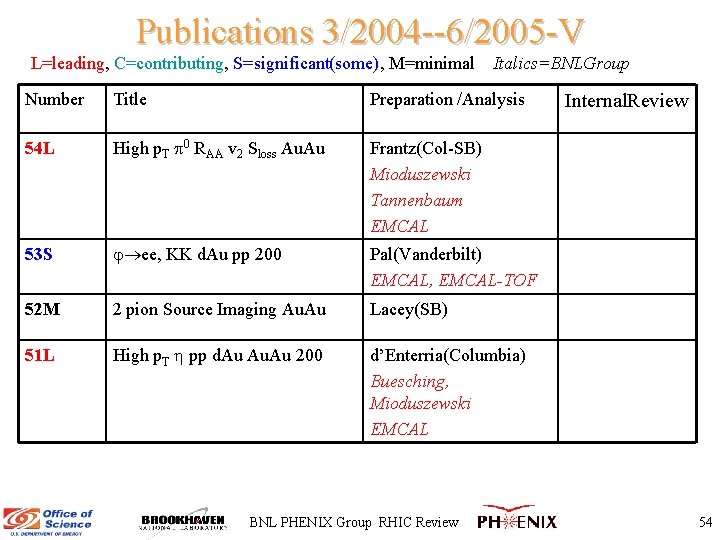
Publications 3/2004 --6/2005 -V L=leading, C=contributing, S=significant(some), M=minimal Italics=BNLGroup Number Title Preparation /Analysis 54 L High p. T 0 RAA v 2 Sloss Au. Au Frantz(Col-SB) Mioduszewski Tannenbaum EMCAL 53 S ee, KK d. Au pp 200 Pal(Vanderbilt) EMCAL, EMCAL-TOF 52 M 2 pion Source Imaging Au. Au Lacey(SB) 51 L High p. T pp d. Au Au. Au 200 d’Enterria(Columbia) Buesching, Mioduszewski EMCAL BNL PHENIX Group RHIC Review Internal. Review 54
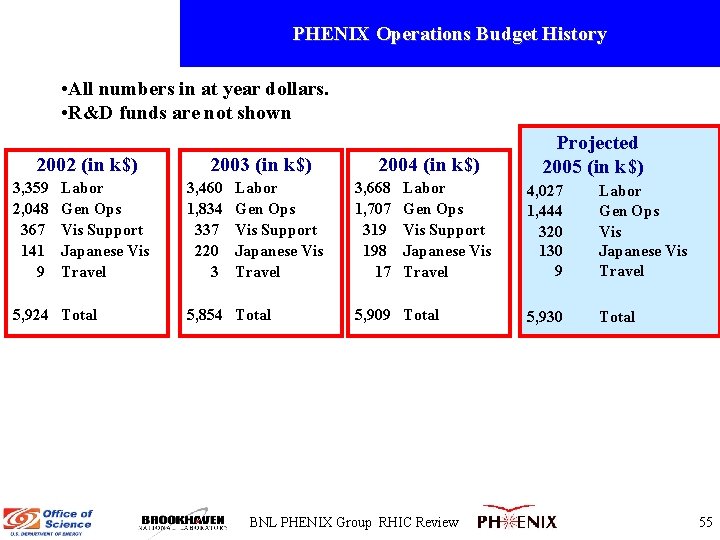
PHENIX Operations Budget History • All numbers in at year dollars. • R&D funds are not shown 2002 (in k$) 3, 359 2, 048 367 141 9 Labor Gen Ops Vis Support Japanese Vis Travel 5, 924 Total 2003 (in k$) 3, 460 1, 834 337 220 3 Labor Gen Ops Vis Support Japanese Vis Travel 5, 854 Total 2004 (in k$) 3, 668 1, 707 319 198 17 Labor Gen Ops Vis Support Japanese Vis Travel 5, 909 Total BNL PHENIX Group RHIC Review Projected 2005 (in k$) 4, 027 1, 444 320 130 9 Labor Gen Ops Vis Japanese Vis Travel 5, 930 Total 55
- Slides: 55