1 Anticrisis State Policy in Russia Vera Kononova
- Slides: 21
1 Anti-crisis State Policy in Russia Vera Kononova Institute for Complex Strategic Studies Lomonosov Moscow State University Business School December 4 th, 2017 Lomonosov Moscow State University Business School
Outline 1. The Dilemma of State Policy in Russia • The main goals adopted by the Government of Russia and the Central Bank of Russia in 2014 -2017 2. Policy of the Central Bank of Russia • Monetary tightening and banking regulations • Exchange rate: ruble is strengthening again 3. Policy of the Government of Russia • Industrial policy measures (interest rate subsidies, low -tax zones) • Attempts to develop small business • Budget deficit as a limit on Government initiatives Lomonosov Moscow State University Business School
1. Dilemma of the State Policy Lomonosov Moscow State University Business School
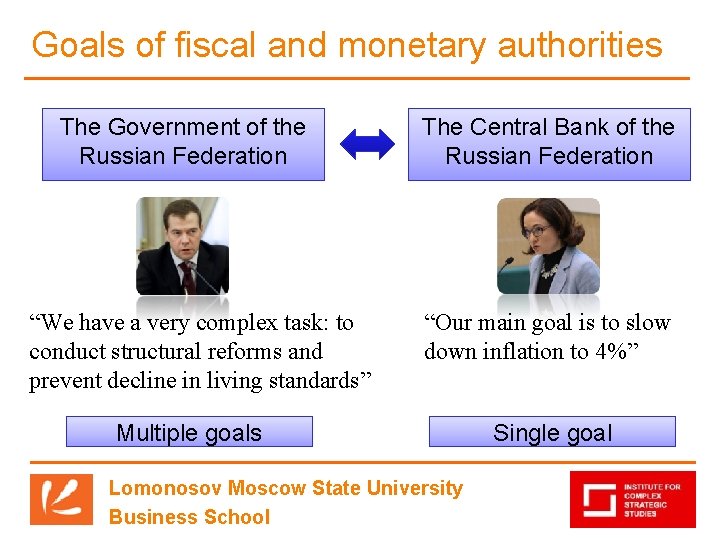
Goals of fiscal and monetary authorities The Government of the Russian Federation “We have a very complex task: to conduct structural reforms and prevent decline in living standards” The Central Bank of the Russian Federation “Our main goal is to slow down inflation to 4%” Multiple goals Lomonosov Moscow State University Business School Single goal
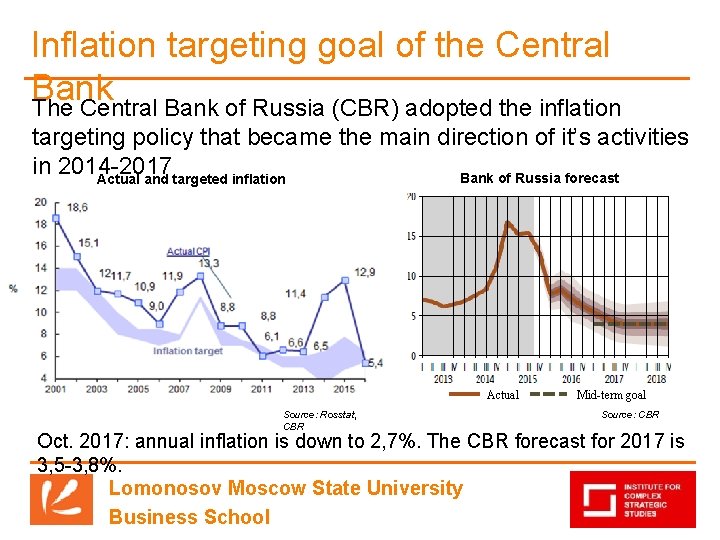
Inflation targeting goal of the Central Bank The Central Bank of Russia (CBR) adopted the inflation targeting policy that became the main direction of it’s activities in 2014 -2017 Bank of Russia forecast Actual and targeted inflation Actual Source: Rosstat, CBR Mid-term goal Source: CBR Oct. 2017: annual inflation is down to 2, 7%. The CBR forecast for 2017 is 3, 5 -3, 8%. Lomonosov Moscow State University Business School
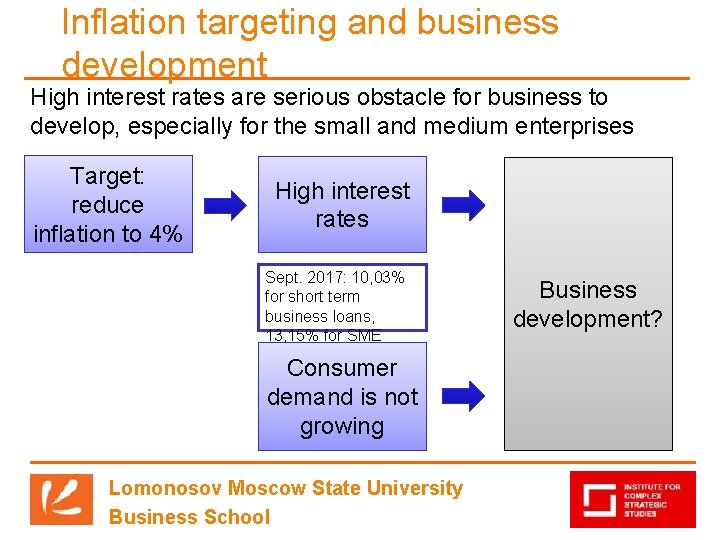
Inflation targeting and business development High interest rates are serious obstacle for business to develop, especially for the small and medium enterprises Target: reduce inflation to 4% High interest rates Sept. 2017: 10, 03% for short term business loans, 13, 15% for SME Consumer demand is not growing Lomonosov Moscow State University Business School Business development?
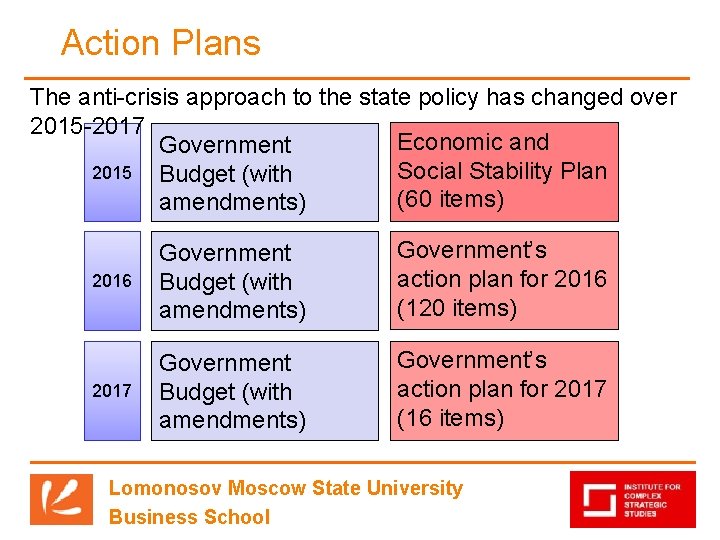
Action Plans The anti-crisis approach to the state policy has changed over 2015 -2017 Economic and Government Social Stability Plan 2015 Budget (with (60 items) amendments) 2016 Government Budget (with amendments) Government’s action plan for 2016 (120 items) 2017 Government Budget (with amendments) Government’s action plan for 2017 (16 items) Lomonosov Moscow State University Business School
2. Policy of the Central Bank of Russia Lomonosov Moscow State University Business School
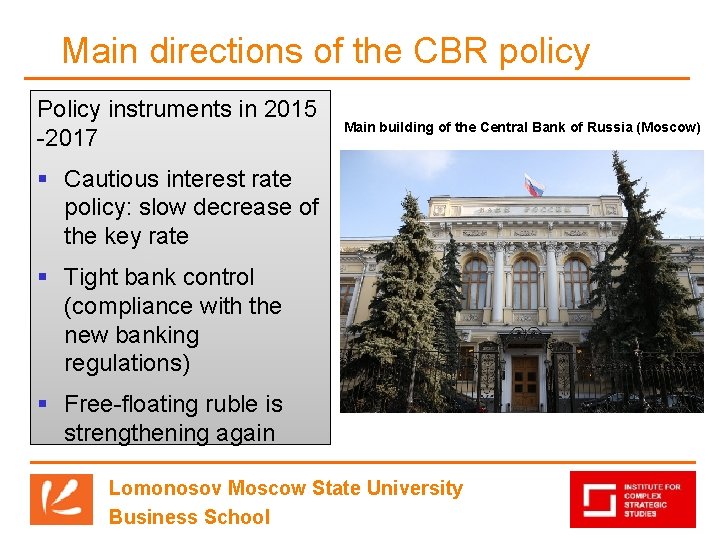
Main directions of the CBR policy Policy instruments in 2015 -2017 Main building of the Central Bank of Russia (Moscow) § Cautious interest rate policy: slow decrease of the key rate § Tight bank control (compliance with the new banking regulations) § Free-floating ruble is strengthening again Lomonosov Moscow State University Business School
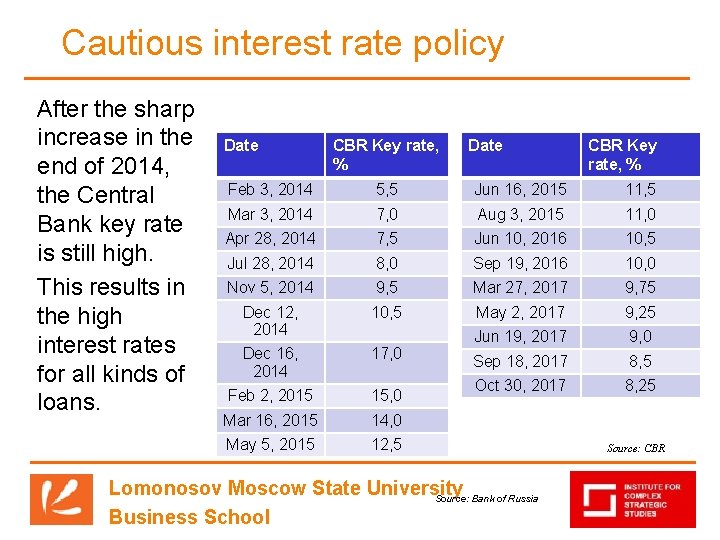
Cautious interest rate policy After the sharp increase in the end of 2014, the Central Bank key rate is still high. This results in the high interest rates for all kinds of loans. Date CBR Key rate, % Feb 3, 2014 5, 5 Jun 16, 2015 11, 5 Mar 3, 2014 7, 0 Aug 3, 2015 11, 0 Apr 28, 2014 7, 5 Jun 10, 2016 10, 5 Jul 28, 2014 8, 0 Sep 19, 2016 10, 0 Nov 5, 2014 9, 5 Mar 27, 2017 9, 75 Dec 12, 2014 10, 5 May 2, 2017 9, 25 Dec 16, 2014 17, 0 Jun 19, 2017 9, 0 Sep 18, 2017 8, 5 Feb 2, 2015 15, 0 Oct 30, 2017 8, 25 Mar 16, 2015 14, 0 May 5, 2015 12, 5 Lomonosov Moscow State University Source: Bank of Russia Business School Source: CBR
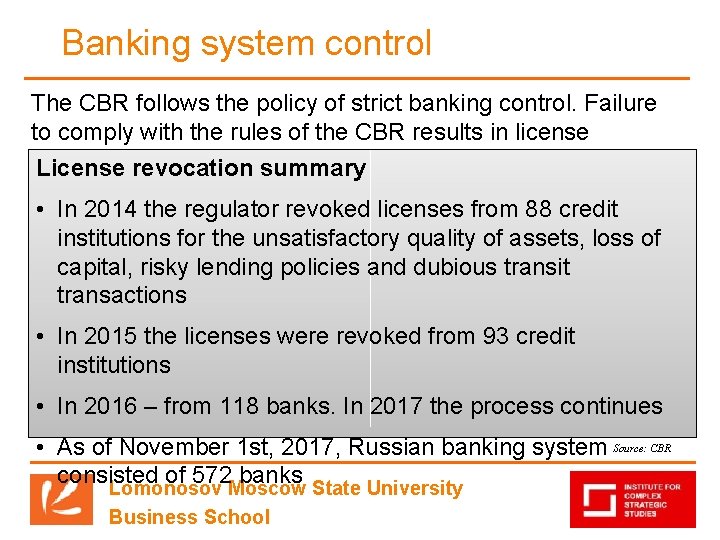
Banking system control The CBR follows the policy of strict banking control. Failure to comply with the rules of the CBR results in license revocation License revocation summary • In 2014 the regulator revoked licenses from 88 credit institutions for the unsatisfactory quality of assets, loss of capital, risky lending policies and dubious transit transactions • In 2015 the licenses were revoked from 93 credit institutions • In 2016 – from 118 banks. In 2017 the process continues • As of November 1 st, 2017, Russian banking system Source: CBR consisted of 572 banks Lomonosov Moscow State University Business School
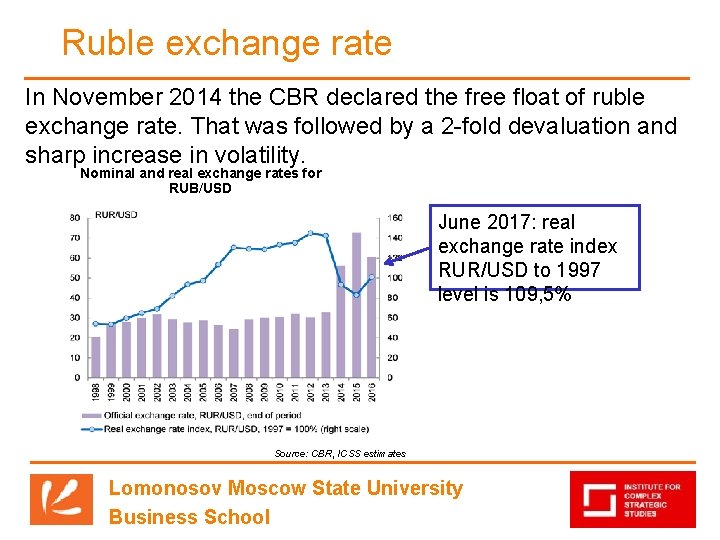
Ruble exchange rate In November 2014 the CBR declared the free float of ruble exchange rate. That was followed by a 2 -fold devaluation and sharp increase in volatility. Nominal and real exchange rates for RUB/USD June 2017: real exchange rate index RUR/USD to 1997 level is 109, 5% Source: CBR, ICSS estimates Lomonosov Moscow State University Business School
3. Policy of the Government of Russia Lomonosov Moscow State University Business School
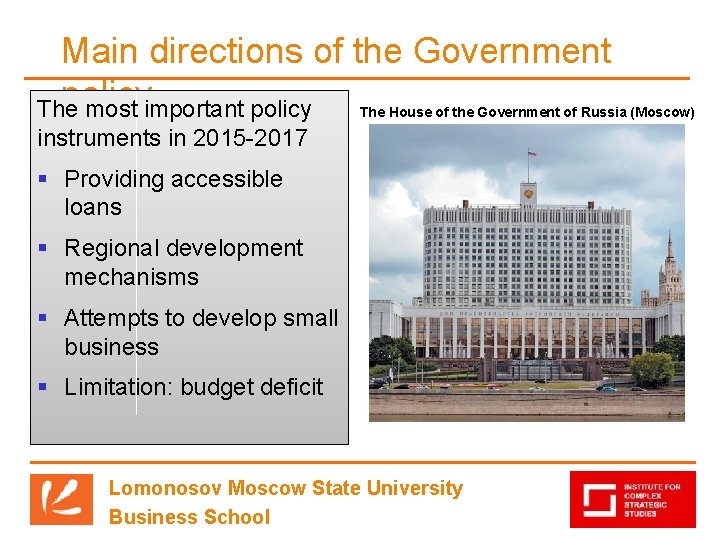
Main directions of the Government policy The most important policy The House of the Government of Russia (Moscow) instruments in 2015 -2017 § Providing accessible loans § Regional development mechanisms § Attempts to develop small business § Limitation: budget deficit Lomonosov Moscow State University Business School
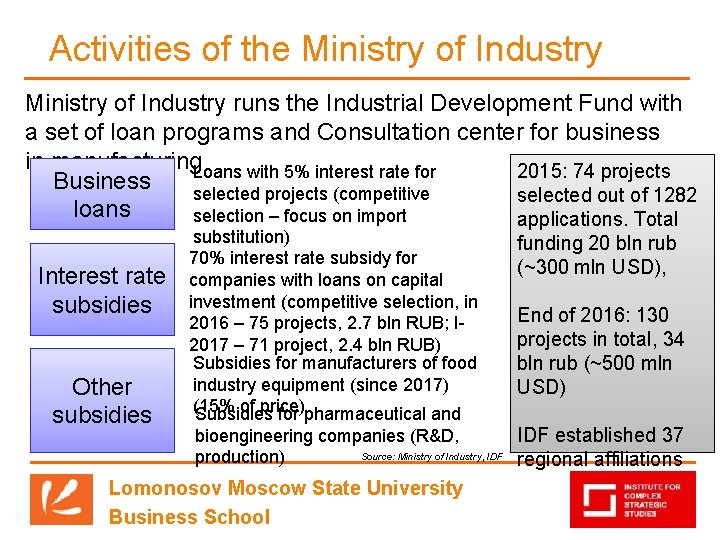
Activities of the Ministry of Industry runs the Industrial Development Fund with a set of loan programs and Consultation center for business in manufacturing. Loans with 5% interest rate for 2015: 74 projects Business selected projects (competitive selected out of 1282 loans selection – focus on import applications. Total Interest rate subsidies Other subsidies substitution) 70% interest rate subsidy for companies with loans on capital investment (competitive selection, in 2016 – 75 projects, 2. 7 bln RUB; I 2017 – 71 project, 2. 4 bln RUB) Subsidies for manufacturers of food industry equipment (since 2017) (15% of price) Subsidies for pharmaceutical and funding 20 bln rub (~300 mln USD), End of 2016: 130 projects in total, 34 bln rub (~500 mln USD) bioengineering companies (R&D, IDF established 37 Source: Ministry of Industry, IDF production) regional affiliations Lomonosov Moscow State University Business School
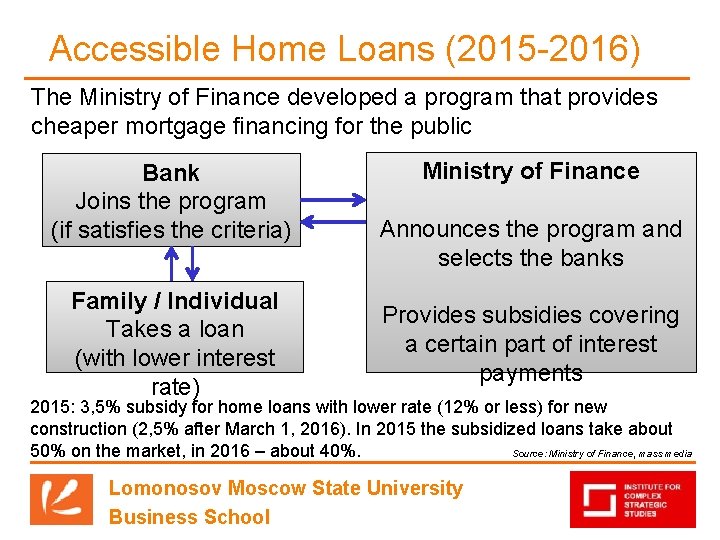
Accessible Home Loans (2015 -2016) The Ministry of Finance developed a program that provides cheaper mortgage financing for the public Bank Joins the program (if satisfies the criteria) Family / Individual Takes a loan (with lower interest rate) Ministry of Finance Announces the program and selects the banks Provides subsidies covering a certain part of interest payments 2015: 3, 5% subsidy for home loans with lower rate (12% or less) for new construction (2, 5% after March 1, 2016). In 2015 the subsidized loans take about Source: Ministry of Finance, mass media 50% on the market, in 2016 – about 40%. Lomonosov Moscow State University Business School
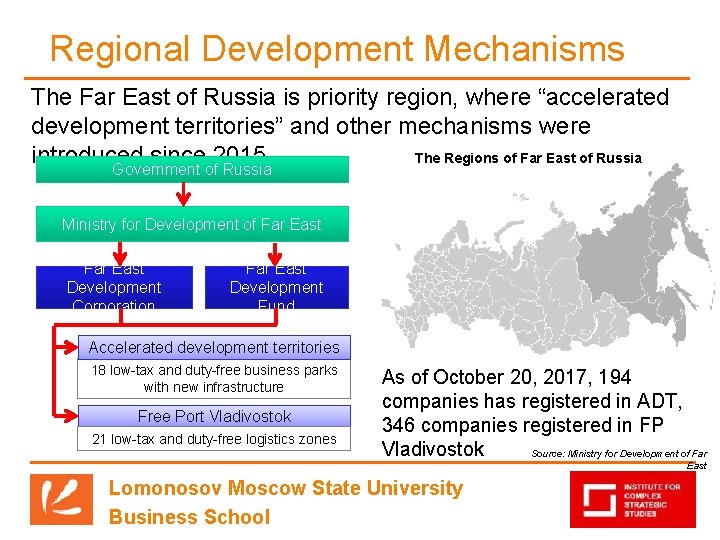
Regional Development Mechanisms The Far East of Russia is priority region, where “accelerated development territories” and other mechanisms were introduced since 2015 The Regions of Far East of Russia Government of Russia Ministry for Development of Far East Development Corporation Far East Development Fund Accelerated development territories 18 low-tax and duty-free business parks with new infrastructure Free Port Vladivostok 21 low-tax and duty-free logistics zones As of October 20, 2017, 194 companies has registered in ADT, 346 companies registered in FP Vladivostok Source: Ministry for Development of Far East Lomonosov Moscow State University Business School
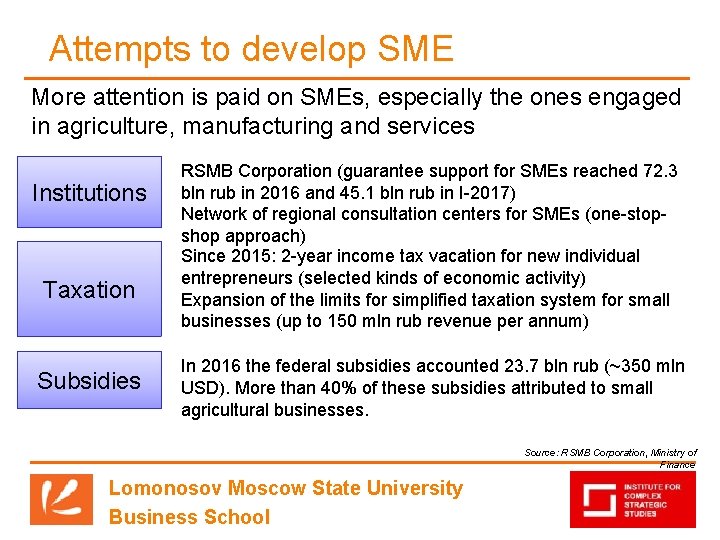
Attempts to develop SME More attention is paid on SMEs, especially the ones engaged in agriculture, manufacturing and services Institutions Taxation Subsidies RSMB Corporation (guarantee support for SMEs reached 72. 3 bln rub in 2016 and 45. 1 bln rub in I-2017) Network of regional consultation centers for SMEs (one-stopshop approach) Since 2015: 2 -year income tax vacation for new individual entrepreneurs (selected kinds of economic activity) Expansion of the limits for simplified taxation system for small businesses (up to 150 mln rub revenue per annum) In 2016 the federal subsidies accounted 23. 7 bln rub (~350 mln USD). More than 40% of these subsidies attributed to small agricultural businesses. Source: RSMB Corporation, Ministry of Finance Lomonosov Moscow State University Business School
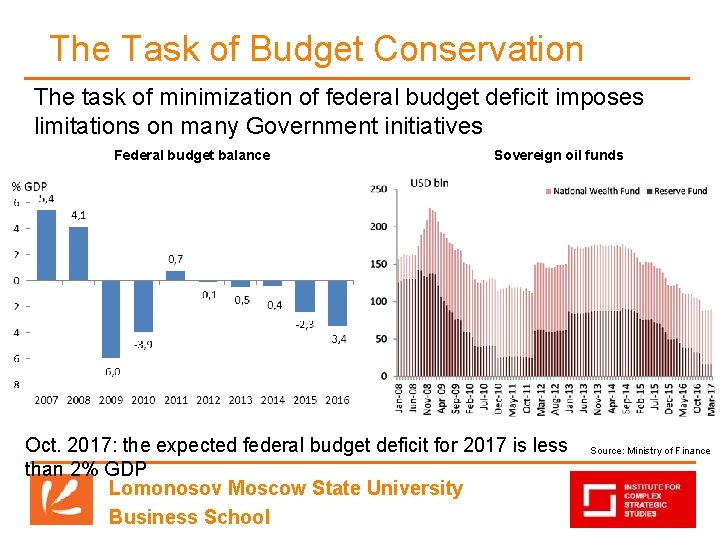
The Task of Budget Conservation The task of minimization of federal budget deficit imposes limitations on many Government initiatives Federal budget balance Sovereign oil funds Oct. 2017: the expected federal budget deficit for 2017 is less than 2% GDP Lomonosov Moscow State University Business School Source: Ministry of Finance
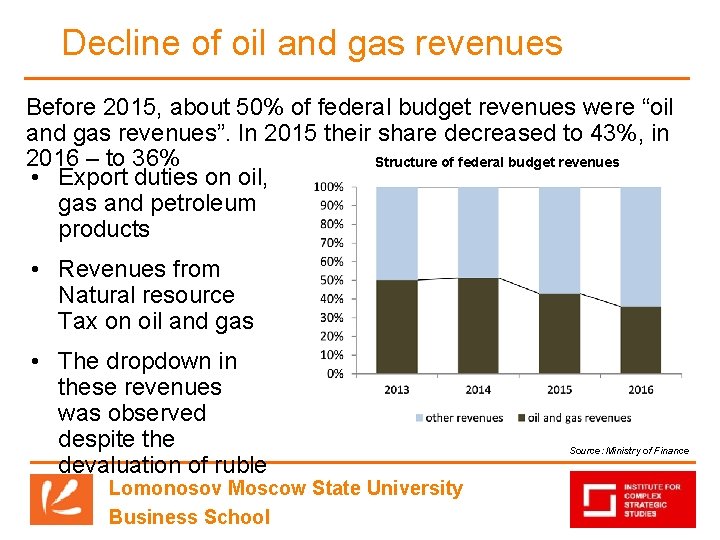
Decline of oil and gas revenues Before 2015, about 50% of federal budget revenues were “oil and gas revenues”. In 2015 their share decreased to 43%, in 2016 – to 36% Structure of federal budget revenues • Export duties on oil, gas and petroleum products • Revenues from Natural resource Tax on oil and gas • The dropdown in these revenues was observed despite the devaluation of ruble Lomonosov Moscow State University Business School Source: Ministry of Finance
Thank you for your attention! Lomonosov Moscow State University Business School