ZPR PWr Zintegrowany Program Rozwoju Politechniki Wrocawskiej Types

- Slides: 23
„ZPR PWr – Zintegrowany Program Rozwoju Politechniki Wrocławskiej” Types of market structure: Monopoly dr hab. inż. Grzegorz Chodak, prof. PWr.
Plan 1. 2. 3. 4. Examples of Polish monopolists Entry barriers characteristics Profit/loss analysis Price discrimination
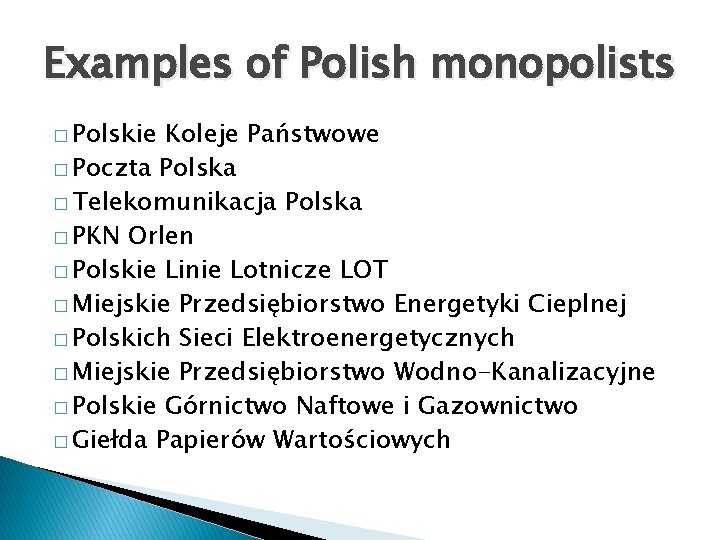
Examples of Polish monopolists � Polskie Koleje Państwowe � Poczta Polska � Telekomunikacja Polska � PKN Orlen � Polskie Linie Lotnicze LOT � Miejskie Przedsiębiorstwo Energetyki Cieplnej � Polskich Sieci Elektroenergetycznych � Miejskie Przedsiębiorstwo Wodno-Kanalizacyjne � Polskie Górnictwo Naftowe i Gazownictwo � Giełda Papierów Wartościowych
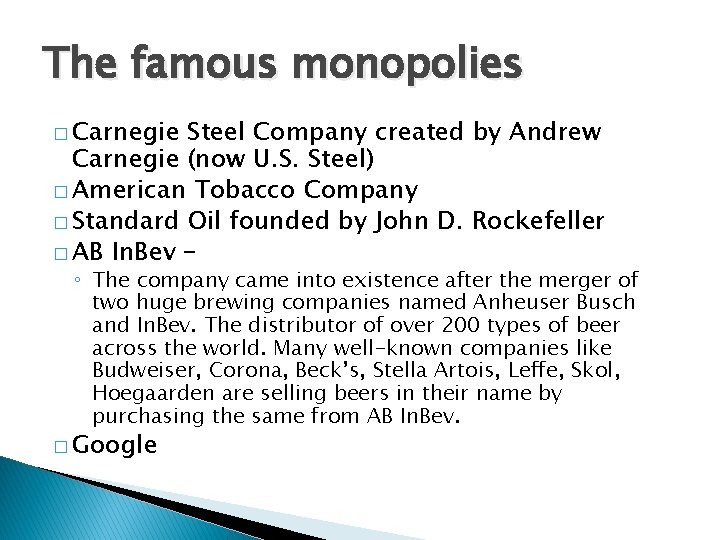
The famous monopolies � Carnegie Steel Company created by Andrew Carnegie (now U. S. Steel) � American Tobacco Company � Standard Oil founded by John D. Rockefeller � AB In. Bev – ◦ The company came into existence after the merger of two huge brewing companies named Anheuser Busch and In. Bev. The distributor of over 200 types of beer across the world. Many well-known companies like Budweiser, Corona, Beck’s, Stella Artois, Leffe, Skol, Hoegaarden are selling beers in their name by purchasing the same from AB In. Bev. � Google
Monopoly market � single seller for a product with no close substitutes � Huge entry barriers
Barriers to entry � economies of scale � actions by firms � actions by government
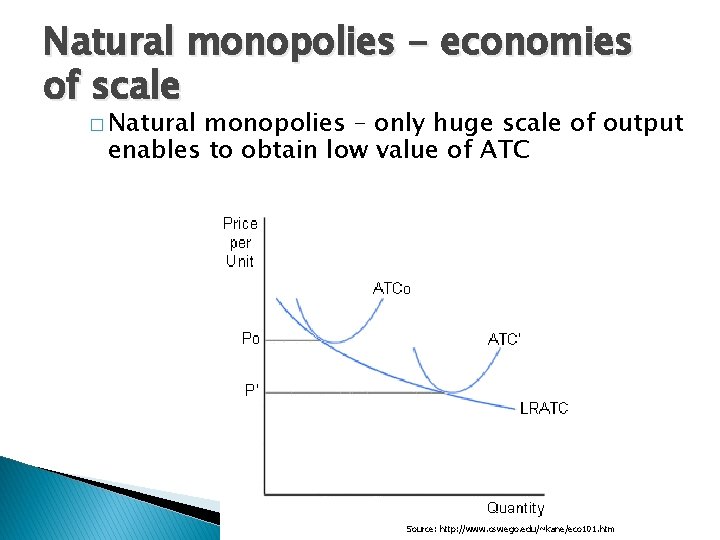
Natural monopolies - economies of scale � Natural monopolies – only huge scale of output enables to obtain low value of ATC Source: http: //www. oswego. edu/~kane/eco 101. htm
Actions by firms to protect monopoly power � patents and copyrights, � high advertising expenditures result in high sunk costs (costs that are not recoverable on exit), � taking over smaller competitors � illegal actions designed to restrict competition
Monopolies created by government action � Government can create concessions, � All kinds of law which restrict entering the market � Government protection often concerns public monopolies
Local monopoly � Local monopoly – a monopoly that exists in a local geographical area ◦ ◦ ◦ Examples: local newspapers, water suppliers, energy suppliers, public transport.
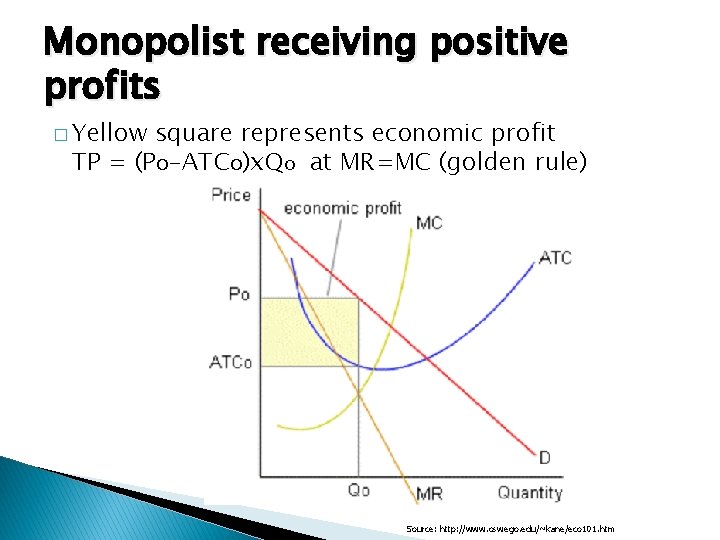
Monopolist receiving positive profits � Yellow square represents economic profit TP = (Po-ATCo)x. Qo at MR=MC (golden rule) Source: http: //www. oswego. edu/~kane/eco 101. htm
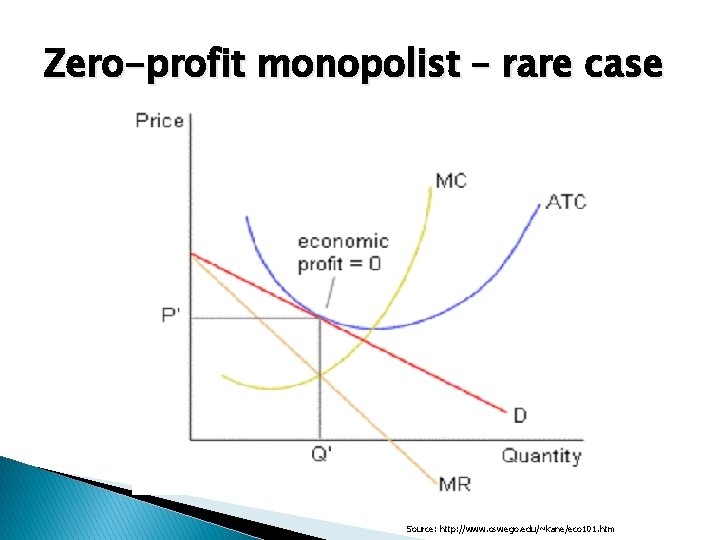
Zero-profit monopolist – rare case Source: http: //www. oswego. edu/~kane/eco 101. htm
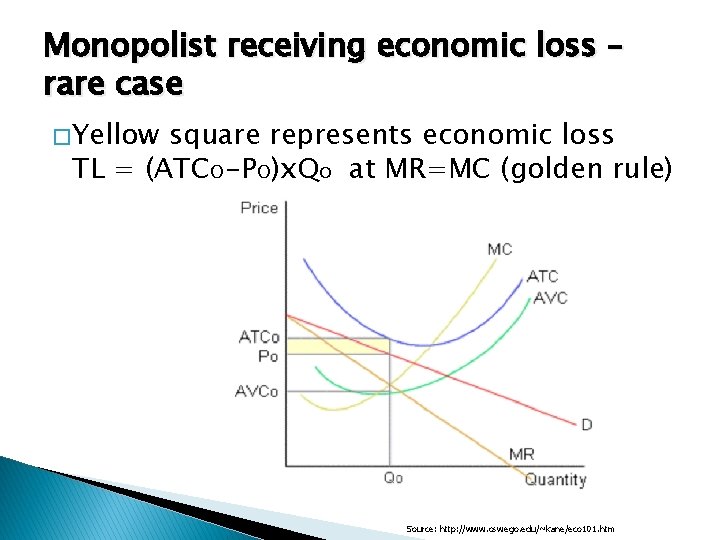
Monopolist receiving economic loss – rare case � Yellow square represents economic loss TL = (ATCo-Po)x. Qo at MR=MC (golden rule) Source: http: //www. oswego. edu/~kane/eco 101. htm
Monopoly price setting � There is only one profit-maximizing price and output level for a monopolist. � It is most profitable to produce at the level of output at which MR = MC (golden rule) ◦ and to charge the price given by the demand curve at such output level. � Charging a higher (or lower) price results in lower profits.
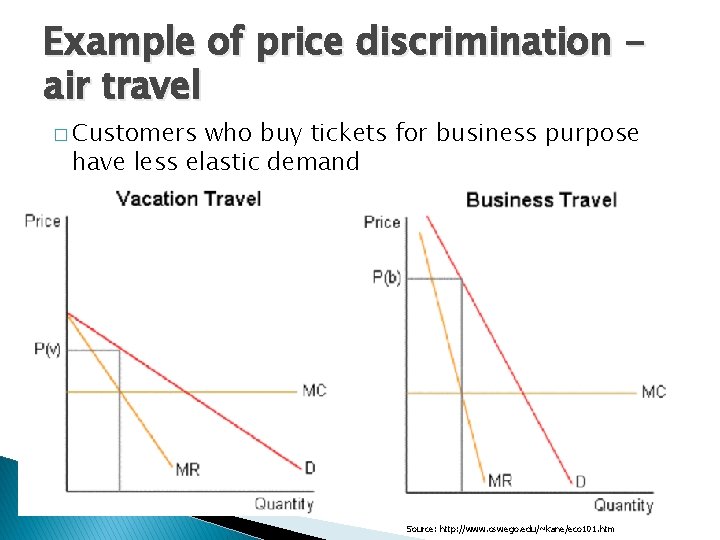
Price discrimination � In imperfectly competitive markets, firms may increase their profits by using price discrimination ◦ charging higher prices to those customers with the most inelastic demand for the product. � Necessary conditions for price discrimination: ◦ firms can classify customers by their elasticity of demand ◦ the firm must be a price-maker ◦ resale is not possible
Example of price discrimination air travel � Customers who buy tickets for business purpose have less elastic demand Source: http: //www. oswego. edu/~kane/eco 101. htm
Dumping � If firms use price discrimination by charging different prices in different countries, ◦ they are often accused of dumping in the lowprice country. � Predatory dumping occurs if a company charges a low price initially in an attempt to drive out domestic competitors ◦ and then raises prices once the domestic industry is destroyed.
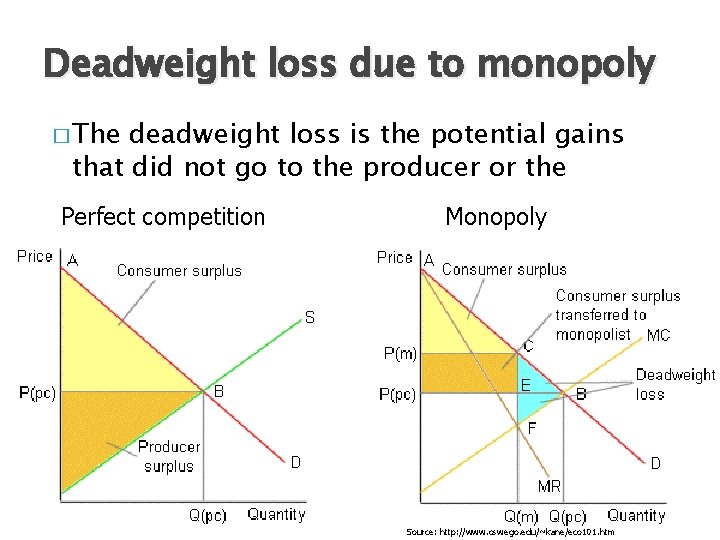
Deadweight loss due to monopoly � The deadweight loss is the potential gains that did not go to the producer or the consumer. Perfect competition Monopoly Source: http: //www. oswego. edu/~kane/eco 101. htm
Other costs associated with monopoly � X-inefficiency – occurs if companies do not have an incentive to engage in least-cost production ◦ since they are not faced with competitive pressure. � Monopolists may not be interested in: ◦ Efficient cost management, ◦ Searching and implementation of innovations.
Other costs associated with monopoly cont. � Rent-seeking behavior – the cost of using resources (such as lawyers, lobbyists, etc. ) in an attempt to acquire and maintain monopoly power. � This behavior does not benefit society and diverts resources away from productive activities.
Monopoly - review � Film
Bibliography: � http: //www. oswego. edu/~kane/eco 101. htm � Czarny B. „Podstawy ekonomii”, PWE, 2002 � https: //www. educba. com/monopolyexamples/ � https: //courses. lumenlearning. com/boundles s-economics/chapter/impacts-of-monopolyon-efficiency/
Discussion topics 1. 2. 3. 4. 5. Give the examples and characterize Polish monopolies. Give the examples and characterize world monopolies. Characterize different kinds of entry barriers. Give examples of price discrimination. What is deadweight loss due to monopoly.