Wound Management in the Elderly Stephanie Yates MSN










- Slides: 58
Wound Management in the Elderly Stephanie Yates, MSN, ANP-BC, CWOCN Nurse Practitioner/CNS Duke University Medical Center Durham, NC stephanie. yates@duke. edu
Skin Condition • Key quality indicator • To the family • To the regulators • To other healthcare providers
Cost of Skin Breakdown • To the facility • To the healthcare system • To the patient
Documentation Absolutely important • Assessment • Reassessment • Follow-up care • Aspects of care that can’t be changed • Supportive measures – nutrition, consults, rehab • Physician communication
Alterations in Skin Integrity among Geriatric Population • Pressure Injuries • Skin Tears • Lower Extremity Ulcers • • • Venous Arterial Neuropathic • Incontinence-related Skin Breakdown
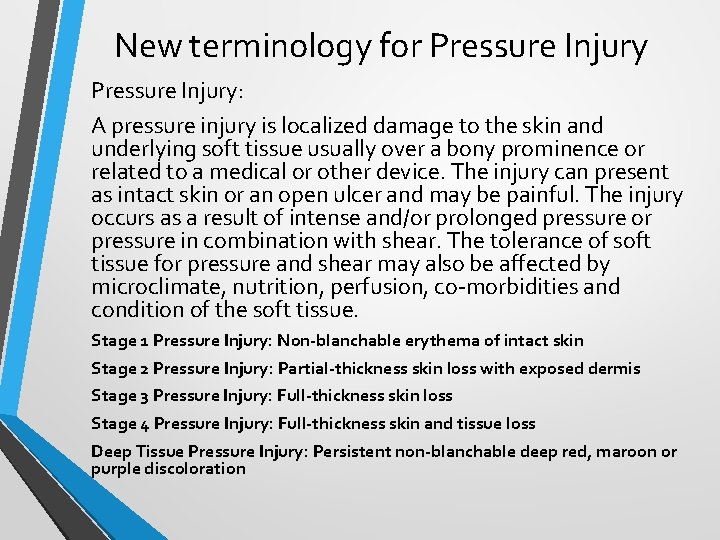
New terminology for Pressure Injury: A pressure injury is localized damage to the skin and underlying soft tissue usually over a bony prominence or related to a medical or other device. The injury can present as intact skin or an open ulcer and may be painful. The injury occurs as a result of intense and/or prolonged pressure or pressure in combination with shear. The tolerance of soft tissue for pressure and shear may also be affected by microclimate, nutrition, perfusion, co-morbidities and condition of the soft tissue. Stage 1 Pressure Injury: Non-blanchable erythema of intact skin Stage 2 Pressure Injury: Partial-thickness skin loss with exposed dermis Stage 3 Pressure Injury: Full-thickness skin loss Stage 4 Pressure Injury: Full-thickness skin and tissue loss Deep Tissue Pressure Injury: Persistent non-blanchable deep red, maroon or purple discoloration
Assessing Risk for Skin Breakdown • Risk Assessment Tools • Braden Scale Score • Norton Score • Policy to define when risk assessment is repeated • Interventions/Protocol to address risk elements
Support Surfaces • Old Terms – Pressure Reduction and Pressure Relief • New term – Pressure Redistribution • The ability of a support surface to distribute load over the contact areas of the human body
Support Surfaces • Components – air, foam, fluid, gel, etc. • Features – alternating pressure, air fluidized, low air loss, multi-zoned • Categories – active or reactive, powered or not, overlay or mattress Regardless of support surface, patients will always need to be turned.
Types of support surfaces
What about bacteria in wounds?
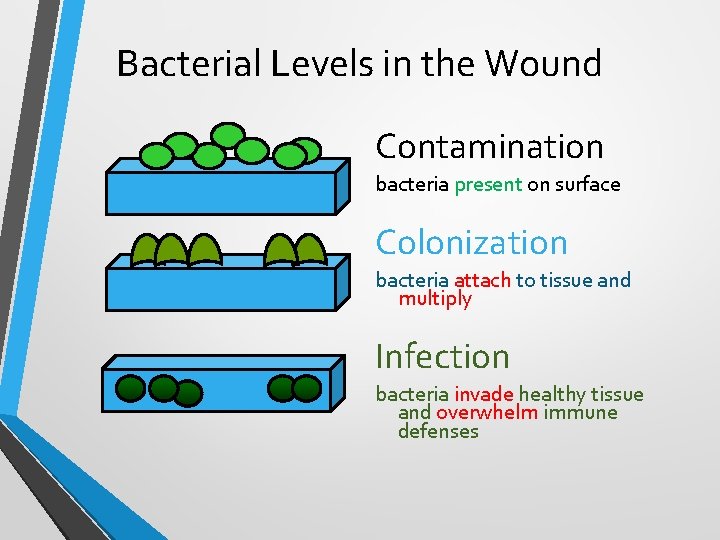
Bacterial Levels in the Wound Contamination bacteria present on surface Colonization bacteria attach to tissue and multiply Infection bacteria invade healthy tissue and overwhelm immune defenses
Assessing for Infection • Inflammation vs Infection • Watch for changing in drainage, fever, local pain, signs of sepsis (hypotension, ^ pulse rate, ^ respirations) • Localized pain may be only sign of infection with immunocompromised patient • Look for infection when blood glucose elevated with no explanation
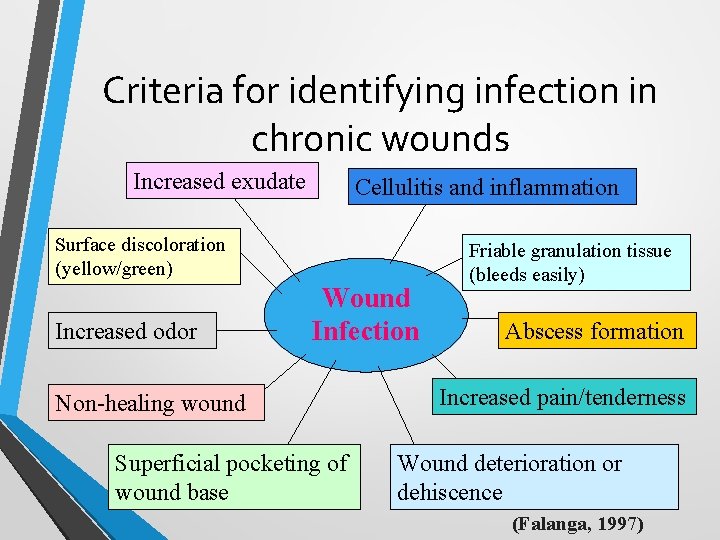
Criteria for identifying infection in chronic wounds Increased exudate Cellulitis and inflammation Surface discoloration (yellow/green) Increased odor Wound Infection Non-healing wound Superficial pocketing of wound base Friable granulation tissue (bleeds easily) Abscess formation Increased pain/tenderness Wound deterioration or dehiscence (Falanga, 1997)
Infection • Colony counts > 105 per gram of tissue • Prolongs the inflammatory phase • Destroys surrounding tissue • Retards epithelialization and collagen deposition • Interrupts the wound healing cascade
Infection • IFFE - Induration, Fever, Erythema, Edema • When and how to culture • Cleanse wound with saline, press with swab in 1 cm square area to express fresh exudate • Follow-up on cultures • Antibiotics - topical vs. systemic
Swab culture techniques • Levine technique (Best Practice) • • • Clean wound prior to culture • Has been correlated to tissue biopsy results Moisten swab with saline 1 cm square Rotate swab over a 1 cm square area with sufficient pressure to express fluid from wound tissue (Levine, 1976)
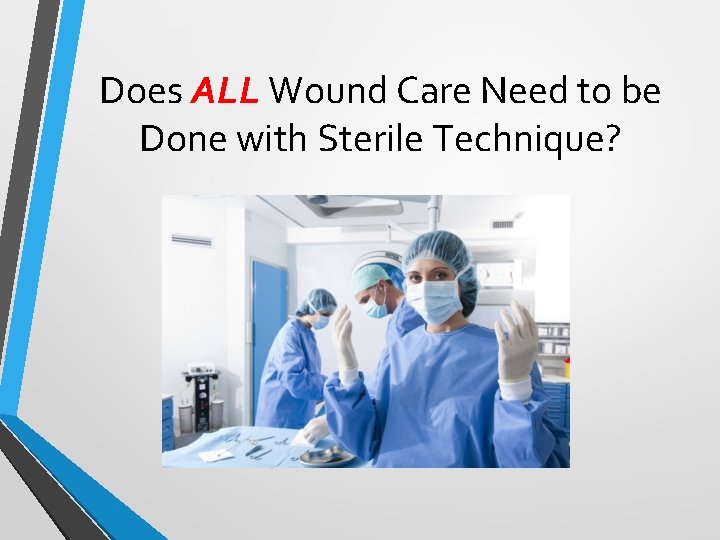
Does ALL Wound Care Need to be Done with Sterile Technique?
Wound Care Issues ØPresent literature suggests that pressure ulcer dressing protocols may use clean technique rather than sterile, but that appropriate sterile technique may be needed for those wounds that recently have been surgically debrided or repaired. • ©National Pressure Ulcer Advisory Panel March 2014
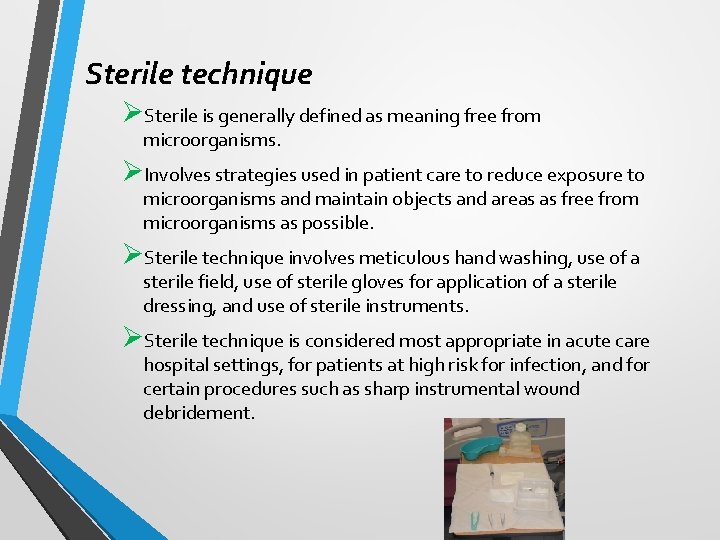
Sterile technique ØSterile is generally defined as meaning free from microorganisms. ØInvolves strategies used in patient care to reduce exposure to microorganisms and maintain objects and areas as free from microorganisms as possible. ØSterile technique involves meticulous hand washing, use of a sterile field, use of sterile gloves for application of a sterile dressing, and use of sterile instruments. ØSterile technique is considered most appropriate in acute care hospital settings, for patients at high risk for infection, and for certain procedures such as sharp instrumental wound debridement.
Clean Technique ØClean means free of dirt, marks, or stains. ØClean technique involves strategies used in patient care to reduce the overall number of microorganisms or to prevent or reduce the risk of transmission of microorganisms from one person to another or from one place to another. ØClean technique involves meticulous handwashing, maintaining a clean environment by preparing a clean field, using clean gloves and sterile instruments, and preventing direct contamination of materials and supplies. ØNo “sterile to sterile” rules apply. ØThis technique may also be referred to as non-sterile. ØClean technique is considered most appropriate for longterm care, home care, and some clinic settings; for patients who are not at high risk for infection; and for patients receiving routine dressings for chronic wounds such as venous ulcers, or wounds healing by secondary intention with granulation tissue.
General Rules for Changing Dressings üDisinfect area around bedside where supplies are going to be placed (over bed table etc. , ) üPlace trash bag near by üPerform hand hygiene üGather all necessary supplies, equipment üDon clean disposable gloves üRemove tape and outer dressings and dispose of in trash container üAssess the wound for color, edema, exudate, odor etc. , üRemove soiled gloves, dispose of and perform hand hygiene üPut on clean gloves üApply dressing and secure üDispose of all supplies üRemove gloves and perform hand hygiene
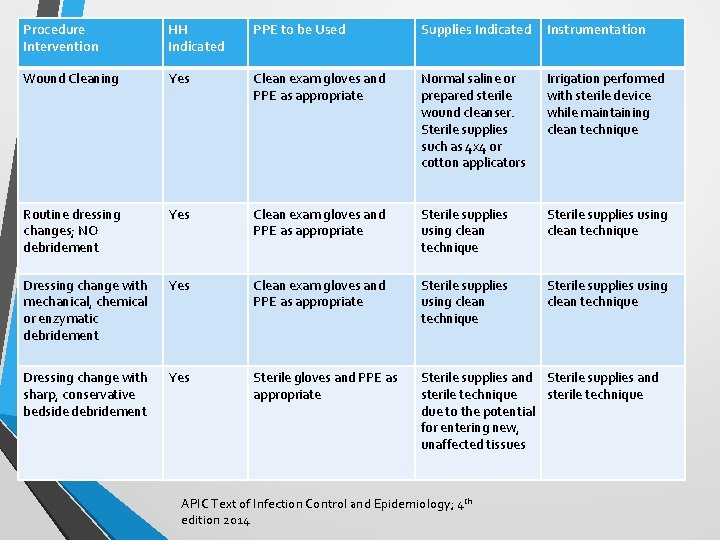
Procedure Intervention HH Indicated PPE to be Used Supplies Indicated Instrumentation Wound Cleaning Yes Clean exam gloves and PPE as appropriate Normal saline or prepared sterile wound cleanser. Sterile supplies such as 4 x 4 or cotton applicators Irrigation performed with sterile device while maintaining clean technique Routine dressing changes; NO debridement Yes Clean exam gloves and PPE as appropriate Sterile supplies using clean technique Dressing change with mechanical, chemical or enzymatic debridement Yes Clean exam gloves and PPE as appropriate Sterile supplies using clean technique Dressing change with sharp, conservative bedside debridement Yes Sterile gloves and PPE as appropriate Sterile supplies and sterile technique due to the potential for entering new, unaffected tissues APIC Text of Infection Control and Epidemiology; 4 th edition 2014
Points to Remember • Contamination of the wound is minimized by not touching it. Blotting excess fluid that pools in the wound and cleaning the periwound skin with moist gauze is acceptable. • Contamination of the wound from supplies is avoided by opening and preparing all that is needed before removing the dressing and putting on fresh clean gloves. • Contamination of the local environment and supplies is avoided by organizing the procedure to ensure that anything coming into contact with the wound does not contact jars, bottles, tubes, bedside table or supplies to be kept for use at a later date.
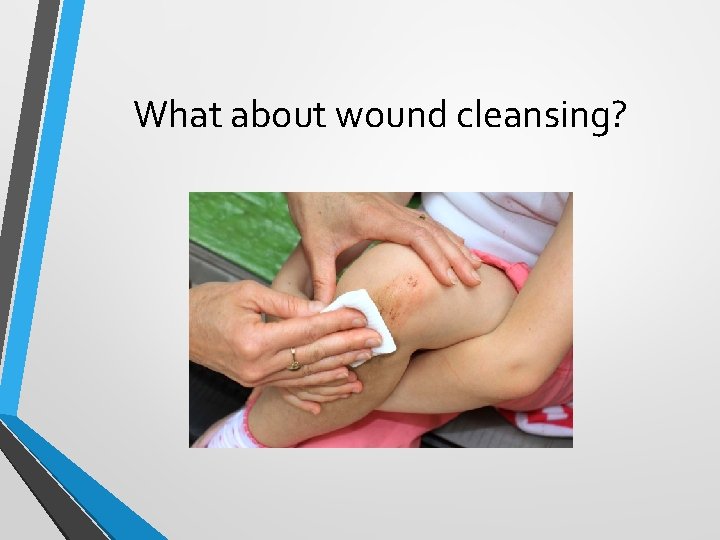
What about wound cleansing?
Which wounds need cleansing? • “Dirty” wounds – wounds caused by bites, trauma with foreign objects or debris • Infected wounds • Debate over clean granulating wounds – post surgical wounds, leg ulcers, other chronic wounds
Avoid Antiseptics • Povidone Iodine – (Betadine) – Use solution only – 1% or 10% is acceptable • Hydrogen peroxide – damages healing wounds, do NOT use in deep wounds – no safe dilution • Sodium hypochlorite – Dakin’s solution – safe dilution is. 025% (not. 25% usually ordered) • Acetic Acid – no safe dilution
Characteristics of “safe” wound cleansers • p. H balanced • Non-cytotoxic • Long shelf life
Examples of safe wound cleansers • Normal Saline • Commercially available “wound cleansers” – not the same as “skin cleansers” • • • Smith & Nephew – Dermal Wound Cleanser Bard – Biolex Wound Cleanser Conva. Tec – Saf-clens Medline – Skintegrity Etc…. .
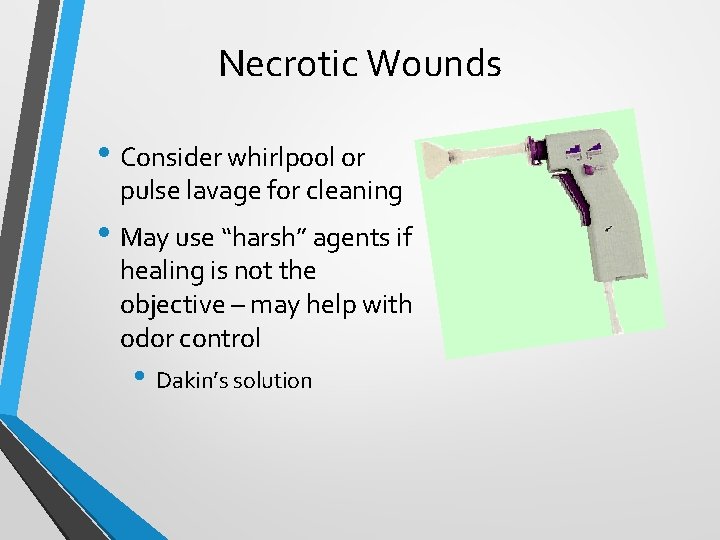
Necrotic Wounds • Consider whirlpool or pulse lavage for cleaning • May use “harsh” agents if healing is not the objective – may help with odor control • Dakin’s solution
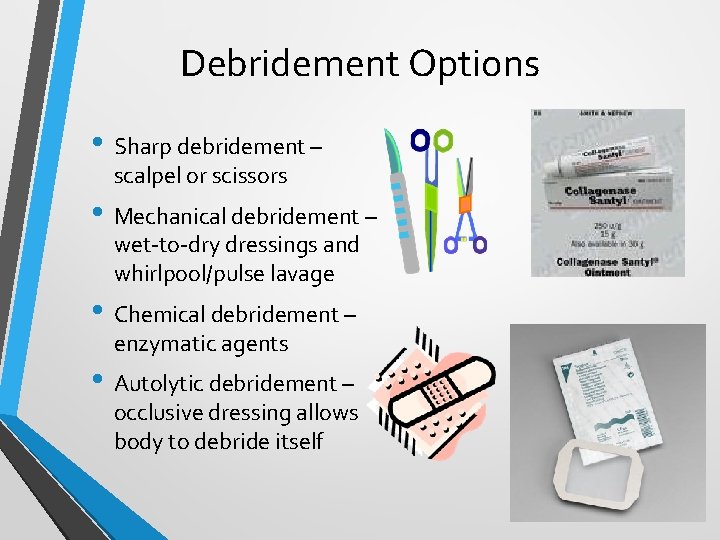
Debridement Options • Sharp debridement – scalpel or scissors • Mechanical debridement – wet-to-dry dressings and whirlpool/pulse lavage • Chemical debridement – enzymatic agents • Autolytic debridement – occlusive dressing allows body to debride itself
Principles of Topical Therapy • Debride non-viable tissue • Treat infection • Gently pack open space • Manage drainage • Maintain moist wound surface • Protect from trauma • Insulate – maintain body temperature
Factors to consider • Filler needed or just a cover dressing? • Amount of drainage expected? • Occlusion needed? • Adhesive safe or not? • Cost/frequency of change/availability? • Goal desired?
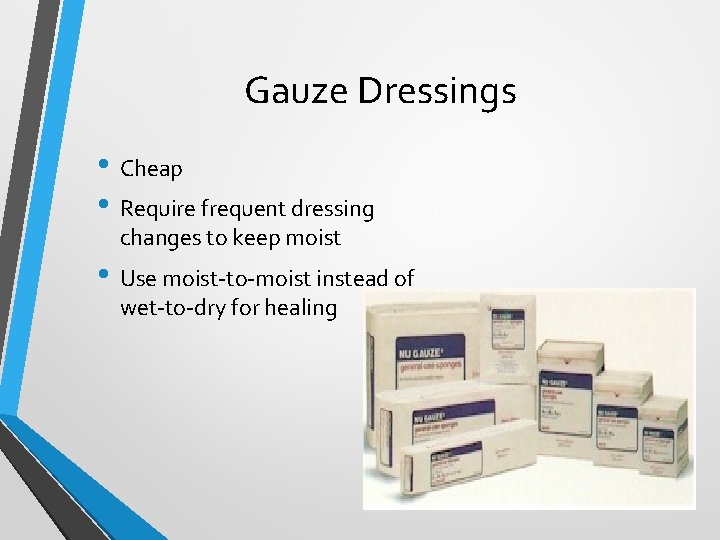
Gauze Dressings • Cheap • Require frequent dressing changes to keep moist • Use moist-to-moist instead of wet-to-dry for healing
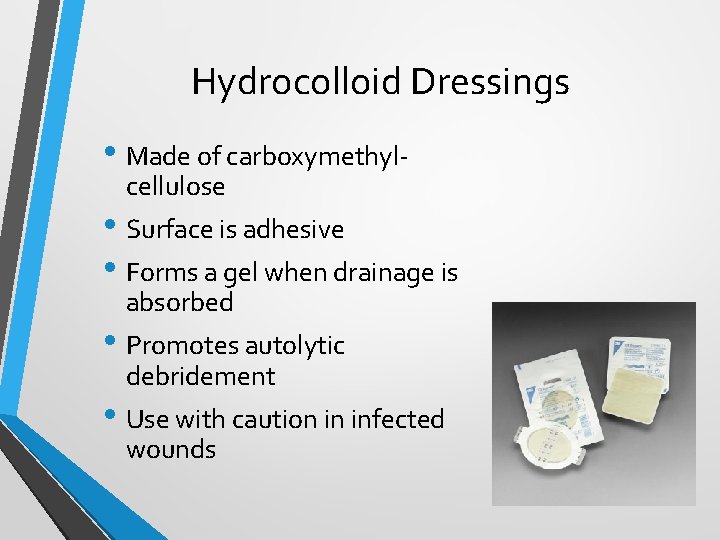
Hydrocolloid Dressings • Made of carboxymethylcellulose • Surface is adhesive • Forms a gel when drainage is absorbed • Promotes autolytic debridement • Use with caution in infected wounds
Hydrofibers • Non-woven dressing used for absorption • Wicks drainage vertically • Used as a filler for draining wounds • Requires a secondary dressing • Absorbs more than an alginate
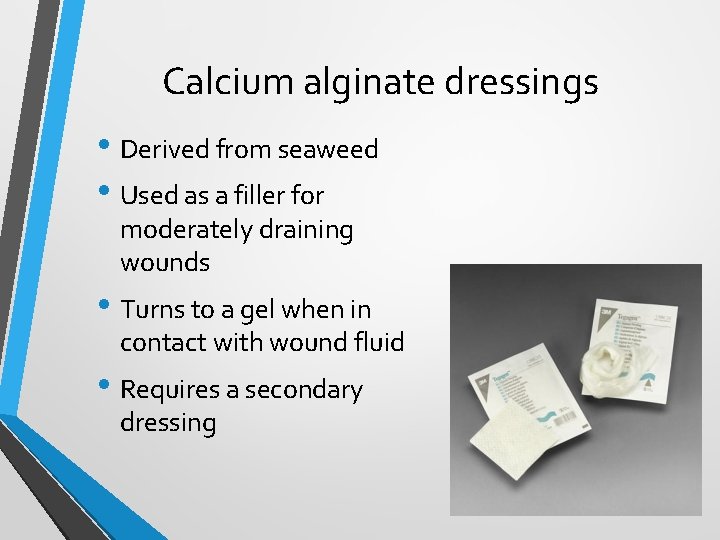
Calcium alginate dressings • Derived from seaweed • Used as a filler for moderately draining wounds • Turns to a gel when in contact with wound fluid • Requires a secondary dressing
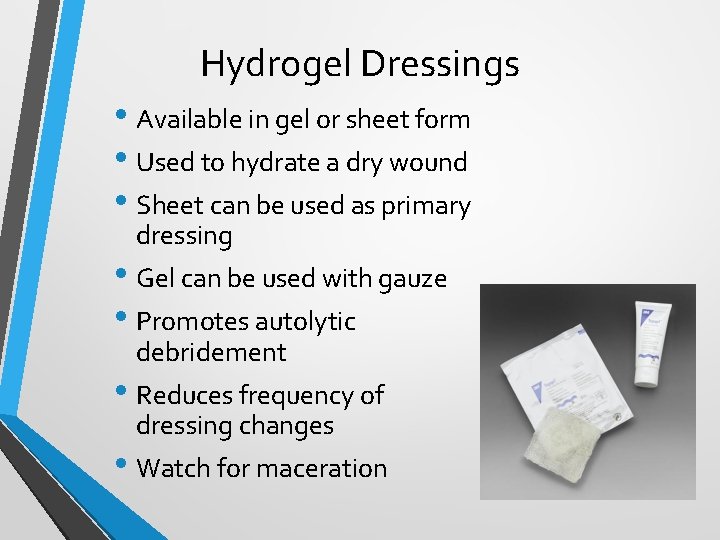
Hydrogel Dressings • Available in gel or sheet form • Used to hydrate a dry wound • Sheet can be used as primary dressing • Gel can be used with gauze • Promotes autolytic debridement • Reduces frequency of dressing changes • Watch for maceration
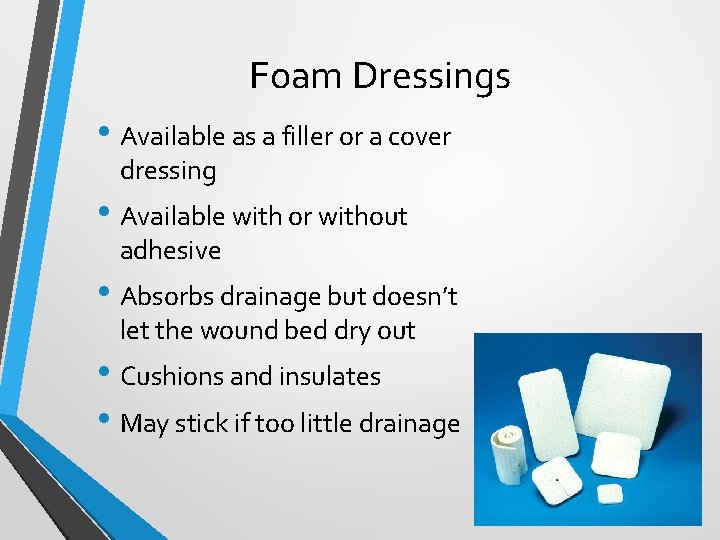
Foam Dressings • Available as a filler or a cover dressing • Available with or without adhesive • Absorbs drainage but doesn’t let the wound bed dry out • Cushions and insulates • May stick if too little drainage
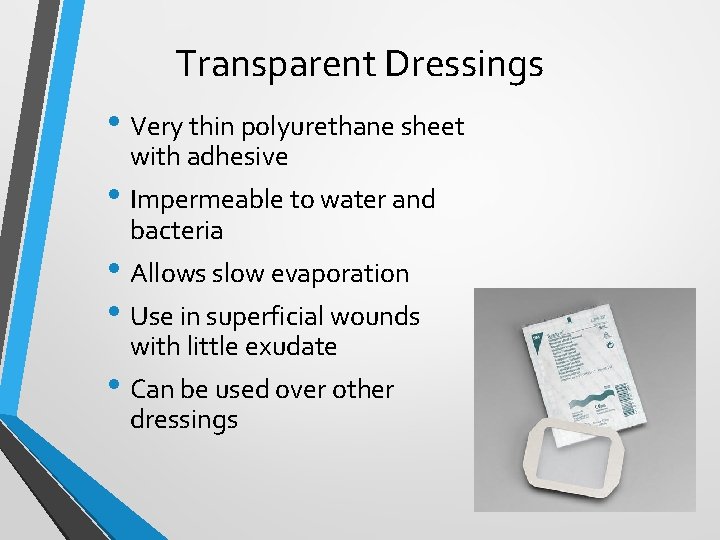
Transparent Dressings • Very thin polyurethane sheet with adhesive • Impermeable to water and bacteria • Allows slow evaporation • Use in superficial wounds with little exudate • Can be used over other dressings
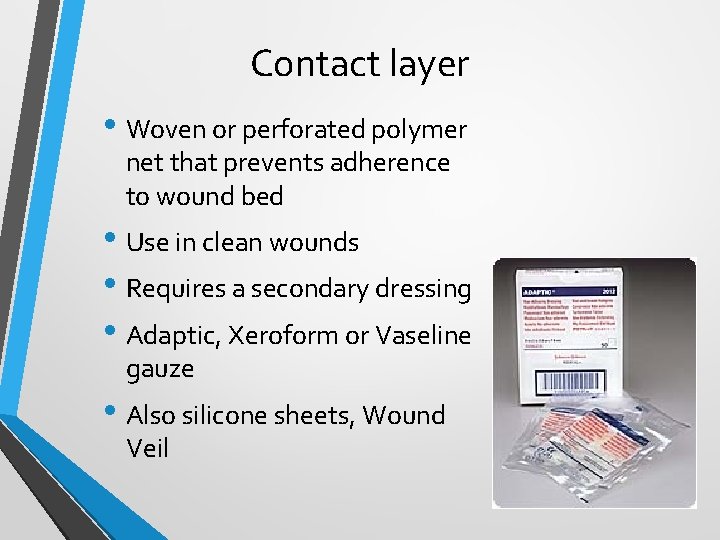
Contact layer • Woven or perforated polymer net that prevents adherence to wound bed • Use in clean wounds • Requires a secondary dressing • Adaptic, Xeroform or Vaseline gauze • Also silicone sheets, Wound Veil
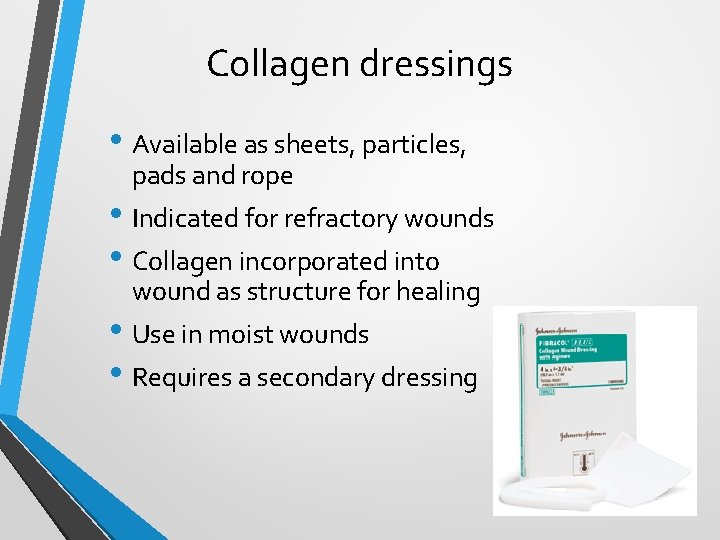
Collagen dressings • Available as sheets, particles, pads and rope • Indicated for refractory wounds • Collagen incorporated into wound as structure for healing • Use in moist wounds • Requires a secondary dressing
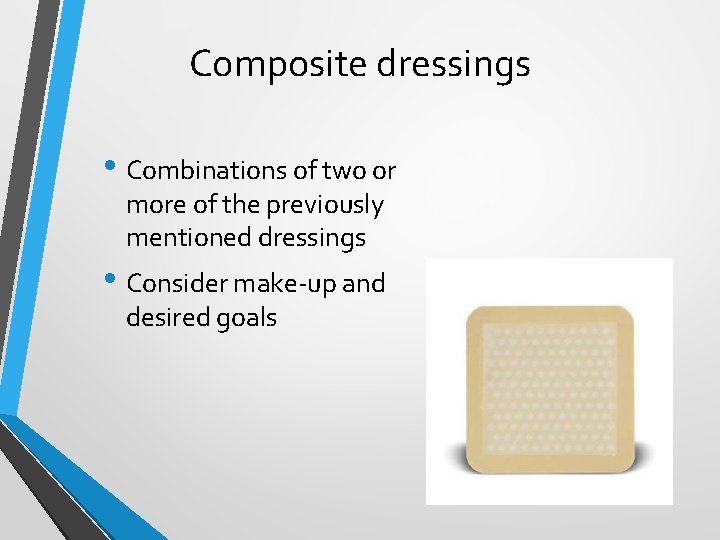
Composite dressings • Combinations of two or more of the previously mentioned dressings • Consider make-up and desired goals
Antimicrobial Dressings • Used to treat wounds that have “stalled” when an increased bioburden may be the problem • Used to treat wounds clinically known to be infected (in conjunction with systemic antibiotic therapy) • Sometimes used for prevention in high risk patients
Topical antimicrobials • Silver compounds • Silver sulfadiazine • Silver impregnated dressings • Cadexomer iodine (Iodosorb & Iodoflex) • PHMB impregnated dressings (Kerlix AMD) • Sodium hypochlorite solution (Anasept) • Manuka honey (Medihoney) • Mupirocin (Bactroban) Antibiotics • Metronidazole gel (Metrogel)
Silver Dressings • Believed by many to provide an environment conducive to the preparation of the wound bed for healing by controlling the bio environment (bacteria) • The evidence base is still in its infancy (really), but early reports point toward accelerated healing when other factors are corrected (i. e. , malnutrition, necrotic tissue, etc. )
Silver Dressings • Advantages: • Disadvantages: Physicians seem to like using silver in wound care Product may be left in the wound for an extended period of time without losing efficacy (5 -7 days) Cost (Product can range from $10 -20 per unit) Discoloration from some products may alarm patients/ caregivers Products are often used incorrectly (changed too often) and have specific nuances
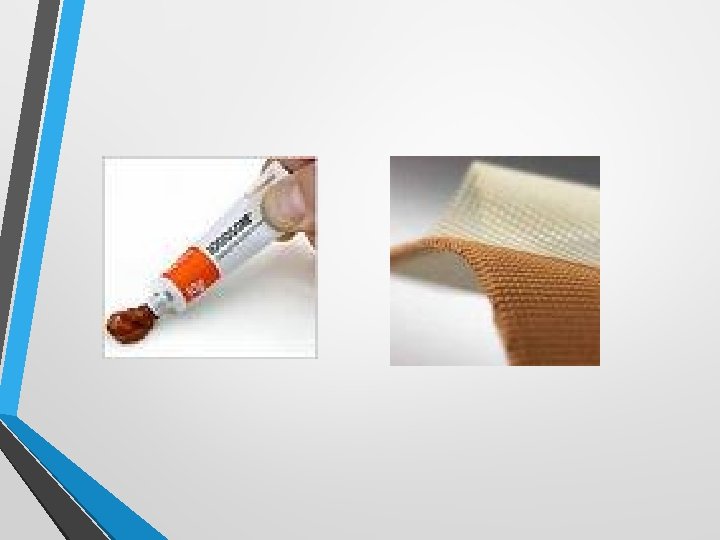
Cadexomer Ointment or Pads with Iodine (Iodosorb/Iodoflex) • Iodine molecules encased in a protective matrix which breaks down as wound exudate is absorbed, allowing for a gradual release of iodine • Absorbs exudate, contributes to the elimination of slough • Very little in the literature to support this delivery system • Advantages: ~ prescribers are familiar with iodine ~Can be left in wounds for several days • Disadvantages: ~improperly used ~awareness of iodine toxicity and other contraindications are sometimes ignored
PHMB impregnated gauze • Polyhexamethylene Biguanide (a compound similar to chlorhexidine) • An antiseptic that has a broad range effectiveness against gram positive and gram negative microorganisms • Prevents infection, no claims for treatment of infection
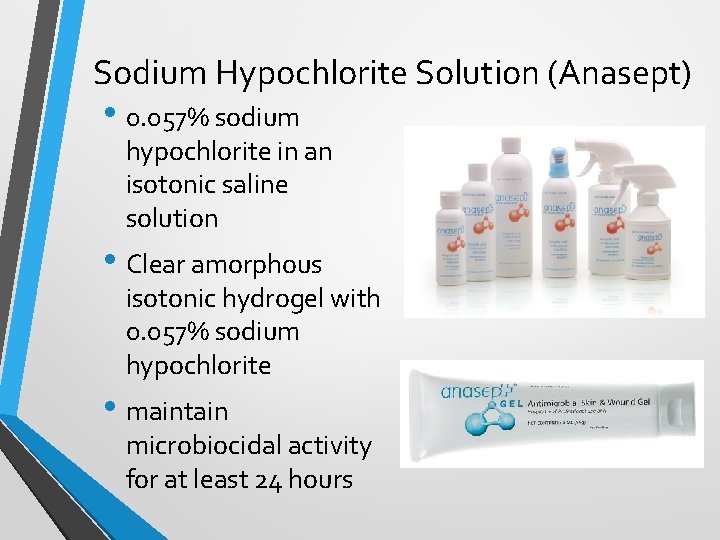
Sodium Hypochlorite Solution (Anasept) • 0. 057% sodium hypochlorite in an isotonic saline solution • Clear amorphous isotonic hydrogel with 0. 057% sodium hypochlorite • maintain microbiocidal activity for at least 24 hours
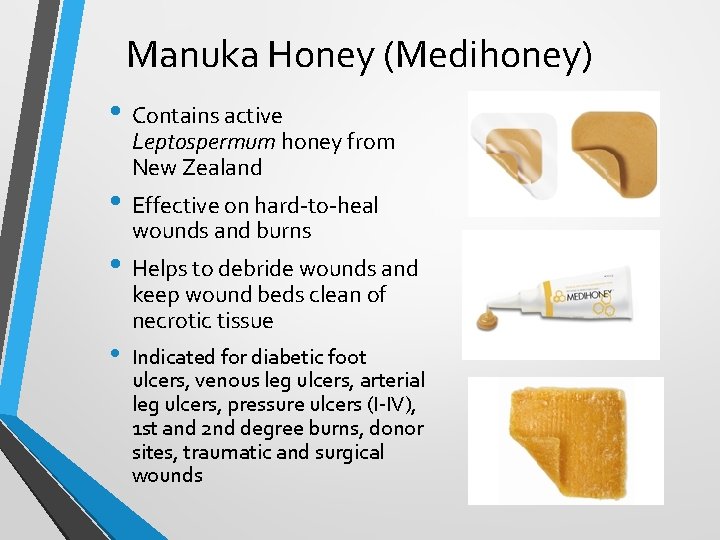
Manuka Honey (Medihoney) • Contains active Leptospermum honey from New Zealand • Effective on hard-to-heal wounds and burns • Helps to debride wounds and • keep wound beds clean of necrotic tissue Indicated for diabetic foot ulcers, venous leg ulcers, arterial leg ulcers, pressure ulcers (I-IV), 1 st and 2 nd degree burns, donor sites, traumatic and surgical wounds
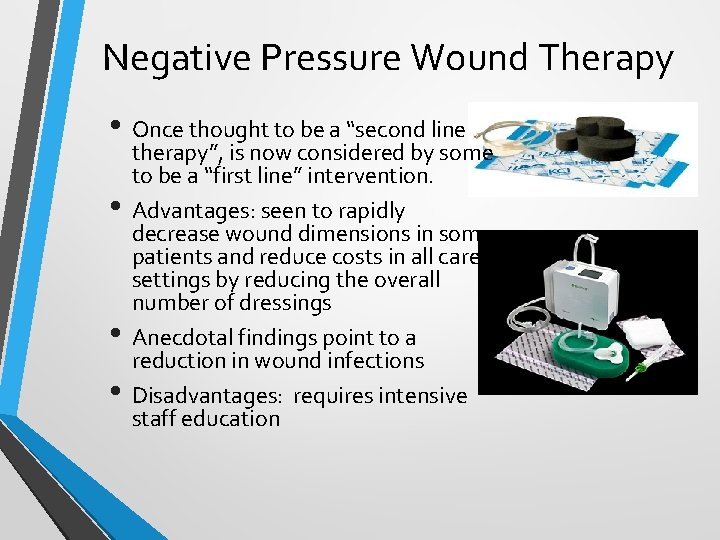
Negative Pressure Wound Therapy • Once thought to be a “second line • • • therapy”, is now considered by some to be a “first line” intervention. Advantages: seen to rapidly decrease wound dimensions in some patients and reduce costs in all care settings by reducing the overall number of dressings Anecdotal findings point to a reduction in wound infections Disadvantages: requires intensive staff education
Reassessment • Few dressings can take a wound from beginning to healed. • Reassess wound adjust dressing regimen as needed. • Policy on wound reassessment. • Standardize wound measurement techniques or have same person measure weekly.
Guidelines for Care • AHRQ (formerly AHCPR) guidelines are outdated and archived • WOCN Society has guidelines for pressure ulcers and lower extremity ulcers • AMDA published in 2008 and reaffirmed in 2013 • 2014 NPUAP/EPUAP/PPPIA guideline
References 1. Baranoski, S. & Ayello, E. A. (eds. ). (2011). Wound Care Essentials: Practice Principles (3 rd ed. ). Philadelphia: Lippincott Williams & Wilkins. 2. Bryant, R. A. (ed. ). (2012). Acute and Chronic Wounds: Current Management Concepts (4 th ed. ). St. Louis: Mosby. 3. Hess, C. T. (2012). Clinical Guide to Skin & Wound Care (7 th ed. ). Philadelphia: Lippincott Williams & Wilkins. 4. National Pressure Ulcer Advisory Panel, European Pressure Ulcer Advisory Panel and Pan Pacific Pressure Injury Alliance. Prevention and Treatment of Pressure Ulcers: Clinical Practice Guideline. Emily Haesler (Ed. ). Cambridge Media: Osborne Park, Western Australia; 2014.
References 5. www. npuap. org – National Pressure Ulcer Advisory Panel website 6. www. bradenscale. com - Information about using the Braden Scale for risk assessment. 7. www. wocn. org - Website for the WOCN Society; resource for guidelines 8. www. amda. com - Website for the American Medical Directors Association, resource for AMDA guidelines and online journal.










![Msn]](https://slidetodoc.com/wp-content/uploads/2020/12/3305482_b48b1a63b3813712ffceded1012692e7-300x225.jpg "Msn]")