Some Commonly Held Opinions Each of the following

- Slides: 44
Some Commonly Held Opinions • Each of the following statements represents a commonly held opinion. You will probably agree with some and disagree with others. Read each statement carefully; then, using the scale below, please indicate the extent to which you agree or disagree with the statement. • 0 = disagree strongly • 1 = disagree somewhat • 2 = disagree slightly • 3 = agree slightly • 4 = agree somewhat • 5 = agree strongly
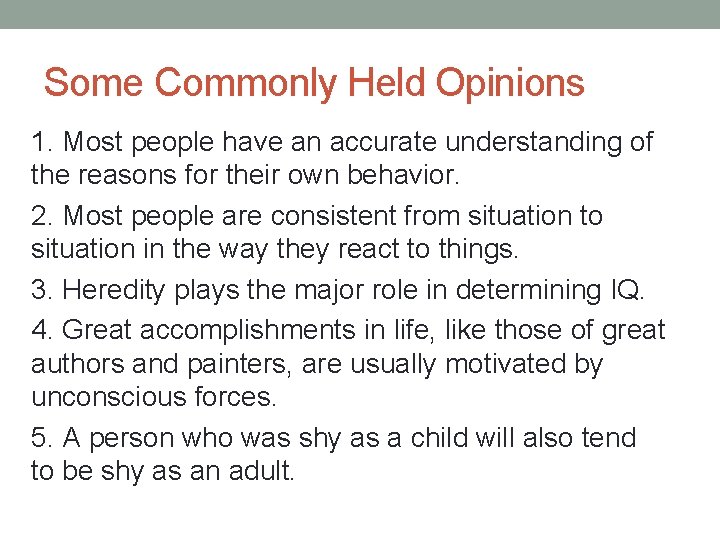
Some Commonly Held Opinions 1. Most people have an accurate understanding of the reasons for their own behavior. 2. Most people are consistent from situation to situation in the way they react to things. 3. Heredity plays the major role in determining IQ. 4. Great accomplishments in life, like those of great authors and painters, are usually motivated by unconscious forces. 5. A person who was shy as a child will also tend to be shy as an adult.
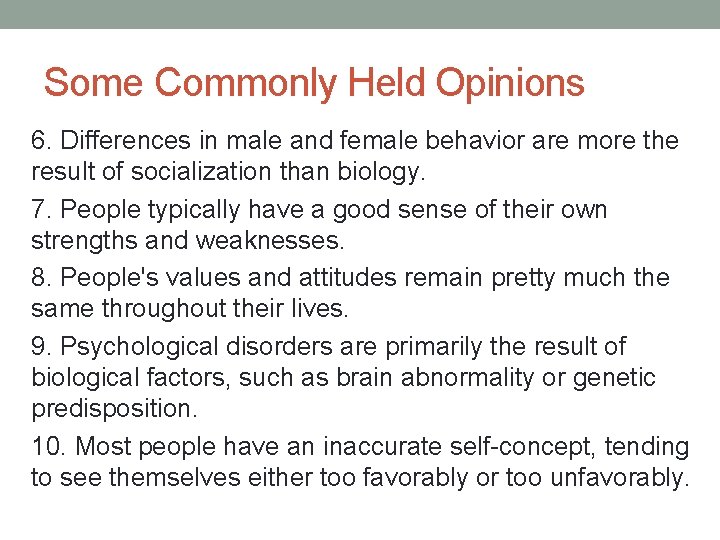
Some Commonly Held Opinions 6. Differences in male and female behavior are more the result of socialization than biology. 7. People typically have a good sense of their own strengths and weaknesses. 8. People's values and attitudes remain pretty much the same throughout their lives. 9. Psychological disorders are primarily the result of biological factors, such as brain abnormality or genetic predisposition. 10. Most people have an inaccurate self-concept, tending to see themselves either too favorably or too unfavorably.
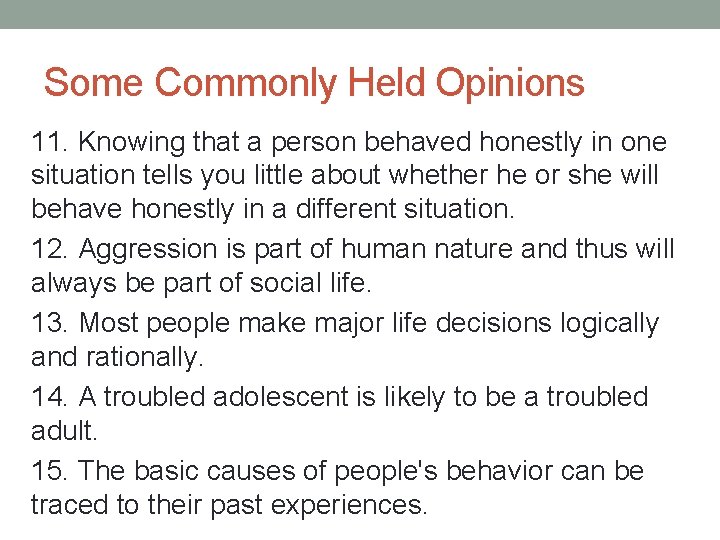
Some Commonly Held Opinions 11. Knowing that a person behaved honestly in one situation tells you little about whether he or she will behave honestly in a different situation. 12. Aggression is part of human nature and thus will always be part of social life. 13. Most people make major life decisions logically and rationally. 14. A troubled adolescent is likely to be a troubled adult. 15. The basic causes of people's behavior can be traced to their past experiences.
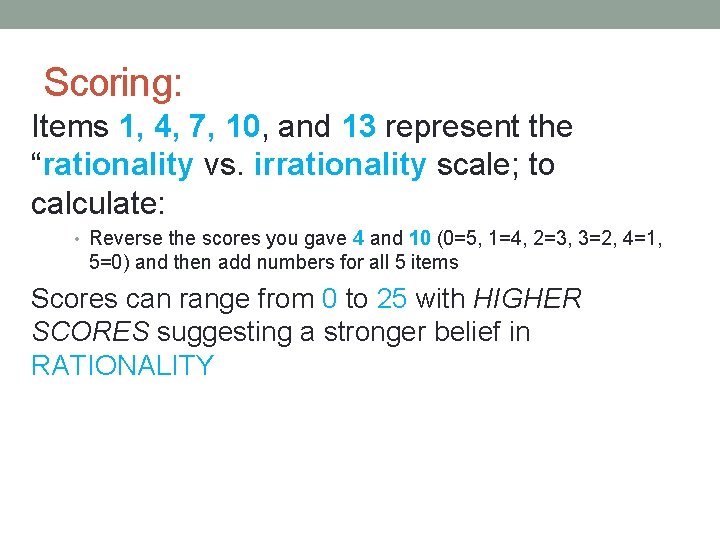
Scoring: Items 1, 4, 7, 10, and 13 represent the “rationality vs. irrationality scale; to calculate: • Reverse the scores you gave 4 and 10 (0=5, 1=4, 2=3, 3=2, 4=1, 5=0) and then add numbers for all 5 items Scores can range from 0 to 25 with HIGHER SCORES suggesting a stronger belief in RATIONALITY
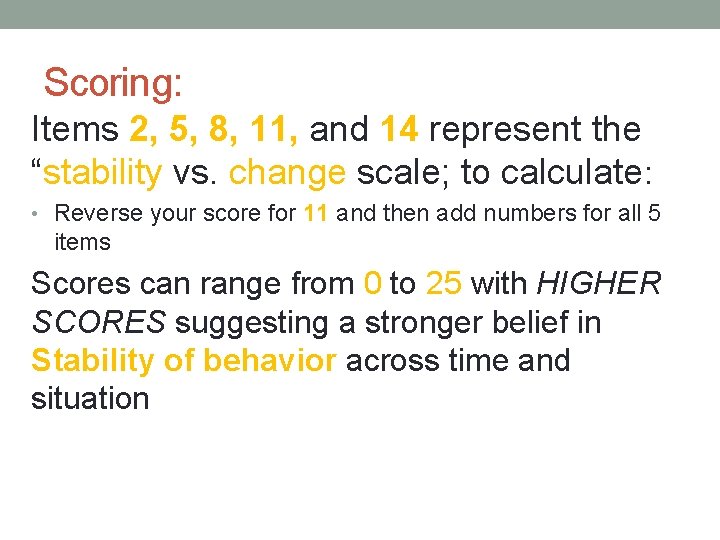
Scoring: Items 2, 5, 8, 11, and 14 represent the “stability vs. change scale; to calculate: • Reverse your score for 11 and then add numbers for all 5 items Scores can range from 0 to 25 with HIGHER SCORES suggesting a stronger belief in Stability of behavior across time and situation
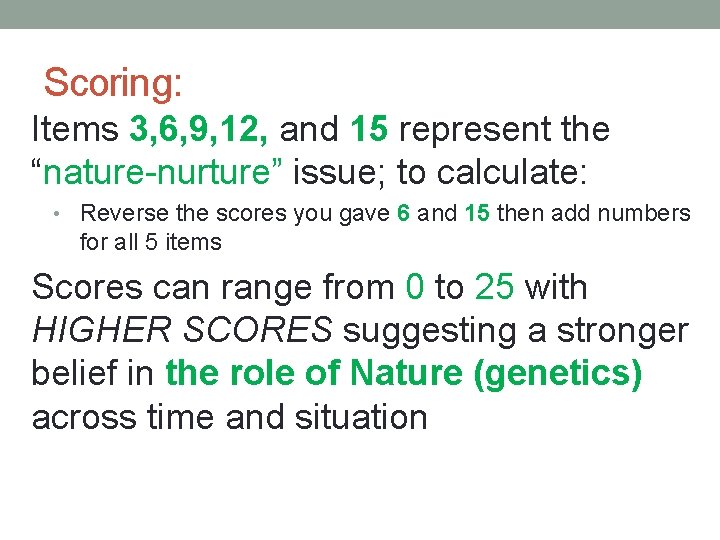
Scoring: Items 3, 6, 9, 12, and 15 represent the “nature-nurture” issue; to calculate: • Reverse the scores you gave 6 and 15 then add numbers for all 5 items Scores can range from 0 to 25 with HIGHER SCORES suggesting a stronger belief in the role of Nature (genetics) across time and situation
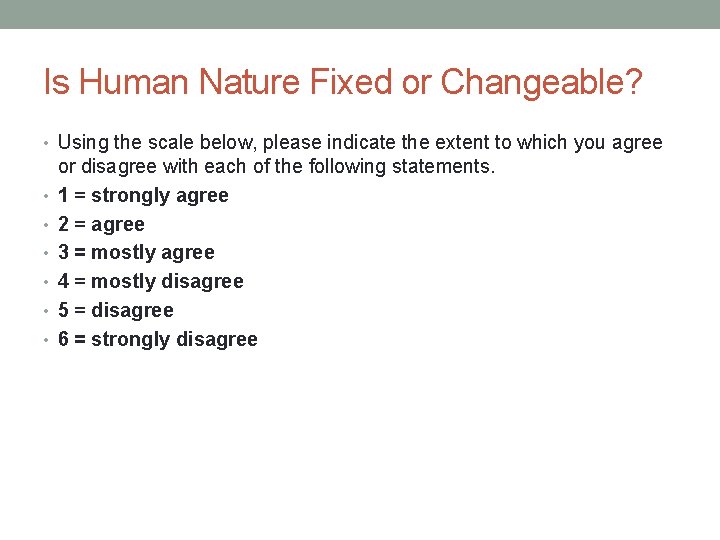
Is Human Nature Fixed or Changeable? • Using the scale below, please indicate the extent to which you agree • • • or disagree with each of the following statements. 1 = strongly agree 2 = agree 3 = mostly agree 4 = mostly disagree 5 = disagree 6 = strongly disagree
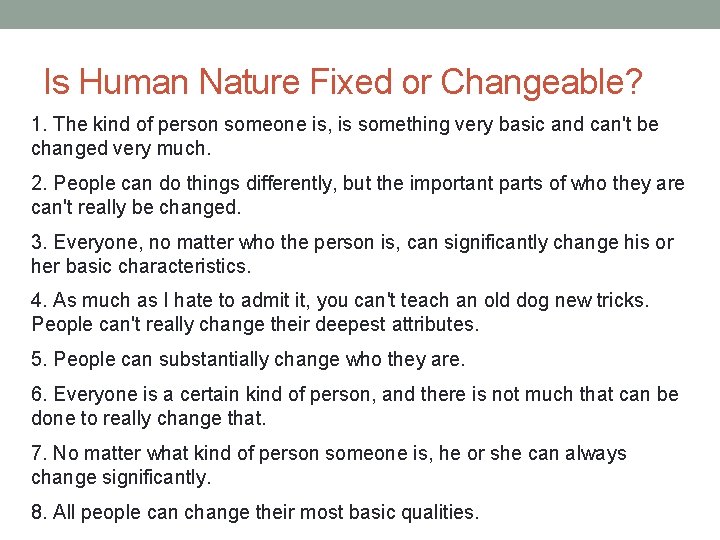
Is Human Nature Fixed or Changeable? 1. The kind of person someone is, is something very basic and can't be changed very much. 2. People can do things differently, but the important parts of who they are can't really be changed. 3. Everyone, no matter who the person is, can significantly change his or her basic characteristics. 4. As much as I hate to admit it, you can't teach an old dog new tricks. People can't really change their deepest attributes. 5. People can substantially change who they are. 6. Everyone is a certain kind of person, and there is not much that can be done to really change that. 7. No matter what kind of person someone is, he or she can always change significantly. 8. All people can change their most basic qualities.
Some strategies • Things I’m looking for this period… • A notebook for your reading and class notes • Materials out and ready for class • http: //coe. jmu. edu/Learning. Toolbox/notetaking. html
PSYCHOLOGY… …a long past but a short history.
Prologue: Psychology’s Roots Prescientific Psychology § Is the mind connected to the body or are they separate? § Are ideas inborn or is the mind a blank slate filled by experience?
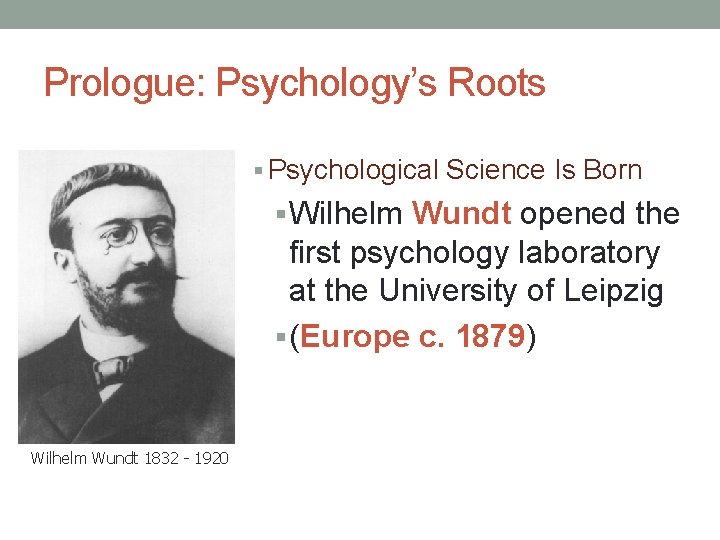
Prologue: Psychology’s Roots § Psychological Science Is Born § Wilhelm Wundt opened the first psychology laboratory at the University of Leipzig § (Europe c. 1879) Wilhelm Wundt 1832 - 1920
Prologue: Psychology’s Roots §Psychological Science Is Born §Empiricism § Knowledge comes from experience via the senses § Science flourishes through observation and experiment
Prologue: Psychology’s Roots §Psychological Science Is Born • New science (1879) created from application of physiology/biology to age-old questions of philosophy
Prologue: Psychology’s Roots §Definition of Psychology §The science of behavior (what we do) and mental processes (sensations, perceptions, dreams, thoughts, beliefs, and feelings)
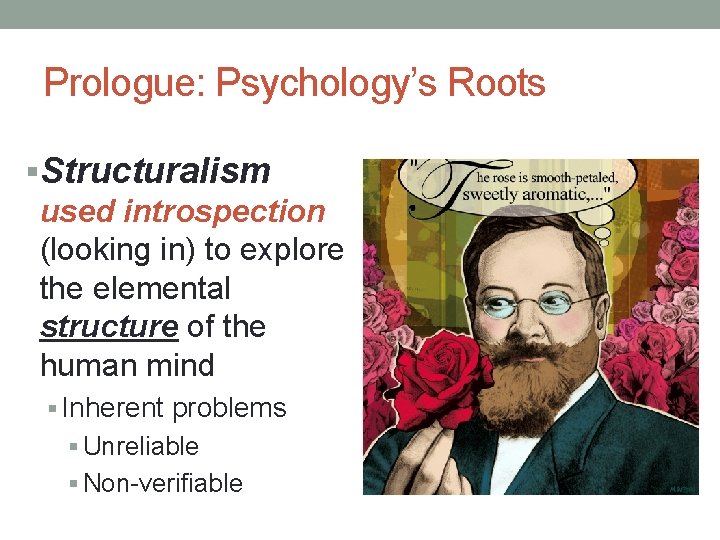
Prologue: Psychology’s Roots §Structuralism used introspection (looking in) to explore the elemental structure of the human mind § Inherent problems § Unreliable § Non-verifiable
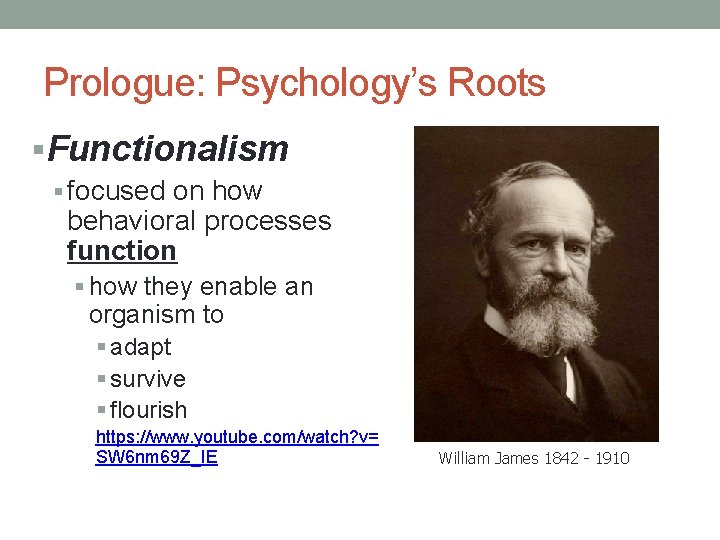
Prologue: Psychology’s Roots §Functionalism § focused on how behavioral processes function § how they enable an organism to § adapt § survive § flourish https: //www. youtube. com/watch? v= SW 6 nm 69 Z_IE William James 1842 - 1910
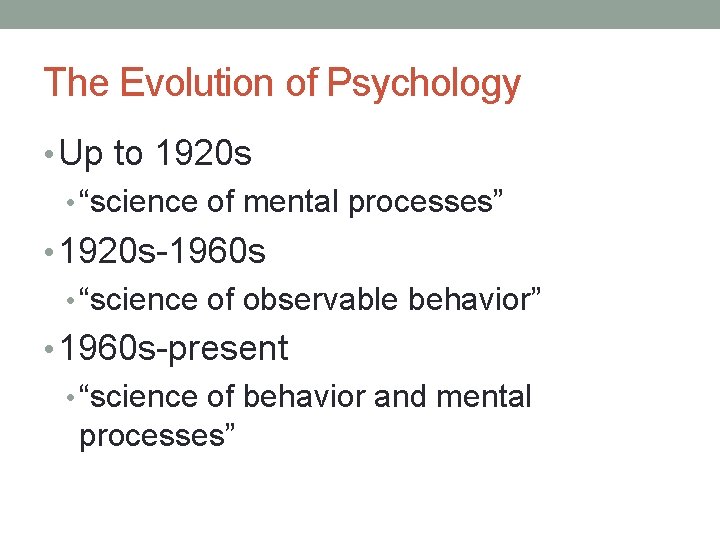
The Evolution of Psychology • Up to 1920 s • “science of mental processes” • 1920 s-1960 s • “science of observable behavior” • 1960 s-present • “science of behavior and mental processes”
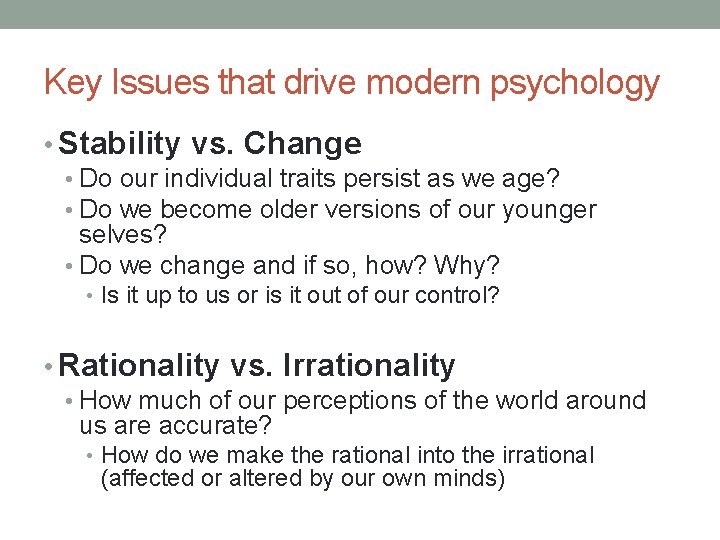
Key Issues that drive modern psychology • Stability vs. Change • Do our individual traits persist as we age? • Do we become older versions of our younger selves? • Do we change and if so, how? Why? • Is it up to us or is it out of our control? • Rationality vs. Irrationality • How much of our perceptions of the world around us are accurate? • How do we make the rational into the irrational (affected or altered by our own minds)
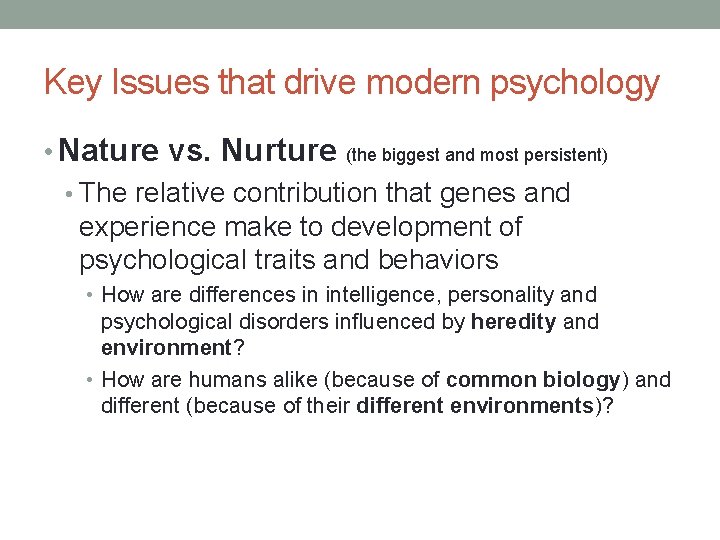
Key Issues that drive modern psychology • Nature vs. Nurture (the biggest and most persistent) • The relative contribution that genes and experience make to development of psychological traits and behaviors • How are differences in intelligence, personality and psychological disorders influenced by heredity and environment? • How are humans alike (because of common biology) and different (because of their different environments)?
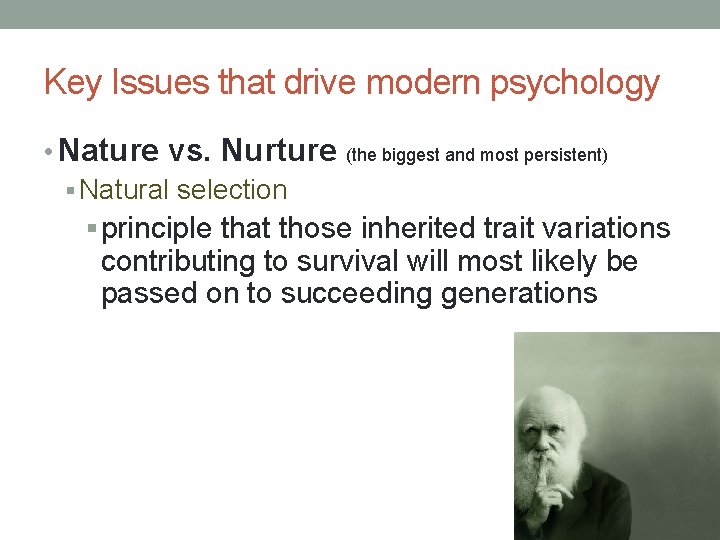
Key Issues that drive modern psychology • Nature vs. Nurture (the biggest and most persistent) § Natural selection § principle that those inherited trait variations contributing to survival will most likely be passed on to succeeding generations
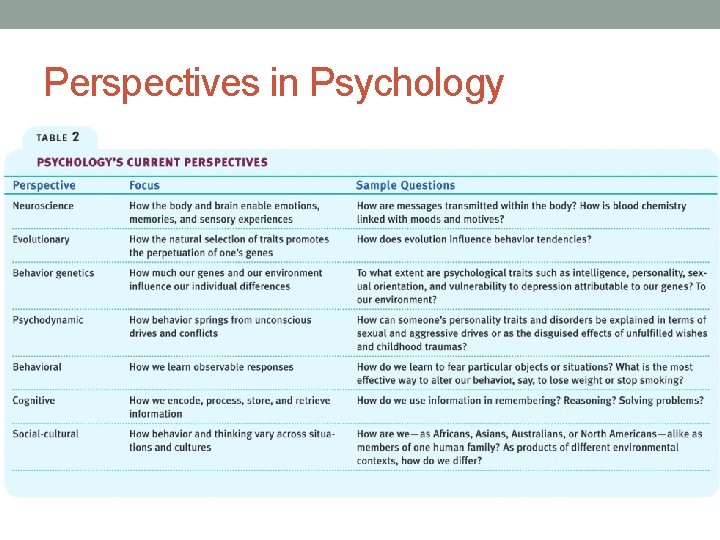
Perspectives in Psychology
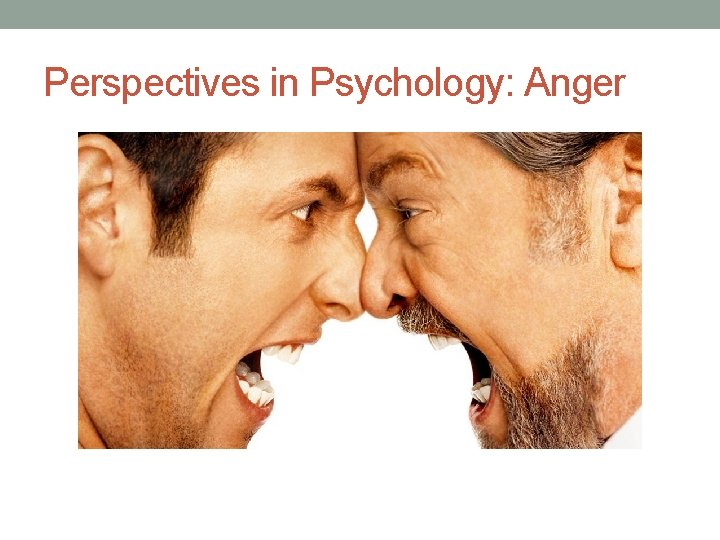
Perspectives in Psychology: Anger
Perspectives in Psychology • Neuroscience perspective • Study the brain circuits that produce physical state of red in the face and hot under the collar • Evolutionary perspective • Study how anger facilitated survival or genes • Behavior genetics perspective • Study how heredity and experience influence our individual differences in temperament • Psychodynamic perspective • How are outbursts an outlet for unconscious hostility or frustration?
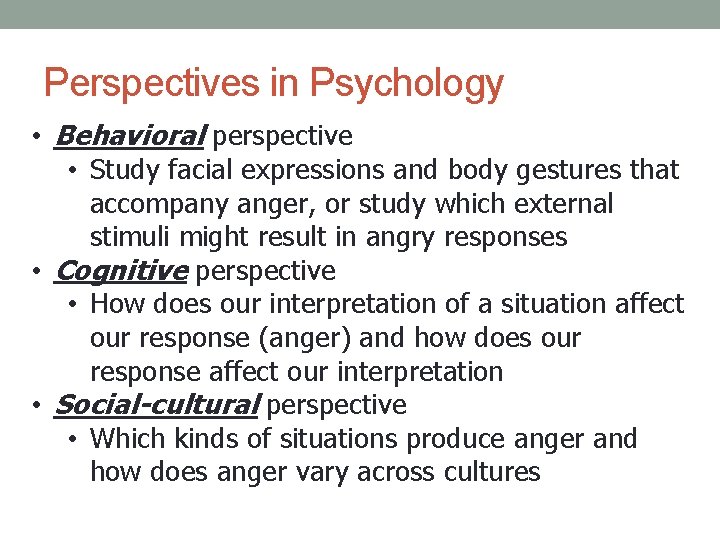
Perspectives in Psychology • Behavioral perspective • Study facial expressions and body gestures that accompany anger, or study which external stimuli might result in angry responses • Cognitive perspective • How does our interpretation of a situation affect our response (anger) and how does our response affect our interpretation • Social-cultural perspective • Which kinds of situations produce anger and how does anger vary across cultures
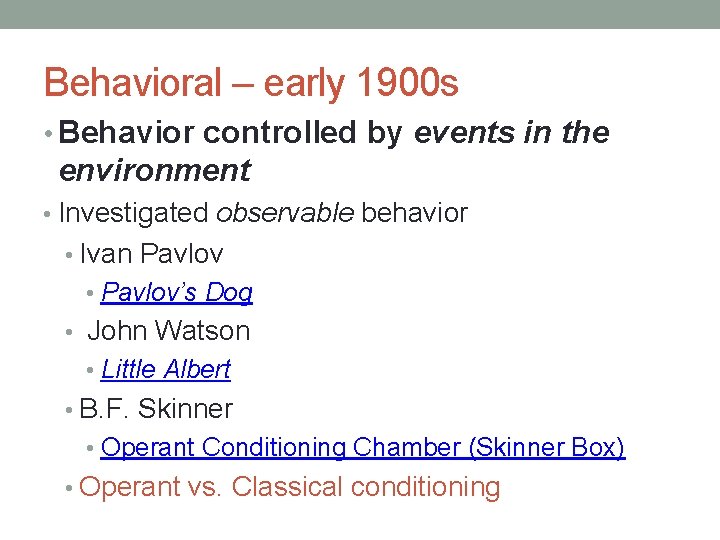
Behavioral – early 1900 s • Behavior controlled by events in the environment • Investigated observable behavior • Ivan Pavlov • Pavlov’s Dog • John Watson • Little Albert • B. F. Skinner • Operant Conditioning Chamber (Skinner Box) • Operant vs. Classical conditioning
Psychodynamic – early 1900 s • Behavior controlled by unconscious fears, drives, and conflicts • Sigmund Freud • personality developed through unconscious experiences: id, ego, superego
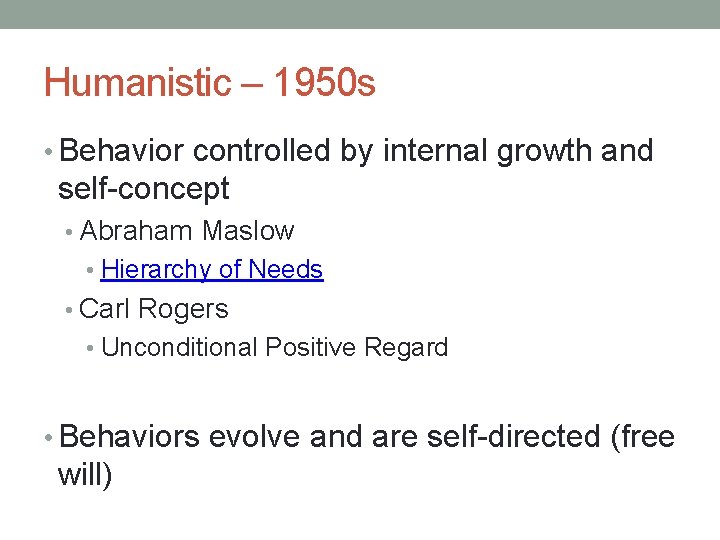
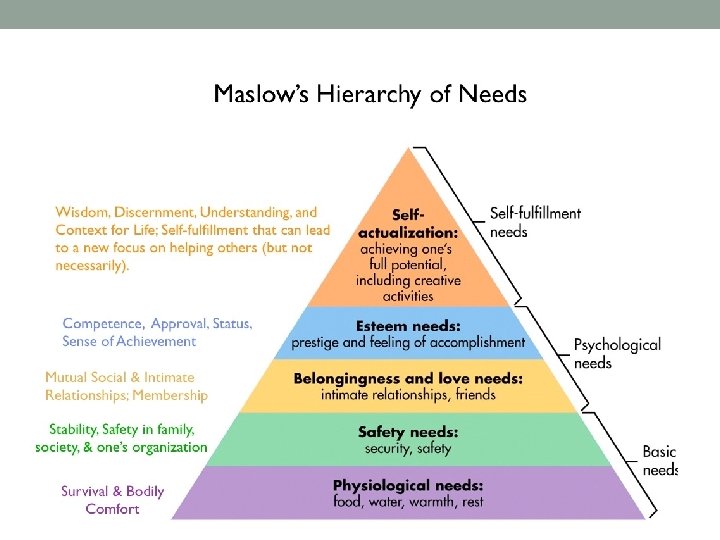
Humanistic – 1950 s • Behavior controlled by internal growth and self-concept • Abraham Maslow • Hierarchy of Needs • Carl Rogers • Unconditional Positive Regard • Behaviors evolve and are self-directed (free will)
Humanistic – 1950 s
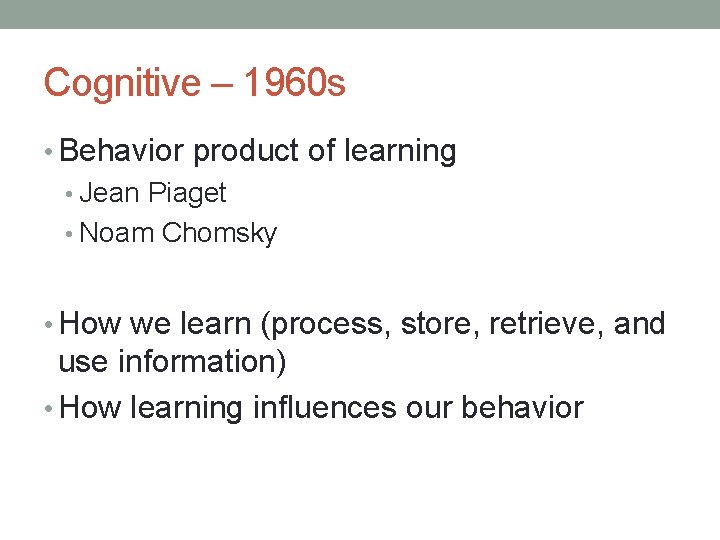
Cognitive – 1960 s • Behavior product of learning • Jean Piaget • Noam Chomsky • How we learn (process, store, retrieve, and use information) • How learning influences our behavior
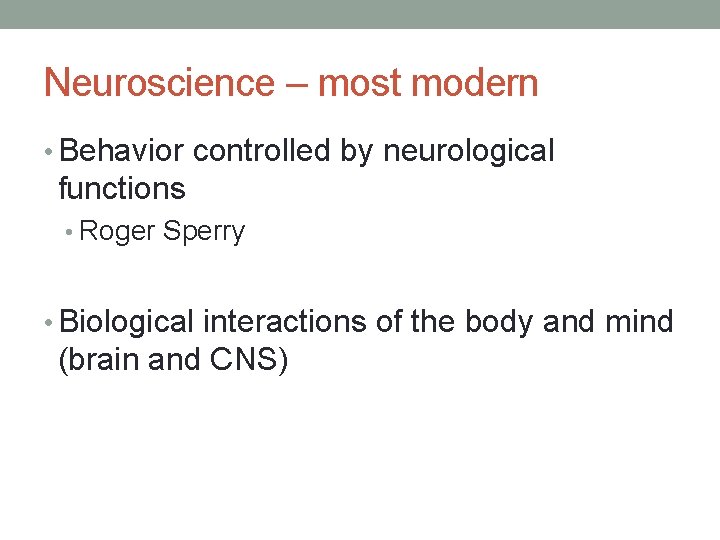
Neuroscience – most modern • Behavior controlled by neurological functions • Roger Sperry • Biological interactions of the body and mind (brain and CNS)
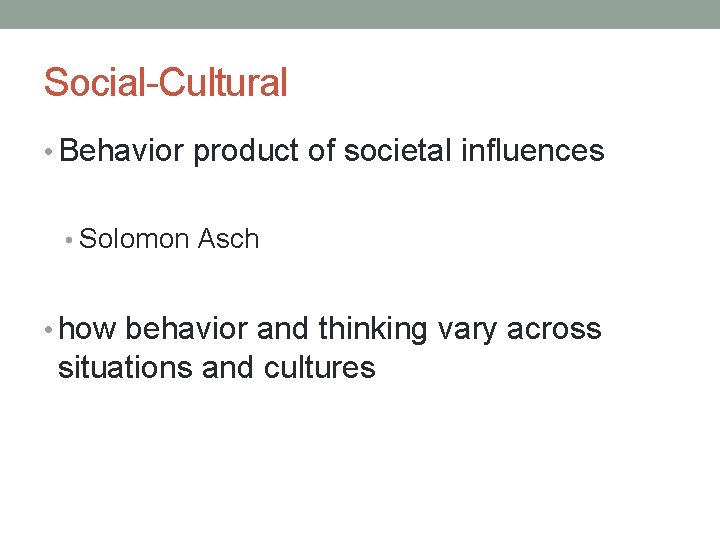
Social-Cultural • Behavior product of societal influences • Solomon Asch • how behavior and thinking vary across situations and cultures
Evolutionary – newest perspective • Behavior product of genetics • (inherited traits) • Charles Darwin • Natural selection of traits promotes perpetuation of genes
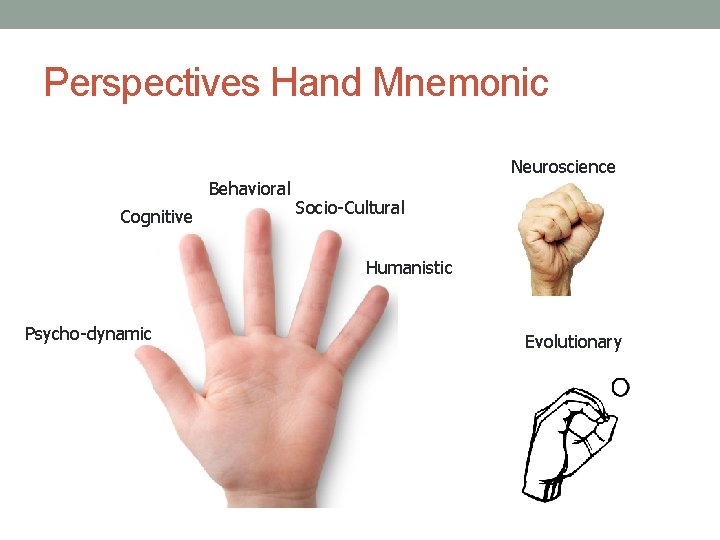
Perspectives Hand Mnemonic Behavioral Cognitive Neuroscience Socio-Cultural Humanistic Psycho-dynamic Evolutionary
Psychological Perspectives • Crash Course • Worksheet: 7 Perspectives 1. Evolutionary 2. Behavior genetics 3. Neuroscience 4. Psychodynamic 5. Cognitive 6. Social-cultural 7. Behavioral 8. Humanistic
Psychological Perspectives: The Scientific Approach • God is dead • The best things in life are free • Shakespeare’s Richard III is a better play than Romeo and Juliet • Abortion is wrong • The mind is like a computer • Attitudes affect cancer • Pornography is harmful • 2+2=4 How might you establish the validity (legitimacy, authority) of each statement? Have you had any classes that might have addressed these issues?
Psychological Perspectives: What’s the point • What is the purpose of Psychology? • Just to “Know More”? • What does that get us? • Is it to make us better people? • Issues can be identified and addressed, thereby “fixing” the individual? • Is it so we “get along” better? • If everyone acts in a “normal” way, AND if we know WHY people who don’t act in a normal way act the way they do, we can build a better society
Psychological Perspectives: What’s the point • What is the purpose of Psychology? • As we delve into the workings of the mind, consider YOUR own motivations and intentions: • WHY do you want to know this stuff? • Why do we teach this stuff (or anything for that matter)?
Perspectives Practice • Peter has some emotional problems and is acting out in school. His teacher notices that – while bright- he lacks self-esteem. He is left alone at home and is not eating properly. She found out recently that he is also homeless. She believes that with time and help, he can reach his full potential. • What perspective might she use to explain or deal with his behavior?
Perspectives Practice • Peter has some emotional problems and is acting out in school. After he begins taking medication, he begins to slow down and focus on his work. He seems to be doing better, but his mood is “off” and he is not his “happy-golucky” self. • What perspective might she use to explain or deal with his behavior?
Perspectives Practice • Peter has some emotional problems and is acting out in school. Upon doing some test, they discover that he excels in visual learning and visual learning cues, while textual cues seem to be a problem. They also learn he may have dyslexia. • What perspective might she use to explain or deal with his behavior?
Perspectives Practice • Peter has some emotional problems and is acting out in school. After further investigation into his past, we discover that both his father and grandfather suffered from aggressive tendencies – including Oppositional Defiant Disorder – and had not received help for their illness. • What perspective might she use to explain or deal with his behavior? • Beth (1: 43)
Psychology Perspectives • Death Penalty – For or Against? • The Andrea Yates Story: 60 minutes • Forensic Psychiatrist Analysis