
Chapter 31 Functional Assessment of the Older Adult


- Slides: 29
Chapter 31 Functional Assessment of the Older Adult Copyright © 2016 by Elsevier, Inc. All rights reserved. Copyright © 2012, 2008, 2004, 2000, 1996, 1993 by Saunders, an affiliate of Elsevier Inc.
Functional Assessment of the Older Adult I Requires knowledge of normal aging changes and effects of chronic diseases, heredity, and lifestyle Comprehensive geriatric assessment is multidimensional and incorporates not only physical examination but also assessments mental status, functional status, social and economic status, pain, and examination of physical environment for safety concerns Multiple disciplines may participate in assessment Early recognition of disabilities and treatable conditions is instrumental in preserving function and quality of life for older adults Copyright © 2016 by Elsevier, Inc. All rights reserved. Copyright © 2012, 2008, 2004, 2000, 1996, 1993 by Saunders, an affiliate of Elsevier Inc. 2
Older Adult Statistics The U. S. has a large and expanding population of older adults In 2010 persons 65 years of age and older totaled 13. 3% of U. S. population and 13. 6 million short hospital stays Ø Older adults are heterogeneous, and differences exist among biological, physical, and emotional rates of aging Ø The cost of personal caregiving was noted at 450 billion in 2005 Ø Copyright © 2016 by Elsevier, Inc. All rights reserved. Copyright © 2012, 2008, 2004, 2000, 1996, 1993 by Saunders, an affiliate of Elsevier Inc. 3
Normal Changes with Aging Do not necessarily represent pathology Ø With imposition of acute and chronic illnesses, including hospitalization, older adults may be predisposed to disability • Older adults may arrive not only with an acute illness, such as pneumonia, but also with ongoing chronic “geriatric syndromes, ” such as urinary incontinence, fragile skin, confusion, problems with eating or feeding, falls, and sleep disorders • If these syndromes are not identified early, an older adult may have functional decline Copyright © 2016 by Elsevier, Inc. All rights reserved. Copyright © 2012, 2008, 2004, 2000, 1996, 1993 by Saunders, an affiliate of Elsevier Inc. 4
Functional Ability Refers to one’s ability to perform activities necessary to live in modern society Ø Includes driving, using telephone, and performing personal tasks, such as bathing and toileting • Also incorporates older adult’s physiologic and psychological status and physical and social environments • Functional status: individual’s actual performance of activities and tasks associated with his or her current life roles and dependent on motivation, vision and hearing, degree of assistance needed to accomplish tasks, and cognition Copyright © 2016 by Elsevier, Inc. All rights reserved. Copyright © 2012, 2008, 2004, 2000, 1996, 1993 by Saunders, an affiliate of Elsevier Inc. 5
Functional Status Functional status is not static; older adults may move continuously through varying stages of independence and disability Ø Lack of social support or safe physical setting are environmental issues affecting functional status and ability to live independently Ø Interaction of these components provides a snapshot of an older adult’s functional status at a given point in time Assessment of function is important geriatric tenet to provide a baseline Ø For continuing comparison and to predict prognosis Ø Assists practitioner with objective measures to determine efficacy of treatments Copyright © 2016 by Elsevier, Inc. All rights reserved. Copyright © 2012, 2008, 2004, 2000, 1996, 1993 by Saunders, an affiliate of Elsevier Inc. 6
Functional Assessment Basis for care planning, goal setting, and discharge planning Needed for eligibility to obtain services, such as durable medical equipment, home modifications, and inpatient or outpatient rehabilitation services For older adult and family, a functional assessment can identify areas for current and future planning Functional assessment includes three overarching domains Activities of daily living (ADLs) Ø Instrumental activities of daily living (IADLs) Ø Mobility Ø Copyright © 2016 by Elsevier, Inc. All rights reserved. Copyright © 2012, 2008, 2004, 2000, 1996, 1993 by Saunders, an affiliate of Elsevier Inc. 7
Approaches to Functional Assessment Two approaches to functional assessment Individual’s self-report about his or her ability to perform tasks Ø Observing his or her ability to perform tasks Ø • For persons with memory problems, use of surrogate reporters (proxy reports), such as family members or caregivers may be necessary, keeping in mind that they may either overestimate or underestimate actual abilities Copyright © 2016 by Elsevier, Inc. All rights reserved. Copyright © 2012, 2008, 2004, 2000, 1996, 1993 by Saunders, an affiliate of Elsevier Inc. 8
Activities of Daily Living (ADLs) ADLs measure tasks necessary for self-care Ø Eating Ø Bathing Ø Grooming (washing, combing hair, shaving, cleaning teeth, dressing) Ø Toileting Ø Walking, including propelling a wheelchair, using stairs Ø Transferring, such as bed to chair • ADL instruments are designed as either self-report, observation of tasks, or proxy/surrogate report Copyright © 2016 by Elsevier, Inc. All rights reserved. Copyright © 2012, 2008, 2004, 2000, 1996, 1993 by Saunders, an affiliate of Elsevier Inc. 9
ADL Instruments Katz Index of Independence in ADL Barthel Index Functional Independence Measure (FIM) Rapid Disability Rating Scale-2 (RDS-2) Copyright © 2016 by Elsevier, Inc. All rights reserved. Copyright © 2012, 2008, 2004, 2000, 1996, 1993 by Saunders, an affiliate of Elsevier Inc. 10
Katz Index of Independence in ADL Based on concept of physical disability and is intended to measure physical function in older adults and the chronically ill Activities assessed are bathing, dressing, toileting, transferring from bed to chair, continence, and feeding Quick to administer and has been revised over time Limitations: unable to directly assess activities in outpatient setting and must rely on self-report or report by proxy Only activities that can be performed without help are rated as independent Copyright © 2016 by Elsevier, Inc. All rights reserved. Copyright © 2012, 2008, 2004, 2000, 1996, 1993 by Saunders, an affiliate of Elsevier Inc. 11
Instrumental Activities of Daily Living Goal of measuring functional abilities necessary for independent community living IADLs include shopping, meal preparation, housekeeping, laundry, managing finances, taking medications, and using transportation Ø These instruments may have cultural and gender biases, especially in older cohorts Ø IADL instruments measure tasks historically done by women, and most do not address activities done primarily by men, such as home repairs and working in yard Ø Copyright © 2016 by Elsevier, Inc. All rights reserved. Copyright © 2012, 2008, 2004, 2000, 1996, 1993 by Saunders, an affiliate of Elsevier Inc. 12
IADL Instruments Lawton Instrumental Activities of Daily Living OARS-IADL , Older Americans Resources and Services Multidimensional Functional Assessment Questionnaire-IADL Direct Assessment of Functional Abilities (DAFA) Copyright © 2016 by Elsevier, Inc. All rights reserved. Copyright © 2012, 2008, 2004, 2000, 1996, 1993 by Saunders, an affiliate of Elsevier Inc. 13
Advanced Activities of Daily Living (AADLs) Activities older adults perform as family member, member of society and community, including occupational and recreational activities Various AADL instruments commonly include selfcare, mobility, work (either paid or volunteer), recreational activities/hobbies, and socialization Ø Occupational therapists often perform assessment of AADLs Ø Older adult sets priorities for these activities so that interventions can be individualized Ø Copyright © 2016 by Elsevier, Inc. All rights reserved. Copyright © 2012, 2008, 2004, 2000, 1996, 1993 by Saunders, an affiliate of Elsevier Inc. 14
AADL Instruments Physical Performance Test (PPT) Performance Activities of Daily Living (PADL) Up and Go Test Copyright © 2016 by Elsevier, Inc. All rights reserved. Copyright © 2012, 2008, 2004, 2000, 1996, 1993 by Saunders, an affiliate of Elsevier Inc. 15
Question The nurse is assessing the patient’s ability to bathe and dress herself. The nurse knows this type of assessment is considered: 1. the Mini-Cog. 2. independent activities of daily living. 3. dependent activities of daily living. 4. activities of daily living. Copyright © 2016 by Elsevier, Inc. All rights reserved. Copyright © 2012, 2008, 2004, 2000, 1996, 1993 by Saunders, an affiliate of Elsevier Inc. 16
Assessment of Cognition Assessment of cognitive status in older adults is an important part of the functional assessment Domains of cognition included in most mental status assessments Attention Ø Memory Ø Orientation Ø Language Ø Visuospatial skills Ø Higher cognitive functions Ø Copyright © 2016 by Elsevier, Inc. All rights reserved. Copyright © 2012, 2008, 2004, 2000, 1996, 1993 by Saunders, an affiliate of Elsevier Inc. 17
Altered Cognition in Older Adults Commonly attributed to three disorders Dementia Ø Delirium Ø Depression Ø Copyright © 2016 by Elsevier, Inc. All rights reserved. Copyright © 2012, 2008, 2004, 2000, 1996, 1993 by Saunders, an affiliate of Elsevier Inc. 18
Social Domain Focuses on relationships within family, social groups, and community Comprises multiple dimensions, including sources of formal and informal assistance available from those relationships Ø Comprehensive social assessment is typically spread over several evaluation periods Ø Copyright © 2016 by Elsevier, Inc. All rights reserved. Copyright © 2012, 2008, 2004, 2000, 1996, 1993 by Saunders, an affiliate of Elsevier Inc. 19
Informal and Formal Support Informal support Includes family and close long-time friends, and is usually provided free of charge Ø Services provided include tasks such as shopping, bathing, feeding, and paying bills Ø Formal supports Include programs such as social welfare and other social service and health care delivery agencies such as home health care Ø Several studies conclude that presence of a caregiver is most important factor in discharge plan of older adults from an acute care hospital Ø Several standardized assessment instruments are available to provide structured assessment Ø Copyright © 2016 by Elsevier, Inc. All rights reserved. Copyright © 2012, 2008, 2004, 2000, 1996, 1993 by Saunders, an affiliate of Elsevier Inc. 20
Caregiver Assessment I Most elders with functional impairment live with help of informal support Spouse, daughter, or other family member Ø High levels of functional dependency place a burden on caregiver and may result in caregiver Ø • • • Burnout Sleep disturbances Depression Morbidity Increased mortality Copyright © 2016 by Elsevier, Inc. All rights reserved. Copyright © 2012, 2008, 2004, 2000, 1996, 1993 by Saunders, an affiliate of Elsevier Inc. 21
Caregiver Assessment II Older person’s need for institutionalization often better predicted from assessment of caregiver than from severity of patient’s illness Ø Health and well-being of patient and caregiver are closely linked • Part of caring for a frail elder involves paying attention to the well-being of caregiver • Social worker may help identify programs, such as caregiver support groups, respite programs, adult day care, or hired home health aides Copyright © 2016 by Elsevier, Inc. All rights reserved. Copyright © 2012, 2008, 2004, 2000, 1996, 1993 by Saunders, an affiliate of Elsevier Inc. 22
Assessment of Caregiver Burden All caregivers should be screened for caregiver burden Caregiver burden is perceived strain by person who cares for an elderly, chronically ill, or disabled person Ø Caregiver burden is linked to caregiver’s ability to cope and handle stress Ø Level of care older adult requires may exceed caregiver ability Ø Signs of possible caregiver burnout include multiple somatic complaints, increased stress and anxiety, social isolation, depression, and weight loss Ø Copyright © 2016 by Elsevier, Inc. All rights reserved. Copyright © 2012, 2008, 2004, 2000, 1996, 1993 by Saunders, an affiliate of Elsevier Inc. 23
Caregiver Strain Index Screening tool that identifies caregivers needing a more comprehensive assessment Ø Brief tool with 13 questions addressing potential strain in employment, financial, physical, social, and time domains Ø Caregiver stress can lead to mistreatment of older adults Ø Thorough assessment may identify opportunities to prevent and stop mistreatment of older adults Copyright © 2016 by Elsevier, Inc. All rights reserved. Copyright © 2012, 2008, 2004, 2000, 1996, 1993 by Saunders, an affiliate of Elsevier Inc. 24
Contexts of Care Location of the heath care setting contributes to the ability to perform a comprehensive functional assessment Different types of settings Ø Ø Ø Acute care Community Home care Nursing facilities Assisted living Continuing-care retirement communities Maintaining independence Exercise Ø Health care maintenance Ø Copyright © 2016 by Elsevier, Inc. All rights reserved. Copyright © 2012, 2008, 2004, 2000, 1996, 1993 by Saunders, an affiliate of Elsevier Inc. 25
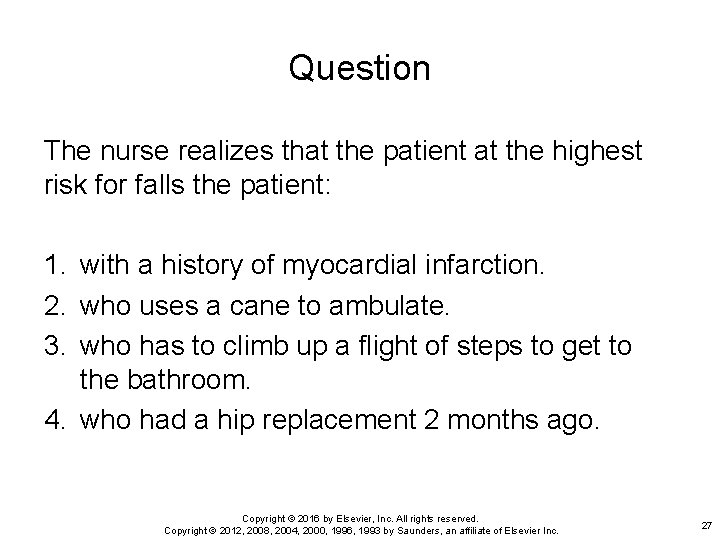
Environmental Assessments Physical environment: Observations to determine safety Falls: Nearly 30% of older adults fall in the community Older adult drivers: 8% of all traffic injuries and 18% of all pedestrian fatalities Sleep: Screening tools to measure sleep pattern Spiritual assessment: Individualized inquiry Special considerations: May require more time to examine Cultural considerations: May impact care and influence decision making Copyright © 2016 by Elsevier, Inc. All rights reserved. Copyright © 2012, 2008, 2004, 2000, 1996, 1993 by Saunders, an affiliate of Elsevier Inc. 26
Question The nurse realizes that the patient at the highest risk for falls the patient: 1. with a history of myocardial infarction. 2. who uses a cane to ambulate. 3. who has to climb up a flight of steps to get to the bathroom. 4. who had a hip replacement 2 months ago. Copyright © 2016 by Elsevier, Inc. All rights reserved. Copyright © 2012, 2008, 2004, 2000, 1996, 1993 by Saunders, an affiliate of Elsevier Inc. 27
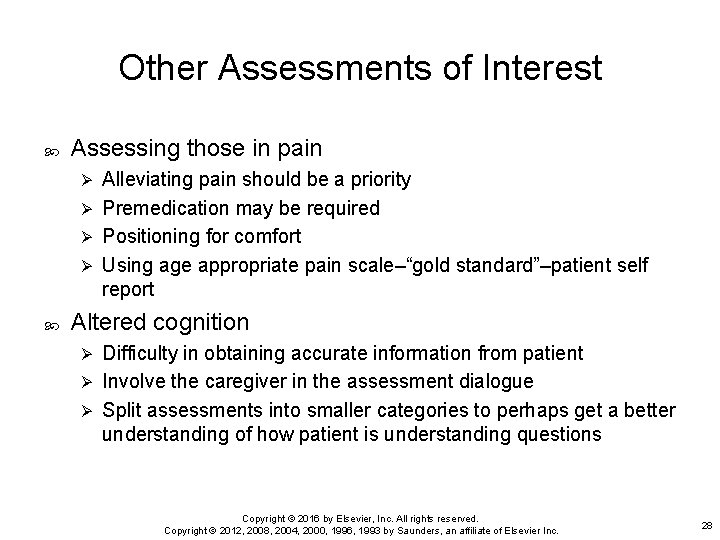
Other Assessments of Interest Assessing those in pain Alleviating pain should be a priority Ø Premedication may be required Ø Positioning for comfort Ø Using age appropriate pain scale–“gold standard”–patient self report Ø Altered cognition Difficulty in obtaining accurate information from patient Ø Involve the caregiver in the assessment dialogue Ø Split assessments into smaller categories to perhaps get a better understanding of how patient is understanding questions Ø Copyright © 2016 by Elsevier, Inc. All rights reserved. Copyright © 2012, 2008, 2004, 2000, 1996, 1993 by Saunders, an affiliate of Elsevier Inc. 28
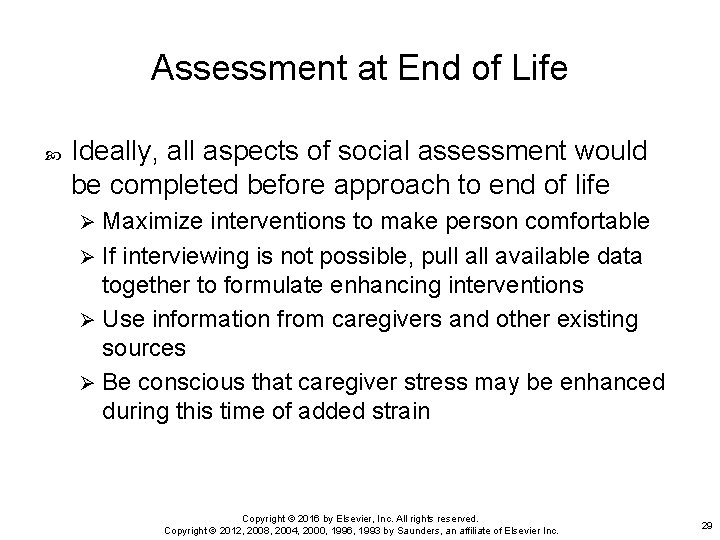
Assessment at End of Life Ideally, all aspects of social assessment would be completed before approach to end of life Maximize interventions to make person comfortable Ø If interviewing is not possible, pull available data together to formulate enhancing interventions Ø Use information from caregivers and other existing sources Ø Be conscious that caregiver stress may be enhanced during this time of added strain Ø Copyright © 2016 by Elsevier, Inc. All rights reserved. Copyright © 2012, 2008, 2004, 2000, 1996, 1993 by Saunders, an affiliate of Elsevier Inc. 29