
Snow Anchor Testing v Snow anchor testing was


- Slides: 25
Snow Anchor Testing
v. Snow anchor testing was done on February 21 st, 2009 at Tombstone Pass, Oregon. v. The weather was in the high 30 s to low 40 s, mostly sunny, and no wind. v. The anchors were all placed in an east facing, 15 to 20 degree, slope. v. Testing was conducted using a 7/16 in static rope, a 4: 1 pulley system, and a steady increase in force with no bouncing
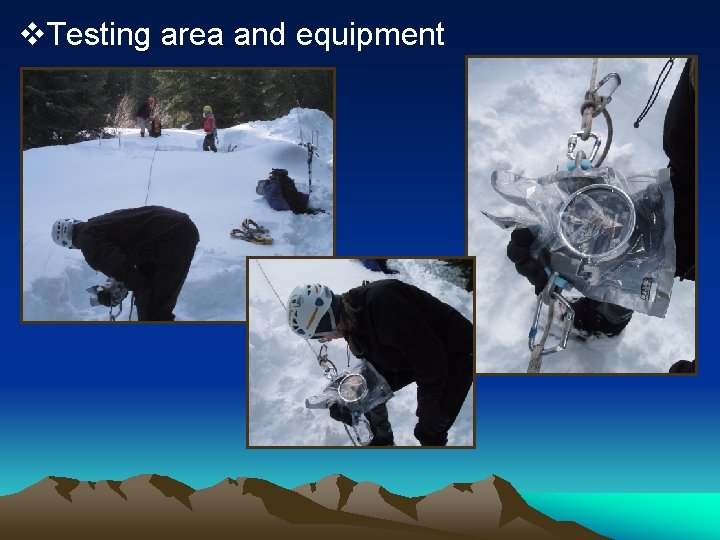
v. Testing area and equipment
v. The top 14 in of snow could not be work hardened very well in the morning since there was little water content v. By the afternoon, the top 14 in of snow was wetter and work hardening was fairly effective v. Surface work hardening did not extend below about 16 in due to the hard layers at 14 in and 20 in
v“T” picket was MSR Coyote v“V” picket was Yates Expedition v 8 mm sling was Mammut Contact Dyneema v 8 mm cord was Liberty Mountain accessory v. Dynamometer was a Dillon with a 2, 500 pound capacity and a maximum force recording needle v. Dynamometer was last verified in 1989 to be within 50 pounds of true force
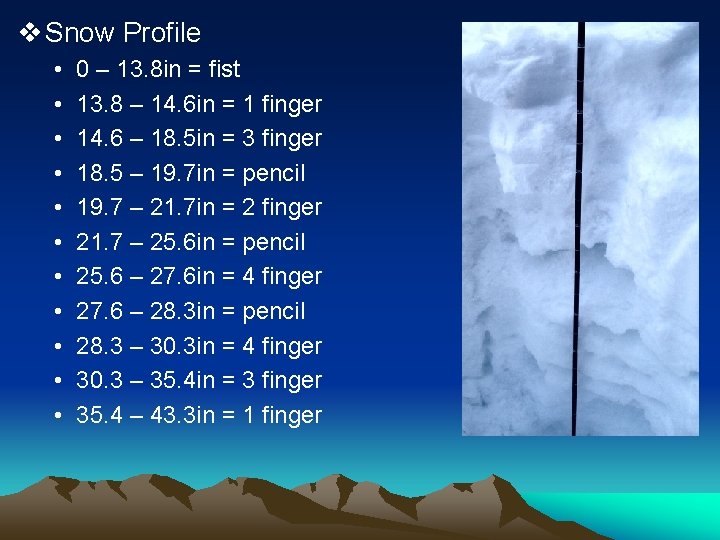
v Snow Profile • • • 0 – 13. 8 in = fist 13. 8 – 14. 6 in = 1 finger 14. 6 – 18. 5 in = 3 finger 18. 5 – 19. 7 in = pencil 19. 7 – 21. 7 in = 2 finger 21. 7 – 25. 6 in = pencil 25. 6 – 27. 6 in = 4 finger 27. 6 – 28. 3 in = pencil 28. 3 – 30. 3 in = 4 finger 30. 3 – 35. 4 in = 3 finger 35. 4 – 43. 3 in = 1 finger
v. Anchor 1 • • 36 in single vertical “T” picket No hardening Placed to top of snow pack Carabiner with 8 mm cord First levers forward at 80 lbs Total failure at 110 lbs Failure was levering forward then pulling out
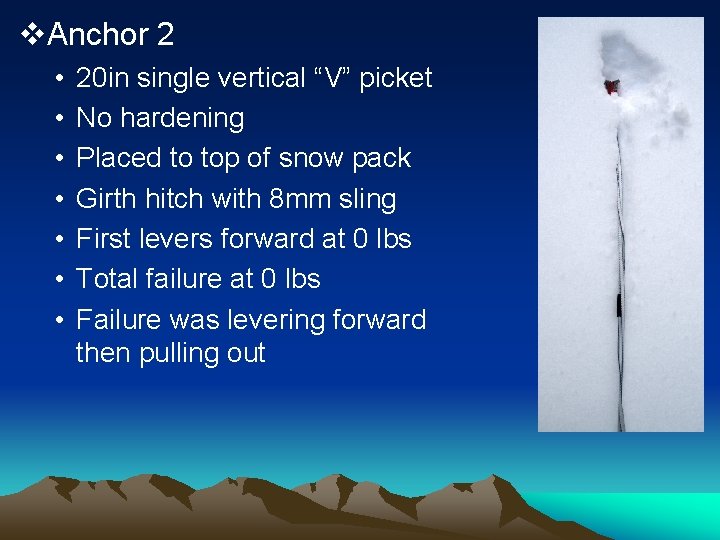
v. Anchor 2 • • 20 in single vertical “V” picket No hardening Placed to top of snow pack Girth hitch with 8 mm sling First levers forward at 0 lbs Total failure at 0 lbs Failure was levering forward then pulling out
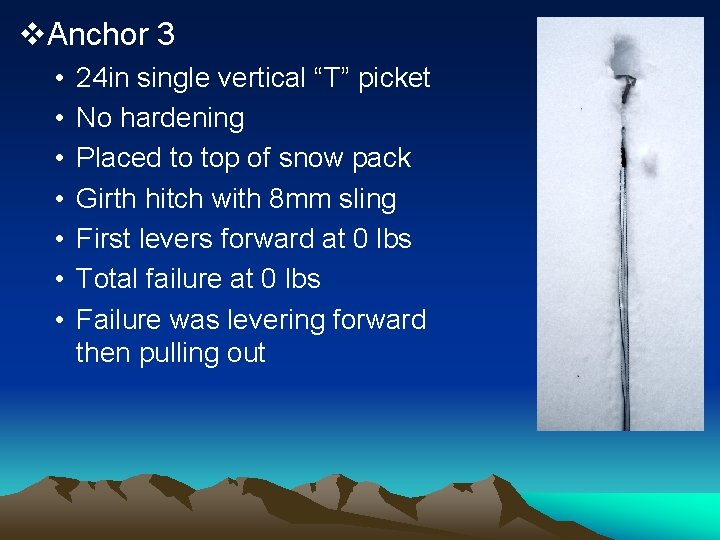
v. Anchor 3 • • 24 in single vertical “T” picket No hardening Placed to top of snow pack Girth hitch with 8 mm sling First levers forward at 0 lbs Total failure at 0 lbs Failure was levering forward then pulling out
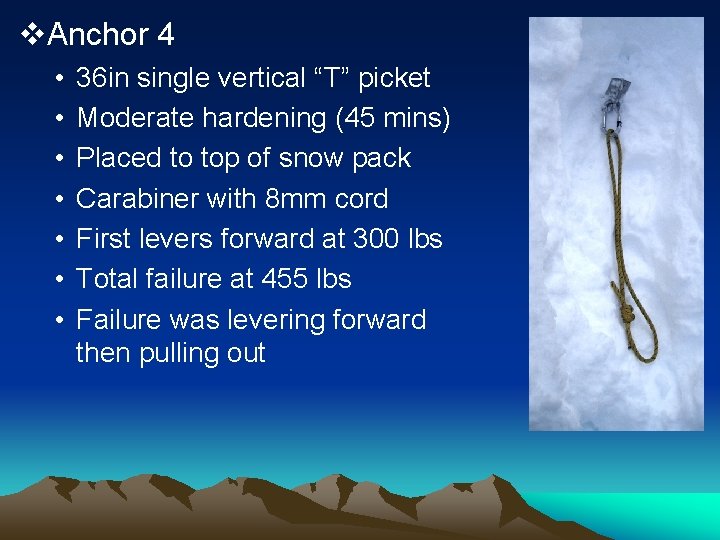
v. Anchor 4 • • 36 in single vertical “T” picket Moderate hardening (45 mins) Placed to top of snow pack Carabiner with 8 mm cord First levers forward at 300 lbs Total failure at 455 lbs Failure was levering forward then pulling out
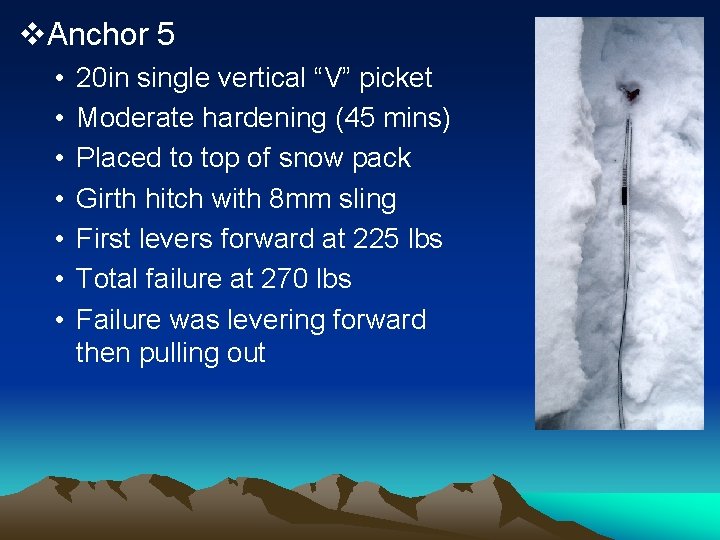
v. Anchor 5 • • 20 in single vertical “V” picket Moderate hardening (45 mins) Placed to top of snow pack Girth hitch with 8 mm sling First levers forward at 225 lbs Total failure at 270 lbs Failure was levering forward then pulling out
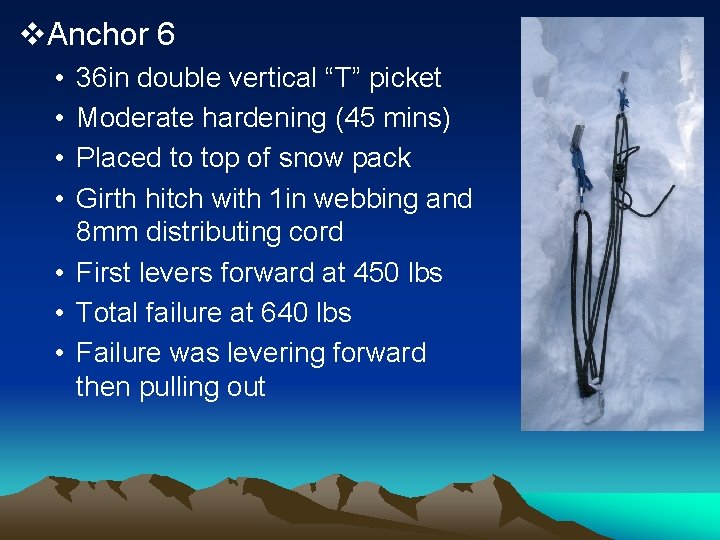
v. Anchor 6 • • 36 in double vertical “T” picket Moderate hardening (45 mins) Placed to top of snow pack Girth hitch with 1 in webbing and 8 mm distributing cord • First levers forward at 450 lbs • Total failure at 640 lbs • Failure was levering forward then pulling out
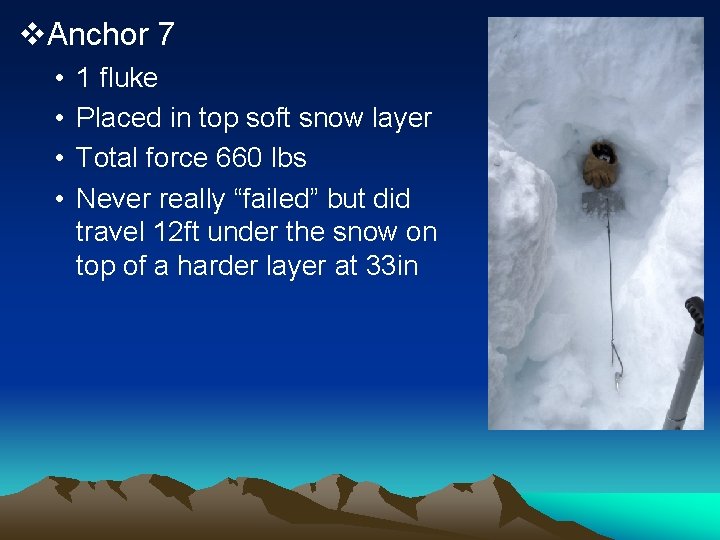
v. Anchor 7 • • 1 fluke Placed in top soft snow layer Total force 660 lbs Never really “failed” but did travel 12 ft under the snow on top of a harder layer at 33 in
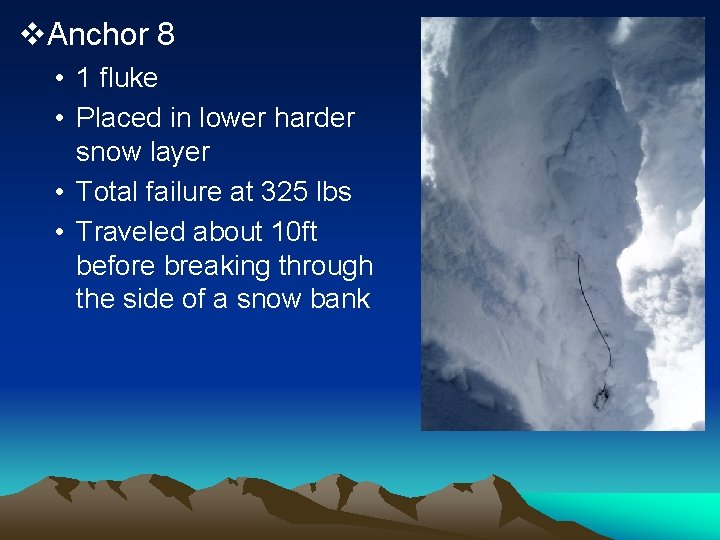
v. Anchor 8 • 1 fluke • Placed in lower harder snow layer • Total failure at 325 lbs • Traveled about 10 ft before breaking through the side of a snow bank
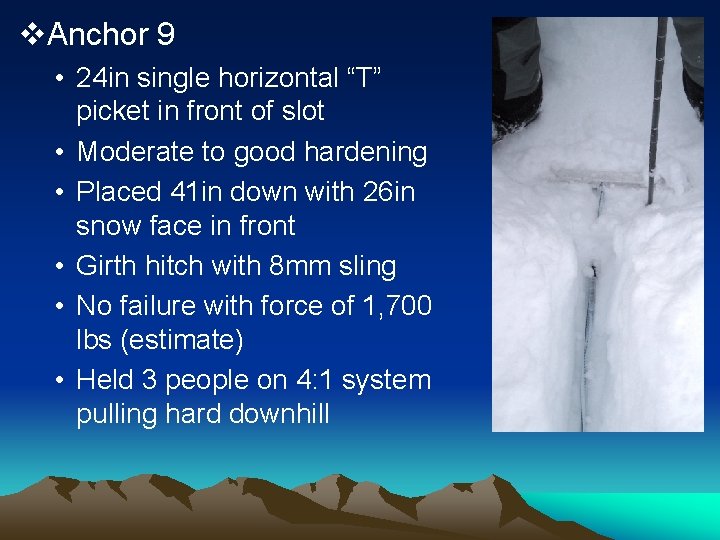
v. Anchor 9 • 24 in single horizontal “T” picket in front of slot • Moderate to good hardening • Placed 41 in down with 26 in snow face in front • Girth hitch with 8 mm sling • No failure with force of 1, 700 lbs (estimate) • Held 3 people on 4: 1 system pulling hard downhill
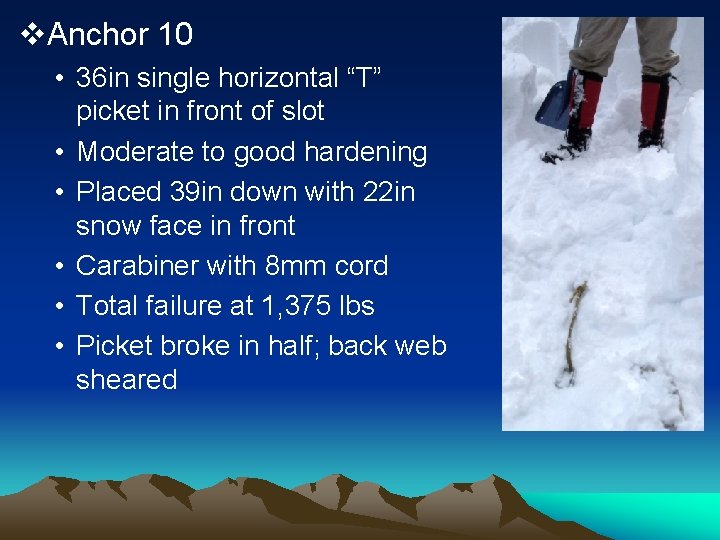
v. Anchor 10 • 36 in single horizontal “T” picket in front of slot • Moderate to good hardening • Placed 39 in down with 22 in snow face in front • Carabiner with 8 mm cord • Total failure at 1, 375 lbs • Picket broke in half; back web sheared
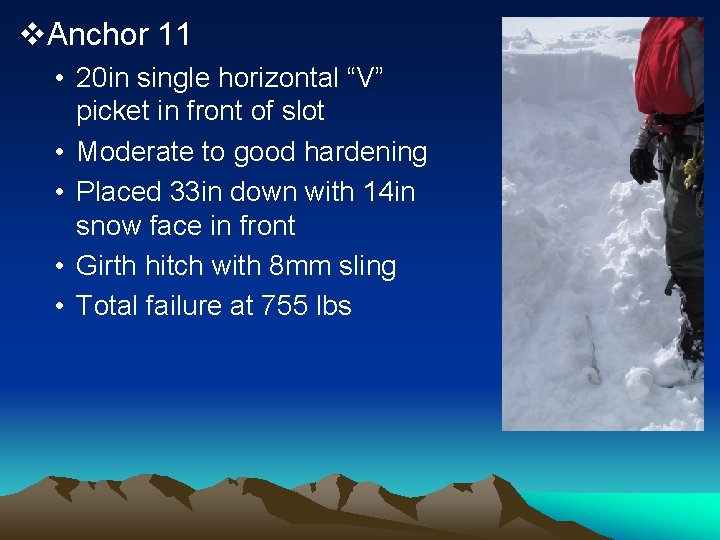
v. Anchor 11 • 20 in single horizontal “V” picket in front of slot • Moderate to good hardening • Placed 33 in down with 14 in snow face in front • Girth hitch with 8 mm sling • Total failure at 755 lbs
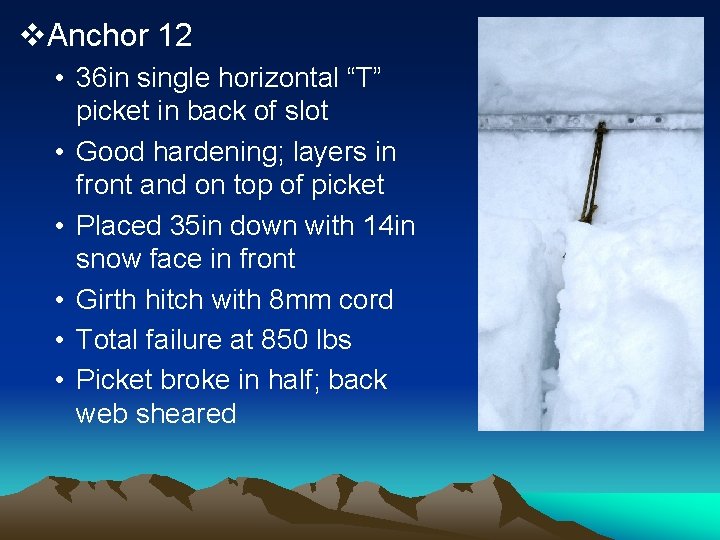
v. Anchor 12 • 36 in single horizontal “T” picket in back of slot • Good hardening; layers in front and on top of picket • Placed 35 in down with 14 in snow face in front • Girth hitch with 8 mm cord • Total failure at 850 lbs • Picket broke in half; back web sheared
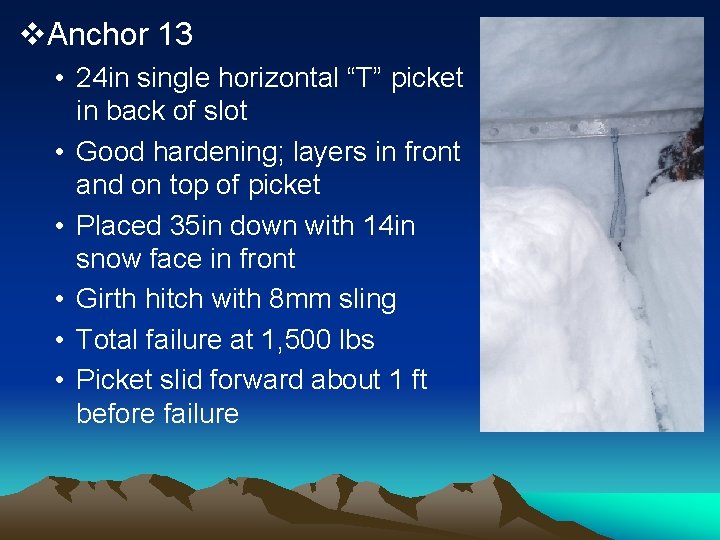
v. Anchor 13 • 24 in single horizontal “T” picket in back of slot • Good hardening; layers in front and on top of picket • Placed 35 in down with 14 in snow face in front • Girth hitch with 8 mm sling • Total failure at 1, 500 lbs • Picket slid forward about 1 ft before failure
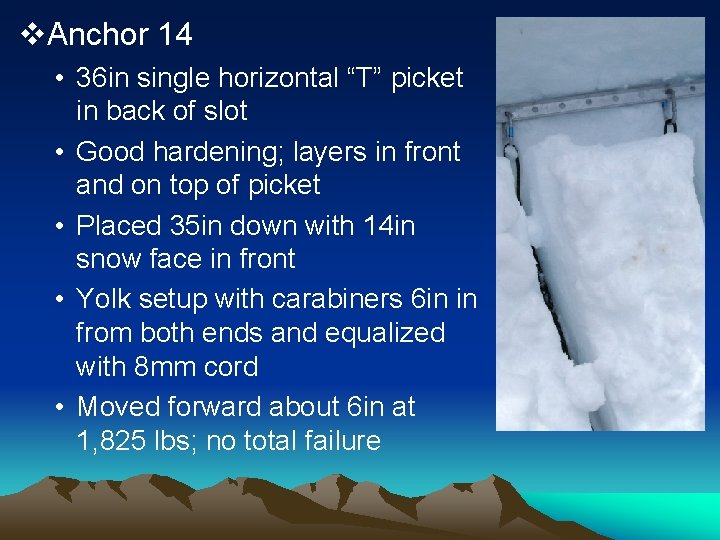
v. Anchor 14 • 36 in single horizontal “T” picket in back of slot • Good hardening; layers in front and on top of picket • Placed 35 in down with 14 in snow face in front • Yolk setup with carabiners 6 in in from both ends and equalized with 8 mm cord • Moved forward about 6 in at 1, 825 lbs; no total failure
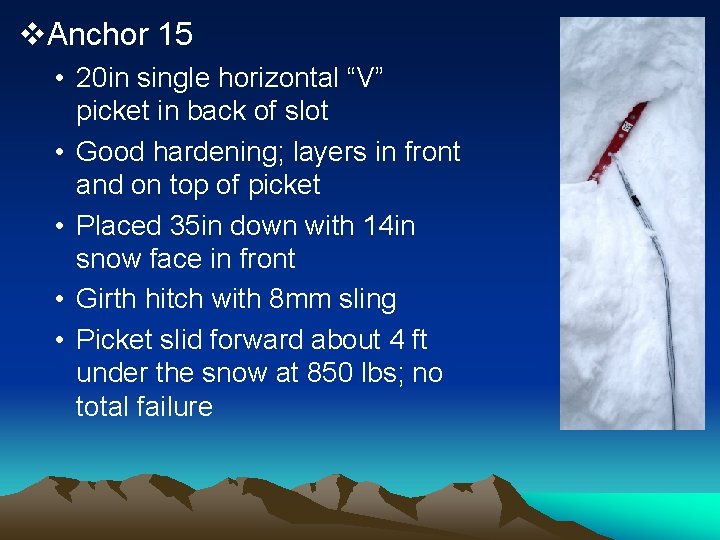
v. Anchor 15 • 20 in single horizontal “V” picket in back of slot • Good hardening; layers in front and on top of picket • Placed 35 in down with 14 in snow face in front • Girth hitch with 8 mm sling • Picket slid forward about 4 ft under the snow at 850 lbs; no total failure
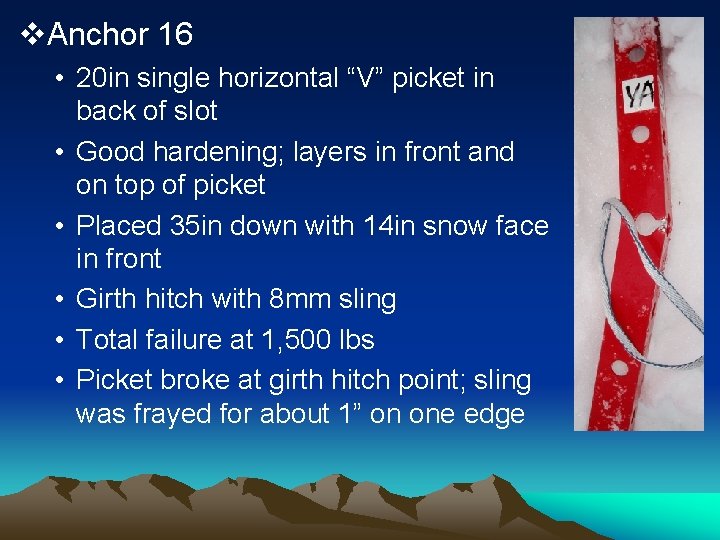
v. Anchor 16 • 20 in single horizontal “V” picket in back of slot • Good hardening; layers in front and on top of picket • Placed 35 in down with 14 in snow face in front • Girth hitch with 8 mm sling • Total failure at 1, 500 lbs • Picket broke at girth hitch point; sling was frayed for about 1” on one edge
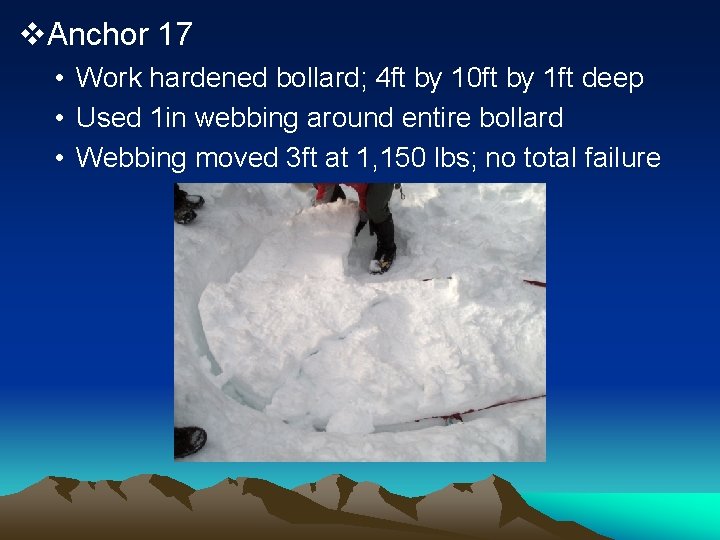
v. Anchor 17 • Work hardened bollard; 4 ft by 10 ft by 1 ft deep • Used 1 in webbing around entire bollard • Webbing moved 3 ft at 1, 150 lbs; no total failure
v. Potential Lessons • Given the snow conditions, some anchors can travel a long distance through the snow and not actually totally fail. • The 36 in “T” pickets seem prone to structural failure. It looks like the picket may roll up or down enough to transfer force to the thinner back web which breaks. • The 20 in “V” pickets do not seem to perform as well as the 24 in “T” pickets. The travel under snow and the structural failure were surprising.
v. Potential Lessons • Given the snow conditions, even three sets of work hardened, backed up, vertical pickets would not have met CMRU’s safety margin. • Given the snow conditions, the most reliable anchor system would be two 24 in horizontal “T” pickets with a distributed power point. This would met CMRU’s safety margin. • CMRU needs to explore the use of mid-point clip vertical picket. This has been shown to often be the strongest type of snow anchor.