
Chapter 30 Psychosocial Needs of the Older Adult
- Slides: 14
Chapter 30 Psychosocial Needs of the Older Adult Copyright © 2014, 2010, 2006 by Saunders, an imprint of Elsevier Inc.
Mental Health Issues Related to Aging Depression—not a normal part of aging Depression and suicide risk—white males older than age 75 at highest risk Anxiety disorders Delirium—secondary to general medical condition Dementia Alcohol abuse Copyright © 2014, 2010, 2006 by Saunders, an imprint of Elsevier Inc. 2
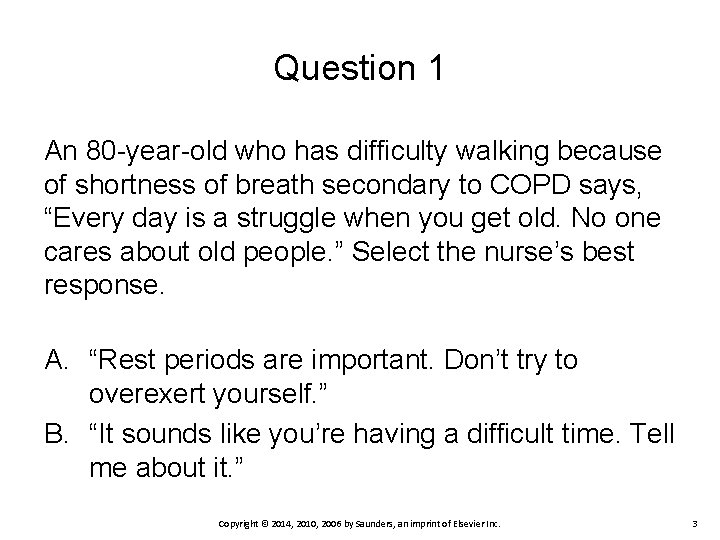
Question 1 An 80 -year-old who has difficulty walking because of shortness of breath secondary to COPD says, “Every day is a struggle when you get old. No one cares about old people. ” Select the nurse’s best response. A. “Rest periods are important. Don’t try to overexert yourself. ” B. “It sounds like you’re having a difficult time. Tell me about it. ” Copyright © 2014, 2010, 2006 by Saunders, an imprint of Elsevier Inc. 3
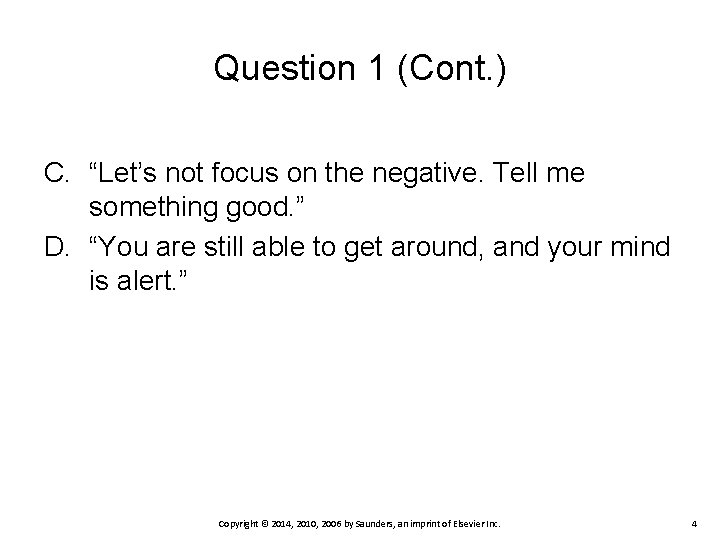
Question 1 (Cont. ) C. “Let’s not focus on the negative. Tell me something good. ” D. “You are still able to get around, and your mind is alert. ” Copyright © 2014, 2010, 2006 by Saunders, an imprint of Elsevier Inc. 4
Pain Barriers to accurate pain assessment Assessment tools Wong-Baker FACES Pain Rating Scale Ø Present pain intensity (PPI) rating from the Mc. Gill Pain Questionnaire (MPQ) Ø Pain Assessment in Advanced Dementia (PAINAD) scale Ø Pain Management Pharmacological pain treatments Ø Nonpharmacological pain treatments Ø Copyright © 2014, 2010, 2006 by Saunders, an imprint of Elsevier Inc. 5
Health Care Concerns of Older Adults Financial burden Caregiver burden Ageism and public policy Ø Ageism and research Ø Copyright © 2014, 2010, 2006 by Saunders, an imprint of Elsevier Inc. 6
Health Care Decision Making Advance directives Patient Self-Determination Act Ø Psychiatric advance directives Ø Living will Directive to physician Durable power of attorney for health care Guardianship Copyright © 2014, 2010, 2006 by Saunders, an imprint of Elsevier Inc. 7
Nursing Care of Older Adults Theories of aging (Box 30 -5) Facts and myths about aging (Box 30 -6) Assessment strategies (Figure 30 -4) Geriatric Depression Scale (Box 30 -7) Helpful techniques for interviewing older adults (Box 30 -8) Copyright © 2014, 2010, 2006 by Saunders, an imprint of Elsevier Inc. 8
Case Study A nurse is going to interview an elderly patient. What are some techniques the nurse could use to help the patient feel more comfortable? Copyright © 2014, 2010, 2006 by Saunders, an imprint of Elsevier Inc. 9
Intervention Strategies Environmental intervention Psychosocial interventions Pharmacological interventions Promotion of self-care activities Teamwork and safety Copyright © 2014, 2010, 2006 by Saunders, an imprint of Elsevier Inc. 10
Care Settings Skilled nursing facilities Residential care settings Partial hospitalization Day treatment programs Behavioral health home care Community-based programs Copyright © 2014, 2010, 2006 by Saunders, an imprint of Elsevier Inc. 11
Question 2 A community mental health nurse plans an educational program for the staff of a home health agency specializing in care of the elderly. A topic of high priority should be A. B. C. D. identifying clinical depression in older adults. identifying nutritional deficiencies in the elderly. providing cost-effective foot care for the elderly. psychosocial stimulation for those who live alone. Copyright © 2014, 2010, 2006 by Saunders, an imprint of Elsevier Inc. 12
Audience Response Questions 1. Which component of Medicare assists seniors to pay for prescription drugs? A. Part A B. Part B C. Part C D. Part D Copyright © 2014, 2010, 2006 by Saunders, an imprint of Elsevier Inc. 13
Audience Response Questions 2. A family member of a patient with advanced dementia says to the nurse, “I will sign the consent for my mother’s surgery. ” What is the nurse’s best response? A. “This should be a family decision. When will your siblings arrive? ” B. “Please show me the court order designating you as guardian. ” C. “Thank you. Please use a black ballpoint pen to sign. ” D. “The patient is able to sign her own consent. ” Copyright © 2014, 2010, 2006 by Saunders, an imprint of Elsevier Inc. 14