Weve found an exponential expression for operators n
- Slides: 27
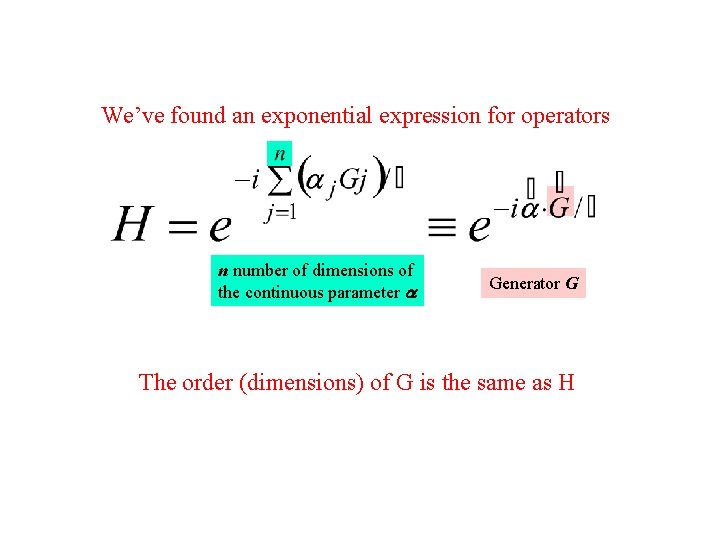
We’ve found an exponential expression for operators n number of dimensions of the continuous parameter Generator G The order (dimensions) of G is the same as H
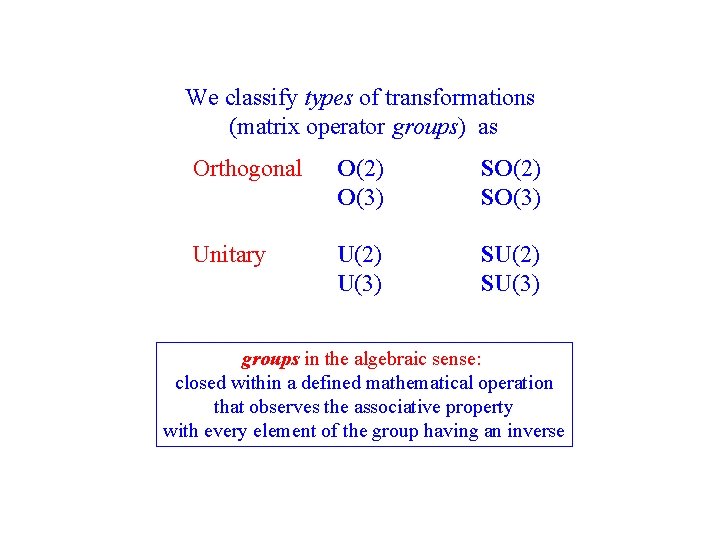
We classify types of transformations (matrix operator groups) as Orthogonal O(2) O(3) SO(2) SO(3) Unitary U(2) U(3) SU(2) SU(3) groups in the algebraic sense: closed within a defined mathematical operation that observes the associative property with every element of the group having an inverse
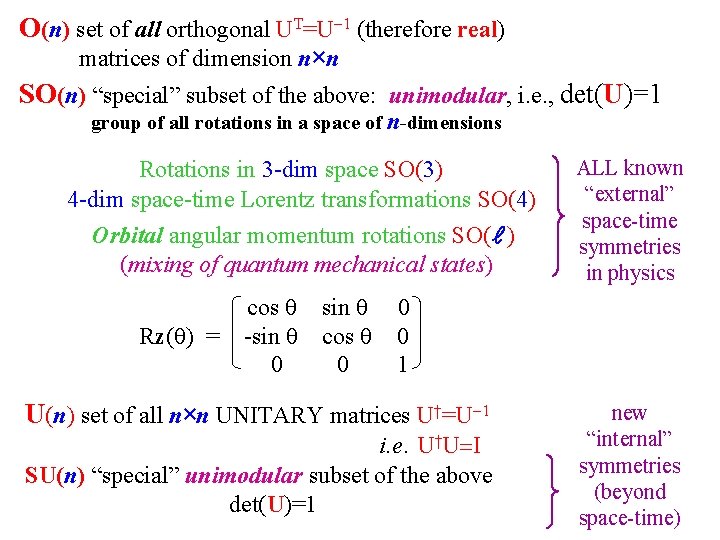
O(n) set of all orthogonal UT=U-1 (therefore real) matrices of dimension n×n SO(n) “special” subset of the above: unimodular, i. e. , det(U)=1 group of all rotations in a space of n-dimensions Rotations in 3 -dim space SO(3) 4 -dim space-time Lorentz transformations SO(4) Orbital angular momentum rotations SO(ℓ ) (mixing of quantum mechanical states) Rz( ) = cos sin -sin cos 0 0 ALL known “external” space-time symmetries in physics 0 0 1 U(n) set of all n×n UNITARY matrices U†=U-1 i. e. U†U=I SU(n) “special” unimodular subset of the above det(U)=1 new “internal” symmetries (beyond space-time)
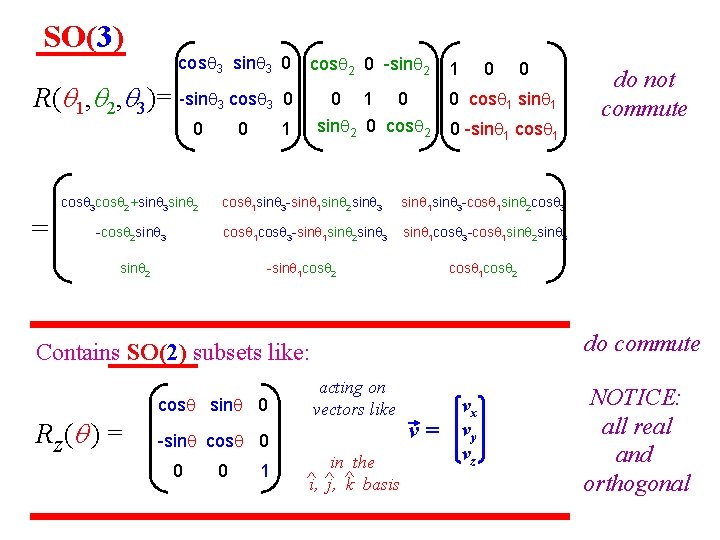
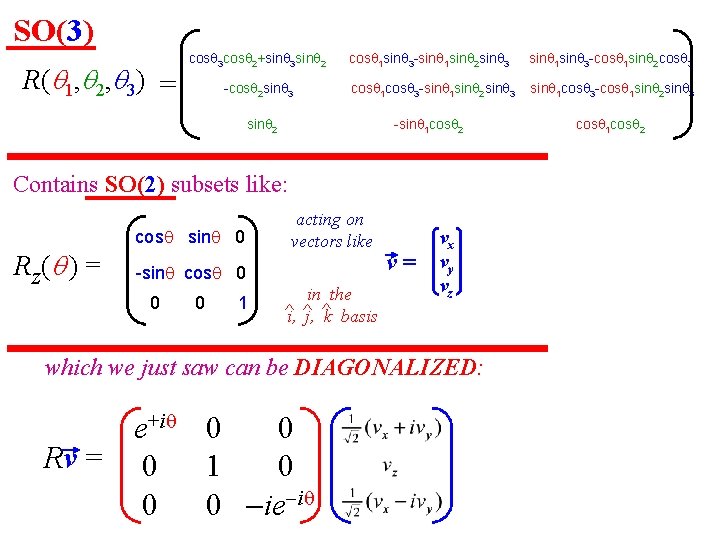
SO(3) cos 3 sin 3 0 R( 1, 2, 3)= -sin 3 cos 3 0 = 0 cos 2 0 -sin 2 0 0 1 0 sin 2 0 cos 2 1 1 0 0 0 cos 1 sin 1 0 -sin 1 cos 3 cos 2+sin 3 sin 2 cos 1 sin 3 -sin 1 sin 2 sin 3 sin 1 sin 3 -cos 1 sin 2 cos 3 -cos 2 sin 3 cos 1 cos 3 -sin 1 sin 2 sin 3 sin 1 cos 3 -cos 1 sin 2 sin 3 sin 2 -sin 1 cos 2 cos 1 cos 2 do commute Contains SO(2) subsets like: R z ( ) = cos sin 0 acting on vectors like -sin cos 0 0 0 1 do not commute in the ^i, ^j, ^ k basis v= vx vy vz NOTICE: all real and orthogonal
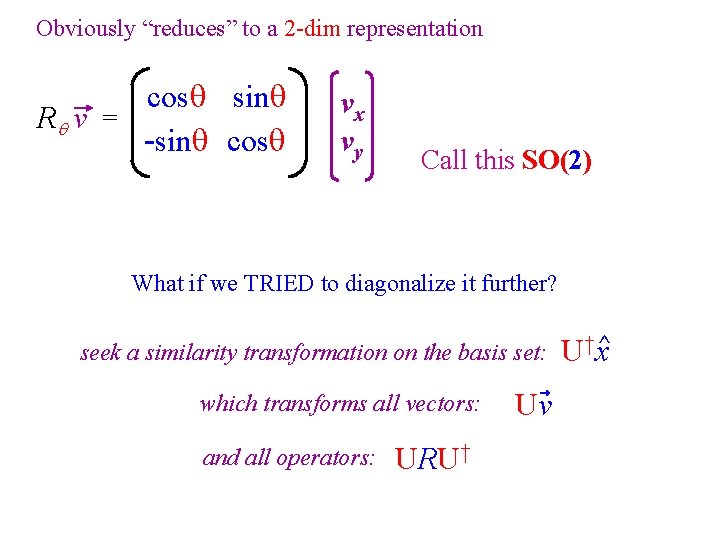
Obviously “reduces” to a 2 -dim representation cos sin R v = -sin cos vx vy Call this SO(2) What if we TRIED to diagonalize it further? seek a similarity transformation on the basis set: which transforms all vectors: and all operators: URU† Uv U†x^
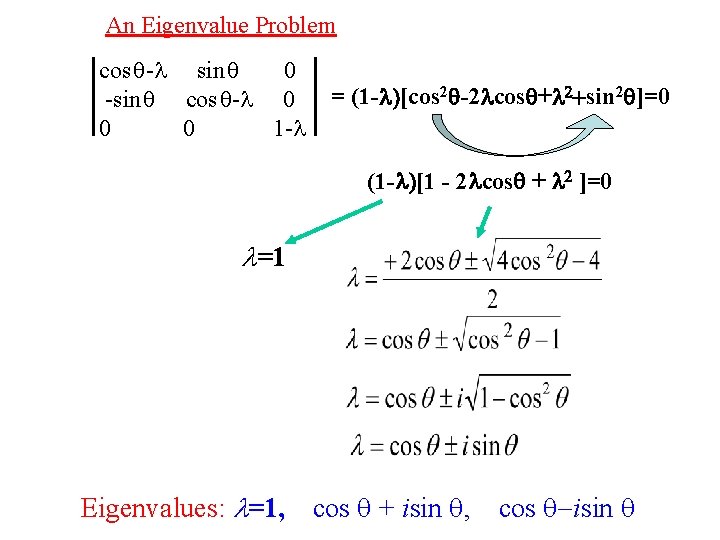
An Eigenvalue Problem cos -l sin 0 -sin cos -l 0 0 0 1 -l 2 -2 lcos +l 2+sin 2 ]=0 ==(1 -l)[cos 0 (1 -l)[1 - 2 lcos + l 2 ]=0 l=1 Eigenvalues: l=1, cos + isin , cos -isin
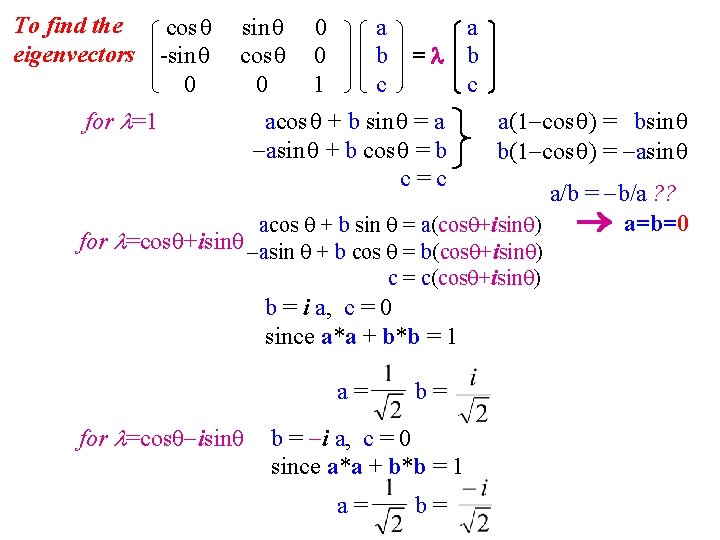
To find the eigenvectors cos -sin 0 sin cos 0 for l=1 0 0 1 a b c a =l b c acos + b sin = a -asin + b cos = b c=c a(1 -cos ) = bsin b(1 -cos ) = -asin a/b = -b/a ? ? a=b=0 acos + b sin = a(cos +isin ) for l=cos +isin -asin + b cos = b(cos +isin ) c = c(cos +isin ) b = i a, c = 0 since a*a + b*b = 1 a= for l=cos -isin b= b = -i a, c = 0 since a*a + b*b = 1 a= b=
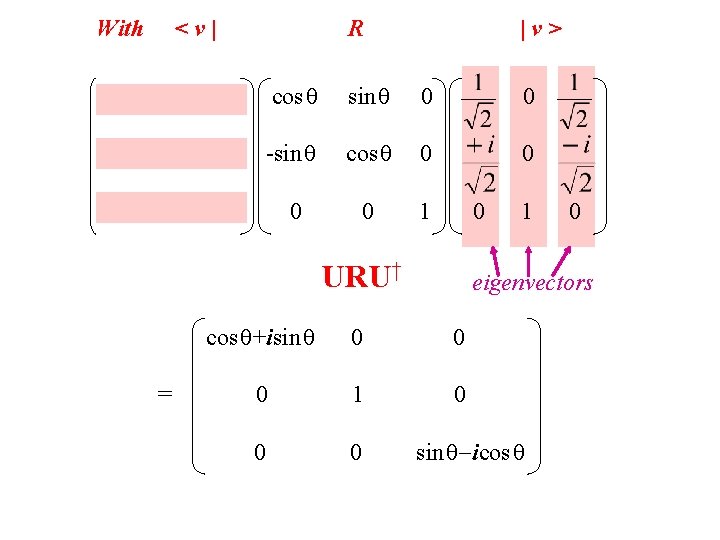
With <v| R |v> cos sin 0 0 -sin cos 0 0 1 0 URU† = 1 0 eigenvectors cos +isin 0 0 0 1 0 0 0 sin -icos
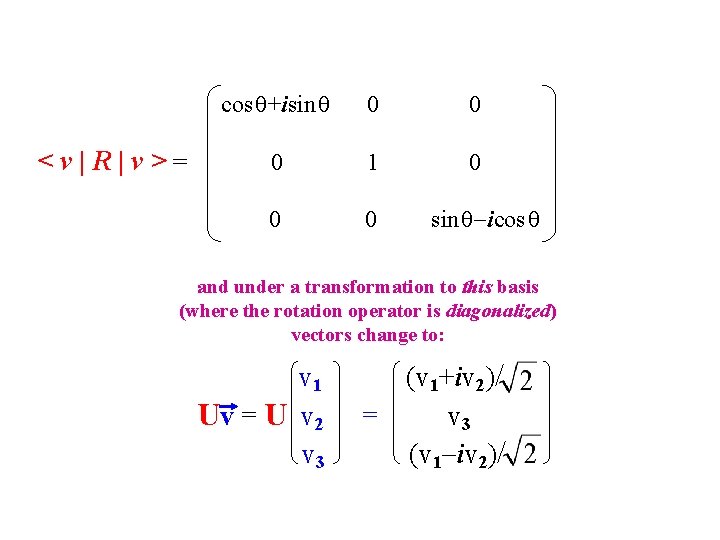
<v|R|v>= cos +isin 0 0 0 1 0 0 0 sin -icos and under a transformation to this basis (where the rotation operator is diagonalized) vectors change to: v 1 Uv = U v 2 v 3 = (v 1+iv 2)/ v 3 (v 1 -iv 2)/
SO(3) R( 1, 2, 3) = cos 3 cos 2+sin 3 sin 2 cos 1 sin 3 -sin 1 sin 2 sin 3 sin 1 sin 3 -cos 1 sin 2 cos 3 -cos 2 sin 3 cos 1 cos 3 -sin 1 sin 2 sin 3 sin 1 cos 3 -cos 1 sin 2 sin 3 sin 2 -sin 1 cos 2 cos 1 cos 2 Contains SO(2) subsets like: R z ( ) = cos sin 0 acting on vectors like -sin cos 0 0 0 1 in the ^i, ^j, ^ k basis v= vx vy vz which we just saw can be DIAGONALIZED: e+i 0 0 Rv = 0 1 0 0 0 -ie-i
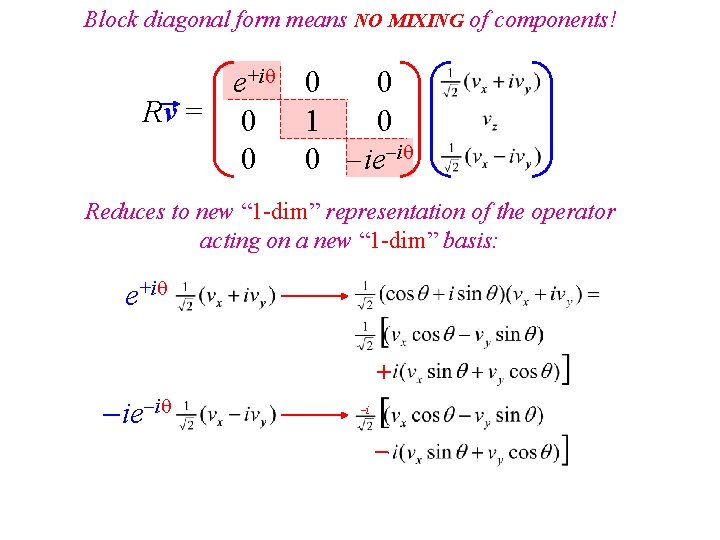
Block diagonal form means NO MIXING of components! e+i 0 0 Rv = 0 1 0 0 0 -ie-i Reduces to new “ 1 -dim” representation of the operator acting on a new “ 1 -dim” basis: e+i + -ie-i -i -
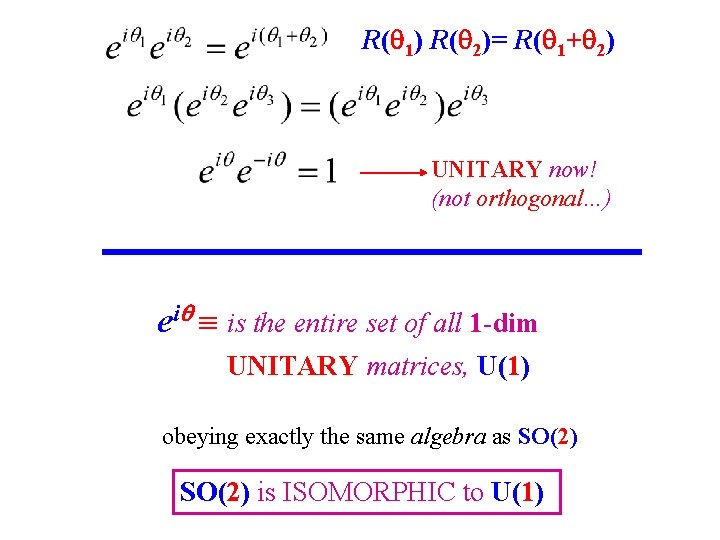
R( 1) R( 2)= R( 1+ 2) UNITARY now! (not orthogonal…) ei is the entire set of all 1 -dim UNITARY matrices, U(1) obeying exactly the same algebra as SO(2) is ISOMORPHIC to U(1)
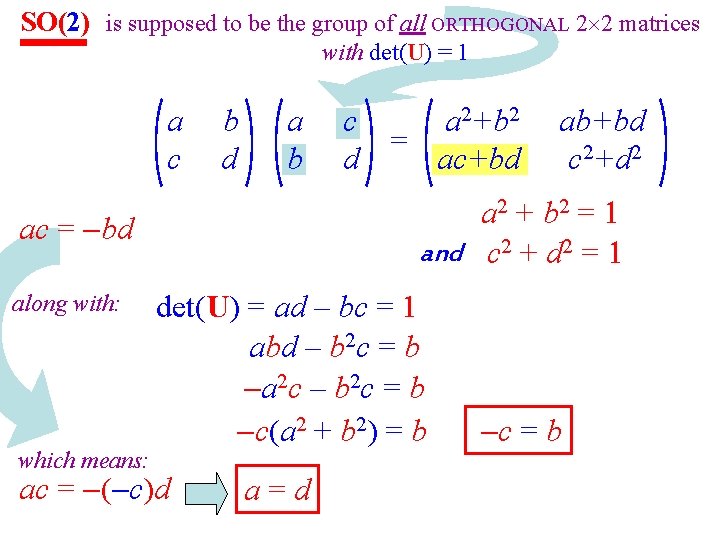
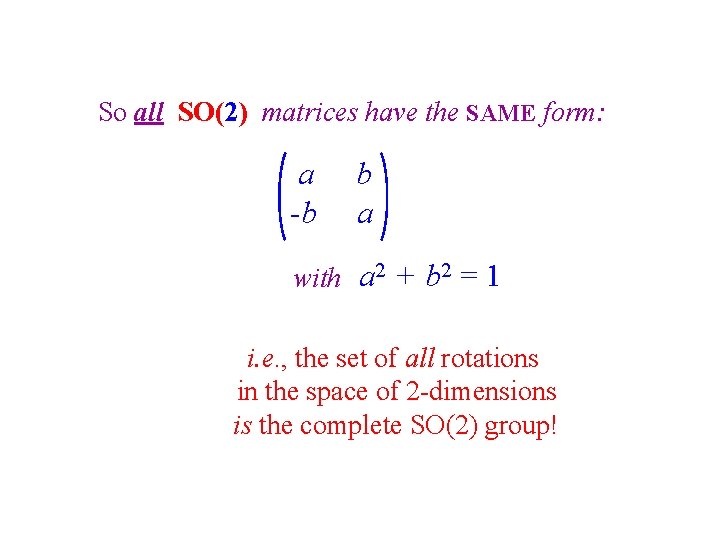
SO(2) is supposed to be the group of all ORTHOGONAL 2 2 matrices with det(U) = 1 a c b d a b which means: ab+bd c 2+d 2 a 2 + b 2 = 1 and c 2 + d 2 = 1 ac = -bd along with: c a 2+b 2 = d ac+bd det(U) = ad – bc = 1 abd – b 2 c = b -a 2 c – b 2 c = b -c(a 2 + b 2) = b ac = -(-c)d a=d -c = b
So all SO(2) matrices have the SAME form: a -b b a with a 2 + b 2 = 1 i. e. , the set of all rotations in the space of 2 -dimensions is the complete SO(2) group!
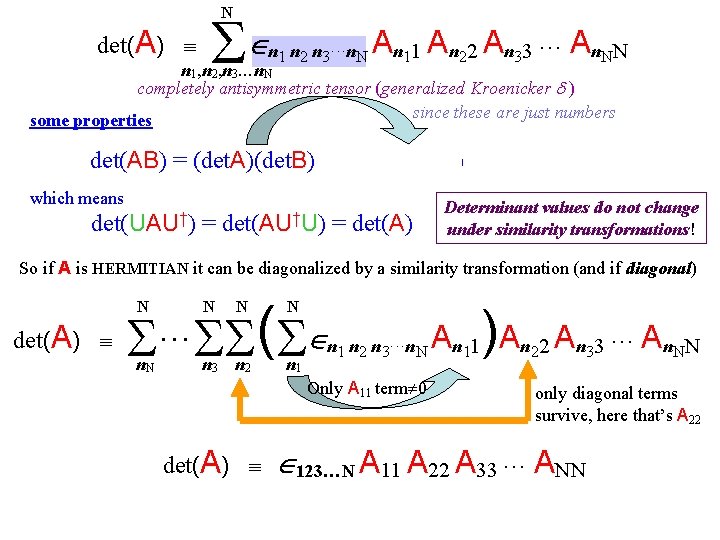
N det(A) n 1 n 2 n 3···n. N A n 11 A n 22 A n 33 … A n N N n 1, n 2, n 3…n. N completely antisymmetric tensor (generalized Kroenicker ) since these are just numbers some properties det(AB) = (det. A)(det. B) = (det. B)(det. A) = det(BA) which means det(UAU†) = det(AU†U) = det(A) Determinant values do not change under similarity transformations! So if A is HERMITIAN it can be diagonalized by a similarity transformation (and if diagonal) N det(A) N N … n. N n 3 n 2 ( N n 1 n 2 n 3···n. N Only A 11 term 0 det(A) ) An 11 An 22 An 33 … An. NN only diagonal terms survive, here that’s A 22 123…N A 11 A 22 A 33 … ANN = l 1 l 2 l 3. . . l. N
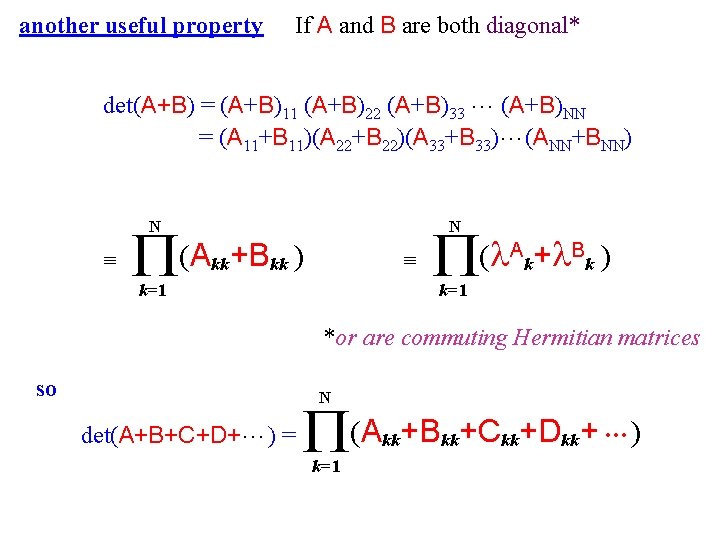
another useful property If A and B are both diagonal* det(A+B) = (A+B)11 (A+B)22 (A+B)33 … (A+B)NN = (A 11+B 11)(A 22+B 22)(A 33+B 33)…(ANN+BNN) P N (Akk+Bkk ) k=1 (l. Ak+l. Bk ) k=1 *or are commuting Hermitian matrices so P(A +B +C +D + …) N det(A+B+C+D+…) = kk k=1 kk kk kk
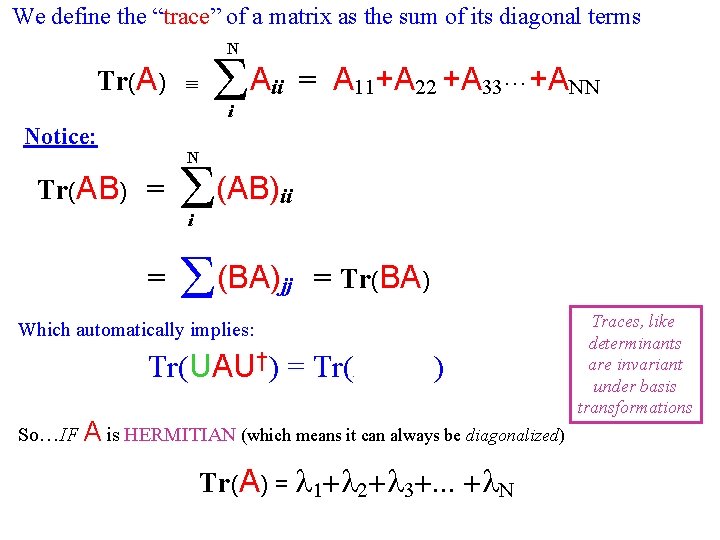
We define the “trace” of a matrix as the sum of its diagonal terms A N Tr(A) ii = A 11+A 22 +A 33…+ANN i Notice: (AB) = A B = B A = (BA) = Tr BA N N Tr(AB) = N N ii i ij i jj ji j ( N ji j ij i ) Which automatically implies: Tr(UAU†) = Tr(AU†U) = Tr(A) So…IF A is HERMITIAN (which means it can always be diagonalized) Tr(A) = l 1+l 2+l 3+. . . +l. N Traces, like determinants are invariant under basis transformations
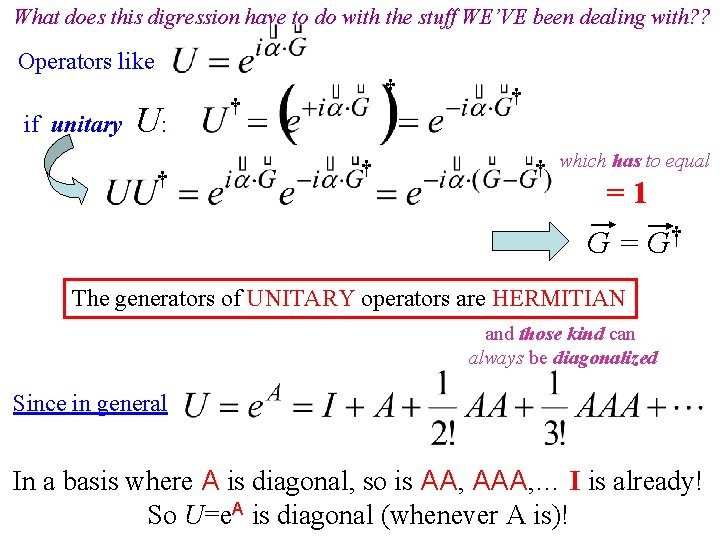
What does this digression have to do with the stuff WE’VE been dealing with? ? Operators like if unitary U: † † † which has to equal =1 G = G† The generators of UNITARY operators are HERMITIAN and those kind can always be diagonalized Since in general In a basis where A is diagonal, so is AA, AAA, … I is already! So U=e. A is diagonal (whenever A is)!
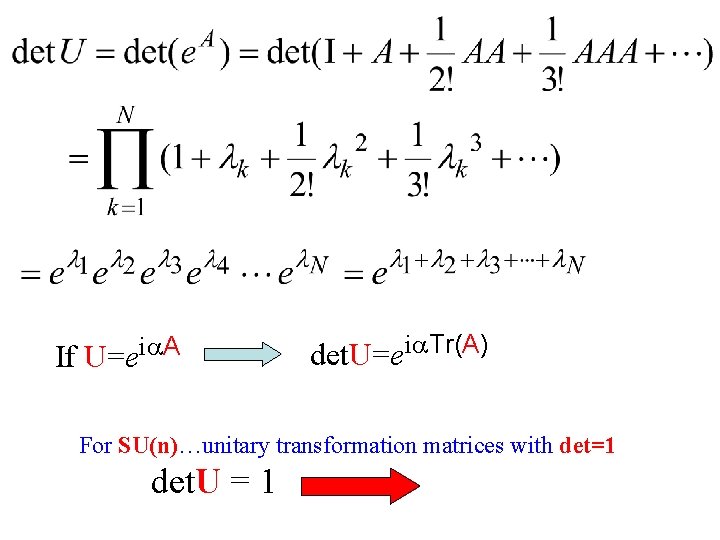
If U=eia. A det. U=eia. Tr(A) For SU(n)…unitary transformation matrices with det=1 det. U = 1 Tr(A)=0
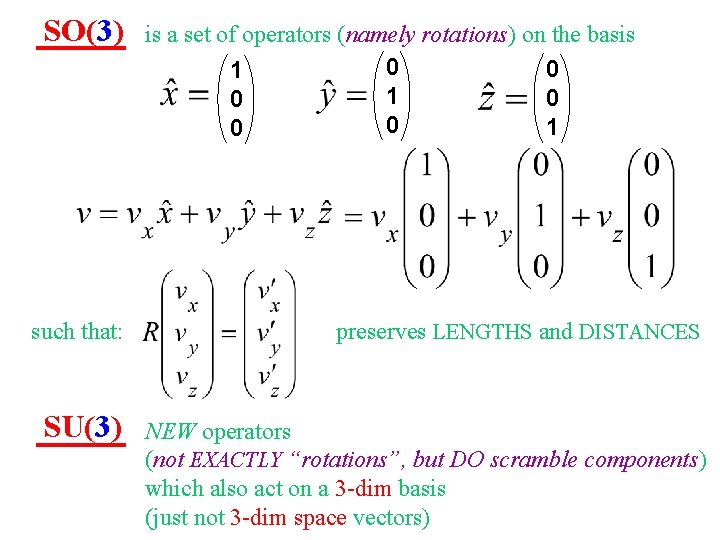
SO(3) is a set of operators (namely rotations) on the basis 0 0 1 1 0 0 0 1 0 such that: preserves LENGTHS and DISTANCES SU(3) NEW operators (not EXACTLY “rotations”, but DO scramble components) which also act on a 3 -dim basis (just not 3 -dim space vectors)
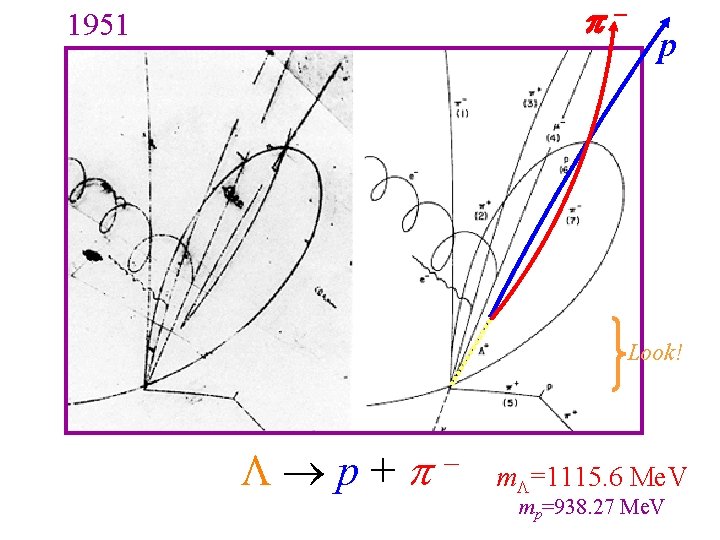
- 1951 p Look! p+ - m =1115. 6 Me. V mp=938. 27 Me. V
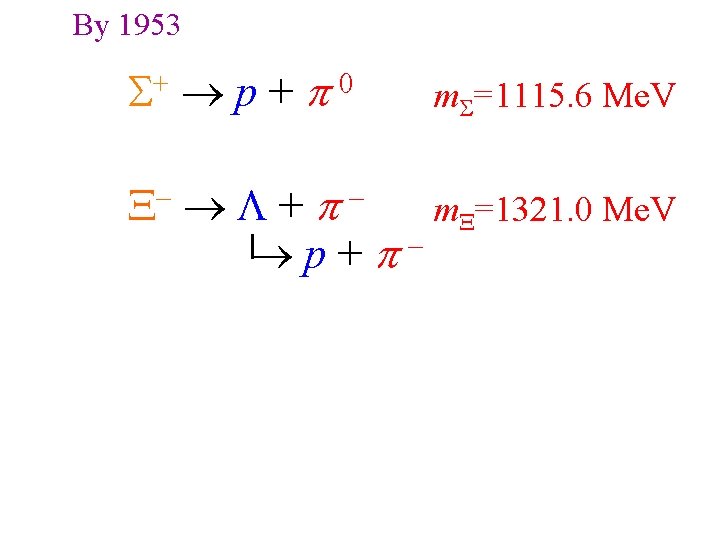
By 1953 + p + 0 m =1115. 6 Me. V + m =1321. 0 Me. V p+ -
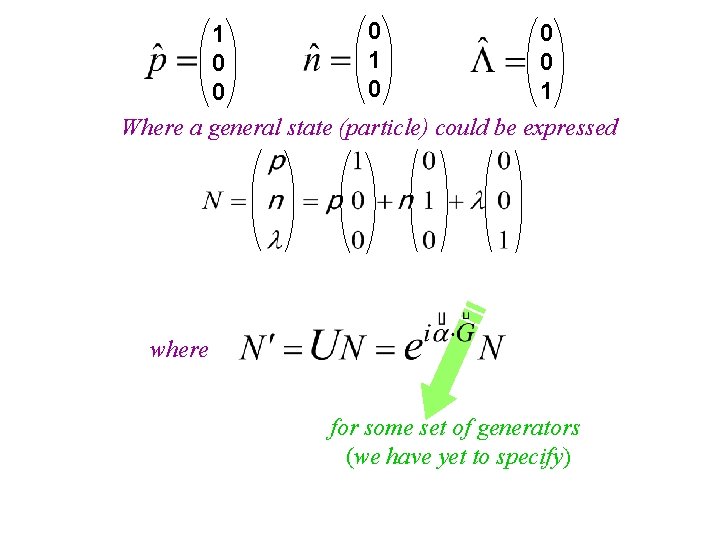
0 0 1 1 0 0 0 1 0 Where a general state (particle) could be expressed where for some set of generators (we have yet to specify)
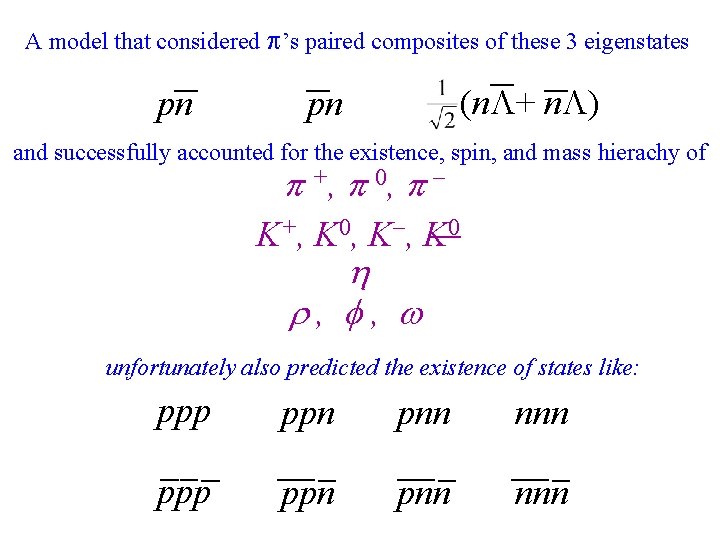
A model that considered p’s paired composites of these 3 eigenstates pn (n + n ) pn and successfully accounted for the existence, spin, and mass hierachy of +, 0, - K+, K 0, K-, K 0 , , unfortunately also predicted the existence of states like: ppp ppn pnn nnn
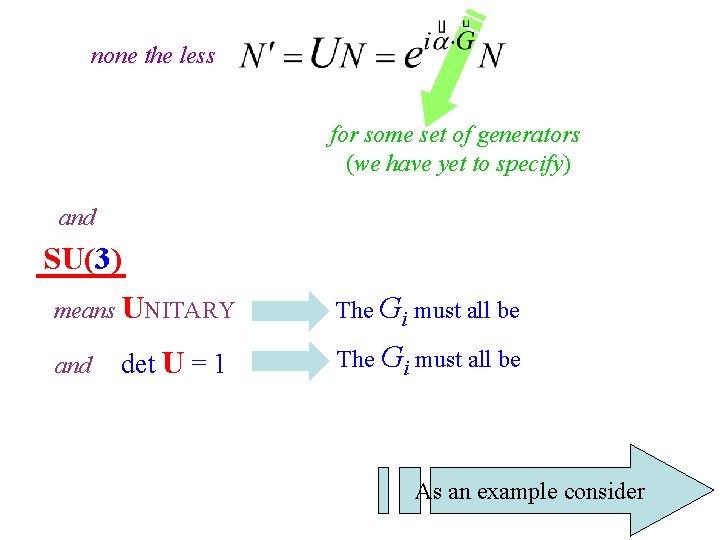
none the less for some set of generators (we have yet to specify) and SU(3) means UNITARY and det U = 1 The Gi must all be HERMITIAN The Gi must all be TRACELESS As an example consider
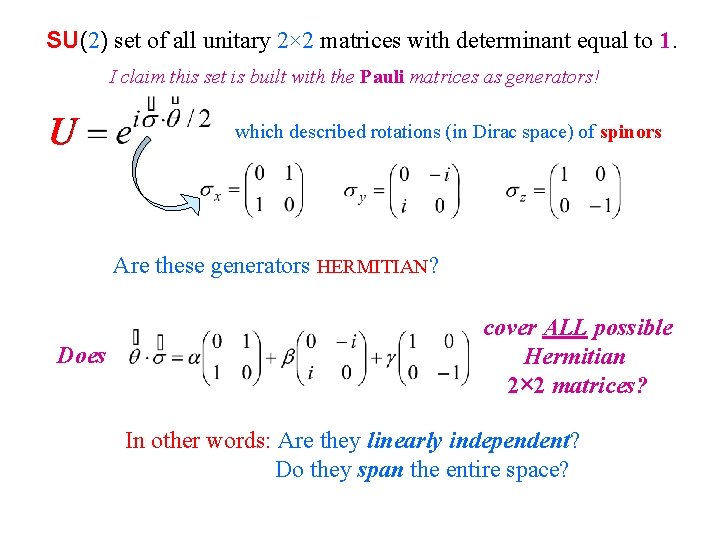
SU(2) set of all unitary 2× 2 matrices with determinant equal to 1. I claim this set is built with the Pauli matrices as generators! U which described rotations (in Dirac space) of spinors Are these generators HERMITIAN? Does TRACELESS? cover ALL possible Hermitian 2× 2 matrices? In other words: Are they linearly independent? Do they span the entire space?
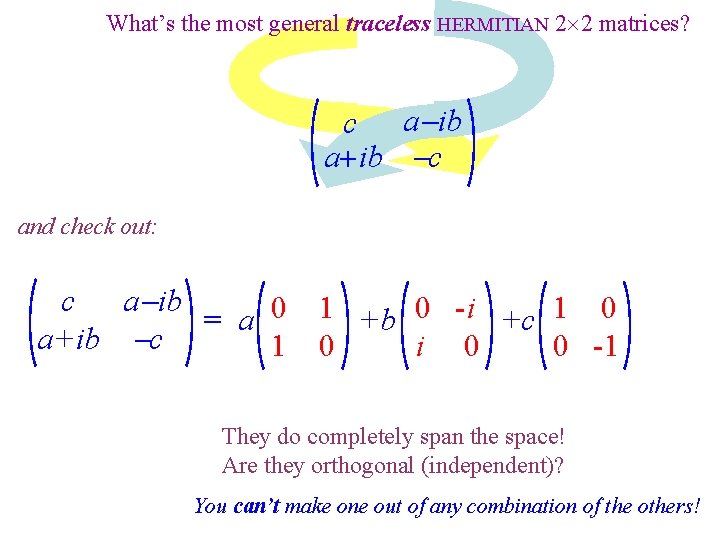
What’s the most general traceless HERMITIAN 2 2 matrices? c a-ib a+ib -c and check out: c a-ib = a 0 a+ib -c 1 1 +b 0 -i +c 1 0 0 i 0 0 -1 They do completely span the space! Are they orthogonal (independent)? You can’t make one out of any combination of the others!