Video Conferencing Unit Candidate Architecture 4 Video Conferencing


- Slides: 34
Video Conferencing Unit Candidate Architecture 4
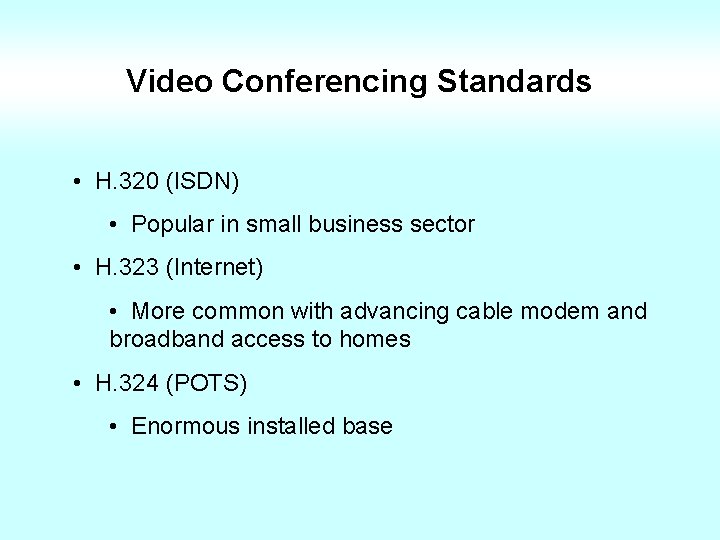
Video Conferencing Standards • H. 320 (ISDN) • Popular in small business sector • H. 323 (Internet) • More common with advancing cable modem and broadband access to homes • H. 324 (POTS) • Enormous installed base
Why support more than 1 standard? • Increase customer trust for future • Keep up with competition • True compatibility • International use • i. e. not what happened with cellular technologies • Keeps design general
Data Standards • Set by ITU-T (International Telecommunications Union – Telecommunication Standardization Sector)
Design Strategies • Hardware • Software • Hybrid
Hardware Approach • ASICs (Application Specific Integrated Circuits) • Time consuming • Expensive Development • Can be VERY fast!! • Often used in high performance devices • Military devices
Software Approach • Runs on general purpose microprocessors • Little computers • Development time fast – assume correctness of CPU • Inexpensive • Can be VERY slow!! • Industry trend for software to grow beyond control • Trying to implement too many functions. . .
Hybrid Approach • Hardware/Software Co-Design • Use ASICs or focused microprocessors • Need to divide system functionality between HW and SW
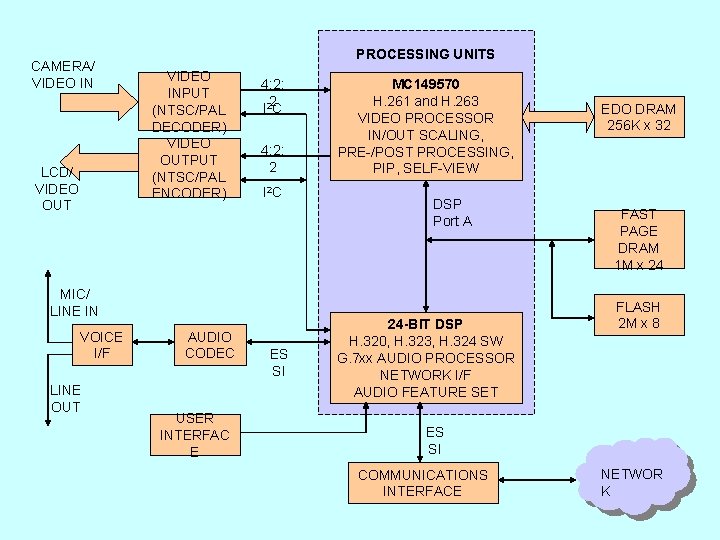
Method Used for Videoconferencing Unit • Hybrid approach taken • Two basic processors with many attached smaller ASICs • VPU (Video Processing Unit) handles video only • DSP (Digital Signal Processor) handles audio and control
CAMERA/ VIDEO IN LCD/ VIDEO OUT PROCESSING UNITS VIDEO INPUT (NTSC/PAL DECODER) VIDEO OUTPUT (NTSC/PAL ENCODER) 4: 2: 2 I 2 C MIC/ LINE IN VOICE I/F LINE OUT AUDIO CODEC USER INTERFAC E ES SI MC 149570 H. 261 and H. 263 VIDEO PROCESSOR IN/OUT SCALING, PRE-/POST PROCESSING, PIP, SELF-VIEW DSP Port A 24 -BIT DSP H. 320, H. 323, H. 324 SW G. 7 xx AUDIO PROCESSOR NETWORK I/F AUDIO FEATURE SET EDO DRAM 256 K x 32 FAST PAGE DRAM 1 M x 24 FLASH 2 M x 8 ES SI COMMUNICATIONS INTERFACE NETWOR K
24 -Bit DSP • Motorola DSP 56300 core family • Large instruction set • Keeps with core instructions • In case unit is updated with newer processor, old code should still work • Handles all audio processing • Handles all control (UI, networking, muxing/demuxing, etc. )
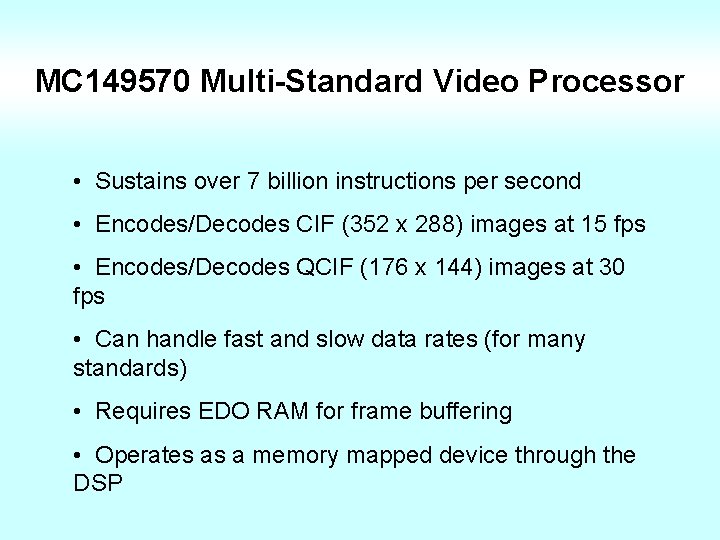
MC 149570 Multi-Standard Video Processor • Sustains over 7 billion instructions per second • Encodes/Decodes CIF (352 x 288) images at 15 fps • Encodes/Decodes QCIF (176 x 144) images at 30 fps • Can handle fast and slow data rates (for many standards) • Requires EDO RAM for frame buffering • Operates as a memory mapped device through the DSP
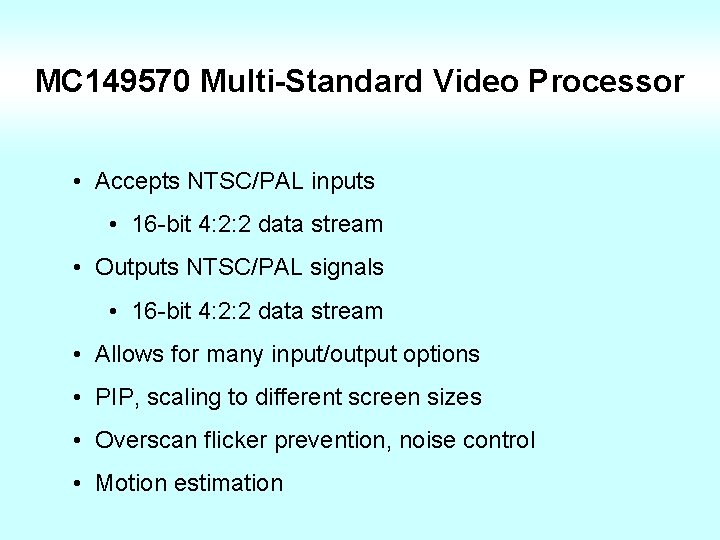
MC 149570 Multi-Standard Video Processor • Accepts NTSC/PAL inputs • 16 -bit 4: 2: 2 data stream • Outputs NTSC/PAL signals • 16 -bit 4: 2: 2 data stream • Allows for many input/output options • PIP, scaling to different screen sizes • Overscan flicker prevention, noise control • Motion estimation
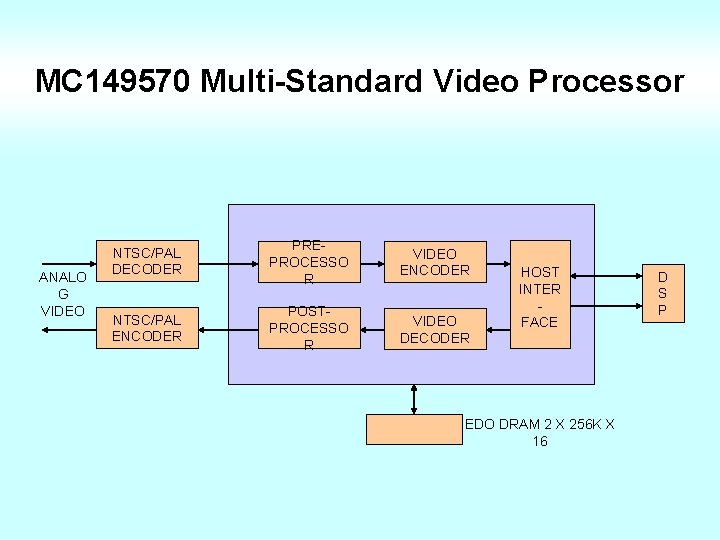
MC 149570 Multi-Standard Video Processor ANALO G VIDEO NTSC/PAL DECODER PREPROCESSO R VIDEO ENCODER NTSC/PAL ENCODER POSTPROCESSO R VIDEO DECODER HOST INTER FACE EDO DRAM 2 X 256 K X 16 D S P
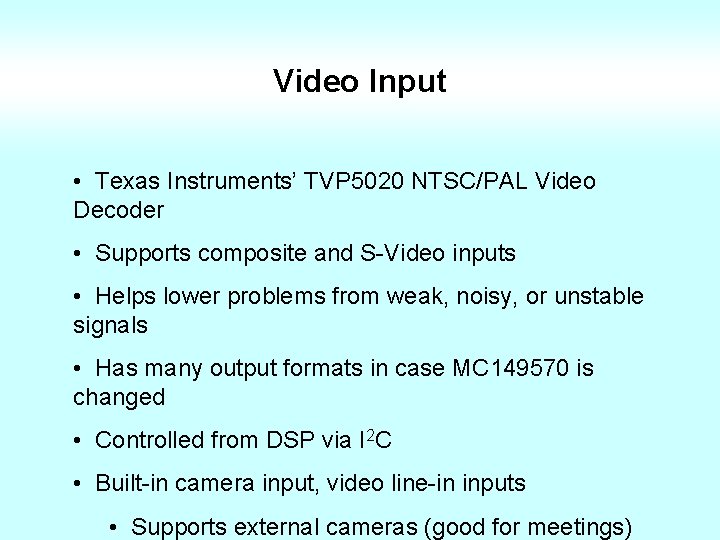
Video Input • Texas Instruments’ TVP 5020 NTSC/PAL Video Decoder • Supports composite and S-Video inputs • Helps lower problems from weak, noisy, or unstable signals • Has many output formats in case MC 149570 is changed • Controlled from DSP via I 2 C • Built-in camera input, video line-in inputs • Supports external cameras (good for meetings)
Video Output • Texas Instruments’ TVP 6000 NTSC/PAL Video Encoder • Supports composite and S-Video outputs • Helps lower problems from weak, noisy, or unstable signals • Has many input formats in case MC 149570 is changed • Controlled from DSP via I 2 C • Multiple video line-out options, so TVs and monitors can be attached as well as built-in screen
Audio Codec • Texas Instruments’ TLC 320 AD 77 • 16, 20, 24 -bit input and output lines • Sampling range of 16 k. Hz to 95 k. Hz • Connects to DSP via ESSI (Enhanced Synchronous Serial Interface) • Provides high-speed, reliable connection
Voice Interface • Analog device that accepts multiple input lines • Built-in microphone • Line-in jacks • and multiple output lines • Built-in speaker • Line-out jacks
Memory • MC 149570 requires 256 K x 32 EDO RAM • Available directly to VPU as frame buffers • Fast Page DRAM and FLASH connected to DSP Port A • MC 149570 also connected to DSP Port A • Operates as a memory-mapped device • FLASH stores system software
Communications Interface Unit • Why include a modem that might be out of date soon? • Too expensive and difficult to include numerous modems/NICs • Solution: • External modems/NICs • Base unit has ESSI port, CIUs plug directly in • Software handles detection and protocol changes
Communications Interface Unit • One device for each of the videophone standards • Devices can be made to handle conversions • e. g. cellular to H. 323 format • Makes device dynamic to handle technological growth • Makes consumers feel safe purchasing unit • Will work in home now, and in future, upgraded home
Camera/Display Unit • Can be cheap or high quality • Since external lines are available, save cost by including only medium grade devices • Cameras with NTSC/PAL outputs can be found as low as $80 • Displays with NTSC/PAL inputs can be found as low as $80
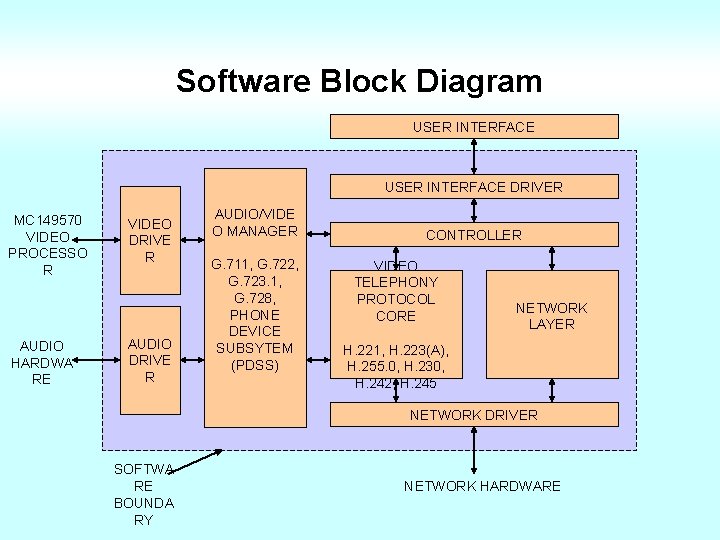
System Software • Motorola’s Qorus Video Conferencing Software kit • Modular design • Well-defined interfaces • Software easily written to apply to PC Cards to make home computers operate as videoconferencing unit
Software Block Diagram USER INTERFACE DRIVER MC 149570 VIDEO PROCESSO R AUDIO HARDWA RE VIDEO DRIVE R AUDIO/VIDE O MANAGER G. 711, G. 722, G. 723. 1, G. 728, PHONE DEVICE SUBSYTEM (PDSS) CONTROLLER VIDEO TELEPHONY PROTOCOL CORE NETWORK LAYER H. 221, H. 223(A), H. 255. 0, H. 230, H. 242, H. 245 NETWORK DRIVER SOFTWA RE BOUNDA RY NETWORK HARDWARE
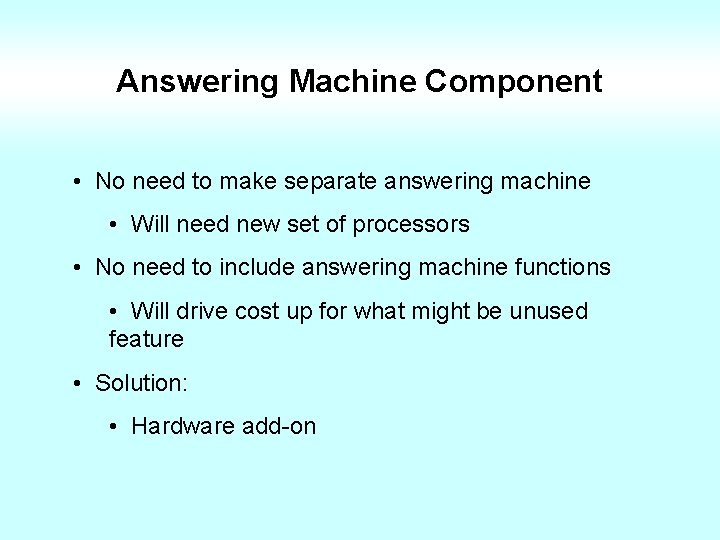
Answering Machine Component • No need to make separate answering machine • Will need new set of processors • No need to include answering machine functions • Will drive cost up for what might be unused feature • Solution: • Hardware add-on
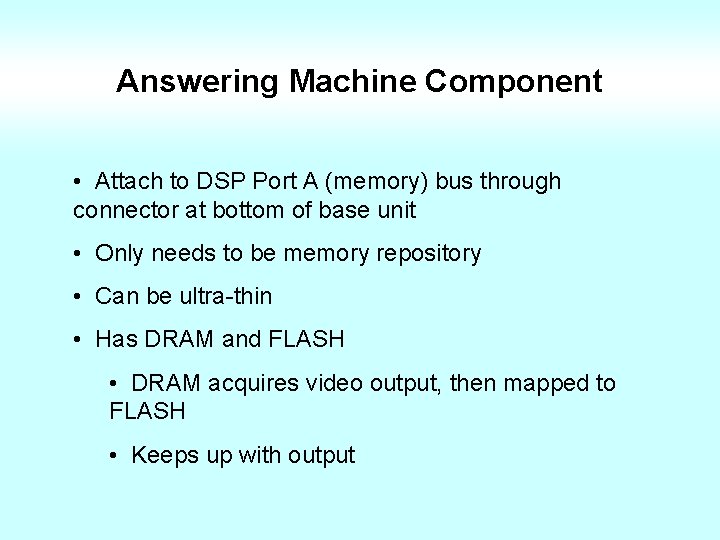
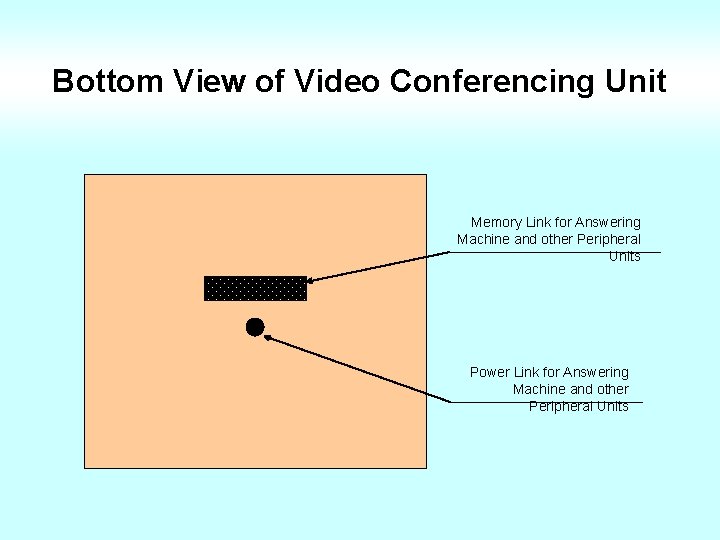
Answering Machine Component • Attach to DSP Port A (memory) bus through connector at bottom of base unit • Only needs to be memory repository • Can be ultra-thin • Has DRAM and FLASH • DRAM acquires video output, then mapped to FLASH • Keeps up with output
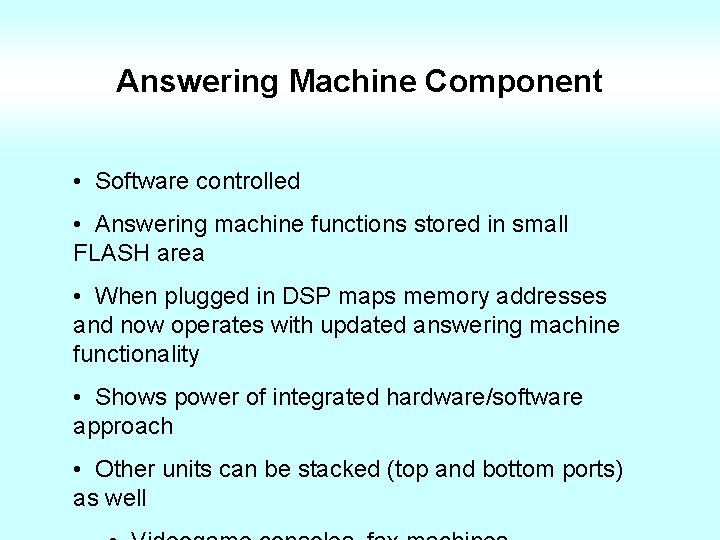
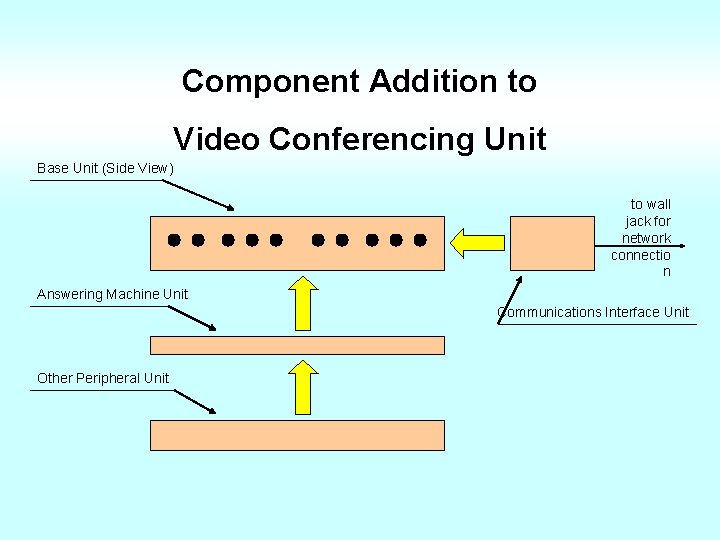
Answering Machine Component • Software controlled • Answering machine functions stored in small FLASH area • When plugged in DSP maps memory addresses and now operates with updated answering machine functionality • Shows power of integrated hardware/software approach • Other units can be stacked (top and bottom ports) as well
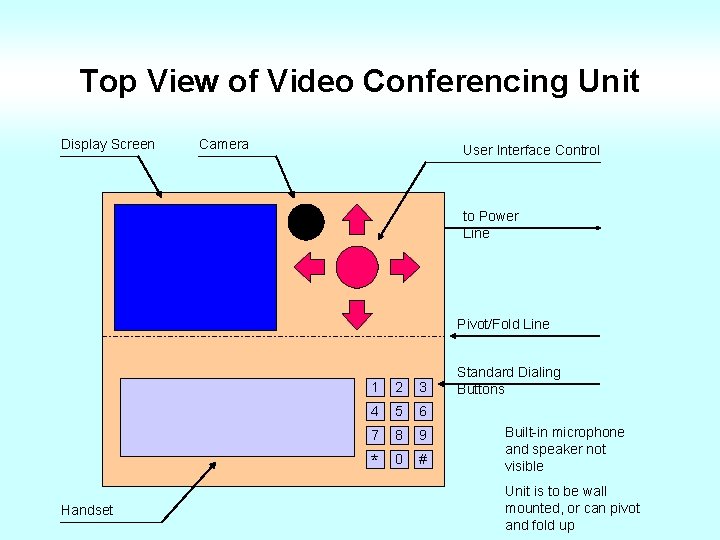
Top View of Video Conferencing Unit Display Screen Camera User Interface Control to Power Line Pivot/Fold Line Handset 1 2 3 4 5 6 7 8 9 * 0 # Standard Dialing Buttons Built-in microphone and speaker not visible Unit is to be wall mounted, or can pivot and fold up
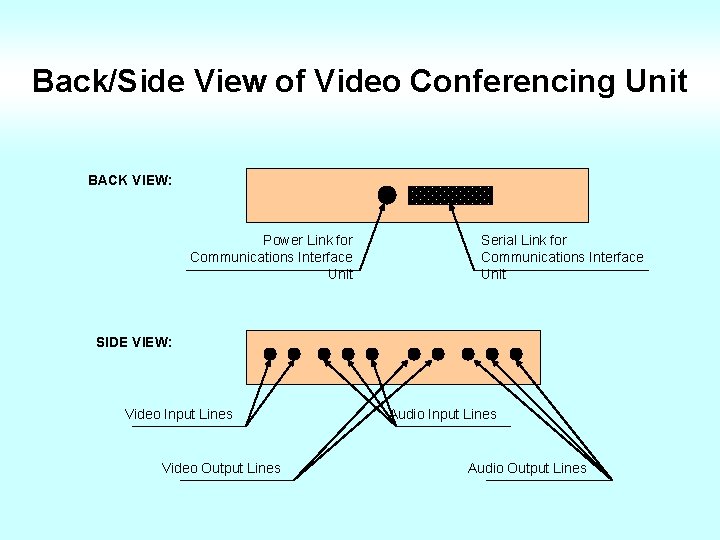
Back/Side View of Video Conferencing Unit BACK VIEW: Power Link for Communications Interface Unit Serial Link for Communications Interface Unit SIDE VIEW: Video Input Lines Video Output Lines Audio Input Lines Audio Output Lines
Bottom View of Video Conferencing Unit Memory Link for Answering Machine and other Peripheral Units Power Link for Answering Machine and other Peripheral Units
Component Addition to Video Conferencing Unit Base Unit (Side View) to wall jack for network connectio n Answering Machine Unit Communications Interface Unit Other Peripheral Unit
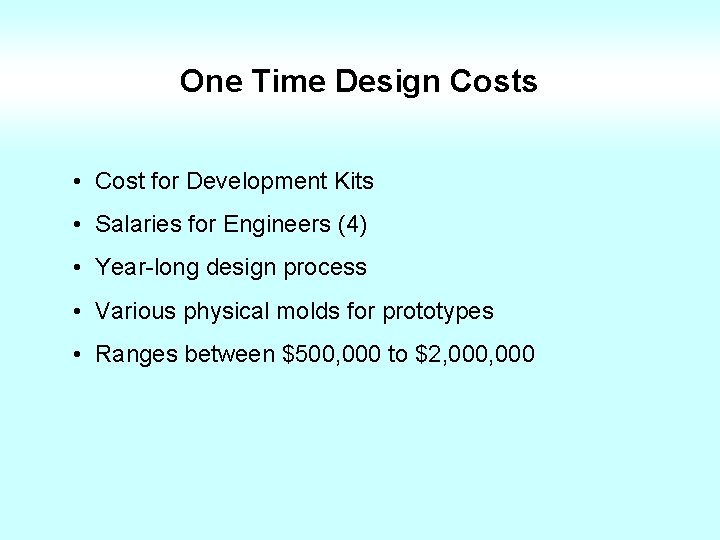
One Time Design Costs • Cost for Development Kits • Salaries for Engineers (4) • Year-long design process • Various physical molds for prototypes • Ranges between $500, 000 to $2, 000
Construction Costs • Approximately $500 total in parts cost and labor
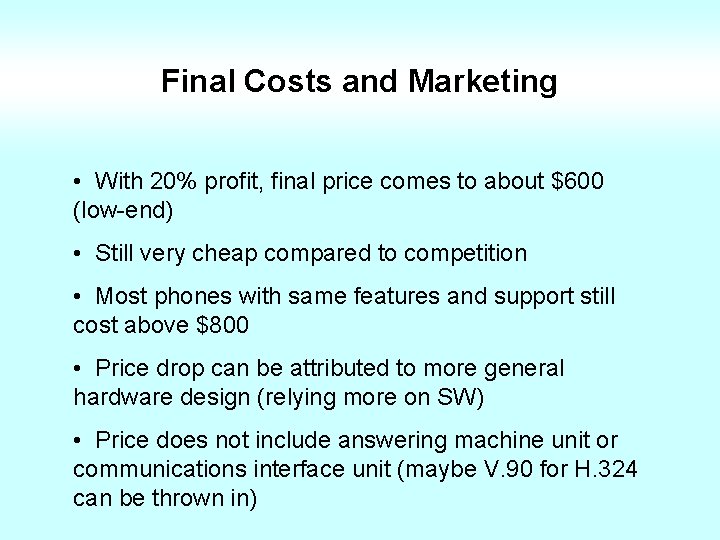
Final Costs and Marketing • With 20% profit, final price comes to about $600 (low-end) • Still very cheap compared to competition • Most phones with same features and support still cost above $800 • Price drop can be attributed to more general hardware design (relying more on SW) • Price does not include answering machine unit or communications interface unit (maybe V. 90 for H. 324 can be thrown in)