VIDEO COMPRESSION FUNDAMENTALS Pamela C Cosman 1 Compressing
- Slides: 57
VIDEO COMPRESSION FUNDAMENTALS Pamela C. Cosman 1
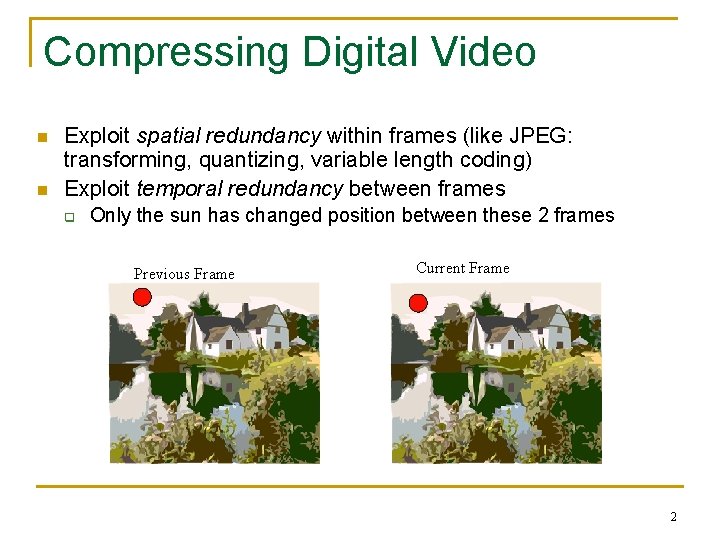
Compressing Digital Video n n Exploit spatial redundancy within frames (like JPEG: transforming, quantizing, variable length coding) Exploit temporal redundancy between frames q Only the sun has changed position between these 2 frames Previous Frame Current Frame 2
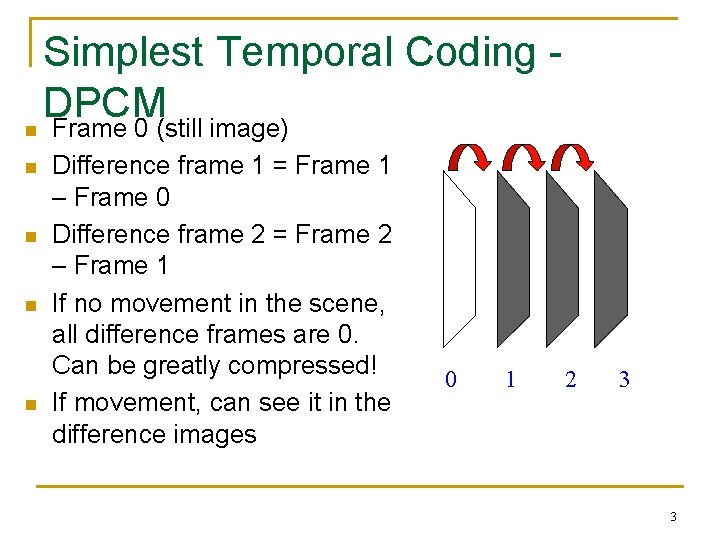
Simplest Temporal Coding DPCM n Frame 0 (still image) n n Difference frame 1 = Frame 1 – Frame 0 Difference frame 2 = Frame 2 – Frame 1 If no movement in the scene, all difference frames are 0. Can be greatly compressed! If movement, can see it in the difference images 0 1 2 3 3
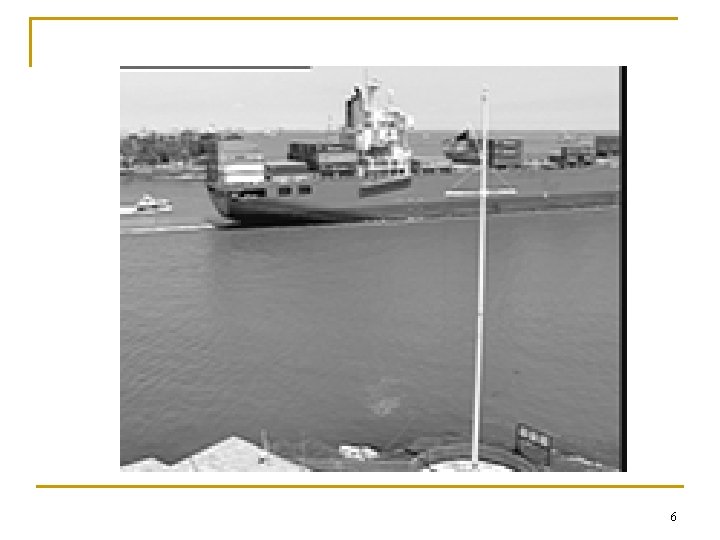
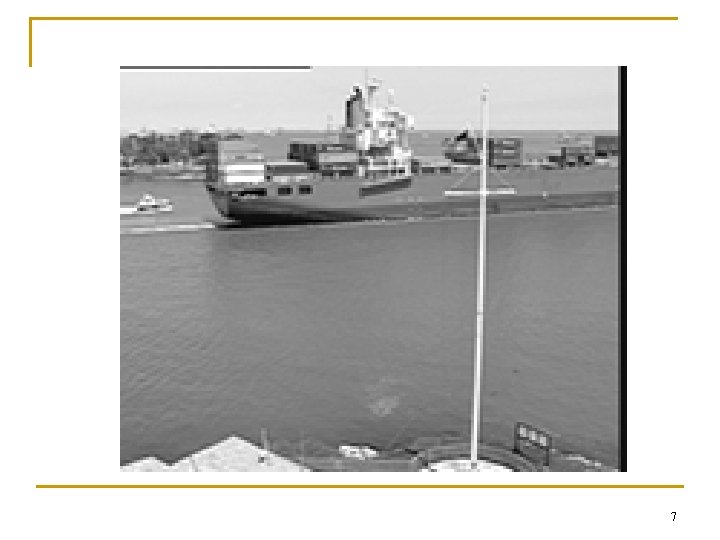
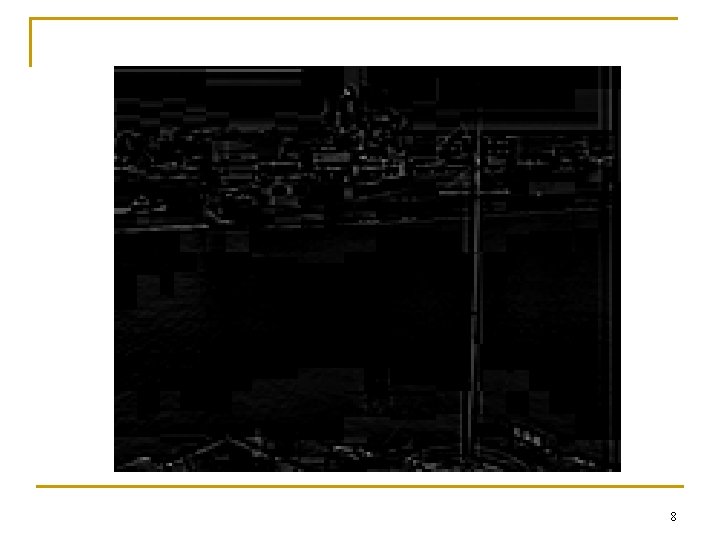
Difference Frames n Differences between two frames can be caused by q q q Camera motion: the outlines of background or stationary objects can be seen in the Diff Image Object motion: the outlines of moving objects can be seen in the Diff Image Illumination changes (sun rising, headlights, etc. ) Scene Cuts: Lots of stuff in the Diff Image Noise 4
Difference Frames n n n If the only difference between two frames is noise (nothing moved), then you won’t recognize anything in the Difference Image But, if you can see something in the Diff Image and recognize it, there’s still correlation in the difference image Goal: remove the correlation by compensating for the motion 5
6
7
8
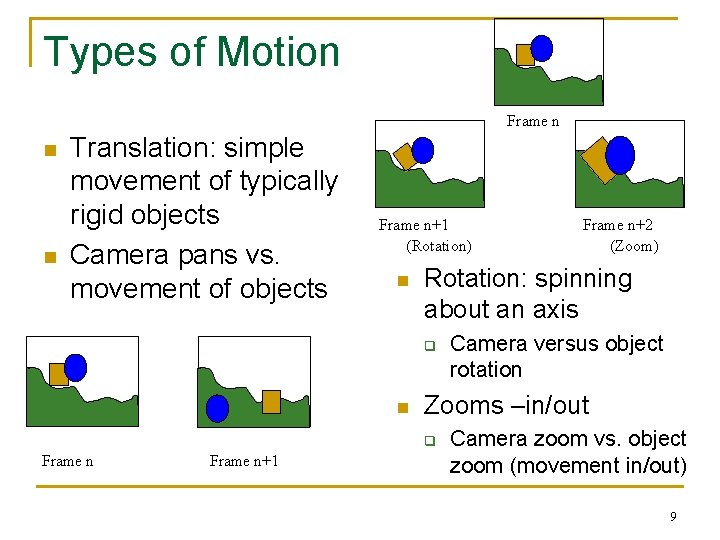
Types of Motion Frame n n n Translation: simple movement of typically rigid objects Camera pans vs. movement of objects Frame n+1 (Rotation) n Rotation: spinning about an axis q n Frame n+1 Camera versus object rotation Zooms –in/out q Frame n+2 (Zoom) Camera zoom vs. object zoom (movement in/out) 9
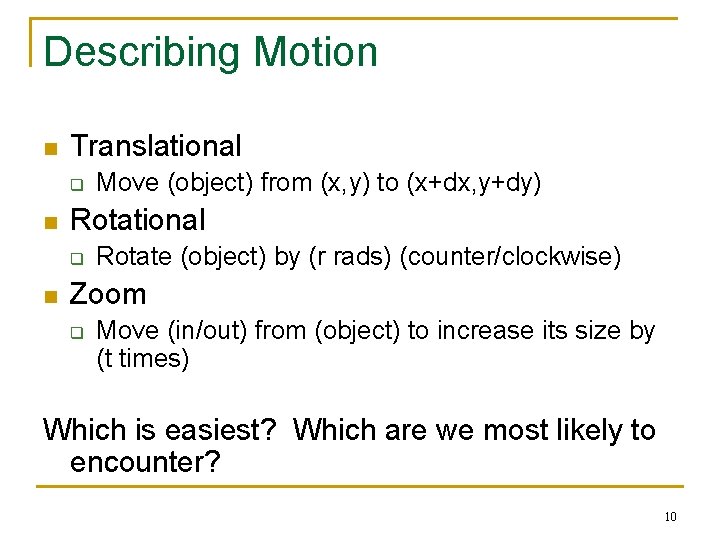
Describing Motion n Translational q n Rotational q n Move (object) from (x, y) to (x+dx, y+dy) Rotate (object) by (r rads) (counter/clockwise) Zoom q Move (in/out) from (object) to increase its size by (t times) Which is easiest? Which are we most likely to encounter? 10
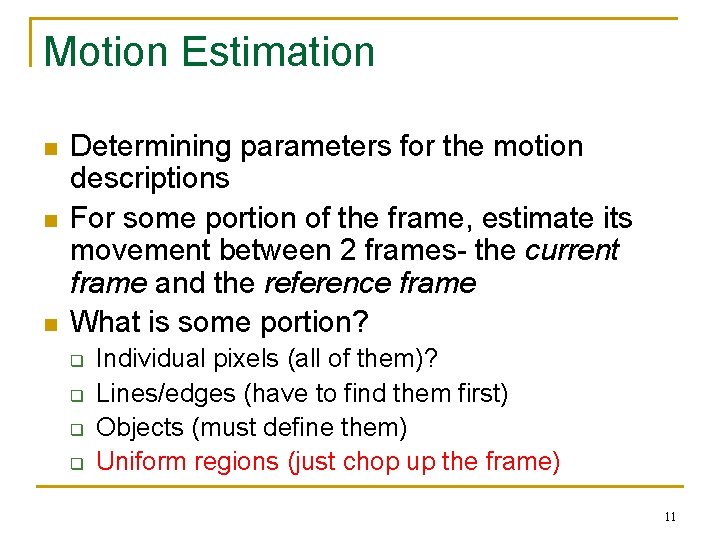
Motion Estimation n Determining parameters for the motion descriptions For some portion of the frame, estimate its movement between 2 frames- the current frame and the reference frame What is some portion? q q Individual pixels (all of them)? Lines/edges (have to find them first) Objects (must define them) Uniform regions (just chop up the frame) 11
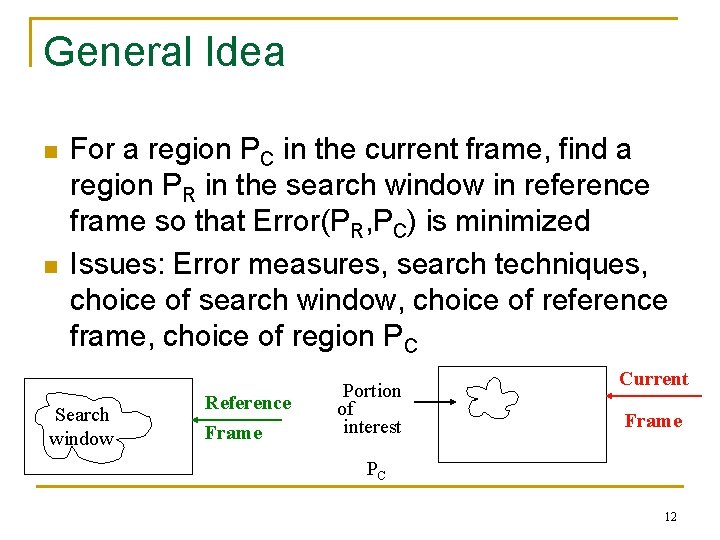
General Idea n n For a region PC in the current frame, find a region PR in the search window in reference frame so that Error(PR, PC) is minimized Issues: Error measures, search techniques, choice of search window, choice of reference frame, choice of region PC Search window Reference Frame Portion of interest Current Frame PC 12
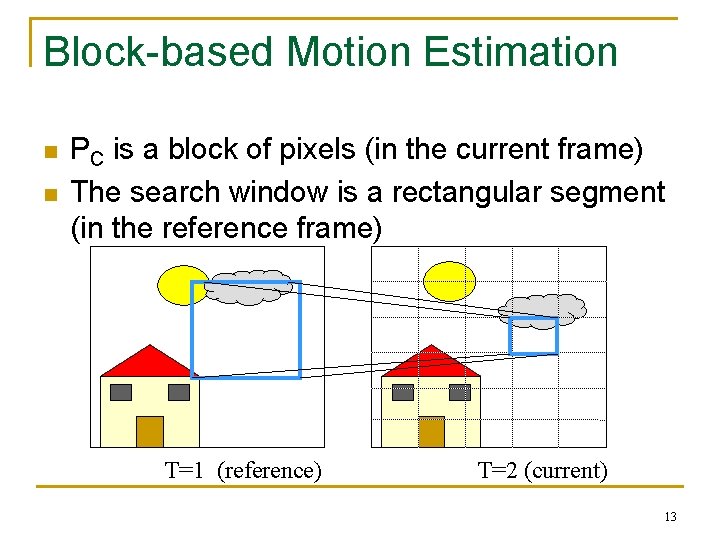
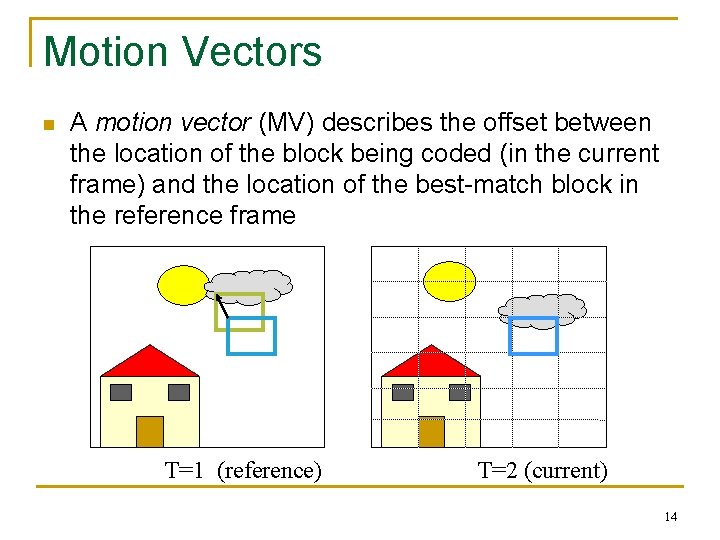
Block-based Motion Estimation n n PC is a block of pixels (in the current frame) The search window is a rectangular segment (in the reference frame) T=1 (reference) T=2 (current) 13
Motion Vectors n A motion vector (MV) describes the offset between the location of the block being coded (in the current frame) and the location of the best-match block in the reference frame T=1 (reference) T=2 (current) 14
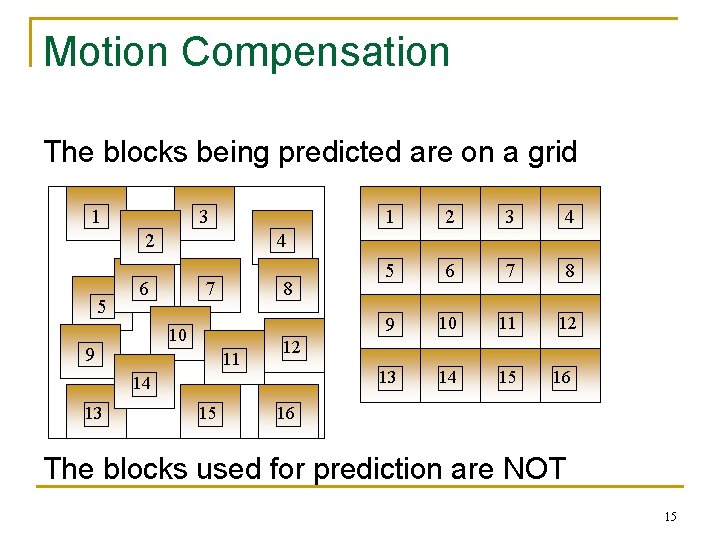
Motion Compensation The blocks being predicted are on a grid 1 3 2 5 7 8 10 11 3 4 5 6 7 8 9 10 11 12 13 14 15 12 14 13 2 4 6 9 1 15 16 16 The blocks used for prediction are NOT 15
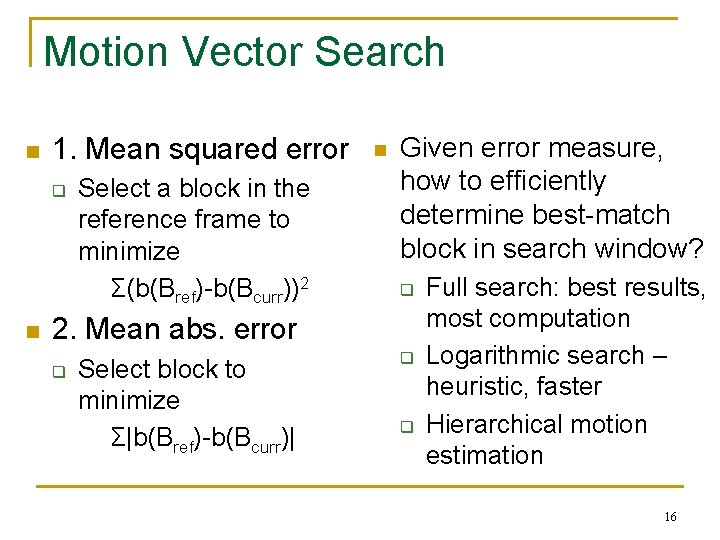
Motion Vector Search n 1. Mean squared error q n Select a block in the reference frame to minimize Σ(b(Bref)-b(Bcurr))2 n Given error measure, how to efficiently determine best-match block in search window? q 2. Mean abs. error q Select block to minimize Σ|b(Bref)-b(Bcurr)| q q Full search: best results, most computation Logarithmic search – heuristic, faster Hierarchical motion estimation 16
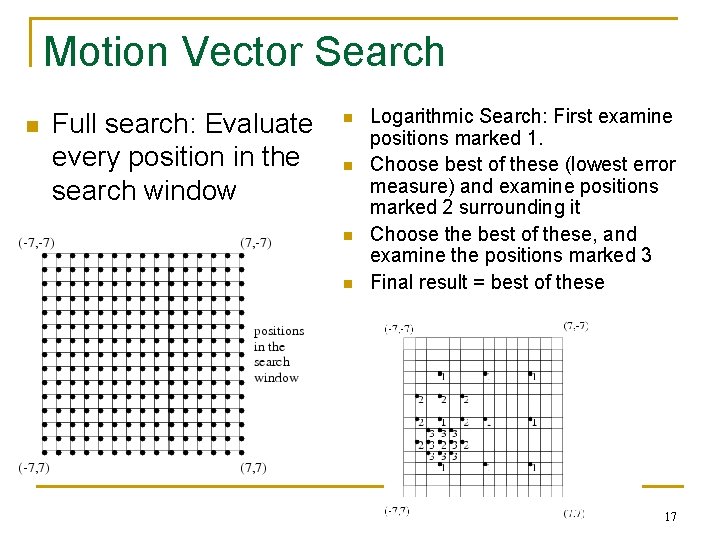
Motion Vector Search n Full search: Evaluate every position in the search window n n Logarithmic Search: First examine positions marked 1. Choose best of these (lowest error measure) and examine positions marked 2 surrounding it Choose the best of these, and examine the positions marked 3 Final result = best of these 17
Hierarchical Motion Estimation n Use an averaging filter on the image, then downsample by a factor of 2 Conduct a search on the downsampled image (only ¼ of the size) Given the results of the search on the downsampled image, return to the full resolution image and refine the search there 18
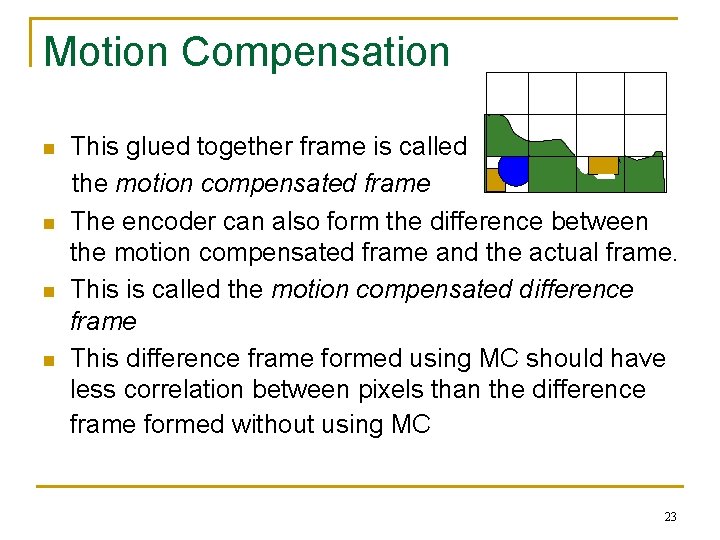
Motion Compensation n The standards do not specify HOW the encoder will find the motion vectors (MVs) The encoder can use exhaustive/fast search, MSE /MAE/other error metric, etc. The standard DOES specify q q n The allowable syntax for specifying the MVs What the decoder will do with them What the decoder does is to grab the indicated block from reference frame, and glue it in place 19
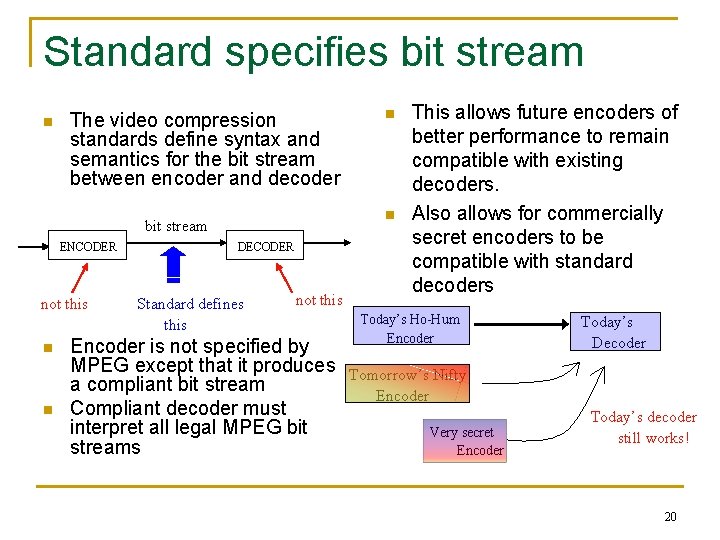
Standard specifies bit stream n The video compression standards define syntax and semantics for the bit stream between encoder and decoder n bit stream ENCODER not this n n n DECODER Standard defines this not this Encoder is not specified by MPEG except that it produces a compliant bit stream Compliant decoder must interpret all legal MPEG bit streams This allows future encoders of better performance to remain compatible with existing decoders. Also allows for commercially secret encoders to be compatible with standard decoders Today’s Ho-Hum Encoder Today’s Decoder Tomorrow’s Nifty Encoder Very secret Encoder Today’s decoder still works! 20
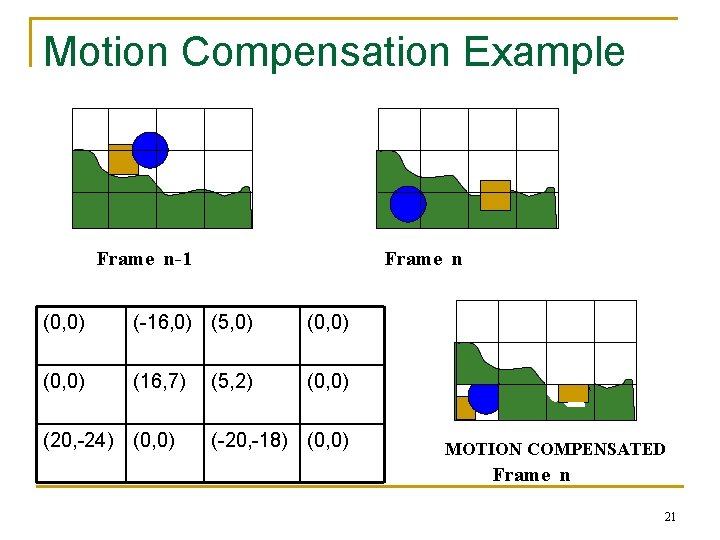
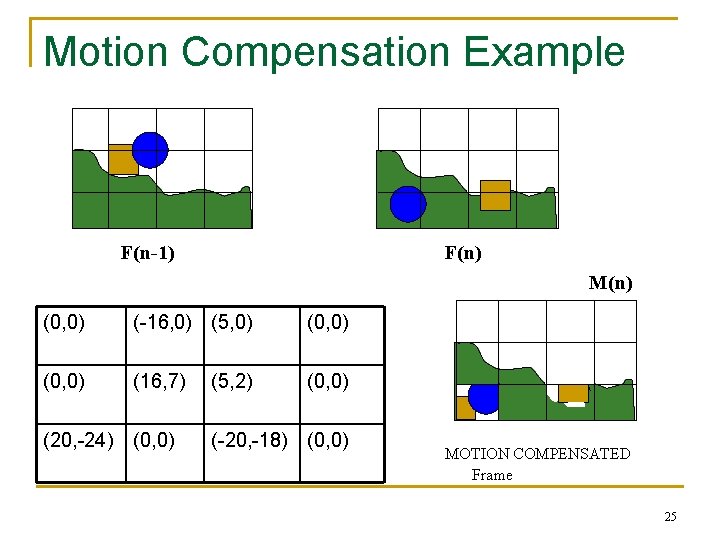
Motion Compensation Example Frame n-1 Frame n (0, 0) (-16, 0) (5, 0) (0, 0) (16, 7) (5, 2) (0, 0) (20, -24) (0, 0) (-20, -18) (0, 0) MOTION COMPENSATED Frame n 21
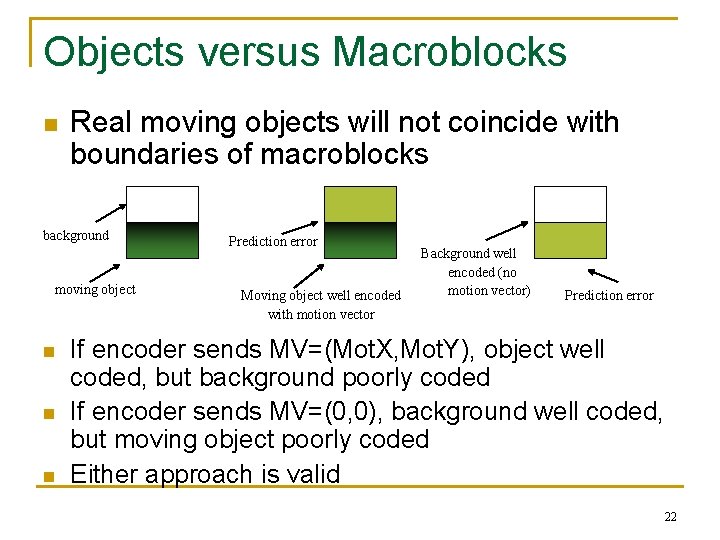
Objects versus Macroblocks n Real moving objects will not coincide with boundaries of macroblocks background moving object n n n Prediction error Moving object well encoded with motion vector Background well encoded (no motion vector) Prediction error If encoder sends MV=(Mot. X, Mot. Y), object well coded, but background poorly coded If encoder sends MV=(0, 0), background well coded, but moving object poorly coded Either approach is valid 22
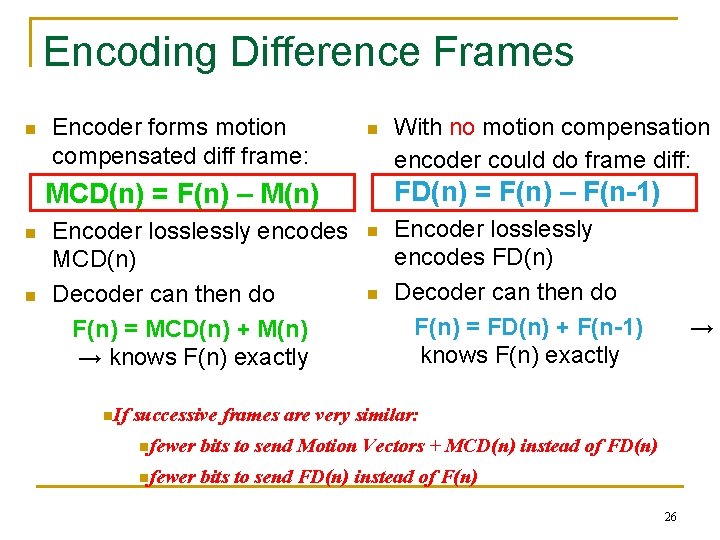
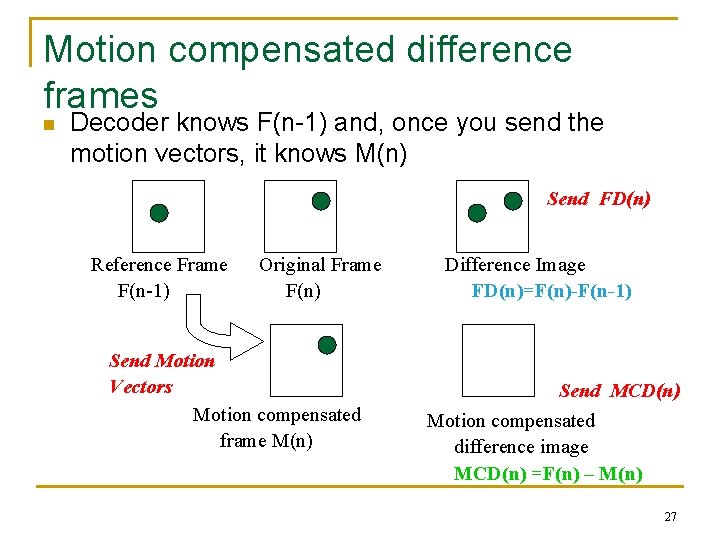
Motion Compensation n n This glued together frame is called the motion compensated frame The encoder can also form the difference between the motion compensated frame and the actual frame. This is called the motion compensated difference frame This difference frame formed using MC should have less correlation between pixels than the difference frame formed without using MC 23
Motion Compensated Difference Frames n n n Suppose we are doing lossless coding Encoder has sequence of frames: …, F(n-2), F(n-1) Next: encode F(n) Past frames have been losslessly encoded, so the decoder knows F(n-1) perfectly already Encoder sends the motion vectors for frame F(n) relative to frame F(n-1), to form motion compensated frame M(n) q Encoder knows M(n), Decoder knows M(n) 24
Motion Compensation Example F(n-1) F(n) M(n) (0, 0) (-16, 0) (5, 0) (0, 0) (16, 7) (5, 2) (0, 0) (20, -24) (0, 0) (-20, -18) (0, 0) MOTION COMPENSATED Frame 25
Encoding Difference Frames n Encoder forms motion compensated diff frame: n FD(n) = F(n) – F(n-1) MCD(n) = F(n) – M(n) n n Encoder losslessly encodes MCD(n) Decoder can then do F(n) = MCD(n) + M(n) → knows F(n) exactly n. If With no motion compensation encoder could do frame diff: n n Encoder losslessly encodes FD(n) Decoder can then do F(n) = FD(n) + F(n-1) knows F(n) exactly → successive frames are very similar: nfewer bits to send Motion Vectors + MCD(n) instead of FD(n) nfewer bits to send FD(n) instead of F(n) 26
Motion compensated difference frames n Decoder knows F(n-1) and, once you send the motion vectors, it knows M(n) Send FD(n) Reference Frame F(n-1) Original Frame F(n) Send Motion Vectors Motion compensated frame M(n) Difference Image FD(n)=F(n)-F(n-1) Send MCD(n) Motion compensated difference image MCD(n) =F(n) – M(n) 27
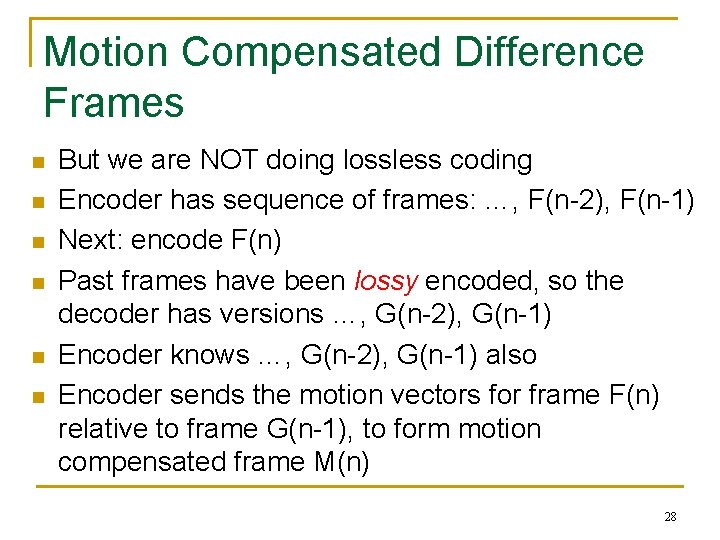
Motion Compensated Difference Frames n n n But we are NOT doing lossless coding Encoder has sequence of frames: …, F(n-2), F(n-1) Next: encode F(n) Past frames have been lossy encoded, so the decoder has versions …, G(n-2), G(n-1) Encoder knows …, G(n-2), G(n-1) also Encoder sends the motion vectors for frame F(n) relative to frame G(n-1), to form motion compensated frame M(n) 28
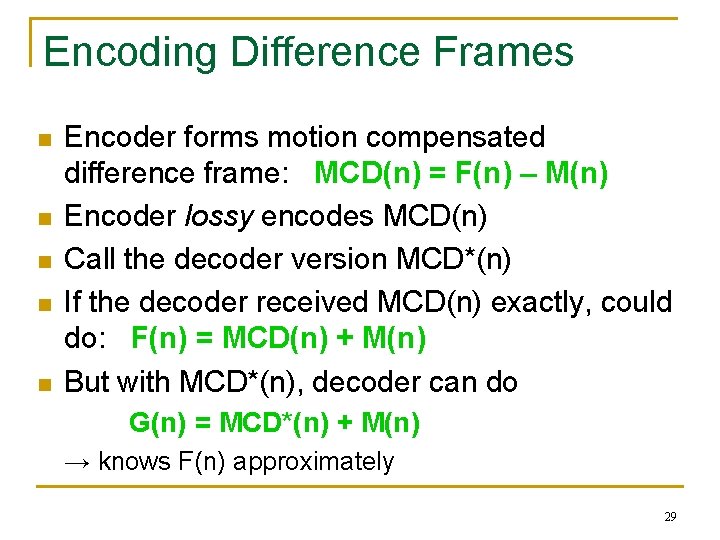
Encoding Difference Frames n n n Encoder forms motion compensated difference frame: MCD(n) = F(n) – M(n) Encoder lossy encodes MCD(n) Call the decoder version MCD*(n) If the decoder received MCD(n) exactly, could do: F(n) = MCD(n) + M(n) But with MCD*(n), decoder can do G(n) = MCD*(n) + M(n) → knows F(n) approximately 29
Motion estimation philosophy n n Goal of motion estimation is NOT to provide a careful analysis of the actual motion Goal is to achieve a given quality of representation of the video while globally minimizing the bit rate required to send q q n The motion information The prediction error information Most of the time, for a given representation quality q q fewer bits to send MV+MCD(n) instead of sending FD(n) fewer bits to send FD(n) instead of sending F(n) itself. 30
Motion Compensation for Chrominance n n n Luminance is highly correlated, more so than chrominance The “best” motion vectors are available by searching in the luminance plane Motion vectors for chrominance are not computed separately, simply scaled as needed 31
Motion Estimation/Compensation Summary n At the encoder: q q q For each block in the frame being coded, examine the search window(s) in the reference frame to find the best match block (do this for luminance only) Form the MC difference image = original image minus motion compensated image Scale the motion vectors for the chrominance, form the motion compensated chrominance frames, and form chrominance difference image 32
Motion Estimation/Compensation Summary n At the decoder: q q Decode the reference frames (Y, Cr, Cb) For each block in a temporally coded Y frame, use the motion vector to select a block from the reference frame and glue it in place Add the Y difference image For each block in temporally coded Cr, Cb frames, first scale the motion vector, then do the previous 2 steps with Cr and Cb data 33
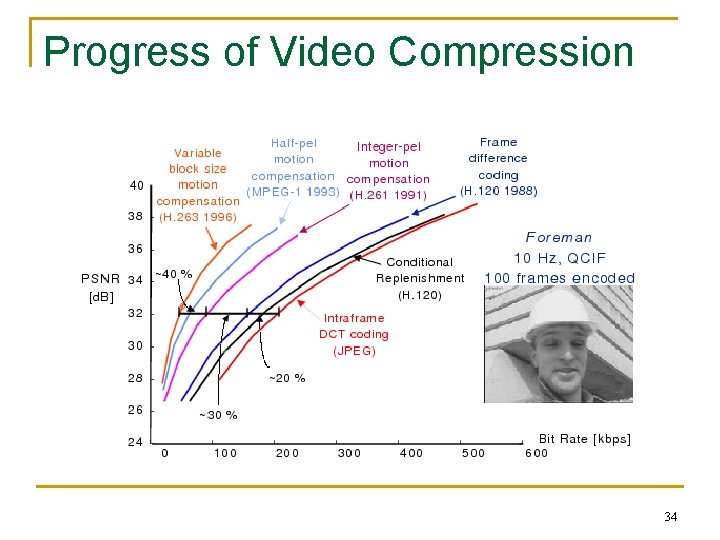
Progress of Video Compression 34
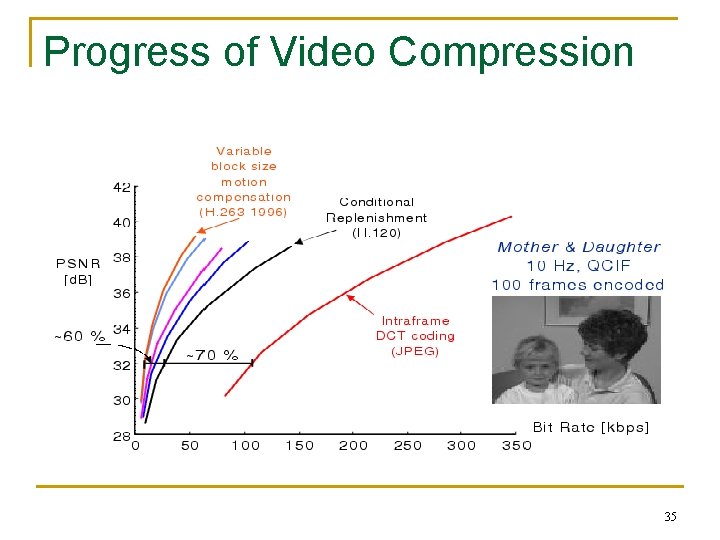
Progress of Video Compression 35
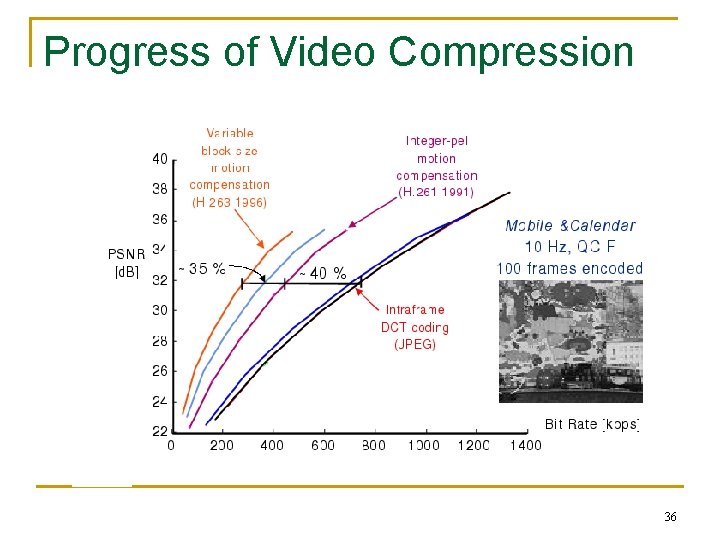
Progress of Video Compression 36
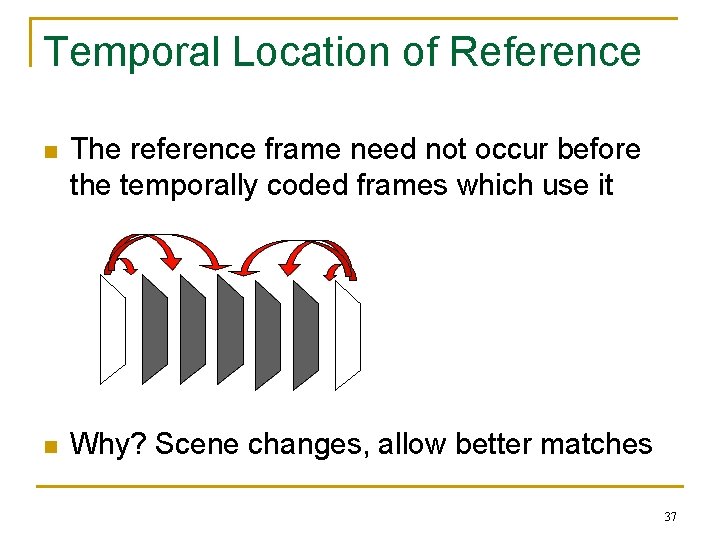
Temporal Location of Reference n The reference frame need not occur before the temporally coded frames which use it n Why? Scene changes, allow better matches 37
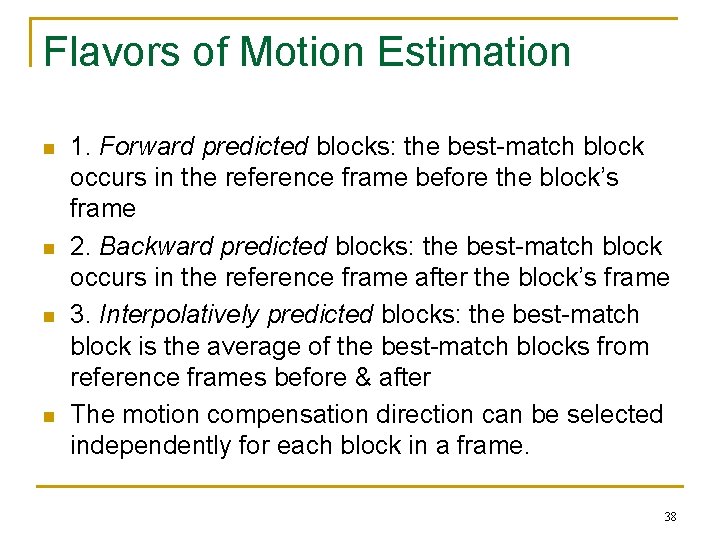
Flavors of Motion Estimation n n 1. Forward predicted blocks: the best-match block occurs in the reference frame before the block’s frame 2. Backward predicted blocks: the best-match block occurs in the reference frame after the block’s frame 3. Interpolatively predicted blocks: the best-match block is the average of the best-match blocks from reference frames before & after The motion compensation direction can be selected independently for each block in a frame. 38
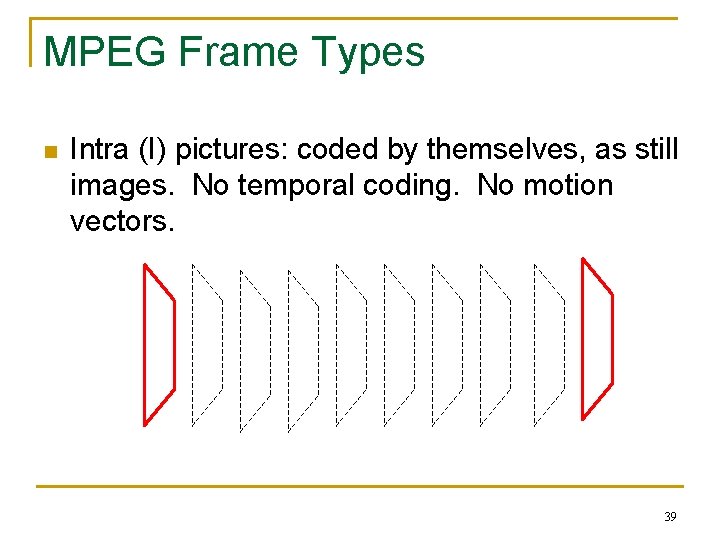
MPEG Frame Types n Intra (I) pictures: coded by themselves, as still images. No temporal coding. No motion vectors. 39
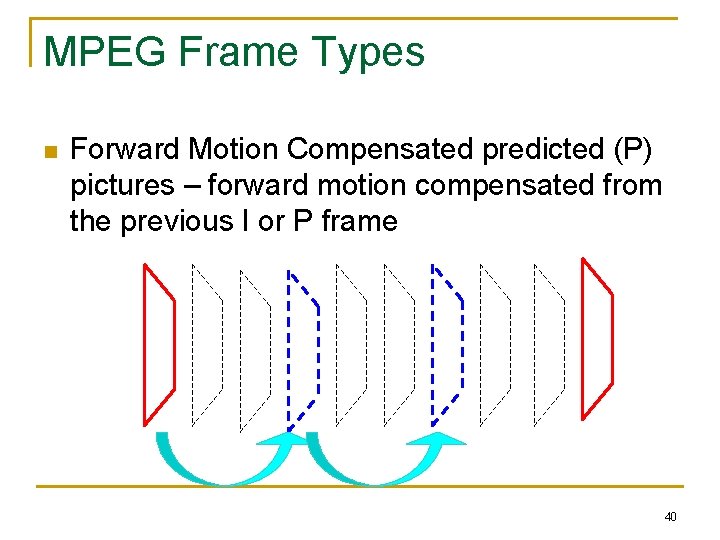
MPEG Frame Types n Forward Motion Compensated predicted (P) pictures – forward motion compensated from the previous I or P frame 40
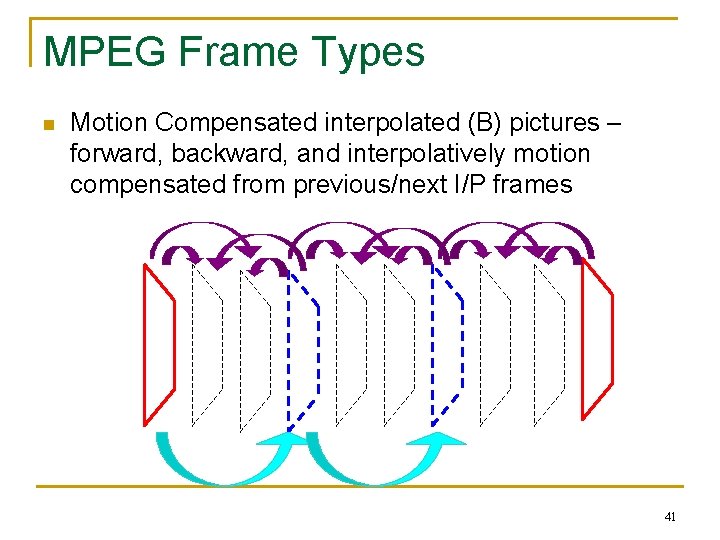
MPEG Frame Types n Motion Compensated interpolated (B) pictures – forward, backward, and interpolatively motion compensated from previous/next I/P frames 41
Motion Vector Coding n How are the motion vectors actually encoded for transmission to the decoder? q q q Start by taking the difference between the current motion vector and the most recent previous one of the same type (forward/backward/interpolative) Encode the difference using variable length coding Horizontal and vertical components coded separately 42
MPEG Frame Structure Terminology n A block contains 8 x 8 pixels q n The DCT unit A macroblock (MB) contains 4 blocks from the luminance, plus the corresponding chrominance blocks q q 4 blocks from each of Cr/Cb if 4: 4: 4 format 2 blocks from each of Cr/Cb if 4: 2: 2 format 1 block from each of Cr/Cb if 4: 1: 1 or 4: 2: 0 format The motion compensation unit 43
MPEG Frame Structure Terminology n A slice is a collection of macroblocks, tracing in a raster scan from upper left to lower right q n A picture is a frame, either progressive (noninterlaced) or interlaced q n The resynchronization unit The primary coding unit A Group of Pictures (GOP) contains ≥ 1 frame. q The unit for random access into the sequence 44
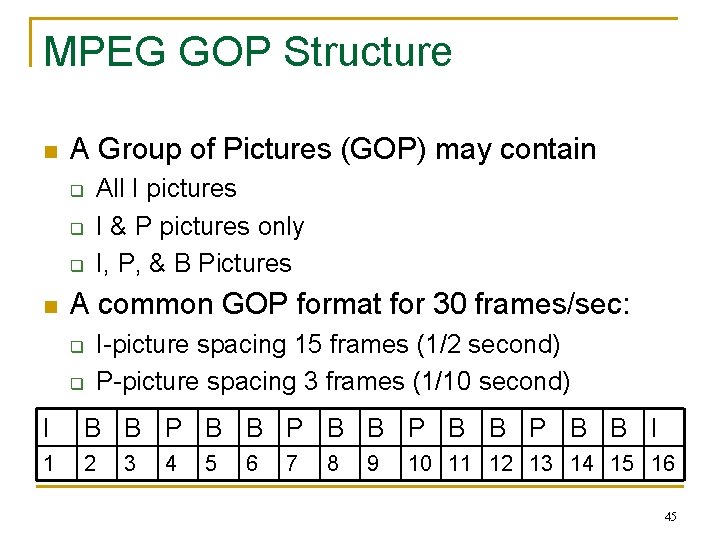
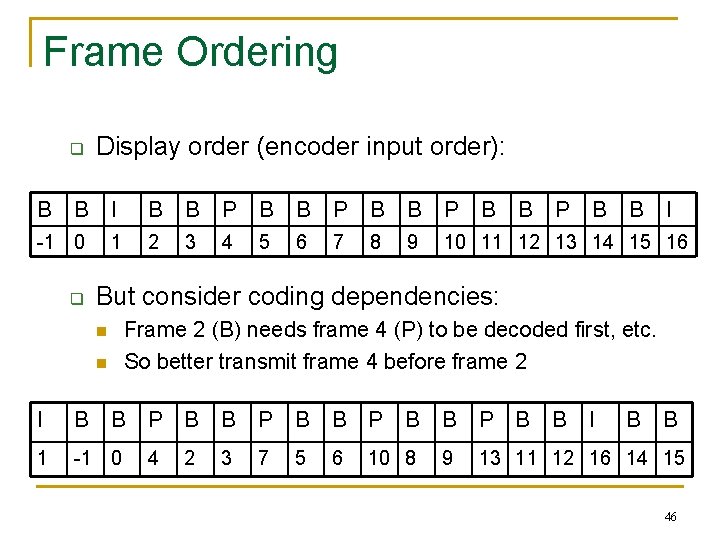
MPEG GOP Structure n A Group of Pictures (GOP) may contain q q q n All I pictures I & P pictures only I, P, & B Pictures A common GOP format for 30 frames/sec: q q I-picture spacing 15 frames (1/2 second) P-picture spacing 3 frames (1/10 second) I B B P B B I 1 2 3 4 5 6 7 8 9 10 11 12 13 14 15 16 45
Frame Ordering q B Display order (encoder input order): B I B B P -1 0 1 2 3 4 5 6 7 8 9 10 11 12 13 14 15 16 q B B P B B I But consider coding dependencies: Frame 2 (B) needs frame 4 (P) to be decoded first, etc. So better transmit frame 4 before frame 2 n n I B B P B B I B B 1 -1 0 4 2 3 7 5 6 10 8 9 13 11 12 16 14 15 46
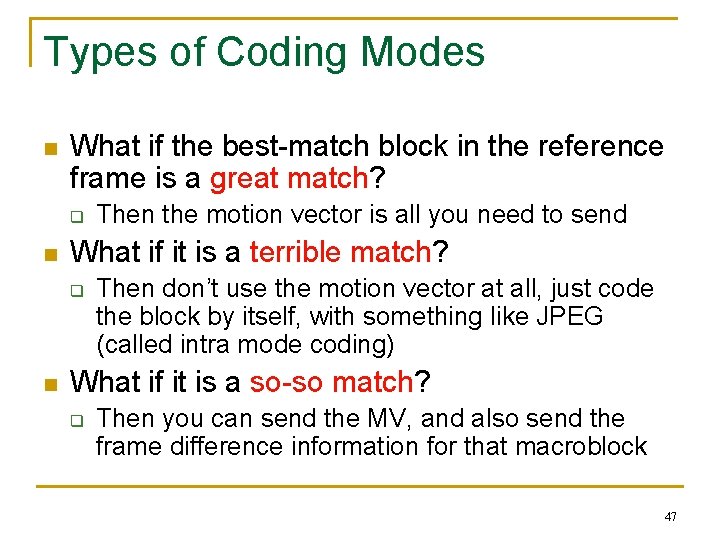
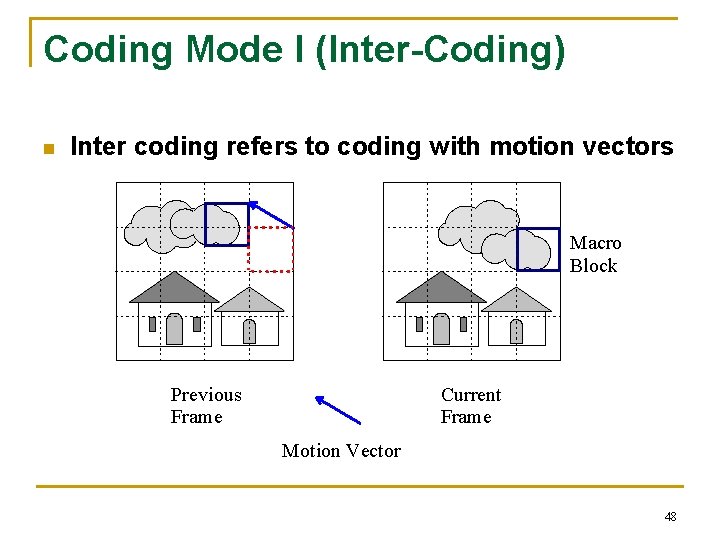
Types of Coding Modes n What if the best-match block in the reference frame is a great match? q n What if it is a terrible match? q n Then the motion vector is all you need to send Then don’t use the motion vector at all, just code the block by itself, with something like JPEG (called intra mode coding) What if it is a so-so match? q Then you can send the MV, and also send the frame difference information for that macroblock 47
Coding Mode I (Inter-Coding) n Inter coding refers to coding with motion vectors Macro Block Previous Frame Current Frame Motion Vector 48
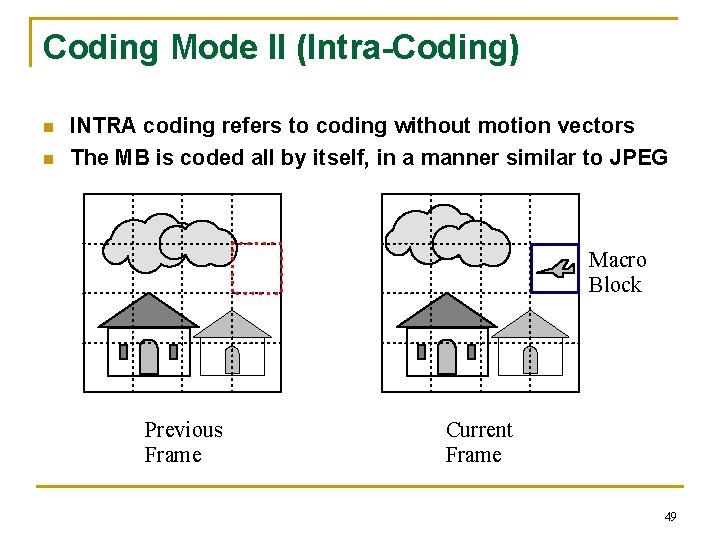
Coding Mode II (Intra-Coding) n n INTRA coding refers to coding without motion vectors The MB is coded all by itself, in a manner similar to JPEG Macro Block Previous Frame Current Frame 49
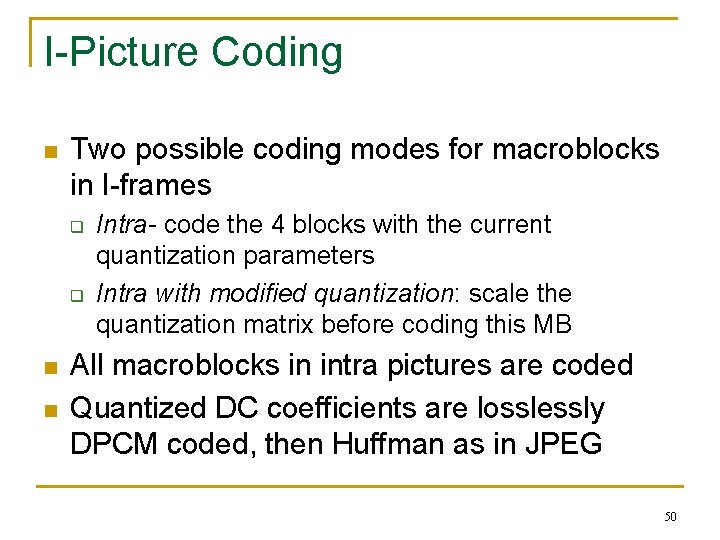
I-Picture Coding n Two possible coding modes for macroblocks in I-frames q q n n Intra- code the 4 blocks with the current quantization parameters Intra with modified quantization: scale the quantization matrix before coding this MB All macroblocks in intra pictures are coded Quantized DC coefficients are losslessly DPCM coded, then Huffman as in JPEG 50
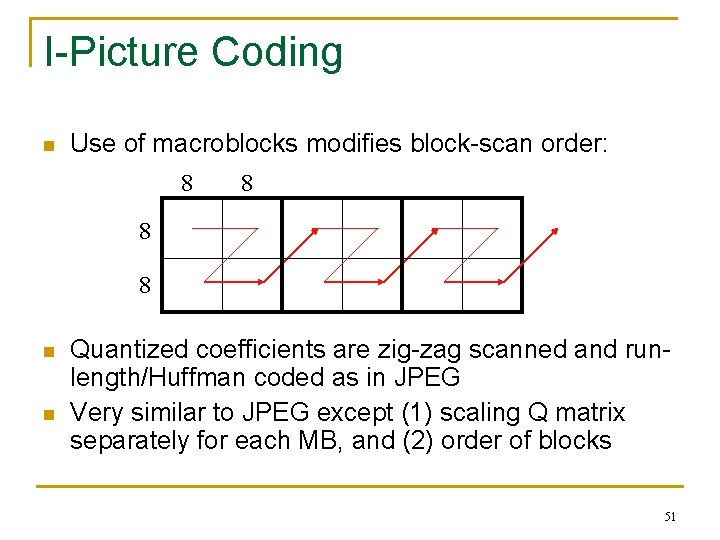
I-Picture Coding n Use of macroblocks modifies block-scan order: 8 8 n n Quantized coefficients are zig-zag scanned and runlength/Huffman coded as in JPEG Very similar to JPEG except (1) scaling Q matrix separately for each MB, and (2) order of blocks 51
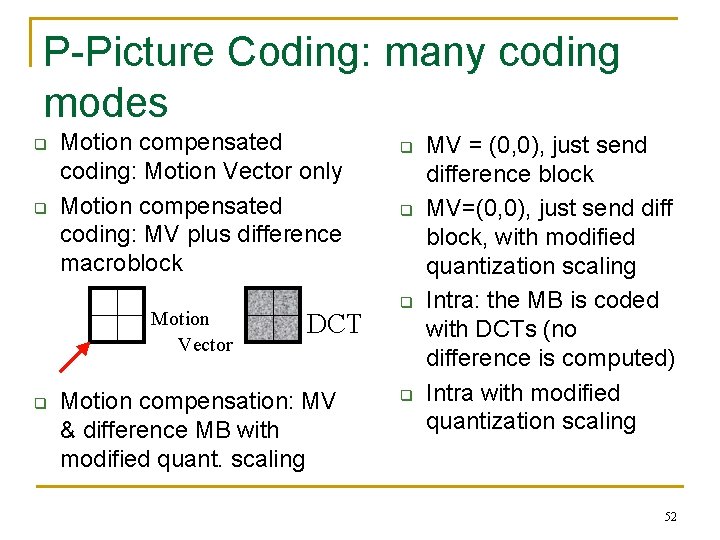
P-Picture Coding: many coding modes q q Motion compensated coding: Motion Vector only Motion compensated coding: MV plus difference macroblock Motion Vector q DCT Motion compensation: MV & difference MB with modified quant. scaling q q MV = (0, 0), just send difference block MV=(0, 0), just send diff block, with modified quantization scaling Intra: the MB is coded with DCTs (no difference is computed) Intra with modified quantization scaling 52
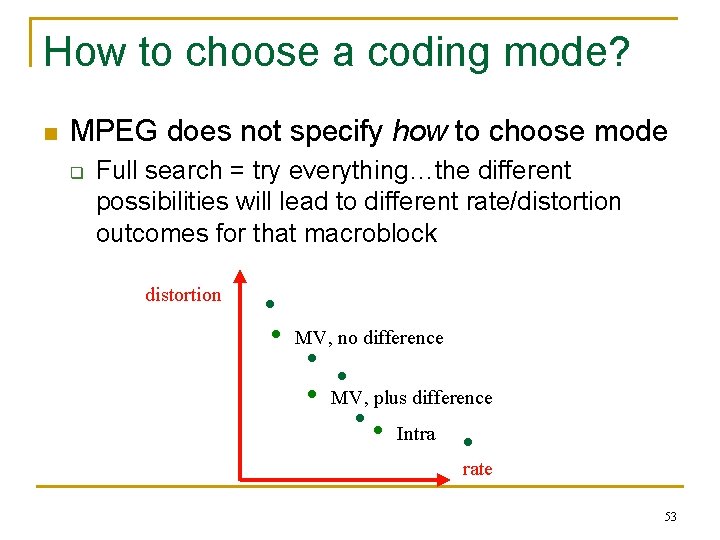
How to choose a coding mode? n MPEG does not specify how to choose mode q Full search = try everything…the different possibilities will lead to different rate/distortion outcomes for that macroblock distortion • • MV, no difference • • • MV, plus difference • • Intra • rate 53
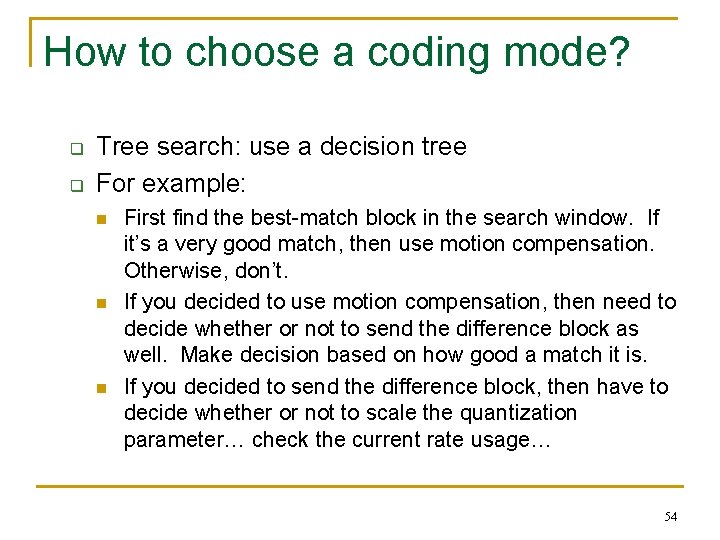
How to choose a coding mode? q q Tree search: use a decision tree For example: n n n First find the best-match block in the search window. If it’s a very good match, then use motion compensation. Otherwise, don’t. If you decided to use motion compensation, then need to decide whether or not to send the difference block as well. Make decision based on how good a match it is. If you decided to send the difference block, then have to decide whether or not to scale the quantization parameter… check the current rate usage… 54
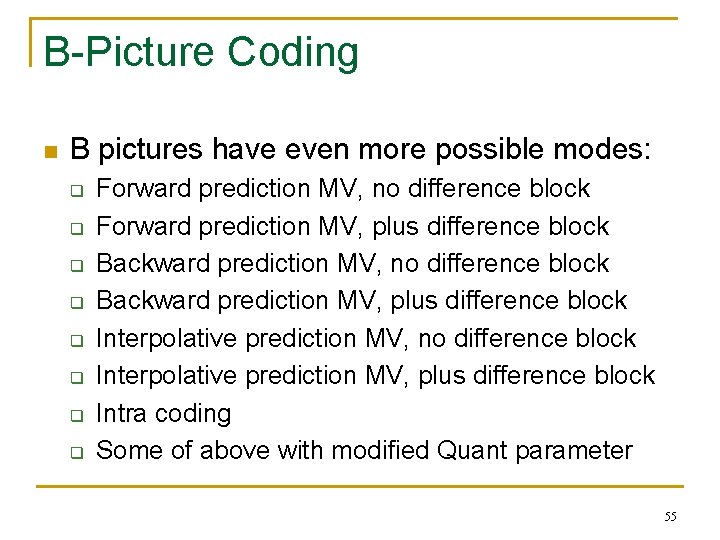
B-Picture Coding n B pictures have even more possible modes: q q q q Forward prediction MV, no difference block Forward prediction MV, plus difference block Backward prediction MV, no difference block Backward prediction MV, plus difference block Interpolative prediction MV, no difference block Interpolative prediction MV, plus difference block Intra coding Some of above with modified Quant parameter 55
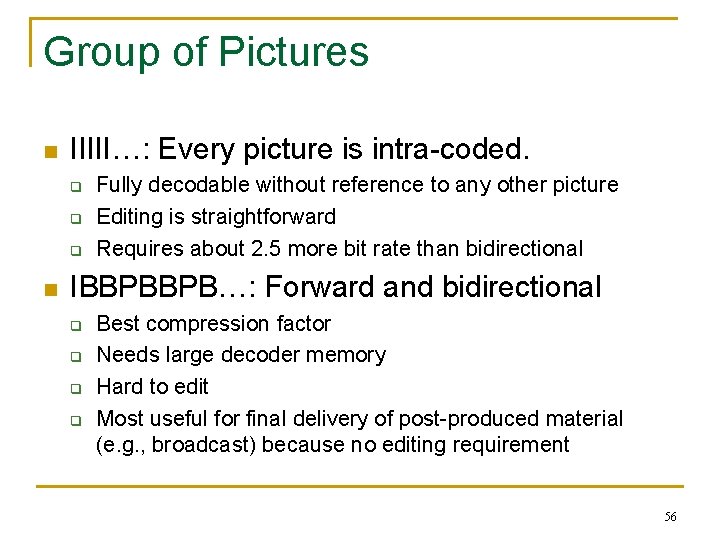
Group of Pictures n IIIII…: Every picture is intra-coded. q q q n Fully decodable without reference to any other picture Editing is straightforward Requires about 2. 5 more bit rate than bidirectional IBBPBBPB…: Forward and bidirectional q q Best compression factor Needs large decoder memory Hard to edit Most useful for final delivery of post-produced material (e. g. , broadcast) because no editing requirement 56
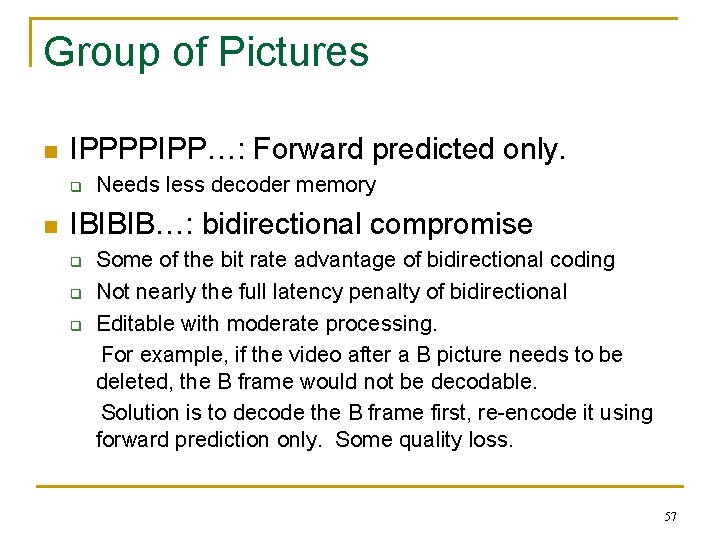
Group of Pictures n IPPPPIPP…: Forward predicted only. q n Needs less decoder memory IBIBIB…: bidirectional compromise q q q Some of the bit rate advantage of bidirectional coding Not nearly the full latency penalty of bidirectional Editable with moderate processing. For example, if the video after a B picture needs to be deleted, the B frame would not be decodable. Solution is to decode the B frame first, re-encode it using forward prediction only. Some quality loss. 57