Using Unscripted Spoken Texts in Teaching L 2

- Slides: 72
Using Unscripted Spoken Texts in Teaching L 2 Listening Comprehension Elvis Wagner Department of Teaching and Learning elvis@temple. edu
Introduction Elvis Wagner, Associate Professor of TESOL Introduce yourself: n Your name n What/where you teach n Your opinion of Philadelphia n The best thing you’ve done since you’ve gotten here 2
Introduction Second Language Listening ability--the “forgotten skill” in L 2 teaching and research. Why? 3
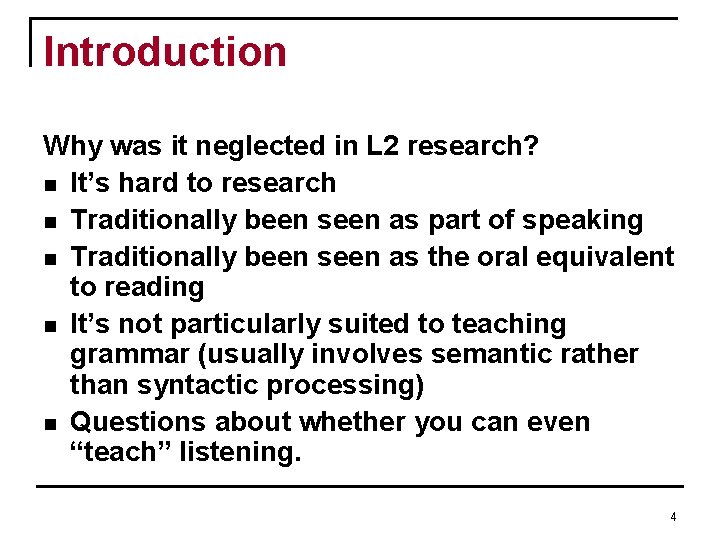
Introduction Why was it neglected in L 2 research? n It’s hard to research n Traditionally been seen as part of speaking n Traditionally been seen as the oral equivalent to reading n It’s not particularly suited to teaching grammar (usually involves semantic rather than syntactic processing) n Questions about whether you can even “teach” listening. 4
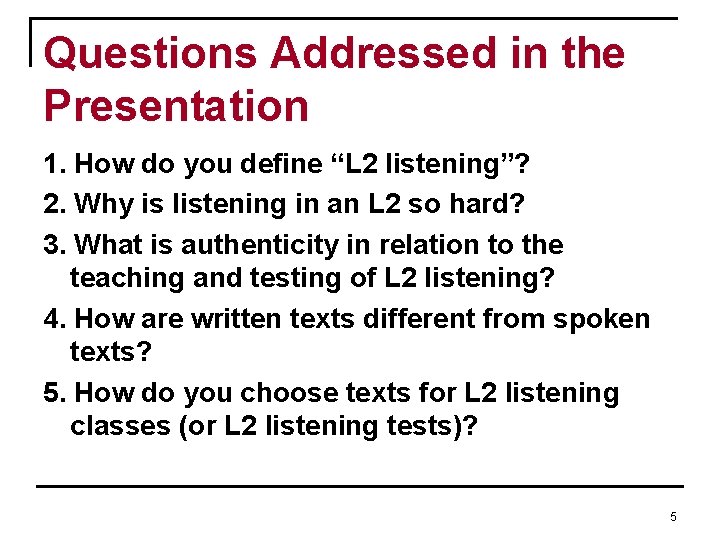
Questions Addressed in the Presentation 1. How do you define “L 2 listening”? 2. Why is listening in an L 2 so hard? 3. What is authenticity in relation to the teaching and testing of L 2 listening? 4. How are written texts different from spoken texts? 5. How do you choose texts for L 2 listening classes (or L 2 listening tests)? 5
Defining L 2 Listening How would you define L 2 listening? In pairs, come up with a formal definition of what it means to be able to listen in a second language (3 minutes). 6
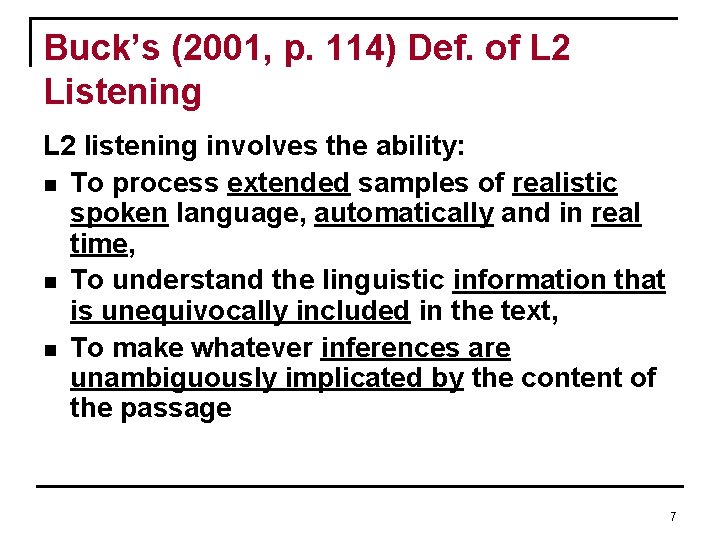
Buck’s (2001, p. 114) Def. of L 2 Listening L 2 listening involves the ability: n To process extended samples of realistic spoken language, automatically and in real time, n To understand the linguistic information that is unequivocally included in the text, n To make whatever inferences are unambiguously implicated by the content of the passage 7
Teaching L 2 Listening Who studied a foreign language for many years in their home country, and then, only after many years of study, went to a country where that language was spoken? What happened? The “I studied French for 3 years in high school, and 2 years in college, but when I got to Paris, I couldn’t understand a word anybody said” phenomenon. 8
Teaching L 2 Listening Why do we spend (many) years studying a language, and then we go to actually use that language in a real world context, we can’t? How does this happen? Why does this happen? As language teachers, what are we doing wrong? Discuss these questions in your groups (3 minutes) 9
Teaching L 2 Listening As language teachers, what are we doing wrong? § Too much focus on grammar § Learning about the language, rather than actually using the language to learn § The artificial nature of much of the (spoken) input that FL learners receive in the classroom 10
Why is listening in an L 2 difficult? Think about your own L 2 learning experiences. In groups, take 3 minutes to create a list of answers to the following questions: n Why is listening in an L 2 so hard? n What are some of the specific aspects of L 2 listening that make it difficult for learners? 11
Why is listening in an L 2 difficult? n n n n It is ephemeral. It happens in real time, with (usually) no physical record The rate of delivery of the input stream is out of the listener’s control (to some extent) Imperfect oral input stream It is anxiety-inducing Interactive nature of speaking/listening (very cognitively demanding) The L 2 listener often lacks the background/cultural knowledge that the speaker assumes the listener has The L 2 listener often lacks target language textual knowledge Real world L 2 listening often different from the types of listening L 2 learners experience in the classroom 12
Why is listening in an L 2 difficult? Lots of things make L 2 listening difficult. And it is exactly those things that make L 2 listening difficult that we should focus on in our teaching. We need to focus on those language characteristics that are unique to listening, and those things that make L 2 listening difficult. 13
Spoken texts are on-line and ephemeral n n Unlike with reading, the listener cannot go back and peruse the text again No record of the text 14
How to address it in teaching? Spoken texts are ephemeral, in real time, with (usually) no physical record. How to address it? n Practice, practice n Promote learners’ ability to do bottom-up processing automatically 15
Rate of delivery of input is out of the listener’s control Unlike with reading, to a large extent, the listener is unable to dictate the pace of the text; the rate of delivery of the input stream is out of the listener’s control (to some extent). How to address it? n Aim for automatization (practice, practice) n Communication strategies (“Could you repeat that? ”, “Could you say that again more slowly? ”) 16
Imperfect oral input stream L 2 listeners have to deal with background noise, other people speaking, and other less than perfect aural input. In addition, the speaker might be speaking too quietly, or unclearly, with an accent, etc. How to address it in teaching? n Include authentic texts (with authentic background noise) n Provide lots of listening practice so learners can do it more automatically 17
Anxiety-inducing Because of the real-time, on-line nature of listening (and speaking), it can be frustrating and anxiety-inducing. Anxiety takes attentional resources. How to address it in teaching? n Give them strategies for reducing anxiety n Practice, practice 18
Interactive Speaking/Listening Cognitively Demanding Interactive speaking and listening is very cognitively demanding, but the L 2 listener has finite attentional resources; s/he is a limited capacity processor. S/he has to listen to use his/her senses to perceive the spoken input, parse it, decode it, interpret it, and figure out how to respond to it (all at the same time!). 19
How to address it in teaching? n n Create communicative speaking and listening tasks that are characteristic of authentic communicative interactions—tasks that require the listener to listen to and respond to the speaker Practice, practice 20
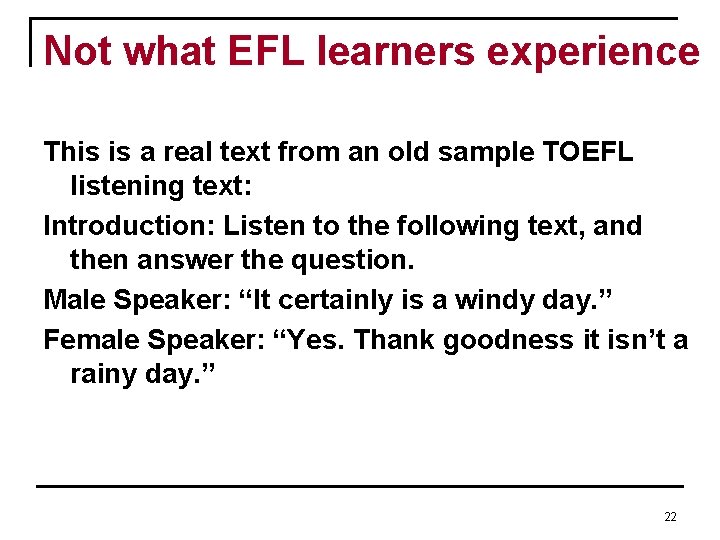
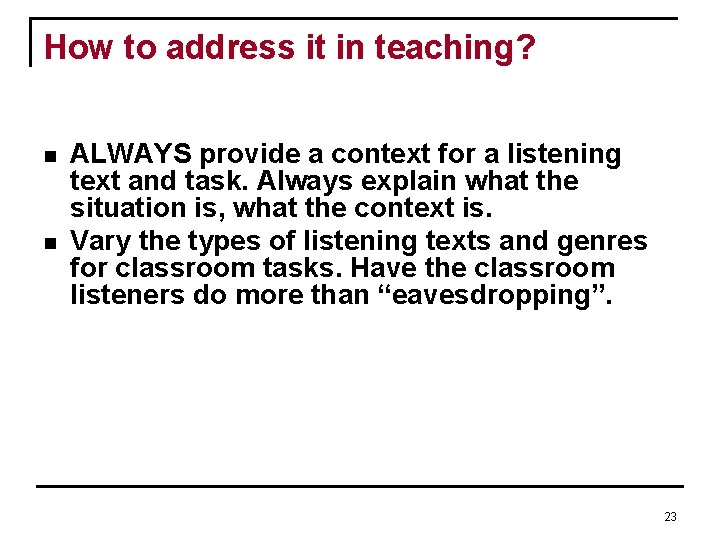
Not what EFL learners experience Real world L 2 listening is often different from L 2 classroom listening. Classroom learners often: n Are expected to listen to a text without being provided any context as to what the text is about n Are expected to be “overhearers” (eavesdroppers) of conversations, rather than participate in them 21
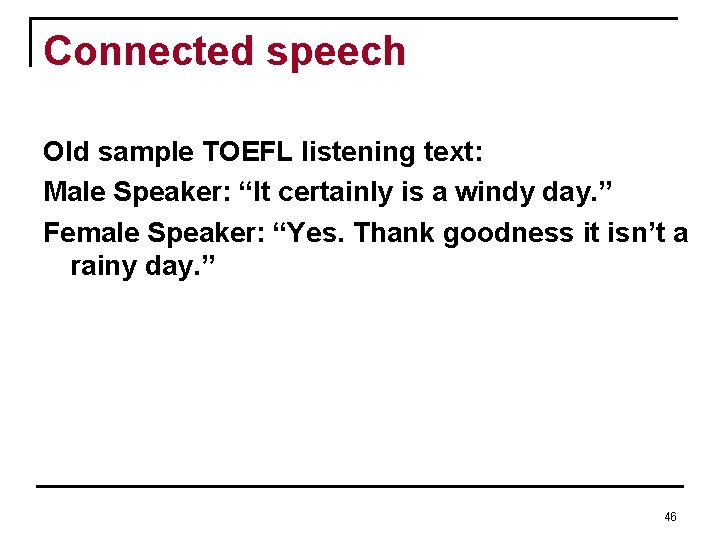
Not what EFL learners experience This is a real text from an old sample TOEFL listening text: Introduction: Listen to the following text, and then answer the question. Male Speaker: “It certainly is a windy day. ” Female Speaker: “Yes. Thank goodness it isn’t a rainy day. ” 22
How to address it in teaching? n n ALWAYS provide a context for a listening text and task. Always explain what the situation is, what the context is. Vary the types of listening texts and genres for classroom tasks. Have the classroom listeners do more than “eavesdropping”. 23
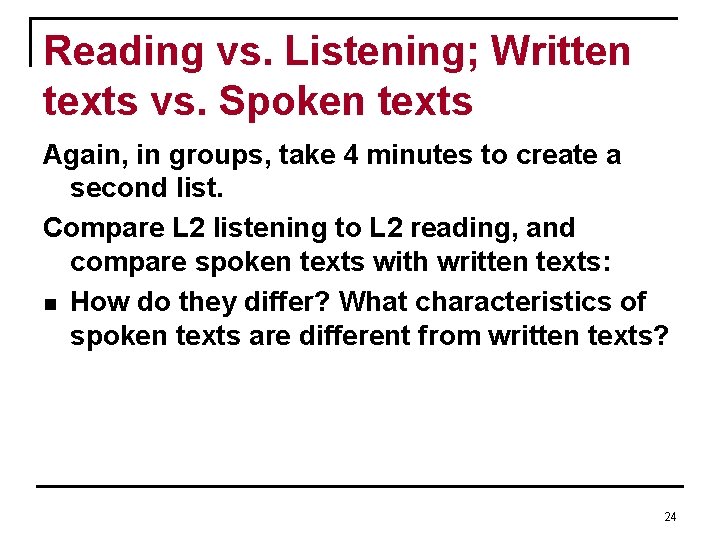
Reading vs. Listening; Written texts vs. Spoken texts Again, in groups, take 4 minutes to create a second list. Compare L 2 listening to L 2 reading, and compare spoken texts with written texts: n How do they differ? What characteristics of spoken texts are different from written texts? 24
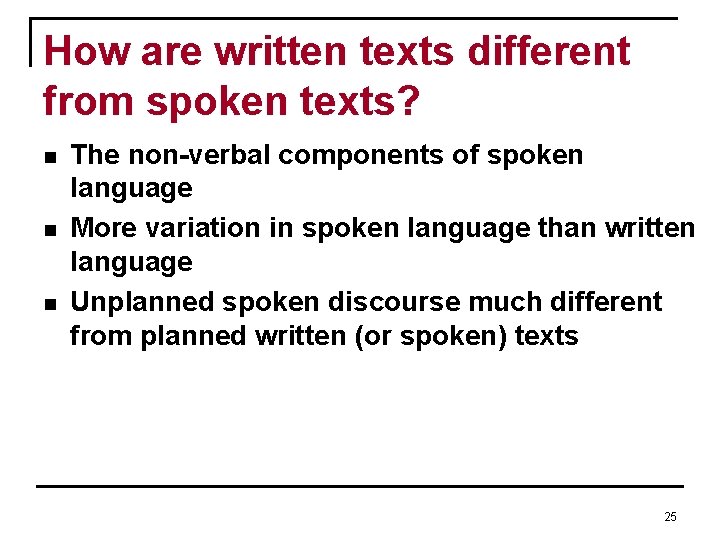
How are written texts different from spoken texts? n n n The non-verbal components of spoken language More variation in spoken language than written language Unplanned spoken discourse much different from planned written (or spoken) texts 25
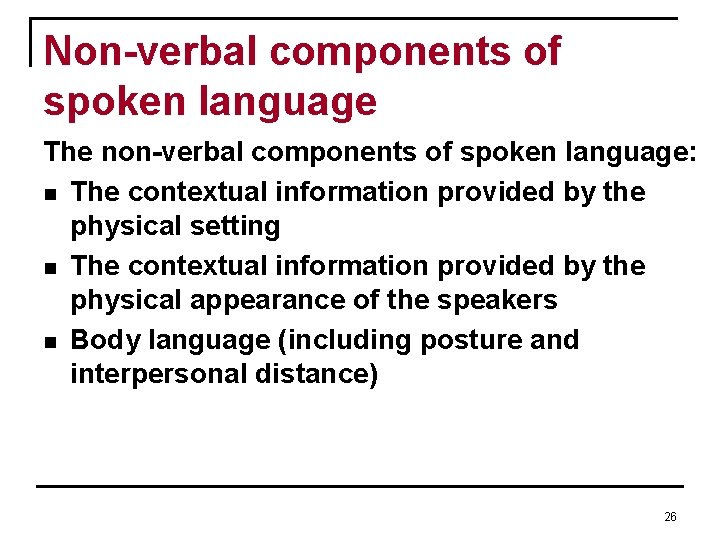
Non-verbal components of spoken language The non-verbal components of spoken language: n The contextual information provided by the physical setting n The contextual information provided by the physical appearance of the speakers n Body language (including posture and interpersonal distance) 26
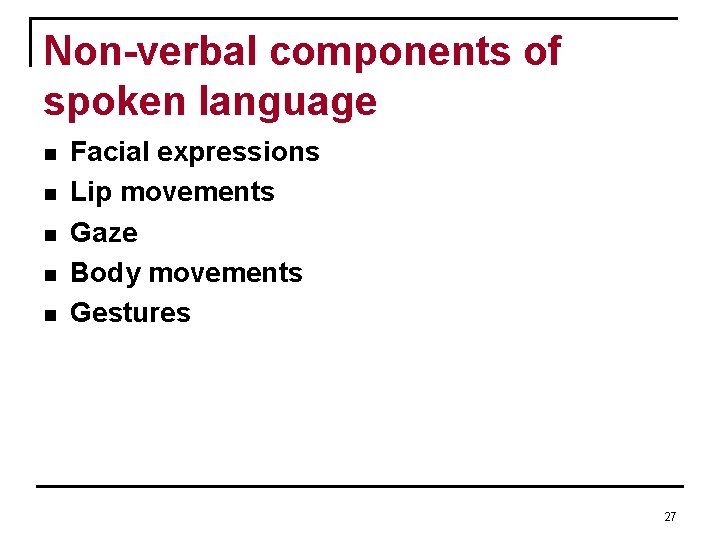
Non-verbal components of spoken language n n n Facial expressions Lip movements Gaze Body movements Gestures 27
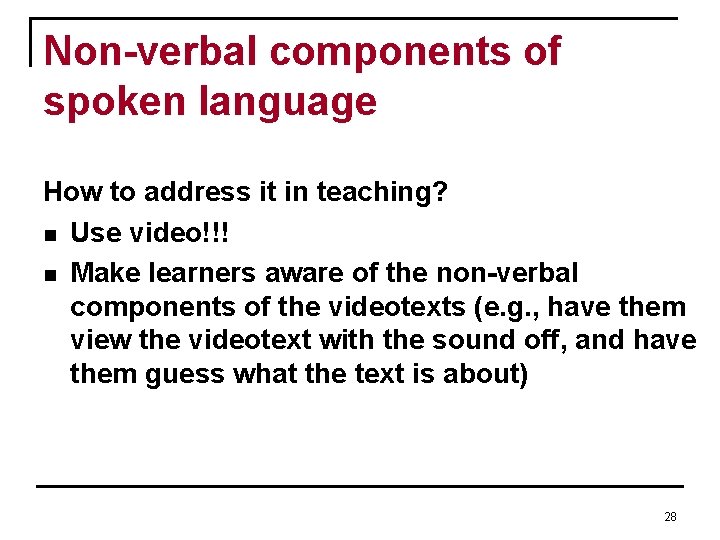
Non-verbal components of spoken language How to address it in teaching? n Use video!!! n Make learners aware of the non-verbal components of the videotexts (e. g. , have them view the videotext with the sound off, and have them guess what the text is about) 28
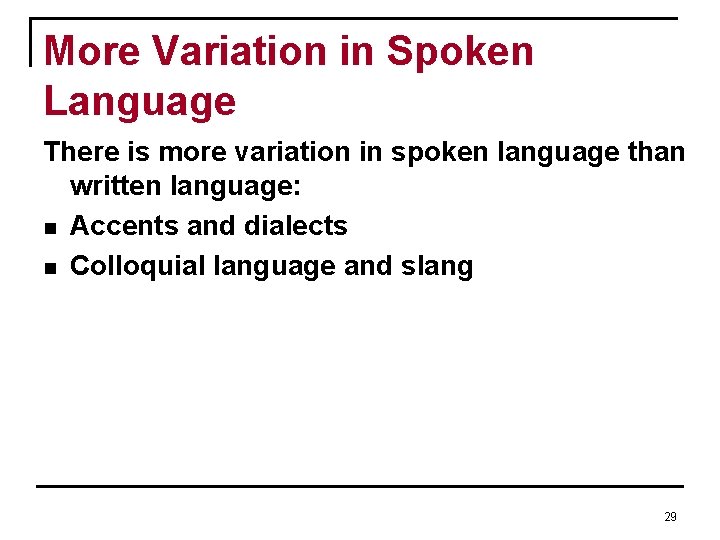
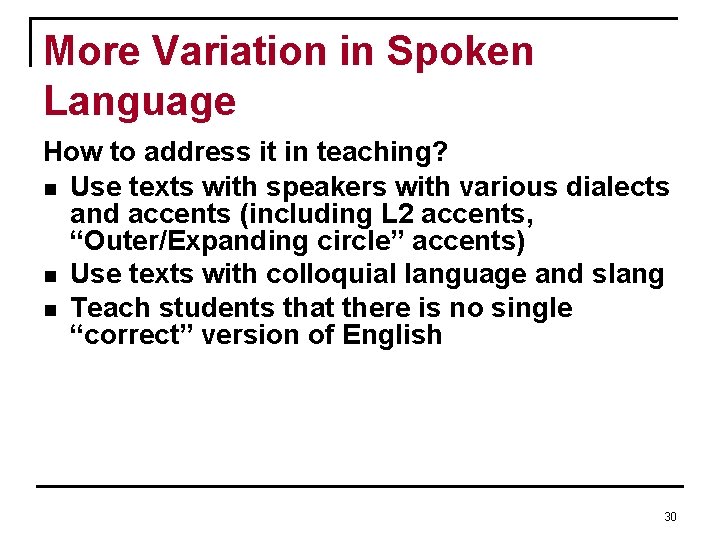
More Variation in Spoken Language There is more variation in spoken language than written language: n Accents and dialects n Colloquial language and slang 29
More Variation in Spoken Language How to address it in teaching? n Use texts with speakers with various dialects and accents (including L 2 accents, “Outer/Expanding circle” accents) n Use texts with colloquial language and slang n Teach students that there is no single “correct” version of English 30
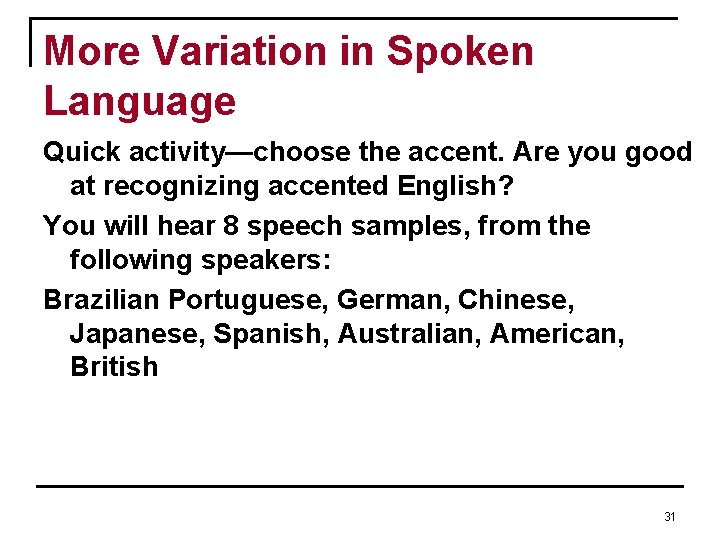
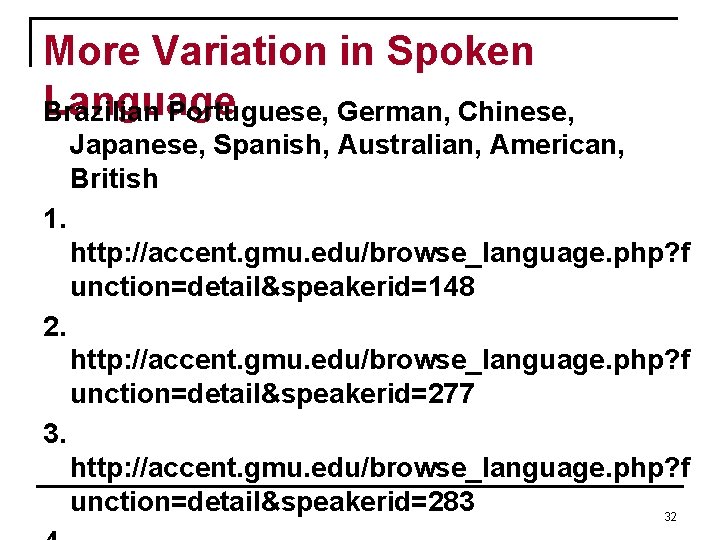
More Variation in Spoken Language Quick activity—choose the accent. Are you good at recognizing accented English? You will hear 8 speech samples, from the following speakers: Brazilian Portuguese, German, Chinese, Japanese, Spanish, Australian, American, British 31
More Variation in Spoken Language Brazilian Portuguese, German, Chinese, Japanese, Spanish, Australian, American, British 1. http: //accent. gmu. edu/browse_language. php? f unction=detail&speakerid=148 2. http: //accent. gmu. edu/browse_language. php? f unction=detail&speakerid=277 3. http: //accent. gmu. edu/browse_language. php? f unction=detail&speakerid=283 32
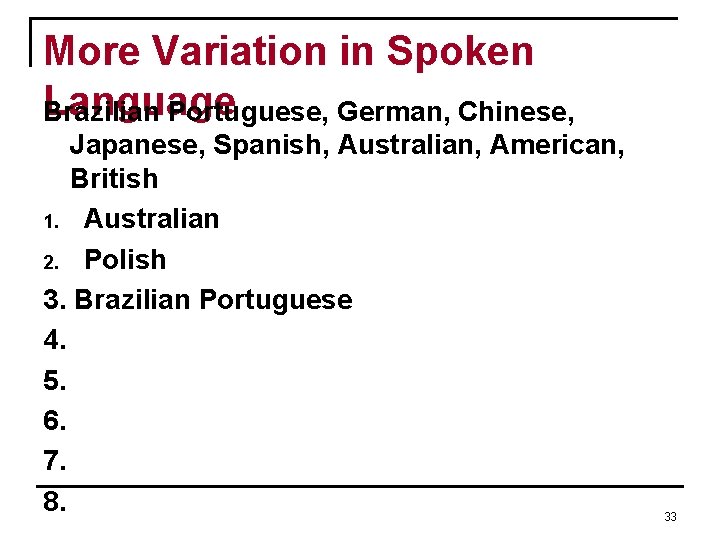
More Variation in Spoken Language Brazilian Portuguese, German, Chinese, Japanese, Spanish, Australian, American, British 1. Australian 2. Polish 3. Brazilian Portuguese 4. 5. 6. 7. 8. 33
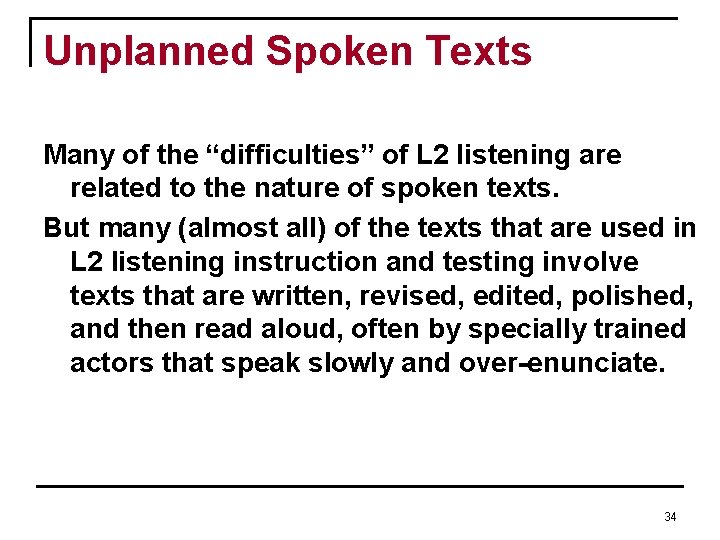
Unplanned Spoken Texts Many of the “difficulties” of L 2 listening are related to the nature of spoken texts. But many (almost all) of the texts that are used in L 2 listening instruction and testing involve texts that are written, revised, edited, polished, and then read aloud, often by specially trained actors that speak slowly and over-enunciate. 34
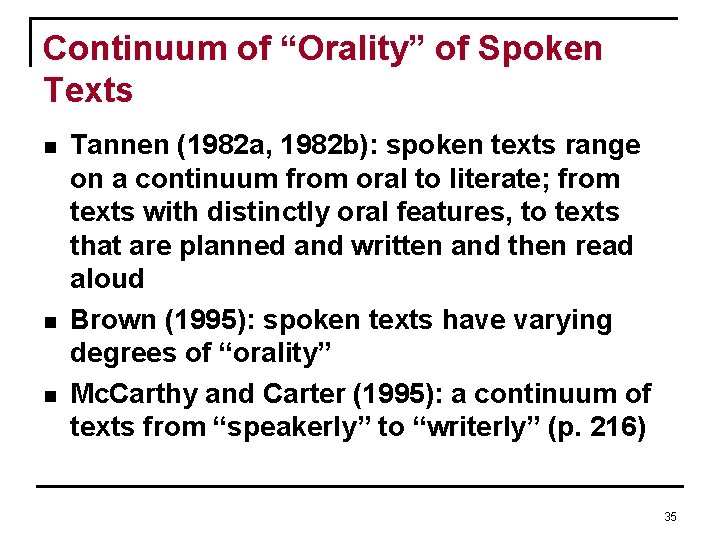
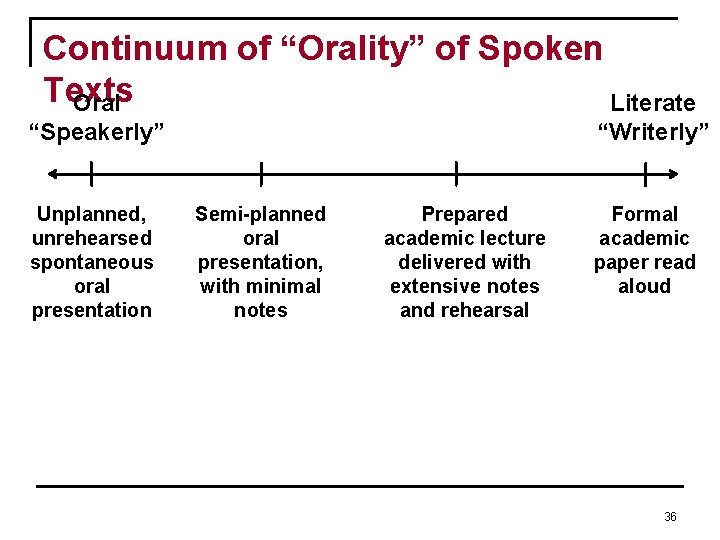
Continuum of “Orality” of Spoken Texts n n n Tannen (1982 a, 1982 b): spoken texts range on a continuum from oral to literate; from texts with distinctly oral features, to texts that are planned and written and then read aloud Brown (1995): spoken texts have varying degrees of “orality” Mc. Carthy and Carter (1995): a continuum of texts from “speakerly” to “writerly” (p. 216) 35
Continuum of “Orality” of Spoken Texts Oral Literate “Speakerly” Unplanned, unrehearsed spontaneous oral presentation “Writerly” Semi-planned oral presentation, with minimal notes Prepared academic lecture delivered with extensive notes and rehearsal Formal academic paper read aloud 36
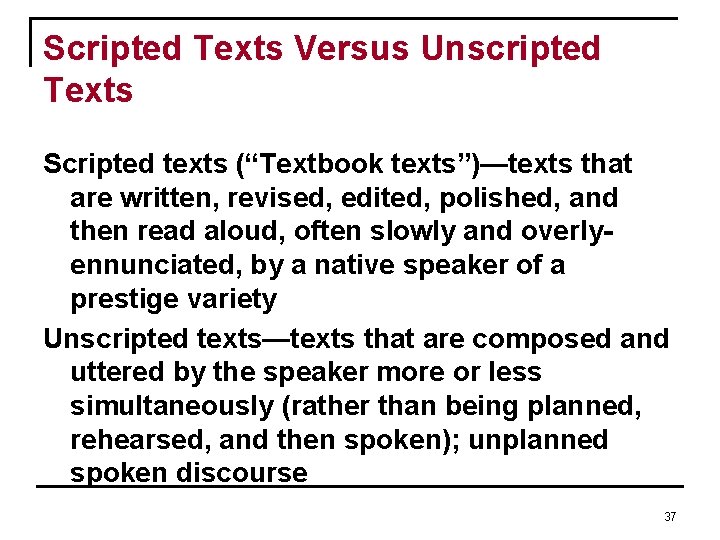
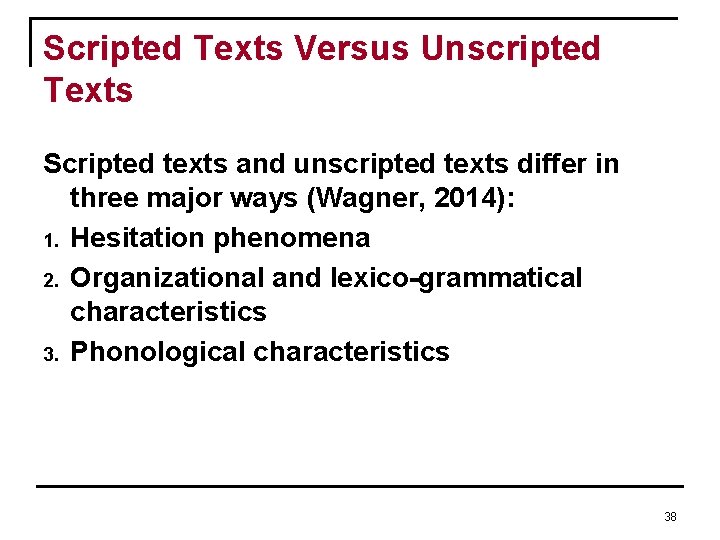
Scripted Texts Versus Unscripted Texts Scripted texts (“Textbook texts”)—texts that are written, revised, edited, polished, and then read aloud, often slowly and overlyennunciated, by a native speaker of a prestige variety Unscripted texts—texts that are composed and uttered by the speaker more or less simultaneously (rather than being planned, rehearsed, and then spoken); unplanned spoken discourse 37
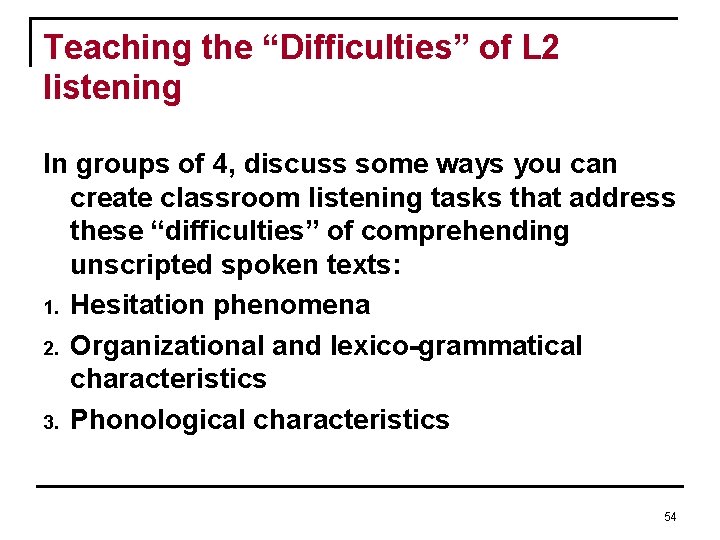
Scripted Texts Versus Unscripted Texts Scripted texts and unscripted texts differ in three major ways (Wagner, 2014): 1. Hesitation phenomena 2. Organizational and lexico-grammatical characteristics 3. Phonological characteristics 38
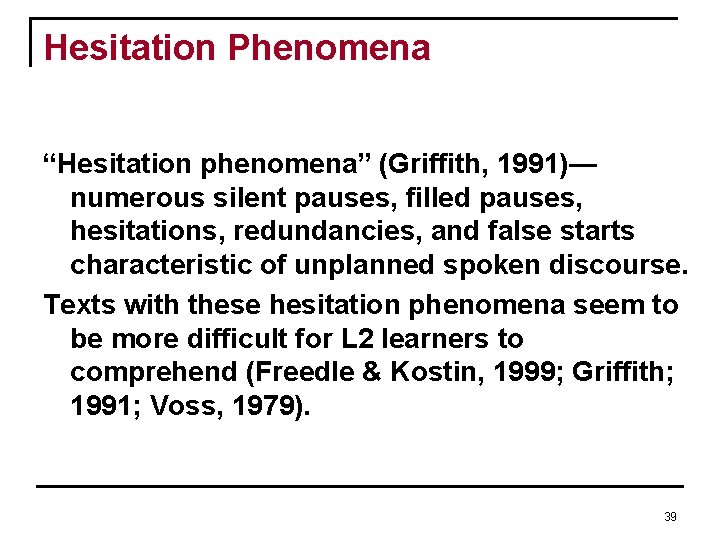
Hesitation Phenomena “Hesitation phenomena” (Griffith, 1991)— numerous silent pauses, filled pauses, hesitations, redundancies, and false starts characteristic of unplanned spoken discourse. Texts with these hesitation phenomena seem to be more difficult for L 2 learners to comprehend (Freedle & Kostin, 1999; Griffith; 1991; Voss, 1979). 39
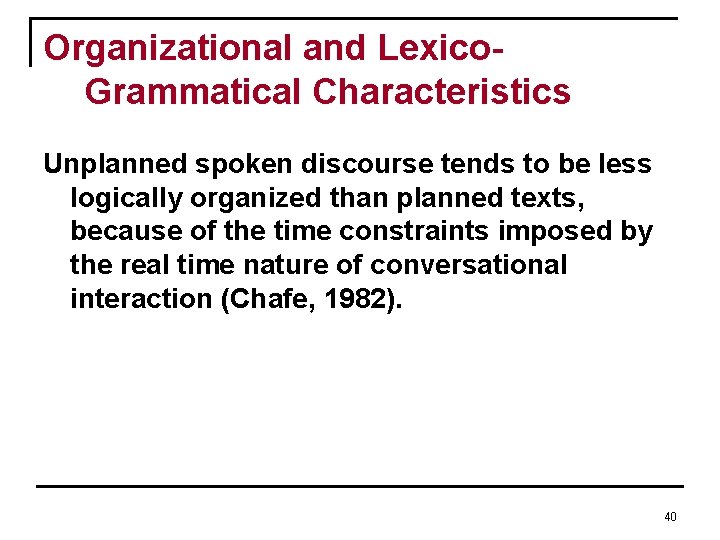
Organizational and Lexico. Grammatical Characteristics Unplanned spoken discourse tends to be less logically organized than planned texts, because of the time constraints imposed by the real time nature of conversational interaction (Chafe, 1982). 40
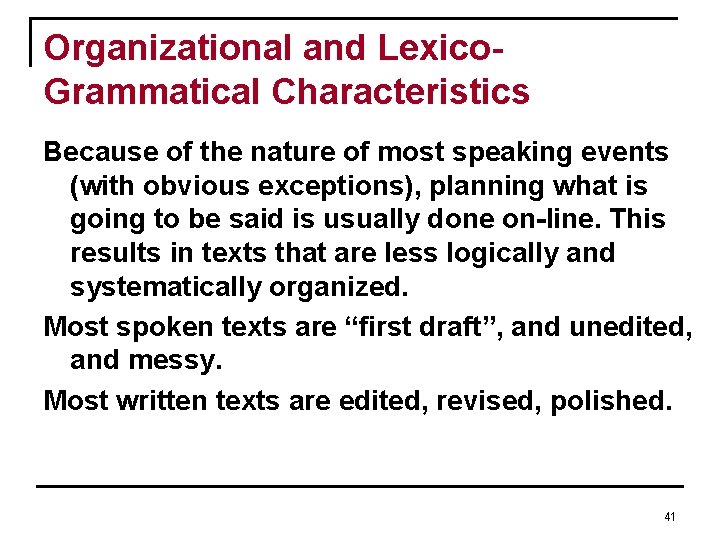
Organizational and Lexico. Grammatical Characteristics Because of the nature of most speaking events (with obvious exceptions), planning what is going to be said is usually done on-line. This results in texts that are less logically and systematically organized. Most spoken texts are “first draft”, and unedited, and messy. Most written texts are edited, revised, polished. 41
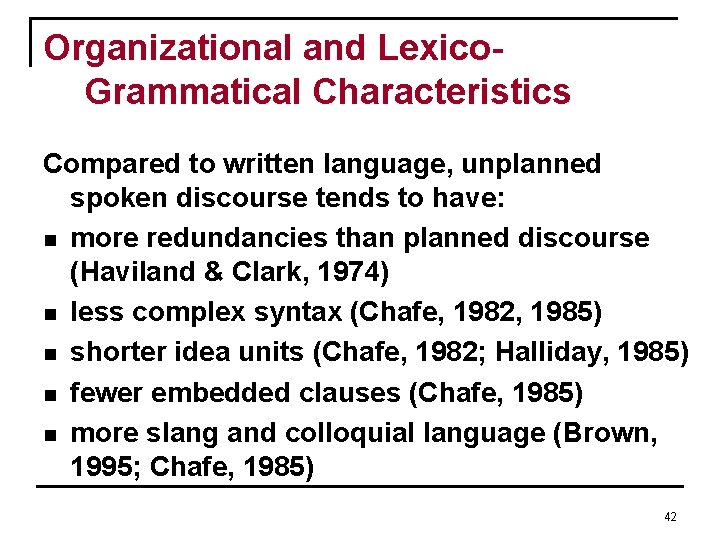
Organizational and Lexico. Grammatical Characteristics Compared to written language, unplanned spoken discourse tends to have: n more redundancies than planned discourse (Haviland & Clark, 1974) n less complex syntax (Chafe, 1982, 1985) n shorter idea units (Chafe, 1982; Halliday, 1985) n fewer embedded clauses (Chafe, 1985) n more slang and colloquial language (Brown, 1995; Chafe, 1985) 42
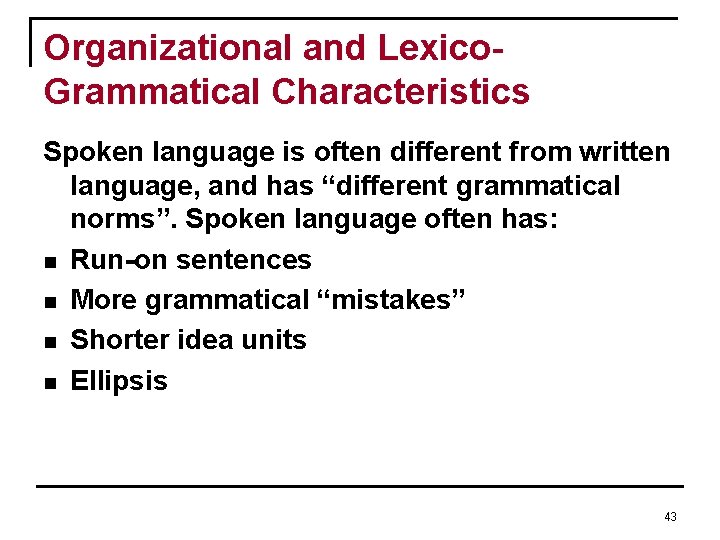
Organizational and Lexico. Grammatical Characteristics Spoken language is often different from written language, and has “different grammatical norms”. Spoken language often has: n Run-on sentences n More grammatical “mistakes” n Shorter idea units n Ellipsis 43
Phonological Characteristics The phonological characteristics of unscripted, spontaneous texts also tend to be very different from the phonological characteristics of scripted texts that are written and read aloud. 44
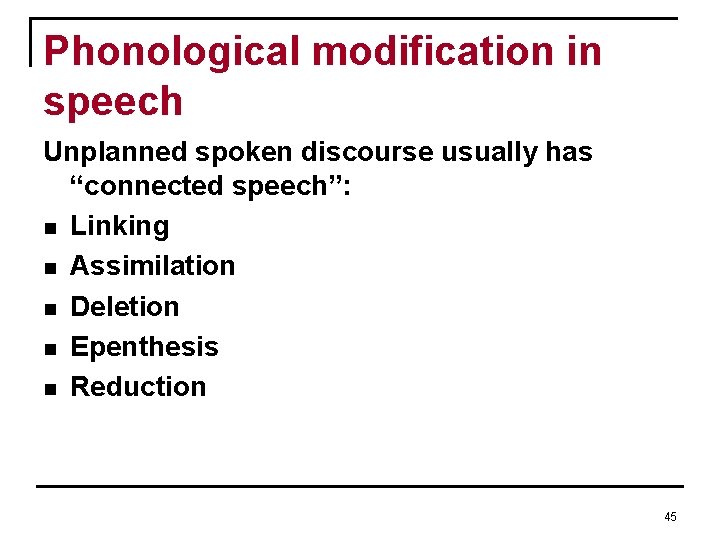
Phonological modification in speech Unplanned spoken discourse usually has “connected speech”: n Linking n Assimilation n Deletion n Epenthesis n Reduction 45
Connected speech Old sample TOEFL listening text: Male Speaker: “It certainly is a windy day. ” Female Speaker: “Yes. Thank goodness it isn’t a rainy day. ” 46
The need to segment the aural input Segmenting is HARD. You’ve had the experience in an L 2 where all of the oral input seemed like an unbroken stream of sounds. 47
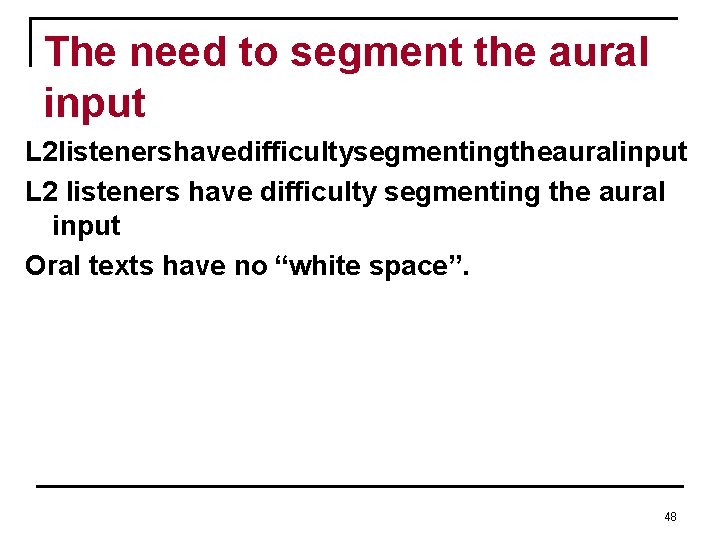
The need to segment the aural input L 2 listenershavedifficultysegmentingtheauralinput L 2 listeners have difficulty segmenting the aural input Oral texts have no “white space”. 48
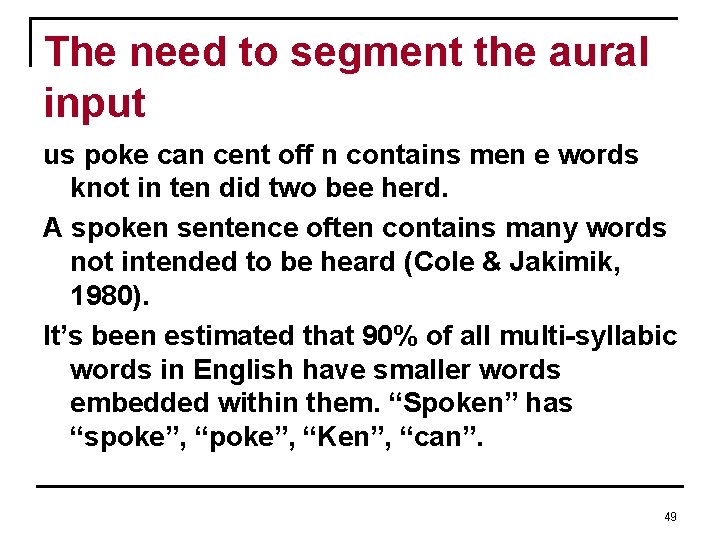
The need to segment the aural input us poke can cent off n contains men e words knot in ten did two bee herd. A spoken sentence often contains many words not intended to be heard (Cole & Jakimik, 1980). It’s been estimated that 90% of all multi-syllabic words in English have smaller words embedded within them. “Spoken” has “spoke”, “Ken”, “can”. 49
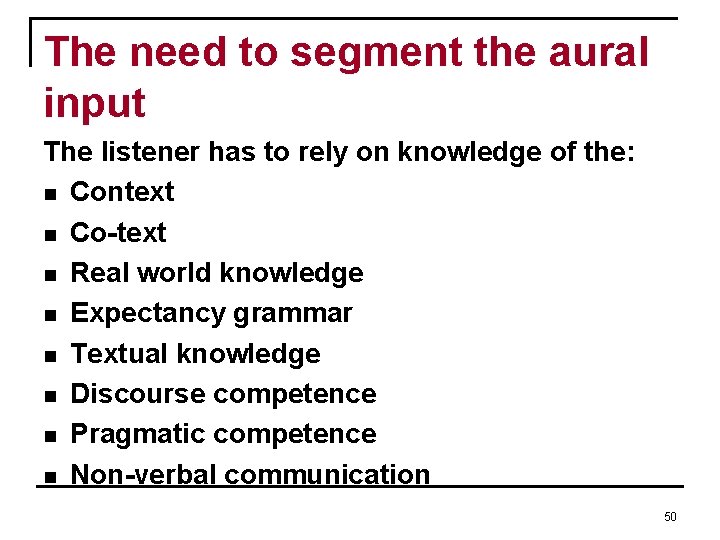
The need to segment the aural input The listener has to rely on knowledge of the: n Context n Co-text n Real world knowledge n Expectancy grammar n Textual knowledge n Discourse competence n Pragmatic competence n Non-verbal communication 50
So what does it all mean? Why spend so much time dwelling on why/how L 2 listening is so difficult? We need to use this information about what makes L 2 listening difficult to inform how we teach L 2 listening. 51
Teaching the “Difficulties” of L 2 listening We can devise tasks that address those difficult aspects of L 2 listening in order to improve L 2 listeners’ ability to do the skill involved, and ultimately they will become better listeners. 52
Teaching the “Difficulties” of L 2 listening So let’s go back and look at the differences between scripted and unscripted spoken texts, and try to think of activities/tasks/lessons that can address these difficulties. 53
Teaching the “Difficulties” of L 2 listening In groups of 4, discuss some ways you can create classroom listening tasks that address these “difficulties” of comprehending unscripted spoken texts: 1. Hesitation phenomena 2. Organizational and lexico-grammatical characteristics 3. Phonological characteristics 54
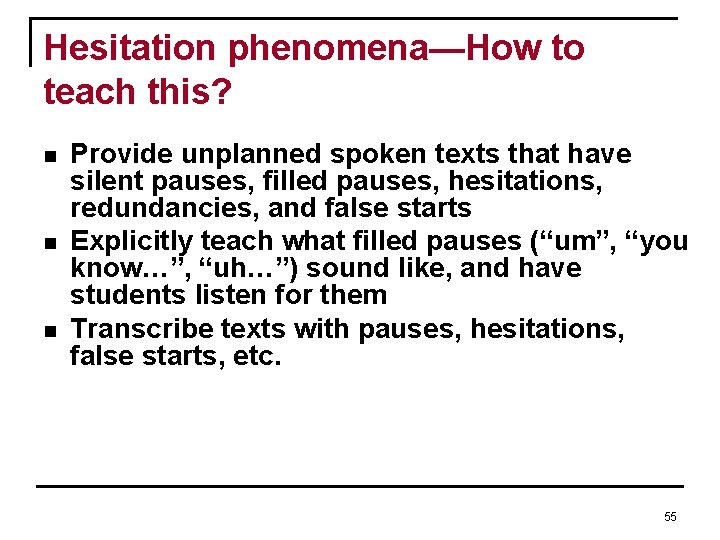
Hesitation phenomena—How to teach this? n n n Provide unplanned spoken texts that have silent pauses, filled pauses, hesitations, redundancies, and false starts Explicitly teach what filled pauses (“um”, “you know…”, “uh…”) sound like, and have students listen for them Transcribe texts with pauses, hesitations, false starts, etc. 55
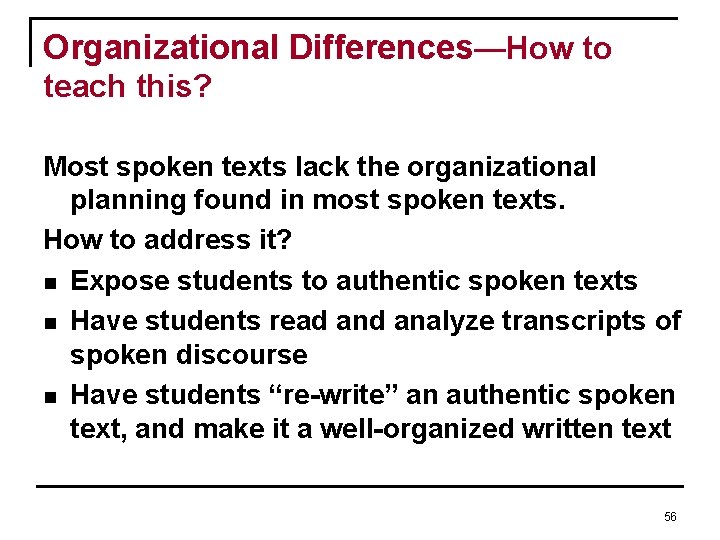
Organizational Differences—How to teach this? Most spoken texts lack the organizational planning found in most spoken texts. How to address it? n Expose students to authentic spoken texts n Have students read analyze transcripts of spoken discourse n Have students “re-write” an authentic spoken text, and make it a well-organized written text 56
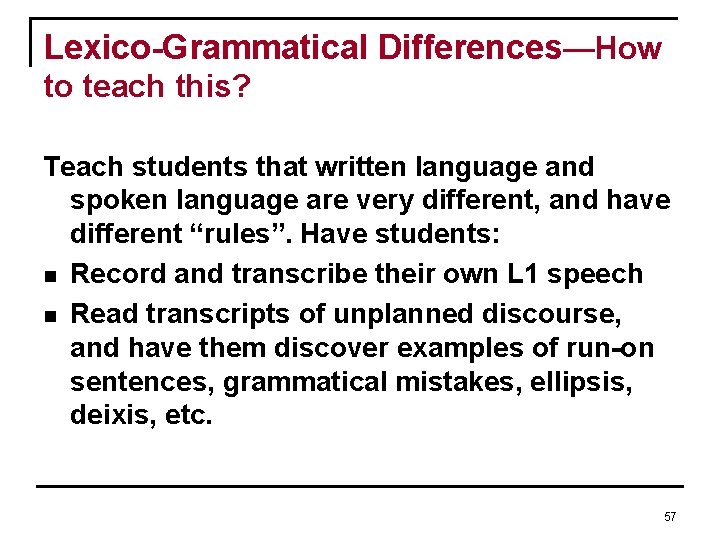
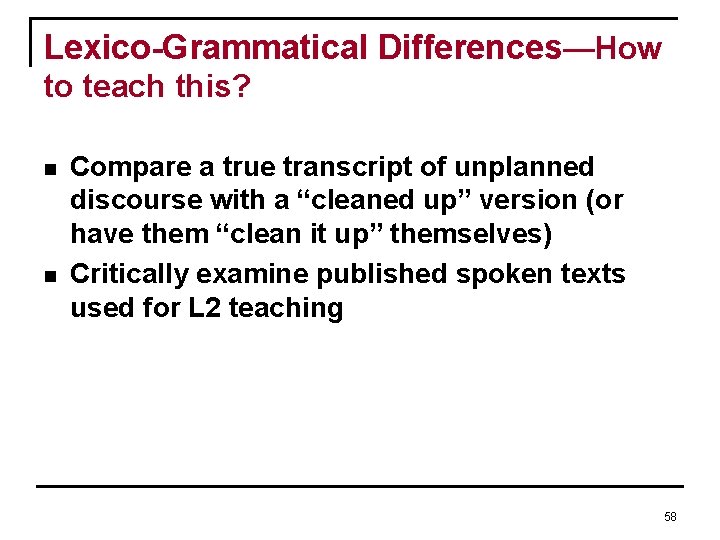
Lexico-Grammatical Differences—How to teach this? Teach students that written language and spoken language are very different, and have different “rules”. Have students: n Record and transcribe their own L 1 speech n Read transcripts of unplanned discourse, and have them discover examples of run-on sentences, grammatical mistakes, ellipsis, deixis, etc. 57
Lexico-Grammatical Differences—How to teach this? n n Compare a true transcript of unplanned discourse with a “cleaned up” version (or have them “clean it up” themselves) Critically examine published spoken texts used for L 2 teaching 58
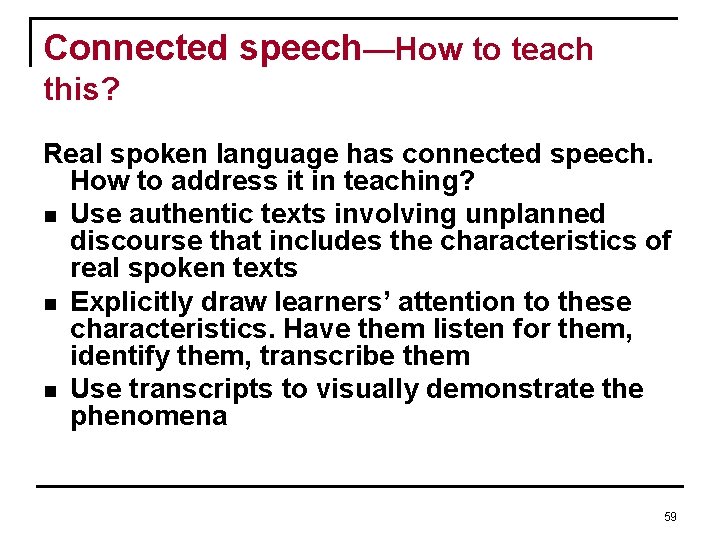
Connected speech—How to teach this? Real spoken language has connected speech. How to address it in teaching? n Use authentic texts involving unplanned discourse that includes the characteristics of real spoken texts n Explicitly draw learners’ attention to these characteristics. Have them listen for them, identify them, transcribe them n Use transcripts to visually demonstrate the phenomena 59
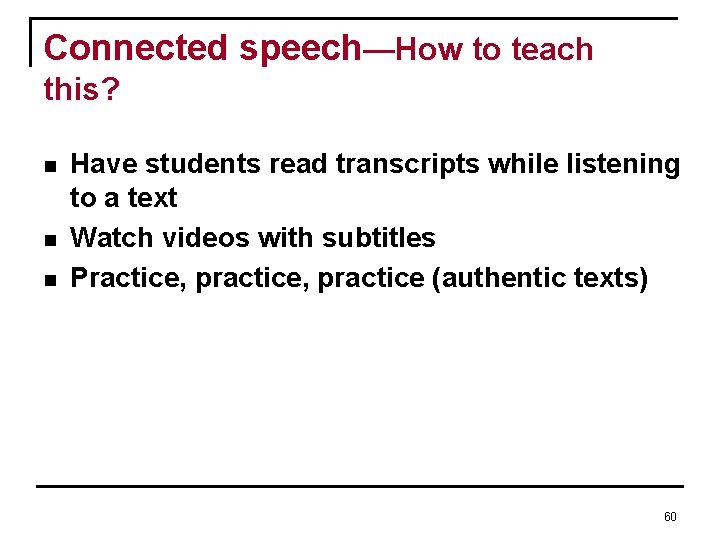
Connected speech—How to teach this? n n n Have students read transcripts while listening to a text Watch videos with subtitles Practice, practice (authentic texts) 60
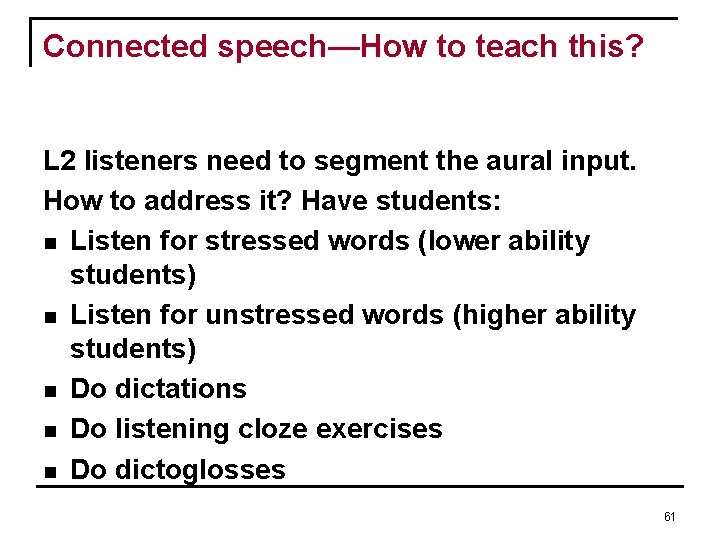
Connected speech—How to teach this? L 2 listeners need to segment the aural input. How to address it? Have students: n Listen for stressed words (lower ability students) n Listen for unstressed words (higher ability students) n Do dictations n Do listening cloze exercises n Do dictoglosses 61
Why No Unscripted Spoken Texts? (Wagner, 2014) argues that the publishing and testing industries are reluctant to incorporate unscripted texts because: n they might sound unprofessional n the difficulty in creating learning and testing tasks for these types of texts n little empirical evidence investigating how L 2 listeners might differ in their ability to comprehend scripted versus unscripted texts. 62
Creating learning tasks for an unscripted spoken text www. elllo. org is a great resource for finding unplanned spoken texts. Here’s an example: http: //elllo. org/english/0901/T 928 -Naomi. Free. Time. htm 63
Creating learning tasks for an unscripted spoken text Now, in your groups, take 10 minutes to create a teaching task using this audio text. First describe who your learners are (age, ability level, etc. ), then create a task or tasks using this audio text. Be ready to share your task with the class. 64
Positive Washback Using unscripted texts in L 2 listening classes can have a positive washback on students, curricula, tests, SLA research. 65
Positive Washback on Teaching and Curricula “The ‘I studied French for 3 years in high school and 2 years in college, and when I got to Paris, I couldn’t understand a word people said’ phenomenon. ” Perhaps a “chicken or the egg” problem between teachers and testers. 66
“Takeaways” for Teaching L 2 listening If you “take away” nothing else from this lecture, remember this: n Use unplanned, authentic texts in the L 2 classroom; use texts that include the characteristics of real spoken language n Make learners aware of the characteristics of unplanned, authentic spoken texts n Texts created by publishers are useful, but almost always are NOT representative of unplanned spoken discourse 67
“Takeaways” for Teaching and Testing L 2 listening When creating or choosing texts for teaching or testing L 2 listening, there a number of things to consider. Obviously, you need to consider the learning needs of your students: n What sort of listening do they need to be able to do? n What ability level are they? What types of texts will be accessible for them? 68
“Takeaways” for Teaching and Testing L 2 listening As a teacher or tester, you can do two different things to make L 2 listening texts the “appropriate” level for your students. You can: n Choose or modify a text of the appropriate level for your students (e. g. , graded texts) n Modify the task demands so that your students can accomplish the task 69
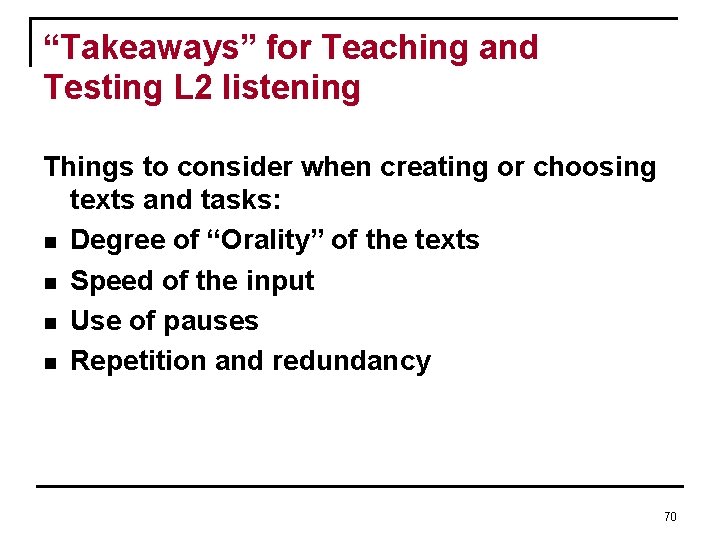
“Takeaways” for Teaching and Testing L 2 listening Things to consider when creating or choosing texts and tasks: n Degree of “Orality” of the texts n Speed of the input n Use of pauses n Repetition and redundancy 70
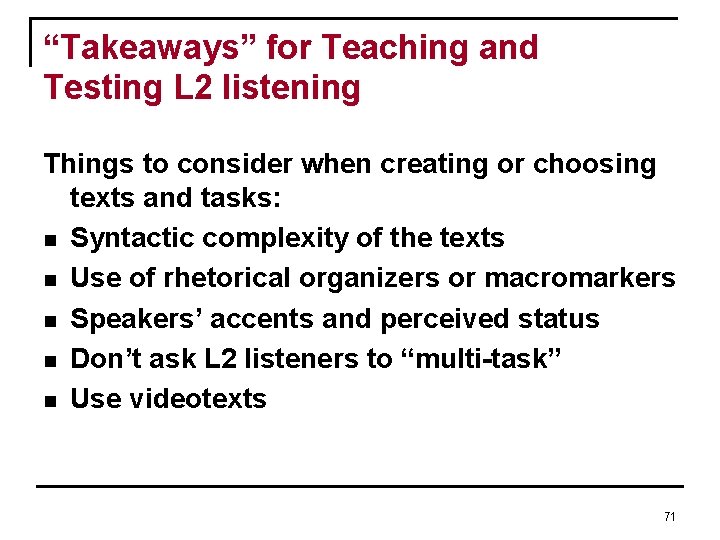
“Takeaways” for Teaching and Testing L 2 listening Things to consider when creating or choosing texts and tasks: n Syntactic complexity of the texts n Use of rhetorical organizers or macromarkers n Speakers’ accents and perceived status n Don’t ask L 2 listeners to “multi-task” n Use videotexts 71
Thank You elvis@temple. edu 72