
FR 118 Strategies for Reading French Texts Authorship
- Slides: 15
FR 118 Strategies for Reading French Texts Authorship and Intentionality Term 3, Lecture 2 Friday 4 May 2012, 1 -2 pm, H 0. 51
Initial questions • Theory and ‘metaquestions’. What is a metaquestion? • How are such questions relevant to thinking about authorship and intentionality? • Why deal with authorship and intentionality together?
Lecture plan • The ‘Birth’ of the Author • The ‘Death’ of the Author – Barthes – Foucault – Example: Montaigne • The Afterlife of the Author? – Example: Abd Al Malik • Conclusion
The ‘Birth’ of the Author • Authorship in historical perspective – Technologies of textual production – Authorship as an historically variable concept • Idea of the author as origin of meaning in a work – draws on ideas from Enlightenment/Romantic period – Idea of literature as expression of author-creator > criticism as reconstruction of authorial meaning
The ‘Death’ of the Author • Context – Russian Formalism; American New Criticism; French Structuralism – Text rather than author as source of meaning – New Criticism: the ‘intentional fallacy’ • Difference from what went before? – Literary explanation vs. literary interpretation – Reconstruction of authorial meaning vs. exploration of meanings to which texts give rise
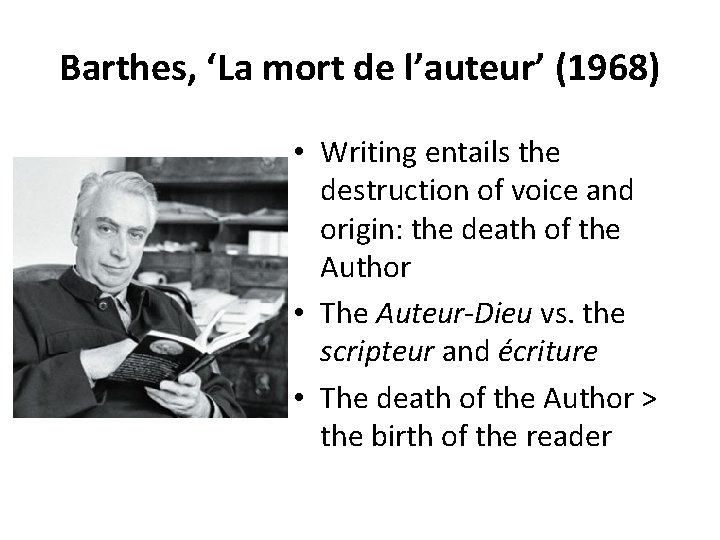
Barthes, ‘La mort de l’auteur’ (1968) • Writing entails the destruction of voice and origin: the death of the Author • The Auteur-Dieu vs. the scripteur and écriture • The death of the Author > the birth of the reader
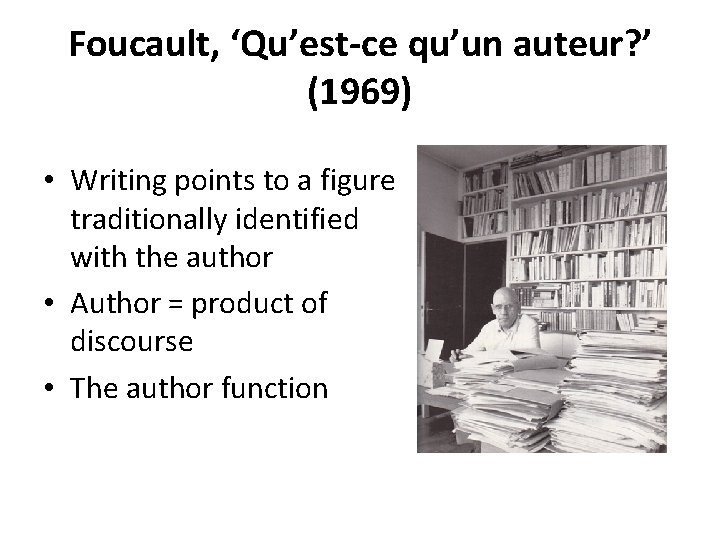
Foucault, ‘Qu’est-ce qu’un auteur? ’ (1969) • Writing points to a figure traditionally identified with the author • Author = product of discourse • The author function
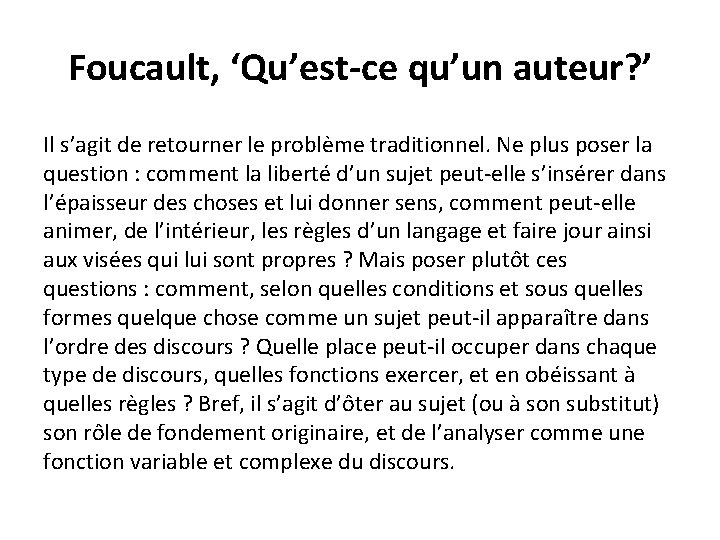
Foucault, ‘Qu’est-ce qu’un auteur? ’ Il s’agit de retourner le problème traditionnel. Ne plus poser la question : comment la liberté d’un sujet peut-elle s’insérer dans l’épaisseur des choses et lui donner sens, comment peut-elle animer, de l’intérieur, les règles d’un langage et faire jour ainsi aux visées qui lui sont propres ? Mais poser plutôt ces questions : comment, selon quelles conditions et sous quelles formes quelque chose comme un sujet peut-il apparaître dans l’ordre des discours ? Quelle place peut-il occuper dans chaque type de discours, quelles fonctions exercer, et en obéissant à quelles règles ? Bref, il s’agit d’ôter au sujet (ou à son substitut) son rôle de fondement originaire, et de l’analyser comme une fonction variable et complexe du discours.
Montaigne, ‘Au Lecteur’ C'EST icy un livre de bonne foy, lecteur. Il t'advertit dés l'entrée, que je ne m'y suis proposé aucune fin, que domestique et privee : je n'y ay eu nulle consideration de ton service, ny de ma gloire : mes forces ne sont pas capables d'un tel dessein. Je l'ay voué à la commodité particuliere de mes parens et amis : à ce que m'ayans perdu (ce qu'ils ont à faire bien tost) ils y puissent retrouver aucuns traicts de mes conditions et humeurs, et que par ce moyen ils nourrissent plus entiere et plus vifve, la connoissance qu'ils ont eu de moy…
Montaigne, ‘Au Lecteur’ … Si c'eust esté pour recher la faveur du monde, je me fusse mieux paré de et me presenterois en une marche estudiée. Je veux qu'on m'y voie en ma façon simple, naturelle et ordinaire, sans estude et artifice : car c'est moy que je peins. Mes defauts s'y liront au vif, et ma forme naïfve, autant que la reverence publique me l'a permis. Que si j'eusse esté entre ces nations qu'on dict vivre encore souz la douce liberté des premieres loix de nature, je t'asseure que je m'y fusse trèsvolontiers peint tout entier, et tout nud. Ainsi, lecteur, je suis moy-mesmes la matiere de mon livre : ce n'est pas raison que tu employes ton loisir en un subject si frivole et si vain. A Dieu donq.
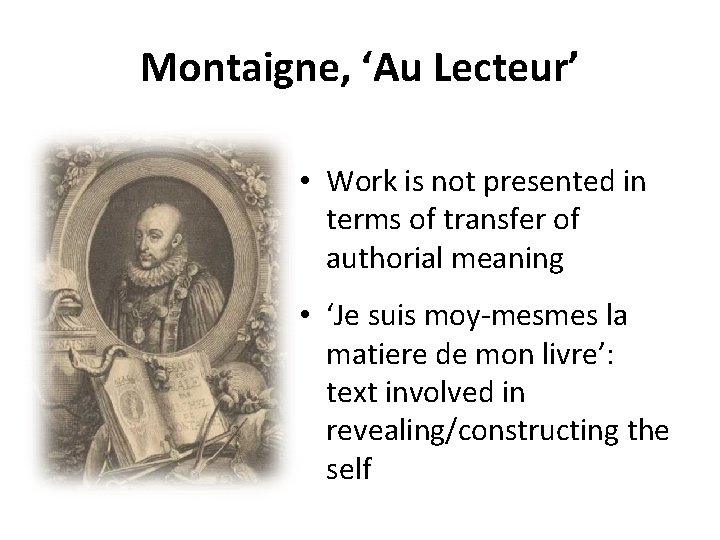
Montaigne, ‘Au Lecteur’ • Work is not presented in terms of transfer of authorial meaning • ‘Je suis moy-mesmes la matiere de mon livre’: text involved in revealing/constructing the self
Montaigne, ‘Au Lecteur’ • The death of the author: Je l'ay voué à la commodité particuliere de mes parens et amis : à ce que m'ayans perdu (ce qu'ils ont à faire bien tost) ils y puissent retrouver aucuns traicts de mes conditions et humeurs, et que par ce moyen ils nourrissent plus entiere et plus vifve, la connoissance qu'ils ont eu de moy. – Book as replacement for dead author – Book as more vivid and accurate than the real thing? • Montaigne encourages a reading like that proposed by Barthes and Foucault: writing constitutes the author rather than simply expressing what he wants to say
The Afterlife of the Author? • Implications of the ‘death of the author’: – Freer way of thinking about meaning in texts – Rethinking of literary canons – New approaches • new historicism; cultural materialism; gender; postcolonial studies • exploration of more political concerns related to gender, class, and race • Return to identity and intentionality?
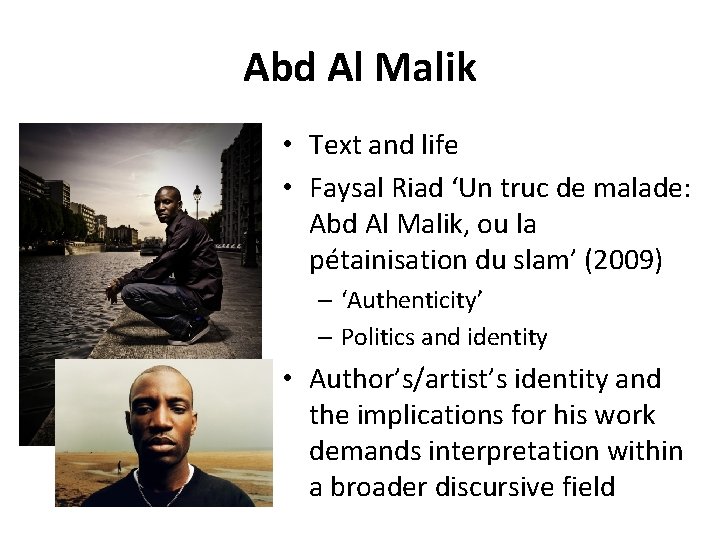
Abd Al Malik • Text and life • Faysal Riad ‘Un truc de malade: Abd Al Malik, ou la pétainisation du slam’ (2009) – ‘Authenticity’ – Politics and identity • Author’s/artist’s identity and the implications for his work demands interpretation within a broader discursive field
Conclusion • Developments in the definition of authorship and its place in literary criticism • New ways of thinking about texts and meaning that emerged in the middle of the 20 th century • Barthes and Foucault’s legacy