
Reading Academic Texts in English Extension Unit 1

- Slides: 33
Reading Academic Texts in English Extension Unit 1 Developing Critical Reading Competences © Mu. Mi. S 2013
2
Developing critical reading competences How should we interpret academic texts? 3
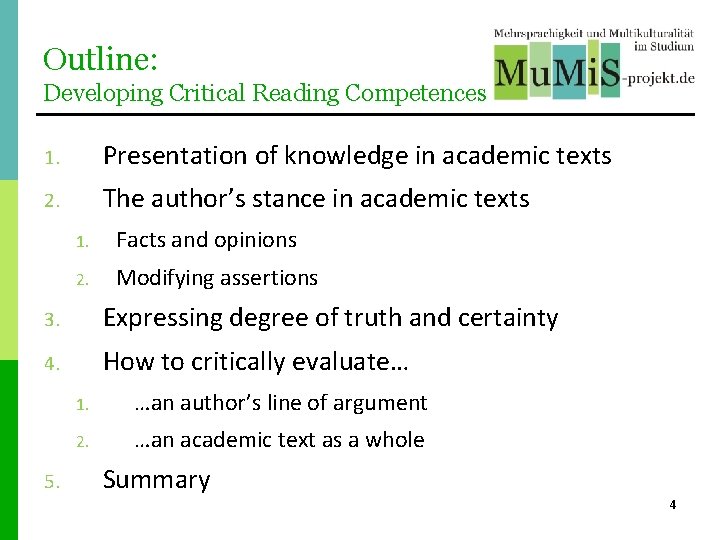
Outline: Developing Critical Reading Competences 1. Presentation of knowledge in academic texts 2. The author’s stance in academic texts 1. Facts and opinions 2. Modifying assertions 3. Expressing degree of truth and certainty 4. How to critically evaluate… 5. 1. …an author’s line of argument 2. …an academic text as a whole Summary 4
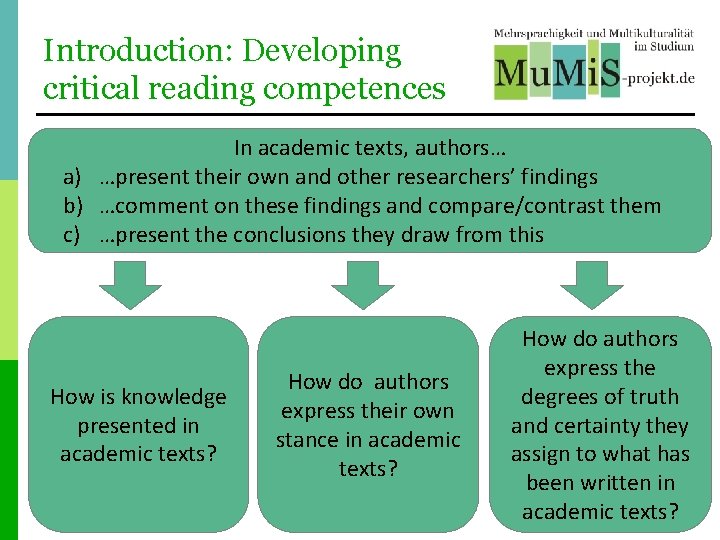
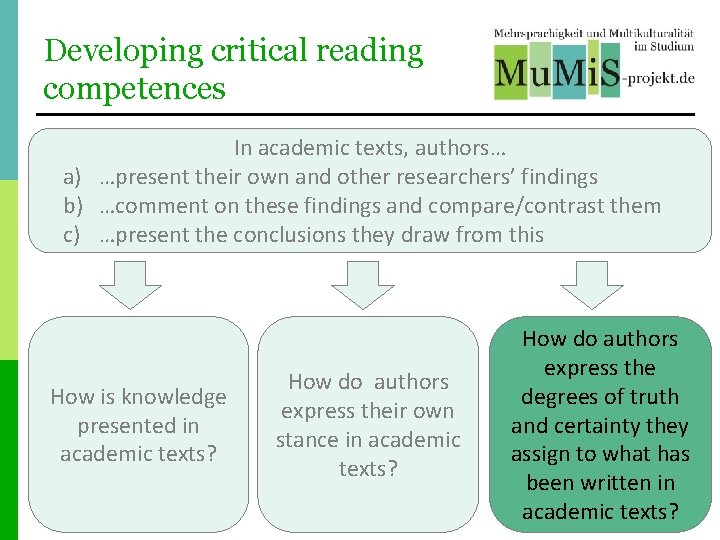
Introduction: Developing critical reading competences In academic texts, authors… a) …present their own and other researchers’ findings b) …comment on these findings and compare/contrast them c) …present the conclusions they draw from this How is knowledge presented in academic texts? How do authors express their own stance in academic texts? How do authors express the degrees of truth and certainty they assign to what has been written in academic texts?
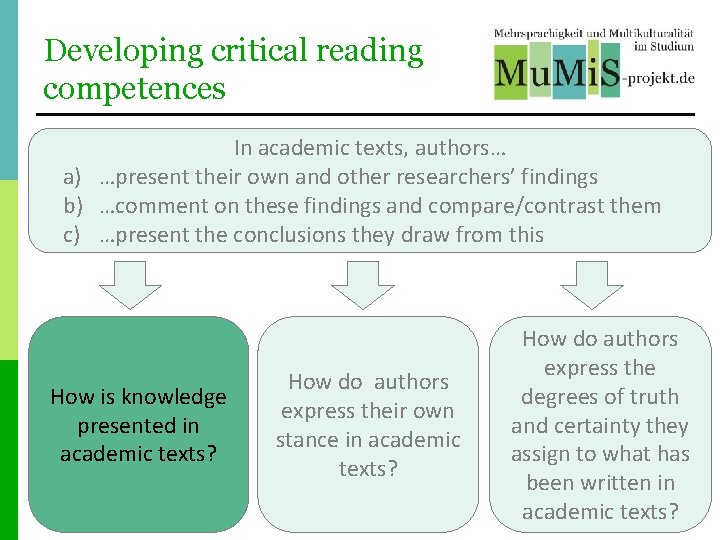
Developing critical reading competences In academic texts, authors… a) …present their own and other researchers’ findings b) …comment on these findings and compare/contrast them c) …present the conclusions they draw from this How is knowledge presented in academic texts? How do authors express their own stance in academic texts? How do authors express the degrees of truth and certainty they assign to what has been written in academic texts?
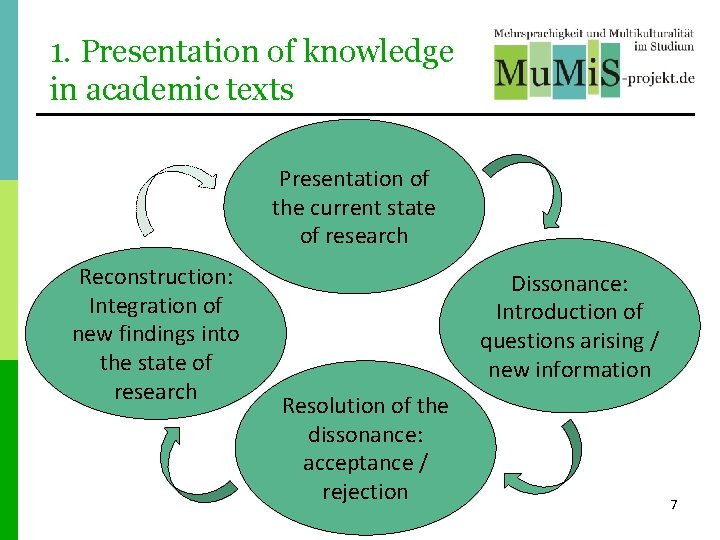
1. Presentation of knowledge in academic texts Presentation of the current state of research Reconstruction: Integration of new findings into the state of research Dissonance: Introduction of questions arising / new information Resolution of the dissonance: acceptance / rejection 7
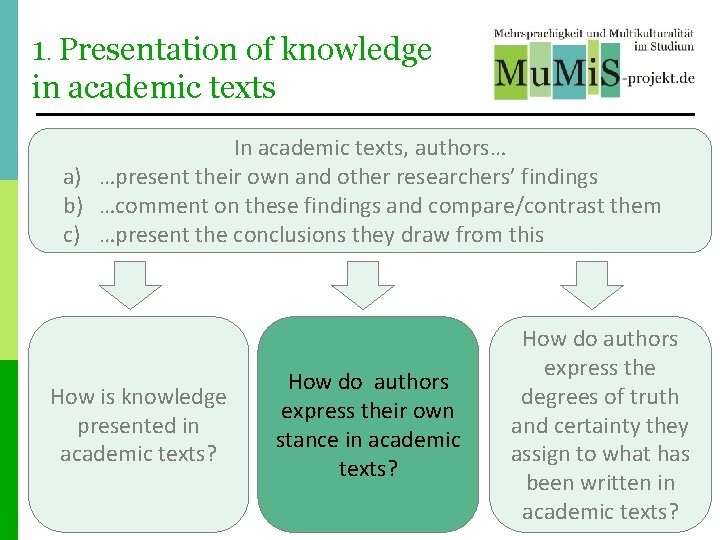
1. Presentation of knowledge in academic texts In academic texts, authors… a) …present their own and other researchers’ findings b) …comment on these findings and compare/contrast them c) …present the conclusions they draw from this How is knowledge presented in academic texts? How do authors express their own stance in academic texts? How do authors express the degrees of truth and certainty they assign to what has been written in academic texts?
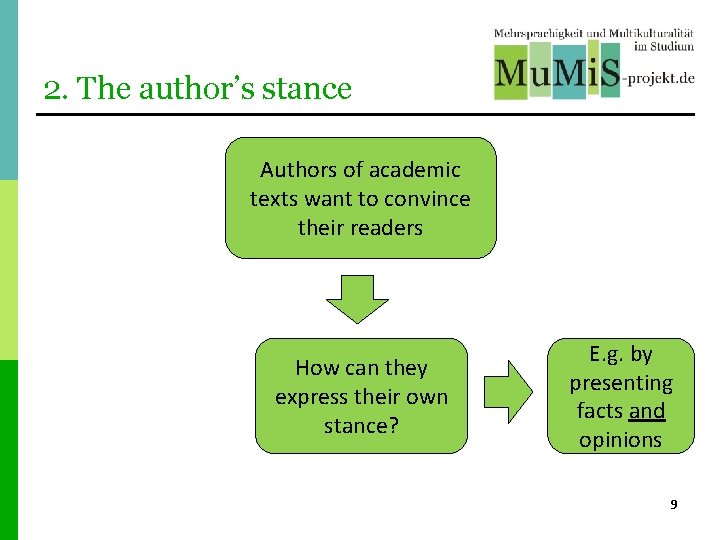
2. The author’s stance Authors of academic texts want to convince their readers How can they express their own stance? E. g. by presenting facts and opinions 9
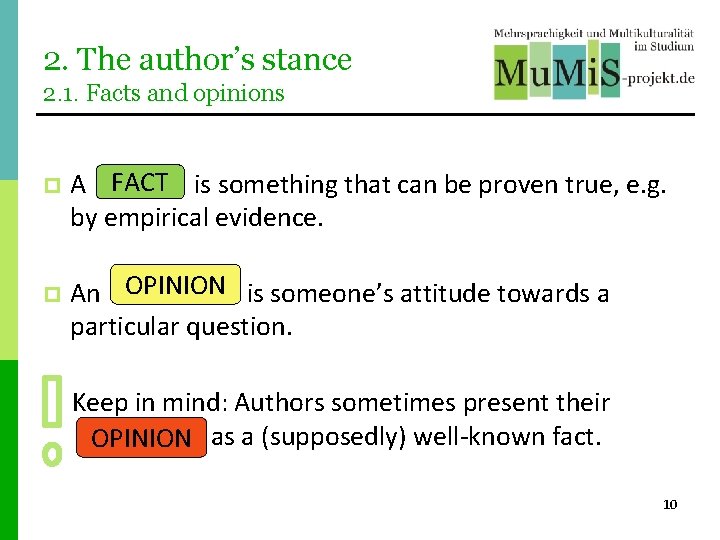
2. The author’s stance 2. 1. Facts and opinions p p FACT A is something that can be proven true, e. g. by empirical evidence. OPINION An is someone’s attitude towards a particular question. Keep in mind: Authors sometimes present their as a (supposedly) well-known fact. OPINION 10
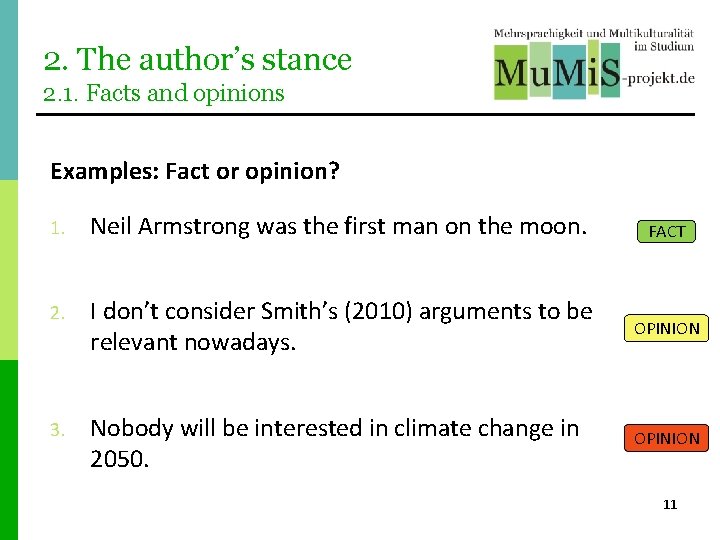
2. The author’s stance 2. 1. Facts and opinions Examples: Fact or opinion? 1. Neil Armstrong was the first man on the moon. 2. I don’t consider Smith’s (2010) arguments to be relevant nowadays. OPINION 3. Nobody will be interested in climate change in 2050. OPINION FACT 11
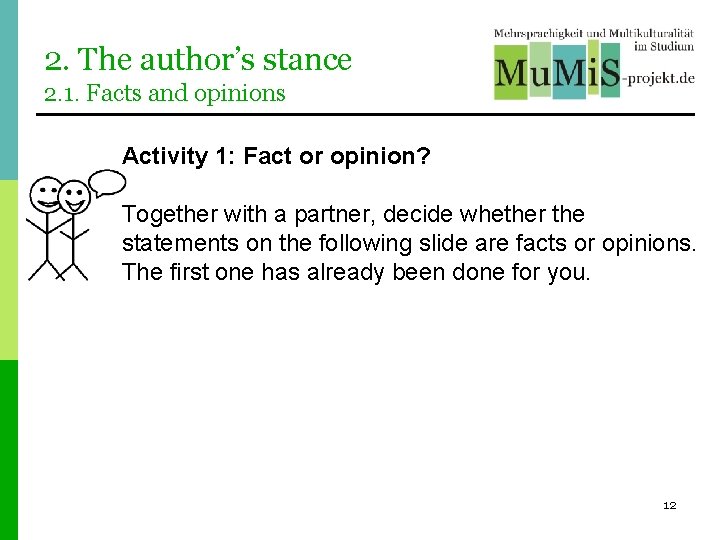
2. The author’s stance 2. 1. Facts and opinions Activity 1: Fact or opinion? Together with a partner, decide whether the statements on the following slide are facts or opinions. The first one has already been done for you. 12
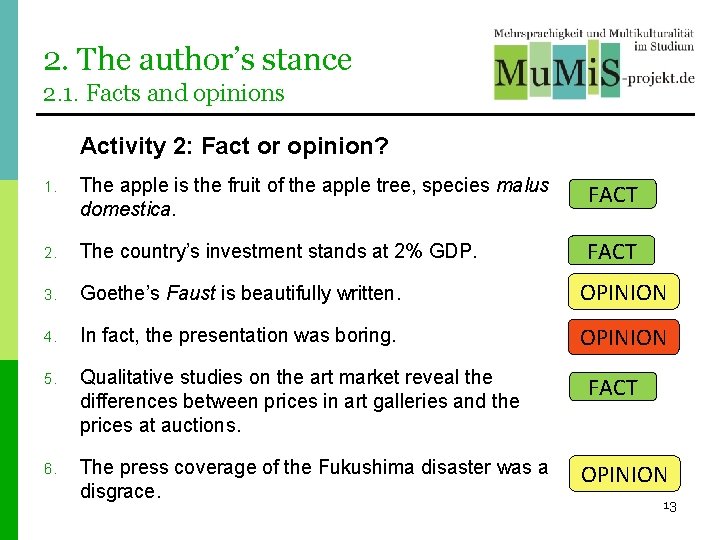
2. The author’s stance 2. 1. Facts and opinions Activity 2: Fact or opinion? 1. The apple is the fruit of the apple tree, species malus domestica. FACT 2. The country’s investment stands at 2% GDP. FACT 3. Goethe’s Faust is beautifully written. OPINION 4. In fact, the presentation was boring. OPINION 5. Qualitative studies on the art market reveal the differences between prices in art galleries and the prices at auctions. 6. The press coverage of the Fukushima disaster was a disgrace. FACT OPINION 13
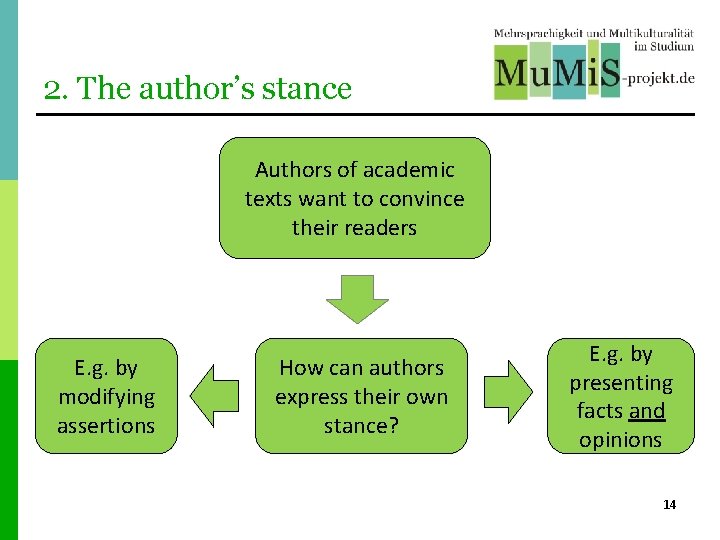
2. The author’s stance Authors of academic texts want to convince their readers E. g. by modifying assertions How can authors express their own stance? E. g. by presenting facts and opinions 14
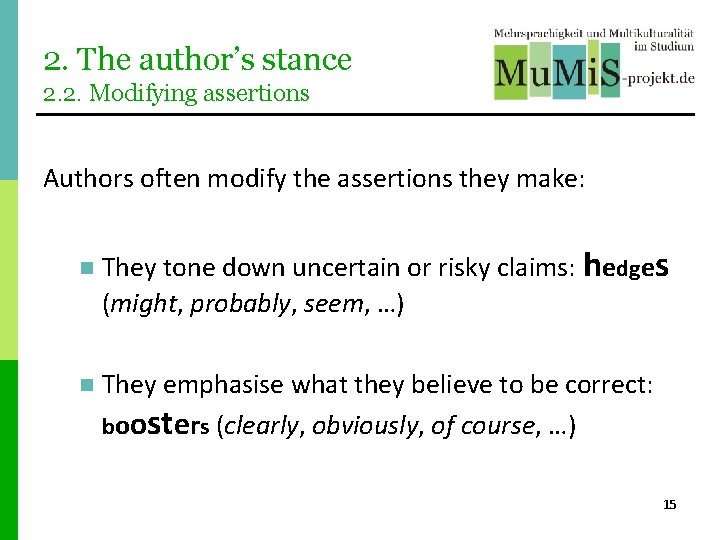
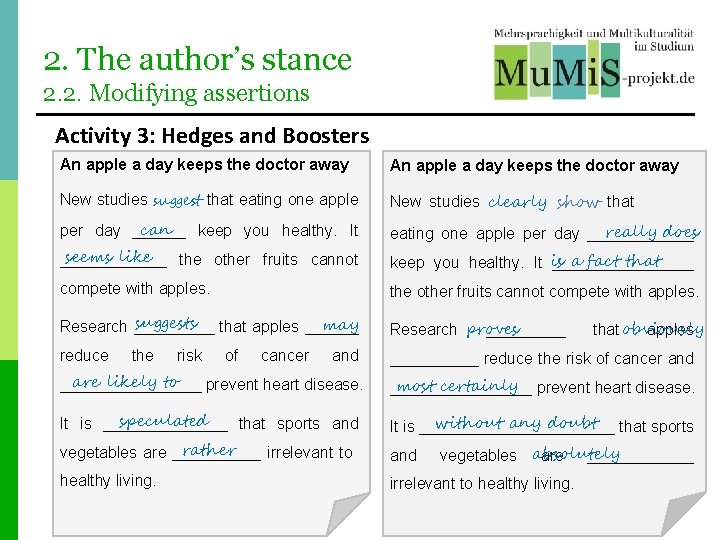
2. The author’s stance 2. 2. Modifying assertions Authors often modify the assertions they make: n n They tone down uncertain or risky claims: hedges (might, probably, seem, …) They emphasise what they believe to be correct: boosters (clearly, obviously, of course, …) 15
2. The author’s stance 2. 2. Modifying assertions Activity 2: Hedges and boosters Fill in the gaps. Use only hedges for the first text and only boosters for the second text. Then compare both texts and the meanings they convey. 16
2. The author’s stance 2. 2. Modifying assertions Activity 3: Hedges and Boosters An apple a day keeps the doctor away New studies suggest that eating one apple New studies clearly show that can per day ______ keep you healthy. It really does eating one apple per day ______ seems like ______ the other fruits cannot a fact that keep you healthy. It is ________ compete with apples. the other fruits cannot compete with apples. suggests that apples ______ may Research _____ Research proves _____ reduce the risk of cancer and that obviously apples are likely to ________ prevent heart disease. most certainly prevent heart disease. ________ speculated It is _______ that sports and without any doubt that sports It is ___________ rather vegetables are _____ irrelevant to and healthy living. irrelevant to healthy living. vegetables absolutely are ______ 17
Developing critical reading competences In academic texts, authors… a) …present their own and other researchers’ findings b) …comment on these findings and compare/contrast them c) …present the conclusions they draw from this How is knowledge presented in academic texts? How do authors express their own stance in academic texts? How do authors express the degrees of truth and certainty they assign to what has been written in 18 academic texts?
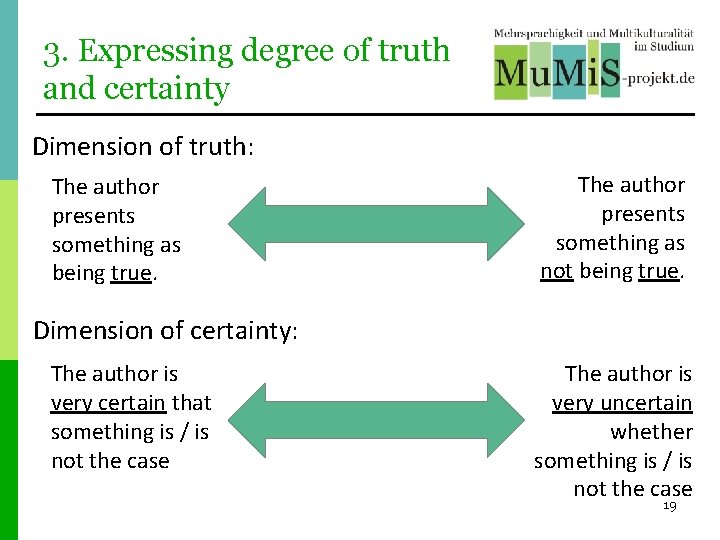
3. Expressing degree of truth and certainty Dimension of truth: The author presents something as being true. The author presents something as not being true. Dimension of certainty: The author is very certain that something is / is not the case The author is very uncertain whether something is / is not the case 19
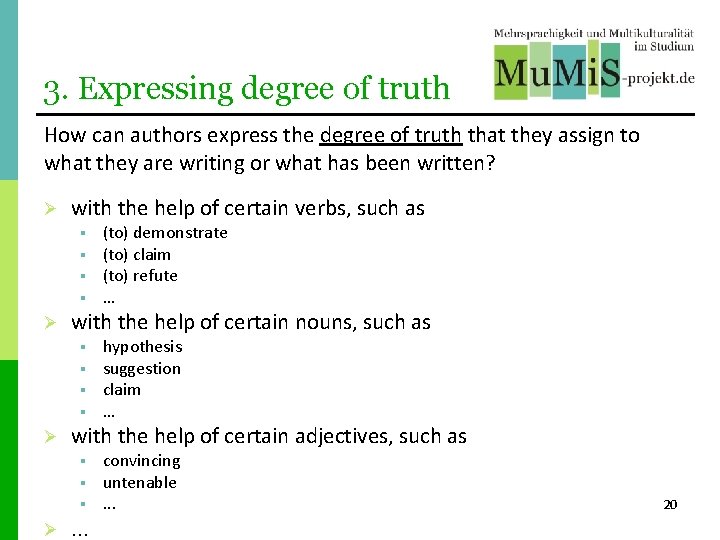
3. Expressing degree of truth How can authors express the degree of truth that they assign to what they are writing or what has been written? Ø with the help of certain verbs, such as § § Ø with the help of certain nouns, such as § § Ø hypothesis suggestion claim … with the help of certain adjectives, such as § § § Ø (to) demonstrate (to) claim (to) refute … . . . convincing untenable. . . 20
3. Expressing degree of certainty How can authors express the degree of certainty with which something is stated? Ø with the help of certain adverbs, such as § § Ø with the help of certain verbs, such as § § Ø (to) believe (to) suppose (to) suggest … with the help of auxiliary verbs, such as § § § Ø surely apparently probably … … might (e. g. it might / might not be the case that) can (e. g. it can be concluded) … 21
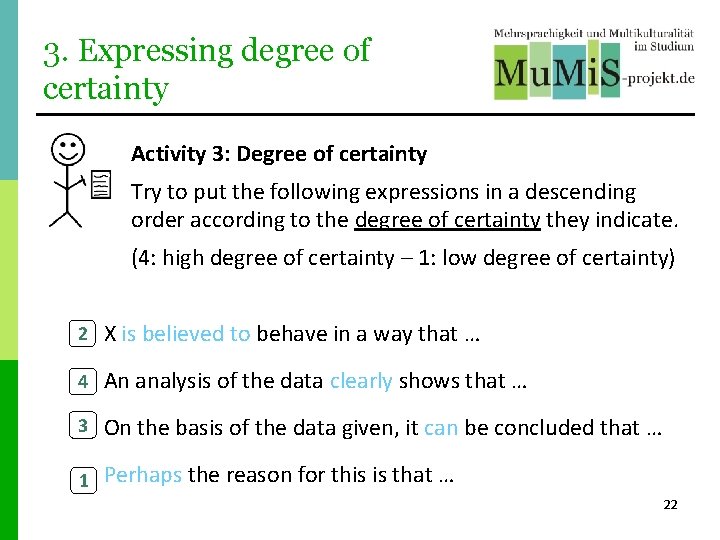
3. Expressing degree of certainty Activity 3: Degree of certainty Try to put the following expressions in a descending order according to the degree of certainty they indicate. (4: high degree of certainty – 1: low degree of certainty) 2 X is believed to behave in a way that … 4 An analysis of the data clearly shows that … 3 On the basis of the data given, it can be concluded that … 1 Perhaps the reason for this is that … 22
4. How to critically evaluate an academic text How can we critically evaluate the author’s line of argument and the text as a whole? 23
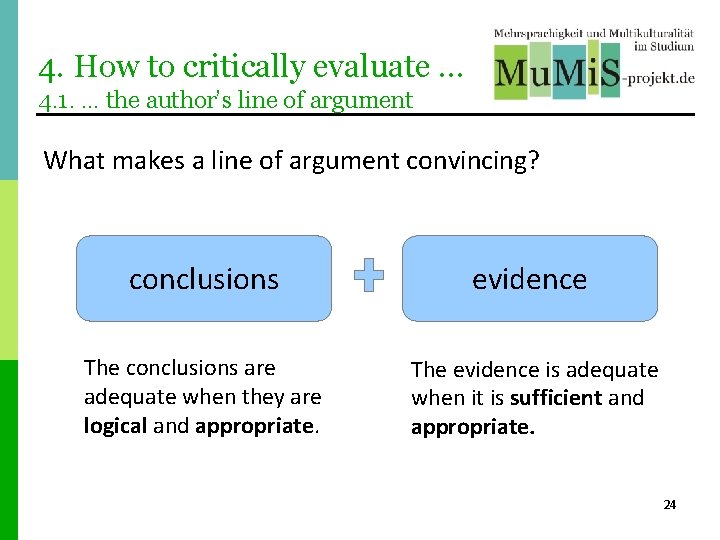
4. How to critically evaluate … 4. 1. … the author’s line of argument What makes a line of argument convincing? conclusions The conclusions are adequate when they are logical and appropriate. evidence The evidence is adequate when it is sufficient and appropriate. 24
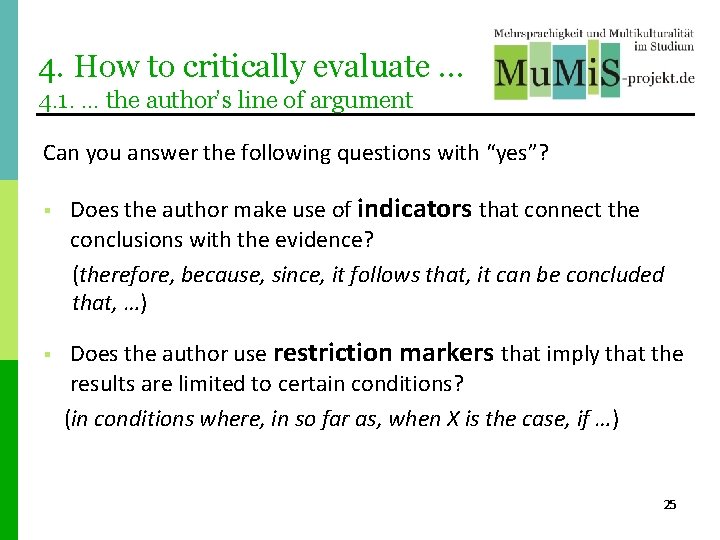
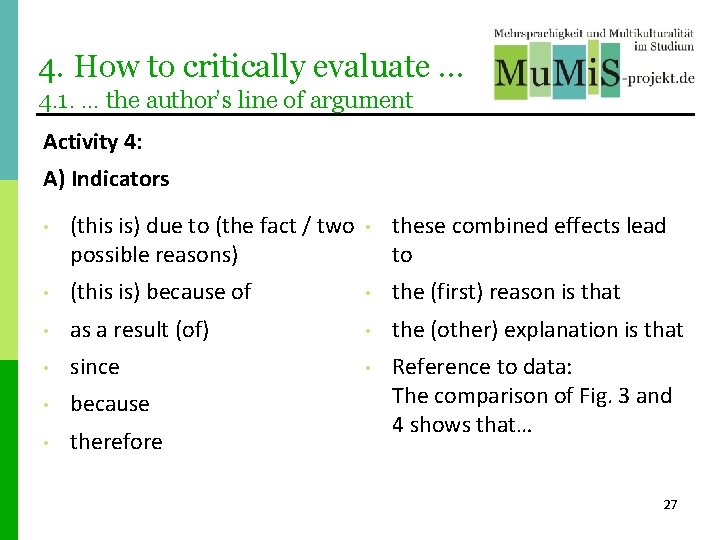
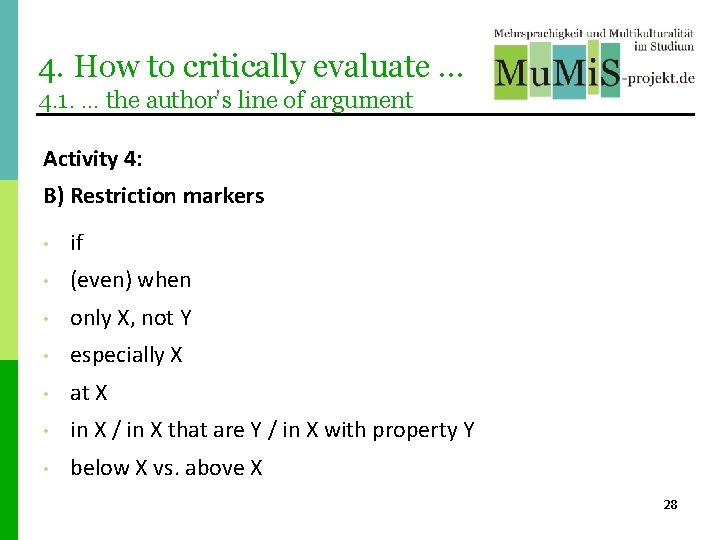
4. How to critically evaluate … 4. 1. … the author’s line of argument Can you answer the following questions with “yes”? § Does the author make use of indicators that connect the conclusions with the evidence? (therefore, because, since, it follows that, it can be concluded that, …) Does the author use restriction markers that imply that the results are limited to certain conditions? (in conditions where, in so far as, when X is the case, if …) § 25
4. How to critically evaluate … 4. 1. … the author’s line of argument Activity 4: Indicators and restriction markers Have a look at the excerpt from an academic text on your worksheet (page 6 f. ) and mark all the indicators (Group A) / all the restriction markers (Group B) it contains. Then, compare your results with a neighbour. 26
4. How to critically evaluate … 4. 1. … the author’s line of argument Activity 4: A) Indicators • (this is) due to (the fact / two • these combined effects lead to possible reasons) • (this is) because of • the (first) reason is that • as a result (of) • the (other) explanation is that • since • • because • therefore Reference to data: The comparison of Fig. 3 and 4 shows that… 27
4. How to critically evaluate … 4. 1. … the author’s line of argument Activity 4: B) Restriction markers • if • (even) when • only X, not Y • especially X • at X • in X / in X that are Y / in X with property Y • below X vs. above X 28
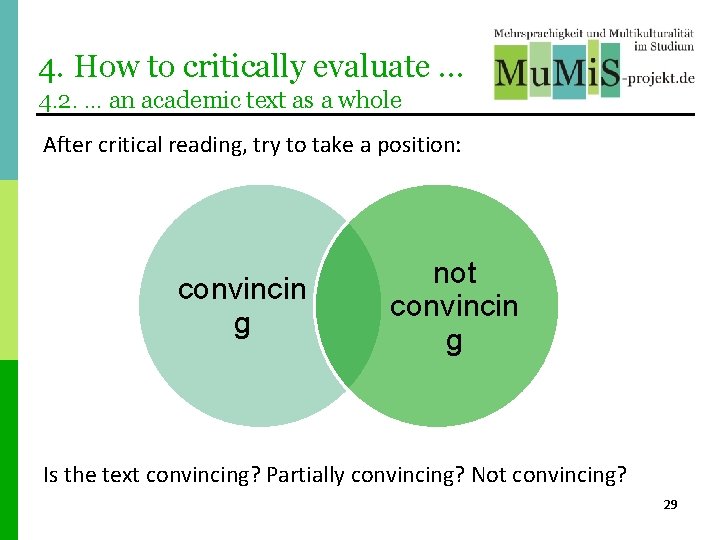
4. How to critically evaluate … 4. 2. … an academic text as a whole After critical reading, try to take a position: convincin g not convincin g Is the text convincing? Partially convincing? Not convincing? 29
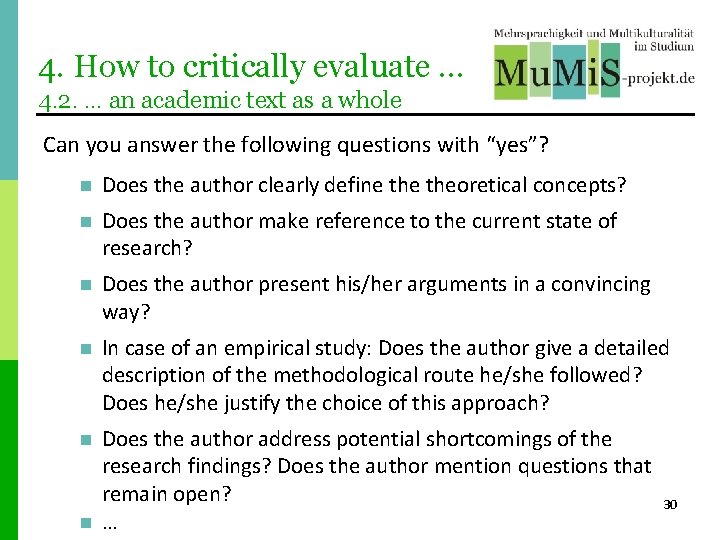
4. How to critically evaluate … 4. 2. … an academic text as a whole Can you answer the following questions with “yes”? n Does the author clearly define theoretical concepts? n Does the author make reference to the current state of research? n Does the author present his/her arguments in a convincing way? n In case of an empirical study: Does the author give a detailed description of the methodological route he/she followed? Does he/she justify the choice of this approach? n Does the author address potential shortcomings of the research findings? Does the author mention questions that remain open? 30 … n
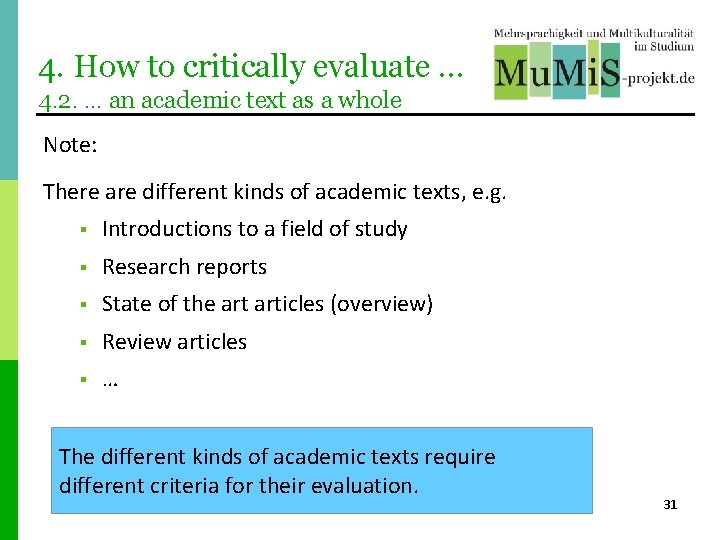
4. How to critically evaluate … 4. 2. … an academic text as a whole Note: There are different kinds of academic texts, e. g. § Introductions to a field of study § Research reports § State of the articles (overview) § Review articles § … The different kinds of academic texts require different criteria for their evaluation. 31
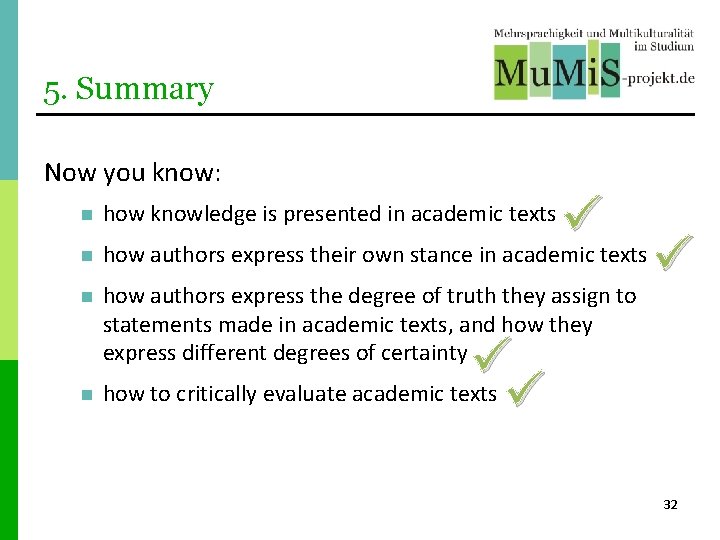
5. Summary Now you know: n n n how authors express their own stance in academic texts how authors express the degree of truth they assign to how knowledge is presented in academic texts statements made in academic texts, and how they express different degrees of certainty n how to critically evaluate academic texts 32
Reading Academic Texts in English Extension Unit 1 Developing Critical Reading Competences © Mu. Mi. S 2013