
Advanced Topics in Spoken Language Processing Julia Hirschberg
Advanced Topics in Spoken Language Processing Julia Hirschberg CS 6998 Spring 2020 2/19/2021 1
Columbia Speech Lab Last Spring 2
Getting to know each other 1/21/19 3

Speech Processing Questions – How do you produce sounds that other people interpret as language? – How does your hearer decode what you are trying to convey? – In a conversation, how do you know when it’s your turn to talk? – Once you decide what you want to say, how do you decide how to say it? : • • 2/19/2021 How do you decide where to pause in the sentence? How do you decide what words to emphasize? How do you decide what intonational contour to use? How do you convey your own feelings and emotions? 4
• Different languages can convey this information in different ways but most use intonation or sometimes word order in the process – and of course facial expression and body gesture also play a role in communication – How do you ask a question in your native language? How do you make a statement? • What we’ll be learning in this class is a wide range of the information that speech can convey to others and what we in turn can learn about others from their speech 2/19/2021 5
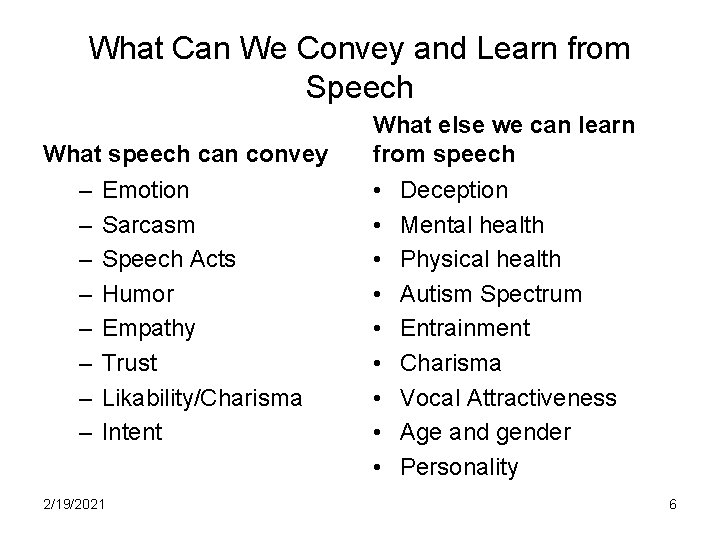
What Can We Convey and Learn from Speech What speech can convey – – – – Emotion Sarcasm Speech Acts Humor Empathy Trust Likability/Charisma Intent 2/19/2021 What else we can learn from speech • • • Deception Mental health Physical health Autism Spectrum Entrainment Charisma Vocal Attractiveness Age and gender Personality 6
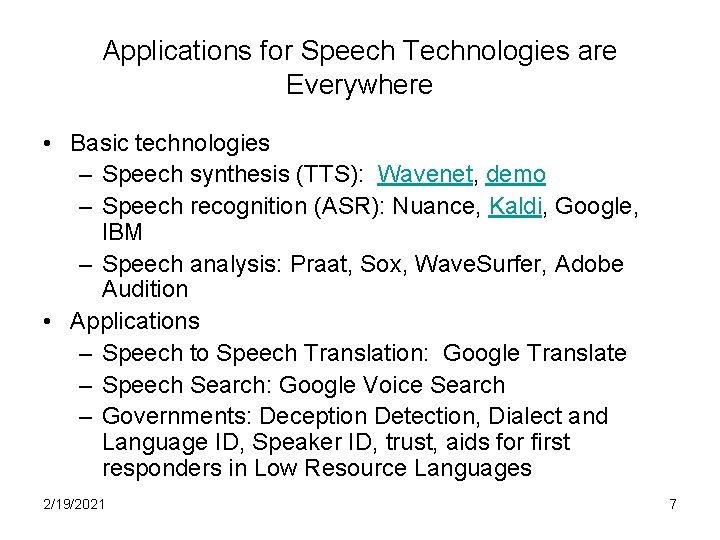
Applications for Speech Technologies are Everywhere • Basic technologies – Speech synthesis (TTS): Wavenet, demo – Speech recognition (ASR): Nuance, Kaldi, Google, IBM – Speech analysis: Praat, Sox, Wave. Surfer, Adobe Audition • Applications – Speech to Speech Translation: Google Translate – Speech Search: Google Voice Search – Governments: Deception Detection, Dialect and Language ID, Speaker ID, trust, aids for first responders in Low Resource Languages 2/19/2021 7
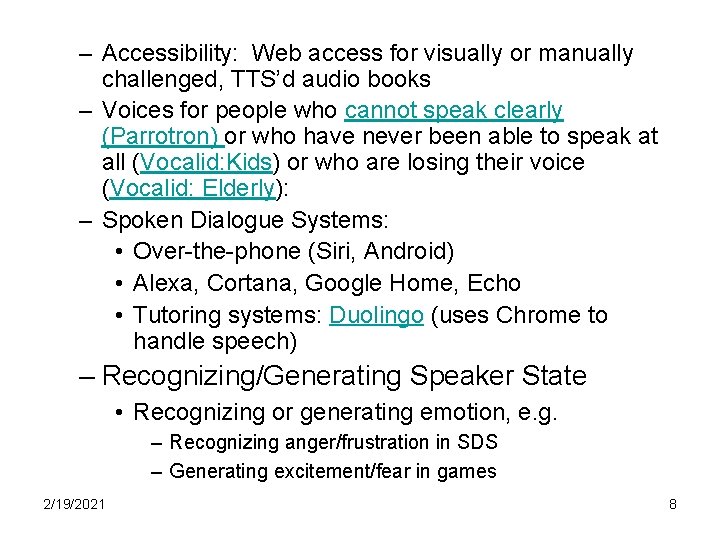
– Accessibility: Web access for visually or manually challenged, TTS’d audio books – Voices for people who cannot speak clearly (Parrotron) or who have never been able to speak at all (Vocalid: Kids) or who are losing their voice (Vocalid: Elderly): – Spoken Dialogue Systems: • Over-the-phone (Siri, Android) • Alexa, Cortana, Google Home, Echo • Tutoring systems: Duolingo (uses Chrome to handle speech) – Recognizing/Generating Speaker State • Recognizing or generating emotion, e. g. – Recognizing anger/frustration in SDS – Generating excitement/fear in games 2/19/2021 8
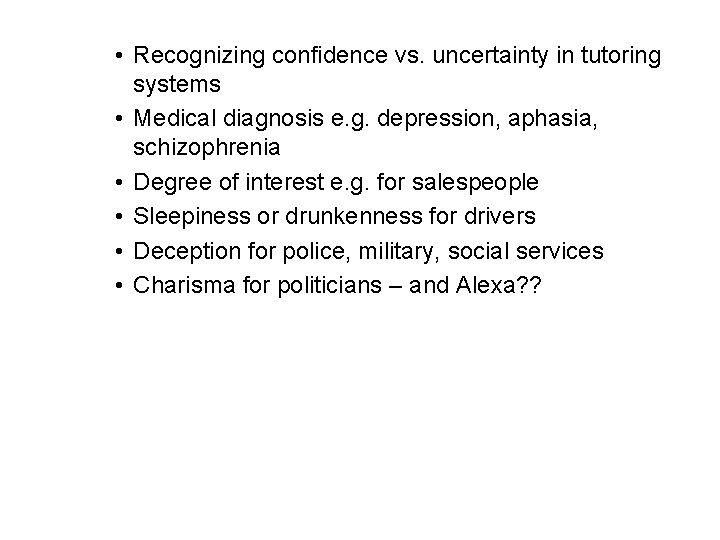
• Recognizing confidence vs. uncertainty in tutoring systems • Medical diagnosis e. g. depression, aphasia, schizophrenia • Degree of interest e. g. for salespeople • Sleepiness or drunkenness for drivers • Deception for police, military, social services • Charisma for politicians – and Alexa? ?
What you will Learn in This Class • By the end of the course, you should be able to: – Analyze acoustic and prosodic features of speech and connect these with text information – Analyze and classify corpora using these features to identify different types of information (dialogue acts, emotion) – Evaluate research papers on spoken language processing 10
What You Should Know/Have before You Start • A laptop or access to a computer (hopefully a Mac but…) • Headphones with close-talking mic for recording • Some knowledge of NLP or speech processing • Some experience using Machine Learning (not necessarily Deep Learning) – scikit-learn. org, e. g. 2/19/2021 11
Syllabus Overview • Course syllabus • Part 1: basic concepts, tools, analysis approaches – Acoustics, prosody, tools, TTS, ASR, dialogue systems • Part 2: speech analysis applications – Entrainment, emotion, sentiment, deception, trust, sarcasm, humor, charisma, personality, mental state 12
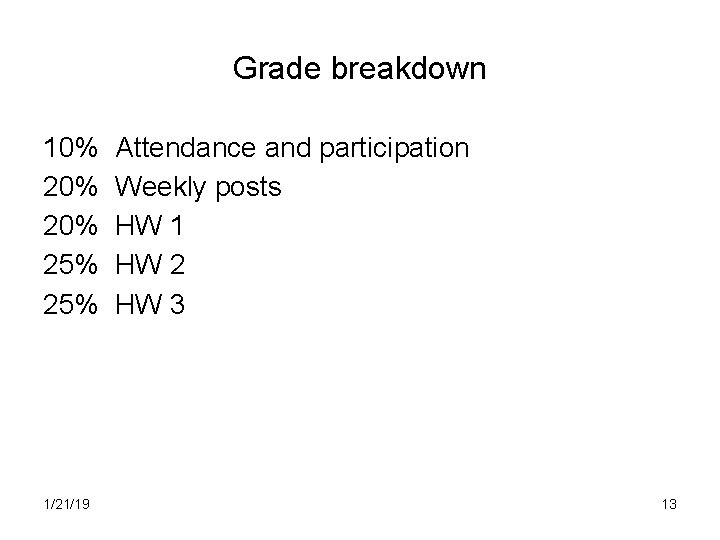
Grade breakdown 10% Attendance and participation 20% Weekly posts 20% HW 1 25% HW 2 25% HW 3 1/21/19 13
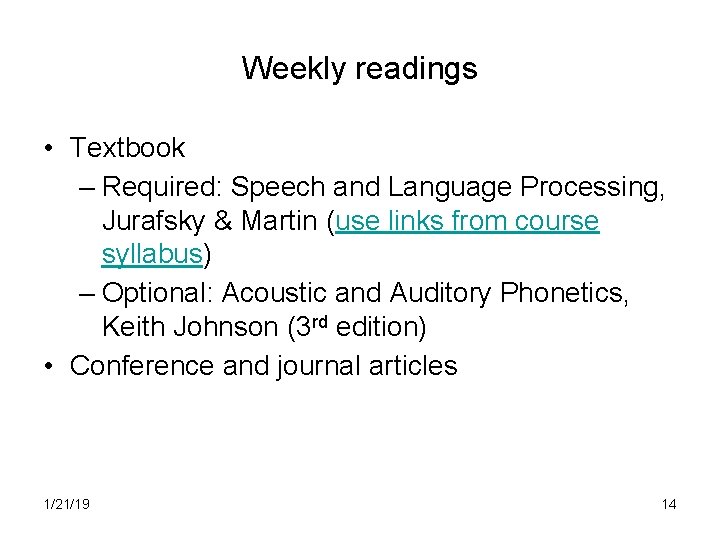
Weekly readings • Textbook – Required: Speech and Language Processing, Jurafsky & Martin (use links from course syllabus) – Optional: Acoustic and Auditory Phonetics, Keith Johnson (3 rd edition) • Conference and journal articles 1/21/19 14
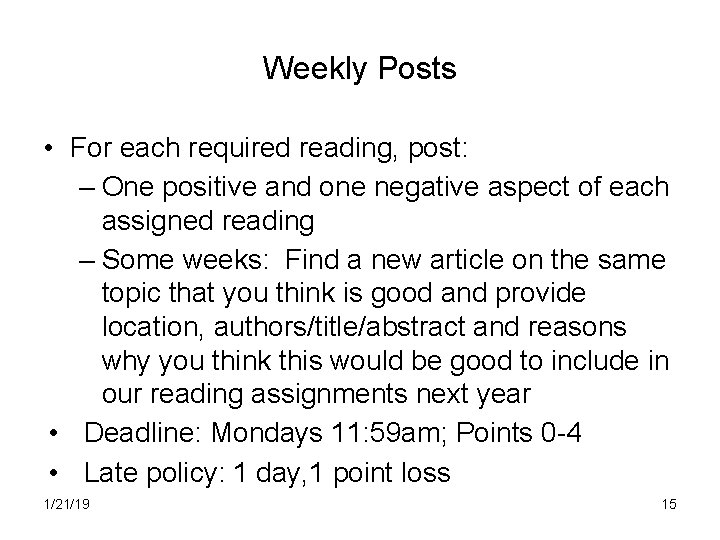
Weekly Posts • For each required reading, post: – One positive and one negative aspect of each assigned reading – Some weeks: Find a new article on the same topic that you think is good and provide location, authors/title/abstract and reasons why you think this would be good to include in our reading assignments next year • Deadline: Mondays 11: 59 am; Points 0 -4 • Late policy: 1 day, 1 point loss 1/21/19 15
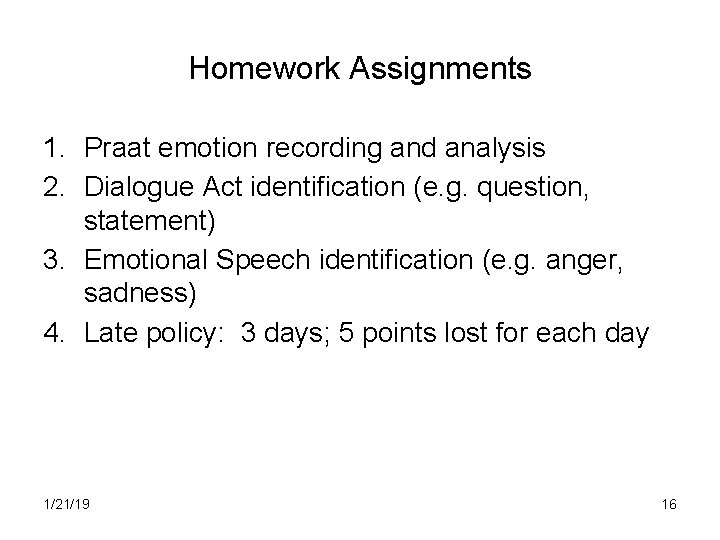
Homework Assignments 1. Praat emotion recording and analysis 2. Dialogue Act identification (e. g. question, statement) 3. Emotional Speech identification (e. g. anger, sadness) 4. Late policy: 3 days; 5 points lost for each day 1/21/19 16
Teaching Assistants • Becky Calinsky • Jessica Yin Huyhn 1/21/19 17
Todo • Are you officially enrolled in this class? – Do you intend to stay in it? If not please drop asap and send me mail • Are you on the waitlist? – If so, do you still want to take the course? If so please send me new email with your NLP/speech course background and grades • Note: if we can find another TA for this class we will be able to raise the cap to include more students so I will inform the waitlist when/if this occurs 1/21/19 18
• Honor policy on syllabus • We will announce office hours by the end of this week • Julia Hirschberg office hours: CEPSR 705 • Jessica Yin Huyn office hours: CEPSR 7 LW 3 (Speech Lab) • Becky Calinsky: office hours, CEPSR 7 LW 3 (Speech Lab) 1/21/19 19
For next week • Look at today’s slides and follow the links that weren’t played (or those that were) • Reading: J&M Chapter 7 (7. 1 -7. 3) • Post on Courseworks before next Monday 11: 59 am • Record your name on Courseworks Name. Coach so we can learn to pronounce everyone’s name correctly 20

Questions? 2/19/2021 21
- Slides: 21