
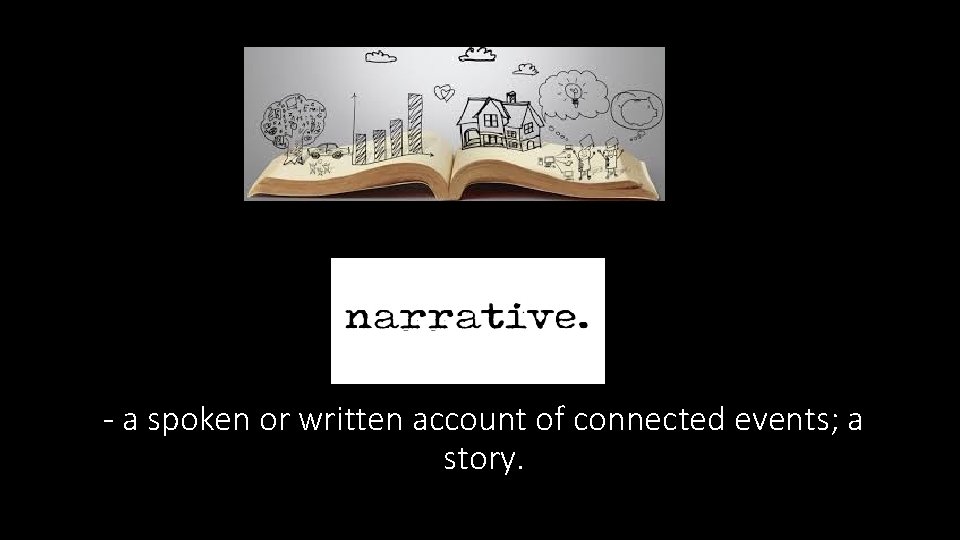
a spoken or written account of connected events

- Slides: 25
- a spoken or written account of connected events; a story.
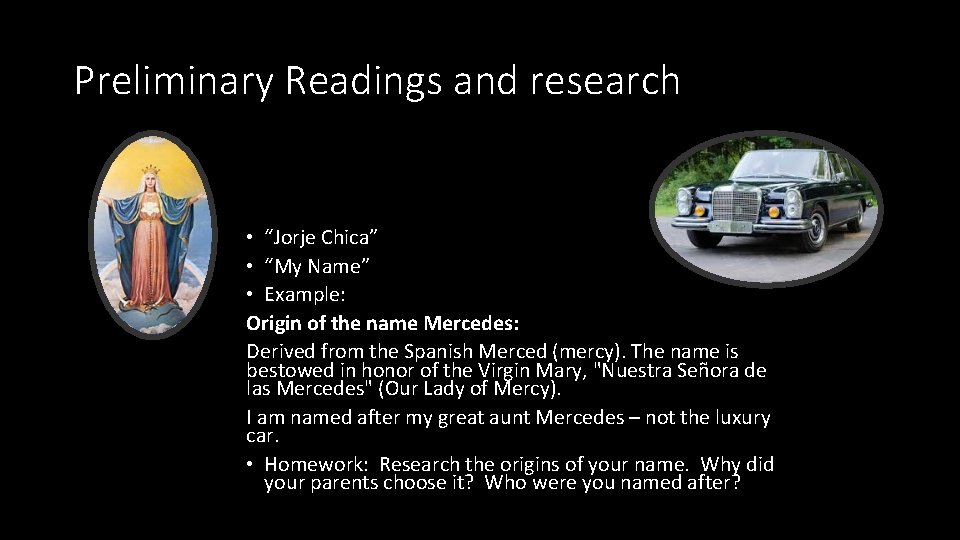
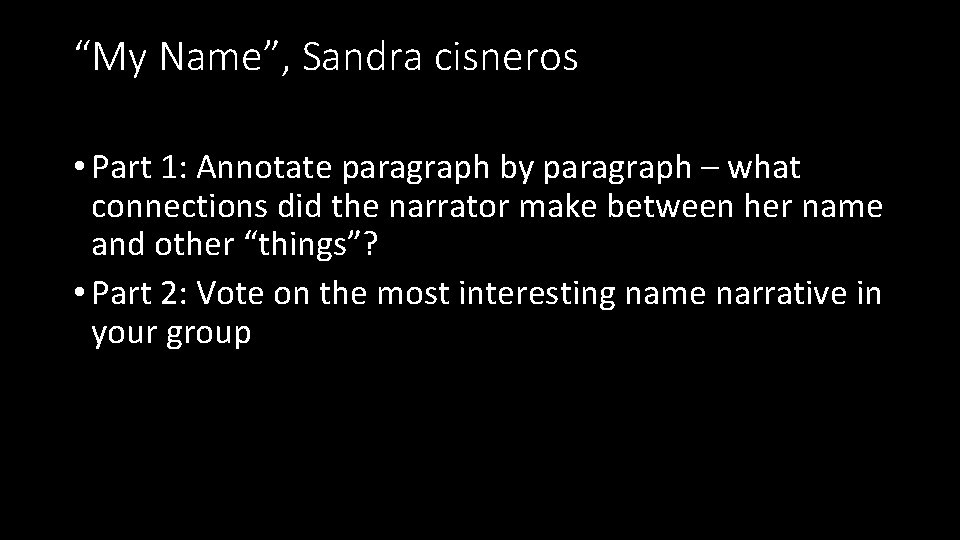
Preliminary Readings and research • “Jorje Chica” • “My Name” • Example: Origin of the name Mercedes: Derived from the Spanish Merced (mercy). The name is bestowed in honor of the Virgin Mary, "Nuestra Señora de las Mercedes" (Our Lady of Mercy). I am named after my great aunt Mercedes – not the luxury car. • Homework: Research the origins of your name. Why did your parents choose it? Who were you named after?
“My Name”, Sandra cisneros • Part 1: Annotate paragraph by paragraph – what connections did the narrator make between her name and other “things”? • Part 2: Vote on the most interesting name narrative in your group
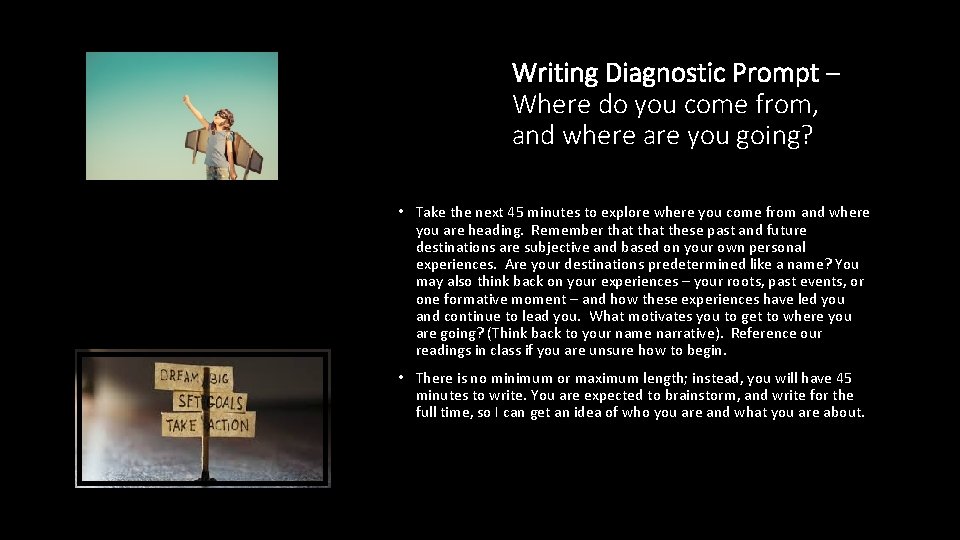
Writing Diagnostic Prompt – Where do you come from, and where are you going? • Take the next 45 minutes to explore where you come from and where you are heading. Remember that these past and future destinations are subjective and based on your own personal experiences. Are your destinations predetermined like a name? You may also think back on your experiences – your roots, past events, or one formative moment – and how these experiences have led you and continue to lead you. What motivates you to get to where you are going? (Think back to your name narrative). Reference our readings in class if you are unsure how to begin. • There is no minimum or maximum length; instead, you will have 45 minutes to write. You are expected to brainstorm, and write for the full time, so I can get an idea of who you are and what you are about.
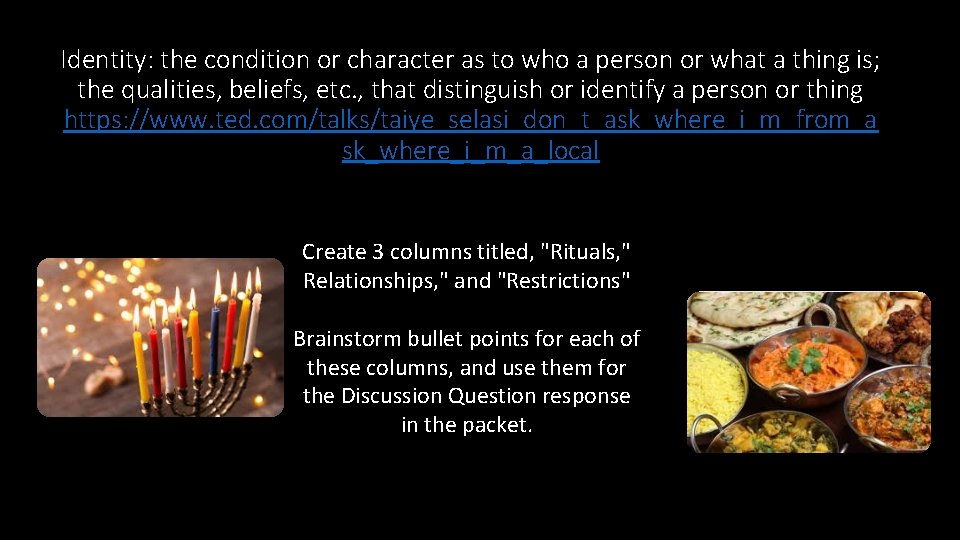
Identity: the condition or character as to who a person or what a thing is; the qualities, beliefs, etc. , that distinguish or identify a person or thing https: //www. ted. com/talks/taiye_selasi_don_t_ask_where_i_m_from_a sk_where_i_m_a_local Create 3 columns titled, "Rituals, " Relationships, " and "Restrictions" Brainstorm bullet points for each of these columns, and use them for the Discussion Question response in the packet.
Identity: the condition or character as to who a person or what a thing is; the qualities, beliefs, etc. , that distinguish or identify a person or thing In your journal answer the following: Where are you from? What does this say about you? What are some of your fondest or most painful memories in that location?
Due Wednesday: ALL LATE WORK + College Readiness Survey Warm up: What personal tensions have consumed your life? OR Who is your mentor in your hero’s journey (life) and why? Palomo Senior English
Identity: the condition or character as to who a person or what a thing is; the qualities, beliefs, etc. , that distinguish or identify a person or thing https: //www. youtube. com/watch? v=Tu. CUg. D 3 Si-M The 3 building blocks of a narrative: 1) Find your marks and own them 2) Tell personal and family stories 3) Find your mentors How do we make someone else’s story compelling and authentic when it isn’t ours?
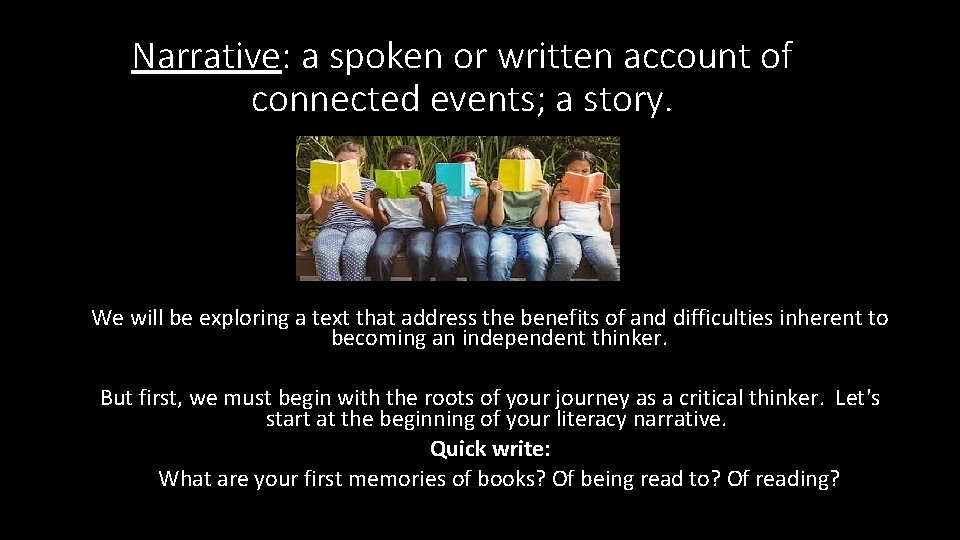
Narrative: a spoken or written account of connected events; a story. We will be exploring a text that address the benefits of and difficulties inherent to becoming an independent thinker. But first, we must begin with the roots of your journey as a critical thinker. Let's start at the beginning of your literacy narrative. Quick write: What are your first memories of books? Of being read to? Of reading?
Narrative: a spoken or written account of connected events; a story. Take concise notes on the following: “The Joy of Reading and Writing: Superman and Me” is an essay by Sherman Alexie, a Spokane/Coeur d’Alene Indian who grew up on a reservation in Wellpinit, Washington. As a child, Alexie read widely and often, even as economic circumstances on the reservation would have seemed to limit Alexie’s opportunities. Indeed many, if not most, of Alexie’s classmates put little time into schoolwork and even less time into reading. Alexie did well in school and attended Gonzaga University on a scholarship. He is currently a prolific and award-winning novelist, short story writer and poet. He attributes the bulk of his success to the relationship he cultivated, against all odds, with reading. Now let's read!
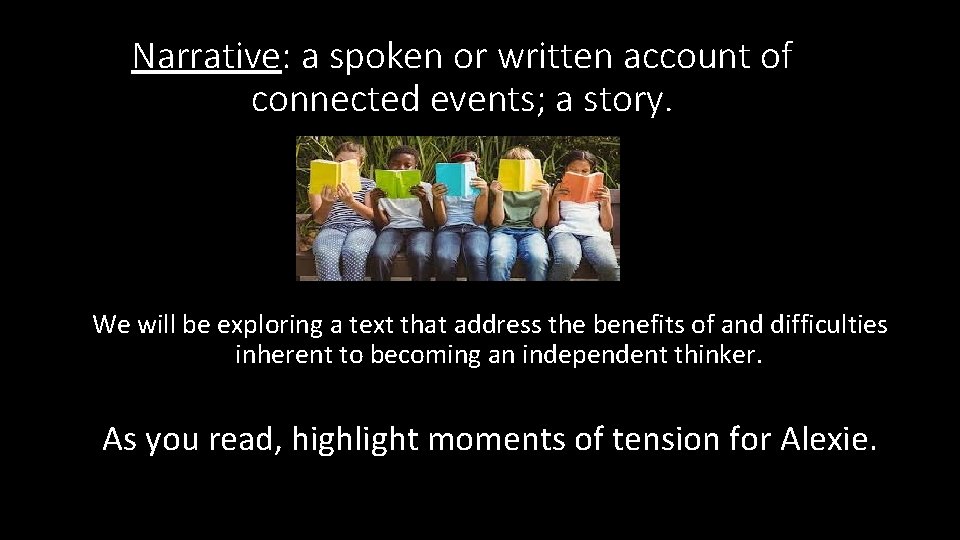
Narrative: a spoken or written account of connected events; a story. We will be exploring a text that address the benefits of and difficulties inherent to becoming an independent thinker. As you read, highlight moments of tension for Alexie.
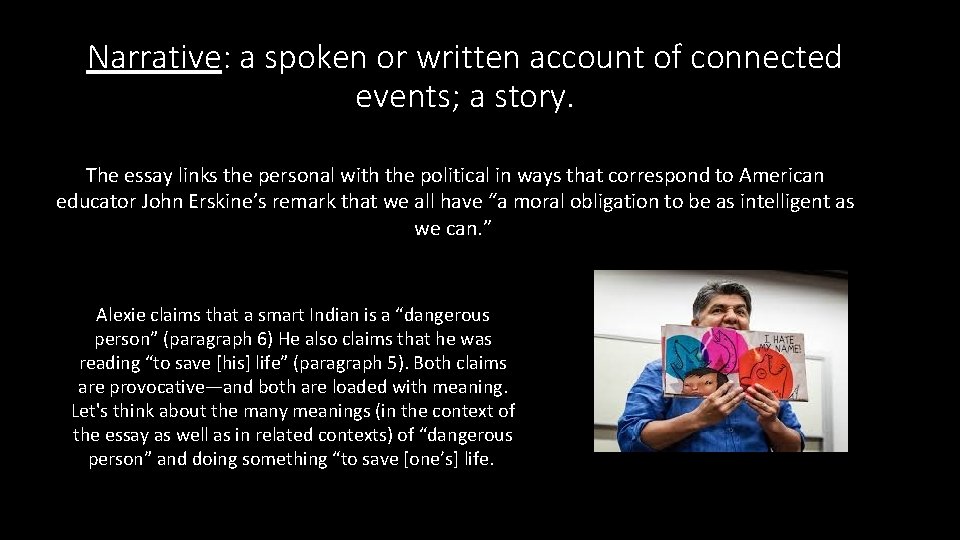
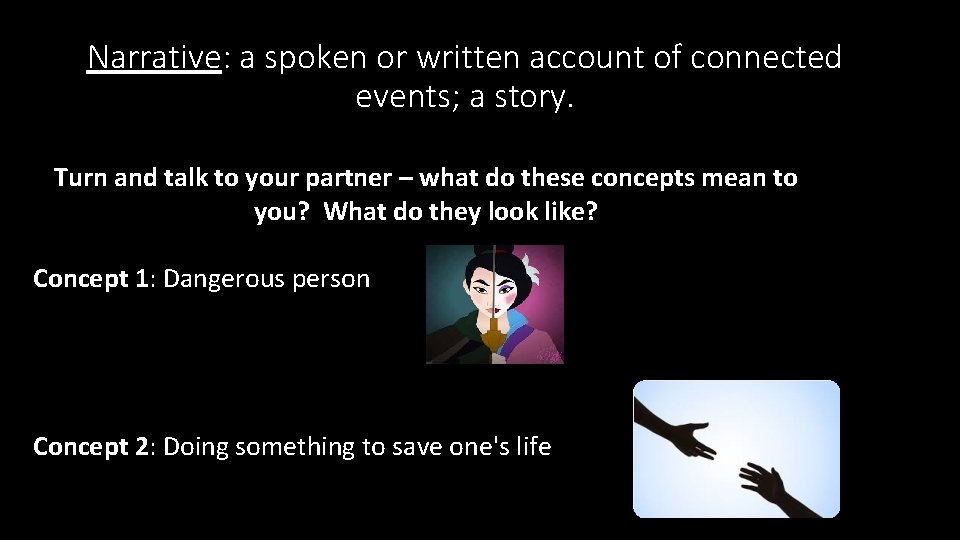
Narrative: a spoken or written account of connected events; a story. The essay links the personal with the political in ways that correspond to American educator John Erskine’s remark that we all have “a moral obligation to be as intelligent as we can. ” Alexie claims that a smart Indian is a “dangerous person” (paragraph 6) He also claims that he was reading “to save [his] life” (paragraph 5). Both claims are provocative—and both are loaded with meaning. Let's think about the many meanings (in the context of the essay as well as in related contexts) of “dangerous person” and doing something “to save [one’s] life.
Narrative: a spoken or written account of connected events; a story. Turn and talk to your partner – what do these concepts mean to you? What do they look like? Concept 1: Dangerous person Concept 2: Doing something to save one's life
Narrative: a spoken or written account of connected events; a story. Create a T-chart for concept 1 and 2. You will list ideas and use these ideas for your response. Critical thinking/writing: What are the different meanings associated with each concept? Apply these concepts to your life – how do YOU personally define these concepts? Concept 1: Dangerous person Concept 2: Doing something to save one's life
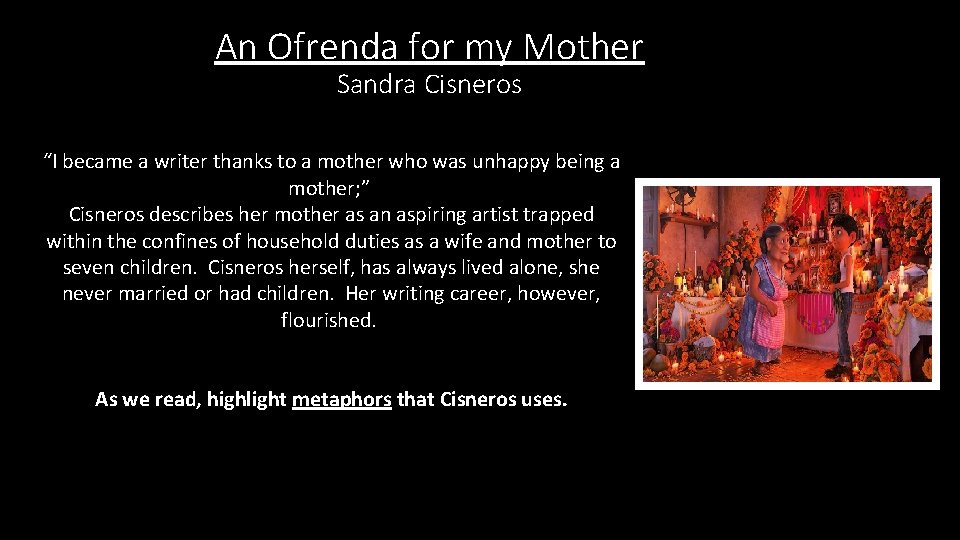
An Ofrenda for my Mother Sandra Cisneros “I became a writer thanks to a mother who was unhappy being a mother; ” Cisneros describes her mother as an aspiring artist trapped within the confines of household duties as a wife and mother to seven children. Cisneros herself, has always lived alone, she never married or had children. Her writing career, however, flourished. As we read, highlight metaphors that Cisneros uses.
Due TODAY: ALL LATE WORK + College Readiness Survey Agenda: Ticket out the door: Write a one paragraph description of how words are used to describe Cisneros’ mother. Use evidence from the text to support your answers. - Narrative essay prompt -Where are you from? Poem HOMEWORK: WIF poem DUE Block Day
Due TODAY 9/13 -14: WIF Poem Agenda: -WIF POEMS -”Us and Them” - Narrative Drafting (1 1/2 page minimum) DUE MONDAY: Narrative Essay Rough Draft (HARDCOPY)
Senior Housekeeping • Free FAFSA assistance: Saturday, October 6, 1: 00 -4: 00 p. m. • Dual Enrollment: Payment deadline is today! Pay online, by phone or in person • Raising Canes essay: Optional • Senior Reps: Meetings will begin AFTER break.
Due TODAY 9/17: Hardcopy of Narrative Rough Draft Agenda: -Image Warm-up (groups) - Narrative Workshop Reflection – Based on feedback, what changes will you make in your narrative?
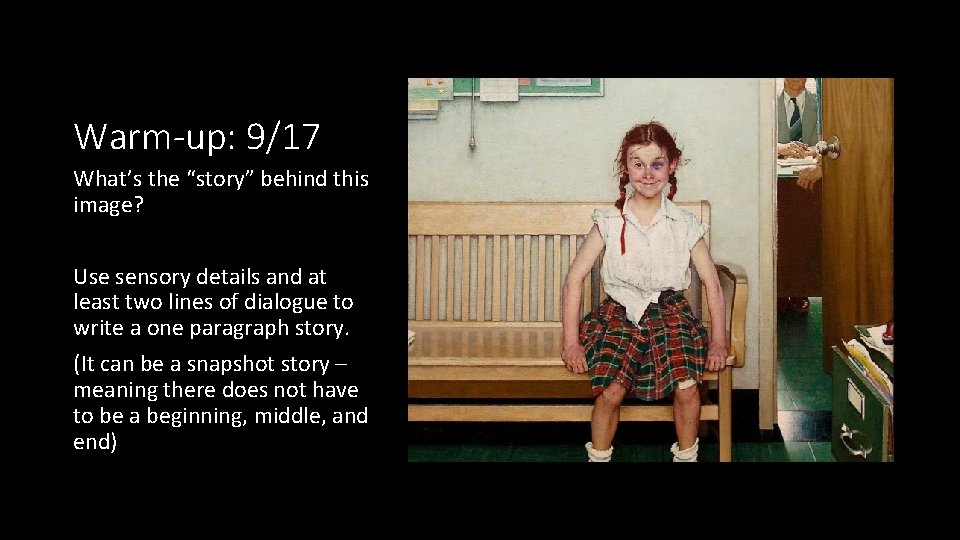
Warm-up: 9/17 What’s the “story” behind this image? Use sensory details and at least two lines of dialogue to write a one paragraph story. (It can be a snapshot story – meaning there does not have to be a beginning, middle, and end)
Upcoming Due Dates: 9/17: Narrative Essay Final Draft 9/24: Artifact Presentations begin 9/18 Agenda: - “Fish Cheeks” by Amy Tan - Main point extraction (TOTD) - Artifact criteria: choosing an excerpt
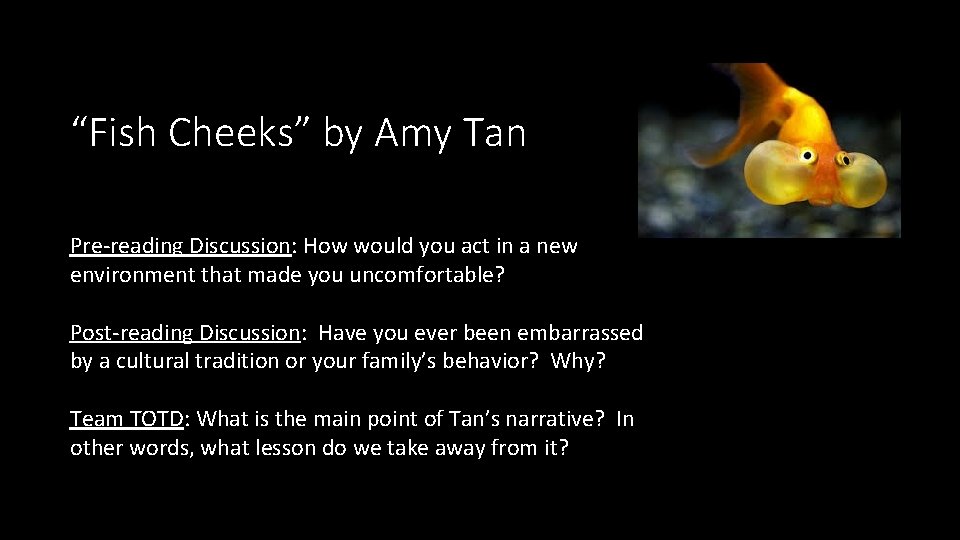
“Fish Cheeks” by Amy Tan Pre-reading Discussion: How would you act in a new environment that made you uncomfortable? Post-reading Discussion: Have you ever been embarrassed by a cultural tradition or your family’s behavior? Why? Team TOTD: What is the main point of Tan’s narrative? In other words, what lesson do we take away from it?
TOTD: Take back your partner’s rough draft and answer the following: What is the author’s main point in this story (what’s the takeaway? ) Author – on the same sheet, answer the following: Was the reader’s interpretation correct?
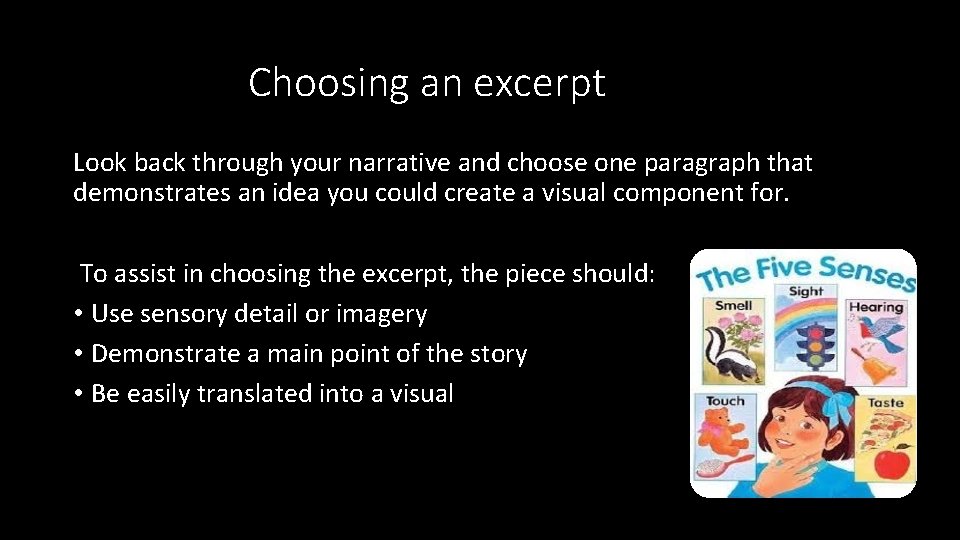
Choosing an excerpt Look back through your narrative and choose one paragraph that demonstrates an idea you could create a visual component for. To assist in choosing the excerpt, the piece should: • Use sensory detail or imagery • Demonstrate a main point of the story • Be easily translated into a visual
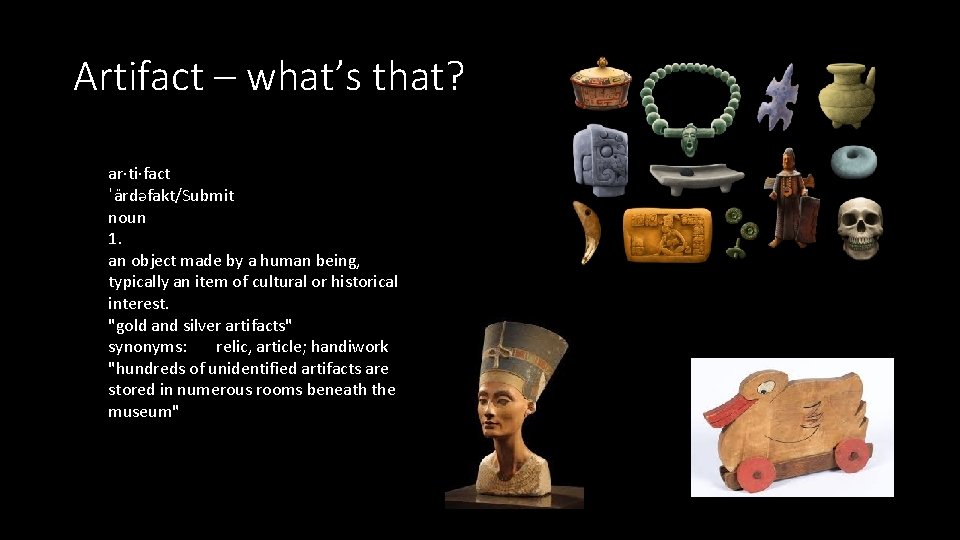
Artifact – what’s that? ar·ti·fact ˈärdəfakt/Submit noun 1. an object made by a human being, typically an item of cultural or historical interest. "gold and silver artifacts" synonyms: relic, article; handiwork "hundreds of unidentified artifacts are stored in numerous rooms beneath the museum"