UNIT 2 NATURAL RESOURCES LOGO Contents Classification of



- Slides: 96
UNIT – 2 NATURAL RESOURCES LOGO
Contents Classification of Natural Resources Water Resources Mineral Resources Energy Resources Land Resources 2
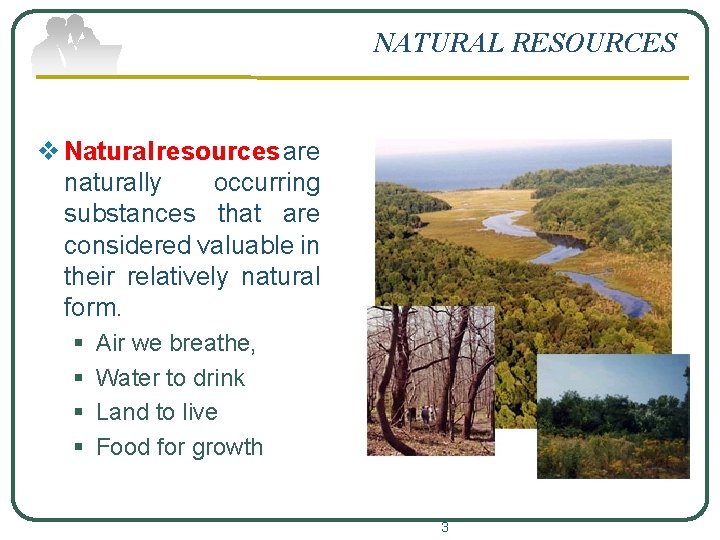
NATURAL RESOURCES v Natural resources are naturally occurring substances that are considered valuable in their relatively natural form. § § Air we breathe, Water to drink Land to live Food for growth 3
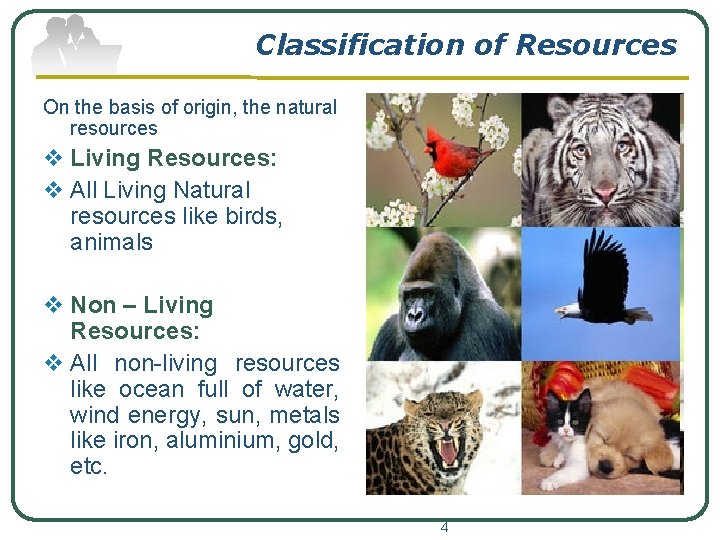
Classification of Resources On the basis of origin, the natural resources v Living Resources: v All Living Natural resources like birds, animals v Non – Living Resources: v All non-living resources like ocean full of water, wind energy, sun, metals like iron, aluminium, gold, etc. 4
Based on the availability, natural resources are divided into (a) Inexhaustible Resources Present in unlimited quantities on earth Eg: Water, wind, sun (b) Exhaustible Resources Present in limited quantities. Coal, oil , gas 5
Renewable & Non-renewable Resources v On the basis of Replenishability: v Renewable : Resources have the ability to reappear or replenish themselves by recycling, reproduction or replacement. v E. g. : Oxygen in air is replenished through photosynthesis. v Fresh water is replenished through water cycles. v Biological products include wild life and natural vegetation of all kinds. v They are replenished through natural cycles of growth and reproduction. 6
v Non-renewable Resources v. It exists in a fixed amount that cannot be re-made, re-grown or regenerated as fast as it is consumed and used up. v Often fossil fuels, such as coal, petroleum natural gas , and Gold 7
WATER RESOURCES Introduction Use and over utilization of surface and ground water FLOODS DROUGHT Dams: Benefits & problems 8
Introduction v. The economy, agriculture and industrial growth of mankind is largely dependent on water resources v. Infact, ancient civilizations flourished along perennial surface water like streams and rivers 9 SNIST/Biotech/Ravindra/ES-2 Company
10 SNIST/Biotech/Ravindra/ES-2 Company
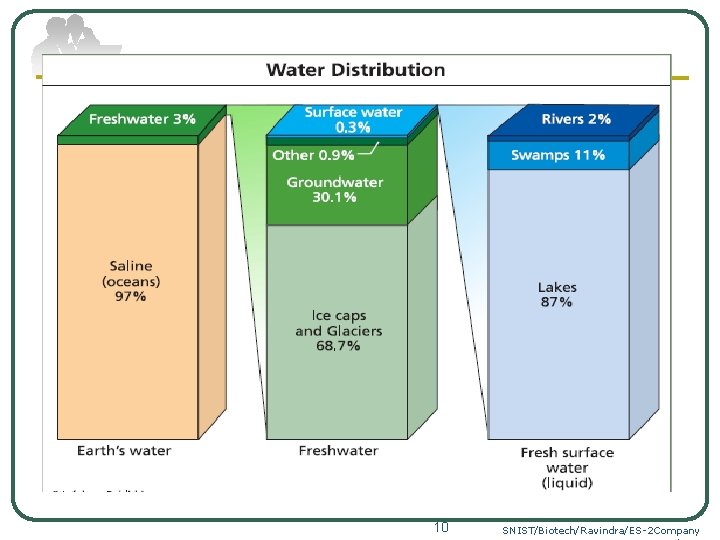
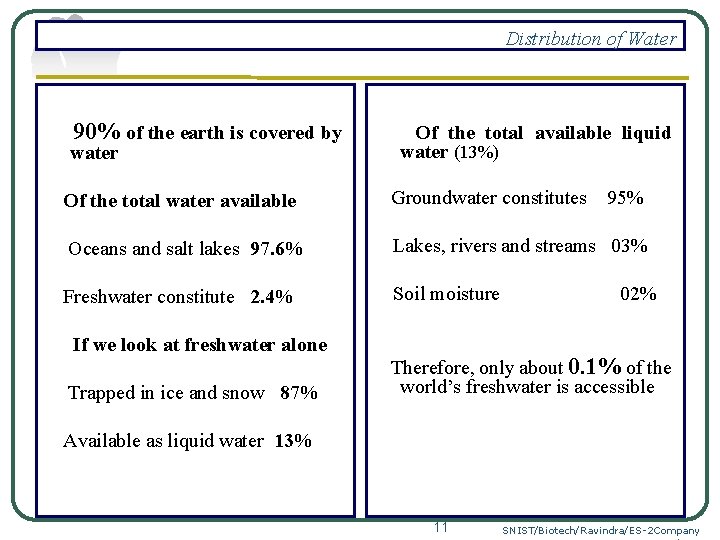
Distribution of Water 90% of the earth is covered by water Of the total available liquid water (13%) Of the total water available Groundwater constitutes Oceans and salt lakes 97. 6% Lakes, rivers and streams 03% Freshwater constitute 2. 4% Soil moisture If we look at freshwater alone Trapped in ice and snow 87% 95% 02% Therefore, only about 0. 1% of the world’s freshwater is accessible Available as liquid water 13% 11 11 SNIST/Biotech/Ravindra/ES-2 Company
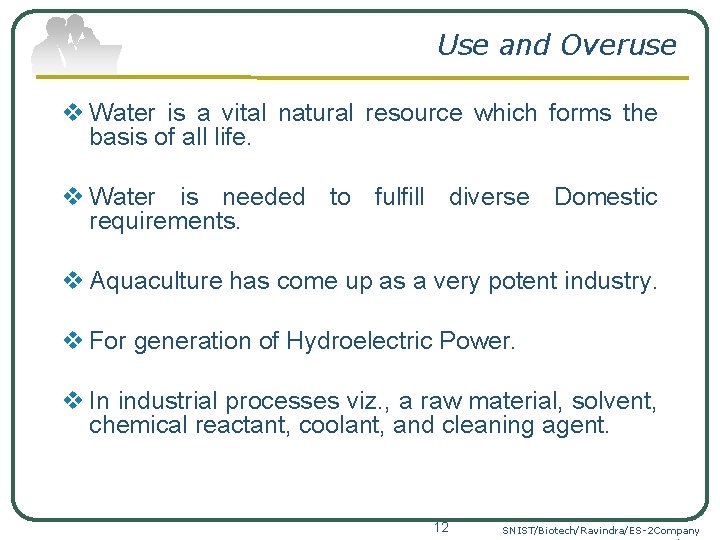
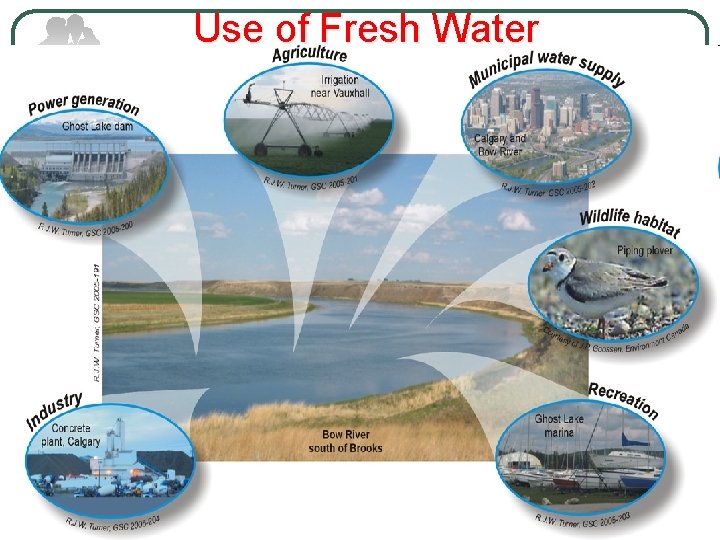
Use and Overuse v Water is a vital natural resource which forms the basis of all life. v Water is needed to fulfill diverse Domestic requirements. v Aquaculture has come up as a very potent industry. v For generation of Hydroelectric Power. v In industrial processes viz. , a raw material, solvent, chemical reactant, coolant, and cleaning agent. 12 SNIST/Biotech/Ravindra/ES-2 Company
Use of Fresh Water 13 SNIST/Biotech/Ravindra/ES-2 Company
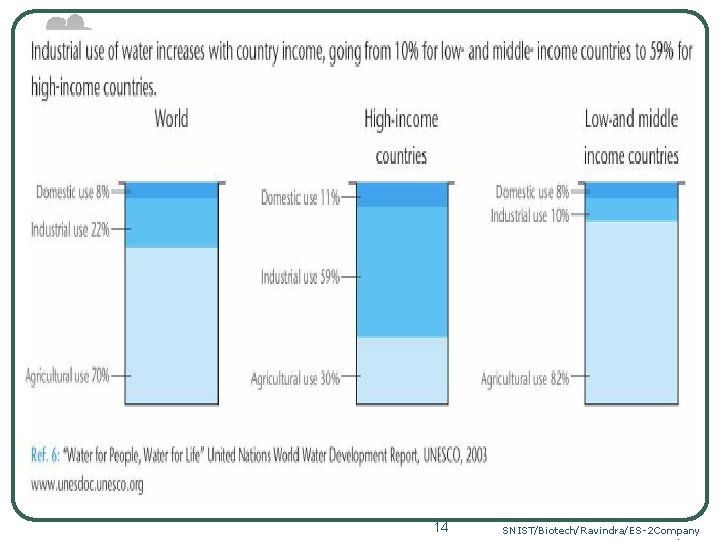
14 SNIST/Biotech/Ravindra/ES-2 Company
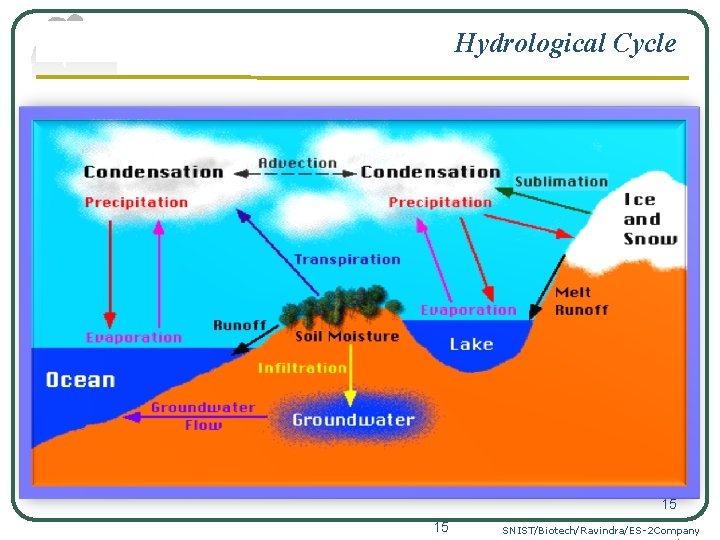
Hydrological Cycle 15 15 SNIST/Biotech/Ravindra/ES-2 Company
Ground Water: v Groundwater is the source of about 90% country's drinking water. v In rural areas, groundwater is the only source for water and more than one-third of our 100 largest cities depend on it. v Rain water move downward and get stopped when the water meets rock that has no porosity. v A layer of sediment or rock that is highly permeable (porous) and contains water is called an aquifer. v This causes saturation of water in the soil and the zone is called saturation zone. v The upper boundary of the zone of saturation is called the water table. 16
v. However, groundwater is becoming contaminated with industrial effluents discharged on land septic systems, as well as illegal and uncontrolled hazardous waste sites. v. Once contaminated, groundwater difficult, if not impossible, to restore. 17 is
Over utilization Groundwater v Groundwater abstraction from aquifers faster than natural recharge causes a ‘cone of depression’ in the water table v This may dry up nearby wells v Over utilization also allows aquifers to collapse followed by sinking of the groundwater surface v Overuse of freshwater allows salt water intrusion into aquifers used for domestic and agricultural purposes in coastal areas 18
Surface Water: v Surface waters are available as a result of precipitation. v Precipitation that doesn't seep into the ground or does not return to the atmosphere by evaporation or transpiration is called surface water. v Rain drops and snow flakes reach to surface of the earth v It forms streams, ponds, ocean, lakes, wetlands and artificial reservoirs 19
v. In china it takes 1000 tonnes of water to produce one tonne of wheat. vwater required to grow a tonne of grain = manufacture a tonne of most industrial materials (e. g. , metals or plastics, etc. ). v. World water council believes that by 2020, we shall need 17% more water than is available to feed the world. 20
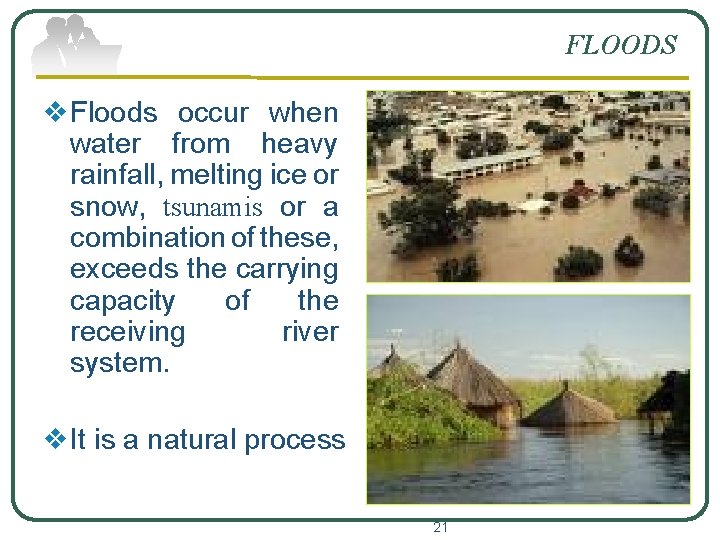
FLOODS v. Floods occur when water from heavy rainfall, melting ice or snow, tsunamis or a combination of these, exceeds the carrying capacity of the receiving river system. v. It is a natural process 21
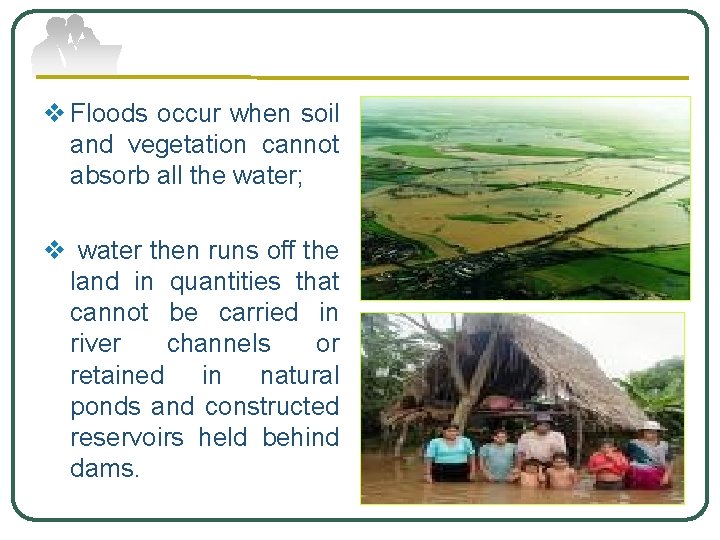
v Floods occur when soil and vegetation cannot absorb all the water; v water then runs off the land in quantities that cannot be carried in river channels or retained in natural ponds and constructed reservoirs held behind dams.
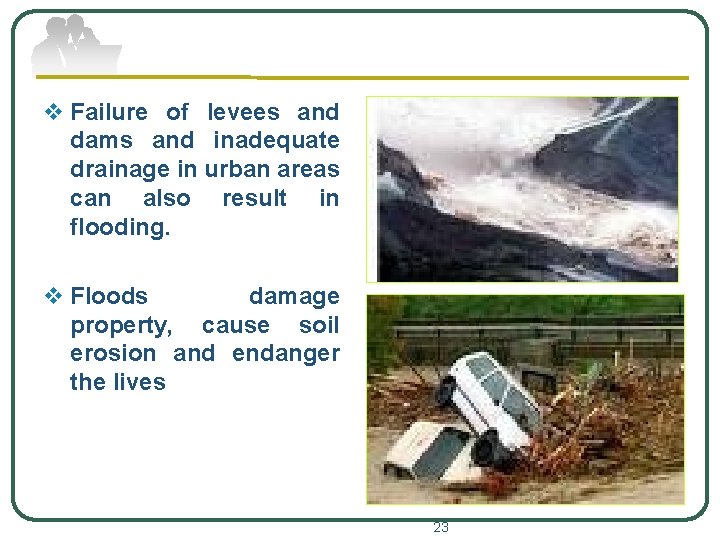
v Failure of levees and dams and inadequate drainage in urban areas can also result in flooding. v Floods damage property, cause soil erosion and endanger the lives 23
v Flooding may deposit as much as 0. 4 inches (1 cm) of sediment a year on a flood plain v Floods throughout Asia in 1998 killed 7, 000 people, damaged more than 6 million houses and destroyed 25 million hectares of cropland in Bangladesh, China, India and Vietnam v In 2005, the remarkable flooding by Hurricane Katrina, caused more than $200 billion in losses, constituted the costliest natural disaster in U. S. history 24
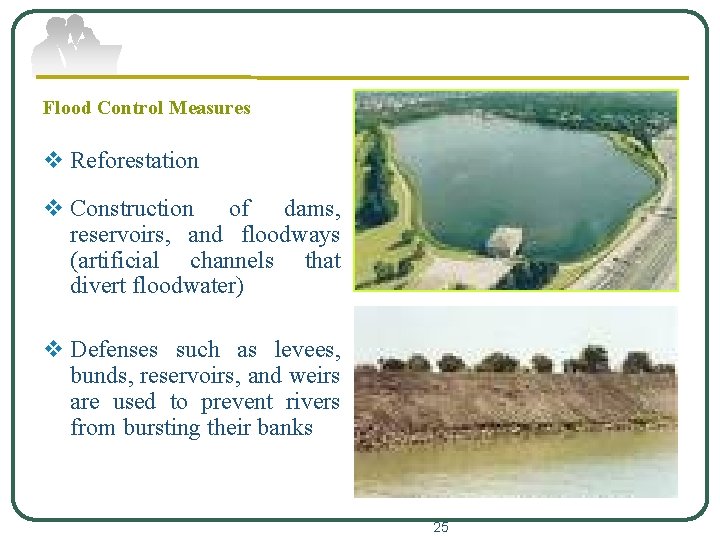
Flood Control Measures v Reforestation v Construction of dams, reservoirs, and floodways (artificial channels that divert floodwater) v Defenses such as levees, bunds, reservoirs, and weirs are used to prevent rivers from bursting their banks 25
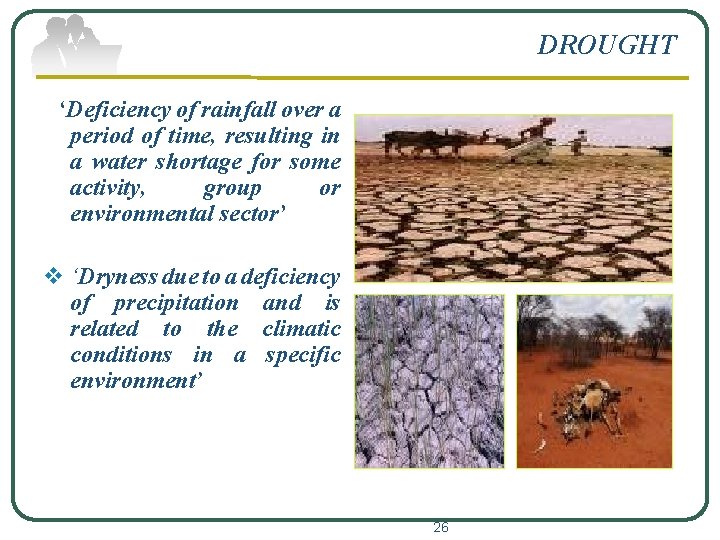
DROUGHT ‘Deficiency of rainfall over a period of time, resulting in a water shortage for some activity, group or environmental sector’ v ‘Dryness due to a deficiency of precipitation and is related to the climatic conditions in a specific environment’ 26
EFFECTS OF DROUGHT Economic impacts v Lower crop yields, v Spend on irrigation, v Digging wells, v loss of livestock Environmental impacts v Forest fires, v Soil erosion, v Loss of habitat v Loss of endangered species 27
Social impacts v Conflicts between people v Mental and physical stress on people due to economic losses v Health problems related to low water flows v Threat to public safety from an increased number of forest and range fires v Reduced incomes v Population migrations from rural to urban areas v Fewer recreational activities v Loss of Human life 28 SNIST/Biotech/Ravindra/ES-2 Company
DAMS – Benefits and problems v Dam is the barrier constructed across a stream or river to impound water and raise its level. Dams - Benefits v To concentrate the natural fall of a river at a given site; v To generate electricity; v To direct water from rivers into canals , irrigation and watersupply systems; v To increase river depths for navigational purposes; v To control water flow during times of flood and drought; v To create artificial lakes for recreational use. v The first dam was built about 4000 BC to divert the Nile in Egypt in order to provide a site for the city of Memphis. 29 SNIST/Biotech/Ravindra/ES-2 Company
Environmental Impacts of Large dams - Problems v loss of vegetal cover v submergence of large area of land (human settlement) v soil erosion v Resettlement and rehabilitation problem of displaced people. v variation in water table and v enhanced seismic activities due to pressure of water. v Salts left behind by evaporation increase salinity of the river and makes it unusable. v The nature and magnitude of the impacts vary with the project locations and the conditions therein. 30 SNIST/Biotech/Ravindra/ES-2 Company
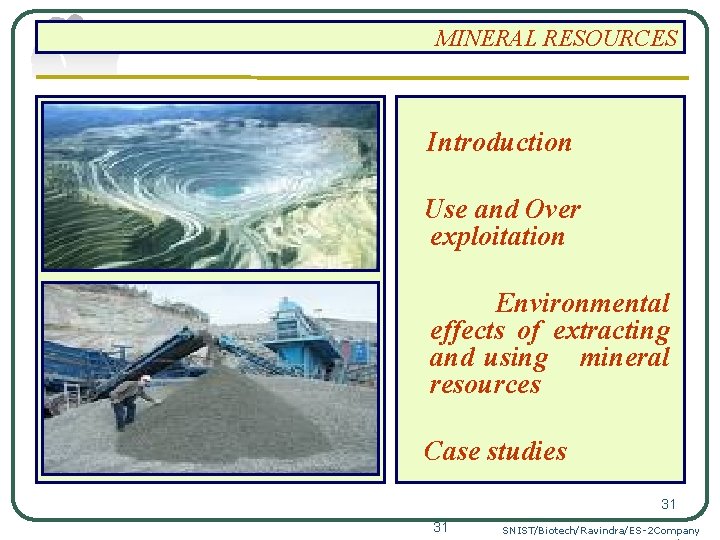
MINERAL RESOURCES Introduction Use and Over exploitation Environmental effects of extracting and using mineral resources Case studies 31 31 SNIST/Biotech/Ravindra/ES-2 Company
Introduction Minerals are naturally occurring chemical elements or compounds, formed through inorganic processes They are exhaustible, non renewable resources found in the earth's crust More than 3, 000 mineral species are known. However, only 200 minerals are put to economic use They are characterized by v chemical composition v crystalline structure v physical properties Minerals are not evenly distributed in the world Therefore, each country is dependent upon other countries for the requirement of certain minerals India has large reserves of iron, manganese, lime stone, dolomite, silica, and mica But it has little reserves of copper, gold, silver, lead and phosphate Even for NPK fertilizers, India is dependent upon foreign countries 32 32 SNIST/Biotech/Ravindra/ES-2 Company
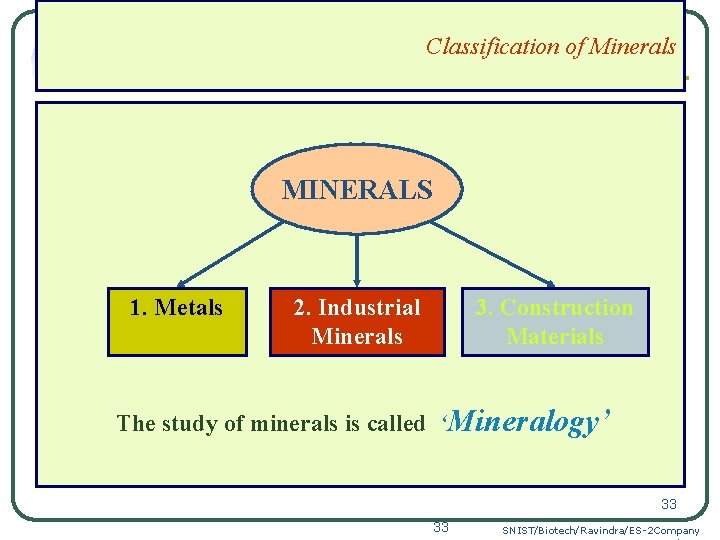
Classification of Minerals MINERALS 1. Metals 2. Industrial Minerals 3. Construction Materials The study of minerals is called ‘Mineralogy’ 33 33 SNIST/Biotech/Ravindra/ES-2 Company
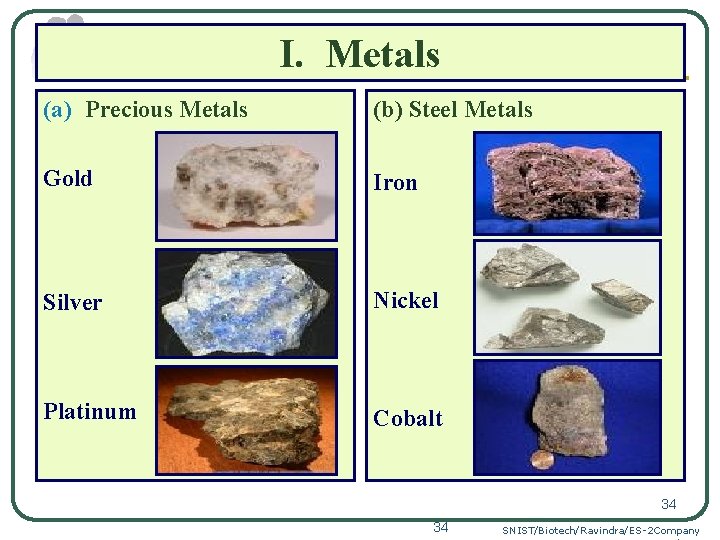
I. Metals (a) Precious Metals (b) Steel Metals Gold Iron Silver Nickel Platinum Cobalt 34 34 SNIST/Biotech/Ravindra/ES-2 Company
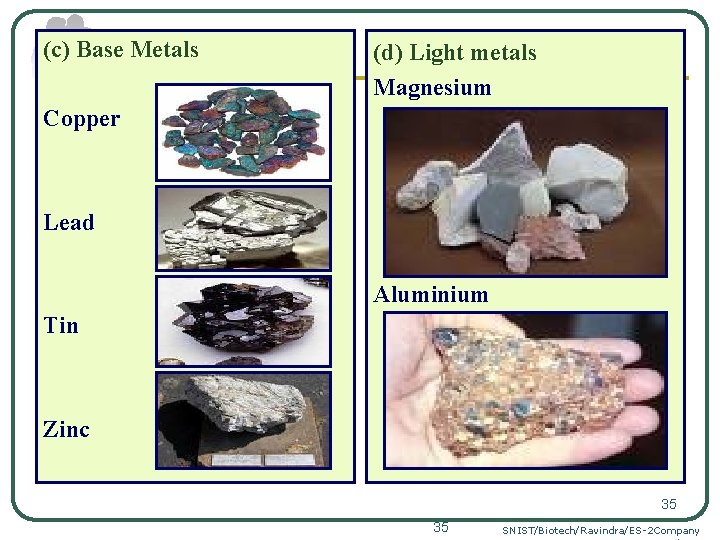
(c) Base Metals (d) Light metals Magnesium Copper Lead Aluminium Tin Zinc 35 35 SNIST/Biotech/Ravindra/ES-2 Company
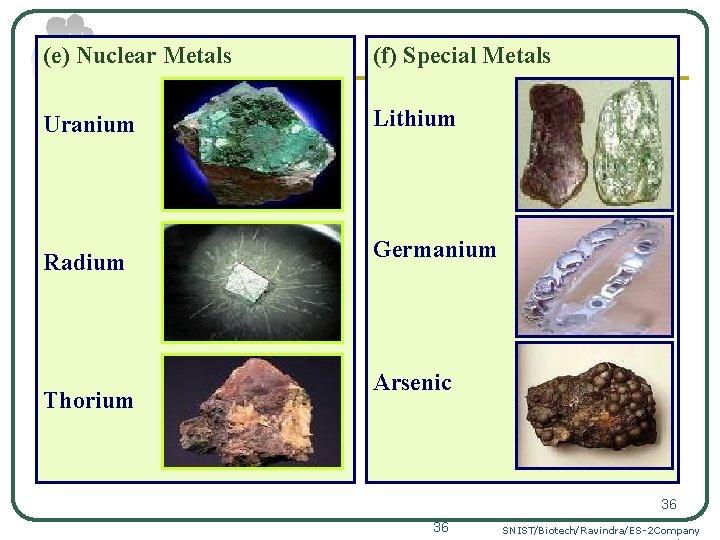
(e) Nuclear Metals (f) Special Metals Uranium Lithium Radium Thorium Germanium Arsenic 36 36 SNIST/Biotech/Ravindra/ES-2 Company
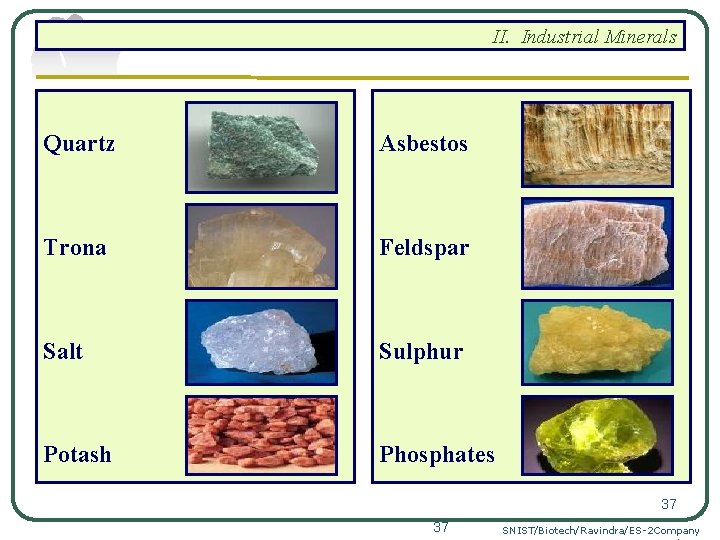
II. Industrial Minerals Quartz Asbestos Trona Feldspar Salt Sulphur Potash Phosphates 37 37 SNIST/Biotech/Ravindra/ES-2 Company
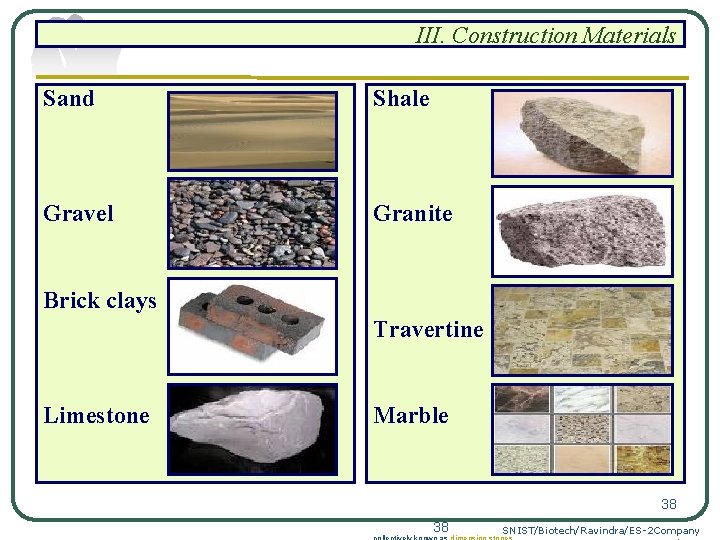
III. Construction Materials Sand Shale Gravel Granite Brick clays Travertine Limestone Marble 38 38 SNIST/Biotech/Ravindra/ES-2 Company
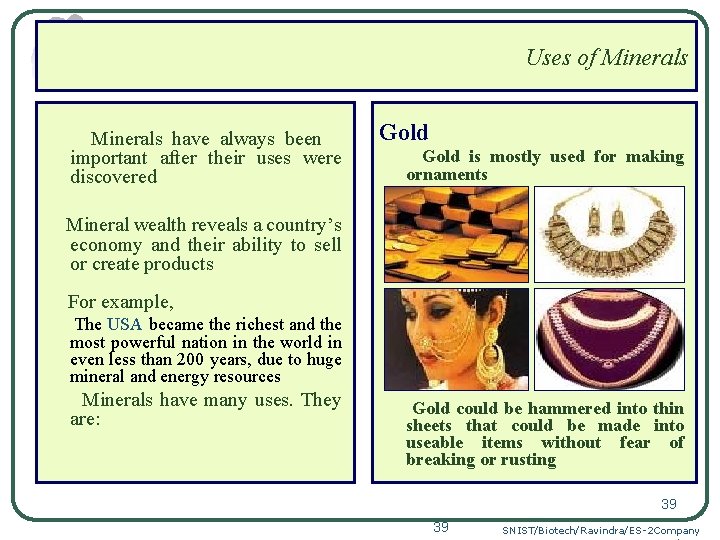
Uses of Minerals have always been important after their uses were discovered Gold is mostly used for making ornaments Mineral wealth reveals a country’s economy and their ability to sell or create products For example, The USA became the richest and the most powerful nation in the world in even less than 200 years, due to huge mineral and energy resources Minerals have many uses. They are: Gold could be hammered into thin sheets that could be made into useable items without fear of breaking or rusting 39 39 SNIST/Biotech/Ravindra/ES-2 Company
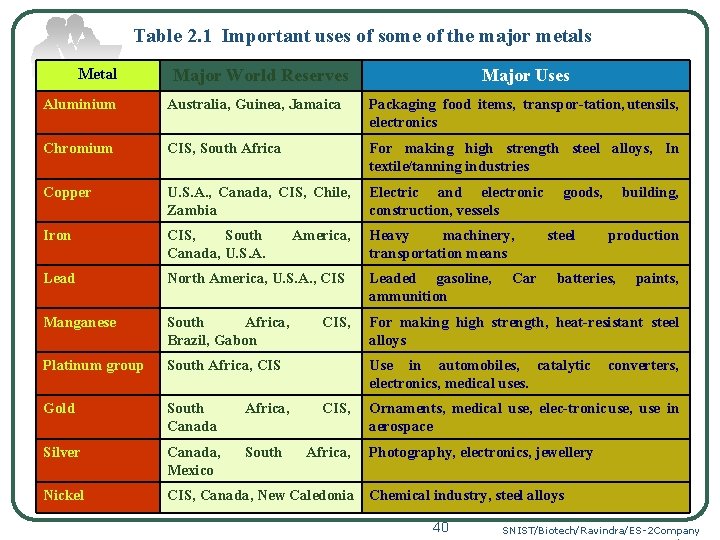
Table 2. 1 Important uses of some of the major metals Metal Major World Reserves Major Uses Aluminium Australia, Guinea, Jamaica Packaging food items, transpor tation, utensils, electronics Chromium CIS, South Africa For making high strength steel alloys, In textile/tanning industries Copper U. S. A. , Canada, CIS, Chile, Zambia Electric and electronic construction, vessels Iron CIS, South Canada, U. S. A. Heavy machinery, transportation means Lead North America, U. S. A. , CIS Leaded gasoline, ammunition Manganese South Africa, Brazil, Gabon For making high strength, heat resistant steel alloys Platinum group South Africa, CIS Gold South Canada Africa, Silver Canada, Mexico South Nickel CIS, Canada, New Caledonia Chemical industry, steel alloys America, CIS, Car goods, steel Africa, production batteries, Use in automobiles, catalytic electronics, medical uses. CIS, building, paints, converters, Ornaments, medical use, elec tronic use, use in aerospace Photography, electronics, jewellery 40 40 SNIST/Biotech/Ravindra/ES-2 Company
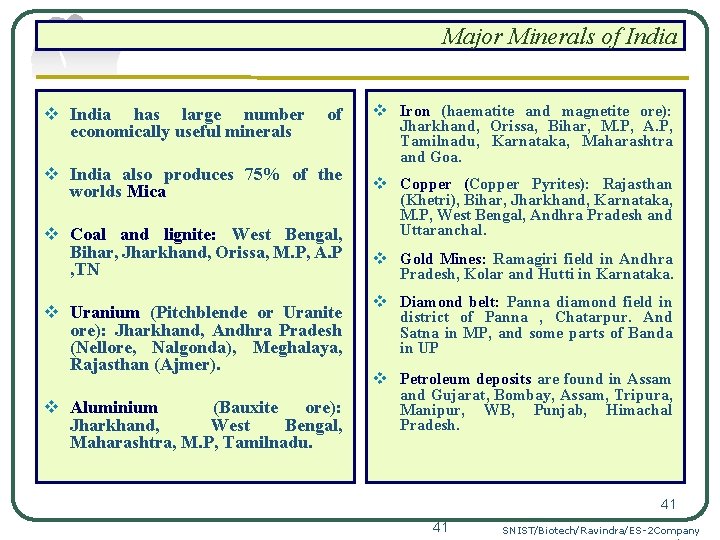
Major Minerals of India v India has large number economically useful minerals of v India also produces 75% of the worlds Mica v Coal and lignite: West Bengal, Bihar, Jharkhand, Orissa, M. P, A. P , TN v Uranium (Pitchblende or Uranite ore): Jharkhand, Andhra Pradesh (Nellore, Nalgonda), Meghalaya, Rajasthan (Ajmer). v Aluminium (Bauxite ore): Jharkhand, West Bengal, Maharashtra, M. P, Tamilnadu. v Iron (haematite and magnetite ore): Jharkhand, Orissa, Bihar, M. P, A. P, Tamilnadu, Karnataka, Maharashtra and Goa. v Copper (Copper Pyrites): Rajasthan (Khetri), Bihar, Jharkhand, Karnataka, M. P, West Bengal, Andhra Pradesh and Uttaranchal. v Gold Mines: Ramagiri field in Andhra Pradesh, Kolar and Hutti in Karnataka. v Diamond belt: Panna diamond field in district of Panna , Chatarpur. And Satna in MP, and some parts of Banda in UP v Petroleum deposits are found in Assam and Gujarat, Bombay, Assam, Tripura, Manipur, WB, Punjab, Himachal Pradesh. 41 41 SNIST/Biotech/Ravindra/ES-2 Company
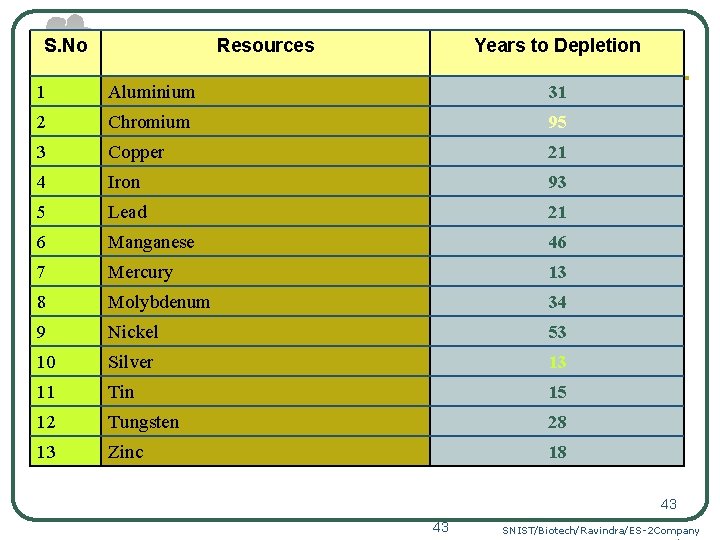
Exploitation The ever increasing demand of the limited mineral deposits and over exploitation may exhaust them within a few decades 42 42 SNIST/Biotech/Ravindra/ES-2 Company
S. No Resources Years to Depletion 1 Aluminium 31 2 Chromium 95 3 Copper 21 4 Iron 93 5 Lead 21 6 Manganese 46 7 Mercury 13 8 Molybdenum 34 9 Nickel 53 10 Silver 13 11 Tin 15 12 Tungsten 28 13 Zinc 18 43 43 SNIST/Biotech/Ravindra/ES-2 Company
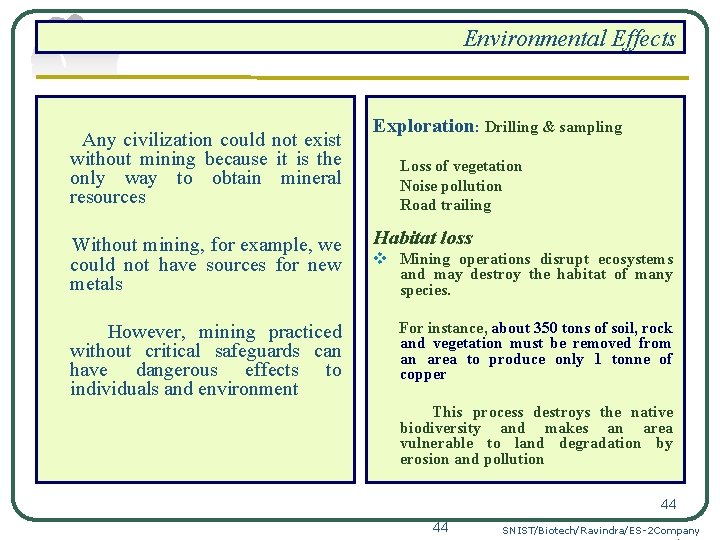
Environmental Effects Any civilization could not exist without mining because it is the only way to obtain mineral resources Without mining, for example, we could not have sources for new metals However, mining practiced without critical safeguards can have dangerous effects to individuals and environment Exploration: Drilling & sampling Loss of vegetation Noise pollution Road trailing Habitat loss v Mining operations disrupt ecosystems and may destroy the habitat of many species. For instance, about 350 tons of soil, rock and vegetation must be removed from an area to produce only 1 tonne of copper This process destroys the native biodiversity and makes an area vulnerable to land degradation by erosion and pollution 44 44 SNIST/Biotech/Ravindra/ES-2 Company
v Mining and Milling - Ore extraction, crushing /grinding of ore, chemical concentration of ore. v wind borne dust, acid generation from waste rock, heavy metal leaching from acid mine drainage v Mining leads to severe water, air and land pollution v Many drainage waters from mining areas have high sulfate and iron concentrations v When exposed to air, pyrite and ferrous sulphide in coal seams produce sulphuric acid v Plants can be seriously affected in areas with waste water contaminated by copper, nickel, lead and zinc mines v Such waste discharges may also kill the decomposers and reduce the soil fertility v There also impacts on aquatic life. One recent study found that mine discharges contain selenium, a chemical harmful in high doses accumulates in fish downstream v That might also pose a risk to humans who eat the fish 45 45 SNIST/Biotech/Ravindra/ES-2 Company
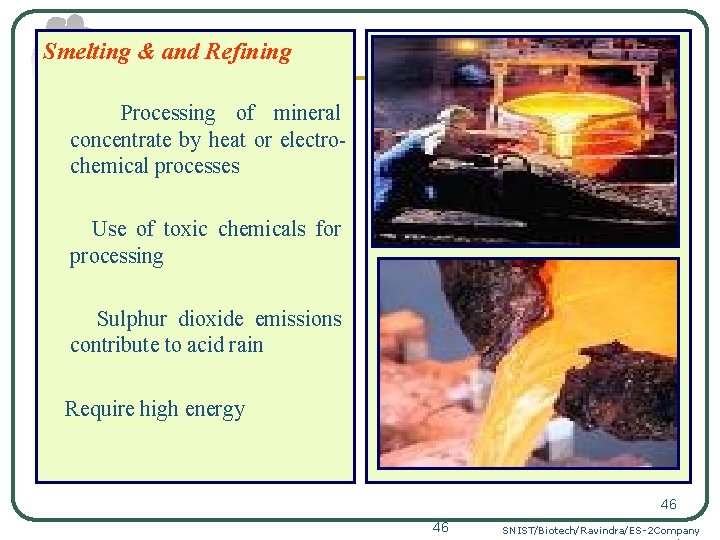
Smelting & and Refining Processing of mineral concentrate by heat or electrochemical processes Use of toxic chemicals for processing Sulphur dioxide emissions contribute to acid rain Require high energy 46 46 SNIST/Biotech/Ravindra/ES-2 Company
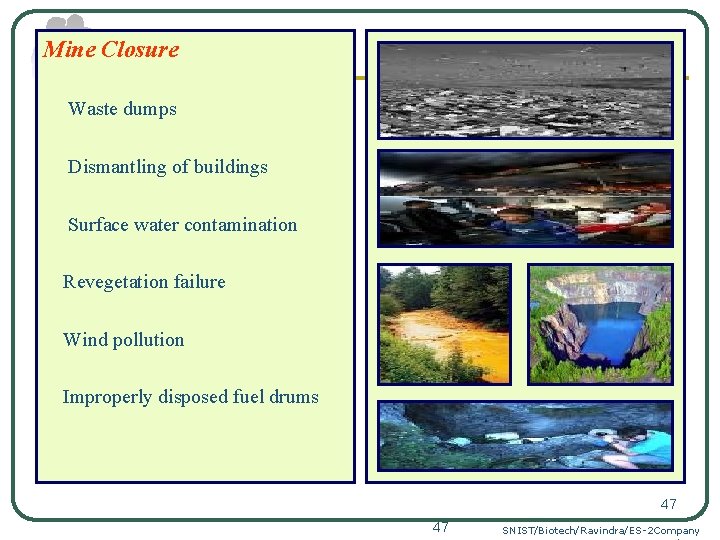
Mine Closure Waste dumps Dismantling of buildings Surface water contamination Revegetation failure Wind pollution Improperly disposed fuel drums 47 47 SNIST/Biotech/Ravindra/ES-2 Company
CASE STUDIES v 1) Jaduguda Uranium Mine, Jharkhand—-exposing local people to radioactive hazards v (2)Jharia coal mines, Jharkhand —underground fire leading to land subsidence and forced displacement of people v v (3) Sukinda chromite mines, Orissa—seeping of hexavalent chromium into river posing serious health hazard, Cr 6+ being highly toxic and carcinogenic v (4) Kudremukh iron ore mine, Karnataka—causing river pollution and threat to biodiversity v (5) East coast Bauxite mine, Orissa—Land encroachment and issue of rehabilitation unsettled v (6) North Eastern Coal Fields, Assam—Very high sulphurcontamination of groundwater 48 48 SNIST/Biotech/Ravindra/ES-2 Company
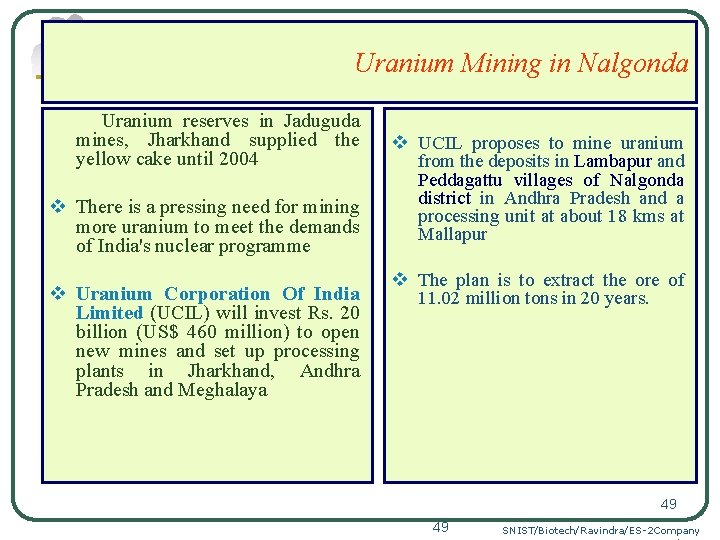
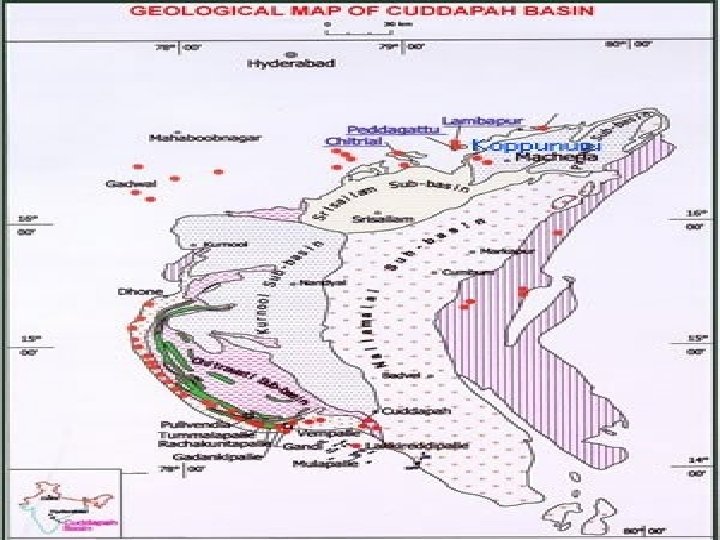
Uranium Mining in Nalgonda Uranium reserves in Jaduguda mines, Jharkhand supplied the yellow cake until 2004 v There is a pressing need for mining more uranium to meet the demands of India's nuclear programme v Uranium Corporation Of India Limited (UCIL) will invest Rs. 20 billion (US$ 460 million) to open new mines and set up processing plants in Jharkhand, Andhra Pradesh and Meghalaya v UCIL proposes to mine uranium from the deposits in Lambapur and Peddagattu villages of Nalgonda district in Andhra Pradesh and a processing unit at about 18 kms at Mallapur v The plan is to extract the ore of 11. 02 million tons in 20 years. 49 49 SNIST/Biotech/Ravindra/ES-2 Company
50 SNIST/Biotech/Ravindra/ES-2 Company
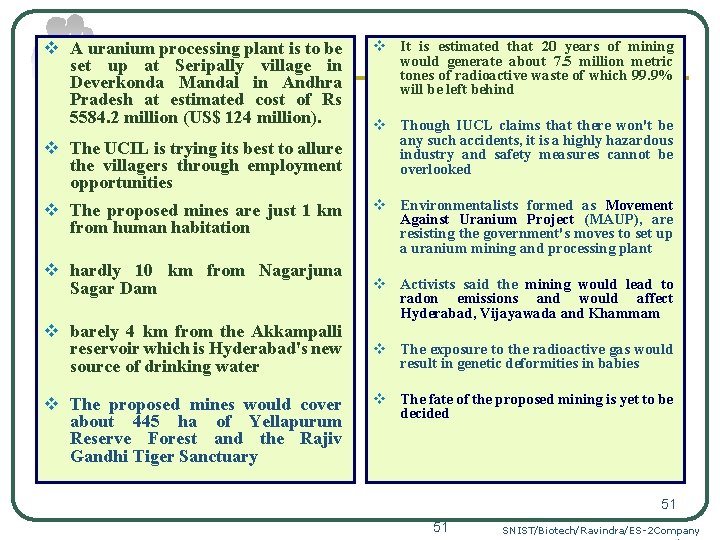
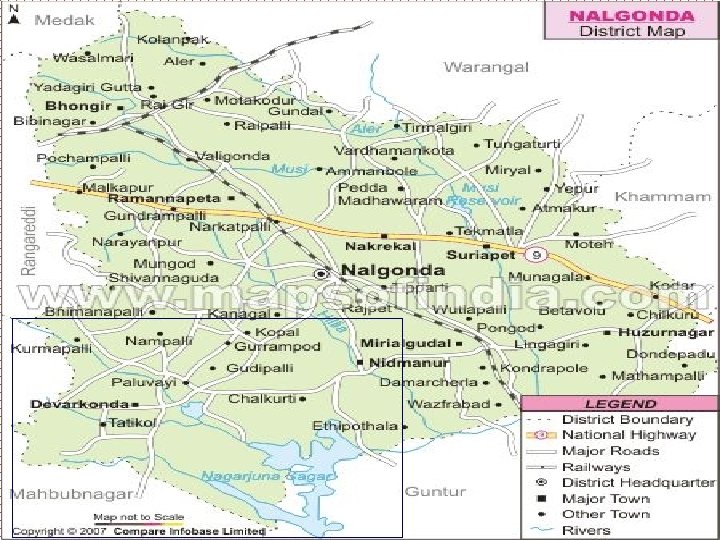
v A uranium processing plant is to be set up at Seripally village in Deverkonda Mandal in Andhra Pradesh at estimated cost of Rs 5584. 2 million (US$ 124 million). v The UCIL is trying its best to allure the villagers through employment opportunities v The proposed mines are just 1 km from human habitation v hardly 10 km from Nagarjuna Sagar Dam v barely 4 km from the Akkampalli reservoir which is Hyderabad's new source of drinking water v The proposed mines would cover about 445 ha of Yellapurum Reserve Forest and the Rajiv Gandhi Tiger Sanctuary v It is estimated that 20 years of mining would generate about 7. 5 million metric tones of radioactive waste of which 99. 9% will be left behind v Though IUCL claims that there won't be any such accidents, it is a highly hazardous industry and safety measures cannot be overlooked v Environmentalists formed as Movement Against Uranium Project (MAUP), are resisting the government's moves to set up a uranium mining and processing plant v Activists said the mining would lead to radon emissions and would affect Hyderabad, Vijayawada and Khammam v The exposure to the radioactive gas would result in genetic deformities in babies v The fate of the proposed mining is yet to be decided 51 51 SNIST/Biotech/Ravindra/ES-2 Company
52 SNIST/Biotech/Ravindra/ES-2 Company
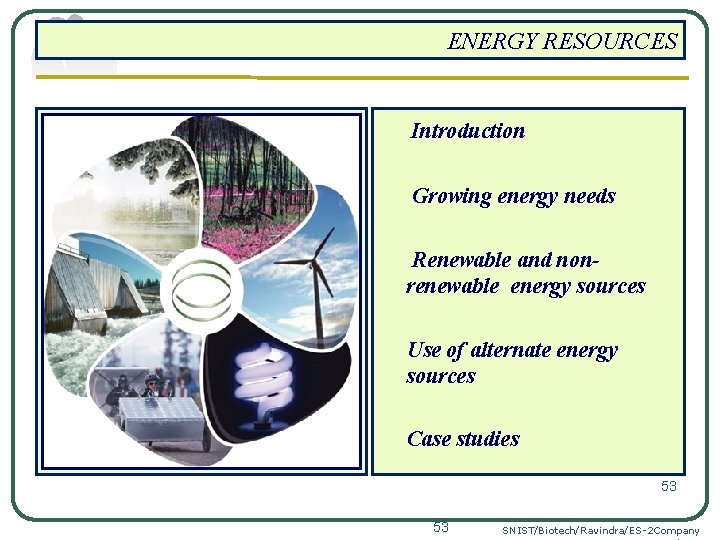
ENERGY RESOURCES Introduction Growing energy needs Renewable and nonrenewable energy sources Use of alternate energy sources Case studies 53 53 SNIST/Biotech/Ravindra/ES-2 Company
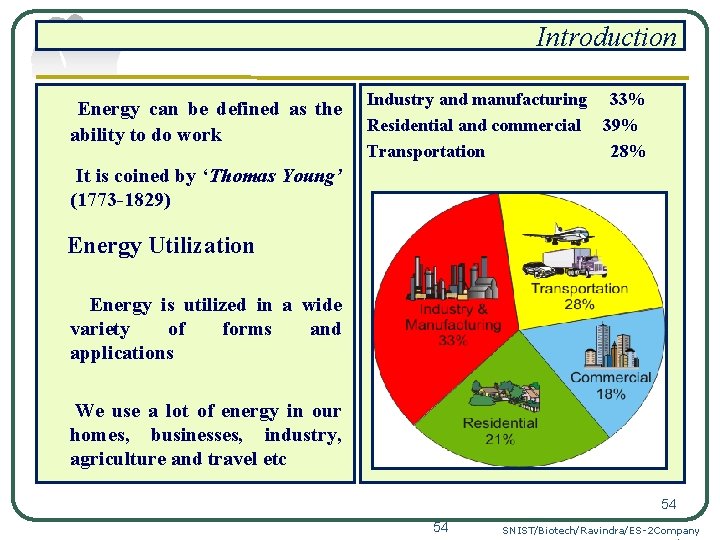
Introduction Energy can be defined as the ability to do work Industry and manufacturing 33% Residential and commercial 39% Transportation 28% It is coined by ‘Thomas Young’ (1773 1829) Energy Utilization Energy is utilized in a wide variety of forms and applications We use a lot of energy in our homes, businesses, industry, agriculture and travel etc 54 54 SNIST/Biotech/Ravindra/ES-2 Company
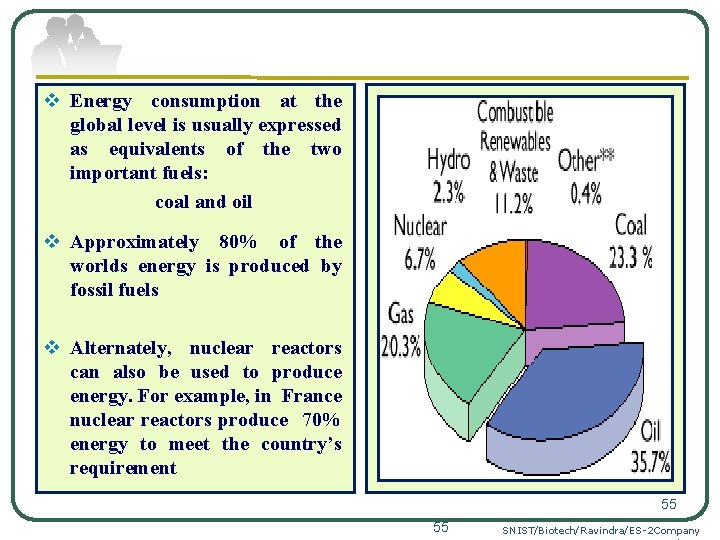
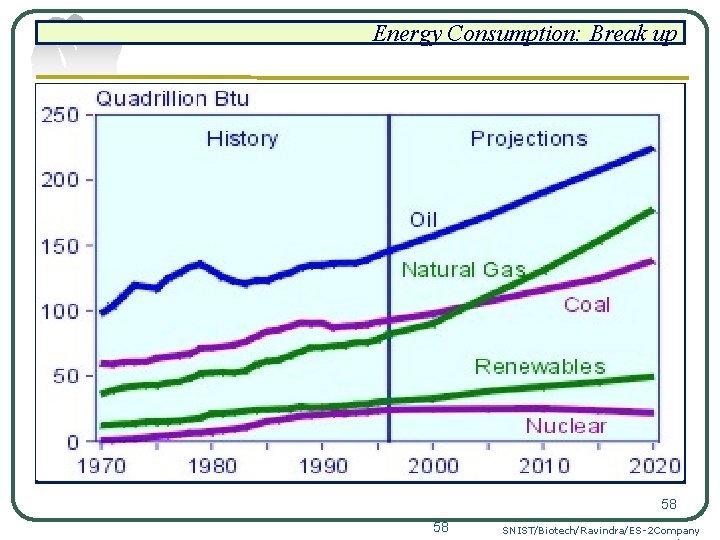
v Energy consumption at the global level is usually expressed as equivalents of the two important fuels: coal and oil v Approximately 80% of the worlds energy is produced by fossil fuels v Alternately, nuclear reactors can also be used to produce energy. For example, in France nuclear reactors produce 70% energy to meet the country’s requirement 55 55 SNIST/Biotech/Ravindra/ES-2 Company
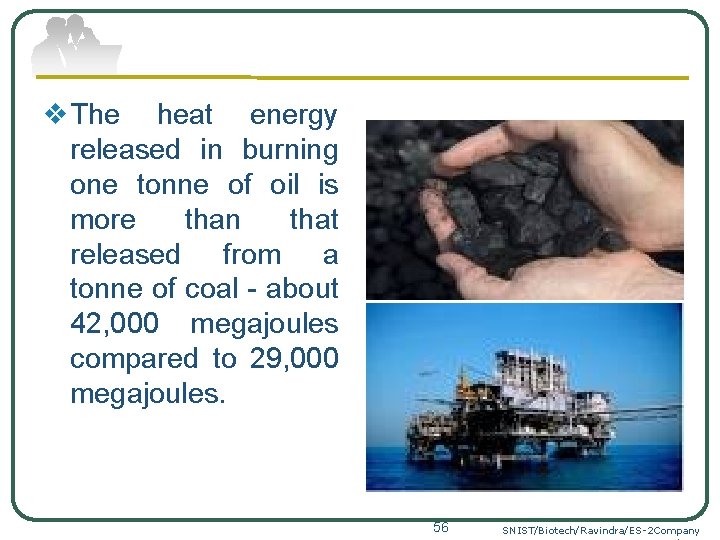
v. The heat energy released in burning one tonne of oil is more than that released from a tonne of coal - about 42, 000 megajoules compared to 29, 000 megajoules. 56 SNIST/Biotech/Ravindra/ES-2 Company
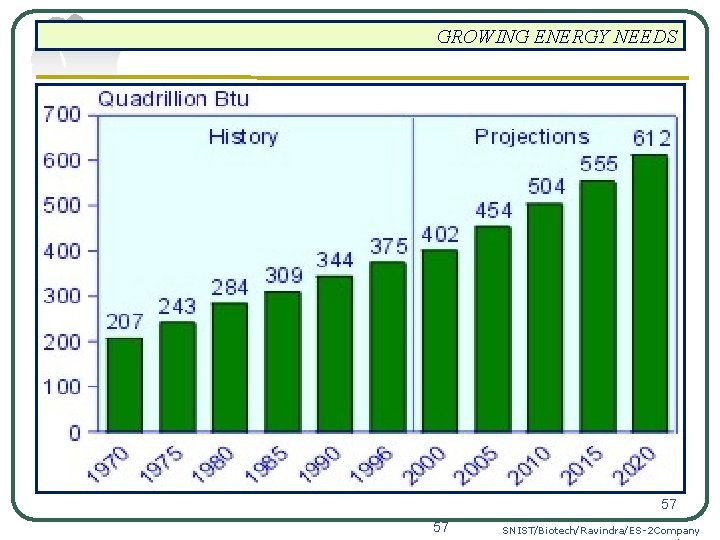
GROWING ENERGY NEEDS 57 57 SNIST/Biotech/Ravindra/ES-2 Company
Energy Consumption: Break up 58 58 SNIST/Biotech/Ravindra/ES-2 Company
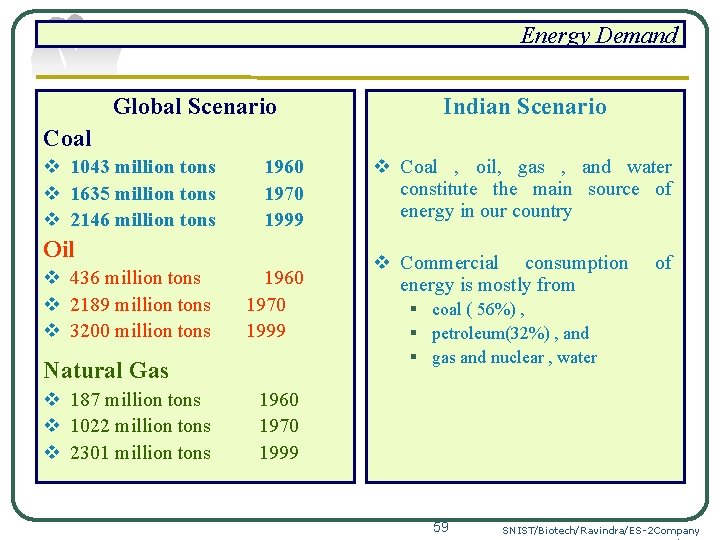
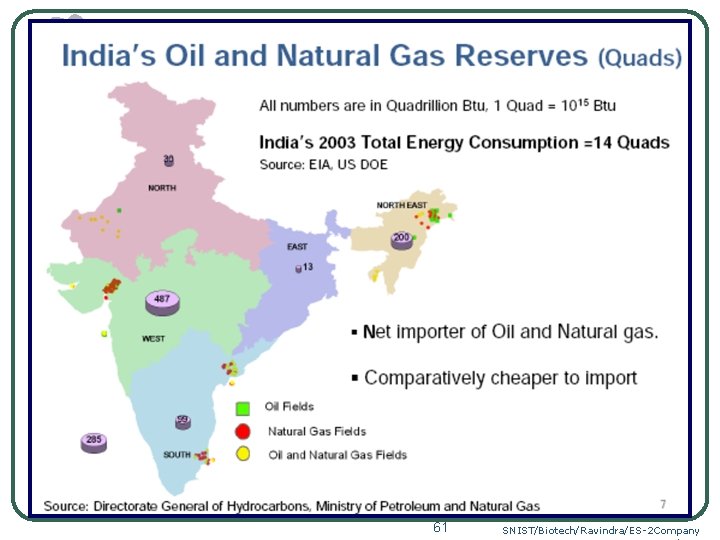
Energy Demand Global Scenario Indian Scenario Coal v 1043 million tons v 1635 million tons v 2146 million tons 1960 1970 1999 Oil v 436 million tons v 2189 million tons v 3200 million tons 1960 1970 1999 Natural Gas v 187 million tons v 1022 million tons v 2301 million tons v Coal , oil, gas , and water constitute the main source of energy in our country v Commercial consumption energy is mostly from of § coal ( 56%) , § petroleum(32%) , and § gas and nuclear , water 1960 1970 1999 59 SNIST/Biotech/Ravindra/ES-2 Company
60 SNIST/Biotech/Ravindra/ES-2 Company
61 SNIST/Biotech/Ravindra/ES-2 Company
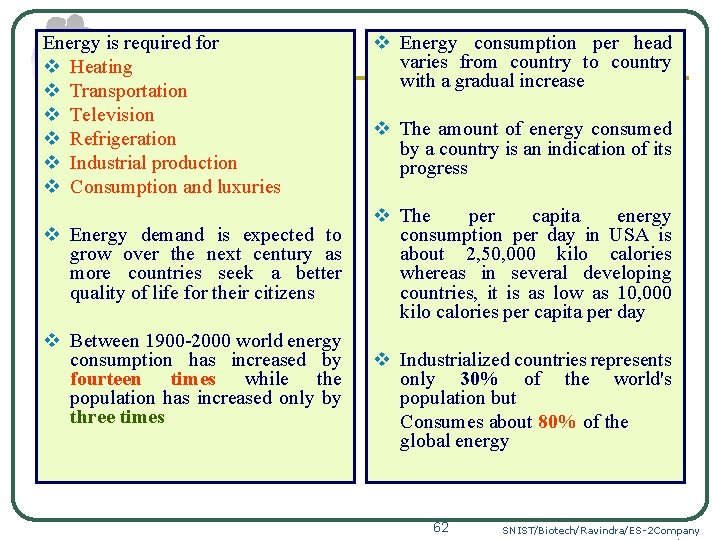
Energy is required for v Heating v Transportation v Television v Refrigeration v Industrial production v Consumption and luxuries v Energy demand is expected to grow over the next century as more countries seek a better quality of life for their citizens v Between 1900 -2000 world energy consumption has increased by fourteen times while the population has increased only by three times v Energy consumption per head varies from country to country with a gradual increase v The amount of energy consumed by a country is an indication of its progress v The per capita energy consumption per day in USA is about 2, 50, 000 kilo calories whereas in several developing countries, it is as low as 10, 000 kilo calories per capita per day v Industrialized countries represents only 30% of the world's population but Consumes about 80% of the global energy 62 SNIST/Biotech/Ravindra/ES-2 Company
World Total Energy Consumption 1990 -2020 (Quadrillion Btu) 63 63 SNIST/Biotech/Ravindra/ES-2 Company
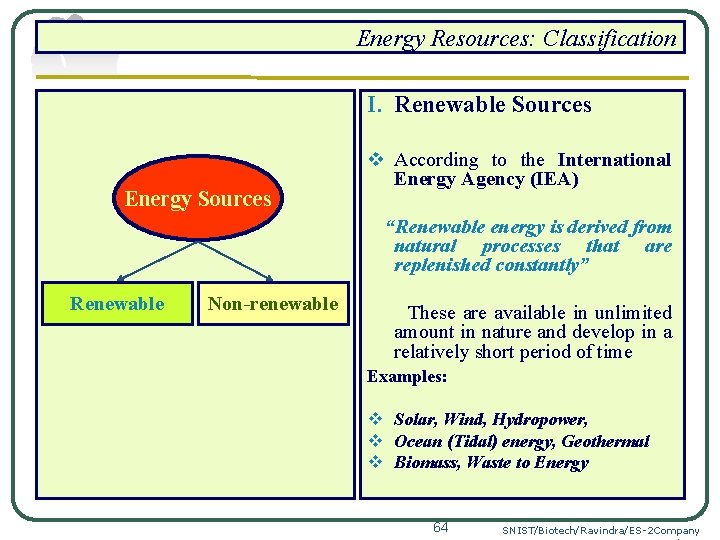
Energy Resources: Classification I. Renewable Sources Energy Sources v According to the International Energy Agency (IEA) “Renewable energy is derived from natural processes that are replenished constantly” Renewable Non renewable These are available in unlimited amount in nature and develop in a relatively short period of time Examples: v Solar, Wind, Hydropower, v Ocean (Tidal) energy, Geothermal v Biomass, Waste to Energy 64 SNIST/Biotech/Ravindra/ES-2 Company
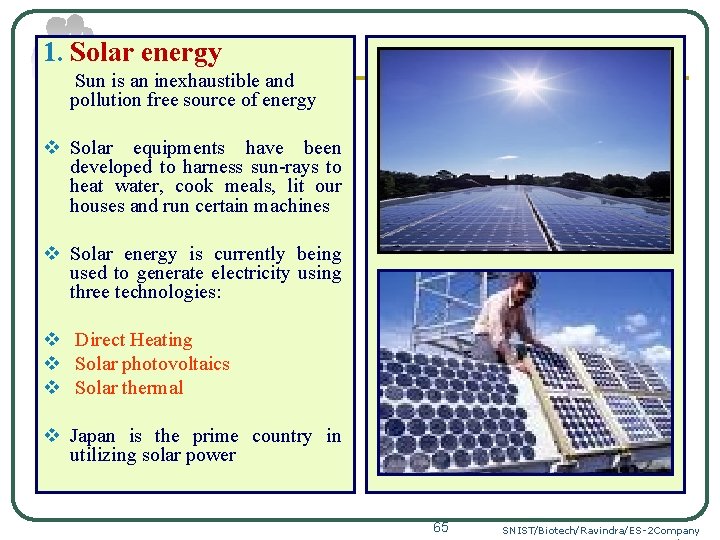
1. Solar energy Sun is an inexhaustible and pollution free source of energy v Solar equipments have been developed to harness sun-rays to heat water, cook meals, lit our houses and run certain machines v Solar energy is currently being used to generate electricity using three technologies: v Direct Heating v Solar photovoltaics v Solar thermal v Japan is the prime country in utilizing solar power 65 SNIST/Biotech/Ravindra/ES-2 Company
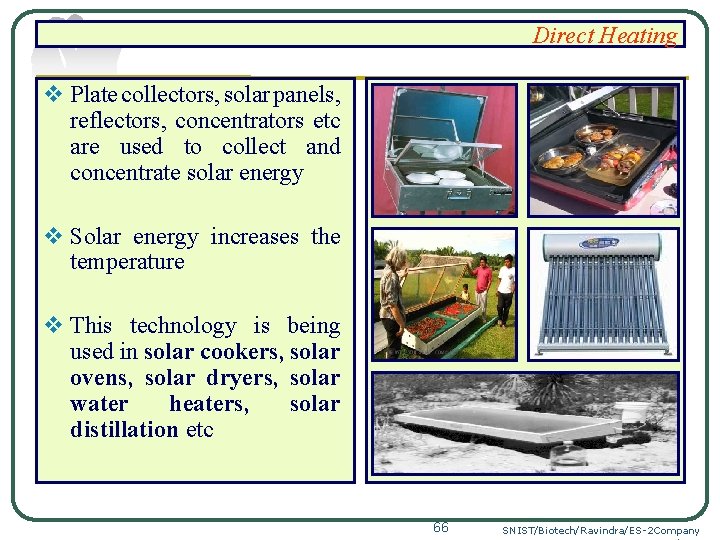
Direct Heating v Plate collectors, solar panels, reflectors, concentrators etc are used to collect and concentrate solar energy v Solar energy increases the temperature v This technology is being used in solar cookers, solar ovens, solar dryers, solar water heaters, solar distillation etc 66 SNIST/Biotech/Ravindra/ES-2 Company
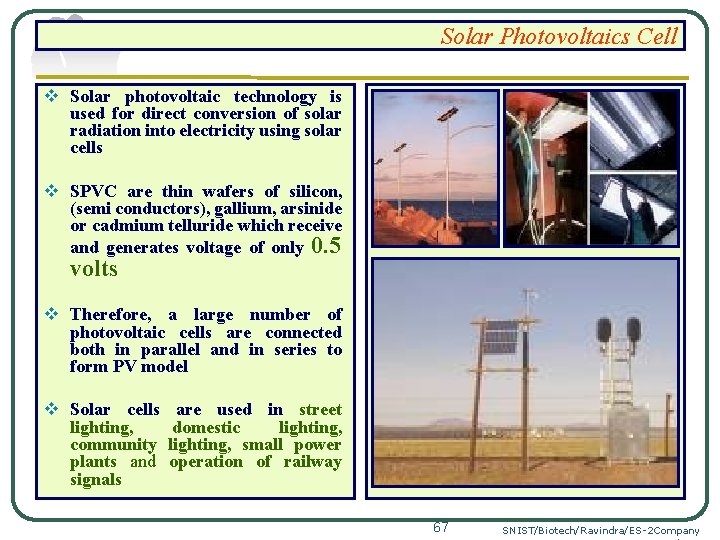
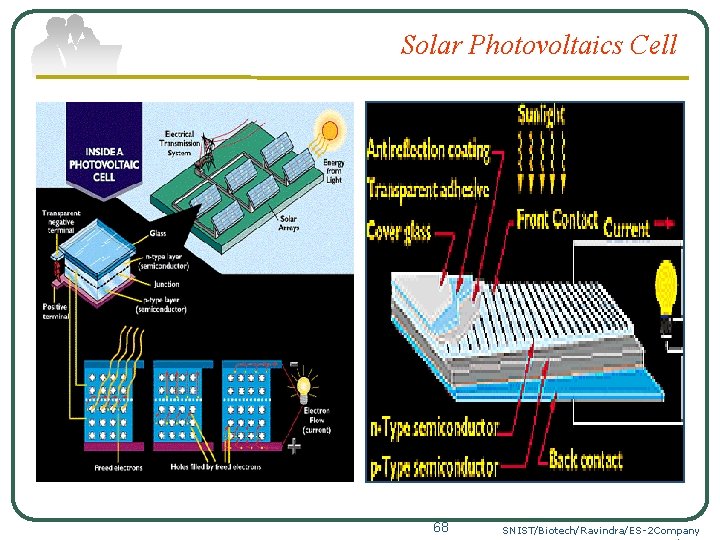
Solar Photovoltaics Cell v Solar photovoltaic technology is used for direct conversion of solar radiation into electricity using solar cells v SPVC are thin wafers of silicon, (semi conductors), gallium, arsinide or cadmium telluride which receive and generates voltage of only 0. 5 volts v Therefore, a large number of photovoltaic cells are connected both in parallel and in series to form PV model v Solar cells lighting, community plants and signals are used in street domestic lighting, small power operation of railway 67 SNIST/Biotech/Ravindra/ES-2 Company
Solar Photovoltaics Cell 68 SNIST/Biotech/Ravindra/ES-2 Company
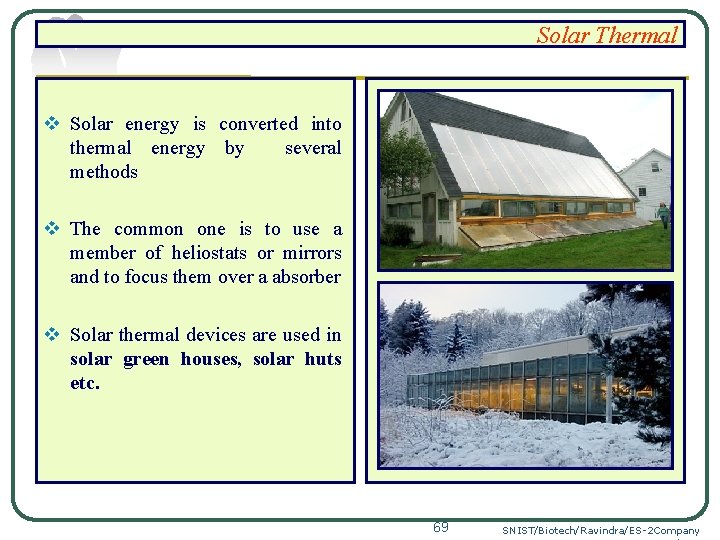
Solar Thermal v Solar energy is converted into thermal energy by several methods v The common one is to use a member of heliostats or mirrors and to focus them over a absorber v Solar thermal devices are used in solar green houses, solar huts etc. 69 SNIST/Biotech/Ravindra/ES-2 Company
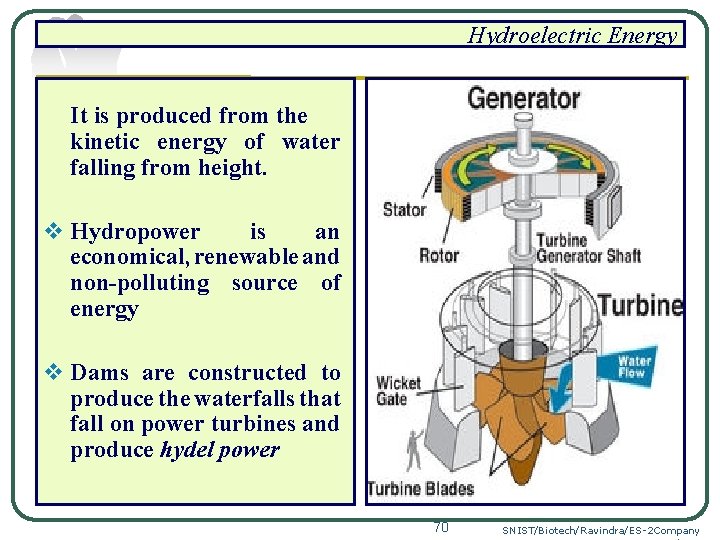
Hydroelectric Energy It is produced from the kinetic energy of water falling from height. v Hydropower is an economical, renewable and non polluting source of energy v Dams are constructed to produce the waterfalls that fall on power turbines and produce hydel power 70 SNIST/Biotech/Ravindra/ES-2 Company
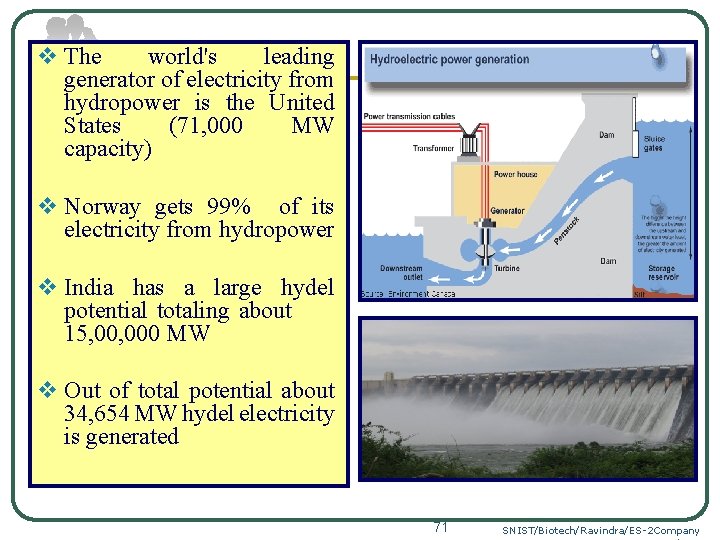
v The world's leading generator of electricity from hydropower is the United States (71, 000 MW capacity) v Norway gets 99% of its electricity from hydropower v India has a large hydel potential totaling about 15, 000 MW v Out of total potential about 34, 654 MW hydel electricity is generated 71 SNIST/Biotech/Ravindra/ES-2 Company
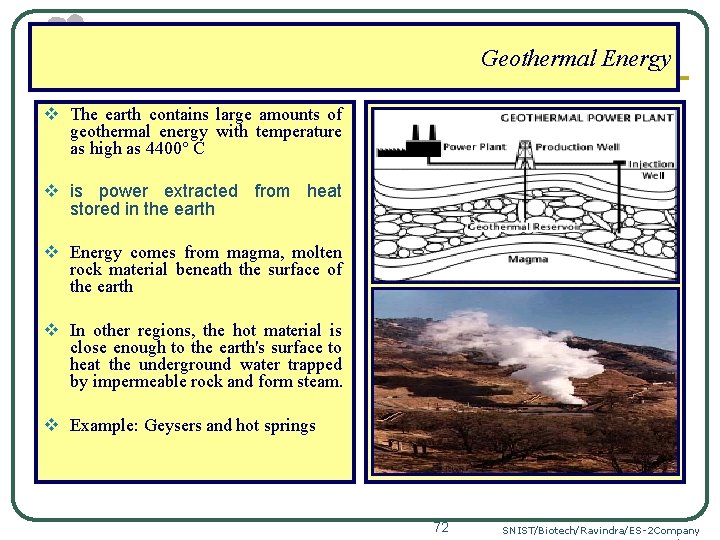
Geothermal Energy v The earth contains large amounts of geothermal energy with temperature as high as 4400° C v is power extracted from heat stored in the earth v Energy comes from magma, molten rock material beneath the surface of the earth v In other regions, the hot material is close enough to the earth's surface to heat the underground water trapped by impermeable rock and form steam. v Example: Geysers and hot springs 72 SNIST/Biotech/Ravindra/ES-2 Company
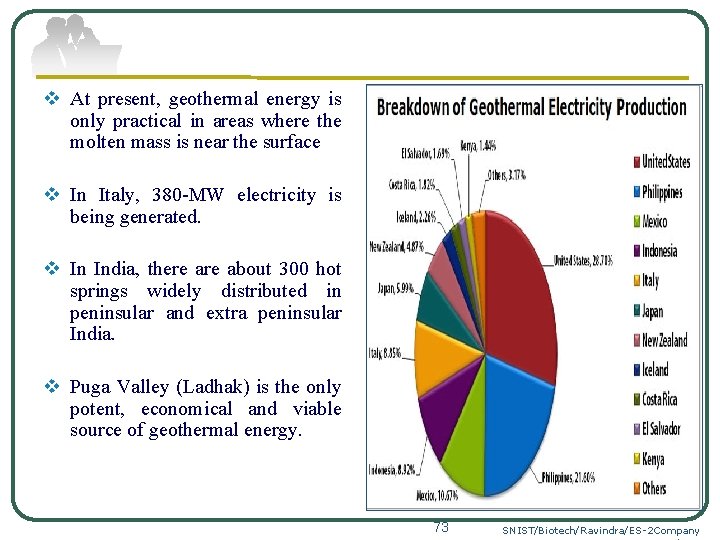
v At present, geothermal energy is only practical in areas where the molten mass is near the surface v In Italy, 380 -MW electricity is being generated. v In India, there about 300 hot springs widely distributed in peninsular and extra peninsular India. v Puga Valley (Ladhak) is the only potent, economical and viable source of geothermal energy. 73 SNIST/Biotech/Ravindra/ES-2 Company
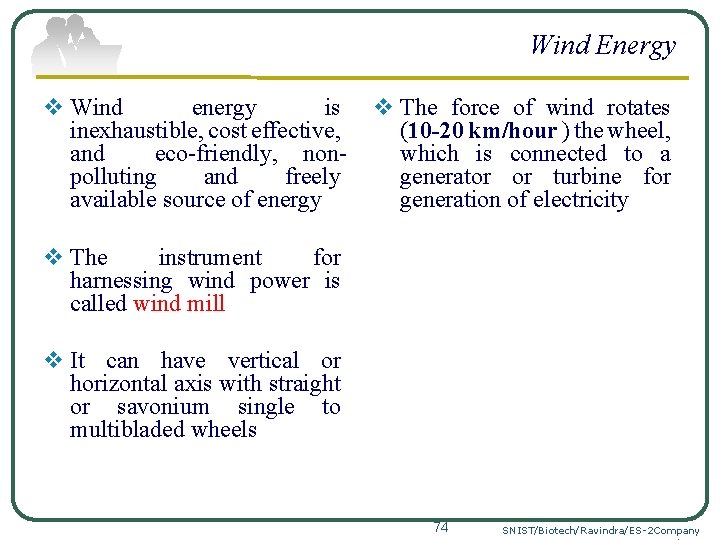
Wind Energy v Wind energy is inexhaustible, cost effective, and eco-friendly, nonpolluting and freely available source of energy v The force of wind rotates (10 20 km/hour ) the wheel, which is connected to a generator or turbine for generation of electricity v The instrument for harnessing wind power is called wind mill v It can have vertical or horizontal axis with straight or savonium single to multibladed wheels 74 SNIST/Biotech/Ravindra/ES-2 Company
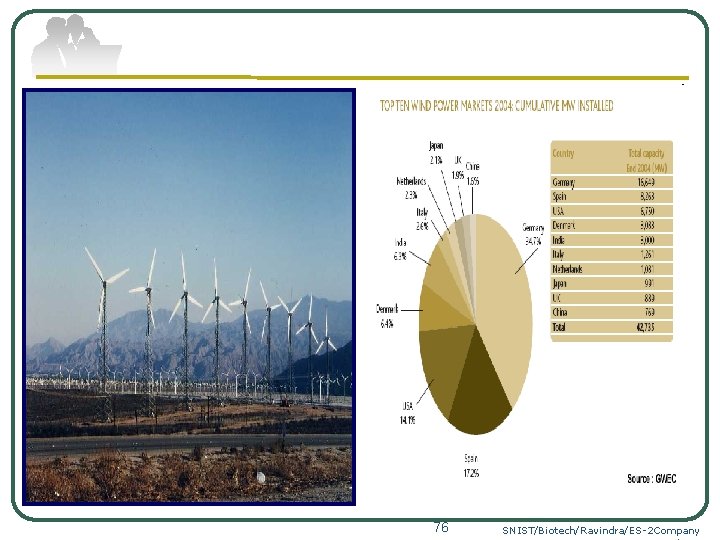
v World Watch Institute (The Washington, USA) ranked India as a Wind Superpower v Muppandal (Tamil Nadu), has the highest concentration (400 MW) of wind farms in Asia and the third highest in the world v Tamil Nadu State is one of the most windy regions of the world accounting for about 10% of the total installed global wind energy capacity and over 70 % of the country's total installed capacity 75 SNIST/Biotech/Ravindra/ES-2 Company
76 SNIST/Biotech/Ravindra/ES-2 Company
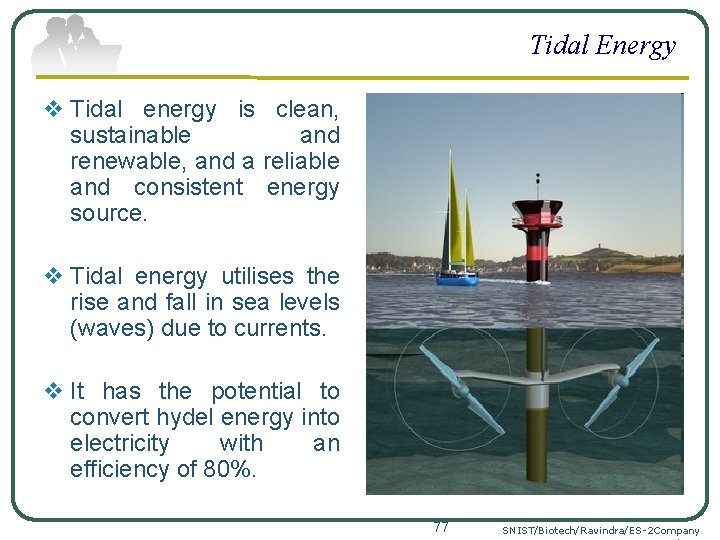
Tidal Energy v Tidal energy is clean, sustainable and renewable, and a reliable and consistent energy source. v Tidal energy utilises the rise and fall in sea levels (waves) due to currents. v It has the potential to convert hydel energy into electricity with an efficiency of 80%. 77 SNIST/Biotech/Ravindra/ES-2 Company
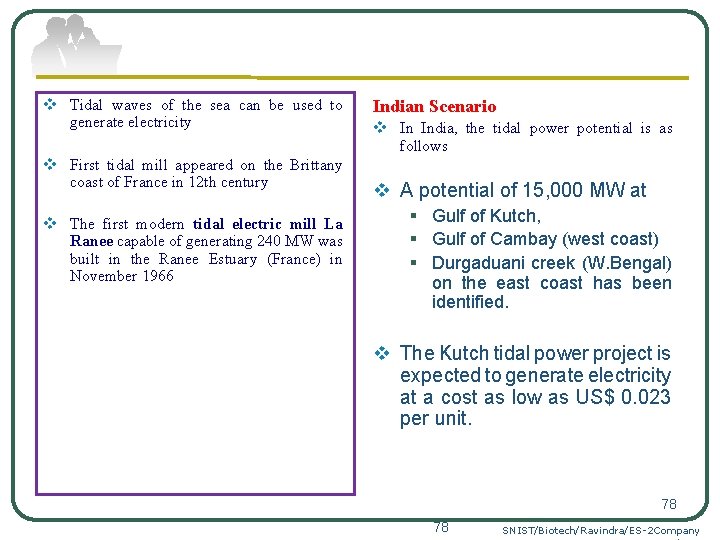
v Tidal waves of the sea can be used to generate electricity v First tidal mill appeared on the Brittany coast of France in 12 th century v The first modern tidal electric mill La Ranee capable of generating 240 MW was built in the Ranee Estuary (France) in November 1966 Indian Scenario v In India, the tidal power potential is as follows v A potential of 15, 000 MW at § Gulf of Kutch, § Gulf of Cambay (west coast) § Durgaduani creek (W. Bengal) on the east coast has been identified. v The Kutch tidal power project is expected to generate electricity at a cost as low as US$ 0. 023 per unit. 78 78 SNIST/Biotech/Ravindra/ES-2 Company
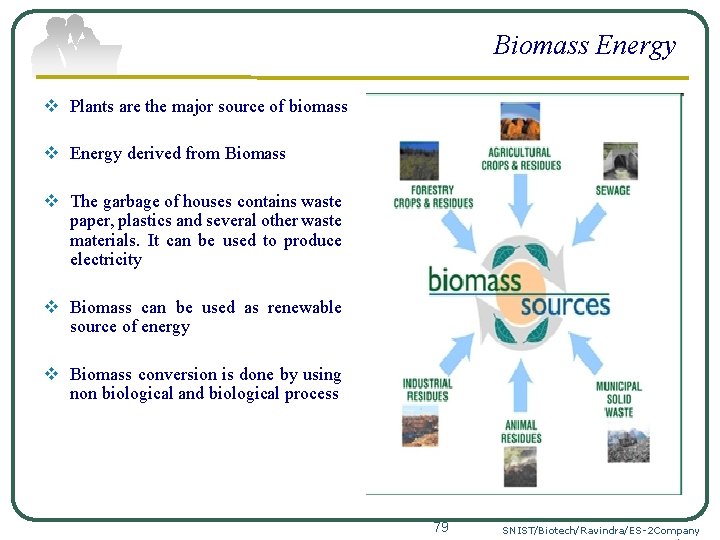
Biomass Energy v Plants are the major source of biomass v Energy derived from Biomass v The garbage of houses contains waste paper, plastics and several other waste materials. It can be used to produce electricity v Biomass can be used as renewable source of energy v Biomass conversion is done by using non biological and biological process 79 SNIST/Biotech/Ravindra/ES-2 Company
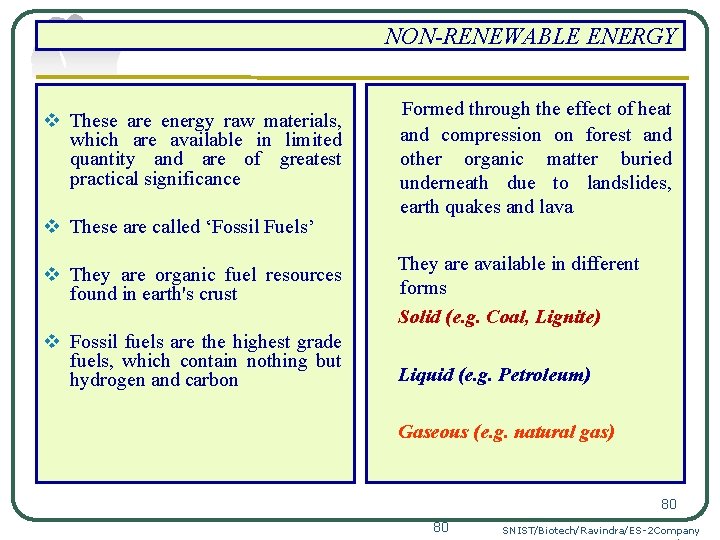
NON-RENEWABLE ENERGY v These are energy raw materials, which are available in limited quantity and are of greatest practical significance v These are called ‘Fossil Fuels’ v They are organic fuel resources found in earth's crust v Fossil fuels are the highest grade fuels, which contain nothing but hydrogen and carbon Formed through the effect of heat and compression on forest and other organic matter buried underneath due to landslides, earth quakes and lava They are available in different forms Solid (e. g. Coal, Lignite) Liquid (e. g. Petroleum) Gaseous (e. g. natural gas) 80 80 SNIST/Biotech/Ravindra/ES-2 Company
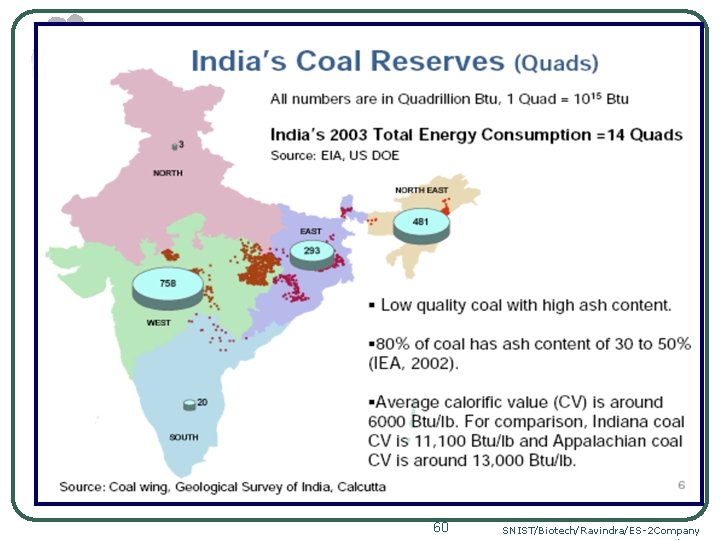
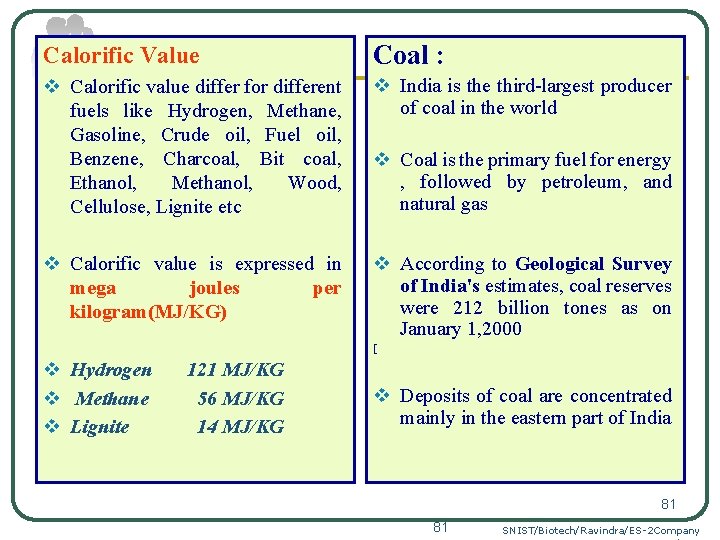
Calorific Value Coal : v Calorific value differ for different fuels like Hydrogen, Methane, Gasoline, Crude oil, Fuel oil, Benzene, Charcoal, Bit coal, Ethanol, Methanol, Wood, Cellulose, Lignite etc v India is the third-largest producer of coal in the world v Calorific value is expressed in mega joules per kilogram(MJ/KG) v According to Geological Survey of India's estimates, coal reserves were 212 billion tones as on January 1, 2000 v Coal is the primary fuel for energy , followed by petroleum, and natural gas [ v Hydrogen v Methane v Lignite 121 MJ/KG 56 MJ/KG 14 MJ/KG v Deposits of coal are concentrated mainly in the eastern part of India 81 81 SNIST/Biotech/Ravindra/ES-2 Company
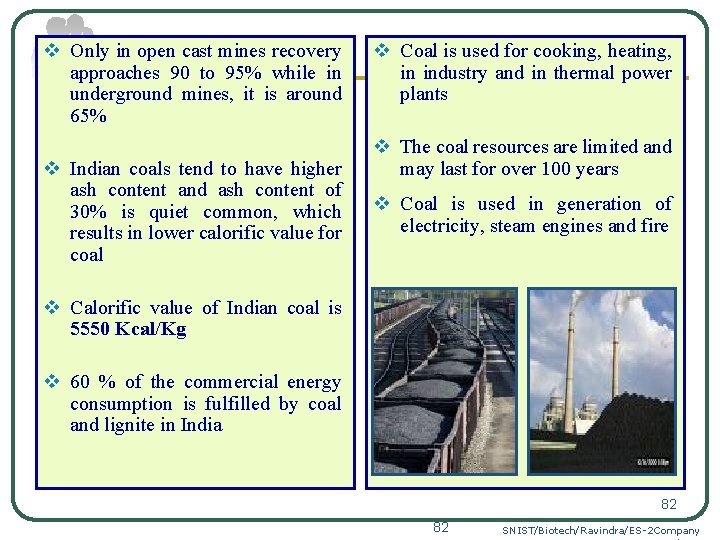
v Only in open cast mines recovery approaches 90 to 95% while in underground mines, it is around 65% v Indian coals tend to have higher ash content and ash content of 30% is quiet common, which results in lower calorific value for coal v Coal is used for cooking, heating, in industry and in thermal power plants v The coal resources are limited and may last for over 100 years v Coal is used in generation of electricity, steam engines and fire v Calorific value of Indian coal is 5550 Kcal/Kg v 60 % of the commercial energy consumption is fulfilled by coal and lignite in India 82 82 SNIST/Biotech/Ravindra/ES-2 Company
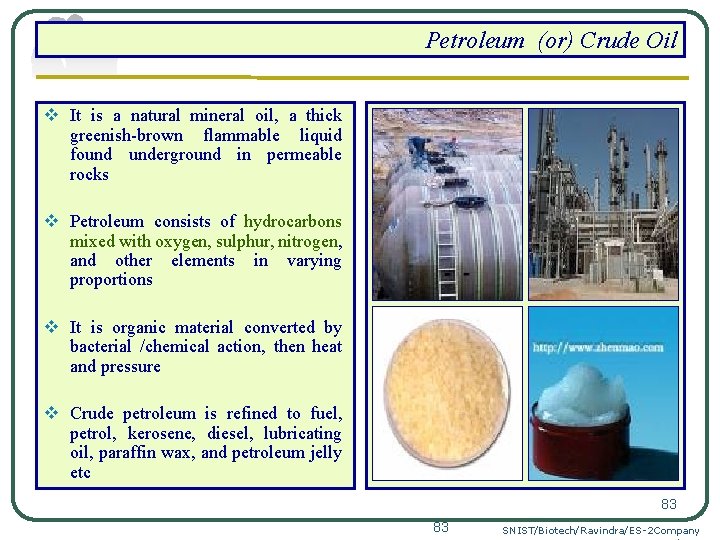
Petroleum (or) Crude Oil v It is a natural mineral oil, a thick greenish-brown flammable liquid found underground in permeable rocks v Petroleum consists of hydrocarbons mixed with oxygen, sulphur, nitrogen, and other elements in varying proportions v It is organic material converted by bacterial /chemical action, then heat and pressure v Crude petroleum is refined to fuel, petrol, kerosene, diesel, lubricating oil, paraffin wax, and petroleum jelly etc 83 83 SNIST/Biotech/Ravindra/ES-2 Company
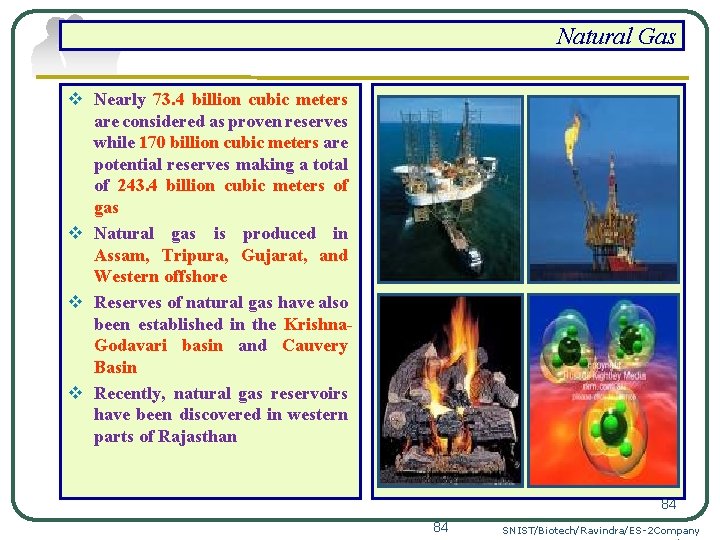
Natural Gas v Nearly 73. 4 billion cubic meters are considered as proven reserves while 170 billion cubic meters are potential reserves making a total of 243. 4 billion cubic meters of gas v Natural gas is produced in Assam, Tripura, Gujarat, and Western offshore v Reserves of natural gas have also been established in the Krishna Godavari basin and Cauvery Basin v Recently, natural gas reservoirs have been discovered in western parts of Rajasthan 84 84 SNIST/Biotech/Ravindra/ES-2 Company
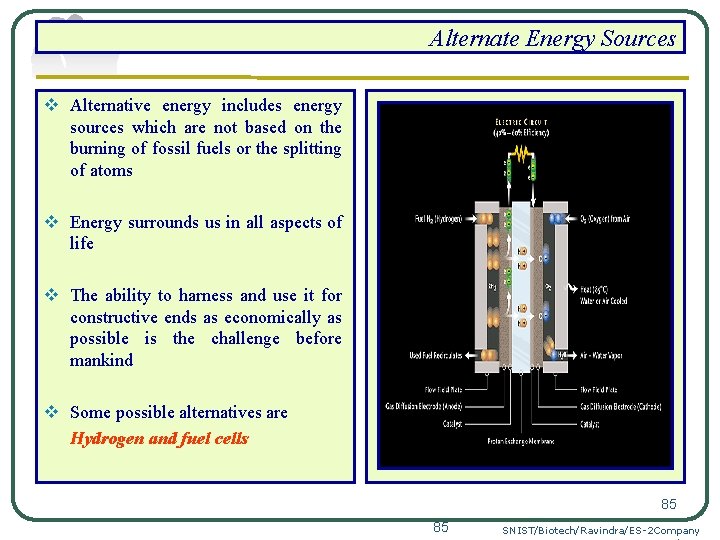
Alternate Energy Sources v Alternative energy includes energy sources which are not based on the burning of fossil fuels or the splitting of atoms v Energy surrounds us in all aspects of life v The ability to harness and use it for constructive ends as economically as possible is the challenge before mankind v Some possible alternatives are Hydrogen and fuel cells 85 85 SNIST/Biotech/Ravindra/ES-2 Company
v Hydrogen stored in fuel cells can be an alternative energy resource for oil v Hydrogen must be obtained by using some other energy source. Usually it is obtained by the electrolysis of water, or by breaking down natural gas (methane CH 4) v Hydrogen is highly explosive, and to be contained and carried in significantly usable amounts it has to be compressed or cooled to a liquid at 2530 C v Hydrogen is not easy to handle, and it is not as convenient as pouring 10 litres of oil into an automobile fuel tank v Fuel cells are being developed for use in transportation (automobiles, trucks, buses, etc. ) but fuel cells have to be fueled with hydrogen v Fuel cells are not a source of energy in themselves, but are a possible ultimate substitute for the internal combustion engine v To effectively and store hydrogen on the widespread basis is a costly and long term task v Even nano carbon materials can also be effectively used to store hydrogen 86 86 SNIST/Biotech/Ravindra/ES-2 Company
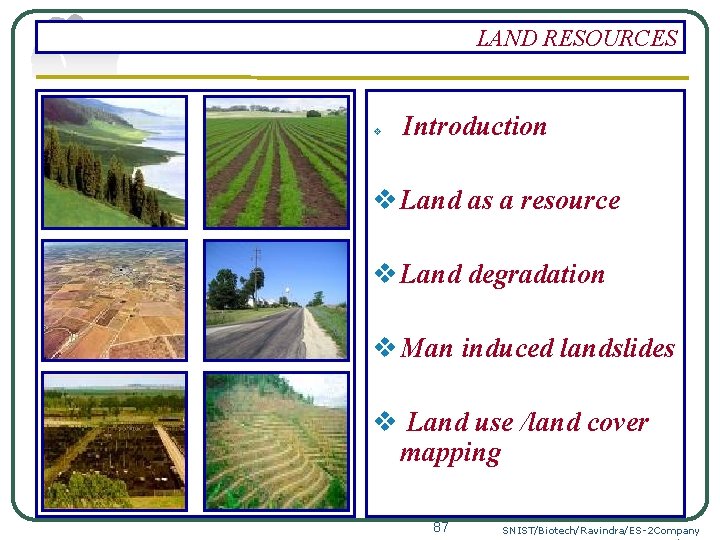
LAND RESOURCES v Introduction v Land as a resource v Land degradation v Man induced landslides v Land use /land cover mapping 87 SNIST/Biotech/Ravindra/ES-2 Company
Introduction v Land supports all terrestrial life including man v Land is a major constituent of the lithosphere v It provides essential medium for development of agriculture, forestry etc v The per capita land availability vary widely across the globe v Land resources include four major components (a) Croplands (b) Forests (c) Grasslands (d) Waste lands v For the sustenance of a balanced ecosystem, equilibrium among these four land resources is essential v Man’s shortsighted alterations in the patterns of land use are creating environmental stresses and imbalances v For example, the neglect of grassland its conversion to other forms is the biggest abuse in the land management today leading to ecological imbalance 88 SNIST/Biotech/Ravindra/ES-2 Company
Land as a Resource v Land forms about one fifth of the earth's surface covering about 13, 393 million hectares Soil is formed by two processes v About 36. 6 % of the land area is occupied by human dwellings, factories, roads, railways, deserts, mountains, rocks, glaciers and polar ice marshes v (ii) Pedogenesis maturation of soil through development of humus v About 30 % of the total land mass in under forests v About 22 % of land is occupied by meadows and pastures v (i) Weathering breaking down of rock into small particles v The study of soil is called Pedology (Gk. pedion = ground, logos = discourse) v It deals with the origin, formation and geographic distribution of the soil v Only 11 % of land is suitable for ploughing v Soil is an organized mixture of minerals, organic matter, living organisms, air and water 89 SNIST/Biotech/Ravindra/ES-2 Company
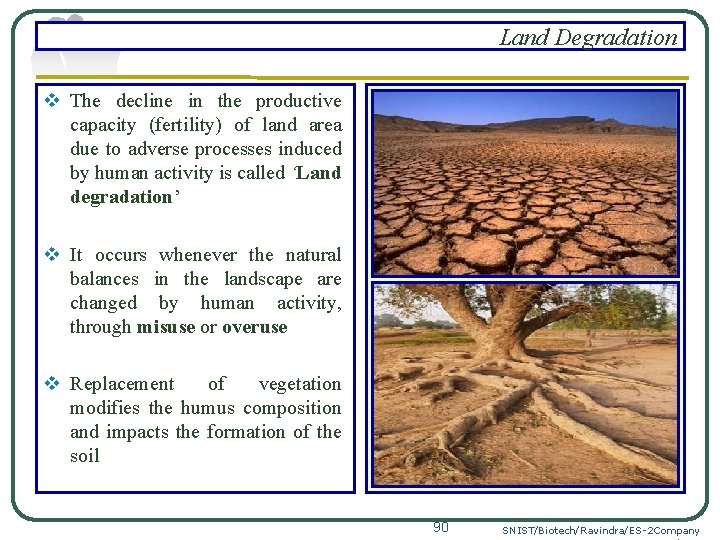
Land Degradation v The decline in the productive capacity (fertility) of land area due to adverse processes induced by human activity is called ‘Land degradation’ v It occurs whenever the natural balances in the landscape are changed by human activity, through misuse or overuse v Replacement of vegetation modifies the humus composition and impacts the formation of the soil 90 SNIST/Biotech/Ravindra/ES-2 Company
Causes: Deforestation Overgrazing Agricultural practices Industrialization The main causes of soil degradation differ in various continents Europe: Deforestation Agriculture Africa: Overgrazing North America: Agriculture Other factors include v Soil erosion v Salinization of soils v Acidification due to leaching of soluble bases v Deposition of salt due to floods v Developmental activities such as construction of dams, roads, railways, urban encroachment, mining Australia New Zealand: Overgrazing 91 SNIST/Biotech/Ravindra/ES-2 Company
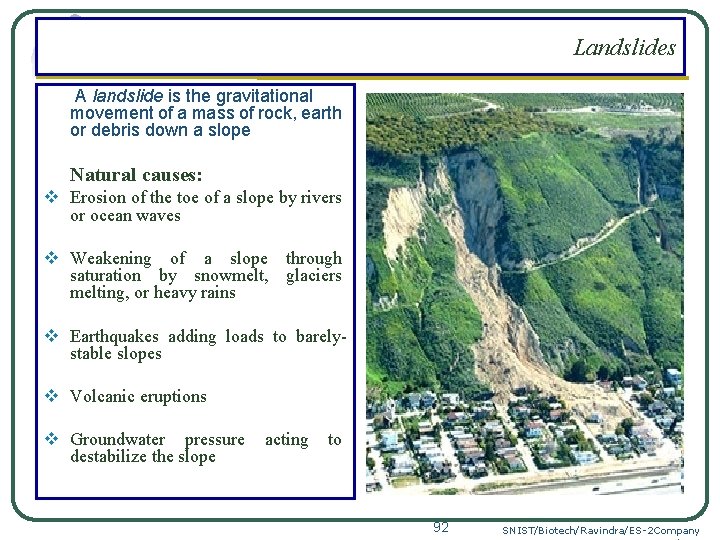
Landslides A landslide is the gravitational movement of a mass of rock, earth or debris down a slope Natural causes: v Erosion of the toe of a slope by rivers or ocean waves v Weakening of a slope through saturation by snowmelt, glaciers melting, or heavy rains v Earthquakes adding loads to barelystable slopes v Volcanic eruptions v Groundwater pressure destabilize the slope acting to 92 SNIST/Biotech/Ravindra/ES-2 Company
Human causes: v Vibrations from machinery or traffic v Blasting v Earth work which alters the shape of a slope, or which imposes new loads on an existing slope v In shallow soils, the removal of deep-rooted vegetation that binds soil to bedrock v Construction, agricultural, or forestry activities which change the amount of water which infiltrates into the soil 93 SNIST/Biotech/Ravindra/ES-2 Company
Land Use v Land use is the human modification of natural environment or wilderness into built environment such as fields, pastures, and settlements. v The major effect of land use on land cover since 1750 has been deforestation of temperate regions. v Significant effects of land use include urban sprawl, soil erosion, soil degradation, salinization, and desertification. 94 SNIST/Biotech/Ravindra/ES-2 Company
Land cover Mapping LAND COVER - Definition v Land cover is the observed (bio)physical cover on the earth's surface. v Land use is characterized by the arrangements, activities and inputs people undertake in a certain land cover type to produce, change or maintain it. v Definition of land use in this way establishes a direct link between land cover and the actions of people in their environment. 95 SNIST/Biotech/Ravindra/ES-2 Company
Examples: v "grassland" is a cover term, while "rangeland" or v "tennis court" refer to the use of a grass cover; and v "recreation area" is a land use term that may be applicable to different land cover types: v for instance sandy surfaces like a beach; v a built-up area like a pleasure park; v woodlands; etc. 96 SNIST/Biotech/Ravindra/ES-2 Company