
Natural Resource Conservation and Preservation Lesson Plan NRES
- Slides: 38
Natural Resource Conservation and Preservation Lesson Plan: NRES A 1 -2 1
Anticipated Problems 1. Why are conservation and preservation important? 2. What are some important historic events and people associated with wildlife conservation? 3. What are government policies that impact wildlife conservation? 2
Terms n conservationist n ecology n Endangered Species Act n exploitation n Lacey Act n Migratory Bird Conservation Act n Migratory Bird Hunting Stamp Act 3
Terms n National Park Service n overexploitation n Pittman-Robertson Act n preservationist n U. S. Forest Service n Wildlife Refuge System 4
Conservation & Preservation n Humans use natural resources to help meet their basic needs (food, clothing, shelter) – This consumes natural resources. – When resources are used, supplies are reduced – If consumption goes unchecked, the availability of the natural resource may be threatened and even exhausted. 5
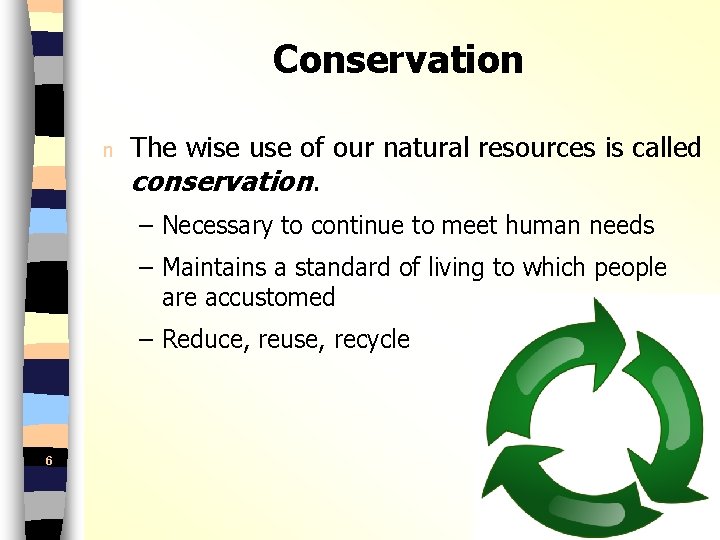
Conservation n The wise use of our natural resources is called conservation. – Necessary to continue to meet human needs – Maintains a standard of living to which people are accustomed – Reduce, reuse, recycle 6
Conservationist n 7 A person who studies and promotes conservation and believes that natural resources should be used responsibly is called a conservationist.
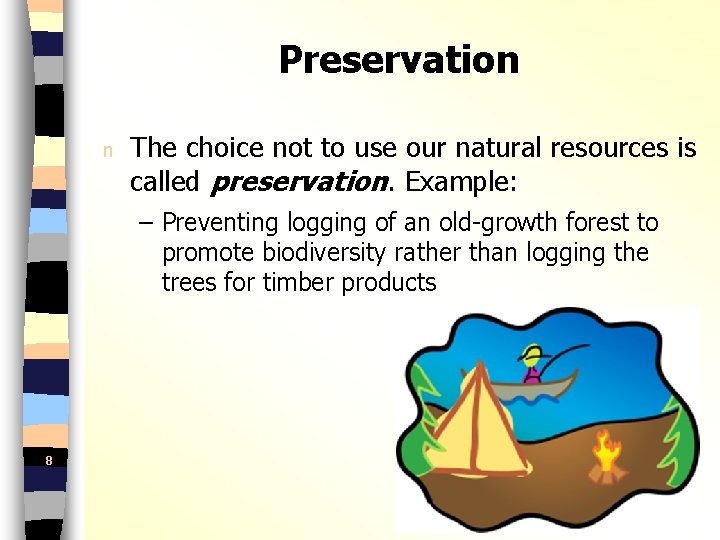
Preservation n The choice not to use our natural resources is called preservation. Example: – Preventing logging of an old-growth forest to promote biodiversity rather than logging the trees for timber products 8
Preservationist n 9 Someone who believes in and promotes preservation is called a preservationist.
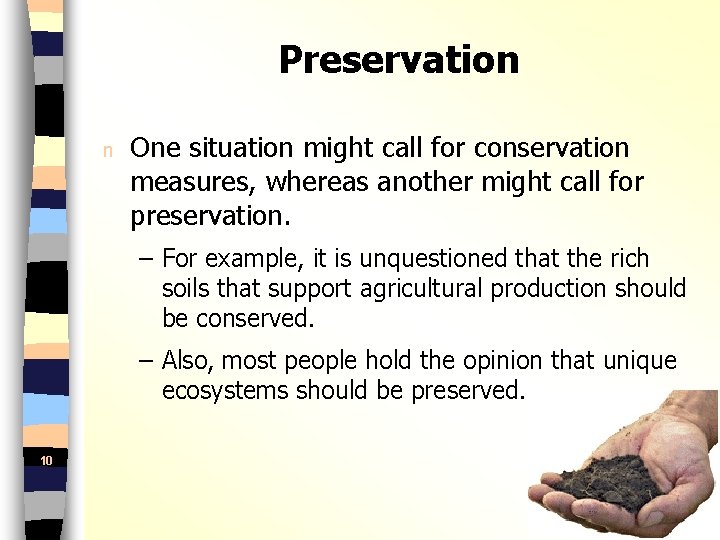
Preservation n One situation might call for conservation measures, whereas another might call for preservation. – For example, it is unquestioned that the rich soils that support agricultural production should be conserved. – Also, most people hold the opinion that unique ecosystems should be preserved. 10
Conserving & Preserving n Some reasons for conserving and preserving natural resources seem self-evident. – Most natural resources cannot be easily reproduced by humans. (conserve them wisely) – Essential for human life – Necessary to meet the needs of future generations 11 – Conservation of habitats helps preserve biodiversity
Natural Resources n When the Europeans settled in North America in the 1600 s, natural resources were plentiful. – Nature provided people with resources to build homes and clothe and feed themselves. – The general feeling was that natural resources were inexhaustible. 12
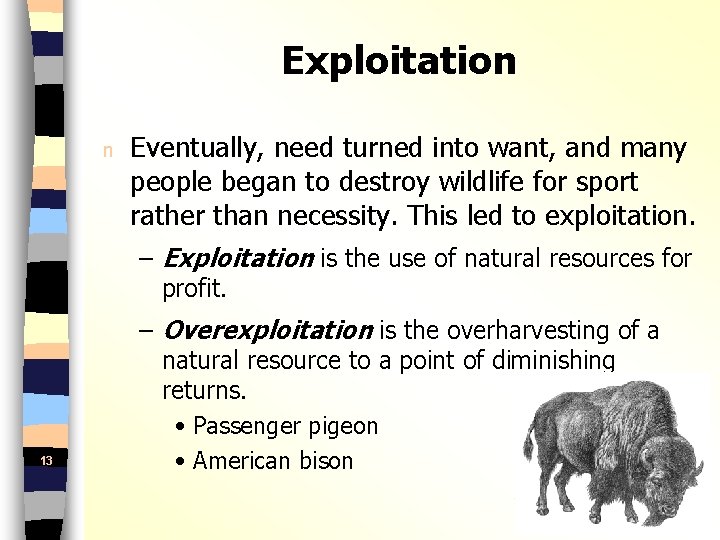
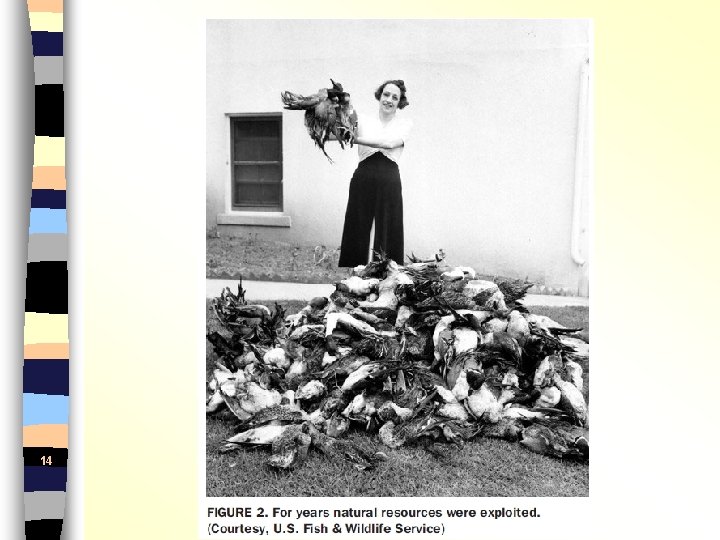
Exploitation n Eventually, need turned into want, and many people began to destroy wildlife for sport rather than necessity. This led to exploitation. – Exploitation is the use of natural resources for profit. 13 – Overexploitation is the overharvesting of a natural resource to a point of diminishing returns. • Passenger pigeon • American bison
14
Late 1800 s n It wasn’t until the late 1800 s that people began to see the need for conservation of our natural resources. – The Morrill Act was passed in 1862: in order to establish colleges to teach agricultural practices – The Yellowstone National Park was established in 1872: to preserve the natural resources of the area, including wildlife 15
People Who Have Impacted Wildlife Conservation n 16 Many people have had an impact on the wildlife conservation movement over the past few centuries. Included are: – John James Audubon – Gifford Pinchot – John Muir – Hugh Bennett – Theodore Roosevelt – Jay Darling – Franklin Roosevelt – Rachel Carson – Aldo Leopold – Gaylord Nelson
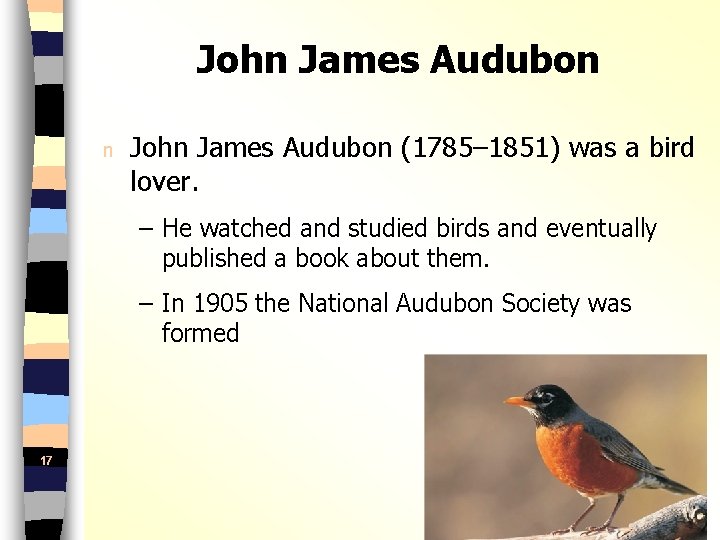
John James Audubon n John James Audubon (1785– 1851) was a bird lover. – He watched and studied birds and eventually published a book about them. – In 1905 the National Audubon Society was formed 17
John Muir n John Muir (1838– 1914) was partly responsible for the development of the Yellowstone and Sequoia National Parks. – Through his encouragement, President Theodore Roosevelt established these parks. – Also responsible for starting the Sierra Club, whose purpose is to promote conservation. – A forest in California was also named for Muir. 18
Theodore & Franklin Roosevelt n Theodore Roosevelt (1858– 1919) and Franklin Roosevelt (1882– 1945) were both U. S. presidents. – Theodore was responsible for passing legislation to help protect our natural resources (“father of the conservation movement. ” ) – Franklin was the president who set up the Soil and Water Conservation Department within the USDA. 19
Aldo Leopold n Aldo Leopold (1886– 1948) is noted for applying ecology to wildlife. – Ecology is the study of the interrelations between living organisms and their environment Leopold believed that people should enjoy nature but not destroy it in the process. – His book Game Management was used to help educate future wildlife biologists. 20
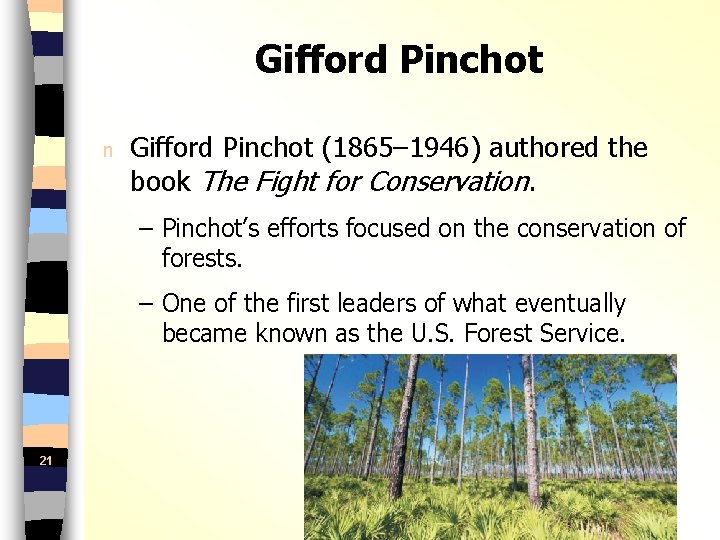
Gifford Pinchot n Gifford Pinchot (1865– 1946) authored the book The Fight for Conservation. – Pinchot’s efforts focused on the conservation of forests. – One of the first leaders of what eventually became known as the U. S. Forest Service. 21
Hugh Bennett n Hugh Bennett (1881– 1960) was the first person to run the Soil Conservation Service. – Known as: “Father of soil conservation” – Promoted the use of scientific investigation in determining soil needs. 22
Jay Darling n Jay Darling (1876– 1962) was the designer of the first migratory bird hunting stamp. – Remembered for his cartoons of wildlife and natural resources. – Used his cartoons to make the public aware of the need for natural resource conservation. 23
Rachel Carson n Rachel Carson (1907– 1964) was responsible for making people aware of the problems caused by pesticides. – A biologist and a writer who authored a book titled Silent Spring 24
Gaylord Nelson n Wisconsin Senator Gaylord Nelson (1916– 2005) is credited for creating Earth Day, which first took place on April 22, 1970. – To bring environmental issues to the forefront of the national agenda – Earth Day was an important precursor to the formation of the Environmental Protection Agency (EPA). 25
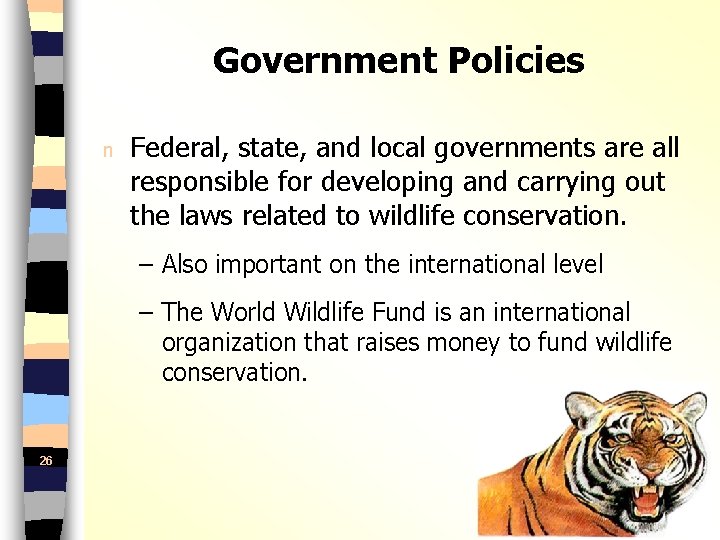
Government Policies n Federal, state, and local governments are all responsible for developing and carrying out the laws related to wildlife conservation. – Also important on the international level – The World Wildlife Fund is an international organization that raises money to fund wildlife conservation. 26
Government Policies n 27 Many laws have been enacted at the federal level that address the conservation of wildlife.
National Park Service n In 1916 the National Park Service was established. The National Park Service is the federal government agency that manages 394 units in the National Parks System. – Some of the units are 123 historic parks or sites, 74 monuments, 58 national parks, 25 battlefields or military parks, 18 preserves, 18 recreation areas, 10 seashores, 4 parkways, 4 lakeshores, and 2 reserves. 28
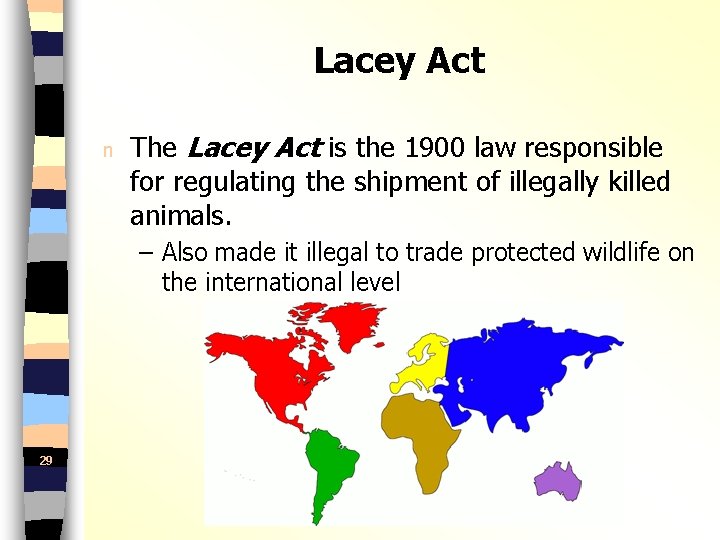
Lacey Act n The Lacey Act is the 1900 law responsible for regulating the shipment of illegally killed animals. – Also made it illegal to trade protected wildlife on the international level 29
Migratory Bird Conservation Act n The Migratory Bird Conservation Act, passed in 1929, was the first step in protecting migratory birds. – Provided no money to help protect the animals 30
Migratory Bird Hunting Stamp Act n The Migratory Bird Hunting Stamp Act, passed in 1934, is a law requiring people planning to hunt migratory birds to buy special stamps. – Since 1934, these stamps have raised $1 billion for the protection of migratory birds. 31
Pittman-Robertson Act n The Pittman-Robertson Act is the 1937 law that raises money in the form of taxes on hunting equipment and ammunition. – The federal government collects the taxes and returns matching money to the states. 32
Endangered Species Act n 33 The Endangered Species Act, passed in 1966, is a law that has as its purpose the identification and management of rare, threatened, and endangered species of wildlife.
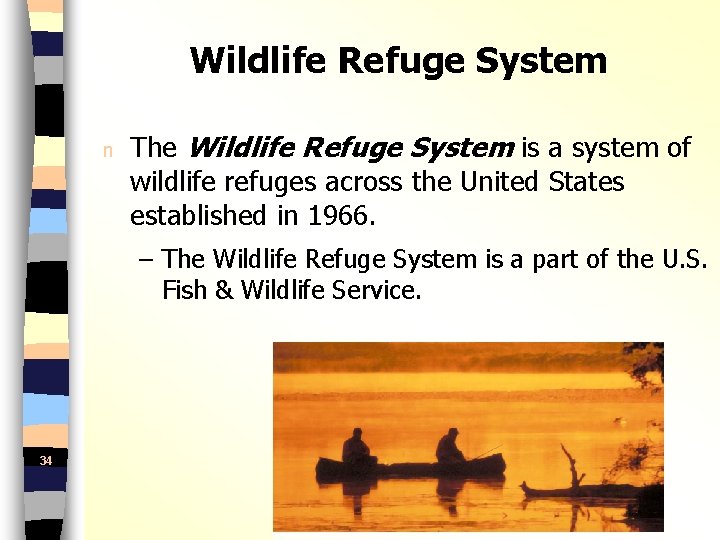
Wildlife Refuge System n The Wildlife Refuge System is a system of wildlife refuges across the United States established in 1966. – The Wildlife Refuge System is a part of the U. S. Fish & Wildlife Service. 34
U. S. Forest Service n The U. S. Forest Service is the federal agency that manages the nation’s 155 national forests and 20 national grasslands, which encompass 193 million acres, or 8. 5 percent of the total land area in the United States. – The public lands managed by the Forest Service are known collectively as the National Forest System. 35
U. S. Forest Service n National forests are managed for logging, farming, mining, rangeland, oil and gas extraction, recreation, hunting, and fishing. – The natural resources on these lands are some of the nation’s greatest assets and have major economic, environmental, and social significance for all Americans. 36
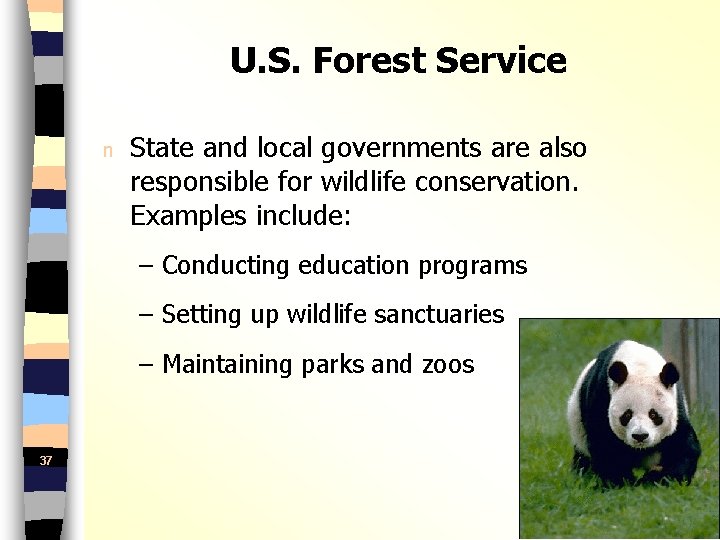
U. S. Forest Service n State and local governments are also responsible for wildlife conservation. Examples include: – Conducting education programs – Setting up wildlife sanctuaries – Maintaining parks and zoos 37
Review 38 n List three reasons for conserving and preserving natural resources. n What year was The Yellowstone National Park was established? Why was it established? n What 1900 law is responsible for regulating the shipment of illegally killed animals?