Trauma and stress related disorders Dr Hanan Yousif




- Slides: 42
Trauma and stress related disorders Dr. Hanan Yousif Aly Lecturer of psychiatry. Sohag University
Definition of stress: �Stress is the anxious or threatened feeling that comes when interpret or appraise the situation. (Lazarus. , 1999)
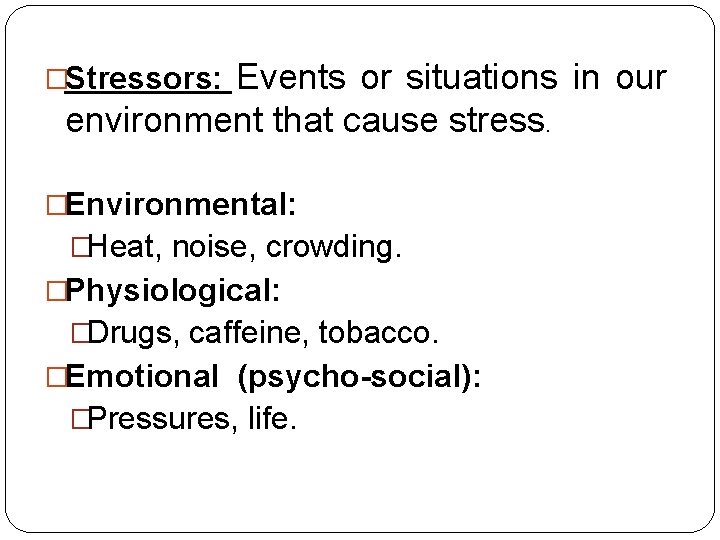
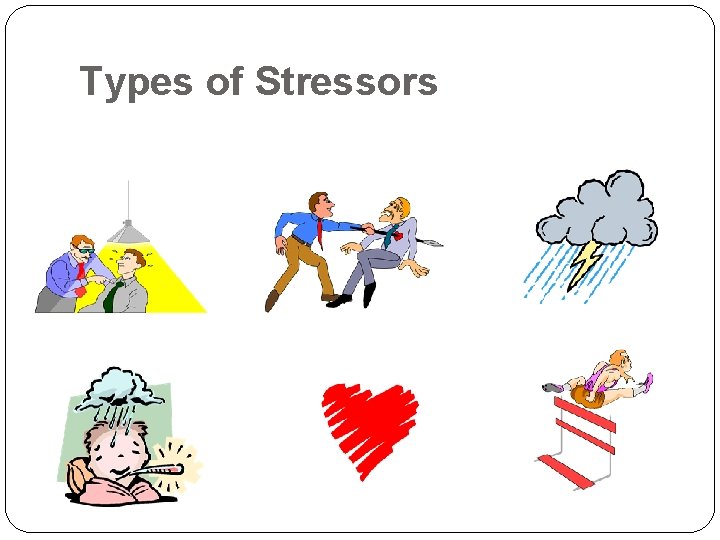
Events or situations in our environment that cause stress. �Stressors: �Environmental: �Heat, noise, crowding. �Physiological: �Drugs, caffeine, tobacco. �Emotional (psycho-social): �Pressures, life.
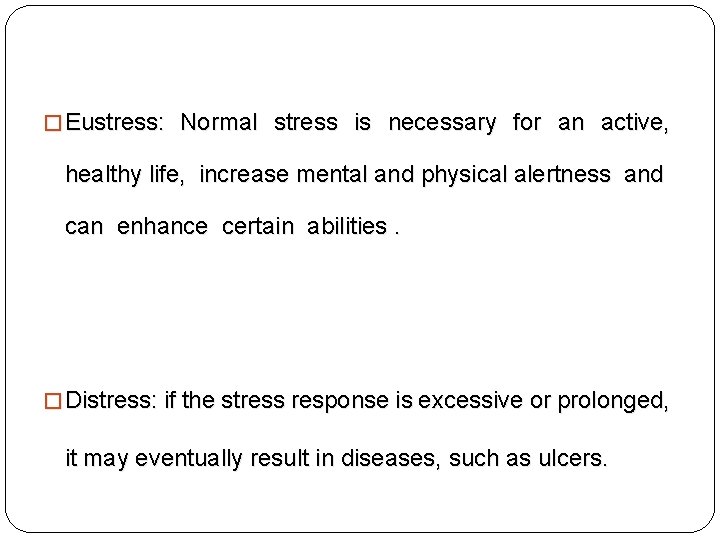
� Eustress: Normal stress is necessary for an active, healthy life, increase mental and physical alertness and can enhance certain abilities. � Distress: if the stress response is excessive or prolonged, it may eventually result in diseases, such as ulcers.
Types of Stressors
Classification: � Posttraumatic stress disorder (PTSD), � Acute stress disorder, and � Adjustment disorders.
Post trumatic stress disorder:
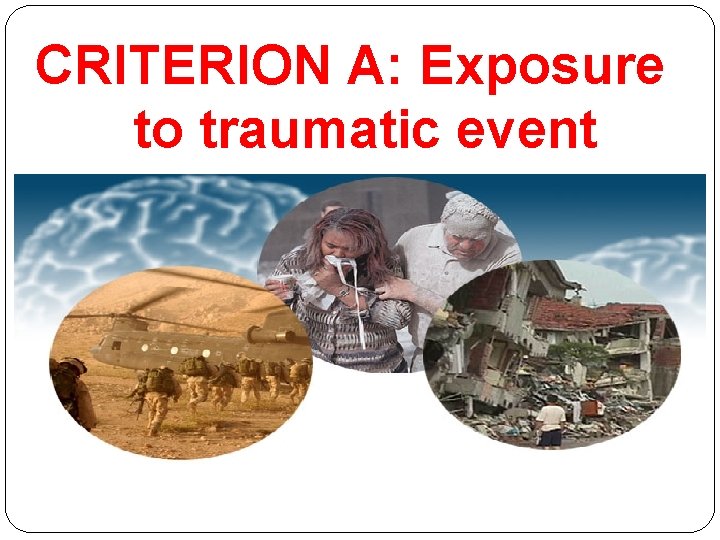
CRITERION A: Exposure to traumatic event
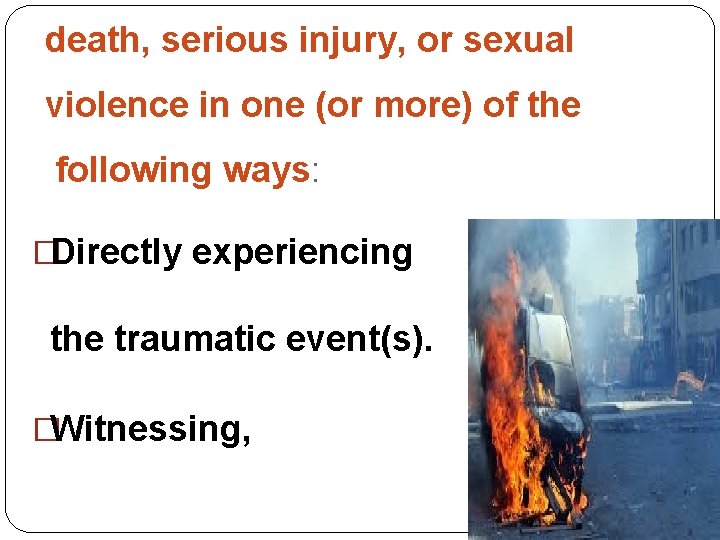
death, serious injury, or sexual violence in one (or more) of the following ways: �Directly experiencing the traumatic event(s). �Witnessing,
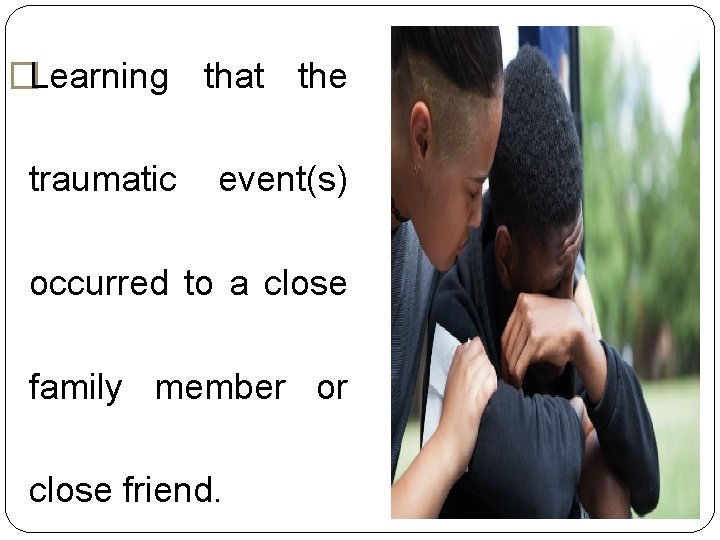
�Learning that the traumatic event(s) occurred to a close family member or close friend.
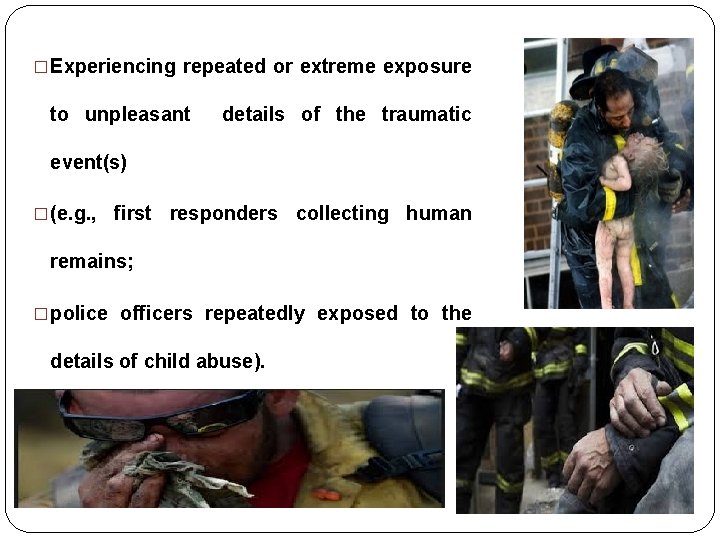
�Experiencing repeated or extreme exposure to unpleasant details of the traumatic event(s) �(e. g. , first responders collecting human remains; �police officers repeatedly exposed to the details of child abuse).
CRITERION B - Intrusion :
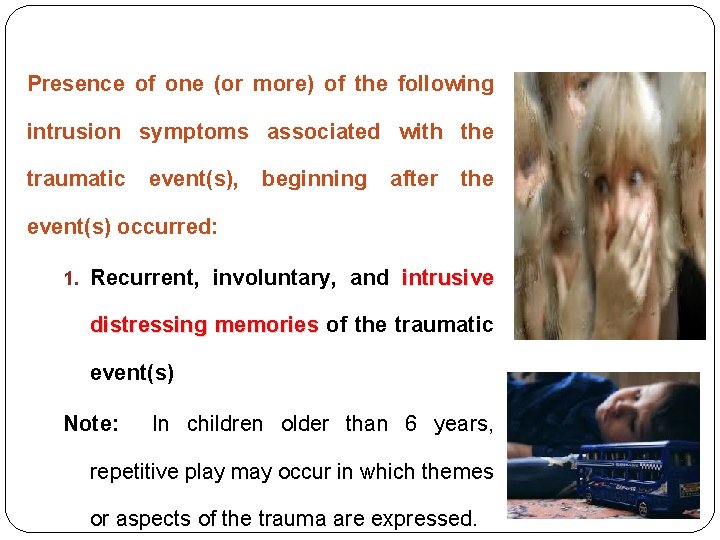
Presence of one (or more) of the following intrusion symptoms associated with the traumatic event(s), beginning after the event(s) occurred: 1. Recurrent, involuntary, and intrusive distressing memories of the traumatic event(s) Note: In children older than 6 years, repetitive play may occur in which themes or aspects of the trauma are expressed.
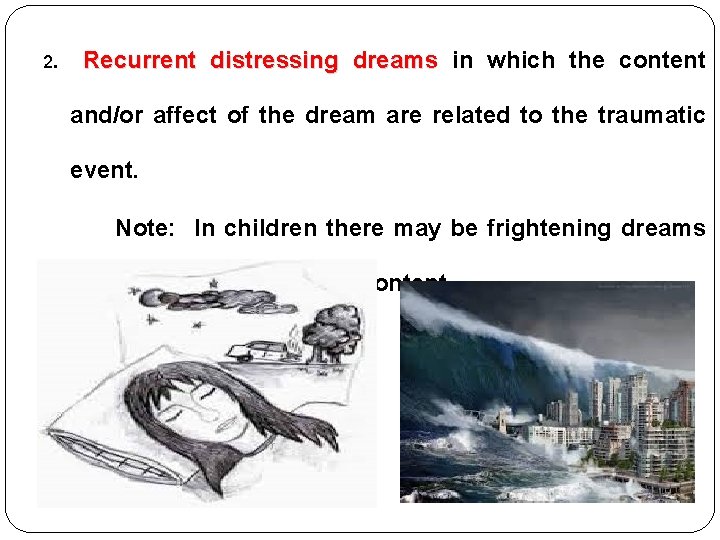
2. Recurrent distressing dreams in which the content and/or affect of the dream are related to the traumatic event. Note: In children there may be frightening dreams without recognizable content.
3. Dissociative reactions (e. g. , flashbacks) in which the individual feels or acts as if the event(s) were recurring.
4. Intense or prolonged psychological distress at exposure to internal or external cues that symbolize or resemble an aspect of the traumatic event(s). 5. Marked physiological reaction to external or internal cues that symbolize or resemble an aspect of
CRITERION C – Avoidance: �Persistent avoidance of stimuli associated with the traumatic event(s), beginning after the traumatic event(s) occurred, as evidenced by one or both of the following:
1. Avoidance of or efforts to avoid distressing memories, thoughts, or feelings about or closely associated with the traumatic event(s).
� 2. Avoidance of or efforts to avoid external reminders � (people, places, conversations, activities, objects, situations) that arouse distressing, memories, thoughts, or feelings about or closely associated traumatic event(s). with the
CRITERION D – Negative alterations in cognition & Mood. Negative alterations in cognitions and mood associated with the traumatic event(s), beginning or worsening after the event(s) occurred, as evidenced by two or more of the following:
1. Inability to remember an important aspect of the traumatic event(s) � typically due to dissociative amnesia and � not to other factors such as head injury, alcohol or drugs.
2 - Persistent and exaggerated negative beliefs or expectations about oneself, others, or the world (e. g. , �“I am bad, ” �“No one can be trusted, ” �“The world is completely dangerous, ” � “My whole nervous system is permanently destroyed”).
3 - Persistent, distorted cognitions about the cause or consequences of the traumatic event(s) that leads the individual to blame himself/herself or others. 4 - Persistent negative emotional state (e. g. , fear, horror, anger, guilt, or shame).
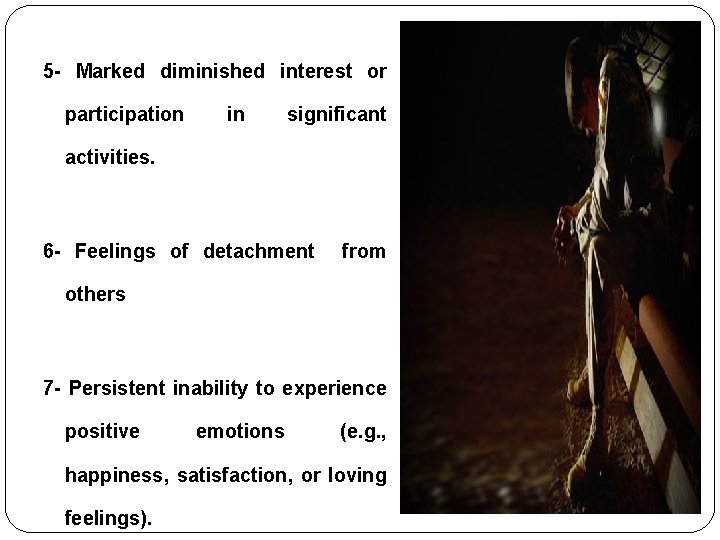
5 - Marked diminished interest or participation in significant activities. 6 - Feelings of detachment from others 7 - Persistent inability to experience positive emotions (e. g. , happiness, satisfaction, or loving feelings).
CRITERION E – Arousal & Reactivity Marked alterations in arousal and reactivity associated with the traumatic event(s), beginning or worsening after the traumatic event(s) occurred, as evidenced by two or more of the following:
1. Irritable behavior and angry outbursts expressed as verbal or physical aggression toward people or objects.
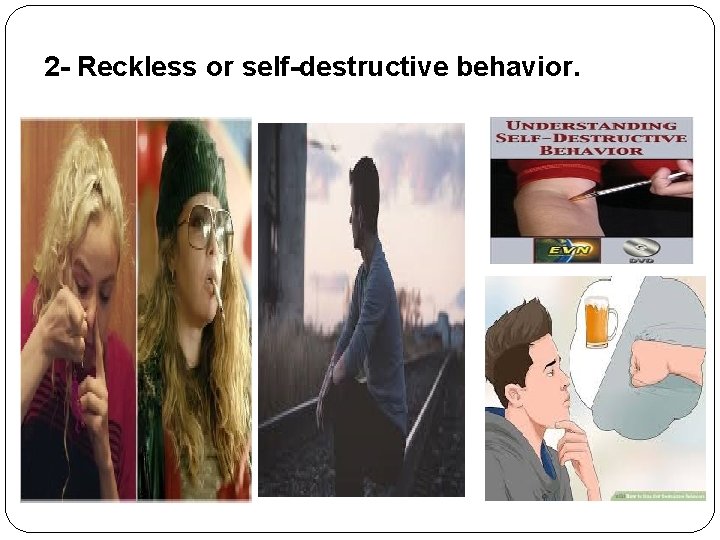
2 - Reckless or self-destructive behavior.
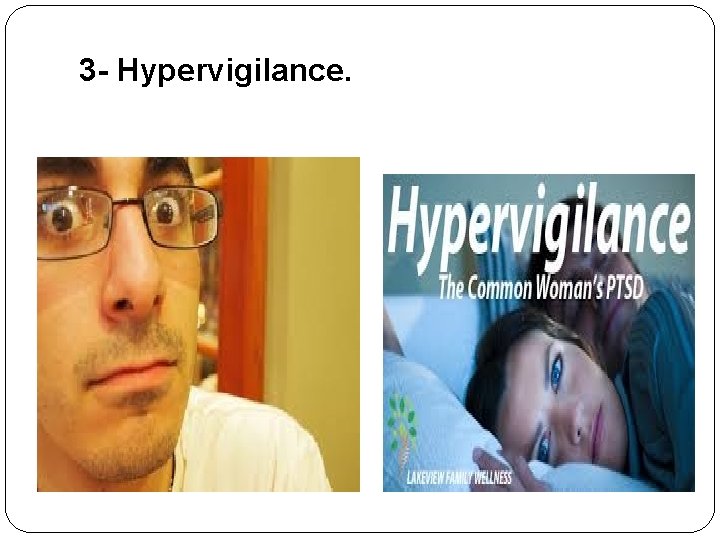
3 - Hypervigilance.
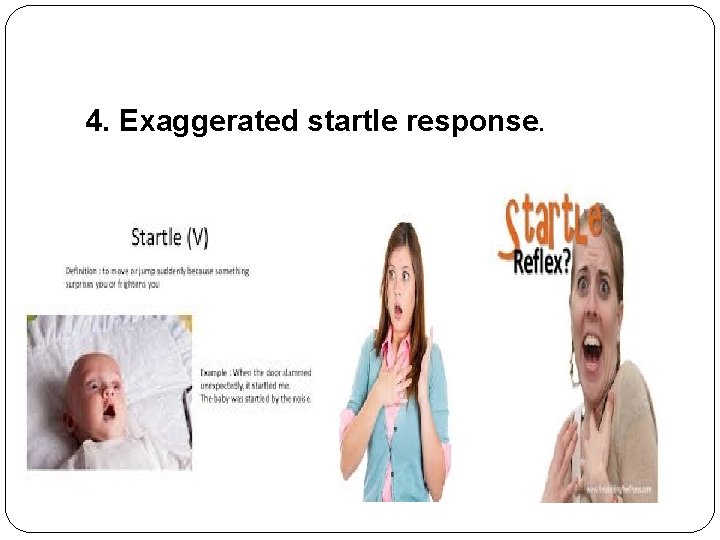
4. Exaggerated startle response.
5. Problems with concentration.
6. Sleep disturbance (e. g. problems falling or staying asleep or restless sleep).
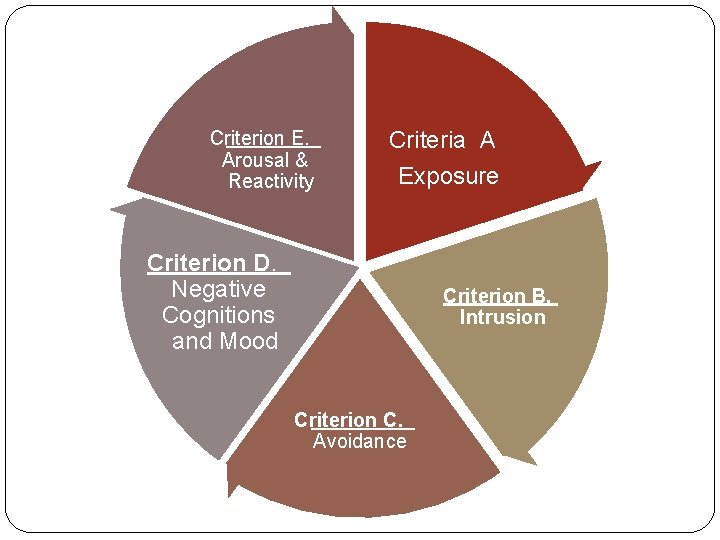
Criterion E. Arousal & Reactivity Criteria A Exposure Criterion D. Negative Cognitions and Mood Criterion B. Intrusion Criterion C. Avoidance
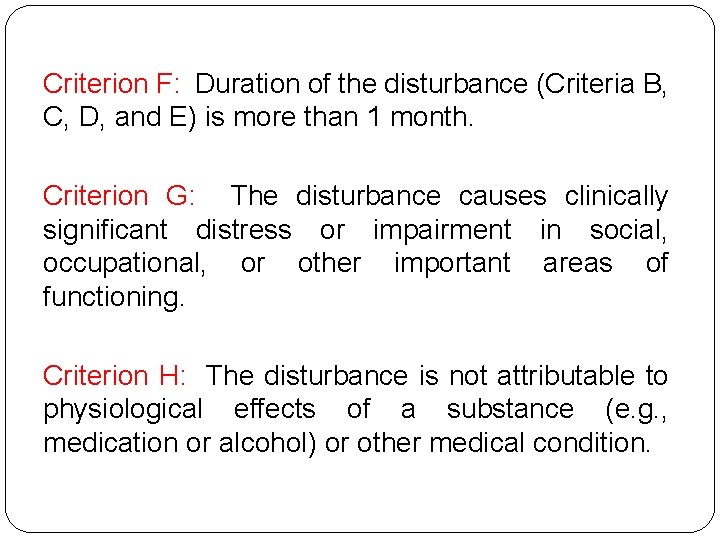
Criterion F: Duration of the disturbance (Criteria B, C, D, and E) is more than 1 month. Criterion G: The disturbance causes clinically significant distress or impairment in social, occupational, or other important areas of functioning. Criterion H: The disturbance is not attributable to physiological effects of a substance (e. g. , medication or alcohol) or other medical condition.
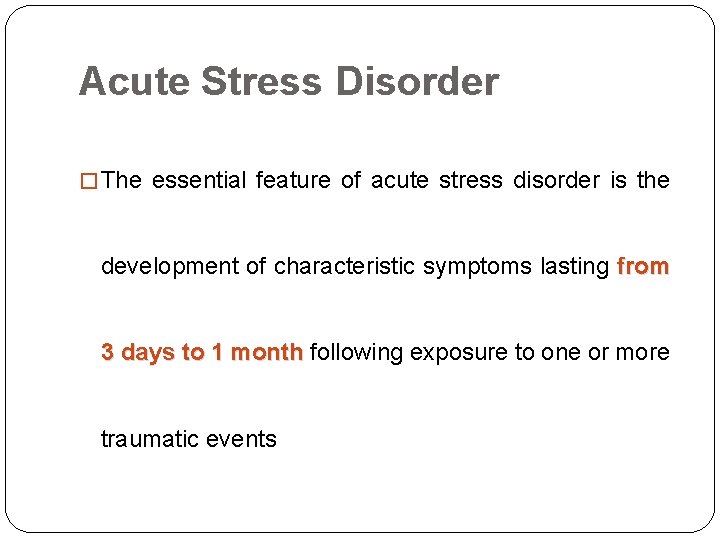
Acute Stress Disorder � The essential feature of acute stress disorder is the development of characteristic symptoms lasting from 3 days to 1 month following exposure to one or more traumatic events
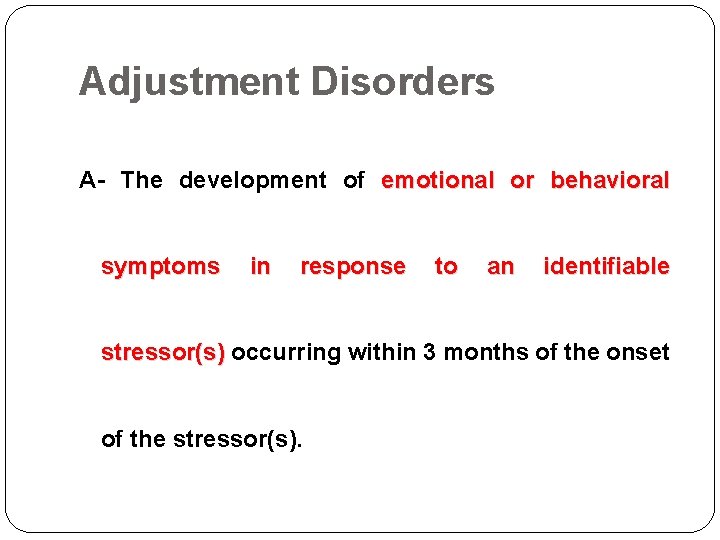
Adjustment Disorders A- The development of emotional or behavioral symptoms in response to an identifiable stressor(s) occurring within 3 months of the onset of the stressor(s).
Adjustment Disorders � In adjustment disorders, the stressor can be of any severity rather than of the severity in PTSDs. � The stressor may be a single event (e. g. , a termination of a romantic relationship), � or there may be multiple stressors (e. g. , marked business difficulties and marital problems)
Adjustment Disorders �Stressors may be recurrent (e. g. , associated with seasonal business crises, unfulfilling sexual relationships) � or continuous (e. g. , a persistent painful illness with increasing disability, living in a crime-ridden
Adjustment Disorders B. These symptoms or behaviors are clinically significant, as evidenced by one or both of the following: 1. Marked distress that is out of proportion to the severity or intensity of the stressor, 2. Significant impairment in social, occupational, or other important areas of functioning.
Adjustment Disorders �The stress-related disturbance does not meet the criteria for another mental disorder and is not merely an exacerbation of a preexisting mental disorder.
Adjustment Disorders � D. The symptoms do not represent normal bereavement. � E. Once the stressor or its consequences have terminated, the symptoms do not persist for more
Adjustment Disorders � With depressed mood: � With anxiety: � With mixed anxiety and depressed mood: � With disturbance of conduct: � With mixed disturbance of emotions and conduct: � Unspecified: