Welcome The Trauma Audit Research Network TARN Foundation





- Slides: 25
Welcome The Trauma Audit & Research Network (TARN) Foundation course
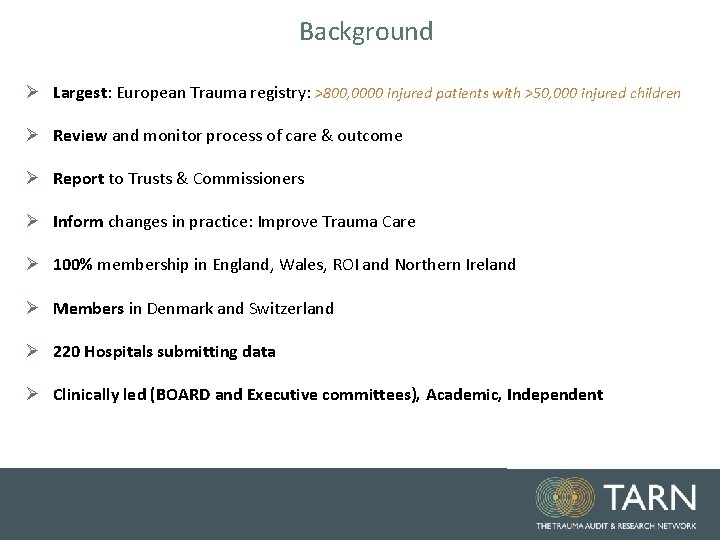
Background Ø Largest: European Trauma registry: >800, 0000 injured patients with >50, 000 injured children Ø Review and monitor process of care & outcome Ø Report to Trusts & Commissioners Ø Inform changes in practice: Improve Trauma Care Ø 100% membership in England, Wales, ROI and Northern Ireland Ø Members in Denmark and Switzerland Ø 220 Hospitals submitting data Ø Clinically led (BOARD and Executive committees), Academic, Independent
The beginning Ø 1988: Report by RCS: The Management of patients with Major Injuries “Serious deficiencies in the management of severely injured patients” § § § Enhancing pre-hospital care, ensuring appropriate medical intervention Rapid transfer to the best local facility Assessing the use of helicopters Adopting ATLS principles Integrating trauma services within and between hospitals Investing in rehabilitation services § System of Auditing & Research Ø TARN Established in 1989: Based Salford Royal Hospital
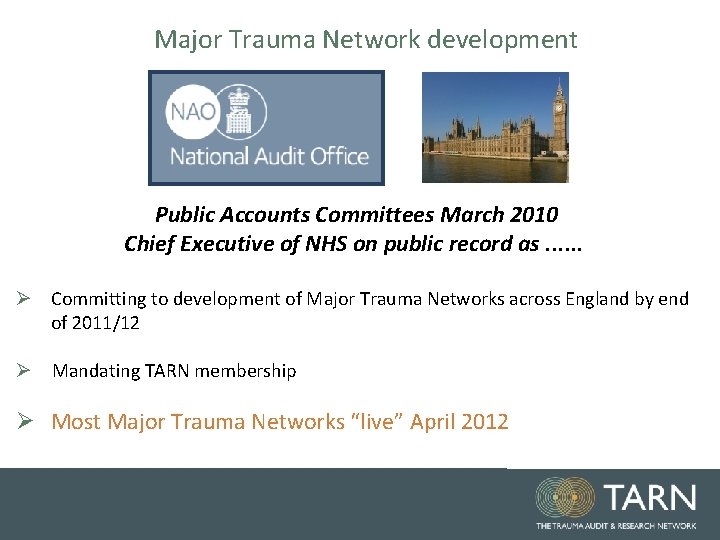
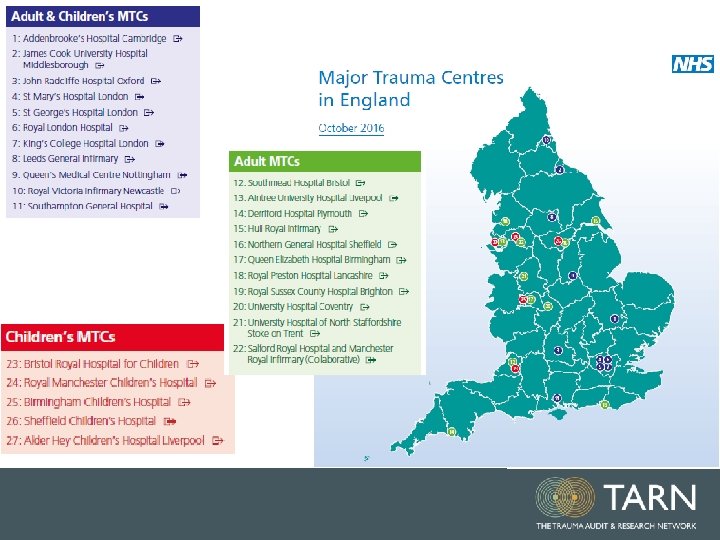
Major Trauma Network development Public Accounts Committees March 2010 Chief Executive of NHS on public record as. . . Ø Committing to development of Major Trauma Networks across England by end of 2011/12 Ø Mandating TARN membership Ø Most Major Trauma Networks “live” April 2012
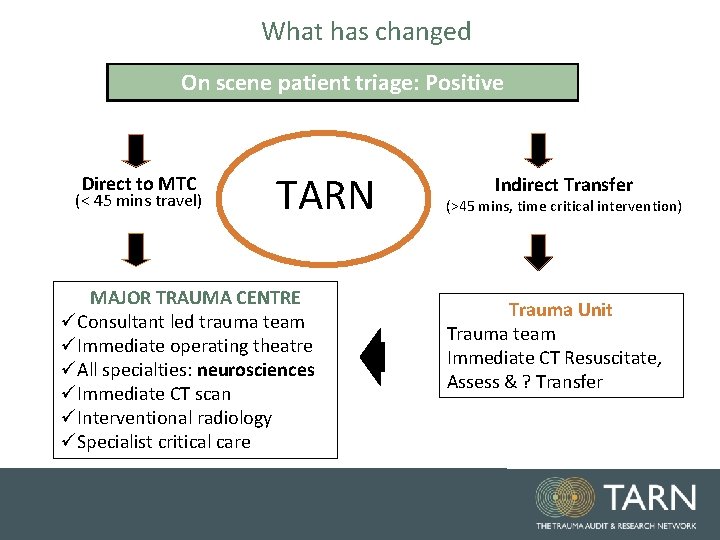
What has changed On scene patient triage: Positive Direct to MTC (< 45 mins travel) TARN MAJOR TRAUMA CENTRE üConsultant led trauma team üImmediate operating theatre üAll specialties: neurosciences üImmediate CT scan üInterventional radiology üSpecialist critical care Indirect Transfer (>45 mins, time critical intervention) Trauma Unit Trauma team Immediate CT Resuscitate, Assess & ? Transfer
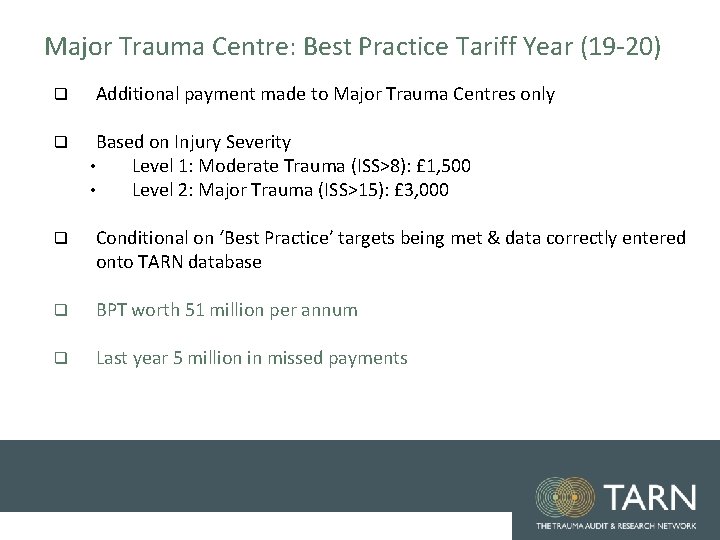
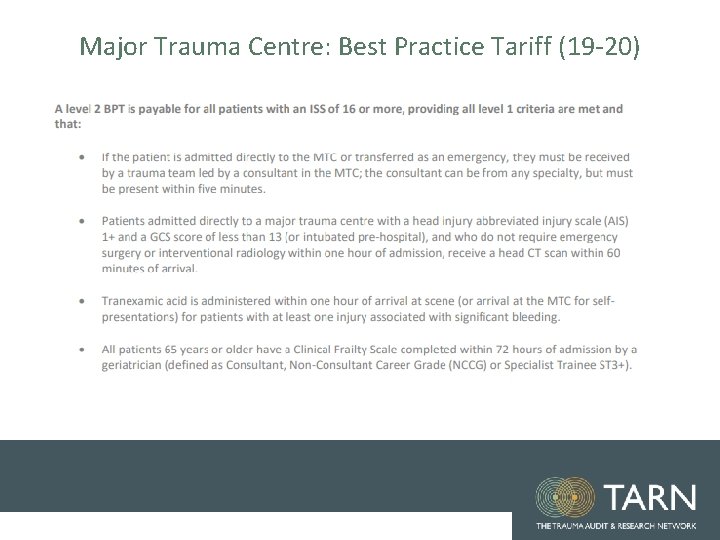
Major Trauma Centre: Best Practice Tariff Year (19 -20) q q Additional payment made to Major Trauma Centres only Based on Injury Severity • Level 1: Moderate Trauma (ISS>8): £ 1, 500 • Level 2: Major Trauma (ISS>15): £ 3, 000 q Conditional on ‘Best Practice’ targets being met & data correctly entered onto TARN database q BPT worth 51 million per annum q Last year 5 million in missed payments
Major Trauma Centre: Best Practice Tariff Year (19 -20)
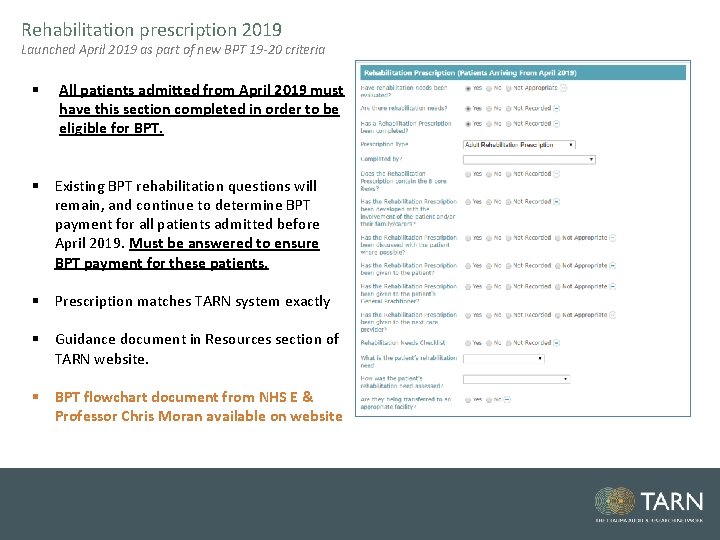
Rehabilitation prescription 2019 Launched April 2019 as part of new BPT 19 -20 criteria § All patients admitted from April 2019 must have this section completed in order to be eligible for BPT. § Existing BPT rehabilitation questions will remain, and continue to determine BPT payment for all patients admitted before April 2019. Must be answered to ensure BPT payment for these patients. § Prescription matches TARN system exactly § Guidance document in Resources section of TARN website. § BPT flowchart document from NHS E & Professor Chris Moran available on website
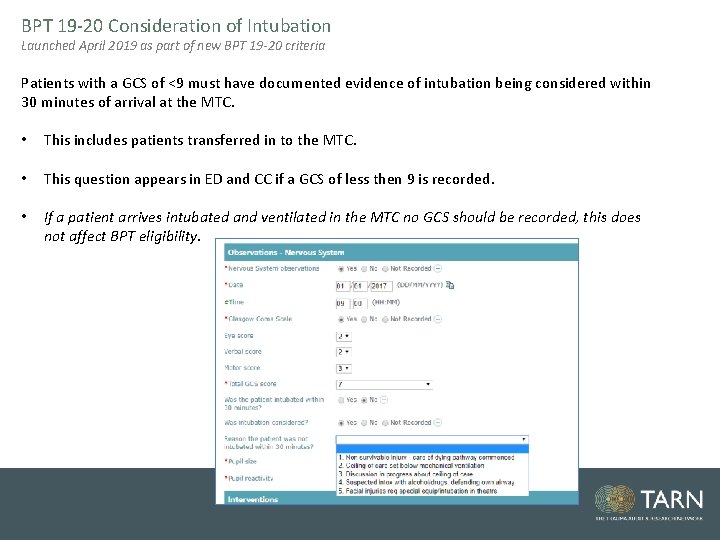
BPT 19 -20 Consideration of Intubation Launched April 2019 as part of new BPT 19 -20 criteria Patients with a GCS of <9 must have documented evidence of intubation being considered within 30 minutes of arrival at the MTC. • This includes patients transferred in to the MTC. • This question appears in ED and CC if a GCS of less then 9 is recorded. • If a patient arrives intubated and ventilated in the MTC no GCS should be recorded, this does not affect BPT eligibility.
Major Trauma Centre: Best Practice Tariff (19 -20)
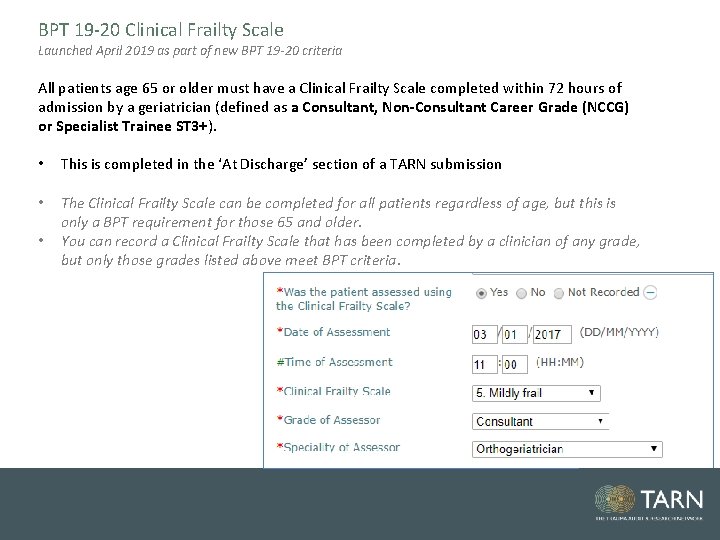
BPT 19 -20 Clinical Frailty Scale Launched April 2019 as part of new BPT 19 -20 criteria All patients age 65 or older must have a Clinical Frailty Scale completed within 72 hours of admission by a geriatrician (defined as a Consultant, Non-Consultant Career Grade (NCCG) or Specialist Trainee ST 3+). • This is completed in the ‘At Discharge’ section of a TARN submission • The Clinical Frailty Scale can be completed for all patients regardless of age, but this is only a BPT requirement for those 65 and older. You can record a Clinical Frailty Scale that has been completed by a clinician of any grade, but only those grades listed above meet BPT criteria. •
Web-based Trauma Data Collection Ø Electronic data collection & reporting system Ø Secure on-line system through patient pathway Ø Data Collection AND Reporting
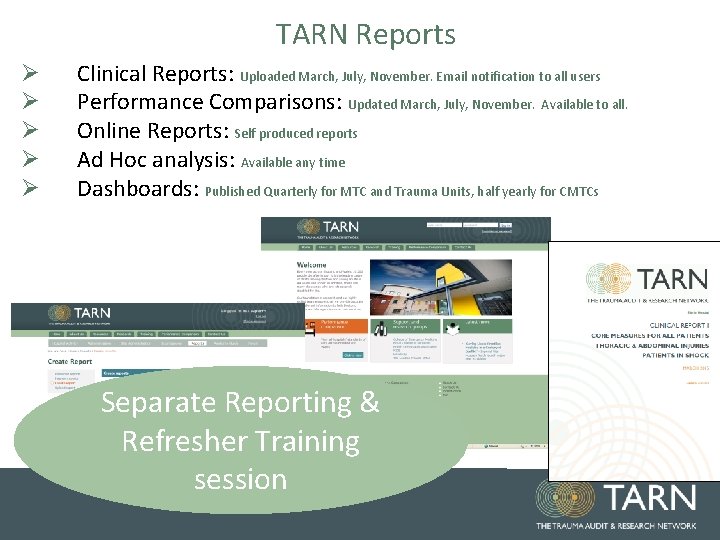
TARN Reports Ø Ø Ø Clinical Reports: Uploaded March, July, November. Email notification to all users Performance Comparisons: Updated March, July, November. Available to all. Online Reports: Self produced reports Ad Hoc analysis: Available any time Dashboards: Published Quarterly for MTC and Trauma Units, half yearly for CMTCs Separate Reporting & Refresher Training session
Trauma Dashboards Benchmarking between comparable hospitals Major Trauma Centre Dashboard Developed by MTC Clinical Reference Group Children’s Major Trauma Centre Dashboard Developed by TARNLet Trauma Unit Dashboard Developed by Trauma Unit Working Party
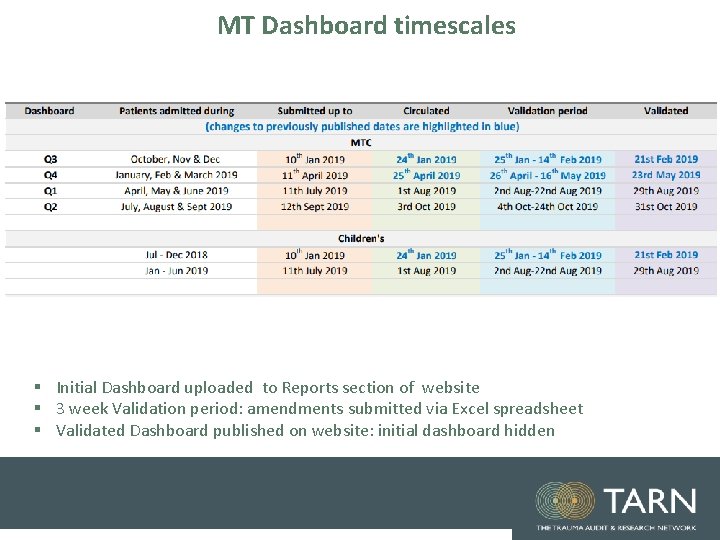
MT Dashboard timescales § Initial Dashboard uploaded to Reports section of website § 3 week Validation period: amendments submitted via Excel spreadsheet § Validated Dashboard published on website: initial dashboard hidden
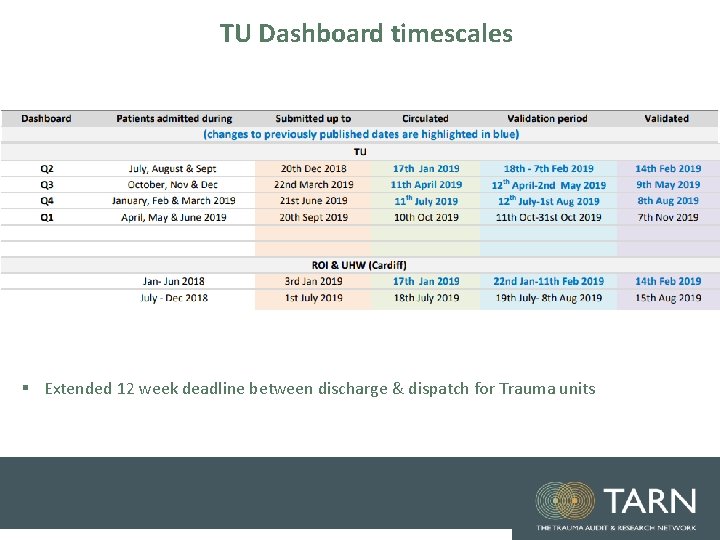
TU Dashboard timescales § Extended 12 week deadline between discharge & dispatch for Trauma units
The 2018 TARN database
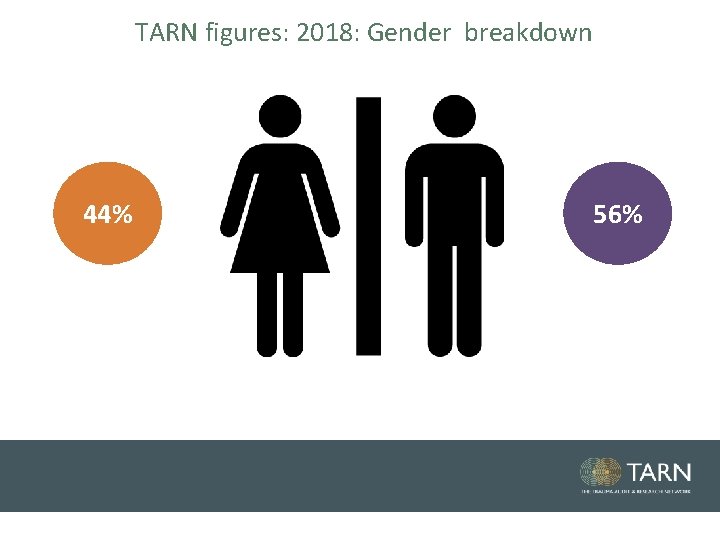
TARN figures: 2018: Gender breakdown 44% 56%
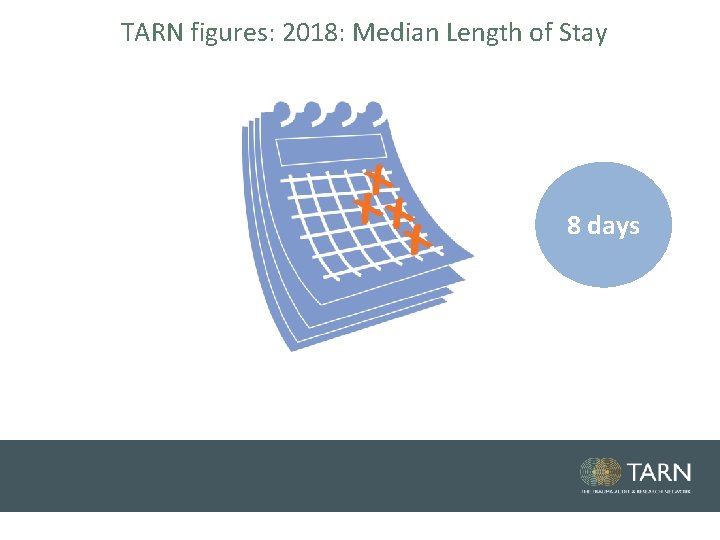
TARN figures: 2018: Median Length of Stay 8 days
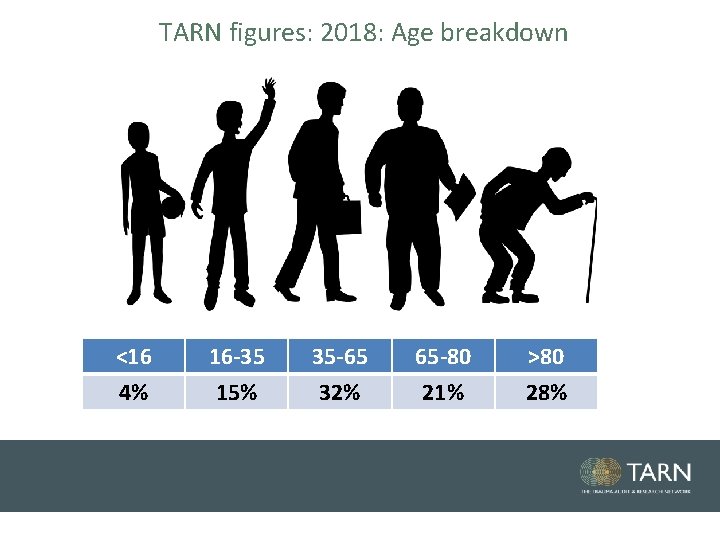
TARN figures: 2018: Age breakdown <16 4% 16 -35 15% 35 -65 32% 65 -80 21% >80 28%
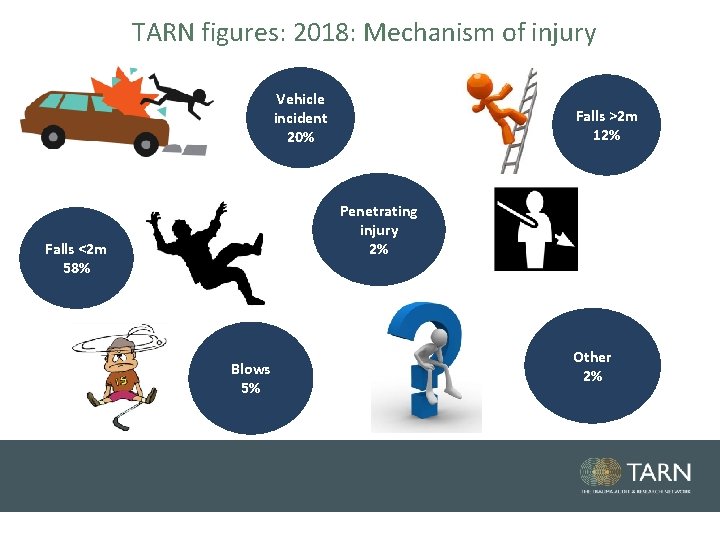
TARN figures: 2018: Mechanism of injury Vehicle incident 20% Falls >2 m 12% Penetrating injury 2% Falls <2 m 58% Blows 5% Other 2%
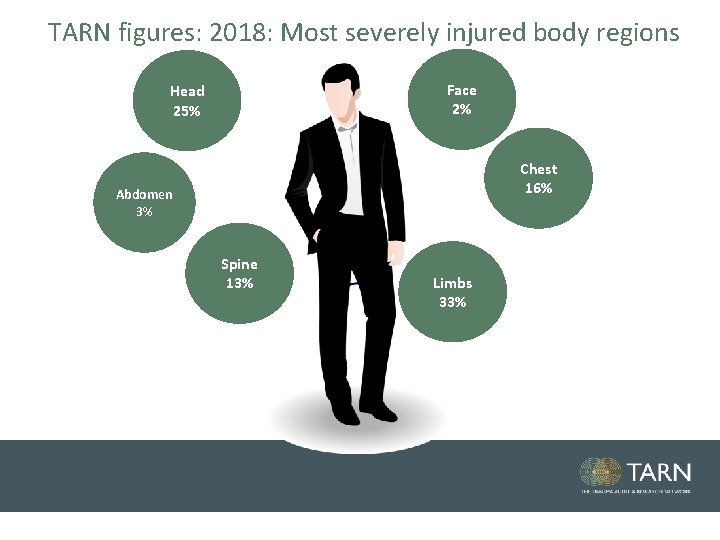
TARN figures: 2018: Most severely injured body regions Face 2% Head 25% Chest 16% Abdomen 3% Spine 13% Limbs 33%
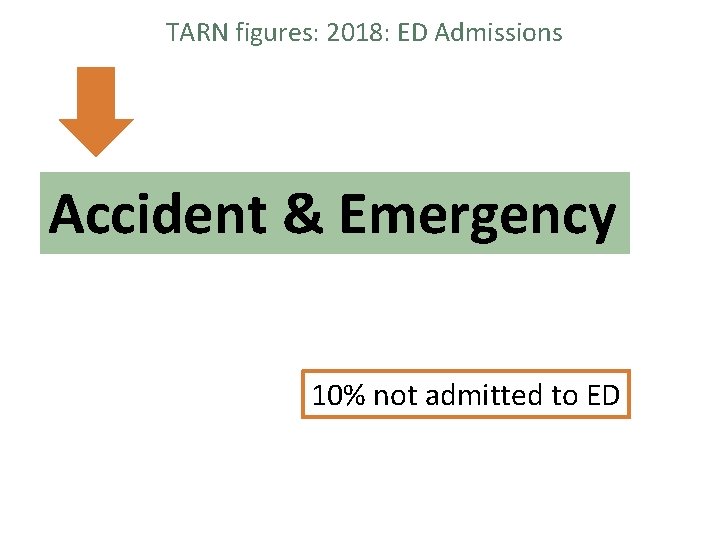
TARN figures: 2018: ED Admissions Accident & Emergency 10% not admitted to ED
Contact us Phone-line: 0161 206 4397 Email: support@tarn. ac. uk tarn. supportstaff@nhs. net Twitter account: @TARNaudit www. facebook. com/TARNaudit Website: www. tarn. ac. uk