Trans Rank A Novel Algorithm for Transfer of
- Slides: 28
Trans. Rank: A Novel Algorithm for Transfer of Rank Learning Depin Chen, Jun Yan, Gang Wang et al. University of Science and Technology of China, USTC Machine Learning Group, MSRA depin. chen@mail. ustc. edu. cn 2008 -12 -15 Page
Content • Ranking for IR • Paper motivation • The algorithm: Trans. Rank • Results & future work 2008 -12 -15 Page 2
Ranking in IR • Ranking is crucial in information retrieval. It aims to move the good results up, while the bad down. • A well known example: web search engine 2008 -12 -15 Page 3
Learning to rank • Ranking + Machine learning = Learning to rank • An early work Ranking SVM, “Support Vector Learning for Ordinal Regression” , Herbrich et al [ICANN 99]. 2008 -12 -15 Page 4
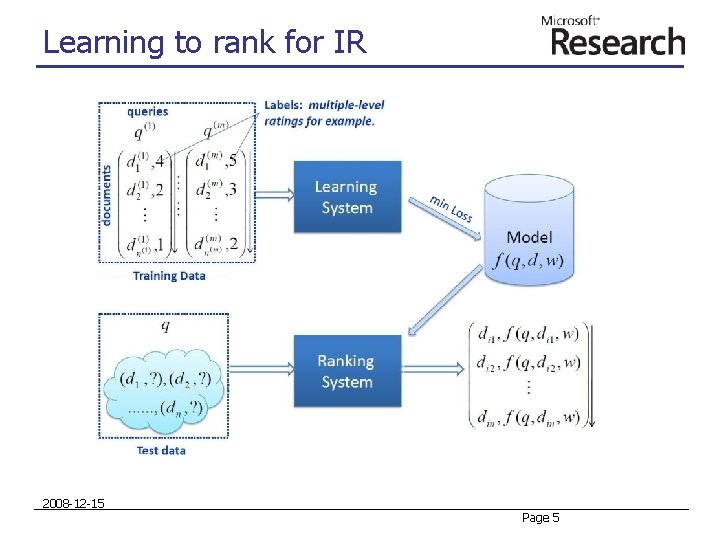
Learning to rank for IR 2008 -12 -15 Page 5
Existing approaches • Early ones Ranking SVM, Rank. Boost … • Recently IRSVM, Ada. Rank, List. Net. . . • Tie-Yan Liu’s team at MSRA 2008 -12 -15 Page 6
Content • Learning to rank in IR • Paper motivation • The algorithm: Trans. Rank • Results & future work 2008 -12 -15 Page 7
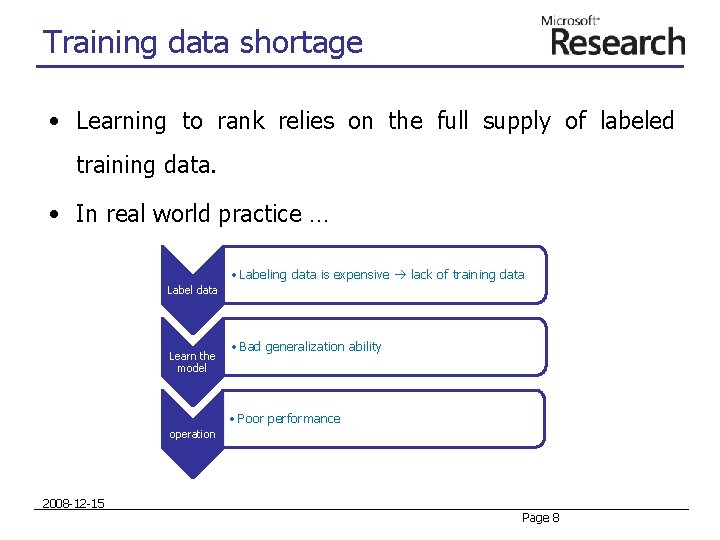
Training data shortage • Learning to rank relies on the full supply of labeled training data. • In real world practice … • Labeling data is expensive lack of training data Label data Learn the model • Bad generalization ability • Poor performance operation 2008 -12 -15 Page 8
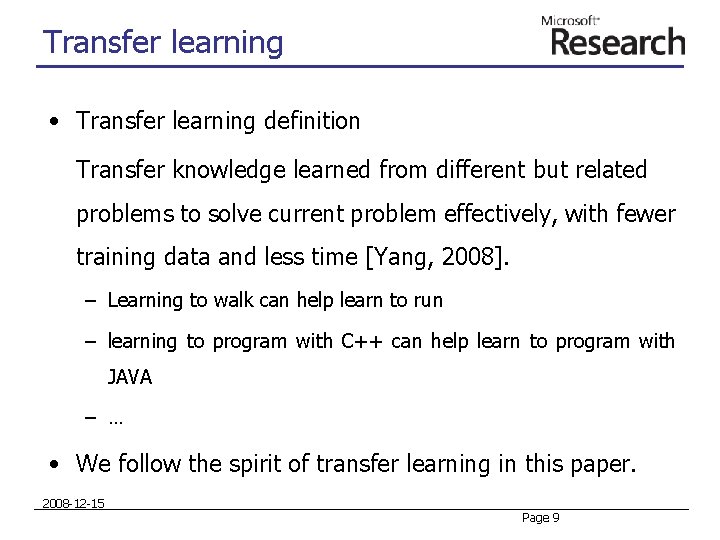
Transfer learning • Transfer learning definition Transfer knowledge learned from different but related problems to solve current problem effectively, with fewer training data and less time [Yang, 2008]. – Learning to walk can help learn to run – learning to program with C++ can help learn to program with JAVA – … • We follow the spirit of transfer learning in this paper. 2008 -12 -15 Page 9
Content • Learning to rank in IR • Paper motivation • The algorithm: Trans. Rank • Results & future work 2008 -12 -15 Page 10
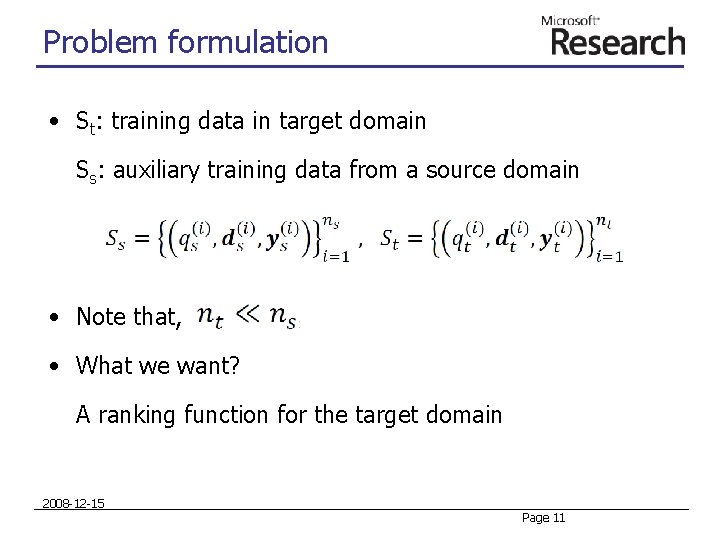
Problem formulation • St: training data in target domain Ss: auxiliary training data from a source domain • Note that, • What we want? A ranking function for the target domain 2008 -12 -15 Page 11
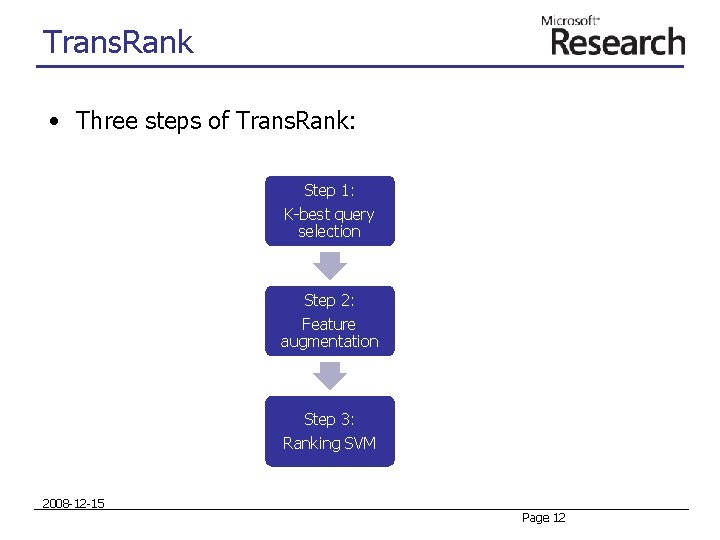
Trans. Rank • Three steps of Trans. Rank: Step 1: K-best query selection Step 2: Feature augmentation Step 3: Ranking SVM 2008 -12 -15 Page 12
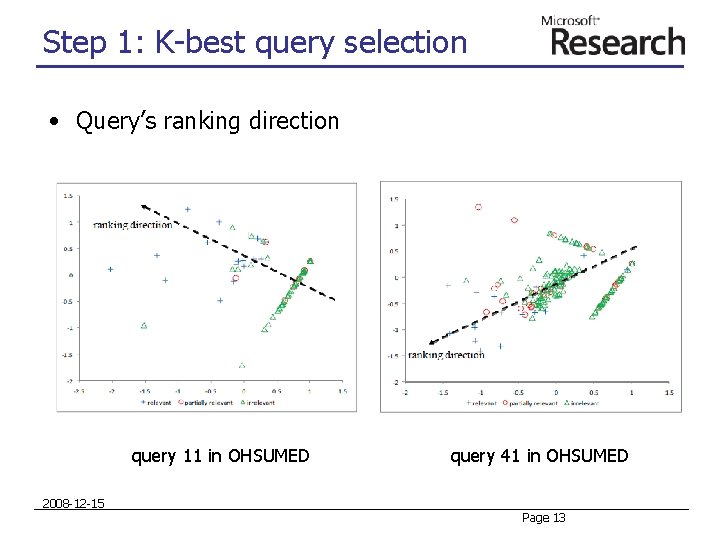
Step 1: K-best query selection • Query’s ranking direction query 11 in OHSUMED 2008 -12 -15 query 41 in OHSUMED Page 13
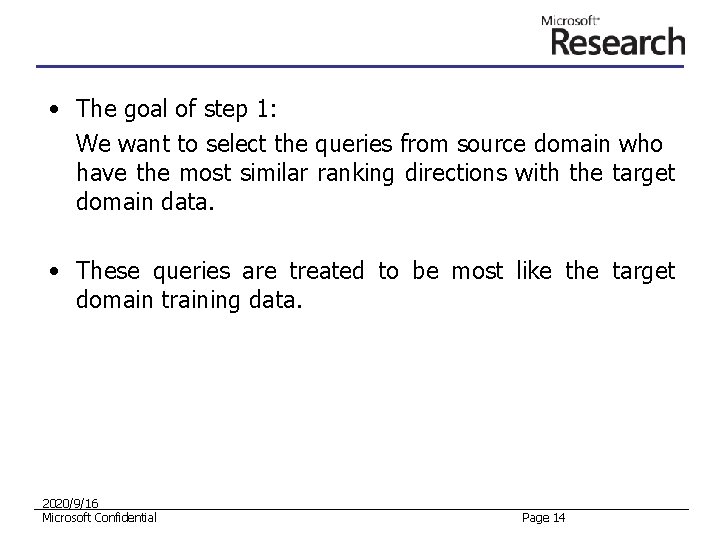
• The goal of step 1: We want to select the queries from source domain who have the most similar ranking directions with the target domain data. • These queries are treated to be most like the target domain training data. 2020/9/16 Microsoft Confidential Page 14
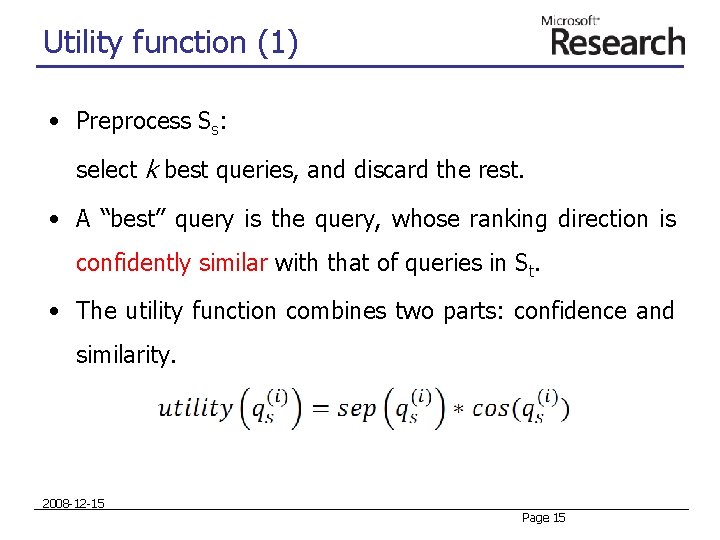
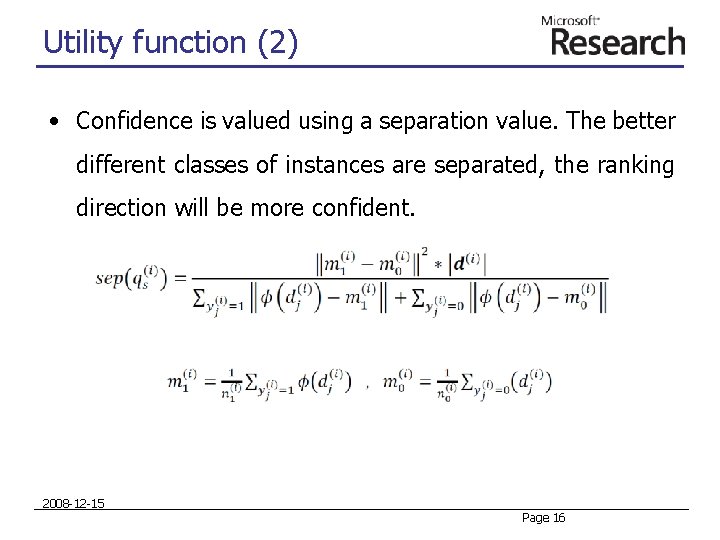
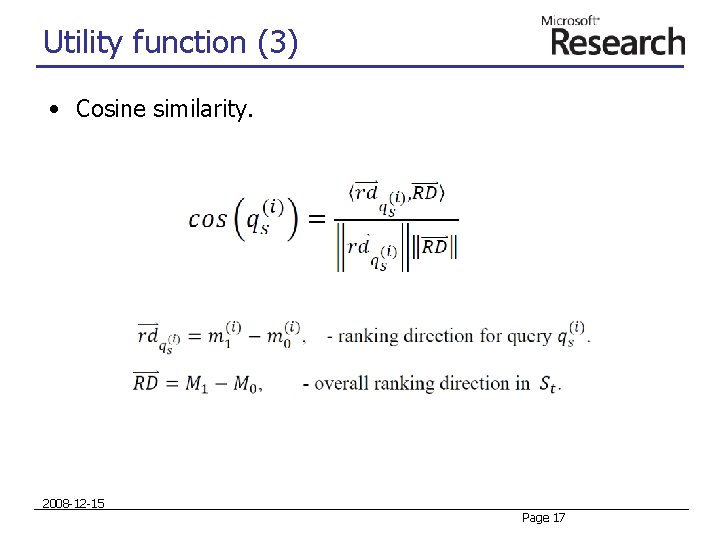
Utility function (1) • Preprocess Ss: select k best queries, and discard the rest. • A “best” query is the query, whose ranking direction is confidently similar with that of queries in St. • The utility function combines two parts: confidence and similarity. 2008 -12 -15 Page 15
Utility function (2) • Confidence is valued using a separation value. The better different classes of instances are separated, the ranking direction will be more confident. 2008 -12 -15 Page 16
Utility function (3) • Cosine similarity. 2008 -12 -15 Page 17
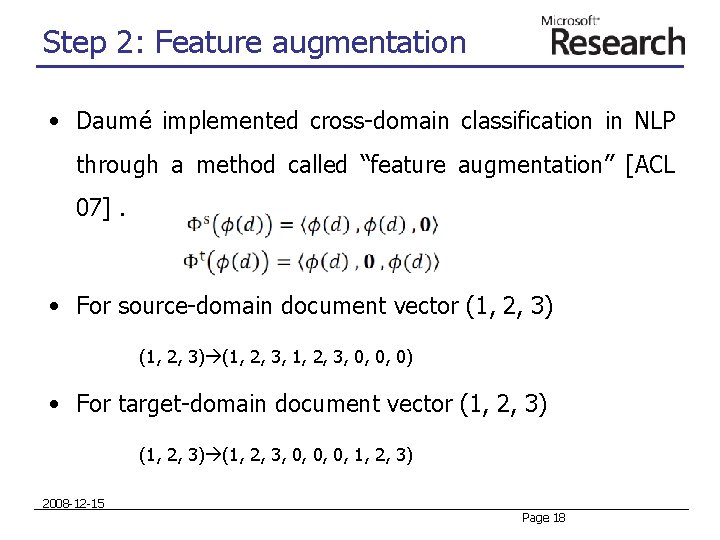
Step 2: Feature augmentation • Daumé implemented cross-domain classification in NLP through a method called “feature augmentation” [ACL 07]. • For source-domain document vector (1, 2, 3) (1, 2, 3, 0, 0, 0) • For target-domain document vector (1, 2, 3) (1, 2, 3, 0, 0, 0, 1, 2, 3) 2008 -12 -15 Page 18
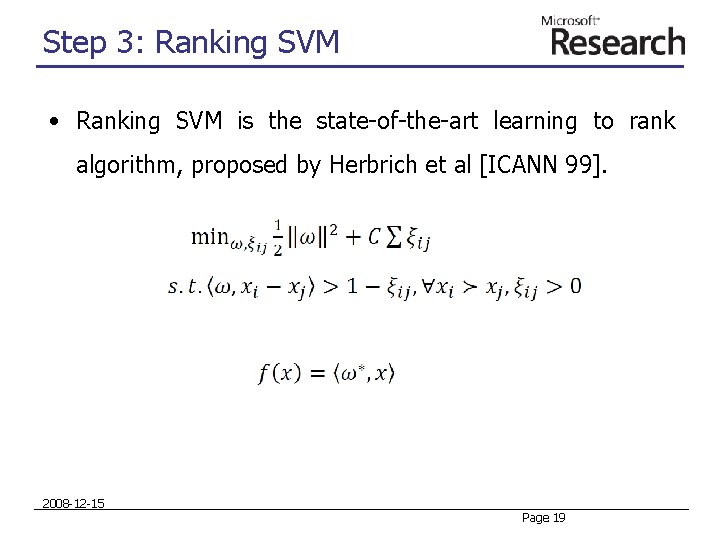
Step 3: Ranking SVM • Ranking SVM is the state-of-the-art learning to rank algorithm, proposed by Herbrich et al [ICANN 99]. 2008 -12 -15 Page 19
Content • Learning to rank in IR • Paper motivation • The heuristic algorithm: Trans. Rank • Results & future work 2008 -12 -15 Page 20
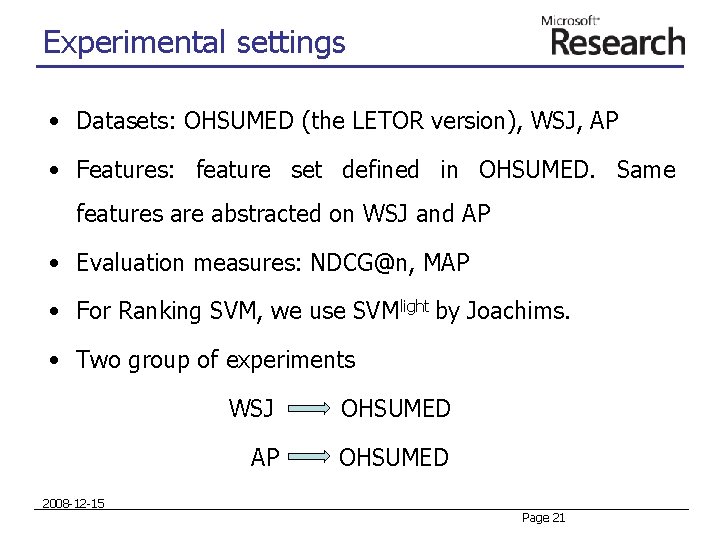
Experimental settings • Datasets: OHSUMED (the LETOR version), WSJ, AP • Features: feature set defined in OHSUMED. Same features are abstracted on WSJ and AP • Evaluation measures: NDCG@n, MAP • For Ranking SVM, we use SVMlight by Joachims. • Two group of experiments 2008 -12 -15 WSJ OHSUMED AP OHSUMED Page 21
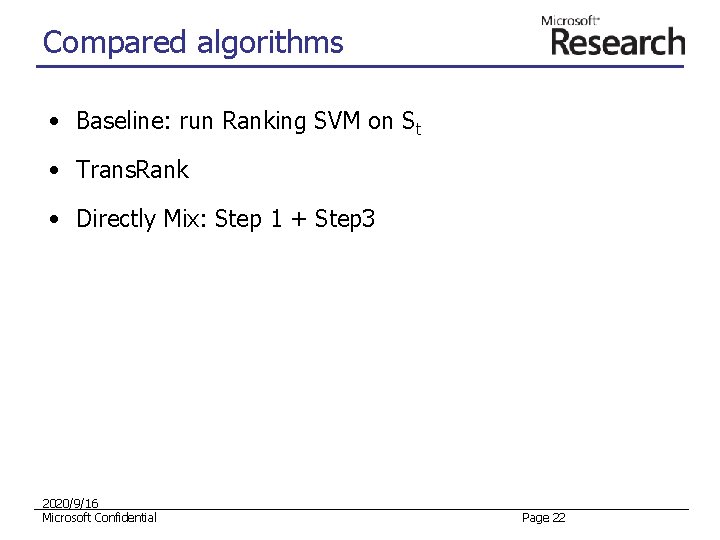
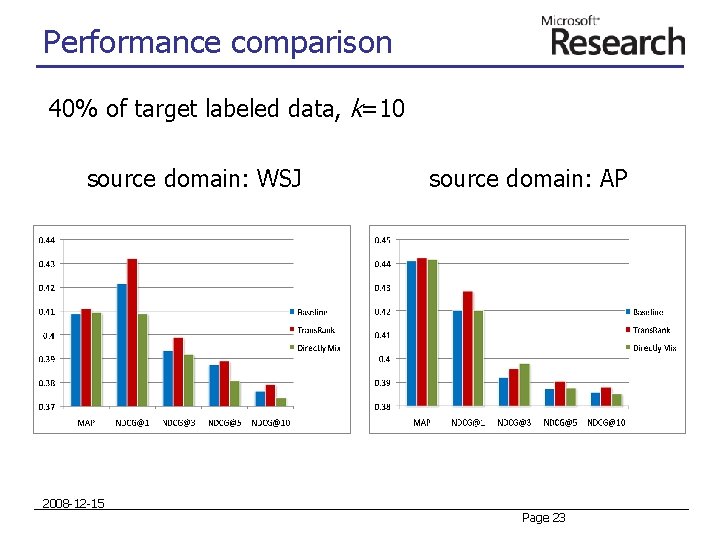
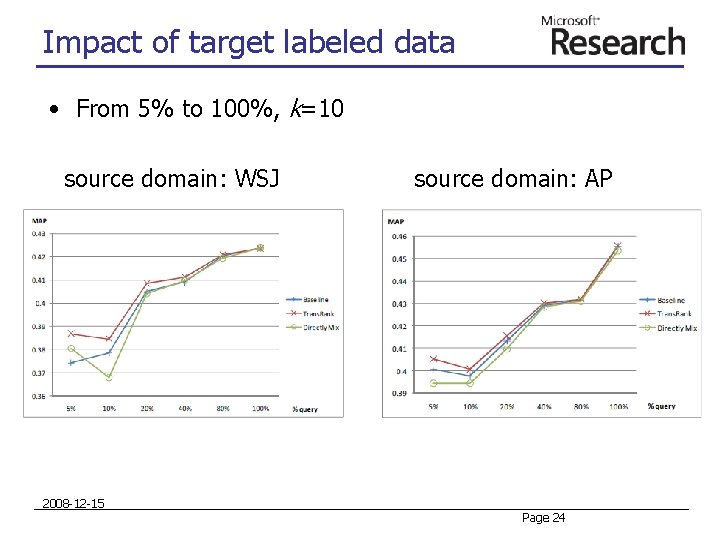
Compared algorithms • Baseline: run Ranking SVM on St • Trans. Rank • Directly Mix: Step 1 + Step 3 2020/9/16 Microsoft Confidential Page 22
Performance comparison 40% of target labeled data, k=10 source domain: WSJ 2008 -12 -15 source domain: AP Page 23
Impact of target labeled data • From 5% to 100%, k=10 source domain: WSJ 2008 -12 -15 source domain: AP Page 24
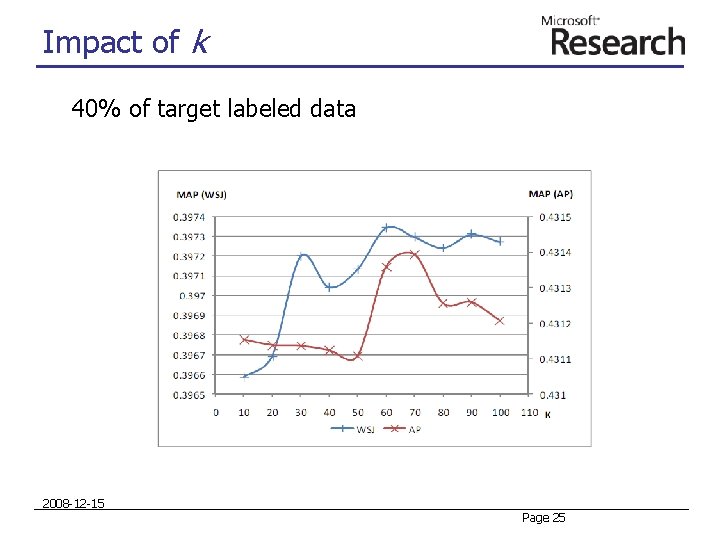
Impact of k 40% of target labeled data 2008 -12 -15 Page 25
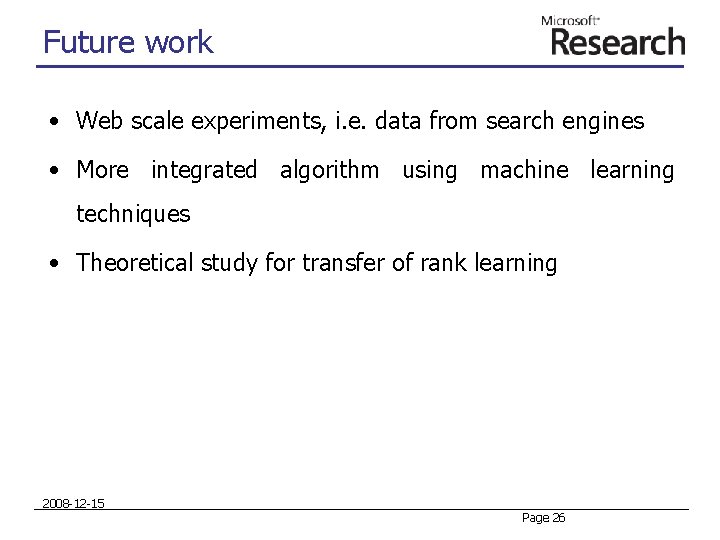
Future work • Web scale experiments, i. e. data from search engines • More integrated algorithm using machine learning techniques • Theoretical study for transfer of rank learning 2008 -12 -15 Page 26
Q&A 2008 -12 -15 Page 27
Thanks! 2008 -12 -15 Page 28