Traffic Engineering Mike Freedman Fall 2012 COS 561

- Slides: 31
Traffic Engineering Mike Freedman Fall 2012 COS 561: Advanced Computer Networks http: //www. cs. princeton. edu/courses/archive/fall 12/cos 561/
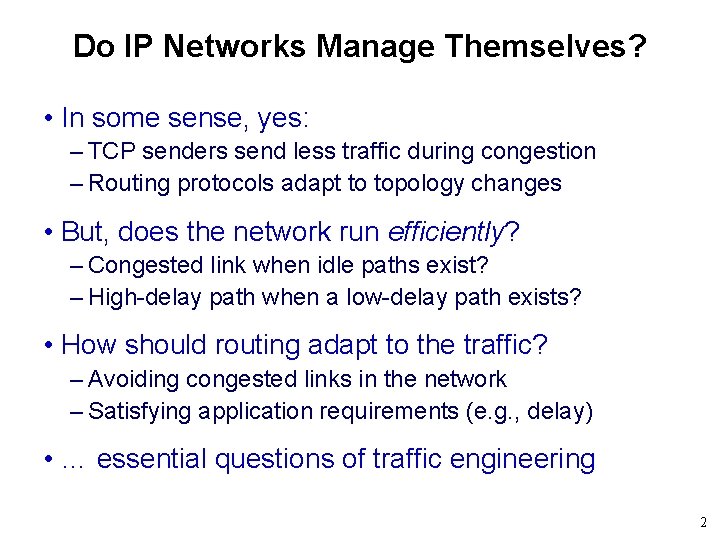
Do IP Networks Manage Themselves? • In some sense, yes: – TCP senders send less traffic during congestion – Routing protocols adapt to topology changes • But, does the network run efficiently? – Congested link when idle paths exist? – High-delay path when a low-delay path exists? • How should routing adapt to the traffic? – Avoiding congested links in the network – Satisfying application requirements (e. g. , delay) • … essential questions of traffic engineering 2
Outline • ARPAnet routing protocols • Tuning routing-protocol configuration • Multipath load balancings • Traffic engineering for multi-homed stubs 3
ARPAnet Routing 4
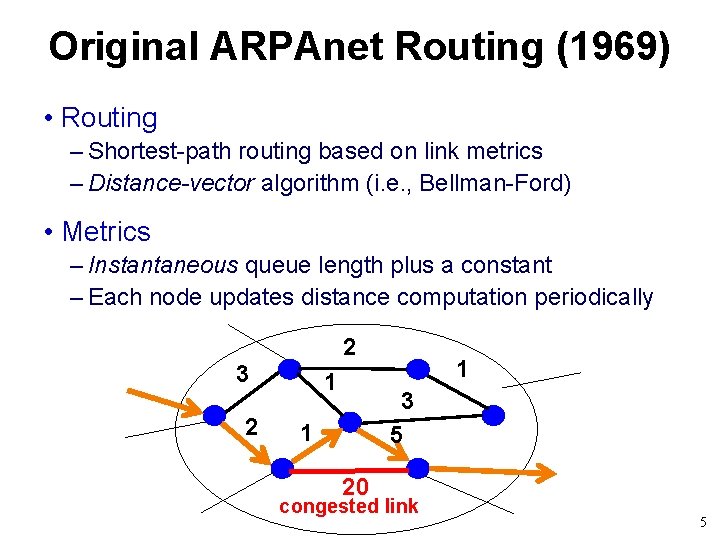
Original ARPAnet Routing (1969) • Routing – Shortest-path routing based on link metrics – Distance-vector algorithm (i. e. , Bellman-Ford) • Metrics – Instantaneous queue length plus a constant – Each node updates distance computation periodically 2 3 2 1 1 3 5 1 20 congested link 5
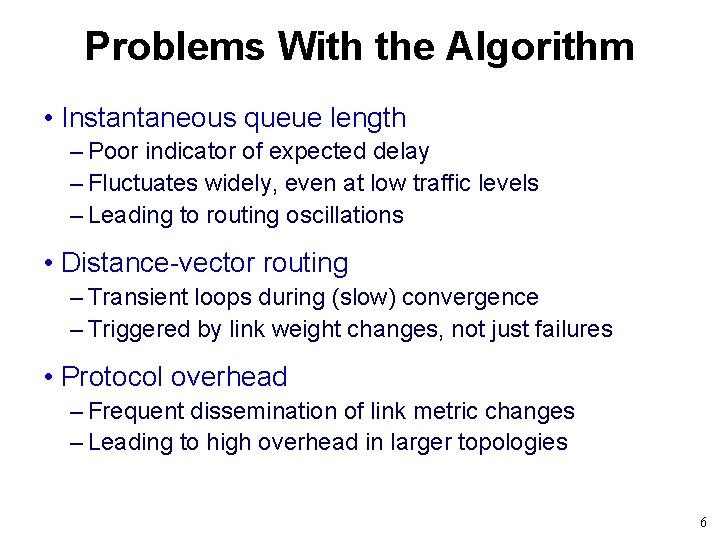
Problems With the Algorithm • Instantaneous queue length – Poor indicator of expected delay – Fluctuates widely, even at low traffic levels – Leading to routing oscillations • Distance-vector routing – Transient loops during (slow) convergence – Triggered by link weight changes, not just failures • Protocol overhead – Frequent dissemination of link metric changes – Leading to high overhead in larger topologies 6
New ARPAnet Routing (1979) • Averaging of the link metric over time – Old: Instantaneous delay fluctuates a lot – New: Averaging reduces the fluctuations • Link-state protocol – Old: Distance-vector path computation leads to loops – New: Link-state protocol where each router computes shortest paths based on the complete topology • Reduce frequency of updates – Old: Sending updates on each change is too much – New: Send updates if change passes a threshold 7
Performance of New Algorithm • Light load – Delay dominated by the constant part (transmission delay and propagation delay) • Medium load – Queuing delay is no longer negligible on all links – Moderate traffic shifts to avoid congestion • Heavy load – Very high metrics on congested links – Busy links look bad to all of the routers – All routers avoid the busy links – Routers may send packets on longer paths 8
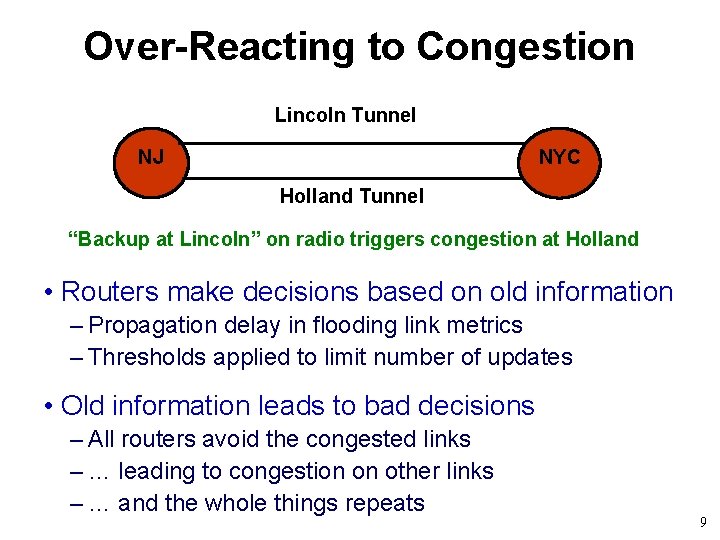
Over-Reacting to Congestion Lincoln Tunnel NJ NYC Holland Tunnel “Backup at Lincoln” on radio triggers congestion at Holland • Routers make decisions based on old information – Propagation delay in flooding link metrics – Thresholds applied to limit number of updates • Old information leads to bad decisions – All routers avoid the congested links – … leading to congestion on other links – … and the whole things repeats 9
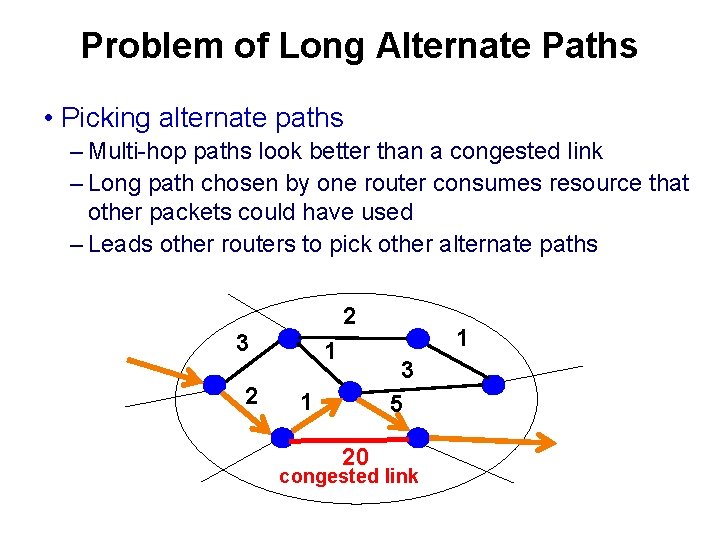
Problem of Long Alternate Paths • Picking alternate paths – Multi-hop paths look better than a congested link – Long path chosen by one router consumes resource that other packets could have used – Leads other routers to pick other alternate paths 2 3 2 1 1 3 5 1 20 congested link
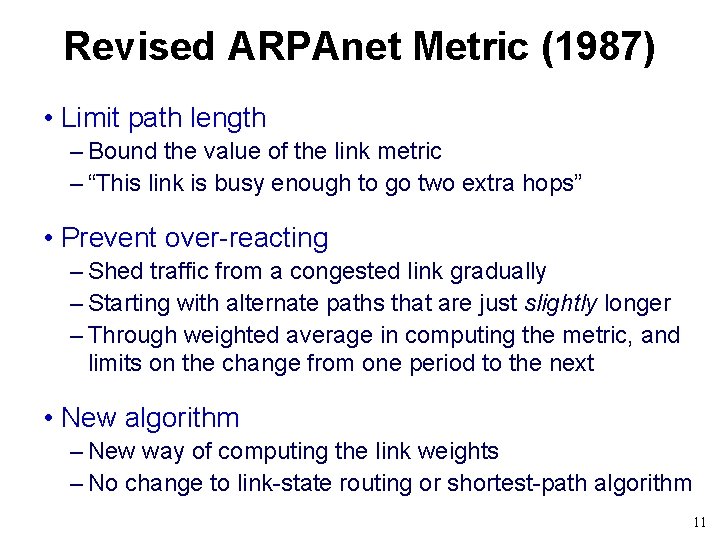
Revised ARPAnet Metric (1987) • Limit path length – Bound the value of the link metric – “This link is busy enough to go two extra hops” • Prevent over-reacting – Shed traffic from a congested link gradually – Starting with alternate paths that are just slightly longer – Through weighted average in computing the metric, and limits on the change from one period to the next • New algorithm – New way of computing the link weights – No change to link-state routing or shortest-path algorithm 11
Tuning Routing-Protocol Configuration 12
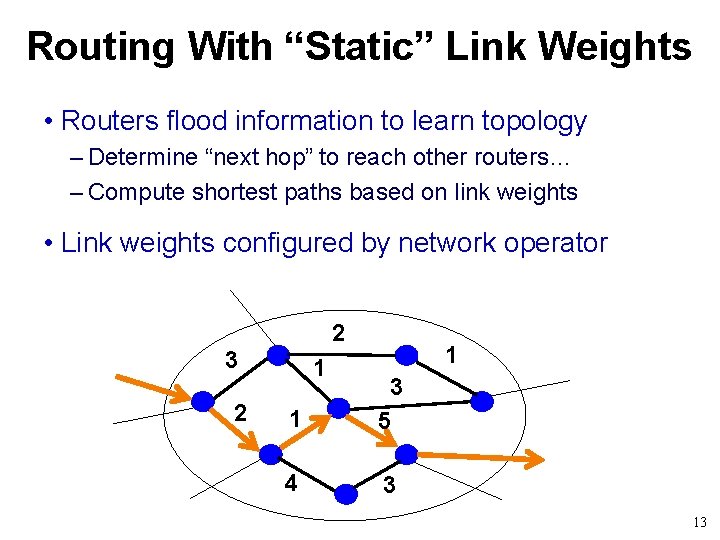
Routing With “Static” Link Weights • Routers flood information to learn topology – Determine “next hop” to reach other routers… – Compute shortest paths based on link weights • Link weights configured by network operator 2 3 2 1 1 1 3 5 4 3 13
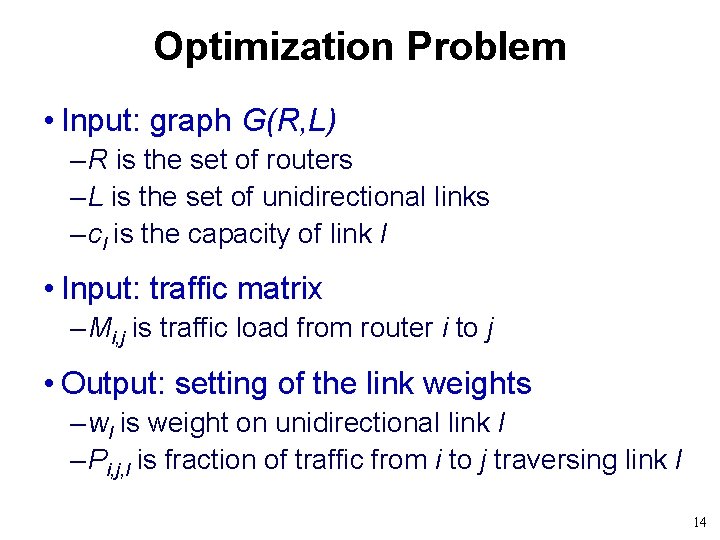
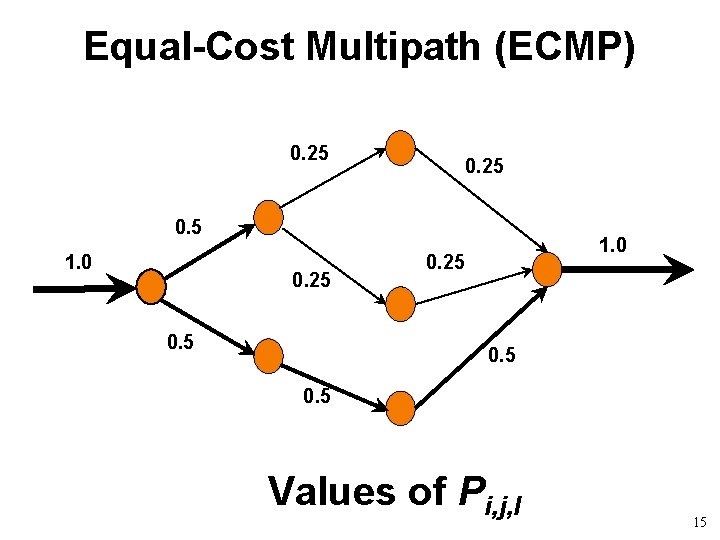
Optimization Problem • Input: graph G(R, L) – R is the set of routers – L is the set of unidirectional links – cl is the capacity of link l • Input: traffic matrix – Mi, j is traffic load from router i to j • Output: setting of the link weights – wl is weight on unidirectional link l – Pi, j, l is fraction of traffic from i to j traversing link l 14
Equal-Cost Multipath (ECMP) 0. 25 0. 5 1. 0 0. 25 0. 5 Values of Pi, j, l 15
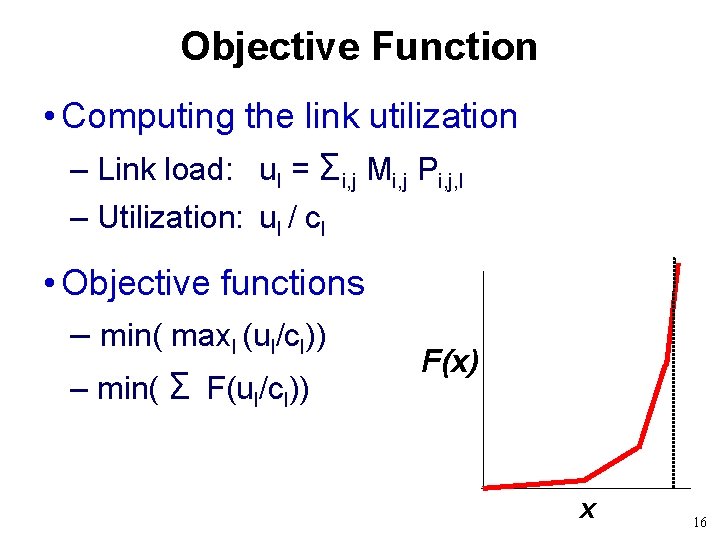
Objective Function • Computing the link utilization – Link load: ul = Σi, j Mi, j Pi, j, l – Utilization: ul / cl • Objective functions – min( maxl (ul/cl)) – min( Σ F(ul/cl)) F(x) x 16
Complexity of Optimization Problem • NP-complete optimization problem – No efficient algorithm to find the link weights – Even for simple objective functions – Have to resort to searching through weight settings • Clearly suboptimal, but effective in practice – Fast computation of the link weights – Good performance, compared to “optimal” solution 17
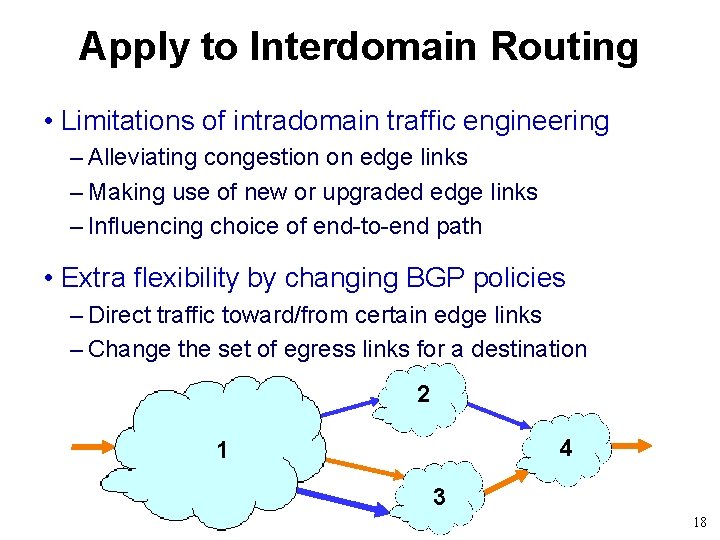
Apply to Interdomain Routing • Limitations of intradomain traffic engineering – Alleviating congestion on edge links – Making use of new or upgraded edge links – Influencing choice of end-to-end path • Extra flexibility by changing BGP policies – Direct traffic toward/from certain edge links – Change the set of egress links for a destination 2 4 1 3 18
Multipath Load Balancing 19
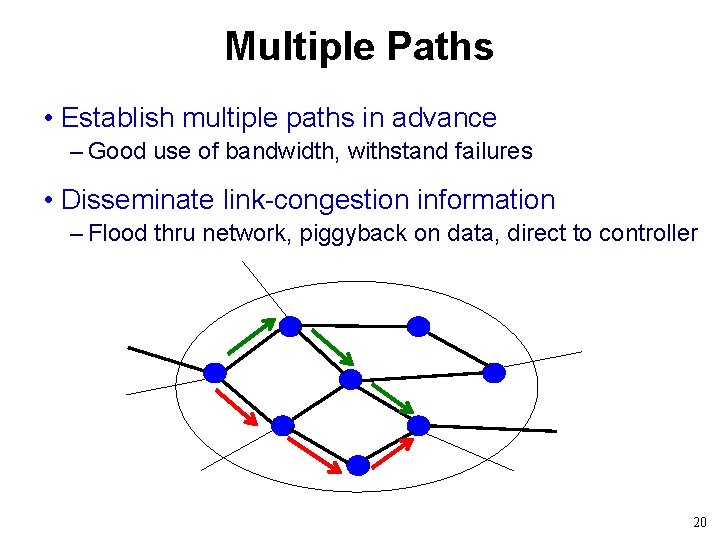
Multiple Paths • Establish multiple paths in advance – Good use of bandwidth, withstand failures • Disseminate link-congestion information – Flood thru network, piggyback on data, direct to controller 20
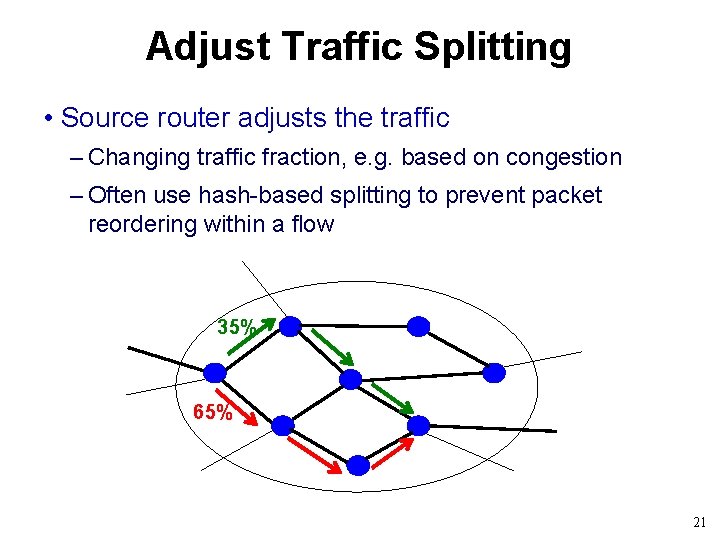
Adjust Traffic Splitting • Source router adjusts the traffic – Changing traffic fraction, e. g. based on congestion – Often use hash-based splitting to prevent packet reordering within a flow 35% 65% 21
Stub Traffic Engineering 22
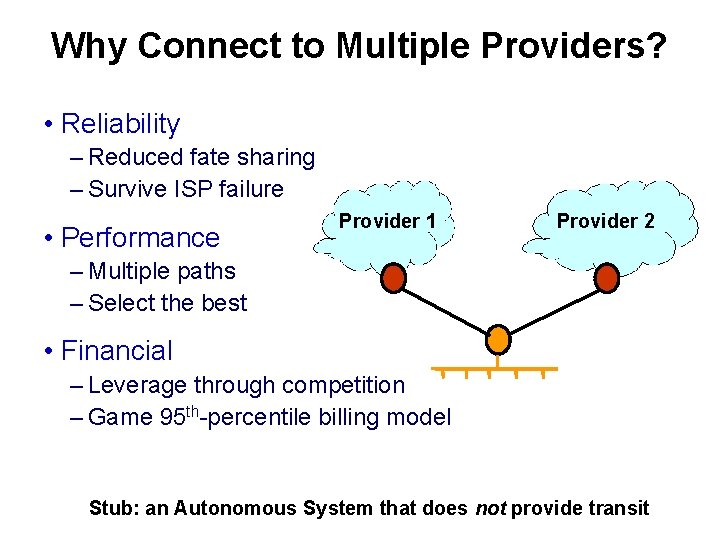
Why Connect to Multiple Providers? • Reliability – Reduced fate sharing – Survive ISP failure • Performance Provider 1 Provider 2 – Multiple paths – Select the best • Financial – Leverage through competition – Game 95 th-percentile billing model Stub: an Autonomous System that does not provide transit
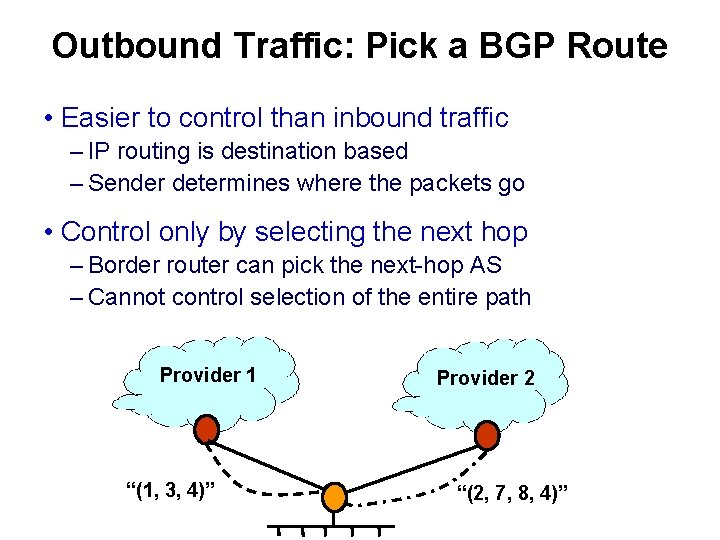
Outbound Traffic: Pick a BGP Route • Easier to control than inbound traffic – IP routing is destination based – Sender determines where the packets go • Control only by selecting the next hop – Border router can pick the next-hop AS – Cannot control selection of the entire path Provider 1 “(1, 3, 4)” Provider 2 “(2, 7, 8, 4)”
Choosing Outbound Traffic • Primary and Backup – Single policy for all prefixes High local-pref for session to primary provider Low local-pref for session to backup provider – Outcome of BGP decision process Choose the primary provider whenever possible Use the backup provider when necessary • Load Balancing: Selectively use each provider – Assign local-pref across destination prefixes – Change the local-pref assignments over time
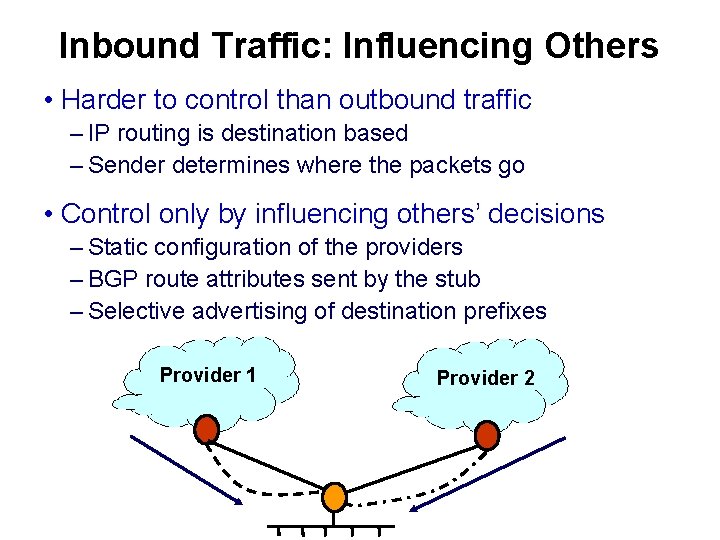
Inbound Traffic: Influencing Others • Harder to control than outbound traffic – IP routing is destination based – Sender determines where the packets go • Control only by influencing others’ decisions – Static configuration of the providers – BGP route attributes sent by the stub – Selective advertising of destination prefixes Provider 1 Provider 2
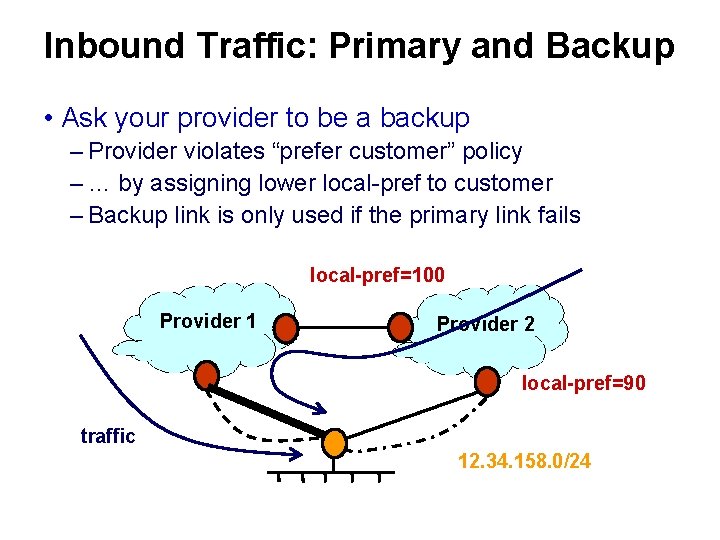
Inbound Traffic: Primary and Backup • Ask your provider to be a backup – Provider violates “prefer customer” policy – … by assigning lower local-pref to customer – Backup link is only used if the primary link fails local-pref=100 Provider 1 Provider 2 local-pref=90 traffic 12. 34. 158. 0/24
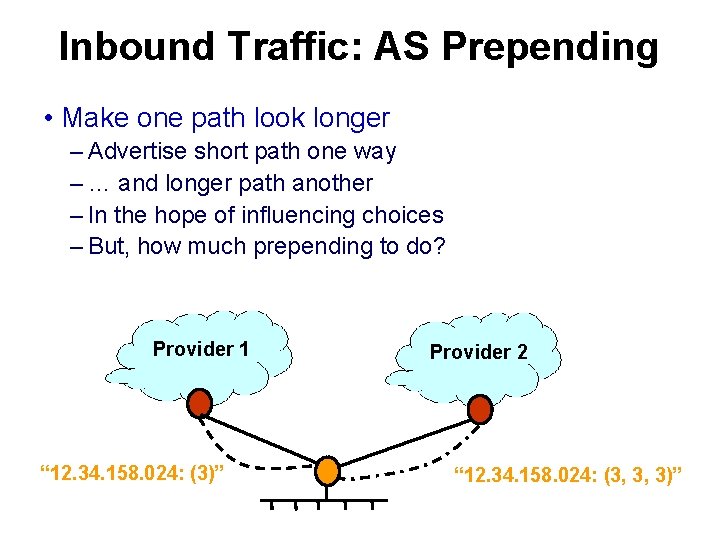
Inbound Traffic: AS Prepending • Make one path look longer – Advertise short path one way – … and longer path another – In the hope of influencing choices – But, how much prepending to do? Provider 1 “ 12. 34. 158. 024: (3)” Provider 2 “ 12. 34. 158. 024: (3, 3, 3)”
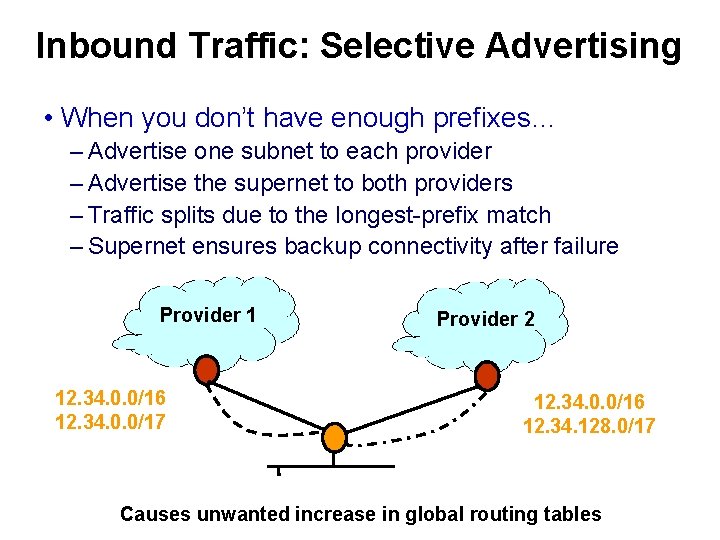
Inbound Traffic: Selective Advertising • When you don’t have enough prefixes… – Advertise one subnet to each provider – Advertise the supernet to both providers – Traffic splits due to the longest-prefix match – Supernet ensures backup connectivity after failure Provider 1 12. 34. 0. 0/16 12. 34. 0. 0/17 Provider 2 12. 34. 0. 0/16 12. 34. 128. 0/17 Causes unwanted increase in global routing tables
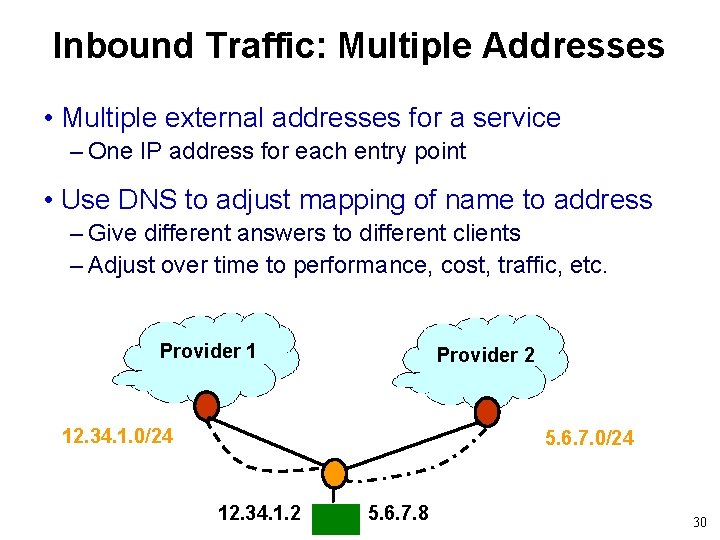
Inbound Traffic: Multiple Addresses • Multiple external addresses for a service – One IP address for each entry point • Use DNS to adjust mapping of name to address – Give different answers to different clients – Adjust over time to performance, cost, traffic, etc. Provider 1 Provider 2 12. 34. 1. 0/24 5. 6. 7. 0/24 12. 34. 1. 2 5. 6. 7. 8 30
Papers • MONET: Multi-homed clients • Entact: Multi-homed online service providers (datacenters + private backbone) 31