
Thyroid Function tests Dr Danielle B Freedman please
Thyroid Function tests Dr Danielle B Freedman please see January 2015 PULSE p 50 - 51 April 2018
Incidence of Thyroid disease Hypothyroidism Ø Spontaneous 2%, 10 Females : 1 Male Ø Another 1% due to destructive treatment for Hyperthyroidism Ø Congenital Hypothyroidism 1/4000 births Hyperthyroidism Ø 0. 5 – 2%, 10 Females : 1 Male

Important Clinical Manifestations Hyperthyroidism • 5 -10% of patients with thyrotoxicosis have Atrial Fibrillation • Correctable cause of osteoporosis • Associated with menstrual irregularity, subfertility and foetal loss Hypothyroidism • Well recognised secondary cause of hyperlipidaemia • Associated with menstrual irregularity, subfertility and foetal loss
Causes of Hyperthyroidism • • • Grave’s disease Account for Toxic Mutinodular goitre >90% cases Solitary toxic adenoma Thyroiditis Exogenous iodine and iodine-containing drugs eg amiodarone Excessive T 4 or T 3 ingestion Ectopic thyroid tissue, eg struma ovarii, functioning metastatic thryoid cancer h. CG dependent: choriocarcinoma TSH dependent: pituitary tumour
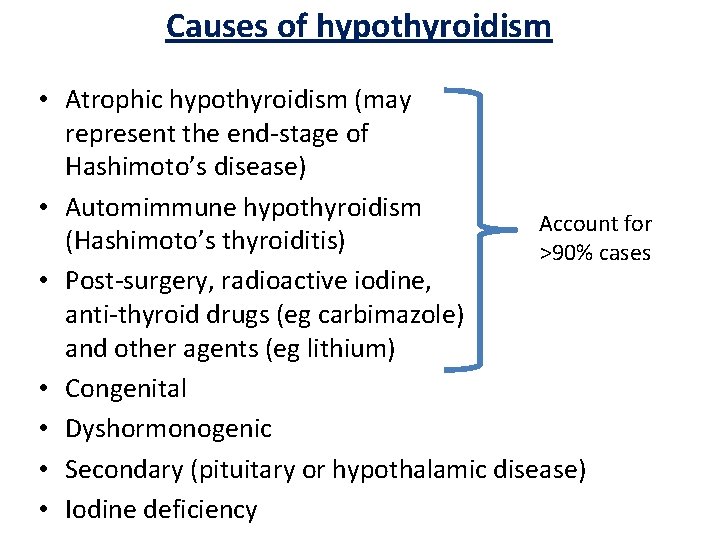
Causes of hypothyroidism • Atrophic hypothyroidism (may represent the end-stage of Hashimoto’s disease) • Automimmune hypothyroidism Account for (Hashimoto’s thyroiditis) >90% cases • Post-surgery, radioactive iodine, anti-thyroid drugs (eg carbimazole) and other agents (eg lithium) • Congenital • Dyshormonogenic • Secondary (pituitary or hypothalamic disease) • Iodine deficiency

Drugs and thyroid disease Amiodarone • Hyperthyroidism (iodine deficient) 10% • Hypothyroidism (iodine replete) 20% Lithium • Hypothyroidism: Mild 34% Overt 15% Monitoring for patients taking either drug • 6 monthly TFT’s • 12 monthly review
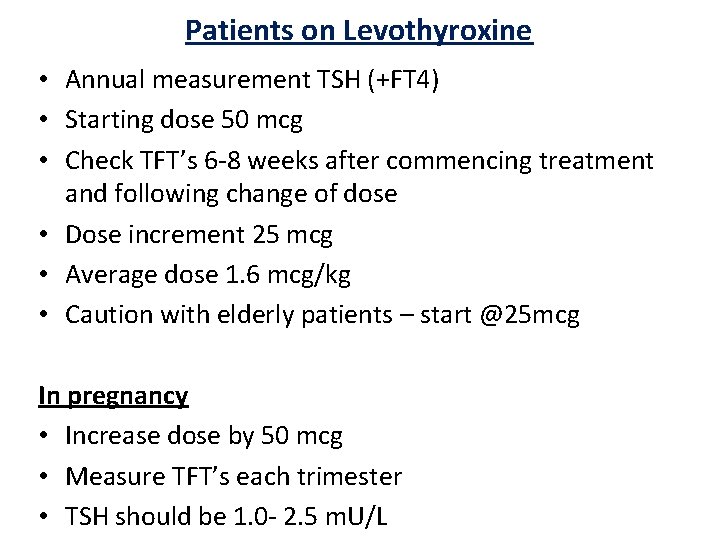
Patients on Levothyroxine • Annual measurement TSH (+FT 4) • Starting dose 50 mcg • Check TFT’s 6 -8 weeks after commencing treatment and following change of dose • Dose increment 25 mcg • Average dose 1. 6 mcg/kg • Caution with elderly patients – start @25 mcg In pregnancy • Increase dose by 50 mcg • Measure TFT’s each trimester • TSH should be 1. 0 - 2. 5 m. U/L
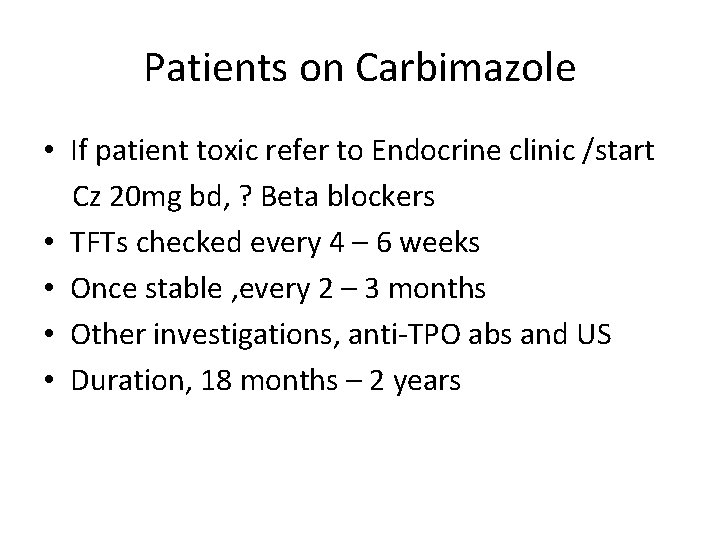
Patients on Carbimazole • If patient toxic refer to Endocrine clinic /start Cz 20 mg bd, ? Beta blockers • TFTs checked every 4 – 6 weeks • Once stable , every 2 – 3 months • Other investigations, anti-TPO abs and US • Duration, 18 months – 2 years

Thyroid disorders in pregnancy and the post partum period
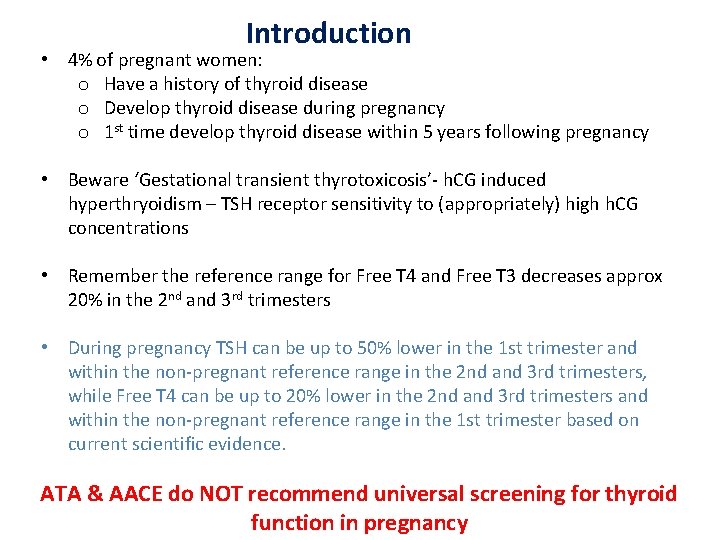
Introduction • 4% of pregnant women: o Have a history of thyroid disease o Develop thyroid disease during pregnancy o 1 st time develop thyroid disease within 5 years following pregnancy • Beware ‘Gestational transient thyrotoxicosis’- h. CG induced hyperthryoidism – TSH receptor sensitivity to (appropriately) high h. CG concentrations • Remember the reference range for Free T 4 and Free T 3 decreases approx 20% in the 2 nd and 3 rd trimesters • During pregnancy TSH can be up to 50% lower in the 1 st trimester and within the non-pregnant reference range in the 2 nd and 3 rd trimesters, while Free T 4 can be up to 20% lower in the 2 nd and 3 rd trimesters and within the non-pregnant reference range in the 1 st trimester based on current scientific evidence. ATA & AACE do NOT recommend universal screening for thyroid function in pregnancy
Hypothyroidism in pregnancy • 2 -3% of iodine-sufficient pregnant women will have undiagnosed hypothyroidism – mostly subclinical • Main cause in iodine sufficient is chronic autoimmune thyroiditis • 10 -20% of women of child bearing age have positive anti-TPO antibodies • Untreated overt hypothyroidism is associated with: o Increased risk of miscarriage o Preterm delivery o PET o Neonatal mortality o Low birth weight o Decreased IQ

Treatment and monitoring in pregnancy • ATA recommend diagnosis of hypothryoidism in all pregnant women with; - a TSH > reference interval and a low FT 4 - All with TSH > 10 m. U/L irrespective of FT 4 • In women with subclinical hypothryoidism who are not initially treated; ATA recommends monitoring FT 4 and TSH every 4 weeks until 16 -20/40 and once between 26/40 - 32/40 weeks gestation • Dosage of levothyroxine will go up during pregnancy ( 30 -50%) • Aim for TSH 1. 0 – 2. 5 m. U/L, monitor TSH as above • Post partum revert back to original dosage and check TFT’s 6 weeks post partum
Thyrotoxicosis in pregnancy • Grave’s disease occurs in 0. 1 -1% of all pregnancies • Transient gestational hyperthyroidism can occur in the 1 st trimester (prevalence 2 -3 %) • In patients with Grave’s: ü Monitor TFT’s every 4 -6 weeks ü TRAb at 24 weeks – can cross the placenta and cause foetal and neontal hyperthryoidism (<1%) • Uncontrolled Grave’s: o Foetal loss o PET o Miscarriage o Premature labour o CCF o Thyroid storm
Treatment of thyrotoxicosis in pregnancy • 1 st trimester PTU • 2 nd and 3 rd trimester PTU/CBZ • Block replacement and I 131: CONTRAINDICATED • Aim to keep: FT 4 in within or slightly above reference range TSH within the reference range • 30 -40% of women are able to remain euthyroid without treatment in the last few weeks of pregnancy • Can relapse post partum • Breast-feeding is ok if the dose of PTU < 300 mg/day CBZ < 30 mg/day
Post partum thyroiditis • May be difficult to distinguish from Grave’s • 4 -9% of women develop post partum thyroiditis • Positive Anti-TPO antibodies (which rise in titre 6 weeks PP) • Can be transiently hyperthyroid (unless Grave’s) – do not treat with antithyroid drugs • Can become transiently hypothryoid or permanent (20 - 30%) • If ‘transient’ check TFT’s annually – can recur with subsequent pregnancy
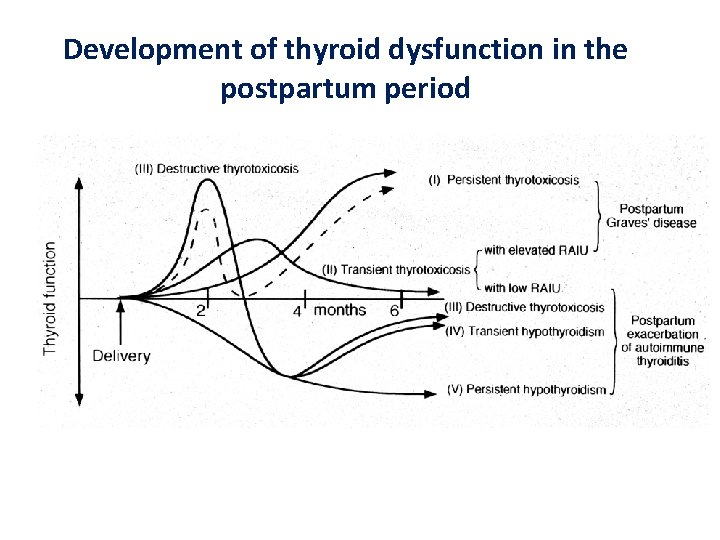
Development of thyroid dysfunction in the postpartum period
Adapted from the ACB/RCPath ‘Minimum Retesting Intervals’ 2016
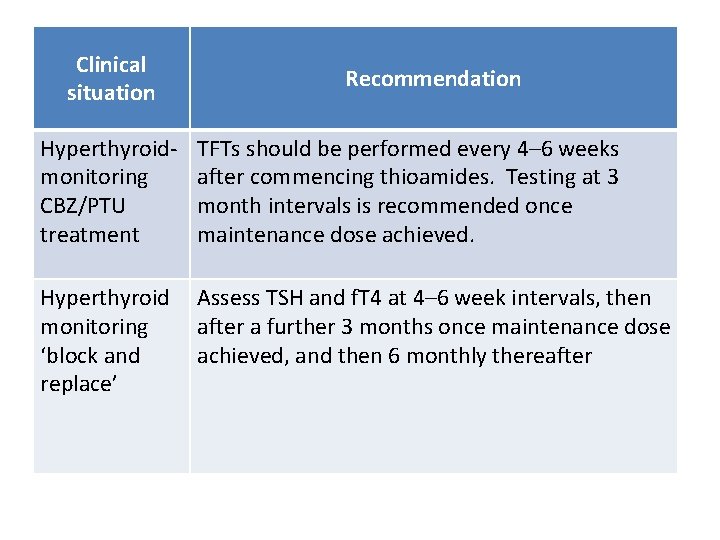
Clinical situation Recommendation Hyperthyroidmonitoring CBZ/PTU treatment TFTs should be performed every 4– 6 weeks after commencing thioamides. Testing at 3 month intervals is recommended once maintenance dose achieved. Hyperthyroid monitoring ‘block and replace’ Assess TSH and f. T 4 at 4– 6 week intervals, then after a further 3 months once maintenance dose achieved, and then 6 monthly thereafter
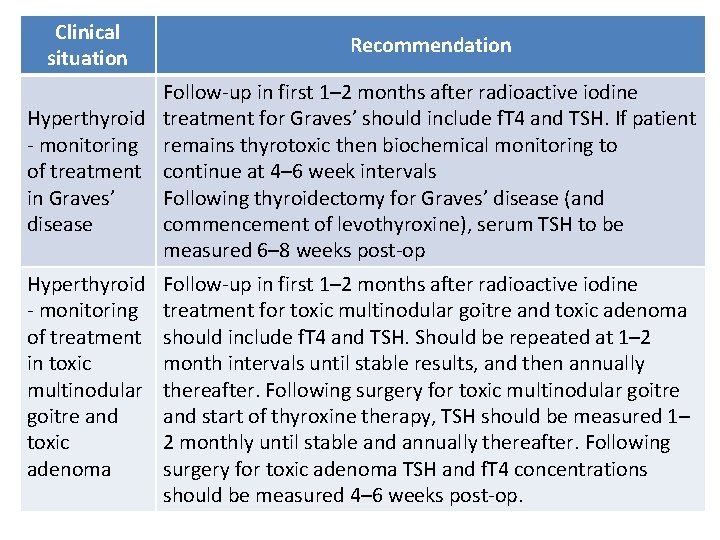
Clinical situation Recommendation Follow-up in first 1– 2 months after radioactive iodine Hyperthyroid treatment for Graves’ should include f. T 4 and TSH. If patient - monitoring remains thyrotoxic then biochemical monitoring to of treatment continue at 4– 6 week intervals in Graves’ Following thyroidectomy for Graves’ disease (and disease commencement of levothyroxine), serum TSH to be measured 6– 8 weeks post-op Hyperthyroid - monitoring of treatment in toxic multinodular goitre and toxic adenoma Follow-up in first 1– 2 months after radioactive iodine treatment for toxic multinodular goitre and toxic adenoma should include f. T 4 and TSH. Should be repeated at 1– 2 month intervals until stable results, and then annually thereafter. Following surgery for toxic multinodular goitre and start of thyroxine therapy, TSH should be measured 1– 2 monthly until stable and annually thereafter. Following surgery for toxic adenoma TSH and f. T 4 concentrations should be measured 4– 6 weeks post-op.
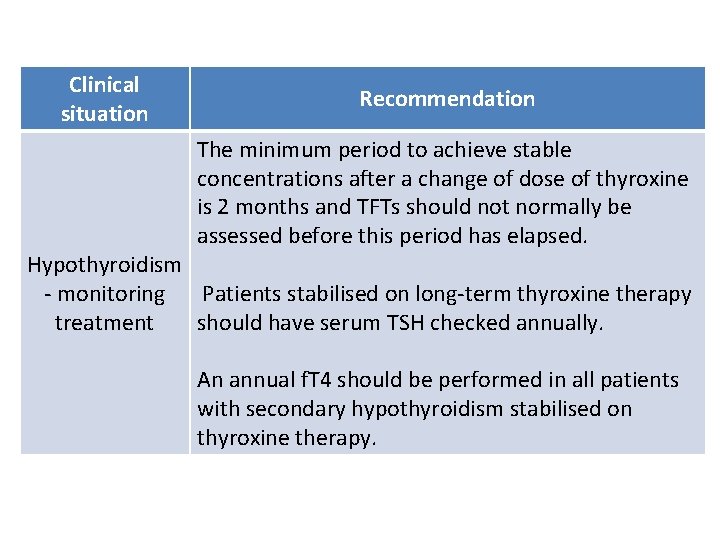
Clinical situation Recommendation The minimum period to achieve stable concentrations after a change of dose of thyroxine is 2 months and TFTs should not normally be assessed before this period has elapsed. Hypothyroidism - monitoring Patients stabilised on long-term thyroxine therapy treatment should have serum TSH checked annually. An annual f. T 4 should be performed in all patients with secondary hypothyroidism stabilised on thyroxine therapy.
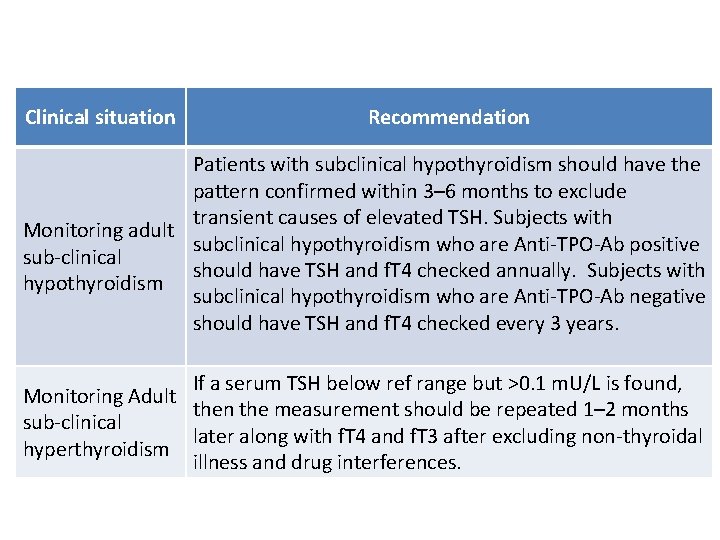
Clinical situation Recommendation Patients with subclinical hypothyroidism should have the pattern confirmed within 3– 6 months to exclude transient causes of elevated TSH. Subjects with Monitoring adult subclinical hypothyroidism who are Anti-TPO-Ab positive sub-clinical should have TSH and f. T 4 checked annually. Subjects with hypothyroidism subclinical hypothyroidism who are Anti-TPO-Ab negative should have TSH and f. T 4 checked every 3 years. If a serum TSH below ref range but >0. 1 m. U/L is found, Monitoring Adult then the measurement should be repeated 1– 2 months sub-clinical later along with f. T 4 and f. T 3 after excluding non-thyroidal hyperthyroidism illness and drug interferences.
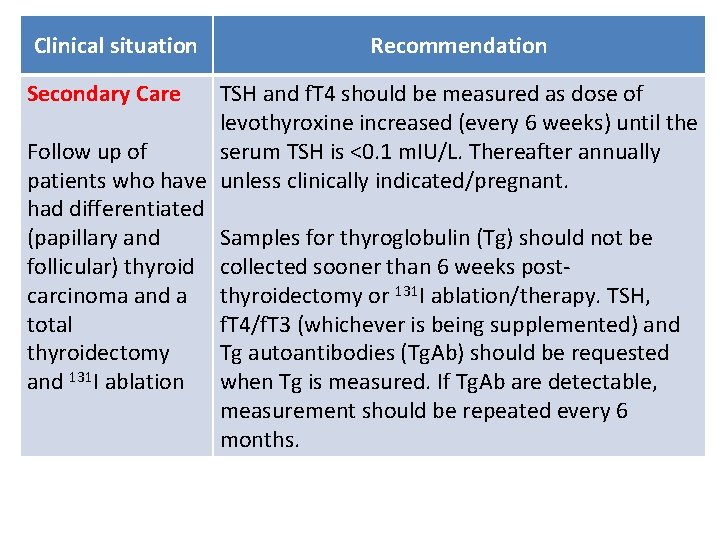
Clinical situation Secondary Care Recommendation TSH and f. T 4 should be measured as dose of levothyroxine increased (every 6 weeks) until the Follow up of serum TSH is <0. 1 m. IU/L. Thereafter annually patients who have unless clinically indicated/pregnant. had differentiated (papillary and Samples for thyroglobulin (Tg) should not be follicular) thyroid collected sooner than 6 weeks postcarcinoma and a thyroidectomy or 131 I ablation/therapy. TSH, total f. T 4/f. T 3 (whichever is being supplemented) and thyroidectomy Tg autoantibodies (Tg. Ab) should be requested and 131 I ablation when Tg is measured. If Tg. Ab are detectable, measurement should be repeated every 6 months.
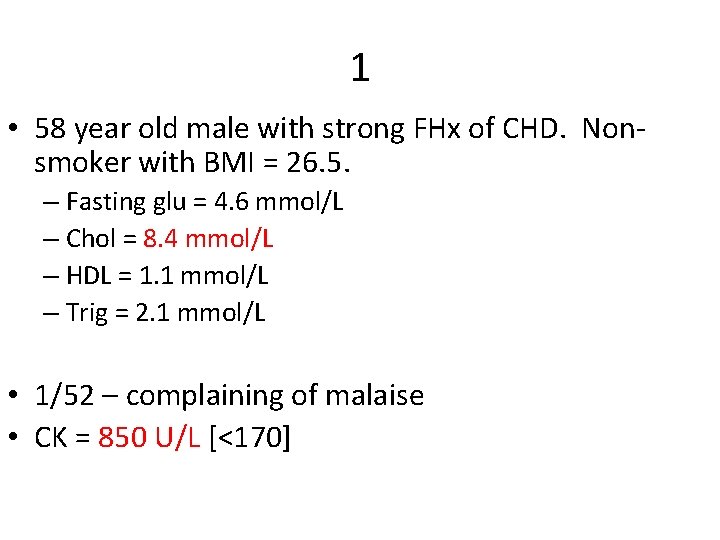
1 • 58 year old male with strong FHx of CHD. Nonsmoker with BMI = 26. 5. – Fasting glu = 4. 6 mmol/L – Chol = 8. 4 mmol/L – HDL = 1. 1 mmol/L – Trig = 2. 1 mmol/L • 1/52 – complaining of malaise • CK = 850 U/L [<170]
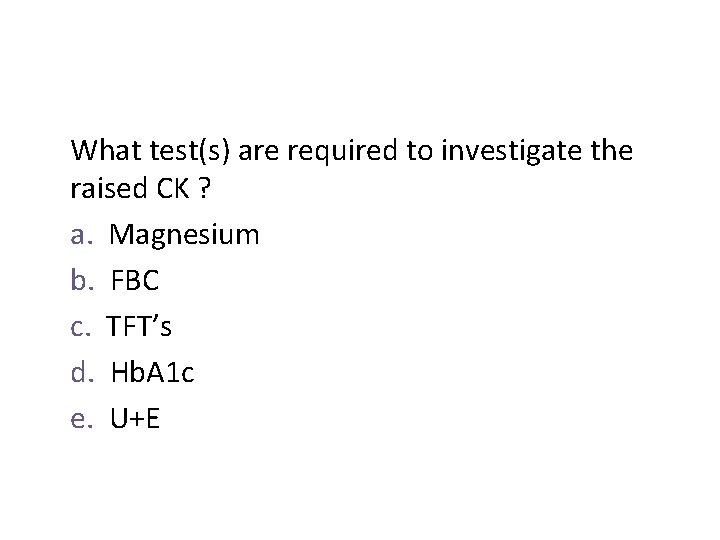
What test(s) are required to investigate the raised CK ? a. Magnesium b. FBC c. TFT’s d. Hb. A 1 c e. U+E

a. TFT
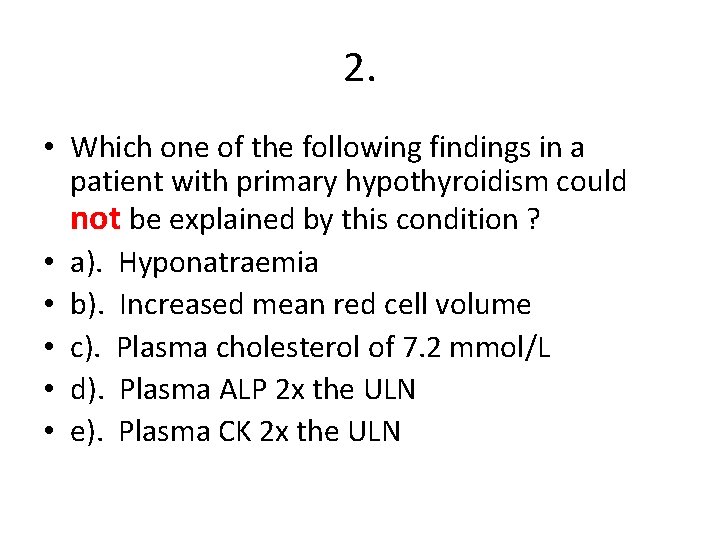
2. • Which one of the following findings in a patient with primary hypothyroidism could not be explained by this condition ? • a). Hyponatraemia • b). Increased mean red cell volume • c). Plasma cholesterol of 7. 2 mmol/L • d). Plasma ALP 2 x the ULN • e). Plasma CK 2 x the ULN

• d). Plasma ALP 2 x the ULN
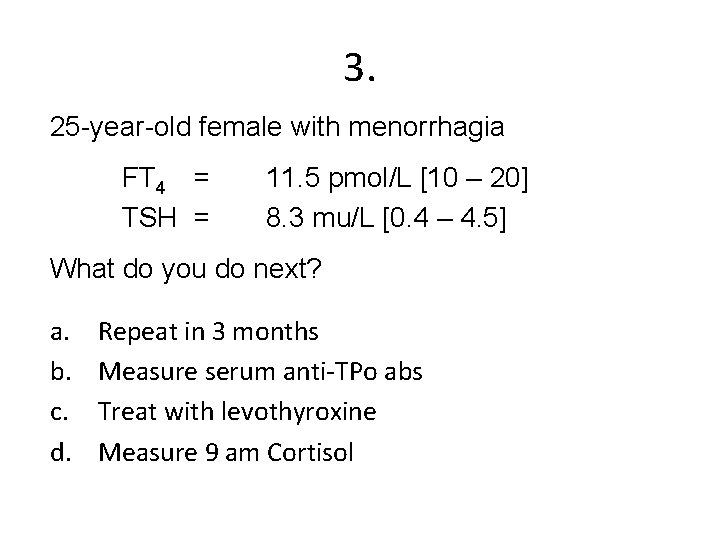
3. 25 -year-old female with menorrhagia FT 4 = TSH = 11. 5 pmol/L [10 – 20] 8. 3 mu/L [0. 4 – 4. 5] What do you do next? a. b. c. d. Repeat in 3 months Measure serum anti-TPo abs Treat with levothyroxine Measure 9 am Cortisol
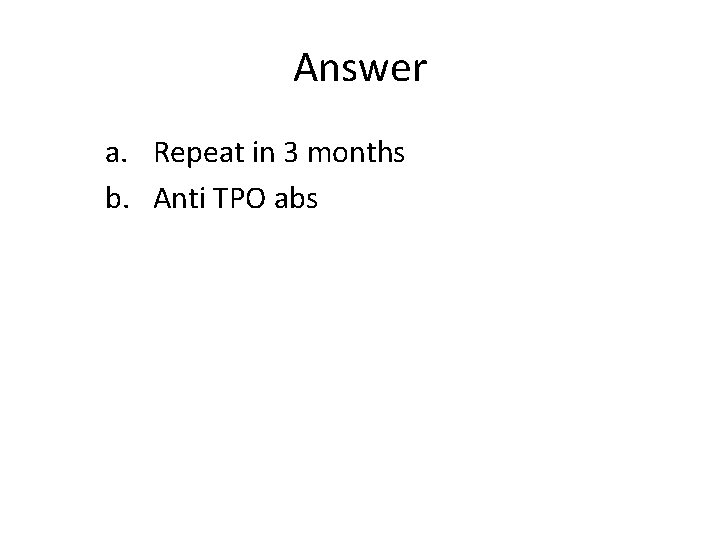
Answer a. Repeat in 3 months b. Anti TPO abs
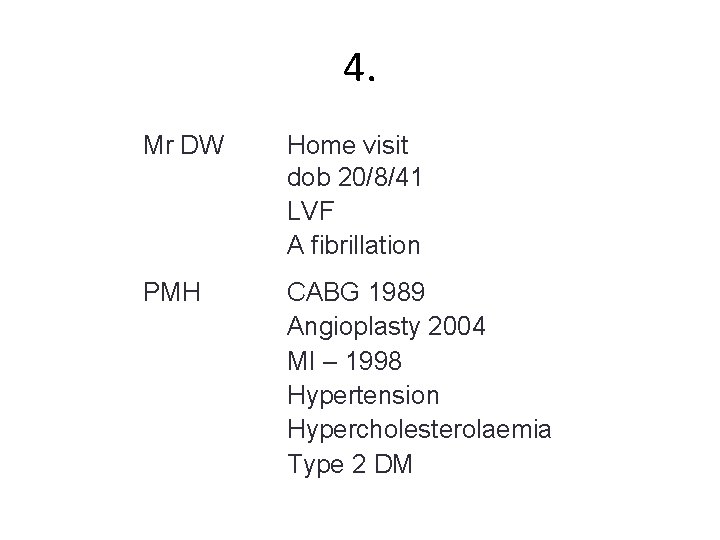
4. Mr DW Home visit dob 20/8/41 LVF A fibrillation PMH CABG 1989 Angioplasty 2004 MI – 1998 Hypertension Hypercholesterolaemia Type 2 DM
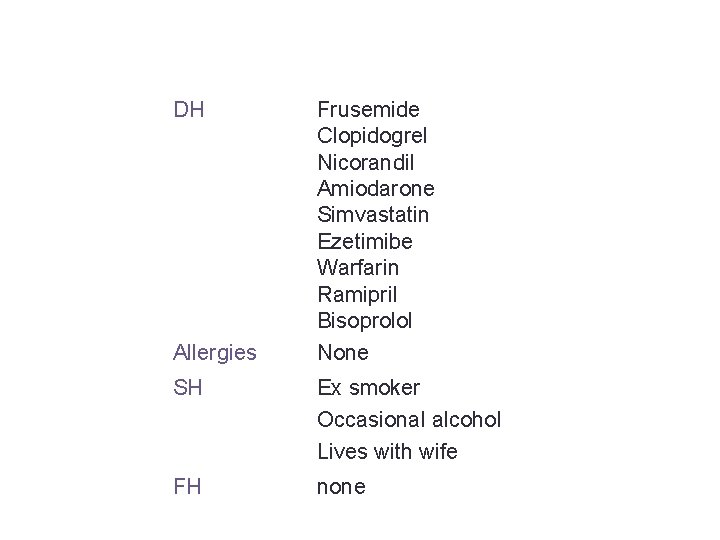
DH Allergies Frusemide Clopidogrel Nicorandil Amiodarone Simvastatin Ezetimibe Warfarin Ramipril Bisoprolol None SH Ex smoker Occasional alcohol Lives with wife FH none
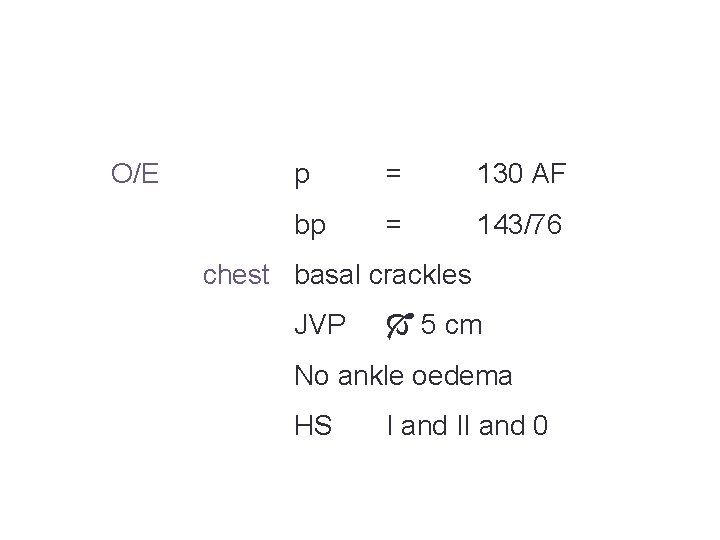
O/E p = 130 AF bp = 143/76 chest basal crackles JVP 5 cm No ankle oedema HS I and II and 0
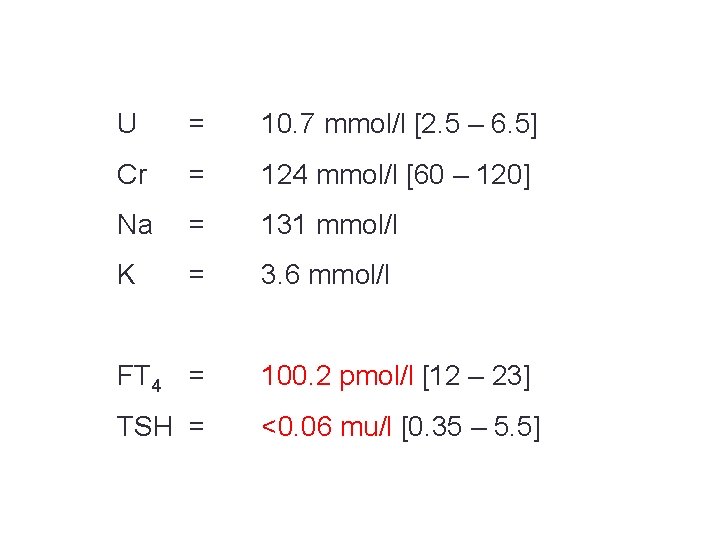
U = 10. 7 mmol/l [2. 5 – 6. 5] Cr = 124 mmol/l [60 – 120] Na = 131 mmol/l K = 3. 6 mmol/l FT 4 = 100. 2 pmol/l [12 – 23] TSH = <0. 06 mu/l [0. 35 – 5. 5]
Question In addition to treating his AF and LVF, how do you think the patient’s deranged thyroid function should be treated? interactive a. b. c. d. Do nothing Stop Amiodarone Start Propylthiouracil Treat with radioactive iodine
Answer b. Stop Amiodarone c. PTU
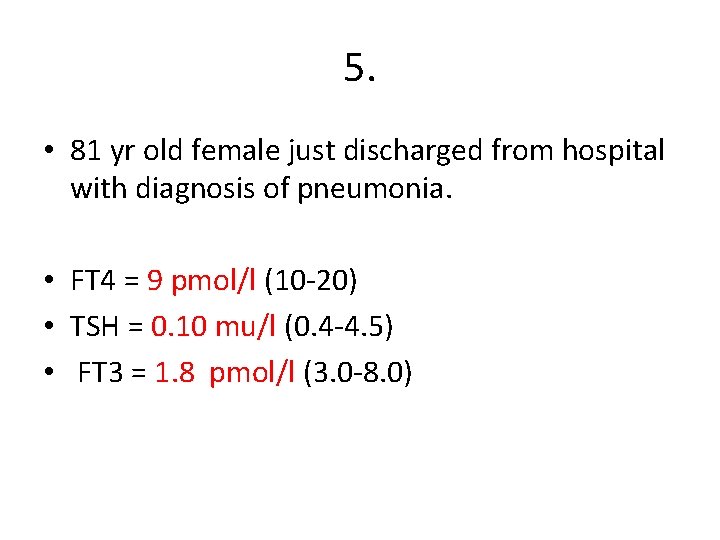
5. • 81 yr old female just discharged from hospital with diagnosis of pneumonia. • FT 4 = 9 pmol/l (10 -20) • TSH = 0. 10 mu/l (0. 4 -4. 5) • FT 3 = 1. 8 pmol/l (3. 0 -8. 0)
What would you do next ? • a) Nothing • b) Treat with carbimazole • c) Treat with levothyroxine • d) repeat TFTs in 4 weeks
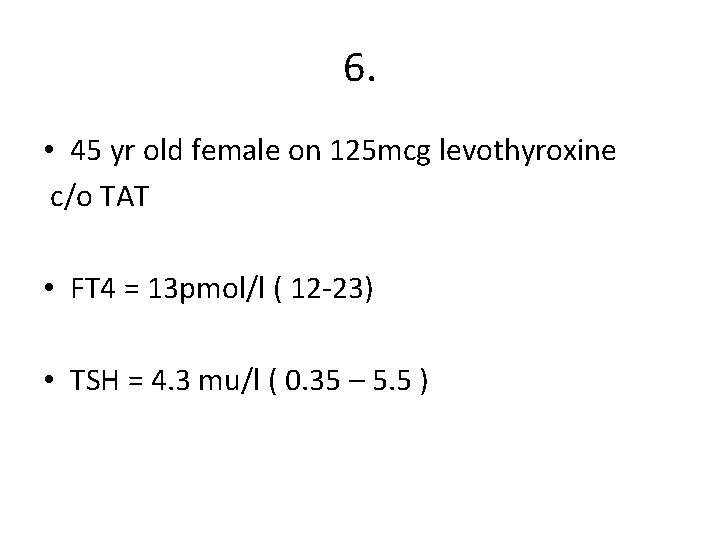
6. • 45 yr old female on 125 mcg levothyroxine c/o TAT • FT 4 = 13 pmol/l ( 12 -23) • TSH = 4. 3 mu/l ( 0. 35 – 5. 5 )
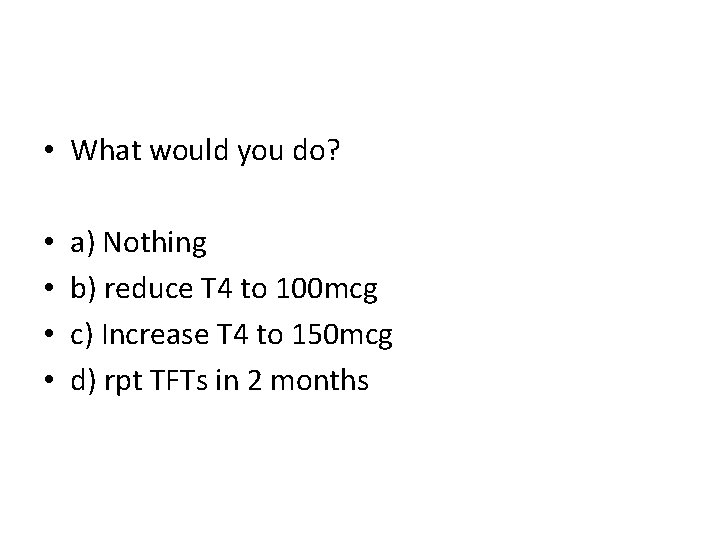
• What would you do? • • a) Nothing b) reduce T 4 to 100 mcg c) Increase T 4 to 150 mcg d) rpt TFTs in 2 months
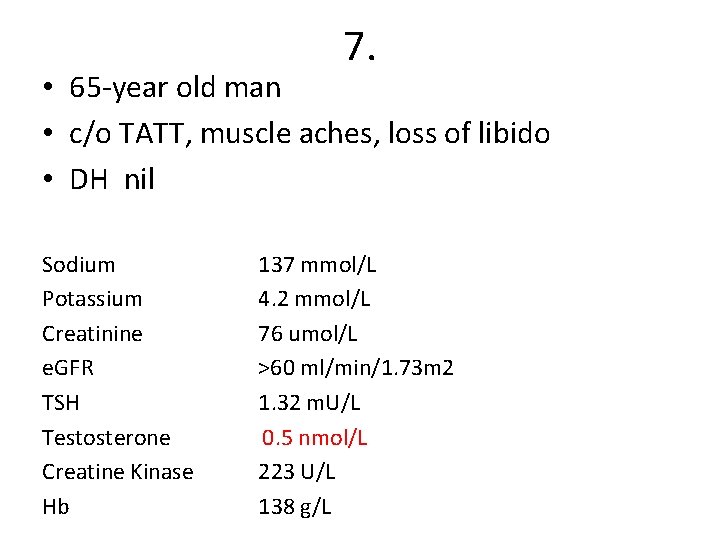
7. • 65 -year old man • c/o TATT, muscle aches, loss of libido • DH nil Sodium 137 mmol/L Potassium 4. 2 mmol/L Creatinine 76 umol/L e. GFR >60 ml/min/1. 73 m 2 TSH 1. 32 m. U/L Testosterone 0. 5 nmol/L Creatine Kinase 223 U/L Hb 138 g/L
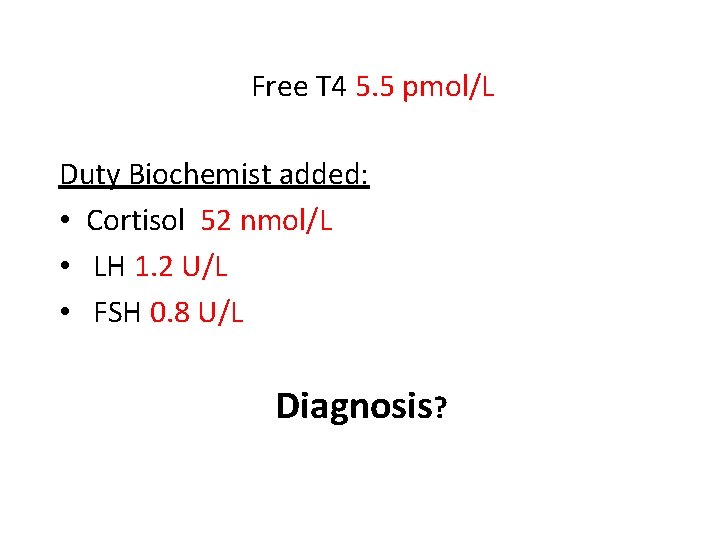
Free T 4 5. 5 pmol/L Duty Biochemist added: • Cortisol 52 nmol/L • LH 1. 2 U/L • FSH 0. 8 U/L Diagnosis?
What most determines a clinician’s test ordering? 1. Fear of litigation 2. Cost of test 3. Evidence based guidelines 4. Patient went to Lab Tests Online 5. Watched an episode of ‘House’ last night
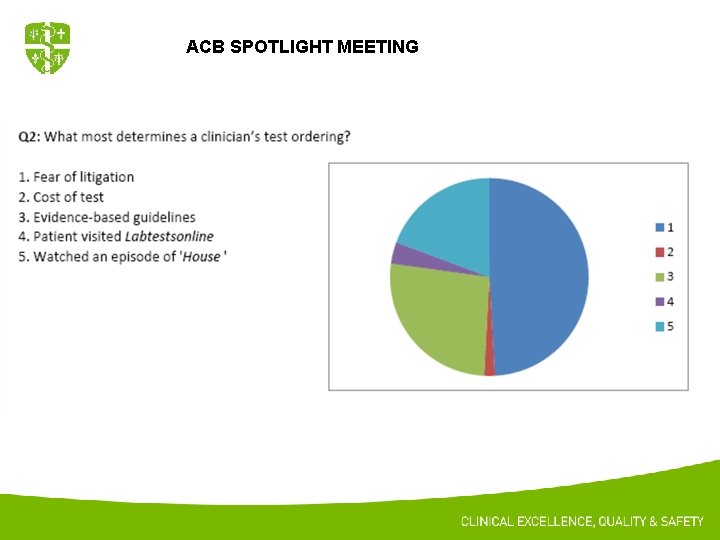
ACB SPOTLIGHT MEETING
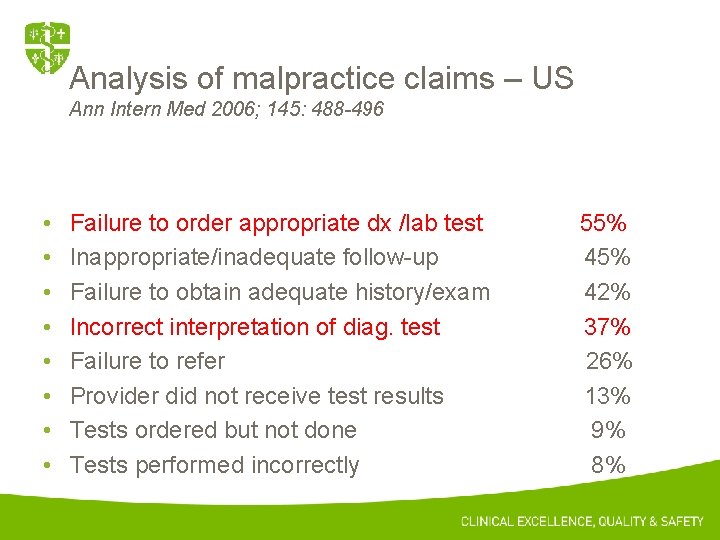
Analysis of malpractice claims – US Ann Intern Med 2006; 145: 488 -496 Faulty process leading to missed diagnosis: • • Failure to order appropriate dx /lab test Inappropriate/inadequate follow-up Failure to obtain adequate history/exam Incorrect interpretation of diag. test Failure to refer Provider did not receive test results Tests ordered but not done Tests performed incorrectly 55% 42% 37% 26% 13% 9% 8%
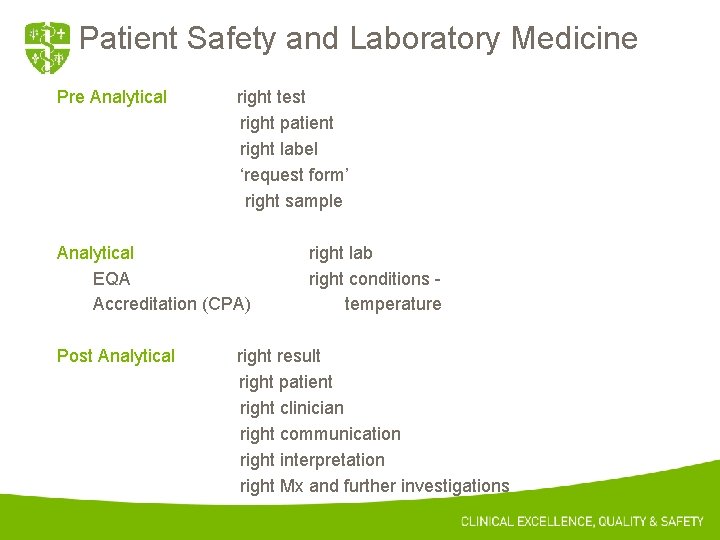
Patient Safety and Laboratory Medicine Pre Analytical right test right patient right label ‘request form’ right sample Analytical EQA Accreditation (CPA) Post Analytical right lab right conditions temperature right result right patient right clinician right communication right interpretation right Mx and further investigations
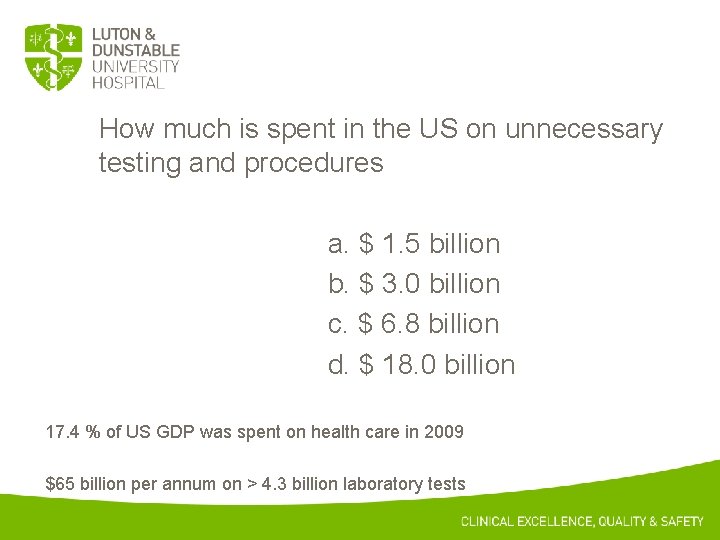
How much is spent in the US on unnecessary testing and procedures a. $ 1. 5 billion b. $ 3. 0 billion c. $ 6. 8 billion d. $ 18. 0 billion 17. 4 % of US GDP was spent on health care in 2009 $65 billion per annum on > 4. 3 billion laboratory tests

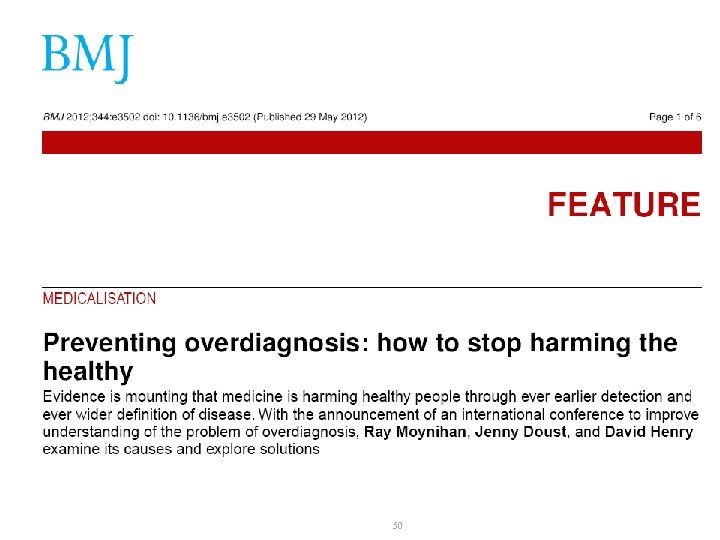
50
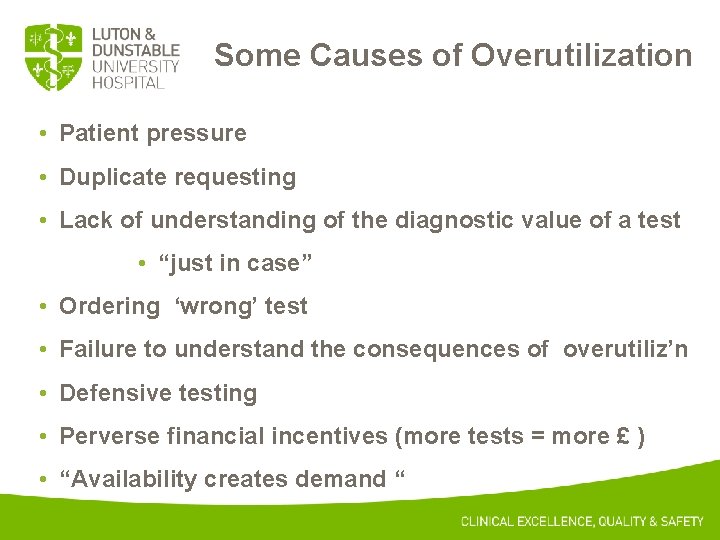
Some Causes of Overutilization • Patient pressure • Duplicate requesting • Lack of understanding of the diagnostic value of a test • “just in case” • Ordering ‘wrong’ test • Failure to understand the consequences of overutiliz’n • Defensive testing • Perverse financial incentives (more tests = more £ ) • “Availability creates demand “
• • Laboratory investigations £ 2. 5 billion / year Approximately 4% of total NHS expenditure Annual increase in workload 8 -10% 25% of pathology tests unnecessary • Department of Health Independent Review of Pathology Services 2009 • BUT same amount of under requesting? • 30% “Consensus” estimate AACC Webinar 26 th Oct 2010 • ”
Which points in the process have the highest incidence of errors? Test selection by clinicians? Interpretation of test results by clinicians? Yes Laposata, 2008
Types and frequency of errors in the different phases of the TTP Phase of the TTP Relative Frequency (%) Pre-pre-analytic 46 – 68. 2 Wrong test choice accounts for up to 50 – 60% of missed / delayed diagnoses Approx 30% of total laboratory medicine errors have direct impact on patient care, and 2. 7%-12% cause an adverse event. Plebani Ann Clin Biochem 2010, 47: 101 -110
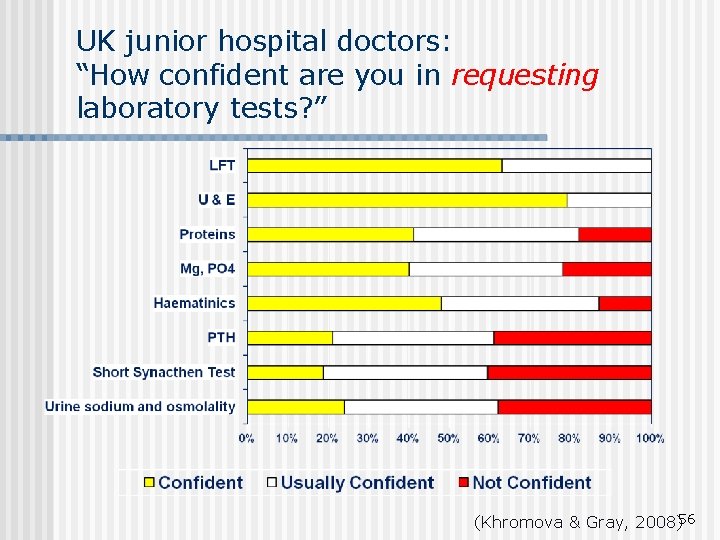
UK junior hospital doctors: “How confident are you in requesting laboratory tests? ” (Khromova & Gray, 2008)56
How confident are you in interpreting laboratory tests?
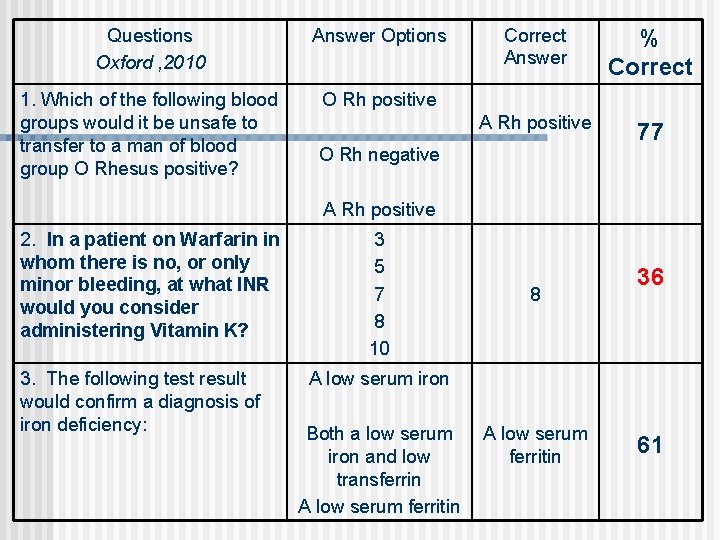
Questions Oxford , 2010 Answer Options 1. Which of the following blood groups would it be unsafe to transfer to a man of blood group O Rhesus positive? O Rh positive Correct Answer % Correct A Rh positive 77 O Rh negative A Rh positive 2. In a patient on Warfarin in whom there is no, or only minor bleeding, at what INR would you consider administering Vitamin K? 3. The following test result would confirm a diagnosis of iron deficiency: 3 5 7 8 10 8 36 A low serum iron Both a low serum iron and low transferrin A low serum ferritin 61
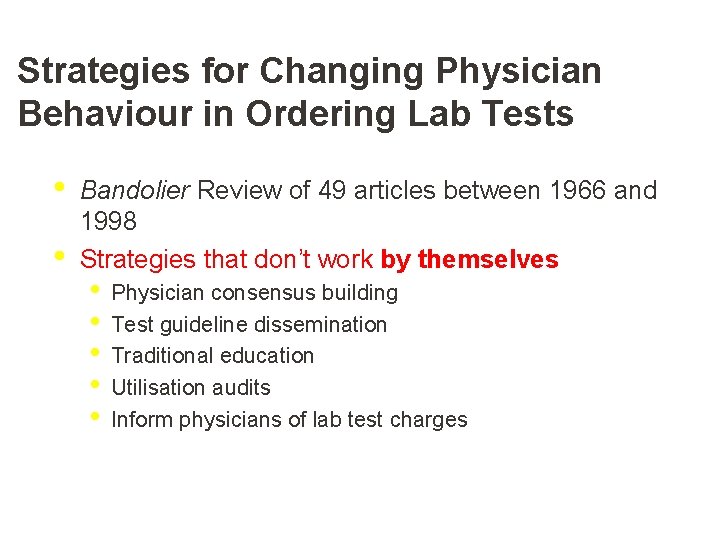
Strategies for Changing Physician Behaviour in Ordering Lab Tests • • Bandolier Review of 49 articles between 1966 and 1998 Strategies that don’t work by themselves • • • Physician consensus building Test guideline dissemination Traditional education Utilisation audits Inform physicians of lab test charges
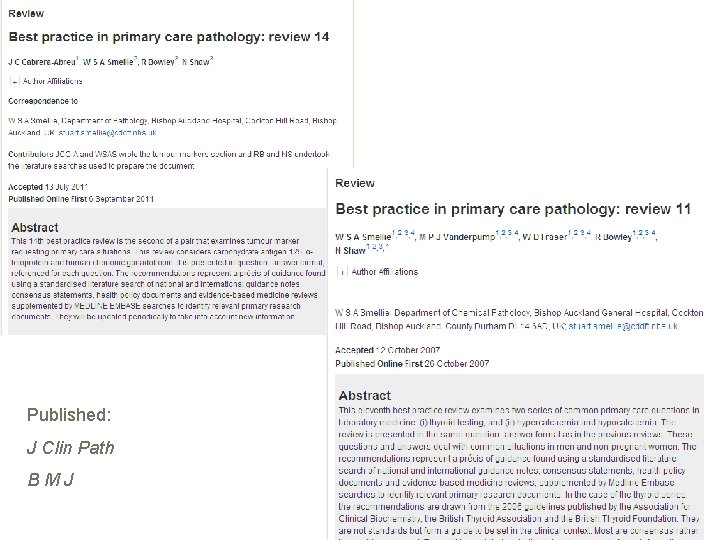
Published: J Clin Path B M JMJ
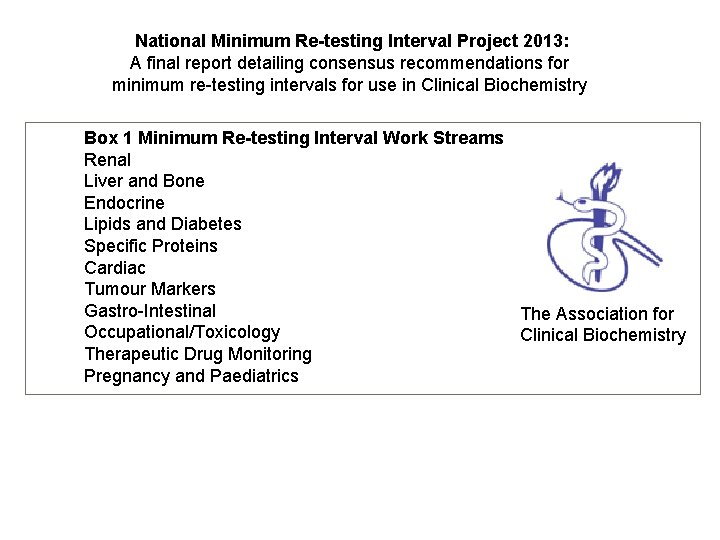
National Minimum Re-testing Interval Project 2013: A final report detailing consensus recommendations for minimum re-testing intervals for use in Clinical Biochemistry Box 1 Minimum Re-testing Interval Work Streams Renal Liver and Bone Endocrine Lipids and Diabetes Specific Proteins Cardiac Tumour Markers Gastro-Intestinal The Association for Occupational/Toxicology Clinical Biochemistry Therapeutic Drug Monitoring Pregnancy and Paediatrics
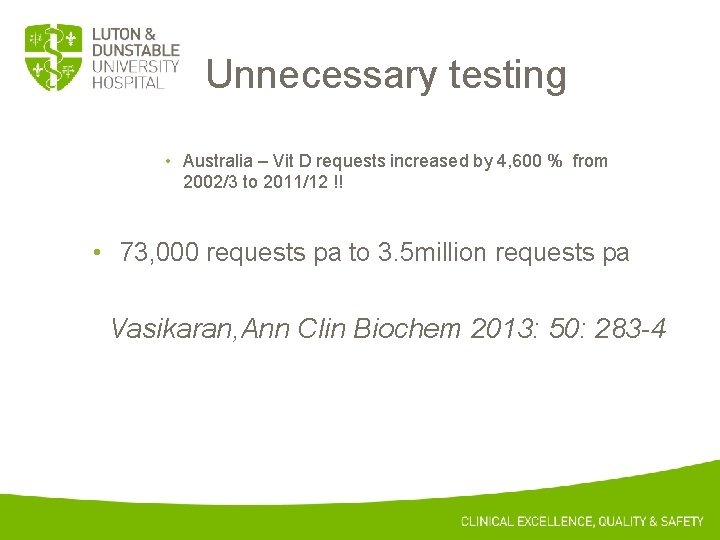
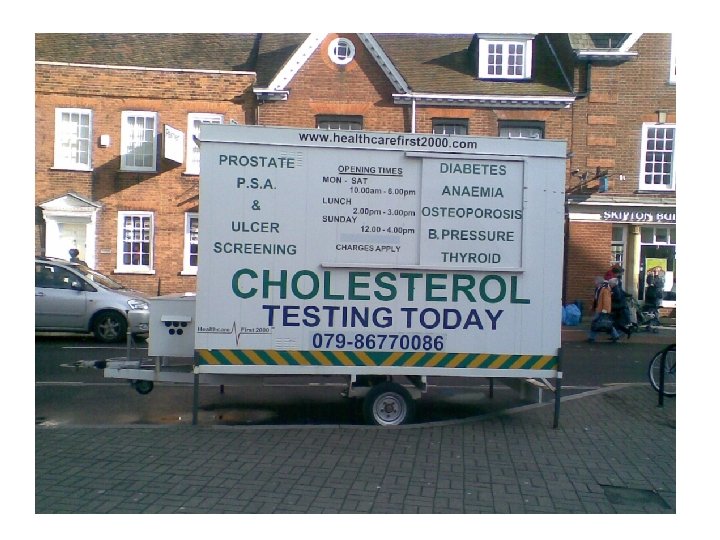
Unnecessary testing • Australia – Vit D requests increased by 4, 600 % from 2002/3 to 2011/12 !! • 73, 000 requests pa to 3. 5 million requests pa Vasikaran, Ann Clin Biochem 2013: 50: 283 -4
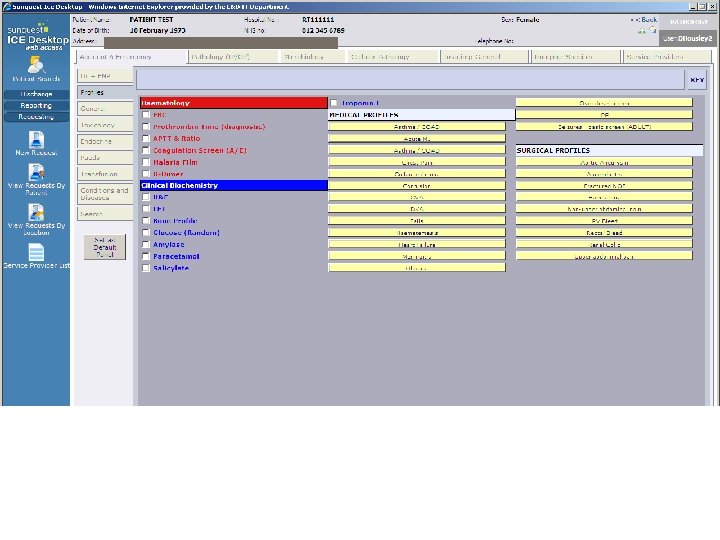
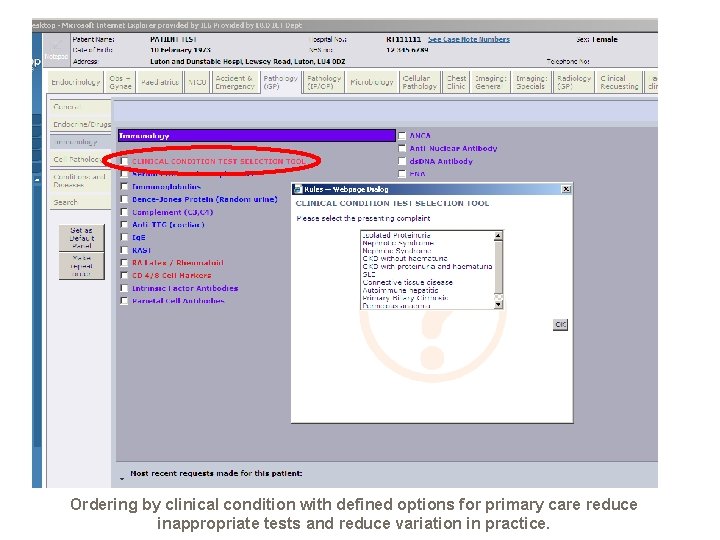
Ordering by clinical condition with defined options for primary care reduce inappropriate tests and reduce variation in practice.
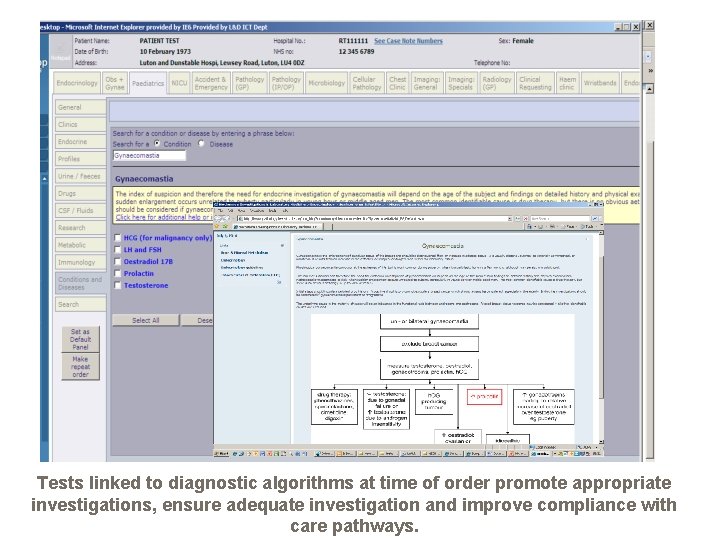
Tests linked to diagnostic algorithms at time of order promote appropriate investigations, ensure adequate investigation and improve compliance with care pathways.
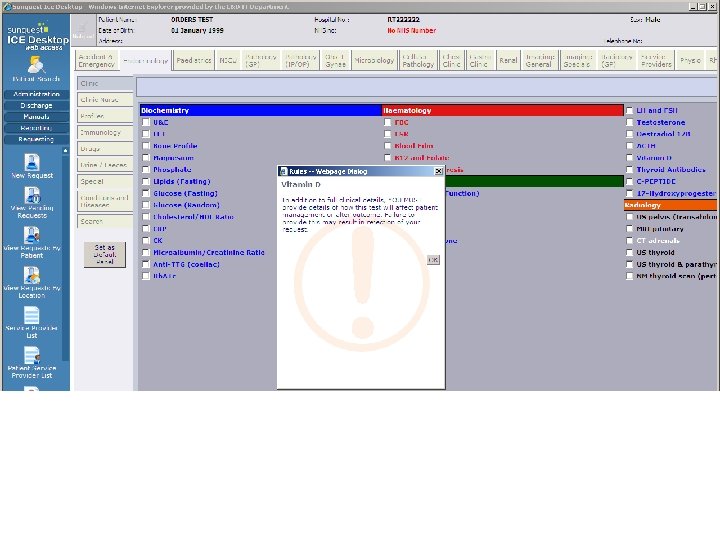
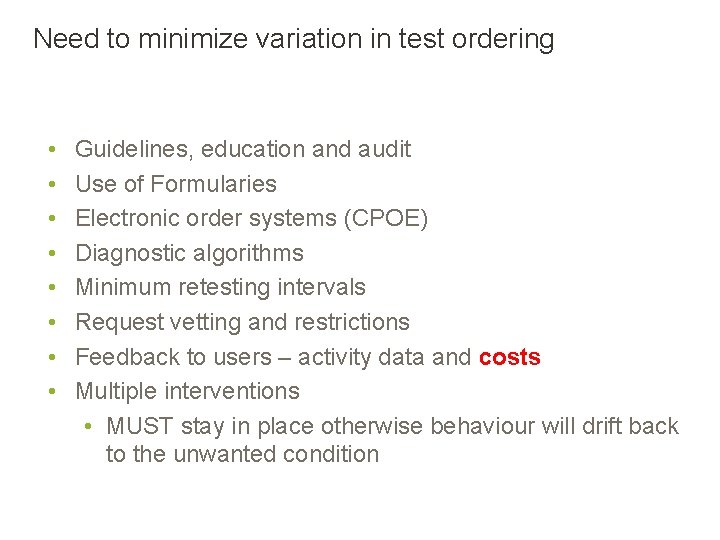
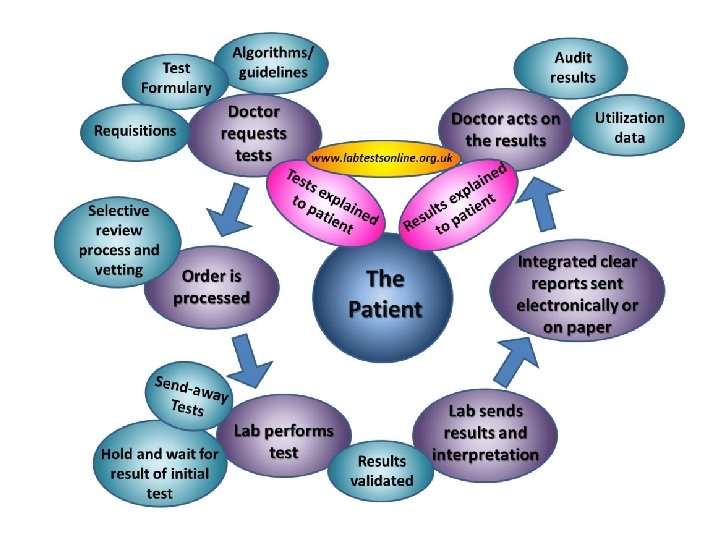
Need to minimize variation in test ordering • • Guidelines, education and audit Use of Formularies Electronic order systems (CPOE) Diagnostic algorithms Minimum retesting intervals Request vetting and restrictions Feedback to users – activity data and costs Multiple interventions • MUST stay in place otherwise behaviour will drift back to the unwanted condition
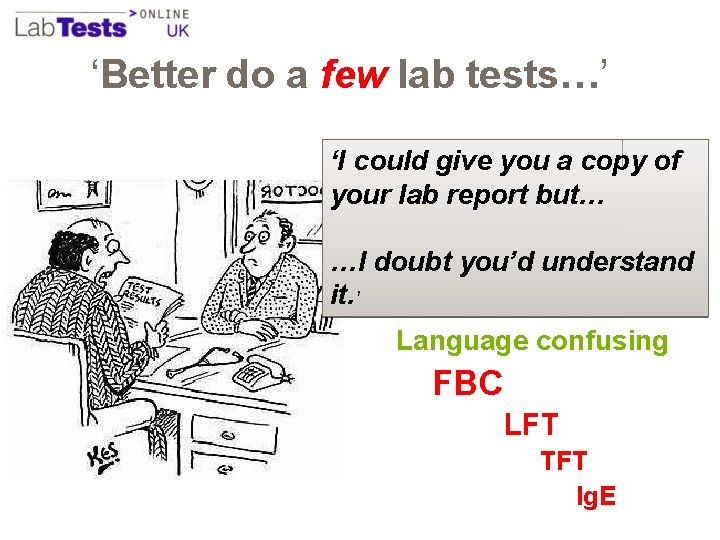
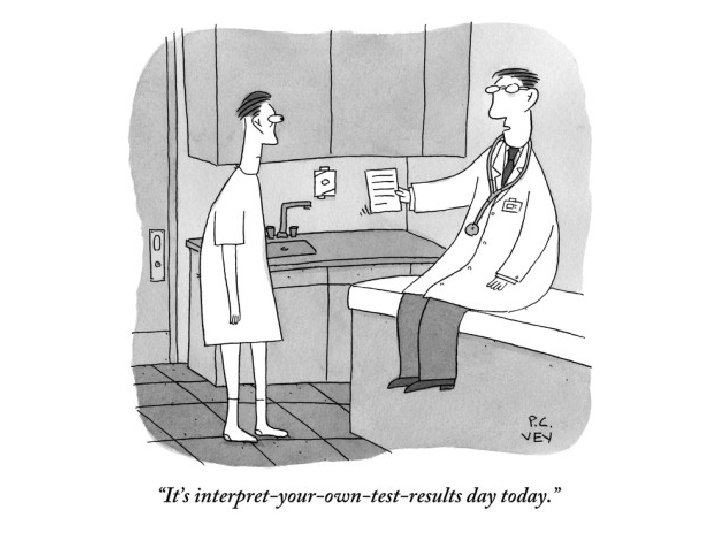
‘Better do a few lab tests…’ ‘I could give you a copy of your lab report but… …I doubt you’d understand it. ’ Language confusing FBC LFT TFT Ig. E
Why do I need this blood test? What does this laboratory result mean? www. labtestsonline. org. uk “Laboratory medicine empowering patients”
Peer-reviewed - Practicing laboratory doctors and scientists Noncommercial Patient centered - Language that’s easy to understand - Access for all
Lab Tests Online-UK provides: • Detailed descriptions of 302 laboratory tests • Descriptions of 114 conditions and diseases, cross-referenced to the relevant tests • News on advances in laboratory testing • Links to other relevant and useful websites that can help answer any further questions www. labtestsonline. org. uk
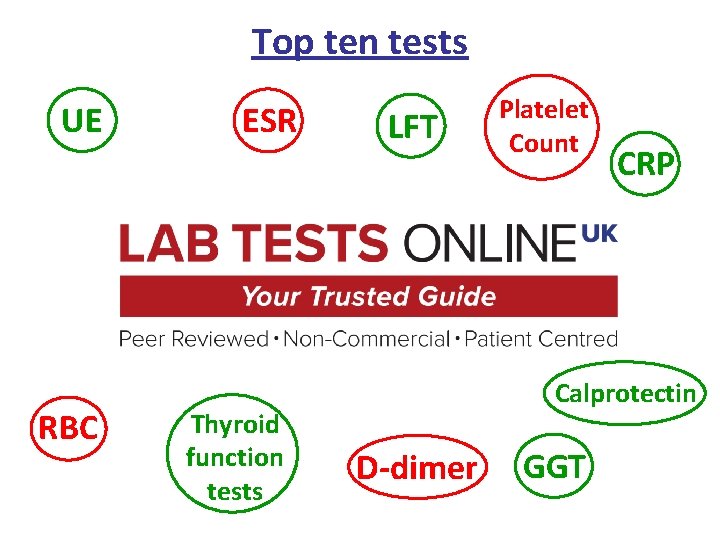
Top ten tests UE RBC ESR Thyroid function tests LFT Platelet Count CRP Calprotectin D-dimer GGT
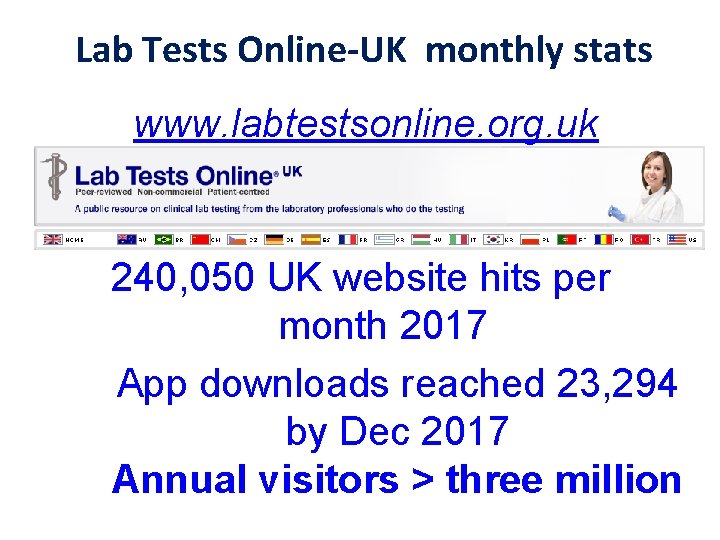
Lab Tests Online-UK monthly stats www. labtestsonline. org. uk 240, 050 UK website hits per month 2017 App downloads reached 23, 294 by Dec 2017 Annual visitors > three million
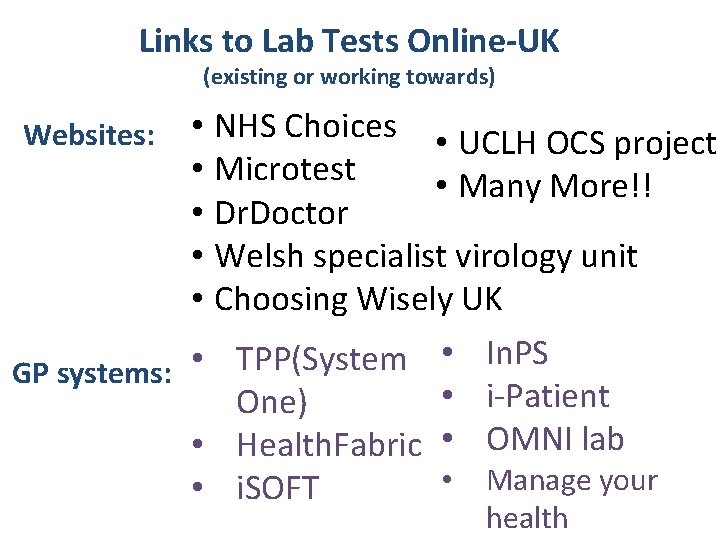
Links to Lab Tests Online-UK (existing or working towards) • NHS Choices • UCLH OCS project • Microtest • Many More!! • Dr. Doctor • Welsh specialist virology unit • Choosing Wisely UK • In. PS • TPP(System GP systems: • i-Patient One) • Health. Fabric • OMNI lab • Manage your • i. SOFT Websites: health
Some comments from users 2016/17 • Nicely presented and well written. A good educational resource for a retired GP • As a nurse just starting to learn how to interpret blood tests. . the site is amazing…love it. Thank you. • Very helpful to be able to see differences between one test and another. I am noting INR kidney filtration rate potassium and blood sugar levels. Thanks for info. • Excellent and easy to understand • Loved the sumple explanations of what the test means, what it measures and what it can be used to indicate eg high ESR and inflammation • Brilliant & reliable. The mobile app is excellent, too.
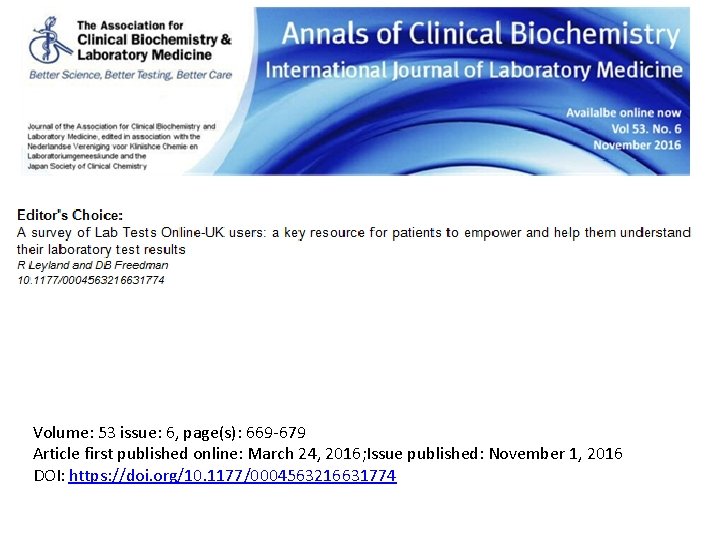
Volume: 53 issue: 6, page(s): 669 -679 Article first published online: March 24, 2016; Issue published: November 1, 2016 DOI: https: //doi. org/10. 1177/0004563216631774
Who uses the Lab Tests Online-UK website? • Patients, their carers and health care professionals In our 2014 survey (661 responders): • 40% of respondents were healthcare professionals • 60% were patients or carers
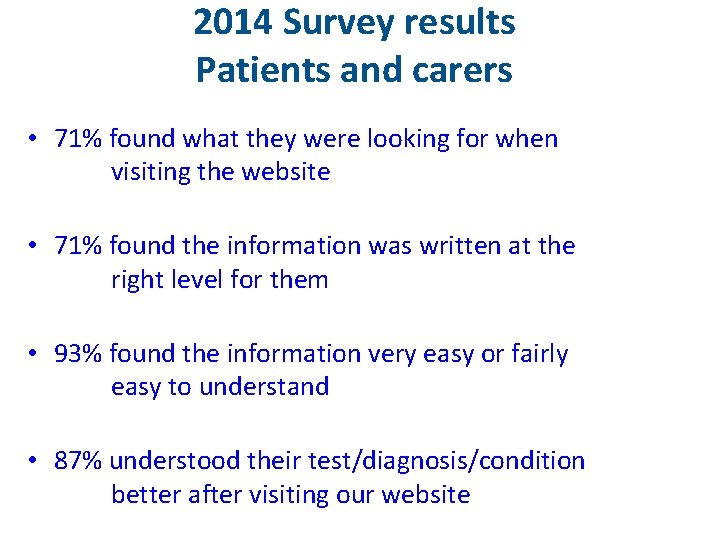
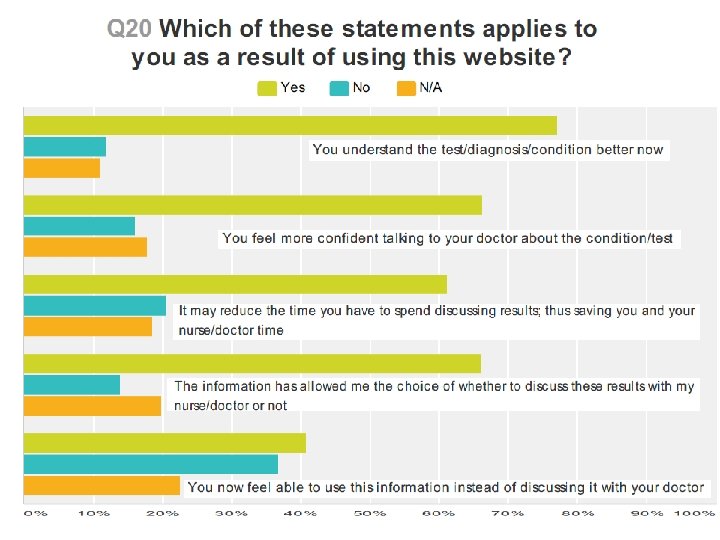
2014 Survey results Patients and carers • 71% found what they were looking for when visiting the website • 71% found the information was written at the right level for them • 93% found the information very easy or fairly easy to understand • 87% understood their test/diagnosis/condition better after visiting our website
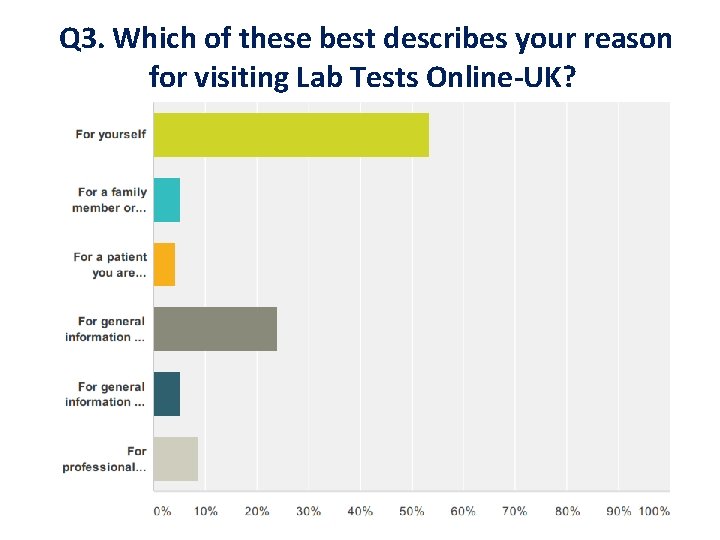
Q 3. Which of these best describes your reason for visiting Lab Tests Online-UK?
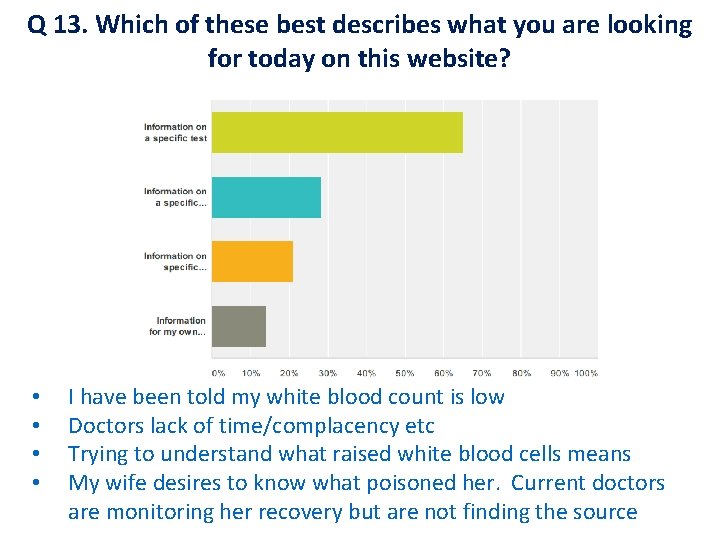
Q 13. Which of these best describes what you are looking for today on this website? • • I have been told my white blood count is low Doctors lack of time/complacency etc Trying to understand what raised white blood cells means My wife desires to know what poisoned her. Current doctors are monitoring her recovery but are not finding the source
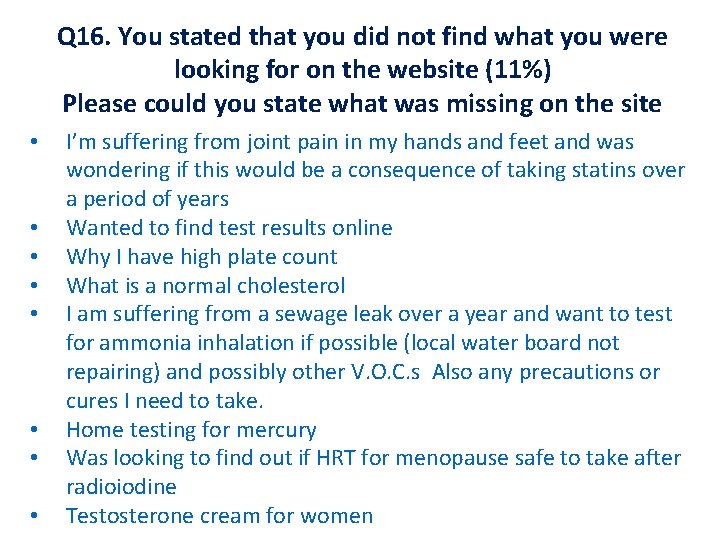
Q 16. You stated that you did not find what you were looking for on the website (11%) Please could you state what was missing on the site • • I’m suffering from joint pain in my hands and feet and was wondering if this would be a consequence of taking statins over a period of years Wanted to find test results online Why I have high plate count What is a normal cholesterol I am suffering from a sewage leak over a year and want to test for ammonia inhalation if possible (local water board not repairing) and possibly other V. O. C. s Also any precautions or cures I need to take. Home testing for mercury Was looking to find out if HRT for menopause safe to take after radioiodine Testosterone cream for women
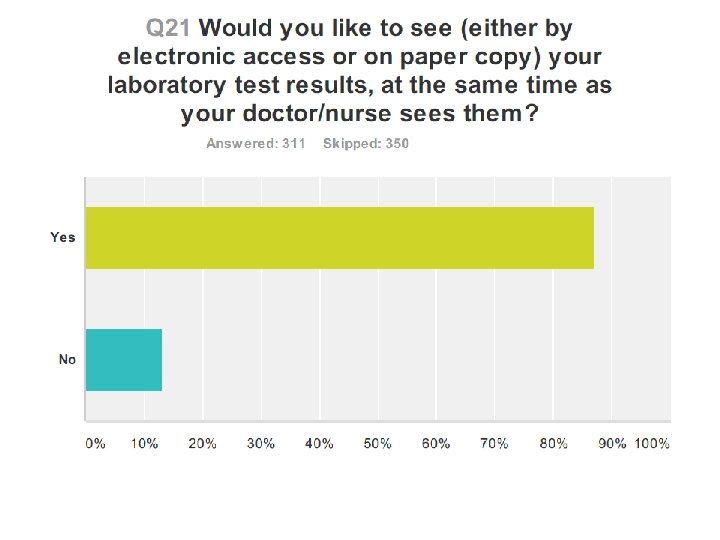
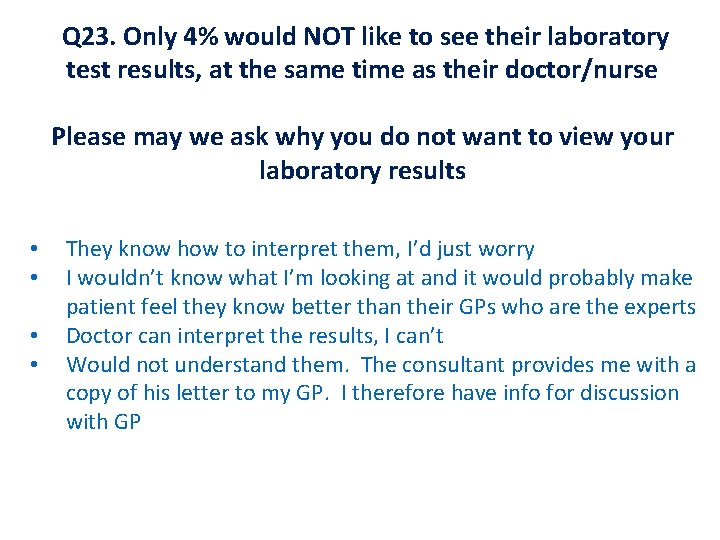
Q 23. Only 4% would NOT like to see their laboratory test results, at the same time as their doctor/nurse Please may we ask why you do not want to view your laboratory results • • They know how to interpret them, I’d just worry I wouldn’t know what I’m looking at and it would probably make patient feel they know better than their GPs who are the experts Doctor can interpret the results, I can’t Would not understand them. The consultant provides me with a copy of his letter to my GP. I therefore have info for discussion with GP
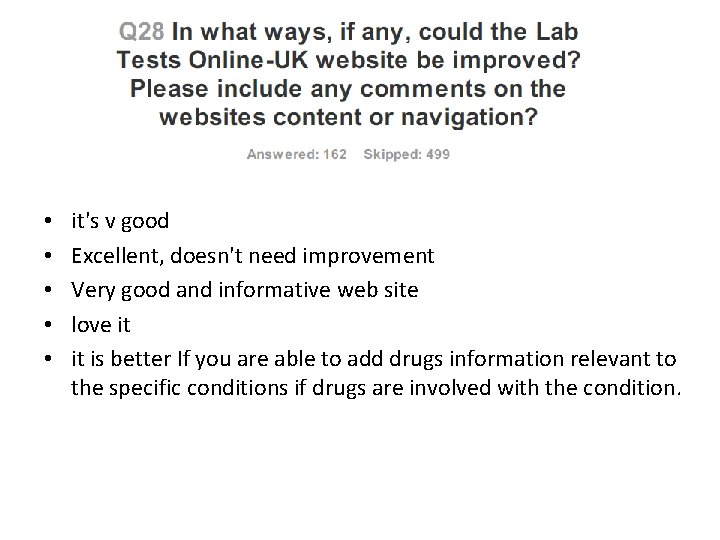
• • • it's v good Excellent, doesn't need improvement Very good and informative web site love it it is better If you are able to add drugs information relevant to the specific conditions if drugs are involved with the condition.
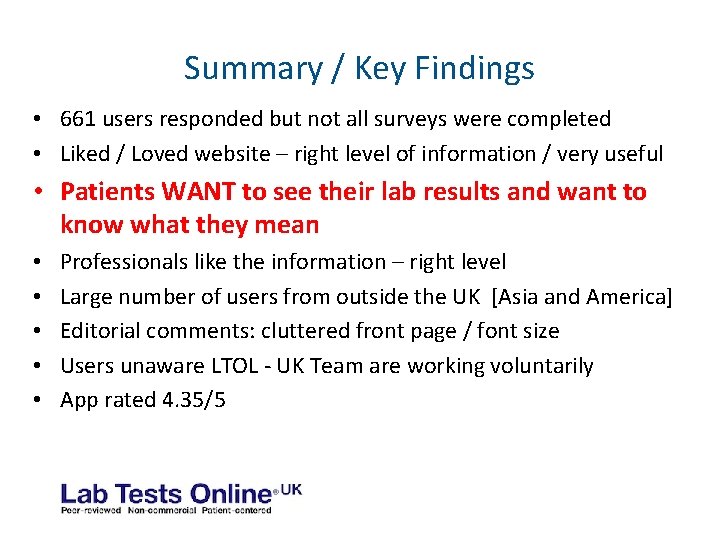
Summary / Key Findings • 661 users responded but not all surveys were completed • Liked / Loved website – right level of information / very useful • Patients WANT to see their lab results and want to know what they mean • • • Professionals like the information – right level Large number of users from outside the UK [Asia and America] Editorial comments: cluttered front page / font size Users unaware LTOL - UK Team are working voluntarily App rated 4. 35/5
William Osler (adapted) Laboratories are … to the GP as the knife and scalpel are to the surgeon.
- Slides: 91